





Introduction
The alfalfa weevil, Hypera postica Gyllenhal (Coleoptera: Curculionidae), a pest of Eurasian origin, causes significant damage to alfalfa crops globally (Goosey, Reference Goosey2012; Harcourt and Guppy, Reference Harcourt, Guppy, Kelliher and Hulme1984; Hoff et al, Reference Hoff, Brewer and Blodgett2002; Pons and Nuñez, Reference Pons, Nuñez, Lloveras, Delgado and Chocarro2020; Saeidi and Moharramipour, Reference Saeidi and Moharramipour2017; Soroka et al, Reference Soroka, Grenkow, Cárcamo, Meers, Barkley and Gavloski2019). Hypera postica larvae are parasitised by solitary endoparasitoid wasps of several species from the genus Bathyplectes Förster (Hymenoptera: Ichneumonidae) (Kuhar et al, Reference Kuhar, Youngman and Laub1999; Yu et al, Reference Yu, van Achterberg and Horstmann2016). Despite their known association with H. postica, limited information exists regarding these parasitoids’ biology, phenology, population dynamics and biocontrol potential in European and Mediterranean conditions.
Among the eight Bathyplectes species recorded in Spain (Ribes, Reference Ribes2012), only B. anurus (Thomson) and B. curculionis (Thomson) are associated with alfalfa. Recent studies in the Ebro Basin, Spain, revealed fluctuating abundance and parasitism rates for both species across years (Levi-Mourao et al, Reference Levi-Mourao, Meseguer and Pons2021b, Reference Levi-Mourao, Meseguer and Pons2021, Reference Levi-Mourao, Muñoz, Cerda-Bennasser, Meseguer and Pons2022a, Reference Levi-Mourao, Núñez, García, Meseguer and Pons2022b; Pons and Nuñez, Reference Pons, Nuñez, Lloveras, Delgado and Chocarro2020). However, it is noteworthy that other Bathyplectes species, such as B. infernalis (Gravenhorst) and B. stenostigma (Thomson), are also reported in the literature as parasitoids of H. postica in both Europe and North America (Chamberlin, Reference Chamberlin1926; Dysart and Coles, Reference Dysart and Coles1971; Horstmann, Reference Horstmann1974; Kingsley et al, Reference Kingsley, Bryan, Day, Burger, Dysart and Schwalbe1993; Radcliffe and Flanders, Reference Radcliffe and Flanders1998; Ribes, Reference Ribes2012; Soroka et al, Reference Soroka, Bennett, Kora and Schwarzfeld2020).
Accurate identification of Bathyplectes parasitoids is essential for successful biological control programs but remains challenging, particularly for cryptic taxa (Levi-Mourao et al, Reference Levi-Mourao, Muñoz, Cerda-Bennasser, Meseguer and Pons2022a; Pons and Nuñez, Reference Pons, Nuñez, Lloveras, Delgado and Chocarro2020). Bathyplectes species can be distinguished by ovipositor length, in the case of females, and following other morphological traits, such as the shape of the areolar area of the propodeum, have also been proposed as diagnostic (Horstmann, Reference Horstmann1974; Soroka et al, Reference Soroka, Bennett, Kora and Schwarzfeld2020), although their applicability is often limited due to variability and interpretation difficulty. Cocoons provide diagnostic features: B. anurus cocoons are dark brown, with a narrow raised yellowish band and exhibit jumping behaviour, unlike the light brown cocoons of B. curculionis with a flat, diffuse yellowish band (Brunson and Coles, Reference Brunson and Coles1968; Chamberlin, Reference Chamberlin1926; Day, Reference Day1970; Dysart and Day, Reference Dysart, Day, Dysart and Day1976; Fisher et al, Reference Fisher, Schlinger and VanDen Bosch1961). However, morphological variations in cocoons can lead to misidentification (Moore, Reference Moore2014; Soroka et al, Reference Soroka, Bennett, Kora and Schwarzfeld2020).
Specific molecular primers for the COI barcoding region have been developed for B. anurus and B. curculionis, enabling the identification of morphologically similar parasitoids within H. postica larvae (Levi-Mourao et al, Reference Levi-Mourao, Muñoz, Cerda-Bennasser, Meseguer and Pons2022a). However, DNA-based methods are limited by their cost and the requirement of sequences existing in the DNA libraries. The landmark-based geometric morphometrics method (GM) offers an alternative, enabling species differentiation based on the shape and size of the morphological structure (Bookstein, Reference Bookstein1991). GM is widely applied in resolving taxonomic and evolutionary issues (e.g., Mitrovski-Bogdanović et al, Reference Mitrovski-Bogdanović, Mitrović, Milošević, Žikić, Jamhour, Ivanović and Tomanović2021; Žikić et al, Reference Žikić, Stanković, Petrović, Milošević, Tomanović, Klingenberg and Ivanović2017), and assessing morphological changes conditioned by external factors, for example, in toxicological tests using the insecticides, essential oils, or food colouring additives (Cvetković et al, Reference Cvetković, Jovanović, Lazarević, Jovanović, Savić-Zdravković, Mitrović and Žikić2020, Reference Cvetković, Lazarević, Mitić, Zlatković, Stojković Piperac, Jevtović, Stojanović and Žikić2024; Lazarević et al, Reference Lazarević, Kavallieratos, Nika, Boukouvala, Skourti, Žikić and Papanikolaou2019; Žikić et al, Reference Žikić, Lazarević, Stanković, Milošević, Kavallieratos, Skourti and Boukouvala2024).
This study evaluates the use of GM to distinguish B. anurus and B. curculionis based on fore wing morphology, complementing traditional methods, such as cocoon characteristics. We also assess fore wing size and shape for potential sexual dimorphism. An illustrated guide is provided to support the accurate and efficient identification of these parasitoids, enhancing their application in biological control programs.
Materials and methods
Collection and rearing of host larvae
Larvae of H. postica were collected by sweeping 180° with a 38-cm diameter net across several alfalfa fields in the Ebro Basin from March to May 2019 and 2020. Field-collected larvae were reared in 500 ml polyethylene cages (maximum 50 larvae per cage), covered with mesh for aeration. Fresh alfalfa shoots were provided daily. Cages were maintained in a climatic chamber set to 22°C, with an 8:16 (L:D) photoperiod and 50% relative humidity until pupation. Approximately 2,500 larvae were collected in 2019, 12% of which were parasitised by Bathyplectes species. In 2020, approximately 3,000 larvae were collected; however, a substantial proportion were killed by a field epizootic of the entomopathogenic fungus Zoophthora phytonomi (Arthur) (Zygomycetes: Entomophthorales).
Parasitoid identification
First, parasitoid adults were identified based on the morphological characteristics of their cocoons, following the descriptions by Day (Reference Day1970), and Dysart and Day (Reference Dysart, Day, Dysart and Day1976). Female specimens were distinguished from males by the presence of a conspicuous ovipositor sheath (Soroka et al, Reference Soroka, Bennett, Kora and Schwarzfeld2020). Each specimen was labelled according to species and sex. Specimens of B. anurus and B. curculionis were frozen at –80 °C for subsequent wing excision.
Wing preparation
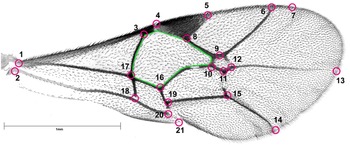
The right fore wing was carefully removed from each specimen, including both males and females, using fine entomological forceps under a Leica MZ125 stereoscopic microscope (Heinnenburg, Germany). The excised wings were mounted on microscope slides pre-coated with Beadle’s medium. To ensure a flat, two-dimensional position, each slide was pressed with a microscope cover slip and allowed to air-dry for 15 days at room temperature. To maintain consistent pressure during the drying process, slides were placed between layers of polythene and cardboard, secured with two spring clips. This method ensured the wings were flattened evenly without causing damage. After drying, the wings were photographed using a Moticam Pro S5Plus digital camera (MoticEurope, Barcelona, Spain) connected to the stereoscopic microscope at 10× magnification. For reference, wing veins and cells are labelled in fig. 1 to clarify the comments regarding the fore wing venation.
Nomenclature of fore wing venation and cells in female Bathyplectes curculionis (Bennett et al., Reference Bennett, Cardinal, Gauld and Wahl2019).

Geometric morphometrics
The GM technique was used to examine potential differences in the shape of the fore wings of the two parasitoid species based on the wing venation pattern. To apply the GM method, 21 landmarks were precisely positioned on each fore wing. These landmarks were thoughtfully selected to accurately depict specific places on the wing (fig. 2), including the intersections of veins and the endpoints of veins that reach the wing margin. In addition to the landmarks, the 1 M + 1R1 cell, was outlined by a boundary defined by four curves. Landmarks and curves were digitised using StereoMorph software version 1.6.7 (Olsen and Westneat, Reference Olsen, Westneat and Freckleton2015). The wing veins and cells nomenclature follows (Bennett et al, Reference Bennett, Cardinal, Gauld and Wahl2019).
Position of landmarks and curves on the right fore wing of a female Bathyplectes curculionis. Landmark placement on the wings follows studies analysing wing venation in other hymenopterans (e.g., Mitrovski-Bogdanović et al., Reference Mitrovski-Bogdanović, Mitrović, Milošević, Žikić, Jamhour, Ivanović and Tomanović2021; Žikić et al., Reference Žikić, Stanković, Petrović, Milošević, Tomanović, Klingenberg and Ivanović2017).

Statistical analysis
To compare the wing shapes of the two parasitoid species, generalized Procrustes analysis (GPA) was performed to align the wing images, eliminating variation in scale, position, and orientation. This process resulted in a matrix of shape coordinates, known as Procrustes coordinates (Dryden and Mardia, Reference Dryden and Mardia1998; Rohlf and Slice, Reference Rohlf and Slice1990; Walker and Naylor, Reference Walker and Naylor2000; Zelditch et al, Reference Zelditch, Swiderski and Sheets2012). As a result of GPA analysis, the centroid size (CS), a geometric measure of size was also obtained. Shape variation was analysed and visualised through the principal component analysis (PCA). To assess statistical differences in fore wing size and shape the variate analysis of variance (ANOVA) and the multivariate analysis of variance (MANOVA) were used to examine differences between species, between sexes, and between sexes within each species. All statistical analyses were done in Geomorph version 4.0.5. (Adams et al, Reference Dysart, Day, Dysart and Day2023) and gmShiny (Baken et al, Reference Baken, Collyer, Kaliontzopoulou and Adams2021).
Results
Specimen identification
Out of 5,500 H. postica larvae collected in the field (see M&M), 850 reached the pupal stage. From these, 102 Bathyplectes cocoons were collected, and all 102 adults successfully emerged from pupae. Based on the morphology of the cocoons, 61 individuals were identified as B. anurus and 41 as B. curculionis.
Discrimination of fore wing shape between the two bathyplectes species
A comprehensive set of 102 specimens, comprising 27 females and 28 males of B. anurus, along with 21 females and 26 males of B. curculionis, were employed for wing shape analysis through GM. The analysis of variance (ANOVA) revealed no significant differences in wing size either between the analysed species or between the sexes within each species. The statistical analysis conducted to assess wing shape (MANOVA) revealed significant differences between the two Bathyplectes species. However, no significant differences were observed between the sexes within each species (table 1). The results of geometric morphometrics of fore wings are shown in the morphospace defined by the first two principal components (PC1 × PC2). These axes cumulatively describe 46.53% of the total wing shape variability (fig. 3). Along with PC1, a clear separation between the two species is evident. Both females and males of B. anurus are positioned in the positive part of the PC1 axis (fig. 3). The fore wings of this species are slightly narrower and more elongated compared to those of B. curculionis. Notably, the 1 M + 1R1 cell, outlined by four curves (referring to fig. 1), appears more elongated. Also, the 2R1 cell is wider, particularly in the distal part; the 2 M cell is more elongated, and the 2Cu cell is slightly shorter and wider in B. anurus. Conversely, B. curculionis presents wider fore wings, with a distinct characteristic being the short and wide 1 M + 1R1 cell (in voluntary horse head cell). Additionally, all other features exhibit an opposite trend to those described for B. anurus. Notably, no discernible differences were identified between the sexes or within each species when considering these morphometric parameters.
Differentiation of the two Bathyplectes species, within the morphospace, defined by PC1 and PC2. Red represents B. anurus, blue represents B. curculionis; filled circles indicate males, and outlined circles indicate females. The transformation grids illustrate the change in fore wing shape associated with the maximum and minimum values along the PC1 axis.

The MANOVA: the effects of categorical variables (species and sex) on fore wing shape. Abbreviations: df – degrees of freedom, SS – sums of squares, MS – mean square, rsq – the proportion of variation in shape explained by each categorical variable, f and z – effect size

Morphological comparison of two Bathyplectes species
Upon observing the results derived from the GM analysis of the fore wings, there arose a necessity for a comparative presentation of selected morphological structures of B. anurus and B. curculionis. This was undertaken to streamline the identification process for these two species, primarily relying on conspicuous differences in wing venation and the arrangement of wing cells. A comparative illustrated guide to the identification of B. anurus and B. curculionis is given in figs. 4 and 5.
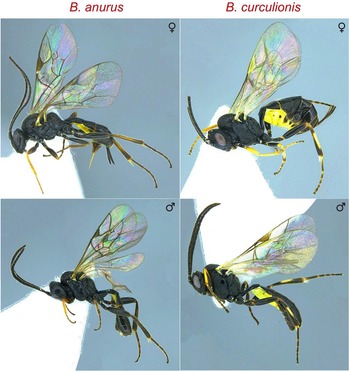
General habitus of males and females of two Bathyplectes species.

The most important morphological characters of bathyplectes species for quick identification: (A) ovipositor length, (B) shape of propodeal areolar area, (C) fore wing shape, and (D) cocoon morphology.

Focusing on body colouration (fig. 4), B. anurus individuals were observed to be black with light brown details on the legs and metasoma ventrally, while B. curculionis exhibited bright yellow details in those areas. Notably, the yellow longitudinal pattern on the hind tibia was particularly prominent in both sexes of B. curculionis. This colouration pattern is present in most of B. anurus individuals, although few individuals presented also black tibiae with an inconspicuous, pale brown pattern.
Identification of both female Bathyplectes species can be made with higher certainty when both are present in a sample, based on the length of the ovipositor and ovipositor sheath. The ovipositor of B. curculionis is longer than that of B. anurus. In cases where identification based on the ovipositor is not possible due to specimen deformation or improper mounting, a lateral view of the specimens reveals that the distal height of the metasoma in B. curculionis is almost twice as long as that in B. anurus (fig. 5A). In B. anurus, the ovipositor and sheath never extend beyond the tip of the metasoma. Additionally, another character for distinguishing these two species is the propodeal areolar (fig. 5B). When clearly visible, the area of this character in B. anurus is approximately twice as wide at its base – as measured by the distance between the origins of the dorsal propodeal carinae – as in B. curculionis, although this structure is sometimes poorly defined, making direct comparison difficult in certain specimens.
Although distinguishing the two Bathyplectes species based on the vein pattern on the fore wings can be challenging for the untrained eye, we have highlighted a few consistent differences, focusing on the most significant features. To facilitate following our observations, we have marked the selected structures in fig. 5C: two cells are labelled with Roman numerals, and three veins are labelled with Arabic numerals. For the nomenclature of wing veins and cells, refer to fig. 1. In B. anurus, the 1 M + 1R1 (I), also known as the horsehead cell, is narrower compared to B. curculionis. This narrowing is influenced by the lengthening of veins 2 (r-rs) and 3 (1 m-cu and Rs + M). Additionally, in B. anurus, vein 2 is smoothly curved, while in B. curculionis, it is slightly kinked in the middle. Moreover, in B. anurus, vein 1 (Rs and M) is more curved. The elongation of cell II (2 M) is also influenced by the elongation of vein 2.
The cocoons of B. anurus are relatively squat, with a height/width ratio of 1.4, whereas those of B. curculionis are more elongated, with a ratio of 1.9. Notably, the cocoons of B. curculionis exhibited significant variability in both size and proportions. Furthermore, although the width of the central belt of the cocoon is highly variable, it is consistently broader than that observed in B. anurus (fig. 5D).
Discussion
Accurate and easy species identification is essential for the success of biological control programs, particularly when working with parasitoids, as highlighted in previous studies (Huber et al, Reference Huber, Liu, Fernández-Triana and G Mason2021; Moraes, Reference Moraes1987; Rosen, Reference Rosen1989). Female parasitoids are generally more informative than males due to their pronounced genital structures, especially the ovipositor, which serves as a key diagnostic feature. Consequently, many identification keys for Ichneumonoidea are based on female morphology. In most cases, species identification can be reliably achieved through adult morphological assessment or examination of cocoons.
However, identification becomes challenging when dealing with morphologically similar species or species complexes. In this study, we focused on distinguishing two Bathyplectes species parasitizing the same host, H. postica. Traditional identification methods, such as those based on cocoon characteristics and adult morphology, including the diagnostic key used by Soroka et al (Reference Soroka, Bennett, Kora and Schwarzfeld2020), serve as a critical foundation. Nonetheless, in our case, initial identifications based on cocoon traits led to misclassification, as 61 specimens were initially identified as B. anurus and 41 as B. curculionis, whereas geometric morphometrics revealed 55 and 47, respectively. This highlights the need of complementary tools for accurate species identification.
An additional trait used in Bathyplectes spp. identification is pupae jumping behaviour, a characteristic typical of the Campopleginae subfamily. However, only B. anurus exhibits this behaviour. Day (Reference Day1970) showed that this trait can sometimes be absent if the parasitoid larvae are dead or in the pre-pupal stage, which can lead to errors in identification.
While the original descriptions by Thomson (Reference Thomson1883) are available, there is limited information on the adult morphology of Bathyplectes species, which are known to closely resemble one another (Horstmann, Reference Horstmann1974; Moore, Reference Moore2014; Soroka et al, Reference Soroka, Bennett, Kora and Schwarzfeld2020). The ovipositor sheath length is the primary distinguished trait for females of B. anurus and B. curculionis species discrimination (Horstmann, Reference Horstmann1974; Soroka et al, Reference Soroka, Bennett, Kora and Schwarzfeld2020). This character is associated with host larval instar preference, as it facilitates the parasitism of early instars hidden in unfolded leaves and buds, a behaviour previously described for B. curculionis in several studies (Barney et al., Reference Barney, Armbrust, Bartell and Goodrich1978; Bartell and Pass, Reference Bartell and Pass1980; Dowell and Horn, Reference Dowell and Horn1977; Duodu and Davis, Reference Duodu and Davis1974; Levi-Mourao et al, Reference Levi-Mourao, Muñoz, Cerda-Bennasser, Meseguer and Pons2022a). Differences in host-stage preferences and search patterns create partial temporal and spatial refuges that allow multiple parasitoid species to utilise a single host species (Dowell and Horn, Reference Dowell and Horn1977; Harcourt and Guppy, Reference Harcourt and Guppy1991). The temporal separation between Bathyplectes species can be attributed to the timing of adult flight. In the Ebro Basin, where B. anurus and B. curculionis occur sympatrically, the peak flight activity of B. anurus occurs earlier in the season than that of B. curculionis (Levi-Mourao et al, Reference Levi-Mourao, Meseguer and Pons2021; Pons and Nuñez, Reference Pons, Nuñez, Lloveras, Delgado and Chocarro2020).
Distinguishing the shape of the areolar area on the propodeum can sometimes be challenging. Although it is a highly reliable character, the propodeal carina is weakly developed in some individuals and high variability was found between individuals; therefore, if the specimen is a male, other morphological characters must be examined. Additionally, the presence of pits on the clypeus can aid in species discrimination (Horstmann, Reference Horstmann1974; Soroka et al, Reference Soroka, Bennett, Kora and Schwarzfeld2020). However, these traits require some expertise and a trained eye.
Conventional molecular barcoding methods, such as COI sequence analysis, are commonly used for species identification, but they are costly, labour-intensive and occasionally encounter challenges during DNA isolation (King et al., Reference King, Read, Traugott and Symondson2008; Levi-Mourao et al, Reference Levi-Mourao, Muñoz, Cerda-Bennasser, Meseguer and Pons2022a). Molecular analyses previously conducted on individuals from the same population using COI primers showed high specificity (Levi-Mourao et al, Reference Levi-Mourao, Muñoz, Cerda-Bennasser, Meseguer and Pons2022a), which supports, though indirectly, the reliability of the species identification in this study.
In contrast, alternative methods, such as GM, have not been previously explored for Bathyplectes species. In this study, we demonstrated that the analysis of the fore wing morphology via GM offers a reliable and cost-effective alternative for adult identification, especially when both species are available for comparison. By integrating GM with other methods, as in previous studies (Petrović et al, Reference Petrović, Mitrović, Ivanović, Žikić, Kavallieratos, Starý, Bogdanović, Tomanović and Vorburger2015, Reference Petrović, Mitrović, Ghaliow, Ivanović, Kavallieratos, Starý and Tomanović2019), we successfully differentiated between B. anurus and B. curculionis based on fore wing shape. Our results show that wing shape differed significantly between the two species, with B. curculionis having wider fore wings. A key characteristic distinguishing the two species is the 1 M + 1R1 cell, also known as the ‘horsehead’ cell, which is narrower in B. anurus than in B. curculionis. This finding aligns with previous reports, which noted that B. curculionis has wider wings than B. anurus (Jervis et al, Reference Jervis, Ferns and Heimpel2003), although without specifying the distinct appearance of the horsehead cell. Differences in wing morphology between species may reflect niche specialisation and host selection strategies that minimise interspecific competition and interspecific mating (Dowell and Horn, Reference Dowell and Horn1977; Harcourt, Reference Harcourt1990). Studies on host selection and handling have shown that B. anurus is faster in host handling, while B. curculionis achieves greater dispersal rates (Dowell and Horn, Reference Dowell and Horn1977; Harcourt, Reference Harcourt1990). It should be noted that in many individuals, the difference in the horsehead cell can be observed even without preparing the wings or applying GM.
Sexual dimorphism is common among insects and other animals (Hopkins and Kopp, Reference Hopkins and Kopp2021). Koinobiont endoparasitoids such as Bathyplectes spp. show less pronounced sexual dimorphism (Gross, Reference Gross1993; Quicke, Reference Quicke2014), with males and females often being similar in size, shape, and colour (Jervis et al, Reference Jervis, Ferns and Heimpel2003; Soroka et al, Reference Soroka, Bennett, Kora and Schwarzfeld2020). Our findings corroborate this, as we observed intraspecific overlap in wing morphology between the sexes in both species, suggesting similar allometry, a characteristics shared by some ichneumonid parasitoids (Gauld and Fitton, Reference Gauld and Fitton1987).
In the analysed, randomly selected sample, cell 1 M + 1R1 was identified as the most reliable morphological character for distinguishing the species, applicable to both sexes. In conclusion, this study underscores the importance of precise species identification methods, such as GM, in distinguishing closely related parasitoid species. This is vital for effective biological control strategies and could contribute to the sustainable production of alfalfa in Spain and potentially other Mediterranean countries.
Acknowledgements
The authors would like to thank Dr. Addy García, Pedro Cerdá-Bennasser and Dra. Ana Mari Jauset for all their help and support, and Dr. Richard M Twyman for manuscript editing.
Author contributions
Conceptualisation: A.L.-M., X.P., V.Z.; Methodology: A.L.-M., R.M., X.P., P.P.-C.; Formal analysis: M.L., P.P.-C., V.Z.; Investigation: A.L.-M., M.L., R.M., X.P.; Writing – original draft preparation: A.L.-M., X.P.; Writing – review and editing: A.L.-M., M.L., P.P.-C., R.M., X.P., V.Z.; Funding acquisition and resources: X.P.; V.Z.. All authors have read and agreed to the published version of the manuscript.
Funding
This study was funded by Ministerio de Ciencia, Innovación y Universidades, Spanish Government, project AGL2017-84127-R: ‘Arable crop management and landscape interactions for pest control’; and the Ministry of Science, Technological Development and Innovations of the Republic of Serbia [Grant Nos.: 451-03-136/2025-03/ 200124 and 451-03-137/2025-03/ 200124]. A.L.-M. was funded by a pre-doctoral JADE plus grant from the University of Lleida, and now is the recipient of a post-doctoral grant JDC2023-052129-I, funded by MCIU/AEI/10.13039/501100011033 and FSE+. RM was funded by a pre-doctoral grant FPI-PRE2018-083602, Ministerio de Ciencia, Innovación y Universidades.
Competing interests
The authors have no relevant financial or non-financial interests to disclose.
Data availability
The datasets generated and/or analysed during the current study are available from the corresponding author on reasonable request. Specimens have been deposited in the entomological collection of the Natural History Museum of Barcelona (Museu de Ciències Naturals de Barcelona).
Ethical approval
This article does not contain any studies involving human participants or animals other than insects.





 Open access

