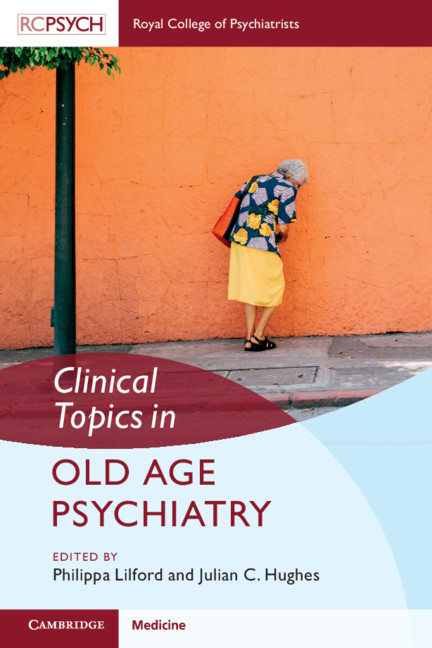
Clinical Topics in Old Age Psychiatry

-
Select format
-
- Publisher:
- Cambridge University Press
- Publication date:
- 12 September 2020
- 17 September 2020
- ISBN:
- 9781108594714
- 9781108706148
- Dimensions:
- Weight & Pages:
- Dimensions:
- (234 x 156 mm)
- Weight & Pages:
- 0.6kg, 460 Pages
- Products:
- The Royal College of Psychiatrists, Royal College of Psychiatrists / RCPsych
- Subjects:
- Psychiatry and Clinical Psychology, Neurology and Clinical Neuroscience, Medicine, Psychiatry
- Series:
- Clinical Topics in
You may already have access via personal or institutional login- Products:
- The Royal College of Psychiatrists, Royal College of Psychiatrists / RCPsych
- Subjects:
- Psychiatry and Clinical Psychology, Neurology and Clinical Neuroscience, Medicine, Psychiatry
- Series:
- Clinical Topics in
Show more authors 
You may already have access via personal or institutional login
Book description
This book updates articles previously published in BJPsych Advances to compile a current review of noteworthy subjects in old age psychiatry. It opens with epidemiology, then offers information and advice about a variety of disorders, including rare and unusual dementias. It considers assessment, from cognitive testing and the use of neuroimaging, to newer issues around biomarkers. Turning to treatment and management, the book provides readers with up-to-date evidence-based guidance on common situations that clinicians face, from home assessments to giving advice about driving. It refreshingly discusses self-management and the notion of recovery; it reviews the literature on psychosocial interventions and palliative care; and it tackles delirium and depression. The final chapters explore related legal, ethical, and philosophical issues. Written for old age psychiatrists and trainees, but also relevant to other health and social care workers, this text shows the excitement of old age psychiatry – its importance, breadth, and depth.
Reviews
'Although Professor Hughes and Dr Lilford are clear that this is not a textbook, it could usefully be viewed as one, with an extraordinary breadth of contributors. As a consultant old age psychiatrist I found the up to date and readable summaries of a wide range of topics really helpful, from help in day to day diagnosis and management to thought-provoking meditations on personhood and ethics. As a clinician I was also introduced to a number of new concepts in both neuropsychiatric investigations and social care. It is a collection of essays that I can thoroughly recommend to all old age psychiatrists, or those who would wish to be so.'
Dr Matt Jelley MBChB FRCPsych - Consultant Liaison Psychiatrist for Older People, Royal United Hospital, Bath
‘This book … provide a current perspective of various disorders seen in geriatric psychiatry as well as up-to-date, evidence-based guidance on common clinical presentations ... This book is mainly aimed at consultants and trainees in geriatric psychiatry, but it will also be of interest to clinician's who work with this population from gerontologists to mental health and general nurses, social workers, occupational and speech and language therapists, and all other healthcare professionals that work with an elderly population.’
Michael Easton Source: Doody’s Book Review Service
Contents
Contents
Metrics
Altmetric attention score
Full text views
Full text views helpTotal number of HTML views: 0
Total number of PDF views: 0 *
 Loading metrics...
* Views captured on Cambridge Core between #date#. This data will be updated every 24 hours.
Usage data cannot currently be displayed.
Accessibility standard: Unknown
Why this information is here
This section outlines the accessibility features of this content - including support for screen readers, full keyboard navigation and high-contrast display options. This may not be relevant for you.
Accessibility Information
Accessibility compliance for the HTML of this book is currently unknown and may be updated in the future.