

Introduction
The stratigraphic relationships of pre-Carboniferous strata in the Netherlands are poorly understood. The lithostratigraphic nomenclature of the Netherlands accounts merely informally for Devonian strata by means of the Banjaard group (TNO–GDN, 2020). Somewhat of an exception is the northern offshore sectors where the Upper Devonian Old Red Group is formally established, largely in analogy to the nearby and extensively studied United Kingdom (UK) offshore. For older than Devonian strata, not even an informal lithostratigraphic nomenclature is available.
In well Kortgene-01 (KTG-01; Fig. 1) and in a well from the adjacent southwestern offshore (O18-01; Fig. 1), both located on the northern flank of the Brabant Massif, Silurian strata have repeatedly been described close to these wells’ total depths (TDs). This ‘interpretation’ is mainly based on facies correlation to wells in the UK (e.g. well 53/16-1; Pharaoh, Reference Pharaoh1999; Fig. 1) and Belgium (Verniers & Van Grootel, Reference Verniers and Van Grootel1991). Independent biostratigraphic evidence for Silurian age strata in the Netherlands is lacking. A similar situation is observed for the overlying Devonian succession in these wells. According to Van Adrichem Boogaert & Kouwe (Reference Van Adrichem Boogaert and Kouwe1994), the Lower Devonian sediments were eroded or were not deposited, an interpretation that is based on the inferred timing of the Brabantian inversion phase related to the onset of the Variscan Orogeny (Herbosch & Debacker, Reference Herbosch and Debacker2018; Pharaoh, Reference Pharaoh2018).
Geographical locations where Silurian and/or Devonian strata have been reported in the Netherlands; including relevant wells in the UK and Belgium.

The informal Devonian Banjaard group consists of the Bollen Claystone formation, which was assigned a tentative Frasnian (early Late Devonian) age, and the Bosscheveld formation of Famennian (late Late Devonian) to Tournaisian (earliest Carboniferous) age. Strata that are undifferentiated on the formation level are claimed to be as old as Middle Devonian (Givetian; see TNO-NITG, 1999). However, the age of the sediments straddling the interval between the metamorphic basement and the conspicuous Lower Carboniferous platform and ramp limestones of the Zeeland Formation (see e.g. Reijmer et al., Reference Reijmer, Ten Veen, Jaarsma and Boots2017) remains elusive.
We conducted a palynological study on core material from two key wells penetrating the inferred Silurian and Devonian strata in the southwestern part of the Netherlands: wells KTG-01 and S05-01 (Fig. 1). The resultant stratigraphic relationships, combined with palynologically derived interpretations of the depositional environment, help to elucidate palaeogeographic patterns of the northern fringe of the Brabant Massif.
Geological setting
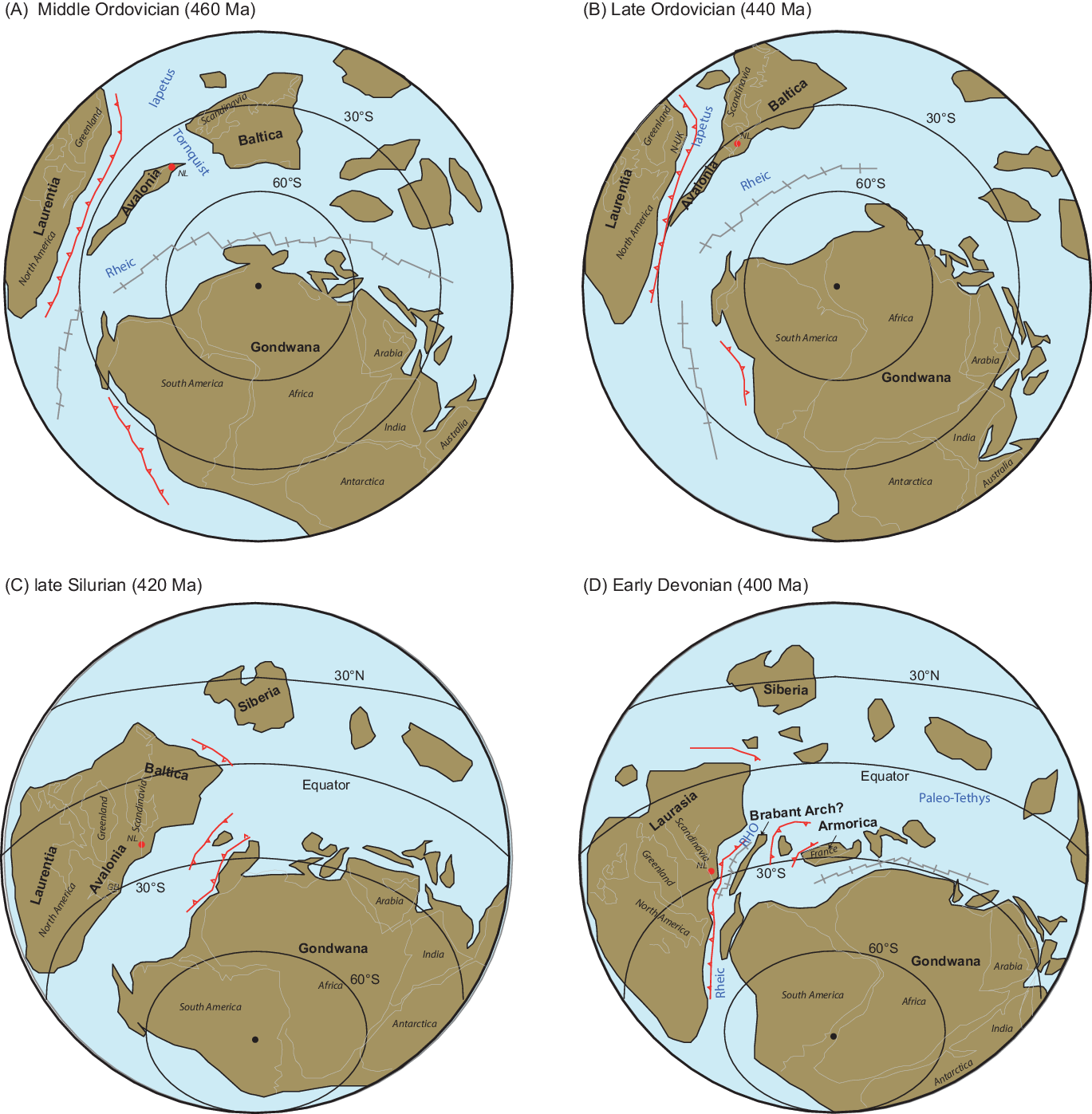
During Ordovician to Devonian times, the present-day area of NW Europe was affected by major collisions (see Franke et al., Reference Franke, Cocks and Torsvik2017 for an overview). Over the course of the Cambrian and Ordovician, Avalonia rifted from Gondwana, drifted northwards and joined Baltica, thereby progressively closing the Tornquist and Iapetus Oceans (Fig. 2A–C). This major tectonic reorganisation is often referred to as the Caledonian Orogeny. As the Avalonia–Baltica continent progressively collided with Laurentia in the late Silurian (Fig. 2C), the large continent Laurussia was formed in the Early Devonian (Fig. 2D). Coeval large-scale compression and rifting of the Rheic Ocean between Armorica and Gondwana and clockwise rotation of Laurussia led to a complex tectonic regime south of the present-day location of the Netherlands, with the establishment of the Rheno-Hercynic Ocean, which comprises a steep foredeep trough, the Brabant Trough, by latest Silurian – earliest Devonian times (Fig. 2C and D). In Belgium, the last phase of the Caledonian orogeny is referred to as the Brabantian inversion phase (Verniers et al., Reference Verniers, Pharaoh, André, Debacker, De Vos, Everaerts, Herbosch, Samuelsson, Sintubin and Vecoli2002), which set the stage for the progressive uplift of the Late Palaeozoic – Mesozoic Brabant Massif.
Palaeogeographic reconstructions displaying the palaeoposition of the Netherlands (red dot) from the Ordovician to the Early Carboniferous. These maps were modified after Franke et al. (Reference Franke, Cocks and Torsvik2017). Bold annotations refer to ancient land masses, whereas the annotations in italic indicate the position of present-day geographical areas. RHO refers to Rheno-Hercynic Ocean.
The present-day Brabant Massif is completely covered by Mesozoic–Cenozoic deposits. However, the nature and timing of its genesis remain poorly understood. Early Palaeozoic deposition in the present-day Brabant Massif area comprises a siliciclastic, often turbiditic succession, ranging from the lower Cambrian in the core to the lowermost Devonian along the southern rims. Evidence exists for a compressional deformation event, likely relating to the Brabantian inversion phase (Debacker, Reference Debacker2002, Reference Debacker2012; Verniers et al., Reference Verniers, Pharaoh, André, Debacker, De Vos, Everaerts, Herbosch, Samuelsson, Sintubin and Vecoli2002; Sintubin et al., Reference Sintubin, Debacker and Van Baelen2009). To the south, southwest and southeast of the Brabant Massif area, the lower Palaeozoic succession is truncated by a major unconformity, with deformed strata overlying relatively undeformed Devonian to Carboniferous deposits (Herbosch & Debacker, Reference Herbosch and Debacker2018). Based on the youngest deformed basement rocks in boreholes on the Brabant Massif (Pridoli to Lochkovian, latest Silurian to earliest Devonian; Verniers & Van Grootel, Reference Verniers and Van Grootel1991) and the oldest cover sediments above the Brabantian unconformity (Givetian, Middle Devonian; De Vos et al., Reference De Vos, Verniers, Herbosch and Vanguestaine1993), deformation along the southern rim of the Brabant Massif is thought to have taken place between the latest Silurian and the Middle Devonian (Herbosch & Debacker, Reference Herbosch and Debacker2018).
The stratigraphic and depositional context of the northern edge of the Brabant Massif, into the current Dutch study area, remains largely unknown. In the Campine Basin in Belgium, about 50–100 km to the southeast of the current study area. Lagrou & Coen-Aubert (Reference Lagrou and Coen-Aubert2017) illustrate, on the basis of two critical wells, that the Caledonian basement of the Brabant Massif, which is of Silurian age, is overlain by a Middle–Late Devonian succession. Details of this stratigraphic section are provided in the next section.
Van Adrichem Boogaert & Kouwe (Reference Van Adrichem Boogaert and Kouwe1994) suggest the presence of a similar truncation in the southwestern part of the Netherlands. In essence, they state that inferred Silurian strata are unconformably overlain by Upper Devonian shales that are in turn overlain by unequivocal lower Carboniferous limestones of the Zeeland Formation (Fig. 3A).
Results and interpretation of the inferred Silurian–Carboniferous succession as sampled in wells KTG-01, S05-01 and BHG-01. The palynological data of wells KTG-01 and S05-01 were generated in this study. The data for BHG-01 are after Bless (Reference Bless1978). (A) Gamma-ray log patterns for the wells and the lithostratigraphic interpretation according to TNO-GDN (2020). Note that the sections are aligned at the top of the interpreted Bollen Claystone formation. (B) Stratigraphic ranges of palynomorphs. Details on the sampling and palynological observations can be found in the Supplementary Material available online at https://doi.org/10.1017/njg.2020.20. (C) Resulting chronostratigraphic interpretations following from the Stratigraphic Nomenclature of the Netherlands (TNO-GDN, 2020) and the proposed interpretation following from this study.

Wells penetrating pre-Carboniferous strata in the Netherlands and the Campine Basin (Belgium)
Southwestern Netherlands
Wells O18-01, S02-02, S05-01, Kortgene-01 (KTG-01) and Brouwershavensegat-01 (BHG-01) have penetrated sediments of the Banjaard group. These sediments comprise dark-coloured shaly and occasionally carbonate-containing mudstones and intercalations of white to greenish-grey, fine-grained sandstones (TNO–GDN, 2020). Wells O18-01 and KTG-01 are supposed to penetrate older, supposed Silurian strata.
Attempts to biostratigraphically constrain the Banjaard group deposits in the SW Netherlands have been unsuccessful (Krans et al., Reference Krans, Fermont, Van de Laar, Meessen and Pagnier1983), or compromised by contamination (Abbink & Van de Laar, Reference Abbink and Van de Laar2000).
(South)eastern Netherlands
Directly east of the Brabant Massif, in well Kastanjelaan-02 (KSL-02; Fig. 1), in the city of Maastricht, South Limburg, c.120 m of Banjaard group sedimentary rocks were continuously cored, all assigned to the Bosschieveld formation. The succession at KSL-02 has been successfully dated using miospores (Bless et al., Reference Bless, Boonen and Bouckaert1981) as latest Devonian (Upper Famennian) to earliest Carboniferous (Tournaisian). The Bosscheveld formation at KSL-02 comprises from base to top a micaceous sandstone interval, an uppermost Famennian bioclastic limestone interval and a lower Tournaisian dark-coloured shale interval (Bless et al., Reference Bless, Boonen and Bouckaert1981). Respectively, these intervals can be correlated to the Evieux Formation, the Hastière Formation and the Pont d’Arcole Formation in the Walloon Region in Belgium (Bultynck & Dejonghe, Reference Bultynck and Dejonghe2001).
Well Winterswijk-01 (WSK-01) has recovered almost 550 m of Banjaard group sedimentary rocks (4460–5010 m). A short (0.25 m) core was retrieved close to the well’s terminal depth, recovering a non-fossiliferous arcosic sandstone that could not be biostratigraphically dated. However, based on its mineral content, it was considered to be analogous to the Lower Devonian of Germany and Belgium (Bless, Reference Bless1978).
Northeastern Netherlands
Well Luttelgeest-01 (LTG-01; Fig. 1) recovered c.40 m of sediments assigned to the Banjaard group just above its terminal depth of 5162 m. Similarly, in well Uithuizermeeden-02 (UHM-02; Fig. 1), c.90 m of sedimentary rock were recovered immediately above the terminal depth of 5432 m and underneath characteristic limestones of the Zeeland Formation. Based on their stratigraphic position in the well, these sediments were assigned to the Devonian and consequently the Banjaard group.
Campine Basin (Belgium)
In the Campine Basin of Belgium, two key wells (Heibaart and Booischot; Fig. 1) penetrate pre-Carboniferous strata that rest on Silurian basement. Lagrou & Coen-Aubert (Reference Lagrou and Coen-Aubert2017) describe the stratigraphy of this interval in detail. A nearly 400 m thick continental conglomeratic succession is intersected close to the base of the Booischot borehole. These strata are formally described as the Booischot Formation by Lagrou & Coen-Aubert (Reference Lagrou and Coen-Aubert2017). The upper part of the Booischot Formation is tentatively dated as late Givetian to late Frasnian in age. In the Booischot borehole, the Booischot Formation is overlain by the Upper Devonian marine sediments of the Aisemont and Falisolle formations which are capped by Famennian sandstones assigned to the Evieux Formation. These latter three lithostratigraphic units are also present in the Heibaart borehole, above a few metres of shale and nodular limestone that is attributed to the Middle Frasnian Huccorgne Formation which rests directly on the Caledonian basement of the Brabant Massif (Lagrou & Coen-Aubert, Reference Lagrou and Coen-Aubert2017). In both boreholes a succession of richly fossiliferous nodular limestones and shales is assigned to the Aisemont Formation. Based on corals and lithofacies correlation to the type area for this unit in the Ardennes (Bultynck & Dejonghe, Reference Bultynck and Dejonghe2001), an upper Frasnian age is inferred. The Aisemont Formation is overlain by green-grey shales with micaceous sand intercalations that are assigned to the Falisolle Formation. According to Lagrou & Coen-Aubert (Reference Lagrou and Coen-Aubert2017), the Falisolle Formation straddles the Frasnian–Famennian boundary in terms of age, largely based on legacy acritarch and conodont interpretations (Kimpe et al., Reference Kimpe, Bless, Bouckaert, Concil, Groessens, Meessen, Poty, Streel, Thorez and Vanguestaine1978; Vanguestaine et al., Reference Vanguestaine, Declairfayt, Rouhart and Smeesters1983). On top of this shaly succession, green and red alluvial sandstones are recorded in both boreholes in the Campine Basin. Streel (Reference Streel1965) presents a typical Famennian palynoflora for these sandstones, supporting their correlation to the Evieux Formation. These Famennian sandstones are overlain by Lower Carboniferous carbonates.
Recent developments
Wells drilled between 2012 and 2016 for geothermal energy near Venlo (CAL-GT-01 to CAL-GT-05; Fig. 1) have all encountered Devonian sediments near their terminal depths (Bosscheveld formation). Two wells drilled near the Belgian border in 2017 and 2019 (Terziet-1 (B62D1112) and 2 (B62D1113); Fig. 1) also encountered Devonian micaceous sandstones. Near the Belgian town of Mol in the Campine Basin (Fig. 1), a well drilled for a geothermal plant encountered 150 m of Late Devonian (Famennian) sandstones (VITO, 2018).
Material and methods
Material
Wells O18-01, S05-01, KTG-01 and BHG-01 all contain cored sections through the interval of interest. Core material from wells KTG-01, S05-01 and BHG-01 is curated in the core storage of both the TNO – Geological Survey of the Netherlands (Zeist) and Nederlandse Aardolie Maatschappij (NAM, Assen). For well O18-01, only polymer slabs, unsuited for palynological sampling, are curated at the TNO – Geological Survey of the Netherlands in Zeist. The remainder of the core could not be traced. For the purpose of this study, we sampled the cores from KTG-01 and S05-01.Published palynological data from BHG-01 exist (Bless, Reference Bless1978) and were used for correlation in this study.
Well Kortgene-01 (KTG-01)
Vertical well KTG-01 was drilled in 1982 as an exploration well by NAM near the town of Kortgene (Fig. 1). The slightly deviated well recovered a 945 m thick Cenozoic–Cretaceous succession which is unconformably underlain by a 100 m thick lower Carboniferous limestone succession (Beveland Member of the Zeeland Formation). Below 1043 m depth, a c.900 m thick fine-grained succession was recovered up to the well’s terminal depth at 1900 m. In terms of the gamma-ray log (Fig. 3A), the interval below 1690 m is distinct from the overlying succession in having more prominent low-gamma-ray beds. This is the position at which, according to current insight, strata of the Devonian Banjaard group are separated from underlying Silurian strata.
A total of four cored intervals were retrieved from the well, three of which are below the Carboniferous limestone succession. Both core 4 (1891–1900 m depth) and core 3 (1720–1735 m depth) contain dark laminated silty claystones, with relatively small-scale erosional scours overlain by slightly coarser-grained, lighter-coloured sediment. The depositional setting is interpreted as turbiditic. Core 2 (1351–1363 m depth) consists of dark shaly mudstones and intercalated fine-grained sandstones. Throughout, calcareous and dolomitic veins are recorded. The Geological Survey of the Netherlands has carried out a biostratigraphic study on these cores (Krans et al., Reference Krans, Fermont, Van de Laar, Meessen and Pagnier1983), without success. Based on sediment petrographical comparison to outcrops in the Ardennes, the entire interval underlying the lower Carboniferous limestones was inferred to be Middle to Upper Devonian (Givetian–Frasnian; Krans et al., Reference Krans, Fermont, Van de Laar, Meessen and Pagnier1983). Abbink & Van de Laar (Reference Abbink and Van de Laar2000) palynologically analysed one sample from 1351.8 m depth. They only report on two remarkably light-coloured spores which were assigned to Discernisporites micromanifestus and Rotaspora knoxii and on this basis suggest a Late Devonian to early Carboniferous (Visean) age. In the light of the palynological associations found in this study, these two specimens are regarded as contamination.
Well S05-01
Vertical well S05-01 was drilled as an exploration well by NAM, c.20 km offshore (Fig. 1). The stratigraphic succession is similar to that of well KTG-01. At 1187 m depth the unconformable contact between the Cretaceous Ommelanden Formation (Chalk Group) and the underlying Lower Carboniferous Zeeland Formation was reached. Below this 800 m thick section at 1997 m depth, 233 m of deposits assigned to the Banjaard group were recovered.
The upper 8 m are ascribed to the Bosscheveld formation (Fig. 3) and comprise alternations of dark-grey clay-, silt- and sandstones and nodular limestones. The lower section is ascribed to the Bollen Claystone formation and consists of dark-grey to green clayey siltstones with intercalated sandstones with hummocky cross-stratification. Based on this observation, a shallower water depth, likely above storm wave-base, may be inferred compared to the sediments recovered in well KTG-01. Two sections were cored in the Bollen Claystone formation between 2130–2148 m and 2015–2019 m.
Sampling
The cores were sampled from the core repository of TNO – Geological Survey of the Netherlands. Although the complete cores were no longer present, large (>100 cm3) representative core samples were curated for every metre. These were subsampled using a hammer and/or saw and the surface was cleaned with a brush and water. In the Supplementary Material available online at https://doi.org/10.1017/njg.2020.20, an Excel file with the sampling and palynological observations is provided.
Methodology
Rock samples were processed at Palynological Laboratory Services (PLS), Holyhead, UK. Samples were first treated with dilute hydrochloric acid to remove calcium carbonate, and subsequently macerated by leaving the sample in 75% hydrofluoric acid overnight. The organic residue was sieved over a 53 μm and subsequently a 10 μm mesh. The resultant kerogens of these size classes were visually examined for their degree of brown colouration and the presence of dark macerals, upon which a specific oxidation step was applied. This involves the addition of Schulze reagents, fuming nitric acid and/or warm nitric acid. Both the unoxidised kerogens and the oxidised kerogens were transferred to a glass slide in epoxy resin and covered by a cover slip. Typically, the unoxidised kerogen did not yield discernible palynomorph associations. The slides with oxidised kerogen were microscopically examined using a transmissive light Leica DM-LB2 microscope fitted with a Leica MC170 digital camera on 787.5× magnification. Each slide was fully scanned and the presence of palynomorph taxa and palynodebris clasts was scored qualitatively. The palynological slides and macerated residues are in the Geological Survey of the Netherlands sample archive.
Results and interpretation
The abundance and quality of the palynological associations in the studied material is variable and ranges from barren to moderate. Many specimens are substantially affected by thermal alteration, oxic degradation and/or the imprint of diagenetic pyrite-growth structures (Fig. 4: 6). This caused many miospore specimens to be unidentifiable and some samples to be very scarce in determinable palynomorphs. Palynomorphs are consistently dark-coloured (values of 7 to 9 on the Spore Coloration Index of Fisher et al., Reference Fisher, Barnard and Cooper1980). In addition, a majority of the recorded miospore specimens are remarkably affected by tension gashes. According to Arai & Melo (Reference Arai and Melo2003), similar phenomena indicate the effects of severe faulting. In terms of palynomorph assemblages, terrestrial palynomorphs are clearly dominant. In some samples acritarchs are recorded. Although a special 53 µm mesh sieving was performed for the concentration of chitinozoans, only two specimens of the latter palynomorph category were observed in the residue sieved over a 10 µm mesh from 1351 m MD in well KTG-01 (Fig. 4: 9).
Photomicrographs of illustrative phytodebris clasts and palynomorphs encountered in this study. Photomicrographs 1–3 display different types of phytoclasts, 4–8 display miospores, 9 is a chitinozoan and 10–12 display reworked Ordovician acritarchs.
1: Overview of palynodebris associations in a sample 1898.5 m from well KTG-01. 2: Specimen of phytodebris class assigned to the genus Porcatitubulus (well KTG-01, 1898.5 m). 3: Specimen of phytodebris class assigned to genus Constrictitubulus (well KTG-01, 1898.5 m). 4: Ambitisporites ambitus–dilutus group (sample KTG-01, 1910.4 m, EF-coordinate E38-3). 5: Artemopyra spp. (sample KTG-01, 1898.5 m, EF coordinate F25-4). 6: Degraded rounded–subtriangular miospore, affected by pyrite grains (sample KTG-01, 1730.3 m, EF coordinate E35-1). 7: ?Scylaspora spp. (sample KTG-01, 1351.9 m, EF-coordinate D41-2). 8: Dyadospora spp. (sample KTG-01, 1351.9 m, EF coordinate F2-5). 9: Chitinozoan resembling the genus Fungochitina (sample KTG-01, 1351.9 m, EF coordinate E8-4). 10: Genus Cymatiogalea (sample KTG-01, 1722.43 m). 11: Genus Acanthodiacrodium (sample KTG-01, 1722.42 m). 12: Genus Multiplicisphaeridium (sample S05-01, 2022 m).

Stratigraphic interpretation of phytodebris associations
A classification for early Palaeozoic phytodebris clasts is laid out by Burgess & Edwards (Reference Burgess and Edwards1991) and Wellman (Reference Wellman1995). According to these authors, phytodebris assemblages comprise tubular structures ascribed to Porcatitubilus and Constrictitubulus (Fig. 4: 2 and 3). In addition, septate filamentous cuticle-like structures resembling Nematothallus are recorded in low abundance. These tubular structures and filaments remain difficult to link to unambiguous biological entities. One hypothesis is that these structures stem from nematophytes, a group of probable land plants of uncertain affinity which have a tubular anatomy. Burgess & Edwards (Reference Burgess and Edwards1991) considered the stratigraphical distribution of these phytodebris groups in the uppermost Ordovician to Lower Devonian of the Anglo-Welsh basin. They recognised essentially two assemblages, with the oldest (Ordovician to early Silurian) having low diversity and dominance of smooth forms ascribed to Laevitubulus. A more diverse assemblage appears in the middle Silurian and ranges into the Lower Devonian. The latter is similar to that that recorded in the lower two cores of well KTG-01, suggesting a middle Silurian to Early Devonian age for these cores. The phytodebris associations in the upper core from KTG-01 and the cores from S05-01 are not distinctly dominated by these associations.
Stratigraphic interpretation of palynological associations
Out of four samples from the lowermost cored section from well KTG-01 (1890–1910 m), two have sufficient palynological recovery. It is often very difficult to identify specimens to the species level or even generic level. Therefore we have grouped specimens into morphological groups. Identifiable miospore taxa include those of the Ambitisporites avitus–dilutus group, Apiculiretusispora synorea, Artemopyra spp., Cymbohilates microgranulatus and Tetrahedraletes spp. The latter taxon is confined to this interval. The presence of the Ambitisporites avitus–dilutus group has biostratigraphic significance. This taxon is the oldest laevigate trilete miospore and is generally known to first occur in the late Aeronian Stage (middle of the early Silurian Llandovery Epoch; see Richardson, Reference Richardson, Jansonius and McGregor1996 and references therein). However, recently in extremely well-preserved palynological associations from Saudi Arabia, reminiscent spores have also been found in Upper Ordovician strata (Wellman et al., Reference Wellman, Steemans and Miller2015). Apiculiretusispora synorea first occurs in the Ludfordian Stage of the late Silurian Ludlow Epoch (Richardson, Reference Richardson1974; Richardson et al., Reference Richardson, Rasul and Al-Ameri1981) and is thought to range up to the base of the Devonian (reported as the British regional Downtonian stage, which is roughly equivalent to the latest Silurian Pridoli Epoch). The alete monads ascribed to Artemopyra spp. are considered to originate in the Homerian Stage (upper part of the middle Silurian Wenlock Epoch); their range top is poorly constrained (Richardson, Reference Richardson, Jansonius and McGregor1996).
The Ambitisporites avitus–dilutus group, Apiculiretusispora synorea, Artemopyra spp., Cymbohilates microgranulatus and Tetrahedraletes spp. continue stratigraphically into the overlying cored section of KTG-01 (1736–1722 m). This section yielded sufficient recovery in two out of the five processed samples. In this section, Chelinohilates sinuosus appears. Some authors reported this taxon to first occur in the uppermost Silurian to lowermost Devonian (Richardson & Lister, Reference Richardson and Lister1969; Barclay et al., Reference Barclay, Rathbone, White and Richardson1994; Wellman et al., Reference Wellman, Habgood, Jenkins and Richardson2000). Remarkably, this interval is also characterised by the abundance of acritarchs resembling Micrhystridium stellatum, the Cymatiogalea group, Diexallophasis remota, the Gorgonisphaeridium group and the Multiplicisphaeridium group. Except for the M. stellatum, which is a stratigraphically very long-ranging taxon (see e.g. Wall, Reference Wall1965), these are restricted to the Early Ordovician (Tremadocian) of the Brabant Massif (Servais and Maletz, Reference Servais and Maletz1992; Servais et al., Reference Servais, Vanguestaine and Herbosch1993) and are therefore considered to be reworked. Although some of the above-mentioned miospore taxa range well into the Devonian, the presence of A. synorea and the alete monads together with the absence of taxa specifically appearing during Early Devonian times leads us to surmise that the section below 1722 m depth in well KTG-01 was deposited during late Silurian (Ludlow–Pridoli) to Earliest Devonian (Lochkovian) times. These observations are in line with those on cores from similar-looking deposits in the UK (well 53/16-1, 919-1151 m; Church et al., Reference Church, Fryer and Greenwood1968). According to these authors, ‘The spores encountered here are of a very simple organisation; they are generally small and belong to a very restricted variety of types. These assemblages consist almost exclusively of the genera Leiotriletes and Retusotriletes, which exhibit a marked dominance throughout.’ It is likely that these simple trilete forms in fact resemble the Silurian – Early Devonian forms associated with Ambitisporites and Retusotriletes. Interestingly, these authors record such associations immediately below Lower Carboniferous limestones, an observation that points towards the absence of Middle to Upper Devonian strata in the adjacent UK sector.
Successively, there is a clear distinction in miospore-assemblage composition in the overlying cored section (1350–1367 m) which yielded two productive samples out of five processed in total. The Ambitisporites avitus–dilutus group, Apiculiretusispora synorea, Artemopyra spp., Chelinohilates sinuousus and Tetrahedraletes spp. are no longer recorded. Morphologically distinct taxa that would suggest a substantially younger Middle–Late Devonian age such as Geminospora lemurata, Auroraspora greggsi, Grandispora famennensis and/or Retispora lepidophyta are not recorded. The poorly preserved associations contain miospores tentatively identified as ?Scylaspora spp. and Cymbohilates microgranulatus, which would fit with a Silurian to earliest Devonian age.
In the cores from well S05-01, preservation is generally very poor. The identification of Cymbosporites stellospinosus may indicate the Early Devonian (Lockhovian) is reached (Steemans, Reference Steemans1989; Breuer & Steemans, Reference Breuer and Steemans2013), but this can also be assigned to reworking. In addition, we note the appearance of Retusotriletes dittonensis, which is reported to first occur in the Lochkovian (e.g. Wellman & Richardson, Reference Wellman and Richardson1996; Wellman et al., Reference Wellman, Habgood, Jenkins and Richardson2000). However, this taxon ranges substantially longer into the Late Devonian. Reworked acritarchs, including the Multiplicisphaeridium group and the Gorgonisphaeridium group, are also recorded in this interval.
On the basis of absence of marker species, the intervals between 1367 and 1351 m in well KTG-01 and 2145.9-2018.4 m in well S05-01 may be interpreted as older than Middle Devonian. Since this is no more than a tentative indication, the age of the sediments assigned to the Bollen Claystone formation and the undifferentiated Banjaard group essentially remains elusive. In the Campine Basin, a relatively well-dated Frasnian to Famennian sedimentary succession is developed (Lagrou & Coen-Aubert, Reference Lagrou and Coen-Aubert2017). In particular, the sediments in the cores from well S05-01 are quite similar to those reported for the Falisolle Formation. Hence, it cannot be excluded that a correlative upper Frasnian – lower Famennian succession is developed in the SW Netherlands (Fig. 3C). However, other aspects of the stratigraphy of the Campine Basin (e.g. the Booischot conglomerate and/or the nodular limestones of the Aisemont Formation) have not been recognised in the Netherlands.
The only evidence for Upper Devonian strata in the study area comes from well BHG-01. Here, two cores were taken below the Lower Carboniferous Zeeland Formation. According to M. Streel in Bless (Reference Bless1978), the lower core (2902–2906.8 m in the Bollen Claystone formation) did not contain any miospores. The upper core (2672–2681 m in the Bosscheveld formation) contains the miospore taxa Retusotriletes planus, Rugospora versabilis, Aneurospora greggsi, Aneurospora incohata and Grandispora cf. tenuispina. The presence of these taxa unambiguously indicates a Late Devonian (early late Famennian) age. The type section for this Bosscheveld formation is in well KSL-02 in Maastricht, about 170 km to the southeast of well BHG-01. In the Maastricht–Visé area, the Bosscheveld formation is underlain by a Frasnian–Famennian sandstone-dominated succession which is analogous to the Evieux Formation of the Walloon Region (see Bultynck & Dejonghe, Reference Bultynck and Dejonghe2001). This contrasts with the general clay- and silt-dominated lithologies currently described for the Bollen Claystone formation. and thus points to complications in adopting the informal lithostratigraphic concepts of the Banjaard group in different parts of the Netherlands.
Summary and conclusions
In spite of the relatively low-diversity and poorly preserved miospore associations, we arrive at new insights for the regional stratigraphic development of the southwestern part of the Netherlands. The sediments of the lower two cores from well KTG-01 are of a late Silurian (Ludlow–Pridoli Epoch) to earliest Devonian (Lochkovian) age (Fig. 3C), making these the oldest sedimentary strata ever recovered in the Netherlands.
Van Adrichem Boogaert & Kouwe (Reference Van Adrichem Boogaert and Kouwe1994) suggest the presence of an unconformity (i.e. the Brabantian Unconformity) in the study area and that the Silurian strata are separated from Middle–Upper Devonian shales that underlie unequivocal Lower Carboniferous limestones of the Zeeland Formation. The palynological results do not unambiguously support the existence of such a major unconformity between the now confirmed Silurian – earliest Devonian strata and the Lower Carboniferous limestones of the Zeeland Formation. In terms of lithological facies, the sediments assigned to the Bollen Claystone formation in well S05-01 resemble the upper Frasnian – lower Famennian Falisolle Formation of the Campine Basin (Lagrou & Coen-Aubert, Reference Lagrou and Coen-Aubert2017).
Since the strata discussed here are the basis of the informal Banjaard group, their age, genesis and depositional context need to be revisited, which will be part of the ensuing efforts of the Geological Survey of the Netherlands. Since this area is characterised by a different stratigraphic architecture than observed in the southeast of the Netherlands (Limburg), where the Middle and Upper Devonian are well developed (e.g. in well Kastanjelaan-2), we advise against interchangeable use of the lithostratigraphic nomenclature between these areas, including the use of the Bosscheveld formation.
The Silurian and lowermost Devonian of the SW Netherlands is characterised by the abundance of miospores, which points to the presence of a vegetated hinterland and relatively proximal setting during late Silurian and Devonian times. This differs markedly from the open marine depositional settings reported from the Brabant Massif area in Belgium (Verniers et al., Reference Verniers, Herbosch, Vanguestaine, Geukens, Delcambre, Pingot, Belanger, Hennebert, Debacker, Sintubin and De Vos2001, Reference Verniers, Pharaoh, André, Debacker, De Vos, Everaerts, Herbosch, Samuelsson, Sintubin and Vecoli2002 and references therein). Woodcock & Pharaoh (Reference Woodcock and Pharaoh1993) report Silurian lithofacies types in the East Anglian Basin (UK) resembling those recorded in our study area. Based on facies variation patterns, they suggest the presence of an eastward-deepening basin with a wide progradational shelf in the west. The recorded abundance of miospores suggests that Laurasia-sourced terrestrial material from the north eventually reached a relatively distal basin in the SW Netherlands. The episodic presence of reworked (marine) acritarchs of Ordovician age also suggests the influx of sedimentary material from uplifted elements on the present-day Brabant Massif to the south, possibly related to the inception of the Brabant Arch (Fig. 2D), a phenomenon also noted in the Ardennes Region (Steemans, Reference Steemans1989).
Supplementary material
To view supplementary material for this article, please visit https://doi.org/10.1017/njg.2020.20
Acknowledgements
We are grateful to Phillippe Steemans, Thomas Servais and Jacques Verniers for discussion and suggestions. Gilda Lopes and an anonymous reviewer are thanked for constructive feedback that improved this contribution. Malcolm Jones (Palynological Laboratory Services Ltd) is thanked for his excellent palynological preparation. Nico Janssen is acknowledged for sampling assistance. We are indebted to the late Mark Geluk for sparking interest in the Silurian–Devonian deposits of the Netherlands.
Taxonomic appendix
Miospores
Ambitisporites avitus/dilutus group Steemans, LeHérissé and Bozdogan, 1996
Apiculiretusispora synorea Richardson and Lister, Reference Richardson and Lister1969
Artemopyra spp. This represents a group of simple emphanoid miospores. Preservation is not sufficient to differentiate specimens to species level.
Chelinohilates sinuosus Wellman and Richardson, Reference Wellman and Richardson1996
Cymbohilates microgranulatus Wellman and Richardson, Reference Wellman and Richardson1996
Cymbosporites stellospinosus Steemans, 1986
Dyadospora spp. This represents a group of miospores occurring in dyads. Preservation is not sufficient to differentiate specimens to species level.
Retusotriletes dittonensis Richardson and Lister, Reference Richardson and Lister1969
?Scylaspora sp. Wellman, 1999
Tetrahedraletes medinensis Strother and Traverse, 1979
Phytodebris clasts
Genus Constrictitubulus Burgess and Edwards, Reference Burgess and Edwards1991
Genus Porcatitubulus Burgess and Edwards, Reference Burgess and Edwards1991
Genus Laevitubulus Burgess and Edwards, Reference Burgess and Edwards1991
Genus Nematothallus Lang, 1937
Acritarchs
Acanthodiacrodium spp.
Cymatiogalea cristata (Downie) Rauscher, 1973
Diexallophasis remota (Deunff) Playford, 1977
Goniosphaeridium spp.
Gorgonisphaeridium spp.
Multiplicisphaeridium spp.
Mychristridium stellatum Deflandre, 1937
Polygonium spp.


 Open access

