





Introduction
Literature suggests that populist politicians gain support by appealing to the will of ‘the people’ against a conspiring elite (Mudde Reference Mudde2004; Rico et al. Reference Rico, Guinjoan and Anduiza2017; Hawkins et al. Reference Hawkins, Carlin, Littvay and Rovira Kaltwasser2019; Marcus et al. Reference Marcus, Valentino, Vasilopoulos and Foucault2019). Emotions, in particular, play a fundamental role, as populist politicians are able to capitalize on people’s anger and fear, for example, by ‘performing crisis’ (Moffitt Reference Moffitt2015). Drastic examples relate to economic downturns (Vittori Reference Vittori2016; Rhodes-Purdy et al. Reference Rhodes-Purdy, Navarre and Utych2021), terror attacks (Vasilopoulos et al. Reference Vasilopoulos, Marcus, Valentino and Foucault2019), and immigration waves (Erisen and Vasilopoulou Reference Erisen and Vasilopoulou2022). This makes it important to better understand the interplay of crises, emotions, and populism.
The Coronavirus pandemic is a perfect case in point. This global crisis provided a challenge for governments around the world and also provoked active responses from populist actors (Rovira Kaltwasser and Taggart Reference Rovira Kaltwasser and Taggart2024). Importantly, the pandemic had unprecedented impacts not only on health, economics, politics, and society, but also on emotions (Metzler et al. Reference Metzler, Rimé, Pellert, Niederkrotenthaler, Di Natale and García2023). Analyzing survey data, Filsinger et al. (Reference Filsinger, Hofstetter and Freitag2023) show, further, that anger induced by the pandemic was related positively, and fear negatively, with populist attitudes. Yet, little is known about the particular ways populist and governmentalist actors framed their communication, and appealed to emotions, to influence their audiences and the wider public.
Studying British social media during COVID-19 is compelling for a number of reasons. These include the enduring populist sentiment highlighted by Brexit, the populist leanings of Prime Minister Boris Johnson and his political allies, and the adversarial nature of British politics, with Labor strongly opposing the Conservatives. In addition, the government’s reactive approach to public sentiment, such as delaying lockdowns until public pressure mounted, makes this a uniquely significant case. While our case offers a window on populist and governmentalist communication, we explore generalizability in the discussion below.
In this paper, we conceptualize populism in opposition to governmentalism, which, pursuant to Foucault, we understand as the ‘conduct of conduct’ (Gordon Reference Gordon, Burchell, Gordon and Miller1991:48). This allows us to define populism and governmentalism as a cleavage between two rival thin-centered ideologies. We then apply this governmentalist-populist framework to a specific case: COVID-19 in the British Twittersphere. We examine fear and anger as the emotions most characteristic of antagonism between governmentalist and populist actors (Friedrichs et al. Reference Friedrichs, Stoehr and Formisano2022).
Our research question is: How does populist and governmentalist communication intersect with the use of frames and appeals to emotions (fear and anger) in a crisis situation?
To address this question, we analyze how appealing to emotions is associated with frames adopted and with governmentalist versus populist framings.Footnote 1 Regarding emotions, we specifically consider fear and anger. Following an emerging literature on emotions in political communication, discussed further below, we expect fear to be associated with governmentalist and anger with populist communication. Furthermore, we define four different frames: rule, authority, risk, and morality. We posit that, for each frame, there are rival governmentalist versus populist framings. For example, a populist framing of rule suggests that political elites betray the pure people, whereas a governmentalist framing suggests that people should trust political elites. Overall, governmentalist framings are geared towards governing conduct, whereas populist framings are characterized by anti-establishment appeals. Since much political discussion is about government versus opposition rather than governmentalism versus populism, we consider partisanship as an additional framing alongside populism and governmentalism.
We thus adopt a bottom-up approach, where the coding of frames in combination with framings determines the categorization of populist versus governmentalist communication. This, then, allows us to offer a nuanced analysis of fear and anger appeals, as well as the way they intersect with populist and governmentalist styles of communication. We collect and analyze one million tweets (now X posts) about COVID-19 by British Members of Parliament (MPs), as well as their audiences, during the first 18 months of the pandemic (from the initial outbreak to the time when vaccination had reduced vulnerability at the population level). Using 5,000 expert-annotated tweets and employing supervised machine learning, we conduct emotion analysis to relate fear and anger to governmentalist and populist frames and framings.
We find, across frames and measures, that the more populist the text of a tweet, the more anger and fear it contains, and the more governmentalist its text, the less fear and anger. We also find that, on average, populist tweets appeal more to anger and fear than governmentalist tweets. This challenges an emerging consensus about populism being associated with anger rather than fear (Rico et al. Reference Rico, Guinjoan and Anduiza2017; Vasilopoulos et al. Reference Vasilopoulos, Marcus, Valentino and Foucault2019; Marcus Reference Marcus, Forgas, Crano and Fiedler2021).
We make three additional contributions. First, we define populism in relation to governmentalism as a rival thin-centered ideology, sharpening contours (Goertz Reference Goertz2020) and analyzing both as sides of a political cleavage rather than placing them under a moral hierarchy, as others do when pitting ‘authoritarian populism’ against ‘liberal democracy’ (Norris and Inglehart Reference Norris and Inglehart2019; Urbinati Reference Urbinati2019). Second, we separate contestation between populists and their opponents from contestation between government and opposition, solving a longstanding problem in the literature (Hirst et al. Reference Hirst, Riabinin, Graham, Boizot-Roche, Morris, Kaal, Maks and van Elfrinkhof2014; Baden et al. Reference Baden, Pipal, Schoonvelde and van der Velden2022). Third, we go deeper in the analysis of political contestation than previous exercises in natural language processing, offering a more nuanced understanding of the politics of populism, emotions, and crisis. At a time when all three of these threaten to overwhelm political discourse, this is very much needed.Footnote 2
Conceptualization and hypotheses
In this section, we conceptualize populism as a thin-centered ideology in relation to an equally thin-centered counter-ideology that we describe as governmentalism. Thin-centered ideologies rely on a few core tenets and thus have limited scope (Hawkins et al. Reference Hawkins, Carlin, Littvay and Rovira Kaltwasser2019: 4-5). Given their ‘thin’ nature, they usually incorporate additional tenets from other sources to become salient in specific situations (Silva et al. Reference Silva, Neuner and Wratil2023). Next, we operationalize populism and governmentalism through frames, as well as opposing framings for each. Our frames and framings combine core tenets of each thin-centered ideology with additional tenets specific to the pandemic (in our case, additional elements will vary from case to case). We then discuss the politics of fear and anger pertaining to governmentalism and populism, explaining why an emerging consensus associates populism with anger rather than fear, which we tentatively associate with governmentalism. Based on this conceptualization, we state our hypotheses.
Populism versus governmentalism
Any study of populism and populist communication begins with the question of how to define populism and detect populist communication. In recent years, a majority of scholars have relied on Mudde’s (Reference Mudde2004: 534) minimum definition of populism as positive identification with the ‘pure people’ combined with hostility against ‘corrupt elites’ (Aslanidis Reference Aslanidis2018). We agree that antagonism between people and elites is what defines populism at its core. Some authors have added further criteria, such as the stigmatization of ‘enemies’ like immigrants or criminals (Engesser et al. Reference Engesser, Ernst, Esser and Büchel2017) or the idea that populists are always anti-pluralist (Urbinati Reference Urbinati2019; Norris and Inglehart Reference Norris and Inglehart2019). While these are important features of many populist movements, we can think of counterexamples, such as certain forms of left-wing populism that do not stigmatize enemies like immigrants or criminals, or libertarian populism professing to demand rather than oppose pluralism in the name of free speech and freedom of expression. Accordingly, we find it prudent for our analytical purposes to follow Mudde (Reference Mudde2004) and restrict the core definition of populism to the combined necessary criteria of people-centrism and anti-elitism.
Minimal definitions have enabled scholars to measure populism in quantitative studies, from expert surveys (Norris Reference Norris2020) to computational text analysis, for example, of political speeches (Cinar et al. Reference Cinar, Stokes and Uribe2020), party manifestos (Akkerman et al. Reference Akkerman, de Lange, Rooduijn, Akkerman, de Lange and Rooduijn2016; Di Cocco and Monechi Reference Di Cocco and Monechi2022 Footnote 3 ), and Twitter (now X) data (Licht et al. Reference Licht, Abou-Chadi, Barberá and Hua2025). Since Mudde’s (Reference Mudde2004) parsimonious ‘thin’ or minimum definition has proven so useful for empirical research, we, too, take it as our starting point. For our purposes, we assume that, at its core, populism is a communication style where a speaker identifies with the ‘pure people’ as opposed to ‘corrupt elites’.
Operationally, we conceptualize populism in relation to its opposite: what one might call ‘establishment’ or ‘mainstream’ but what we choose to call, more conceptually, ‘governmentalism’. Defining concepts as opposites is a helpful move, as it has significant advantages for clarity of contours and thus improves measurement (Goertz Reference Goertz2020: 81-83).
Introducing governmentalism as the opposite of populism on a bipolar scale is further justified by the fact that populism is a form of ‘backlash politics’ (Norris and Inglehart Reference Norris and Inglehart2019; Alter and Zürn Reference Alter and Zürn2020). While backlash politics can and does manifest across the political spectrum, currently it is most acute in the case of right-wing populism. Decades of social, economic, and political progress from a liberal cosmopolitan perspective have left behind a ‘silent majority’ of people feeling disenfranchized. When populist leaders turn some of them into a source of opposition, mainstream actors refuse to accommodate their demands or even accept their claims as legitimate. Doing so would pose a serious challenge for mainstream actors because populists contest precisely what mainstream actors deem uncontestable: the benefits of globalization, mass migration, cultural diversity, minority inclusion, etc. Populists are ill-prepared to stop contesting what ‘liberals’ see as progress because they associate it with economic distress and identity threat (Manunta et al. Reference Manunta, Becker, Vignoles, Bertin, Crapolicchio, Contreras, Gavreliuc, González, Manzi, Salanova and Easterbrook2025). The result is a new political cleavage (Zürn Reference Zürn2022) where populists react with a political and emotional backlash against liberal cosmopolitan elites, or ‘the establishment’ (Busher et al. Reference Busher, Giurlando and Sullivan2018; Salmela and von Scheve Reference Salmela and von Scheve2017). Establishment actors, then, present populists as authoritarian or antidemocratic, whereas populists present themselves as railing against ‘political correctness’ or ‘woke ideology’.
Rather than taking sides in this controversy, we find it more scholarly to characterize populism as a reaction against the moral-political imperative to think, feel, speak, and act in ways that are prescribed by the cosmopolitan-liberal mainstream, or establishment. We can think of no better term for this imperative to conform than governmentalism.
Governmentalism is a political ideology rooted in governmentality, which, as per the term, is a mentality or rationality of governing (Foucault Reference Foucault, Burchell, Gordon and Miller1991 [1978]). More specifically, governmentality is the practice of, and perspective on, governing not so much as ‘command and control’ but rather as influencing the way people act and interact, or what Gordon (Reference Gordon, Burchell, Gordon and Miller1991:48) has called the ‘conduct of conduct’. While conventional government relies on binding laws and direct coercion, governmentality relies on indirect methods such as disciplining or moralizing subjects into compliance. Foucault and his disciples deliberately kept the concept of governmentality open rather than defining it, enabling scholars, in concrete situations and open-ended ways, to examine the myriad strategies through which people pursue regulatory goals by directing others, as well as themselves (Rose Reference Rose1999; Dean Reference Dean2010). Yet, the amorphous ways they use the concept should not stop us, as empirical scholars, from operationalizing it. Constructing a governmentalist framework holds particular promise in the context of public health governance, which is all about the conduct of conduct (Bigo et al. Reference Bigo, Guild and Mendos Kuskonmaz2021).
We customize our governmentalist-populist framework to the requirements of a specific context and case, namely the Coronavirus pandemic in the UK. In doing so, we take inspiration from Brubaker (Reference Brubaker2021: 81): ‘Populism […] is always anti-elite, always anti-establishment – but substantively variable, depending on how the opposition between ‘the people’ and ‘the establishment’ is constructed’. Customizing our framework allows us to study populist and governmentalist communication with greater empirical richness. We trust that others will be motivated by our study to develop similar customized frameworks.
Note that ‘governmentalist’ does not equal ‘government’, nor does ‘populist’ equal opposition. Populists can be in government but continue to talk and act like populists. Opposition parties may communicate in ways that are more governmentalist than the government, claiming, for example, that the government is acting irresponsibly by ignoring expert advice (as some British Labor MPs did during COVID-19). It is crucial, therefore, to distinguish the government-opposition cleavage from the populist-governmentalist cleavage.Footnote 4
Text-based analysis has significant advantages over survey-based studies, which offer their own benefits but capture only snapshots in time rather than providing continuous measurement (Licht et al. Reference Licht, Abou-Chadi, Barberá and Hua2025). Furthermore, it is difficult to conduct surveys without prompting or priming participants in some way, as responses to survey questions are highly contingent on the wording of the questions asked (Laver Reference Laver2014). As an alternative, studying large bodies of text offers the opportunity to observe linguistic features over time, without priming respondents.
Unsurprisingly, therefore, the analysis of populist communication on social media, such as Twitter and Facebook, has surged (Engesser et al. Reference Engesser, Ernst, Esser and Büchel2017; Maurer and Diehl Reference Maurer and Diehl2020; Cassell Reference Cassell2021; Gründl Reference Gründl2022). While early scholarship relied on dictionary-based approaches to measure populism in political communication (Aslanidis Reference Aslanidis2018), recent work employs supervised machine learning (Cinar et al. Reference Cinar, Stokes and Uribe2020; Dai and Kustov Reference Dai and Kustov2022; Bonikowski et al. Reference Bonikowski, Luo and Stuhler2022; Klamm et al. Reference Klamm, Rehbein, Ponzetto, Vlachos and Augenstein2023; Tzelgov and Wilson Reference Tzelgov and Wilson2024; Erhard et al. Reference Erhard, Hanke, Remer, Falenska and Heiberger2025). As our own contribution, we develop a machine learning classifier to detect populism and governmentalism in political communication. This allows us to study political emotions. We specifically study tweets about COVID-19 in the UK, but future researchers may customize our approach for other contexts and cases.
Frames and framings
Frames are a fundamental feature of human communication, allowing speakers to highlight the salience of some aspects of a situation over others (Goffman Reference Goffman1974; Entman Reference Entman1993). In the case of a pandemic, we suggest that people frame public health measures as a matter of obeying political leaders, following scientific authority, managing risk, or acting morally. Accordingly, we distinguish between four frames: rule, authority, risk, and morality. In choosing any particular frame, people may then adopt a governmentalist or a populist framing (Table 1).
Frames and framings

The first frame (rule) corresponds directly with the definition of populism as ‘pure people’ versus ‘corrupt elites’. The second frame (authority) is an extension of the first, insofar as elites do not only encompass politicians but also scientific experts. Not only with regard to public health but also in many other contexts, from climate change to financial stability, governmentalist and populist framings construct science and experts as part of the establishment but take different evaluative stances towards them. Governmentalist framings resonate with what Foucault calls ‘power/knowledge’, that is, regimes of political rule and scientific authority where power and knowledge support and constitute one another (Foucault Reference Foucault1980; Feder Reference Feder and Taylor2011). Populist framings take an oppositional stance towards such governmentalist framings.
Rule and authority frames are concerned with the question of (dis)trust in political and scientific elites. This is crucial in a pandemic, given the importance of political decisions backed by expertise. During a public health emergency, people must follow guidance released by politicians and backed by scientists. Think of a head of government appearing in front of a national flag, flanked by scientific advisors, and announcing the latest public health measures. Alternatively, think of an opposition leader criticizing the government, not for the intrusiveness of their policies but for ‘doing too little too late’ and failing to ‘follow the science’. A populist, in turn, would fundamentally question the benevolence of political and scientific elites.
While rule and authority frames align with what Foucault calls ‘power/knowledge’, risk and morality frames align with what Foucault calls ‘biopolitics’ (Foucault Reference Foucault2008 [1978-1979]; Rose Reference Rose2007; Taylor Reference Taylor and Taylor2011). Insofar as health is about bodies, the main purpose of health governance in a public health crisis is to gain influence over bodily conduct at the population level. In a pandemic, therefore, establishment framings amount to medical governmentalism. Anti-establishment framings, by contrast, amount to ‘medical populism’ (Lasco Reference Lasco2020).
Regarding morality, a governmentalist framing prescribes solidarity and responsible bodily conduct, whereas a populist framing apportions blame to outsiders and dismisses calls for solidarity and responsibility as disingenuous virtue signaling and political correctness. Confronted with governmentalist framings of morality, populists react with sarcasm. In the name of individual freedom of choice and behavior, they reject social solidarity and responsibility. Whenever the opportunity arises, they follow the populist impulse of asserting ‘freedom of speech’ in the face of moralizing but misguided ‘political correctness’ (Pilkington Reference Pilkington and Miladi2021). Regarding risk, a governmentalist framing emphasizes that any risk the pandemic poses to human life is unacceptable as a matter of principle, whereas a populist framing stresses the need to follow common sense and find a balance between risk-taking and risk aversion.
While the two of our frames (rule and morality) and framings are likely to be salient whenever governmentalist and populist actors lock horns, the other two (authority and risk) are more specific to communication about a public health crisis, such as COVID-19. Yet, even authority and risk are relevant beyond our case study. Authority is salient whenever political rule relies on scientific expertise and vice versa (e.g., in climate change governance). Risk is salient whenever a threat to public or personal safety offers governmentalist actors an opportunity to frame it as unacceptable, whereas populists will appeal to common sense and a proportionate approach. Indeed, the latter is remarkably common. Populists have an ingrained habit of railing against liberal ‘snowflakes’. In defiance of various risks, they have for many years ridiculed the so-called ‘nanny state’ trying to regulate mundane life risks, for example, by means of health and safety legislation (Magnusson and Griffiths Reference Magnusson and Griffiths2015; Smismans Reference Smismans2017).
Having clarified our theory, let us explain the framework with operational precision. Regarding rule, a governmentalist framing suggests that political elites act in the best interest of the people. A populist framing suggests that common people know what is best. Contrary to a governmentalist framing, which presents political leaders as trustworthy, a populist framing presents them as corrupt and betraying ‘the pure people’ (Mudde Reference Mudde2004, 543). Regarding authority, a governmentalist framing highlights trust in science. A populist framing highlights distrust. Contrary to a governmentalist framing, which presents experts as disinterested and working in the public interest, a populist framing presents them as arrogant and self-serving collaborators of out-of-touch politicians (Mede and Schäfer Reference Mede and Schäfer2020; Singer Reference Singer2021).
Both framings come together in the idea of a conspiracy where unaccountable politicians and self-serving experts harm the people and deprive them of their liberties (Oana and Bojar Reference Oana and Bojar2023). A populist framing suggests that, to disrupt this kind of conspiracy, people should follow common sense rather than trusting corrupt politicians and experts. In practice, this often implies that people should follow alternative experts and populist leaders (Harris Reference Harris2023; Nattrass Reference Nattrass2023). In short, populist framings give primacy to ‘the people’, whereas governmentalist framings prescribe trust in political or scientific elites (Caramani Reference Caramani2017; Bertsou Reference Bertsou2019).
In a governmentalist framing of risk, a pandemic jeopardizes health in unacceptable ways (Alaszewski Reference Alaszewski2021). While risk is a theme in other contexts of governmentality (O’Malley Reference O’Malley and Zinn2008), it becomes more salient in real or perceived crises, including public health emergencies (Turner Reference Turner, Petersen and Bunton1997). A governmentality of risk prescribes that risk to life is unacceptable, but, in practice, the best one can do is manage it. It prescribes, further, that this requires the collaboration of self-governing subjects who must follow a suite of measures regulating their bodily conduct (Nygren and Olofsson Reference Nygren and Olofsson2020). Spreading fear of a pandemic, from this perspective, is in the public interest (Degerman et al. Reference Degerman, Flinders and Johnson2023). Populist discourse, by contrast, frames governmentalist risk aversion as misguided and defying common sense (Magnusson and Griffiths Reference Magnusson and Griffiths2015). While presenting measures like lockdowns and mandatory facemasks as disproportionate, a populist framing emphasizes the need for balancing health risks against risks to other core values, such as political freedom or economic prosperity (Brubaker Reference Brubaker2021).
In a governmentalist framing of morality, compliance with public health guidance is a sign of virtue. To show themselves worthy of any residual freedom, individuals must act responsibly towards themselves and others (Burchell Reference Burchell1993). In an effort to shape people’s bodily conduct through the ‘social construction of the normative pandemic subject’ (Hier Reference Hier2023: 1082), following rules and showing solidarity are prescribed as signs of personal worth. Such moralization enables compliant subjects to claim the high ground vis-à-vis those failing to meet governmentalist expectations (Bor et al. Reference Bor, Jørgensen, Lindholt and Petersen2023). This may contribute to a presumption in favor of keeping public health measures in place, regardless of their continued effectiveness (Graso et al. Reference Graso, Chen and Reynolds2021). Populist discourse, by contrast, frames governmentalist moralization as misguided. Tapping into culture-war narratives, it attributes faux political correctness and disingenuous virtue signaling to those showing eagerness to follow governmentalist appeals (Horton Reference Horton2022). Populist discourse sometimes goes as far as celebrating rule transgression as a libertarian entitlement, while shifting any blame for the public health crisis to outsiders like ‘China’.
The politics of fear and anger
Politicians often appeal to emotions in their communications, such as campaign advertisements, to influence voter choice and promote democratically desirable behavior (Brader Reference Brader2005). On social media, politicians are further incentivized to strategically appeal to emotions because emotionally charged messages typically spread faster and elicit stronger reactions, such as retweets and comments, from other users (Stieglitz and Dang-Xuan Reference Stieglitz and Dang-Xuan2012; Brady et al. Reference Brady, Wills, Jost, Tucker and Van Bavel2017).
Regular citizens also express their emotions on social media. Increasingly, politics has become a chronic stressor for many people, and dealing with distressing information requires employing emotion regulation strategies (Ford and Feinberg Reference Ford and Feinberg2020). Emotion regulation refers to the set of processes through which people influence which emotions they have, when they experience them, and how they feel and express those emotions (Gross Reference Gross1998). In this context, sending an angry or fearful tweet is an attempt to up- or down-regulate positive or negative mental states. At the same time, the emotional expressions of social media users stimulate online discussion and contribute to the further emotionalization of political debates (Heiss Reference Heiss2021). For example, emotional communication surrounding a major health crisis like the Coronavirus pandemic and the protective measures taken by the government have a strong potential to induce the need for emotion regulation and to prompt citizens to express their emotions in tweets.
Among political actors, populists have earned a reputation for instrumentalizing negative emotions for political purposes. As Widmann (Reference Widmann2021) has found, populist parties use more negative appeals to anger and fear, and fewer positive appeals, than mainstream parties. While some scholars have suggested that populists appeal to fear more than any other negative emotion (Wodak Reference Wodak2015; Nussbaum Reference Nussbaum2018), there is an emerging consensus that populists appeal to anger more than fear (Rico et al. Reference Rico, Guinjoan and Anduiza2017; Vasilopoulos et al. Reference Vasilopoulos, Marcus, Valentino and Foucault2019; Marcus Reference Marcus, Forgas, Crano and Fiedler2021). Some have suggested, further, that the political establishment, or what we call governmentalist politicians, appeal to fear more than populists and other anti-establishment actors (Albertson and Gadarian Reference Albertson and Gadarian2015; Friedrichs et al. Reference Friedrichs, Stoehr and Formisano2022). This would lead us to expect that populist communication is associated with anger rather than fear, and governmentalist communication with fear rather than anger.
How does this play out under the circumstances of a public health crisis? Political theorists suggest that, normally, politicians and other elites should avoid frightening the public by using negative emotional appeals; in a pandemic, however, they argue that it is in the public interest for politicians to appeal to fear in order to nudge citizens towards following rules implemented to contain the crisis (Degerman et al. Reference Degerman, Flinders and Johnson2023). Given the contrarian nature of populism – saying and doing the opposite of what governmentalist elites say and do – we may expect populists to take a stance that is diametrically opposed to that of their adversaries.
Indeed, during the first wave of the pandemic, in early 2020, when governing parties increased their fear appeals as case numbers were rising, populist parties did the opposite: they decreased fear appeals and increased hope appeals instead (Widmann Reference Widmann2022). At the time, there was a rally-round-the-flag effect. Trust in governing elites increased, and people’s evaluations of the situation were highly emotional, with fear of the pandemic underlying a growth in satisfaction with elites (Schraff Reference Schraff2021; Dietz et al. Reference Dietz, Roßteutscher, Scherer and Stövsand2023). As the pandemic progressed, populist politicians started using more negative emotional appeals, such as anger, as shown by a manual content analysis of emotions used in parliamentary debates in four European countries (Louwerse et al. Reference Louwerse, Sieberer, Tuttnauer and Andeweg2021). A survey-based study shows that, during the Coronavirus pandemic, anger was positively and fear negatively related with populist attitudes in six European countries (Filsinger et al. Reference Filsinger, Hofstetter and Freitag2023). Another survey-based study of the emotional factors driving people to support or oppose public health measures during the pandemic confirms that experiencing fear of the Coronavirus had a strong positive effect on people’s support for governmentalist restrictions, while hope and anger played a minimal role (Vasilopoulos et al. Reference Vasilopoulos, McAvay, Brouard and Foucault2023).
All of this leads us to expect that, as the pandemic progressed, populists reverted, with increasing success, to their habit of stoking anger, whereas governmentalist actors tried, with diminishing success, to keep people fearful so that they might continue to follow public health guidance. In short, we base our hypotheses on the expectation that the more governmentalist politicians resorted to fear, the more populist politicians resorted to anger.
Hypotheses
We derive populism and governmentalism from frames and framings, as explained above, and explore the association of each with fear and anger. Frames and emotions are distinct theoretical concepts. This means that adopting specific frames can be associated with, but does not predetermine, appeals to particular emotions. For example, the risk frame can be adopted with appeals to fear or anger. The goal of this paper is to establish and test empirically which emotional appraisals populist and governmentalist framings mobilize.
An emerging consensus among scholars associates populism with anger and governmentalism with fear. We may easily relate this to our four frames (rule, authority, risk, morality). Given their opposition to what they see as corrupt political and scientific elites, unreasonable risk avoidance, and disingenuous virtue signaling, populists have a desire to disrupt the status quo and are more likely to appeal to anger and less likely to appeal to fear. Given their tendency to believe that, especially in a public health emergency, it is necessary to trust political and scientific elites, avoid any risk of contagion, and show solidarity with those who are vulnerable, governmentalist actors are more likely to appeal to fear and less likely to appeal to anger. In accordance with these considerations, we state the following hypotheses:
Hypothesis 1: The more populist the text of a tweet, the more anger it contains.
Hypothesis 2: The more governmentalist the text of a tweet, the less anger it contains.
Hypothesis 3: The more governmentalist the text of a tweet, the more fear it contains.
Hypothesis 4: The more populist the text of a tweet, the less fear it contains.
Data and methods
We have collected tweets about the Coronavirus by Conservative and Labor MPs in the UK. Moreover, we have collected the timelines of their respective audiences. As explained further below, we have manually annotated a stratified sample of 5,000 tweets representing all user groups, and subsequently deployed supervised machine learning to classify one million tweets. We further use emotion analysis to assign fear and anger scores to each tweet.
Dataset of tweets
In June and July 2021, we collected 983,400 tweets on COVID-19 by Conservative MPs, Labor MPs, and their respective audiences through the Academic API (Kearney Reference Kearney2019; Barrie and Ho Reference Barrie and Ho2021), posted between 1 January 2020 and 10 July 2021. First, we collected the timelines – the last 3,000 tweets – of all 308 Conservative and 189 Labor MPs for whom we were able to obtain a valid Twitter handle in May 2021, selecting all tweets that contain any of the following keywords: corona, covid, contact, facemask, face mask, hand AND wash, lockdown, pandemic, quarantine, social distanc*, vaccin*, virus. We have excluded retweets by MPs.
Second, we have collected the Twitter handles of users who liked any of the tweets about the Coronavirus by Conservative and Labor MPs. Third, we have collected the timelines – the last 3,000 tweets – of 10,000 randomly selected users who liked any of the tweets about the Coronavirus pandemic by either a Conservative MP or a Labor MP – 20,000 timelines in total. We again select all tweets about the Coronavirus pandemic using the keywords mentioned above. Some timelines do not contain any tweets about the pandemic, leaving us with 8,059 timelines of users who liked tweets about the pandemic by Conservative MPs and 9,111 timelines of users who liked tweets about the pandemic by Labor MPs. Online Appendix A provides further details on data collection.
Development of a supervised machine learning classifier
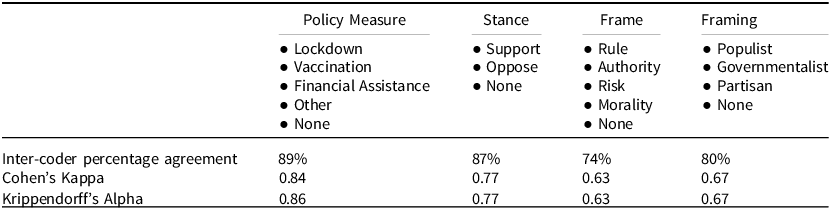
Two authors have manually annotated a stratified random sample of 5,000 tweets: 500 from Conservative MPs, 500 from Labor MPs, 2,000 from Conservative audience members, and 2,000 from Labor audience members. We annotate the tweets identifying: (1) Policy measure referred to (lockdown, vaccination, financial assistance, other, none); (2) Policy stance (support, oppose, none), (3) Frame (rule, authority, risk, morality); (4) Framing (governmentalist, populist, partisan). Our codebook is provided in online Appendix B.
Not all framings fall under a governmentalist-populist cleavage. Indeed, many tweets position the user as a partisan of one political party as opposed to another, thereby positioning them on a government-opposition cleavage. To account for this, we have added partisanship as a third framing. We code a tweet as partisan when it does not position a user with regard to governmentalist versus populist communication, as defined by the four frames and related framings, but rather with regard to the political cleavage of government versus opposition. Coding partisan alongside governmentalist and populist tweets has the important benefit of removing false positives from the categories of populism and/or governmentalism (Hirst et al. Reference Hirst, Riabinin, Graham, Boizot-Roche, Morris, Kaal, Maks and van Elfrinkhof2014; Baden et al. Reference Baden, Pipal, Schoonvelde and van der Velden2022). For our codebook, see Appendix B.
Table 2 presents a summary of our inter-coder reliability tests conducted among human coders, including metrics such as percentage agreement, Cohen’s Kappa, and Krippendorff’s Alpha. The results indicate good inter-coder reliability. For further details, see Appendix C.
Inter-coder reliability tests among human coders

We then build machine learning classifiers to measure populist versus governmentalist communication across policies and frames. We subsequently apply these classifiers to our full sample of circa 1 million tweets.
In the annotated dataset of 5,000 tweets, which serves as the training data for our classifier, the most frequently identified policy measure is vaccination (25%), followed by lockdowns (16%), and financial assistance (8%). The remaining coded tweets contain no mention of a policy measure (24%) or are about a mix of other policies, which we are excluding from the analysis (27%). Regarding stance, a majority of tweets express support (56%) for public health measures, while opposition appears in 19% of tweets and 24% are neutral. For frames, nearly half of all tweets are associated with morality (48%), followed by rule (25%), risk (14%), and authority (10%). The dominant framing is governmentalist (57%), with populist (26%) and partisan (15%) framings also present. In Appendix C, we provide further details about our training data.
Transformer model for sequence classification
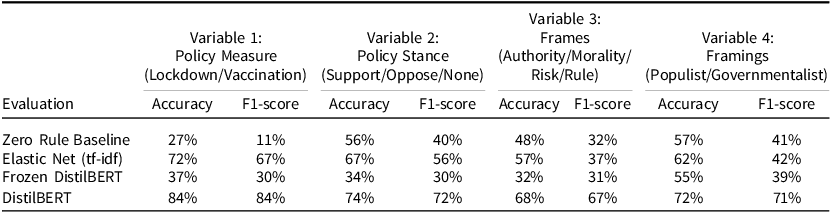
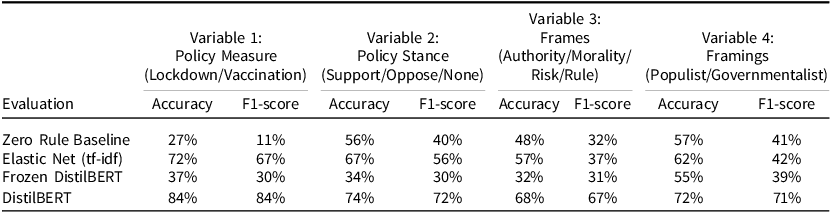
We train a machine learning model on the annotated dataset of 5,000 tweets and use it to classify the full corpus of tweets. To evaluate the performance of this approach, we compare four different classifiers: (1) a zero-rule baseline, which always naively predicts the majority class, that is, whichever class is most frequently observed in the training set, (2) an Elastic Net classifier, which is a simple yet performant classifier based on a term frequency-inverse document frequency (tf-idf) representation of text. This classifier serves as a baseline against which to compare the more powerful transformer models. Classifiers (3) and (4) are two variants of the transformer model DistilBERT, which we explain next.
DistilBERT is a parameter-efficient version of BERT (Bidirectional Encoder Representations from Transformers) (Devlin et al. Reference Devlin, Chang, Lee and Toutanova2018) that retains 97% of BERT’s performance, but is 60% faster. Specifically, we use DistilBERT-uncased, borrowed from Huggingface’s transformers library (Tunstall et al. Reference Tunstall, von Werra and Wolf2022). Pre-trained on large text tasks, DistilBERT generates informative word and sentence representations for tasks like text classification. Following common practice, we add a logistic regression layer on top of the model’s output to map high-dimensional sentence representations to classification labels (Sanh et al. Reference Sanh, Debut, Chaumond and Wolf2019).
We test two settings: fine-tuning the entire DistilBERT model (DistilBERT) and fine-tuning only the logistic regression layer while keeping DistilBERT frozen (Frozen DistilBERT). Frozen DistilBERT is easier and cheaper to train, which comes at the cost of reduced accuracy. For training and testing, we use a dataset of 5,000 human-annotated tweets, split into 80% training and 20% test sets. To prevent overfitting, we employ 5-fold cross-validation when optimizing model hyperparameters and validate robustness through runs with multiple different random seeds. The human-annotated test set is held out during the entire training and validation procedure.
We report accuracy and weighted F1 scores on the test set in Table 3, comparing DistilBERT, Frozen DistilBERT, Elastic Net, and a zero-rule baseline. We provide full details about our training pipeline, as well as how DistilBERT outperforms the baseline and other methods, in Appendices D and E.
Results obtained on the test set for each variable in the annotation scheme
Our classifier produces a predicted probability of each policy measure and frame for each tweet. For practical and statistical reasons, we collapse the predicted probabilities into a single dominant-label category (the policy or frame with the highest probability). The most important reasons for why we do this are simplicity and interpretability: it makes our downstream regression analysis easier to manage and explain, and it reflects the fact that humans are likely to perceive just a single policy measure and the frame surrounding it.
When employing our best-performing classifiers to the tweet corpus, the most common policy measures mentioned are vaccination (28%), lockdowns (16%), and financial assistance (8%). 23% refer to other policies that are not part of the analysis, while 25% do not reference any policy. Regarding frames, morality is the most prevalent (59%), followed by rule (21%), risk (12%), and authority (9%). In terms of framings, most tweets are classified as governmentalist (60%), followed by populist (28%), and partisan (12%). Appendix F contains further information about the distribution of predicted labels.
Measurement of emotions
We measure fear and anger using the neural network emotion classifier by Colnerič and Demšar (Reference Colnerič and Demšar2020). We use this classifier because it has been trained on 73 billion tweets using emotion hashtags, such as #anger, #fear, etc., as ground-truth labels. This allows the neural network to classify discrete emotion scores in tweets with high predictive performance. Such a model outperforms several baseline models and has been widely used in the analysis of emotional tweets (e.g. Wang and Wei Reference Wang and Wei2020; Xue et al. Reference Xue, Chen, Chen, Zheng, Li and Zhu2020; Mechkova and Wilson Reference Mechkova and Wilson2021). In Appendix I, we provide two robustness checks of our emotion measure. First, we compare the neural network (Colnerič and Demšar Reference Colnerič and Demšar2020) against two dictionaries (NRC Emotion Lexicon and WordNet Affect) and a transformer-based classifier trained on the GoEmotions dataset (Demszky et al. Reference Demszky, Movshovitz-Attias, Ko, Cowen, Nemade and Ravi2020). Second, we have manually coded 100 tweets and compared our coding with the emotion scores obtained by the neural network classifier. The percent agreement between the classifier and the human coding is 78%. Taken together, this two-step procedure supports the validity of our approach.
Analytical strategy
We divide our analytical strategy into two parts. First, we rely on the descriptive analysis of time series to discover trends in the communication of MPs and their audiences. Second, we test our hypotheses using ordinary least squares regression. For each of our four hypotheses, we regress either fear or anger on either populist or governmentalist communication and control variables. In linear regression, the coefficients, which measure the strength and direction of linear relationships between two variables, can be interpreted as marginal effects. We also obtain a p-value as a measure of statistical significance, which can be interpreted as the probability of observing a correlation by chance. We require a significance level of less than 5%.
Analysis and results
We first present observational findings regarding social media trends. We then test our hypotheses about populist anger and governmentalist fear via regression analysis.
Social media trends
Figure 1 presents a time series of tweets per day by user type. It shows that the dataset contains fewer tweets by MPs than by audience members, given the limited number of MPs. The frequency of tweets builds up before each lockdown and culminates around its announcement. The effect is weaker, but also discernible, during the second lockdown, which lasted only four weeks. While tweet numbers are comparable and synchronous for Labor and Conservative audience members, the number of Conservative audience members surpasses the number of Labor audience members in the second half of the observation period, especially from the third lockdown. This is probably because Britain’s Conservative government became more popular with the successful vaccination rollout.
Tweets posted per day by user type.
Note: Tweets are aggregated by date.

Figure 2 presents a time series of tweets per day by framing. We classify tweets as either governmentalist or populist, depending on which framing has the highest predicted probability. The first lockdown triggered a strong governmentalist but only a weak populist surge, resulting in a ratio of 4:1 for governmentalist versus populist tweets (March 2020). During the first lockdown, governmentalist framings declined steadily, whereas those of populist framings remained relatively constant. The ratio declined to 2:1 after the end of the first lockdown (June 2020), with governmentalist remaining twice as frequent as populist framings. From the third lockdown (January 2021) to the end of the observation period (July 2021), framings converged further.
Tweets posted per day by framing.
Note: Tweets are aggregated by date.
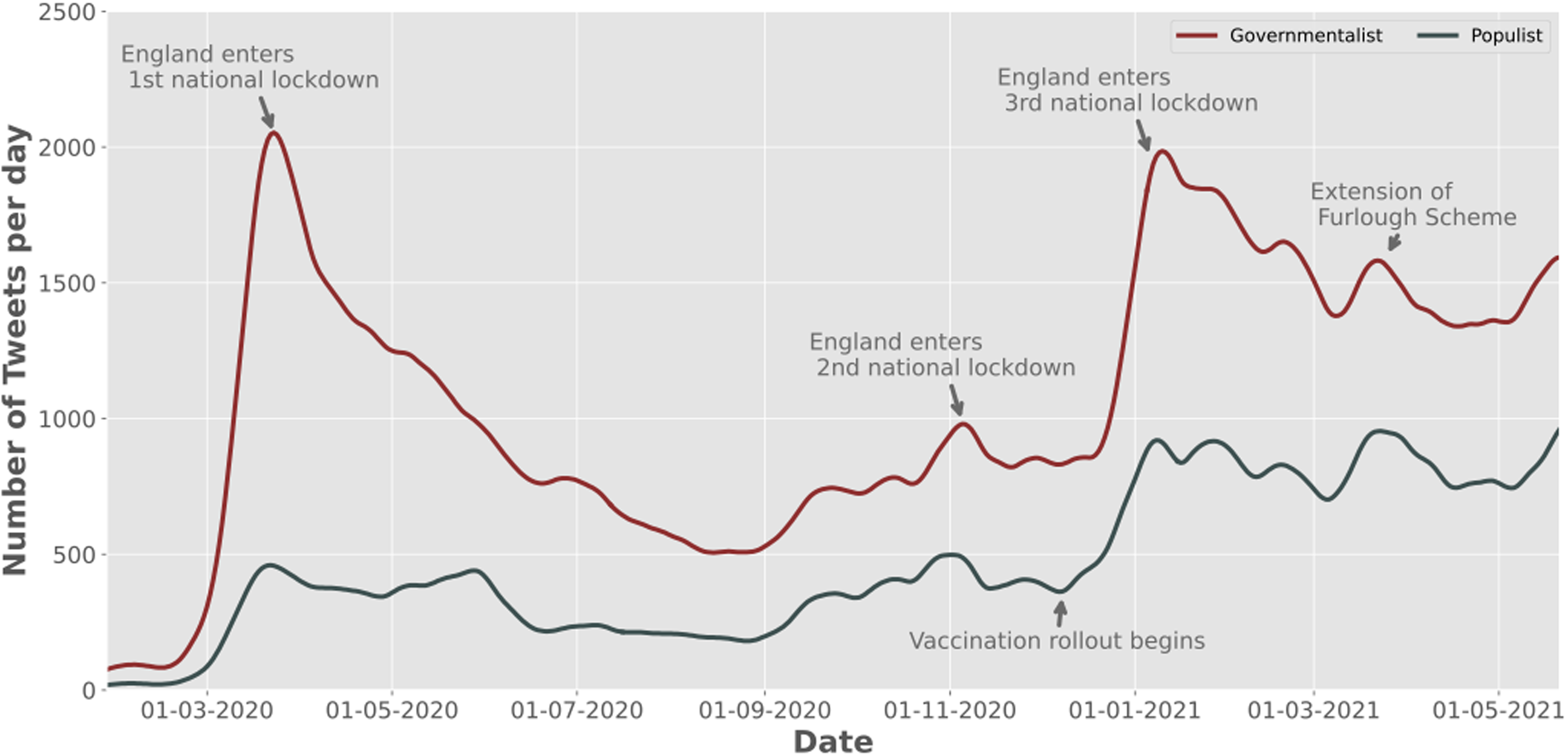
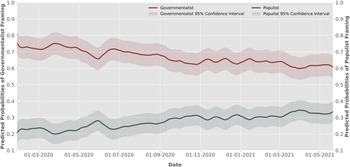
Figure 3 shows predicted probabilities of populist versus governmentalist framings from our classifier, without forcing them into a binary categorization (as in Figure 2). It shows that governmentalist communication was most prevalent at the early stages of the pandemic, then declined steadily. As governmentalist framings declined, populist framings rose, with the ratio dropping from more than 4:1 to less than 2:1. Evidently, the early stages of the pandemic were characterized by a sense of anxiety and uncertainty, attracting people towards governmentalist framings for guidance. As the pandemic progressed, familiarity with the virus and frustration with health measures grew, leading to a shift from governmentalist to populist framings. Also, popular discontent may have taken time to articulate itself, especially in the absence of a centralized opposition structure and given barriers to offline collective action during lockdown.
Populist and governmentalist framing over time.
Note: Predicted Probabilities are computed via our classifier and aggregated by date.

Finally, tweets from MPs are more governmentalist on average than tweets from the public, whereas tweets from the public are more populist on average than tweets from MPs (see Appendix H, Figures H3 and H4). While this is hardly surprising given that MPs are in the business of trying to govern ‘the people’, it may suggest that British MPs had an incentive to select populist framings to boost their popularity. For further observations of this kind, see Appendix H.
Populist anger and governmentalist fear?
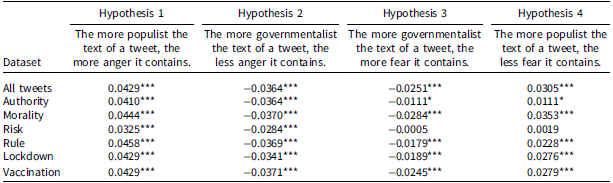
To test our hypotheses, we fit twelve ordinary least squares regression models and present the estimated marginal effects of interest in Table 4. The full regression estimates are available in Appendix J. The dependent variables for the regression models are anger (Hypotheses 1 and 2) and fear contained in tweets (Hypotheses 3 and 4). The row ‘All tweets’ in Table 4 denotes the average marginal effect of populist communication (Hypotheses 1 and 4) and governmentalist communication (Hypotheses 2 and 3) on anger and fear. The remaining rows show the marginal effects of populist and governmentalist communication on anger and fear conditional on frame (authority, morality, risk, rule) and policy measure (lockdown, vaccination).
Marginal effects by hypothesis
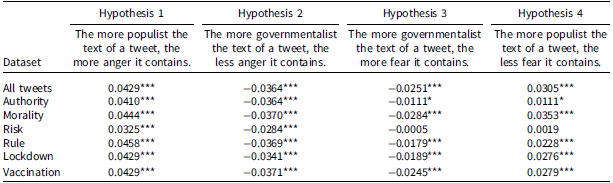
Note: The table contains marginal effects obtained from twelve ordinary least squares regression models (available in Tables J1-J4 of Appendix J). Appendix H (Table H1) contains detailed information on the dataset used for this analysis, including the numbers of tweets, numbers of unique users, numbers of days covered. The dependent variables are predictions themselves, and thus only proxies of the quantities we intend to correlate. Period of analysis: 1 January 2020 to 10 July 2021. ***p < 0.001; **p < 0.01; *p < 0.05.
Given that the core of our theoretical argument is that individuals use populist and governmentalist framings regardless of their party affiliation or whether they are MPs or regular social media users, we analyze the data from MPs and regular users together within our regression models. In our analysis, however, we do take into account the different user categories by controlling for tweet type (Conservative MPs, Labor MPs, users who liked a tweet by Conservative MPs, users who like a tweet by Labor MPs) in all regression models that we use to calculate the marginal effects. Furthermore, in all regressions, we include time fixed effects (days) and control for stance towards the policy (support, oppose, none).
The results show that the anger-related Hypotheses 1 and 2 stand strongly confirmed. The more populist the text of a tweet, the more anger it contains, and the more governmentalist the text of a tweet, the less anger it contains. Looking at the estimated marginal effects, the most populist tweets contain 4.29% more anger than the least populist tweets, and the most governmentalist tweets contain 3.65% more anger than the least governmentalist tweets. Importantly, the marginal effects are all statistically significant at the 0.1% level, not only for all tweets but also for different frames – authority, morality, risk, rule – and policy measures – lockdown and vaccination.
The results also indicate that Hypotheses 3 and 4, related to fear, are not supported. Contrary to our expectations, we observe that the more governmentalist the text of a tweet, the less fear it contains, and the more populist a tweet, the more fear it contains. The estimated marginal effects reveal that the most governmentalist tweets contain 2.52% less anger than the least governmentalist tweets, and the most populist tweets contain 3.05% more fear than the least populist tweets. Once again, these results hold across frames and policies, except for two frames: authority, where the marginal effect is weak and statistically significant only at the 5% level, and risk, where the marginal effect is not statistically significant at the 5% level.
The negative finding regarding fear (Hypotheses 3 and 4) is surprising given our own theorizing, as well as previous empirical findings (Albertson and Gadarian Reference Albertson and Gadarian2015; Rico et al. Reference Rico, Guinjoan and Anduiza2017; Vasilopoulos et al. Reference Vasilopoulos, Marcus, Valentino and Foucault2019; Marcus Reference Marcus, Forgas, Crano and Fiedler2021) and leads us to query how we can make sense of this observation. We, therefore, explore the possibility that populists generally appeal to fear and anger more than governmentalist actors. To test this, we fit two additional linear regression models with anger and fear as the dependent variables, but this time including populism versus governmentalism as a binary categorical predictor, based on the category in which tweets were classified according to predicted probability. We again include time fixed effects (days), and we control for tweet type (Conservative and Labor MPs; Conservative- and Labor-leaning users) and stance towards policy measures (support, oppose, none). The full models are available in Appendix J, Table 5. In line with our findings reported in Table 4, we find that populist tweets are 1.73% more likely to appeal to anger and 1.09% more likely to appeal to fear than governmentalist tweets. Hence, populist tweets appeal to both more anger and more fear than governmentalist tweets. We surmise that populist fear relates not so much to the pandemic itself but rather to the effects of public health measures such as lockdowns and vaccinations, but concede that, on the whole, populists were more fearful than governmentalist actors and that this must have contributed to our unexpected findings regarding Hypotheses 3 and 4.
Discussion
This article contributes both theoretically and methodologically to the study of populist communication. Theoretically, we conceptualize populism as one end of a political cleavage between thin-centered ideologies, with governmentalism at the opposite end of the spectrum. This offers sharp contours and allows us to study political contestation without the baggage of biased conceptualizations like ‘authoritarian populism’ versus ‘liberal democracy’ (Norris and Inglehart Reference Norris and Inglehart2019). Thereby, we not only contribute to the empirical study of populism (Hawkins et al. Reference Hawkins, Carlin, Littvay and Rovira Kaltwasser2019), but we also offer a timely operationalization of governmentality (Foucault Reference Foucault, Burchell, Gordon and Miller1991 [1878]). Governmentality is an intellectually appealing and influential concept that has hitherto been the prerogative of poststructuralist scholars (Rose Reference Rose1999; Dean Reference Dean2010), but, as our study shows, holds considerable promise for the empirical study of political communication.
Methodologically, we separate ideological contestation between populists and their political opponents from partisan contestation between government and opposition, solving a longstanding challenge discussed in previous scholarship (Hirst et al. Reference Hirst, Riabinin, Graham, Boizot-Roche, Morris, Kaal, Maks and van Elfrinkhof2014; Rheault and Cochrane Reference Rheault and Cochrane2020; Baden et al. Reference Baden, Pipal, Schoonvelde and van der Velden2022; Németh Reference Németh2023). By addressing this challenge, our work enables researchers to more accurately measure how populist ideas spread beyond populist parties and are adopted by mainstream actors, which is a crucial dynamic in contemporary democracies (Roodujin 2014). Specifically, we have developed a machine learning classifier to study populist and governmentalist rhetoric, enabling us to study how either side uses relevant frames, as well as the emotions of anger and fear. We thereby provide scholars with a reliable and replicable tool to analyze the emotional and framing strategies of political contestation at scale.
Our observational findings show that governmentalist communication was predominant at the early stages of the pandemic, but populist communication gained prominence as the situation unfolded. This confirms existing research on the politics of fear, especially during crises (Albertson and Gadarian Reference Albertson and Gadarian2015; Nygren and Olofsson Reference Nygren and Olofsson2020; Degerman et al. Reference Degerman, Flinders and Johnson2023; Vasilopoulos et al. Reference Vasilopoulos, McAvay, Brouard and Foucault2023), as well as scholarship on the populist counter-politics of anger (Lasco Reference Lasco2020; Horton Reference Horton2022; Friedrichs et al. Reference Friedrichs, Stoehr and Formisano2022; Filsinger et al. Reference Filsinger, Hofstetter and Freitag2023; Oana and Bojar Reference Oana and Bojar2023). It also reveals a temporal pattern in the politics of emergency (Agamben Reference Agamben2003). The decline of fearful governmentalist and concomitant rise of angry populist communication may have contributed to the reluctance of the British government to sustain health measures, especially after Boris Johnson faced a rebellion from around 100 Conservative MPs (Bale Reference Bale, Ringe and Rennó2022).
In line with our hypotheses, the more populist the text of a tweet, the more anger it contains, and the more governmentalist the text of a tweet, the less anger it contains. However, contrary to our expectations, the more governmentalist a tweet, the less fear it contains, and the more populist a tweet, the more fear it contains. Apart from a few exceptions, our findings are robust to the disaggregation of our dataset by frames and policy measures. We also find that populist tweets appeal more than governmentalist tweets, not only to anger but also to fear.
When taken at face value, our results suggest that populists were both angrier and more fearful than governmentalists. Thereby, they challenge an emerging consensus among quantitative scholars associating populism with anger rather than fear (Rico et al. Reference Rico, Guinjoan and Anduiza2017; Vasilopoulos et al. Reference Vasilopoulos, Marcus, Valentino and Foucault2019; Marcus Reference Marcus, Forgas, Crano and Fiedler2021). Up to a point, this may revindicate qualitative scholarship associating populism with fear (Wodak Reference Wodak2015; Nussbaum Reference Nussbaum2018). However, the idea that populism is either fueled by anger or driven by fear could be a false dichotomy. Based on our qualitative understanding of the data (having hand-coded 5,000 tweets), we believe that, unlike governmentalist actors, populists were fearful not so much of the pandemic as such but rather of compulsory measures like lockdowns and vaccinations. Regardless, we suggest that the question of whether populism is driven by anger, fear, or both is worth revisiting in the future.
Despite rigorous analysis, our findings present limitations. We have trained our machine learning classifier on DistilBERT, which at the time was one of the best-performing transformer models. One might object that better-performing models were available, such as BERTweet, which had been trained specifically on tweets (Nguyen et al. Reference Nguyen, Vu and Nguyen2020). However, our choice of DistilBERT was motivated by an understanding of performance that includes practical considerations. DistilBERT lowered training time considerably without compromising results.
While we urge caution regarding the external validity of our findings, we are confident that our conceptualization and procedure is transferable to other contexts and communication platforms. It is possible that our results are influenced by the political context of the UK, which is led by a strong government with a large parliamentary majority. However, other work has reached cross-nationally valid conclusions regarding populists appealing more to anger than fear (Rico et al. Reference Rico, Guinjoan and Anduiza2017; Vasilopoulos et al. Reference Vasilopoulos, Marcus, Valentino and Foucault2019; Marcus Reference Marcus, Forgas, Crano and Fiedler2021), as well as governmentalist politicians and their audiences being more inclined towards fear (Albertson and Gadarian Reference Albertson and Gadarian2015). Therefore, we expect our findings regarding anger to be cross-nationally valid. Our results regarding fear, however, challenge the notion of fearless populist outsiders taking on a fearful political establishment. To gain greater clarity on the dynamics of fear and anger, we encourage future comparative research on political communication to apply our approach to other national and institutional contexts – such as multiparty parliamentary systems, presidential democracies, or countries with different populist traditions, for example, in South Asia or Latin America.
We have studied a case of populist and governmentalist communication during a publicly acknowledged crisis, but populists have a tendency to ‘perform crisis’ under any circumstance (Moffitt Reference Moffitt2015). Governmentalist actors tend to react to populist crisis communication in standardized ways, such as presenting populists as unreasonable, dangerous, and to be feared. We, therefore, expect that much of what we have found applies not only to crisis communication narrowly conceived but also to political communication more widely.
It is interesting to note that fear and anger are widely understood as polar emotions (Plutchik Reference Plutchik2001): the more fear, the less anger, and vice versa. Our findings, however, rather seem to suggest a synergistic view of negative emotions: the more fear the more anger and, perhaps, sadness, disgust, etc. This warrants further investigation. The same applies to the analysis of frames such as authority, risk, and morality. An analytical procedure similar to the one followed in this article could be adopted, for example, to the analysis of communicative contestation over technocracy (Caramani Reference Caramani2017) and the politics of emergency (Agamben Reference Agamben2003).
Specifically, our framework yields insight into ‘backlash politics’ and related political controversies in the context of the ‘culture wars’ (Chapman Reference Chapman2015; Alter and Zürn Reference Alter and Zürn2020; Manunta 2025). We may hypothesize that governmentalist actors deploy a rhetoric of fear regarding social regression, while populists counter with anger at ‘woke’ elites and, crucially, a cultivated fear of elite-imposed and state-enforced social engineering. Analyzing this kind of intersecting emotional strategies may provide a more sophisticated understanding of cultural-political contestation than is possible through conventional ideological classification.
While our approach is thus transferable, scholars should take care to customize it to the requirements of whatever context they wish to examine. While rule is a core feature of populist-governmentalist contestation and will always play a role, authority is more important in contexts where science and expertise are paramount, such as public health and climate change, than in other contexts. Risk is likely to be important when public or personal safety is at stake, as in crisis situations or when debating prudential rules about ‘health and safety’, but less in other contexts. Morality, however, is likely to play a key role whenever populist and governmentalist actors lock horns, insofar as populism is a backlash against governmentalist attempts to moralize people into compliance. By clarifying how the use of frames such as authority, risk, and morality varies across contexts, we may further our understanding of political communication in general and crisis communication in particular (Moffitt Reference Moffitt2015). As thin-centered ideologies, populism and governmentalism are inherently contextual but not infinitely malleable.
Supplementary material
The supplementary material for this article can be found at https://doi.org/10.1017/S147567652510042X.
Data availability statement
Replication files are available on the Harvard Dataverse: https://doi.org/10.7910/DVN/7U4QGN.
Acknowledgements
Jörg Friedrichs led on the theoretical framework. Giuliano Formisano, Florian S. Schaffner, and Niklas Stoehr led on the empirical analysis. We thank Kevin Arceneaux, Bruno Castanho Silva, Oliver von Dzengelevski, Spyros Kosmidis, Sascha Riaz, Ralph Schroeder, Marie-Lou Sohnius, Jan Zilinsky, and three anonymous reviewers for helpful comments and suggestions. We thank Nuffield College, University of Oxford, for allowing us to use their computer server to train our classifiers and run our analyses. Previous drafts were presented at the 2021 Annual Conference of the European Political Science Association and the 2024 (Digital) Information and Political Decision-Making Workshop at the University of Geneva.
Funding statement
We thank the Department of International Development at the University of Oxford for funding a research assistant. Giuliano Formisano acknowledges funding through the Economic and Social Research Council and Nuffield College (Oxford) for his PhD Scholarship. Niklas Stoehr acknowledges funding through the Swiss Data Science Center SDSC PhD Fellowship.
Competing interests
The authors declare no conflicts of interest.





 Open access

