




Hybridity, Labour and Citizenship
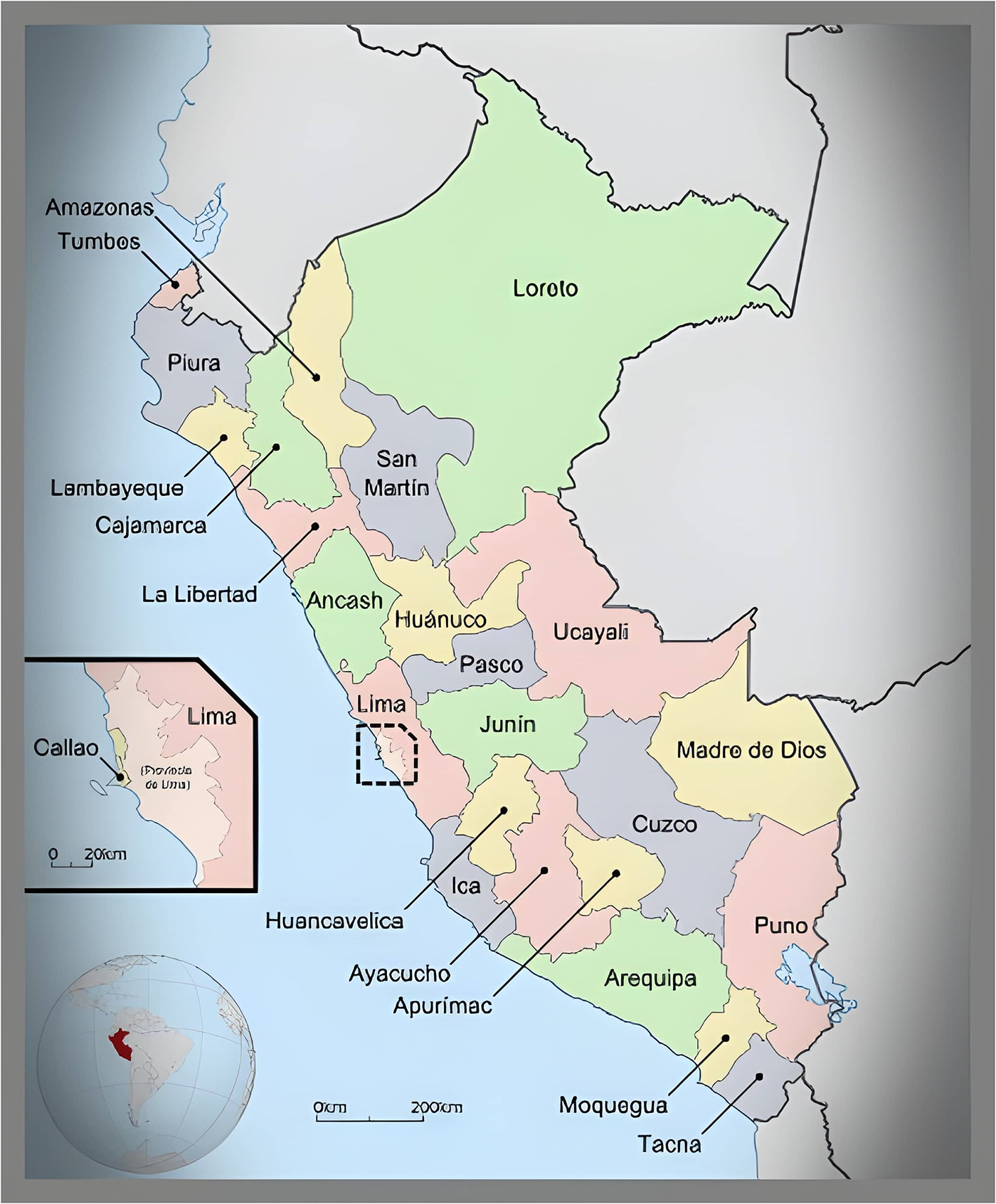
In the period 1880 to 1930, labour contracting (enganche) developed to recruit agricultural labourers to zones of export expansion throughout Latin America. Labour contractors (enganchadores) advanced wages to workers, who were then required to repay the debt by labouring on haciendas or plantations or in extractive enterprises such as rubber or logging camps. Unlike classic debt peonage, enganche implied migration – often from a more densely populated highland region to sparsely populated lowlands – and was usually a temporary arrangement. In northern Peru, enganche facilitated the recruitment of workers from the highland department of Cajamarca to sugar plantations in the coastal departments of Lambayeque and La Libertad (see Figure 1).
The Administrative Departments of Peru

Figure 1 Long description
The map illustrates the administrative departments of Peru, each labeled with its name. Departments include Amazonas, Tumbes, Piura, Lambayeque, Cajamarca, La Libertad, Ancash, Lima, Huánuco, Pasco, Junín, Huancavelica, Ayacucho, Apurímac, Ica, Arequipa, Moquegua, Tacna, Puno, Cuzco, Madre de Dios, Ucayali, San Martín and Loreto. An inset map shows a detailed view of Lima and a globe at the bottom left highlights Peru's location in South America. The map includes a scale indicating distances in kilometers.
The historiography of enganche to sugar plantations in northern Peru, like that in Latin America more widely, has focused on the relative importance of coercion and monetary incentives in the creation of a plantation workforce, and conceptualised enganche as a stage in the transition to capitalism and free wage labour.Footnote 1 However, here I argue that market and non-market incentives – both coercive and non-coercive – played an initial and ongoing role in labour recruitment during the period, and such hybridity has been obscured by the conceptual dichotomy between market and non-market incentives integral to theories of capitalist modernisation rooted in classical economic theory.
The concept of hybrid markets has developed to counter teleological, Eurocentric narratives of modernisation and capitalist development that crystallised in the eighteenth and nineteenth centuries as European colonial expansion spread in Asia and Africa. In his article ‘Merchants, Markets, and Commerce in Early Modern South India’, David Washbrook uses hybridity as a paradigm to better conceptualise global capitalist modernisation after 1700. He points out that in classical economic theory and economic anthropology, non-market and market exchange are ‘conceived [of] as juxtapositional and antithetical’ and modernisation is defined as the transition from the former to the latter.Footnote 2 Douglass C. North’s theory of institutional economics, in which effective institutions reduce transaction and production costs per exchange, recognised the historical role of institutions, ‘humanly devised constraints that structure political, economic and social interaction’,Footnote 3 and drew attention to ‘distortions’ from theory in the ‘real’ world.Footnote 4 However, in this paradigm, history is still interpreted teleologically and normatively as ‘largely a story of institutional evolution’ in the transition from non-market towards market economies.Footnote 5 Therefore it reproduces the dichotomy of classical economic theory.Footnote 6 Washbrook argues that these theories obscure how, ‘for long periods of history, non-market and market systems of exchange subsisted side-by-side, creating a “hybrid” institutional environment’.Footnote 7 Furthermore, hybridity may be constituted by coercive and/or moral non-market mechanisms, and it is how these work with market incentives, even in advanced capitalist economies, that directs economic structures in particular ways at particular times.Footnote 8
More recently, Ben Fallaw and David Nugent have referred to the ‘hybrid nature’ of agrarian capitalism in Mexico, Peru, and other regions of Latin America during the liberal era (c. 1850–1930), which combined ‘technology, high levels of capitalization, and integration into global commodity markets with repressive labor regimes’.Footnote 9 In this definition, hybridity is characterised by the role of coercion in disrupting free market exchange. For example, historians of Guatemala and southern Mexico have documented the important role of an increasingly centralised and authoritarian state apparatus in co-ordinating labour control and recruitment for the export sector through the systematic enforcement of taxation, vagrancy legislation, labour drafts and contractual servitude.Footnote 10 Yet, as Fallaw and Nugent point out, levels of state-sponsored coercion were not uniform across countries or sectors. Instead, ‘a great many emergent forms of everyday, active citizenship were being claimed, contested, disavowed, and denied across the socioeconomic and political landscape of Mexico and Peru’. These ranged ‘from the freedoms and dangers of “bandit citizenship” in Cajamarca, Peru … to the coercive abuses endured by “conscript citizens” [in Chiapas, Mexico]’.Footnote 11 Here, I argue that in Cajamarca, where the state – in stark contrast to Chiapas – was chronically weak and so-called ‘bandit citizenship’ predominated, non-market mechanisms including coercion also played an important role in enganche. Such hybridity, though, has been obscured in the historiography by the juxtaposition of non-market and market mechanisms of exchange and a definition of non-market incentives focused on state-sponsored coercion.
Reconceptualising the relationship between market and non-market incentives in Peru necessitates revisiting debates about the consolidation of the state and nation. The early historiography of the República Aristocrática (1895–1919) asserted that a unified coastal elite (labelled the ‘oligarchy’ or ‘bourgeoisie’) connected to the expanding export economy, captured the state and used its resources to further its power and wealth.Footnote 12 Subsequently, historians began to question the extent of the power of the coastal elite and to problematise its relationship with landowners (gamonales) in the Peruvian sierra.Footnote 13 Manuel Burga and Alberto Flores Galindo highlighted the regional and sectoral fragmentation of Peru’s ruling class, although still asserting that coastal interests based on sugar were dominant enough to effectively constitute a national oligarchy.Footnote 14 Julio Cotler argued that a modernising ‘liberal oligarchy’ fomented the growth and penetration of the state as an instrument of its own development. Coastal elites were able to displace the political and economic power of regional gamonales, although their dependence on foreign capital made them incapable of becoming a true national governing class.Footnote 15 Gamonales from the interior gained local autonomy in exchange for becoming clients of the coastal ‘bourgeoisie’ and provincial agents of centralised power and foreign capital.Footnote 16 Michael J. Gonzales recognised that personal and political in-fighting weakened the rule of the Partido Civil (Civilista or Civilian Party), but nevertheless considered that planters remained the most powerful group in Peruvian society, adept at getting what they wanted from the state.Footnote 17 Thus, power still flowed from centre to periphery, controlled by the export-oriented oligarchy on the coast, although its complexity was now visible.
Further challenging the hegemony of coastal elites, Rory Miller argued that the power and cohesion of the ‘oligarchy’ was undermined by intense factionalism and bitter personal conflict. Moreover, central to its failure to secure national power was its inability to control Congress, where local landowners, particularly from large over-represented Andean departments such as Cajamarca, independently elected their own representatives and used executive patronage to further their power vis-à-vis local rivals and to ensure autonomy from Lima.Footnote 18 Thus, Miller asserts, local power remained the key to advancing elite interests even for the most influential members of the coastal oligarchy, such as sugar planters.Footnote 19 Ernesto Yepes went so far as to suggest that landlord control in the interior vis-à-vis central state power may even have increased in the period, above all in northern Peru.Footnote 20 In this region, the ‘bourgeois–oligarchic’ state could not guarantee capitalist labour relations on the plantations; instead, the power of gamonales came to constitute a fundamental ‘moment’ in their reproduction.Footnote 21 This ‘moment’ initially strengthened the gamonales, whose power was concentrated in the provincial bureaucracy and the national parliament. However, it constituted a ‘transitional form’, the ‘embryo’ of the modern capitalist state, that eventually and inevitably led towards the erosion of gamonalismo and pre-capitalist productive relations and the emergence of the capitalist oligarchical state.Footnote 22 Ultimately, then, Yepes’ insights, which I build upon below, become drawn back into teleological narratives of modernisation and the inevitable transition from pre-capitalist to capitalist productive relations.
More recently, historians José Luis Rénique and Nelson Manrique have argued that the state was fragmented, seigneurial privilege and clientelism masked as liberal republican administration and various regional economic logics operated – in the southern Andes, central sierra, Lima and the central and northern coast and Amazonas – undermining national consolidation.Footnote 23 Similarly, for Paulo Drinot, the República Aristocrática represented a process of ‘traditional modernisation’, an expression of the contradictory character of the Partido Civil and capitalist development enmeshed in pre-existing structures of power.Footnote 24 The diversity of labour regimes contributed to the development of regional economies, which had different characteristics, despite all interacting with international markets.Footnote 25
The History of Peru’s Sugar Plantations, 1880–1930
Sugar plantations were established on Peru’s north coast in the colonial period. In the nineteenth century, they experienced growth during the guano bonanza (1840s to the early 1870s) and destruction and financial loss during the War of the Pacific (1879–82). In subsequent decades, sugar planters constituted a significant proportion of the Peruvian political and economic elite, and their influence in the Partido Civil and links to foreign banking and merchant houses enabled them to rebuild and modernise the industry, particularly during the República Aristocrática. Throughout this time, the plantations underwent territorial expansion and consolidation along the north coast, and technological innovation, including the construction of larger processing mills, railways and modern port facilities. However, while sugar processing became a complex mechanised operation, sugar cultivation and cane-cutting remained labour-intensive. Consequently, recruiting sufficient labour was perhaps the most intractable difficulty faced by planters in the period 1880 to 1930.Footnote 26
Labour had always been in short supply in the sparsely populated coastal region. Black slaves were used on the plantations during the colonial period. After the abolition of slavery in 1854, much of the compensation paid by the state to sugar planters was used to import indentured labour from China. Thus, coercion remained an integral component of the labour system for the next two decades.Footnote 27 Planters began to look to the highlands as a source of wage labour only after the banning of the Chinese ‘coolie’ trade in 1874.Footnote 28 Therefore, as Gonzales states, the initial transition to wage labour had nothing to do with the marketplace, but resulted from legal and political changes, which made alternative sources of non-wage labour unavailable.Footnote 29
Subsequently, though, historians such as Gonzales have argued that technological and market forces principally drove a gradual process of proletarianisation,Footnote 30 in which ‘different wage-labor regimes developed in a series of stages, with laborers gradually acquiring more freedom or, put another way, with planters losing more control over labor’. This was an ‘evolution’ that ‘reflected the growing size and social complexity of the plantation economy and community, as well as the growing stability … of the Peruvian nation [, which] made coercion a less-effective tool of social control’.Footnote 31 So, ‘all regional estates were transformed into what could be called factories in the field’,Footnote 32 and, by the 1920s, they had become enterprises ‘in which men sold their labor throughout the year and planters produced for an international market’.Footnote 33 At first peasants from the highland department of Cajamarca were reluctant to leave their small mountain plots for work on the hot coast. However, as the population began to grow rapidly in the late nineteenth century, increasing man–land ratios forced many to seek migratory wage work on coastal plantations.Footnote 34 Wage labour was attractive because it was short-term and seasonal, and wages were higher than in the highlands.Footnote 35 Thus, ‘a free labor system gradually replaced indenture, as capitalist relations of production expanded’Footnote 36 and a ‘modern, export-oriented industrial complex’ emerged in northern Peru.Footnote 37 Indeed, the sugar industry became a motor of industrialisation and driver of modernisation in other economic sectors such as banking, finance and trade in early twentieth-century Peru.Footnote 38 Furthermore, collective labour agitation for better wages and working conditions on the plantations contributed to the consolidation of unions and the rise of APRA (Alianza Revolucionaria Popular Americana), Peru’s first populist mass-based political party, founded by Víctor Raúl Haya de la Torre in 1924, while he was in exile in revolutionary Mexico.Footnote 39 APRA and the sugar plantations became symbols of working-class mobilisation and ideological and institutional modernisation in Peru in the 1930s and beyond.Footnote 40
In this narrative of modernity, however, the historiography is ambivalent about the role of coercion in the process of enganche, through which highland workers were recruited to the plantations. For Lewis Taylor, the system of enganche appealed to peasants due to high wages and the seasonal nature of the work, which enabled them to retain parcels in the highlands, because migrant labourers could pick and choose which estates they worked for and because competition between enganchadores and estates for labour worked to reduce abuses.Footnote 41 Therefore, ‘extra-economic coercion in order to force the sale of labour-power to capital became unnecessary’.Footnote 42 Gonzales, though, recognised that non-market incentives, including but not limited to violence, were involved in labour contracting in Cajamarca.Footnote 43 Labour contractors sometimes employed deceit and trickery to recruit workers, some individual contractors combined economic leverage with political power, and indebtedness was a deliberate strategy used by planters to control workers.Footnote 44 Therefore enganche did on occasion undermine the free will of workers to choose where to work, and ‘both coercion and the marketplace played important roles in labor recruitment’.Footnote 45 Yet, because enganche was a competitive business and labour demand and wages responded to market forces, he concludes that coercion and bondage were not primarily responsible for the creation of a plantation workforce.Footnote 46 Bill Albert perceived that ‘even though enganche may have relied more on material incentives than extra-economic coercion, the two were by no means mutually exclusive’;Footnote 47 while Peter Klarén observed that planters employed a variety of techniques to tap the growing reserve of seasonal surplus labour, ‘some of which were coercive in nature such as enganche – a form of debt entrapment through cash advances’.Footnote 48 Nevertheless, he concludes, despite being ‘much denounced by a generation of indigenistas (pro Indian) reformers during the 1910s and 1920s and later the subject of a lively debate in the historiographical literature, it appears that labor recruitment was essentially “voluntary”, relying more on material incentives than [on] coercion’.Footnote 49 For, eventually, through a ‘process of acculturation to coastal, creole society’ the once traditional highland peasant became willing ‘to adopt the local patterns of life’ typical of proletarianisation on the modern plantation.Footnote 50
Spanish-language historiography identifies coercion as a ubiquitous feature of labour recruitment to sugar plantations in northern Peru but retains a conceptual dichotomy between modern capitalist on one hand and pre-modern, feudal or colonial labour relations on the other. For example, Cotler perceived a complex articulation of capitalist (on the coast) and pre-capitalist (in the sierra) modes of production. Via enganche, a form of ‘semi-proletarianisation’, ‘coastal capitalism colonially exploited the feudal sierra’.Footnote 51 Yepes asserted that the development of capitalism in certain regions simultaneously strengthened servility and landlord domination in others.Footnote 52 In northern Peru, the majority of workers contracted via enganche were under the control of gamonales.Footnote 53 The process of labour contracting was not purely market-driven, but rather marked by a ‘certain coercive character’.Footnote 54 Thus enganche represented the persistence of servile labour relations alongside capitalist expansion, which eventually entered into ‘contradiction’ with the needs of capitalism.Footnote 55 Nevertheless, in northern Peru the process of proletarianisation was tied to both the persistence of servile labour relations and to landlord power until the 1950s.Footnote 56 Looking specifically at the enganche of Chota peasants to the Pucalá hacienda in Lambayeque, Enrique A. Rodríguez Doig underlines the co-existence of extra-economic coercion alongside wage incentives into the 1950s. The system of labour contracting successfully linked the needs of the highland peasant economy with salaried labour on the coast, by means of cash advances and/or consumer credit.Footnote 57 Nevertheless, even after Chinese contract labour had been replaced by Peruvian workers, coercion continued both in the enforcement of labour contracts and in labour discipline on the plantations, where private justice – whereby landlords took the law into their own hands – armed guards, corporal punishment and prisons played a role alongside more paternalist types of patron–client relations.Footnote 58 Even as late as 1954, 60 per cent of the plantation workforce on Pucalá was still contracted by eight enganchadores in the highlands.Footnote 59 The plantations of Casa Grande, Roma and Cartavio in La Libertad also continued to recruit workers via enganche from the province of Cajamarca into the 1950s.Footnote 60 Should we thus conclude that, before 1960, the agro-export sector on Peru’s northern coastal was not capitalist?
Instead, in the rest of this article, I will take up the theme of hybridity to analyse how and why market and non-market incentives together underwrote capitalist modernisation on Peru’s sugar plantations until the 1950s. I argue that, rather than vestigial pre-capitalist elements, coercion and other non-market incentives were an integral element of modernisation, which have often been overlooked in the literature because of the ‘juxtapositional and antithetical’ nature of market and non-market systems of exchange in theories of capitalist transition.
Land, Labour and Markets in the Department of Cajamarca
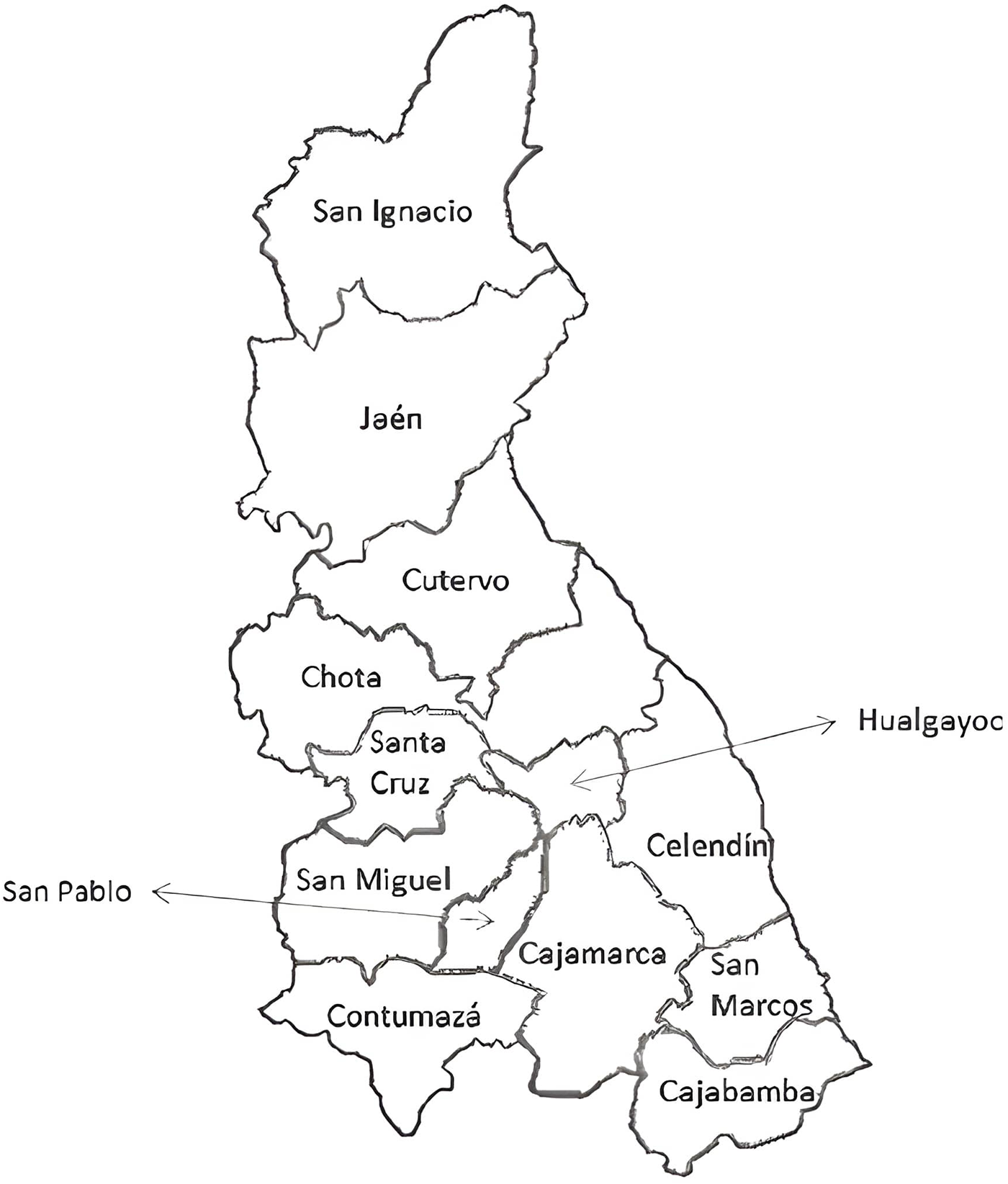
The department of Cajamarca in Peru’s northern highlands was not a remote subsistence enclave, despite being geographically distant from the centres of commercial and export development located along Peru’s northern coast (see Figure 2). From the mid-nineteenth century even the most apparently isolated provinces were integrated into the monetary economy, and participation in local and regional commodity markets was generalised amongst all social classes.Footnote 61
Provinces in the Department of Cajamarca

Figure 2 Long description
The map illustrates the provinces within the Department of Cajamarca in Peru. The provinces are outlined and labeled, including San Ignacio at the top, followed by Jaén, Cutervo, Chota, Santa Cruz, San Miguel, Contumazá and San Pablo. Hualgayoc is positioned to the right of Chota. Celendín, Cajamarca, San Marcos and Cajabamba are located towards the bottom of the map. Each province is distinctly marked, showing their geographical boundaries within the department.
In the 1870s, approximately 70 per cent of the population of the department were independent peasant smallholders, but haciendas controlled around two-thirds of the land, which was exploited through a variety of arrangements including sharecropping and labour and quit-rent tenancy.Footnote 62 There were virtually no Indigenous communities, communal landholding was extremely rare, and most peasants were Spanish-speaking.Footnote 63 Thus market relations and private property were well established before the expansion of coastal sugar plantations in the 1880s and 1890s.
The completion of a railway line from the port of Pacasmayo to Chilete in the Jequetepeque valley in 1871 and the construction of better roads linking Chilete with the highlands of the interior in the 1890s increased commercial connections and opportunities.Footnote 64 Cajamarca became a significant supplier of livestock and agricultural products to growing coastal markets, and the origin of an ever-increasing number of migrant workers to coastal rice and sugar estates.Footnote 65 The department’s population density doubled between 1876 and 1940.Footnote 66 This accelerated minifundisation among the independent peasantry, while on the estates increased market pressures contributed to widening class differences amongst a peasantry that was already considerably socially differentiated.Footnote 67 In this context, the need for cash, and the provision of rice and meat rations, which workers could not afford at home, were strong inducements to migrate to coastal plantations.Footnote 68
Indeed, the flow of workers to the coast increased substantially between the years 1883 and 1900 and by 1920 migration was a well-established part of the highland and lowland economies. For example, Taylor reports that approximately 80 per cent of the field hands on sugar estates on the coast were from the highlands – possibly 9,500 men from Cajamarca in 1915 and 12,500 in 1922.Footnote 69 Labourers from the province of Cajamarca in the department of the same name were contracted to work on plantations in the department of Libertad, such as Casa Grande, Roma and Cartavio in the Chicama valley. In Lambayeque plantations including Cayaltí and Pomalca contracted workers from Chota, and provinces further north.Footnote 70 Peasant smallholders were attracted to the coast for the wages, which were the highest available in the region, and for the flexible working arrangements.Footnote 71 For example, the account book of the enganchador Régulo Regulado, who supplied Pomalca with peons from Chota and Hualgayoc, shows that in 1920 he contracted 115 workers who stayed on the hacienda for between three and six months. They were paid 1.10 to 1.20 soles per task and were advanced quantities of between seven and 80 soles. The workers could choose how many days that they wished to work per week. The only stipulation was that they should make a minimum of 15 soles (the equivalent of 12–14 tasks) per month.Footnote 72 Plantations also attracted workers by providing housing, maize, rice, meat, milk and fruit and vegetables, and attempting to regulate the quality, prices and hygiene levels of the stores operated by third parties on the plantations. They even subsidised some goods in the period 1917–18 when inflation was high.Footnote 73
Institutions, Politics and Conflict in Cajamarca
The system of exchange in Cajamarca was highly monetarised and market forces increasingly drew workers to the coast; however, an institutional configuration capable of sustaining free market relations or guaranteeing property rights and contractual obligations was absent. Instead, arbitrary authority, personalised violence and patron–client relations infused daily economic and political interactions, and this situation intensified as commercial opportunities increased from the 1880s into the 1920s. As Taylor masterfully shows in Bandits and Politics in Peru: Landlord and Peasant Violence in Hualgayoc 1900–30, in the neighbouring provinces of Chota and Hualgayoc, which supplied workers to the sugar plantations of Lambayeque, a situation of ‘brigandage, commonly related to clan conflict’ existed which had ‘attained endemic proportions’ by the early twentieth century.Footnote 74 Central to such developments were the ‘role of clientage relations in social and political life … rooted in the landlord control of resources’, a context of increased commercial activity, and, crucially, the Chilean invasion during the War of the Pacific and the subsequent civil war of 1882 to 1885.Footnote 75 These conflicts brought economic ruin and precipitated ‘the collapse of an already chronically weak state, devoid of coercive powers and moral authority, [which] further encouraged the spread of lawlessness’.Footnote 76 The result was an upsurge of factional strife, politically motivated assassination, vendetta feuding, banditry and general criminality in the region, and ‘the collapse of the state as a source of law enforcement and coercion’.Footnote 77
In each town there operated two to three rival bands, allied at the departmental and provincial level with leaders who were normally the wealthiest and most important landowners and merchants, known as gamonales.Footnote 78 These men protected armed bandits, whose services they employed to further their personal and political interests. When a faction was in power the armed group with which it had developed ties effectively became an arm of ‘the state’.Footnote 79 According to Taylor,
This tendency to use control of official positions in order to arm supporters of the dominant band, confiscate weapons possessed by the opposing faction and harass them to the utmost in all walks of life, meant that there could be no pretence that the representatives of the state were neutral. Impartiality gave way to active intervention in partisan politics, thus further debilitating an already weak state at the local level by depriving it of any semblance of moral authority and legitimacy.Footnote 80
The dominant group usually managed to have one of its members appointed sub-prefect of the province, who then strove to have other followers named governors of the districts or lieutenant-governors in the parishes. These were in charge of taxation, labour for public works and military conscription, areas of jurisdiction which provided ample opportunity for graft, favouritism towards supporters and the punishment of enemies.Footnote 81 The struggle for local dominance was violent and authority was mostly exercised by individuals through control of a well-armed bandit group, rather than being an impersonal prerogative of the state.
Reports from Chota illustrate the way in which a weak state without legitimacy was unable to protect property, collect taxes, control public order or punish criminality. Following the end of the civil war that brought General Andrés Cáceres to the presidency in 1886, the sub-prefect reported that the province was in chaos, animosity between different factions remained strong and there was an urgent need to disarm the population.Footnote 82 He considered the establishment of a local security force to tackle widespread criminality and law-breaking to be an urgent necessity.Footnote 83 By July 1888 a rural police force was functioning in the region.Footnote 84 But three months later it had been disbanded.Footnote 85 Consequently, no taxes were collected in the province that year.Footnote 86 In 1889, the sub-prefect was to attempt to resume tax collection,Footnote 87 and was aided by troops drafted in from Hualgayoc.Footnote 88 Finally, in 1891, President Remigio Morales Bermúdez authorised the establishment of a rural police force to ensure the collection of taxes and the preservation of public order. Each province was to have five salaried policemen and one inspector under the command of a tax inspector and the political authorities.Footnote 89 Rural police were collecting taxes in the provinces of Chota as well as Cajamarca and Contumazá in the years 1892 to 1895.Footnote 90 However, their low numbers made it virtually impossible for the sub-prefects to police the provinces and systematically collect taxes.Footnote 91 Furthermore, they were subject to assaults by a peasantry still armed with weapons left over from the civil conflict of 1882–5.Footnote 92 Frequently, the district governors refused to co-operate with the police, and a number of inspectors lost all credibility by fleeing with the arms, horses and taxes belonging to the state.Footnote 93 Taxation became a weapon used to further personal and factional political interests, not a means to consolidate bureaucratic state power.Footnote 94
In 1898, a Cacerista revolt was eventually contained by the government of Miguel Iglesias that had returned to national power in 1895.Footnote 95 That year the sub-prefect complained that one of the principal problems was finding suitable candidates for the post of district governor and lieutenant-governor due to the terrible example of those above, who had ‘converted public office into a vehicle of oppression and despotism’, undermining authority and introducing disorder ‘with their abuses, exactions and acts of revenge, awakening resistance in those who obey, thus fomenting antagonisms and conflicts, without caring at all for the public good’. The problems of establishing any centralised authority were compounded by the absence of institutionalised political groupings. For, he wrote:
In the province … there are not really any political parties. [Instead] the well-known struggle between Montagues and Capulets, so graphically described by the renowned novelist [sic], are accurately reproduced here in real life. Groups in constant struggle, endless grudges, which suddenly pass from a latent state to blood-letting, once again to return to an apparent calm, only later to acquire the force with which to pursue and finish off the irreconcilable enemy. [This] is the never-ending history of this province, which has registered many sorrowful events over the years.Footnote 96
Little had changed since the end of the civil war 13 years earlier. Poor communications and the insufficiency of men and equipment was compounded by a lack of respect for the law amongst the population, the high incidence of criminality and violence, and the fact that district governors and their subordinates were reluctant to enforce the law, either due to fear of reprisals or because they were themselves in league with the criminals. The population was accustomed to not paying taxes and the authority in charge of collection tended to protect certain private interests at the expense of fiscal income.Footnote 97
Taylor argues that while such ‘institutionalised disorder’ throughout Cajamarca may at first sight appear to have been a provincial matter, in fact ‘… political quarrels unfolding at the national level jointed with local conflict to determine the contours of political and armed struggle’.Footnote 98 Peruvian politics was formally dominated by competition between parties, but in practice personal jealousies and ambitions rather than principles or ideology constituted the basis of political division. Thus, ‘like their local counterparts, parties in Lima were unstable coalitions headed by caudillos … [and/or] suffer[ing] from deep internal divisions caused by personal and family rivalries’.Footnote 99 In the National Congress, representatives of regional elites ‘gathered around national caudillos like Piérola, Cáceres and Durand, as well as leading politicians in the Partido Civil’. These parliamentary bosses (caciques parlamentarios) constituted a crucial connection between the national leaders and their provincial associates.Footnote 100 Consequently, even ‘if the dominance of Lima … went unchallenged, that dominance was only loosely imposed, so that the national state depended on local élites, delegating political functions, especially in the highlands, to gamonales’.Footnote 101 Each group was headed by a regional caudillo or gamonal who was allied to one faction or another at the national level.Footnote 102 The relative autonomy of such local power-brokers, according to Taylor, calls into doubt the degree to which the Peruvian state existed at all outside Lima, because it was in no way the monopolist of violence in a given territory.Footnote 103 Instead what existed was ‘a Hobbesian social climate, which … lacked the restraining presence of Leviathan itself’.Footnote 104
Such a political context inevitably impacted on property rights, investment and productive relations in Cajamarca. Land was an established commodity with large and small properties and part-shares put up for sale and rent, and many purchases financed with loans and mortgages. Ownership and boundaries were often contested, individual peasant smallholders frequently disputed territory with neighbouring estates and fellow smallholders, while families regularly fought over the inheritance of increasingly subdivided plots of land. However, the courts failed to deliver justice or resolve quarrels.Footnote 105 The lack of secure property rights damaged levels of investment. Thus, the development of the commercial economy was ‘more due to the variety of commodities than … to its output’. Technology was basic, and low productivity was compounded by the ‘… subdivision of rural property, to such a degree that … there is perhaps not one inhabitant of this province who is not the owner of a small piece of cultivated land, often less than una área [100 m2]’. Minifundisation resulted in over-farming, soil exhaustion and reduced yields. Capital was extremely scarce, and the high levels of distrust and factionalism discouraged lending, investment and the establishment of commercial associations.Footnote 106
Political conflict and instability also affected labour conditions and contractual arrangements on the haciendas. Gamonales provided workers with land and protection in return for entering their band of dependants, drawing them into factional conflicts.Footnote 107 Thus political events at the national level directly influenced local agrarian relations.Footnote 108 For example, in 1886, following the end of the 1882–5 civil war, peons on a number of highland haciendas appealed to the state authorities for protection from the abuses of landowners, renters and overseers. On the Porcón hacienda workers complained to the sub-prefect of Cajamarca that since Paula Iturbe had taken over the lease of the estate they had not been paid their wages and they had been treated badly by the overseer (mayordomo).Footnote 109 Workers from the Llaucan hacienda complained to the sub-prefect that they were subject to forced labour, the violent confiscation of livestock, imprisonment and beatings by the leaseholders of the property. They had not complained before because those responsible had had the support of the previous military and political authorities.Footnote 110 The same year, the administrator of the Jerez hacienda in the district of Sorochuco, along with an armed party of renters (arrendatarios), stole the livestock of one of the peasants on the property, killed his mother, injured his sister and kidnapped his father. However, due to the personal friendship between the administrator and the local lieutenant-governor, the sub-prefect’s orders to arrest the culprits were ignored, the case was not pursued in the courts, the livestock was not returned to the victim, and his father was not released from the hacienda.Footnote 111
Forced labour and the use of corporal punishment, including whippings and the stocks, were common.Footnote 112 So was the kidnapping and imprisonment of peasants and their children by hacienda owners (hacendados), arrendatarios and administrators.Footnote 113 According to the sub-prefect of Chota, on the haciendas, the administrators and overseers:
… commit in this province unspeakable abuses [but any] attempts to respect the individual rights of the Constitution run into the insurmountable obstacle of not being supported by the Judiciary … and finally, the administration of justice in this province is totally lacking the honesty and impartiality with which it should be distinguished … handing down blatantly unjust and illegal judgements, letting delinquents go free and charging the innocent.Footnote 114
The lack of judicial impartiality, qualified judges and due process, and the existence of impunity, errors and irregularities, unjust imprisonment and the frequent release of dangerous criminals was due to the way in which local families monopolised all the political and juridical posts in one location, in order to further their own interests.Footnote 115 Consequently, such abuses remained largely unpunished, the victims frequently went into hiding and were too scared to prosecute the perpetrators, knowing that the chances of achieving justice were low and those of retaliation high.Footnote 116
The absence of a state apparatus capable of implementing the law or settling agrarian disputes had the effect of reinforcing patron–client relations, factionalism and private vigilante justice into the 1920s and beyond.Footnote 117 As Taylor points out, the high degree of peasant engagement in commercial activities increased the contact smallholders had with landowners and merchants, which cemented close patron–client ties and heightened peasant involvement in banditry and factional conflicts.Footnote 118 On the estates, loyal peasants, who were rewarded with opportunities for economic advancement, constituted a source of trusted dependants from whose ranks a hardcore of armed retainers could be recruited.Footnote 119 Thus, widening class differences among peasants strengthened patron–client relations and fuelled conflict.Footnote 120 Furthermore, highland merchants and landlords – gamonales – who competed to control the largest share of the expanding regional trade, engaged in factionalised violence as a means to further their entrepreneurial ambitions.Footnote 121 These gamonales were precisely the individuals who became enganchadores to coastal sugar plantations in the period after 1880.
Enganche and enganchadores
When enganche started after the War of the Pacific, there were no effective state institutions capable of enforcing labour contracts, although there were some administrative efforts to implement legislation after 1885. For example, in 1886, the departmental authorities sought to have all rural and urban workers registered with the provincial governments because, wrote the prefect of Cajamarca, it was the duty of the authorities ‘to protect the agricultural sector by stopping the constant flight of workers from one estate to another, making a mockery of their masters and frequently taking their money; and [therefore] to prevent laziness and vagrancy’.Footnote 122 According to the legislation, before they could change employers, workers needed to have a pass certified by the sub-prefect attesting that they did not owe any money, or face a fine. Hacendados who took on workers without a certified pass would also be fined.Footnote 123 However, the law was only ever applied in a few districts of the department, and after two months it was declared an illegal form of taxation and suspended.Footnote 124 In 1891 a new police code sought to register peons with the local police inspector to prevent indebted workers from leaving estates, to discourage hacendados from employing them and to ensure payment of the head tax.Footnote 125 But, after the National Congress abolished the head tax throughout the republic in December 1895, the rural police force was dissolved in Cajamarca.Footnote 126
By 1898 approximately 4000 labourers were migrating yearly from the province of Chota to Chiclayo and Pacasmayo to work for periods of three to six months on the large haciendas.Footnote 127 That year, the sub-prefect considered that the enganche of peons from Chota to Lambayeque and La Libertad had become ‘one of the principal industries of the province’ which brought in between 4000 and 6000 soles of trade per month. Therefore, he opined, the state should intervene ‘to protect this industry, subjecting both masters (patrones) and peons to a system of regulation that it would be necessary to formulate’. The former, he noted, suffered losses when the latter failed to fulfil the commitments that they had voluntarily contracted. Peons, on the other hand, were subject to onerous demands by hacendados and labour contractors in order to reduce the loss of money that they lent out as wage advances. However, he lamented, in most cases he was helpless to intervene ‘as it was a matter outside the jurisdiction’ of his office.Footnote 128
Labour contracts were legal documents.Footnote 129 But they were not enforced by the judicial system or the police.Footnote 130 Rather, they were enforced by enganchadores, who also often collected taxes from workers on behalf of state officials.Footnote 131 If a peon did not complete his contract, he was pursued by the enganchador’s enforcers (capataces), who liaised with sympathetic authorities to enforce contractual obligations and loan repayment.Footnote 132 Sometimes enganchadores themselves held public office. For example, Don Génaro Ugarte Negrón, who was the most important enganchador in Jesús between 1910 and 1945, was governor in 1915, municipal president in 1917, and mayor in 1925.Footnote 133 However, an officeholder’s authority, ‘flowed from … strength of personality and status in the community (usually involving a willingness to use firearms) rather than legitimacy invested via their public position’.Footnote 134 Therefore, it was not the bureaucratic state, but rather gamonales – sometimes directly and sometimes through the control they exercised over access to public office – who guaranteed the labour system on the coast.
In this system of labour recruitment, market and non-market incentives were tightly entwined. Frequently, workers – driven by poverty and the lack of alternatives for generating comparable cash incomes in the highlands – approached labour contractors and, during periods of depressed demand, labour contractors could choose the men they considered most loyal and hard-working.Footnote 135 However, enganchadores could also oblige peasants indebted to them for products they bought on credit in their stores to subsequently work off the debt on distant plantations. Furthermore, competition for workers between enganchadores, especially in times of high demand, could lead to greater coercion and trickery. For example, in 1918 a number of workers from the town of Jesús in the province of Cajamarca complained to the prefect about the ‘arbitrary manner whereby many labour contractors … have arrived, and taken advantage of the drunkenness of peons in order to make them wage advances, when they had already contracted with others, [then] they have pursued them aggressively to make them fulfil the contractual obligation, illegally’.Footnote 136 Competition for workers did not make coercion unnecessary; rather coercion was leveraged as a strategy of competitive advantage.
Enganchadores also sent tenants and sub-tenants from their highland properties to work off their labour obligations on coastal plantations.Footnote 137 For example, in 1912 Eduardo Tiravante, whose family had been contracting peons for over a decade, promised to supply Pomalca with at least 200 men from Chota and his Churucancha hacienda for four years.Footnote 138 In 1917 the contract was renewed for five years and the number of peons increased to 250 from Chota, Churucancha, and another hacienda, Mollebamba.Footnote 139 Indeed, enganchadores purchased properties in the highlands specifically for this purpose, sometimes with the financial backing of sugar planters. For example, the Aspíllagas of Cayaltí helped José Santos Medina Cedrón from Bambamarca acquire the lease to the Hacienda del Colegio in Chota with the aim of securing 100 more workers for the sugar plantation.Footnote 140 In this way, enganchadores made cash profits from monetarising their tenants’ rental obligations in the highlands and selling them to the export sector on the coast.
The system of enganche evolved over time but not in a straight linear direction from non-monetary towards monetary incentives. For example, the enganche of workers to the Cayaltí plantation in Lambayeque first started in 1882, when Augusto Hoyos Osores received money from the owners to contract peons from the district of Huambos in the province of Chota. He was made responsible by the Aspíllagas for ensuring that the workers completed their contracts.Footnote 141 In 1886 Medina Cedrón from Bambamarca also began to contract workers for the plantation.Footnote 142 However, in 1889, labourers from the highlands still only made up around 14 per cent of the workers, and the owners wished to increase their numbers.Footnote 143 Medina Cedrón informed them that many workers were unwilling to return due to the poor working conditions. Keen to keep working with Medina Cedrón, who contracted workers with his own capital, and to make the necessary shift from servile Chinese to salaried Peruvian labour, the owners ordered an investigation.Footnote 144 Subsequently, the plantation reduced the use of corporal punishment and introduced cash bonuses.Footnote 145 In 1892, the Aspíllagas suggested that Medina Cedrón employ an overseer on the hacienda to prevent workers from fleeing before they had repaid their wage advances. From this point on, it became generalised on Cayaltí and other plantations for enganchadores to appoint trusted employees to ensure worker discipline, instead of the plantation owners directly employing overseers, as they had with Chinese indentured labour.Footnote 146 Coercion was thus not abolished, but contracted out to third parties and deployed alongside market incentives.
What is more, the Aspíllagas considered that too much free competition could impede rather than aid labour recruitment to the plantation, so they endeavoured to boost the power and monopolies of local gamonales. For example, in 1892, one of the Aspíllaga brothers travelled to the highlands to discuss ways of improving the system of labour recruitment. He noted that the regions of Chota and Hualgayoc had much potential as sources of labour because local agriculture was very poor and the mining sector in decline. But there was a lot of competition from sugar and rice haciendas located nearer to the highlands. Consequently, he opined it was necessary to have an ‘active local man’ to manage labour recruitment for whom enganche offered a ‘first class’ business opportunity. For example, Medina Cedrón was the principal trader in Bambamarca; he sold goods on credit to the workers he contracted for the Cayaltí plantation, consequently ‘win[ning] from all sides, even through the enormous mark-up with which he sells his merchandise’.Footnote 147 Enganchadores also profited from supplying meat or other goods to the plantations and operating stores (tambos) where workers could purchase products.Footnote 148 However, the main way that enganchadores profited from labour contracting was via a commission of 15–25 per cent of the wages of the workers they supplied, the exact percentage depending on whether they used their own capital or that of the plantation.Footnote 149 Planters were willing to pay a high price for workers because, as the Aspíllagas of Cayaltí euphemistically remarked, peons from Chota and other provinces in Cajamarca could be contracted only by gamonales from the area, who ‘know and understand its complexities’.Footnote 150
One such ‘active local man’ who certainly knew and understood the complexities of Chota was the gamonal and ‘brigand’, Eleodoro Benel, later notorious for violently resisting attempts to centralise state power during the presidency of Augusto B. Leguía (1919–30). In 1911, Benel signed a contract with the Aspíllagas to contract workers for Cayaltí. He produced a wide variety of commodities on his properties and owned various shops in the towns of Bambamarca, Chota, Hualgayoc and Santa Cruz. The wage advances he made to workers came from his own capital, much of which was lent in the form of store credit for goods that he had produced or imported, and he received a commission of 25 per cent from the plantation on the wage advances he made.Footnote 151 Thus, writes Taylor, ‘through a mixture of a wide network of contacts, ruthlessness and entrepreneurial skill that enabled him to integrate intelligently four different branches of business – agriculture, commerce, labour and tax collecting – Eleodoro Benel was able to take good advantage of the favourable commercial conjuncture between 1900 and 1920’.Footnote 152 By 1915, he had become one of the most important labour contractors in the province of Hualgayoc, not least because he had a large political clientele and ‘possessed the necessary military muscle to force any recalcitrants quickly back into line’.Footnote 153 In many ways, Benel was an archetypal gamonal/enganchador. Like him, some owned or rented large estates, others were medium-sized landowners and/or merchants. Rather than feudal landlords, all were entrepreneurs, engaged in a wide variety of economic activities, who were primarily driven by capital accumulation rather than seigniorial privilege.Footnote 154 But the means they used to pursue profits included banditry, armed assault, political assassination, patronage, and the exercise of moral, patriarchal and community authority as well as market incentives.
Another enganchador and hated rival of Benel’s was Catalino Coronado, who became sub-prefect of Chota in 1918.Footnote 155 In 1917 he signed a contract to supply approximately 200 peons to the Pátapo hacienda in Lambayeque (which merged with Pucalá in 1924) and to provide an agent to watch over them paid for by the plantation. In exchange he was supplied with money for wage advances and paid 15 per cent commission per worker per day. Workers received a daily wage of one sol, which was discounted against the original advance. If they failed to complete the contract, they were charged interest of 25 per cent on the loan. The advances were usually paid to family members in the highlands, who also served as guarantors. Frequently, a part of the advance was paid not in cash, but in tokens valid only in Coronado’s commercial establishments. He also lent money at 2 per cent interest per month, traded in debts, and was known to illegally confiscate land and violently force family members to pay outstanding loans.Footnote 156 He had close patron–client ties to violent bandits and employed sub-contractors from his entourage to ensure the peons fulfilled their contractual obligations. However, coercion was only one facet of the non-market incentives he used. Indeed, according to Rodríguez Doig, Catalino Coronado was perceived as a benefactor and a patron, whose authority was based upon the ability to resolve peasants’ material needs as well as to force obedience through political and legal patronage and naked violence. He was able both to reach peasant families who needed cash but would have been reluctant to send men to the coast if it was not for his personal offer of a wage advance, and to increase the probability that the loan would be repaid.Footnote 157 Nevertheless, between 1920 and 1923, 533 of his peons ran away from the Pátapo hacienda owing between 50 and 100 soles each. Most either fled to the army or rival armed bands, where they could not be captured or punished by Coronado. In their absence, family members were frequently made liable for repayment.Footnote 158 By 1958 Coronado had accumulated at least 27 rural properties in Chota and 42 urban properties which he rented out, as well as valuable commercial assets.Footnote 159
Plantation owners often granted individual enganchadores monopoly rights to contract workers in a specific area, but labour contractors who worked for different plantations competed against each other to recruit workers from the same area.Footnote 160 On the Pomalca plantation, there were as many as 36 labour contractors employed in 1920.Footnote 161 These included Régulo Regulado, Oswaldo Hoyos Osores, who stood for election as deputy in Chota on the Civilista slate in 1919, and Cecilio Montoya, who contracted peons from Huambos, Cochabamba and Querocoto.Footnote 162 Both Montoya and Hoyos Osores belonged to families that had been involved in the enganche of peons to the coast for decades.Footnote 163 This included Isabel Hoyos, who in 1900 took over the contract that her late husband had had to send workers from Bambamarca to Pomalca.Footnote 164 Bound by ties of blood and marriage, as well as patronage and violence, these clans, like that of the ‘brigand’ Pedro Nolasco Aguinaga, who contracted peons for Pomalca from the province of Santa Cruz, were sworn enemies of Eleodoro Benel.Footnote 165 On the one hand such factional conflicts strengthened family-based loyalties and relations of patronage between leaders and peasants; on the other hand they provided a means by which workers could avoid their contractual obligations on the coast by fleeing from one band to another. In neither case was the result favourable to the consolidation of stable political institutions or a free market in labour.
Sometimes enganchadores to the same plantation worked together to protect their common interests against the free play of supply and demand. For example, on Pomalca in 1908, José Mercedes Valera, Roberto Delgado from Lajas and Natalio Piedra from Cutervo hired an overseer to jointly manage their workers’ accounts and keep a record of runaways. They agreed to work together to pursue runaways, not to hire one another’s peon unless he had first paid off his account, and to prevent those who had done so from moving to other plantations. Instead, they would be obliged to stay on as ‘free’ workers or libres on Pomalca.Footnote 166 The number of ‘libres’ had grown steadily after 1900.Footnote 167 But these workers were not free to move to other plantations in response to wages and demand, and the contractors who had originally brought them to the plantation continued to receive a daily commission of 10 per cent of their wages.Footnote 168 The proportion of indebted labourers fell over time and the workforce became more permanent.Footnote 169 However, the definition of free wage labour was not always clear and indebtedness, paternalism and coercion in the highlands continued to impact on the development of the labour market even after workers had moved to the coast.
Sugar planters relied on the ‘collusion’ and services of enganchadores and local officials both in the highlands and the coastal region to ensure labour recruitment and control. Such reliance highlights the political weakness of the coastal elite and the failure of an independent national state to consolidate in this period beyond local and regional hegemonies. Indeed, it can be argued that the enganche of workers to the coast enabled gamonales from the highlands to accumulate resources that underpinned their autonomy from the national government and fuelled violent conflicts between rival families. In this circuit of accumulation, the ‘centre’, if it existed at all beyond rival factions in Lima, nurtured the ‘periphery’, regions and localities captured ‘national’ state power, and ‘traditional’ non-market mechanisms of labour control constituted integral aspects of proletarianisation and capitalist modernisation.
In the 1920s, to neutralise the local power of gamonales in Cajamarca, President Leguía carried out a purge of public officials associated with the Partido Civil, excluding from power the ‘web of patronage’ of a number of caudillos, notably Benel.Footnote 170 In the following years violent opposition to Leguía’s reforms reached such proportions that a situation of ‘open rebellion and generalised civil war’ developed in Cajamarca.Footnote 171 Some gamonales allied with Leguía and occupied posts in the state bureaucracy, which remained highly corrupt, personalist and nepotistic, while others, among them Benel, became drawn in to plots to assassinate the president.Footnote 172 After Benel’s death in 1927 at the hands of the army and the newly formed Guardia Civil, banditry was reduced to a much smaller scale in Cajamarca,Footnote 173 and political power was increasingly derived from connections with the government bureaucracy rather than control of a private army. However, one should not over-emphasise the growth of centralised state power.Footnote 174 Provincial gamonal and national oligarchical power co-existed in a complex formation, while enganche continued to supply considerable numbers of workers to sugar plantations until the 1950s.Footnote 175 According to Drinot, during Leguía’s oncenio (1919–30) the presence of the state and its coercive powers increased and a more progressive vision was advanced, but practices of state rule were little changed, as was the economic structure of the country, although the presence of foreign capital and levels of corruption increased.Footnote 176 Leguía’s rule may have been the most ‘bourgeois’ expression of power in Peru’s history, but it still failed to integrate the nation or consolidate the state.Footnote 177 Indeed it is unclear when (or even whether) a rational-bureaucratic state ever consolidated in twentieth-century Peru.
Conclusion
Despite the wealth and political influence of sugar planters, the Peruvian state was unable to enforce labour contracts or oversee enganche in the highland department of Cajamarca in the period 1880 to 1930. This situation, as Taylor argues, was the product of both national and regional political processes, and a reflection of the chronic institutional weakness of the Peruvian state, which had to rely on local power brokers (gamonales) to govern in its place.Footnote 178 As a direct result, instead of an institutional configuration capable of protecting property rights, guaranteeing contracts, upholding public order or implementing taxation, bandits and outlaws constituted the agents of law enforcement as well as the tools of factional politics and unchecked conflict. Modern capitalist relations could barely flourish in such a context. Nevertheless, at the same historical juncture, the department became ever more tightly drawn into a transnational circuit or corridor of accumulation, which connected it to coastal export agriculture and international commodity markets.Footnote 179
Global capital increasingly industrialised the sugar sector, but capitalist rationality and relations did not diffuse seamlessly from the coast to the highlands. Instead, they were mediated by local structures of power and systems of incentives – both monetary and non-monetary. Within these ‘geographies of accumulation’,Footnote 180 patronage, paternalism and the violent coercion of workers and their families contributed to economic modernisation on the coast. Pivotal to the labour system were enganchadores – landowners, merchants, monopolists and entrepreneurs, who via networks of overlapping monetary, moral and coercive mechanisms linked highland labour to coastal sugar plantations and bridged merchant and industrial capital, and commodity and subsistence production. Paradoxically perhaps, by increasing the wealth, power and prestige of anti-state actors – gamonales and the bandits they patronised – market growth on the coast weakened the consolidation of a modern state in the highlands for decades. Thus, instead of free markets and liberal citizenship, hybrid markets and ‘bandit citizenship’ developed in Cajamarca from the 1880s and the situation did not definitively change until well beyond the end of Leguía’s oncenio in 1930.
North noted that in a context where the state is weak and contracts and property rights are not assured by an effective juridical apparatus, patron–client relations or violence by private groups reduce transaction costs.Footnote 181 But, does this institutional configuration precede or impede capitalist modernisation? For Washbrook, studying an economic and political system in early modern South India, with a remarkable number of structural similarities to nineteenth-century Cajamarca, it did neither, but rather constituted part of the hybridity which characterises global processes of capitalist modernisation more generally.Footnote 182 In Cajamarca, the system of enganche to coastal sugar plantations, which were fundamental to Peruvian processes of modernisation, is an example of such hybridity – both market-driven and underwritten by the patronage and violence of bandits, outlaws, and rural strong men (and women) from the highlands. However, the conceptual dichotomy between market and non-market incentives, a teleological view of capitalist transition, a state-centred definition of coercion, and a focus on coastal plantations rather than circuits of exchange between the highlands and the coast has tended to obscure the integral part that non-monetary incentives had in the process of proletarianisation in Peru’s coastal sugar industry in the years after 1880.
Acknowledgements
I would like to thank Alan Knight for supervising this research during my British Academy postdoctoral fellowship at the Latin American Centre, St Antony’s College, Oxford, Rosemary Thorp for arranging logistical support in Peru, and the manuscript reviewers for important insights and comments. A special thanks also goes to my father, David Washbrook, for some timely posthumous inspiration. I dedicate this article to him.

 Open access

