

The Middle Horizon (AD 600–1000) was a time of profound socioeconomic change, shaped in part by the Wari state, the most expansive pre-Inka imperial project in the Andes. The Wari are traditionally described as a first-generation empire that established colonies and state-administered sites far beyond their Ayacucho heartland (Isbell and McEwan Reference Isbell and McEwan1991; Schreiber Reference Schreiber, Alcock, D'Altroy, Morrison and Sinopoli2001; Figure 1). Here we examine Wari political economic strategies that financed state projects across such vast geographic distances. Studies suggest that they made special efforts to control key trade routes where access to exotic goods and prestige items was used to maintain class differentiation and legitimize rulership (Earle and Jennings Reference Earle and Jennings2012; Isbell Reference Isbell and Jennings2010; Rosenfeld et al. Reference Rosenfeld, Jordan and Street2021). At this time, obsidian served as both a precious material and a common domestic item that was transported in greater quantities and distances than ever before identified in the Andes, largely through Wari networks (Burger et al. Reference Burger, Mohr Chávez and Chávez2000; Burger and Glascock Reference Burger and Glascock2009; Williams et al. Reference Williams, Dussubieux, Nash, Liritzis and Stevenson2012). Using obsidian provenance analysis, we investigate both top-down political economic strategies of the Wari and bottom-up processes of regional exchange outside state control.
Map of significant Middle Horizon and Wari sites in Peru. (Color online)

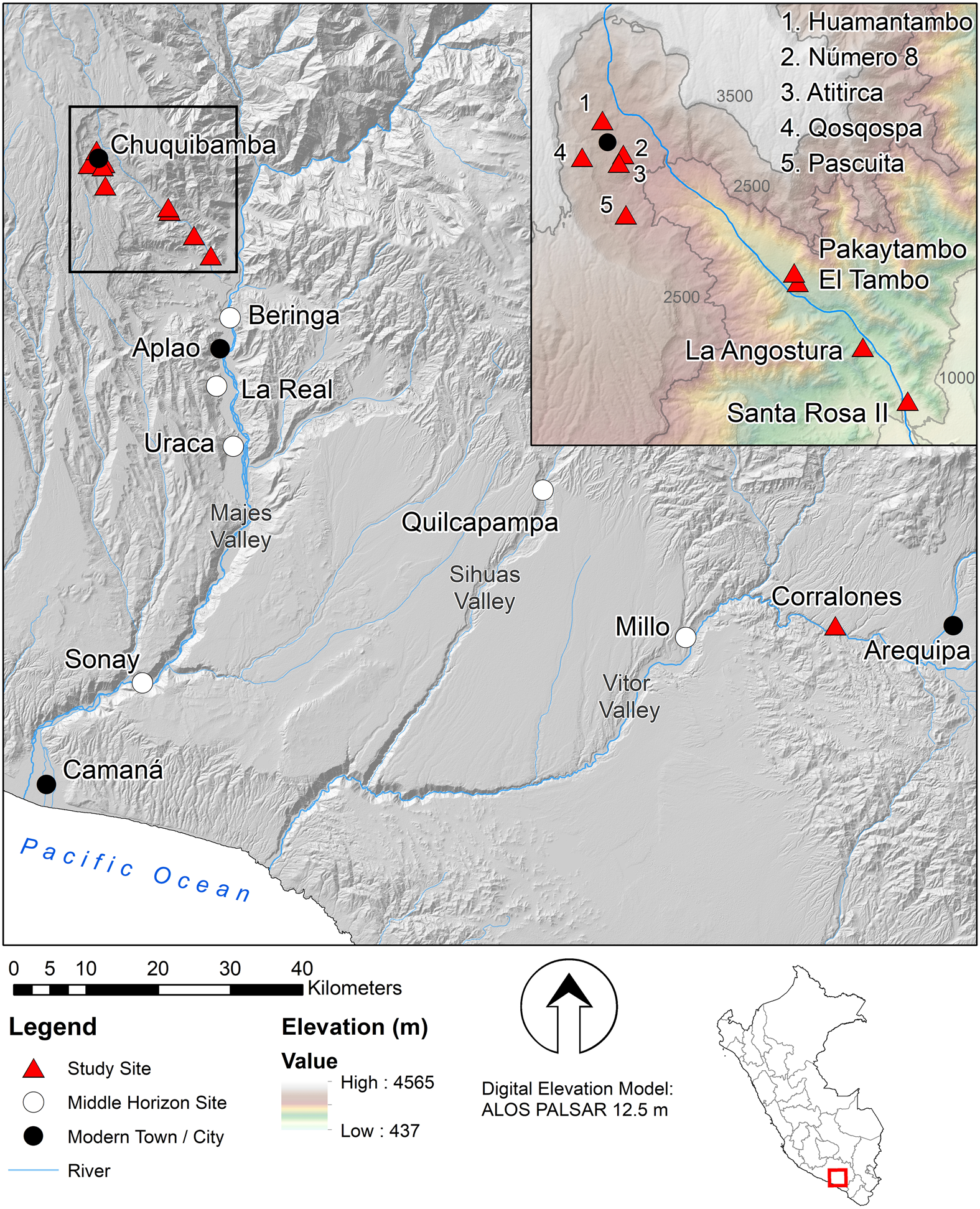
We report the geochemical analysis of 383 obsidian artifacts from 10 Middle Horizon sites located in the modern department of Arequipa, Peru (Figure 2). The majority of these sites correspond to the late Middle Horizon (ca. AD 800–1000) during the apogee of Wari imperialism when state projects and colonies proliferated (Reid Reference Reid2023; Schreiber Reference Schreiber, Alcock, D'Altroy, Morrison and Sinopoli2001; Williams Reference Williams2001). Arequipa has traditionally been considered part of Wari's southern periphery (Lumbreras Reference Lumbreras1974) and served as a crossroads between the state heartland in Ayacucho and Wari's southernmost holdings in Moquegua (Williams Reference Williams and Young-Sánchez2009). Although the department of Arequipa contains two of the three major Peruvian obsidian sources used in the past, as well as several minor sources (Glascock et al. Reference Glascock, Speakman, Burger, Glascock, Speakman and Popelka-Filcoff2007), little is known about obsidian use in the region and its role in regional political economies. In contrast to viewing the Middle Horizon as a monolithic or homogeneous period, we trace how obsidian use changed during the Middle Horizon with the entrance of Wari state actors into Arequipa (ca. AD 800–1000) and during the subsequent Terminal Middle Horizon (ca. AD 1000–1100) when state centers were abandoned yet communities continued to engage with Wari ideas and material culture.
Map of Arequipa study sites. (Color online)
Wari Political Economy
Political economies are intrinsically tied to various forms of power through which state projects are funded and maintained. Comparative archaeology illustrates the differences between highly centralized state economies and more heterarchical organizations based on collective action (Blanton and Fargher Reference Blanton and Fargher2008; Smith and Schreiber Reference Smith and Schreiber2005). Andean political economies are typically assessed in terms of Inka staple and wealth finance as defined in the seminal work of D'Altroy and Earle (Reference D'Altroy and Earle1985). Under staple finance, polities intensified the production of everyday stuffs and agricultural goods to support state institutions and activities. Related infrastructure such as roads, storage facilities, and administrative centers enabled the redistribution of surplus resources where needed. In contrast, wealth finance strategies focused on the production and acquisition of prestige and high-value items. These materials were often imbued with ideological power and were distributed to elites in exchange for their collaboration and fulfillment of political duties to the state (DeMarrais et al. Reference DeMarrais, Castillo and Earle1996).
Wari expressions of power varied on a regional and temporal basis as related to oscillating processes of state development, expansion, consolidation, and ultimate dissolution (Schreiber Reference Schreiber1992). Strategies of Wari staple finance were most apparent in regions under direct state control, especially within the Ayacucho heartland where agricultural intensification maintained incipient urban populations. Outlying Wari centers were also transformed by terrace agriculture and canal construction as part of a Wari-built landscape (McEwan and Williams Reference McEwan, Williams and Bergh2012). Given the infrastructural limitations of first-generation empires, the Wari likely used practices of “mediated” or “negotiated” rule, relying on local elites and social institutions, such as ayllu or kinship-based corporate groups, to mobilize corvée labor for state projects (Dillehay and Wernke Reference Dillehay, Wernke and Yoffee2019; Sandweiss and Reid Reference Sandweiss and Reid2016). Consequently, staple finance was not an entirely secure or feasible strategy in areas of local resistance or where direct Wari presence was minimal or nonexistent.
In regions where Wari control was indirect or hegemonic, the Wari may have relied on wealth finance strategies (Earle and Jennings Reference Earle and Jennings2012). Wealth finance entails the circulation of high-end goods linked to ideological systems of prestige, hierarchy, and religion. State elites may attempt to control the chokepoints within commodity chains of high-end items either in the acquisition, production, or distribution stages (Earle and Jennings Reference Earle and Jennings2012:214–215). Evidence suggests the Wari attempted to control key trade and mobility routes (Isbell Reference Isbell and Jennings2010; Reid Reference Reid2020) and secured access to materials of ideological significance such as Spondylus and obsidian (Glowacki and Malpass Reference Glowacki and Malpass2003; Rosenfeld et al. Reference Rosenfeld, Jordan and Street2021; Topic and Topic Reference Topic, Topic and Jennings2010). Wari enclaves found within niche ecological zones suggest that colonization efforts were in part aimed at acquiring exotic resources not found within the Ayacucho highlands. For example, the Wari established Espíritu Pampa on the eastern slopes of the Andes where they could acquire Amazonian goods, including fanciful feathers, coca, beeswax, and hallucinogenic plants (Fonseca Santa Cruz and Bauer Reference Fonseca Santa Cruz and Bauer2020). Likewise, Wari settlements in the coastal valleys of Nasca and Majes may have facilitated the production of cotton and coca (Conlee et al. Reference Conlee, Kellner, Walker and Noriega2021; Edwards and Schreiber Reference Edwards and Schreiber2014; Goldstein Reference Goldstein2010).
Trade items often extend beyond a polity's political boundaries in ways that complicate models of state power. Wari materials were often “bundled” with “physical items, ritual practices, and the meanings exercised through them” (Lau Reference Lau2012:30) and included Spondylus, greenstone/turquoise figurines, ceramic polychrome vessels, textiles, and obsidian. Such processes relate to bottom-up socioeconomic strategies through which locals may have emulated or co-opted an “international Wari identity” for their own purposes (Isbell Reference Isbell and Jennings2010:248). Thus, the circulation of wealth items can co-occur under and outside Wari control, especially in frontier settings. It is unclear to what extent Wari interfered in more traditional realms of exchange such as “down-the-line” trade or reciprocal barter relationships that linked ecological zones and communities. However, it is likely that state-affiliated llama caravans were employed to maintain connections between Wari centers responsible for the transport of exotic goods between distant regions (Edwards Reference Edwards, Clarkson and Santoro2021; Rosenfeld et al. Reference Rosenfeld, Jordan and Street2021).
The Role of Obsidian in Wari's Political Economy
Obsidian was a major component of Wari's political economy and is often used as a proxy for Wari–local interaction. Located about 120 km from Wari's capital, Quispisisa was the preferred obsidian source in Ayacucho due to its high-quality and large-sized nodules (Burger and Glascock Reference Burger, Glascock, Isbell and Silverman2002; Tripcevich and Contreras Reference Tripcevich and Contreras2011). Quispisisa obsidian comprised nearly the entire assemblages at the capital and at the secondary center Conchopata (Burger et al. Reference Burger, Mohr Chávez and Chávez2000, Reference Burger, Bencic and Glascock2016; Kaplan Reference Kaplan2018; Wistuk Reference Wistuk2019; Figure 3). The geographically dispersed nature of Andean obsidian sources made it impossible to directly control any singular source (Jennings and Glascock Reference Jennings and Glascock2002). Instead, Wari obsidian trade items were widely distributed in the form of large or “oversized” lanceolate obsidian bifaces/preforms and Wari “laurel leaf” points.
Map of obsidian sources of the south-central Andes in relation to the study region (box) and capitals of the Wari and Tiwanaku states.

Lithic tool and ornamental production may have been centralized by the Wari state, given evidence of lithic specialists at the capital as noted by MacNeish and colleagues (Reference MacNeish, Nelken-Terner, Vierra, MacNeish, Nelken-Terner and Vierra1980:14), who described three compounds: one associated with turquoise ornament manufacturing, a second with large quantities of debitage including obsidian, and a third containing hundreds of finished projectile points but no lithic waste debris. Mass production of projectile points and bifaces would have been necessary to support Wari's militaristic campaigns of expansion (see Tantaleán Reference Tantaleán2013). Obsidian may also have possessed other symbolic qualities, especially as an accoutrement of the warrior class (Goldstein Reference Goldstein2010:61). The state may have distributed obsidian raw materials or tool blanks to second-tier centers and non-Wari communities as a form of institutionalized reciprocity, as hypothesized in Moquegua (Nash Reference Nash2022; Williams et al. Reference Williams, Reid, Nash, Chacaltana, Costion, Goldstein, Sharratt, Riebe and Feinman2022).
Arequipa Obsidian
The first Andean obsidian provenance analyses were conducted in the 1970s by Burger and Asaro (Reference Burger and Asaro1977, Reference Burger and Asaro1978). Numerous studies across 12,000 years of the Andean past and using various analytical instrumentation have since identified three major obsidian sources and several minor sources that were predominantly used in Peru and the Bolivian altiplano (Figure 3). Of the three major sources, Alca and Chivay are found in the department of Arequipa (Brooks et al. Reference Brooks, Glascock and Giesso1997; Burger, Asaro, Salas, and Stross Reference Burger, Asaro, Salas and Stross1998; Burger, Asaro, Trawick, and Stross Reference Burger, Asaro, Trawick and Stross1998; Jennings and Glascock Reference Jennings and Glascock2002; Rademaker et al. Reference Rademaker, Glascock, Kaiser, Gibson, Lux and Yates2013, Reference Rademaker, Glascock, Reid, Zuñiga and Bromley2021), and Quispisisa in Ayacucho (Burger and Glascock Reference Burger, Glascock, Isbell and Silverman2002; Tripcevich and Contreras Reference Tripcevich and Contreras2011).
Arequipa's highland zones contain a complex volcanic geology that resulted in several geochemically distinct obsidian sources. Obsidian was initially reported near the modern town of Alca in the Cotahuasi Valley (Burger, Asaro, Trawick, and Stross Reference Burger, Asaro, Trawick and Stross1998), and further geological investigations defined six Alca subsources (Rademaker et al. Reference Rademaker, Glascock, Kaiser, Gibson, Lux and Yates2013, Reference Rademaker, Glascock, Reid, Zuñiga and Bromley2021). Alca-1 was matched to the initial “Cusco Type” defined by Burger and Asaro (Reference Burger and Asaro1977) and was the dominant Alca subsource used in the past. The minor sources Anillo (Tripcevich Reference Tripcevich, Capriles and Tripcevich2016) and Sayrosa (Burger et al. Reference Burger, Tsurumi, Boulanger, Rademaker, Bélisle and Glascock2022) are also found in Alca's immediate region. Of these multiple sources, only Alca-1 and Alca-4 demonstrate extensive bedrock outcrops with large nodules of high-quality volcanic glass up to 30 cm in size.
Middle Horizon obsidian use in Arequipa reflected broader sociopolitical trends as the region became a frontier between the Wari and Tiwanaku states (Cardona Rosas Reference Cardona Rosas2002). Alca-1 obsidian was transported across Wari networks as far north as Huamachuco (Burger et al. Reference Burger, Mohr Chávez and Chávez2000; Burger and Glascock Reference Burger and Glascock2009), to the eastern Amazonian slopes of Vilcabamba (Fonseca Santa Cruz and Bauer Reference Fonseca Santa Cruz and Bauer2020), and to Peru's far south in Moquegua (Burger et al. Reference Burger, Mohr Chávez and Chávez2000; Reid, Goldstein, and Williams Reference Reid, Goldstein and Williams2022; Williams et al. Reference Williams, Dussubieux, Nash, Liritzis and Stevenson2012, Reference Williams, Reid, Nash, Chacaltana, Costion, Goldstein, Sharratt, Riebe and Feinman2022; Figure 1). Minimal transfers of Alca-1 were made to the Wari capital in Ayacucho where Quispisisa obsidian remained the dominant source in the state heartland and in northern Peruvian exchange networks (Burger et al. Reference Burger, Mohr Chávez and Chávez2000, Reference Burger, Bencic and Glascock2016; Kaplan Reference Kaplan2018; Wistuk Reference Wistuk2019). In contrast, Chivay obsidian served as the predominant source for Tiwanaku-affiliated settlements in the Titicaca Basin during the Middle Horizon (Burger et al. Reference Burger, Mohr Chávez and Chávez2000; Giesso Reference Giesso and Kolata2003; Glascock and Giesso Reference Glascock, Giesso, Liritzis and Stevenson2012; Tripcevich Reference Tripcevich, Dillian and White2010).
Obsidian provenance studies from Middle Horizon contexts in Arequipa include both local and intrusive Wari contexts. At Beringa in the mid-Majes Valley, Tung (Reference Tung2012:48) reports the presence of Alca-1 (N = 1), Anillo (N = 1), and Quispisisa (N = 2). At La Real, early mortuary contexts (ca. AD 700–850) included single artifacts composed of Alca-1, Chivay, and Quispisisa, whereas later contexts (ca. AD 900–1050) show the sole use of Alca-1 (N = 4; Glascock Reference Glascock, Álvarez and Jennings2012:179; Jennings et al. Reference Jennings, Tung, Yépez Álvarez, Quequezana Lucano and López Hurtado2015:391). At the Wari enclave Quilcapampa in the Sihuas Valley, residents predominantly used Alca-1 (79%, N = 55) followed by Quispisisa (20%, N = 14) and Chivay (N = 1; Rizzuto and Jennings Reference Rizzuto, Jennings, Jennings, Álvarez and Bautista2021:273). Temporal distinctions show a decline in the use of Quispisisa obsidian in favor of Alca-1 between early and late occupations at La Real, Quilcapampa, and Wari contexts in Moquegua (Williams et al. Reference Williams, Dussubieux, Nash, Liritzis and Stevenson2012:84).
Archaeological Site Background and Samples
This study presents provenance data for 383 obsidian artifacts across 10 archaeological sites in Arequipa, Peru. Study sites represent two regional foci: the Chuquibamba–Majes drainage and the Vitor Valley (Figure 2). Notably, all sites are found along the same pre-Inka road network that connected Arequipa's coastal valleys (Cardona Rosas Reference Cardona Rosas2002, Reference Cardona Rosas2015; Reid Reference Reid2020; Williams Reference Williams and Young-Sánchez2009). All sampled sites show evidence of Wari or Wari-affiliated materials such as diagnostic polychrome ceramics. Radiocarbon dates from the study sites largely correspond to the late Middle Horizon (ca. AD 800–1000), and it is possible that most sites were occupied contemporaneously at some point (Supplemental Table 1). A smaller set of samples date to the Terminal Middle Horizon (ca. AD 1000–1100), a time when Wari influence is still observed in the local material record but interaction with the last vestiges of the Wari state is unclear.
Excavations by Goldstein (Reference Goldstein2010:222) at five Middle Horizon settlements near the modern town of Chuquibamba (ca. 2,940 m asl) allowed for the analysis of 39 obsidian flakes, more than half of all recovered obsidian from Goldstein's excavations (N = 69). The Chuquibamba Tributary forms the upper drainage of the Majes Valley and serves as a major highland–coast corridor. Obsidian was sampled from the agricultural villages of Atitirca (N = 5), Huamantambo (N = 18), Pascuita (N = 1), and Qosqospa (N = 10). Five specimens were analyzed from the site Numero 8 (ca. 2,850 m asl). Sector B of Numero 8 is oriented around a small rectilinear compound of double-course stonewalls at least 2 m in height, with internal divisions similar to Wari architectural syntax. Domestic remains indicate that elite residents, possibly tied to the Wari state, once resided there (Goldstein Reference Goldstein2010:247).
Wari imperial presence in Arequipa is most conclusively identified at Pakaytambo (ca. 1,700 m asl) at the transition of the Chuquibamba Tributary and the Majes Valley (Reid Reference Reid2023). Pakaytambo displays imperial-style architecture including patio groups and a D-shaped temple enclosure built atop a monumental platform that measures 35 × 65 m and is up to 3 m in height. Accelerator mass spectrometry (AMS) radiocarbon dates from construction and abandonment events place site occupation between AD 770 and AD 980 (all reported dates are calibrated SHCal20, 95% ranges; Supplemental Table 1). Twenty-three specimens were analyzed comprising 32.9% of all obsidian recovered from Pakaytambo (N = 70). Samples include a biface, scraper, and small-sized debitage recovered from wall-fall and floor deposits. Obsidian micro-debitage that was too small to fit over the pXRF aperture were not analyzed. By weight, obsidian comprised almost 30% of all excavated lithic materials from Pakaytambo and 57% by count.
The large administrative center El Tambo (ca. 1,650 m asl) is located 0.5 km south of Pakaytambo and is organized around a central plaza 45 × 50 m in size. Several large orthogonal enclosures with massive stonewalls more than 3 m high are found adjacent to the plaza. AMS radiocarbon dates suggest the site was occupied during the late Middle Horizon, if not earlier (Reid Reference Reid2023). Surface collections of Inka ceramics suggest that El Tambo was reoccupied during the Late Horizon (AD 1400–1532). Forty-one obsidian artifacts from El Tambo were large enough to be analyzed by pXRF and comprised 35% of all recovered obsidian from the site (N = 117). The majority of the samples (n = 28) were recovered from excavation contexts, with the remaining corresponding to surface collections (n = 13). Because El Tambo is a multicomponent site, surface artifacts may correspond to the later occupation. In addition to obsidian debitage, one drill, one projectile point, and three tool fragments were also analyzed. Obsidian comprised almost 80% of all excavated lithic materials by weight and 86% by count, indicating its importance as a raw material.
Santa Rosa II (ca. 1,060 m asl) is located at the confluence of the Majes Valley and upper tributaries that form the Chuquibamba, Pampacolca, and Colca drainages. The site was first recorded by García Márquez and Bustamente Montoro (Reference García Márquez and Bustamente Montoro1990:32–34) and comprises several sectors with informal structures, llama corrals, and a ceremonial core organized around a plaza 67 × 67 m in size. An attached orthogonal complex is adjacent to the plaza's north end where site managers likely resided. Excavations and material analyses by Reid (Reference Reid2020) indicate that the ceremonial core of the site dates to the late Middle Horizon between AD 770 and AD 1020. At Santa Rosa II, 136 obsidian artifacts were large enough for pXRF analysis, comprising 91.3% of all recovered obsidian (N = 149). Of the analyzed obsidian, 16.2% (n = 22) correspond to the ceremonial core, and 83.8% (n = 114) are from adjacent areas. A variety of projectile points (n = 15) exhibiting common Middle Horizon forms were analyzed (Figure 4) alongside tool fragments (n = 25), drills (n = 2), a single core, preform blank, and lithic debitage (n = 92). All point types from Santa Rosa II display typical Middle Horizon forms identical to those recorded at Cerro Baul in Moquegua (Vining Reference Vining2005:51–56). At Santa Rosa II, obsidian comprised almost 33% of all excavated lithic materials by weight and 36% by count.
Sample of bifacially worked tools from La Angostura (a) and Santa Rosa II (b–d). Source characterization: a = Alca-4; b = Quispisisa; c = Anillo; and d = Alca-1. (Color online)

La Angostura (ca. 1,130 m asl) is found within the Quebrada Huario, an arid drainage that connects the Majes Valley and the lower Chuquibamba Tributary. Several informal structures, corrals, and the presence of geoglyphs at La Angostura indicate the site's use as a waystation along the valley's highland–coastal road. As at Santa Rosa II, a central plaza with an adjoining complex abutting the north wall served as a ceremonial space and was dated to AD 770–1040 (Reid Reference Reid2020). From La Angostura, 109 obsidian artifacts were large enough for pXRF analysis comprising 83.2% of all recovered obsidian (N = 131). Analyzed specimens largely correspond to surface collections, including tool fragments (n = 8), blades (n = 2), and debitage (n = 99). By weight, obsidian comprised almost 6% of all excavated lithic materials from La Angostura and 30% by count.
Thirty-five obsidian artifacts were recovered and analyzed from Corralones (ca. 2,035 m asl), which is strategically located along a transit route at the confluence of the Vitor Valley and the agriculturally productive Arequipa Valley (Cardona Rosas Reference Cardona Rosas2002). Corralones exhibits orthogonal architecture, plazas, and patio groups suggestive of Wari lexicons that are notably similar to Wari-affiliated sites in Moquegua such as Cerro Mejia (Nash and Williams Reference Nash and Williams2005). Excavations at the site by Cardona Rosas yielded Wari ceramics and two radiocarbon dates between AD 680 and AD 900 (Supplemental Table 1). Analyzed obsidian artifacts from Corralones included projectile points (n = 9), point fragments (n = 8), one blade, flakes (n = 9), and shatter (n = 8).
Methodology
We used portable X-ray fluorescence (pXRF) and laser ablation-inductively coupled plasma-mass spectrometry (LA-ICP-MS) to investigate obsidian artifact geochemistry. pXRF has increasingly been used to determine obsidian artifact provenance from Peru (Bélisle et al. Reference Bélisle, Quispe-Bustamante, Hardy, Davis, Condori, González, Gonzales Avendaño, Reid and Williams2020; Beresford-Jones et al. Reference Beresford-Jones, Mader, Lane, Cadwallader, Gräfinghol, Chauca and Grant2022; Kellett et al. Reference Kellett, Golitko and Bauer2013; Matsumoto et al. Reference Matsumoto, Nesbitt, Glascock, Palomino and Burger2018; Reid, Goldstein, and Williams Reference Reid, Goldstein and Williams2022; Reid, Williams, et al. Reference Reid, Williams, Rademaker, Tripcevich, Glascock, Riebe and Feinman2022). It provides a rapid and nondestructive elemental analysis that can be undertaken in the field and produces comparable analytical data to benchtop XRF, INAA, and LA-ICP-MS (Kellett et al. Reference Kellett, Golitko and Bauer2013; Rademaker et al. Reference Rademaker, Glascock, Kaiser, Gibson, Lux and Yates2013, Reference Rademaker, Glascock, Reid, Zuñiga and Bromley2021; Williams et al. Reference Williams, Dussubieux, Nash, Liritzis and Stevenson2012). However, pXRF's limitations relate to inadequate specimen size, thickness, and surface irregularity (Davis et al. Reference Davis, Jackson, Steven Shackley, Teague, Hampel and Steven Shackley2011; Shackley 2010). In contrast, LA-ICP-MS is ideal for small fragments and provides a high-resolution, single-point beam analysis that first ablates the surface of the artifact, removing any potential surface contamination. Investigations have used LA-ICP-MS to accurately distinguish Andean obsidian sources (Eerkens et al. Reference Eerkens, Vaughn, Linares-Grados, Conlee, Schreiber, Glascock and Tripcevich2010; Kellett et al. Reference Kellett, Golitko and Bauer2013; Williams et al. Reference Williams, Dussubieux, Nash, Liritzis and Stevenson2012).
All reported pXRF and LA-ICP-MS data were collected using instrumentation maintained by the Elemental Analysis Facility (EAF) at the Field Museum of Natural History in Chicago (see Supplemental Text 1 for instrument specifications). Obsidian artifacts from Corralones were analyzed using an Innov-X Systems Alpha pXRF spectrometer in 2008. Analyses of obsidian artifacts from Pakaytambo, El Tambo, Santa Rosa II, and La Angostura were conducted using a Thermo Scientific Niton XL3t Goldd+ pXRF spectrometer in 2018. LA-ICP-MS analyses of Alca geological materials and obsidian artifacts from Chuquibamba and Majes were conducted in 2005, 2008, and 2019. These analyses used a Varian Inductively Coupled Plasma-Mass Spectrometer (ICP-MS) in 2005 and 2008 and a Thermo ICAP Q ICP-MS in 2019. Both spectrometers were connected to a New Wave UP213 laser for the direct introduction of solid samples.
Elemental data were calibrated using EAF standard methods (Supplemental Tables 2 and 3), and subsequent ppm concentrations were log10 transformed for statistical analyses following Glascock and colleagues (Reference Glascock, Braswell, Cobean and Shackley1998) in the program JMP Pro v16.2.0. Obsidian source character groups were first formed using Ward's hierarchical cluster analysis and then compared to reference geological materials. Ratios of elemental concentrations have been shown to mitigate exaggerated elemental values that are sometimes associated with the analysis of small-sized samples by pXRF (Frahm Reference Frahm2016; Reid, Williams, et al. Reference Reid, Williams, Rademaker, Tripcevich, Glascock, Riebe and Feinman2022). Ratios of strontium and rubidium compared to other elemental values proved valuable. This is not surprising as both elements are known to best discriminate Andean obsidians by XRF (Glascock et al. Reference Glascock, Speakman, Burger, Glascock, Speakman and Popelka-Filcoff2007; Supplemental Figure 1). pXRF character groups are optimally visualized as ternary graphs by individual instrument using Sr, Rb, and Zr (Figures 5 and 6). LA-ICP-MS results are presented as the ratios between ppm concentrations of Sr/Zr and U/La (Figure 7; Supplemental Figures 2 and 3). A total of 13 obsidian artifacts from La Angostura (n = 8) and Pakaytambo (n = 5) were analyzed both by pXRF and LA-ICP-MS and showed successful replicability of character groups, verifying source assignments by LA-ICP-MS.
Ternary graph (Sr, Rb, Zr) of obsidian artifacts from Corralones by pXRF.

Ternary graph (Sr, Rb, Zr) of obsidian artifacts from the upper Majes–Chuquibamba Drainage by pXRF.

Scatterplot of LA-ICP-MS ppm data of obsidian artifacts. Solid ellipses = 95% confidence interval surrounding LA-ICP-MS values of Alca-1 geological obsidian (n = 46). Dashed ellipses = 95% confidence interval surrounding NAA values of Alca-4 geological obsidian (n = 10). Square symbols represent single geological samples run by LA-ICP-MS. Plus symbols represent averaged NAA values for major geological obsidian sources as reported by Glascock and colleagues (Reference Glascock, Speakman, Burger, Glascock, Speakman and Popelka-Filcoff2007).

Results
Geochemical characterization by pXRF and LA-ICP-MS allowed us to assign 383 obsidian artifacts from Arequipa to six previously defined obsidian sources—Alca-1, Alca-4, Anillo, Lisahuacho, Jampatilla, Quispisisa—and one unidentified source (Table 1). Obsidians local to Arequipa were unsurprisingly the dominant sources across all study sites. Alca-1 comprised nearly 60% (n = 227) of the entire assemblage followed by Alca-4 with 28% (n = 108). Four triangular projectile points and several flakes were sourced to Anillo (n = 12) from Santa Rosa II, as was a single flake from La Angostura (n = 1). Anillo has rarely been identified in the archaeological record, with only a single specimen from Beringa (Tung Reference Tung2012:48) and three flakes from the Tiwanaku center Omo in the Moquegua Valley (Reid, Goldstein, and Williams Reference Reid, Goldstein and Williams2022). Of note, not a single specimen of Chivay obsidian was detected in this study, although it constitutes one of the three major obsidian sources in Peru and is the proximal obsidian source to Corralones (Figure 3).
Character Group Assignment of Obsidian Artifacts from Arequipa Study Sites.

Several exotic obsidians whose sources are found outside Arequipa were detected at five of the study sites. Single flakes of Quispisisa were identified at Huamantambo and Qosqospa and greater quantities from Corralones (n = 5), Santa Rosa II (n = 9), and La Angostura (n = 11; Table 1). Quispisisa obsidian was the dominant source used in Ayacucho (Burger et al. Reference Burger, Mohr Chávez and Chávez2000, Reference Burger, Bencic and Glascock2016; Kaplan Reference Kaplan2018) and Ica/Nasca (Beresford-Jones et al. Reference Beresford-Jones, Mader, Lane, Cadwallader, Gräfinghol, Chauca and Grant2022; Eerkens et al. Reference Eerkens, Vaughn, Linares-Grados, Conlee, Schreiber, Glascock and Tripcevich2010) and was distributed through Wari networks as far south as Moquegua (Burger et al. Reference Burger, Mohr Chávez and Chávez2000; Reid, Goldstein, and Williams Reference Reid, Goldstein and Williams2022; Williams et al. Reference Williams, Dussubieux, Nash, Liritzis and Stevenson2012).
A single flake of Lisahuacho obsidian was detected at La Angostura and a single flake of Jampatilla at Santa Rosa II. These findings mark the farthest south that either of these obsidian sources has been archaeologically detected. The Lisahuacho source is found in the province of Aymaraes in the department of Apurimac, and its use was largely restricted to the immediate region (Burger et al. Reference Burger, Fajardo Ríos and Glascock2006; Kellett et al. Reference Kellett, Golitko and Bauer2013; Mendoza Martínez et al. Reference Mendoza Martínez, Nesbitt, Matsumoto, Palomino and Glascock2020). The Jampatilla source is in Ayacucho in the province of Lucanas (Burger, Schreiber, et al. Reference Burger, Schreiber, Glascock and Cenccho1998). Jampatilla obsidian has been detected at archaeological sites in the Sondondo Valley, including the Wari administrative center of Jincamocco (Schreiber Reference Schreiber1992). Almost half the obsidian sourced from Jincamocco was attributed to Jampatilla, along with Quispisisa and Alca-1 (Burger et al. Reference Burger, Mohr Chávez and Chávez2000:332).
Our study also detected six flakes from the surface of Santa Rosa II categorized as Unknown-1. Strontium and rubidium elemental concentrations suggest they may be related to the Accobangra or Chumbivilcas source areas (see Figure 5 in Burger et al. Reference Burger, Tsurumi, Boulanger, Rademaker, Bélisle and Glascock2022). Because corresponding geological materials were not available at the time of this analysis, future investigations are needed to determine the source(s) of these six flakes.
In the absence of completed tools, small flake debitage produced through tool maintenance may best indicate source diversity and transport distance (Eerkens et al. Reference Eerkens, Ferguson, Glascock, Skinner and Waechter2007). Most of the analyzed obsidian in this study corresponds to late-stage reduction, and only one small core of Alca-1 was recovered from Santa Rosa II. Just over 70% of all Quispisisa artifacts correspond to flakes (n = 16) and shatter (n = 3; Table 2). Four completed projectile points and four tool fragments were also sourced to Quispisisa. A single flake of Lisahuacho obsidian and a bifacial thinning flake of Jampatilla indicate their parent materials were likely transported as completed tools into the region and discarded off-site. The only complete Wari-style biface analyzed in this study was recovered from Santa Rosa II; it was composed of Alca-1 obsidian (Figure 4d).
Obsidian Source Characterization by Artifact Form.

Discussion
In the Andes, obsidian served both as a highly valued exotic material and as a common everyday good within some domestic economies (Tripcevich Reference Tripcevich, Dillian and White2010). It was an ideal lithic material to produce formal tools, including bifaces and projectile points used in hunting and warfare. Expedient obsidian flakes served utilitarian purposes and were likely sought after by pastoralists for the shearing of camelid wool (Nesbitt et al. Reference Nesbitt, Johnson and Horowitz2019). During the Middle Horizon, obsidian was transported to its greatest geographic extent through Wari networks (Burger et al. Reference Burger, Mohr Chávez and Chávez2000), often “bundled” with other Wari materials and related practices (Lau Reference Lau2012). In addition to its utilitarian traits, symbolic qualities of obsidian relating to its many colors, reflection, and ideological attributes may also explain its significant role in Wari's ritual economy and wealth financing. Along with factors of geography and mobility, we argue that obsidian use in Arequipa illustrates resource consolidation by the Wari; it was likely one of several material interests of an intrusive Wari state. Notwithstanding, local obsidian use and bottom-up economic strategies co-occurred in tandem or outside of direct Wari control at centrally located waystations and local ceremonial centers in Arequipa.
Considerations of Chronology and Geography
Across all 10 study sites and related time periods, Alca-1 and Alca-4 were the dominant obsidians used in Arequipa (Table 1). This was followed by minor use of the Ayacucho-sourced Quispisisa identified at five of the sampled sites. Quispisisa obsidian first reached far southern Peru by the mid-seventh century AD in Moquegua along with initial Wari colonization (Burger et al. Reference Burger, Mohr Chávez and Chávez2000; Williams et al. Reference Williams, Dussubieux, Nash, Liritzis and Stevenson2012). Located along transit routes between the Wari heartland and Moquegua, Corralones is the earliest Wari-affiliated site in Arequipa with a 14C date range of AD 680–960 (Supplemental Table 1), which may explain its considerable amount of Quispisisa obsidian (14.3%). In southern Peru, by the end of the ninth century AD, use of Quispisisa obsidian declines in favor of Alca-1, as identified at La Real, Quilcapampa, and Wari contexts in Moquegua (Jennings et al. Reference Jennings, Tung, Yépez Álvarez, Quequezana Lucano and López Hurtado2015:391; Rizzuto and Jennings Reference Rizzuto, Jennings, Jennings, Álvarez and Bautista2021:273; Williams et al. Reference Williams, Dussubieux, Nash, Liritzis and Stevenson2012:84). This study’s results also confirm an overwhelming use of Alca obsidian in southern Peru during the late Middle Horizon (ca. AD 800–1000).
Notably, not a single fragment of Chivay obsidian was detected in this study. This is especially surprising for Corralones since Chivay is the closest source and Alca-1 is located twice as far away (Table 3). As noted by Burger and colleagues (Reference Burger, Mohr Chávez and Chávez2000), a potential cultural and geographic divide may have taken place, in which Alca fell under the Wari interaction sphere, and Chivay, located above the Colca Valley, remained the dominant obsidian used by Tiwanaku and Titicaca Basin populations (Giesso Reference Giesso and Kolata2003; Glascock and Giesso Reference Glascock, Giesso, Liritzis and Stevenson2012). This pattern is upheld in Moquegua, where Chivay is the proximal source; however, associated trade routes that brought Chivay obsidian eastward appear to have bypassed the coastal plain. Instead, Tiwanaku colonists in frontier contexts crossed highly maintained social boundaries to obtain small amounts of Wari-affiliated Alca-1 and Quispisisa obsidians, along with minor regional sources (Burger et al. Reference Burger, Mohr Chávez and Chávez2000, Reference Burger, Tsurumi, Boulanger, Rademaker, Bélisle and Glascock2022; Reid, Goldstein, and Williams Reference Reid, Goldstein and Williams2022).
Distance between Study Sites and Obsidian Sources by Least Cost-Path Distance and Estimated Travel Time by Llama Caravan Based on 20 km/day Caravan Speed.

Note: Caravan speed based on Tripcevich (Reference Tripcevich2007:166).
Wari Political Economy and Consolidation of Resources
By the late Middle Horizon, obsidian use in southern Peru was defined not by the importation of Quispisisa obsidian from the Wari heartland but by the exploitation of local bedrock Alca-1 and Alca-4 sources (Table 1). In the absence of known Wari influence or presence, this pattern may be explained by a regionalization of local domestic economies or even a rejection of Wari-affiliated trade and waning state influence (e.g., Bélisle et al. Reference Bélisle, Quispe-Bustamante, Hardy, Davis, Condori, González, Gonzales Avendaño, Reid and Williams2020; Jennings et al. Reference Jennings, Tung, Yépez Álvarez, Quequezana Lucano and López Hurtado2015). However, recent findings in Arequipa of imperial Wari installations at Pakaytambo and possibly El Tambo in the Chuquibamba–Majes drainage (Reid Reference Reid2023) provide alternative top-down explanations. In contrast to the diversity of obsidian sources identified at regional settlements and waystations, Wari imperial contexts at Pakaytambo and El Tambo show the sole use of Alca-1 and Alca-4 obsidian, the only obsidian bedrock sources in the region with nodules up to 30 cm in size (Rademaker et al. Reference Rademaker, Glascock, Kaiser, Gibson, Lux and Yates2013, Reference Rademaker, Glascock, Reid, Zuñiga and Bromley2021). From excavated contexts at these two sites, obsidian accounts for over half of all lithic raw materials by count (Supplemental Table 4).
Obsidian was commonly transported by the Wari in two forms: large or “oversized” lanceolate bifaces that also served as preform blanks and smaller laurel leaf points. Reliable access to large-sized obsidian nodules was thus essential to producing Wari-style bifacial points. For Wari agents residing in Arequipa, the import of Quispisisa obsidian would have been costly: travel estimates indicate that a one-way caravan journey took more than two weeks (Table 3). Coinciding with the apogee of state expansionism, Wari residents at Pakaytambo and El Tambo had sufficient local knowledge and infrastructure to provision the highest-quality obsidian resources in the region: Alca-1 and Alca-4. Settlements with strong Wari affiliations, such as Numero 8, also show a sole reliance on Alca-1, which is perhaps related to Wari provisioning of second-tier centers or institutionalized reciprocity as has been proposed in Moquegua (Nash Reference Nash2022; Williams et al. Reference Williams, Reid, Nash, Chacaltana, Costion, Goldstein, Sharratt, Riebe and Feinman2022). An alternative explanation for the absence of nonlocal obsidians is sample size. It is not surprising that the greatest source diversity is identified at the two best-represented sites in the study: Santa Rosa II (N = 136) and La Angostura (N = 109).
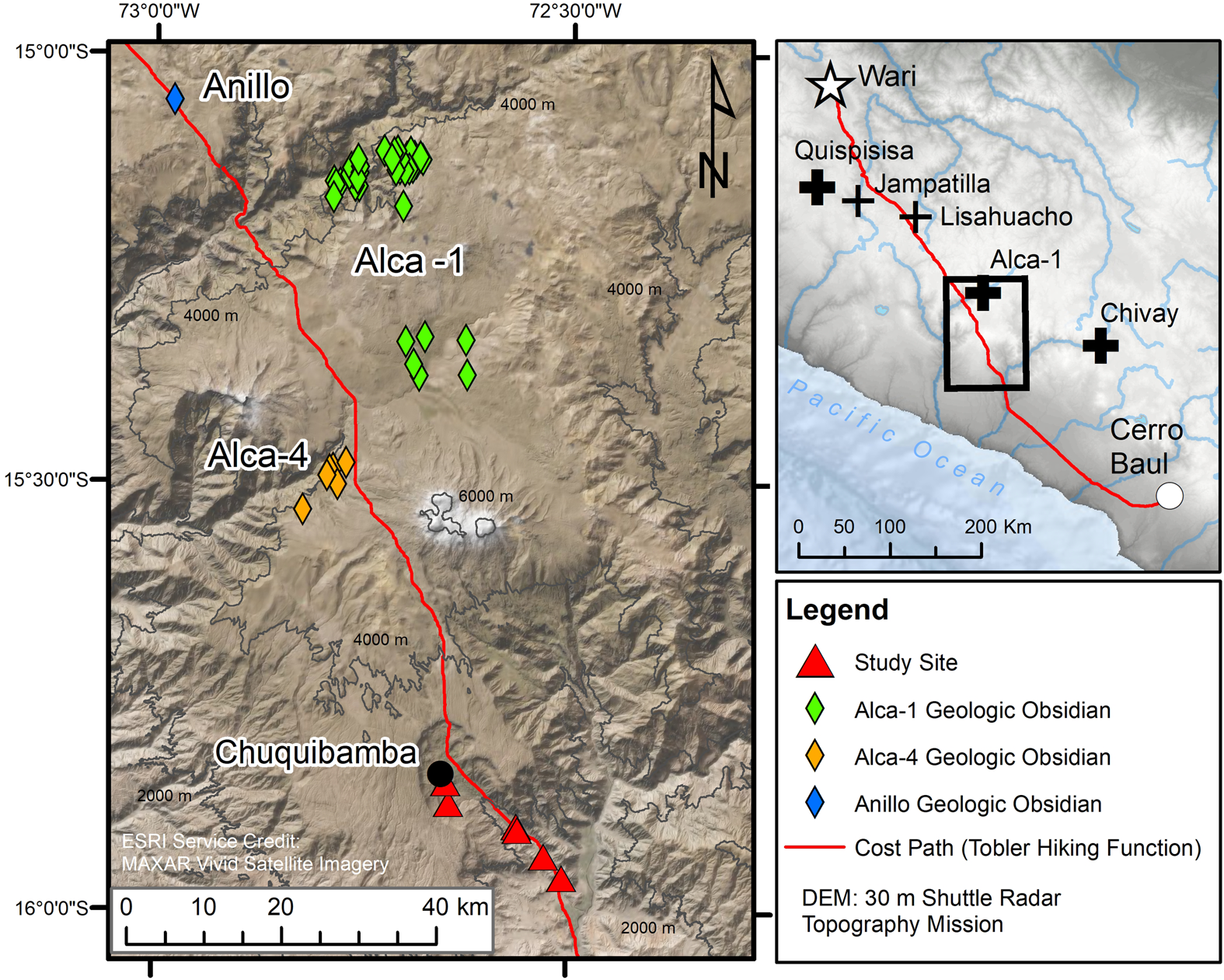
Within models of wealth financing, elites may attempt to restrict access to prestige goods or control the chokepoints within commodity chains in the acquisition, production, or distribution stages (Earle and Jennings Reference Earle and Jennings2012:214–215). Due to the expansive extents of Andean obsidian sources, it would have been impossible to directly control obsidian at the geological source (Jennings and Glascock Reference Jennings and Glascock2002). Instead, Pakaytambo and El Tambo may have been uniquely established to control a major trade and mobility route connecting the south-central highlands to the coastal valleys of far southern Peru, as indicated by GIS least-cost path models (Figure 8). Pakaytambo and El Tambo held strategic positions along the corridor's pre-Inka road at a major constriction in the drainage that also marked the ecological transition between highland and coastal zones and populations (Reid Reference Reid2023).
Least cost path (Tobler Hiking Function) between Wari capital and the southernmost colony Cerro Baul. (Color online)
We can also question how Wari settlers in Arequipa obtained obsidian materials. If residents at Pakaytambo and El Tambo relied on the taxation of local populations or periodic exchange with long-distance caravans, we might expect a greater diversity of local and exotic obsidians, such as those identified at contemporaneous Middle Horizon sites. Instead, Wari agents may have directly procured Alca-1 and Alca-4 obsidian. Pakaytambo is the nearest Wari enclave to the Alca source region, for which direct travel to bedrock outcrops could be made in less than a week (Table 3). Formal lithic analysis of Pakaytambo lithics indicates late-stage bifacial tool production occurred on site (Reid Reference Reid2020:333). If Wari agents directly procured Alca bedrock obsidians, initial lithic reduction likely occurred at the sources, a pattern observed for Wari exploitation of Quispisisa obsidian (Bencic Reference Bencic2016; Kaplan Reference Kaplan2018).
Wari provisioning of Alca obsidian was not strictly for local use but included wider distribution. Skilled lithic knappers shaped Alca-1 obsidian into Wari-style bifaces and laurel leaf points, such as the one recovered from Santa Rosa II (Figure 4d). Wari-style bifaces made of Alca-1 have been identified to the far south at Cerro Baul and Cerro Mejia in Moquegua (Williams et al. Reference Williams, Reid, Nash, Chacaltana, Costion, Goldstein, Sharratt, Riebe and Feinman2022:156), at Espiritu Pampa on the eastern slopes of the Andes (Fonseca Santa Cruz and Bauer Reference Fonseca Santa Cruz and Bauer2020:193), and as far north as Huamachuco, where they were found as offerings at the shrine Cerro Amaru (Burger and Glascock Reference Burger and Glascock2009; Topic and Topic Reference Topic, Topic and Jennings2010). Minor amounts of Alca-1 debitage have also been identified at the Wari capital (Burger et al. Reference Burger, Mohr Chávez and Chávez2000; Kaplan Reference Kaplan2018; Wistuk Reference Wistuk2019), the administrative center Jincamocco (Burger et al. Reference Burger, Mohr Chávez and Chávez2000), and Wari colonial contexts in Cusco at Huaro (Skidmore Reference Skidmore2014; Figure 1). The exportation of Alca-1 outside Arequipa, in the form of recognized Wari-style bifaces, shows that resource acquisition in the study region was not solely for local consumption but was also tied to far-reaching Wari networks, perhaps related to wealth financing strategies of easily transported goods.
Bottom-Up Exchange Networks
Obsidian provenance data from local settlements, road waystations, and ceremonial contexts in Arequipa provide a counterpoint to top-down Wari political economic models. Bottom-up processes of interregional exchange proliferated during the Middle Horizon in tandem with or outside direct Wari control (see Bélisle et al. Reference Bélisle, Quispe-Bustamante, Hardy, Davis, Condori, González, Gonzales Avendaño, Reid and Williams2020). During the Middle Horizon, new settlements were founded along Arequipa's intervalley roads that show intense engagement with Wari material identity. Road settlements such as Corralones (Cardona Rosas Reference Cardona Rosas2002) and Millo (Nigra et al. Reference Nigra, Rosas, Lozada and Barnard2017) show architectural similarities to Wari syntax and ceremonial space; however, their relationship with the Wari state remains unclear. In the Majes Valley, excavations at Santa Rosa II and La Angostura indicate dual waystation and ceremonial functions that centered around local placemaking, rather than Wari ideology (Reid Reference Reid2020). These sites also exhibit the greatest diversity of obsidian sources in the region (Table 1).
Obsidian sourced to Quispisisa, Lisahuacho, and Jampatilla originating in Peru's south-central highlands was likely transported to Arequipa's coastal valleys by long-distance llama caravans. GIS cost-path analysis between Wari's capital and the southernmost colony Cerro Baul models a route that traverses Ayacucho and Apurimac and passes directly through the Anillo and Alca geologic areas before entering the upper Chuquibamba–Majes drainage (Figure 8). Highland caravans could have thus collected incidental obsidian finds without deviating from their original route. Such caravans may have been tied to formal Wari activities (see Edwards Reference Edwards, Clarkson and Santoro2021); however, even under the auspices of state control, unofficial barter and exchange could occur. The establishment of the waystation/ceremonial centers of Santa Rosa II and La Angostura in a marginal zone between local and Wari settlements may have been a bottom-up strategy to co-opt increased caravan activity at this time.
Large plaza spaces at Santa Rosa II and La Angostura likely facilitated the periodic convergence of locals and nonlocals where exchange was embedded within ceremonial and religious activities (Reid Reference Reid2020). Visitors would have brought goods from their homeland regions, including obsidian, for use during travel and exchange or barter purposes. Similar social processes have been hypothesized for Formative and Early Horizon temple centers where diverse obsidian assemblages have been identified (Burger et al. Reference Burger, Mohr Chávez and Chávez2000; Matsumoto et al. Reference Matsumoto, Nesbitt, Glascock, Palomino and Burger2018). This study's detection of rare obsidian source materials also provide insight as to how exchange goods flowed into waystations and outward to local residents, exemplified by the presence of Anillo at Santa Rosa II and at the nearest village of Beringa (Tung Reference Tung2012). Isotopic analysis of camelid remains from Arequipa also indicates that mid-valley yunga communities maintained camelid herds (Alaica et al. Reference Alaica, Scaffidi, González La Rosa, Jennings, Knudson and Tung2022), illustrating how local communities took an active role in shaping exchange relationships during the Middle Horizon.
Wari centers in Arequipa were abandoned by the end of the tenth century AD (Jennings et al. Reference Jennings, Álvarez and Bautista2021; Reid Reference Reid2020). Obsidian from Terminal Middle Horizon (around AD 1000–1100) contexts at several of the study sites correspond to the period when Wari state interaction presumably waned but Wari influence is still archaeologically observed in regional material culture (Supplemental Table 1). Excavated materials from Huamantambo, Numero 8, and Qosqospa in Chuquibamba follow patterns of obsidian consumption established in the late Middle Horizon with a near-complete reliance on Alca-1 and Alca-4 obsidian (Table 1). The breakdown of interregional networks once facilitated by Wari activity may be one explanation for the absence of nonlocal obsidians in later contexts. Regionalization and factionalism occurring around AD 1100 may also account for the abandonment of the dual waystation and ceremonial centers Santa Rosa II and La Angostura. Unfortunately, very little is known about subsequent obsidian use in Arequipa during preceding centuries, largely due to sampling bias.
Conclusions
During the Middle Horizon, Andean obsidian served as both a common domestic good and an exotic material imbued with ideological meaning. At this time, it was transported to its greatest extent and quantity than ever before identified and was transported across Wari networks in the form of large lanceolate bifaces/preforms and laurel leaf points. In contrast to treating the Middle Horizon as a homogeneous and monolithic period, this study's regional perspective highlights changes in obsidian procurement and use related to (1) initial Wari colonization in far southern Peru beginning in the mid-seventh century AD, (2) imperial expansion and political economy at the apogee of empire in the late Middle Horizon (around AD 800–1000), and (3) the Terminal Middle Horizon (around AD 1000–1100) when Wari state centers had been abandoned yet local communities continued to engage in Wari practices and material culture.
Often viewed as a hallmark of Wari interaction, Quispisisa obsidian was first transported to Arequipa by Wari colonists. By the late Middle Horizon, Wari state centers in Arequipa and Moquegua no longer relied on Ayacucho obsidian but solely utilized Alca-1 and Alca-4 bedrock materials. These were the highest-quality proximate sources with nodules 30 cm in size and sufficiently large to manufacture the export product of “oversized” Wari obsidian bifaces. Wari bifaces composed of Alca-1 have been identified from contexts across Peru. We suggest that this demonstrates the regional consolidation of key resources in Arequipa, which depended on local knowledge of the landscape and the presence of key infrastructure. However, Wari expansionism in Arequipa was uneven as indicated by the absence of Chivay obsidian across all study sites. This study complicates regional models of obsidian use, whereby the presence of Alca-1 at local settlements may indicate a relationship with Wari networks, rather than a regionalization of domestic economies outside Wari influence.
During the late Middle Horizon in Arequipa, obsidian use did not solely rely on distance to the nearest source but instead was shaped by a combination of sociopolitical and geographic factors. Contemporaneous roads, trails, and waystations were established along routes that linked Arequipa's coastal valleys. Gateway sites such as Corralones, Santa Rosa II, and La Angostura displayed the greatest obsidian source diversity in the study, including the exotic obsidians Quispisisa, Lisahuacho, and Jampatilla from Ayacucho and Apurimac; Arequipa sources of Alca-1, Alca-4, and Anillo; and one unidentified source. The central placement of dual waystation/ceremonial centers attracted a variety of local communities and nonlocals; there, exchange was embedded within ritual practice and periodic gatherings. The adoption and emulation of Wari material identity and customs by Arequipa residents may have been strategies to co-opt or gain entry to Wari networks, of which obsidian was only one of many exchanged materials of both utilitarian and ideological significance. At the dissolution of the Wari state, these long-distance interregional connections also appear to have broken down.
Acknowledgments
Analyses were permitted by the Ministerio de Cultura, Peru (Resolucion 152-2018-VMPCIC-MC). Various individuals made this work possible: we thank Lidia Betsabe Camargo Padilla, Mark Golitko, and Elizabeth Olson. Comparative geological samples of Andean obsidians were generously loaned by Michael D. Glascock, Nicholas Tripcevich, and Kurt Rademaker. We also thank the anonymous reviewers for their comments.
Funding Statement
Various individuals and institutions made this research possible with funding for fieldwork and laboratory analyses provided by the National Science Foundation (Goldstein: No. 0548829; Reid: No. 1854651) and the Wenner Gren Foundation (Reid). Funding of the Elemental Analysis Facility at the Field Museum of Natural History was provided by the Grainger Foundation, the Negaunee Foundation, and the National Science Foundation (BCS-1628026, 1531394, 1321731, 0818401, and 0320903).
Data Availability Statement
All archaeological obsidian artifacts analyzed by the authors are curated in the facilities of the Ministerio de Cultura in Arequipa, Peru. Detailed scientific data are available on request to David Reid (dreid5@uic.edu).
Competing Interests
The authors declare none.
Supplemental Material
For supplemental material accompanying this article, visit https://doi.org/10.1017/laq.2023.68.
Supplemental Text 1. Methodology and instrumental specifications.
Supplemental Figure 1. Scatterplot of InnovX pXRF ppm ratioed values of Corralones artifacts (color icons) versus geological obsidians (black square icons). Solid ellipses = 95% confidence interval surrounding geological materials only.
Supplemental Figure 2. Scatterplot of LA-ICP-MS ppm values of Alca-1 obsidian artifacts (color icons) versus geological obsidians (black square icons). Solid ellipses = 95% confidence interval surrounding artifact materials only.
Supplemental Figure 3. Scatterplot of LA-ICP-MS ppm values of Alca-4 obsidian artifacts (color icons) versus geological obsidians (black square icons). Solid ellipses = 95% confidence interval surrounding artifact materials only.
Supplemental Table 1. Radiocarbon Dates from Study Sites.
Supplemental Table 2. pXRF Elemental Concentrations (ppm) of Obsidian Artifacts from Arequipa Study Sites.
Supplemental Table 3. LA-ICP-MS Elemental Concentrations (ppm) of Obsidian Artifacts from Arequipa Study Sites.
Supplemental Table 4. Obsidian vs. Non-Obsidian Lithic Materials from Excavated Contexts.


 Open access

