





Introduction
Acute kidney injury is a common complication after paediatric congenital heart surgery. Reference Aronson and Blumenthal1–Reference Aydin, Seiden and Blaufox6 Multiple studies have shown that acute kidney injury is associated with increased morbidity and increased utilisation of health care resources. Reference Toth, Breuer and Cserep2–Reference Hazle, Gajarski and Aiyagari11 Currently, acute kidney injury is defined by serum concentration changes of the endogenous functional biomarker creatinine that likely identifies only patients with greater than mild injury and this definition delays the diagnosis after the initial insult. Reference Parikh, Coca and Thiessen-Philbrook12–Reference Adams, Vargas and Baust15 Confounding this already limited functional biomarker, patients with CHD are more likely to have decreased muscle mass, which may in turn decrease the utility of serum creatinine as a marker of kidney injury. Reference Krawczeski, Goldstein and Woo16,Reference Bellomo, Kellum and Ronco17 Urinary neutrophil gelatinase-associated lipocalin, interleukin-18, liver fatty acid-binding protein, kidney injury molecule-1, and cystatin C are biomarkers of tubular injury and their elevations have been shown to reliably detect acute kidney injury in patients following surgical intervention. Reference Goldstein, Goldstein and Devarajan9,Reference Hazle, Gajarski and Aiyagari11,Reference Haase, Devarajan and Haase-Fielitz14,Reference Krawczeski, Goldstein and Woo16,Reference Mishra, Ma and Prada18– Reference Cooper, Claes and Goldstein21
Few studies have investigated the incidence of acute kidney injury after the staged palliations in patients with single ventricle physiology. Reference Wong, Selewski and Yu8,Reference Goldstein, Goldstein and Devarajan9,Reference Garcia, Natarajan, Walters, Delius and Aggarwal22 Hypoplastic left heart syndrome and its variants require multiple surgical interventions in the first year and throughout the patient’s life. These operations increase the risk of developing acute kidney injury which leads to an increased risk in morbidity and mortality. Reference Wong, Selewski and Yu8,Reference Goldstein, Goldstein and Devarajan9,Reference Krawczeski, Goldstein and Woo16 Two recent studies have shown that patients with hypoplastic left heart syndrome undergoing the Norwood procedure have a greater likelihood of developing acute kidney injury than their hybrid counterparts. Reference Goldstein, Goldstein and Devarajan9,Reference Garcia, Natarajan, Walters, Delius and Aggarwal22 However, no studies have compared the bidirectional Glenn procedure to the comprehensive stage II procedure in terms of acute kidney injury. At the Heart Center of Nationwide Children’s Hospital, we have been utilising the Hybrid primarily as the preferred first stage palliation. Reference Galantowicz23 Therefore, our institution is in a prime position to assess the incidence and risk of acute kidney injury across the staged palliations.
The comprehensive stage II procedure entails an amalgamation of the pulmonary artery with the ascending aorta, arch reconstruction, stent removal, pulmonary artery band removal and superior vena cava to pulmonary artery anastomosis. The comprehensive stage II procedure is more complex than the bidirectional Glenn, leading to a longer cardiac bypass time which increases the risk of acute kidney injury. Reference Li, Krawczeski and Zappitelli3–Reference Blinder, Goldstein and Lee5,Reference Venugopal, Luna and Anderson24–Reference Akinturk, Michel-Behnke and Valeske26 Our hypothesis was that patients who undergo comprehensive stage II palliation will have an increased incidence of acute kidney injury by Kidney Disease Improving Global Outcomes established criteria Reference Khwaja27 and demonstrate higher levels of urinary biomarkers compared to those who undergo bidirectional Glenn procedure in the early postoperative period.
Materials and methods
This was a prospective, observational pilot study of 20 patients undergoing stage 2 palliation for single ventricle physiology between July 2019 and December 2021 at Nationwide Children’s Hospital. This study was approved by the Institutional Review Board (STUDY00000027). Acute kidney injury was defined and classified by Kidney Diseases Improving Global Outcomes criteria, only based on peak serum creatinine changes through postoperative day 3 in this cohort because all values of urine output data collected through postoperative day 2 remained within normal ranges (Supplementary Table) despite a non-significant trend towards lower urine out in patients who developed moderate to severe acute kidney injury (Supplementary Figure 1). Urine samples (2-5 mL/per sample) were collected pre-operatively in the operating room then at 1, 6, and 24 hours after surgery, placed immediately on ice, centrifuged for 15 minutes at 4°C, and supernatant was aliquoted and stored at -80°C until analysis. Urinary concentrations of neutrophil gelatinase-associated lipocalin (R&D system, catalog number DLCN20), interleukin-18 (R&D system, catalog number DBP180), liver fatty acid-binding protein (Abcam, catalog number ab218261), kidney injury molecule-1(R&D system, catalog number DKM100), and cystatin C (R&D system, catalog DSCTCO) were determined using commercially available enzyme-linked immunosorbent assay kits and normalised to urinary creatinine (Cayman Chemical, catalog number 500701).
In addition to urinary biomarkers, peak lactate level, vasoactive-inotropic score, percent fluid overload, and serum creatinine level were analysed to evaluate postoperative outcomes. Lactate level reflects systemic hypoperfusion and metabolic stress; vasoactive inotropic score is calculated by adding together the weighted doses of all inotropic and vasopressor agents given to a patient and has been used to evaluate outcome in infants after cardiopulmonary bypass; Reference Gaies, Gurney and Yen28 percent fluid overload was calculated by dividing net fluid balance (in liters) during each time period (postoperative: 6 hours, day1, and day 2) by the body weight (in kilograms); serum creatinine was a traditional indicator of renal function in clinical practice.
Demographic, clinical, and postoperative characteristics were summarised using count and percentage for categorical variables and median/interquartile range (25th and 75th percentile) for continuous variables. All descriptive tables for patient characteristics are stratified by surgery (received comprehensive stage II versus bidirectional Glenn). Primary outcomes were levels of neutrophil gelatinase-associated lipocalin, interleukin-18, liver fatty acid-binding protein, kidney injury molecule-1, and cystatin C at baseline and 1, 6, and 24 hours postoperatively. Biomarker levels at each timepoint were summarised using median and interquartile range stratified by biomarker and surgery. For each outcome, a linear mixed model was fit with terms for time, surgery, a time-surgery interaction, and a random effect for individual. Due to non-normality of residuals, all biomarker outcomes except interleukin-18 were log-transformed within these models. For the log-transformed biomarkers, the log-transformed values were plotted over time for each group and estimated ratios and 95% confidence intervals were also visualised at each time point in an adjacent forest plot. For interleukin-18, raw values were plotted over time for each group and estimated difference and 95% confidence intervals were visualised at each timepoint in an adjacent forest plot. As a sensitivity analysis, the same analysis was conducted with no/mild versus moderate/severe acute kidney injury replacing surgery type for each biomarker. P-values are not presented in descriptive tables following best statistical practice and STROBE reporting guidelines. Reference von Elm, Altman, Egger, Pocock, Gøtzsche and Vandenbroucke29 A confidence interval not encompassing 1 for ratios or a confidence interval not encompassing 0 for differences indicated a statistically significant difference between groups. All analyses were performed using R version 4.2.2.
Results
Demographic characteristics
Twenty patients were included in this cohort. Twelve patients underwent bidirectional Glenn procedure, whereas 8 patients received the comprehensive stage II palliation. Demographic and clinical parameters were compared and presented in Table 1. The gestational ages, birth weight, and pre-operative serum creatinine levels appeared similar between the two groups; however, statistical analysis was not conducted due to the small sample size. Although the comprehensive stage II group consisted entirely of males, the bidirectional Glenn group included a significant majority of males (67%), ensuring somewhat gender comparability. Racial distribution was predominantly Caucasian in both groups, albeit more diverse in the bidirectional Glenn group. The bidirectional Glenn cohort was older than the comprehensive stage II group with median of 235 (160, 268) compared to 154 (151, 257) days. Surgical parameters such as bypass time, cross-clamp time, and intraprocedural contrast use differ markedly, with the comprehensive stage II group showing longer bypass and cross-clamp times and higher intraprocedural contrast usage. Intraprocedural contrast use reflected our institutional practice of routinely performing intraoperative angiograms during comprehensive stage II procedures and selectively during bidirectional Glenn procedure.
Demographic, clinical, and postoperative characteristics by surgery group

1 Data are in median (interquartile range) or n (%). P-values are not presented following best statistical practice and STROBE reporting guidelines Reference von Elm, Altman, Egger, Pocock, Gøtzsche and Vandenbroucke29 .
HLHS: hypoplastic left heart syndrome. PA/IVS: pulmonary atresia with intact ventricular septum. POD: post-op day. AKI-KIDGO: acute kidney injury-Kidney Disease Improving Global Outcomes. PPV: positive pressure ventilation.
# Other diagnosis: One case with dextrocardia, D-transposition of the great arteries, and tricuspid atresia. Two cases with tricuspid atresia. One case of double outlet right ventricle, double outlet right atrium, and malposed great arteries. One case of double inlet left ventricle, transposition of the great arteries, and hypoplastic pulmonary artery. One case of double inlet left ventricle, transposition of the great arteries, pulmonary stenosis. One case of double outlet right ventricle, atrioventricular canal defect, hypoplastic left ventricle, and heterotaxy syndrome. One case of right dominant atrioventricular canal defect, coarctation of the aorta.
One patient was missing birth weight. Two patients were missing both serum creatinine POD 2 and serum creatinine POD 3, with one more patient missing for each one separately.
Post-operation characteristics
Postoperative serum creatinine, vasoactive inotropic score, percent fluid balance, and peak lactate are summarised in Figure 1, using boxplots to visualise values for the two surgery groups at each timepoint. Peak lactate levels within one week postoperatively were similar between the two groups, though greater variability was noted in the comprehensive stage II group (Figure 1A). The vasoactive-inotropic score was comparable at 8 hours postoperatively, decreasing to zero by 48 hours, with minimal need for inotropic support in one patient in the comprehensive stage II group (Figure 1B). Percent fluid overload was consistently higher in the bidirectional Glenn group across all postoperative time points compared to the comprehensive stage II group(Figure 1C), likely reflecting institutional practices aimed at aggressive diuresis and extubation strategies in comprehensive stage II patients. Reference Hardisky, Satija and Yates30 Serum creatinine was higher in the comprehensive stage II group throughout postoperative days 1 to 3 (Figure 1D). Importantly, the peak creatinine value was not until day 2 or 3 in all but 1 of the patients that developed stage 2 or stage 3 AKI.
Comparative analysis of clinical parameters between comprehensive stage II (Comp II) and bidirectional Glenn (Glenn) palliation. (A) Peak lactate levels; (B) Vasoactive Inotropic Score; (C) Present fluid overload; (D) Serum creatinine levels. Data are presented as box plots with error bars representing variability within the groups.

Stage 2 or higher acute kidney injury was present in 8% (1/12) of patients undergoing bidirectional Glenn procedure and in 50% (4/8) of patients undergoing comprehensive stage II palliation (Table 1). There were no instances of chylous effusion, cardiopulmonary arrest, ECMO activation, arrhythmia, infection, neurological injury, or renal replacement therapy in either group. Patients in the comprehensive stage II palliation group had longer median stays both in the ICU and the hospital overall. The comprehensive stage II group had a longer median time to extubation. The bidirectional Glenn group also shows a higher incidence of pleural effusion requiring additional placement of a chest tube, as it is not our standard practice to leave pleural chest tubes at the conclusion of either comprehensive stage II or bidirectional Glenn surgeries.
Postoperative urine output by acute kidney injury severity
Postoperative urine output was compared between patients with moderate or severe acute kidney injury (stage 2 or greater) and those with no or mild acute kidney injury (stage 0 or 1) at 6 hours, postoperative day 1, and postoperative day 2. At 6 hours postoperatively, median urine output was slightly higher in patients with moderate or severe acute kidney injury (2.76 mL/kg/hr [interquartile range: 1.57 – 2.80]) compared to those with no or mild acute kidney injury (1.65 mL/kg/hr [interquartile range: 1.50 – 2.90]). However, by postoperative day 1, patients with moderate or severe acute kidney injury had lower median urine output (2.82 mL/kg/hr [interquartile range: 2.21– 4.82]) than the no or mild acute kidney injury group (4.24 mL/kg/hr [interquartile range: 3.03 – 4.49]), and this pattern persisted at postoperative day 2 (moderate or severe acute kidney injury: 2.16 mL/kg/hr [interquartile range: 1.72 – 3.23] versus no or mild acute kidney injury: 3.12 mL/kg/hr [interquartile range: 2.66 – 3.89]), suggesting a trend towards reduced urine output in patients with more severe acute kidney injury in the early postoperative period (Supplementary Figure 1).
Table 2 shows the urinary biomarkers at baseline, 1, 6, and 24 hour postoperatively between the comprehensive stage II and the bidirectional Glenn procedure.
Biomarker levels at each timepoint stratified by biomarker and surgery

1 Median (interquartile ranges) are described at baseline, 1 hour (h), 6 hours, and 24 hours post-operation for the urinary biomarkers cystatin-C, interleukin-18 (IL-18), Kidney Injury Molecule-1 (KIM-1), liver fatty acid-binding protein (L-FABP), and neutrophil gelatinase-associated lipocalin (NGAL). These values are shown after both the Comprehensive Stage II (Comp II) and bidirectional Glenn (Glenn) operations. N = number in cohort, Cr= normalised to creatinine.
Note: one patient missed all observations at baseline, 1 patient missed all observations at 6h Post, and 1 patient missed all observations at 24h Post.
Neutrophil gelatinase-associated lipocalin
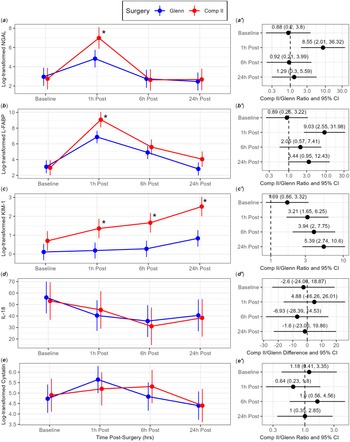
Urinary neutrophil gelatinase-associated lipocalin levels were comparable at baseline, 6, and 24 hour postoperatively, but peaked at one hour postoperatively and was 8.55-folds higher (95% confidence interval: 2.01 – 36.32) in the comprehensive stage II group than in the bidirectional Glenn group [1769 (Interquartile range :1309 – 1961) vs. 91 (Interquartile range: 18 – 1120) ng/mg urinary creatinine]. (Figure 2A)
Changes in biomarker levels over time and ratios of actual biomarker values between comprehensive stage II (Comp II) and bidirectional Glenn (Glenn) palliation. Comparison of (A) urinary neutrophil gelatinase-associated lipocalin (NGAL), (B) urinary liver fatty acid-binding protein (L-FABP), (C) urinary kidney molecular injury - 1 (KIM-1), (D) Interleukin-18 (IL-18) and (E) Cystatin C between patients undergoing Comp II and Glenn palliation pre-operatively, followed by 1, 6 and 24 hours post-operatively. Data are presented as the natural logarithm (ln) transformed values (except data for interleukin-18). Linear mixed model was used for statistical analysis. A’ to E’: Ratios of the actual (non-transformed) values between the Comp II and the Glenn palliation are presented with their 95% confidence interval. A confidence interval not encompassing 1 for ratios indicates a statistically significant difference (denoted by *) between groups.

Liver fatty acid-binding protein
Similar to the urinary neutrophil gelatinase-associated lipocalin levels, the urinary liver fatty acid-binding protein level showed no statistical difference at baseline, 6, and 24 hour postoperatively. However, the urinary liver fatty acid-binding protein level was significantly greater by 9.03-fold (95% confidence interval: 2.55 – 31.98) in the comprehensive stage II group at one hour post-operatively than in the bidirectional Glenn group [12,836 ( Interquartile range: 5016 – 19,798) vs. 1272 ( interquartile range: 220 – 5172) ng/mg urinary creatinine]. (Figure 2B).
Kidney injury molecule -1
The urinary kidney injury molecule-1 level was similar at baseline but increased by 3.21-folds (95% confidence interval: 1.65 – 6.25) at one hour postoperatively, with the levels being higher in the comprehensive stage II group compared to the bidirectional Glenn group. The trend continued by 3.94-folds increase at 6 hours postoperatively and reached the highest point by 5.39-folds increase at 24 hours postoperatively with a median value of 11 ng/mg urinary creatinine in the comprehensive stage II compared to 2 ng/mg urinary creatinine in the bidirectional Glenn patients (95% confidence interval: 2.74 – 10.6). (Figure 2C).
Cystatin C and Interlukin-18
No statistically significant difference was observed in urinary cystatin C (Figure 2D) and interlukin-18 levels (Figure 2E).
Biomarker sensitivity analysis
Sensitivity analysis using a binary classification, i.e., normal/mild versus moderate/severe acute kidney injury, was conducted to assess the robustness of biomarker differences between these two groups. While trends suggested higher biomarker levels in patients with moderate/severe acute kidney injury (Stage 2 or 3) at early postoperative time points, these differences were not statistically significant (Supplementary Figure 2).
Discussion
This study was a pilot investigation into urinary biomarkers for acute kidney injury in infants who underwent comprehensive stage II or bidirectional Glenn procedure due to congenital single ventricle disease. Infants undergoing comprehensive stage II palliation had significantly higher levels of neutrophil gelatinase-associated lipocalin, liver fatty acid-binding protein and kidney injury molecule-1 at 1 hour postoperatively compared to those undergoing bidirectional Glenn procedure, despite creatinine values which were nearly all within age specific normative values and did not yet qualify as stage 2 or 3 acute kidney injury by Kidney Disease Improving Global Outcomes criteria. Second, only the urine biomarkers associated with proximal renal tubular injury demonstrated differences between the procedures, suggesting a specific pathophysiologic injury pattern. The greater increase in these biomarkers may indicate more severe proximal tubular injury in the comprehensive Stage II group, and these biomarkers could serve as early indicators of proximal tubular damage, detectable as early as one hour after palliation surgery in single-ventricle patients.
The proximal tubules play a crucial role in reabsorbing important substances from the filtrate, and injury to these tubules can affect their function. The metabolism of neutrophil gelatinase-associated lipocalin, liver fatty acid-binding protein and kidney injury molecule-1 primarily involve in the proximal tubes. Reference Oyama, Takeda and Hama31–Reference Holzscheiter, Beck and Rutz33 Elevated urinary neutrophil gelatinase-associated lipocalin, liver fatty acid-binding protein and kidney injury molecule-1 levels are a valuable marker for assessing kidney injury and detecting damage to the proximal tubules which may be reversible if caught early. Reference Hisamichi, Kamijo-Ikemori and Sugaya34 The clinical diagnosis of acute kidney injury is based on elevated serum creatinine concentration and/or fall in urine output. However, creatinine level and urine output can be affected by various factors, such as degradation of muscle mass, fluid administration and medications. This inherent variability may result in a delayed diagnosis of acute kidney injury. Utilising neutrophil gelatinase-associated lipocalin, liver fatty acid-binding protein, and kidney injury molecule-1, we were able to detect “subclinical” kidney injury at 1 hour after surgery. This early detection may be helpful to the bedside clinician to be wary of known sequalae of acute kidney injury such as fluid overload, increased need for vasoactive drugs, longer duration of mechanical ventilation and a longer hospital stay.
Although the postoperative serum creatinine levels in the comprehensive stage II group suggest a greater degree of renal stress or impaired renal function following surgery, nearly all creatinine values for both groups were within the age expected norms. When interpreting these values in the context of individual baseline creatinine, the diagnostic threshold for acute kidney injury was not observed until day 2 or 3 in almost all the patients who developed stage 2 or stage 3 acute kidney injury. These findings hightlight the need for novel biomarkers to enable more effective surveillance of early acute kidney injury, specifically in patients undergoing comprehensive stage II procedure, given that 50% of patients in this group experienced stage 2 or 3 acute kidney injury compared to only 8% in the bidirectional Glenn group. Furthermore, the AWARE study demonstrated that stage 2 or 3 acute kidney injury is associated with significantly worse outcomes, including increased mortality, higher risk of future acute kidney injury, and progression to chronic kidney disease. Reference Kaddourah, Basu, Bagshaw and Goldstein35 Therefore, closer monitoring and more aggressive management of renal function in the early postoperative period in comprehensive stage II group may help preserve long-term renal function.
Neutrophil gelatinase-associated lipocalin and liver fatty acid-binding protein have gained prominence as promising biomarkers for the early detection of acute kidney injury due to their sensitivity to renal stress and the unique characteristics they bring to the diagnostic landscape. Reference Baek, Lee and Jang36–Reference Liu, Che and Xue38 The substantial increase of neutrophil gelatinase-associated lipocalin and liver fatty acid-binding protein levels following comprehensive stage II palliation not only highlights their sensitivity to the unique physiological changes induced by the comprehensive stage II procedure but also suggests their utility as a promising indicator of acute kidney injury in this specific patient population.
Kidney injury molecule-1 has emerged as a compelling and distinctive biomarker in the realm of acute kidney injury but exhibited a pattern distinct from neutrophil gelatinase-associated lipocalin and liver fatty acid-binding protein in this study. Kidney injury molecule-1 exhibits a unique profile in response to acute kidney injury in the postoperative stage, with levels continuing to rise to its highest point at 24 hours after surgery, which was the final time point of the study. This distinctive pattern underscores the multifaceted role of kidney injury molecule-1 in acute kidney injury diagnosis and monitoring. The ability of kidney injury molecule-1 to increase early after surgery aligns with its role as an effective early detection biomarker. However, the protracted response aligns with kidney injury molecule-1’s role in the renal repair process, as it is involved in the phagocytosis of damaged renal tubular cells. Reference Song, Yu and Prayogo39 The continued elevation of kidney injury molecule-1 levels may indicate the ongoing clearance of cellular debris and the progress of kidney tissue regeneration, Reference Yang, Brooks and Xiao40 providing a unique window into the recovery process. Clinicians may be able to harness kidney injury molecule -1 not only to detect acute kidney injury promptly but also to gauge the progress of renal recovery in the postoperative period. Further research into kidney injury molecule-1’s temporal dynamics and its correlation with clinical outcomes holds promise for enhancing the management of acute kidney injury and improving patient care.
This study suggests that cystatin C and interleukin-18 may not be as effective as neutrophil gelatinase-associated lipocalin, liver fatty acid-binding protein, and kidney injury molecule-1 in the early detection of acute kidney injury following the second stage palliative procedures. While cystatin C and interleukin -18 have shown promise as a diagnostic marker for acute kidney injury in various clinical scenarios, Reference Choudhary, Basu, Dey, Rout, Das and Dey41– Reference Naqvi, Hossain and Butt43 their relatively diminished performance in this study necessitates further investigation in their use in detection of kidney injury after the staged palliative procedure in this infant population.
Our study also found no significant difference in the clinical markers of cardiac output and inotropic support as measured by lactate level and vasoactive-inotrope scores between our surgical groups. When comparing lactate levels across the two surgical groups the comprehensive stage II group showed greater patient level variability than bidirectional Glenn patients. Vasoactive-inotropic score was generally similar between the two surgical groups. The comprehensive stage II group showed greater variability and required higher levels of vasoactive support in some patients at 8 hours and exhibited a slower decline in vasoactive-inotropic score over time compared to the bidirectional Glenn group. By 48 hours, all bidirectional Glenn patients had ceased needing inotropic support, whereas one patient in comprehensive II group continued to require vasoactive support.
This study has multiple limitations: 1. This study utilised a notably small cohort, comprising only 20 patients. The limited cohort size can be attributed to the intricate nature of the comprehensive stage II procedures and patient volume in a single centre, thus presenting challenges in patient recruitment which were complicated by the COVID-19 pandemic. 2. Although all patients had single ventricle physiology, subtype differences may impact outcomes. At our institution, patients with hypoplastic left heart syndrome typically undergo the hybrid procedure, avoiding neonatal cardiopulmonary bypass and its associated risk of renal complications. Additionally, the bidirectional Glenn group had predominantly left ventricular dominance, while the comprehensive stage II group had right ventricular dominance, introducing physiologic heterogeneity that may influence the risk of acute kidney injury. 3. Due to our institutional practice patterns, there were some minor demographic differences, including a small number of female patients and predominate Caucasian population, which weren’t formally analysed due to the small sample sizes. 4. Given that urinary biomarker reference ranges may vary by age, the age difference between groups may affect biomarker comparisons. However, our small sample size precluded statistical adjustment for age and bypass time. Nevertheless, our recent study involving a larger cohort demonstrated that acute kidney injury is common after comprehensive stage II heart surgery, particularly in infants with hypoplastic left heart syndrome. Reference Cunningham, Bai, Krawczeski, Spencer, Phelps and Yates44 5. The observational endpoint of urine sample collection was set at 24 hours post-surgery to coincide with the planned removal of the Foley catheter. This timing was chosen to avoid the risks associated with prolonged catheterisation or repeated catheterisation procedures, which would be necessary to collect urine samples. While this endpoint aligns with clinical definitions of acute kidney injury, where early post-operative periods are critical for detection, the short follow-up duration limits the assessment of long-term outcomes. Future studies with larger sample sizes and extended follow-up periods are warranted to validate and expand upon our findings.
In conclusion, the findings of this study shed light on the potential utility of neutrophil gelatinase-associated lipocalin, liver fatty acid-binding protein, and kidney injury molecule-1 rather than cystatin C and interleukin-18, in the early detection of acute kidney injury in infants undergoing comprehensive stage II palliation. The study revealed significantly elevated levels of these proximal tubular injury biomarkers in the comprehensive stage II group as compared to the bidirectional Glenn palliation, suggesting their potential as sensitive indicators for acute kidney injury in this specific clinical context. These findings underscore the importance of ongoing research into innovative biomarkers, offering healthcare professionals valuable tools for timely diagnosis and intervention of acute kidney injury diagnosis and in this vulnerable patient population. Further clinical trials are warranted to fully establish the clinical significance and diagnostic accuracy of these biomarkers in the context of acute kidney injury, potentially paving the way for more proactive patient management strategies in single ventricle patients undergoing palliation.
Supplementary material
The supplementary material for this article can be found at https://doi.org/10.1017/S1047951125100838.
Acknowledgements
The authors gratefully acknowledge the support of the Molecular Core of Center for Cardiovascular Research and BRANCH (Statistics Group) of Nationwide Children’s Hospital and thank Dr Dennis Lewandowski, our medical writer, for his meticulous editing of this paper.
Financial support
The study was supported by the intramural grant (51108-0016-0620, AY and TC) from Nationwide Children’s Hospital.
Competing interests
The author(s) declare none.
Ethical standards
The authors assert that all procedures contributing to this work comply with the ethical standards of the Nationwide Children’s Hospital guidelines on human experimentation and with the Helsinki Declaration of 1975, as revised in 2008, and has been approved by the Institutional Review Board of Nationwide Children’s Hospital.




 Open access

