

Business has long been involved in the political process, contributing to political candidates, lobbying for favorable policies, and influencing who runs and wins elections (Bonica Reference Bonica2016; Kalla and Broockman Reference Kalla and Broockman2016; Canes-Wrone and Gibson Reference Canes-Wrone and Gibson2019; Katz Reference Katz2015; Quinn and Shapiro Reference Quinn and Shapiro1991). According to Lindblom (Reference Lindblom1982), business occupies a privileged position in American politics by influencing what ideas make it onto the public agenda. Fearful that businesses could withdraw their investments in local communities, Lindblom argues, elected officials preemptively narrow the range of policy proposals to those acceptable to the business community. Influencing politics “quietly” through traditional venues and focusing on economic activity (e.g., economic regulation and taxes), business interests and Republican politics have mostly aligned (Culpepper Reference Culpepper2010, Reference Culpepper2021). The Democratic Party was, at least historically, the party of labor; Republicans were the party of business.
This traditional cleavage began to break down long before businesses went “woke.” Reagan Democrats, a key to the Republican governing coalition in 1980, were defined as socially conservative union members who felt the Democratic Party had moved too far to the left on social issues (Abramson et al., Reference Abramson, Aldrich John and Rhode1983). As Ronald Reagan famously quipped, “I didn’t leave the Democratic Party. The Democratic Party left me.”Footnote 1 Then-head of the Democratic Congressional Campaign Committee, California Representative Tony Coelho aggressively targeted corporate campaign contributions in the mid-1980s by reminding businesses that Democrats still controlled the House of Representatives (Gaddie Reference Gaddie1996; Goidel, Gross and Shields Reference Goidel, Gross and Shields1999). And, in what was seen as a betrayal of his labor union base, President Bill Clinton signed the North American Free Trade Agreement (NAFTA) (Baer Reference Baer2000).
Within this context, the growth of “woke capitalism” may reflect a broader partisan realignment. The Democratic Party increasingly appeals to college-educated and economically affluent progressives while the Republican Party increasingly aligns with socially conservative, white working-class voters (Zingher Reference Zingher2022; Hersh and Shah Reference Hersh and Shah2023; Goidel et al., Reference Goidel, Moreira and Armstrong2024). Demographic change also plays a role. As the Baby Boom generation phases into retirement, Millennials and Gen Z make up a larger share of the workforce, consumer markets, and the electorate (Twenge Reference Twenge2023). As voters, consumers, and employees, these younger generations pressure corporations to play a more visible role in public life and actively engage in partisan consumerism (Panagopoulos et al. Reference Panagopoulos, Green, Krasno, Schwam-Baird and Endres2020; Baker and Zuech Reference Baker and Zuech2021; Jin et al. Reference Jin, Mitson, Qin, Vielledent and Rita Men2023a). As a result, corporate CEOs increasingly make public statements supportive of a broad array of progressive social causes, including support for voting rights, diversity, equity, and inclusion (DEI) employment initiatives, and environmental sustainability. These efforts parallel lobbying efforts and, arguably, signal political capacity and virtue helpful to their political pursuits (Liu, Wei and Zhang Reference Liu, Wei and Zhang2023).
Not surprisingly, this progressive wave of corporate political activity has not gone unnoticed or unchallenged (Ulver and Laurell Reference Ulver and Laurell2020). Environmental, social, and governance (ESG) initiatives increasingly face criticism from Republican politicians, conservative activists, and shareholders.Footnote 2 As of September 2023, for example, 20 US states had rules limiting “considerations of, and/or the weight given to, ESG-related factors in investment decisions and/or discourage such investments.”Footnote 3 If such statements fit well within contemporary populist politics, they also reflect a change from the Republican Party’s long-term alliance with corporate political interests. As Hersh and Shah (Reference Hersh and Shah2023) observe, this shift is well-recognized by corporate stakeholders and business leaders. The public, Hersh and Shah observe, is less likely to recognize this shift. Even when they do, they often become more negative toward corporate political activity rather than more supportive of the issue at stake (Marsh and Peterson Reference Marsh and Carr Peterson2024).
A second related, but contradictory, criticism is that woke businesses are deploying a cynical “bait and switch” strategy, publicly advancing progressive social causes to detract attention from increasing corporate profits and shareholder value while depressing wages and reducing benefits.Footnote 4 This brings us to the current analysis’s central question: Does the public distinguish between business involvement in politics across issue areas? Or do the same factors (e.g., partisan affiliation, ideology, and racial resentment) that drive dissatisfaction with socially progressive initiatives also drive dissatisfaction with business initiatives that address “bread and butter” issues like increased wages and improved health care?Footnote 5
The Demand for Corporate Political Activity
An emerging literature finds that CEOs often take public stances on hot-button issues to appease their corporation’s stakeholders, and these appeasement strategies can pay off reputationally and financially (Larcker et al. Reference Larcker, Miles, Tayan and Wright-Violich2018). For example, CEO activism makes young consumers more trusting of the CEO’s corporation (Jin et al. Reference Jin, Mitson, Qin, Vielledent and Rita Men2022) and more likely to become or remain a loyal customer of the corporation (Jin et al. Reference Jin, Mitson, Qin, Vielledent and Rita Men2023b ). Yet, taking these public stances can also alienate other stakeholders (Bedendo and Siming Reference Bedendo and Siming2021; Brown, Manegold and Marquardt Reference Brown, Manegold and Marquardt2020), especially when public stances are taken on more contentious social issues (Larcker et al. Reference Larcker, Miles, Tayan and Wright-Violich2018). So, why do CEOs take public stances on issues when their public stances could—if miscalculated—hurt the bottom line?
Perceptions of corporate political activity are nuanced. Hersh (Reference Hersh2023) finds that perceptions are conditional on individual partisanship and the issue at hand. For example, Democrats want businesses to use their resources to influence policy on climate change or income inequality, but not to reduce government regulations or lower corporate taxes. Meanwhile, Republicans are generally opposed to corporate political activity when it comes to social, environmental, and governance issues, but support corporate political activity that leads to favorable regulatory environment and lower taxes. Business leaders perceive that businesses—including their own—have shifted leftward in response to pressure from their stakeholders (Hersh and Shah Reference Hersh and Shah2023). This shift, however, appears to have happened within the last few years. Cohen et al. (Reference Cohen, Hazan, Tallarita and Weiss2019) find, looking at political donations from 2000 to 2017, that CEOs were much more likely to give to Republican candidates than Democratic candidates. While we are interested in examining how the public views corporate political activity, most existing research looks at how employees and consumers respond to corporate political activity.
As previously mentioned, corporate political activity can both attract and repel stakeholders (Jin et al. Reference Jin, Mitson, Qin, Vielledent and Rita Men2023b , Reference Jin, Mitson, Qin, Vielledent and Rita Men2022; Bedendo and Siming Reference Bedendo and Siming2021; Brown, Manegold and Marquardt Reference Brown, Manegold and Marquardt2020). Employees that feel more politically aligned with their employers are more satisfied with their jobs (Zacher and Rudolph Reference Zacher and Rudolph2023; Williamson and Perumal Reference Williamson and Perumal2021). Politically unaligned employees are likelier to be dissatisfied, and, thus, more likely to resign (Bermiss and McDonald Reference Bermiss and McDonald2018). This is especially true of conservative employees working for more liberal firms. Among consumers, alienation is perhaps best captured by the act of boycotting. Boycotting involves withholding support and expressing disapproval towards companies that hold opposing political positions—motivated by a desire to punish such companies (Copeland Reference Copeland2014). On the other hand, “buycotting” involves actively endorsing and supporting companies that align with one’s political beliefs. It is motivated by a desire to reward such companies (Copeland Reference Copeland2014). Boycotting and buycotting fall under the broader umbrella of consumer behavior known as political consumerism.
While previous literature investigates CEO political activism and its effects on consumers (Panagopoulos et al. Reference Panagopoulos, Green, Krasno, Schwam-Baird and Endres2020; Hydock, Paharia and Weber Reference Hydock, Paharia and Weber2019; Endres and Panagopoulos Reference Endres and Panagopoulos2017), it does not explore the individual-level determinants of views on the current level of corporate activism. Our research seeks to answer this question and fill this gap.
Expectations
Theoretically, we offer four rationales for why individuals might want more or less corporate political activity. First, individual responses to corporate political activity might be ideological, meaning that it would be in their belief that corporations should stick to core business activity and stay out of politics. Macey (Reference Macey2022) argues that the growth in ESG activity, and demands that corporations become more politically involved, reflects government dysfunction and failure, and a “libertarian turn” in American politics. Corporate political activity, he further contends, is unlikely to be successful in addressing larger systemic issues, such as climate change or racial discrimination.
The political leanings of stakeholders, particularly investors, play a pivotal role in shaping corporate political activity (Wright Reference Wright2023). Specifically, investors’ political affiliations guide their investment choices, with a preference among Democrats to support firms that exhibit a liberal political stance (Enete and Sturr Reference Enete and Sturr2023). Because stakeholders and CEOs themselves are, for the most part, socially liberal, corporate political activity reflects their beliefs (Wright Reference Wright2023). Therefore, in addition to an ideological commitment to the idea that corporations should stick to core business activity (a process-based preference), conservatives likely disagree with the content of corporate political activity (a policy-based preference).
H1: Perceptions of corporate political activities related to environmental, social, and governance issues reflect individual political ideology. Conservatives will be more likely to believe that businesses are doing too much regardless of the issue focus.
Second, individuals might respond to corporate activity as partisans, wanting more corporate action on issues that benefit their side and wanting less action on issues that work against their party’s goals. Republican Leader Mitch McConnell well articulated this view, arguing that corporations should stay out of politics, except when donating to Republican candidates and causes.Footnote 6 His view is consistent with the research on employee satisfaction and employee-employer political alignment (Zacher and Rudolph Reference Zacher and Rudolph2023; Williamson and Perumal Reference Williamson and Perumal2021). If partisanship is driving the perception that businesses are overly involved in politics, then we should see partisan affiliation play a larger role on issues that create a partisan advantage (voting rights and fair elections) and on issues that have been highly politicized (climate change, gun violence, and racial inequality).
H2: Perceptions of corporate political activities will reflect individual partisanship with the strongest effects on the most politicized issues.
Third, individuals might respond reflexively to “woke” corporate political activity (Wetts and Willer Reference Wetts and WillerN.d.), largely lumping corporate political activity together because it advances a progressive social agenda.Footnote 7 As a result, thinking there’s too much corporate political activity would better reflect racial resentment and hostile sexism than partisan affiliation or ideology (Gubitz and Avant Reference Gubitz and Avant2020). An evaluation in one domain can extend to evaluations in other domains. For example, consumers give products better ratings if they are from firms that are high in corporate social responsibility (Chernev and Blair Reference Chernev and Blair2015). The positive firm evaluation spills over into the product evaluation. Similarly, individuals who view corporations as “woke” due to their activity on gender/racial inequality or gun violence may carry this negative perception over to other areas of corporate political activity, such as workers’ wages or healthcare policies. It is not unusual to see non-racial issues, like healthcare, get racialized (Tesler Reference Tesler2012, Reference Tesler2015).
Additionally, people could see “woke” corporate political activity as a slippery slope, where corporate activity sets a precedent for deeper involvement in the more contentious social issues—fostering broader resistance to corporate political activity. Neither of these imply a direct link between racism or sexism and views on healthcare policy; instead, it reflects a generalized opposition to perceived “wokeness” that is rooted in racism and sexism. This leads us to hypothesize that perceptions of “woke” corporate political activity will reflect underlying racial resentment and hostile sexism, extending beyond socially progressive issues to a broader range of corporate engagements.
H3: Perceptions that American corporations are doing too much will reflect individual racial resentment and hostile sexism.
Fourth, and finally, we are interested in the importance of social and political variables relative to pocketbook economic considerations. One might argue, for example, that dissatisfaction with business activity on climate change or socially progressive initiatives might be rooted in economic vulnerability (Melcher Reference Melcher2023; Benegal and Scruggs Reference Benegal and Scruggs2016), but that this economic vulnerability effect should not extend to economic issues. In other words, low income respondents should want more corporate activity on “increasing worker wages,” yet they should not necessarily want more corporate activity on “addressing climate change,” which could be seen as wasting time or taking resources away from lower wage workers. This leads to our fourth hypothesis:
H4: Pocketbook financial considerations should affect perceptions of corporate political activity on ”bread and butter” issues, like raising wages and providing affordable health care.
Data
To test these hypotheses, we use survey data from a module in the 2022 Cooperative Election Study (CES) fielded in the months leading up to the midterm elections (Schaffner, Ansolabehere and Shih Reference Schaffner, Ansolabehere and Shih2023). The module contains 1,000 respondents and, using sampling matching and weights provided by the CES, approximates a nationally representative sample.Footnote 8 As dependent variables, we use a set of items designed to gauge whether respondents think businesses are doing too much, not enough, or about the right amount across a set of issues, ranging from addressing climate change to reducing racial and sex-based discrimination to increasing wages and reducing poverty. We model perceptions of business involvement in politics as a function of partisanship, ideology, racial resentment, and hostile sexism, as well as a set of pocketbook considerations.
Measuring perceptions of corporate political activity
Our interest in the current paper builds off the diversity of activities encompassed under the “corporate political activity” label. Do perceptions vary across issue areas? Or do individuals think of the various initiatives as a cluster of “woke” business activities? Within this context, it is worth noting that the expansion of corporate political activity into areas not explicitly tied to economic activity itself reflects dysfunctional government and, arguably, a “libertarian turn in the history of American politics” (Macey Reference Macey2022). Corporations are pressured to solve social and political issues when government fails to do so.
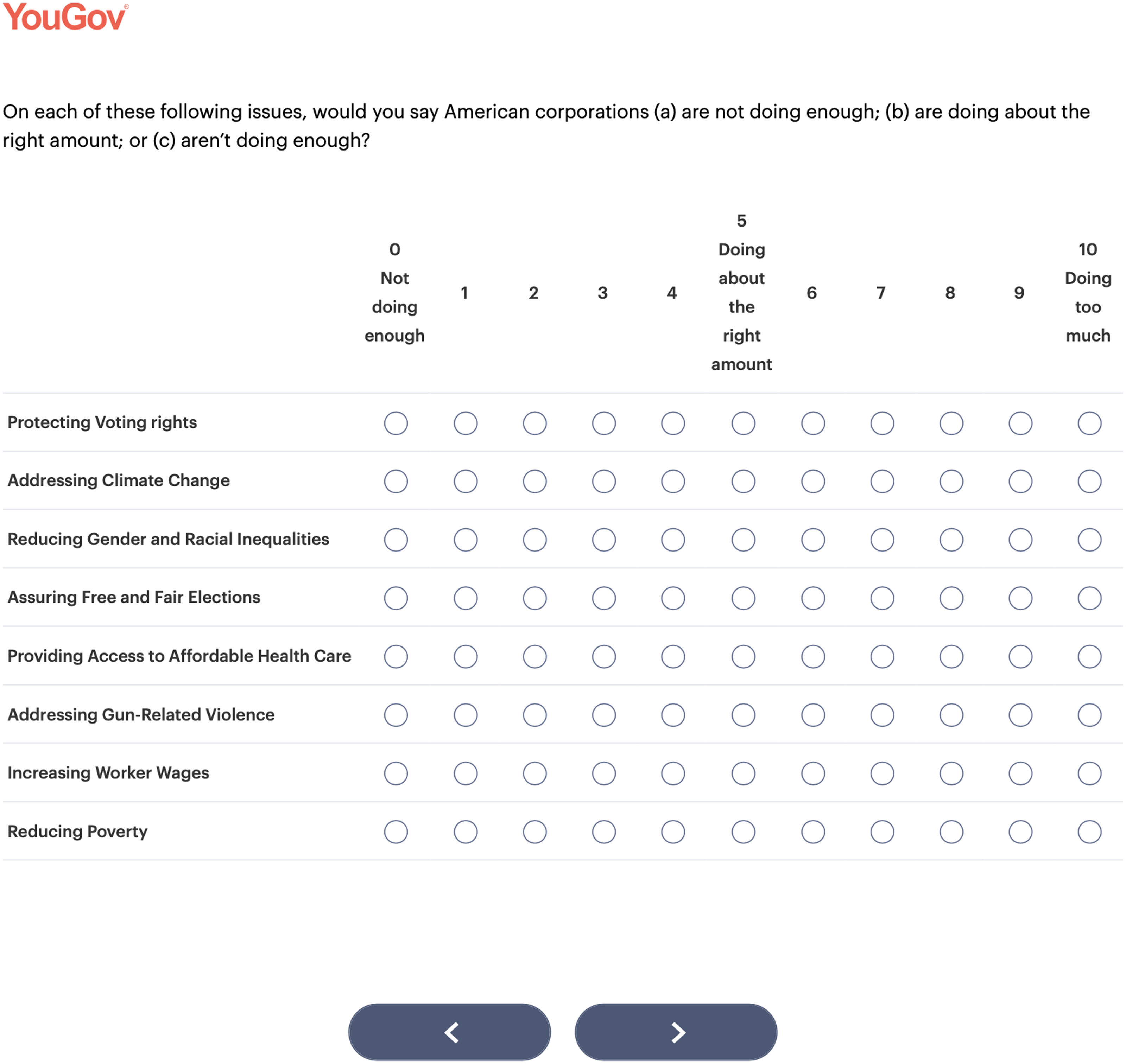
We measure perceptions of corporate involvement on a range of issues by asking survey respondents: “On each of these following issues, would you say American corporations (a) are not doing enough; (b) are doing about the right amount; or (c) are doing too much?”Footnote 9
• “Protecting Voting rights”
• “Addressing Climate Change”
• “Reducing Gender and Racial Inequalities”
• “Assuring Free and Fair Elections”
• “Providing Access to Affordable Health Care”
• “Addressing Gun-Related Violence”
• “Increasing Worker Wages”
• “Reducing Poverty”
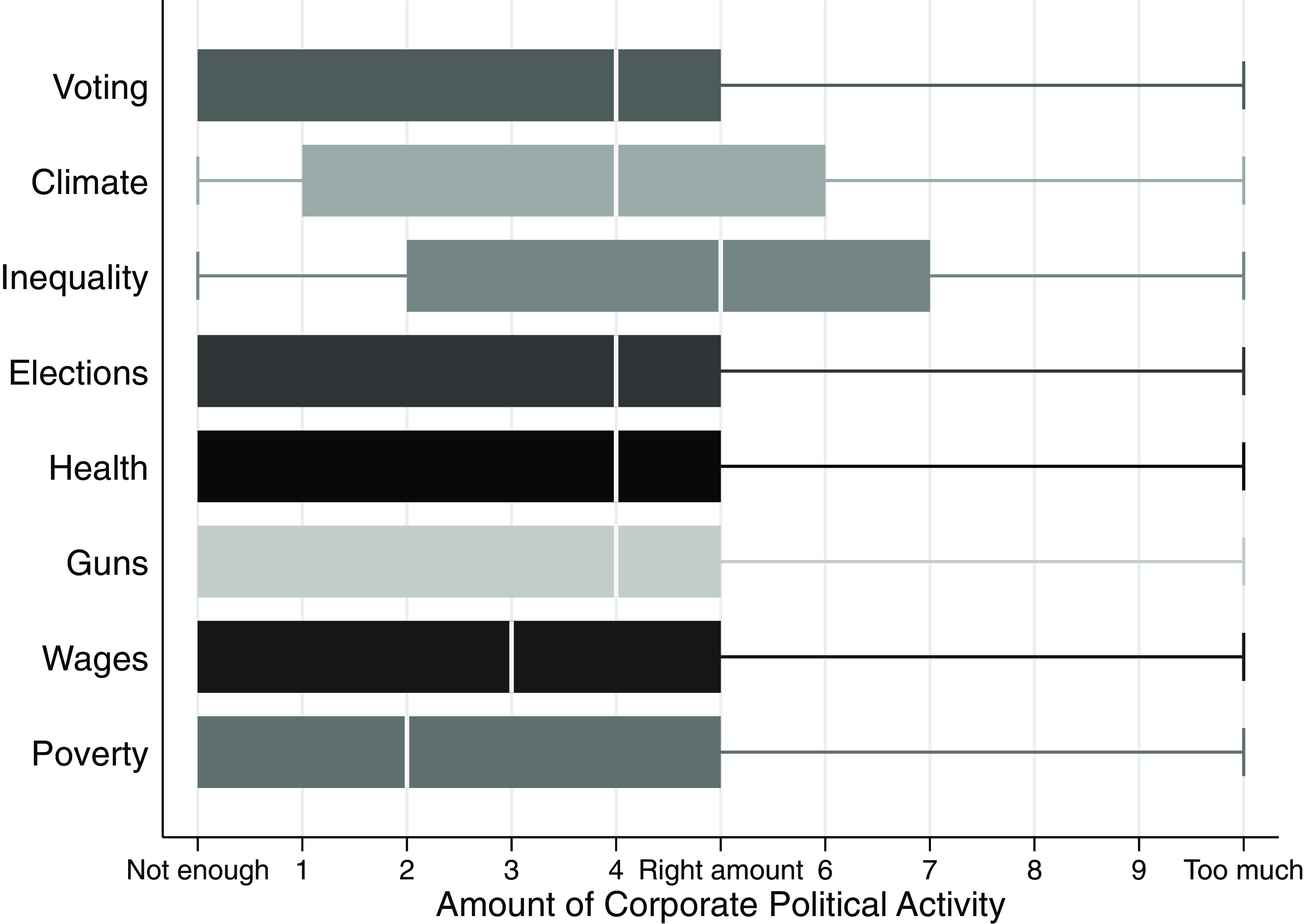
Respondents answered the prompt on an 11-point scale where zero indicates that the respondent believes American corporations are not doing enough, five indicates that the respondent thinks American corporations are doing about the right amount, and 10 indicates that the respondent thinks American corporations are doing too much.
In Figure 1, we present the medians and interquartile ranges for each of these items. Across issue areas, more respondents believe businesses are not doing enough or are doing about the right amount, rather than doing too much. On none of the items considered is the median response greater than five—which would indicate that respondents thought businesses were doing too much. Second, we do see variation across issue areas. For example, we find a greater number of respondents think there’s too much corporate political activity aimed at reducing racial and gender-based inequalities ( $\mu =4.48$
) than reducing poverty (
$\mu =4.48$
) than reducing poverty ( $\mu =2.70$
,
$\mu =2.70$
, $p \lt 0.01$
) or increasing wages (
$p \lt 0.01$
) or increasing wages ( $\mu =3.16$
,
$\mu =3.16$
, $p \lt {\rm{\;}}0.01$
).Footnote
10
$p \lt {\rm{\;}}0.01$
).Footnote
10
Distribution of corporate political activity perceptions by issue area.
We model perceptions of corporate political activity as a function of a set of social/political variables (partisan identification, ideology, racial resentment, and hostile sexism) as well as a set of pocketbook considerations (college education, income, union memberships, working in a blue-collar job, unemployment, and stock ownership). We are especially interested in the relative importance of social variables and pocketbook considerations on financial issues (increasing wages, improving health benefits, and reducing poverty) but also on issues not specifically tied to race or gender.
Social variables
Our models include four social variables: partisan identification, ideology, racial resentment, and hostile sexism. Partisan identification is measured using a standard seven-point scale ranging from strong Democrat to strong Republican (M = 3.88; SE = .09). Political ideology is measured on a five-point scale ranging from very liberal to very conservative (M = 3.39; SD = .07). Racial resentment and hostile sexism are indices composed of multiple questions/prompts.
The CES Common Content includes prompts from the well-established racial resentment and hostile sexism batteries.Footnote 11 Our measure of racial resentment is an additive index of the following four items:
• “Irish, Italians, Jewish, and many other minorities overcame prejudice and worked their way up. Blacks should do the same without any special favors.”
• “Generations of slavery and discrimination have created conditions that make it difficult for blacks to work their way out of the lower class.” (Reverse Coded)
• “White people in the United States have certain advantages because of the color of their skin.” (Reverse Coded)
• “Racial problems in the United States are rare, isolated situations.”
Racial resentment ranges from one to five (M = 2.71; SE = 1.24; alpha = 0.89). We measure hostile sexism as an average of the following two items (M = 2.67; SD = 0.05; alpha = 0.76):
• “Women seek to gain power by getting control over men.”
• “Women are too easily offended.”
Hostile sexism also ranges from one to five. The average respondent falls between a two and three on racial resentment and hostile sexism, meaning they are between neither agreeing nor disagreeing and somewhat disagreeing with the prompts.
Pocketbook variables
Our selection of pocketbook variables is designed to capture an individual’s working-class status.Footnote 12 Previous research has grappled with how best to measure working-class status. Our approach is to include a range of indicators.Footnote 13 Specifically, we include:
• w/o College—individuals without a college education (36.7 percent).
• Low Income—households earning 40,000 or less per year (27.9 percent).
• Union Household—households where at least one household member is/was in a union (29.9 percent).
• Blue Collar—whether a respondent reported working in the following industries: agriculture, mining, utilities, construction, or manufacturing (11.9 percent).
• Out of Work—respondents who reported that they were laid off, unemployed, retired, disabled, homemaker, or student (51.6 percent).
• Doesn’t Own Stock—coded 1 if the respondents report not owning stock, 0 otherwise (55.7 percent).
Some of these indicators are more interrelated than others. For example, w/o College is correlated with Low Income at $\rho =0.28$
, Out of Work at
$\rho =0.28$
, Out of Work at $\rho =0.20$
, and Doesn’t Own Stock at
$\rho =0.20$
, and Doesn’t Own Stock at $\rho =0.34$
.
$\rho =0.34$
.
Results
Before presenting the results of our regression models, we consider whether corporate political activity perceptions across issues areas reflect a single underlying latent construct or multiple constructs. In Figure 1 (above), we displayed median corporate political activity perceptions across issue areas. Based on the medians, it appears that survey respondents were able to distinguish across issue areas. However, the individual items are also highly correlated—correlations range from 0.40 to 0.74—and Cronbach’s Alpha for an eight-item index is 0.90.
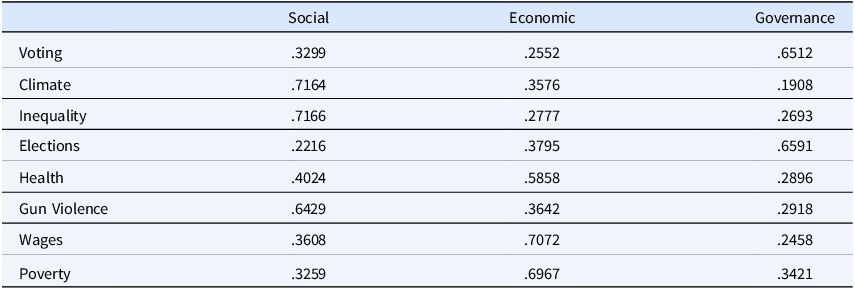
To further investigate this question, we conducted an exploratory factor analysis (with orthogonal rotation). The findings are presented in Table 1. What emerges is a three-factor solution reflecting the items gauging social issues (inequality, climate, and gun violence), economic issues (wages, health care, and poverty), and governance issues (voting rights, free and fair elections). Rather than reflecting a single underlying construct (reactions to business involvement in politics), it appears that individuals are responding as well to the focus of the activity.
Factor analysis of corporate political activity perceptions
Factor analysis can give some insight into the underlying dimensions capturing perceptions of corporate political activity, but it leaves open the question of how individuals evaluate these activities. Are individuals largely responding to these items as partisans? Or do economic considerations play a role? To answer this question we regressed perceptions of corporate political activity across issue areas on our competing sets of social and pocketbook economic factors. We estimate nine linear regression models with each item as an outcome, as well as an index of all eight items.Footnote 14 The results are presented visually as coefficient plots in Figures 2a–2d, with the full results presented in Table A1 of the Appendix.
a. Perceptions of corporate political activity on elections issues. b. Perceptions of corporate political activity on cultural issues. c. Perceptions of corporate political activity on economic issues. d. Perceptions of corporate political activity on all issues.
Notes. All eight of the individual corporate political activity issues, as well as the index are continuous variables ranging from 0 = not enough to 10 = too much. The coefficients plotted here are from linear regression models. The models include survey weights provided by CES. The coefficients are bracketed by 95 percent confidence intervals.
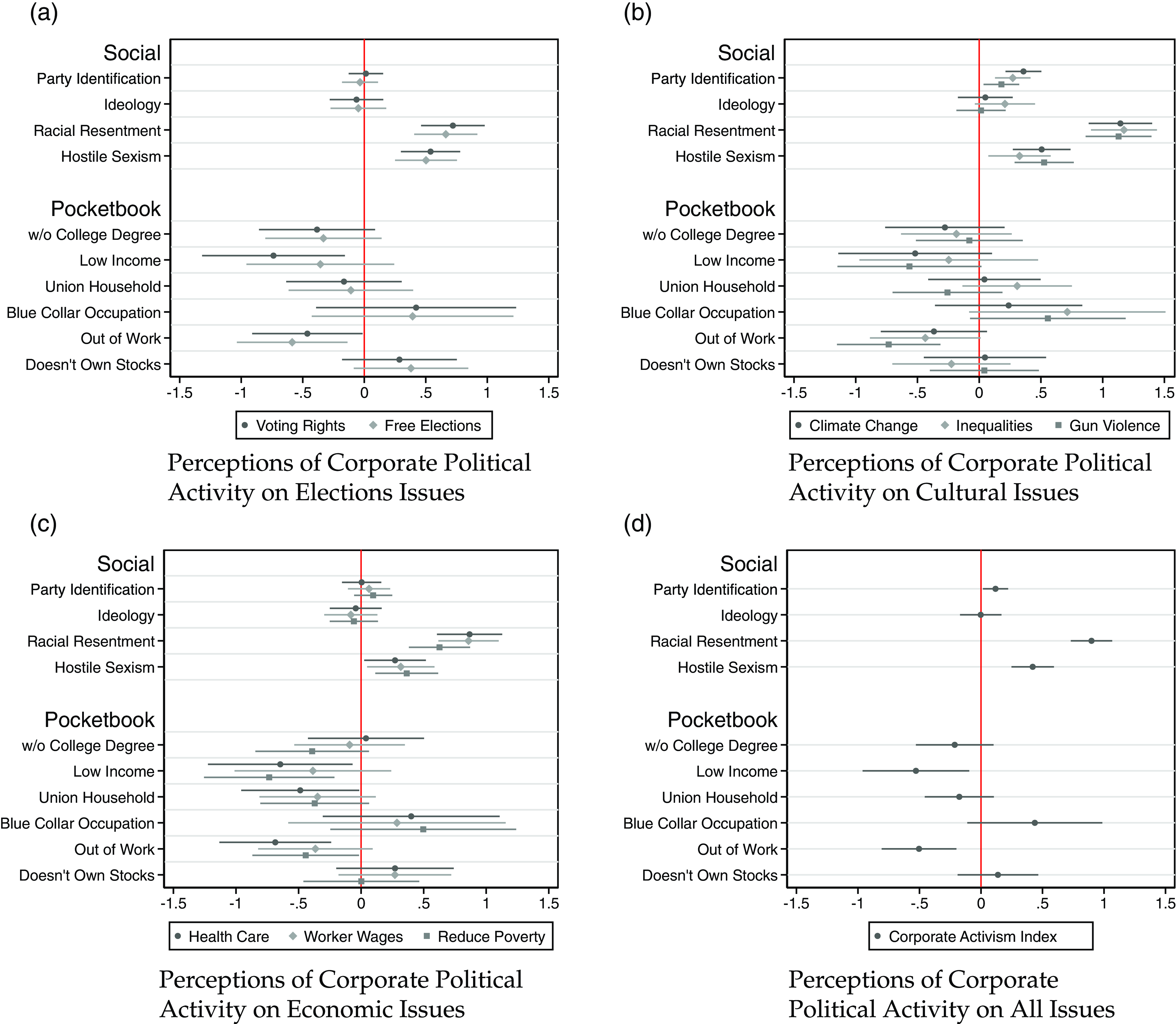
What is most striking about the results is the relative importance of racial resentment and hostile sexism across all eight issue areas (supporting Hypothesis 3). The smallest effect of racial resentment suggests that a one-unit increase in racial resentment is associated with a 0.63 point increase on the 11-point poverty scale (24 percent of a standard deviation). The largest suggests a one-unit increase in racial resentment is associated with a 1.17 point increase on the 11-point inequality scale (36 percent of a standard deviation). Racial resentment and hostile sexism are important even in those areas where they have little explicit connection (wages, health care, and poverty) to race or gender. Individuals, it would appear, reflexively respond to cues about business involvement in politics as part of a larger progressive social agenda.Footnote 15
Unlike racial resentment and hostile sexism, partisan identification varies in importance across issues. With controls of racial resentment and hostile sexism, it is not a significant predictor of corporate political activity perceptions of voting rights or assuring free and fair elections. Notably, if perceptions of corporate political activity were based on partisan advantage, these are the issues where we should have seen strong effects. Nor is partisan identification a significant predictor of thinking there is too much or too little business activity on the “bread and butter” issues—raising wages, providing access to health care, or reducing poverty. In support of Hypothesis 2, partisan identification primarily plays a leading role on the most visible and polarizing issues—addressing climate change, reducing race and gender inequalities, and reducing gun violence—where party cues are most readily available.Footnote 16
Overall, we find no support for Hypothesis 1. With controls for racial resentment, hostile sexism, and partisan identification, ideology is not a significant predictor of corporate political activity perceptions in any of the nine models. Thus, we find little evidence that perceptions of corporate political activity are ideological, reflecting a principled belief that businesses should stick to their core business.
Finally, some of the pocketbook economic considerations are consistently related to thinking American corporations are doing too much—lending mixed support to Hypothesis 4. Individuals who are out of work (retired, unemployed, and students) are significantly more likely to say American corporations need to do more to address a range of issues. It is not entirely clear that this is economic self-interest at work, however, as the effect of being out of work is only marginally significant as a predictor of wanting corporations to do more to increase wages, but it is a significant predictor for wanting corporations to do more to address climate change, protect voting rights, and assure free and fair elections. Having said that, the most consistent effects of pocketbook considerations on perceptions of corporate political activity are for providing access to affordable health care. Lower-income, union households, and out-of-work respondents all favor more corporate activity aimed at providing access to affordable health care.
Robustness: what should be the role of business in politics?
Our eight measures of corporate political activity perceptions reveal whether respondents think American corporations are “doing enough” or “doing too much,” as well as the motivations for these perceptions. But, the responses don’t inform us if “doing too much” means the corporate activity is too liberal or too conservative. We assume, given the current rhetoric regarding business in politics, that prompts referencing corporate activity on “addressing climate change” cue respondents to think of “woke” social goals and activities. However, it is possible that more liberal respondents perceive businesses as taking action consistently to the right of their preferences.
To explore these nuances, we fielded a small (five question) supplementary survey as part of the Verasight Interdisciplinary Omnibus Survey.Footnote 17 We ask respondents specifically about businesses 1) advocating for progressive causes, and 2) stepping in on economic, social, or cultural issues when the federal government fails. The exact question wording follows:
1. “American businesses should spend more time making money and less time advocating for progressive social causes.”
2. “If the federal government fails to address an economic, social, or cultural issue, then it is big business’s responsibility to address the problem.”
Responses range from 1 = strongly agree to 5 = strongly disagree (M = 2.68 and 2.92; SE = 1.28 and 2.92 respectively). We quasi-replicate our previous set of analyses on these two dependent variables—we are limited in the number and scope of independent variables. We include two social and two pocketbook variables in our ordered logistic regression models: party identification, racial resentment, w/o college degree, and low income.Footnote 18
The results from these additional analyses are presented in Figure 3 and Table A2 of the Appendix. Our analyses provide further evidence that racially resentful Americans think businesses should stay out of progressive social causes. Yet, the racially resentful are not opposed to the general idea of business involvement in politics. For example, a one-unit increase in racial resentment makes a respondent approximately 13.7 percent more likely (p = 0.00) to agree that corporations “should spend more time making money and less time advocating for progressive social causes,” and approximately 3.4 percent more likely (p = 0.01) to agree that big business should step up “if the federal government fails to address an economic, social, or cultural issue.” How can racially resentful respondents both want businesses to “shut up and dribble” and to step in when the government fails? We suspect that abstract support for business involvement in politics does not translate into specific support for business involvement in social, economic, or governance issues. In other words, racially resentful individual appear more sensitive to policy ends to policy means.
The relationship between racial resentment and corporate political activity.
Notes. Less time advocating and Big business’s responsibility are ordinal variables ranging from 1 = strongly agree to 5 = strongly disagree. The coefficients plotted here are from ordered logistic regression models. The models include survey weights provided by CES. The coefficients are bracketed by 95 percent confidence intervals.
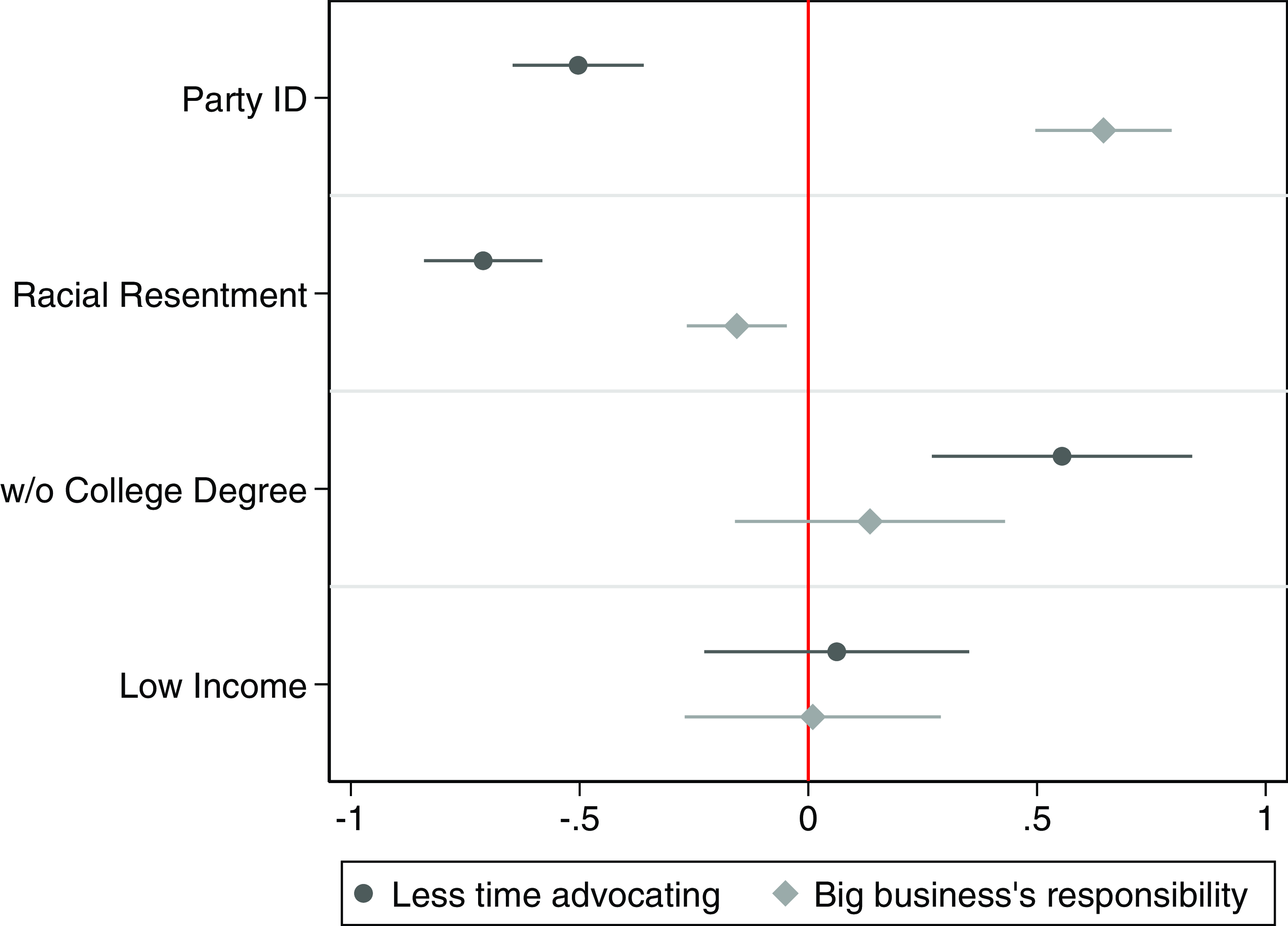
Contrary to racial resentment, the effect of partisan identification is consistent in nature. Republicans are significantly more likely to agree that business should spend less time advocating for progressive causes, and less likely to agree that big business should step in when the government fails. Republicans are anti-big business involvement in politics across both issues. For Republicans, means and ends align.
Limitations
Our study is not without limitations that warrant careful consideration. We acknowledge the potential constraints related to (i) our data sources and (ii) the interpretation/implications of our findings.
We use data from the Cooperative Election Study (CES) and the Verasight Interdisciplinary Omnibus Survey. Both surveys, at least partially, use opt-in online convenience samples—Verasight pairs them with random address- and text-based recruitment methods. While the datasets are weighted to approximate a nationally representative sample of US adults on key demographic variables such as race/ethnicity, sex, and age, there are inherent limitations to generalizing from an opt-in convenience sample. Specifically, the representativeness of the datasets rests on the assumption that individuals who join opt-in panels have attitudes, views, and behaviors similar to those of individuals with the same demographics who do not participate in such panels (MacInnis et al. Reference MacInnis, Krosnick, Ho and Cho2018). This assumption may not always hold true, and as such, our findings should be interpreted with caution when generalizing to the broader US population. However, the Cooperative Election Study’s accuracy is noteworthy (Ansolabehere and Rivers Reference Ansolabehere and Rivers2013; Ansolabehere and Schaffner Reference Ansolabehere and Schaffner2014), and its use is widespread (Shor and Rogowski Reference Shor and Rogowski2018; Barber Reference Barber2016; Jacobson Reference Jacobson2012).
Another important limitation concerns the interpretation of our findings, particularly regarding the relationship between racial resentment, hostile sexism, and perceptions of corporate political activity. While our results indicate that racial resentment and hostile sexism are associated with the perception that corporations are doing too much in various social and political issue areas, we must be cautious not to overstate these findings. It is possible that perceptions of corporate political activity are driven by other factors, and these other factors also influence the racial resentment and hostile sexism measures. For example, individuals who score higher on racism and sexism scales might also hold stronger patriotic beliefs or have a greater sense of personal efficacy, and it could be that these latter attitudes are driving their perceptions of corporate political activity. In other words, our findings highlight significant correlations, but they do not establish causation or rule out the influence of other unmeasured variables.
Conclusion
One of the more important changes in contemporary politics has been a shift in the alignment of corporate political interests and the Republican Party. This shift was preceded by changes to the Democratic Party, moving it from a working-class party to a party dominated by college-educated elites, and to the Republican Party, as it increasingly hewed toward right-wing populism and away from corporate political elites (Goidel et al., Reference Goidel, Moreira and Armstrong2024; Zingher Reference Zingher2022; Hersh Reference Hersh2023). As these shifts were unraveling, American national government grew increasingly dysfunctional (Mann and Ornstein Reference Mann and Ornstein2016; Goidel Reference Goidel2013). As a result, the pressures increased for corporate America to play a role in addressing political issues ranging from the existential threat of climate change to the persistent problems of race and gender-based discrimination.
In this paper, we explored how individuals respond to corporate political activity across a range of social and political issues. The findings are as striking as they are clear. Individual dissatisfaction with (thinking there’s too much) corporate political activity is associated most consistently with racial resentment and hostile sexism. These effects extend beyond ideology and partisanship. Even in the “bread and butter” issue areas such as increasing wages, providing affordable health care, and reducing poverty, racial resentment and hostile sexism are strongly related to perceptions of corporate political activity. Our interpretation is that the effects of racial resentment and hostile sexism spill over into these related issue areas because they are seen as part of a larger “woke” progressive social agenda. Previous research has noted that importance of racial resentment in evaluations of government policy, particularly welfare policy. Even policies that are not based on race (e.g., the Affordable Care Act) can become racialized (Tesler Reference Tesler2012). Our findings extend this literature by connecting racial resentment and sexism to corporate political activities driven not by government policy but by market-based or reputational concerns.
The findings likely matter beyond the individual level. In a study of business responses to the Black Lives Matter movement, Kinderman (Reference Kinderman2022) argues that the Chamber of Commerce Equality of Opportunity Initiative could, at least potentially, effectively address racial inequality. However, Kinderman also observes a negative relationship between racial resentment at the state level and state and local Chamber of Commerce participation in the Equality of Opportunity Initiative and notes that DEI initiatives have not extended to support of the minimum wage. Our results add further reason for caution. Individual racial resentment and sexism not only undermine support for corporate political activities aimed socially progressive issues but also activities aimed at improving wages and benefits. If there is pressure of business to engage in corporate political activities, there may also be pressure to scale back those efforts.
The effects of partisan identification and political ideology are less consistent and less clear. Party identification matters—independently of racial resentment and hostile sexism—only on the most highly visible and polarized issues (climate change, racial inequality, and gun violence). Ideology does not have an effect independent of these other controls. We should be clear, however, we are not arguing that party and ideology do not matter. They are both important in structuring how individuals think about the world. This includes how individuals evaluate the current level of corporate political activity. But in this case, racial resentment and hostile sexism are more proximate and powerful predictors than partisan affiliation and political ideology. Corporate political activity is seen largely through the lens of race and gender, even in those areas not explicitly tied to race or gender. In this respect, corporate efforts to increase wages, provide access to affordable health care, or reduce poverty may suffer from spillover effects from efforts to reduce racial and gender-based inequalities (Tesler Reference Tesler2012, Reference Tesler2015). More generally, corporate political activity may undermine the causes it is intended to support, particularly when those causes are not explicitly tied to race or gender (Marsh and Peterson Reference Marsh and Carr Peterson2024).
Statements and declarations
The authors do not have any conflicts of interest and did not receive support from any organization for the submitted work.
Appendix A
Determinants of Corporate Political Activity Perceptions Across Issue Areas
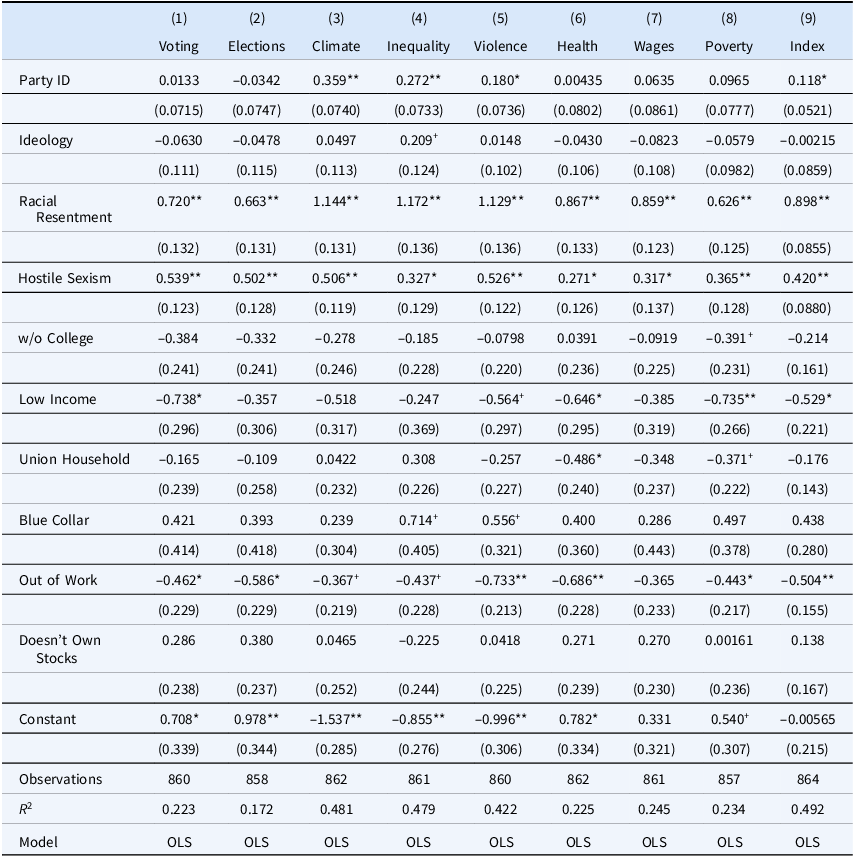
Standard errors in parentheses
+p < 0.1, *p < 0.05, **p < 0.01
Perceptions of Business’s Role in Politics
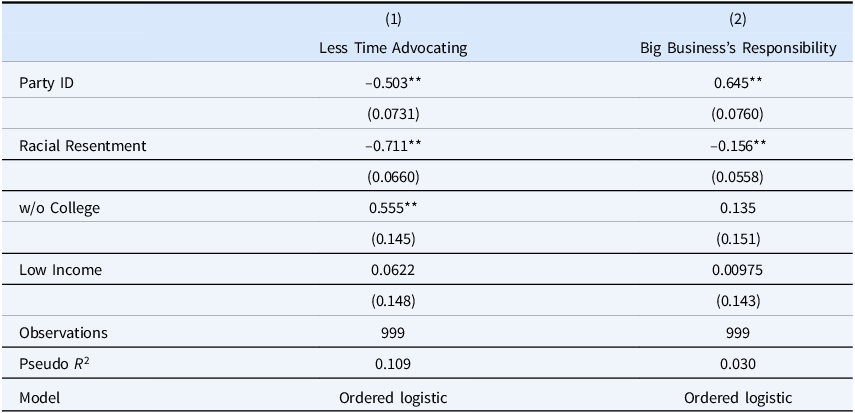
Standard errors in parentheses
+p < 0.1, *p < 0.05, **p < 0.01
Determinants of Corporate Political Activity – Decomposed Racism and Sexism Scales
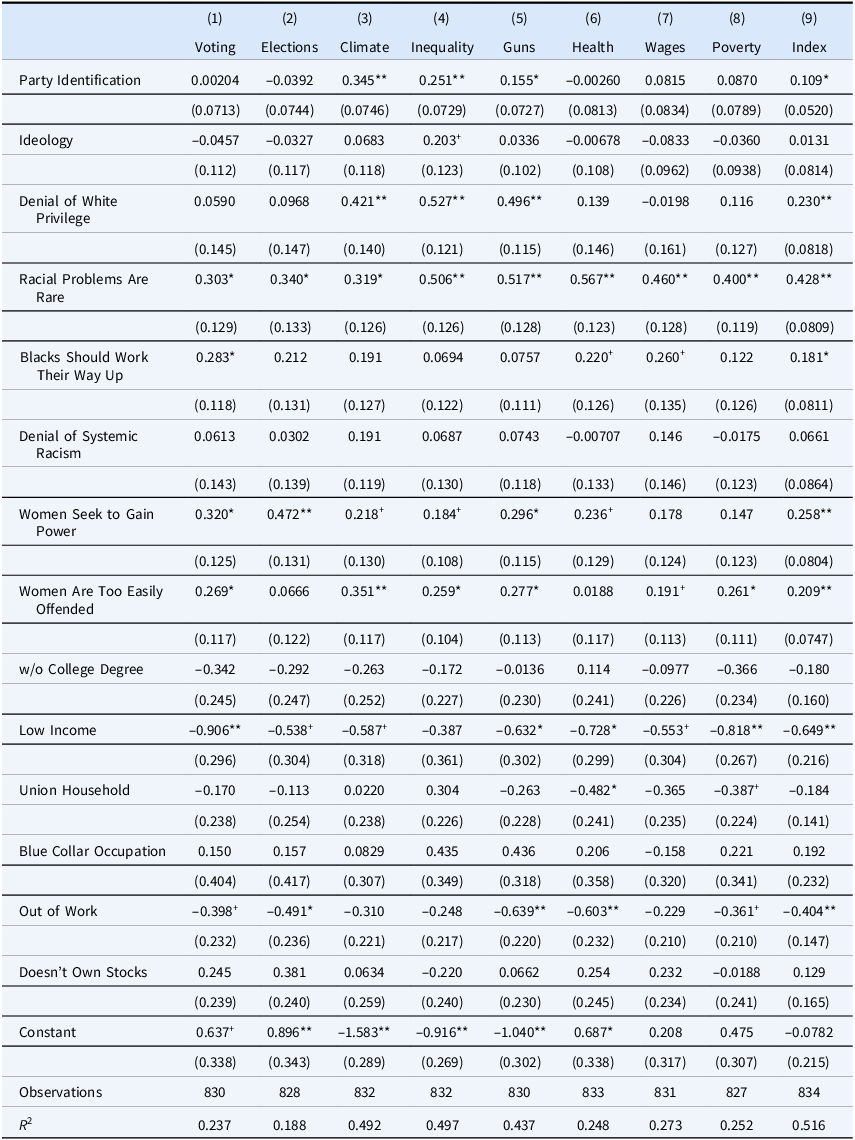
Standard errors in parentheses
+p < 0.1, *p < 0.05, **p < 0.01
Determinants of Corporate Political Activity – Without Racial Resentment and Hostile Sexism
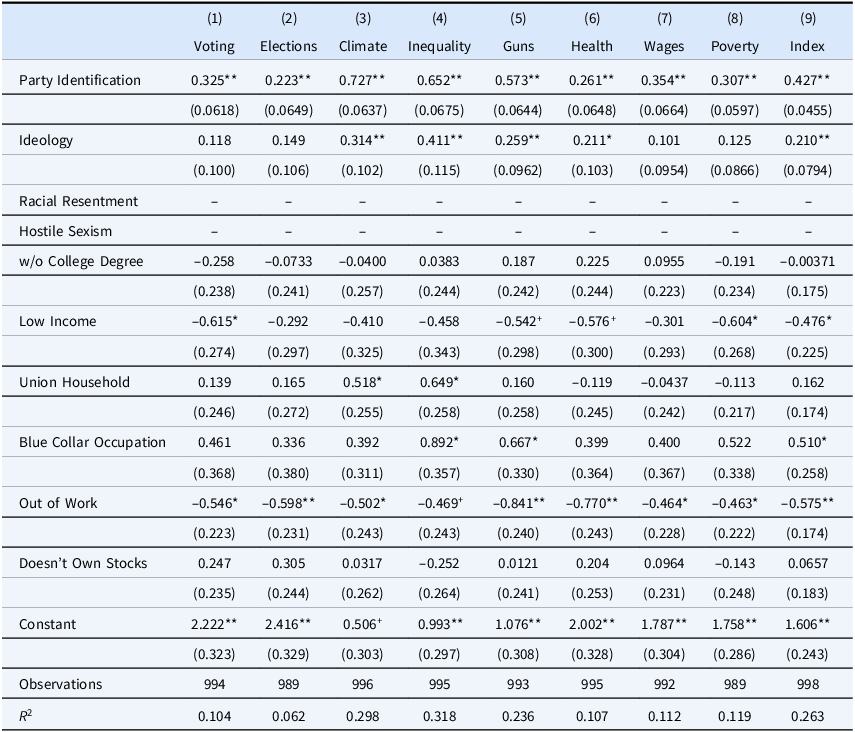
Standard errors in parentheses
+p < 0.1, *p < 0.05, **p < 0.01
Determinants of Corporate Political Activity – Without Party ID and Ideology
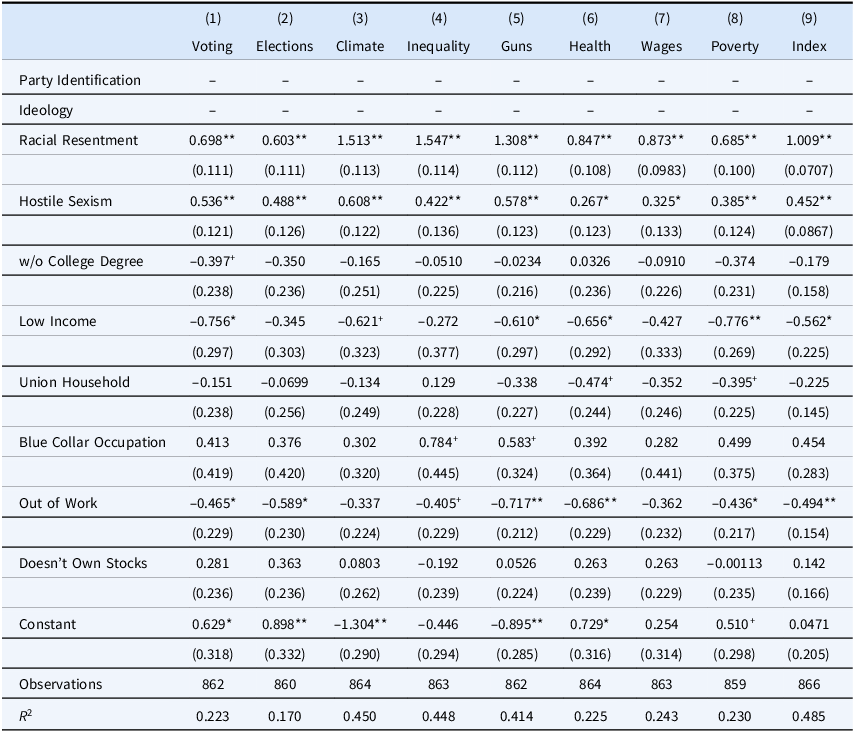
Standard errors in parentheses
+p < 0.1, *p < 0.05, **p < 0.01
Determinants of Corporate Political Activity – Excluding “Straightliners”
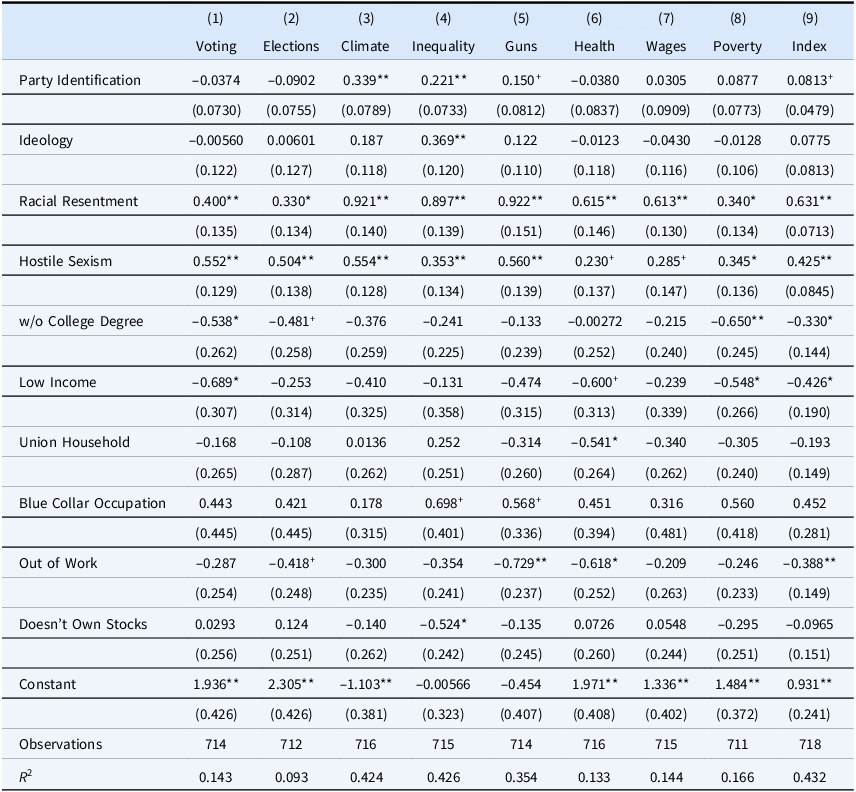
Standard errors in parentheses
+p < 0.1, *p < 0.05, **p < 0.01
Determinants of Corporate Political Activity – Including Individual-Level Controls
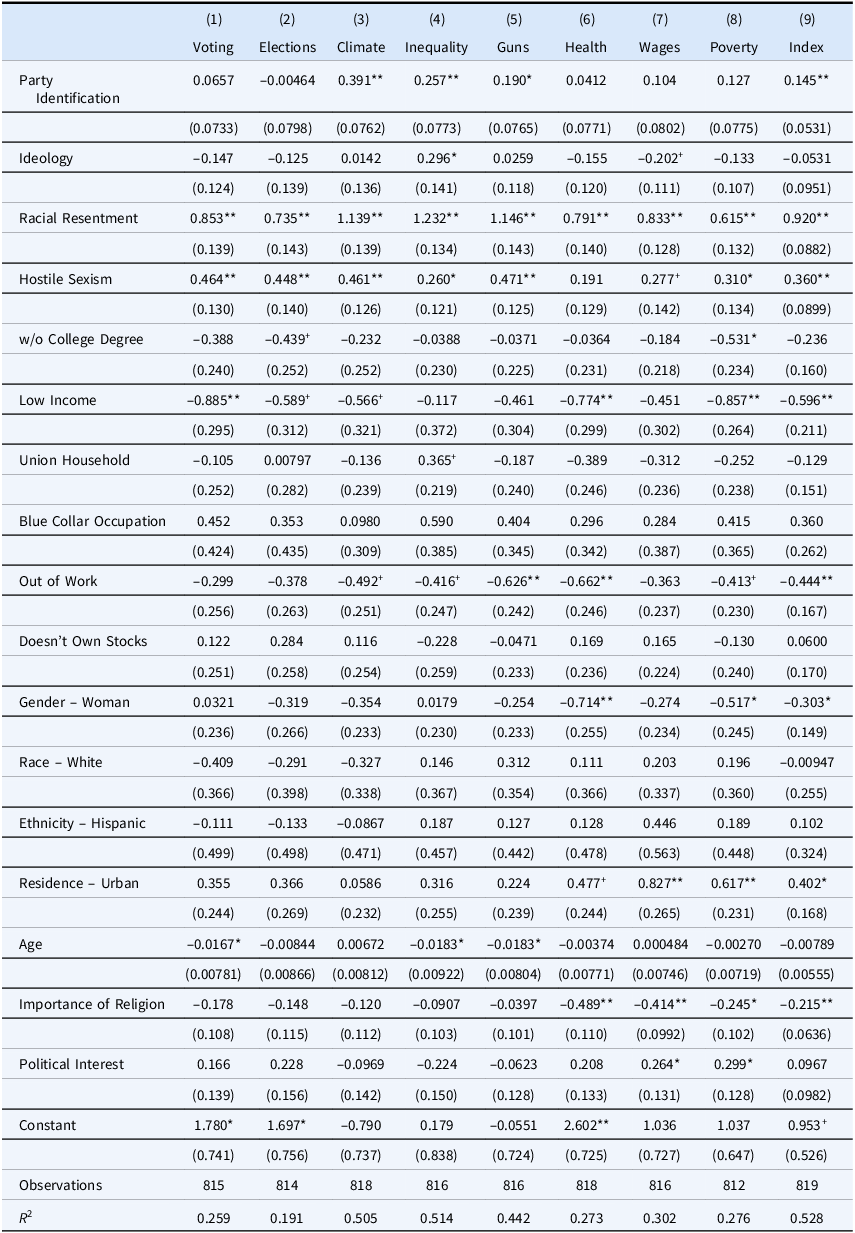
Standard errors in parentheses
+p < 0.1, *p < 0.05, **p < 0.01
CES Module – Perceptions of Corporate Political Activity.


 Open access

