


Mobility has been a key aspect of China’s reform and opening-up programme, yet most of the reforms and regulations have aimed to facilitate the mobility of Chinese nationals rather than that of foreigners coming to China. Since the 2010s, immigration has become a prominent area of legislative and policy activities in the PRC, with the Immigration Law coming into force in 2013 and the establishment of the Ministry of Immigration in 2018.Footnote 1 In the same year as the new ministry was set up, China signed up to the non-binding UN Global Compact for Migration agreement, together with its commitment to promote ‘safe, orderly, and regular migration’.Footnote 2 The establishment of a ministry-level organ dealing with immigration reveals a tension in Chinese policy, as in most if not all immigrant-receiving societies, between a commitment to opening up China to foreign migrants and national security discourses and practices premised on distinctions between foreigners and nationals.Footnote 3 Priority has been given to encouraging skilled immigrants who can contribute to China’s socioeconomic development, rather than a broad and comprehensive development of integration and naturalisation policies for foreigners in China.Footnote 4 Chinese officials stress that domestic laws and national conditions take priority in defining the state’s position on immigration.Footnote 5 Although one of the global migration compact’s guiding principles is to provide ‘gender-responsive’ migration policies, the spheres of family and marriage migration remain largely underdeveloped areas, showing that gender and reproductive labour considerations are largely absent in the normative and institutional design of immigration policy in China.
In this chapter, I analyse the development of the Chinese immigration regime by cutting across the spheres of familial, border and national security concerns. In particular, I discuss how romantic relations and marriages between Chinese and foreigners are governed and how the discursive constructions of Slavic wives emerged in official and popular discussions at the intersection where national security concerns extend to norms on sexuality, gender and race. I demonstrate how these discourses infuse debates and regulatory practices and their effect on Chinese citizenship and practices of belonging.
1.1 Regulating Foreign Lives in China
The lives of foreigners living in China are regulated within a framework that has scarcely been revised since the Maoist period.Footnote 6 During the reform period the arrival of foreigners in China led to a distinct national response, which Haiyan Lee calls ‘a tremendous anxiety of inadequacy’.Footnote 7 The 1985 Law on the Control of the Exit and Entry of Aliens was the first legal framework for regulating foreigners produced in the reform era. After the socioeconomic acceleration in China’s position when it joined the World Trade Organization in 2001, it became apparent that new legal and administrative tools needed to be devised to control foreigners crossing the border, and their access to China’s domestic labour, financial and property markets, as well as their residence rights. As a result, a succession of new laws has been developed to manage immigration, and immigration policies have been drawn up since the mid 2000s.Footnote 8 Ever since 2010, information on foreigners residing in China has been included in the national census data and this has shown a steady increase in the presence of foreigners in the country.Footnote 9 However, despite the rhetorical shift towards openness, the new policies are in fact aimed at imposing stricter control on immigration and foreign residents.Footnote 10
The 2004 Regulations on the Examination and Approval of the Permanent Residence of Aliens in China specify the procedure for applying for a permanent residence permit in China, including on the basis of marriage with a Chinese national.Footnote 11 As the number of marriages with foreigners increased and the Chinese state welcomed stronger links with overseas Chinese, the procedures were simplified to facilitate the mobility of spouses from Taiwan, Hong Kong and Macao and for children of cross-border marriages.Footnote 12 When the national permanent residency programme was launched in 2004 only about 20,000 foreign nationals obtained long-term residency status.Footnote 13 In 2010 a border-crossing ‘compatriot pass’ or ‘return home pass’ (the two English translations for 通行证 tongxing zheng) was introduced for people from Taiwan, Hong Kong and Macao to travel to and reside in China. The tongxing zheng, which recognises the holder of the document as a ‘subject of the Chinese state’ without, however, giving them full citizenship, was subsequently used to regulate the status of children with foreign citizenship who were born to parents who held a Chinese and a foreign passport, respectively. This generated worries among some foreign mothers in China, who feared for their parental rights and were concerned that it entailed their children belonging to the Chinese state more than to them. I return to this discussion in Chapter 5. From the Chinese state’s perspective, the tongxing zheng addresses the limitations of its single citizenship norms by granting more rights to people of Chinese descent, irrespective of their presence in the country, than to non-Chinese. This shows that ethno-racial ties are given privileged status in accessing national membership in China.
The ethno-racial ideas informing Chinese citizenship laws have evolved from the practices of the late Qing reformers and republicans, who stressed the importance of blood lineage to secure Chinese national unity against foreign domination. The first modern idea of national membership codified in the 1909 Nationality Ordinance extended to all overseas Chinese who could prove their Chinese descent.Footnote 14 The early communist Chinese state’s conception of nationality was predicated on the same idea of blood lineage until the PRC had to abandon its practice of dual citizenship in 1955 to avoid the escalation of ethnic animosity towards overseas Chinese communities in south-east Asia.Footnote 15 At the same time, a project that aimed to identify the ethnic groups residing in communist China led to the recognition of fifty-five ethnic minority groups, one of which consisted of the descendants of escapees and exiles from the Russian empire and the Soviet revolution, who had settled on the Chinese side of the border in the early twentieth century. These groups were granted citizenship of the PRC and ethnic minority status as a result of the ethnic identification project. This change in the Chinese citizenship law and the national model of a unified, multi-ethnic state set the stage for the position of foreigners in the Chinese nation and society. These broad processes also affected the regulations of marriage migration, which in recent decades have changed several times.
The 2013 Entry and Exit Administration Law provides the latest regulatory framework for dealing with immigration and addressing the ‘three illegalities’ problem: unauthorised work, and illegal entry into and residence in China, by creating limited conditions for foreigners to work and reside legally within the country.Footnote 16 The Immigration Law mainly regulates the status of foreign workers in China, while formulating new conditions for foreign members of Chinese families to live and work in China. This law contributed to the introduction of new classes and a hierarchy of foreigners in China: classes A, B and C.Footnote 17 Classes A and B include professionals in the research, technology and innovation sectors who can contribute to China’s development goals. They are able to enjoy longer and better working conditions than class C foreigners, but the application process for these types of visa is complicated. Foreigners in class C fall into the category of unskilled workers whose stay in China is strictly limited. The class C category has become a common route for foreigners working in the entertainment industry – colloquially known as ‘white monkey jobs’, as singers, dancers and models in China.Footnote 18 When I asked one of my research participants with a degree in teaching German and English from a university in Russia if it was easier for her to find a job as a teacher or as a singer in China, she unambiguously said that it was easier to get a visa as a singer, because less paperwork was required for a visa application. However, this type of visa is short-term and ties its holder to the employer who sponsors their visa application. Obtaining a long-term visa requires financial and other resources, such as student status, a company support or ties with a Chinese family.
In September 2013, when the new immigration law came into force, the tourist and short-stay visa (Visa L) that had previously been issued to the foreign spouses of Chinese citizens in accordance with the 1985 version of the Exit–Entry Law was replaced with a new ‘China Family Reunion Visa (Q)’. This law introduced two types of family visitor visas – Q1 and Q2. The Q2 visa is issued to relatives of Chinese citizens or of foreigners who have permanent residence in China for a short period (up to six months). The Q1 visa is issued to the relatives of Chinese nationals for a single entry and is valid for up to thirty days. The holders of this visa must apply for a temporary residence permit within thirty days of entry. Such residence permits can be granted for a minimum of ninety days and a maximum of five years. Although this law makes provision for long-term residence (up to ten years) for foreign spouses, the application process for these visas is lengthy and expensive, and many find it difficult to meet the qualifying criteria. In addition to providing a valid marriage certificate showing that they have been married for at least five years and have been a resident in China for at least nine months each year, the applicant must also provide evidence of savings that cover at least ten years of living costs, a notarised certificate for leasing a house or a certificate showing they own property, and a résumé summarising the applicant’s educational, personal and professional qualifications.Footnote 19 Until a foreign spouse secures a long-term residence permit that grants them the right to work in China, they are officially restricted to the domestic sphere, and cannot officially work or access public healthcare or education. In this way, their position is that of a foreign family visitor who is dependent on the goodwill of a Chinese national spouse to support them and sponsor a family visa application for their legal, albeit dependent, residence status in China. The law treats labour in the narrow sense of an exchange of labour for money, placing the spheres of family and reproduction outside the economic sphere and limiting the status of foreign spouses to that of temporary family visitors. The immigration regulatory framework relies on the clear separation of domestic and public spheres and reserves for foreign spouses in China an exclusively familial role by monitoring their stay, using one- and two-year visas. A five-year stay on consecutive family visas is construed as a probationary period before an application for long-term residency and labour rights may be considered and granted.Footnote 20
The sphere of immigration is governed by China’s modernisation goals and gives priority to attracting highly skilled workers to further the country’s economic and technological development. The state continuously revises its policy mechanisms to attract this workforce. For example, in February 2016 the general office of the Chinese Communist Party Central Committee and the State Council published an opinion paper that identified problems with the existing system of granting permanent residence, in particular unreasonable application requirements, an insufficient number of applications granted and the inadequate implementation of benefits.Footnote 21 It reiterated its strategic objective of reinvigorating China with talented people (落实人才强国战略, luoshi rencai qiangguo zhanlüe) and recommended the adoption of a more transparent permanent residency policy.Footnote 22 While the document was aimed primarily at encouraging highly skilled workers who could, in the eyes of the state, play an important role in China’s national talent strategy, it also outlined a detailed proposal for systematising and improving the regulations for and administration of foreign permanent residents in China. In less ambitious terms, it made provision for the ‘reasonable’ satisfaction of the needs and status of foreign family members.
The development of the immigration framework was not only intended to attract talent useful for China’s development goals, but also stressed the priority of strengthening and capitalising on the ethnic ties of the Chinese diaspora. Immigration regulations and citizenship rules, shaped by the collective memory of national humiliation, reflect a cautious, often negative, attitude toward foreigners.Footnote 23 The implementation of the 2013 Immigration Law narrowed China’s ambiguity towards foreign Chinese by treating them as members and citizens of the Chinese nation. Subsequently, overseas Chinese gained more rights in a new visa arrangement that came into force from 1 February 2018, giving foreigners of Chinese descent who have one Chinese ‘parent, grandparent or ancestor’ the right to apply for a five-year multi-entry visa.Footnote 24 At the same time, when China’s Ministry of Justice proposed in early 2020 to ease the criteria for foreigners to qualify for permanent residence and invited the Chinese public to comment on the proposal, it generated an overwhelmingly negative reaction from netizens who argued that such changes would undermine Chinese national sentiment and cohesion.Footnote 25 Collectively, these developments indicate that China’s immigration regime, as well as public sentiment, continues to prioritise ethnic and ancestral ties as the basis for long-term residence and membership in the nation.
I now turn to look at how the sphere of Chinese–foreign family relations is governed and how self–other relations are mediated at the intersection of public and private.
1.2 Governing Chinese–Foreign Marriages
Early in the reform era the phenomenon of marriage migration generated new state activity in creating the legal and regulative institutions and frameworks that organise, arrange and shape it. Some of the international marriages documented by researchers and local governments came about after the renewal of intra-ethnic customs along reopened borderlands, others after the increase in the number of foreigners (mostly men) working in big Chinese cities and dating Chinese women, or because of the growing network of cross-border matchmaking services.Footnote 26 Since 1986, when the categories of Chinese–foreign marriage and cross-border marriage started becoming more popular, the regulatory mechanism for international marriages has been under constant review.Footnote 27 An increasing number of marriages between Chinese and foreigners – that is, from any country in the world, with the explicit exclusion of ethnically Chinese foreigners – became possible with the changing moral culture and relaxing control on international travel.Footnote 28 The official statistics of the PRC include only marriages registered on Chinese territory and exclude customary ethnic marriages and those registered outside China. Chinese law recognises three types of foreign marriages (涉外婚姻shewai hunyin): those with overseas Chinese, those with compatriots in Taiwan, Hong Kong and Macao, and those with nationals of foreign countries.Footnote 29 Most registered foreign marriages in the PRC between 1979 and 2020 were categorised as ‘cross-border marriages’, meaning marriages with those whom China refers to as ‘compatriots’ in Taiwan, Hong Kong and Macao. Although Chinese women constitute the majority of PRC citizens in Chinese–foreign marriages, the number of Chinese men marrying foreign women has been steadily growing since the 2000s.Footnote 30
Recent research on social attitudes towards immigration in China has shown that, despite their negative views of foreigners, Chinese citizens support immigration if it can help to solve the marriage crisis. Population concerns over gender imbalance and marriage crisis translate into positive attitudes towards immigration.Footnote 31 Researchers have also stressed the need to make integration and naturalisation processes easier for marriage migrants.Footnote 32 By the early 2000s, public views of international marriages had shifted to accepting a ‘joint venture’ arrangement, under the assumption that mixed couples would predominately decide to live in China to make use of the business opportunities there.Footnote 33 Marriages with citizens from the former Soviet Union fall into the category of foreign, notwithstanding its geographical status as a neighbour, together with the two countries’ deeply intertwined borderland histories, cross-border ethnic groups and the common socialist legacy.Footnote 34 This points to fluid conceptions of borders in the Chinese national imaginary that privileges the role of ethno-racial ties uniting all ethnic Chinese rather than geographical proximity per se.Footnote 35
Marriages between Chinese and foreigners in China are governed along the intersecting areas of legal structures and state policies relating to marriage and family, immigration and population management, which are all intimately related to national security. Intersecting structures of gender, socioeconomic, racial and sexual inequality are reinforced by the state’s resistance to providing certain citizens with social goods such as healthcare and social security. This is combined with control over citizens’ legitimate reproductive practices by restricting them to the space of monogamous (heterosexual and documented) marriage via the norms and laws of conjugal relations.Footnote 36 Even when these norms are being continuously challenged by transformations in social, cultural and economic spheres, they reflect the dominant structures of feeling about marriages with foreigners in China, together with the strict administrative and judicial regulation of the foreign presence in that country.
In the Mao period, marriage was regulated by the party and work-unit relation, but the reform era is characterised by growing concern about the deinstitutionalisation of marriage in China and the growing number of divorces.Footnote 37 In addition, between 1979 and 2015 family planning legislation strictly regulated population growth by controlling women’s right to reproduce.Footnote 38 The 2001 amendment of the marriage law and subsequent regulations for registering marriages in 2003 made it easier for couples to get a divorce.Footnote 39 This led to a deinstitutionalisation of marriage as a social norm and basic unit of organising labour, sexual and reproductive relations in Chinese society.Footnote 40 These issues are related to the national concern with raising a hard-working, competitive Chinese population of excellent ‘population quality’, which in turn is aimed at improving general civility in the Chinese population as a whole, including in education, manners and habits.Footnote 41 Laws governing the population and the state’s concern about the quality of the population are directly related to the way in which marriage with foreigners is perceived. As I show in the next section, while foreign brides (外籍新娘 waiji xinniang) are perceived as offering a potential solution to Chinese national problems, marriages between Chinese women and foreign men are considered a matter of national security in China.
1.3 National Security and the Emergence of the ‘Russian Wife’
In 2016 the topic of marriages with foreigners captured the attention of the Chinese public and media on at least two occasions. On 8 June 2016 the East Asia Tribune, an allegedly Singaporean-based online English news site specialising in independent journalism and reportage, published a news item announcing that the Supreme People’s Court of China had passed legislation banning Chinese women (but not men) from marrying someone who was not Chinese.Footnote 42 Quoting one of the legislators, the site claimed that the law had been passed in the name of social harmony to forestall the possibility of rape by frustrated Chinese bachelors. In the following days, the news item was dismissed as a hoax on other news sites. Yet we need to consider the context in which this apparent information was framed, narrated and disseminated, as well as to reflect on the responses it generated, which indicate broad ‘actively lived and felt’ collective sentiments in Chinese society.Footnote 43
When the news started circulating through WeChat, readers who were not suspicious of its veracity enthusiastically commented on the alleged proposal, some supporting it and some rejecting it. When an eminent professor from one of the top Chinese universities shared the news item through WeChat, he was hesitant about its truth, conceding nevertheless that ‘anything was possible in the current political climate’. The East Asia Tribune article touched on widely shared public concerns about the shortage of women of marital age and the dubious intentions of Western English-language teachers, contributing to the widespread perception that many male Western teachers of English in China end up marrying Chinese women. Furthermore, considered in relation to another public campaign which may be hard to believe, the purported ban on interracial marriage for Chinese women could not but seem real.
Earlier, on 15 April 2016, a poster campaign targeting ‘dangerous love’ (危险的爱情 weixian de aiqing) appeared in the residential areas of inner Beijing to commemorate the inaugural National Security Education Day on 14 April.Footnote 44 This campaign warned of the perils of romantic relationships between Western male English teachers and Chinese women, which was the very subject of the later hoax in the East Asia Tribune. The cartoon in the poster shows a Western spy disguised as a language teacher using a female civil servant to obtain access to undisclosed materials, landing both with a term in prison. This made foreign teachers of English the target of the campaign.
While the Chinese public, accustomed to ubiquitous state propaganda, barely noticed the poster campaign, which had been dreamed up by the public security authorities after the investment of considerable resources, the hoax news two months later generated hundreds of responses within hours of being published. These two events highlight the structures of feeling in national discourses on marriage with foreigners and the feared effects of its skewed gender balance on national security. Both cultural products appealed to common sentiments, providing fertile ground for readers’ imagination, desires and fears to conjure up a picture of the perils of marriage with a foreigner.
Public anxiety over the lack of marriageable Chinese women follows China’s decades-long family planning policy, together with the persistence of traditional values that elevate the status of the son in the family, the emigration of Chinese women to marry in the West, Taiwan and Hong Kong, and the ‘loss’ of child-producing women to professional careers. These fears are exacerbated by the way that marriages with foreigners are framed. The nature and content of state propaganda and popular discourses show that the topic of intimate relations and marriage with foreigners is key to China’s concerns about its population, social stability and national security. It is therefore important to pay attention to the changing structures of feeling in a slippery space of hyperreality where the distinction between reality and fiction is repeatedly obliterated in the interests of national security.
It was in this context that the images of Slavic women from the states of the former Soviet Union entered the collective Chinese consciousness as suitable foreign partners for Chinese men. While women from south-east Asia had become the default choice as foreign brides for rural Chinese bachelors, these Russian wives became presented in a series of official and popular publications as the first choice for well-off Chinese urbanite men. It is difficult to estimate to what extent the Chinese state favours the idea of promoting Russian–Chinese marriages, yet its implicit encouragement is noticeable.
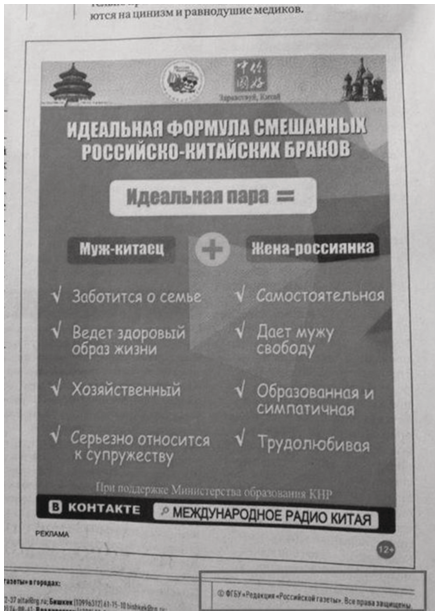
Russian–Chinese bilateral relations grew closer when, in May 2015, Xi Jinping visited Moscow for the seventieth anniversary of the Victory of the Great Patriotic War and to mark formally the merger of two state initiatives, China’s new Silk Road Economic Belt and the Eurasian Economic Union. While foreign commentators observed that China and Russia’s bilateral relations were becoming closer, Chinese and Russian interstate media started tacitly promoting Chinese–Russian marriages. Several weeks after Xi Jinping’s visit to Moscow a curious advert circulated in the Russian print media, promoting ‘the ideal formula’ of mixed Russian–Chinese marriages. Originally placed in the Rossiyskaya Gazeta (the official mouthpiece of Russia’s main party, United Russia) with the alleged support of China’s Ministry of Education, the advert offered a formula for the ideal international couple: Russian wife + Chinese husband = ‘the ideal couple’ (Fig. 1.1). The advert summarised the qualities of a Russian wife: good-looking, educated, independent, hard-working and giving her husband freedom to do whatever he wants. According to the advert, a Chinese husband is a caring and serious-minded family man. He leads a healthy lifestyle and is a good handyman. Subsequently, the Russian media started commenting on this unexpected by-product of ‘Putin’s turn to Asia’. The advert became a topic of heated discussion in Chinese and Russian social media spheres.Footnote 45
The ideal formula of mixed Russian–Chinese marriages.
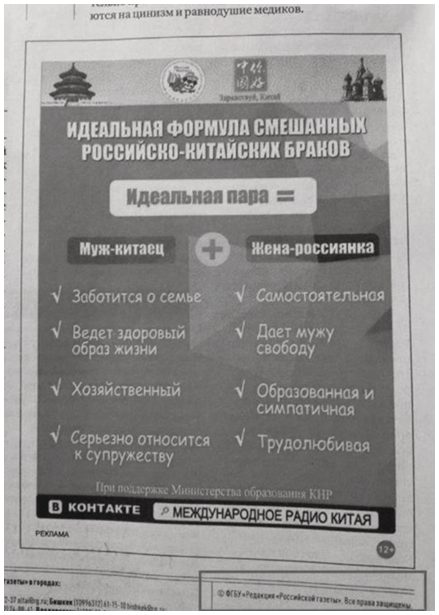
I often brought up this advert in my conversations in order to gauge the sentiments of my research participants about the topic. One of the women offered a vivid definition of the stereotypical Russian wife from her experiences and observations. ‘The Russian wife, in the minds of many Chinese men, is an undemanding and strong white woman, who can be bought.’ The ideal formula in the advert epitomised the official stance on the marriages in China and Russia emerging against the background of the two governments’ efforts to promote communication between young people within the framework of the Sino–Russian Youth Friendship Exchange Year announced that same year.Footnote 46 One professional woman from St Petersburg working as a translator in Beijing expressed her particularly strong reaction towards the advert: ‘When I saw this advert, I was shocked. The bastards. They were paid to write it and they published it. It is Rossiyskaya Gazeta, the state’s mouthpiece! After a series of corruption scandals, our people just do not understand [the power of advertising]. Those who published it are “enemies of the people”.’
State propaganda on family relations is ubiquitous in China. During the socialist period, the Chinese government distributed printed material and organised public entertainments to convey the party’s values on all aspects of private life. After the opening up of China, the state’s efforts to interfere in the private lives of its population intensified.Footnote 47 In her research on the role of the population in China’s reform, Susan Greenhalgh concludes that the idea of ‘population quality’ was initially eugenic in character, aimed at preventing defective births through medical and legal means. Later, it expanded to include health, education and child-rearing more generally, and all social forces were used to promote the cultivation of a new generation of citizens who would grow into a high-quality labour force and contribute to China’s global rise.Footnote 48 The eugenic laws and rhetoric have characterised much of the modern political system of the Chinese state, leaving the eugenic foundations of population policies largely unquestioned.Footnote 49
Gender and sexuality are of central concern to the Chinese leaders. James Farrer found that in the 1990s the Ministry of Propaganda was engaged in cautioning against the favourable media portrayal of mixed marriages between Chinese women and foreign men in Shanghai, because such representations were undermining Chinese masculinity.Footnote 50 As I show in Chapter 2, visual products about Chinese–Russian romantic relations produced during the reform period are aligned with the party’s propaganda directives. Furthermore, the Rossiyskaya Gazeta advert shows that the two states tacitly undertook the role of matchmaking as well as strengthening bilateral state relations. However, in the absence of a sizeable number of Chinese–Russian families in real life, there is scope for the Chinese state media and propaganda industry to create and promote the idea that such families are popular and excite the desire in single Chinese men to find a foreign wife in one of the former Soviet Union states.
When the ‘Russian wife’ trope became a notable presence in the Chinese media, it initially referred indiscriminately to all Slavic women from the former Soviet states. However, since the war in Ukraine started in 2014, new distinctions between Russian and Ukrainian women have appeared in the Chinese media. This public awareness of Ukraine as a separate entity and Ukrainian women as different from Russian, yet with similar qualities and within the reach of Chinese men, was popularised by the story of Mei Aisi, a self-professed Chinese loser (屌丝 diao si) who went to Ukraine in the early 2000s to take up educational and business opportunities there after failing the Chinese university entrance exam. In December 2014, he published images of his wife in a bikini holding their baby daughter, making many Chinese netizens jealous. Overnight, Mei became an internet celebrity, and his business idea to create the largest Chinese–Ukrainian business specialising in matchmaking services was off to a promising start.Footnote 51 Since then, Chinese media and netizens have made the theme of Ukrainian wives a regular topic of discussion.
These social media comments have been amplified by Russia’s war in Ukraine. Soon after Russia invaded Ukraine in February 2022, the Chinese internet became awash with messages from users wanting to ‘shelter’ 18–25-year-old Ukrainian women. After overseas Chinese students waiting for evacuation from Ukraine started pleading with their co-nationals to stop posting misogynist messages about Ukrainian women that could jeopardise their safety, the Chinese media regulators responded by blocking the accounts of some of these writers.Footnote 52 The first popular reaction to the invasion reflected widespread collective feelings about the idea of romantic relationship and marriages with Slavic women and appealed to the Chinese public and media who invested resources in covering the topic.
Marriages between Chinese men and Slavic women became a paradigm of the idea of how ideal transnational love is imagined and popularised in China.Footnote 53 The need for Chinese men to demonstrate their attractiveness to these women can be seen as part of the effort to revive China’s national strength and to recover a form of masculinity that had been violated by the imperial powers throughout the late nineteenth to early twentieth centuries and suppressed during the Mao period.
1.4 Gender, Sexuality and Race in China’s National Revival
Gender and sexuality have historically played a central role in China’s imperial encounters and conquests. In imperial China’s relations with its immediate neighbours, intermarriage was used as a tool for building ethnic alliances or promoting assimilation.Footnote 54 During the Manchu period (1644–1912), the imperial court practised marriage exchanges between court princesses and nobles from the empire’s frontiers.Footnote 55 These practices have continued to the present day in the form of state-sponsored marriage programmes between Han Chinese men and Uyghur women in Xinjiang.Footnote 56 The role of intermarriage with outsiders for the purpose of strengthening China is related to how the knowledge of human development has influenced intellectual debate and social scientific knowledge production. This form of knowledge is closely related to the way that eugenics and ideas about race entered intellectual debate in modern China.
Introduced at the end of the nineteenth century, the notion of race appealed to Chinese intellectuals because it could make China the equal of Western empires through an idea of unification based on blood.Footnote 57 The inclusion of race in the vocabulary of national unity and struggle, in terms formulated by and comprehensible to European rulers, reinvented China as a new entity comparable to European states.Footnote 58 Chinese elites adopted the political language of race to make sense of European dominance on the one hand, and to overcome China’s semi-colonial status of national humiliation by building a nation based on blood lineage, on the other. At the same time, the term foreigners (or foreign devils) came to designate almost exclusively the hegemonic forces of capitalism, colonialism and imperialism.Footnote 59 As a result, in the early twentieth century, intermarriage with foreigners was seen as a renewed threat to the survival of the Chinese race in the face of foreign aggression and was scorned and eventually equated with cultural treason.Footnote 60
Early twentieth-century discourses on race continue to reverberate during the twenty-first century in China’s desire for national rejuvenation, together with ideas of returning to Chinese cultural roots and of restoring China to its deserved place in the world order.Footnote 61 Yet the idea of whiteness as a marker of modernity, strength and beauty has not been rejected: on the contrary, it has been embraced in particular gendered and sexualised ways. An illustration from the fields of the creative and beauty economies may help to demonstrate these points.
The themes of gendered bodies and sexualities have been a continuous trope in literary and screen culture in post-Mao China. Cultural inquiries into China–foreign relations in literary products took notice of the gendered and racialised quest for a new characterisation of manhood, manifested in the concept of ying hanzi (硬汉子 a tough guy) and popularised by Chinese male writers during the reform period.Footnote 62 For example, Kenny Ng describes Mo Yan’s Big Breasts and Wide Hips (1996) as a ‘foundational fiction’Footnote 63 of modern China, which narrates its tumultuous history through a story of the origins and decline of one family in north-east China. The themes of nationalism, sexuality and self–other relations are at the forefront of the family relations in this novel that were used as an allegory of China’s struggle for a sovereign self. The weakness of the Chinese national self is represented by the inability of the Chinese father in the story to conceive a son to secure the continuation of his family’s blood line. This threatens the vitality and renewal of the Chinese national body. A foreign missionary comes to the rescue of the family to father twins with the Chinese mother, one of which is a boy. In Rong Cai’s reading of Mo Yan’s novel, the themes of sexuality and gendered bodies are metaphors for Chinese national anxieties. A foreign male body fills in for the ‘lack of strength’ in the Chinese national body. The female body in the story serves as a site where both foreign and native masculinities can measure their strength and resolve their tensions.Footnote 64 Geremie Barmé examines the protagonist of a popular early 1990s Chinese TV series, A Beijing Man in New York, who hires a white American sex worker in order to take out his frustrations on her. The series was released at a time of growing nationalist sentiment and anger about China’s inferior position in the world order, and Barmé attributes the popularity of this particular scene to a changing notion of what was considered to be patriotic behaviour. He argues that, in the post-1989 disillusionment with the West, ‘screwing foreigners’ (literally) became a way of expressing Chinese frustrations and taking revenge for the humiliations of the past. Subsequently, China’s economic success and its realisation of its material desires, brought about by market reforms in a restrictive political climate, gave rise to nationalistic narcissism.
Whiteness has become a constant reference point in China’s economic transformations. The reform period witnessed the development of a market economy that promotes the pursuit of beauty.Footnote 65 The proliferation of the beauty and cosmetic surgery economy since the 1990s has subjected Chinese society to discourses and practices that profess that Western bodies are synonymous not only with beauty but also with economic success and development.Footnote 66 The expansion of the beauty economy and consumer culture, along with their agents, modelling contests, advertisements, cosmetic surgery and media spheres, is underpinned by racialised gender relations and inequalities. The desire for a whiter skin among Chinese men and women has been growing in popularity since the 1990s as cosmetic procedures to acquire Western features have developed into industrial-scale businesses and have recently been extended to a new underground trade in the ova of white women. While Chinese women want to look more like European women, a common way for Chinese men to show off their success and power in the competitive market has been through proximity to, and better still, possession of a white woman’s body. In both instances, women’s agency has been reduced to being the object of the male gaze. The ruling Communist Party is implicated in the promotion of the beauty economy in its ideological and propaganda campaigns that orient and provide legitimacy to a consumer capitalism that values youth, beauty and sexuality as markers of success rather than one’s personal traits and skills.
This concern is related to other prominent aspects of the Chinese national imagination – in particular, the uncomfortable relationship with the question of race. Louisa Schein describes the changing meanings of the bodies of white women in China in the early 1990s in her ethnographic discussion of a wedding gift: a poster of a white Western woman in a bikini.Footnote 67 Relating this episode to the changing political and social culture in the post-Tiananmen era, Schein shows how the politics of whiteness gave way to different sexualised and political interpretations of Chinese market reforms, informing consumerist interpretations of social relations. Thus, in the early 1990s, the white woman was a distant object of consumption, often featuring on calendars, posters, adverts and billboards to adorn the private sphere and being used in public displays of modern family life and domesticity. The white woman was an object of admiration and longing, and the symbol of qualities, including development and civility, that China, in the view of its leadership, lacked.Footnote 68 This has changed with China’s rapid economic growth, particularly from the late 1990s onwards when China became more open and started attracting foreigners. Due to the particular geopolitical meaning of Russia as a neighbour, yet a superior in the global racialised order, the type of woman that became constructed as one that Chinese men could possess was a Slavic woman from the former Soviet Union. Shifting power relations and changing socioeconomic realities in the areas once known as the Soviet Union have altered Chinese perceptions of Slavic women who had become available to Chinese men to fulfil the symbolic role of social status (or 面子 mianzi (face), in Chinese cultural terms). This feeds into the cultural politics of gender in post-Mao China in which a particular kind of successful competitive man needs a certain type of woman ‘to monopolise, control and objectify’.Footnote 69

 Open access