





Introduction
In the context of history education in Indonesia, students’ understanding of Japan’s arrival during the Pacific Wartime often sparks sharp debates between viewing Japan as a savior or as a colonizer (Wray Reference Wray, Budianta and Tiwon2023; Tanjung Reference Tanjung2024; Poeze and Schulte Nordholt Reference Poeze and Schulte Nordholt2024). Historically, according to Benda (Reference Benda1956), Japan’s arrival in 1942 was initially welcomed with hope as a liberator from centuries of Dutch colonial rule. Japan promoted the narrative of “Asia for Asians” (Spector Reference Spector2012; Paine Reference Paine2012) and sought to present itself as a force that would end Western dominance in Southeast Asia (Reporter 1942, 1943). For example, Japan allowed Indonesian nationalist figures like Sukarno to participate in the occupation government (Siong Reference Siong2000; Buono Reference Buono2018; Ricklefs Reference Ricklefs2005), and encouraged the use of the Indonesian language and the formation of local political organizations. This created the impression that Japan acted as a savior and supporter of Indonesian independence.
However, behind this narrative, the reality of Japanese occupation was harsh and exploitative. Japan imposed forced labor known as romusha, where thousands of Indonesians were compelled to work under extremely difficult conditions to support Japan’s war efforts (Sufyan et al. Reference Sufyan, Zubir and Novita2025; Renshaw Reference Renshaw2017; Wakabayashi et al. Reference Wakabayashi, Kurasawa and Mitsui2024). Additionally, Sato (Reference Sato1998) noted that Indonesia’s economic resources were fully directed to meet Japan’s military needs, causing food shortages and famine in various regions. The military cruelty and oppression inflicted by Japan left deep scars in the collective memory of the Indonesian people (Kingston Reference Kingston2001; Anderson Reference Anderson1988; Astuti Reference Astuti2018). This raises a significant issue because these differing perceptions not only reflect the complexity of history but also influence how younger generations understand national identity and the historical relationship between Indonesia and Japan. The lack of consistency in delivering historical material in schools, along with the influence of political and cultural narratives, further reinforces this ambiguity (Kurniawan et al. Reference Kurniawan, Warto and Sutimin2019; Sant Reference Sant2021; Barr Reference Barr, Ting and Cajani2023; Barton and Levstik Reference Barton and Levstik2004), posing challenges in shaping an objective and critical historical understanding among students.
Students’ historical understanding of Japan’s arrival in Indonesia during the Pacific War is often influenced by conflicting national narratives that shape collective identity and perceptions of the “self” and the “other” (Fazio Reference Fazio2014). In this context, the duality theory of victim–perpetrator (higai vs. kagai) is crucial for understanding how power relations and political constructions affect historical interpretation (Kubota Reference Kubota2012). Critical history education can open opportunities for students to explore alternative perspectives that transcend national boundaries, thereby broadening their understanding not only of the target culture but also of their own culture (Ziv et al. Reference Ziv, Golden and Goldberg2015; Purnomo and Kurniawan Reference Purnomo and Kurniawan2025; Fitrianto and Kurniawan Reference Fitrianto and Kurniawan2023). Therefore, this theoretical approach emphasizes the importance of ethically and reflectively examining historical narratives to foster a more objective and critical understanding among students. The goal is to build a historical consciousness that equips students to methodically analyze historical evidence. This approach trains them to look beyond mainstream accounts by actively seeking out marginalized perspectives. In the end, students learn to grapple with the full complexity of the past, free from the constraints of reductive political narratives or narrow identity politics.
Previous research has revealed various important dimensions related to Japan’s arrival in Indonesia during the Pacific War. Nurrahman and Marmoah (Reference Nurrahman and Marmoah2024) compared education policies and curricula in Japanese and Indonesian elementary schools today, reflecting historical legacies and differing approaches in shaping national identity through education. Meanwhile, Pasaribu, Barus, and Fauzi (Reference Pasaribu, Barus and Fauzi2024) highlighted the resistance of the Indramayu community against the Japanese occupation, which became one of the triggers for the spirit of nationalism and Indonesia’s struggle for independence. Van der Eng (Reference Van der Eng2024) uncovered the impact of the great famine in Java during 1944–45, often overlooked in Indonesian historiography, adding a dimension of suffering during the occupation period. On the other hand, Mark (Reference Mark2014) examined the role of Takeda Rintarō in the context of Japan’s postcolonial empire in Southeast Asia, revealing the complexity of relationships between colonizers and occupied territories. Collectively, these studies provide a multidimensional picture that enriches the understanding of the impact and legacy of the Japanese occupation in Indonesia.
The aim of this study is to conduct an in-depth examination of the pros and cons in students’ current education on Japan’s arrival in Indonesia during the Pacific War, focusing on how these historical narratives shape the identity and perceptions of the younger generation. The Japanese occupation serves as a collective memory site that continually shapes young people’s national identity. Young Indonesians today perceive this period through a lens of deep ambivalence, torn between narratives of political progress and accounts of public suffering. This historical tension fosters a blended consciousness, where youth continually negotiate what it truly means to be part of an independent Indonesia.
This research contributes to the development of history education studies by highlighting the complex and diverse dynamics of historical interpretation among students, while providing critical insights into the influence of national and political narratives in history learning. Furthermore, this study enriches Indonesia’s postcolonial historiography by presenting a more nuanced perspective on Japan’s role as both a colonizer and a savior, thereby opening a space for more reflective and ethical dialogue in understanding this controversial past. Consequently, this research is expected to serve as an important reference for educators, researchers, and policymakers in designing a more inclusive and critical history curriculum.
Research question
-
1. How do students understand Japan’s arrival in Indonesia during the Pacific Wartime within the context of national historical narratives?
-
2. What factors influence the differences in students’ perceptions of Japan as savior and/or colonizer?
-
3. How does this historical understanding affect the formation of students’ identity and nationalist attitudes?
Theoretical framework
Historical understanding is a complex cognitive and interpretative process in which individuals or groups actively construct meaning from past events based on available narratives and sources (Ashby Reference Ashby and Davies2017; Bevernage and Temoney Reference Bevernage, Temoney, Simon and Deile2022; Monte-Sano and Reisman Reference Monte-Sano, Reisman, Monte-Sano and Reisman2015). According to Wineburg (Reference Wineburg2006) this process goes beyond mere memorization of facts; it involves interpretation influenced by the social, cultural, and political contexts surrounding the learning experience. In the context of history education, this understanding is crucial because it shapes how students perceive the relationship between the past and the present, as well as how they identify themselves within a broader temporal framework. National narratives, as a key element in shaping historical understanding, are collective stories constructed and maintained by a nation to form a shared identity and collective memory (Foster and Crawford Reference Foster and Crawford2006; Pyrah Reference Pyrah2024; Jaskułowski et al. Reference Jaskułowski, Majewski and Surmiak2018). These narratives are often selective and interpretative, highlighting certain aspects of history deemed relevant or beneficial for national identity formation, while other aspects may be ignored or downplayed. In this regard, national narratives function not only as tools for teaching history but also as mechanisms for shaping social attitudes and values embraced by society. The concept of collective memory emphasizes that historical experiences are stored not only as objective facts but also as symbols and stories passed down through generations, influencing how societies understand and respond to their past (Halbwachs Reference Halbwachs1992; Moscovici Reference Moscovici1988). Therefore, students’ historical understanding of Japan’s arrival in Indonesia during the Pacific Wartime must be viewed within the framework of interacting national narratives and collective memory, which shape diverse and sometimes contradictory perceptions. This approach provides a strong conceptual foundation for analyzing how students interpret complex and ambiguous historical events, as well as how the narratives they receive influence their identity and attitudes toward both the past and the present.
Students’ historical understanding of Japan’s arrival in Indonesia during the Pacific Wartime is often influenced by conflicting national narratives that shape collective identity and perceptions of “self” and “other” (Fazio Reference Fazio2014). The duality theory of victim–perpetrator (higai vs. kagai) serves as an important framework for understanding how power relations and political constructions influence historical interpretation in the context of the Japanese occupation (Kubota Reference Kubota2012). In this narrative, Japan is simultaneously positioned as an oppressive colonizer and a savior bringing progress, creating tension in the historical understanding accepted by society and students. Mark (Reference Mark2014) elaborates on the complexity of Japan’s postcolonial empire in Southeast Asia, which not only acted as a colonizer but also attempted to shape its image as a liberator from Western colonialism, despite the often brutal and exploitative nature of its occupation practices. Additionally, Van der Eng (Reference Van der Eng2024) highlights the great famine in Java during 1944–45, often overlooked in Indonesian historiography, adding a dimension of suffering experienced by the population during the Japanese occupation. The tension between victim and villain narratives affects students’ perceptions, who often struggle to reconcile these conflicting views. This poses a challenge in history education, where students must be encouraged to critically understand the complexity and ambiguity of history without being trapped in simplistic, singular narratives.
Critical history education plays a vital role in opening opportunities for students to explore alternative perspectives that go beyond national boundaries and dominant narratives (Ashby Reference Ashby and Davies2017; Basaraba and Cauvin Reference Basaraba and Cauvin2023; Zajda Reference Zajda2015). Through this approach, students are encouraged not only to reject passive acceptance of historical stories but also to develop critical thinking skills that enable them to objectively evaluate various sources and viewpoints. Nurrahman and Marmoah (Reference Nurrahman and Marmoah2024), in their study comparing elementary school education policies and curricula in Japan and Indonesia, highlight significant differences in how history is taught and how national values are shaped through learning materials. The Japanese curriculum tends to emphasize critical reflection on the past and international relations, while the Indonesian curriculum focuses more on building a strong national identity through specific historical narratives. Therefore, critically designed history education can not only help students understand the target culture, in this case Japan, but also deepen their understanding of their own culture and context. This approach allows students to see history as a dynamic and complex process (Keynes Reference Keynes2024; Ahmad Reference Ahmad2016), rather than a mere collection of static facts. Moreover, interactive and dialogic teaching methods are essential to foster broader and more inclusive historical awareness, which ultimately strengthens students’ ability to critically and ethically examine and reflect on historical narratives.
The ethical reflection approach in the study of historical narratives emphasizes the importance of critical attitudes and empathy in understanding complex and controversial historical events (Milligan et al. Reference Milligan, Gibson and Peck2018), such as the Japanese occupation of Indonesia during the Pacific War. Ethical reflection invites students not only to reject passive acceptance of historical narratives but also to consider various differing perspectives, including the experiences of victims and perpetrators, as well as the socio-political contexts underlying these events. The study by Pasaribu et al. (Reference Pasaribu, Barus and Fauzi2024) on the resistance of the Indramayu community against the Japanese occupation demonstrates how acknowledging local struggles and resistance can enrich historical understanding by adding moral and humanitarian dimensions often overlooked in official narratives. By integrating ethical reflection into history education, students are encouraged to develop empathy for the various parties involved, while honing critical thinking skills that allow them to assess historical narratives in a more objective and balanced way (Salinas et al. Reference Salinas, Blevins and Sullivan2012; Yogev Reference Yogev2013). This approach not only broadens students’ insights into the complexities of the past but also shapes more inclusive and responsible attitudes in understanding and conveying history. Therefore, ethical reflection becomes a crucial foundation in building history education that is not only informative but also transformative, capable of guiding young generations to become critical, empathetic, and well-informed citizens.
Method
Research design
This research employs a qualitative approach (Yin Reference Yin2018) with a case study design conducted at a high school participating in the Sekolah Penggerak program, which focuses on developing innovation and improving the quality of learning. The Sekolah Penggerak program is a flagship initiative by Indonesia’s Ministry of Education designed to comprehensively transform learning practices. At its core, the program strengthens the capabilities of school principals and teachers through intensive mentoring, preparing them to become authentic change agents. It focuses on implementing student-centered learning approaches that foster critical reasoning skills and develop the Pancasila Student character profile. Beyond elevating academic quality, the program also cultivates inclusive and reflective learning environments. These pioneering schools are envisioned as demonstration sites that will ultimately inspire and guide the spread of effective teaching methods to other educational institutions.
This location was chosen due to its representative characteristics in implementing critical and reflective history learning methods. Operationally, this research involves direct interaction with students and teachers in the school environment to understand the learning context and historical understanding that develops within it. The victim–perpetrator duality theory (higai vs. kagai) is applied operationally in this research through thematic analysis of student narratives generated from opinion gathering in the classroom. The concept of victim–perpetrator duality is used to interpret ambiguities in student narratives, particularly in understanding how power relations and political constructions influence their perceptions of history. Thus, this theory becomes an analytical lens that guides data collection, thematic coding, and the formulation of critical and reflective conclusions.
Data sources
The research data were obtained entirely through memos containing notes on student narratives, classroom interactions, and reflections collected during the learning process at the high school participating in the Sekolah Penggerak program. These memos were collected over a full semester of Indonesian history classes focusing on the Japanese occupation, taught to 11th-grade students. The collection took place during the first semester of the 2024/2025 academic year, spanning from July to December 2024. I gathered all memos personally rather than through representatives to capture the learning phenomena directly. This hands-on approach allowed me to observe the classroom dynamics and student reflections as they unfolded naturally. The direct collection method provided immediate access to authentic student perspectives throughout the research period. These memos serve as the primary data source, recording in detail students’ understanding and interpretation of the historical narrative of Japan’s arrival in Indonesia. By using memos as the data source, this study captures the dynamics of students’ thinking in a contextual and in-depth manner, consistent with the qualitative approach employed.
Data collection
Data collection was conducted systematically by recording and documenting all student narratives, classroom interactions, and reflections that emerged during the history learning process at the high school serving as the research site. Each memo was created in a structured and chronological manner to ensure that the collected data accurately reflected the contextual and in-depth development of students’ understanding. This process involved direct observation and detailed note taking carried out continuously throughout the research period, enabling a comprehensive analysis of the patterns of historical interpretation that arose within the classroom.
Student reflections were elicited through a series of open-ended prompts administered after classroom discussions on the Japanese occupation. These prompts were designed to align with the three research questions and explored students’ historical understanding, the factors influencing their perceptions, and the implications for identity formation and nationalism. The complete list of guiding questions is provided in Appendix 1. These written responses, referred to throughout this article as “memos,” were then coded and analyzed to address the research questions.
Participants
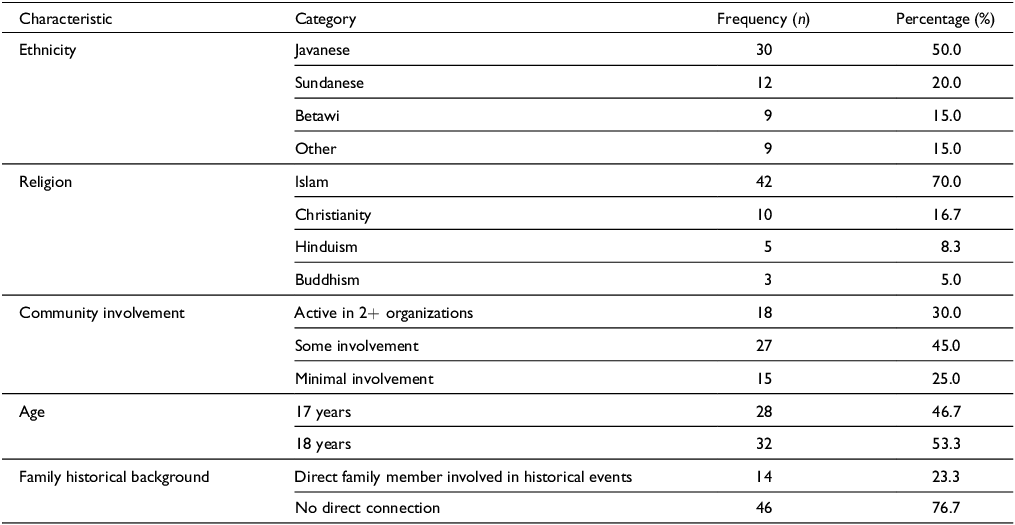
Understanding the demographic and background characteristics of research participants is essential for contextualizing study findings and ensuring the representativeness and diversity of the sample. In this study, a total of 60 participants were involved, each bringing unique perspectives shaped by their ethnicity, religion, community involvement, age, and family historical background (See Table 1). These characteristics provide a comprehensive lens through which the complexity of students’ historical understanding can be examined, particularly in relation to the nuanced narratives surrounding Japan’s arrival in Indonesia during the Pacific War. Ethnicity and religion often influence cultural frameworks and value systems, which in turn affect how historical events are perceived and internalized. Similarly, the degree of community involvement reflects the social engagement and exposure of participants to collective memory and local narratives, potentially shaping their historical consciousness. Age, while narrowly ranged between 17 and 18 years, marks a critical developmental stage where identity formation and critical thinking about history are actively evolving. Lastly, the presence or absence of direct family connections to historical events offers insight into the personal and intergenerational transmission of historical knowledge and attitudes. Presenting these characteristics in a detailed frequency table allows for a clear visualization of the participant profile, setting a solid foundation for interpreting the study’s qualitative findings and understanding the diversity within the sample. This comprehensive overview not only highlights the heterogeneity of the participants but also underscores the importance of considering multiple social and cultural dimensions when analyzing historical understanding in educational contexts. Such detailed demographic profiling is crucial for researchers, educators, and policymakers aiming to design inclusive and contextually relevant history education programs that resonate with diverse student backgrounds and experiences.
Characteristics of research participants

The frequency table reveals a diverse composition of participants across several key demographic and contextual variables, providing a rich foundation for understanding the varied perspectives on historical narratives. Ethnically, most participants identify as Javanese (50%), followed by Sundanese (20%), Betawi (15%), and other ethnicities (15%). This composition provides a broad representation of Indonesia’s cultural mosaic. For context, nationally, the Javanese constitute the largest ethnic group at approximately 40.1% of the population, followed by Sundanese at 15.5%, while the Betawi represent around 2.9%. Other major ethnic groups at the national level include Batak (3.6%), Madurese (3.0%), Minangkabau (2.7%), Buginese (2.7%), and Malay (2.3%) (Penyusun Reference Penyusun2025), among many others. Indonesia is home to more than 300 ethnic groups, reflecting its extraordinary diversity. This diversity is significant as ethnic background can influence cultural memory and the interpretation of historical events, potentially shaping how students relate to the complex legacy of Japan’s occupation. In terms of religion, Islam predominates with 70% of participants, while Christianity, Hinduism, and Buddhism are also represented, highlighting the religious pluralism that characterizes Indonesian society. For context, nationally, Islam is adhered to by approximately 87.06% of the Indonesian population, followed by Protestantism (7.41%), Catholicism (3.06%), Hinduism (1.08%), Buddhism (0.71%), Confucianism (0.03%), and other beliefs (0.5%). The lower proportion of Muslims in our sample compared to the national average may reflect the specific demographic characteristics of the study population or regional variations in religious composition. Such religious diversity may affect moral and ethical frameworks through which history is understood and taught.
Community involvement varies, with 30% of participants actively engaged in two or more organizations, 45% showing some involvement, and 25% having minimal engagement. This range suggests differing levels of social interaction and exposure to collective narratives, which can influence the depth and breadth of historical understanding. The age distribution is fairly balanced between 17 and 18 years, a critical period for cognitive and identity development, which underscores the relevance of examining how historical narratives are internalized during late adolescence. Notably, only 23.3% of participants report having direct family members involved in historical events, indicating that for most students, historical knowledge is likely mediated through education and community narratives rather than personal family history. This factor may affect the emotional connection and perceived relevance of historical events, influencing engagement and interpretation. Overall, these participant characteristics underscore the importance of considering multiple social, cultural, and personal dimensions when analyzing students’ historical understanding, ensuring that educational approaches are responsive to the diverse backgrounds and experiences that shape learning.
Reliability of data
The reliability of the data in this study is systematically maintained by applying several strategies to ensure the accuracy and validity of the memos as the primary data source. First, the memos were created in a structured and consistent manner following established recording protocols to avoid subjective bias and ensure completeness of information. Next, member checking was conducted by asking students to confirm and verify the contents of the memos that recorded their narratives and reflections, thereby enhancing data accuracy. Additionally, the memos were compared and cross-verified with direct classroom observations and other supporting documentation for data triangulation. An audit trail process was carried out by documenting all steps of data collection and analysis in detail, allowing transparency and traceability of the data. With this approach, the study guarantees that the data obtained through memos have a high level of trustworthiness and authentically reflect students’ historical understanding.
Data analysis
Data analysis in this study is conducted using a coding system consisting of 12 sets of data codes, namely Code Data 1 (CD1), Code Data 2 (CD2), up to Code Data 12 (CD12). Each data code set is developed based on the research focus and the theoretical framework used, enabling systematic organization of data according to important aspects to be analyzed. The coding process begins with an in-depth reading of all memos to identify relevant data segments, which are then categorized into the predetermined codes. This approach helps connect empirical data with the theoretical framework and answer the research questions in a structured and focused manner.
Subsequently, after coding the data, thematic analysis is performed to identify patterns and relationships among the themes emerging from the codes. These patterns are then interpreted to understand how students construct their historical understanding of Japan’s arrival in Indonesia, including the dynamics of pro and contra narratives they receive. The validity of the analysis is maintained by cross-checking among codes and ongoing discussions to ensure consistency of interpretation. Thus, the structured coding system and in-depth thematic analysis enable this study to produce rich and meaningful findings related to students’ historical understanding.
Results
The evolution of curriculum narratives on the Japanese occupation in Indonesia
Based on our original analysis of Indonesian history textbooks from 1975 to 2022, we observed how political changes shape national narratives. Our document analysis reveals that during the New Order era (1975–1998), textbooks consistently portrayed the Japanese occupation as merely accelerating independence, while reducing the romusha forced labor system to brief mentions. The 2004 curriculum began creating more balanced accounts, though still within a nation-building framework. The revised 2013 curriculum notably expanded romusha coverage from two to five pages, yet maintained the simplified dichotomy between Japan’s contribution to independence versus its exploitative practices.
This narrative evolution reflects Indonesia’s changing political landscape and relationship with Japan. Early academic works emphasized Japan’s revolutionary role in arming youth and creating a power vacuum. The 1970s–1980s saw textbook canonization that sublimated occupation violence within a teleological narrative leading to proclamation. The post-Reformasi period finally created space for victim-centered narratives, though these remained supplemental rather than integrated into core curriculum.
The 2013 curriculum attempted to balance nation-building priorities with critical historiography. Textbooks now feature separate chapters discussing both Japan’s military training programs and its forced labor policies. However, narrative framing still prioritizes political contributions while subordinating civilian suffering, maintaining history education’s primary function as identity formation rather than critical discipline.
Indonesia–Japan relations have implicitly influenced curricular content through economic dependency. Since 1966, reparations and investment programs created conditions for softened historical narratives. Guidelines for textbook authors explicitly emphasized “positive aspects of Indonesia–Japan cooperation,” while diplomatic emphasis on “maintaining strategic friendship” established unspoken parameters for acceptable narratives.
Generational change among Indonesian historians has driven significant re-evaluation. Post-reformation historians introduced subaltern perspectives highlighting local experiences and oral history. Their influence appears in the 2013 curriculum’s incorporation of personal memoirs and local documents, though comprehensive integration of international scholarship remains limited.
Recent curricula increasingly employ human rights and global history frameworks. Newer textbooks discuss Japanese “war crimes” using careful language that avoids generalization. This represents progress in historical accuracy, though national exam questions through 2022 reveal persistent emphasis on political history, with 70% focused on Japan’s role in independence preparation rather than the occupation’s social impact.
RQ1: How do students understand Japan’s arrival in Indonesia during the Pacific Wartime within the context of national historical narratives?
Students’ understanding of Japan’s arrival in Indonesia during the Pacific Wartime is a crucial aspect in the study of history education, with implications for the formation of national identity and historical awareness among the younger generation. The main research question raised in this study is how students comprehend this event within the context of the national historical narrative, which is often contradictory and complex. The Indonesian national historical narrative about Japan’s arrival does not only portray Japan as an oppressive colonizer but also as a liberator that paved the way for independence, thus creating ambiguity in students’ interpretations. This study seeks to reveal how these narratives are internalized by students and how they shape their perceptions of collective identity and the historical relationship between Indonesia and Japan.
The theoretical framework used in this research refers to the concept of the victim–perpetrator duality (higai vs. kagai). The victim–perpetrator duality theory provides an analytical lens to understand how historical narratives can contain ambiguity and internal conflict, where Japan is simultaneously positioned as both colonizer and victim within political and power contexts. This approach allows for a deeper analysis of the complexity of students’ historical understanding, in which they do not merely accept dominant narratives but also experience interpretative tensions.
Students’ understanding of Japan’s arrival in Indonesia during the Pacific Wartime is heavily influenced by the national historical narratives they receive through formal education and their social environment. Based on the analysis of data codes CD1 to CD4, it was found that students internalize narratives that are often contradictory, where Japan is simultaneously positioned as both liberator and colonizer. Some students adopt views emphasizing Japan’s role in replacing Dutch colonialism and opening opportunities for independence, as reflected in a student’s statement: “Japan came bringing new hope, replacing the Dutch who had long oppressed” (CD1).
However, on the other hand, narratives about the brutality of the Japanese occupation, such as forced labor (romusha) and brutal oppression, are also deeply ingrained in students’ understanding, as expressed in another memo: “They did help, but many suffered because of Japanese policies” (CD3), reflecting the complex reality of the Japanese occupation in Indonesia.
Initially, Japan came with promises of liberation from Dutch colonialism and provided space for nationalist figures like Sukarno and Hatta to play roles in the occupation government, which strengthened the spirit of independence. However, Japan’s policy of forced labor (romusha) caused immense suffering, with millions of Indonesians forced to work under harsh conditions, many of whom died, while resource exploitation and famine during that period further increased widespread suffering.
This contradiction reflects how the national historical narrative shapes a complex and layered collective meaning. Students do not passively accept the narrative but actively process and reflect on the information they receive, resulting in ambivalent and sometimes conflicting understandings. For example, a student wrote in a memo, “I am confused, is Japan a hero or a villain? Sometimes they help, but sometimes they also hurt the people” (CD2). This shows that the national historical narrative is not singular and homogeneous but consists of various interacting perspectives that influence students’ collective identity.
Furthermore, the narratives students receive are also influenced by the social and cultural context in their school and family environments, which shape their social representations of Japan. Some students relate family experiences or oral histories emphasizing suffering during the Japanese occupation, while others highlight aspects of liberation from Dutch colonialism. A memo noting a student’s statement, “My grandfather often told stories about suffering when Japan came, but my teacher said Japan also brought progress” (CD4), illustrates the contrast between personal experience and official narratives in history education.
The forced labor system (romusha) imposed by Japan forced millions of Indonesians, including many men from Java and other regions, to work on military and infrastructure projects under extremely harsh conditions, causing widespread death and suffering. On the other hand, Japan also introduced some advancements such as basic infrastructure development and education emphasizing the use of the Indonesian language, which later contributed to strengthening national identity and preparing for independence.
These findings reinforce the importance of understanding how national historical narratives shape not only factual knowledge but also identity and perceptions of “self” and “other.” The diverse and sometimes conflicting narratives create space for students to develop more critical and reflective understandings, although at an early stage there is still ambiguity and uncertainty. Thus, the analysis based on data codes CD1 to CD4 shows that students’ understanding of Japan’s arrival during the Pacific Wartime is a result of a dynamic social construction, reflecting the complexity of national historical narratives and the process of collective identity formation in the context of history education.
Students’ understanding of Japan’s arrival in Indonesia during the Pacific Wartime is often filled with ambiguity and tension, reflecting conflicting national historical narratives. Based on the analysis of data codes CD5 through CD8, it was found that students internalize the dual role of Japan as both oppressor and victim, which significantly influences how they interpret these historical events. This narrative positions Japan not only as a power that oppressed the Indonesian people through forced labor policies and military repression but also as an entity experiencing pressure and limitations within the geopolitical context of the Pacific War. For example, one student wrote in a memo, “Japan was indeed harsh and oppressive, but they were also trapped in a great war that made it difficult for them to act freely” (CD6). This statement shows students’ awareness of the complexity of Japan’s position, which is not entirely black-and-white but full of nuances as both victim and perpetrator.
The concept of victim–perpetrator duality (higai vs. kagai) is highly relevant in explaining how students understand Japan’s arrival in a layered and sometimes contradictory manner. Another memo recorded a student’s statement describing internal conflict in understanding the historical narrative: “I feel Japan has two faces; on one side, they are cruel colonizers, but on the other, they are also victims of the world’s great powers” (CD7). This interpretation reflects how power relations and political constructions influence students’ historical perceptions, where official narratives and collective experiences interact to form a complex understanding. Students do not only see Japan as an enemy to be fought but also as an entity that suffered and faced constraints, leading to ambivalence in their attitudes.
Furthermore, students also show an understanding of how historical narratives can be influenced by political interests and ideologies shaping Japan’s position in national history. A memo containing student reflections stated, “The narratives we learn sometimes seem made to defend one side, making it hard to see the full picture” (CD8). This indicates students’ critical awareness of the constructed nature of historical narratives, which are often biased and used for specific political purposes. Thus, the victim–perpetrator duality theory helps explain how students identify layers of meaning in the historical narratives they receive while recognizing biases and interests affecting those interpretations.
These findings confirm that students’ historical understanding is not monolithic but the result of a complex process of reflection and meaning negotiation. The duality narrative provides an effective framework for understanding how students manage ambiguity and internal conflict in their historical interpretations. Therefore, this theory enriches the analysis of students’ historical understanding and opens space for more critical and reflective history education that accommodates diverse perspectives and teaches students to view history more holistically and ethically.
Critical and reflective history education plays an important role in shaping students’ understanding of the historical narrative of Japan’s arrival in Indonesia during the Pacific War. Based on the analysis of data codes CD9 and CD10, it was found that learning processes emphasizing open dialogue and exploration of alternative perspectives create space for students to question dominant narratives and develop critical attitudes toward history. For example, one memo recorded a student’s statement: “I started to see that the story about Japan is not just black and white; there are many sides we need to understand together” (CD9). This shows that critical history education encourages students not only to passively accept information but also to actively explore and reflect on various viewpoints.
Moreover, learning that emphasizes ethics and inclusivity in delivering history helps students understand the complexity of national historical narratives more deeply. Another memo described how the teacher provided space for students to discuss and express their opinions: “Our teacher invited us to discuss how Japan could be both a savior and a colonizer, so we learned to see history from various perspectives” (CD10). This approach highlights the importance of dialogue and reflection in forming a more inclusive and critical collective meaning. Thus, critical history education not only enriches students’ understanding but also equips them with critical and ethical thinking skills essential for dealing with complex and diverse historical narratives.
Diverse historical understanding among students significantly influences the formation of their identity and nationalism, as revealed through the analysis of data codes CD11 and CD12. The historical narratives they receive and their internalization of Japan’s dual role as both savior and colonizer create a complex and sometimes ambivalent collective identity dynamic. Some students express pride in the independence struggle triggered by Japan’s arrival, as reflected in a student memo stating, “I feel proud because Japan paved the way for our independence, even though it was in a difficult way” (CD11). This statement shows how historical narratives can strengthen national pride and identity as part of a nation that experienced colonization and struggle.
However, on the other hand, there are feelings of conflict and ambivalence arising from an understanding that is not entirely positive about Japan’s role. Some students express confusion and uncertainty in integrating conflicting historical narratives, as expressed in the following memo: “I find it hard to accept Japan as a hero because of the suffering they caused, but I also know they helped us get out of Dutch colonization” (CD12). This condition reflects how complex and contradictory historical narratives can create identity tensions, where students must balance pride and awareness of historical wounds. This ambivalence shows that national identity formation is not always linear or homogeneous but a dynamic process full of critical reflection.
Furthermore, the historical narratives students receive also influence their nationalism attitudes, whether in the form of pride, critical awareness, or skepticism toward official narratives. Some students demonstrate a form of critical and reflective nationalism, one that does not reject national narratives outright, but engages with them as a starting point for deeper inquiry. This approach involves both understanding the dominant historical account and subjecting it to scrutiny, thereby moving beyond passive acceptance toward a more nuanced and informed patriotism. For example, a student memo noted, “I learned not only to accept the stories taught but also to find out other sides of our history so I can love the nation more wisely” (CD11). Here, “accepting” serves as a foundation, not a final destination, enabling the student to question and re-examine history from a place of national attachment rather than detachment. This attitude shows that diverse historical understanding can encourage the formation of more inclusive and broad-minded nationalism, capable of accommodating the complexity of the past without neglecting national values.
The implications of these findings for history education are very significant, as they demonstrate that historical narratives do not merely function as conveyors of facts but also as tools for shaping identity and social attitudes. History education that can present diverse narratives and encourage critical reflection will help students develop a strong national identity that remains open to the complexities of history. Therefore, teachers and curricula need to provide space for dialogue and exploration of various historical perspectives, enabling students to build a more comprehensive understanding and foster a healthy and critical nationalism. This approach emphasizes the importance of inclusive and reflective collective meaning in the formation of social identity and nationalism among the younger generation.
RQ2: What factors influence the differences in students’ perceptions of Japan as savior and/or colonizer?
Perceptual differences among students primarily stem from exposure to contradictory narratives disseminated through educational institutions, familial accounts, and media channels (CD1). A student’s memo captures this divergence: “At school, we were taught that Japan brought independence, but at home, I often hear stories about the suffering of forced laborers and the cruelty of Japanese soldiers.” This juxtaposition of institutional and personal accounts establishes a cognitive conflict, where liberation-oriented narratives compete with memories of oppression.
The design and implementation of history curricula significantly shape student interpretations (CD2). Instructional emphasis on nationalistic themes and independence milestones often marginalizes discussions of occupation violence. One student noted, “The teacher often talks about how Japan helped Indonesia fight the Dutch, but there are not many stories about the people’s suffering.” This tendency in pedagogical emphasis results in a partial comprehension that highlights Japan’s facilitative role while obscuring its coercive practices.
Familial oral histories and intergenerational trauma constitute another critical factor (CD3). Students with ancestors who experienced Japanese rule frequently internalize narratives centered on suffering. A memo stated, “My grandfather often told stories about forced labor and starvation during Japanese rule, so I see Japan more as an occupier.” Conversely, those without direct familial exposure tend to adopt sanitized official versions, illustrating how private memory either challenges or reinforces public discourse.
Extracurricular engagement in discussion forums and academic clubs further diversifies perspectives (CD4). Participation in structured dialogues exposes students to heterogeneous viewpoints, as reflected in a participant’s account: “In the history club, we often discuss different viewpoints about Japan, so I learned there are many different sides.” Such environments promote criticality by encouraging comparative analysis of historical sources.
Digital media accessibility introduces both opportunities and complications (CD5). Online platforms offer abundant yet often contradictory information, leading to evaluative difficulties. A student confessed, “Sometimes I get confused because there is a lot of conflicting information on the internet about Japan.” This informational overload necessitates advanced analytical and critical thinking skills, beyond basic literacy, to reconcile fragmented narratives.
Contemporary geopolitical and diplomatic considerations also permeate historical discourse (CD6). Students discern how state-level interactions influence narrative framing, with one memo noting, “I think the government wants to maintain a good relationship with Japan, so stories about Japan as an occupier are downplayed.” This awareness of political instrumentation alters perceived credibility of historical accounts.
Individual epistemological orientations determine narrative receptivity (CD7). While some students exhibit heuristic acceptance of curricular content, others pursue independent verification. A student articulated this divergence: “I want to know more, so I read books and ask other teachers.” Such variance in investigative rigor directly affects how Japan’s dual roles are reconciled.
Linguistic framing within educational materials generates conceptual ambiguity (CD8). Loaded terms like “savior” or “occupier” evoke distinct moral associations that, without contextual clarification, foster interpretative confusion. One student questioned, “Sometimes I get confused, is Japan really a savior or an occupier?” This terminological imprecision complicates efforts to construct coherent historical understanding.
Experiential learning through museum visits and heritage sites provides tangible context (CD9). Direct engagement with artifacts and testimonies mitigates abstract binary thinking, as evidenced by a student’s reflection: “After visiting the museum, I better understood that history is complex and not black-and-white.” Multisensory immersion thus facilitates nuanced appreciation of historical complexity.
Teacher-mediated discourse and instructional methodologies critically impact perception formation (CD10). Educators who foster dialogic classrooms enable students to deconstruct dominant narratives. A memo observed, “Our teacher often invites us to discuss and question existing narratives, so we learn to see things from various perspectives.” This pedagogical approach cultivates analytical skills essential for navigating historical contradictions.
Region-specific cultural values and collective memories locally condition historical interpretation (CD11). Localized narratives often emphasize particular aspects of Japanese rule, as indicated by a student’s statement: “In my region, stories about Japan are mostly negative because of our ancestors’ experiences.” These geographically embedded perspectives prioritize certain experiential truths over others.
Globalized historical narratives and cross-cultural exchanges comprise the final factor (CD12). Access to international historiography expands referential frameworks but introduces narrative reconciliation challenges. A student acknowledged, “I also read stories from Japan and other countries, so I know there are many versions of history.” This global consciousness fosters multiplex understanding while complicating identity-based historical alignment.
RQ3: How does this historical understanding affect the formation of students’ identity and nationalist attitudes?
The analysis of RQ3 draws upon the same corpus of student memos examined in the preceding sections. However, while RQ1 focused on how students understand Japan’s dual role and RQ2 examined the factors shaping those understandings, RQ3 interrogates how these same understandings subsequently inform students’ identity formation and nationalist attitudes. Where the same memo is cited across multiple research questions, this reflects the multidimensional nature of student reflections, wherein a single statement often contains implications for historical comprehension, perceptual influences, and identity construction simultaneously.
The internalization of Japan’s dual role as both savior and colonizer generates cognitive dissonance in students’ identity construction processes. This dissonance arises from competing narratives that position historical understanding within a spectrum of moral evaluation. One student articulated this tension: “I feel confused because at school Japan is taught as a hero, but my family’s story is different” (CD1). Such conflict necessitates ongoing negotiation between institutional historiography and personal memory, resulting in nationalist attitudes that reflect hybrid identity formations rather than monolithic allegiance.
Curricular emphasis on independence struggle narratives directly shapes national self-perception. When pedagogical approaches prioritize Japan’s facilitative role in ending Dutch colonialism, students develop pride-oriented nationalism. A student’s memo noted, “Our teacher often emphasized how Japan helped Indonesia gain independence, so I feel proud to be part of a strong nation” (CD2). However, this selective focus creates identity schisms when contrasted with familial accounts of oppression, revealing how educational framing can produce compartmentalized historical consciousness.
Familial transmission of lived experience serves as counter-narrative to institutional accounts. The intergenerational recollection of Japanese occupation atrocities fosters identity rooted in historical grievance. One student expressed, “My grandfather’s story about suffering during the Japanese era makes me feel I must appreciate the nation’s struggle” (CD3). This embodiment of familial trauma transforms abstract nationalism into personalized moral obligation, anchoring collective identity in specific historical injustices.
Participation in discursive communities enables identity reformulation through perspectival diversity. Engagement with alternative viewpoints in structured settings cultivates reflective nationalism. A participant observed, “In the history community, I learned to see Japan from different viewpoints, so my nationalism became more open and critical” (CD4). This demonstrates how social epistemology facilitates the evolution from parochial nationalism to conceptually sophisticated patriotism.
Digital information ecosystems complicate identity formation through narrative pluralism. The accessibility of unvetted historical claims generates epistemological uncertainty. One student confessed, “Information on the internet sometimes makes me doubt, but it also makes me want to learn more about history” (CD5). This dual effect of digital exposure necessitates developed critical literacy to construct stable identities amidst informational chaos.
Political instrumentalization of historical narrative consciously directs identity formation. Student awareness of diplomatic considerations undermines narrative credibility. A memo stated, “I know the government wants to maintain good relations with Japan, so negative stories about Japan are rarely discussed” (CD6). This perception of strategic omission fosters cynical nationalism where official narratives are met with hermeneutic suspicion.
Individual epistemic dispositions determine identity integration patterns. The spectrum from uncritical acceptance to investigative skepticism shapes nationalist character. One student declared, “I am skeptical of official stories and want to find the truth myself” (CD7). Such agential engagement with history produces self-authored nationalism that resists ideological interpellation.
Linguistic framing in educational materials constructs perceptual parameters for identity. Binary terminology like “savior” versus “occupier” creates artificial moral dichotomies. A student questioned, “I am confused whether Japan is really a savior or an occupier” (CD8). This lexical ambiguity impedes coherent identity formation by forcing categorical choices where historical reality demands nuanced integration.
Experiential learning through material culture facilitates identity crystallization. Direct encounter with historical artifacts dissolves simplistic binaries. One student reflected, “After visiting the museum, I realized history is complex and not black-and-white” (CD9). This somatic engagement enables embodied historical understanding that informs more grounded national identity.
Dialogic pedagogy directly shapes identity negotiation capacities. Teacher-facilitated critical discourse develops complex historical consciousness. A memo noted, “Our teacher often invites us to discuss and question existing narratives, so I learned to see from various perspectives” (CD10). This pedagogical approach fosters multiplex identity formation through practiced epistemic flexibility.
Localized historical memory territorializes national identity. Regional experiences with Japanese occupation produce geographically distinct nationalist sentiments. One student wrote, “In my region, stories about Japan are mostly negative because of my ancestors’ experiences” (CD11). This spatial dimension of memory creates subnational identity variants within broader nationalist frameworks.
Transnational historiography expands identity possibilities beyond parochial narratives. Access to global perspectives facilitates cosmopolitan nationalism. A student stated, “I read stories from Japan and other countries, so I know there are many versions of history” (CD12). This border-crossing historical awareness cultivates identity that balances national particularity with global interdependence.
The cumulative effect of these factors produces layered identity formations where nationalist attitudes incorporate contradiction and ambiguity. This complexity mirrors the victim–perpetrator duality inherent in the historical narrative itself, demonstrating how historical understanding directly constitutes rather than merely influences identity construction processes.
Discussion
From the perspective of the victim–perpetrator duality, the findings of this study confirm previous research results showing that the historical narrative of the Japanese occupation in Indonesia contains complex and multidimensional ambiguities. Cultural trauma and identity studies, such as those by Micale and Pols (Reference Micale and Pols2021), Cooper and Nichol (Reference Cooper and Nichol2015), and Koh (Reference Koh2021), highlight how collective experiences of suffering and violence shape layered and often contradictory social memories. In the East Asian context, research on trauma in Japan and South Korea by Hashimoto (Reference Hashimoto2015) and Arrington (Reference Arrington, Burrett and Kingston2023) reveals how Japan is positioned both as a perpetrator of violence and as an agent of social change bringing modernization and political transformation. These findings parallel the situation in Indonesia, where the historical narrative of the Japanese occupation reflects not only cruelty and exploitation but also Japan’s role in accelerating independence and the formation of national identity.
This study confirms that students internalize this duality in their understanding, which impacts diverse and sometimes ambivalent nationalist attitudes. This aligns with Moscovici’s (Reference Moscovici1988) concept of social representation, which explains that social meaning is shaped through interaction and symbolic negotiation within society, making historical narratives arenas of conflict and identity reconstruction. Kubota (Reference Kubota2012) adds that history as a social construct contains the ambivalence of victim and perpetrator that must be critically understood to avoid narrative simplification. In the context of history education in Indonesia, students face the challenge of balancing the official narrative, which tends to highlight Japan as a savior, with family and community experiences that reveal suffering caused by Japanese policies such as forced labor (romusha).
Furthermore, these findings strengthen arguments from previous studies emphasizing the importance of a critical and reflective approach to history education to accommodate the complexity of historical narratives. As expressed by Wineburg (Reference Wineburg2006) and Barton and Levstik (Reference Barton and Levstik2004), history education should open space for students to explore multiple perspectives and develop nuanced understanding, thereby shaping an inclusive and balanced national identity. In the context of cultural trauma, Ziv et al. (Reference Ziv, Golden and Goldberg2015) emphasize the importance of dialogue and reflection in the collective healing process, which is relevant to addressing ambiguities and conflicts in the historical narrative of the Japanese occupation. Therefore, this study not only enriches the literature on the social construction of history in Indonesia but also provides practical implications for curriculum development and teaching methods that can constructively address the victim–perpetrator duality.
The unique contribution of this study lies in the context of history education in Indonesia, specifically examining the romusha experience and the influence of the national curriculum. Unlike some previous studies that focused more on historical narratives at the general societal or other national levels, this research highlights how curriculum and teaching methods in schools shape students’ understanding, which sometimes neglects the darker side of the Japanese occupation. Additionally, family experiences passed down through generations serve as an important source that enriches or challenges the official narrative, adding a personal dimension to the formation of students’ identity and nationalism. These findings provide new insights into how history education can become an arena for negotiating complex historical meanings.
This focus on the educational apparatus and intergenerational memory distinguishes the present findings from broader societal analyses prevalent in existing scholarship. Where Mark’s (Reference Mark2018) work masterfully deconstructs the intellectual and political dimensions of collaboration by exploring the ambiguous space between coercion and Asian solidarity among Indonesian elites, this study traces how such complex academic debates become simplified within pedagogical transmission. The “Asian solidarity” narrative that Mark identifies as a powerful ideological tool undergoes a significant reduction in textbooks, frequently appearing as a sterile reference to Japanese propaganda rather than as the contested and sometimes compelling discourse that attracted certain nationalist actors (Mark Reference Mark2018). Consequently, the nuanced collaboration that Mark elucidates becomes frequently obscured for students, who encounter a binary analytical framework ill-equipped to categorize historical figures who simultaneously exhibited both resistance and cooperation.
When placed in dialogue with economic historians, the curricular limitations appear even more pronounced. Sato’s (Reference Sato1998) meticulous documentation of the extractive war economy reveals the romusha system as an integral component of Japan’s imperial machinery, demonstrating how it systematically dismantled local economies and social structures. While data from this study indicate a quantitative expansion in textbook coverage of romusha, the qualitative analysis remains strikingly shallow. The curriculum consistently fails to engage with Sato’s (Reference Sato1998) political-economic framework, resulting in a critical disconnect: students learn about the existence and suffering of romusha but lack the analytical tools to comprehend it as a logical outcome of imperial policy rather than an isolated tragedy. This systematic erasure of political-economic context demonstrates how national curriculum design filters and flattens sophisticated historical scholarship, ultimately shaping collective memory through strategic omission.
The implications of these findings for history education are significant, especially in shaping critical and inclusive identity and nationalist attitudes. Referring to the framework of cultural trauma and identity, history education needs to accommodate narrative diversity and encourage critical dialogue so that students can understand history comprehensively and balanced. This will help students develop nationalism based not only on pride but also on awareness of historical complexity and the importance of critical reflection. Thus, curricula and teaching methods should be designed to open space for various perspectives and experiences, enabling healthy and constructive national identity formation.
Conclusion
The conclusion of this study confirms that students’ understanding of the Japanese arrival in Indonesia during the Pacific Wartime is heavily influenced by a contradictory national historical narrative, which directly shapes their identity and nationalist attitudes. The main findings show that students accept conflicting narratives, namely Japan as a liberator accelerating independence and Japan as a colonizer causing suffering through forced labor policies (romusha) and resource exploitation. The theoretical approach that views the victim–perpetrator duality provides a strong analytical framework to understand how students negotiate the meaning of this history within their social context. These results align with previous research findings that also highlight the complexity of the Japanese occupation historical narrative and its impact on the formation of collective identity and youth nationalism. This study reinforces the understanding that students’ national identity is not static but rather the result of a dynamic social construction process, where ambiguous and layered historical narratives become an ongoing arena for meaning negotiation.
Practically, the findings emphasize the importance of a critical and reflective approach in history education in Indonesia. Curricula and teaching methods need to be designed to accommodate diverse historical perspectives, including official narratives and personal experiences that often differ, so that students can develop a more comprehensive and balanced understanding. This approach not only enriches students’ insights but also shapes inclusive and mature nationalist attitudes capable of accepting historical complexity without losing pride in national identity. Therefore, history education should be an open and critical dialogue space that encourages students to think reflectively and develop analytical skills in responding to diverse historical narratives. These implications are crucial for curriculum development and teacher training to create more meaningful and socially relevant history learning experiences for students today.
Financial support
This research is not getting financial support from any institution.
Competing interests
The author declares that there are no competing interests.
Appendix 1. Student Reflection Prompts and Guiding Questions
This appendix presents the guiding questions and prompts used to elicit student reflections and memos that form the primary data source for this study. The questions were designed to align with the three research questions and were administered as part of structured reflection activities following classroom discussions on the topic of Japan’s occupation of Indonesia (1942–1945). Students were given approximately 20–30 minutes to write their responses, which were then collected as memos and coded for analysis (CD1–CD12).
A.1 Questions Related to Historical Understanding (RQ1: How do students understand Japan’s arrival in Indonesia during the Pacific Wartime within the context of national historical narratives?)
These prompts aimed to uncover students’ comprehension of Japan’s role and the narratives they have internalized.
-
1. In your own words, describe how Japan came to Indonesia during the Pacific War. What is the main story of Japan’s arrival that you have learned?
-
2. Based on what you have learned in school, at home, or from other sources, do you see Japan’s arrival as a positive or negative event in Indonesian history? Please explain your answer.
-
3. Is there a single “correct” story about Japan’s arrival, or are there different versions? If there are different versions, please describe them.
-
4. The following student memo stated: “I am confused, is Japan a hero or a villain? Sometimes they help, but sometimes they also hurt the people” (CD2). Do you ever feel this kind of confusion? Please share your thoughts and experiences.
A.2 Questions Related to Factors Influencing Perception (RQ2: What factors influence the differences in students’ perceptions of Japan as savior and/or colonizer?)
These prompts were designed to identify the sources and influences that shape students’ diverse viewpoints.
-
1. Where do you get most of your information about the Japanese occupation? (e.g., school textbooks, teachers, family stories, the internet, movies, books). Which source do you trust the most and why?
-
2. Have you ever heard stories about the Japanese occupation from your family members (grandparents, parents, relatives)? If so, what were those stories about, and how do they compare to what you learn in school?
-
3. Do you ever look for information about history on the internet or social media? If so, what has been your experience with finding information that differs from your school lessons?
-
4. The following student memo stated: “I think the government wants to maintain a good relationship with Japan, so stories about Japan as an occupier are downplayed” (CD6). Do you think the relationship between Indonesia and Japan today influences how history is taught? Why or why not?
-
5. Have discussions in class or with friends ever changed the way you think about Japan’s role in Indonesian history? Can you give an example?
A.3 Questions Related to Identity and Nationalism (RQ3: How does this historical understanding affect the formation of students’ identity and nationalist attitudes?)
These prompts explored how students integrate historical understanding into their sense of national identity.
-
1. How does learning about the Japanese occupation make you feel about being Indonesian? Does it make you feel proud, confused, critical, or something else? Please explain.
-
2. The following student memo stated: “I learned not only to accept the stories taught but also to find out other sides of our history so I can love the nation more wisely” (CD11). What does “loving the nation wisely” mean to you?
-
3. Do you think it is important to learn about the suffering caused by Japan, even if it paints a negative picture of a country that is now a close partner of Indonesia? Why or why not?
-
4. After learning about the complexity of Japan’s dual role as both liberator from the Dutch and oppressive occupier, how has your view of Indonesian history and your identity as an Indonesian changed or developed?
Author Biography
Romadi Romadi is an assistant professor of history at the Faculty of Social and Political Sciences, Universitas Negeri Semarang, Republic of Indonesia. He focuses on the study of Indonesian history during the national movement and the Japanese invasion of Indonesia in 1942. His works have been published in the form of books and articles in national and international journals.
Ganda Febri Kurniawan is an assistant professor of history at the Faculty of Social and Political Sciences, Universitas Negeri Semarang, Republic of Indonesia. He is also a PhD Student in Theoretical and Historical Pedagogy, ELTE Eötvös Loránd University, Budapest, Hungary. His academic focus centers on the history of education in national and global contexts, where he explores both historical narratives and the role of history in education.
Arif Purnomo is a full professor of Social Studies Education Philosophy and a faculty member in the Social Studies Education Program at the Faculty of Social and Political Science, Universitas Negeri Semarang (UNNES), Republic of Indonesia. He focuses on enhancing the quality of social studies instruction and participates in various conferences, as well as publishing in national and international journals.

 Open access

