




INTRODUCTION
West Mexico is a rather large and ill-defined subarea of Mesoamerica which, at its narrowest, is restricted to the modern states of Colima, Nayarit, Jalisco, and western Michoacán, an area we refer to as Far West Mexico, and at its broadest, it also includes eastern Michoacán and the Bajío region of southern Guanajuato, Querétaro, and Mexico state, or what we call Near West Mexico. The substantial increase in archaeological investigations in both of these areas over the past several decades has shed considerable light on what has been one of the least-known parts of Mesoamerica (Beekman Reference Beekman2010; Pollard Reference Pollard1997; Williams Reference Williams2020). Given its size and considerable physical and cultural diversity, the numerous local sequences defined by these investigations are indispensable in bridging the “mosaic of distinctive cultural developments of what is known as West Mexico” (Jiménez Betts Reference Enríquez Farias, Saint-Charles Zetina, Anzures and Limón2017:6), although the paucity of chronometric dating remains a problem (Pollard Reference Pollard1997:354). In addition to challenging previous perceptions that it was a peripheral area lacking in cultural sophistication, these investigations have also produced evidence of systematic interaction between West Mexico and other parts of Mesoamerica, in particular central Mexico. Moreover, these investigations demonstrate West Mexico's role not only as a recipient of cultural elements from nuclear Mesoamerica, but as a donor of elements that comprise key aspects of Mesoamerican culture, including major components of the Early/Middle Formative Tlatilco ceramic complex (Grove Reference Grove and Hammond1974; Tolstoy Reference Tolstoy1975), imports and/or imitations of Middle/Late Formative Chupícuaro ceramics (Darras Reference Darras2006), West Mexican immigrants in Classic period Teotihuacan (Gómez Reference Gómez Chávez and Gallut2002), and obsidian from the Ucareo-Zinapécuaro, Michoacán (hereafter, “U-Z”) obsidian source area, which became a pan-Mesoamerican resource that dominated lithic assemblages in central Mexico and other parts of Mesoamerica during the Epiclassic period (Healan Reference Healan1997:Table 2).
Located in Near West Mexico (Figure 1), the U-Z source area was the focus of extensive archaeological investigations conducted in the 1990s that provided a diachronic perspective on settlement and obsidian exploitation that appeared to span more than a millennium (Healan Reference Healan1997, Reference Healan, Williams and Maldonado2016). Analysis and classification of more than 100,000 ceramic artifacts recovered from survey and excavation, coupled with ceramic cross-dating, produced a comprehensive ceramic sequence and tentative chronology for the U-Z source area (Hernández Reference Hernández2000), which, while based on the ceramic sequence previously established for this part of Near West Mexico by Gorenstein's (Reference Gorenstein1985) investigations in neighboring Acámbaro, Guanajuato, differs from the latter in a number of ways, as detailed below.
Map of central and Near West Mexico (adapted from Raisz Reference Raisz1959), including the U-Z obsidian source area and sites discussed in text. (a) Acámbaro; (b) Chupícuaro; (c) La Tronera; (d) Queréndaro; (e) El Rosario; (f) Huamango; (g) Tula; (h) Teotihuacan.

Over the last two decades we have refined the U-Z ceramic sequence, its chronology, and its relationship to other areas through (1) study of a portion of the ceramics from Gorenstein's Acámbaro excavations; (2) comparative study of ceramic collections from neighboring parts of the Bajío and central Mexico; (3) refinements to our cross-dating based on more recently published data from other sites; and (4) radiocarbon dating of 30 contexts associated with the various phases and subphases of the U-Z ceramic sequence. Given its location and the natural east–west route of the Lerma River Valley (Figure 1), it is easy to imagine this part of Near West Mexico as a link between neighboring central Mexico and other parts of West Mexico, and we have encountered significant evidence of interaction with both of these areas, including possible migration (Hernández and Healan Reference Hernández, Healan, Beekman and Fowler2019).
In previous publications (Hernández Reference Hernández, Merino Carrión and Cook2006, Reference Hernández, Williams and Maldonado2016, Reference Hernández, Faulseit, Xiuhtecuhtli and Mehta2018; Hernández and Healan Reference Hernández and Healan2008, Reference Hernández, Healan, Beekman and Fowler2019), we have addressed portions of the U-Z source area ceramic sequence in discussing specific aspects of the prehistory of northeastern Michoacán. In this article, we formally present the entire ceramic sequence and chronology for the U-Z source area and discuss its relationship to other sequences in Near West Mexico and neighboring areas. We encourage readers interested in a more detailed presentation and discussion of the formal typology of the U-Z ceramics and our methodology to consult Hernández's (Reference Hernández2000) unpublished doctoral dissertation. We will begin with a phase-by-phase presentation of the U-Z ceramic sequence and its tentative dating based on modal analysis, frequency seriation, and ceramic cross-dating, after which the veracity of the sequence is evaluated in light of results obtained from the radiocarbon dating.
BACKGROUND
The U-Z source area occupies the eastern flank of Lake Cuitzeo (Figure 1) and encompasses two distinct subareas corresponding to the Lake Cuitzeo Basin (hereafter, Cuitzeo Basin) and the Ucareo Valley (Figure 2). Each subarea is associated with a geologically and chemically distinct obsidian flow system, designated the Ucareo and Zinapécuaro flows after the modern towns near to where each is located. The Cuitzeo Basin is dominated by flat terrain and lacustrine sediments, although at the eastern end, a series of rhyolite domes and cinder cones form a contrasting landscape of hills containing the Zinapécuaro flow system (Figure 2a). Although less than 15 km to the east, the Ucareo flow system is about 650 m higher in elevation, located at the north end of the Ucareo Valley (Figure 2b), near the northwest rim of the Los Azufres caldera (Ferrari Reference Ferrari, Garduño, Pasquarè and Tibaldi1991).
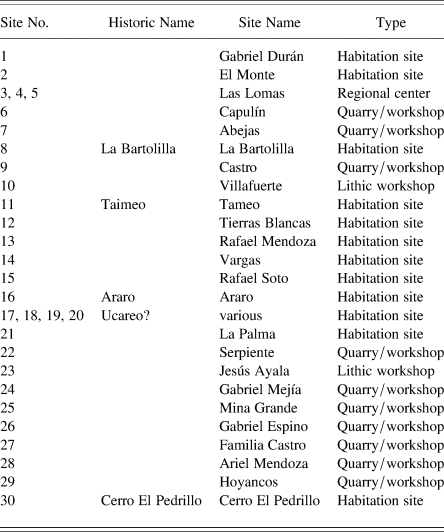
Topographic map of the U-Z obsidian source area. Stippled areas indicate the (a) Zinapécuaro and (b) Ucareo obsidian flows. Numbers refer to sites listed in Table 1. Map by Healan.

The Ucareo and Zinapécuaro flow systems were collectively defined by Healan (Reference Healan1997) as an obsidian source area using criteria established by Sidrys et al. (Reference Sidrys, Andresen and Marcucci1976), based on an informal regional survey in the 1980s, during which the approximate extent of each flow system was delineated, as seen in Figure 2. Informal surveys in the surrounding area also identified three major habitation sites (12, 16, and 30 in Figure 2 and Table 1) corresponding to settlements mentioned in ethnohistorical sources (de Alcalá Reference de Alcalá2008; Paredes Reference Paredes Martínez1994; Pollard Reference Pollard1993).
Sites in the U-Z obsidian source area explored by excavation.
The only published archaeological investigations in the area were Hugo Moedano's (Reference Moedano1946) exploratory excavations at La Bartolilla (08 in Figure 2), a large habitation site near the modern town of Zinapécuaro. Moedano provided a preliminary ceramic sequence consisting of three periods (Antiguo, Medio, Reciente), based on informally defined ceramic types. Despite the simplicity of Moedano's typology and sequence, he noted several features of the La Bartolilla ceramic assemblage that accurately characterize ceramic sequences created for settlements throughout much of Near West Mexico, especially adjacent areas of the Bajío, including (1) the initial appearance of a complex consisting of elaborately painted polychromes, followed by a shift to simpler bichrome decoration of red paint on natural brown vessels; (2) ceramic complexes that share numerous attributes with those in the Basin of Mexico; and (3) a relatively minor occurrence of Tarascan material culture, including ceramics.
In January 1990, Healan began a year-long investigation of pre-Hispanic settlement and obsidian exploitation within the U-Z source area, consisting of two distinct operations or phases (Healan Reference Healan1997). Phase one consisted of a field-by-field intensive survey, initiated at the center of the Ucareo and Zinapécuaro flow systems and subsequently moving outward, following a predetermined strategy. For the Ucareo flow system, this strategy consisted of proceeding to the practical limits of the Ucareo Valley on the north, south, and west sides, before proceeding on the open-ended east side as far as time permitted. For the Zinapécuaro flow system, the strategy was to avoid the modern urban settlement abutting the flow system and proceed along the Lake Cuitzeo Basin floor as far to the north, south, and west as time permitted. In the course of phase one, some 85 km2 was surveyed, during which 13 major pre-Hispanic settlements and two special-purpose sites were identified (Figure 2 and Table 1), plus numerous surface artifact scatters and 1,030 obsidian quarries and associated initial processing areas. Survey revealed that the Ucareo source experienced a far greater intensity of pre-Hispanic exploitation than did the Zinapécuaro source, which agrees with the much more frequent identification of Ucareo than Zinapécuaro obsidian in recent sourcing studies at other sites in Mesoamerica (Healan Reference Healan1997:Table 1). As a result, survey beyond the Zinapécuaro flow system in the Lake Cuitzeo Basin was restricted in favor of devoting additional effort to survey in the Ucareo Valley.
Phase two involved exploratory excavation of all 15 major settlements and special-purpose sites, plus ten quarry and associated initial processing facilities or workshops (Figure 2 and Table 1). Excavation of habitation and special-purpose sites was intended to recover in situ artifacts and ecofacts to facilitate relative and chronometric dating, and to investigate surface features of interest. Excavation of quarries and associated processing facilities was intended to accomplish these same goals, plus recovery of in situ material pertaining to quarrying and lithic technology.
THE U-Z CERAMIC SEQUENCE: PHASES, COMPLEXES, AND PRINCIPAL CERAMIC TYPES
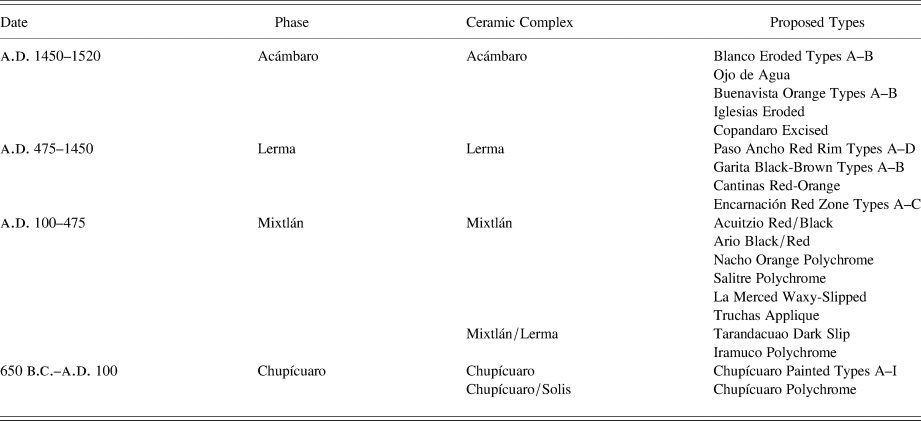
As noted above, the U-Z ceramic sequence is based on the sequence established by Gorenstein (Reference Gorenstein1985) during archaeological investigations conducted near Acámbaro, Guanajuato, located some 12 km north of Zinapécuaro (Figure 1a). Gorenstein's investigations included exploratory excavations at the Cerro Chivo site and surface survey and collection of the surrounding Middle Lerma River Valley. Analysis and classification of the Cerro Chivo ceramics were performed by Snarskis (Reference Snarskis1973, Reference Snarskis and Gorenstein1985), and the resulting ceramic sequence (Table 2 and Figure 3; see also Gorenstein Reference Gorenstein1985:46) has been widely utilized by other investigators in Near West Mexico and surrounding regions. While spanning more than 2,000 years, the Acámbaro sequence consists of only four phases, of which the latest (Acámbaro) phase is restricted to the last 70 years of the pre-Hispanic era (Table 2 and Figure 3). Each of the other three phases is therefore notably long, including one (Lerma) that encompasses more than 1,000 years, spanning the Middle Classic to Late Postclassic periods. Two radiocarbon dates were obtained which provided end dates for the two earliest (Chupícuaro, Mixtlán) phases, while ethnohistorical dates for the period of Tarascan imperial expansion provided the beginning date for the final (Acámbaro) phase (Gorenstein Reference Gorenstein1985:45)
The Acámbaro ceramic sequence (Snarskis Reference Snarskis and Gorenstein1985).
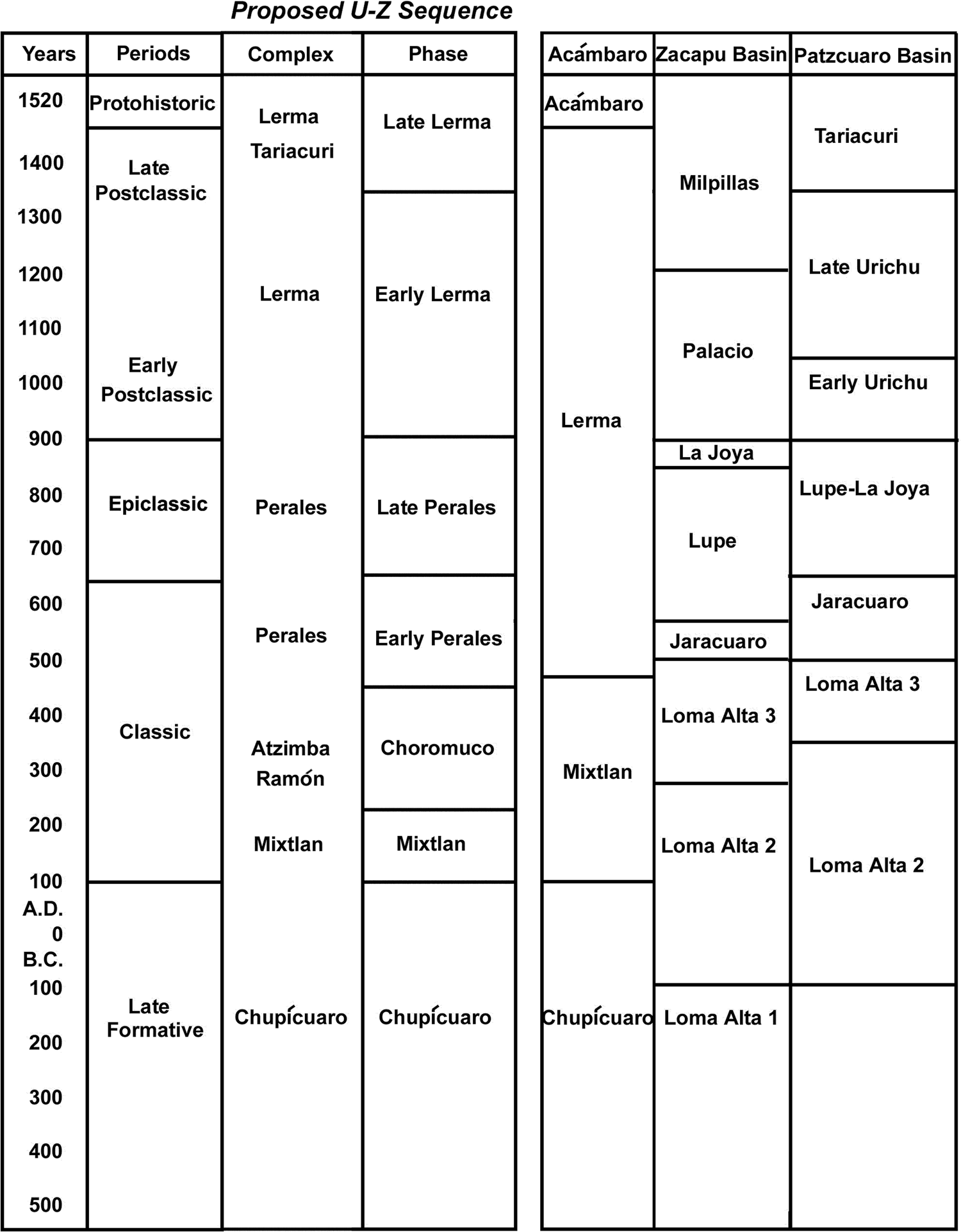
Proposed ceramic complexes and ceramic sequence for the U-Z obsidian source area, compared to the sequences for Acámbaro (Gorenstein Reference Gorenstein1985), the Zacapu Basin (Jadot Reference Jadot2016), and the Pátzcuaro Basin (Pollard Reference Pollard, Faulseit, Xiuhtecutli and Mehta2018).
Creating the U-Z ceramic sequence was a multistage process that began with comprehensive modal analysis of a nonrandom sample of over 3,300 excavation and survey sherds. The sample included ceramics recovered from deep, well-stratified exposures at two major habitation sites, plus more abbreviated, but equally well-stratified exposures from other habitation, quarry, and special-purpose sites. Hernández (Reference Hernández2000:130–138) designed the modal analysis to identify ceramic attributes that exhibit patterns singly or in conjunction with other traits that could be used to define temporally sensitive attributes, or “principal identifying modes,” which became the basis for typological categories into which all of the remaining ceramics were sorted and grouped.
Classification was then performed on all the ceramic artifacts (potsherds, whole vessels, and miscellaneous ceramic objects) recovered by the U-Z Project, which totaled a little more than 100,000 specimens. Hernández (Reference Hernández2000:138–149) created a formal ceramic typology using a version of the type-variety method (Gifford Reference Gifford1960; Sabloff and Smith Reference Sabloff and Smith1969; Smith et al. Reference Smith, Willey and Gifford1960), specifically adapted to facilitate the identification of ceramic wares, varieties, types, and type groups that collectively form contemporaneous ceramic complexes whose temporal duration is termed a ceramic phase. Our use of type-variety classification was consistent with its use to create the Acámbaro sequence (Gorenstein Reference Gorenstein1985:39–41), which was already widely used by other investigators.
To facilitate the definition of ceramic complexes, frequency seriation (Renfrew and Bahn Reference Renfrew and Bahn1996:106–108; see also Clarke Reference Clarke1968:217–228) was performed on a large sample of stratigraphically controlled contexts to evaluate the apparent associations of types and type groups over time. The seriations were performed using MINITAB statistical software and programs created by Healan using the FORTRAN programming language.
During the ceramic analysis, Hernández was able to examine a portion of the ceramics from Gorenstein's excavations at Cerro Chivo, and was given access to pre-Hispanic ceramic vessels at the city museum of Acámbaro, Guanajuato, and was also allowed to examine archaeological collections at the Centro Regional de Querétaro and the Museo Jorge Acosta in Tula, Hidalgo. Other opportunities to examine comparative ceramics from other archaeological sites included Eronguarícuaro, Tzintzuntzan, and Loma Alta in Michoacán, and Calixtlahuaca and Teotihuacan in Mexico state. The opportunity to study relevant collections from adjacent areas provided an invaluable comparative perspective, many aspects of which are evident in the discussion below.
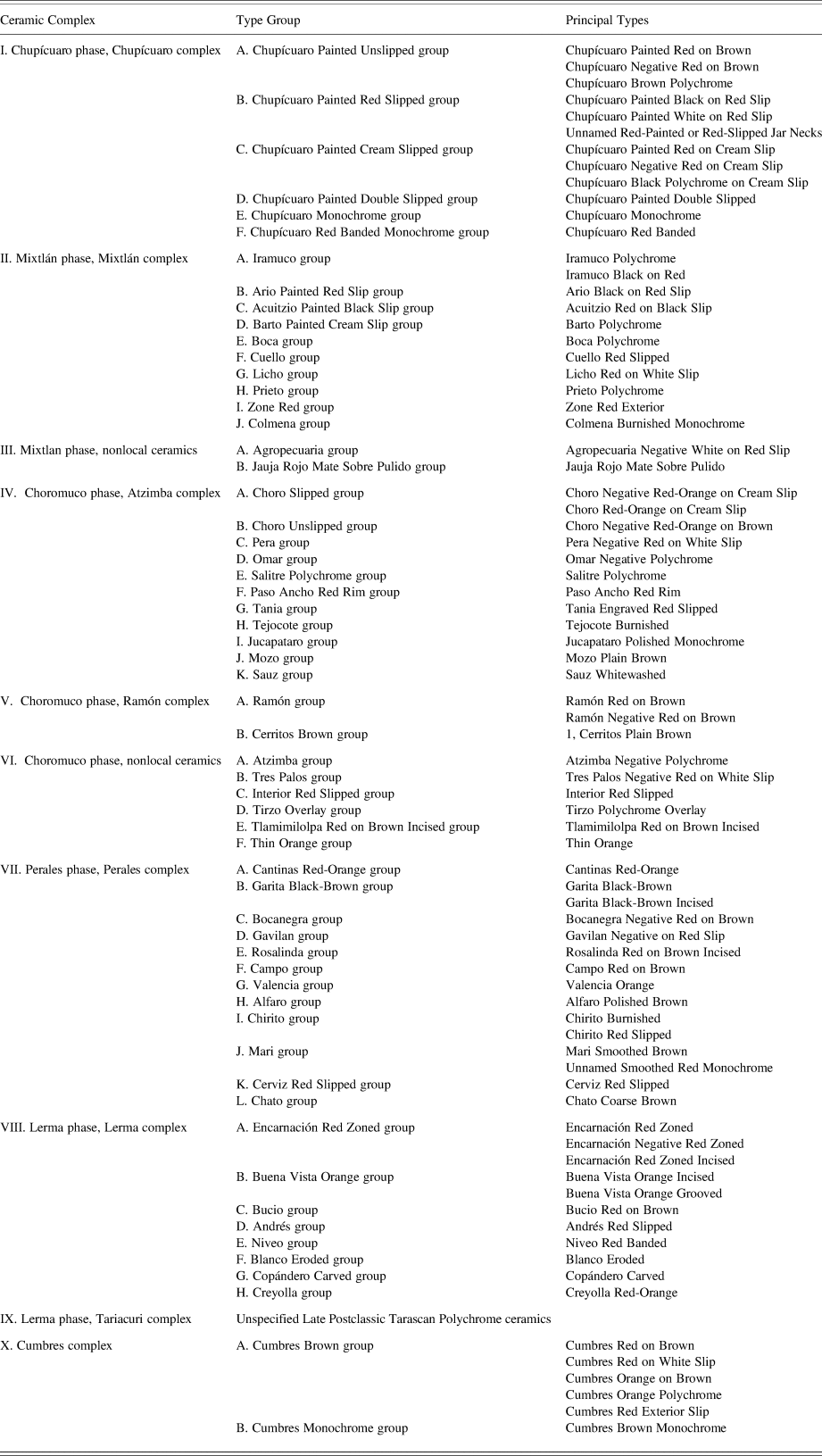
Ceramic analysis and classification resulted in the formulation of nine ceramic complexes and seven ceramic phases and subphases for the U-Z source area seen in Figure 3, and 59 type groups with constituent types listed in Table 3. Some phases contain more than one complex and, conversely, some complexes encompass more than one phase. The proposed dating of the seven phases seen in Figure 3 and described in the following section is based on comparative cross-dating using stylistic similarities and the presence of nonlocal types from other, previously established ceramic sequences.
Ceramic complexes, type groups, and principal types of the U-Z ceramic sequence.
Chupícuaro Phase (ca. 500 b.c.–a.d. 100)
As was the case with the Acámbaro sequence, the earliest identifiable ceramic complex in the U-Z source area is Chupícuaro. Porter (Reference Porter1956) first described Chupícuaro ceramics recovered from burial contexts at the type site located in Guanajuato, approximately 26 km northeast of Zinapécuaro in the southern reaches of the Bajío (Figure 1b). The Chupícuaro complex in the U-Z source area is a synthesis and an elaboration of Porter's (Reference Porter1956:538–555) original Chupícuaro ceramic typology, plus Gorenstein's (Reference Gorenstein1985:39–44) formulation of the Chupícuaro/Solis complex and Snarskis’ (Reference Snarskis and Gorenstein1985:213–225) analysis of excavated ceramics from Cerro Chivo. The classifications of Porter and Snarskis divided Chupícuaro ceramics into painted and monochrome type groups. Porter (Reference Porter1956:544–555) used design attributes to subdivide painted vessels into red-painted and black-painted bichrome, black polychrome, and brown polychrome groups. Snarskis (Reference Snarskis and Gorenstein1985:213–225) likewise described Chupícuaro Monochrome apart from Chupícuaro Painted groups (Table 2) and subdivided the latter into types based primarily on rim form. His classification system grouped together ceramics of similar vessel form that subsumed multiple modes of surface finish and painted decoration.
In contrast, Hernández (Reference Hernández2000:164–166) created a type-variety classification for Chupícuaro ceramics in the U-Z source area that prioritized attributes that exhibited temporal sensitivity. The resulting complex contains six principal groups of ceramics, four painted and two monochrome, of which the painted groups were differentiated, first, on type of surface finish and, in some cases, subdivided by mode of decoration or specificity of form (Table 3:I, A–F). Bichrome and polychrome designs were painted on natural surfaces or over one or more colored slips. Designs range from simple patterns of zone-slipped areas, geometric solids, and bands to intricate geometric designs often executed as polychromes. Figures 4a–4d show some of the variations in form and painted design among the painted groups. Chupícuaro monochrome ceramics occur as both heavy-duty utilitarian vessels and finely finished, delicately made vessels with incised, engraved, or hand-modelled decoration.
Examples of vessel form and decoration for many of the principal types for each ceramic complex in the U-Z ceramic sequence. (a) Chupícuaro Black Polychrome on Cream; (b–d) Chupícuaro Painted Red Slipped; (e) Iramuco Polychrome; (f) Ario Black on Red Slip; (g) Acuitzio Red on Black Slip; (h) Barto Polychrome; (i) Choro Negative Red-Orange on Cream Slip; (j) Tania Engraved Red Slipped; (k) Paso Ancho Red Rimmed; (l) Tres Palos Negative Red on White Slip; (m–p) Ramon Red on Brown; (q) Cantinas Red-Orange; (r) Garita Black-Brown; (s) Bocanegra Negative Red on Brown; (t) Rosalinda Red on Brown Incised; (u) Campo Red on Brown; (v) Encarnación Red Zoned; (w) Buena Vista Orange Incised; (x) Bucio Red on Brown; (y) Niveo Red Banded; (z) Cumbres Red on Brown; (a' and b') Cumbres Orange Polychrome. Images prepared by the authors.

Previous studies date the Chupícuaro complex to the Late Formative period, based on ceramic cross-dating. Porter (Reference Porter Weaver and Frierman1969:7–9) noted that Chupícuaro's strongest similarities are to Ticomán 3 ceramics in the Basin of Mexico, dated to around 300 b.c. Gorenstein (Reference Gorenstein1985:45) used ties to various ceramic assemblages from the Basin of Mexico, including Ticomán, Cuicuilco, Chimalhuacán, and sites in the Teotihuacan Valley, to assign the Chupícuaro and Chupícuaro/Solis complexes from the Acámbaro region to between 650 b.c. and a.d. 100. Radiocarbon dating from recent excavations at La Tronera, a Chupícuaro site near the type site in southeastern Guanajuato (Figure 1c), established an occupation sequence extending from 400 b.c. to around a.d. 1 (Darras and Faugère Reference Darras, Faugère, Williams, Weigand, Mestas and Grove2005).
We further date the Chupícuaro phase in the U-Z source area to the Late Formative period, between around 500 b.c. and a.d. 100, based not only on strong ceramic stylistic ties to the late Ticomán 3 and 4 ceramic complexes (Vaillant Reference Vaillant1931:269–292), but also to diagnostic First Intermediate Two and Three (400–100 b.c.) ceramics from the Basin of Mexico (Sanders et al. Reference Sanders, Parsons and Santley1979:93, 441–446). All of these ceramic types share several common decorative modes, including zone slipping, red-painted and white-painted bichrome decoration, and negative or resist decoration. Highly distinctive bowl forms, including composite silhouette, tecomate, and spider-leg tripods are present in both the Chupícuaro and the Ticomán complexes. Moreover, Chupícuaro ceramic vessels have been identified in Late Formative period deposits at sites in the Basin of Mexico and across the central Bajío (Crespo Reference Crespo Oviedo, Crespo and Brambila1991a, Reference Crespo Oviedo, Crespo and Brambila1991b; Darras Reference Darras2006; Hernández Reference Hernández2000:171–172, Table 23; McBride Reference McBride and Frierman1969:35; Noguera Reference Noguera1943; Saint-Charles and Argüelles Reference Zetina, Carlos, Gamboa, Crespo and Brambila1991).
In the U-Z source area, settlement associated with Chupícuaro ceramics represents the earliest settled occupation. It appears to have been confined to the Cuitzeo Basin, at two sites (16 and 30 in Figure 2), although excavations at two others (08 and 11 in Figure 2) encountered small quantities of Chupícuaro ceramics in the lowest levels, suggesting they were established near the end of the Chupícuaro phase.
Mixtlán Phase (a.d. 100–300)
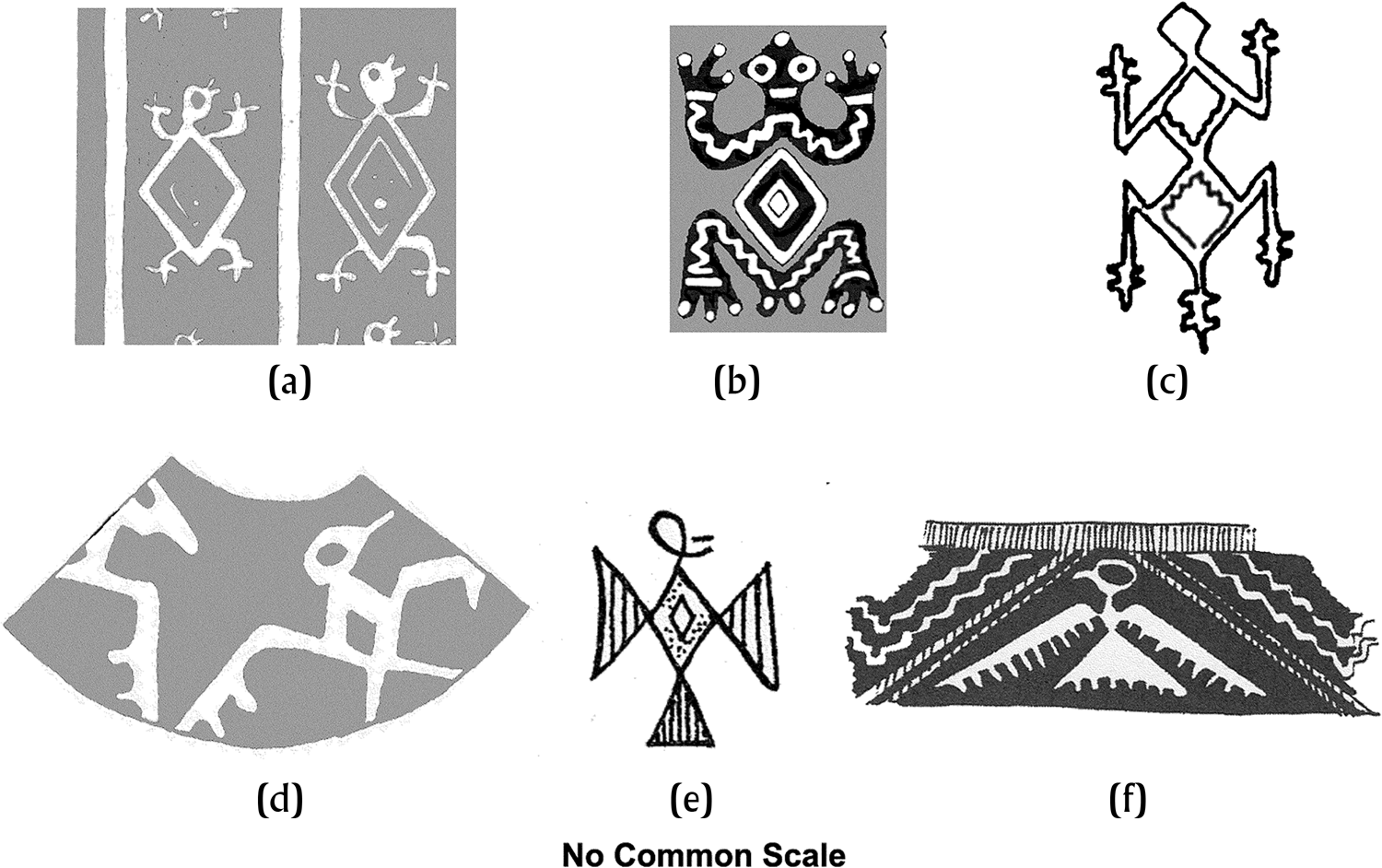
The Mixtlán complex is clearly derived from Chupícuaro, perpetuating many of the common characteristics of Late Formative pottery in terms of ceramic technology, vessel form, and decoration. Painted Mixtlán ceramic groups and types continue the focus on bichrome and polychrome decoration comprised largely of complex geometric elements and motifs that were seen in Chupícuaro ceramics, although some include stylized zoomorphic figures, including birds and quadrupeds (e.g., Figure 5d). Like Chupícuaro, the Mixtlán complex contains a single monochrome type group, Colmena Burnished. Colmena exhibits a range of forms, sizes, and surface colors, with occasional embellishment of simple designs using red paint, incision, carving, appliqué, or hand-modelling. Mixtlán phase monochrome ceramics can be distinguished from Chupícuaro monochromes by their more delicate vessel forms and reduced frequency of surface polishing and decoration. The Mixtlán complex in the Acámbaro sequence contains a monochrome group, La Merced Waxy-Slipped (Table 2), which Snarskis (Reference Snarskis and Gorenstein1985:229) only vaguely described, but may be equivalent to Colmena Burnished. Equally similar is the Loma Alta Inciso monochrome type group described by Carot (Reference Carot2010:Figure 6, 325) for the Loma Alta 2 phase in the Zacapu Basin (Figure 3).
Zoomorphic ceramic motifs from (a) the Tezoyuca phase, Teotihuacan Valley (Sanders et al. Reference Sanders, Parsons and Santley1979), and various phases/localities in Near West Mexico: (b) Chupícuaro, Guanajuato (Covarrubias Reference Covarrubias1961); (c) Morales phase, Guanajuato (Braniff Reference Braniff Cornejo2004); (d) Mixtlán phase, U-Z source area (Hernández Reference Hernández2000); (e) Loma Alta phase, Zacapu Basin (Carot Reference Carot, Williams and Novella1994); (f) Morales phase, Guanajuato (Braniff Reference Braniff Cornejo2004). (a, b, and d) White paint featured on red slip.
The Mixtlán complex, as defined for the U-Z source area, is considerably more diverse than that described by Gorenstein (Reference Gorenstein1985:39–44) for the Acámbaro sequence (Table 2). In addition to all three diagnostic painted types of the latter sequence (Table 3:II, A–C, and Figures 4e–4g), the Mixtlán complex in the U-Z source area includes six other painted type groups (Table 3:II, D–I, Figure 4h). The two bichromes, Acuitzio Red on Black and Ario Black on Red, include specimens that appear virtually identical to ceramics described by Braniff (Reference Braniff Cornejo1972:279) and Saint-Charles (Reference Zetina and Carlos1990:44–45) for the Morales phase in central and southern Guanajuato.
Also present are minor amounts of two nonlocal ceramic types, Agropecuaria Negative White on Red and Jauja Rojo Mate Sobre Pulido (Table 3:III, A and B). Both types were defined at Loma Alta in the Zacapu Basin (Figure 1), where Agropecuaria ceramics peak in popularity during the Loma Alta 1 phase and subsequently disappear by the end of Loma Alta 2, around a.d. 300 (Figure 3; Carot Reference Carot2010:320; Michelet Reference Michelet, Arnauld, Carot and Fauvet-Berthelot1993:150–151). Neither type was identified in the Acámbaro sequence, although a minor Mixtlán phase potential type, Truchas Appliqué (Snarskis Reference Snarskis and Gorenstein1985:230) appears to be the same as Jauja.
We have tentatively dated the Mixtlán phase in the U-Z sequence to the Protoclassic period (a.d. 100–200/250), based in part on cross-dating of the two Loma Alta types. In addition, the white on red slip bichrome and white and black on red slip polychrome decoration common to the Mixtlán painted groups are shared with Tzacualli phase (around a.d. 1–150) ceramics from Teotihuacan (Rattray Reference Rattray2001:Figure 36). Other Mixtlán/Tzacualli phase modal similarities include thick white paint on red slip, highly polished vessel surfaces with a waxy feel, composite silhouette forms, and the use of resist technology to produce black-colored elements in decorative designs.
In the Acámbaro sequence, the Mixtlán phase is dated to a.d. 100–450 (Figure 3). This considerably later end date is based on radiocarbon dating of a stratigraphic layer that Gorenstein believed marked the end of the Mixtlán phase. However, Gorenstein (Reference Gorenstein1985:45) noted that the layer contained both Mixtlán and Lerma ceramics, and hence appears to postdate the end of the Mixtlán phase occupation.
Interestingly, several highly distinctive modes of Mixtlán ceramics are also characteristic of Tezoyuca, a Basin of Mexico ceramic complex associated with a series of closely spaced “hilltop centers” at the southwest entrance to the Teotihuacan Valley (Sanders et al. Reference Sanders, Parsons and Santley1979:104–105). These include a white-painted zoomorphic motif on a red-slipped Tezoyuca vessel that is strikingly similar to motifs on Mixtlán ceramics in the U-Z source area, as well as motifs on Agropecuaria and Tres Palos ceramics from the Zacapu Basin, and Chupícuaro and Morales phase ceramics from Guanajuato (Figure 5). Sanders et al. (Reference Sanders, Parsons and Santley1979:93, 105, Table 5–1) tentatively placed Tezoyuca ceramics in the Late Formative period (300–350 b.c.), while Cowgill (Reference Cowgill1996) dated it to the very end of that period, around 100 b.c.
Mixtlán phase settlement in the U-Z source area appears to have remained largely confined to the Cuitzeo Basin, including all four habitation sites from the Chupícuaro phase (08, 11, 16, and 30 in Figure 2).
Choromuco Phase (ca. a.d. 200/250–450)
A major difference between the U-Z and Acámbaro ceramic sequences is our insertion of two new phases (Choromuco, Perales) in a portion of the time range occupied by the Mixtlán and Lerma phases in the Acámbaro sequence (Figure 3). The Choromuco phase encompasses two distinct ceramic complexes, Atzimba and Ramón, that differ markedly in both content and occurrence within the U-Z source area, although Atzimba constitutes the majority complex at all 10 Choromuco phase sites. The Atzimba complex contains 11 local type groups whose diagnostic ceramics include vessels with orange-red paint on an unslipped or cream-slipped surface (Table 3:IV, A and B, Figure 4i), negative polychromes (Table 3:IV, C and D), a painted polychrome (Table 3:IV, E), red on brown bichromes (Table 3:IV, F and G, and Figures 4j and 4k), and four monochrome type groups (Table 3:IV, H–K). The Ramón ceramic complex contains only two type groups, one decorated and one monochrome (Table 3:V, A and B).
Other than Paso Ancho Red-Rim, which was identified as part of the Lerma complex, no other Choromuco phase types are evident among those described for the Acámbaro ceramic sequence. However, Hernández identified examples of all the major Choromuco phase ceramic types for both the Atzimba and Ramón complexes during an examination of a portion of the Cerro Chivo ceramic collection and unprovenanced collections in the Acámbaro regional museum. In most cases, very few specimens were encountered in any one context, hence they could have escaped the attention of someone not familiar with them. It must also be noted that the Acámbaro sequence was based on approximately 4,500 sherds recovered from four 2 × 2 m excavations at a single site, whereas the U-Z sequence is based on nearly 35,000 sherds recovered from excavation at 30 different sites.
The Choromuco phase in the U-Z source area sequence is remarkable in four respects: (1) decorated ceramics in both the Atzimba and Ramón complexes show a distinct decline in the popularity of painted polychromes, compared to the earlier Chupícuaro and Mixtlán traditions, in favor of negative polychromes and red-on-brown bichromes; (2) Atzimba and Ramón vessel forms are dramatically different from the relatively thick-walled vessels with composite silhouette, incurved tecomate tripod bowls with large, hollow supports, and outflaring copa forms of the preceding phases, instead characterized by thin-walled, unsupported, outcurving, and outflaring bowls, tripodal vessels with solid conical supports, and tall-necked jars; (3) for the first time in the U-Z source area, local ceramic complexes include long-distance imports of luxury pottery; and (4) the decorated ceramics in both complexes exhibit strong modal ties that suggest an affiliation through pottery between the U-Z source area and regions immediately to the west in northern Michoacán and regions to the east across the southern Bajío, southern Hidalgo, and the northern Basin of Mexico.
The decorated ceramics in the Atzimba complex feature some of the principal identifying modes of earlier Mixtlán painted ceramics, but also exhibit various innovations, including resist decoration to create negative polychrome designs on white- and red-slipped zones, punctate grinding bowls, and post-fired polychrome overlay, described below. Some of the Atzimba decorated types share a distinctive paste characterized by uniformly small black particles of what appears to be crushed volcanic rock, presumed to have been added as temper. Ceramics with this paste, named Oreo ware, consistently occur as unsupported, flat-bottomed, outflaring, or outcurving vessels. Oreo ware ceramics include Tres Palos (Figure 4l), a ceramic import diagnostic of the Loma Alta 2 and 3 subphases in the Zacapu Basin (Carot Reference Carot, de Lameiras and Weigand1990:74–75, Reference Carot2010:320; Michelet Reference Michelet, Arnauld, Carot and Fauvet-Berthelot1993:150–151).
Another Oreo ware ceramic type, which Hernández (Reference Hernández2000:873–882) named Tirzo Polychrome Overlay, uses a highly distinctive postfire decorative technique, described as “polychrome overlay” by Holien (Reference Holien1977:122–139). Molina Montes and Torres Montes (Reference Montes and Montes1974) previously described a large museum collection of such vessels from nearby Queréndaro, Michoacán (Figure 1d), and Hernández (Reference Hernández2000:858) notes that these vessels are widely recognized and previously described as an emulation of painted stucco pottery from Teotihuacan (Rattray Reference Rattray2001:227, Reference Rattray, Merino Carrión and Cook2006:242–243). Notably, recent excavations of an apartment compound at Teotihuacan encountered two vessels identifiable as Tirzo Polychrome Overlay and two figurines common to sites in Michoacán, in a burial inside a structure believed to have housed immigrants from the area of Michoacán (Gómez Reference Gómez Chávez and Gallut2002:582–585, Photo 5).
Ceramics with pastes containing similar volcanic particle inclusions occur in north-central Michoacán (Manzanilla Reference Manzanilla López1984:23) and in the Tarascan heartland around Lake Pátzcuaro (Pollard Reference Pollard1993:Appendix 2). Given their unique character and association with a rather small part (approximately 8 per cent) of the Atzimba ceramic complex inventory, we think that Oreo ware ceramics were imported, presumably from areas to the west. The red banding and red-zone slipping definitive of Paso Ancho Red Rim vessels (Snarskis Reference Snarskis and Gorenstein1985:233–236) link the Atzimba complex to assemblages described for sites in the Bajío that include similar or identical examples of this type (Crespo Reference Crespo Oviedo, Crespo and Brambila1991a; Nalda Reference Nalda, Crespo and Brambila1991:47; Saint-Charles Reference Zetina and Carlos1990:67–75, Plates 59–79.
The Ramón complex exhibits particularly strong ties to ceramic complexes to the east. Ramón is distinguished by highly polished, light brown vessels decorated with unusually large, red-painted motifs on one or both surfaces (Figures 4m–4p), which occur as bichromes or as negative polychromes (i.e., red-painted designs in combination with resist). A common vessel form for both painted type groups is a flat-bottomed, outflaring tripod bowl with solid nubbin or short conical supports (Figures 4n–4o), while other vessels include a variety of unsupported and tripodal cups, basins, grinding bowls, and jars. One element that distinguishes Ramón from Atzimba is the use of cross-hatched incisions for grinding bowl interior bases, instead of punctate typically found on Tres Palos negative polychrome grinding bowls (compare Figures 4i and 4m).
Another novel feature of Choromuco phase ceramics is the pronounced presence of nonlocal ceramics, including several long-distance imports. Unlike the Mixtlán phase, where Hernández (Reference Hernández2000:672–679, 707–715) detected only a minor presence of Loma Alta ceramics (Table 3:III, A and B), the presence of imports in the Choromuco phase is stronger both in the number of type groups (6 versus 2) and in total number of sherds (758 versus 32). Two additional imported type groups (Table 3:VI, E and F), Tlamimilolpa Red on Brown Incised and Thin Orange trade bowls, originated from much further east, either from Teotihuacan or through its pan-regional exchange networks. However, the number of sherds (45) for these two imported types is minor compared to the Oreo ware type groups.
Our Early/Middle Classic dating of the Choromuco phase is based on cross-dating with ceramic sequences to the east and west. Ramón pottery is virtually identical to two ceramic types, Arado and Loma Linda Rojo Sobre Bayo, from sites in the central river valleys of Querétaro, dated to a.d. 400–650 and a.d. 150–500, respectively (Crespo Reference Crespo Oviedo, Crespo and Brambila1991a:100, Reference Crespo Oviedo, Crespo and Brambila1991b:178–184; Nalda Reference Nalda, Crespo and Brambila1991:46), and these are likewise essentially indistinguishable from Cajete al Negativo ceramics, as described by Enríquez Farias (Reference Enríquez Farias, Saint-Charles Zetina, Anzures and Limón2010:189–193), for El Rosario in the Río San Juan Valley of southern Querétaro (Figure 1e). The suite of principal identifying modes of Ramón ceramics described above is also characteristic of monochrome and red on brown ceramics described by Rattray (Reference Rattray2001:163–202, 491–515, Figures 56–96) for the Early Tlamimilolpa and Late Tlamimilolpa phases at Teotihuacan, broadly dated to around a.d. 200–350 (Cowgill Reference Cowgill1996; Nichols Reference Nichols2016; Rattray Reference Rattray2001). Ramón ceramics share numerous modal similarities as well, notably similarities in vessel form, with Middle Horizon ceramics from the Basin of Mexico survey, dated to a.d. 300–750 (Sanders et al. Reference Sanders, Parsons and Santley1979:93, 455–457; Figures C.12–C.15).
Other local and nonlocal ceramics provide additional bases for cross-dating. Tres Palos Negative Red on White (Figure 4l) is a diagnostic local ceramic of the Loma Alta 2 and 3 and succeeding Jaracuaro phases in the Zacapu Basin that span approximately a.d. 100–500 (Figure 3). Minor quantities of Thin Orange occur in association with Tres Palos ceramics in both the Zacapu Basin and the U-Z source area (Hernández Reference Hernández2000:205, 902–906; Michelet Reference Michelet, Arnauld, Carot and Fauvet-Berthelot1993:150). Rattray (Reference Rattray, Rattray, Litvak and Díaz1981:59–64) dates the exportation of Thin Orange to the Early Tlamimilolpa through Early Xolalpan periods (around a.d. 200–450). The Tirzo Polychrome Overlay ceramics in the West Mexico style tomb at Teotihuacan described above were associated with local Teotihuacan ceramics that correspond to the Tlamimilolpa phase (Gómez Reference Gómez Chávez and Gallut2002:588, 591). Choro Slipped (Figure 4i) and Unslipped vessels appear to be local versions of Loma Alta Pulido, likewise a diagnostic Loma Alta 3 type in both the Zacapu and Lake Pátzcuaro Basins (Pollard Reference Pollard2001:19). Snarskis (Reference Snarskis and Gorenstein1985:233–236) described Paso Ancho Red Rim (Figure 4k) as a transitional type that bridges the Mixtlán and Lerma phases in the Acámbaro sequence because of its red-painted surface decoration. Paso Ancho also shares this decorative mode, as well as vessel form, with Ciénaga Rojo and Lupe Café Rojo Pulido, two types that appear to span the Loma Alta 3, Jaracuaro, and Lupe phases in the Zacapu Basin ceramic sequence (Michelet Reference Michelet and de Méndez1990:284, 1993:153–155).
Choromuco phase settlement in the Cuitzeo Basin features continued occupation of all four settlements from the Mixtlán phase (08, 11, 16, and 30 in Figure 2), plus the appearance of one new settlement (12 in Figure 2). In addition, the Choromuco phase marks the initial settlement of the Ucareo Valley with the appearance of five sites (03, 13, 14, 15, and 21 in Figure 2). Exploratory excavation encountered very small quantities of Mixtlán complex sherds in the lowest levels at four of the five Ucareo Valley sites, suggesting they were settled at the very end of that phase.
Atzimba and Ramón complex ceramics exhibit strikingly different distributions within the U-Z source area, in which Atzimba occurs at all ten Choromuco phase sites, while Ramón is largely limited to the five Ucareo Valley sites, where it constitutes around 14–28 percent of Choromuco ceramics. Small quantities of Ramón ceramics were recovered from two Cuitzeo Basin sites (12 and 16 in Figure 2), most of which (12 of 16 sherds) were recovered from site 12, the new settlement in the basin. Atzimba and Ramón ceramics co-occur throughout the stratigraphy of all five Ucareo Valley settlements, while Ramón ceramics are restricted to the upper levels in excavations at sites 12 and 16 in the Cuitzeo Basin, hence appearing later at these two sites than do Atzimba ceramics. Despite these differences, however, radiocarbon dating described below suggests that Choromuco phase settlement occurred in both subareas at the same time.
Perales Phase (Early: ca. a.d. 450–650; Late: ca. a.d. 650–900)
The Perales phase occupies approximately the first 450 years of the Lerma phase as defined for the Acámbaro sequence, an interval spanning the Late Classic and Epiclassic periods (Figure 3). The Perales ceramic complex in the U-Z sequence incorporates two of the key diagnostic type groups of Gorenstein's (Reference Gorenstein1985:43) Lerma complex (Table 3:VII, A and B, and Figures 4q and 4r), plus a number of previously undefined types (Table 3:VII, C–L, and Figures 4s–4u). The key diagnostic type group of the Perales complex is Cantinas Red-Orange (Figure 4q), one of four ceramic groups that comprise the Lerma complex in the Acámbaro sequence (Table 2). In the U-Z source area, Cantinas Red-Orange occurs as wide, outflaring, buff-colored tripod bowls, tripod jars, and large basins decorated with red-orange painted geometric designs. Red-on-brown painted decoration is, in fact, the most popular mode of decoration in the Perales complex, followed by incision and engraving on delicately formed, monochrome vessels of Garita Black-Brown Incised (Figure 4r). The use of negative decoration persists, but is limited to two types: a single type of negative red on brown polychrome, and a negative on red-slipped bowl (Table 3:VII, C and D, and Figure 4s). Monochromes (Table 3:VII, G–J) and red-slipped jars (Table 3:VII, K) are more common than in the previous phase. Another notable feature is a well-developed subcomplex of censers and braziers (Table 3:VII, L), a characteristic of many Epiclassic period ceramic assemblages (Ringle et al. Reference Ringle, Negrón and Bey1998). The Cerritos Brown Group of the Ramón complex in the preceding Choromuco phase included outcurving spiked censers that appear simpler in form than the more elaborately constructed and decorated Perales phase Chato vessels (Hernández Reference Hernández2000:225, Appendix D, 1045–1055).
Another feature of the Perales Complex that distinguishes it from its Choromuco predecessors is the virtual lack of imported luxury ceramics. Thin Orange and Tlamimilolpa Red on Brown Incised vessels appear to co-occur with Perales complex ceramics in lower levels of stratified deposits, but in very low frequency (less than ten sherds in total) compared to the preceding Choromuco phase, and subsequently disappear, presumably a consequence of the demise of Middle Classic Teotihuacan and its trade networks. So, too, do the previously popular ceramic types linked to northern Michoacán, Tres Palos Negative Red on White Slip and Tirzo Overlay polychrome.
Seriation analysis revealed that Cantinas Red-Orange ceramics and Valencia Orange monochromes in the U-Z source area declined in popularity over time, coinciding with the appearance of two new painted red-on-brown types, Rosalinda Red on Brown Incised and Campo Red on Brown (Hernández Reference Hernández2000:1087–1104, 1143–1158, Appendix E, 1325–1328, 1333–1336; Figures 4t and 4u). Rosalinda Red on Brown Incised typically occurs as a delicately fashioned outflaring, basal Z-angle tripod bowl, and occasionally as a hemispherical bowl, whose exterior walls exhibit red-painted zones, over which an incised or engraved design is placed (Figure 4t). A horizontal panel filled with geometric motifs is most common. Campo Red on Brown is a more robust, outcurving tripod bowl, with a similar red-painted zone on the interior rim and body, and an exterior rim band and some combination of painting and/or incision on the interior base. Some versions contain simple resist designs on the interior of the vessel as well. Neither Rosalinda nor Campo were recognized by Snarskis (Reference Snarskis and Gorenstein1985) for the Acámbaro sequence, but in fact Hernández identified specimens of both during her examination of a portion of the Cerro Chivo ceramic collection.
The simultaneous waning of Cantinas and Valencia and the appearance of Rosalinda and Campo provided a means of dividing Perales into Early and Late subphases. Equally useful in this capacity is Garita Black-Brown (Figure 4r), a polished black-brown monochrome that occurs as unsupported or tripodal bowls and jars, undecorated or with incised and/or engraved geometric designs, and which appears in Early Perales contexts, but peaks in popularity during the Late Perales phase. The incised or engraved designs on Garita ceramics utilize many of the same motifs common among red-painted ceramics in the Perales complex (Hernández Reference Hernández2000:1061–1075).
We dated the Perales phase to the Middle/Late Classic and Epiclassic periods, based in part on ties to ceramic complexes dated to this time period from central and southern Guanajuato and Querétaro in which Cantinas Red-Orange and/or Garita Black-Brown occur, in some cases as principal types (Antonieta Moguel and Sanchez Reference Moguel, Sánchez, Brambila and Crespo1988:230–231; Brambila and Castañeda Reference Brambila, Castañeda, Crespo and Brambila1991:146–149; Braniff Reference Braniff Cornejo1972:282–283, Figure 1, Reference Braniff Cornejo1999:32–50; Castañeda et al. Reference Castaneda, María Flores, Antonio Contreras, Duran, Maria Crespo, Saint-Charles, Brambilla and María Crespo1988:324–326, Figure 9; Crespo Reference Crespo Oviedo, Crespo and Brambila1991a:112–134, Reference Crespo Oviedo, Crespo and Brambila1991b:184–190; Flores and Saint-Charles Reference Morales, María, Saint-Charles Zetina, Carrión and Cook2006:369–372; Gorenstein Reference Gorenstein1985:43–45; Saint-Charles Reference Zetina and Carlos1990:51, Map 6, Reference Crespo, Zetina, Maria Crespo and Viramontes1996:144–147; Saint-Charles and Argüelles Reference Zetina, Carlos, Gamboa, Crespo and Brambila1991:82–88; Nalda Reference Nalda, Lombardo and Nalda1996:274, n20). These Bajío complexes also share with Perales the same suite of vessel forms (outflaring tripod, annular-supported, and flat-bottomed bowls and jars), the same modes of decoration (red-painted or incised or engraved geometric designs on brown pottery or cream-slipped pottery with minor use of resist), and the same companion monochrome groups (utilitarian brown, orange, and coarse brown braziers and censers). Types from the Bajío analogous to Cantinas Red-Orange include Red on Brown El Mogote (Nalda Reference Nalda, Crespo and Brambila1991:50), San Miguel Red on Buff (Braniff Reference Braniff Cornejo1972:282), Rojo Sobre Bayo el Bajío (Saint-Charles Reference Zetina and Carlos1990:60), and San Bartolo Red on Buff (Flores and Saint-Charles Reference Morales, María, Saint-Charles Zetina, Carrión and Cook2006:372–277). Additional ceramics from further to the east that appear analogous to Cantinas include Ana Maria Red on Brown and Coyotlatelco Red on Brown (Cobean Reference Cobean1990:92) from Prado and Corral phase Tula (Figure 1g), and Rojo Sobre Natural ceramics (Rattray Reference Rattray, Merino Carrión and Cook2006:253–257) from Metepec phase Teotihuacan (Figure 1h).
Late Perales phase Rosalinda Red on Brown Incised is quite similar to ceramics from sites dated to the Late Classic/Epiclassic period in Guanajuato, Querétaro, and Tula (Braniff Reference Braniff Cornejo1999:Figure 76, p. 125; Cobean Reference Cobean1990:75–92, 289–312; Flores and Saint-Charles Reference Morales, María, Saint-Charles Zetina, Carrión and Cook2006:361). Possible precursors to Rosalinda include incised red on brown tripod cylindrical vases from Xolalpan phase Teotihuacan (around a.d. 350–550) that may have served as prototypes for Epiclassic potters in the Bajío and Tula regions. Likewise, Late Perales phase Campo Red on Brown shares decorative modes and designs with ceramics assigned to the Epiclassic period La Mesa and Corral phases in the Tula region (Hernández and Healan Reference Hernández, Healan, Beekman and Fowler2019).
Garita Black-Brown shares numerous similarities with Lupe Pulido and Lupe Inciso from the Zacapu Basin that span the Lupe and La Joya phases, around a.d. 550–900 (Figure 3; Arnauld et al. Reference Arnauld, Carot and Fauvet-Berthelot1993:153–154; Faugère-Kalfon Reference Faugère-Kalfon1996:84; Michelet et al. Reference Michelet, Arnauld and Fauvet-Berthelot1989:80–81), and is one of a number of incised/engraved polished monochrome tripod vessel types in use across northern Michoacán and the Bajío during this time (Pomedio Reference Pomedio2009:19–32). At a site near San Juan del Rio, Querétaro, a radiocarbon sample associated with ceramics identified as Garita Black-Brown was dated to around a.d. 760, and the underlying level contained both Garita and Cantinas ceramics (Crespo and Saint-Charles Reference Crespo, Zetina, Maria Crespo and Viramontes1996:124–125, Cuadro 1). Garita Black-Brown also exhibits strong technological, formal, and decorative similarities to Prado phase Clara Luz Negro Engraved tripod vessels from Tula (Cobean Reference Cobean1990:104–118).
Pre-Hispanic settlement in the U-Z source area appears to have reached its apogee during the Perales phase. No new habitation sites appear, but all sites occupied during the Choromuco phase continued to be occupied, although one Cuitzeo Basin site (11 in Figure 2) appears to have declined in population. It is during the Perales phase that Ucareo obsidian becomes a widely distributed commodity in Mesoamerica (Healan Reference Healan1997:Table 2), predominately in the form of prismatic cores and blades. The site of Las Lomas (03 in Figure 2) grew to become a major regional center that was heavily involved in the exploitation of Ucareo obsidian, as indicated by numerous concentrations of prismatic cores, blades, and core/blade debitage within the approximately 250 ha site and smaller outlying settlements. Over 1,000 obsidian quarries were identified during surface survey of the Ucareo obsidian source, many of which are believed to date from this time period, although most quarries could not be dated given the virtual absence of ceramics or other temporally diagnostic artifacts or features.
Lerma Phase (Early: a.d. 900–1350; Late: a.d. 1350–1520)
As defined for the U-Z source area, the Lerma ceramic complex and corresponding phase are quite different from those defined for the Acámbaro sequence (Table 2). The former complex includes only one of the four Lerma ceramic type groups, Encarnación Red Zone (Table 3:VIII, A, and Figure 4v), that were used to define the Lerma phase for the Acámbaro sequence, since the other three (Paso Ancho Red Rim, Cantinas Red-Orange, and Garita Black-Brown) were reassigned to the Atzimba or Perales complexes in the U-Z ceramic sequence (Table 3:III, F and VII, A and B). In addition, the Lerma complex in the U-Z ceramic sequence includes type groups that Gorenstein (Reference Gorenstein1985:45–46) assigned to the later, protohistoric Acámbaro complex and phase in the Acámbaro ceramic sequence (Table 3:VIII, B, F, and G, and Figure 4w), but which our stratigraphic data and ceramic cross-dating indicate appear earlier in the U-Z source area. Finally, our Lerma complex includes a number of ceramic types (Table 3:VIII, C–E and H, and Figures 4x and 4y) that were not identified in the Acámbaro sequence. Since our Lerma complex incorporates Gorenstein's Acámbaro complex ceramics, there is no Acámbaro phase in the U-Z ceramic sequence, and its time range corresponds to our Late Lerma subphase, as described below.
The Lerma ceramic complex in the U-Z ceramic sequence is a mixture of painted ceramics, negative polychromes, and incised monochromes, including two key diagnostic types (Table 3:VIII, A and B, and Figures 4v and 4w) that were originally defined for the Acámbaro sequence (Snarskis Reference Snarskis and Gorenstein1985:243–249). One of the latter two, Buena Vista Orange, typically occurs as outflaring tripod bowls, with solid conical or loop supports and incised geometric designs on the vessel exterior, which, along with their orange color, make them very similar to Sillon Incised, a diagnostic Tollan phase (around a.d. 900–1150) ceramic at Tula (Cobean Reference Cobean1990:375–385). The other key type, Encarnación Red Zoned, consists of hemispherical outcurving and outflaring, supported bowls covered with a thick cream-colored slip and decorated with red-painted bands, and/or large, simple, geometric motifs, sometimes with incision or resist decoration (Hernández Reference Hernández2000:1120–1142). These vessel forms and the use of red-painted geometric decoration and cream slips are reminiscent of Coyotlatelco ceramics of the preceding Late Classic and Epiclassic periods, although the same decorative modes also occur on a variety of Postclassic period pottery vessels found at sites in the Toluca Basin (Sodi and Herrera Reference Sodi Miranda and Torres1991:23–24; Sugiura Reference Sugiura2005:195–200; Segura and León Reference Segura, León and Chan1981:115–117; Vargas Reference Vargas Pacheco and Chan1975:232–233).
Three other equally diagnostic Lerma complex types in the U-Z ceramic sequence suggest ties to the west. Two of these, Bucio Red on Brown and Andrés Red Slipped (Table 3:VIII, C and D, and Figure 4x), may be local variants of Lupe Café Rojo Pulido and Ciénaga Rojo, two types defined for the preceding Lupe and La Joya phases in the Zacapu Basin (Michelet Reference Michelet, Arnauld, Carot and Fauvet-Berthelot1993:153–155, Figures 53 and 54). The other is Niveo Red Banded (Table 3:VIII, E, and Figure 4y), a red-painted white ware that also occurs with resist decoration and may be a local manifestation of Copujo ceramics that Pollard (Reference Pollard2001) described for the Urichu phase (a.d. 900–1350) in the southern Lake Pátzcuaro Basin.
Except for one in the Cuitzeo Basin (11 in Figure 2), all sites occupied during the Perales phase continued to be occupied during the Lerma phase. In addition, four habitation sites and three specialized sites associated with obsidian production appear in the Ucareo Valley during the Lerma phase. As the latest pre-Hispanic phase, Lerma ceramics typically occurred in the uppermost levels or on the surface, but often overlapped with underlying Perales complex ceramics in sites with deeper, stratified deposits. Seven sites also contained diagnostic Tarascan heartland ceramics, collectively designated the Tariacuri complex (Table 3:IX), which co-occurred with Lerma complex ceramics in the uppermost levels, confirming historical accounts (Feldman Reference Feldman1973) that the region came under the control of the Tarascan (Purépecha) state in the late prehistoric period. This enabled us to subdivide Lerma into Early and Late subphases, based on the appearance of Tariacuri complex ceramics in the latter. Rather than using Gorenstein's date of a.d. 1450–1520 for the Tarascan presence in the U-Z source area, our dating of the Late Lerma subphase to a.d. 1350–1520 corresponds to Pollard's (Reference Pollard2008:Table 2, 220, 224–225) more recent dating of the Tariacuri phase in the Tarascan heartland.
The new Lerma phase habitation sites (17–20 in Figure 2) appeared in agricultural fields around the modern community of Ucareo, and it seems likely that all were part of a single site, although we were unable to confirm this, given dense modern settlement in the intervening area. It is known, however, that a pre-Hispanic settlement known as Ucareo existed at contact (López Reference López Lara1984), and all four sites did contain Tariacuri complex ceramics. Three other Ucareo Valley sites (29, 10, and 23 in Figure 2) were each involved in a different stage of the prismatic core/blade chaine operatoire, including a quarry and initial processing facility (site 29), a nearby polyhedral core preparation facility (site 10), and a high-volume prismatic core/blade workshop (site 23). All three were associated with Tariacuri complex ceramics, thus supporting historical accounts of Tarascan-controlled exploitation of the Ucareo and Zinapécuaro obsidian sources (Gorenstein and Pollard Reference Gorenstein and Pollard1983) and archaeological evidence that the bulk of obsidian consumed in the Tarascan capital at Tzintzuntzan came from the U-Z source area (Pollard and Vogel Reference Pollard, Vogel, Williams and Novella1994).
In the Cuitzeo Basin, Tariacuri complex ceramics were almost entirely confined to two existing sites (12 and 30 in Figure 2); but with the exception of site 11, all of the Cuitzeo Basin sites contained substantial quantities of Early Lerma complex ceramics. It appears that, like the Ucareo Valley, Tarascan occupation in the Cuitzeo Basin was limited to sites that served particular purposes for the Tarascan state. Site 30 may have been part of a ritual complex dedicated to the Tarascan creator goddess Cuerauáperi which is known to have existed at Zinapécuaro at the time of European contact (Pollard Reference Pollard1993:152), while site 12 is located in a zone of thermal springs known to have been the scene of activities involving human sacrifice associated with that same deity (Pollard Reference Pollard1993:136, 145, 152).
The Cumbres Anomaly: A Probable Foreign Enclave from Huamango
The Cumbres ceramic complex is restricted almost entirely to two habitation sites in the Ucareo Valley, and is the only ceramic found at either site. The mutually exclusive occurrence of Cumbres with respect to the other ceramic complexes in the U-Z source area implies that these two sites were intrusive (Hernández and Healan Reference Hernández and Healan2008). Cumbres ceramics (Table 3:X, A and B) include plain utilitarian vessels, painted bichrome and polychrome serving and storage vessels, and a subcomplex associated with ritual activity (Hernández Reference Hernández2000:257–262). Painted ceramics feature red-painted designs placed directly on the matte surface of self-slipped brown vessels or over a light-colored, cream slip. Motifs include simple combinations of horizontal bands, parallel wavy lines, and more intricate compositions involving parallel, wavy, or zig-zag lines, scrolls and other elements (Hernández Reference Hernández2000:259, Figure 35; Hernández and Healan Reference Hernández and Healan2008:Figures 5–10). Polychrome designs incorporate similar red-painted designs and orange-painted bands (Figures 4a' and 4b'). Cumbres vessels also feature negative polychrome decoration in which post-fired, red-painted bands were placed over negative designs on a white slip.
Many of the geometric and rectilinear motifs are quite similar to designs found on Coyotlatelco Red on Brown ceramics, so much so that Cumbres ceramics were initially misidentified as Coyotlatelco (Healan Reference Healan and Darras1998). In fact, however, Cumbres ceramics are virtually indistinguishable from ceramics previously identified at the site of Huamango (Figure 1f) in the Acambay region of the northern Toluca Basin (Granados and Guevara Reference Granados Reyes and Guevara1999; Guevara and Granados Reference Guevara and Reyes2001; Pina Chan Reference Piña Chan1981; see also Hernández and Healan Reference Hernández and Healan2008). So similar are the two ceramic complexes that we believe the two Cumbres sites in the Ucareo Valley were enclaves from Huamango or elsewhere in the Acambay region.
Given its mutually exclusive nature with respect to all of the other ceramic complexes, we assigned the Cumbres ceramic complex to its own phase. For this very reason, we were unable to determine its temporal placement vis-à-vis the other phases in the U-Z sequence, and cross-dating with ceramics from Huamango is problematic. Segura and León (Reference Segura, León and Chan1981:116–117) dated Huamango to somewhere within the Epiclassic and Early Postclassic periods, based on similarities between Huamango and Coyotlatelco, Mazapan, and Early Matlatzinca ceramics. Sugiura (Reference Sugiura2005:181–195, 199–200) recently identified the ceramics from Huamango as one of three distinctive complexes present in the Toluca Basin from the Early Postclassic period to the introduction of Aztec III and III–IV ceramics associated with the imperial expansion of Axayacatl in 1474 during the Late Postclassic. We initially considered the Cumbres phase to be Epiclassic to Early Postclassic in date, which would make it contemporaneous with the Late Perales and Early Lerma phases, but this dating has been subsequently revised in light of radiocarbon dating discussed below.
RADIOCARBON DATING
Field Methods
During excavation, all datable organic material, mostly carbonized wood, was recovered with a clean trowel and sealed in aluminum foil. Each sample was opened and allowed to dry in the laboratory before being resealed for storage. No wood beams, roof poles, or other structural elements were recovered, and most samples were associated with refuse or midden deposits. Only nucleated charcoal specimens were selected for dating, no aggregate samples (loose flecks and small fragments collected from a single level during excavation) were involved. Some 197 nucleated specimens were recovered from 171 different contexts, which formed the population from which the samples to be dated were selected.
Sampling Strategy
Some 30 radiocarbon samples were dated. Our objective was not to date specific sites, but rather multiple contexts associated with each of the seven ceramic phases and subphases in order to evaluate the tentative chronological framework that was established through cross-dating. Six of the 30 samples were drawn from the two Cumbres complex sites, while the remaining 24 were drawn from contexts associated with each of the seven phases/subphases represented by the other seven ceramic complexes in Figure 6.
One- and two-sigma calibrated date ranges for the 24 samples from non-Cumbres contexts presented in Table 4, grouped by probable phase affiliation and ordered within group by median probability date. Shaded rectangles delineate dating of corresponding phase based on ceramic cross-dating. Image by Healan.

Our intention was to date at least two contexts associated with each phase/subphase, ideally samples from contexts whose ceramic assemblage consisted solely of types associated with the phase/subphase to be dated. This was not a problem for the six Cumbres complex samples, which came from two single component sites, but only nine of the other 24 radiocarbon samples involved contexts in which all or virtually all (i.e., 96 percent or greater) of their ceramic assemblage was associated with a single phase. The remaining samples had to be selected from contexts containing ceramics associated with more than one phase, but in all cases involved contexts with ceramics from only two, temporally adjacent phases. This “mixture” of ceramics from different phases does not appear to be the result of intrusion or other mixing of deposits, but simply a consequence of the fact that types associated with a particular ceramic phase often have different life spans, including some that may originate in a previous phase and/or continue into a subsequent one. This pattern of overlapping rather than discontinuous popularity curves over time, which Clarke (Reference Clarke1968) described as “double lenticular,” means that a ceramic assemblage in use at a given time will often include specimens of types considered diagnostic of temporally adjacent phases.
Nevertheless, it remains a problem to determine the true affiliation of a context containing ceramics associated with more than one phase. One solution would be simply to assign it to the phase with the largest number of representatives in the context. There are at least two problems with this procedure, one of which is that it does not consider differences in the relative size of the various ceramic complexes; for example, our ceramic collection of diagnostic ceramics includes 9,180 Perales sherds, but only 1,623 Lerma sherds. The other problem is that this procedure considers only the specific context being dated, thus ignoring information that may be provided by contexts that precede and follow it in time. For this reason, we utilized frequency seriation to help determine the most likely affiliation of such contexts in order to look for larger trends in the stratigraphic/seriation sequence of which it was part. This was also a useful procedure in situations where contexts of interest had relatively few ceramics. Unfortunately, even with frequency seriation, we were unable to determine the probable phase affiliation with a high level of confidence for 13 of the contexts, and could only assume that their ages lay somewhere within the time range of the two phases represented in their ceramic assemblages.
Although our goal was to obtain at least one radiocarbon date for each phase, we were only able to identify one datable context whose ceramic inventory could be assigned with confidence to the Mixtlán phase. In addition, one of the two samples assumed to date to the Late Lerma subphase came from a layer of debitage associated with an obsidian quarry and associated initial core/blade preparation facility (29 in Figure 2). No diagnostic ceramics were recovered from the layer whose Late Lerma date was based instead on the presence of debitage associated with the preparation of ground core platforms, a trait that did not appear in the region until the arrival of the Tarascans (Healan Reference Healan, Williams, Weigand and Grove2005:174–175). Diagnostic Tariacuri complex sherds were recovered from other contexts at the same quarry.
The 30 samples were selected and submitted for dating in multiple batches over several years, as funds for dating became available. This process allowed the information obtained from dating a given batch to aid in the selection of the next batch of samples.
Radiocarbon dating was performed by Beta Analytic using standard radiometric dating or accelerated mass spectrometry, depending on sample size. The resulting dates were calibrated using CALIB Radiocarbon Calibration Program, version 8.1.0 (Stuiver et al. Reference Stuiver, Reimer and Reimer2020). Results of dating the 24 non-Cumbres and six Cumbres contexts are summarized in Table 4, and their calibrated two-sigma ranges presented graphically in Figures 6 and 7.
Radiocarbon dates for non-Cumbres phase (samples 1–24) and Cumbres phase (samples A–F) contexts, ordered by phase assignment and median probability date.

One- and two-sigma calibrated date ranges for the six samples from Cumbres contexts presented in Table 4, ordered by median probability date. Image by Healan.

Results
The 24 non-Cumbres dated contexts in Table 4 and Figure 6 are grouped according to their ceramic phase assignment, based on the procedures described in the preceding paragraphs. The 13 contexts that could not be assigned with confidence to either of the two temporally adjacent phases represented by their ceramic assemblages were placed in a temporally intermediate group.
It is often convenient to provide point estimates for radiocarbon dates, which in the present study provided a objective method for temporally ordering the date ranges within each group. In the past, two commonly used point estimates have been the uncalibrated mean date (years B.P. or its inverse) and the intercept (intersection of mean date and calibration curve), although the former does not consider the adjustments provided by calibration and the latter is overly sensitive to these adjustments, as noted by Telford et al. (Reference Telford, Heegaard and Birks2004). The latter authors recommend using either weighted mean probability or median probability, both of which they found to be relatively robust and stable estimates. We have used median probability, a measure provided by the CALIB Radiocarbon Calibration Program.
While it is now common practice to graphically depict the range of a radiocarbon age determination using its full probability distribution, we have used the older convention of presenting the one- and two-sigma probability ranges in the form of a shaded bar, a simpler representation that in our experience facilitates pattern recognition more effectively when comparing large numbers of dates.
Figure 6 plots the one-sigma and two-sigma ranges of the 24 non-Cumbres radiocarbon dates in Table 4. The horizontal lines and stippled rectangles demarcate the temporal range of the various phases based on ceramic cross-dating described in the preceding section. The four rectangles that span two adjacent phases (i.e., “Choromuco/Early Perales,” “Early Perales/Late Perales,” “Late Perales/Early Lerma,” and “Early Lerma/Late Lerma”) contain the 13 dates from contexts that could not be assigned with confidence to one of the other ceramic complexes represented.
One of the most striking features of Figure 6 is that all dates obtained fell within the anticipated 2,000-plus year span of occupation. Moreover, most of the two-sigma ranges of adjacent dates overlap each other, forming the nearly continuous series that our sampling strategy was intended to provide. By far the most gratifying aspect of Figure 6 is that the two-sigma range for each of the 24 dates falls entirely or mostly within the temporal span of its assigned phase based on ceramic cross-dating. Even the 13 dates that could not be assigned to a specific ceramic phase all fell within the combined range of the two phases to which they were jointly assigned.
Dating the Cumbres Ceramic Complex
As detailed in a preceding section, we interpreted the two sites with Cumbres ceramics to be enclaves of immigrants from Huamango in the Acambay region of the northern Toluca Basin, which its investigators had dated to the Epiclassic or Early Postclassic periods (Piña Reference Piña Chan1981). However, the first two Cumbres context samples that were dated, one from each site, both yielded 2-sigma ranges from the mid-thirteenth to early fifteenth centuries (Table 4:B and D, and Figure 7:B and D). In order to determine the veracity of these rather unexpected dates, four additional samples, two from each site, were dated, all of which yielded essentially the same results as the previous two (Table 4:A, C, E, and F, and Figure 7:A, C, E, and F). Given the strikingly high level of agreement among these six dates, all from distinct contexts, we conclude that the Cumbres enclaves and, by extension, Huamango, date to the Middle Postclassic period, which would place them in the Ucareo Valley during the latter part of the Early Lerma phase.
DISCUSSION AND CONCLUSIONS
The ceramic sequence and chronology for the U-Z source area, presented in its finalized form in Figure 8, provide a record of nearly 2,000 years of continuous pre-Hispanic occupation. Our radiocarbon dating generally confirmed the chronological framework that was tentatively established by cross-dating. The only notable discrepancy involved the Cumbres phase, which dated considerably later in time than expected, but the mutually exclusive occurrence of Cumbres vis-à-vis the other ceramic complexes allowed it to be moved upward in time without affecting the dating of the other phases.
Ceramic sequence and chronology for the U-Z source area incorporating the results of radiocarbon dating, compared to the sequences for Acámbaro (Gorenstein Reference Gorenstein1985), the Zacapu Basin (Jadot Reference Jadot2016), the Pátzcuaro Basin (Pollard Reference Pollard, Faulseit, Xiuhtecutli and Mehta2018), Teotihuacan (Cowgill Reference Cowgill1996; Nichols Reference Nichols2016; Rattray Reference Rattray2001; Sanders et al. Reference Sanders, Parsons and Santley1979), and Tula (Healan et al. Reference Healan, Cobean and Suárez2021).

Like the Acámbaro sequence, the U-Z sequence begins with the Chupícuaro phase. Excavation of deep, well-stratified refuse deposits provided a large, diverse, and temporally wide Chupícuaro ceramic assemblage, leading to the definition of a wide variety of painted types and type groups that we anticipate will provide additional grounds for the subdivision and revised dating recently proposed by investigators working in neighboring Guanajuato (Darras and Faugère Reference Darras, Faugère, Williams, Weigand, Mestas and Grove2005, Reference Darras, Faugère and Faugère2007). For example, a small number of painted sherds from the lowest levels of our excavations at site 16 exhibited resist decoration, a decorative mode not previously described for Chupícuaro ceramics, although resist ceramics are known from the Early Formative shaft tomb site of El Opeño in northwestern Michoacán (Oliveros Reference Oliveros2006), and from Late/Terminal Formative sites in the Basin of Mexico, including Cuicuilco, Ticomán, and Tezoyuca phase sites in the Teotihuacan Valley. Our estimated beginning date of 500 b.c. for Chupícuaro settlement in the U-Z source area is based on our earliest radiocarbon date (Table 4:1 and Figure 6:1) for a level just above sterile deposits overlying bedrock in site 16. Adjacent levels contained several ceramic types that were at or near their peak frequency before subsequently waning and disappearing, suggesting they had been in existence for some time prior to their appearance at site 16.
There is also evidence which suggests that the end date for Chupícuaro should be extended to perhaps as late as a.d. 100, given the considerable temporal overlap between Chupícuaro and Mixtlán complex ceramics at three sites that we believe is an indication of direct evolution. The differences between the two complexes pertain to subtle changes in technological, formal, and stylistic modes in both the painted and monochrome ceramics, sufficient to identify distinctive type and group categories substantiated by seriation. Chupícuaro and Mixtlán are unequivocally distinct ceramic complexes, but overlapped in time before Mixtlán went on to peak in popularity during the Early Classic period.
Hernández (Reference Hernández2000) has noted that the Mixtlán complex includes ceramics that are indistinguishable from types illustrated by Braniff (Reference Braniff Cornejo1996:Figure 3) for the Morales complex from central Guanajuato, which Braniff believed was contemporaneous with Chupícuaro. However, our data would suggest that Morales and Mixtlán are contemporaneous complexes, if not in fact the same complex. The notable similarities between Mixtlán and Morales ceramics have also been noted by other authors (Darras and Faugère Reference Darras, Faugère, Williams, Weigand, Mestas and Grove2005).
The absence of settlement in the Ucareo Valley during the Chupícuaro and Mixtlán phases is rather perplexing, considering that Ucareo obsidian has been identified at Formative period sites in the Basin of Mexico, Oaxaca, and the Gulf Coast. This may indicate a procurement pattern of direct access by peoples who visited the source area and obtained obsidian for further reduction at their home sites. We do not believe that this would have involved forays from as far away as Oaxaca or the Gulf Coast, but it could have involved peoples from the Basin of Mexico, who acquired it directly and produced and traded finished objects to the more distant consumers of Ucareo obsidian. Evidence of possible interaction between West Mexico and the Basin of Mexico during this time includes ceramic vessels at Early Formative Tlatilco and other sites in the basin that closely resemble Capacha complex vessels from Far West Mexico (Grove Reference Grove and Hammond1974), and the presence of Late Formative Chupícuaro ceramics at numerous sites in the basin and surrounding areas (Darras Reference Darras2006; Hernández Reference Hernández2000:169–171, Table 23). Trade with the Gulf Coast may explain the presence of X-complex ceramics at these same Early Formative sites in the Basin of Mexico (Grove Reference Grove and Hammond1974; Tolstoy Reference Tolstoy1975).
While continuous in a general sense, the overall history of occupation in the U-Z source area appears to be the product of both continuous and discontinuous processes. The latter include several episodes of trait-unit and site-unit intrusion that were not only instrumental in defining temporal boundaries for specific phases or subphases, but provide a perspective on interaction with the surrounding region and other parts of Mesoamerica. A case in point is the Choromuco phase Ramón ceramic complex, largely restricted to the initial settlements in the Ucareo Valley, which we noted exhibits strong similarities and, in some cases, near-identity to ceramics at Early/Middle Classic sites in southern Querétaro and Guanajuato. While this might suggest that the Ucareo Valley was settled by peoples from the eastern Bajío, the predominant ceramic complex at all Choromuco sites in the Ucareo Valley is Atzimba, the nearly exclusive ceramic complex at Choromuco sites in the Cuitzeo Basin, where settlement goes back to at least Late Formative times. Although the few Ramón ceramics that do occur at two sites in the Cuitzeo Basin appear late in their stratigraphic sequence, the radiocarbon dates obtained for Choromuco phase sites in the two areas exhibit nearly identical ranges (Figure 9), suggesting the Choromuco phase began in both areas at the same time. It thus seems likely that the Ucareo Valley was settled by Choromuco phase people from the Cuitzeo Basin, who came to enjoy some kind of relationship with people in the eastern Bajío that allowed them to acquire or emulate their ceramics. An obvious possibility is the acquisition of ceramics through trade involving Ucareo obsidian, which could be addressed if sourcing of obsidian artifacts at some of the eastern Bajío sites were conducted.
Comparative radiocarbon dating of Choromuco phase contexts in Figure 6 for the Cuitzeo Basin versus the Ucareo Valley. Dates within each subarea are ordered by median probability date. Image by Healan.

The co-occurrence of Thin Orange and Tlamimilolpa Red on Brown with Choromuco phase ceramics is part of a much larger body of evidence of interaction between Teotihuacan and Near West Mexico that is increasingly thought to represent the acquisition of prestige items by local elites either through trade or other exchange or by emulation of such items, rather than control by Teotihuacan or the actual presence of Teotihuacanos (Beekman Reference Beekman2010; Hernández Reference Hernández2000:214–217; Jiménez Betts Reference Enríquez Farias, Saint-Charles Zetina, Anzures and Limón2017; Pollard Reference Pollard1997). A case in point involves Ramón and virtually identical ceramics from southern Querétaro and Guanajuato, whose similarity to ceramics at Teotihuacan and other sites in the Basin of Mexico provided one means of dating the Choromuco phase. While similarities between vessels at Teotihuacan and those in the eastern Bajío might be interpreted as evidence of colonization or other direct contact by Teotihuacan, Hernández (Reference Hernández, Williams and Maldonado2016) has argued that the similarities are the product of conscious emulation of Teotihuacan themes by local potters, a practice that persisted into the Epiclassic period, long after Teotihuacan's demise.
It is equally important, however, to note evidence for the movement of goods, and even people, in the opposite direction, most notably the aforementioned excavations at Teotihuacan of an apartment compound believed to have housed individuals from Near West Mexico, which contained two West Mexican-style slab tombs with burial goods that included Tirzo Overlay Polychrome vessels (Gómez Chávez Reference Gómez Chávez1996). In addition, the strikingly similar decorative modes that Mixtlán and other ceramic complexes in neighboring areas share with Tezoyuca complex ceramics in the Teotihuacan Valley (Figure 5) raise intriguing questions regarding the origin of the latter complex, whose extremely restricted appearance in space and time and highly distinctive pattern of settlement suggests it represents an intrusive population, seemingly from Near West Mexico around the time of the Mixtlán phase. This, however, would require that the Tezoyuca phase, currently dated to the Late Formative period, be Early Classic in date, making it coeval with the emergence of Teotihuacan during the Tzacualli and Miccaotli phases (Figure 8).
One of the most significant refinements of the Acámbaro sequence was the partitioning of the thousand-year-long Lerma phase with the creation of the Choromuco and Perales phases. We noted that it is during the Late Perales subphase that Ucareo obsidian became widely distributed in Mesoamerica and that the Las Lomas regional center (03 in Figure 2) appears to have played a major role in its exploitation. We assume this included its distribution, although the specific manner in which Ucareo obsidian was moved into other areas is not known at present. It may, in fact, have involved a number of different agents and mechanisms, given evidence that the form (reduction stage) in which it was being imported varied considerably among consumer sites, which will be addressed in subsequent research.
Even after partitioning, the Lerma phase remains rather long, spanning approximately 600 years. Efforts to further subdivide it were hampered by its tendency to occur on the surface and in the uppermost levels of sites often located in modern orchards and agricultural fields, which generally precluded seriation analysis of undisturbed deposits. Nevertheless, the co-occurrence of Late Postclassic Tarascan (Tariacuri complex) ceramics facilitated a tentative Early/Late subdivision, “tentative” in the sense that, at present, the ceramics of the two subphases differ solely on the presence or absence of Tariacuri ceramics without any knowledge of possible temporal differences within the Lerma complex itself.
In the Ucareo Valley, Tariacuri ceramics are almost entirely restricted to the Late Postclassic settlement of Ucareo and nearby sites involved in obsidian exploitation, and in the Cuitzeo Basin, Tariacuri ceramics were almost entirely restricted to two sites known ethnohistorically to have been associated with human sacrifice and other activities involved in the veneration of the chief Tarascan deity (Pollard Reference Pollard1993:136, 152). Although this agrees with other accounts of a relatively small Tarascan-speaking population in the Zinapécuaro region at the time of European contact (Gorenstein Reference Gorenstein1985:25), the absence of a substantial resident Tarascan population may seem surprising, given both ethnohistorical and archaeological evidence of considerable utilization and exploitation (and presumably control) of the source area by the Tarascan state during the Late Postclassic period. In fact, this may simply reflect the ability of the Tarascan state and other similarly organized “hegemonic empires” (Hassig Reference Hassig1985) to dominate subject populations and resources acquired by expansion in an indirect manner rather than investing large amounts of its own energy and personnel in direct occupation. This strategy could have been accomplished by using the political and logistical infrastructure of the local population, over whom a position of dominance is maintained by threat of force and probably through various displays of power and authority.
Finally, we have previously noted (Hernández and Healan Reference Hernández and Healan2008) that the Cumbres enclaves suggest that the ethnic diversity which characterized northeastern Michoacán at contact can be extended back at least to Middle Postclassic times. We also suggested that these enclaves were ethnically Otomí, given their presence in the Acambay region and northeastern Michoacán during the Tarascan era. The Middle Postclassic dating of the Cumbres enclaves has obvious implications for the current Epiclassic to Early Postclassic dating of Huamango and contemporaneous sites in the Acambay region. Moreover, Cumbres is yet another indication (Hernández and Healan Reference Hernández, Healan, Beekman and Fowler2019) that red-on-brown and red-on-white-slipped ceramics featuring intricate geometric designs are not restricted in time to Coyotlatelco and other red-on-buff complexes in Epiclassic to Early Postclassic central and Near West Mexico, instead extending back in time to the Late Formative Chupícuaro complex, and forward in time to the end of the pre-Hispanic era.
RESUMEN
Entre 1990 y 1995, se efectuó un programa de recorrido, excavación y análisis del asentamiento y la explotación prehispánica en el área de fuentes de obsidiana de Ucareo y Zinapécuaro, Michoacán, una fuente de obsidiana de mucha importancia por todas partes de Mesoamérica. Las investigaciones se llevaron a cabo dentro de un área de aproximadamente 85 km2, donde se encontraron diez asentamientos principales, muchos más asentamientos más pequeños y sitios especializados, y más de 1.000 canteras de obsidiana.
Se recuperaron más que 100.000 artefactos cerámicos, que fueron analizados por Hernández (Reference Hernández2000) y constituyeron el base del presente artículo. El análisis fue un proceso de etapas múltiples, empezando con un análisis “modal” de una muestra sistemática de 3.333 tiestos desde contextos bien estratificados que formaron el base de la creación de una clasificación tipológica, usando el método “tipo-variedad”, que posteriormente se utilizó para clasificar el resto de la colección cerámica. Dicha clasificación se basó, en parte, en la clasificación anterior del estudio efectuado por Snarskis (Reference Snarskis1973, Reference Snarskis and Gorenstein1985) de la cerámica obtenida de las investigaciones de Gorenstein (Reference Gorenstein1985) en Acámbaro, Guanajuato.
Durante el análisis, se indentificaron nueve complejos cerámicos distintos que formaron una secuencia cerámica conteniendo siete fases y sub-fases que se estimó abarcar un período de casi 2.000 años. El fechamiento de la secuencia se efectuó inicialmente por “ceramic cross-dating”, y posteriormente ha sido confirmado por fechamiento cronométrico proveído por 30 fechas de radiocarbón.
Los 2.000 años de asentamiento revelaron un patrón general de continuidad cultural, pero hubieron dos episodios de discontinuidad en la forma de intrusión cultural desde el Bajío y el México central. Este último involucró la apariencia de dos enclaves asentados por individuos procedentes del Valle de Acambay, aproximadamente 90 km al este, probablemente del sitio de Huamango que, según nuestro fechamiento de los enclaves, habría sido ocupado durante el período posclásico medio.
ACKNOWLEDGMENTS
Investigations of the Ucareo-Zinapécuaro obsidian source area were conducted by Tulane University, with funding provided by the National Science Foundation (SBR 8910741), under authorization of the Consejo de Arqueología, Instituto Nacional de Antropología e Historia, Mexico. Ceramic analysis was partially supported by a Dissertation Improvement Grant provided by the National Science Foundation (DBS-9215542). We appreciate the generous support of the following individuals in providing access to relevant ceramic collections: Ángeles Cruz Álvarez, Director, Museo de la Ciudad de Acámbaro, Guanajuato; Dr. Robert H. Cobean, Zona Arqueológica de Tula, Hidalgo; Raúl Omar Tapia Pérez, Zinapécuaro, Michoacán; Dr. Helen P. Pollard, Director, Urichu Archaeological Project; Dr. Juan Carlos Saint-Charles Zetina, Instituto Nacional de Antropología e Historia, Centro Regional Querétaro; Dr. Michael E. Smith, Director, Calixtlahuaca Archaeological Project and Arizona State University Teotihuacan Archaeological Laboratory. Our article benefited greatly from the many useful and insightful comments provided by three anonymous reviewers.


 Open access

