

Introduction
What structural conditions reproduce socio-political inequalities and constrain the pursuit of self-determination in Greenland (Kalaallit Nunaat)?Footnote 1 Existing inequalities have been shaped by a dualistic ethnic setting, comprised mainly of two ethnic groups, Indigenous Inuit and Danish Europeans, residing in the same territory but with distinct life prospects, worldviews, and histories. Significant economic disparities have disadvantaged Greenlanders compared to Danes. In Greenland, Danes are more likely to be employed than Greenlanders, even when they have the same level of education (Ravn and Høgedahl Reference Ravn and Høgedahl2023). These disparities are further compounded by media portrayals. In Danish newspapers, Greenlanders are sometimes stereotyped as dependent on Danish support, incapable of managing their own resources or government efficiently and thus trapped in a subaltern status (Mei-Mei Kjær Petersen Reference Mei-Mei Kjær Petersen2019; Rud Reference Rud2017, 145; Thisted Reference Thisted, Evengård, Larsen and Paasche2015, 30). Media can reproduce racial/ethnic stereotypes and power structures by shaping public perceptions through framing and repeated exposure of dominant narratives (Arendt Reference Arendt2023; Mastro Reference Mastro2009). This process, whether deliberate or inadvertent, can normalize and sustain systemic inequalities. Greenland, therefore, represents a particularly revealing case, as its growing strategic importance in Arctic geopolitics intensifies discursive framings of the territory through security and resource narratives.
This article examines how such dynamics are manifest in Danish newspaper coverage of Greenland. The focus on Danish newspapers is justified by the fact that both Danish citizens residing in Greenland and those living in Denmark primarily consume Danish-language media (Schrøder, Blach-Ørsten, and Eberholst Reference Schrøder, Blach-Ørsten and Eberholst2025, 58). Accordingly, the narratives and representations presented in these outlets substantially influence readers’ understanding of Greenland by reinforcing racial/ethnic stereotypes. This article uses critical race theory, hereafter CRT, to examine how Danish newspapers frame Greenlandic sociopolitical issues, including self-determination, and how such framing may normalize systemic inequalities.
Despite numerous United Nations human rights instruments ranging from the Universal Declaration of Human Rights to the Declaration on the Rights of Indigenous Peoples, systemic discrimination and colonial forms of disenfranchisement persist (Durfee and Johnstone Reference Durfee and Johnstone2019, 155–57; Holck and Muhr Reference Holck and Muhr2019; van Kammen Reference van Kammen2015). These dynamics are often obscured by media and policy narratives, which depict the country as having moved beyond colonialism, even though formal colonial rule ended only in 1953, followed by Home Rule in 1979 and the Self-Government Act in 2009.
While Greenland is currently engaged in a process of self-determination under international law, this legal status coexists with a persistent post-colonial milieu. This context is reproduced not only through institutional governance practices but also through media representations that reflect and amplify Denmark’s political involvement in Greenland. Despite Home Rule and Self-Government, Danish political engagement remains influenced by longstanding paternalistic logics of assimilation and “civilization” (Graugaard and Høgfeldt Reference Graugaard and Høgfeldt2023, 164; Jensen Reference Jensen2022, 17; Rud Reference Rud2017, 133; Thisted Reference Thisted2020, 10).Footnote 2
Danish newspaper portrayals often emphasize Greenland’s dependence, centering Danish interests as natural and legitimate in debates about Greenland (Mortensen and Maegaard Reference Mortensen and Maegaard2019, 3). This framing could reflect a logic of interest convergence, whereby support for equality appears mainly when it aligns with the interests of a dominant majority (Bell Reference Bell2018). Such dynamics are more evident in recent geopolitical tensions, including US President Donald Trump’s statements about a possible American purchase of Greenland, which Danish newspapers frame as calls for national unity in defence of the island.
Outside geopolitical matters, Danish newspapers often portray Greenlandic society as exotic or troubled, especially in coverage of family and social issues (Seidler et al. Reference Seidler, Hansen, Bloch and Larsen2023; Sørensen et al. Reference Sørensen, Øst, Heilmann, Alberdi and Morthorst2025). This framing frequently portrays Greenlanders in need of adaptation to Danish norms and institutions. These representations reflect a logic of whiteness as norm, in which Danish standards function as the default for legitimate knowledge, culture, and political authority, while Greenlandic perspectives are marginalized or positioned as requiring adjustment (Harris Reference Harris1993; Hervik Reference Hervik2020, 1; Jensen et al. Reference Jensen, Weibel and Vitus2017, 66; Skadegård Reference Skadegård2022, 159).
Examining isolated media cases is insufficient to capture a structural problem in which race is central.Footnote 3 Analyzing contemporary power relations between Denmark and Greenland, therefore, requires a critical framework. CRT is used here as an analytical lens that shapes both the questions posed and what is treated as analytically relevant. CRT starts from the premise that inequality is not accidental, that race and coloniality continue to operate even when unnamed, and that institutions such as the media and the state reproduce power while appearing neutral. In doing so, this framework helps to make visible forms of inequality that are often normalized and overlooked.
This article analyses how Danish newspapers frame key themes related to Greenland, with particular attention to representations of Greenlandic self-determination. It addresses two research questions: (1) how major Danish newspapers frame Greenland in the context of self-determination and (2) how these framings relate to core concepts in critical race theory. Drawing on a content analysis of Danish newspaper coverage of Greenland’s sociopolitical issues, the study applies a CRT lens to examine how narratives of self-determination are constructed and circulated. The analysis shows that what may appear as isolated media representations instead form patterned discourses that reflect broader structures of power. In unpacking these framings, the article highlights the value of critical media analysis for identifying and challenging narratives that normalize and perpetuate systemic inequality.
The article is organized as follows: the ensuing section focuses on the theoretical framework of critical race theory, followed by a section that describes the historical context and current controversies. A fourth section focuses on the method and data of the content analysis, and the fifth section is devoted to analyzing and discussing the results. The last section concludes.
The CRT Paradigm and Framing Theory
Systemic inequality refers to enduring patterns of disadvantage produced through institutional norms and practices that appear neutral yet consistently privilege dominant groups. CRT is employed in this study as an analytical framework for identifying how race and power operate structurally within institutions, including the media, even when not explicitly articulated. Framing theory pairs this approach by focusing on how media select, emphasize, and organize meaning, thereby shaping how social realities and power relations are interpreted. Although developed in a US context, this framework is applicable to Greenland as a framework for analyzing colonial legacies and racialized power relations. The following section reviews some concepts used in this analysis, with particular attention to whiteness as norm and interest convergence.
Key Concepts from CRT
Systemic racism, a deeply ingrained element of many societies, particularly those with colonial histories, is embedded in laws, policies, institutions, and societal practices, reproducing inequality and discrimination (Banaji et al. Reference Banaji, Fiske and Massey2021, 1; Bonilla-Silva Reference Bonilla-Silva2021). Thus, the existence of this dynamic involves a further exploration through the lens of CRT. Systemic inequalities, rooted in colonial legacies, are highlighted in studies by Banaji et al. (Reference Banaji, Fiske and Massey2021) and Tarlow (Reference Tarlow2024), which emphasize their pervasive impact on post-colonial societies. This has become a paradigm because of its distinctiveness from other critical approaches by questioning, for example, the term “color-blindness,” creating a framework for understanding and dismantling systemic racism in ways, which other critical theories do not fully address (Delgado and Stefancic Reference Delgado and Stefancic2017, 26, 31–34). Indigenous scholars such as Linda Tuhiwai Smith (Reference Smith1999), Taiaiake Alfred and Jeff Corntassel Reference Alfred and Corntassel2005, and Rauna Kuokkanen (Reference Kuokkanen2020) build on these insights by arguing that racism is rooted within ongoing colonial and imperial structures. Their work emphasizes the need to transform state institutions shaped by settler colonial power (see also Dunbar Reference Dunbar2008).
CRT, defined as a “progressive legal movement that seeks to transform the relationship among race, racism and power,” (Delgado and Stefancic Reference Delgado and Stefancic2017, 171) has been exemplified by the seminal work of Bell (Reference Bell1995); Crenshaw (Reference Crenshaw1991); Delgado and Stefancic (Reference Delgado and Stefancic1994); DiAngelo (Reference DiAngelo2016); Frankenberg (Reference Frankenberg1988); and Ladson-Billings and Tate (Reference Ladson-Billings and Tate1995) among others. Broadly, it challenges the view that racism stems solely from individual bias, emphasizing instead how institutional power sustains racial inequality. Scholars such as Bell (Reference Bell1995), Crenshaw et al. (Reference Crenshaw, Gotanda, Peller and Thomas1995), and Delgado and Stefancic (Reference Delgado and Stefancic2017) argue that addressing racial injustice requires transforming the structural conditions that reproduce it, rather than focusing on isolated acts of bias. Delgado and Stefancic (Reference Delgado and Stefancic2017) summarize this approach through a set of core principles explaining how racism operates within society.
A key concept is interest convergence, which suggests that progress for marginalized groups tends to occur only when it serves the interests of dominant actors. Thus, civil rights victories, while significant, often reinforce existing power structures, not dismantle them. This is connected to race not being a biological reality but a social construct, deliberately shaped by dominant groups to maintain hierarchy and preserve privilege.Footnote 4
A related concept to the ones above is “Whiteness as norm” developed by Cheryl Harris (Reference Harris1993), which argues that whiteness confers privileges and advantages to those considered “white,” while excluding others (see, e.g., Hervik Reference Hervik2020; Jensen Reference Jensen2022; Skadegård Reference Skadegård2022). This social construction of race refers to the idea that race is neither a biological nor inherent characteristic, rather a concept created and maintained by societal norms, institutions, and power structures. Racial categories are thus used to assign value, privilege, and disadvantage, shaping social hierarchies and reinforcing systemic inequalities (Lopez Reference Lopez1995).
This article focuses on interest convergence and whiteness as property because these concepts are directly applicable to the analysis of Danish newspaper representations of Greenland and colonial forms of systemic inequality. Interest convergence is used to examine how attention to Greenlandic issues in Danish media aligns with Danish political, economic, or strategic interests, shaping when such issues are emphasized or marginalized. Whiteness as property is used to analyze how Danishness and whiteness structure authority and credibility in media discourse, influencing which perspectives are treated as legitimate. Other CRT concepts are relevant but fall outside the scope of this study. For instance, Intersectionality is better suited to the analysis of individual identity positions, while counter-storytelling would require different methods and data sources, particularly local Greenlandic media rather than Danish newspapers.
Media Framing
Media framing refers to the way news outlets or journalists actively shape how issues are presented and understood by selecting certain facts, angles, and language while omitting others (Entman Reference Entman1993). With this, the media construct narratives that influence how the public interprets events, assigns responsibility, and forms opinions. A frame serves as a lens through which information is filtered, guiding attention toward specific aspects of an issue and away from others. This shaping process is rarely neutral: it can subtly promote particular values, define problems in specific ways, and suggest preferred solutions.
Seminal scholars such as Entman (Reference Entman1993) and Scheufele (Reference Scheufele1999) argue that framing involves selecting and emphasizing aspects of perceived reality in order to shape how people define problems, attribute causality, make moral judgments, and evaluate policy responses. Because frames organize meaning, they do not just reflect social reality; they help produce it. This makes framing a key mechanism through which media can reinforce or challenge dominant ideologies, power relations, and public perceptions. Therefore, framing shapes how a particular version of a narrative becomes accepted as truth by emphasizing certain elements while marginalizing others. In the Arctic, framing plays a crucial role in shaping how the region is understood politically, economically, and strategically, influencing public opinion and policy debates (Pincus and Ali Reference Pincus and Ali2016).
In this sense, framing addresses the how of narrative construction, whereas CRT addresses the why. Danish newspapers repeatedly framed the construction of a new airport in Greenland as a story of individual intervention, portraying Danish politician Lars Løkke Rasmussen (who was Prime Minister at the time) as “stepping in” to resolve the issue; this framing appears, for example, in Weekendavisen (Breum Reference Breum2020, 1). By focusing on him as the central actor, the narrative shifts attention away from the broader geopolitical context, including Denmark’s strategic interests and U.S. pressure to limit Chinese investment in Greenland. This illustrates the how of framing: complex state interests are reduced to a simple narrative centered on one political figure.
Yet, from a CRT view, the why can be explained through interest convergence. Denmark’s actions aligned with its own geopolitical interests, yet the narrative avoided openly acknowledging concerns about China by substituting a “rescue” storyline centered on Rasmussen. Thus, framing explains how the story is constructed, while CRT explains why that construction serves Denmark’s political interests. These narratives are examined in depth in the ensuing analysis. However, to develop a more nuanced understanding of how they emerged, it is necessary to situate them within their historical evolution.
Historical Context and Current Controversies on Greenland’s Self-Determination
Greenland’s ongoing debates on self-determination cannot be understood without reference to its colonial history and the institutional arrangements that followed it. While formal colonial rule has ended and self-government has expanded, unresolved questions of political authority, external influence, and social inequality persist. These tensions are currently most visible in media coverage of Arctic security and domestic social issues, where Greenland’s strategic position and internal challenges are framed as central to debates about its future. The following sections outline the historical foundations of these debates and examine how they are reflected in contemporary media coverage.
Brief Historical Context
Greenland is the largest island in the world, nearly fifty times larger in area than Denmark, yet with a population of only around 57,000 thousand (Kleemann Reference Kleemann2024, 6). The year 1721 is considered the beginning of Danish colonization of Greenland, with the arrival of Hans Egede, a priest who established a mission to convert Indigenous peoples to Christianity. Upon realizing the economic potential of the island, the Royal Greenland Trading Department (known as KGH, in Danish for Den Kongelige Grønlandske Handel) was established in 1776 by the Kingdom of Denmark-Norway (Arnaut Reference Arnaut2021; Graugaard Reference Graugaard2009; Rud Reference Rud2017). The Danish-Norwegian Kingdom had established trading posts to address competition from Dutch whalers and tradespeople. Via the KGH, the Kingdom established a monopoly to secure all colonial profits from Greenland (Graugaard Reference Graugaard2009; Petersen Reference Petersen1995). This type of colonial extractivism, which differs from settler colonialism, was designed to manage resource extraction, with the territory perceived as more a resource outpost than a place for Danish permanent settlement.
Colonial control in Greenland was not exclusively concerned with regulating trade and managing extraction, additionally extending to governance of social relations, encompassing gender norms and reproductive rights. This regulation of public life sought to impose Western social values, aligning labor practices with the economic interests of the Kingdom (Arnaut Reference Arnaut2021; Seiding Reference Seiding2011). This social divide distinguished citizens, who enjoyed full rights, from colonial subjects as individuals who were under the colonial protection without possessing genuine rights (Rud Reference Rud2017, 122).
After World War II, Denmark found itself in an uneasy position in an ideological climate where the United Nations was strongly proposing decolonization (Dahl Reference Dahl1986, 316–17). Initially, rather than granting independence, initiating decolonization, or establishing home rule or self-determination, Danish authorities chose to redefine Greenland’s colonial status via integration within the Danish Kingdom.Footnote 5 This strategy was realized in 1953, following a referendum in Denmark, which excluded Greenlanders’ rights to participate (Rud Reference Rud2017, 122–23).
A period of “decolonization” followed, framed as a move toward equality within the Danish Kingdom, yet modernization deepened Greenland’s economic dependence through Danish block grants and an influx of administrative, educational, and construction personnel (Petersen Reference Petersen1995, 121). The process of decolonization came to have a different meaning for Greenlanders, as many from small settlements and less populated places were relocated to the four largest cities (Nuuk, Paamiut, Sisimiut and Maniitsoq), through administrative coercion and the closure of essential services in small settlements, leaving residents with little choice but to move to larger urban centers such as Nuuk. From the 1950s onward, this strategy was implemented to concentrate the workforce in cities where Danes were developing industries such as fisheries and construction (Dahl Reference Dahl1986, 317; Olsen Reference Olsen2016; Poppel and Stenbæk Reference Poppel and Stenbæk2005, 699; Sørensen Reference Sørensen2007). One outcome was the uneven composition of the local labor force, as the number of ethnic Danes who moved to Greenland in 1950–1970 rose from 4.5% to an outstanding twenty percent (Dahl Reference Dahl1986).
Many newly arrived Danes often took lucrative public and private sector jobs, including in the construction industry, as well as government and lawmaking, enjoying privileges for imported staff such as exclusive economic, housing, and social services (Petersen Reference Petersen1995, 121; Arnaut Reference Arnaut2021, 38; Sørensen Reference Sørensen2007, 85). Two major development schemes were implemented in Greenland: G-50 (1950–1962) and G-60, a ten-year plan spanning 1966–1975 (Poppel and Stenbæk Reference Poppel and Stenbæk2005). Both aimed to concentrate the population in larger towns in order to expand employment opportunities.
Despite these development plans, the postwar period prior to the introduction of Home Rule increased Greenland’s dependence on Denmark. This dependence was both institutional and economic, as administrative systems were based on European models and many Danish officials in Greenland had incentives to maintain close trade and business ties with Denmark. Such ties supported their career prospects upon returning to Denmark after short-term postings (Jonsson Reference Jonsson1996, 140; Lynge Reference Lynge2006, as cited in Kuokkanen Reference Kuokkanen2019, 64; Sørensen Reference Sørensen2007, 111).
Shortly after Home Rule, Greenland held a referendum in February 1982, with a small majority voting against continued membership in the European Community. Consequently, Greenland became the first member to officially leave the Community in February 1984 (Janussen Reference Janussen2021, 23). Increasing pressure from Greenlandic politicians for greater sovereignty led Denmark to agree to a Self-government Agreement in 2009 (Kuokkanen Reference Kuokkanen2019). These developments were presented as advancing Greenlandic self-determination. In practice, they reinforced Greenland’s economic and political dependence on Denmark and reinforced large income disparities that continue today.Footnote 6 Contrary to narratives portraying Denmark as fully supporting Greenland’s move toward Home Rule through block-grant financing, Scarpa (Reference Scarpa2023) argues that the negotiations were driven primarily by Danish state interests. These aimed to preserve Greenland’s economic dependence and maintain the unity of the Danish Kingdom. Evidence from US government documents from 1973–9 revealed how Denmark historically misled Greenland into unfavorable agreements that primarily benefited Denmark, while presenting these actions as being in Greenland’s best interests (Scarpa Reference Scarpa2024).
Current Controversies on Greenland’s Self-Determination: Danish Newspapers Reporting on Arctic Security and Social Issues in Greenland
The above historical facts are widely recognized in Greenland. Yet a growing number of Greenlandic residents, primarily individuals of Danish origin, have increasingly voiced criticisms regarding race-related issues and self-determination. In some cases, these criticisms take the form of dismissive attitudes, such as gaslighting, “taking a break” from Greenlandic issues (Abelsen Reference Abelsen2020, 60) or a straight denial of the importance of these concerns. Rather than engaging with racial dynamics, discrimination, and the importance of self-determination for Greenlanders, these perspectives tend to emphasize economic development as the basis for independence, while often arguing, particularly among Danish and some Greenlandic actors, that political independence is an unrealistic goal (Thisted Reference Thisted2020, 2).
This does not imply that Danes in Greenland oppose progressive social justice frameworks as explicitly as such frameworks are currently opposed in the United States. There is, nonetheless, a growing skepticism in Denmark and Greenland that frequently dismisses issues of race and Greenlandic self-determination as tokenism (e.g., Ren et al. Reference Ren, Jóhannesson, Kramvig, Pashkevich and Höckert2021, 112). Many express fatigue with colonial-history arguments, shifting attention to present economic challenges and, in the process, sidelining addressing Indigenous self-determination.Footnote 7 This tendency has been further amplified, especially in the wake of statements made by U.S. President Donald Trump in 2019 and again in 2025 and 2026, regarding a potential American acquisition of Greenland. As Vold and Inutiq (Reference Vold and Inutiq2026, 2) argue in response to a perceived U.S. threat, “an imperialist rhetoric has normalized contemporary colonialism and erased Indigenous perspectives, as states such as Denmark and Canada act as though Inuit do not exist […]. Inuit voices from this contemporary moment are understated, sidelined, or de-centred.” Thus, perceived US interest in Greenland has intensified divisions in the public debate, particularly around the legitimacy of independence, future relations with Denmark, and concerns about Greenland’s vulnerability as a sovereign state. Some perceive the United States as a threat, citing its historical treatment of Indigenous populations and its contentious positions on gender and inclusivity, while others view these developments as opportunities to amplify calls for independence (Olsvig Reference Olsvig2019).
However, a deeper controversy that precedes Trump’s statements on Greenland’s sovereignty is regarding the concern of Arctic security. While Greenland governs its domestic affairs, Denmark retains authority over military and international matters. A central issue is the Pituffik Space Base in northwestern Greenland. Although vital to NATO and American strategy, the base agreement was negotiated between Denmark and the United States without Greenlandic participation. Similar tensions emerged in 2018, when Denmark intervened to block Chinese involvement in Greenland’s airport expansion, citing security concerns. Greenlandic leaders interpreted this as a further erosion of their sovereignty in service of Danish and Western geopolitical interests (Olsvig Reference Olsvig2025, 11).
The current situation reflects longstanding American interest in Greenland, justified by claims of security threats from China and Russia, opportunities for resource exploitation, and, most prominently, Greenland’s strategic value as a Western Hemisphere buffer zone. These arguments have been widely circulated and amplified in Danish media. Danish newspapers have given considerable attention to Arctic security, particularly framing Chinese investment in Greenland as a potential threat, citing concerns such as espionage and increased foreign influence on the island. This coverage often emphasized the need for stronger Danish oversight, implicitly justifying expanded control that could override or undermine Greenland’s existing autonomy arrangements.
This case exemplifies “interest convergence” because Denmark’s sudden willingness to invest in Greenlandic infrastructure came only when foreign influence threatened Western dominance. This reinforces the pattern where Greenland’s visibility and value are conditional upon external strategic imperatives, not intrinsic rights or equality.
Arctic security has been a dominant theme in Danish media coverage of Greenland, not only in relation to the financing of airport infrastructure but also concerning natural resources such as rare earth elements and uranium (Thisted Reference Thisted2020). These topics, security, infrastructure, and resource extraction, frequently shape the media narrative about Greenland. Within this context, the concept of interest convergence may help explain how support for Greenlandic development aligns with, and is potentially driven by, Danish strategic and economic interests. A secondary, yet equally important theme in Danish newspapers’ coverage of Greenland concerns social issues affecting the Greenlandic population. Approximately 17,000 Greenlanders reside in Denmark, and many families face significant challenges navigating the Danish family and welfare systems. One critical issue arises from the use of standardized parenting assessments, which are a requirement for receiving public support. These assessments are not adapted to Greenlandic cultural norms or language, resulting in the disproportionate removal of Greenlandic children from their families when parents fail to meet the test criteria.
This issue gained widespread attention in mid-2022 following the publication of a report from the VIVE, the National Research and Analysis Centre for Welfare, in May of that year (Dahl and Olsen Reference Dahl and Olsen2022). The report revealed a striking overrepresentation of Greenlandic children in Denmark’s child protection system. While around 1% of all children in Denmark are placed outside the home, the figure rises to percent for children with one Greenlandic parent and to percent for children born in Greenland. The findings sparked national debate in Denmark and street demonstrations in Greenland about the criteria used to evaluate Greenlandic parenting and the broader systemic biases involved. In the wake of the report, Danish newspapers published a series of articles focusing on domestic challenges within Greenlandic households, further shaping public discourse on social issues related to the Greenlandic community in Denmark.
A central concern raised by scholars is the use of psychological assessment tools that are developed for and normed on ethnically Danish populations (Dahl and Olsen Reference Dahl and Olsen2022). These tools might not be culturally adapted and may result in misunderstandings about Greenlandic parenting practices, so what might be interpreted as dysfunction may instead be cultural differences but those that are pathologized through a Danish lens.
An issue of concern is that, in most newspapers’ articles, Danish voices dominate this controversy. In general, this aligns with the CRT concept of whiteness as norm, where Danish legal, cultural, and social institutions are treated as neutral benchmarks, while Indigenous identities are seen as deviant or deficient.
As discussed in the previous sections, Danish media often frame Greenlandic self-determination in ways that either prioritize Danish national interests or present Danish institutions as the normative framework to which Greenlanders should adapt. However, there have also been moments of public controversy that reflect tensions around these norms. One notable example is the debate surrounding the Danish ice cream product “Kæmpe Eskimo.” This controversy highlighted deeper cultural and political tensions between Danish national identity and Greenlandic dignity and autonomy.
Kæmpe Eskimo, literally “Giant Eskimo,” was a long-standing ice cream brand produced by the Danish company Premier Is. For decades, the product used the term “Eskimo,” a label that many Indigenous peoples, including Greenlandic Inuit, consider offensive and outdated due to its associations with colonialism, marginalization, and stereotyping (Kellmer Reference Kellmer2021).
The word “Eskimo” is generally considered offensive and outdated by most Greenlanders, particularly among the Indigenous Inuit population. It likely originated from a word in an Algonquian language, sometimes translated as “eater of raw meat,” though this interpretation is debated (Graugaard Reference Graugaard2020).The public debate over this commercial product in Denmark brought to the surface how colonial attitudes and power dynamics continue to be embedded in everyday cultural representations, challenging the idea that Danish society has fully reckoned with its colonial past or its ongoing relationship with Greenland. Danish newspapers’ continuous coverage of the Kæmpe Eskimo controversy highlights the strong and divided public reactions it provoked.
While some supported the decision to change the product’s name, many Danes defended it as harmless, nostalgic, and integral to Danish “hygge” culture. Critics of the name were often dismissed as overly sensitive or accused of promoting “woke” agendas. This reaction illustrates a broader social pattern referred to as hyggeracisme; a form of racism that is obscured by appeals to good intentions, tradition, or humor. Hyggeracisme functions to invalidate the experiences of racialized or Indigenous groups when they critique dominant cultural norms (Bodekær Black Reference Bodekær Black2018). This phenomenon also aligns with the CRT concept of whiteness as property to that extent as it reflects the unacknowledged privilege Danes holds to define what is culturally acceptable while denying others the authority to contest it.
Methodology, Data, and Criteria
This section presents the methodological framework for the empirical analysis. It describes the research design, data collection process, and selection criteria, establishing a clear and systematic basis for examining media framing. Since journalists work within a newspaper’s editorial framework, framing is understood as operating at the institutional level rather than arising from individual reporters’ intentions. Accordingly, this methodology treats news production as a collective process shaped by the newspaper’s overall editorial orientation (Shoemaker and Reese Reference Shoemaker and Reese2013).
Method and Data Collection
To systematically assess media framing of Danish newspapers on Greenland social–political issues, the present examination employs a qualitative content and sentiment analysis approach (Neuendorf and Kumar Reference Neuendorf and Kumar2015; Schreier Reference Schreier2012). This was supported by a computer-assisted textual annotation using an open-source qualitative research tool called Taguette to tag and order keywords in text data. The text data were retrieved from a specialized Danish media platform browser, www.infomedia.dk. Through this, 112 online newspaper articles from Danish news outlets were collected, published between October 2017 and August 2024 in major Danish outlets (e.g., Politiken, Jyllands Posten, Berlingske, and Information). The present analysis has intentionally omitted the recent new information from Danish newspapers at the onset of 2025, as the statements of US President Donald Trump on the potential purchase of Greenland would have altered or biased the sample and focus of the study (i.e., Danish views on Greenland’s self-determination). Although those news on the US involvement in Greenland in Danish media are also related to this theme, they should be covered separately in another study.
The analysis follows a content and sentiment method that allows interpretative engagement with language, guided by a code/tagging procedure (see Figure 1). The method was ultimately informed using two principles of CRT, Interest convergence and whiteness as norm. The first (interest convergence) as explained in previous sections, it refers to how the support for marginalized groups typically occurs only when it aligns with dominant Danish political or economic interests. The other principle examined, whiteness as a norm, is the positioning of Danish (white) cultural identity as the unchallenged, superior norm, while other identities are constructed as inferior.
Thematic and sentiment analysis employed in this study.

Naturally, other principles from CRT could have been relevant to explore. However, this article focuses on the two concepts discussed above, both for the sake of analytical clarity and brevity and because incorporating additional principles would have exceeded the methodological scope of this study.
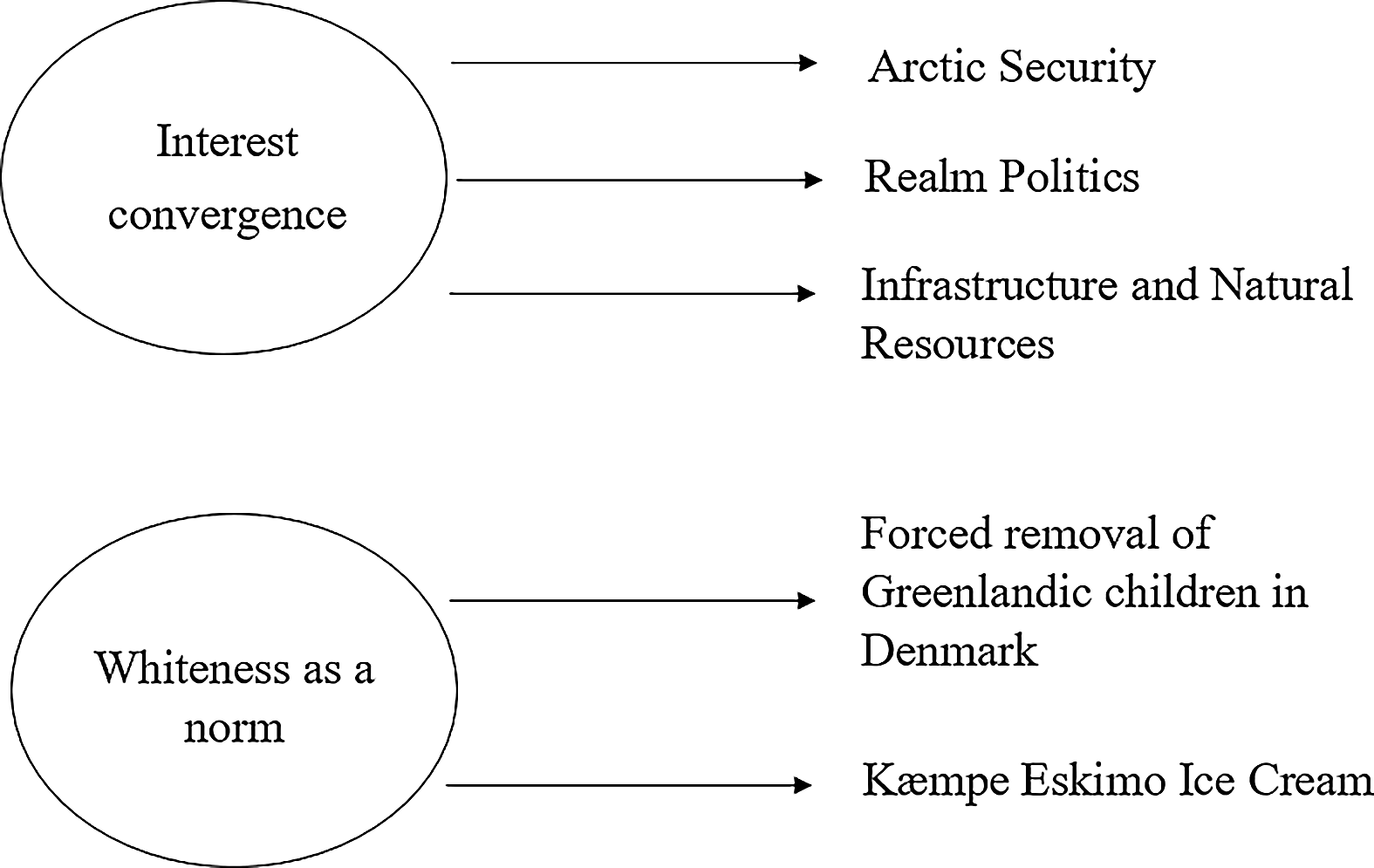
The full sample of 112 articles was split into 56 for each of both categories and principles. Articles were selected using keyword searches and were saved in plain text (.txt) format and uploaded into the software NVivo for ordering and then to MS Excel for analysis. This thematic classification was developed using a keyword-based, multi-label approach. As depicted in figure 2, the analysis began with a careful curation of theme-specific keywords, drawing directly from the research question concerning Danish newspapers’ framings of Greenland in terms of “Arctic security,” “Realm Politics,” and “Infrastructure and Natural resources.” These themes are associated with the concept of interest convergence and were defined by a targeted lexicon of relevant search terms in the Danish language (e.g., “Grønlænder,” “selvstændighed,” “Rigsfællesskabet,” “dansk støtte.” “Grønland, arktisk sikkerhed, infrastruktur, lufthavn, minedrift”), informed both by prior academic literature and empirical patterns in the Danish media corpus. A similar procedure was applied for the themes associated with the concept of whiteness as a norm. The coding scheme was constructed through a deductive perspective with two of the CRT principles. Codes were applied at the sentence or phrase level and allowed for multi-tagging of discursive segments. Texts were saved in .txt format and uploaded into the software NVivo for annotation.
CRT principles and associated themes regarding Greenland by Danish media, 2017–2024.

This approach follows Grimmer and Stewart (Reference Grimmer and Stewart2013), who argue that open-ended human coding supplemented by quantitative content indicators can yield transparent, reliable classifications. The method also follows the example of Roberts et al. (Reference Roberts, Stewart, Tingley, Lucas, Leder-Luis, Gadarian, Albertson and Rand2014), who emphasize the role of structured priors and interpretability in topic modeling for social science inference. By combining frequency-based thresholds with carefully constructed search keyword sets, this method ensures that thematic assignments are both empirically grounded and theoretically meaningful.
In order to reveal these themes more intuitively, two word clouds were generated to check the proportion of the word frequencies. As shown in Figure 3 (a) and (b), frequently occurring words are displayed in larger font sizes, while less common words appear smaller. Figure 3 (a) aside of the expected Danish words of “Greenland (grønland)” and “Denmark (danmark),” it depicts that the words in Danish for “usa,” “arctic (artisk),” “american (amerikanske),” “chinese (kinesiske),” “realm (rigsfællesskabet),” and “airport (lufthavne)” stand out in the sample for interest convergence.
Word clouds for samples on “interest convergence” (a) and “whiteness as norm” (b). Note: Both (a) and (b) samples contain 56 media articles each. To give a more detailed quantitative overview of the word clouds, two horizontal bar charts were created, which depict the total frequencies for each word cloud. Still, for visual purposes, a word cutoff was set at 75 frequencies for the interest convergence bar chart, while for the other, the frequency cutoff was set at 50. See appendix 1 for a more detailed overview of frequencies.

As for the sample of whiteness as norm, Figure 3 (b) depicts aside from the expected words (grønland and danmark), the words “child (børn),” “eskimo,” “danish (danske)” are high frequencies associated with the thematic classification of articles about the forced removal of Greenlandic children and the controversy of the ice cream Kæmpe Eskimo.
Criteria for Sentiment Analysis
Following the method for the initial content analysis, which allowed for the identification of recurring themes and narrative patterns, a further step was necessary to capture the tone and implications included within the newspapers’ coverage. While content analysis offers a structural overview of what is being said, it often falls short in revealing how it is being said and to what sociopolitical effect. To address this, a criterion was tailored to the concepts of CRT. This systematization of sentiment allows a more refined lens for interpreting the political and racial positioning of media texts, enabling us to classify articles not only by topic but also by their underlying attitudes toward Greenlandic self-determination.
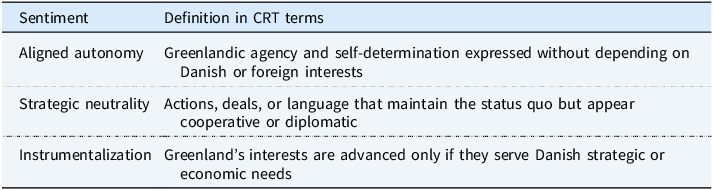
Table 1 presents a three-tiered sentiment framework designed to evaluate newspaper representations of Greenland through the concept of “interest convergence.” The sentiment categories “Aligned Autonomy,” “Strategic Neutrality,” and “Instrumentalization,” serve as interpretive tools for classifying each newspaper article’s portrayal of Greenlandic self-determination. An article was coded as Aligned Autonomy when it highlighted Greenland’s independent decision-making or agency without reference to Danish benefit. Strategic Neutrality captured representations that maintained existing power relations while using language of cooperation or diplomacy, thereby offering an impression of equity without challenging systemic asymmetries. Instrumentalization referred to portrayals where Greenland’s actions or aspirations were validated primarily because they served Danish political, strategic, or economic interests. Applying this typology enabled a clearer understanding of how Danish newspapers either supported or constrained Greenland’s autonomy in practice.
Sentiment analysis criteria for “interest convergence”

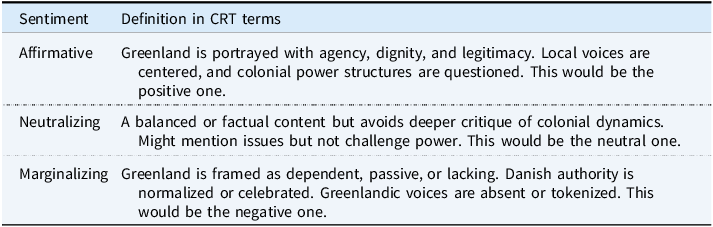
Table 2 complements the abovementioned framework by operationalizing the CRT notion of “Whiteness as norm” into a sentiment analysis. The three categories “Affirmative,” “Neutralizing,” and “Marginalizing” were used to assess how newspaper discourses positioned Greenlandic identity in relation to Danish cultural and racial hierarchies. An affirmative sentiment signified content that centered Greenlandic voices, recognized local legitimacy, and questioned the colonial legacy thereby constituting a positive and decolonial framing. Neutralizing articles, while often factual or balanced, avoided engaging with the deeper racial or power dynamics at play, thus occupying a middle ground. In contrast, marginalizing sentiment was assigned to coverage that erased, downplayed, or undermined Greenlandic agency, often presenting Danish authority as natural or superior. This framework allowed us to systematically interpret how whiteness operated as an implicit standard within newspaper representations and to map the ideological terrain that underpins narratives of national identity and governance.
Sentiment analysis criteria for “Whiteness as norm”

Analysis and Discussion: Interest Convergence and Whiteness as a Norm in Danish Press Discourse
The overall findings suggest that Danish newspapers, as central media institutions, play a significant role in advancing interest convergence and reproducing whiteness as a normative framework within the public discourse of Denmark and Greenland, as Figure 4 shows. However, important nuances emerge, as the extent to which these dynamics are given to readers varies across categories. The following section explores these differences in greater depth and considers their broader implications.
Empirical distribution of media framing categories.

Results on Interest Convergence
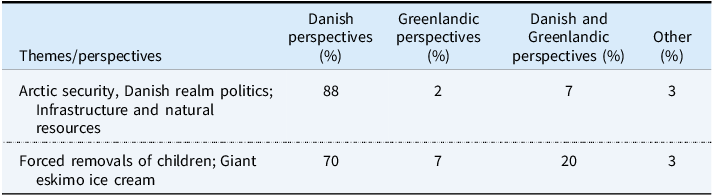
As indicated in Figure 4, a significant number (77%) of articles in the sample depicted a sentiment of instrumentalization, suggesting that Greenland was often framed not as an autonomous political actor but rather as a strategic asset in the context of Denmark and NATO’s Arctic policies. In relation to the set of themes on the three identified categories (Arctic security, Danish realm politics, and infrastructure and natural resources), the findings reveal a significant majority (88%) are newspaper articles published with only Danish opinions, while there is a marginal representation of Greenlandic voices (2%) as Table 3 shows.
Perspectives included as source content in the sample of Danish newspapers

Note: The column “Danish and Greenlandic perspectives” refers to percentages of articles where both a Danish and Greenlandic stakeholder or interviewee’ perspective was included in the same article.
The controversy surrounding infrastructure, particularly the airport development project, further illustrates the dynamics of interest convergence. Most articles indicated that Denmark agreed to co-finance the project only after it aligned with its broader strategic interests and in response to pressure from the United States.
An illustrative extract from the data demonstrating this category of interest convergence can be represented in a 2018 editorial (Collignon Reference Collignon2018, 4) in the newspaper Berlingske:
“For many years, Greenlandic politics has been driven by the resentment embedded in a postcolonial narrative. This has led to attempts to eliminate Danish from Greenlandic schools and public authorities, while politicians have put forward populist campaign promises that Greenland could soon become an independent country. The truth is that complete Greenlandic independence is not feasible. The Danish block grant of 3.8 billion kroner represents more than half of the Self-Government’s revenues this year. In addition, Danish ships, aircraft, helicopters, and dog sled patrols still defend Greenland against external threats.”
In this, Berlingske frames Greenland’s sovereignty as conditional upon the Danish block grant, rather than as an inherent political right grounded in self-determination. Greenland here appears less as a sovereign political community and more as a strategic asset whose political status is evaluated through its utility within Danish security structures. In other words, Greenland’s political future is seen through costs and security functions, not democratic will. That shift, from rights to utility, is the instrumental move that exemplifies the classic case of interest convergence, particularly instrumentalization.
The findings under the theme of interest convergence reveal a strong and consistent trend: Danish newspapers predominantly frame Greenland in terms that prioritize Denmark’s strategic interests. The high percentages (e.g., 77% instrumentalization) suggest that Greenland is positioned as an instrument in relation to Danish or Western interests, with limited space given to Greenlandic agency or visions of autonomous governance. This is a clear case of interest convergence, where support or coverage of Greenland only appears when it aligns with Denmark’s geopolitical or economic goals. This also reflects a predictable power asymmetry, where Greenland’s value is primarily seen through the lens of its utility to Denmark. The newspapers reinforce this by sidelining Greenlandic perspectives and framing Greenland as a passive object of concern.
Results on Whiteness as Norm
With respect to the themes related to whiteness as a norm and the associated issues of the forced removal of Greenlandic children and the ice cream name controversy, only 16% of the articles have an affirmative tone, which means referring to Greenland with agency and legitimacy on these themes. More than a third of the articles (36%) were categorized as adopting a neutralizing tone, meaning presenting the issues in a seemingly objective or depoliticized manner. Similarly, 36% of the articles had a marginalizing tone. The results appear to be more evenly distributed and without a clear tendency.Footnote 8 However, as Table 3 shows, 70% of these articles primarily featured Danish perspectives. On the theme of forced removal of children, in the few cases where Greenlandic individuals were interviewed, they were most often depicted as parents who had lost custody, frequently accompanied by references to alcohol misuse or criminal records, narratives that risk reinforcing negative stereotypes.
The finding of a more even distribution and without a clear tendency in these issues might suggest that the newspapers treated these issues (particularly the forced removal of children) as a serious and sensitive social concern. Rather than employing a clickbait approach, many outlets appeared to adopt a cautious tone, perhaps to avoid inflaming public debate around such a contentious and emotionally charged subject.
Within the apparent neutrality in the media in regard to this issue, whiteness as a norm can still be identified in the sample of newspaper articles analyzed. For instance, the newspaper article “Mangelfuld tolkebistand gør grønlandske forældre magtesløse i anbringelsessager” by Thomas Kellermann Hansen and Trine Marie Vestergaard (Hansen and Vestergaard Reference Hansen and Vestergaard2021, 2) in Kristeligt Dagblad, illustrates this framing in the context of reporting the removal of 16 children from Greenlandic families and their placement within the Danish child protection system.
“It is not certain that interpretation was necessary in the remaining 10 cases. Nevertheless, Vejle Municipality of course cannot guarantee that the parents of the 16 children understood the basis for the placements. We strive to ensure that parents understand it. But we can never guarantee that nothing is misunderstood in communication with the citizen, says Birgit Bech, head of the Family and Disability Department in Vejle Municipality, emphasizing that she cannot comment on specific cases.”
The excerpt exemplifies whiteness as a norm because Danish linguistic competence is treated as the default administrative standard, and comprehension by non-Danish-speaking Greenlandic parents is not guaranteed but merely “strived for,” revealing that institutional design is used around the dominant culture rather than equally accommodating Indigenous language rights. It appears as though the municipality administrator is effectively dismissing the ten remaining children, implying that their exclusion is acceptable on the grounds that at least six were successfully assisted. Yet it reveals how Danish is treated as the default baseline against which understanding is measured, rather than something the institution must actively accommodate. One might argue that this reflects Danishness rather than whiteness as the norm. However, whiteness here does not refer to skin color but to the historically dominant colonial position that defines what counts as normal and legitimate. In Greenland, Danishness occupied precisely that position: Danish language and standards structured law and governance. When Danish remains the unquestioned baseline in child removal proceedings, Danishness continues to function as the governing norm. In that structural sense, Danishness operates as whiteness.
The other theme tied to whiteness as a norm emerged in the public debate over the branding of the Danish ice cream Kæmpe Eskimo. Various news outlets covered the controversy, with 46% of the articles categorized as marginalizing in tone. The majority of coverage defended the name as a benign tradition or a symbol of Danish national identity, while only a few articles critically addressed the term’s colonial and racialized connotations. Moreover, only a small number of articles included any meaningful engagement with Greenlandic perspectives or acknowledged how the term is experienced by Indigenous communities.
In this context, Danish newspapers have often framed Greenlandic objections as excessive or as a threat to cultural heritage. The defence of the term, despite its harmful associations, reflects whiteness as cultural entitlement, the power to define meaning, assert tradition, and dismiss the discomfort of racialized others. Here, whiteness operates not only as a normative framework but also as symbolic property, the presumed right to name, label, and reject critique when that naming is contested by those it affects.
Another example of how whiteness as a norm is framed as the norm subtly and implicitly can be found in one of Denmark’s major newspapers, Politiken. The following excerpt comes from a typical Saturday morning edition in June 2020. In it, a journalist discusses the Kæmpe Eskimo controversy in Greenland surrounding the statue of the missionary Hans Egede in Nuuk and examines how the Black Lives Matter movement in the United States influenced debates about colonialism in Greenland. The article adopts an informative yet distinctly ironic tone:
“Already at the beginning of the week, it was Hans’ turn. That is, the aforementioned Hans Egede, who travelled around Greenland in the 1720s looking for Vikings, but never found any. Instead, he decided to colonize the country and, according to Politiken Historie, requested that “an appropriate number of missionaries” be made available, “so that the savages could be kept under control and discipline.
Here, 300 years later, one must probably conclude that this part of the project has failed.
In any case, some of the descendants of the savages have sprayed Hans Egede’s statue in Nuuk with red paint and the slogan “DECOLONIZE!” (Rasmussen Reference Rasmussen2020, 22).
The problem is that the journalist repeats the colonial term “savages” when referring to present-day Greenlanders. Even if meant ironically, the word carries the old hierarchy in which Danes were seen as civilized rulers and Greenlanders as people who needed control. That label originally justified Danish authority over Greenland and supported the claim that Europeans had the right to govern. By using the term again even rhetorically and ironically, the article keeps that colonial power structure alive in language, treating historical Danish authority as normal and Greenlandic protest as a disturbance rather than a legitimate political act.
In general, these findings reveal a contrast in how Danish newspapers frame Greenland depending on the lens through which the issue is viewed. Under the framework of interest convergence, the results are relatively consistent and unambiguous. Yet, in contrast, the results under the theme of whiteness as a norm are more mixed. Coverage of issues like the removal of Greenlandic children from Danish families tends to adopt a more neutralizing tone, avoiding overt marginalization but also failing to engage critically with the colonial and racialized structures underpinning the issue. Meanwhile, coverage of cultural debates, such as the Kæmpe Eskimo controversy, leans more toward marginalizing tones, often framing Greenlandic objections as exaggerated or unjustified.
These findings of mixed patterns suggest that whiteness as a normative framework operates in more subtle and variable ways than interest convergence. While interest convergence reveals clear structural patterns in how newspapers align with national interests, whiteness as norm appears more context-dependent: in some cases, it hides behind neutrality or objectivity (e.g., in social policy debates), while in others, it asserts itself more explicitly through cultural entitlement and symbolic exclusion (e.g., in debates over language and identity).
Conclusions
This article has examined how Danish newspapers’ representations of Greenland contribute to the reproduction of structural inequalities and the marginalization of Greenlandic perspectives through the analytical lens of CRT. The analysis shows that despite Greenland’s formal autonomy and the ongoing process of self-determination, deep-rooted colonial legacies continue to shape contemporary relations between Denmark and Greenland, particularly in the discursive sphere that exists in Danish media.
Following this, interest convergence and whiteness as a norm provide valuable insights into how Danish newspapers’ framing operates. The findings indicate that Greenland is frequently portrayed as a strategic asset within Danish and NATO geopolitical interests, especially in relation to Arctic security, resource extraction, and infrastructure development. This framing reinforces a logic of instrumentalization, where Greenlandic autonomy is acknowledged primarily when it aligns with broader Danish or Western priorities. The absence of Greenlandic voices in most Danish newspaper articles highlights the asymmetrical power dynamics that sustain this narrative.
The framing of Greenland often reinforces existing power asymmetries by portraying the island as strategically important to Denmark while downplaying Greenlandic agency. Even when addressing social or cultural issues, the newspapers often adopt a neutral or marginalizing tone that normalizes Danish norms and perspectives. As a result, newspaper narratives contribute to sustaining colonial legacies by presenting Danish interests as central and framing Greenlandic self-determination as secondary or conditional.
Issues linked to whiteness as a norm, such as the forced removal of Greenlandic children and debates over infamous symbols like the Kæmpe Eskimo, reveal a more complex discursive pattern. While some coverage adopted a neutralizing tone objective yet lacking historical or structural context, other reports openly marginalize Greenlandic viewpoints. This show how whiteness operates both subtly and explicitly: as a standard against which Inuit culture is measured and as a symbolic property that grants the power to define legitimacy, normalcy, and belonging. Such framings normalize unequal relations and obscure the ongoing colonial dynamics that persist beneath the surface of formal autonomy.
The finding in this study highlights the importance of critically interrogating media discourse in postcolonial contexts. It reveals that the struggle for Greenlandic self-determination unfolds not only in legislative assemblies or international forums but also in the narratives that shape public understanding through the stories told, voices heard, and norms left unquestioned. As Greenland continues to negotiate its political future, addressing these structural inequalities will be essential for realizing a more equitable and genuinely decolonized relationship with Denmark.
It is important to clarify that this analysis is not simply another postcolonial study focused on the historical legacy of colonialism. Rather, using the CRT framework shifts the emphasis to how racial hierarchies are actively reproduced in the present through institutions such as the media, particularly Danish newspapers. In contrast, traditional postcolonial approaches tend to focus more on historical structures and their legacies than on the ongoing institutional reproduction of racial inequality. A meaningful path forward requires acknowledging and actively dismantling these systemic barriers, ensuring that reforms in education, labor, and gender equality genuinely serve all Greenlanders, rather than continuing normalize and reinforce existing hierarchies.
This is not to imply that CRT and understanding framing alone can resolve these deeply rooted issues or that this study provides a complete solution. Tackling these issues will require multifaceted efforts to dismantle the systemic discrimination, which continues to disadvantage Greenlanders in their own land.
At the same time, this does not mean that Greenlanders are silent or unaware of how Greenlandic social issues are framed. On the contrary, there are strong counter-discourses emerging within the arts and cultural sphere. Acclaimed novelist Niviaq Korneliussen, musician Josef Tarrak, and visual artist Julie Edel Hardenberg, among many others, actively challenge dominant narratives. Their work offers alternative perspectives that question and resist prevailing representations.Footnote 9
Supplementary material
The supplementary material for this article can be found at https://doi.org/10.1017/rep.2026.10095.
Acknowledgments
I would like to thank the anonymous reviewers for their valuable feedback, as well as the editor of this journal. I am also grateful for my research stay at the University of California, Santa Barbara, and for Professor Andrew Jolivette’s guidance and support. I would like to thank my colleagues at Ilisimatusarfik—the University of Greenland—for their valuable comments and constructive suggestions.
Funding statement
I gratefully acknowledge funding support from the Greenland Research Council.
Competing interests
None.
Declaration of AI
After the preparation of this work, the author reviewed and edited some of the content through AI (ChatGPT). I confirm that there was no use of generative AI. A round of minor proofreading was used in very few passages of the text. The author takes full responsibility for the content, as it has not replaced in any way the author’s intellectual contribution, critical thinking, and originality of this work.





 Open access

