


10.1 Introduction
Can Hans Kelsen (1881–1973) help us understand present-day autocratic threats to US democracy? In this chapter, I argue that a neglected anti-Kelsenian moment has been decisive among an influential group of right-wing intellectuals who have not only enthusiastically supported Donald Trump but also actively embraced his authoritarianism. Although Trump and his presidency garnered little support among intellectuals, followers of the conservative German-Jewish émigré political philosopher Leo Strauss (1899–1973) affiliated with the Claremont Institute (at California’s Claremont McKenna College) constituted a striking exception to intellectuals’ broadly anti-Trump mood. Strauss’ ‘west coast’ or self-described ‘Claremonster’ followers quickly ‘appreciated and gave intellectual legitimacy’ when they openly advocated ‘the populist revolt against the politically correct contempt of the ruling class’, a revolt that they supported by embracing Trump’s cause.Footnote 1 They thus reconfigured the Institute’s main publications, The Claremont Review of Books and The American Mind, into pro-Trump ideological vehicles, performed key official and semiofficial functions for Trump in Washington, DC, and played a significant role in both seeking to overturn the November 2020 presidential election results and justifying the violent January 6th attack on the US Capitol.Footnote 2 Most shockingly, jurist and Claremont affiliate John Eastman worked energetically with Trump adviser Rudy Giuliani to halt Congress’ tallying of electoral college votes, drafting a memo to then Vice President Michael Pence explaining how he might effectively accomplish this.Footnote 3
The pivotal role of the so-called west coast Straussians at Claremont in enabling Trump has been evaluated by astute political commentators.Footnote 4 For serious observers (including many principled conservatives), there is no question that they actively abetted Trump’s worst authoritarian proclivities.Footnote 5
Nonetheless, the claim that the west-coast Straussians are motivated by a subterranean anti-Kelsenian movement, given Kelsen’s marginal status within recent US political thinking, will likely strike many and perhaps most readers as counterintuitive. Claremont Straussians who trained academically as political theorists or jurists are certainly familiar with Kelsen’s name. However, there is no evidence that they are versed in his ideas. Nevertheless, their intellectual guru was not only knowledgeable about Kelsen and his theory but also systematically engaged with it. As I hope to demonstrate, Strauss’s influential postwar defence of natural law directly attacked Hans Kelsen, perhaps its most incisive twentieth-century critic. Hence, Strauss’ west coast followers have implicitly built upon this anti-Kelsenian launching pad as part of their embrace of a hyper-presidentialist, basically autocratic makeover of US democracy. Strauss’ most influential study, Natural Right and History (1953), can and should be read, in part, as a critical response to Kelsen’s powerful critique of natural law.Footnote 6 As Elisabeth Lefort has correctly observed, ‘Kelsen rejects natural law and endorses moral relativism’, whereas Natural Right emphatically ‘calls for a rediscovery of natural right and rejects moral relativism’.Footnote 7 Strauss not only responded critically to Kelsen but, in effect, inverted his ideas by embracing natural law as a path beyond moral and political relativism, which Strauss forcefully rejected. That is, Kelsen’s intellectual and political polar opposite, Strauss, targeted him, one of twentieth-century political and legal thought’s most incisive critics of natural law. This anti-Kelsenian project is central to Natural Right, postwar American Straussianism’s Ur-text, and a key theoretical launching pad for Trump’s recent Straussian enthusiasts. West coast Straussians have therefore absorbed crucial facets of Strauss’s original rejoinder to Kelsen: the former’s more-or-less overt anti-Kelsenianism has morphed into their implicit or subterranean anti-Kelsenianism.
To validate this claim, this chapter not only revisits Strauss’ complicated dialogue with Kelsen but also highlights crucial moments in the arcane history of postwar American Straussianism. Is anything to be gained theoretically, and not just historically or politically, by our efforts? As I hope to demonstrate, Straussianism’s political programme tends to corroborate Kelsen’s worries that any attempt to revive natural law under contemporary conditions invites autocracy. It is no accident, in other words, that the revival of classical natural right has taken on increasingly authoritarian overtones, as vividly exemplified by the Claremonster love affair with Trump. In short, Strauss and his latest followers’ anti-Kelsenian project has failed in precisely some of the ways Kelsen predicted. In addition, although the following analysis focuses on the limited and perhaps unusual case of US democracy, it may provide broader lessons about present-day authoritarian populism.
10.2 Strauss and Hans Kelsen: A Neglected Dialogue
Strauss exploded onto the US intellectual scene with Natural Right and History (1953), a controversial critique of modern Western political philosophy and, by implication, modern politics that soon became essential reading for right-leaning political theorists.Footnote 8 Both Western political theory and practice had lost their bearings by rejecting natural right – the term Strauss preferred to the more familiar natural law – as expounded by Plato and Aristotle, Strauss’s intellectual heroes and, he posited, the West’s greatest sources of philosophical and political wisdom. In Strauss’ unabashedly nostalgic account, classical political philosophy relied on a teleological conception of nature as a source of universally valid moral distinctions. Classical natural right rested on eternal philosophical truths, with the idea of nature providing a sturdy basis for both morality and a sound, albeit undeniably hierarchical, political and social order. Most controversially, Natural Right insisted unambiguously on the superiority of ancient vis-à-vis modern thinkers. Even if many of the latter still spoke the language of natural right, they had robbed it of its normative merits. In Strauss’ creative but controversial re-readings of Niccolo Machiavelli, Thomas Hobbes, John Locke, Jean-Jacques Rousseau, and others, modern political philosophers divorced natural law ‘from the idea of man’s perfection’, replacing Greek antiquity’s admirable aspiration for a fully good order committed to the cultivation of virtue and pursuit of moral duties with individual rights and the modest quest for self-preservation.Footnote 9 The liberal Locke, for example, built on ‘“the low but solid ground” of selfishness or of certain “private vices”’.Footnote 10
Painting with a broad brush in Natural Right, Strauss traced how the rejection of classical natural right inevitably invited moral relativism. Bluntly, modern political thought had initiated a reduction in matters of right and wrong to arbitrary subjective preferences and thereby nihilism, or ‘the view that every preference, however evil, base, or insane’ is in principle ‘as legitimate as any other preference’.Footnote 11 Absent a self-conscious retrieval of the great lessons of classical Greek antiquity, such relativism and nihilism entailed that the political universe would unavoidably be ‘darkened by the shadow of Hitler’ and other tyrants.Footnote 12
Kelsen makes only a brief appearance in Natural Right. However, the volume represents, in key respects, a pointed rejoinder to Kelsen’s principled anti-natural law position. Most obviously, its central target, relativism qua nihilism, is immediately linked in its opening pages to Kelsen: he and other modern liberals allegedly view the ‘abandonment of natural right not only with placidity but with relief’.Footnote 13 Through this view, hostility to natural right has become commonplace among the social sciences, characteristically modern and congenitally flawed endeavours due to their bracketing of core moral questions and endorsement of the fact/value divide. By rejecting natural right and the possibility of absolute moral knowledge, Kelsen and other liberals no longer delineated those views or standpoints deserving toleration from those to which liberal democracy must offer protection: natural right’s decay means tolerating even those bent on destroying liberalism. Liberals, then, celebrate tolerance without recognising its unavoidable limits.Footnote 14 Accordingly, Kelsen’s theory potentially provides ‘advice with equal competence and alacrity to tyrants as well as free peoples’, a harsh accusation documented in Natural Right with a passage from Allgemeine Staatslehre (1925), whereby Kelsen repeats his legal positivist view that even authoritarian states potentially possess elements of legality or the Rechtsstaat.Footnote 15 This claim, as Kelsen consistently argued, could only be challenged by recourse to naïve and unsound views of natural law. To this argument Strauss acerbically retorts, ‘Since Kelsen has not changed his attitude toward natural law, I cannot imagine why he has omitted this instructive passage from the English translation’.Footnote 16 Kelsen, it seems, failed to admit the errors of his ways by openly expressing, in the aftermath of Nazi tyranny, his misbegotten hostility to natural law: allegedly, the latest English version (General Theory of Law and State [1945])Footnote 17 of his earlier work had disingenuously ‘omitted’ the suspect passage. Even worse, Kelsen’s ‘rejection of natural right leads to nihilism – nay it is identical with nihilism’.Footnote 18 Hence, without additional comment or elaboration, Natural Right infers that Kelsen’s relativism entails a fundamental negation of any possible moral knowledge.
In a brief remark in ‘Foundations of Democracy’, Kelsen directly addressed Strauss’ accusation. General Theory was no mere translation of his earlier 1925 work; his postwar US writings never aimed to elide his longstanding view that both democratic and autocratic states could take identifiably legal forms.Footnote 19 Without mentioning Strauss, ‘Foundations’ also reiterated Kelsen’s claim that his neo-Kantian philosophical standpoint simply entailed that ‘value judgments have only relative validity’ in the sense that they ‘do not refer to values immanent in an absolute reality’, a view that by no means required denying the possibility of principled moral commitments or moral knowledge. Instead, it necessitated discarding the anachronistic, metaphysical and typically religious idea of an absolute moral value or ‘thing in itself’.Footnote 20 Nature cannot be viewed as an immanent source of value: ‘is’ and ‘ought’ must be strictly separated. Moral and political inquiry, always and necessarily rooted in human experience and thus unavoidably fallible, does indeed rest on ‘objective’ normative laws; however, ‘these norms originate in the human mind’, not in a divine ‘thing in itself’ or absolute Good existing beyond or outside human cognition.Footnote 21 When properly conceived, a critical-relativistic understanding of morality and politics need not succumb to ‘the bottomless depth of subjectivism, into a boundless solipsism’.Footnote 22 Nevertheless, no individual or group can claim access to, let alone a monopoly over, privileged modes of a priori moral or political knowledge.
In short, Kelsen’s was an empirical-minded, fallibilistic, yet rational theory of value that, he always insisted, placed strict practical demands on us. That is, since it precludes passing the buck by allowing appeals to superhuman or transcendent ‘absolutes’, individuals need to take full responsibility for their moral and political choices. Kelsen conceived his relativism as the very opposite of irresponsible ‘nihilism’.Footnote 23 By challenging the widespread but flawed belief in a transcendent, intrinsically superior good, it rendered moral and political questions ‘earthly’ matters subject to contestation and debate between and among persons forced to justify their positions to their peers. Undercutting traditionalistic religious and metaphysical justifications, relativism thus compelled ‘a recognition of the normative value of freedom as a right not to be subjected to forms of coercive power one has not consented to’.Footnote 24 Without such a relativistic starting point, modern egalitarian ideas of liberalism and democracy made no sense.
Unfortunately, ‘Foundations of Democracy’ never directly responded to Strauss’ retrieval of natural law, although in a 1957 article Kelsen mentioned Natural Right alongside numerous other postwar efforts to revitalise Platonism, efforts Kelsen decidedly rejected, albeit without any specific references to Strauss’ rendition of this revival.Footnote 25 A generation older than Strauss, Kelsen was of an advanced age when Strauss’ Natural Right began to gain traction among conservatives. Perhaps understandably, Kelsen failed to anticipate the inordinately large role it would play in the broader post-World War II revival of natural law thinking, a revival he frequently discussed and criticised. In contrast, Kelsen was already a prominent intellectual figure when the young Strauss first struggled to enter the German intellectual scene during the final years of the Weimar Republic. Not surprisingly, then, Strauss lacked the luxury of ignoring the senior scholar’s work, evidenced most clearly in his illuminating but frequently neglected (1931) critical interrogation of Kelsen’s Die philosophischen Grundlagen der Naturrechtslehre und des Rectspositivismus (1928).Footnote 26 As the German scholar Peter Gostmann has correctly pointed out, Strauss’ planned (but only posthumously published) ‘Foreword’ (1931) to his subsequent Hobbes book effectively served as a launching pad for the fame and influence of Strauss’ Natural Right.Footnote 27 Crucially, this ‘Foreword’ concludes with a sketch of Natural Right’s general programmatic agenda and, as such, buttresses my claim that we can read Strauss’ influential postwar work as an expressly anti-Kelsenian intervention.
Specifically, Strauss’ proposed ‘Foreword’ initially pursues a line of argumentation familiar among many other natural law-oriented critics of Kelsen: despite his strict insistence on the ‘purity’ of legal positivism, Kelsen had smuggled controversial moral and normative assumptions into it. Contra Kelsen’s insistence on this pure theory’s political ‘indifference’, the young Strauss wondered whether ‘such a position [is] even possible?’Footnote 28 Based on what we might loosely describe as an immanent critique of Kelsen, Strauss answered in the negative. First, Kelsen’s reading of natural law as little more than an ‘ideological’ football in a political game between opposing interest groups neglected that not all such groups deserve to be treated equally: some groups advance interests that may be common or general in character, while others are indeed narrowly partisan and even selfish.Footnote 29 Lurking behind Kelsen’s sceptical, ideology-critical reading of natural law was a ‘crypto-Marxist’ suspicion of all ideologies, a position Strauss suggested amounted to a latent or concealed version of natural law, as certain natural right ideas had been ‘sublated’ within Marxism.Footnote 30 Second, he highlighted Kelsen’s view that legal positivism thrives in relatively peaceful times characterised by a ‘social balance’.Footnote 31 For Strauss, this represented not only an implicit commitment to peace as a value or standard but also a controversial normative denial of the ‘entire dangerousness’ of humankind, something he lauded Hobbes, in contrast to Kelsen, for appreciating.Footnote 32 Hence, positivism also rests on decidedly more contentious presuppositions than Kelsen had conceded. Third, language itself ‘is a powerful ally of natural right’, as evidenced in how jurists inevitably rely on a notion of ‘right’ that contains moral and ethical but by no means exclusively legal connotations.Footnote 33 Kelsen’s legal positivism, it seems, could not even do justice to law’s ordinary, irrepressibly moral language.
For our purposes, the most interesting part of Strauss’ response is embedded in the ‘Foreword’s’ final pages, where he concedes that immanent ‘[c]onsiderations of the preceding kind have very limited value’ since they merely demonstrate that natural law’s critics rely on some of its residual elements. Kelsen and other ‘opponents of natural right claim to be able to show, with compelling reasons, that natural right is itself impossible. We must therefore reexamine whether the alleged reasons of the opponents … are valid’.Footnote 34 In particular, what irritated Strauss was the accusation that natural right was necessarily ‘empty’ and/or fundamentally open-ended, whereby it had taken a vast array of competing and ultimately contradictory historical forms. Precisely this criticism had been levelled against natural law thinking by Kelsen: while highlighting its basically conservative contours, he simultaneously described natural law theories as embodying ‘the most contradictory principles of justice’.Footnote 35 In response, Strauss noted that the existence of an ‘anarchy within the doctrine of natural right’ seems initially indisputable.Footnote 36 In other words, ‘Hobbes opposes Grotius, Rousseau opposes Hobbes, etc. : but are the reasons cogent?’ Unswayed by Kelsen’s anti-natural law position, Strauss added, ‘The reasons with which the various natural right teachers oppose each other must be examined. Prior to this examination, it cannot be simply said whether in the end one of the natural right teachings feuded against by all the other philosophers is not the right teaching’. The seeming indeterminacy of natural law hardly excluded the possibility that one or more of its versions might prove philosophically defensible. Rather than dogmatically excluding such a prospect on the basis of Kelsen’s flawed positivist assumptions, a wide range of rival natural right doctrines should thus instead be sympathetically re-examined and reconsidered: ‘From the fact that agreement of opinion has not so far been obtained in the natural right teaching, nothing follows against the possibility of natural right’.Footnote 37
In a November 1931 letter to Gerhard Krüger describing the ‘Foreword’, Strauss was even more forthright concerning his own proposed project’s contours: against a crude ‘historical consciousness’ – which Natural Right would subsequently pillory as ‘historicism’ – Strauss proposed regaining ‘the ancient freedom of philosophy’ [die antike Freiheit des Philosophierens] to combat contemporary prejudices.Footnote 38 In opposition to those who depreciated natural law’s cognitive claims by focusing on their ideological and historically specific traits, he aimed instead to take them seriously.
Precisely this task became the centrepiece of Natural Right, where Strauss offered a sustained historical survey of competing natural right philosophies, motivated in part by the seemingly naïve premise that ‘a detached, theoretical, impartial discussion’ might successfully demonstrate not only the necessity but also the viability of certain versions of natural law.Footnote 39 Only a series of ‘historical studies’ could allow us properly to ‘familiarise ourselves with the whole complexity of the issue’, something Kelsen and other natural law critics had apparently failed to accomplish.Footnote 40 Although chronological and thus at first glance historical, such studies would nonetheless embody the ‘ancient freedom of philosophy’. By doing so, Strauss aimed to counter reductionist ‘historicist’ readings that had reduced rival natural law views to competing, time-bound ideologies rather than rigorous philosophical systems meriting careful consideration.
When directly viewed against its anti-Kelsenian backdrop, some of the more striking – and unusual – features of Strauss’ alternative gloss on natural law stand out. To be sure, both authors consistently highlighted natural law’s teleological contours and how it ‘satisfies a deeply rooted need of the human mind, the need for justification’.Footnote 41 However, while Kelsen viewed Plato as a ‘classical representative’ of natural law’s most intellectually troublesome and authoritarian variants, Strauss tried to salvage Plato and other so-called classical natural right figures (e.g., Aristotle) whom he perceived to follow in Plato’s footsteps.Footnote 42 For Kelsen, however, Platonic natural law anticipated ‘the ideology of every autocracy’.Footnote 43 Plato’s view of the highest good as ‘beyond all rational or scientific knowledge’ and ultimately accessible only to an intellectual elite via a mystical ‘illumination which occurs in a moment of ecstasy’ spoke volumes about its autocratic features.Footnote 44 In stark contrast, Strauss considered Plato’s revival the best way to safeguard against modern-day nihilism and tyranny.Footnote 45
Moreover, Kelsen interpreted natural law, in contrast to dynamic positive law, as unchanging and immutable.Footnote 46 Interestingly, Strauss’ discussion of Aristotle instead emphasised its mutable and changeable features: one of Aristotle’s key innovations was upholding the idea of eternal natural right while admitting ‘the mutability of all rules of justice’.Footnote 47 For Kelsen, natural law rested, by necessity, on metaphysical and typically religious ideas. With absolute value interpreted to be inherent in nature, natural law was always parasitical on some belief, more or less expressed, in the ‘superhuman … divine, the absolute reason’Footnote 48 Natural Right also directly challenged this claim: natural right’s origins in classical antiquity could instead be traced to doubts and critical questions regarding divinely revealed law.Footnote 49 Knowledge of natural right could thus only be acquired by autonomous human efforts and reason, unassisted by divinity.Footnote 50 Certainly, once natural right was discovered, it could easily ‘be adjusted to the belief in the existence of divinely revealed law’.Footnote 51 However, the marriage of natural law and divinity was historically contingent rather than, as Kelsen suggested, probably necessary.
This last point is pivotal if we are to unpack Strauss’ critical response to Kelsen. For Kelsen, natural law not only depends on metaphysical and religious premises but also thereby invites philosophical absolutism with autocratic connotations. Positing the existence of (usually divine) values, inhering in nature and claiming absolute validity, natural law appeals to a transcendent realm beyond human experience. Its norms are ‘ideally independent of human action and volition’.Footnote 52 Natural law doctrines, then, depend on ‘the metaphysical view that there is an absolute reality, that is, a reality that exists independently of human knowledge’.Footnote 53 In such a view, the object of cognition is independent of the subject of cognition, ‘totally determined in his [sic] cognition by heteronomous law’.Footnote 54 Similarly, political absolutism implies the existence of government power beyond the influence of its subjects, i.e., laws are heteronomously determined by a leader ‘imagined as an authority that stands outside the community’.Footnote 55 Both philosophical and political absolutism degrade human autonomy by viewing human beings as subject to laws over which they have no control.
According to Kelsen, the parallels between philosophical and political absolutism have far-reaching, real-life consequences. By devalorising human cognition and experience, philosophical absolutism undermines any possibility of a principled commitment to human equality. The belief in the intrinsic superiority of some transcendent, absolute good removes moral and political deliberation from the ‘earthly’ realm of real-life existence where individuals must justify their choices to one another. Philosophical absolutism therefore opens the door to authoritarianism, whereby those believing themselves outfitted with privileged wisdom assert their right to rule over those allegedly lacking such wisdom. According to Kelsen,
what else could there be in the face of the towering authority of the absolute Good, but the obedience of those for whom it is their salvation? There could only be unconditional and grateful obedience to the one who possesses – i.e., knows and wills this absolute Good. This obedience … can only rest on the belief that [some] authoritative figure … possesses the absolute Good insofar as the great multitude of subjects is denied the same knowledge.Footnote 56
In contrast to Kelsen’s relativism, philosophical absolutism posits a ‘fundamental inequality in relation to the absolute and supreme being’, or, at the very least, to a monarch or dictator who claims the status of ‘divine hero’, necessarily standing above ‘the profane masses’.Footnote 57 To justify supreme power, rulers present themselves ‘directly or indirectly, as authorised by the only true absolute, the supreme superhuman being’, a tendency Kelsen deemed still prevalent in contemporary authoritarian and totalitarian regimes.Footnote 58 From this perspective, it was no historical accident that while natural law’s most outspoken defenders regularly embraced autocracy, those akin to Kelsen, who acknowledged the unintelligibility of an absolute ‘thing in itself’ and endorsed a postmetaphysical, relativistic account of value, favoured democracy.
By challenging natural right’s religious and perhaps metaphysical credentials, Strauss may have thought he could circumvent the dangers of philosophical absolutism that Kelsen had diagnosed. Might natural right be salvaged, in other words, without paving the way for authoritarianism? Could we revitalise classical natural right without the rule of Platonic philosopher kings or, more generally, more familiar autocrats via appeals to absolute moral truth? The opening pages of Natural Right, where Strauss evokes the Declaration of Independence and its appeals to the ‘self-evident’ rights to life, liberty, and happiness, suggest that he thought it might be possible to do so.Footnote 59 Indeed, he at least seems to infer that US democracy might have some, albeit perhaps limited, relation to the old idea of natural right as eternal or absolute moral reality.
As I attempt to show in the following section in this chapter, however, Strauss and his followers ultimately failed in this endeavour. Despite his anti-Kelsenian orientation, Strauss – and even more unequivocally, his more recent west coast US – succumbed to precisely the authoritarian perils that Kelsen predicted. Like oil and water, modern democracy and classical natural right, interpreted as hierarchical and anti-egalitarian, do not mix.
10.3 Leo Strauss: Making America Great Again?
Natural Right’s brief reference to the Declaration of Independence notwithstanding, its readers will search in vain for a satisfactory defence of modern political egalitarianism, let alone modern democracy. According to Strauss’ decidedly backwards-looking exercise in historical and philosophical retrieval, ‘[i]t is the hierarchic order of man’s natural constitution which supplies the basis for natural right as the classics understood it’ – that is, Plato and other classical authors ‘were not egalitarians’.Footnote 60 Predictably, Strauss was deeply critical of the authors (e.g., Locke, Rousseau) usually associated with the rise of modern ideas of equality, liberalism, and democracy. Nor did he have much if anything positive to say about other pertinent modern figures (e.g., Immanuel Kant, John Stuart Mill, or John Dewey).Footnote 61 To be sure, Natural Right openly acknowledged that classical natural right ‘would act as a dynamite for civil society’.Footnote 62 In other words, it was both irresponsible and unrealistic to try to realise Plato’s model of wise philosophical rulership in contemporary conditions. Some element of consent and the rule, not of a wise philosopher but a mixed, law-governed regime in which ‘gentlemen’ or ‘well-bred’ men ‘of not too great inherited wealth’ dominate, probably represented classical natural right’s best achievable version.Footnote 63
Nonetheless, it remains difficult to conceive how even some modest, real-life approximation of classical natural right, to the extent that its anti-egalitarian core could remain intact, could ever provide much of a basis for justifying modern democracy. Indeed, one can easily imagine Kelsen rightly noting that Strauss’ distinction between esoteric and exoteric knowledge betrays his neo-Platonic and decidedly anti-egalitarian, autocratic outlook. According to Strauss, because philosophy or science ‘must remain the preserve of a small minority’, its practitioners
are driven to employ a peculiar matter of writing which would enable them to reveal what they regard as the truth to the few … They will distinguish between the true teaching as the esoteric teaching and the socially useful teaching as the exoteric teaching; whereas the exoteric teaching is meant to be accessible to every reader, the esoteric teaching discloses itself only to very careful and well-trained readers after long and concentrated study.Footnote 64
Hence, true knowledge of ‘natural right’ – and thus absolute moral and political wisdom – is only available, as Plato originally argued, to ‘true’ philosophers who have undergone long and rigorous training. Even in Strauss’ somewhat watered-down Platonism, we find precisely this tendency to degrade the ‘great multitude’ vis-à-vis some version of the (supposedly) wise elite with privileged access to the ‘absolute’ that so worried Kelsen.Footnote 65 As Kelsen had forewarned, such backwards-looking, traditionalistic ideas about natural law debilitate rather than ground modern liberalism and democracy.
Not surprisingly, many of Strauss’ postwar American disciples rapidly devoted their intellectual energy to delineating the ways in which his ideas might nonetheless provide some grounding to modern liberal democracy.Footnote 66 This task preoccupied the Straussians in part because it was akin to squaring the circle; classical antiquity’s version of natural law and modern political egalitarianism seemed irreconcilable. Moreover, as political conservatives eager to defend not only the United States but also a hard-line anti-communist foreign policy, it was imperative for them to enlist Strauss in their cause. However, Strauss’s reactionary classicism and rejection of the core features of political modernity impeded any principled defence of postwar liberal democracy. Furthermore, few, if any, of the postwar Straussians seem to have been versed in the intricacies of Kelsen’s theory. Nevertheless, we can interpret their efforts, in part, as implicit or subterranean attempts to respond to Kelsen’s principled critique of natural law and his concerns with its autocratic implications. That is, Kelsen always remained an unidentified target of their efforts.
In fairness, some textual evidence suggests that Strauss struggled to identify grounds for any pragmatic or perhaps ‘qualified embrace’ of liberal democracy.Footnote 67 On various occasions, he suggested, as in his remarks on the Declaration of Independence, that elements of classical natural right had survived, at least in Anglophone liberal democracies. In a 1941 lecture on ‘German Nihilism’ given at the New School for Social Research, he commented positively on England’s ‘very un-German prudence and moderation’.Footnote 68 Strauss had spent his early years as a refugee from Nazism in England, and its political culture had apparently impressed him.Footnote 69 Interestingly, Natural Right’s sympathetic discussion of the iconic British conservative Edmund Burke idiosyncratically claims that his critique of the French Revolution rested partly on elements of classical natural right.Footnote 70 Elsewhere, Strauss observed how the framers of the US Constitution spoke not just a modern liberal but also republican political language with ancient roots: ‘Let us also remember that the authors of The Federalist Papers signed themselves “Publius”: republicanism points back to classical republicanism and therefore also to classical antiquity’.Footnote 71 The American Republic was, of course, preferable to communism and fascism: ‘liberal democracy, in contradistinction to communism and fascism, derives powerful support from a way of thinking which cannot be called modern at all: the premodern thought of our western tradition’.Footnote 72 At any rate, liberal democratic regimes, despite their permissive egalitarianism, relativistic and even nihilistic tendencies, and ubiquitous conformism, had provided safe spaces for those devoted to the pursuit of moral excellence and classical philosophical education.Footnote 73
However, the fact remains that Strauss never systematically linked the defence of classical natural right to a sustained justification of modern democracy in general or US liberal democracy in particular. To the extent that he fused the resuscitation of natural law with an appreciation for some features of postwar America, this fusion was always messy and would probably be unstable.
Precisely this liberal and democratic Achilles’ heel has played a major role in the debates between so-called east coast and west coast Straussians. The US Straussian geographical divide has complex biographical, intellectual, and political features; I lack sufficient space to explore them here.Footnote 74 However, this divide remains crucial to our story for the simple reason that many west coast (i.e., mostly Claremont-based and/or trained) but few east coast (based at Harvard, Yale, etc.) Straussians have joined the Trumpist bandwagon. Significantly, Strauss’s more orthodox east coast followers often reproduce his qualified, rather cautious endorsement of liberal democracy generally and the United States specifically. They emphasise America’s Lockean genealogy, for example, and follow Strauss in claiming that its origins in decadent modern natural right have ultimately invited relativism and nihilism.Footnote 75 Such ambivalence has probably helped immunise them against Trump’s extreme ‘America First’ jingoism. In contrast, west coast Straussians, such as the late Harry V. Jaffa, their most influential figure, have rejected such ambivalence, instead devoting their efforts to reinterpreting the US as the world’s very ‘best regime’.Footnote 76 Hence, they have amplified Strauss’ remarks pointing, albeit incompletely and inconclusively, in the direction of a more positive gloss on US liberal democracy.
How Jaffa and his many Claremont offspring have creatively tapped Strauss to ground this flattering portrayal of the United States has been extensively examined.Footnote 77 Committed to hard right US political views, Jaffa and others remained unsatisfied with Strauss’ own less-than-enthusiastic defence of the USA: they needed to go further. As Catherine and Michael Zuckert have demonstrated, the centrepiece of the resulting west coast Straussian project involves ‘Aristotelianising America’, that is, creatively rediscovering elements of classical natural right within the US political tradition and, specifically, its founding conjuncture.Footnote 78 From this perspective, the US framers and some later iconic political figures (e.g., Abraham Lincoln) were not just Lockean liberals or products of a decadent modernity. Rather, they had tapped classical antiquity and Aristotle, or at least Aristotle interpreted along anti-egalitarian lines and as Plato’s pupil.Footnote 79 Additionally, while the Declaration of Independence remains the revolutionary period’s greatest theoretical statement, it should be read – far more straightforwardly than Strauss ever inferred – as a still perhaps unrivalled attempt to salvage classical natural right.
This theoretical shift tilled the soil for the recent Claremont embrace of Trump’s extreme nationalism. In a prescient 1985 critique in the conservative National Review, east coast (and then Toronto-based) Straussian Thomas Pangle warned that the west coast revision of Strauss’ legacy risked culminating in a ‘new mythic Americanism’: its celebratory gloss on America’s founding invited a blind patriotism that denigrated those with competing views as ‘un-American’.Footnote 80 Thus, fulfilling this prediction, many west coast Straussians immediately closed ranks around Trump’s jingoism. A revealing 2019 Trump speech given at a White House ceremony rewarding the Claremont Institute with the prestigious National Humanities Medal aptly captures this superpatriotic ideological overlap:
As one of America’s leading think tanks, the Claremont Institute has made invaluable contributions to the history of American conservative thought. Claremont educates, reminds, and informs Americans about the founding principles that have made our country the greatest nation anywhere on earth. Through publications, seminars, and scholarships, they fight to recover the American Idea – I know it well – by teaching about the Declaration of Independence, the Constitution, the writings of Abraham Lincoln (whose bedroom is right above us). The Claremont Institute helps preserve our national traditions for generations to come.Footnote 81
Nonetheless, this shared discourse of ‘American greatness’ only partially explains the west coast Straussian dalliance with Trump; it neglects the pivotal role of their astonishingly expansive – and basically autocratic – view of executive or presidential power. What Ken Kersch has astutely characterised as the idea of a redemptive ‘messianic presidency’ rooted in fundamental law and natural right has been pivotal in the Claremonsters’ Trumpist gambit.Footnote 82 Jaffa and his west coast allies may have ‘saved’ American democracy for the Straussians by reinterpreting it as based on elements of classical natural right, but only at the cost of unleashing its autocratic potential.
Concerning this matter, Kelsen also proves remarkably prescient. A principled defender of parliamentary government, he worried that presidential regimes amid a strict separation of powers where the executive is directly elected by the people heighten the ‘chances of an – even temporary – autocracy’ by inviting unaccountable political leaders who surround themselves with ‘the halo of divine origin or of magical powers’.Footnote 83 In a so-called presidential democracy, ‘[w]here there is only one elected individual for millions of voters, the idea of popular representation must lose every last pretense of legitimacy’, as a president enjoying complete independence from the legislature ‘cannot be [realistically] controlled by a populace too massive to take [effective] action’.Footnote 84 Kelsen thus questioned whether presidential regimes could flourish qua democracies or even deserved to be described as such: General Theory even went so far as to classify them as ‘autocracies’, grouping them alongside constitutional monarchies and modern party dictatorships.Footnote 85 In Essence and Value of Democracy, Kelsen noted that it was ‘a matter of historical irony when a republic such as the United States of America faithfully’ adopts a presidential system: given that the American presidency ‘is a conscious imitation of the position of king in England’, it not only conflicts with the core features of modern democracy but also invites irresponsible, pseudo-democratic leadership.Footnote 86 In autocratic states, political leaders are viewed as standing above the social community; their selection is ‘beyond question and cannot be objects for or captured by rational inquiry. Leadership … represents an absolute value, which is expressed in the deification of the leader’.Footnote 87 Typically, autocracies rely on some version of the obsolescent idea of a supreme or transcendent moral or political good, accessible only to leaders possessing superhuman or supernatural qualities. Accordingly, such regimes tend to mask ‘the most important problem[s] in politics with a mystical-religious veil’.Footnote 88 America’s presidential democracy, Kelsen suggested, risked succumbing to precisely such dangers.
Whatever its virtues as an empirical account of presidential democracy or its US rendition, Kelsen’s thought aptly captures the core traits of the proposed west coast Straussian institutional makeover. This autocratic, hyper-presidentialist makeover’s main theoretical source remains Jaffa’s Crisis of the House Divided: An Interpretation of the Lincoln-Douglas Debates (1982 [1959]),Footnote 89 a fascinating yet tendentious reinterpretation of Lincoln and especially his Civil War presidency. In Jaffa’s narrative, Lincoln fights the good (Straussian) war against his political rival and – according to Jaffa – moral relativist Senator Stephen Douglas. Pace Lincoln’s self-interpretation of his political positions as congruent with the Declaration of Independence and the framers, Jaffa interpreted Lincoln as revising the founders’ problematic brand of Lockeanism. Lincoln thus supposedly tapped elements of classical natural right to refound the American polity while preserving ‘the central constitutive element of American nationality’, which was interpreted by Lincoln in an Aristotelian vein.Footnote 90 Natural equality, for example, was reconnected to the idea of moral duty and quest for virtue: equality became ‘a condition toward which men have a duty ever to strive, not a condition from which they have a right to escape’.Footnote 91 The republic’s ‘low but solid’ Lockean grounds were elevated, Jaffa argued, by Lincoln’s Aristotelian revision of the Declaration of Independence in particular, which constitutes a sturdier philosophical building block than the US Constitution.Footnote 92 As the philosopher-statesman Lincoln had apparently grasped, the republic demanded leaders ‘of transcendent ability and virtue’, alone capable of thwarting populist demagogues.Footnote 93 Douglas, who viewed local (white male) popular sovereignty as the proper arbiter of slavery, represented just such a threat. The salient paradox, however, was that ‘Caesar must be encountered by one who has all Caesar’s talent for domination, one who could, if he would, govern the people without their consent, but who prefers the people’s freedom to their domination’.Footnote 94 In short, ‘[m]essianic ambition must counteract the Caesarian’.Footnote 95 Luckily, America had produced just such a messianic, superhuman political leader in Lincoln, who in Jaffa’s account represents nothing less than a world-historical figure who successfully synthesised the optimal mix of moral virtue, statesmanship, and fidelity with classical natural right.
Following its publication, conservative critics quickly pointed out that Crisis of the House Divided offered a possible justification for modern presidents to pursue an open-ended overhaul of the US constitutional order.Footnote 96 In effect, Jaffa had defended the possibility of a revolutionary (or what Carl Schmitt called sovereign) dictatorship, something that alarmed those favouring limited government and hostile to Franklin D. Roosevelt and others on the liberal-left who had expanded presidential authority.Footnote 97 In response, Jaffa’s long-awaited follow-up volume, A New Birth of Freedom: Abraham Lincoln and the Coming of the Civil War (2000),Footnote 98 narrowed the gap between Lincoln and America’s founding, with Lincoln reappearing as a loyal exegete of the framers and reinterpreted in an even more Aristotelian light than in Crisis of the House Divided.Footnote 99 Lincoln remained a heroic figure, but, in the context of the Civil War, he was no longer depicted as the author of a second American Revolution but as manifesting its final anti-slavery moment. No revolutionary or sovereign dictator, Lincoln, became, in Schmitt’s terms, a commissarial dictator tasked with preserving the original moral and political aims of America’s founding and, thereby, the key elements of classical natural right.
However, even in Jaffa’s updated exposition, the presidency remained an institutional launching pad for wide-ranging constitutional and political upheaval and, potentially, a frontal assault on any political developments that had (allegedly) eviscerated the framers’ original, morally superior intentions. Only the exceptional and seemingly superhuman Lincoln, outfitted with vast wartime executive powers, had preserved the American Republic and its sound Aristotelian foundations. Given Jaffa’s overwhelmingly pessimistic remarks on the contours of recent US political trends, why not seek another messianic figure of ‘transcendent ability and virtue’ to restore the republic to its classical roots? In light of relativism’s continued sway over and nihilism’s obvious perils to US democracy, why not seek another presidential superhero capable of ensuring the republic’s fidelity to its original foundations in natural law?
Precisely this intuition has helped motivate many of Jaffa’s students and Claremont disciples to embrace Trump. Like Jaffa, they endorse the worrisome, implicitly autocratic idea of a redemptive messianic presidency tasked with revitalising the republic’s original natural law foundations. The result? The heroic yet tragic figure of Lincoln, reluctantly forced to sacrifice millions to save the union and destroy slavery, has been jettisoned in favour of Trump, a failed business executive and con artist.
Claremont Straussianism’s most prominent contemporary figure, pro-Trump political theorist Charles Kesler, the editor of The Claremont Review of Books, not only views America’s founding as established on elements of classical natural right but also hopes that heroic leadership might successfully ‘revive the founders’ wise principles and fortify them again with prudent statesmanship’.Footnote 100 In his post-2020 election postmortem, he laments Trump’s missed opportunity to revitalise the republic by halting the continuing ‘consolidation and expansion of progressivism’, something that Reagan and other GOP leaders had previously failed to thwart by acquiescing to the administrative state’s cancerous growth.Footnote 101 Trump was better positioned than ‘establishment’ GOP political figures to accomplish this because ‘only a genuine outsider could have smashed it’.Footnote 102 Astonishingly, Trump’s disdain for longstanding political mores, institutional norms, and the rule of law is brushed aside. Why? According to Kesler, ‘[t]here is an old distinction – between constitutional law and the law of the Constitution – that might be repurposed here’. That is, Trump stands valiantly on the side of the latter and against the former, which has been polluted by poisonous liberal and progressive public policies and reforms. Judicial precedents that could impede Trump should be interpreted as diseased products of a ‘second’ liberal-progressive constitutional system and thus ‘are not of interest to us’.Footnote 103 The main threat to the republic, it seems, is the burgeoning ‘administrative state’, an offshoot of a decadent liberalism and something never intended by the framers.
Here, Kesler thus openly praises Trump’s ‘courage in defence of one’s own’.Footnote 104 He concedes that the Trump administration was at times ‘a mess’; however, fortunately, ‘competent people [including of course, many from the Claremont Institute] eventually were found’ to work alongside him.Footnote 105 Furthermore, ‘In his confidence in America’s principles and in the ultimate justice of the people … Trump resembles those brave conservatives’ – including Clarence Thomas, the Claremont Straussians’ favourite supreme court justice – who continue to resist the administrative state and dangerous, left-wing ‘guilt-mongering’ concerning race and gender.Footnote 106 Trump’s failure to gain a second term has entailed that the US remains in a dire existential crisis, a view apparently shared by many others from Claremont.Footnote 107
As an erstwhile political advisor to the right-wing and failed GOP presidential candidate Barry Goldwater, Jaffa’s initial Straussian philosophical standpoint was supportive of hardcore partisan views. His present-day Trumpist offspring have taken things a step further: their defences of classical natural right have often been indistinguishable from their partisan war against the administrative – and especially the welfare – state and so-called ‘woke’ left-liberal politics, which they simply consider more evidence of contemporary America’s pernicious moral relativism and nihilism. The Claremont Straussian call for a strong executive thus seems based less on principled institutional or constitutional reflections than a desire for a heroic leader who embodies their own reactionary political preferences. Strauss’ original defence of classical natural right has been directly fused with right-wing politics and the search for a political superman. As Kelsen precisely predicted, difficult political matters calling for rational deliberation and political contestation remain too often obscured by the ‘mystical veil’ of classic natural law theory.
Kelsen might also have predicted that this odd intellectual and political medley would necessarily leave ‘the question of who should become leader and how they should do so … to the arbitrariness of force’.Footnote 108 In fact, far too many of the self-described Claremonsters – most infamously, Eastman, who tried to roll back the 2020 election and defended the violent attempted takeover of the US Capitol – have expressed few if any reservations about supporting Trump’s attempted coup. Having determined that Trump’s presidency was the best vehicle for rekindling classical natural law and saving the republic from its enemies, it became necessary to conceive of him as a quasi-divine political hero standing above ordinary political and constitutional mechanisms. In the west coast Straussian imagination, Trump’s re-election was necessarily ‘beyond question’ and could never be a legitimate object for ‘rational inquiry’.Footnote 109 The autocratic leader ‘must be imagined as the force that first brings society into being’, a personalisation of ‘absolute value, which is expressed in the deification of the leader’.Footnote 110
10.4 Conclusion: Democracy or Authoritarian Populism?
This chapter has argued that Leo Strauss’s prominent postwar attempt to salvage natural law targeted Hans Kelsen and that Strauss’ west coast disciples then implicitly relied on this anti-Kelsenian starting point to reconfigure US democracy along autocratic lines. In effect, Strauss and his pro-Trump followers seem to have confirmed many of Kelsen’s anxieties concerning the illiberal and anti-democratic consequences of any attempt to revive traditional natural law. Although Kelsen’s embrace of relativism does not necessarily represent the final word in democratic theory, the fact that his thought has proved so prescient regarding many features of the story I have tried to retell should give pause even to those unconvinced by his brand of neo-Kantianism.Footnote 111
In a pivotal debate with Carl Schmitt during the Weimar Republic’s final years, Kelsen criticised a view of autocratic presidentialism with some unsettling parallels to that of contemporary west coast Straussians. In a heated exchange concerning the Weimar Constitution’s proper ‘guardian’, Kelsen argued that the judiciary and, ultimately, the constitutional court were best positioned, institutionally, to prevent constitutional violations. In contrast, Schmitt tasked the presidential executive with these requisite protective functions. As Kelsen was well aware, Schmitt’s position was both constitutionally dubious and politically disingenuous; by 1931, the executive had already threatened German democracy. In Kelsen’s refreshingly sober formulation, the ‘power of control must not be conferred upon one of the organs whose acts are to be subject to control’.Footnote 112 Since 1930, Schmitt had been actively working as a public intellectual and legal advisor in support of the right-wing emergency regime’s legally dubious expansion of executive authority. Schmitt justified the president’s sovereign and not merely commissarial dictatorial powers with an appeal to the president’s role as a direct embodiment of the republic’s original, constitution-making power.Footnote 113 During Weimar’s final years, Schmitt thus aggressively defended an effectively unchecked presidency by, in part, interpreting it as directly representing the German people’s ‘unified homogeneous collective’ will.Footnote 114
By doing so, Schmitt – Kelsen bluntly countered – had confused ideology with reality. When viewed not simply as a symbolic but real-life expression of a unified German people, the presidency in Schmitt’s account conveniently functioned to mask ‘the actually existing, radical conflict of interest that expresses itself in the existence of political parties and in the even more important fact of class struggle’. The misleading ideology of the president, as an unmediated embodiment of a ‘unified collective interest’ or ‘solidarity of interests’ among all Germans, tapped an antipluralistic, quasi-monarchical ‘fiction of representation’ that obfuscated their very real political and social divides.Footnote 115 Such ideology, Kelsen argued, impeded any serious attempt to address political conflict in a peaceful and productive fashion. It also rendered the requisite political compromises unlikely and hindered the political give-and-take essential to democratic politics. Rather than freely tackling the genuine political challenges at hand, Germans risked succumbing to a dangerous ideological illusion that satisfied certain psychological needs but nonetheless was destined to be counterproductive. Schmitt’s misleading analysis simply encouraged them to accept those illusions.
Kelsen’s critique remains astonishingly timely. Contemporary authoritarian populism similarly depicts its leading figures as direct embodiments of a ‘people presumed to be one in the figure of a devoted leader’, in part to obfuscate the political community’s actual ‘internal tensions and … diversity’.Footnote 116 Unfortunately, not only Trump and his Straussian groupies but also many others elsewhere are now peddling the antipluralistic and antidemocratic myth that the heroic political leader is a direct embodiment and ‘organ of the people’s body’.Footnote 117 Not surprisingly, they also usually favour hyper-presidentialism over parliamentary government.
To be sure, in contrast to Strauss and his followers, Schmitt vehemently rejected any idea of natural law. Significant theoretical and political differences also distinguish Schmitt from Strauss. History does not, in fact, ‘repeat itself’. Nevertheless, west coast Straussian hyper-presidentialism suffers from precisely that anti-pluralistic failing identified by Kelsen in his exchange with Schmitt.
Given the apparent unpopularity of their reactionary policy preferences, it is rational for the Claremont Straussians to link them directly to idealised views of America’s founding ‘fathers’, now dressed in fancy ancient Athenian garments and conveniently repackaged in the language of classical natural right. Such illusions surely meet familiar psychological and political needs. The fact that none other than Donald Trump has been tasked with revitalising the wisdom of both the founding ‘fathers’ and natural right speaks volumes about this agenda’s bankruptcy. Even more fundamentally, this political vision is simply incongruent with the lively contestation and exchange between and among political equals that constitutes modern democracy’s sine qua non. It masks the many real and complex issues and challenges that US citizens face. Attempting to identify and then blindly support would-be presidential demigods hardly appears to be a useful way to address them.
Indeed, the appeal to traditional ideas about natural law at once demotes rational debate and shrouds political life in a mystical-religious veil. As Hans Kelsen feared, it degrades democratic politics and invites authoritarianism.
11.1 Introduction
This chapter explores how Hans Kelsen’s philosophical relativism informs his political theory of democracy, focusing in particular on the relatively understudied aspect of his theory of democratic leadership. As several scholars have noted, the relationship between democracy and leadership is fraught with tension: while democracy is associated with equality in political power, leadership refers to a basic power inequality between those who follow and those who lead.Footnote 1 Does this mean that leadership and democracy are incompatible? If not, what is the role of leaders in a democratic regime? Kelsen, we suggest, provided an original answer to this puzzle that is worth recovering. Furthermore, we argue that Kelsen’s theory of democratic leadership is intimately connected to his broader philosophical views. It is only by understanding his profound relativistic commitments that we can fully make sense of Kelsen’s defence of parliamentary democracy and understand the role leaders are meant to play in his democratic model.
We make two central contributions. First, we recover a theory of democratic leadership that is of interest for its own sake. While the problem of leadership is a commonplace in empirical studies of democracy, democratic theorists have not paid sufficient attention to it. We all know leaders exist, and empirical studies are able to tell us how they behave, but we are as of yet unclear as to how leaders ought to behave in a democracy. We lack, in other words, the normative tools to distinguish among different forms of leadership.Footnote 2 Writing in the times of fascism, Nazism and Soviet communism, Kelsen was acutely aware of this problem and carefully distinguished between autocratic and democratic forms of leadership. His insights can therefore be of help as we struggle to solve similar problems at a time when democracy seems to be, once again, swimming in unsafe waters.
Second, we hope that an exploration of Kelsen’s theory of leadership will further illuminate the internal unity of his overall thought. As we will show, Kelsen’s conception of leadership is tied to his philosophical relativism. It is only by understanding the philosophical difference between absolutism and relativism and its political implications that we can grasp Kelsen’s approach to the problem of leadership. If we believe that moral absolutes exist, Kelsen shows, it makes sense to have an absolute leader who rules according to them and whose power is unlimited. In contrast, if we believe that moral absolutes are inaccessible to human knowledge and that all we can have are relative moral truths, it makes sense that leaders should have relative power only and that they should be subject to criticism and control. Against the common binary that is usually presented when it comes to leadership, Kelsen shows that the true choice is not between either powerful leaders or no leaders at all; instead, the democratic answer is to multiply leaders while at the same time limiting their power in scope and time.Footnote 3 A careful examination of Kelsen’s thought, we will conclude, shows that he was not the abstract, idealistic thinker that many still think he was; rather, he was deeply interested in practical reality, and he developed a political theory that was simultaneously normative and realist.Footnote 4
The chapter is organised around three main sections. First, we examine Kelsen’s philosophical views and show how they are connected to his analysis of political regimes. We argue that Kelsen did not establish a necessary connection between philosophy and politics, but he did claim that there exists an affinity between them: while autocracies usually adopt an absolutist philosophy, democracies are most commonly associated with a relativistic worldview. Second, we analyse Kelsen’s conception of democracy and show that contrary to popular belief, he was not an abstract thinker uninterested in practical reality; rather, his chief concern was devising an institutional framework that would allow us to maximise the ideal of democratic freedom in the context of modern, large-scale societies. Third, we examine Kelsen’s approach to the problem of leadership and argue that his response is intimately connected to his philosophical relativism. In contrast to the absolute power of a single autocratic leader, Kelsen argued that democracies involve a plurality of leaders who compete with each other and have relative power only. We end the chapter with a concluding section in which we summarise the most important arguments made throughout the text.
11.2 Philosophy and Politics
In his 1955 article on the ‘Foundations of Democracy’ for the journal Ethics, Kelsen explores how this type of political regime relates to three other domains of life: philosophy, religion, and economics.Footnote 5 As far as philosophy is concerned, Kelsen argues that there is a close connection between one’s philosophical stance and one’s political inclinations. Although the former does not determine the latter, Kelsen claims that, historically, there has been a correspondence between certain philosophical views and certain political affiliations. Even if there is no ‘necessary logical connection’, he concludes that the relationship between them seems to be one of ‘congeniality’.Footnote 6 While an absolutistic worldview is generally associated with an autocratic predisposition, a relativistic philosophy is usually connected to a democratic preference. To clarify this connection, let us briefly outline the ways in which Kelsen defines absolutism and relativism.
11.2.1 Absolutism: Either Metaphysics or Pseudorationalism
This topic is discussed in greatest detail in Kelsen’s farewell lecture at the University of California entitled ‘What Is Justice?’Footnote 7 In this lecture, Kelsen poses the question of whether there can ever be a definitive answer to the problem that has haunted philosophy from the beginning: the problem of justice. Is it possible to define, in universal terms, what this concept entails? In the face of all the towering figures who have ventured an answer to this question, Kelsen is relentless: such an answer is not accessible to rational cognition, he insists. However, because human beings have such a hard time accepting the absence of moral absolutes, Kelsen goes on to argue, multiple theories have emerged to give an answer to this problem. In particular, Kelsen recovers two versions of moral absolutism: a metaphysical version and a pseudorational version.
The metaphysical approach consists of an attempt to answer the problem of the definition of justice by turning to extrarational, that is, transcendental, sources. This is the typical religious response, and for Kelsen, it was most paradigmatically developed by Plato. The central problem of Plato’s philosophy is justice. The solution he finds is the doctrine of ideas, according to which concepts are ‘transcendental entities, existing in an ideal world’.Footnote 8 These ideas represent absolute values, and these values are the ones that should guide human behaviour, even though we will never be able to fully realise them. Perhaps most importantly, Kelsen notes that the most decisive Idea, the Idea of the absolute good, ‘is beyond all rational cognition’. A human being can only access this through a ‘mystic experience’. Furthermore, even if some are fortunate enough to acquire the knowledge of what absolute good is, they cannot pass it on to their fellow citizens because ‘it is impossible to describe the object of their mystic vision, the absolute good, in words of human language’.Footnote 9 This is why, as we will see later in this section, in Plato’s philosophy, it is only the few, or perhaps the one, who have access to this knowledge and are therefore allowed to rule without constraints.
An alternative approach, Kelsen suggests, is the pseudorational one. In contrast to the metaphysical solution, this version of absolutism seeks to provide an answer to the problem of justice by means of human reason. Whereas Plato provided the paradigmatic example of the mystical solution, Kelsen claims that Aristotle can provide an equally archetypical illustration of the pseudorational solution. In his Ethics, Aristotle defines justice with reference to a system of virtues. He claims that human beings can find virtue just as the geometers can find the point equidistant from the two ends of a line: virtue is a mean state between two extremes, which are vices (one of excess and one of deficiency). However, Kelsen points out that if we know the vices, we already know the virtue, given that the virtue is nothing other than the middle point between the two vices. The real question, therefore, is how to define the vices. But Aristotle provides no answer to this question. He merely presupposes that vices are ‘what the traditional morality of his time stigmatizes as such’.Footnote 10 This is why Kelsen concludes that Aristotle’s solution is not truly rational but ‘pseudorational’: his system of virtues is tautological; it cannot be sustained by reason alone.Footnote 11
Because of this weakness in the purportedly rationalistic defence of absolutism, Kelsen does not devote much attention to it in his political and legal writings. The pseudorational approach, he seems to believe, fails to deliver what it promises and is therefore an unworthy contender in the epistemological debate. Metaphysical absolutism, on the other hand, is a serious opponent. Consistent with his own relativism, Kelsen admits that we can never prove such absolutism wrong. Precisely because the metaphysical response claims to find answers in an alternative universe that lies beyond human cognition, this theory is unverifiable: we cannot prove it right, but we also cannot prove it wrong. In the end, Kelsen admits that the choice between relativism and absolutism is a personal one. While he is a staunch defender of relativism, he knows that his choice is subjective. He is a relativist, he tells us, because he is a scientist, and science can only prosper on the basis of the freedom and tolerance that a relativistic framework allows.Footnote 12
11.2.2 Relativism: Between Nihilism and AbsolutismFootnote 13
In contrast to the metaphysical version of philosophical absolutism, Kelsen defines relativism as an empirical doctrine. While the absolutist creed assumes that there is an absolute reality that exists independently of human knowledge, relativism asserts that ‘reality exists only within human knowledge, and that, as the object of cognition, reality is relative to the knowing subject’.Footnote 14 In this regard, Kelsen draws a distinction between fact judgements and value judgements. While fact judgements are verifiable and hence objective, value judgements can never have the same scientific character.Footnote 15 The problem of values, he suggests, is first of all the problem of the conflict of values, and such conflicts cannot be solved in an objective manner. In contrast to fact judgements (judgements about what is), value judgements (judgements about what ought to be) are ‘determined by emotional factors’ and, because of that, are ‘subjective in character – valid only for the judging subject and therefore relative only’.Footnote 16
Accepting the absence of moral absolutes, however, does not mean that we should renounce morality, as a moral nihilist would claim.Footnote 17 Instead, Kelsen shows that the rejection of absolutism requires courage, independence, and responsibility: the fact that moral absolutes do not exist does not imply that there are no moral values whatsoever; it means, instead, that all moral values have relative validity and that it is up to each of us to make a choice among them. Relativism, therefore, imposes upon the individual ‘the most serious responsibility a man can assume’, that is, the responsibility of deciding what is right and what is wrong. Absolutism, Kelsen suggests, makes matters simpler for us: if we believe that there is a universally correct answer, we do not need to make a choice, we must simply follow a moral command. However, in the absence of such absolute answers, we must look inwards and decide for ourselves what the right moral choice is. It is the daunting and almost unbearable seriousness of this task, Kelsen concludes, and not its purported amoral character, that drives people away from relativism: ‘relativism is rejected and – what is worse – misinterpreted’, he writes, ‘not because it morally requires too little, but because it requires too much’.Footnote 18
11.2.3 Philosophy and Politics
As we pointed out at the beginning of this section, Kelsen concedes that the relationship between life philosophies and political preferences is not one of logical necessity. However, he believes that a certain congeniality can be observed: while support for autocracy is usually connected to an absolutist philosophy, support for democracy tends to be based on a relativistic framework. To understand the nature of this affinity, let us analyse each of these pairs in turn.
First, Kelsen demonstrates that there is a congeniality between absolutism and autocracy. Here too, he refers to Plato to illustrate his point. In Kelsen’s view, Plato made a perfectly consistent choice: if one believes, as he did, that moral absolutes exist, it does not make sense to treat all people equally or to let them have an equal say in political matters. If there is an absolute truth, only those who have access to it must be allowed to rule. In a world where an absolute good exists and is knowable to some of us, majority rule would seem irrational. If there is one correct answer, we should allow those who know it to rule. Furthermore, those who have access to the truth must have a permanent claim to power, and those who are ignorant must simply obey. The Catholic Church, Kelsen notices, deployed the exact same reasoning in its fight against democracy during the nineteenth century. Because the Church claimed to have access to an absolute truth and because the majority of people might very well ignore such truth, the Church adopted the slogan ‘authority, not the majority!’Footnote 19
However, if one believes, against Plato and against the Catholic Church, that there are only relative answers when it comes to morality, giving absolute power to any single individual or group of individuals appears less reasonable than it might otherwise. Unless we can refer to a transcendental entity to adjudicate conflicts of values, we must deem all moral judgements equally plausible. And it is this absence of absolutes, Kelsen explains, that makes authority so difficult to justify under a relativistic framework. If there is no absolute truth, none of us can claim to have the right to rule over the rest. Furthermore, the absence of such an external criterion of truth makes it arbitrary to establish hierarchies among human beings as subjects of moral knowledge – at least in matters of morality, we should all be regarded as equal. Consequently, the rejection of authority and the concomitant equality that characterises relativism brings with it another corollary: freedom. In a community that has moved beyond anarchy and dogma, all human beings should be regarded as equally free and hence capable of self-government.Footnote 20
It is precisely because relativism entails both freedom and equality that this life philosophy involves, according to Kelsen, a congeniality with the democratic form of government. As we will see in the next section, Kelsen follows Rousseau and defines democracy in terms of these two principles: in contrast to autocracies, which are defined by a hierarchical authority, both Kelsen and Rousseau define democracy as the political system that best realises the principle of equal freedom. In a democratic regime, all citizens have the same power to participate in the creation of the laws under which they will live.Footnote 21 However, as we will also see in the next section, Kelsen departed from Rousseau in his institutional thinking. Although he adopted the Genevan author’s ideal of autonomy as the normative horizon, he believed that such a goal could never be realised in actual societies, and he was ready to make certain compromises to maximise its achievement in practice.
11.3 A Realist Conception of Democracy
Kelsen constructed his analysis of democracy through a direct dialogue with Jean-Jacques Rousseau, whom he considered ‘one of the most efficient ideologists of democracy’.Footnote 22 Kelsen shared Rousseau’s normative premises and goals: for him, as for Rousseau, the normative core of democracy is an ideal of freedom as autonomy. However, contrary to Rousseau, Kelsen argued that this conception of freedom can never be fully realised in existing human societies. Even though we can maximize the number of people who are free, it is not possible to preserve the complete freedom of all individuals under a coercive order – in fact, the very presence of coercion implies that a certain measure of heteronomy always remains. It is this recognition of the gap between the ideal and the real that makes Kelsen a realist and not an idealist thinker. Unlike Rousseau, who could never accept modern democracies because he could never compromise his ideal of freedom, Kelsen not only accepted the relative character of modern democracy but also developed a normative defence of its most important institutions.
11.3.1 A Normative Defence of Majority Rule
In Kelsen’s rendition, Rousseau formulates the fundamental problem of politics as an issue of freedom. In the state of nature, for Rousseau, humans are born absolutely free. His question is therefore: how can we enter into civil society without losing this original freedom? The solution Rousseau proposes, as the reader will know, is popular sovereignty. By subjecting ourselves to the absolute sovereignty of the general will, we develop a new identity, that of the citizen, and, as citizens, we are collectively free. As long as the general will prevails, the reasoning goes, we obey only ourselves and therefore remain ‘as free as before’.Footnote 23 In addition, Rousseau suggests that the freedom we acquire thanks to the social contract is a superior, moral one: while in the state of nature we were free to pursue our animal appetites, in civil society we obey not these wild cravings but the law that we have prescribed for ourselves.Footnote 24
Kelsen shares Rousseau’s aim, but in the end, he shows that Rousseau’s theory does not hold up. As Rousseau himself already recognised, no actually existing society can rely on a criterion of strict unanimity to pass legislation, since that would make the social order itself superfluous.Footnote 25 However, Rousseau does not provide a normative defence of majority rule, either. In his view, the majority principle is not a legitimate procedure independently of the results it produces. Instead, this principle is legitimate only insofar as the majority correctly grasps the general will. Thus, Kelsen concludes that Rousseau’s refusal to admit a partial loss of freedom ultimately undermines the applicability of his abstract ideal: ‘it is obvious that Rousseau has entangled himself in all these contradictions only in order to save the illusion of natural, i.e., absolute freedom’.Footnote 26
To overcome this problem, Kelsen follows a different – and, we might add, more realist – strategy. Unlike Rousseau, he openly recognises that democracy cannot completely preserve natural freedom. While a democratic regime has freedom as its normative horizon, real democracies can only approximate this ideal. All social orders, he insists, retain a measure of heteronomy. However, majority rule can still be justified inasmuch as it maximizes freedom. In this respect, he writes that simple majority rule ‘constitutes the relatively greatest approximation to the idea of freedom. According to this principle, among the subjects of the social order, the number of those who approve the order will always be larger than the number of those who – entirely or in part – disapprove but remain bound by the order’.Footnote 27
This principled defence of majority rule allows Kelsen to advance a conception of democracy that is normative and procedural at the same time. Unlike Rousseau, Kelsen can do away with the pretension that the majority always rules in accordance with the general interest of the people. In his view, an objective common interest does not exist, and even if it does, it is impossible for us to know what it is. However, Kelsen does not need to make a value judgement about the substantive content of legislation in order to provide a normative defence of majority rule. It suffices to point out that this procedure ensures the smallest possible gap between the law and the individual wills of citizens, which means that as many individuals as possible are free.Footnote 28
In addition, Kelsen’s principled realism allows him to incorporate several characteristic features of modern democratic regimes that Rousseau was not able to account for. First, Kelsen’s recognition of the limits of majority rule becomes the basis for a normative defence of conflict and disagreement. While Rousseau assumed that those who are in the minority are simply wrong – and should therefore be ‘forced to be free’ – Kelsen does not need to follow such an intricate reasoning to justify majority rule. He concedes that those in the minority remain, for the time being, unfree. Since there is no such thing as a general will, we cannot claim that the minority is free even if another will is imposed upon it. However, by recognising this unfreedom, Kelsen is also able to recognise and protect the political existence of the minority. Because his conception of majority rule does away with an objective notion of the common good, Kelsen can provide a normative defence of conflict and dissent. The minority, he argues, cannot be ‘forced to be free’ because we can never be certain that the majority got the answer right. In fact, it is possible that the minority of dissenting people had the correct answer, and it is for that reason that the majority should never be able to annihilate the minority.Footnote 29
Second, this legitimation of conflict justifies a political instrument that Rousseau firmly rejected: compromise. If a general will exists, it makes no sense to seek compromises. However, in the absence of such an objective standard of the common good, compromises become not only necessary but also normatively desirable. If there is no general interest, there are only two options: either one partial interest imposes itself on all others, or a compromise of several partial interests is reached. As we will see later in this section, this is why Rousseau opposed, and Kelsen endorsed, the institution of political parties. If there is one common interest apparent, it makes no sense to have partial associations advancing partial aims. But if such a unifying criterion of legitimacy does not exist, parties and compromises are the only tools we have to avoid the complete domination of one interest over others.
Last, this principled defence of conflict is what drives Kelsen to endorse constitutionalism. Because the majority can never legitimately annihilate the minority, the very survival of the democratic regime depends on the protection of certain ‘fundamental rights’ that guarantee the persistence of a minority as a counterpart to the power of the majority.Footnote 30 Paradoxically, Kelsen argues that the institution of a supermajoritarian requirement proves to be a condition for the full realisation of the majority principle itself. When the most important political decisions are at stake, he contends, the majority cannot democratically pass any legislation without obtaining the support of at least part of the minority. It is thanks to this procedural limitation, Kelsen observes, that most democratic activity ends up being the result of a negotiation between the majority and the minority and not the mere imposition of one partial interest over another.
11.3.2 Indirect Democracy and Its Instruments: Representation, Parties, Leadership
Just as majority rule implies a metamorphosis of the original idea of freedom as self-determination, Kelsen also argues that in modernity, this ideal must undergo yet another transformation. While the democratic ideal of self-government is best realised through direct participation, Kelsen maintains that this is not a feasible option under the conditions of modern, large-scale societies. Once again, he opposes Rousseau’s attachment to the abstract ideal of absolute freedom and claims that in modern, large-scale societies, this principle must be further compromised. Because of the practical impossibility of constant, universal, and direct participation, this principle must be partially checked by another one: the division of labour.Footnote 31 In modernity, Kelsen asserts, democracy can have only an indirect character.
Furthermore, and relatedly, Kelsen’s acceptance of democracy’s indirect character drove him to not only accept but also normatively justify three other political instruments that Rousseau rejected: political representation, parties, and leadership. Let us analyse each of these in turn.
11.3.2.1 Representation
As the reader will know, Rousseau passionately rejected representation and argued that adopting such a mechanism was tantamount to eliminating freedom altogether. Representation, Rousseau believed, creates a fundamental division between two groups of people: the representatives (who rule) and the represented (who obey). Even if representation is beneficial in numerous other ways, it deflates freedom, and for that reason, it can never be legitimate.Footnote 32
Against this view, Kelsen presented, once again, a more nuanced and realist reasoning. Yes, he wrote, it is true that representation entails a compromise. In fact, he granted that parliamentarism presents the ‘most significant’ limitation on the idea of freedom. Under this system, the people do not participate directly in the government but limit themselves to choosing and controlling those who actually do the governing.Footnote 33 However, Kelsen believed that it was naïve to believe that representation could be avoided in contemporary societies. In modernity, he argued, we cannot escape the principle of the division of labour, which is ‘the necessary basis for all progress in social technique’.Footnote 34 The nostalgic desire for direct democracy, he suggested, could not be taken seriously.
Nonetheless, Kelsen had no intention of hiding the critical deflation of the principle of freedom that representation generates. Of course, he granted, representation partially curtails freedom. However, if we want to defend democracies in the real world, he argued, we must find a way to come to terms with it. In modern societies, he suggested, parliamentarism is the only realistic solution to the problem of heteronomy. Moreover, Kelsen had no patience for the so-called fiction of representation, according to which ‘parliament is only a proxy for the People’. In his view, these attempts to hide the real loss of freedom that representation generates can actually backfire. Rather than legitimising the institution of parliament, they can undermine its credibility by helping critics of democracy show that parliamentarism is based on a ‘palpable lie’.Footnote 35
Against Rousseau, Kelsen was able to accept representation because he presented a different conception of it. As we have already seen, he rejected the notion of the general will, and he therefore did not think that the task of representatives was to express the unitary will of the people. Instead, Kelsen accepted that a free society is composed of multiple points of view and diverse interests, and he defended representation as the best political instrument to make those voices heard in the public arena. Much like the other realists of the time, Kelsen defended representation as an unideal but useful device.
Kelsen’s realism, however, was different from that of the better-known realists of the twentieth century, such as Joseph Schumpeter or Robert Dahl. While these thinkers proposed changing the definition of democracy itself to narrow the gap between theory and practice, Kelsen always maintained an orientation towards the original Rousseauian ideal of autonomy while admitting that its concrete realisation requires practical compromises. Against Schumpeter, who replaced the goal of self-government with that of leadership competition,Footnote 36 and against Dahl, who substituted the ideal of equal political power with that of equal opportunities to access political power,Footnote 37 Kelsen maintained that modern democracy represents the best possible approximation of the Rousseauian ideal of popular sovereignty. Much like his later disciple, Norberto Bobbio, Kelsen thought of democracy not as the perfect realisation of an ideal but as a constant process of approximation: democratic regimes should strive to achieve freedom, even if they can never fully attain it.Footnote 38
11.3.2.2 Political Parties
Kelsen’s defence of political parties is closely connected to his defence of representation. Once we accept that the people do not rule directly but through representatives, political parties become necessary instruments of political organisation. With explicit reference to Roberto Michels’ analysis of the oligarchical tendencies of political parties, Kelsen argued that, without organisation, individuals lack the capacity to influence political affairs.Footnote 39 However, unlike Michels, and more like the later American political scientist Eric Schattschneider, Kelsen did not think that the inevitability of organisation entails the destruction of democracy.Footnote 40 In contrast, he believed that parties make democracy possible in the real world. Democracy, he wrote, ‘is only feasible if, in order to influence the will of society, individuals integrate themselves into associations based on their various political goals’.Footnote 41
Paradoxically, it was the more radical Michels who remained tied to a Rousseauian framework and was therefore incapable of reconciling democracy with representation and political parties. In contrast, Kelsen’s rejection of Rousseau’s idealism allowed him to specify and normatively justify the institutional framework under which the ideal of autonomy could be maximised in actual societies. Yes, Kelsen claimed, both representation and parties create power inequalities and, in that sense, they compromise the ideal of equal freedom. However, the ideal, he argued, is just compromised upon, not completely eliminated. Parties, like parliaments, are useful instruments that help us approximate freedom as much as possible within a modern social order.
This is also why, as we have noted above, Kelsen’s defence of parties is closely linked to his normative defence of compromise. Parties, for him, are the ‘precondition’ for the achievement of compromises since it is only thanks to parties that citizens can articulate their interests and form political groups around them.Footnote 42 Although Kelsen admits that some parties claim to stand for general, not particular, interests, he believes that in practice, parties are expressions of the particular interests and values of specific groups within society; for him, this is a core aspect of their normative value rather than a liability. Claims to directly embody the general will, he believed, are dangerous, not only because parties can hide behind this veil to seek domination but also because it is harder to accept compromises if one already claims to have access to the ultimate grounds of political legitimacy itself. Conflicts of interest, as opposed to conflicts between competing claims to absolute ‘truth’, can be easily resolved through negotiation and are therefore more likely to produce moderate and dynamic outcomes.
11.3.2.3 Political Leadership
Finally, in his two most important political works, Kelsen devoted special attention to a third political instrument: leadership. Unlike the discussion of representation and parties, the analysis of leadership is not presented in these texts in direct dialogue with the work of Rousseau. While the Genevan thinker explicitly rejected representation and parties, he did not have much to say about the problem of leadership. Presumably, Rousseau did not think leaders had much of a role to play in his ideal republic.Footnote 43 Because in his political model citizens participate directly and silently, there seems to be no room for leadership there. In his ideal republic, there is no place for leadership for the same reason that there is no place for deliberation, persuasion, or mobilisation. Rousseau’s citizens go to the assembly one by one, without talking and definitely without representing partial interests. Their only aim, as the reader will know, is to reason individually and to determine whether the law is in accordance with the general will.Footnote 44
Because Kelsen, unlike Rousseau, defended a realist conception of democracy that takes representation and parties as its constitutive elements, he also recognised the role that leaders inevitably play in such a regime. In modern, representative democracies, some individuals must assume the responsibility of mobilising and organising the different groups of people towards the achievement of their shared goals.Footnote 45 Although he did not provide a precise definition of leadership, he seems to have understood it in the same way Nannerl Keohane does, namely, as an activity that helps ‘determine or clarify goals for a group of individuals and bring together the energies of members of that group to accomplish those goals’.Footnote 46
Writing in the times of Hitler, Mussolini and Stalin, Kelsen was all too conscious of the threat that leadership entailed. His realism, however, was stronger than his dread, and he did not shy away from this theoretical and practical challenge. Rather than avoiding the topic as many past and contemporary democratic theorists had done, Kelsen confronted it head on, and he sought to develop a democratic theory of leadership. In the following section, we examine this theory in greater detail.
11.4 A Democratic Theory of Leadership
It is surprising that Kelsen’s account of democratic leadership has received so little attention. While his views about representation, parties, and constitutionalism are widely considered a key contribution to modern democratic theory, his approach to the problem of leadership is usually ignored. However, Kelsen was deeply preoccupied with this question and even wrote that the problem of leadership is ‘the most important problem in politics’.Footnote 47 In his 1929 political treatise and his 1955 article in the journal Ethics, he dedicated a special section to the discussion of this problem. In both of these texts, he noted that the gap between the ideal and the real reaches its climax when it comes to leadership.
In an ideal democracy, Kelsen argued, there is no place for leadership. The ideal of freedom entails ‘the absence of rule, and hence, of leadership’. But this ideal, he quickly noted, ‘cannot be realized even approximately; social reality is rule and leadership’.Footnote 48 In response to this puzzle, Kelsen developed an original theory of democratic leadership. Against the radical democrats who refused to accept any kind of leadership and against the realists who acquiesced in an admission of almost any form of leadership, he sought to find a middle ground. Real democracies, he argued, are not defined by the rejection of leaders but by the specific way in which they structure and limit leaders’ power.Footnote 49
11.4.1 The Revolutionary Character of Election
At the level of its most abstract ideal, Kelsen concedes, democracy is incompatible with any form of leadership. In a society of political equals, there is no place for leaders. As Plato’s Socrates had already pointed out, a man of ‘exceptional quality’ cannot be welcome in a democratic community, for he would contradict the equality that characterises it. Confronted with a person of extraordinary attributes, Socrates says in Plato’s Republic that the people must ‘pour myrrh on his head, crown him with wreaths, and send him to another city’.Footnote 50 However, Kelsen asserts that leaders are all but absent in real democratic societies. What distinguishes democracies from all other regimes, he claims, is not the absence of leaders but the ‘special method’ through which they are selected.Footnote 51
While autocratic societies do not have a clear response to the question of how leaders should be selected – other than metaphysical theories or the crude power of the mightiest – democracies have a rational, straightforward mechanism: election. And even though we are now so used to it that we almost take it for granted, Kelsen argues that there is nothing natural in the mechanism of election. In fact, he asserts that this is a rather counterintuitive procedure. Against the patriarchal form of authority, which is the first form of authority we experience and the model that most forms of social authority follow, elections give the subjects the power to decide who their rulers shall be. This process, Kelsen claims, is fairly revolutionary. This means that ‘the creator is produced by those whom he has created’ or that ‘the father is created by his children’.Footnote 52
To emphasise how radical the mechanism of election is, Kelsen develops an analogy with the primitive practice of totemism based on a creative rereading of Freud’s interpretation of it. To make sense of Kelsen’s analogy, let us first provide a brief sketch of Freud’s theory, which is itself based on an original combination of Charles Darwin’s account of the evolution of human society and the psychological theories of totemism that were popular at the time.Footnote 53
First, Freud follows Darwin’s conjecture that the earliest state of human society was the primal horde, which was composed of ‘a violent and jealous father’ who kept all women for himself and drove all his sons away after they grew up.Footnote 54 Second, he asserts that such society, although plausible, has never been the object of observation and that the first form of human society that we have actually observed is the totemic one. Totemism, he explains, was, in its origin, both a religion and a social arrangement. Totemic societies believe that all clan members are tied by blood and that they are the descendants of a common ancestor, the totem – which is usually an animal. These communities have two strict rules: first, they cannot kill (and can therefore not eat) their totemic animals; second, male and female members may not have sexual intercourse. The only moment at which they may break these two rules is the totem meal. During such festivals, clan members solemnly slaughter their totemic animal, eat it together, and then mourn its death and participate in orgies.Footnote 55
While Darwin did not write about totemism, Freud developed a theory that explains how human civilisation might have transitioned from the primal horde to the totemic community. According to him, this was achieved through the killing of the father by his sons. In his view, the totem animal is actually a symbol of the dead father, who was both hated and loved by his offspring. ‘One day’, he wrote, ‘the brothers who had been driven out came together, killed and devoured their father, and so made an end of the patriarchal horde … The violent primal father had doubtless been the feared and envied model of each one of the company of brothers: and in the act of devouring him they accomplished their identification with him, and each one of them acquired a portion of his strength’.Footnote 56
Once the brothers killed the father, however, Freud argues that a sense of guilt arose in them. Even though they resented their father, they loved and admired him, too. After slaughtering him, these positive feelings resurfaced and created a form of remorse. It was in response to that feeling that Freud argues that the totemic community developed the practice of the totem meal, along with its two most important moral rules. Even though the father was dead, the brothers exercised what Freud called ‘deferred obedience’; they imposed upon themselves the same restrictions that their living father used to enforce: they could not have sex with the female members of the clan, and they could not kill the father – his figure now represented by the totem animal.Footnote 57
Furthermore, Freud argues that the totem meal highlights the emotional ambivalence that characterises the parricide: during the festival, clan members reconfirm their decision to kill the father while mourning him at the same time. Because they simultaneously love and hate him, they feel liberation and remorse at the same time. The totem meal is a solemn celebration in which all clan members are obligated to participate. It is the time to assume collective responsibility for their deed, and to renew their promise to observe the new moral restrictions that they have imposed on themselves.Footnote 58
In his Essence and Value, Kelsen takes up the Freudian interpretation of totemism and develops an analogy between it and the democratic mechanism of election. According to Kelsen, the electoral procedure plays a role that is analogous to that of the totem meal. He notices that in the totemic festivals, clan members not only mourn the deceased father but also have the opportunity to wear a mask depicting the totemic animal – which is a symbol of the dead father – and play, in turn, the role of the patriarch. ‘In the primitive practice of totemism’, he writes, ‘clan members periodically don masks depicting their holy totemic animal, the primal father of the clan, during certain orgiastic festivals, so that they themselves temporarily play the father and cast off all bonds of social order’.Footnote 59 Thus, he suggests that the electoral mechanism can be seen as a modern reformulation of the totemic mask: just as happens in the totemic festivals, elections give all citizens the opportunity to play the role of the father for some time.
Elected individuals, however, cannot play the role of father for an indefinite amount of time. Just as no clan member can wear the totemic mask forever, Kelsen argues that no democratic citizen can endlessly play the role of the father. The leaders of a democratic society can retain the power to rule only for a certain period, and after this period expires, they must step down and let someone else occupy that role. Democratic citizens, like the brothers of the totemic clan, are defined by a sharp political equality. Just as none of the brothers of the clan can usurp the position of the father (or else they would initiate a renewed war), none of the democratic citizens can occupy a leadership position forever, or else they would destroy the existing social order. This is why, according to Kelsen, the electoral procedure and the theory of popular sovereignty more generally can be seen as ‘nothing more than a – even if very refined and sublimated – totemic mask’.Footnote 60
11.4.2 Leadership and Relativism
The practice of totemism resonates with Kelsen because it highlights, in an evocative fashion, the radical rejection of patriarchal authority that is at the heart of the democratic ideal. Similar to totemism and against ancient and modern forms of autocracy, democracy does away with the absolute power of the father and gives all members of society an equal opportunity to occupy power positions. Above all, Kelsen defines democracy in opposition to autocracy: while the latter is characterised as a ‘paternal community’, the former can be defined as a ‘fatherless society’. In contrast to the hierarchical, child – father relationship that defines autocratic regimes, a democracy is ‘a community of equals’, in which all humans live like siblings and coordination takes the place of super- and subordination.Footnote 61
In the same vein, Kelsen’s characterisation of autocratic and democratic forms of leadership can be traced back to the different life philosophies that he associates with each of these regimes. In a society where moral truth exists, it makes sense to grant all power to the one person who has full knowledge of the absolute good. However, if we believe that there is no such thing as absolute goodness, or that, even if that exists, we can never know for sure what that is, granting all power to one person appears both implausible and dangerous. If we believe that all human beings are limited in their capacity for making moral judgements, the most plausible choice is to grant leaders relative power only. Moreover, Kelsen suggests that in contrast to autocracies, democracies are defined by a multiplicity of leaders. Precisely because all leaders carry relative and not absolute truths, we are better off having multiple and diverse leaders who compete with each other and check each other’s power.
Autocratic leaders cannot be constrained because they are perceived by their subjects as fundamentally unequal. The autocratic leader, Kelsen maintains, is seen ‘as an entirely different, namely higher being, who is surrounded by a halo of divine origin or of magical powers’.Footnote 62 Because the autocratic leader represents an absolute value that is beyond all forms of rational cognition, it is not only his authority but also his specific deeds that cannot be questioned. Given that ignorant people can never understand the ultimate motives of their actions, autocratic leaders do not need to act publicly; in fact, secrecy usually prevails in these regimes.
The situation is radically different in a democratic society. As we have seen, such societies do away with the notion of absolute goodness, and therefore they also refuse to grant absolute power to a single person. Thus, democratic leaders are not external to but immanent in society; they are selected by and from among the people. Precisely because the leader has no transcendental status, he or she is regarded as an equal – someone who temporarily wears the totemic mask. Furthermore, because leaders have only relative access to moral truth, their actions can and should be the subject of criticism and debate. Contrary to what happens in autocracies, Kelsen insists that in democratic regimes, ‘leadership is the focus of rational reflection’.Footnote 63 The democratic leader is only a leader insofar as the people choose him or her to be one; he or she has no power independently of the wishes of the demos. Democratic leadership, in other words, is defined not only by publicity but also by responsibility and accountability. If, at any moment, the people believe that their leader no longer deserves to occupy that position, they can remove him or her from office.
Last, it is this very relativism that forces democracies to keep leadership relationships dynamic in character and open to everyone. While in autocratic regimes, the relationship between rulers and the ruled has a tendency to freeze, Kelsen argues that democracies are defined by their dynamism and ‘upward mobility’.Footnote 64 In democratic societies, leadership positions have a short duration, and there is rapid turnover. Furthermore, such societies radically expand the pool of potential leaders: while autocracies give the monopoly of power to one person, democracies give all citizens the opportunity to compete for political office.
In the final analysis, Kelsen concludes that it is the relative character of leadership, as well as the fact that everyone has an opportunity to occupy such a position, that makes this activity compatible with democracy. While the democratic ideal of freedom would entail a negation of leadership (and the power inequalities that come with it), ‘in social reality, the idea of freedom … is transformed from a rejection of leadership into the idea that leadership should be open to everyone’.Footnote 65
Kelsen’s reasoning in this respect is therefore analogous to his analysis of philosophical relativism. Just as relativism does not entail the rejection of morality but rather the negation of one absolute moral truth, democracy does not imply a rejection of all forms of leadership but the denial of a single, absolute leader. Democracy and leadership are compatible for Kelsen only because democracies are capable of relativizing the power of their leaders: in contrast to what happens in autocratic regimes, in a democracy, there are multiple leaders who constantly compete with one another for temporary and limited power.
11.4.3 Democracy and Efficiency
Kelsen wrote his two most important political works in turbulent times. The first one, The Essence and Value of Democracy, was first published in 1920 and expanded into a larger version in 1929 while he was living in Austria and fighting for the survival of the newly established parliamentary constitution. The second one, ‘Foundations of Democracy’, was written in 1955, just three years after Kelsen retired from his post at the University of California and in the midst of the Cold War. In this lengthy article, Kelsen restated and, to some extent, reformulated the ideas that he presented in his earlier piece. Although he did not change his views in a fundamental way, the older Kelsen showed greater caution in his discussion of the question of leadership. Having experienced the full force of the two world wars and watched the effects of the new totalitarian regime that had emerged in the Soviet Union, Kelsen became awfully aware of the enormous threats that the activity of leadership entails.
While he did not change his original thesis regarding the role of leadership in a democratic regime, his 1955 essay reflects a greater scepticism towards this topic – a greater apprehension regarding its possible dangers. After restating all the points mentioned above, Kelsen wrote that ‘the tendency to present the problem of democracy as a problem of leadership’ should be seen with suspicion.Footnote 66 History showed Kelsen that the enemies of democracy can easily use the discourse of leadership as a Trojan horse to destroy it from within. Carl Schmitt, Kelsen’s lifelong intellectual and political opponent, actively sought to ‘obliterate the difference between democracy and dictatorship’ by suggesting that a dictator might be able to realise the people’s will much better than a bourgeois parliament.Footnote 67 Likewise, Benito Mussolini – the first fascist leader to reach political office – developed the concept of an ‘authoritarian democracy’ and presented fascism as the purest version of democracy.Footnote 68 These trains of thought greatly preoccupied Kelsen, as they should preoccupy us today.
In response, Kelsen contended that the mechanism that fascists use to equate dictatorship with democracy is usually that of efficiency. While parliamentarism is portrayed as an ineffective tool that sterilises the will of the people, the fascist leader is conceived as the best instrument for the achievement of the common good.Footnote 69 But democracy, Kelsen argued, has nothing to do with efficiency. In fact, if we adopt relativism as our epistemic standpoint, it is not possible to present the problem of leadership as a problem of efficiency. Efficiency presupposes that there is a clear goal for us to pursue, while relativism subjects that goal to constant scrutiny. Democracy, Kelsen writes, is the best form of government only if we value freedom above everything else.Footnote 70 If we believe absolute goodness exists, we might very well decide that there is a different form of government that is better at realising such a goal. However, if we reject moral absolutism and if, consequently, we value freedom above everything else, then democracy is the best form of government.Footnote 71
Kelsen, in fact, never tried to justify democracy in absolute terms. Consistent with his philosophical relativism, he knew that democracy is one of many political regimes, and he admitted that it might not be the best one in all cases and for all people. His relativism, however, did not prevent him from providing a defence of democracy. Although Kelsen opposed the imposition of democracy by force, he was a steadfast democrat, and he stood firm in his beliefs throughout his entire life. In this sense, Kelsen was in agreement with Schumpeter, citing his famous words that ‘to realize the relative validity of one’s convictions and yet stand for them unflinchingly is what distinguishes a civilized man from a barbarian’.Footnote 72
11.5 Conclusion
In this chapter, we made three central arguments. First, we contended that Hans Kelsen was above all a relativist. As Sandrine Baume has pointed out in her insightful work on the Austrian thinker, the entire Kelsenian edifice is built upon this philosophical stance. His legal positivism and his procedural defence of democracy ‘echo each other’ and form one ‘coherent doctrine profoundly marked by relativism’.Footnote 73 It is only because Kelsen rejected moral absolutes – including the notion of absolute justice as well as the notion of an absolute common good – that he also rejected natural law theories of justice and substantive theories of democracy. Furthermore, because Kelsen was a consistent relativist, he accepted the relativism of his own philosophical stance.Footnote 74 In the final analysis, he recognised that nothing could prove that relativism was a better life philosophy than absolutism. Nevertheless, Kelsen stood firmly on the side of relativism and defended this philosophy as the only framework within which we can remain free.
Second, we argued that Kelsen defended a procedural yet normative conception of democracy. Unlike Rousseau and unlike contemporary epistemic democrats, Kelsen explicitly denied that democracy is the best political regime because it produces the best decisions.Footnote 75 Consistent with his philosophical relativism, he rejected Rousseau’s concept of the general will as well as all other attempts to objectively define the common good. Democracy is the best political system not, according to Kelsen, because it is the most efficient or the most competent one but because it maximises freedom.
Kelsen’s proceduralism, however, was different from that of the better-known realists of the twentieth century, such as Joseph Schumpeter and Robert Dahl. While Schumpeter and Dahl abandoned the original ideal of self-government in favour of more realistic and less demanding goals, Kelsen refused to compromise the ideal itself. Although he knew that real democracies can never completely fulfil the promise of collective autonomy, he wanted to retain the ideal as a beacon. Even if we can never achieve perfect freedom, he suggested, this is the principle that should guide our thinking and action.
Finally, we argued that Kelsen’s realist approach to democracy drove him to accept and normatively justify not only the institutions of constitutionalism, representation, and parties but also the activity of leadership. Even though the democratic ideal of equal freedom rejects the power inequalities that all forms of leadership entail, Kelsen recognised that in modernity, the idea of a leaderless society is nothing short of utopian. Yet Kelsen’s realism was, once again, more nuanced than that of the better-known realists of his time. From the inevitability of leadership, Kelsen did not conclude that any and all forms of leadership are legitimate. Instead, he developed a set of conceptual tools that allowed him to distinguish between democratic and autocratic forms of leadership.
Kelsen’s democratic theory is worth recovering for numerous reasons, and the different chapters in this volume underscore many of those. In this essay, we sought to emphasise one particular aspect of his political thought that is not usually discussed: his theory of democratic leadership. In the contemporary world, where populist leaders are not only winning political power but also threatening to undermine democracy from within, Kelsen’s reflections on the problem of leadership prove timely. The activity of leadership, so central to the populist as well as to the fascist ideology, contains within it the seeds of absolutism that threaten to destroy that which a democrat must hold dearest: freedom. However, as Kelsen himself recognised, leadership is also an inevitable feature of all actually existing democracies. Rather than shying away from the challenge, therefore, we must pay special attention to this problem and focus on developing conceptual tools that will allow us to distinguish between democratic and autocratic forms of leadership. The work of Hans Kelsen can be of help in this important endeavour.
12.1 Introduction
One of the most intriguing – but for many scholars downright puzzling – claims in Hans Kelsen’s democratic theory concerns the relationship between majorities and minorities. In a parliament, he argued, one party (or several parties) constituting a majority need to somehow compromise with a party (or several parties) in the minority. This clearly goes against common-sense understandings of what it means to have a majority in a democracy, but it is also likely to raise suspicions among majoritarian theorists of democracy who – rightly, I think – worry that such a claim can easily empower a minority to prevent, or at least water down, change desired by a clear majority (of course, we have to remember that not all minorities are, as the standard phrase goes, ‘vulnerable minorities’; often enough, minorities are privileged, sometimes in evidently illegitimate ways).Footnote 1
This chapter investigates whether Kelsen’s central idea can possibly be redeemed. In the first section, I aim to show not merely that Kelsen’s position is rather imprecise, as previous critics of this element of his account of ‘party democracy’ have argued.Footnote 2 Rather, I want to claim that his demand for compromise rests on numerous ambiguities and in fact also underdetermines the precise form of the political system. In the second section, I probe what I take to be the most plausible understanding of the imperative to compromise: the notion of respecting the members of parties in the minority as co-rulers, an intuition derived from a Rousseauian conception of democracy as collective self-rule adapted to societies characterised by persistent conflicts of interest and moral disagreements. This is the most attractive way of rendering Kelsen’s imperative, and it also supports his core argument that democracy is primarily about freedom and hence committed to involving as many actors in rule as possible to approximate the ideal of collective freedom in a complex modern society. I go on to suggest that co-rulership might be achieved in ways other than compromising, not least because there are significant costs to a general imperative to compromise (even when one of the generally most urgent worries about compromise über alles – namely, that significant groups are not represented in parliament and hence excluded from any compromise – might not apply). I conclude that Kelsen’s democratic theory remains an important source of arguments for a time often characterised as a ‘crisis of democracy’ and that his valorisation of parties and parliaments (in the face of rampant anti-partyism) is of special significance. However, his specific imperative to compromise – tempting as it might be to invoke it against the background of seemingly ever-increasing polarisation and majoritarian, sometimes outright antiparliamentary populism – is unlikely to prove particularly helpful.
12.2 Kelsen’s Imperative to Compromise
Kelsen famously claimed that in the modern world, democracy must mean party democracy. He insisted that parliament is sovereign in a democracy but that there is no singular popular will that can be expressed in parliament. In fact, he stated that the very notion of a singular, homogeneous popular will is a metapolitical fiction (and the concept of popular sovereignty, as Kelsen, a careful reader of Freud, put it in a striking formulation, is a mere ‘totem mask’). Modern societies are characterised not only by deep moral disagreements but also by persistent clashes of materially grounded interests. Unlike Rawls,Footnote 3 Kelsen did not in any normative way limit the kind of pluralism that, inevitably, is part and parcel of modern polities; there will always be reasonable and unreasonable forms of pluralism (one can of course question whether such characterisations do not rely on completely cartoonish visions of premodern societies – republican Rome, to name just one obvious example, was hardly a monist polity).
Parties are the prime means of expressing this pluralism; elections generate a faithful legal representation of the strengths of different groups in society. As Veronique Zanetti put it, democracies are both a symptom of diversity and a means of coping with it.Footnote 4 Democracies and autocracies both create forms of social order, but it is only democracy that assumes conflicts and disagreements to be prima facie legitimate and that is committed to peacefully processing conflicts.Footnote 5 Democracies can do so because, philosophically, they are based on relativism (whereas autocracy is founded on absolutism: there is an objective common good, and the autocrat can know it).Footnote 6
Some of these claims will appear very straightforward for theorists of representative democracy. However, Kelsen’s further claim that the majority and minority somehow need to compromise deviates from standard accounts of representative democracy and parliamentarism in particular.Footnote 7 It is important to be attentive to the nuances of the ways in which Kelsen formulated this (deeply puzzling) imperative in relation to numerous other claims about the relationship between majorities and minorities.
At one point, Kelsen suggested that the right of the majority presumes the existence of a minority. This seems to be correct but almost tautological: one cannot meaningfully speak of a majority without some corresponding notion of a minority. However, this observation implies nothing specific about the legitimacy of a minority or about how exactly a majority should relate to a minority. It is not inconsistent with the idea of a majority largely disempowering a minority, for instance (and one might recall that contemporary authoritarians are in fact eager to keep an opposition in parliament – even a real one, not a ‘system opposition’, as in Putin’s Russia – to demonstrate to outside observers that they still have a proper democratic system).Footnote 8
At another point, Kelsen suggested that the very existence of a minority would somehow influence a majority; he also claimed that the larger the minority is, the greater the influence. Again, what follows from this claim is largely underdetermined. It is certainly plausible to assume that a majority will not fail to notice a minority and hence, in however minimal a way, factor the minority into its decision-making (if for no other reason than the explicit thought that the minority will not be any trouble, given the power of the majority). One can also, more ambitiously, imagine that a majority would seek debate with the minority to refine its positions and make them more robust – contestation would have both political and epistemic benefits.Footnote 9 A majority might also search for engagement because it does not want the minority to retreat from parliamentary affairs in total frustration and perhaps encourage extraparliamentary forms of political conflict (such as violent conflict). However, these considerations do not yield the result of substantive influence. Again, Kelsen’s claims do not seem to have the normative implications that would bring us close to anything like a democratic imperative to compromise.
Kelsen also held that a majority can only be created through compromise. Again, this seems entirely plausible on an empirical level but appears to have no relevance for a normative level where a general imperative to compromise with minorities would have to be justified. To create a large party, or a large coalition of smaller parties, one clearly has to engage in negotiations with different groups (be they interest groups or political formations with an ideological agenda). However, one can evidently do this and then successfully gain a majority in parliament without ever having to make any concessions to parties that are not part of the coalition (or groups that generally do not support the one large party). It simply is a non sequitur to think that compromise in party formation and electioneering will necessarily have to carry over into conduct vis-à-vis one’s opposition in parliament (unless one wishes, through compromise with group representatives, to encourage the group itself to vote for one’s own party next time – in short, a purely strategic consideration).
Now, it is not impossible to make a more robust argument for compromise as the default (and not entirely instrumental) approach in parliament, but this argument depends on rather contingent empirical circumstances. Additionally, the most plausible mechanism to explain the path from majority through compromise to majority – minority compromise in parliament would appear to clash with another important claim by Kelsen, namely, one concerning the nature of parties themselves.Footnote 10
What I mean is this: forming a majority though compromise might involve not only backroom bargaining but also processes of deliberative intraparty democracy.Footnote 11 Many parties base the partisanship they promote on a commitment to shared principles (to be realised over time), not just compromises among competing material interests.Footnote 12 However, no principle explains, let alone implements, itself. Partisans are by definition committed to particular shared principles, but sooner or later, their precise meaning will become contentious. Lyndon Johnson, not a pol with philosophical pretensions, once opined: ‘what the man on the street wants is not a big debate on fundamental issues; he wants a little medical care, a rug on the floor, a picture on the wall’. However, as his party has learned the hard way, even ‘a little medical care’ will eventually become a matter of principled conflict inside the party (and of course also between parties). Principles simply do not implement themselves (nor do they magically generate actual political strategies). Moreover, hardly anyone is ever committed to one principle only but needs to reflect on how different principles relate to each other, whether there might be trade-offs, and so on.
What follows from this? Arguments must take place, and in general, a proper pluralist internal party democracy allows partisans to have them. There is also a potential learning effect: more views will be on the table, and the pressure to justify them and, ideally, make them mutually acceptable for partisans will render them more refined. However, there is also a less obvious side effect, which might bring us to Kelsen’s imperative: internal debate habituates partisans to the notion that others might just possibly be right – and that those who lost the debate or lost at the ballot box can remain in loyal opposition (in fact, members whose side lost a mass plebiscite within a party are much more likely to head for the exits; those who made their case in discussion and then lost tend to stick around).Footnote 13 This, in turn, might improve the chances of all partisans accepting that democracy as a whole depends on the existence of legitimate disagreement and (perhaps) also the advantages of compromise, as at least some of what the other side claims might be right.
In short, the idea is that well-functioning forms of intraparty democracy habituate politicians to compromising; it might also make them more open to the expectation – in line with Kelsen’s larger philosophical point about the affinity between democracy and relativism – that there are genuine values even within competing worldviews (relativism, after all, is not the same as nihilism).Footnote 14 Nevertheless, these are ultimately contingent outcomes, and any valorisation of intraparty democracy evidently conflicts with Kelsen’s understanding that, on the inside, parties could be run like monarchies. Therefore, there is a path here, but there is no compelling reason why politicians in a democracy would take it (they could be habituated to compromising inside the party and yet be intransigent in dealing with other parties; there is no contradiction here). In any case, Kelsen’s own theory presents an obstacle on that path to some degree.
Kelsen also suggested that a form of mutual understanding between majority and minority was needed for peaceful coexistence in a democratic polity more broadly and that such coexistence – he used the phrase ‘getting along with each other’ – would then be expressed in compromises. The claim here is ambiguous, and the normative implications are, once again, largely underdetermined. It is plausible that, on one level, the majority and minority have to ‘understand each other’ (‘sich verständigen’); a parliament in which everyone speaks about completely different things, cannot agree on what it means to observe rules of procedure, and so on, is bound to descend into cacophony and chaos.Footnote 15 However, this is a rather trivial observation. The leap from ‘understanding each other’ to ‘agreeing with each other’ (from Verständnis to Einverständnis – agreement and then also to ‘Sich-Vertragen’ – getting along with each other, as Kelsen put it) is a very far one, and no real normative justification or, for that matter, psychological mechanisms for how one gets from one to the other were truly offered by Kelsen (a variation of this slippage, according to critics, can also be found in the theories of Jürgen Habermas).
One might say that ‘getting along’ is actually the equivalent of a desirable ideal of civic friendship. A majority entirely ignoring the wishes of a minority would then constitute a violation of such an ideal. However, this line of reasoning will not go very far either: for one thing, Aristotle in no way thought that the notion of ruling and being ruled in turn somehow diminished civic friendship (perhaps to the contrary).Footnote 16 Second, parties opposing each other in parliament through words (as opposed to force used on the streets) would already seem to presume some good-enough level of shared citizen identity. In modern societies, strangers are not in any meaningful sense ‘friends;’ what they have to share is not friendly dispositions towards each other but commitment to a constitutional project that – without this constituting any kind of contradiction – can involve a parliament with a clear rule of the majority unwilling to make any concessions to other parties. Moreover, it is not clear that civic friendship as such necessitates continuous compromise for principled, as opposed to pragmatic, reasons; as Simon May has pointed out, the relations among citizens greatly differ from those between marriage partners who have an ongoing responsibility in the pursuit of shared ends.Footnote 17
Finally, let me stress that the assertion of an imperative to compromise also makes one wonder why Kelsen so clearly endorsed majority rule in the first place. Supermajority rule or even a consensus requirement would seem to encourage even more compromise (strengthening social integration along the way). Why not make the imperative to compromise truly binding by abolishing majority rule in favour of a more demanding system? Only contingent claims about conflicts and disagreements would seem to supply an answer, but they underspecify institutional design choices.
Note that one can agree with many elements of Kelsen’s democratic theory – the role of pluralism and parties, the affinity with relativism, and so on – and yet not arrive at the view that the majority and minority have to compromise. However, there is one important remaining argument that might help redeem his democratic imperative to compromise.
12.3 Democracy as Collective Self-Rule through Compromise – the Answer to Kelsen’s Puzzle?
Kelsen categorically stated that democracy is primarily about freedom: in a democracy, more people would be free than in any other political system because more would be in favour (assuming majority rule) of any particular law. This is, of course, an adaptation of a Rousseauian intuition about the subjects of the laws also being the authors of the laws; it simply recognises that in modern pluralist societies, legitimate disagreement will persist (and could only be suppressed by autocracy); hence, all we could possibly have is a majority governing itself, not all governing themselves (which would require consensus).
Now, one question that follows is whether those in a minority simply have to put up with being unfree: do they have to experience heteronomy? Is waiting for the next election and hoping to generate a majority on their side (perhaps by forging new kinds of compromises) the best they are able to do? Obviously, many democratic theories argue that such (temporary) heteronomy is the price one pays for participating in representative government based on elections: losers will continue to play the game because they hope to win in the future.Footnote 18
It is here that a principled, as opposed to pragmatic, argument can enter. A compromise might lessen the experience of heteronomy; it could also allow the minority to enjoy a form of freedom (although, depending on the nature of the compromises struck, perhaps not quite the extent of freedom enjoyed by the majority). This reasoning has been presented most coherently by Rostbøll.Footnote 19 Rostbøll asks whether ‘majorities have any reasons of fundamental democratic principle to make concessions to minorities, if minorities have been properly included and listened to in the political process?’.Footnote 20 In other words, an imperative to compromise cannot be based on a general appeal to the value of ‘mutual respect’ or other instrumental considerations, such as enhancing the legitimacy (and sheer empirical acceptance) of an important law by including the minority. Only an ideal of co-ruling, not appealing to equality or community, he holds, provides a suitable principle to explain why losers of elections should participate in the process of law-making. Members of the majority demonstrate respect to their peers in parliament without denying disagreements (so, according to an argument extensively developed by Jeremy Waldron, they do not disrespect conflicts),Footnote 21 and they respect the idea that ‘everyone can be a participant in self-legislation by having some impact not only in the process but also on the outcome.Footnote 22 Not least, politicians who compromise would also model for the citizenry at large what it means to show distinctly democratic respect to others as actual or potential co-rulers (I write ‘potential’ because some might not wish to participate in the political process at all).
Note that one can accept this claim and still insist on the constraints often mentioned as necessary for proper compromises in a democracy: compromises must not be ‘rotten’,Footnote 23 i.e., they must not help establish inhuman policies, let alone regimes; they must not violate core democratic commitments to freedom and equality (a majority and a minority could strike a compromise to disenfranchise or in some other way oppress a minority not represented in parliament); and, as some theorists would argue, they should not violate justice.Footnote 24 For Rostbøll, compromise can have intrinsic value – because the ideals of shared self-government and respect for co-rulers are intrinsic to democracy – and yet the willingness to compromise on the part of a majority can also remain conditional.Footnote 25 Importantly, the danger of compromise at the expense of third parties, so to speak, is very real, but the alternative to Kelsen’s imperative – straightforward rule by the majority – does not truly provide a remedy for it either.
12.4 The Costs of Compromise
Therefore, co-ruling with a view to maximising collective freedom might appear to be a plausible solution to the puzzle stated at the very beginning of the chapter. However, there are complications: for one thing, it is not evident that citizens will necessarily experience such compromises as freedom. They are not the ones in parliament, and they might not at all identify with a particular compromise. There is little in the account of co-rule that, apart from generally important constraints on compromising, tells us much about what political parties can legitimately compromise on. Kelsen himself, as Sandrine Baume and Yannis Papadopoulos have pointed out, did not truly give an account of the different incentives that might make politicians compromise;Footnote 26 it seems largely undetermined how particular compromises would be crafted.
Currently, it is often claimed that parties devoted primarily to the pursuit of material interests (this was also largely Kelsen’s vision) can find it relatively straightforward to compromise without anyone feeling compromised.Footnote 27 However, this seems to be a very simplistic view: for one thing, it has a narrow focus on the success of corporatist arrangements in mid-twentieth century Western Europe, which has led to a sanguine view of people’s general willingness to compromise on money matters; in many other instances, the pursuit, or sometimes just the protection, of material interests can fairly well explain turns to authoritarianism. There were indeed ideologically committed fascists, but, as Robert Paxton, among many other historians, has continued to emphasise, fascist parties only came to power because of the conscious collaboration of existing elites, business elites in particular.Footnote 28 Moreover, even parties that have many specific material demands in their programmes will offer appeals to principles (of justice, to name only the most obvious). It is simply not true that compromise on material issues can always be neatly separated from larger normative agendas. Partisans might eventually perceive compromising parties not as enabling their followers to engage in co-ruling but rather to be selling out – especially if compromises are determined in ways that are not transparent (as is usually the case). It is only one step from this sense to a dissatisfaction with democracy such that citizens feel that a political class – comprising members of all parties in parliament – is colluding at their expense.
Sometimes, parties have every reason to keep a conflict alive precisely to demonstrate to voters how important certain issues are, why compromise solutions are not real solutions, and that only a coherent, uncompromised program should be acceptable. To be sure, such a stance can also be described as fanaticism.Footnote 29 However, in general, given that minorities should always hold out hope for the next election, there is nothing wrong, from a democratic perspective, with an intransigent stance.Footnote 30
There might be further costs to permanent compromising in parliament. One straightforward cost is a proper sense of accountability (a charge frequently also levelled against systems of proportional representation that necessitate the formation of coalitions with many parties, Israel and the Netherlands being prominent contemporary examples).Footnote 31 Compromising makes it much more difficult for voters to assess who is responsible for what; in a perverse way, this might make alternations in power less likely and hence render it more difficult for minorities that can experience a bit of freedom as a result of compromises to enjoy the full freedom of being a ruling majority.
Compromising might also indirectly undermine a distinct benefit of elections. As Adam Przeworski (and before him, Elia Canetti) noted, elections measure the strength of different groups in society; they are a peaceful substitute for civil war (because the losing side truly learns that it is in the minority and that a violent overthrow of the regime is likely to be too costly).Footnote 32 I realise that these scenarios are rather far-fetched, but a general blurring of party identities as a result of permanent compromising could weaken this effect of elections since it will become increasingly difficult to read the distribution of forces in society. Obviously, if everyone always seems ready to compromise, one would not be very worried about civil war – except that the preferences of the compromising parties in parliament and political entrepreneurs outside parliament could diverge radically, with the latter testing violent means of reordering the polity.
There is also the concern, flagged at the very beginning of the chapter, that an imperative to compromise will empower veto players who, in all likelihood, will make important large-scale changes simply impossible. In contrast to anti-democratic cliches, which all too easily cast suspicion on majorities as being ‘mobs’ or using every opportunity to become ‘tyrannical’, there are many examples of majorities being the key to rapid, large-scale emancipatory change; civil rights legislation in the US in the 1960s is one example.Footnote 33
Finally, if one is inclined towards the Kelsenian imperative for the sake of co-ruling, one must answer the following question: why not consider supermajorities, or, even better, why not consider consensus as the basis of decision-making? This would allow everyone to experience freedom, after all (one would think). Or, as a slightly more modest proposal, why not make supermajority requirements, especially if these are combined with the imperative to compromise? Such a solution might itself be a compromise between maximising freedom and preventing a paralyzed parliament because one spoiler is always enough to prevent a decision if the norm happens to be consensus.
12.5 Democratic Alternatives to Compromise
Is compromise the only way to honour the notion of co-rulership? I want to suggest that it is not and that there are other ways of expressing a distinctively democratic form of respect without, prima facie, always letting actors not authorised to govern by a majority of citizens have a say in legislative outcomes.
First, losing an election does not have to mean disempowerment, and being a minority in parliament does not condemn its members to passivity, let alone idleness.Footnote 34 Indeed, perhaps losing is not always simply unfreedom or plain powerlessness. To be sure, there is such a thing as willing sacrifice, an acceptance of loss for the sake of keeping the game going and the polity together.Footnote 35 However, beyond such sacrifice for the whole, losing the right way can pave the path to winning and setting new terms for life in the polity as a whole; simply thinking of losing as resulting in unfreedom does not take proper note of the freedoms an opposition will enjoy in a halfway functioning democracy.
One obvious way for losers to at least partially succeed is to force the winners into major concessions during an election campaign or as a result of a strong showing at the polls.Footnote 36 Another, less obvious, way involves the art of turning a loss into a demonstration of integrity. Barry Goldwater was trounced by Lyndon B. Johnson in the 1964 presidential elections – he only carried the South and his home state of Arizona. However, as political scientists Jeffrey Tulis and Nicole Mellow have pointed out, he lost with integrity: he kept his political principles intact and built a platform for the conservative movement such that Ronald Reagan – masking some of the crueller parts of the platform with sheer charm – could eventually succeed.Footnote 37 In an era when left-wing parties often abandon leaders after one election loss, it is worth remembering how often transformative figures such as Brandt and Mitterrand were defeated before they finally won.
There is an unambiguously democratic art of losing: when democratic losers concede by saying that because everyone had a roughly equal say – a meaningful opportunity to make their case in a fair process – defeat is acceptable.Footnote 38 Otherwise, one would in effect claim to be superior to one’s fellow citizens, who happened to be in the majority at the polls. This does not mean that one resigns oneself to passivity until the next election. Rather, one forms a loyal opposition – one of the major innovations in modern democracy, as opposed to the ancient Athenian type: a coherent grouping that is, for principled reasons, against the government but not, for partisan reasons, against the political system. In other words, this is a group that criticises the government, even very harshly, if necessary, but that does not deny the government’s legitimacy. A governing party, in turn, must recognise this special role. When Theresa May continued to repeat, with increasing exasperation in the face of loss after loss in Parliament, the seeming tautology ‘Brexit is Brexit’, she was in effect saying that the opposition must shut up until the next elections – a profoundly undemocratic intuition in obvious violation of the need for an opposition to question a government’s approach from day to day and to provide a systematic, coherent, but precisely not anti-system, alternative.
The opposition’s loyal role can be institutionalised in many different ways that in turn allow winners to demonstrate their loyalty to the political system: immediate replies by opposition leaders to ministers’ speeches, thereby giving the opposition a chance to dramatise differences and demonstrate other policy ideas; low thresholds for establishing committees of inquiry; opposition days, where the losers of an election set the agenda of a parliament’s business; and even installing opposition figures as the chairs of important committees (where, after all, much of the real work of a parliament gets done). In any case, as Kelsen correctly pointed out, in a well-functioning parliament, the government and opposition are practically forced into engaging with each other somehow; the more this engagement can be understood as fair (and, ultimately, as a collaborative enterprise, but not necessarily one based on compromising on legislature), the better. This contrasts with a crude view of democratic rules as simply ‘hydraulic mechanisms designed to move society in the direction of the greater force’.Footnote 39
An opposition is not enslaved, pace Rousseau, just because it does not control the levers of power: it can keep making the case against the government; it retains the freedom to continuously campaign for its alternatives; and, ideally – again, I agree with Kelsen here – there is a running discussion between majority and minority, with arguments circling in an ongoing (yet also contained) political conflict. In fact, a skilled opposition will use all its rights to provide the majority with ‘correction and instruction’; always being ready for compromise might well undermine these goals.Footnote 40
12.6 Respect for the Disrespectful?
The question remains whether, in addition to those already mentioned, there are conditions that make compromising unacceptable. After all, compromise is a normatively dependent concept, or, as Margalit put it nicely, a ‘boo-hurrah’-concept, sometimes for good reasons maligned and sometimes for equally good reasons celebrated.Footnote 41 In particular, in our era, it seems urgent to ask whether parties should ever compromise with actors who can broadly be described as populist.
This conundrum is familiar from the literature on militant democracy (here, Kelsen famously argued that if a majority rejects democracy, then democracy is indeed finished). However, there are novel aspects in our age that make it problematic to simply fall back on anti-extremism paradigms from the Cold War, let alone what has been described as ‘negative republicanism’, that is, the prohibition of parties that resemble ones that have already ruled once with disastrous consequences (for example, a fascist past allows for the banning of neo-Nazi parties in the present).Footnote 42 This is because many populist parties today not only distance themselves from violence but also emphasise that they are not a reincarnation of authoritarian formations from the twentieth century; not least, many of their programs can read as rather moderate. Rather, it is their exclusionary rhetoric – in particular, the claim that only they represent what they often refer to as ‘the real people’ – that reveals threats to democracy.Footnote 43
Under such conditions, various paths are open to nonpopulist parties that find themselves in the majority. They can refuse not only any substantive concessions to populist parties but even the minimum level of engagement that, for Kelsen, appeared inherent in the majority – minority pair. Alternatively, they can offer populist parties plenty of compromises, hoping that, thereby, these parties will be drawn into some form of ‘responsible government’ (this argument is a variation of the moderation-through-inclusion hypothesis).
Both paths appear to me undesirable. The first would seem to deny real representation to all those who voted for populist parties. As argued above, losers in elections have all kinds of ways to remain politically effective and aim at the ‘correction and instruction of the majority’, but total exclusion from a parliament might well drive politicians to street politics (recall Kelsen’s prudential argument in favour of engagement with minorities). One must remember that not all voters for populist parties are necessarily populists themselves; plenty might hold very specific policy preferences that are matched by the program of the populist party but have no interest in the exclusionary, anti-pluralist rhetoric of the party leadership. Such citizens would then have no opportunity to have their preferences count because the articulation of these preferences in parliament would simply be ignored by politicians guarding a cordon sanitaire.
The other extreme, compromise without conditions, is of course also problematic, especially if undertaken in the name of respecting populist politicians as co-rulers (or assuming that populist deputies necessarily mirror populist preferences). There are many reasons to suspect that such politicians would not act as co-rulers who would in turn respect the members of the current majority (who, in the future, might find themselves in a minority). After all, populist politicians often categorically deny the legitimacy of their political adversaries (and sometimes treat them as outright enemies), mostly with the charge that such supposed ‘establishment figures’ are fundamentally corrupt and, to coin a phrase, ‘crooked’.
The worry is that, by excluding them completely, one does what one accuses the populist of doing: engage in exclusionary rhetoric and conduct. However, this worry about a fateful kind of symmetry can be addressed if one is nuanced about the forms of exclusion one is willing to undertake. There is certainly every reason to follow the Kelsenian idea of engaging with a (populist) minority: their questions to the majority should not be ignored; one should listen to their speeches, and, yes, one should try to enter a dialogue with them. However, talking with populists is not the same as talking like populists: one is not obliged to make any substantive concessions to their diagnosis of political challenges, to their framing of a particular crisis, or to the validity of their policy prescriptions. One should leave open the possibility of compromise but make compromises very clearly conditional: only if the populists change their approach – and, in particular, stop engaging in an anti-pluralist form of rhetoric – is something like co-rulership possible. Given that politicians generally wish to rule, this announcement might have an effect or might not.
12.7 Conclusion
Hans Kelsen argued that in a party democracy, majority and minority have to compromise and somehow ‘get along’. As we saw, how exactly Kelsen derives this imperative remains obscure: it cannot be generated from the meaning of the concepts of majority and minority themselves; it is not simply guaranteed by the sheer existence of a minority, and majority and minority can certainly comprehend each other in the absence of any instances of compromising with each other. Conversely, one can compromise and still not get along. However, the very basis of Kelsen’s theory of democracy – democracy serves to let as many people as possible get their way and hence experience freedom – helps generate a more meaningful argument for the imperative to compromise: if minorities have a say in policy, more people will experience a sense of self-government and be recognised as co-rulers (even if their freedom might not be realised to quite the same extent as that of the majority).
In some ways, this constitutes an attractive vision; if nothing else, it provides strong reasons why losers should stick with the democratic game beyond the standard argument that they can always change things at the next election. It is also not a wildly utopian vision: in consociational regimes, or in Switzerland’s intricate political system, the notion of widely shared rulership would also appear to be a reality,Footnote 44 even if it has clear shortcomings as well.
However, I have also suggested that there are significant costs to such co-rulership, and just as compromise for the sake of co-rulership can be justified for principled democratic reasons, so can some of the scepticism about the imperative to compromise: the ideal of mastering a collective fate often requires ambitious and coherent agendas; allowing opponents of such an agenda a right to interfere with it diminishes the very promise of democracy. Some other costs depend on more speculative scenarios, such as threats of civil war.
As we also saw, there are alternatives to co-rulership with compromise that can make good on the need to properly recognise the minority, beyond the standard arguments for alternations in power: minorities in parliament have many means to put pressure on majorities through questioning, through the work of committees, and, not least, through mobilising public opinion against majority decisions in the legislature. The more skillful minority politicians are, the more likely it is that they will both correct and instruct the majority. However, the basic claim should remain: a minority must have its say, but a majority should still get its way.
As attractive as Kelsen’s imperative might seem in an age of ‘crisis of democracy’ and majoritarian, sometimes outright antiparliamentary, populism, it is clear that a blanket call for compromise and ‘moderation’ as such is unlikely to help with today’s challenges. Permanent compromising might in fact reinforce the framing of parliaments as being populated by a self-dealing political class; on the other hand, when anti-system parties have actually entered parliament, it is prima facie exactly wrong to demand that other parties enter compromises with them no matter what. This does not mean that democrats should exclude such actors completely under all circumstances. However, especially if one takes the notion of co-rulership seriously, it becomes problematic to respect ‘co-rulers’ who in fact are engaged in violating the fundamentals of a system promising collective self-government. Politicians will model respect for such figures (and many citizens might imitate them in this regard), while on the other hand, many citizens might feel that they are now ruled by politicians they find deeply problematic and who they distinctly did not authorise to rule them.
The most plausible approach to the dilemma of ‘respect for the disrespectful’, I have suggested, is to talk with populists but not talk like populists and to also make compromises (and hence co-rulership) clearly conditional. Such a strategy – taking Kelsen’s imperative for engagement seriously but refusing his blanket endorsement of compromise – would also send the clearest possible message to the citizenry at large.
13.1 Introduction
The extent to which democracy is able to secure itself against its enemies is a topic of heated debate today. To illustrate, we could mention recent discussions on the advisability of banning the AfD (Alternative für Deutschland) in Germany, as well as the decision, in January 2024, of the German Federal Constitutional Court to deny public funds and tax breaks legally available to German parties to a far-right party – Die Heimat, formerly known as the NPD.Footnote 1 In other contexts, attempts have been made to ban extremist parties such as the Hellenes in Greece.Footnote 2 These discussions, however, are not new. In the 1930s, Hans Kelsen argued against restraining political competition to protect democratic systems – in other words, against the idea of ‘militant democracy’.Footnote 3
Kelsen’s antagonistic relationship with ‘militant democracy’ is well established in the literature and is not a matter of controversy.Footnote 4 Karl Loewenstein pioneered militant democracy in 1935, and it is indisputable that Kelsen challenged this paradigm.Footnote 5 Kelsen, to be sure, never uses the expression ‘militant democracy’, even though it had been circulating since at least the second half of the 1930s. Nevertheless, even without explicitly mentioning the concept, he clearly manifested his opposition to democratic governments attempting to assert themselves against the will of the majority in any way. The debate on appropriateness and legitimacy precedes the emergence of the term. Theories of militant democracy avant la lettre, such as that of George van den Bergh,Footnote 6 were available even before ‘militant democracy’ became a term of art.
Considering the political events he went through, Kelsen’s opposition to regulating democratic competition was astonishingly consistent and unaffected by even the most tragic events: the rise of fascism in Europe and the persecution of Jews, from which he personally suffered. The widespread conviction in the 1930s that ‘democracy may be structurally weak’Footnote 7 did not shake Kelsen’s conviction that we must not interfere in democratic processes, even to safeguard democracies against their most resolute enemies. After the collapse of the Weimar Republic, a large number of political thinkers arrived at a consensus ‘on the fundamental principle underlying the theory and practice of militant democracy: Democracies have a right to limit fundamental rights of free expression and participation – albeit with various qualifications and caveats – for reasons of self-preservation’.Footnote 8 Nevertheless, Kelsen’s resistance to militant democracy was not weakened or qualified by this consensus.Footnote 9 His resistance to militant democracy was consistently reiterated in The Essence and Value of Democracy,Footnote 10 ‘Verteidigung der Demokratie’,Footnote 11 General Theory of Law and State,Footnote 12 ‘Absolutism and Relativism in Philosophy and Politics’,Footnote 13 ‘What is Justice?’,Footnote 14 and ‘Foundations of Democracy’.Footnote 15
Although Kelsen’s opposition to ‘militant democracy’ appears indisputable, I would like to examine his position for two reasons, each of which justifies a specific section in this paper. In Section 13.2, I attempt to deeply and systematically anchor Kelsen’s opposition to militant democracy in his theory of democracy, intending to explain why his opposition was so surprisingly immune to, first, the defeat of democracies – as painfully observed in the 1930s – and, second, the shared convictions of many of his contemporaries that such vulnerability legitimised the decision to stop ‘anti-democratic parties from abusing the democratic process to gain the political power to realise anti-democratic goals’.Footnote 16 I argue that Kelsen’s main reasons for rejecting militant democracy were intrinsically linked to the foundations of his democratic theory: first, relativism, excluding the regulation of political competition;Footnote 17 second, the primacy of majority rule, in which democracy was conceived of as government by and not for the people;Footnote 18 third, the hypervalorisation of political compromise, which KelsenFootnote 19 presented as closely compatible with relativism and capable of protecting minorities from immoderate political options; and fourth, a minimal conception of deliberation, according to which every political position must have ‘the opportunity to express itself and to compete openly for the affections of the populace’. If Kelsen had abided by the principle of militant democracy, he would have had to invalidate the main foundations of his democratic theory. I argue this explains his inflexibility regarding militant democracy.
In Section 13.3, I examine the contemporary reception of Kelsen regarding his reluctance to allow interference with political competition. Political theorists broadly agree that Kelsen’s neutral model of liberal democracy, which prohibits democrats from interfering with democracy even if it is the only option left to save the system from its demise, ‘has virtually no supporters [left] today’.Footnote 20 This assertion, eloquently expressed by Capoccia,Footnote 21 can be qualified by showing that since the beginning of the 2000s, the opposition to militant democracy has gained some support, most obviously from empirical studies underlining that the costs of militant forms of democracy outweigh the benefits of counteracting extremist, radical-right or antisystem parties.Footnote 22 It is also true, however, that very few political theorists fully support Kelsen’s rejection of militant democracy. In this section, I specifically evaluate the affiliation between Kelsen and Invernizzi Accetti and Zuckerman,Footnote 23 two of those rare political theorists who have explicitly endorsed Kelsen’s resistance to militant democracy. Even when, on isolated occasions, Kelsen inspires opposition to militant democracy, his arguments are not taken up in their entirety. Relativism, which plays a crucial role in his refusal to limit political competition, has disappeared from contemporary arguments.
In sum, in Section 13.2, I identify and assess the doctrinal pillars of Kelsen’s surprisingly consistent opposition to militant democracy, despite his awareness of vulnerabilities inherent to democracy. I also look for blind spots in the main premises that underpin his rejection of militant democracy. In Section 13.3, in turn, I first re-evaluate the widespread opinion that Kelsen has no contemporary supporters of his rejection of militant democracy. Second, I discuss the lines of consistency – inconsistency between Kelsen and a new generation of authors sharing doubts about militant democracy. Through these analyses, this chapter provides a fresh perspective on the strengths and weaknesses of Kelsen’s perspective on militant democracy and evaluates his influence on contemporary literature on the topic.
13.2 The Four Pillars of the Kelsenian Rejection of Militant Democracy
In the first section of this paper, I systematise Kelsen’s main reasons backing his case against militant democracy. Before delving in, I must present a clear definition of militant democracy. According to Pfersmann,Footnote 24 ‘militant democracy is a political and legal structure aimed at preserving democracy against those who want to overturn it from within or those who openly want to destroy it from outside by utilising democratic institutions as well as support within the population’.Footnote 25 This definition focuses on what militant democracy aims at: democratic self-defence. Examining how we would enable our democracy to protect itself, most theorists to date have assumed that militant democracy presupposes illiberal measures, such as legal restrictions on the rights of expression and political participation of groups and associations that are perceived as a threat to a given democratic regime.Footnote 26 Minority voices considering what measures to use in support of militant democracy have either preferred the educational dimensionFootnote 27 to repressive techniques or proposed a combination of these two options.Footnote 28 CapocciaFootnote 29 noted that militant democracies have historically sought to be both repressive in the short term and educational in the long term.
Kelsen’s consistent rejection of militant democracy – even if he does not use this term – is puzzling, considering that his position does not emerge from a naïve, Panglossian perspective of politics or from a political context that could give the illusion that democracy is resistant enough to survive antidemocratic forces. On the contrary, Kelsen’s position was forged at a time that called explicitly into question the solidity of democratic regimes, notably in the high political turbulence of the new Weimar Republic, with its tragic outcome of falling to the Third Reich, which persecuted him due to his Jewish origins.Footnote 30 As PfersmannFootnote 31 shows, the experience of the 1930s strengthened three convictions: that democratic claims and attitudes are fragile, that legal transitions from democratic to nondemocratic governments are smooth, and that the enemies of democracy will not hesitate to undermine it by any means whatsoever. Interestingly, there is no real controversy among scholars (at least in the 1930s) over the fragility and vulnerability of democracies. Kelsen shares this pessimism and does not argue that democracies are especially resilient when they face antidemocratic movements:
[Democracy] is the form of government that defends itself the least against its adversaries. It seems condemned to the tragic fate of having to feed its worst enemy at its own breast. If it is to be true to itself, it has to tolerate even a movement targeting the destruction of democracy, and grant it the same development opportunity as to any other conviction. Therefore, we see the bizarre spectacle of democracy, by its very own means, abolishing itself of a people demanding the rights taken away that it had given itself because someone has succeeded in having these people believe its own right to be its greatest evil. In the face of such a situation, one wishes to believe in Rousseau’s pessimistic words: Such a perfect form of government would be too good for humans, only a people of gods would be able to govern itself democratically in the long run.Footnote 32
Kelsen’s aversion to militant democracy arises at a different level, namely, the legitimate responses we can offer to the vulnerability of our democracies. Given the fragility of democracy, the controversy revolves around how far we can go to protect democracies from succumbing. Under such an interrogation, two paradigms have emerged, which are unequally represented. On the one hand, supporters of militant democracy, represented by the major pioneering figure of Loewenstein,Footnote 33 argued that ‘democracy cannot be blamed if it learns from its ruthless enemy and applies in time a modicum of the coercion that autocracy will not hesitate to apply against democracy’. In 1932, SchmittFootnote 34 evoked the contours of a ‘new theory’ with an ‘opinion held by many current public law scholars that there must be some boundary to constitutional amendment’. Loewenstein is rightly presented by Schmitt as a supporter of this ‘new type of theory’. Given Schmitt’s proven commitments to Nazism, it may seem highly counterintuitive today that he was one of the Weimar jurists who emphasised that ‘value neutrality’ could lead to ‘the point of system suicide’.Footnote 35 Coming from the opposite position, Kelsen is a major representative of supporters of the neutral model of liberal democracy, which argues that ‘all political positions should be given equal rights of expression and participation’Footnote 36 and claims more generally that protecting democracies cannot justify an antidemocratic exclusion of certain political voices. Such a perspective remains minoritarian. Both models – as described above – correspond to the two models that have prevailed since the end of the Second World War: the American and the German models. In the so-called American model, ‘the state provides for as much freedom as possible. This means that all ideas are accepted in the democratic ‘marketplace of ideas’, whether they are democratic or not’.Footnote 37 The German model, called the streitbare or wehrhafte Demokratie,Footnote 38
is based on the legal system in post-war Germany, which has largely been influenced by the Weimar legally and the Allie[s’] (and German elite’s) distrust of the German population. As in the American model, anti-democratic actions are severely punished. But the German state has also explicitly defined the fundamental principles of the free democratic order, and prohibits not only actions, but also ideas that are opposed to these principles.Footnote 39
In 1932, perceiving acutely the Achilles’ heel of democracy’s extreme vulnerability, Kelsen described a dilemma which could be solved only by deciding between the pros and cons of militant democracy: ‘In the face of this situationFootnote 40 also arises the question of whether one should not refrain from providing a theoretical defence of democracy’. Without any ambiguity, KelsenFootnote 41 answers this question in his essay ‘Verteidigung der Demokratie’: ‘A democracy that asserts itself against the will of the majority, possibly by violent means, has stopped being a democracy’. He remains unwavering in his view even after 1945.
Kelsen’s persistence, consistency and even obstinacy in rejecting militant democracy – even when history has shown the risks of such neutrality – can be explained by the danger that militant democracy poses to the very foundations of Kelsenian democratic theory. However, the doctrinal sources of his rejection of militant democracy are poorly documented and systematised in the literature. In the following, I locate and explore the four pillars of Kelsen’s opposition to militant democracy, which are intimately connected to four (strongly interrelated) cardinal aspects of his democratic theory: relativism, the pre-eminence of majority rule (derived from proceduralismFootnote 42), the decisive place of political compromises between the majority and minority as a natural, mechanical way to regulate ‘excesses’ of political discourses, and a minimal conception of deliberation (less elaborated in the literature).
First and fundamentally, Kelsen connects his rejection of militant democracy to relativism. Following Lars Vinx, Kelsen’s conception of relativism consists of a general philosophical worldview that places the fallibilityFootnote 43 of judgements, both of value and of fact, at its core.Footnote 44 This fallibility implies, for Kelsen, a duty to ‘value everyone’s political will equally’ and to give ‘equal regard to each political belief and opinion’ in the democratic context.Footnote 45 Later, KelsenFootnote 46 affirms that ‘the moral principle underlying a relativistic theory of value, or deductible from it, is the principle of tolerance’. Moreover, he states that ‘tolerance, minority rights, freedom of speech, and freedom of thought’ are characteristic of democracy and antagonistic to belief in absolute values.Footnote 47 However, KelsenFootnote 48 makes clear that such tolerance limits itself to opinions only, according to the American model mentioned earlier:
It will be self-evident that a relativistic world-outlook engenders no right to absolute tolerance; it enjoins tolerance only within the framework of a positive legal order, which guarantees peace among its subjects, in that it forbids them any use of force, but does not restrict the peaceful expression of their opinions.
Kelsen’s tolerance is not for use ‘in fine weather only’: he reaffirmed the value of tolerance when democracy ‘is obliged to defend itself against anti-democratic intrigues’.Footnote 49 Even in such conditions, democracy has to reaffirm its specific attribute (i.e., tolerance) to distinguish it from autocratic regimes: ‘We are entitled to repudiate autocracy, and to be proud of our democratic form of government, only so long as we preserve this distinction. Democracy cannot defend itself by abandoning its own nature’.Footnote 50
Although Kelsen is fully aware of the difficulty in distinguishing between opinions and acts, he does not offer solutions to demarcate them:
It may be hard in the process to draw a clear dividing line between the dissemination of certain ideas and the preparation of a revolutionary coup. But the possibility of preserving democracy depends on the possibility of finding such a dividing line. It may also be true that such line drawing itself contains a certain danger. But it is the nature and pride of democracy to take this danger upon itself; if it cannot endure such danger, it is not worthy of defence.Footnote 51
Limiting relativism to actions presupposes a clear distinction between actions and opinions (or discourses), since no serious scholar would endorse a relativist assessment of actions. This distinction, however, is not without difficulty. Following Schauer,Footnote 52 I consider the distinction between speech and action to be untenable, especially if, as Emerson mistakenly claims,Footnote 53 ‘expression is […] conceived [of] as doing less injury to other social goals than action. It generally has less immediate consequences, is less irremediable in its impact’. This distinction between the verbal and the physical has been challenged even in contemporary debates about hate speech.Footnote 54 Given that Kelsen’s adherence to relativism relies heavily on the distinction between speech and action, if the sphere of action cannot be clearly defined, then the principle of relativism is at least debatable.
Secondly, as mentioned above, if there is, according to Kelsen’s relativism, no possibility of discovering absolute values or the ‘absolute good’,Footnote 55 then when the population is confronted with several political choices, a democratic system can only let the majority decide:Footnote 56
If […] it is recognised that only relative values are accessible to human knowledge and human will, then it is justifiable to enforce a social order against reluctant individuals only if this order is in harmony with the greatest possible number of equal individuals, that is to say, with the will of the majority.Footnote 57
Kelsen’s procedural approach, which is considered the polar opposite of militant democracy,Footnote 58 is embodied in the democratic context as majority rule, whatever the consequences of the majority decision might be.Footnote 59 Consequently, the social order must be determined as often as possible by the will of the majority, and as seldom as possible by contradicting it:
The idea underlying the principle of majority is that the social order shall be in concordance with as many subjects as possible, and in discordance with as few as possible. Since political freedom means agreement between the individual will and the collective will expressed in the social order, it is the principle of simple majority which secures the highest degree of political freedom that is possible within society.Footnote 60
Interestingly, the citizen incompetence that Kelsen lucidly envisages does not moderate his support for the supremacy of majority rule. This position stresses, once again, his non-naïve defence of majority rule, which is most conducive to the right to self-determination:
To legislate, and that means to determine the contents of a social order, not according to what objectively is the best for the individuals subject to this order, but according to what these individuals, or their majority, rightly or wrongly believe to be their best – this consequence of the democratic principles of freedom and equality is justifiable only if there is no absolute answer to the question as to what is the best, if there is no such a thing as an absolute good. To let a majority of ignorant men decide instead of reserving the decision to the only one who, in virtue of his divine origin, or inspiration, has the exclusive knowledge of the absolute good – this is not the most absurd method if it is believed that such knowledge is impossible and that, consequently, no single individual has the right to enforce his will upon the others. That value judgments have only relative validity, one of the basic principles of philosophical relativism, implies that opposite value judgments are neither logically nor morally impossible. It is one of the fundamental principles of democracy that everybody has to respect the political opinion of everybody else, since all are equal and free.Footnote 61
Kelsen’s defence of majority rule is not buttressed by the Rousseauist conviction that the majority is right and the minority is wrong, much less that the losing voter is expected to change his or her mind. Kelsen’s relativism implies scepticism of the correctness of the majoritarian choice. Building on that scepticism, minority groups ‘must have a chance to express their opinion freely and must have a full opportunity of becoming the majority’.Footnote 62
However, this approach ignores how the democratic game does not guarantee an alternation in power between majorities and minorities,Footnote 63 especially when there are ‘structural majorities’ or persistent minorities. The problem of representation for persistent minorities may have been obscured or downplayed by the highly optimistic expectation that today’s losers can expect to be tomorrow’s winners.Footnote 64 Indeed, we should not mask the reality that some groups have no hope of returning to power or winning by referendum because of their structural characteristics as minorities. These groups can then be considered as suffering from political inequality, ‘if political equality is not to be strictly procedural, but linked to outcomes and justifications for them’.Footnote 65 As we shall see in the following section, Kelsen’s solution to political inequality is based on a conception of majoritarian decision-making that naturally includes minority voices by way of compromise. While this solution is consistent with Kelsen’s procedural view of democracy and offers a normatively satisfactory response to political inequality, it raises questions of plausibility that we will address in the next section.
The two aforementioned pillars supporting Kelsen’s opposition to militant democracy – relativism and majority rule (derived from proceduralism and rooted in relativism) – are not fully intelligible if they are not related to a third element, which is compromise, taking up a central place in Kelsen’s conception of democratic decision-making. Compromises are an integral part of the democratic relativistic constellation.Footnote 66 As KelsenFootnote 67 points out, ‘there is nothing more characteristic of the relativistic worldview than the tendency to seek a balance between two opposing standpoints’. Given that there is no access to political truths, compromise appears to be a reasonable, sensible way to define political will because it does not exclude minorities – which cannot be proven wrong – from its makeup. Compromise appears to be the ultimate – perhaps the only – safeguard, consistent with his legal positivism, against excessive options that might threaten minorities. It should also be noted that compromises are already part of the Kelsenian understanding of majority rule, incorporating the necessary protection of minorities:Footnote 68
The rule of the majority, which is so characteristic of democracy, distinguishes itself from all other forms of rule in that it not only by its very nature presupposes, but actually recognises and protects – by way of basic rights and freedoms and the principle of proportionality – an opposition, i.e., the minority. The stronger the minority, however, the more the politics in a democracy become politics of compromise. Similarly, there is nothing more characteristic of the relativistic worldview than the tendency to seek a balance between two opposing standpoints, neither of which can be itself be adopted fully, without reservation, and in complete negation of the other.Footnote 69
However, Kelsen might be too optimistic regarding the natural tendency of the majority party to institute self-restraints. In other words, it overestimates the inclination to compromise. In Kelsen’s account, the majority never excludes the minority from the formation of the will of the state out of fear of endangering the democratic process. For him, self-restraint and compromise almost naturally accompany the application of majority rule, without Kelsen truly explaining why.Footnote 70 In the interwar period, Hermann Heller had already expressed a less optimistic view when he emphasised the need to ensure that democracies contained integration mechanisms. In this sense, HellerFootnote 71 suggested that relations between majorities and minorities were not necessarily inclined towards moderation but instead could sink into violent power relations. Moreover, if the minority has no realistic prospect of ever ending up in power, especially if its minority status includes structural characteristics linked to religion or language, then the majority certainly has fewer incentives to include the minority’s preferences.
Furthermore, compromise might not be able to regulate every political conflict. According to Golding,Footnote 72 ‘the compromisable conflict situation is one in which there is a partial coincidence of interests and which, therefore, contains the seeds of competition and cooperation’. Mutual concessions are feasible only if a ‘coincidence of interests or values’ exists because each party has to ‘gain something from a compromise’.Footnote 73 In addition, as Schumpeter conveys, if compromises are related to contradictory and ultimate values, then they are tendentially more difficult to realise because the differences can be irreducible.Footnote 74 Kelsen clearly underestimates the conflictual situations in which the protagonists have neither latitude nor interface for compromise.
Fourth, and this is less documented in the literature, Kelsen’s reluctance to protect popular self-government from the peopleFootnote 75 also builds on a conception of political debate whereby every political conviction must have ‘the opportunity to express itself and to compete openly for the affections of the populace’.Footnote 76 At first glance, such a perspective has some proximity to the Schumpeterian democratic method, underlining the necessity of a pluralist competition of leaders (political actors) for votes.Footnote 77 However, for Kelsen, this element of competition contains a minimal deliberative feature that Schumpeter ignores. For Kelsen,Footnote 78 competing for votes accompanies a ‘dialectical process in both the popular assembly and parliament, which is based on speech and counterspeech’. This pluralist exchange of arguments ‘paves the way for the creation of norms’.Footnote 79 Such a minimal deliberative element also emerges in the General Theory of Law and State, where a ‘running discussion between majority and minority’Footnote 80 characterises democracy.
Kelsen’s conception of public debate has nothing to do with the paradigm of the ‘free market of opinion’, according to which a ‘true belief can be recognised and strengthened only by its constant exposure to error in the free market of opinion’.Footnote 81 Indeed, the minimal deliberative element present in Kelsen’s conception of public debate does not aim at the truth or even an approximation of it. We might therefore ask why Kelsen introduced this minimal deliberative component if democracy is reduced to a fair procedure of majority rule – a view that Estlund labelled ‘fair proceduralism’.Footnote 82 If it was only a matter of a guarantee of free and equal access to the vote, why did Kelsen add the minimal deliberative component in the form of a ‘running discussion between majority and minority’?Footnote 83 It seems that Kelsen is discreetly moving towards what EstlundFootnote 84 eventually called a ‘fair deliberative proceduralism’, where ‘citizens ought to have an equal or at least fair chance to enter their arguments and reasons into the discussion prior to voting’. How is this minimal element of deliberation compatible with Kelsen’s definition of self-determination, which seems to be limited to the will of the majority?
I suggest two answers to this puzzle. The ‘running discussion’ between citizens and representatives that Kelsen mentions is, first, related more to a condition of expressing ‘political emotions’, which is considered an indispensable ingredient in democracies, than to open rational deliberation. In The Essence and Value of Democracy,Footnote 85 Kelsen indeed adds that
the mechanics of democratic institutions are directly aimed at raising the political emotions of the masses to the level of social consciousness, so that they can dissipate. Conversely, the social equilibrium in an autocracy rests on the repression of these political emotions into a sphere, which may be compared to the subconscious on the individual psychological level.
Kelsen and Loewenstein conceive of emotions very differently in a democratic context. Kelsen gave a special, albeit discreet, place to emotions in the stability of democratic regimes. While emotions are repressed in dictatorial regimes,Footnote 86 democratic regimes allow them to circulate. From the opposite perspective, Loewenstein argued that democracy did not develop naturally or effectively in the realm of the emotions and therefore could not combat dictatorships on this terrain: ‘One method of overcoming fascist emotionalism would certainly be to counterbalance or outdo it with similar emotional devices. Obviously, the democratic state cannot undertake this undertaking’.Footnote 87 Second, discussion is valued in Kelsenian democratic theory because it facilitates the creation of compromises: ‘Free discussion between majority and minority is essential to democracy because this is a way to create an atmosphere favorable to compromise between majority and minority’.Footnote 88
This element of deliberation renews our understanding of the Kelsenian principle of self-determination, which here seems to go beyond the simple expression of the will of the majority. The deliberative component serves, on the one hand, to oil the gears of the relations between minorities and majorities. As early as 1929, Kelsen offered a definition of majority rule that included minority preferences.Footnote 89 The exchange of arguments also served this objective. On the other hand, the deliberative element is a vehicle for the expression of political emotions, to which Kelsen gives a significant, if discreet, place in his democratic theory.
In this section, I have systematised the main reasons why Kelsen rejects militant democracy. As previously shown, these reasons are intrinsically linked to the foundations of his democracy theory: relativism, excluding the regulation of political competition; deriving from the first foundation, the primacy of the majority rule favouring government by the people and excluding government for the people;Footnote 90 Kelsen’s hypervalorisation of political compromise, which he presents as highly compatible with relativismFootnote 91 and able to protect minorities from immoderate political options; and last, a minimal conception of deliberation according to which every political position must have ‘the opportunity to express itself and to compete openly for the affections of the populace’.Footnote 92
As previously noted, these four pillars of Kelsen’s objections to militant democracy – or at least three of them – have fractures. Among the most serious is the conceptual fuzziness surrounding the distinction between actions and opinions, which could undermine the ability to restrict relativism to political opinions. Indeed, when opinions are hostile to freedom, they can lead to punishable acts. Second, the procedural choice of majority rule for deciding collective issues conceals the fact that minorities and majorities do not always alternate power in a democratic context and the fact that minorities might be excluded in the long run in the determination of the collective will. Third, the majority’s self-restraint and their natural inclination for compromise are overestimated in some contexts. Fourth, I believe that the minimal deliberative element does not constitute an Achilles heel of Kelsenian thought. It renews and enriches our understanding of the principle of self-determination, which is also oriented to its capacity to integrate minority voices.
Table 13.1 lists and summarises what I call the four pillars of Kelsen’s rejection of militant democracy. In addition, the table lists the unresolved issues linked to these four pillars, which could undermine the foundations of Kelsen’s refusal of militant democracy.
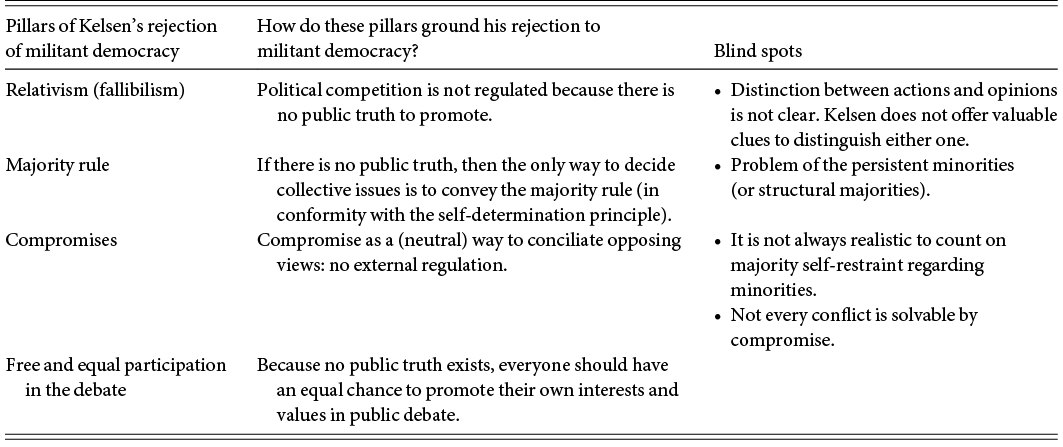
Table 13.1 Long description
Table titled The four pillars of Kelsen’s critique of militant democracy outlining four elements: relativism, majority rule, compromises, and free and equal participation. Middle column explains how each pillar supports Kelsen's critique through stress on absence of public truth, reliance on majority decisions, neutral conciliation, and equal access to debate. Right column lists blind spots including unclear action-opinion line, persistent minority issues, unrealistic expectations about majority restraint, and conflicts not resolvable through compromise.
13.3 Kelsen’s Sparse Legacy
In this second section, I reassess the assumption that Kelsen’s rejection of militant democracy does not have any supporters today. Indeed, the idea that Kelsen has practically no current ‘supporters’ is widespread:
In this recent literature, consensus has emerged on the fundamental principle underlying the theory and practice of militant democracy: Democracies have a right (some say a duty […])Footnote 93 to limit fundamental rights of free expression and participation – albeit with various qualifications and caveats – for reasons of self-preservation. Gustav Radbruch’s and Hans Kelsen’s value-neutral model of pluralist democracy,Footnote 94 according to which all political positions should be given equal rights of expression and participation – and that according to many (including Loewenstein) doomed the Weimar Republic – has virtually no supporters today.Footnote 95
By contrast, the Kelsenian value-neutral model does indeed have a few adherents today. Here, I focus in greater depth on political theorists who have endorsed Kelsen’s rejection of militant democracy. Among this scant group, Invernizzi Accetti and ZuckermanFootnote 96 followed Kelsen’s rejection of militant democracy for three main reasons. Kelsen did not express these grounds in the same terms as these authors do, and for at least one of these grounds, their reasoning exceeds Kelsen’s theoretical arguments.
First, Invernizzi Accetti and ZuckermanFootnote 97 consider – with some Kelsenian nuance – that the principle of self-determination (i.e., that which characterises a democratic regime) necessarily entails political risk for our democracies:
If democracy is to be understood as a form of government based on the principle of freedom as collective self-government, this suggests that it must inevitably be willing to assume a certain measure of political risk […]. Of course, this does not mean that all democratic orders are equally risky, or that there is nothing democracy can do to make itself more secure. But at the very least, the medicine must not be more dangerous than the infirmity. Militant democracy fails this test.
On that point, Invernizzi Accetti and Zuckerman echo Kelsen’s position. Indeed, for the Austrian jurist, even when democracy goes through turbulence, the temptation to resort to nondemocratic methods must be resisted to preserve democratic institutions:
Popular sovereignty cannot subsist against the people. And it should not even attempt to, that is, whoever supports democracy must not get entangled in the disastrous contradiction of resorting to dictatorship to save democracy. One has to remain faithful to one’s flag, even when the ship is sinking; and while reaching the bottom, keep the hope that the idea of liberty is indestructible and that the lower it has sunk, the more passionately it will resurrect.Footnote 98
Taking this political risk implies a guarantee, a ‘right to do wrong’Footnote 99 and the right to ‘seek morally suspect ends’.Footnote 100 If this ‘right to do wrong’ is not guaranteed, then the principle of self-determination is somehow called into question.
The Kelsenian corpus most directly inspires this argument. Accepting such a political risk here is related, according to Kelsen, to the primacy of the self-determination principle (defining democracy itself), which considers any interventions in the democratic game as proceeding from autocratic methods and therefore incompatible with democratic principles. Admittedly, this argument is very robust and the most difficult to challenge. Jan-Werner Müller argues that the angle from which Kelsen rejects militant democracy – which Invernizzi Accetti and ZuckermanFootnote 101 endorse – is convincing and should inspire the camp of ‘sceptics about the very idea of militant democracy’,Footnote 102 to which Müller himself does not belong:
Here the thought is that the very attempt to defend democracy will damage democracy: Governments will fight their enemies until they become like their enemies; they might think that they have held on to democracy, but they actually destroyed it in the process of securing it (which was essentially Kelsen’s core objection to anything resembling militant democracy). This seems more like a genuine paradox. Skeptics about the very idea of militant democracy might be well advised to start their critique right here, at the most fundamental level, just as Kelsen did. They might say that challenges to democracy would in almost all cases resolve themselves through the regular political process; if they do not, then no special political and legal measures will be able to stop a slide into authoritarianism. Hence any attempts to defend the supposed substance of democracy are likely to be counterproductive.Footnote 103
This first line of argument, which adheres to the sanctity of the principle of self-determination, maintains that no ‘militant democracy’ measure can be justified by the continuity and viability of our democracies. Such a perspective closes the door to consequentialist perspectives that focus on the benefits and costs of militant democracy. Indeed, Kelsen never argued against militant democracy by considering the impact of such measures on democratic institutions or their vitality.Footnote 104
Second, Invernizzi Accetti and ZuckermanFootnote 105 point out that drawing a dividing line between enemies and friends of democracy – to exclude the former – coincides with ‘an irreducible element of arbitrariness’. Ultimately, how should one settle the boundaries between enemies and friends of democracy? According to Invernizzi Accetti and Zuckerman,Footnote 106 such a ‘decision over the boundaries of the political community itself cannot coherently be taken by democratic procedures and therefore cannot be subsumed under any prior norm’. The argument according to which militant democracy would necessarily imply arbitrariness in designating ostracised groups is not explicitly present in Kelsen’s argumentation but is indeed close to his ‘relativist’ statement. If ‘only relative values are accessible to human knowledge and human will’,Footnote 107 then consequently, an incontestable method that is able to delineate accepted and ostracised voices or groups does not exist. Nonmajoritarian choices imposed on the collective imply a certain degree of arbitrariness. Therefore, Invernizzi Accetti and ZuckermanFootnote 108 follow Kelsen’s line here, although the notion of relativism does not emerge in their article. I assume that the reference to ‘relativism’ is possibly taboo – or at least very difficult to handle – for those currently tending to reject militant democracy. Indeed, relativism became highly unpopular after 1945. Le BouëdecFootnote 109 describes the quasi-consensus that emerged after the Second World War about the negative impact of relativism on the stability of our democracies:
If there is one idea that has gained consensus in the post-war period, it is that the absolute ‘neutrality’ of the Weimar Constitution and its inability to defend itself against its enemies led to its ‘suicide’. Relativism appears to be the philosophical basis for a formalistic, not normative, conception of democracy, which leads to the constitution being placed entirely at the disposal of the majority. Together with Hans Kelsen, Radbruch was considered the main representative of this relativism. Under Weimar, he had affirmed (like the Austrian jurist) that relativism was the presupposition of the democratic idea, explaining that the spirit of the constitution was summed up in the formal principles of majority decision-making and tolerance.
In 1934, Radbruch, unlike Kelsen, changed his position slightly but significantly. He affirmed that ‘a democratic state should certainly tolerate every opinion, but not the ones that claim to be absolute and the ones that do not respect the rules of the democratic game’.Footnote 110 Thirty years later, Kurt Sontheimer, in his Habilitation thesis, Antidemokratisches Denken in der Weimarer Republik [Antidemocratic Thinking in the Weimar Republic],Footnote 111 held relativism responsible for bringing about the capitulation of German democracy.Footnote 112
I challenge Invernizzi Accetti and Zuckerman’sFootnote 113 idea that a ‘decision over the boundaries of the political community itself […] cannot coherently be taken by democratic procedures and therefore cannot be subsumed under any prior norm’. In fact, democratic procedures can help to define the limits of what is legitimate in a democratic public debate. For example, in the February 2020 Swiss referendum, the majority of voters came out in favour of extending current antiracism legislation that would make it illegal to discriminate against people based on their sexual orientation.Footnote 114 This outcome proves that democratic procedures are capable of drawing a line between acceptable discourses compatible with a democratic worldview and nonacceptable ones and of excluding voices that diffuse such messages.
Third, according to Invernizzi Accetti and Zuckerman, militant democracy could actually be used against its main goal (i.e., protecting democracy) to exclude political actors who do not threaten democracy but who are only political rivals on the path of empowered political groups. Thus, militant democracy would
provide a means for those empowered to make the relevant decisions to arbitrarily exclude an indeterminately expansive range of political competitors from the democratic game, thereby restricting the democratic nature of the regime and therefore effectively ‘doing the work of the enemies of democracy for them’.Footnote 115
This type of objection – consequentialist in nature – must be taken seriously. We can never rule out the concept of ‘militant democracy’ being used for purposes other than protecting our democratic institutions. Ultimately, there is a trade-off between two distinct risks. On the one hand, in a context of nonregulation (hostile to militant democracy), there are parties that exploit their situation to promote nondemocratic goals; on the other hand, in a context where the militant democracy principle is accepted, groups exploit their position to arbitrarily exclude those political groups challenging hegemonic groups. Given how the principle of militant democracy has been used and the fact that its targets have been diverse and not always fully justified, there are reasons to believe that its use could be arbitrary. Notably, extreme right-wing parties have not been the only targets of militant democracy. Far-left parties have also been targeted. In this respect, the Berufsverbot, as implemented in West Germany, which allows for the professional disqualification of civil servants with affinities for the extreme left,Footnote 116 is an example of a variant use of militant democracy that is not unambiguously about protecting democratic institutions. Although the authors are not this explicit, we could mobilise here the reflections of Malkopoulou and NormanFootnote 117 and Stahl and Popp-Madsen,Footnote 118 who denounce the inherently elitist and undemocratic character of theories of militant democracy for showing a certain distrust of citizen participation. In this regard, Stahl and Popp-MadsenFootnote 119 propose a ‘popular model’ of democratic self-defence based on ‘republican and socialist imaginaries’. Ultimately, the safeguarding of democracy is a question of arbitrating between two very real risks: that of giving in to anti-democratic movements without resistance and that of providing groups with instruments of militant democracy whose use is contrary to its objectives. This balancing act explains the ambivalence surrounding the principle of militant democracy. The arbitration between these risks, consequentialist in nature, is not addressed by Kelsen, who emphasises the principled incompatibilities between self-determination and militant democracy: there is no a priori democratic justification for excluding voices or parties, regardless of the consequences of compliance with this principle.
Except for Invernizzi Accetti and Zuckerman,Footnote 120 it is not easy to find contemporary authors who have endorsed Kelsen’s perspective on militant democracy. Malkopoulou and NormanFootnote 121 have attempted to thicken Kelsen’s affiliation because the Austrian jurist was also a source of inspiration for Rosenblum, who would have added
a post-Kelsenian twist to the liberal-democratic paradigm by arguing that political inclusion will temper extremism and gradually socialise its proponents into democrats, as they are increasingly prompted to play according to the rules of the democratic game. Participating in regulated rivalry will force once radical political actors to become more moderate. The core idea is that ‘electoral political competition, like any strong institutional practice, is formative’.Footnote 122
This formative aspect, which, according to Rosenblum,Footnote 123 goes with a certain ‘faith in politics’, is also presupposed by several scholars in the empirical literature, such as Van Spanje and Van der Brug.Footnote 124 The latter have highlighted the impact of inclusion on excluded parties. Including extremist parties would better promote the ‘democratic spirit’ than banning or ostracising them.
However, to what extent does the formative moderating effect – which goes hand in hand with the integration of antisystem political parties – belong to a Kelsenian legacy? In my opinion, the Austrian jurist does not address such a pedagogical aspect. Kelsen would probably be sceptical of what RosenblumFootnote 125 calls ‘democratic acculturation’. The element of moderation works for Kelsen essentially through compromises, as demonstrated above. In his works, Kelsen argues that regular political processes must resolve political divergences and conflicts of interest (possibly of values) and that compromises occupy a significant place among these ‘natural’ processes. The naturalness of compromises or the ‘tendency towards compromise’Footnote 126 in democracies, as Kelsen assumes, does not include a formative aspect among political rivals. Notably, belief in the naturalness of democratic compromises or the ‘tendency towards compromise’Footnote 127 among democracies is no less optimistic than the pedagogical aspect that Rosenblum assumed and exposed earlier.
13.4 Conclusion
Kelsen’s indictment of the principle of militant democracy is rarely used, not because he rejects it outright but because his arguments are unique in two respects. If Kelsen has few followers, it is first because he developed his rejection of militant democracy exclusively on the basis of its principles and not in relation to its democratic implications. The principle of militant democracy is assessed in terms of its (in)compatibility with the principle of self-determination. Such a perspective appears only in the minority in contemporary literature. Since the early 2000s, there has been a burgeoning body of work examining the desirability of militant democracy in terms of its consequences or costs. In particular, a key question is focused on the extent to which the exclusion of anti-establishment or extremist parties is appropriate in light of its consequences for the radicalisation of political profiles and their democratic acculturation.Footnote 128 Such a perspective – assessing the costs and benefits of militant democracy – is by no means Kelsenian. Among the few contemporary authors who have advocated a principled rejection of militant democracy, Invernizzi Accetti and ZuckermanFootnote 129 have been discussed at length in this chapter. Their argument partially overlaps with the Kelsenian position, particularly on the points of friction between the principle of self-determination and the restriction of political competition. Malkopoulou and NormanFootnote 130 also look to Kelsen’s principled position to support their rejection of militant democracy as elitist.Footnote 131 In their view, the liberal model of militant democracy demonstrates a ‘deep-seated mistrust of the people’s ability to govern themselves’.Footnote 132
Second, Kelsen’s rejection of militant democracy is ultimately based on the principle of relativism, which is still a very little-used perspective in this debate. The authors who express serious doubts about militant democracy do not use this concept. Since the Second World War, relativism has been associated with a formalist conception of democracy that offers no resistance to democratic suicide. Moreover, the difficulties of drawing a clear line between discourse and action (to confine relativism to the former) may ultimately support the rejection of relativism as a normative basis for undermining militant democracy. However, despite the fractures in the pillars upholding Kelsen’s rejection of militant democracy, I believe that he must continue to be mobilised in current debates: Kelsen raises an essential question, namely, that of the limits of what our democracies can undertake to protect themselves without denaturing themselves.
How should we interpret Hans Kelsen’s writings on democracy? As a second-order activity in ‘political theory’, which ran alongside his larger enterprise in determining a ‘pure’ theory of law, or of a piece with it? In his own self-presentation from 1927, Kelsen refers to his 1920 publication of the short essay-cum booklet, Vom Wesen und Wert der Demokratie, which first appeared in the Archiv für Sozialwissenschaft und Sozialpolitik, as a form of political theory that ran alongside his work on state-legal thinking.Footnote 1 His thinking about democracy would be developed through the 1920s, and was reiterated in different ways in the 1950s. However, what were the early meanings of a political theory of democracy for him, and how might the sequencing of his writings on that topic intersect with his writing on legal theory? This seems to be one of the driving questions of this volume, which tracks the evolution of his anti-systemic approach to democracy, firstly by noting its early anti-Bolshevik tenor. The strengthening of the essay came later, at a moment in 1929 when Kelsen moved to defend pluralism and then multiparty democracy in the 1920s and 1930s. This he did against what he saw as ideological forms of tyranny and political simplification. Then, his defence of democracy returned anew, during the 1940s and 1950s, when he sought to safeguard the values of pluralism, particularly from drifting (but seemingly stable) forms of liberal democracy, re-emphasising the importance of political parties as vehicles of popular will and of compromise. The contributors to this book amply make the case for the seriousness of Kelsen’s arguments and locate his thinking in multiple contexts and competing timeframes. In writing this brief afterword, my aim is to highlight some of the novelties of the arguments made by the contributors here, with reference to a particular question that has arisen in the ‘historical turn’ in scholarship around Kelsen. More specifically, using Natasha Wheatley’s recent consideration of Kelsen in The Life and Death of States as an example, one major theme that drove Kelsen and his Viennese Kreis towards the pure theory of law, was the absence of ‘time’ from most contemporary legal thinking about what the state was and how it lived (and died) in both real time and juridical time.Footnote 2 My question, following on from this is, what difference might it make if we looked at his early writing on democracy with such a focus in mind?
In some ways, it is an obvious starting point. During the First World War, between service and writing, Kelsen worried about the problem of time as it applied to the problem of sovereignty in general. If sovereignty was a presumption of the state (defined as a combination of territory and a relatively stable population with an effective government), then how should questions of state birth, and more pointedly, state death, be understood? A concern about the latter had been part of the background cultural mood music in the Habsburg Empire for several generations. The threat of impending death and decay seemed to have been hardwired into the fabric of Habsburg modernity, in fact, where the dual empire was thought of, analogously to the Ottoman empire, as one of the ‘sick men’ of Europe; destined to crumble, its crumbling would in turn precipitate a major European cataclysm. This sense of manifest destiny as imperial destruction and European war led to myriad and mordant reflections about how life might continue after death and gave a distinctive and ironic cast to Habsburg literary and psychological culture, as writers such as Marjorie Perloff have taught us.Footnote 3 Therefore, from the perspective of a theory of law, when Kelsen reflected on the problem of the real life of the state, as opposed to the fictitious eternal life of the state that had been sustained by a theory of the two bodies of the ruler from medieval kingship into the modern state, he asked a different question. What happened when states died, in practice, if fiction theory was insufficient for a rational, modern science of jurisprudence? How might law as an abstract science, one that dealt in artifice but which rejected fiction theory, come to frame and interpret such events? The circle of scholars that Kelsen gathered around him went in search of metaphors and models through which to understand the problem – one such model was outlined by Adolf Merkl, who proposed a ‘stepped structure’ (Stufenbau) of law, one that built, node to node, layer upon layer, until you could see both the wood and the trees (his was a forest-inspired construction). Whether such structures were organic or mechanical, inbuilt or separate, Kelsen and his colleagues wondered how best to understand law and authority if you were interested less in their description (the ‘is’), and more in their form (the ‘ought’)? What sort of psychological perspective would make sense of any of this, if you asked where law came from in the first place? Only if you could answer that, it seemed, could you answer the question of where state authority began or ended, and thus when it lived, or when it died. For law, the idea of a basic norm, latterly a Grundnorm, would simply have to be the cognitive presumption through which this made sense. Law was a juridical system of artifice (not a fiction), constructed around a philosophical presumption; other arguments, from natural law, power out of time, and so forth, from the history of legal argumentation as well as the realities of a complex, multi-confessional, sprawling imperial world, meant there was no de facto sovereign point outside of anywhere to judge from, or reason back to when trying to singularly consider law and politics. Everything was plural, multiple, and complicated.Footnote 4
If this foundational norm from which everything else radiated and found meaning was outside of the historical messiness of the domestic nation-state, then where was it to be found? Kelsen and his circle fixed this norm as part of the international sphere, and such fixing of sovereignty outside of the realms of state histories and conflicts gave it a different kind of temporal heft. By presuming a systemic continuity outside the nation-state or empire, real moments of rupture within those spaces (politics and history, put simply) could be explained with reference to a higher-order juridical argument. One might now easily say that there have been many Austrian states, for example, with new constitutional arrangements, new revolutionary transformations, and so on through history. If there have been many different states, juridically speaking, then questions of the life and death of states and sovereignties could be explained with reference to the wider juridical architecture whose Grundnorm was its apex, but simultaneously be normalised as part and parcel of what legal thinking is supposed to explain. Put another way, what made sense of the radical transformation or rupture embodied in revolution and war in the present was the fact that a still higher level of continuity existed at the international level from which these domestic ruptures could be explained.Footnote 5 At the level of the state, revolution and transformation, life and death, were juridically understandable, normal even, because they were framed by an argument about continuity as an epistemic presumption at a more abstract level. The temporality of international law, rather than national or imperial state law, was the thing that was, in principle, limitless.Footnote 6 The nation-state was hereby relativised, which in turn downgraded the place of merely historical argument and explanation, or the hyper-politicised justifications of empire and conquest that the idea of national sovereignty as eternal and limitless had given rise to. That was now seen as quite as backwards or retrograde a sensibility as earlier theories of natural law and divine right.
In fact, it seemed for Kelsen that such historically fixed and conventional notions of sovereignty as the defining attributes of statist politics were to blame for the horrors of the First World War, and he thought that radical jurists had found a way to say so clearly. By explaining its backwardness, they could signal a way of moving forwards into a world in which states themselves were given much more modest roles as the containers through which sequences of legal and political and historical structures come and go, while the meanings of such comings and goings were to be found within still wider frames of reference. Here, democracy would be a major part of that story.
Kelsen opened his first essay on the essence and value of democracy, with a conventional historical background about the rise of democracy in Europe from its revolutionary origins in 1789 and 1848, to its repurposing in the midst of global war. The idea of democracy, like the idea of law, however, was something more foundational than its practical history could show. It grew out of social and psychological foundations. Individual psychology bristles at the idea of social constraint, Kelsen wrote, but at the same time, individuals recognise that selfsame desire in others. This means that society is grounded upon a ‘negative equality’, whose recognition fosters a ‘negative demand’ (negative Forderung) for freedom. Here, Kelsen pursued a thought that could, for political and legal theorists today, suggest a line of thinking running back to Kant and forwards into the twentieth century, through Isaiah Berlin’s value pluralism and into Ronald Dworkin’s attempts to synthesise freedom and equality.
Nevertheless, Kelsen’s focus on the intersubjective and instinctual presumptions behind democracy was, of course, even more deeply connected to his proximity to Sigmund Freud, in whose journal he published a major essay on the state and social psychology.Footnote 7 And as Kelsen also noted, democratic demands progressed alongside wider historical and political developments. Movements towards majority rule and the self-determination of peoples ran alongside revolutionary transformations, reshaping both the theory of the state and the theory of democracy in turn. This seemed to make the freedom of the individual derivative of the freedom of a wider people, society, or state.Footnote 8 However, all these connections, according to Kelsen, were relative. Rousseau’s ‘anthropomorphic expression’ of a general will as the sum of all individual wills was a form of political tyranny rather than democratic freedom, because it presumed a true essence to democracy that was immediate, direct, and unmediated. According to Kelsen, by contrast, the time of modern democracy was representative and therefore plural, fractious, distanced, and contingently fixed into shape by modern political parties. The time of post-Rousseauvian democracy clearly had problems, but the modern world on Kelsen’s account, was not like Rousseau’s world, and modern democracy (like modern law) needed alternative foundations. Political freedom (or democracy) required the ‘conversion’ of natural freedom into politics, which required the veridiction of general law rather than the highly localised and radically patriotic versions that Rousseau proposed. All of which is to say, as several essays in this collection do say, particularly those by Przeworski, Urbinati, and Invernizzi-Accetti, that Rousseau could not stand as the founder of modern democracy according to Kelsen.
Furthering the historical turn in scholarship about Kelsen, it might be worth adding a rider to the general claim. Namely, that this was also an argument with a distinct historical edge that lawyers in German-speaking Europe had long been cognisant of. If the postrevolutionary possibilities of democratic politics in Europe were shaped by national communities under modern states, then the theory of the state most compatible with pluralist democracy could not, these lawyers suggested, route its genealogy back to Hobbes (the absolutist) or to Rousseau (the spark for Jacobin tyranny). Therefore, Kelsen, like many others, turned to Kantian ideals of autonomy and historically relativist accounts of the state and democracy as a way of seeing how similar psychological foundations played out differently in different historical contexts. Kelsen’s genealogy of modern politics and its foundation in the constituent power of a democratic people evolving over time, looks instead like a genealogy where Sieyès, rather than Hobbes or Rousseau, might provide a route towards the complexities of representation that could secure the pluralism he sought to defend. This was the sort of argument his younger colleague Egon Zweig had made, in fact, in his study of the origins and influence of the idea of constituent power. Zweig also rejected Rousseau in favour of Sieyès and thought that Sieyès was a better guide to properly democratic modern politics grounded in a complex division of labour, one that might render sensible the complexities of time and scale in representative politics, such that it could work within the Habsburg framework.Footnote 9 In Kelsen’s version of this, an aversion to militant democracy (well outlined by Baume in this volume) required a model of democracy within which majorities and minorities had to compromise within structures not of their own choosing, and which could not be easily changed. Like his theory of law, where a plurality of norms forms a unity within a hierarchical system owing to the Grundnorm, in Kelsen’s account of democracy, complex schemes of representation and compromise through parties and leadership structures within the state help to generate temporary unity out of plurality, which becomes both the essence and the value of democracy.Footnote 10
What all this also meant, of course, was that Kelsen’s sense of democracy as a modern fate could not be located through what he called the ‘neo-communist’ worldview of Lenin’s Bolsheviks, who claimed to return to true democracy without the trappings of parliamentarism or bureaucracy.Footnote 11 The tensions between the ideal and the reality of democracy were here expressed in a judgement that saw war and revolution as threats to the vitality of pluralism and compromise. At the same time, Kelsen’s pursuit of a depersonalised account of democratic politics might, as Jagi’s contribution to this book makes clear, be seen as a response to the multifaceted quality of the Habsburg imperial polity. In a sort of reversal of a well-established distinction in European political theory between sovereignty and government, by dethroning the radicalism of sovereignty, Kelsen turned democratic government into both norm and exception, a historical and political novelty wherein the will of an administration or bureaucracy is formed differently than the will of a people, but both build into a larger democratic compound. He further rejected the idea that the Bolshevik ‘democratic’ experiment was novel, by showing that its interest in short-term offices, mandates, and so on, was merely part and parcel of how democracy in general can and does function.Footnote 12 In any event, his early concerns with Bolshevik models were relegated by the late 1920s in the second edition of his text, as his own theorems were tested in the fires of postwar reconstruction in law and politics in Europe.
Here, Kelsen as the activist scholar was undoubtedly more politically consequential in the evolution of legal and political practice than his sharpest and most public critic, Carl Schmitt, even if, as several contributors to this volume make clear, his defence of compromise seemed to come without any wider foundational justification than just its necessity. However, this might simply signal another proximity in his democratic theory, to his simultaneous search for the Grundnorm as a cognitive presumption, which made forms of law juridically thinkable and interpretable. For democracy to be politically thinkable, perhaps compromise had to be a similar sort of presumption, something one couldn’t question as a foundational principle even if it could on occasion also be explained with reference to exogenous conditions, such that compromise and parliamentarism were mutually constituted, and the development of parliamentary politics in Europe since the revolutions of 1789 and 1848 had fixed that into a historical reality. Whether this overlaps with the Freudian thought of a background condition of shared and totemic sacrifice, morphing into the shared acceptance of compromise as a psychological foundation of electoral democracy, remains an interesting case, also brought up in this volume. But these social – psychological foundations of democracy and the state also connect, in some other ways, with straightforwardly Hobbesian thoughts about shared subjection to a common authority through representation, which turns plurality into union, and wherein one major compromise undertaken (or contract entered into) in the pursuit of self-interest, sets off another sequence of reasoning and political outcomes, whose implications can only receive proper historical and juridical judgement after the fact. The Hobbesian state exists for as long as it protects citizens and makes their lives better in general, and when that ceases, it exists no longer. This is perfectly normal in Kelsen’s rendering of state life and death, given the wider legal framework within which such matters can be put. Could democracy live and die in the same way? That democracy was in danger of being fixed as an ideology rather than a value, as mere procedure rather than pluralism, whether in wartime or through revolution and antiparliamentary forms of fascism during reconstruction and into the 1930s, was a major concern. Like others, such as Elie Halévy in France, Otto Neurath in Germany, and Nikolai Kondratiev in Russia, who worried about the ‘statification’ (and hence the simplification) of modern politics, a process through which peacetime politics masked the continuation of political and economic warfare by other means by simply calling it democracy, Kelsen sought to defend democratic pluralism through robust compromise and political parties.
This made him understandably obsessed with questions of electoral reform and state law, particularly because it was of crucial importance to political education, something Jaestadt makes clear in their chapter. From the early years of the century, through teaching and writing about state law in the Habsburg Empire, moving into radical debates about electoral reform and administrative oversight, and even taking part in the practical reconstruction of state law and the constitutionalising of democratic politics, Kelsen moved continuously from theory to practice and back again. He did so whether thinking abstractly about time, sovereignty, and law, or about the history and psychology of politics and democracy. It also shows up across the sequential transitions in Kelsen’s varied attempts to defend democracy from its enemies from the 1920s to the 1950s, which the introduction to this book clarifies so well, but it does suggest a rather radical thought. Namely, that without the compromise structures of democracy through party politics, there might be no democracy at all.
Recent political science has been obsessed with the question of whether democracy is already dead, or with how it has died in the past and whether it might soon die again in the future, and of whether threats to democracy in the present require a rethinking of the categories of compromise, respect, and perhaps even of anger and resentment in politics. Across the board, questions of democratic life and its timeframes have been raised in particularly piquant ways. However, these might profitably be seen as a structural mirror to Kelsen’s concern with the life and death of states. Put another way, might the long-term effect of democracy in theory and in practice, in Europe and Anglo-America particularly, have been to make democracy into something like the political analogue of Kelsen’s Grundnorm? This could allow us to understand how states can die while democracy lives on, or see that individual democracies might die while the idea of democracy lives on, and so on and so forth, in varying configurations. Democracy as the political Grundnorm, so to speak, becomes the point of reference from which to measure political success and failure in different times and places. Or is it that democracy is the concept that most easily captures what Kelsen thought of as the natural, instinctual, and intersubjective demand for freedom, at least until some other mode or model of political legitimation is provided that can more readily meet those demands? Whatever it is, the fact that we have not been able to get much further than this in our thinking about the essence or the value of democracy since Kelsen’s time, suggests that there are good reasons to return to his lessons in our own moment, just as this revisionist collection suggests.Footnote 13
Nevertheless, there is also a tragic dimension to this predicament. Consider Max Weber’s contemporaneous assessment of such austere neo-Kantianism as that which he had found in the work of Georg Jellinek as well as that of Kelsen. He saw it as the historical embodiment of a productive attempt to reason through the distinctiveness of Occidental politics, law, and history from a comparative perspective, tracing a path towards increasingly general applications of law that could frame the evolution of modern liberalism and globalised forms of commercial capitalism.Footnote 14 However, like his Habsburg compatriots, Weber’s analysis had sharp edges. The pursuit of a model or mode that could only ever be a partial and incomplete attempt to theoretically grasp the otherwise unfathomable realities of social and political life was itself tragic. The ideas that once offered totalising explanations for the nature of things, like politics or religion, had been secularised and compromised. While the fine-grained armature of juridical science offered the possibility of relevant specialisation and could afford the skilled practitioner a certain historical-developmental clarity, it also came with a cost. Here, democracy (and its concomitant requirements of international credit and bureaucratic state structures, as much as international law), became a peculiarly modern kind of fate.
In part, this was why Kelsen effectively set out to dethrone the idea that there was anything like a substantive ‘will of the state’ or a ‘subject’ (the state) that could be thought to exist independently of the emergence of an appropriate juridical form of knowledge or epistemological construction that would come to explain it.Footnote 15 Only this type of proposition could make sense of Habsburg diversity, and bring it into line with the developmental trajectories of modern democracy.Footnote 16 The logic of Kelsen’s juridical argument seems to mirror the ways in which democracy has become both the presumption and the legitimating ground of modern politics, even if the preconditions for its success, at least in Kelsen’s terms, hardly seem any more secure today than they did when he first began to write about it over a century ago. Perhaps that is entirely the point, however, if democracy (like any form of politics) only ever lives on borrowed time.
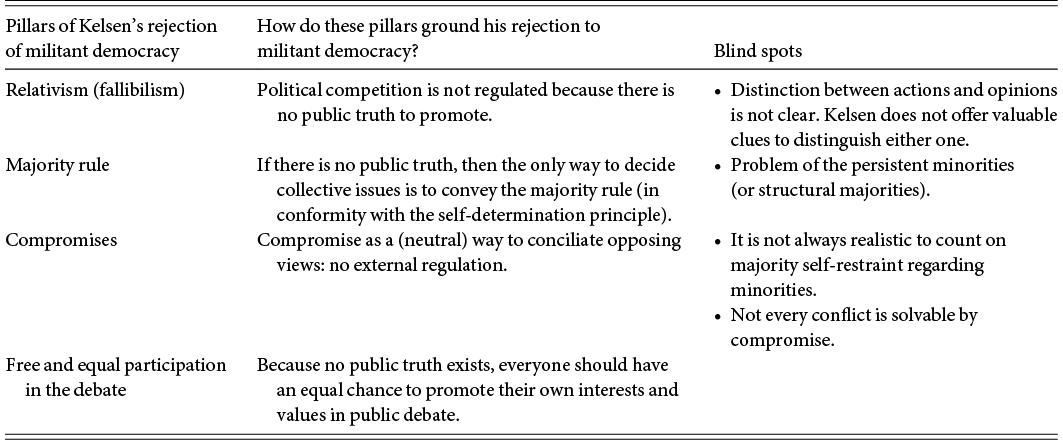

 Open access