





1. Introduction
India has a dynamic, highly heterogeneous and rapidly evolving health system (Kumar, Reference Kumar2023). Achieving Universal Health Coverage (UHC) is a critical goal for India (Zodpey and Farooqui, Reference Zodpey and Farooqui2018), reflecting India’s commitment to equitable access to quality healthcare for all, despite the significant challenges posed by limited financial and material resources (Kalita et al., Reference Kalita, Carton-Rossen, Joseph, Chhetri and Patel2023). Sustaining the current progress and achieving future targets will require a comprehensive analysis of how healthcare needs can be met, and how resources should be allocated in India. Evidence based decision making (EBDM) emerges as a cornerstone in this context, guiding policymakers on how to allocate limited resources efficiently and equitably, thereby improving health outcomes while minimising economic burdens.
Health Technology Assessment (HTA) is a multidisciplinary process that evaluates interventions to guide equitable, efficient, and high-quality decision-making to prioritise between health technologies (Health Technology Assessment in India A Manual 2018). To promote transparency in decision making and to generate quality evidence in healthcare, the Government of India established the Health Technology Assessment in India (HTAIn) under the Department of Health Research. By prioritising interventions that deliver the value for money, HTAIn supports India’s commitment to equitable, accessible, and affordable healthcare in India (Fan et al., Reference Fan, Mehndiratta and Ahazie2024; Health Technology Assessment in India A Manual 2018). Availability of high-quality evidence empowers policymakers and other stakeholders to implement health interventions more effectively and ensure UHC.
However, HTA is not a one-size-fits-all solution for all healthcare decisions. Conducting a full HTA may be unnecessary and time consuming if the existing economic evaluation evidence sufficiently addresses the healthcare challenges. The evidence generated from HTA can become obsolete as the clinical and cost effectiveness data evolves. Similarly, the introduction of newer interventions, particularly in pharmaceuticals, necessitates frequent updating of economic models. These are necessary to ensure their validity and support reimbursement decisions. The resource-intensive nature of traditional HTA makes it difficult to meet this growing demand for evidence even for high income countries (HICs). Therefore, the selection of HTA topics should be strategic, ensuring that evaluations focus on areas where evidence gaps exist and where assessments can meaningfully inform policy and resource allocation. These can be complemented with Adaptive HTA (aHTA), which leverages existing HTA or economic evaluation evidence to facilitate more efficient and rapid assessments, thereby supporting the optimum use of traditional HTA.
2. The role of aHTA in streamlining the decision making
Adaptive HTA is a process that utilises or adapts existing international evidence, economic evaluations models, and decisions from HTA reports or published literature to expedite policy decisions while addressing concerns related to quality, transferability, and uncertainty. With its flexibility and comparatively lower resource requirements, it can address most of the challenges of traditional HTAs (Nemzoff et al., Reference Nemzoff, Shah, Heupink, Regan, Ghosh, Pincombe, Guzman, Sweeney, Ruiz and Vassall2023; Reference Nemzoff, Ruiz, Chalkidou, Mehndiratta, Guinness, Cluzeau and Shah2021).
Adaptive HTA tailors its methods to the specific needs and constraints of a given healthcare system, ensuring a practical and nuanced application rather than a standardised, one-size-fits-all formula. It is typically suited for technologies that already have sufficient international economic evaluation evidence, or for single technologies and simple decision problems with low expected budget impact. These decision questions often relate to procurement decisions, clinical practice guidelines, inclusion in essential medicines lists, subsidies for medical devices and diagnostics, and responses to public health emergencies.
Globally, capacity pressures for conducting full HTAs have been reported. In the UK, the Scottish Medicines Consortium and the National Institute for Health and Care Excellence (NICE) acknowledged before the COVID-19 their programmes were overstretched, leading to backlogs of evidence appraisal (Rubin, Reference Rubin2020). It was identified as a major post pandemic challenge, with concerns that delays could compromise timely patient access (Rubin, Reference Rubin2020). Another study from Europe also reported that pricing and reimbursement timelines were delayed across nine of thirteen HTA agencies because they were still clearing backlogs (Ahnert et al., Reference Ahnert, Seiffert and Brar2020). In low- and middle-income countries (LMICs), the situation is compounded by limited data and institutional capacity, leading to large pipelines of technologies awaiting evaluation (Daniel Ollendorf et al., Reference Ollendorf, Baker, Guzman, Chalkidou, Jena and Teerawattananon2024). These worldwide capacity pressures underscore the need for adaptive approaches that can triage topics and deliver rapid, context specific, quality assessments when full HTAs are difficult. In response, several countries and HTA bodies across the world have piloted various aHTA methods. In many countries, aHTA serves as an initial step before determining the need for a full HTA. In Ireland, all pharmaceuticals first undergo a rapid review (Connolly et al., Reference Connolly, O’Donnell, Lamrock, Tilson and Barry2020). Additional targeted analyses are conducted if significant uncertainties related to available evidence remain after the initial rapid review. Technologies with higher costs, questionable comparative efficacy or uncertain value for money are then subjected to the traditional HTA. An HTA study conducted in Rwanda adopted an aHTA approach to address urgent policy needs and constrained local data availability (Nemzoff et al., Reference Nemzoff, Ahmed, Olufiranye, Igiraneza, Kalisa, Chadha, Hakiba, Rulisa, Riro, Chalkidou and Ruiz2024). By prioritising rapid, simplified economic models using pragmatically sourced data, the aHTA method enabled timely cost-effectiveness insights with methodological rigour. The accelerated decision making and foundational evidence for future priority-setting outweighed the approach’s limitations, as it delivered actionable guidance while building capacity for more comprehensive evaluations. A 10-year review of Ireland’s rapid review process revealed that half of the assessed medicines proceeded to full HTA, while the other half were successfully addressed through aHTA alone. This has saved around 15,000 additional appraisal days that would have been required for a full HTA for all topics, demonstrating the time-saving potential of aHTA (Varley et al., Reference Varley, Tilson, Fogarty, McCullagh and Barry2022).
In the West Bank, the Palestinian National Institute of Public Health and the Norwegian Institute of Public Health piloted an aHTA for breast-cancer screening; the adaptive approach was faster than a de novo HTA, although progress was slowed by the scarcity of local data and the need to build trust with stakeholders (Isbeih et al., Reference Isbeih, Heupink, Qaddomi, Salman and Chola2024). In Argentina, the Institute of Economic and Clinical Studies), AHTA offers timely support for prioritising resources and has been applied in multiple projects to update benefit plans and select priority technologies (IECS, Instituto de Efectividad Clínica y Sanitaria, 2023). These experiences illustrate how adaptive approaches can help manage workloads by synthesising existing evidence, conducting rapid reviews and ICER adjustments, and focusing scarce analytical resources on technologies that warrant more comprehensive evaluation (Daniel Ollendorf et al., Reference Ollendorf, Baker, Guzman, Chalkidou, Jena and Teerawattananon2024).
2.1. Role and process of aHTA in the HTA ecosystem in India
The aHTA process aligns with traditional HTA, as both bridge the gap between scientific evidence and policymaking (Health Technology Assessment in India A Manual 2018). Consistent with any traditional HTA study, the aHTA process involves similar steps- identifying the research question, conducting the analysis, generating evidence and implementation. Despite the growing popularity of aHTA, there are no standardised norms or universally accepted nomenclature for its implementation in India (Chauhan et al., Reference Chauhan, Sharma, Mehndiratta, Gupta, Garg, Kumar and Prinja2023a; Nemzoff et al., Reference Nemzoff, Ruiz, Chalkidou, Mehndiratta, Guinness, Cluzeau and Shah2021). In India, the National Cancer Grid (NCG) in collaboration with the Center for Global Development (CGD) has developed an aHTA Manual with the objective of standardising rapid assessment of cancer technologies (Apurva Ashok et al., Reference Ashok, Baker, Pramesh, D’Cruz, Chaturvedi, Badwe, Saini and Nair2022). The methods in this manual were tested on several technologies (Ghosh et al., Reference Ghosh, Pramesh, Sengar, Ranganathan, Ruiz, Wadasadawala, Nayak, Thorat, Ashok, Singh, Mehndiratta, Nemzoff and Shah2025) and are being further refined with the help of National Health Authority (NHA). Academic institutions in India have tested different aHTA methods(Chauhan et al., Reference Chauhan, Sharma, Mehndiratta, Gupta, Garg, Kumar and Prinja2023a; Kar et al., Reference Kar, Sivanantham, Ravel, Mehndiratta, Tyagi and Ollendorf2024). While the core steps are largely similar, the specific methods for adapting international evidence differ. The aHTA process commonly followed in India is outlined in Figure 1, which illustrates the typical sequence of an aHTA when conducted as a complete rapid assessment, topic selection, scoping, acquiring evidence, evidence analysis, evidence summary and deliberation. The figure further highlights how each step differs in relative complexity and scope compared with traditional HTA. Relative to traditional HTA, the steps of topic selection and scoping are equivalent in complexity, while the evidence analysis involving rapid review, ICER adjustments and explicit assessment of transferability is low to moderate in complexity. Uncertainty is managed during evidence acquisition and analysis and is carried forward transparently through evidence appraisal and deliberation. Each step in the evidence analysis is modular and can also be used independently to inform decisions, for example, rapid synthesis of existing evidence or provisional ICER adjustments can inform guideline development, price negotiations or the decision whether to conduct a full HTA.
Adaptive HTA steps within the decision-making process.

Figure 1. Long description
The diagram illustrates the steps within the decision-making process for adaptive health technology assessment (HTA) in India’s healthcare system. It consists of six steps arranged in a staircase format, each with a specific role. The first step, labeled ‘Topic Selection,’ involves identifying and prioritizing topics with brief, low complexity compared to full HTA. The second step, ‘Scoping,’ defines the scope and data extraction with less exhaustiveness than full HTA scoping. The third step, ‘Acquiring Evidence,’ gathers existing evidence and data rapidly. The fourth step, ‘Evidence Analysis,’ conducts rapid reviews and quality appraisals with higher complexity but simpler than full HTA modeling. The fifth step, ‘Evidence Summary,’ compiles appraised evidence into concise reports. The final step, ‘Deliberation,’ engages stakeholders to interpret evidence, make decisions, and integrate evidence into policy. Each step is visually represented with icons and text labels, indicating the flow and interaction between steps.
Topic prioritisation: Topics are received from multiple stakeholders, and they were prioritised based on the clinical, economic, and social impacts of the intervention, such as the severity and urgency of the problem, disease burden, clinical effectiveness, economic impact, availability of literature and societal implications. These criteria can be adapted to suit any situation or intervention. Topic prioritisation helps to rank different interventions based on priority to identify the most critical topics for immediate evaluation. This prioritisation process acts as the first filter, ensuring resources are allocated to the most impactful interventions. An aHTA could be performed for prioritised interventions where international HTAs suggest reliable and valid cost-effectiveness evidence (Singh et al., Reference Singh, Mehndiratta, Espinoza, Prinja and Giedion2025).
Defining the scope: Once the topic is prioritised, the scope of the study is defined based on international clinical evidence guided by the research question and existing evidence. Adaptive HTA can proceed only if the Population, intervention, comparator, and outcome (PICO) align with the intervention’s approval status, international evidence, and clinical practice in India.
Evidence collection and analysis: The next step is to collect and review internationally available HTA evidence using a literature search from different HTA agency websites, Tufts CUA registry and other databases. Evidence, including background information on the study, clinical and cost-effectiveness data for the intervention and comparator, sensitivity analysis outcomes, and cost drivers, are systematically extracted. Studies not aligning with the PICO framework or containing incomplete results are excluded based on expert opinion and mutual consensus.
Adaptive HTA utilises methods like rapid or targeted literature reviews, adaptation of existing cost-effectiveness models, treatment cost estimation, and price benchmarking to generate insights into the cost-effectiveness of the intervention. The NCG adaptive HTA guidelines suggest three different formulas for estimating the adjusted ICER for India. The simple adjustment assumes the intervention price is the main cost driver and estimates the ICER for India by scaling the published ICER in proportion to the intervention price difference. The adjusted ICER for India, ICER_A = ICER_O × (P_A / P_O), where ICER_O is the reported ICER in the original setting, P_A is the intervention price in India, and P_O is the price in the original country.
The moderate adjustment estimates India specific ICER by re-calculating incremental treatment costs using the monthly cost and treatment duration for both the intervention and comparator and then scaling by the additional treatment time expressed in years. The adjusted ICER is, ICER = [(Cᵢ×Mᵢ) − (Cc×Mc)] / [(Mᵢ − Mc)/12], where C is monthly cost, M is months on treatment, and i and c denote intervention and comparator. The complex adjustment requires more information from the original study and recalculates an India-relevant ICER by separately adjusting costs and quality adjusted life years (QALYs) to reflect cross-country differences and then recomputing the ICER. Since the cost estimates are adapted from different country contexts, adjusting the currency to account for India’s healthcare setting is done using purchasing power parity (PPP) adjusted gross domestic product (GDP). Also, the currency year is accounted for the current year using the consumer price index (CPI). Adjusted cost, Cost_A = (Cost_O × (PPP_India/PPP_O)) × (CPI_India,cur/CPI_India,yr), while QALYs are adjusted using a life-expectancy ratio, QALY_A = QALY_O × (LE_India/LE_O). These adjustments are intended to generate more accurate and relevant India specific data. The adjusted incremental cost and effectiveness data are used to calculate a new ICER for India using the standard formula as, ICER_A = ΔCost_A / ΔQALY_A. The adjusted ICER is then compared to India’s willingness to pay (WTP) threshold to assess the intervention’s value for money within the Indian healthcare system. If the intervention is found to be cost-effective in the Indian context, a budget impact assessment is conducted.
AHTA generates conclusions based on the available evidence from other settings, and the transferability of these inputs varies by parameter type. Evidence on clinical effectiveness and health outcomes inputs can often be transferred with appropriate alignment of PICO definitions, followed by local calibration where feasible. In contrast, absolute cost inputs tend to be less transferable across settings, require explicit contextualisation using local prices, inflation and PPP. The study by Chauhan et al. (Chauhan et al., Reference Chauhan, Sharma, Mehndiratta, Gupta, Garg, Kumar and Prinja2023b) also shows that adapted cost estimates varied considerably, whereas adapted QALYs were comparatively closer to Indian reference estimates. Hence, studies with strong PICO match, similar care pathway, and outcomes can be transferred much easily to another country, while studies with partial pathway differences but feasible localisation of key drivers with explicit scenario analysis can be moderately transferable. Studies with major pathway differences, missing key parameters, or results dominated by non-transferable cost structures should trigger full HTA.
Evidence appraisal, deliberation, and summary: The analysis conducted through adapted methods is deliberated and appraised. The recommendations from the deliberation process, along with the analysis that has an evidence summary of the adapted studies, are combined in a report and a policy brief. This report compiles all relevant evidence generated from the study and concludes whether the intervention is potentially cost effective, unlikely to be cost effective or whether the recommendation or decision remains uncertain. Uncertain decisions will point towards the need for a potential full or traditional HTA. Policy briefs are targeted at stakeholders like policymakers and clinicians, to enable evidence-based decisions like inclusion/ exclusion decisions for health benefits package or clinical practice guidelines.
Embedding aHTA outcomes into clinical guidelines fosters equitable resource allocation, informed by real-world data and iterative improvements, that bridge immediate needs with long term goals. This integration supports sustainable progress towards UHC by transforming evidence into actionable and efficient health care solutions.
3. Adaptive HTA – experience from India
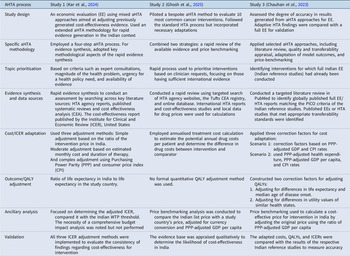
Adaptive HTA can ensure the efficient use of limited resources and has already demonstrated its potential to provide timely cost effectiveness evidence to stakeholders (Chauhan et al., Reference Chauhan, Sharma, Mehndiratta, Gupta, Garg, Kumar and Prinja2023a; Ghosh et al., Reference Ghosh, Pramesh, Sengar, Ranganathan, Ruiz, Wadasadawala, Nayak, Thorat, Ashok, Singh, Mehndiratta, Nemzoff and Shah2025; Kar et al., Reference Kar, Sivanantham, Ravel, Mehndiratta, Tyagi and Ollendorf2024). Due to the variability in methodologies, different published aHTA studies (Chauhan et al., Reference Chauhan, Sharma, Mehndiratta, Gupta, Garg, Kumar and Prinja2023a; Ghosh et al., Reference Ghosh, Pramesh, Sengar, Ranganathan, Ruiz, Wadasadawala, Nayak, Thorat, Ashok, Singh, Mehndiratta, Nemzoff and Shah2025; Kar et al., Reference Kar, Sivanantham, Ravel, Mehndiratta, Tyagi and Ollendorf2024) from India used a similar process with slightly varied methodology for evidence appraisal. The Table 1 summarises three Indian aHTA studies that differ in their approach and methods, Kar et al., demonstrates adjusted ICER approaches for adapting evidence from the international economic evaluation to India, Ghosh et al., applies aHTA to rapidly appraise multiple cancer interventions for policy prioritisation and Chauhan et al., validates aHTA methods by comparing adapted results with Indian reference studies to quantify transferability related uncertainty (Table 1).
Difference in aHTA methodologies followed by Indian studies

Table 1. Long description
The table compares aHTA methodologies used in three Indian studies, highlighting differences in study design, specific methodology, topic prioritization, evidence synthesis and data sources, cost adjustments, outcome adjustments, ancillary analysis, and validation. Study 1 by Kar et al., 2024, employed a four-step aHTA process and rapid evidence synthesis. Study 2 by Ghosh et al., 2025, combined a rapid review of evidence and price benchmarking. Study 3 by Chauhan et al., 2023, applied selected aHTA approaches and conducted a targeted literature review. Each study used different methods for cost and outcome adjustments, ancillary analysis, and validation to adapt international evidence for the Indian context.
Methodologically, Kar et al., specifically employed an expanded four-step aHTA process which included topic prioritisation, rapid literature review, evidence acquisition and evidence appraisal coupled with adjusted cost effectiveness analysis for India (Kar et al., Reference Kar, Sivanantham, Ravel, Mehndiratta, Tyagi and Ollendorf2024). A core component was using three ICER adjustment methods- simple, moderate, and complex, designed to account for price differences and ICER adjustments by international decision support initiative (IDSI) (Daniel Ollendorf et al., Reference Ollendorf, Baker, Guzman, Chalkidou, Jena and Teerawattananon2024). This layered approach to appraisal aimed to enhance the transferability of international evidence to the Indian setting. A critical lesson from the study was the importance of iterative processes for acquiring evidence and expert consultations to mitigate potential selection bias inherent in rapid reviews and ensure the relevance and applicability of evidence to the local context.
Ghosh et al., piloted an aHTA method tailored to oncology combining a rapid literature review, treatment cost estimation and price benchmarking analysis following the NCG aHTA manual (Apurva Ashok et al., Reference Ashok, Baker, Pramesh, D’Cruz, Chaturvedi, Badwe, Saini and Nair2022; Ghosh et al., Reference Ghosh, Pramesh, Sengar, Ranganathan, Ruiz, Wadasadawala, Nayak, Thorat, Ashok, Singh, Mehndiratta, Nemzoff and Shah2025). This method was iteratively refined over the course of evaluating ten cancer interventions, with adaptations made to data extraction criteria, calculation methods, and evidence retrieval processes. This iterative refinement itself is a key lesson, demonstrating that aHTA methodologies are not static but evolve in response to real-world implementation challenges. They also learned that clinical benefits were consistently available and generalisable to the Indian population based on clinical expert feedback, unlike cost-effectiveness estimates which were less transferable due to vast differences in prices, resource use, and local considerations. The paramount importance of clinician involvement in assessing transferability and capturing standard practices was also a crucial lesson.
Compared to the other two studies, Chauhan et al., tried validating aHTA methods and results in comparison to the full HTA (Chauhan et al., Reference Chauhan, Sharma, Mehndiratta, Gupta, Garg, Kumar and Prinja2023a). They have followed a slightly varied method to Kar et al. and Ghosh et al., and applied approaches including literature review, quality, and transferability appraisal along with cost, outcome, and price adjustments for estimating India specific ICER values. They distinguished between two scenarios for cost adaptation, varying the inclusion of correction factors for per capita health expenditure, PPP-adjusted GDP per capita, and inflation rates. For health outcomes, they constructed two correction factors to adjust for differences in life expectancy and utility values. A significant finding here was that adapted cost estimates varied considerably, while adapted QALYs did not differ much when compared against a Indian reference study. Furthermore, adapted findings from countries with similar socio-economic characteristics did not consistently show results closer to the Indian reference study, challenging a common assumption about transferability.
Across the three studies from India, aHTA is identified as a useful tool, rapidly leveraging international evidence to support early decisions and to identify technologies that warrant escalation to full HTA. The Ghosh et al., study demonstrating feasibility of evaluating multiple anticancer medicines including biologicals and radiotherapy within a constrained timeframe and identifying where evidence was sufficient versus where uncertainty remained. Kar et al., used multiple ICER adjustment approaches to adapt international evidence for India and generate rapid decision-relevant estimates, while explicitly noting data limitations and translation uncertainty. Chauhan et al., study further showed that adapted cost estimates can deviate substantially from Indian reference studies, whereas adapted QALYs tend to be relatively closer indicating that cost adaptation and local care pathway assumptions are the dominant sources of error and uncertainty.
3.1. Lessons learned and the challenges identified by aHTA studies from India
The studies collectively highlight benefits of aHTA, primarily centred on its pragmatic nature in resource-constrained environments. A significant strength is the ability of aHTA to serve as a resource-sensitive alternative to traditional HTA, especially as there is enough international evidence on cost-effectiveness available. This approach saves time and resources compared to full HTAs, allowing more interventions to be assessed and generating an evidence base for decision-making, while conserving resources for full HTAs for high-priority technologies with significant uncertainty.
Kar et al., specifically noted the uniqueness, methodological rigour, efficient resource utilisation, and rapidity in decision-making as key strengths (Kar et al., Reference Kar, Sivanantham, Ravel, Mehndiratta, Tyagi and Ollendorf2024). The active involvement of stakeholders, particularly clinicians, improved the relevance and applicability of the research. Furthermore, aHTA can be effectively used for topic prioritisation within the overall HTA process, allowing interventions that are clearly highly cost effective and ineffective to be ruled out directly, thereby saving time and resources. The method can also rapidly generate dossiers of evidence that explain to clinicians and patients why certain interventions might be considered unaffordable for public health benefit packages. Leveraging existing data from reputable international HTA agencies also avoids the duplication of efforts and associated costs.
However, the studies also elucidate several weaknesses associated with aHTA, primarily revolving around its inherent limitations and potential inaccuracies. A fundamental weakness is that aHTA cannot be considered a replacement for traditional HTA methods, but it can supplement it as a screening tool and horizon scanning to exclude highly cost-ineffective interventions. This could ensure efficient use of time and resources for interventions that warrant full HTA. Chauhan et al., conclude that the findings from aHTA methods should be interpreted with caution due to considerable variation in ICER compared to full economic evaluations. (Chauhan et al., Reference Chauhan, Sharma, Mehndiratta, Gupta, Garg, Kumar and Prinja2023a).
There is a need to analyse the suitability of studies in terms of quality, consistency and transferability of evidence is required to address this concern. The reliance on international literature can be a limitation, particularly when evidence is leveraged from high-income countries with different health systems and population characteristics. The adapted ICER often showed a higher level of uncertainty, potentially leading to inappropriate resource allocation if decisions are made on margins, where relative rankings are crucial. In cases where aHTA might lead to inconclusive evidence, it will necessitate a full HTA anyway.
The confidentiality of price and ICER values further limits the transferability of international HTA evidence to India. Kar et al., highlighted that the ICER adjustment methods are not yet validated, lacking a natural counterfactual de novo economic evaluation. The trade-off between the speed of decision-making and the need for certainty and confidence in the results is a perpetual weakness. The study further highlights a lack of Indian-specific evidence from primary studies, including randomised controlled trials, leading to a reliance on expert opinion for key patient-related parameters, which inherently introduces uncertainty into estimates.
Chauhan et al., elaborate on the fundamental difficulties in generalising cost estimates due to variations in health system characteristics such as resource utilisation, valuation, payment mechanisms, and efficiency across countries. Similarly, health outcomes are challenging to generalise because of differences in population characteristics like life expectancy and disease epidemiology. A specific concern was the over-adjustment of costs when using multiple correction factors, which could lead to drastic change in the adapted values that do not reflect the actual scenario, particularly for studies from HICs due to large GDP and health expenditure differences with India. The existing cost correction factors often fail to account for critical nuances like skill mix of personnel, clinical practice variability, and the extent of technical efficiency, further contributing to uncertainty in evidence generated. Access to original economic models, which would allow for more direct adaptation, is often unavailable to researchers, making comprehensive adjustments difficult and time-consuming.
Ghosh et al., emphasise that the aHTA method itself has limited value for non-pharmaceutical interventions or if there is no international evidence on HTA, indicating a scope challenge. Moreover, commercial discounts and cost offsets often included in HTA reports are typically not replicable in India. The rapid nature of aHTA, while efficient, also raises concerns regarding transparency, credibility, and reliability, necessitating cautious interpretation and validation where possible. The price benchmarking analysis, while useful, is a crude method that benchmarks against list prices rather than actual contractual prices with confidential discounts, further limiting its accuracy.
Collectively, the studies suggest that aHTA performs best when there is substantial international evidence, the Indian decision problem is closely aligned with the source setting and conclusions are robust to plausible ranges of local cost adjustments particularly when the adapted ICER lies clearly far below, or several-fold above the decision threshold. By contrast, aHTA under performs when adapted results are sensitive to local context-specific costs and effectiveness data. Therefore, pharmaceuticals, especially high-cost medicines where price is a major driver with enough international evidence appear particularly amenable to aHTA through rapid evidence synthesis and ICER adjustments. However, non-pharmaceutical technologies may face additional transferability challenges because costs are more dependent on local service configuration and practice patterns, reinforcing the need for stronger localisation or escalation to full HTA where pathway differences are material. Further, the changes in ICER may not always be proportional. Instead, they are typically monotonic and linear. The simple method for ICER adjustment relies on proportional rescaling of existing ICER values by simple ratio of local to source intervention costs and are used as an approximation method if there is no proper evidence available. Hence if evidence available for two or more explicit price ICER scenarios then these provide sufficient basis for reliable adjusted ICER values under the assumption of linearity.
Overall aHTA can be positioned as a screening cum scoping mechanism for identifying and prioritising suitable topics for full HTA or as a method for time bound evidence generation if there are mature and consistent international evidence pertaining to the scope of the study in the host country, key cost effectiveness drivers can be localisable and residual uncertainty is unlikely to change the direction of the results. So, it is more suitable for decision that have potentially low policy impact or for policies implemented conditionally based on explicit price regulations. It is different from the rapid review which is more of a qualitative synthesis of the available evidence, while aHTA integrates more analytical methods, to contextualise the cost effectiveness information to a given setting to generate stand-alone decisions. However, full HTA is warranted when there is a substantial budget impact with the intervention; limited or highly heterogeneous evidence, or if the results are very sensitive to local cost effectiveness parameters.
4. Institutionalisation of aHTA in the HTA ecosystem
In India, health services are financed by the central and state governments (directly or through insurance schemes), private insurers, and the general public (through out-of-pocket payments) (Dkhimi et al., Reference Dkhimi, Honda, Hanson, Mtei, Ridde, Slama, Romdhane, Nannini, Oladepo and Hoa2023). An International Society for Pharmacoeconomics and Outcomes Research (ISPOR) council report recommends that countries adopt a uniform set of HTA methods guidelines and ensure that HTAs are produced in a timely and transparent manner (Drummond et al., Reference Drummond, Augustovski, Bhattacharyya, Campbell, Chaiyakunapruk, Chen, Galindo-Suarez, Guerino, Mejía, Mujoomdar, Ollendorf, Ronquest, Torbica, Tsiao, Watkins and Yeung2022). Given the general limitations of full HTA and the challenges of LMICs to use at its optimum level, there is potential to institutionalise aHTA methods in the HTA ecosystem. Institutionalisation is also essential to address the dual challenges of constrained healthcare resources and rising disease prevalence. However, integrating aHTA mechanism into the existing HTA ecosystem requires a strategic, phased approach that complements existing arrangements without overburdening the system. The initial step would require a structured and robust methodology with a clear governance framework to balance efficiency and rigour with timeliness, ensuring evidence-based decisions align with healthcare needs.
4.1. Integration of aHTA within India’s HTA system
The demand for HTA far outstrips capacity; decisions are time sensitive, while full HTA is time and resource intensive. Adaptive HTA could be used as a screening tool to prioritise topics for full HTA or as a standalone method for economic evaluation when time sensitive decisions need to be made. Topics received for HTA could be evaluated to determine their suitability for aHTA versus full HTA. When robust and consistent international HTA evidence is already available demonstrating clear cost-inefficiency or cost savings, aHTA may be an appropriate approach, particularly for time-sensitive topics with limited budgetary impact. By applying an adaptive approach, duplication of effort is reduced, decision-making timelines are shortened, and resources are preserved for conducting traditional HTA on technologies with greater uncertainty or substantial budget implications. Integrating aHTA into the overall HTA process therefore enhances efficiency, agility, and responsiveness to the evolving needs of the healthcare system.
The current Indian aHTA experience is decentralised, limited to few centres and the methods are evolving. The eventual integration of aHTA within the HTA ecosystem is a desirable long-term direction. Integrated institutionalisation would require convergence of the aHTA process with existing HTAIn processes. During the first step of topic prioritisation and scoping itself, HTAIn could assess whether topics are suitable for aHTA or need a traditional HTA. AHTA can be prioritised for time sensitive and low budget impact decisions for which adequate evidence is noted during the topic scoping step. HTAIn could commission aHTA to its existing network of Regional Resource Centers that already perform traditional HTA. Using a shared methods manual endorsed by HTAIn with a standardised, transparently reported methodology that is fit for purpose and acceptable to stakeholders in India will enable quality assurance mechanism and adherence to national standards. After conducting analysis, the aHTA could be appraised by existing HTAIn Technical Appraisal Committees, HTAIn board or developers of clinical practice guidelines for formulation of final recommendations. Some of the aHTA analysis may however need to be converted to a full HTA when transferability is weak, uncertainty is high, or results fall close to the decision threshold before a recommendation can be made.
4.2. Need for standardisation of aHTA methods
Without a standard aHTA methodology, the risk is that decisions will be inconsistent. Hence, there is a need to standardise the aHTA methodology for reliable decisions and valid transferability in decision-making for similar settings. This will also help to define the specific areas where aHTA is applicable in parallel to traditional HTA. In India, the HTA Quality Appraisal Checklist (HTA-QAC) has been developed to review HTA studies in terms of methodology and reporting (includes sections for authors to self-report, and reviewers to evaluate both report and model) (Chugh et al., Reference Chugh, Bahuguna, Sohail, Kavitha Rajsekar and Prinja2023). Also, the NCG aHTA process and methods guide defines resource-stratified guidelines for aHTA versus full HTA, and suggests a process including topic selection, evidence appraisal, etc. (Apurva Ashok et al., Reference Ashok, Baker, Pramesh, D’Cruz, Chaturvedi, Badwe, Saini and Nair2022). In this line, a checklist could be a valuable tool to review aHTA studies in terms of criteria like urgency, uncertainties, disease burden, differences in cost magnitude, budget impact, etc. Such a checklist should capture the level of adjustment used in aHTA, the evidence adapted, and how uncertainty was managed.
Similar to the HTAIn guidance manual for full HTA (Health Technology Assessment in India A Manual 2018) a standalone aHTA reference case can serve as the benchmark or base, with suggestions specifying the core and desirable components in an aHTA study (Sharma et al., Reference Sharma, Prinja, Aggarwal, Rajsekar and Bahuguna2023). Such a reference case for aHTA studies will outline a set of guiding principles, methodological, and reporting standards, which can serve as a benchmark for future aHTA studies. The key components that could be considered in such a reference case for aHTA studies will include the decision problem, urgency of decision, intervention, comparator, perspective, source of evidence, measure of costs, health outcomes, uncertainty, assumptions, transferability concerns and limitations of the study. As mentioned earlier, the reference case can provide guidance on which type of aHTA methods (simple, intermediate, or complex) will be suitable for a particular policy question and context.
4.3. Stakeholder involvement
Strengthening the capacity of different stakeholders (HTAIn, technical partners and economists, academicians, policy advisers and government officials in health and finance ministries) in using aHTA for prioritisation and standalone decisions alongside developing standardised tools, and a reference case, will ensure reliable adaptation of international evidence to local contexts in India. Active stakeholder involvement in aHTA ensures that context-specific needs are addressed effectively, enhance transparency and foster trust. Pilot programmes targeting low-cost, high-impact interventions can serve as testing grounds for the methods, refining methodologies and building trust among stakeholders.
4.4. Monitoring and evaluation
Building institutional and human resource capacity is fundamental to the sustainable implementation of aHTA, ensuring that institutions possess the expertise and tools to conduct rigorous, contextually relevant evaluations. Defining performance metrics that track both procedural efficiency and policy influence is recommended as a step forward. Further, process indicators, such as the time taken to complete assessments ensure agility in decision making, critical for time sensitive evaluations like novel cancer therapies or emergency vaccines.
4.5. Interpreting the evidence
Adopting new technologies given the budget constraints can displace other health initiatives and need to be prioritised carefully. Transferring economic evaluations evidence across settings relate not only to costs but also to the opportunity cost of health care spending. AHTA suffers from the transferability differences that have direct implications for interpreting adapted ICERs against India specific decision thresholds. Importantly, validation evidence cautions that a binary conclusion can be insufficient for LMICs priority setting where decisions are made with a finite budget and where multiple competing priorities are possible. Thus, the adapted ICERs should be interpreted with caution when they fall close to the threshold, because modest differences can change conclusions; for example, when a full HTA finds an ICER only 5 to 10 percent below the threshold, an aHTA may plausibly reverse the conclusion due to adaptation uncertainty. Similarly, conclusions are more likely to align with full HTA when ICERs are far below the threshold or greater than 3 to 4 folds the threshold. Thus, the credibility in the results is high when results are ‘far from the threshold boundary’ because the decision is less likely to change under plausible adjustment ranges. While the adapted ICER lies close to the threshold, small differences in effectiveness or cost adjustment, duration, or assumptions can flip conclusions; in such cases, aHTA outputs should default to a need for full HTA or a time bound conditional recommendation.
The cost-effectiveness thresholds can be conceptualised using two broad approaches, the demand-side thresholds that reflect WTP for health gains, and supply side thresholds that reflect the opportunity cost. In India, a single nationally mandated WTP threshold is not formally available yet and the commonly used benchmark in HTA practice is one time GDP per capita. For India, the practical use of a GDP-based benchmark in HTA should be interpreted as a pragmatic reference point rather than a definitive proxy for opportunity cost in all contexts. This is particularly relevant in a multipayer system and in a federal setting like India where fiscal space, service delivery capacity, and the marginal productivity of health spending may vary across states, suggesting that opportunity cost-based decision making may not be uniform nationwide.
5. Conclusion
HTA generates evidence to identify the interventions that provide value for money. However, the resource intensive nature of traditional HTA limits its optimal use, while aHTA as a pragmatic approach solves many of its limitations and provides quality evidence in a timely manner. Institutionalising aHTA necessitates a phased, iterative approach that harmonises rapid decision making with quality and methodological precision particularly in resource constrained settings like India. It can offer timely, context-sensitive evaluations, prioritising interventions with high impact or low cost to complement traditional HTA both as a screening and independent economic evaluation tool.
Acknowledgements
None.
Financial support
This work was supported by the Bill & Melinda Gates Foundation (Grant no: INV-065600). The funders played no role in the study’s conception, execution, or manuscript preparation.
Competing interests
None.
Declaration
It is declared that all authors have read and agreed to the submitted version of the manuscript.


 Open access

