

In 1920s Seattle, Yesler Way marked a dividing line in the public imagination. Below the line, a “Skid Row” had emerged by turn of the twentieth century with a honky-tonk scene, saloons featuring box-house theaters, and enough prostitution and gambling to earn Seattle a “wide-open” reputation for profiting from vice.Footnote 1 With Canada proximate and graft institutionalized, Washington State prohibition in 1916 hardly curbed the flow of alcohol. Amidst a social dancing craze, this section of the city became a natural home for “taxi”-style dance halls. There, whitepaid women dancers, often referred to as instructors, sold entertainment to lonely men at ten cents per dance.
These halls catered to the neighborhood’s constantly shifting population. Demographic churn reflected Seattle’s orientation toward Pacific Ocean networks.Footnote 2 Situated on expropriated Indigenous lands, Seattle was frequented by sailors, loggers, agricultural workers, and the Alaska-bound. Short-term housing abounded south of Yesler, as did overlapping yet distinctive Japanese, Black, Chinese, and Filipina/o communities. While the Chinese Exclusion Act and “Gentleman’s Agreement” had curtailed Chinese and Japanese immigration, respectively, the 1920s and 1930s featured a new wave of predominately bachelor men. As colonized subjects defined as U.S. “nationals,” Filipina/os were unaffected by the xenophobic Johnson-Reed Immigration Act of 1924. The city’s “Chinatown” soon doubled as “Mecca of the Pinoys,” in the recollections of one Filipino who made Seattle his home base in the twenties.Footnote 3
The combination of demographic diversity and working-class after-hours amusements lent Seattle “below the line” the racially suspect, liminal qualities of a nocturnal landscape. South of Yesler was “an ill-lighted world, peopled with soap-box orators who shout of the Utopia promised by the Industrial Workers of the World, and opium-dreamy-eyed Orientals,” per one journalist.Footnote 4 Paid dancers co-created working-class culture in leisure venues that doubled as sites of employment.Footnote 5 The nighttime setting raised the stakes for burgeoning debates over the appropriateness of dance. Night gave an edge to amusements.Footnote 6 One music store appealed to parents’ fears in an advertisement: “Is it HOME where they find their good times,” or “are you turning that jurisdiction over to the movie, the theatre, the dance hall, the cafe?”Footnote 7
A vision of nighttime perils animated Progressive reformers. In an effort to contain commercial amusements, dance regulations proliferated throughout the early twentieth century U.S., especially after 1918.Footnote 8 A dance hall ordinance passed in Seattle in 1914.Footnote 9 Enforcement lagged, though one police chief attempted to enforce gendered standards of propriety by ordering dance workers to await a “paid ‘introducer’” and not “sit in boxes and spoon with patrons.”Footnote 10 An overriding Progressive aim, via persuasion and regulatory coercion, was to protect white working-class girls and women. To reformers, the figure of the “working mother” posed a severe moral threat to girls.Footnote 11 Night work amplified this peril. The Women’s Bureau of the U.S. Department of Labor warned ominously of the “double burden” faced by women night workers with family responsibilities.Footnote 12 Taxi dance halls, where a woman’s touch cost just ten cents, seemingly intermingled threats of sexual sector labor and night work.Footnote 13
When a resurgent anti-vice movement attacked Seattle’s taxi dance halls, the dancers organized. Anti-vice impulses had manifested in Washington State in 1910, when newly enfranchised Seattle women participated in a successful recall campaign against a mayor who failed to contain vice south of Yesler.Footnote 14 In the early 1920s, Seattle’s “open town” atmosphere again galvanized middle-class reformers. Clubwoman, city councilmember, and later mayor Bertha Knight Landes led the charge against dance halls. To protect their line of night work, white dance workers associated and then unionized.
The dancers’ unionization drive came at an unpropitious time in Seattle labor history. Though a pathbreaking women’s waitress union had formed in Seattle in 1900, women’s participation in unions remained low in most professions.Footnote 15 In Seattle during World War I, an estimated 22,000 women wage earners lacked union options. 1920s Seattle featured energetic consumer organizing.Footnote 16 However, the city lacked the radicalism of the 1919 General Strike that reportedly mobilized 65,000 union affiliates.Footnote 17
The working women of Seattle’s dance halls left a faint paper trail. Cross-referencing between newspapers, municipal ordinances, court cases, police records, Landes’ papers, and transcribed Filipino oral histories, I trace these dancers’ organizing from 1922–1929. Historians have analyzed dance halls as sites of employment, racial conflict, cheap amusement, exploitation, and Progressive reform.Footnote 18 Yet gender, race, labor organizing, and politics intersected in unprecedented ways in Seattle’s nightlife. In a decade of tepid labor organizing and in a sexual labor sector where unions were extremely rare, women dancers unionized.Footnote 19 They did so in what became under Mayor Bertha Knight Landes (1926-1928) the first American city with a population over 150,000 to have a woman mayor.Footnote 20 Centering the labor organizing successes and limitations of dance-hall workers, this paper builds on histories of race and labor. It traces the process through which anti-Asian prejudice entered into regulation of Seattle’s nightlife, and the costly fallout of the dance hall battles for women in politics, women workers, and minoritized men.
I argue that the dancers successfully neutralized the gendered anti-vice campaign coinciding with Landes’ years as city councilmember and then mayor, yet faltered when the next mayor weaponized racial anxieties. Decentering personal travails as workers who faced the occasional unruly patron and weathered a dispiriting midnight commute, the dancers emphasized economic necessity, professionalism, and propriety. They characterized their activities as well-remunerated work, not recreation. Yet the ground shifted under their feet. Formerly “places of entertainment principally for loggers and seafaring men,” dance halls by the close of the twenties were “infested” with “intruders,” in the screed of one American Federation of Labor (AFL) organizer.Footnote 21 Public debate congealed into a racialized conflict over Filipino men dancing with white women. Landes’ successor as mayor vilified interracial couples, undermining dancers’ discursive strategies grounded in Progressive-era language of morality.
The birth of an association: Preserving decorum in Mayor Brown’s “open” town
Dance lurched into Seattle headlines in 1922, during the administration of Mayor Edwin “Doc” Brown (1922–1926). The number of dance hall and cabaret inspections conducted by the Women’s Division of the Seattle Police Department more than doubled from 1922, reaching 987 in 1923. These inspections give a glimpse at who danced. A reported 271 “Dancing Entertainers” worked in Seattle as of 1923, of whom 126 were married. The average age was twenty, and forty-five were “formerly trained workers.”Footnote 22 The religious breakdown hints at some recent immigrant origins, with 119 recorded Protestant dancers, 65 Catholics, and 3 Jews.Footnote 23 Though inspectors’ accounts betray concerns about interracial sexuality in the halls, the whites-only Liberty Dance Hall stood at the heart of dance hall debates and labor organizing during Brown’s tenure.
Seattle’s dance halls featured a spectrum from racial exclusion to tense integration. A minister and Landes ally fretted that halls featured dancing “more suggestive than that found in public dance halls of San Francisco and Portland.”Footnote 24 Given that San Francisco brothels had inaugurated the “tough” style of dancing popularized after 1905, this was a strong indictment indeed.Footnote 25 The minister was particularly alarmed by Dreamland Hall, which was frequented by “males of all colors.”Footnote 26 Taxi dance halls are often considered to have been, by definition, closed to Black customers.Footnote 27 It is unclear whether Seattle followed this trend. Typically the city’s segregated venues excluded multiple minoritized groups rather than singling out Black people.Footnote 28 At least two local taxi dance halls employed Black musicians, and Black performers primarily played south of Yesler due to exclusion from downtown venues by the white musicians’ union.Footnote 29 The taxi dance-hall women appear to have been white.Footnote 30 Women of color worked in the Black-managed Alhambra Café, founded in 1922 and renamed the “Black and Tan” a decade later. The furor over dance halls, however, centered on the ten-cent halls rather than the Alhambra, which was located several blocks to the east in the heart of Seattle’s jazz scene. This reflects white middle-class reformers’ broader inattention to sexual threats faced by Black women.Footnote 31
With the multidenominational Seattle Council of Churches determined to close all establishments in the “lower end of town,” including the segregated and “more aristocratic” Liberty, dancers mobilized.Footnote 32 In October 1922, Mrs. May Stanford and two other dance hall “girls” formed a delegation to represent the thirty-one Liberty Dance Hall workers. They visited councilmember Bertha Knight Landes’ home to dissuade her from attacking the halls. They emphasized economic need and family obligations. Explaining that she had previously made $13.85 weekly sanding chairs, Stanford asked: “What girl can live on that amount of money – much less support a family of three children and a sick husband?”Footnote 33
Stanford’s gendered critique of the bleak economic prospects for women in Seattle was not exaggerated. Some shopworkers made just $9 weekly as “apprentices,” the local International Workers of the World newspaper reported, before being laid off when they worked long enough to qualify for the minimum wage of $13.20.Footnote 34 For women with dependents, the prospect of earning $25 per week selling dances and drinks on commission represented a potential lifeline.Footnote 35 Some dancers reportedly made $50 per week.Footnote 36
The dancers’ woman-to-woman stakeholder engagement initially appeared to find a sympathetic ear. Landes was a college graduate and seasoned clubwoman, yet styled herself a “woman of the people” and ally of workers.Footnote 37 Earlier in 1922, she had become, along with simultaneously elected Kathryn Miracle, the first woman on Seattle’s City Council. Landes tackled the nonpartisan role with brisk professionalism. She insisted on being called “councilman,” later joking that she would “shoot on sight” any who dared to call her “mayoress instead of the mayor.”Footnote 38 Landes shunned feminized labels while remaining committed to what she called the “highest ideals of womanhood.”Footnote 39 A mother of two grown children, Landes understood the dancers’ perspectives yet remained tight-lipped on their conversation. Her visitors were less circumspect: Gladys Nelson, one of the three delegates, leaked to the press that Landes agreed not to seek the halls’ closure for the time.Footnote 40 Landes’ Progressive sensibilities nevertheless soon took precedence over cross-class gender solidarities.
Having failed to win Landes over, the dancers found their strongest supporter in Mayor Brown. He undermined reform by encouraging dance halls to remain open late on the fourth of July in 1923 and allegedly pressuring halls to operate on Sundays.Footnote 41 Hardly a perfect champion for dancers aspiring to respectability, Brown was cozy with the notorious proprietor of the Liberty. Brown’s son was the Liberty’s lawyer and supposedly owned a one-third stake.Footnote 42 Amid rumors of campaign contributions from the Liberty and other below-the-line establishments, Brown rationalized his support for the entertainment district.Footnote 43 He emphasized the city’s revenues from visitors and insisted that if “white-collar” Seattleites have access to dance, then so too should the “working man.”Footnote 44 Given the whiteness of Seattle’s AFL, Brown likely coded the “working man” as white.Footnote 45 Brown backed dancers’ plans for a union, explaining: “Entertaining is their profession and they are able to make a good, honest, decent living at it.”Footnote 46
Brown might have added that dance was hard work. Halls could optimize earnings by keeping songs short, charging ten-cent tickets per minute rather than every three.Footnote 47 Musicians might play three-hundred songs nightly.Footnote 48 Charlston dances, fox-trots, waltzes, polka, ragtime, and jazz strains—the latter at times repackaged by white musicians playing in orchestral style—kept the rooms moving.Footnote 49 Toward closing time, dance labor was “a matter of physical endurance,” in the observation of one sociologist.Footnote 50 Dance exertions could compromise daytime productivity.Footnote 51 Many dancers nonetheless held second jobs, or used dance as a means to an end.Footnote 52 As one dancer weary of her workplace explained: “I don’t intend to stay here many months longer. Forty bucks a week piled up pretty fast, and in February I leave for a university.”Footnote 53
The name the dancers chose hints at a subjectivity resistant to labeling as “girls.” The “Women Dancing Entertainers’ Association” (WDEA) formed in 1923 with over fifty members. Their constitution pledged to “preserve proper decorum.” They sought economic security, and social standing comparable to dancers in more respectable halls “uptown.”Footnote 54 Historians have pointed to “New Women” who frequented dance halls as consumers, enjoying the sensuality of commercial amusements.Footnote 55 Dance hall labor, like other forms of sexual labor, was not necessarily incompatible with sexual self-expression or community involvement.Footnote 56 WDEA self-representations hardly acknowledged this. They seem to have eschewed, or lacked access to, the social trappings of the “New Woman.”Footnote 57
The new association convened dancers, supervisory “matrons,” and Elizabeth Harris, the Superintendent of the Women’s Division of the Seattle Police Department. Employers, too, attended the inaugural meeting.Footnote 58 Harris functioned as an informal ambassador, explaining to a Seattle club that dancers were often “misunderstood and misquoted.” She added, “we are planning to build a clubhouse.” This slip into the first-person, accompanied by her condescending belief that the dancers needed to be “taught thrift,” suggests a Progressive impulse to promote uplift through institutions.Footnote 59 Initial WDEA members worked at both segregated and integrated halls, specifically the Liberty, Dreamland, Strand, and Columbus halls.
The specter of prostitution dogged WDEA efforts toward respectability. Newspapers had long decried the sexualized nature of dance. One inspector from 1917 lamented how “scantily clad” women “openly solicited the men to dance.”Footnote 60 Renewed rumors of prostitution in the halls had prompted Landes’ revival of the issue.Footnote 61 Reformers’ frequent use of the word “soliciting” reflected the concern that women monetized sexuality to earn their fifty-percent share of each dance ticket.Footnote 62 A Seattle newspaper read sexual commoditization into some women’s “hard” expressions. To avoid reputational damage, certain dancers hid their work life from their hometowns.Footnote 63 Concerns about women’s sexuality filtered into social science theorizing, notably in the 1932 study by Chicago-based sociologist and Juvenile Protective Association investigator Paul Cressey. He drew on vice reports, interviews, and even a letter sent by Elizabeth Harris. Cressey found that “older, more sophisticated women” sometimes resorted to “sensual dancing” to maintain incomes. A dancer’s “overnight date” could veer toward “clandestine prostitution.”Footnote 64 Nevertheless, taxi dance earnings could enable cash-strapped white women to avoid prostitution.Footnote 65
Upon formation, the WDEA faced a controversy about working days. Hall proprietors reported that dancers wanted to work Sundays, though the WDEA’s stance is unknown.Footnote 66 Representative Maude Sweetman, a pro-dance hall Republican party hopeful soon elected to the district south of Yesler, labeled Sunday benefit dance proceeds “blood money.” She urged dancers to be “treated like other working girls.”Footnote 67 Sweetman’s call for a rest day coincided with nationwide trends among advocates for women’s labor protection. Proliferating state-level regulations, especially after 1911, capped women’s working hours.Footnote 68 A concurrent campaign to limit women’s nighttime employment, if slower to translate into law, emphasized the moral and physical perils of night work.Footnote 69
The popularity of dance impeded regulation of this form of nightlife, indirectly helping the dancers. Hall operators worried that councilmember Landes’ proposal for a dance ordinance, though directed at below-the-line establishments, might “deliver a heavy blow to this universally popular diversion.”Footnote 70 Fraternities and veterans’ associations campaigned successfully to water down the proposed ordinance lest supervisory matrons be foisted on their events, or limits imposed on fundraising dances.Footnote 71 The argument that dance was too physically taxing likely would have met resistance from dance enthusiasts across social classes. Instead of emphasizing the risk of overstrain from this variety of night work, dance hall reformers stressed moral hazards of working-class neighborhoods’ halls.
The WDEA had pledged “proper decorum,” but the city left nothing to chance. Hiring and policing measures sought to curb perceived excesses. Dancers reputed to have an “immoral character” risked being fired, which incentivized discretion.Footnote 72 Taxi dance hall attendees reportedly adhered to bans on the “shimmie,” a hip-gyrating move popular in more affluent uptown neighborhoods.Footnote 73 The Landes-backed dance ordinance that passed in March 1923 empowered the Chief of Police to cancel permits of establishments convening “lewd or dissolute persons” such as prostitutes. The ordinance barred unchaperoned minors, banned pass checks allowing free re-entry (aiming to curb illegal drinking), and established a 12:30 AM closing time.Footnote 74
Regulations on illumination and closing hours targeted the very premise of night work. The 1923 ordinance mandated the lighting required per square foot and barred dim “moonlight dances.”Footnote 75 Dance hall defenders, too, focused on lighting. Maude Sweetman pointed to the “bright lights and police protection” as a sign of halls’ benign nature.Footnote 76 This reveals an implicit consensus that vice thrived in darkness. Night itself operated on a spectrum in mid-nineteenth to early-twentieth century American cities. Later hours witnessed more explicit sexuality and signaled danger, despite widespread electrification of cities by the 1920s.Footnote 77 Policing offered insufficient protection—not least because, dancers alleged, officers sometimes threatened them on their commute.Footnote 78 Early closing times could allow workers to catch the last bus and guarded against women being offered rides home only to be taken to roadhouses.Footnote 79
A mixture of dance hall noncompliance, police corruption, and Brown’s support for the status quo undermined enforcement. During a stint as Acting Mayor from June 11–30, 1924, while Brown was traveling, Landes fired the Chief of Police and appointed herself to the post.Footnote 80 She took this emergency measure in response to bootlegging, lawlessness, and graft.Footnote 81 Brown reversed the appointment, yet soon faced a concerted attack from Landes and likeminded city councilmembers. In ensuing hearings, Superintendent Harris denied having expressed doubts about the feasibility of enforcing liquor laws.Footnote 82 Within two months, Harris was relieved of her dance hall duties.Footnote 83 Brown’s electoral downfall followed, after headlines revealed his friendly relations to Seattle’s bootleggers.Footnote 84
Women in unions, women in politics: Dancer resistance to Mayor Bertha Landes (1926–1928)
The 1926 protest vote that brought Landes into the mayor’s office bespoke the challenges Seattle’s dancers faced, not least those organized as the WDEA. Dance workers likely shared the widespread apprehension that Landes would “go too far and hurt business.”Footnote 85 The crusade against halls south of Yesler altered during Landes’ mayoralty. When Brown was in office, Landes had targeted the halls in part to disrupt a political machine. She even voted to license a competitor of the Liberty over Brown’s veto, prioritizing prevention of a Liberty monopoly benefitting Brown over her dislike of vice.Footnote 86 As mayor, Landes could select her own Chief of Police and pursue durable policies. The business of running a city precluded a single-minded focus on moral reform. Still, Landes considered dance hall regulation her “most two-fisted adventure in municipal housekeeping,” analogizing the city to a “larger home” needing a woman’s cleansing touch.Footnote 87 Dancers countered these efforts through unionization, court appearances, and appeals to local labor.
The association became the Women Dancing Entertainers’ Union (WDEU) by 1927. By 1928 it extended $22 per month sick benefits to members.Footnote 88 Some dancers were married to musicians or other entertainment-sector workers.Footnote 89 They may have gained organizational insights from ties to unionized workers. Newspaper references to affiliated matrons or women police officers diminished gradually, suggesting an increasingly grassroots, worker-led body.
To protest a proposed ordinance that would jeopardize two hundred jobs by banning solicitation of drinks and dance sales on commission, an estimated twenty-five dancers packed into City Hall.Footnote 90 Many brought infants or young children. Nearly half of Seattle’s surveyed dance hall workers had dependents.Footnote 91 Bringing their children lent salience to their roles as mothers and economic providers. Did the children cry, shout, or break free of their mothers’ laps to dash with rebellious glee through the aisles? If so, such unruliness would have voiced their mothers’ protest. This tactic was not without risk. The presence of children drew attention to the constraints night work imposed on family life, itself a central concern of advocates of night work regulations.Footnote 92
The dance hall laborers brought a radical critique to bear on the anti-solicitation ordinance, commenting on the gendered intent: “The dance hall girls, it appears, inquire that if men can ask them to dance, why may they not ask the men?” paraphrased the Seattle Daily Times.Footnote 93 This stance that women should enjoy the same privileges as men was noteworthy in an era when minimum wage proponents and opponents alike insisted on gender difference.Footnote 94 Neither the entertainers’ protest nor anonymous death threats deterred Landes from signing the ordinance in December 1926.Footnote 95
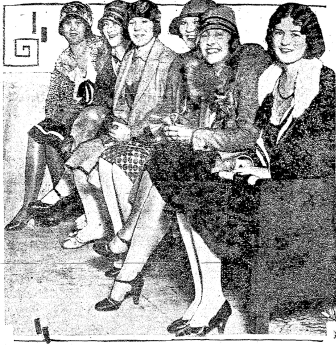
In a politicized May 1927 injunction suit brought by two halls, the plaintiffs’ attorney reportedly argued that the new ordinance would “deprive the girls of their constitutional right to earn a legitimate livelihood.” The “argument that Seattle dance hall girls have as much legal right to solicit dances on commission as Mayor Bertha K. Landes has to solicit votes” also featured, though the speaker went unrecorded.Footnote 96 This subversive phrasing rehabilitated the language of solicitation, rhetorically putting the night workers on par with an upstanding if anomalous woman in politics. At least half a dozen dancers attended, adorned in chic outfits and, in the case of Jean Brown, what appeared to be a fur scarf (Fig. 1).Footnote 97 Their court appearances elicited sympathy from reporters alert to the dual burden of night work and daytime advocacy.Footnote 98 The only recorded dancer testimony came from two women, one of whom was married to a detective, who spent three nights working in each of two halls.Footnote 99 Though these were likely undercover inspectors, their nearly identical affidavits capture workplace pressures and the risk of unwanted advances: Elma Wilson’s described a manager prodding her about “wheedling the men into buying drinks,” while Katherine Pellet attested to being “bawled out” by a male employee after she skipped a date with him.Footnote 100 That WDEU members, along with unionized musicians, stood with management indicates that the earnings may have made such indignities seem worthwhile.Footnote 101
Six dance workers attend an injunction suit brought by two dance halls against the City of Seattle, Mayor Bertha Landes, and the Chief of Police. Jean Brown of the Women Dancing Entertainers’ Union is seated second from the right (“To Dance Or Not To Dance,” Seattle Post-Intelligencer, June 30, 1927, 4, NewsBank: Access World News).

The lengthy trial produced a stalemate. Halls remained open yet officially could not pay dancers by commission. Mayor Landes continued tussling with the City Council over license renewals, yet focused more on technocratic matters such as transportation, budgeting, and utilities. The dance hall issue haunted her 1928 campaign, when frustration with vice reforms—alongside widespread sexism, shadowy yet abundant campaign financing for her opponent, unpopular budget-trimming layoffs, and a recent bridge closure—tipped voters toward a political unknown, Frank Edwards, with strong support south of Yesler.Footnote 102
Filipino dancers, sexual racism, and the closing of the ten-cent halls
While it is difficult to distinguish the dancers’ voices— and votes—in the election that defeated Landes, they likely expected Mayor Frank Edwards (1928–1931) to be a friend of dance. The Strand’s proprietor campaigned for Edwards, who allegedly helped him secure a dance hall license. In an apparent volte-face, the new mayor deemed the halls “centers of immorality.”Footnote 103 Race became central in dance hall debates for three reasons. First, the segregated Liberty Hall had lost its place in reformers’ crosshairs after Edwin Brown’s term ended in 1926. Second, the political transition in 1928 replaced Landes, whom the city’s leading Black newspaper described as personally tolerant but politically apathetic on matters of race, with a mayor whose policies evinced racial animus.Footnote 104 Finally, the halls featured a growing share of Filipino patrons amid a mounting sexual panic about white women and Asian men. This coincided with the passage of anti-intermarriage laws in much of the western U.S.Footnote 105 Intensifying racism manifesting in Washington State’s 1921 alien land law, aimed at curtailing Japanese farm ownership, and through Seattle’s proliferating racially restrictive covenants.Footnote 106 White male sexual resentments assumed increasingly violent dimensions, most notoriously in 1930 when the opening of a taxi dance hall in Watsonville, California provoked a riot and culminated in the murder of Fermin Tobera.Footnote 107
Racist discourses surrounding dance halls targeted Filipinos, as the latest wave of arrivals. By 1930, 1,563 Filipinos and 51 Filipinas resided in Seattle. This reflects a fraction of the workers, students, and recreation-seekers cycling through this “colonial metropole.”Footnote 108
Having weathered U.S. imperialist policies of “benevolent assimilation,” many Filipino migrants to the U.S. sought continuities in their schooling. Paradoxically, the presence of English-speaking Filipinos exhibiting middle-class manners threatened constructed racial hierarchies.Footnote 109 Filipinos were stereotyped as sexually promiscuous.Footnote 110 Seattle police officers regularly harassed, beat, and arrested Filipinos in the company of white women. To avoid physical harm, Filipinos could frequent “high class” establishments free from brutal patrolling, as was the strategy of one University of Washington student who married a white woman; date women of color, which tended to elicit less hostility; or meet women in dance halls.Footnote 111 Dance halls, too, could be sites of racist policing; one 1927 police inspection documenting illegal liquor sales added, as if evidence of criminality, that about half of the patrons were Filipino.Footnote 112 Amid rising tensions, a Filipino Forum contributor insisted on Filipinos’ right as law-abiding U.S. nationals to circulate in the halls. He estimated that two thirds of the city’s dance halls would close for lack of business if Filipinos were banned.Footnote 113
When Filipino men danced with white women, “who exploited whom?”Footnote 114 Dance halls could drain the pockets of Filipinos, who as racialized workers lacked fair compensation. Elderly Filipino interviewees in a 1970s oral history project recalled having made as little as 10–35 cents per hour as migratory laborers.Footnote 115 Others accepted room and board and a mere ten dollars a month as a “houseboy,” a common occupation of high school and university students.Footnote 116 Felix Narte, who traveled into Seattle to dance, remembered that it was possible to spend three dollars in an evening.Footnote 117 High outlays might buy only a fickle dose of affection. Men competed for women’s attention and could wind up in the “icebox” when another patron showed a “bigger bankroll.”Footnote 118 Given the financial stakes, some Filipino organizations on the West Coast sought curtailment of the halls.Footnote 119 Interviewees nonetheless described the dancers as relatable people. The women were college students, girlfriends or wives, runaways seeking freedom from parents, and workers making a living.Footnote 120
Dance hall workers’ descriptions of Asian patrons, conversely, suggest a fragile sympathy not divorced from economic interest. Reports on Filipino dancers consistently reference their dance talents, debonair appearance, and tailored suits; this contrasted with the overalls favored by many white male dancers.Footnote 121 The Seattle Star printed the “startling reply” of a dancer who preferred integrated halls. She cited the politeness and liberal spending she could expect from Asian patrons, yet laced her description with an epithet about Japanese people.Footnote 122 A police report claimed that workers promised dates “for the purpose of prostitution” to encourage spending, only to skip out.Footnote 123 Some interactions were predatory, as women “fleeced” their dance partners.Footnote 124 Cressey’s sociological analysis described white dancers treating Asian customers as “fish’ to be exploited.”Footnote 125 Recent scholarship has cautioned, however, that the “duped ‘Oriental’” may have been the only interpretation legible to inspectors.Footnote 126
Mayor Edwards treated interracial sexuality as a social and medical pathology. Forty-eight women quarantined in City Hospital had been arrested in the “10-cent halls,” a statistic seemingly referencing sexually transmitted infections. Edwards met twenty-five ill dancers, two of whom were local. He called for Seattle to “cease to be the dumping ground for the lower elements,” yet cast dancers as “innocent girls, in search of a livelihood.” Turning on a former supporter, Edwards promised in late 1929 that the “Strand Dance Hall, where white women solicit dances and drinks from Filipino and white habitues, will get the ax first–on Monday.”Footnote 127 The City Council denied the Strand a license and urged the Chief of Police to deny permits to similar halls.Footnote 128 A brief Filipino Forum entry registered disappointment at the closures.Footnote 129
Descriptions of venereal disease elicited an indignant response from Jean Brown, then president of the 350-member WDEU.Footnote 130 She declared that the dancers garnering negative attention were “floaters” rather than union members.Footnote 131 Many taxi-dance workers nationwide did maintain an itinerant lifestyle, sometimes leaving town to avoid specific patrons expecting sexual favors.Footnote 132 The WDEU prioritized a reputation of propriety over geographically expansive solidarities.
The WDEU, by then an AFL affiliate, sought support from musicians’ and janitors’ unions and citywide labor leaders.Footnote 133 Jean Brown explained to the Central Labor Council that hundreds of women, many with dependents, were in dire straits.Footnote 134 The Central Labor Council secretary had heard reports that “the whole trouble comes from the fact that a majority of the patrons are Filipinos.” He demonstrated little solidarity, reportedly saying the halls should stay closed if it “is purely a matter of morals.”Footnote 135 The Council approved a draft contract to prohibit solicitation of drinks or dances, pay dance workers a flat rate of fifty-five cents an hour, and guarantee four hours of daily employment. It suggested reopening below-the-line halls “with a rule prohibiting mingling of races,” according to newspapers.Footnote 136 Dancers supported the salary basis.Footnote 137 The lack of a clear WDEU response to the segregationist proposal raises the possibility that the union acceded to the racist attitudes of the AFL.
Dance hall entertainers—banned?
As the Great Depression dragged on, newspapers reported on the “exodus” of “banned” dance workers.Footnote 138 Competition from radios and “talkies” drove a concurrent employment slump for Seattle musicians.Footnote 139 A reporter who went “slumming” in Skid Row found only boredom and underemployed dance workers.Footnote 140 Reported dance ordinance violations and licensing struggles dragged into the 1930s, but the WDEU faded from the record.Footnote 141 Its members likely accepted lower earnings in remaining halls, migrated, or entered different sectors. A declension narrative of shuttered businesses and failed solidarities, however, risks overstating the halls’ demise. Oral histories hint at continuities, with a Filipino dance hall manager making his way into what had been a predominantly white, male occupation.Footnote 142 Filipino musicians, too, gained a toehold in 1930s Seattle’s dance scene.Footnote 143 This coincided with rights-claiming by Filipinos in Seattle, notably through the formation of Cannery Workers and Farm Laborers Union Local 18257.
Seattle provides a unique case in which a woman executive and unionized women entertainers each mobilized a gendered rhetoric of propriety while remaining nearly silent about race. The three-part development of the dance hall battles reveals high political stakes intrinsic to this sexualized variant of night work. The administration of Edwin Brown featured a conflict between dance hall allies making pro-working class arguments, and opponents concerned with vice and municipal graft. Bertha Landes’ mayoralty showed how a gendered reform politics seeking to protect (and constrain) white women could backfire, weighing on Landes’ failed reelection campaign. Finally, the comparative effectiveness of Frank Edwards in shuttering four halls reveals how sexual racism could be a sharper political weapon than were calls for uplift. Seattle’s dancers meanwhile sought to protect their economic well-being, at times missing opportunities for alliances with itinerant dancers, male unionists, and people of color.
Seattle’s dance hall battles coincided with regulatory efforts to curtail women’s nighttime employment. Night work regulations tended to focus on factory hours, or else the forms and duration of women’s night work, for example in mercantile establishments.Footnote 144 Amicus briefs attempted to persuade courts of the physical toll of night work, resultant familial neglect, and moral risks arising from exposure to coarse talk, dangerous commutes, and temptations to drink.Footnote 145 However meticulously compiled, legal briefs and Women’s Bureau tracts on night work tended to elide the labor of women entertainers. The Women Dancing Entertainer’s Union’s insistence that they were, at the most basic level, workers and economic providers, provides a powerful corrective to contemporaries’ and, until recently, historians’ tendency to overlook sexual sector night labor.Footnote 146

 Open access