


INTRODUCTION
Meningococcal meningitis affects sub-Saharan Africa in a unique and distinctive way. In a region known as the meningitis belt, which spans the continent from Senegal to Ethiopia [Reference Lapeyssonnie1, Reference Molesworth2], there is an increase in incidence of meningococcal meningitis every dry season, which dies out when the first rains arrive [Reference Moore3]. At intervals ranging from 6 to 14 years [Reference Moore4, Reference Roberts5], major epidemics occur, the largest of which killed more than 25 000 people in 10 countries in 1996–1997 [Reference Roberts5]. Some epidemics last for more than 1 year, dying out in the rainy season, only to return afterwards. In a single community, however, an epidemic may last only a few weeks [Reference Greenwood6]. Serogroup A Neisseria meningitidis is the principal cause of these epidemics, although serogroups C, W135 and X have also been implicated [Reference Greenwood7]. The long-term trends in the annual number of meningitis cases in Burkina Faso are shown in Figure 1; this illustrates the periodic, although irregular patterns of epidemics, which vary in size and duration. At the district level, the World Health Organisation threshold for vaccination is defined as weekly incidence of more than 10/100 000 population [8]. In individual communities, incidence rates in epidemics can be in the range of 50–1000/100 000 [Reference Mueller and Gessner9].
Annual number of reported suspected meningitis cases in Burkina Faso, 1940–2008. (Reproduced from [Reference Mueller and Gessner9] with permission from Elsevier.)

Mathematical models of infectious diseases have been widely used to describe patterns of disease and investigate the mechanisms underlying the observed epidemiology. Several theoretical models have been proposed to describe the epidemiology of meningococcal meningitis in the African meningitis belt [Reference Moore3, Reference Mueller and Gessner9, Reference Griffiss10], but these have not yet been translated into a mathematical structure that would allow a thorough investigation of their hypotheses. In this paper we develop transmission models for meningococcal infection to investigate how well simple compartmental models are able to qualitatively capture the patterns of disease observed in the meningitis belt. Although we aim to keep the models as simple as possible (ignoring for example the spatial heterogeneity in disease incidence that is known to exist), several key features must be incorporated to adequately represent the dynamics of meningococcal infection. Where there is uncertainty in the most appropriate model structures and assumptions we have examined a range of options.
The meningococcus can asymptomatically inhabit the nasopharynx, with reported carriage prevalences in the meningitis belt ranging from 3% to 30% [Reference Trotter and Greenwood11]. Only a small proportion of carriers develop invasive disease; the ratio of carriers to cases is likely to be greater than 100:1 [Reference Greenwood7]. Thus, transmission models of meningococcal infection must explicitly include this carrier state [Reference Trotter, Gay and Edmunds12, Reference Trotter, Gay and Edmunds13]. The duration of carriage has not been well researched, but the only study of serogroup A in Africa (to our knowledge) suggested a duration of a half-life of carriage of around 1 month. Disease probably results within a week of infection [Reference Edwards14] but it is not clear whether this constitutes a brief period of carriage before disease or is more accurately represented by direct transition to a disease state; both are considered here.
The seasonality of meningococcal disease is one of the key features of the meningitis belt and must also be captured in a transmission model. A substantial role is played by seasonality for many infectious diseases [Reference Altizer15, Reference Grassly and Fraser16]; this has been widely studied for childhood viral diseases including measles, where seasonal forcing of contact rates (e.g. school terms and holidays [Reference Earn17–Reference Olsen, Truty and Schaffer19]) and birth rates [Reference He and Earn20] can result in complex dynamics. For meningitis, environmental factors are believed to be important in explaining the observed seasonality, particularly the Harmattan, a dry, dusty trade wind that blows across the region during the dry season. There are two hypotheses of how this may affect meningitis incidence. It is possible that transmission of the infection via airborne droplets is more efficient during the dry season [Reference Greenwood6, Reference Trotter and Greenwood11], resulting in an increase in the number of carriers and subsequently the number of cases. Another (perhaps more widely accepted) hypothesis is that the dry and dusty nature of the wind may damage the mucosal barrier in the nasopharynx, making carriers more susceptible to invasive disease [Reference Moore3, Reference Greenwood6, Reference Trotter and Greenwood11]. If this were the case, carriage levels would not vary significantly between seasons, but the ratio of carriers to cases would. Mueller & Gessner's hypothetical model incorporates both of these hypotheses, as they postulate that an increase in the likelihood of disease given carriage changes the model state from endemic rainy season to hyperendemic dry season, and that the transition from a hyperendemic state to localized epidemics is due to increased transmission [Reference Mueller and Gessner9]. A review of the data available from carriage studies in the meningitis belt [Reference Trotter and Greenwood11] showed large variation in reported carriage rates but no clear link to seasonality; however, the limited nature of this data means that this possibility cannot be ruled out. Recent data from carriage studies in Burkina Faso showed that carriage prevalence was significantly higher during the dry season [Reference Kristiansen21]. Here we model scenarios where either the transmission rate or the rate of progression from asymptomatic carriage to invasive disease (or both) is seasonally forced, to investigate which produce patterns of disease consistent with those observed.
The role of immunity was another key question we sought to investigate. The hypothetical models of both Mueller [Reference Mueller and Gessner9] and Moore [Reference Moore3] suggest that changes in population immunity can lead to widespread epidemics. In Mueller & Gessner's model, the introduction of a new strain that can evade pre-existing immunity causes the transition from localized epidemics to epidemic waves. Moore [Reference Moore3] also highlights the potential importance of the introduction of new strains, but adds that high susceptibility can also result from waning of previously acquired immunity. The hypothetical ‘immunoepidemiologic model’ of Griffiss [Reference Griffiss10] is also centred around changes in immunity, but is rather different in that it suggest that epidemic susceptibility results from the induction of serum IgA from cross-reacting enteric bacteria, which block the effective serum bactericidal antibodies.
Although classic studies by Goldscheider et al. in the 1960s [Reference Goldschneider, Gotschlich and Artenstein22] established serum bactericidal activity as the accepted surrogate of immunity against disease, the role of immunity to the meningococcus is far from being clearly understood, particularly in the context of the African meningitis belt. Some previous models of meningococcal infection in Europe [Reference Trotter, Gay and Edmunds12, Reference Trotter, Gay and Edmunds13] did not explicitly include immune compartments; rather, the acquisition of immunity from carriage is only implicitly included by way of reducing the risk of disease given infection with increasing age, consistent with observations that antibodies against N. meningitidis increase with age, probably as a result of frequent exposure to the meningococcus through periods of carriage [Reference Goldschneider, Gotschlich and Artenstein22–Reference Pollard and Frasch24]. However, since in the African setting changes in population immunity have been suggested to be an important factor influencing epidemics [Reference Moore3], we included immunity in our models. We compared different sources of immunity: from disease alone (assuming that invasive disease leads to a much more robust immune response than colonization), from carriage and disease (consistent with observations in adults that bactericidal activity is acquired or boosted following periods of carriage [Reference Goldschneider, Gotschlich and Artenstein22, Reference Reller, MacGregor and Beaty23]), or from neither.
MODELS
We use simple deterministic compartmental models where individuals can be susceptible to infection (S), an asymptomatic carrier (C), ill (I), or immune (R). We denote the models with no immunity, immunity from disease alone and immunity from both disease and carriage as SCIS, SCIRS I and SCIRS CI, respectively. Both carriers and cases are infectious, with transmission rate β. Carriers can either develop invasive disease (at rate a) or lose carriage (at rate α), becoming susceptible in the SCIS and SCIRS I models, and immune in the SCIRS CI model. Those with invasive disease recover at rate ρ (again, to R or S as appropriate) and immunity wanes, so that they return to the susceptible compartment at a rate ϕ. There is a natural death rate from all compartments μ and disease-induced mortality γ. The structure of these models is illustrated in Figure 2.
Disease progression for each model: (a) SCIS, (b) SCIRS I, (c) SCIRS CI, (d) SCIRS ALT.

The total population, N, is S+C+I or S+C+I+R as appropriate. People are born susceptible at a rate b. As we are primarily interested in the effects of infection and not of population dynamics, we follow the approach used by Dye & Williams [Reference Dye and Williams25], taking the birth rate to be b=μ+γI. Since the population is then constant, we can set N=1 so that the values of S, C, I, and R are proportions of the total population. The SCIRS CI model is given by


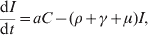
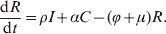
The SCIS and SCIRS I models are defined analogously (equations defining all models are available in the Supplementary material (available online). In each of these models, invasive disease can only occur after a period of time spent in the carriage class. To study the scenario where some people become sick shortly after colonization with the meningococcus, an alternative version of the SCIRS CI model is considered. In this instance, denoted SCIRS ALT, a proportion δ of those infected progress directly from S to I. Note that the SCIRS CI model is the limiting case of SCIRS ALT with δ=0, and SCIS is a limiting case of SCIRS I or SCIRS CI as ϕ tends to ∞.
To compare the effects of the seasonal changes in the transmissibility with changes in the progression rate, we replace one or both of the constant rates a and β with the periodically forced expressions

and

so that the parameter value in question is higher in the dry season that in the rainy season.
Since transmission largely occurs silently from carrier to carrier, several of our parameters have not been well studied or are unknown. As mentioned above, the only attempt to estimate length of carriage of serogroup A meningococcus [Reference Blakebrough26], suggested that carriage has a half-life of 1 month, although it is likely to vary between different strains and age groups [Reference Trotter, Gay and Edmunds12], so we consider carriage length 1/α in the range 1–52 weeks. Similarly, the duration of immunity is unknown, so where applicable we consider a range of 2 months to 25 years. We explore a wide range of values for the transmission parameter β, both to capture the very wide variation in observed carriage rates, and to best explore the model's possible dynamics.
We solved the systems for the parameters given in Table 1. Some of the values considered for a were unrealistically large to allow the model's dynamics to be better understood. In the SCIS, SCIRS I and SCIRS ALT models, for each combination of the other parameters, a was varied in the range 0·1, 0·5, 1, 2, 3, 4, …, 52 and we observed (a) for which values of a disease incidence displayed non-annual behaviour; (b) the longest inter-epidemic period for regular outbreaks; (c) whether there were any irregular regimens and (d) the range of values of I at the largest epidemic peak during non-annual regimens. For the SCIRS CI model, a more fine-grained range of parameters was considered. In this instance the length of inter-epidemic period after a transient period had passed was calculated for each combination of parameters using a Fourier transform. Models were solved numerically using a two-step Rosenbrock algorithm [Reference Press29] in XPPAUT [Reference Ermentrout30].
List of parameters meanings and the parameter ranges for which the model was solved

RESULTS
We first considered the SCIS model without seasonal forcing (εβ=εa=0). The possible dynamics of this system are very limited. When the combination of parameters is such that the basic reproductive number R 0<1, the disease dies out. For R 0>1, the system tends to a unique endemic steady state, either monotonically or via a series of damped oscillations. However, in the SCIS model the endogenous oscillations are damped extremely quickly. This means that when there is seasonal forcing (i.e. when εβ or εa>0), it cannot substantially interact with the underlying oscillations of the model. Thus once the natural oscillations have been damped out over time, there is only annual variation in incidence.
For all the other models, the system approaches its steady state through damped oscillations. When immunity is caused by disease only (the SCIRS I model), again these oscillations are usually very quickly damped. The exception is when a is very large, where the damping is very slow. When both disease and carriage cause immunity (the SCIRS CI and SCIRS ALT models), the pattern of slowly damped oscillations is present for a large range of the parameter space.
We next considered the behaviour of the SCIRS I model, where only invasive disease causes immunity. In this model, if the transmission parameter β is seasonally forced but the progression rate a is constant, then we can observe epidemics at regular intervals with a period of 2–15 years. We can also observe epidemics which occur frequently but at unpredictable times, and are of irregular magnitudes. Between epidemics and in every wet season disease incidence is very low. However, these complex dynamics are observed in this model only if the endogenous oscillations are damped slowly enough to allow them to interact with the seasonal forcing; i.e. when a (the rate of progression to disease from carriage) is unfeasibly high. This is because only invasive disease causes immunity, so in order for the immune class to have any effect on the dynamics (creating a difference between this model and the one with no immunity), a must be sufficiently large. When a is realistically small, too few individuals become infected and therefore too few have immunity. However, when a is large, the epidemics are of an unrealistically high magnitude. For example, for α=25, β=120, ϕ=0·1, εβ=0·9, εa=0 and a=50, there are irregular epidemics. However, not only is a>α in this case, but during some years' epidemics, up to 10% of the population has meningococcal meningitis at any one time.
There is a similar problem in either of the SCIRS models if a alone is forced. The number of people with invasive disease is small, so for I's magnitude to be realistic, a must be too small for any annual variation in it to sufficiently perturb the system from the steady state to cause recurrent epidemics. This is the case whether or not carriage causes immunity.
When immunity is conferred by carriage and disease, the immune class can reach a larger size without unrealistically high disease levels. This means that when β is seasonally forced in the SCIRS CI model, complex dynamics with irregularly timed epidemics are present for much of the plausible parameter space, a section of which is shown in Figure 3. For some of the parameter space, identically sized epidemics occur every dry season (Fig. 4 a). There are also, for some parameters, epidemics at regular multiple year intervals (Fig. 4 b, c). Periods of between 2 and 10 years are most common, but those of up to 30 years also possible for lower transmission rates and longer immunity periods. Moreover, for many parameter values there are epidemics at unpredictable times (Fig. 4 d). In irregular regimens, there are sometimes epidemics in consecutive years as in Figure 4 d, similar to those epidemics in the meningitis belt which last more than 1 year, but die out in the rainy season in between. In most cases, a smaller epidemic precedes a larger one. Whatever the behaviour of the system, levels of carriage and disease are very low each wet season, with typical values of I as low as 10−7 to 10−20 and only increasing by a factor of around 2–10 in non-epidemic dry seasons. In this model, unlike the others considered, the epidemics can be of a realistic size, due to immunity being the result of both carriage and disease. This pattern of complex dynamics occurs for parameter values such that when the system is unforced, the period of the damped oscillations observed is in the range of 1–5 years.
The inter-epidemic period (years) of the SCIRS CI model depending on parameters ϕ and β. Parameter regimens in which epidemics occur at irregular intervals are marked in white. Parameter values: a=0·8, εa=0, εβ=0·4, α=52.

Weekly incidence of meningitis per 100 000 population in the SCIRS CI model for different lengths of immunity, forcing only β. Calculated from time-series by weekly incidence . (a) Annual epidemics. (b) Biennial epidemics. (c) Epidemics every 5 years. (d) Epidemics of unpredictable magnitudes and occurring in unpredictable years. Parameters: a 0=0·2, α=26, εa=0, β0=90, εβ=0·5. (a) ϕ=0·5; (b) ϕ=0·25; (c) ϕ=0·1; (d) ϕ=0·085.

As is clear from Figure 3, the period of the multiennial cycles is longer when the duration of immunity is longer (i.e. ϕ is lower). Regimens with realistically long inter-epidemic periods exist for a wide range of parameter values when the duration of immunity is ⩾2 years (ϕ<0·5). The longer that immunity lasts, the longer it takes for the pool of susceptibles to increase to critical levels, increasing the inter-epidemic period, as can be seen in Figures 3 and 4. The SCIS model can be seen as the limiting case of the SCIRS models as ϕ→∞, so the lack of multiennial outbreaks should be no surprise. In addition, in the SCIRS CI model with forced β, these complex dynamics are more common when the length of carriage is shorter, i.e. when α is larger. Although increasing the magnitude of seasonal forcing increases the likelihood of complex dynamics, such behaviour is still often seen for modest values of εβ, as shown in Figure 3.
Another feature that is clear from Figure 3 is that as ϕ or β gradually changes, the system alternates between regions of regular and irregular behaviour. Between the regions of regular 5-year epidemic cycles and regular 6-year cycles lies a set of irregular epidemics. Fourier analysis of the time-series in this region shows that the dominant period has a non-integer value between 5 and 6. These transitions are more closely demonstrated in the Supplementary material (available online).
We also studied the effect of simultaneously seasonally forcing a and β in the SCIRS CI case. Here, to produce recurrent epidemics the amplitude of forcing εβ must be sufficiently large; it is not enough to have small εβ and large εa. For a fixed value of εa, increasing εβ will increase the chance of resonant oscillations. However, for a fixed value of εβ, increasing εa has little effect. Overall, the dynamics are not significantly different to when only β is forced.
When δ is small, the SCIRS ALT model has similar dynamics to the SCIRS CI model. This is as expected, because SCIRS CI is equivalent to SCIRS ALT when δ=0. It can result in epidemics at regular or irregular intervals, with realistic parameter values and with realistic levels of disease incidence. Although only a small proportion of those leaving compartment S do not become carriers, they account for a significant proportion of the cases of meningitis. If R 0>1, β must be quite large, so if δ is not small, complex dynamics require disease prevalence of at least 1 in 200. The results of all the models are summarized in Table 2.
Summary of results

For all of the models considered, when there are recurrent epidemics, either regular or irregular, disease rates peak a few weeks after the peak in carriage rates, mainly due to a quick recovery, i.e. a short duration of infection 1/ρ. In the SCIRS CI and SCIRS ALT models, when β is forced both C and I peak shortly after the seasonal forcing reaches its maximum level.
DISCUSSION
Our results show that seasonal variation of transmission is capable of accounting for the complex and irregular epidemics of meningococcal meningitis in the meningitis belt in simple transmission models when carriage and disease both confer temporary immunity. Our results indicate that the frequent but irregular epidemics could be the result of interaction between temporary immunity and seasonal variation in disease transmissibility. The interaction between the disease's endogenous frequency, based on temporary, damped oscillations that can occur in the absence of seasonal forcing, and the external frequency of seasonality results in the appearance of subharmonics and recurrent epidemics at both regular and irregular intervals. This has been suggested as a cause of recurrent epidemics of other diseases [Reference Earn17–Reference He and Earn20]. Although our work does not represent a theoretical advance this is the first time that such an explanation has been proposed for the repeated epidemics seen in the meningitis belt. The model's behaviour is quite sensitive to the choice of parameters that are used, as demonstrated by Figure 3. Their values may in reality change slightly over time, for example as the birth rate or force of infection varies. These small perturbations could cause the system to move between attractors of different periods, resulting in the quasi-periodic epidemics that are observed in the meningitis belt.
This study suggests that seasonal changes in transmissibility of meningococci are more important than seasonal changes in the rate of progression to disease. Our simulations show that even a modest seasonal change in β can result in a range of different patterns of epidemics, many of which are consistent with the observed epidemiology in the meningitis belt. In contrast, changes in the rate at which carriers develop disease do not have a large enough effect on the system to produce the periodicity or range in the magnitude of incidence desired. Although we cannot rule out the possibility that progression to disease varies seasonally, in our models this must be accompanied by seasonal changes in transmissibility in order to reproduce the observed epidemic patterns. We would therefore predict that adequately powered carriage studies will observe seasonal changes in carriage and that carriage prevalence varies from year to year. Importantly, our models indicate that epidemics will be accompanied by relatively high carriage rates (consistent with Mueller [Reference Mueller and Gessner9]). This is not just an artefact of one particular model structure; it was shown for models allowing direct progression to disease as well as those where illness was preceded by carriage.
Our results suggest that immunity caused by disease and asymptomatic carriage may be an important factor in causing the unusual epidemiology of meningitis in sub-Saharan Africa. Since meningococcal immunity is not well understood, we considered several model structures. If carriage does not induce immunity, as in the SCIS and SCIRS CI models, the system is not perturbed sufficiently from its steady state to cause inter-outbreak periods greater than a year. When both carriage and invasive disease cause immunity, complex dynamics are present for a wide range of durations of immunity, although these dynamics are more common and have a realistic inter-epidemic period when immunity is in the range of 2–10 years. A parallel can be drawn between this result and that of Grassly et al. [Reference Grassly, Fraser and Garnett31], who showed that temporary immunity is probably a factor in epidemics of syphilis in the USA that occur every 8 and 11 years.
This result is of potential public health importance as it suggests that seasonal variations in environmental factors such as humidity are insufficient, in simple models, to explain the observed patterns of disease in the meningitis belt in the absence of immunity [Reference Sultan32]. In contrast, with immunity of sufficiently long duration, seasonal variation in transmission may be sufficient to cause very complex epidemics. It appears therefore that models used to predict the likelihood of epidemics should take into account population immunity levels, as well as environmental factors.
These results provide some support to Mueller & Gessner's hypothetical model [Reference Mueller and Gessner9]. There, the driver of local epidemics is an increased transmission rate causing a surge of carriage, in agreement with the conclusions drawn from our SCIRS models. However, our models show only a very small difference in the number of cases between the dry and wet seasons, Mueller's ‘endemic’ and ‘hyper-endemic’ periods, even when a and β are simultaneously forced. As our model does not take into account spatial factors, it is best viewed as a description of disease dynamics on a local level. An extension of this model to a meta-population version could be used to study the transition between localized epidemics and epidemic waves. In particular, the appearance of a few local epidemics in a non-epidemic wave year in such a model would be likely to capture the increase in incidence between endemic and hyper-endemic periods that ours does not.
There are a number of limitations to using simple models such as those described We assumed homogeneous mixing for simplicity, but since the risk of meningococcal meningitis varies by age [Reference Leimkugel33], and current vaccination strategies are targeted at the 1–29 years age group an age-structured model with heterogeneous mixing patterns should be used to assess the impact of different vaccination strategies. We chose a sinusoidal term to model seasonal forcing. In reality, given the sudden fall in cases when the first rains arrive, a forcing which fades in gradually but then switches off suddenly might provide a more accurate description of the progression of a single epidemic. However, as it is not yet clear which environmental factor drives the seasonality, using such a method is not currently justified. Another difficulty is that many of the parameters included in our model are not readily available from existing data, although there are recurrent epidemics for a large proportion of the parameter space considered. Ongoing large-scale carriage studies in the meningitis belt (www.menafricar.org) should allow parameter values to be more accurately estimated in the future. Factors such as viral co-infections or cross-reactive immunity were not considered here, to enable the models to be kept simple. As Griffiss [Reference Griffiss10] suggests, these may well play a role in the epidemiology of meningococcal meningitis in the region, but our results demonstrate that they are not necessary in order to capture many aspects of the complex observed dynamics.
Despite these limitations, we have shown that our deliberately simple models can be useful in investigating different hypotheses and elucidating possible mechanisms behind the distinctive epidemiology of meningococcal meningitis in the African meningitis belt. The models will be refined as more data become available from clinical studies, and extended to address public health questions such as the impact of vaccination.
NOTE
Supplementary material accompanies this paper on the Journal's website (http://journals.cambridge.org/hyg).
ACKNOWLEDGEMENTS
T.I. and K.B. are supported by EPSRC grant EP/501214/1. C.T. is supported by the MenAfriCar consortium (Bill & Melinda Gates Foundation/Wellcome Trust).
DECLARATION OF INTEREST
None.



