




Introduction
Agriculture, including livestock farming, is one of the main contributors to human-induced climate change (Prasad et al., Reference Prasad, Kumar, Sheetal and Venkatramanan2020). There are enormous benefits of agricultural intensification in terms of providing an adequate food supply for the growing population of developing countries. However, the flip side is that there are associated consequences with inefficiencies. Evidence suggests that agricultural emissions have increased over the past few decades (Lassey and Harvey, Reference Lassey and Harvey2007; Thomson et al., Reference Thomson, Giannopoulos, Pretty, Baggs and Richardson2012). The Indo-Gangetic plain has been reported to be an area high in gaseous nitrogen pollutants such as ammonia (NH3) and nitrogen oxide (NOx) deposition (Clarisse et al., Reference Clarisse, Clerbaux, Dentener, Hurtmans and Coheur2009; Singh et al., Reference Singh, Sharma and Kulshrestha2016). In addition, an important (non-greenhouse gas (GHG)) pollutant which is mainly from agriculture and has a significant effect on ecosystems is ammonia (NH3). The majority of agricultural NH3 is from livestock manure (Galloway et al., Reference Galloway, Townsend, Erisman, Bekunda, Cai, Freney, Martinelli, Seitzinger and Sutton2008; Kavanagh et al., Reference Kavanagh, Burchill, Healy, Fenton, Krol and Lanigan2019; Sommer et al., Reference Sommer, Webb and Hutchings2019). Among the GHGs that contribute to climate change, nitrous oxide (N2O) is one of the most potent. Per molecule, the global warming potential of N2O is over 264–310 times more than that of CO2 (IPCC, 2014). Of concern is that agriculture is the largest source of N2O (Reay et al., Reference Reay, Davidson, Smith, Smith, Melillo, Dentener and Crutzen2012). Besides the gaseous nitrogen emissions from livestock farming systems, agriculture contributes to methane (CH4) emissions (Lassey, Reference Lassey2008). The global warming potential of CH4 is more than 25–34, greater than that of CO2 (IPCC, 2014). Livestock are responsible for 0.30 of global CH4 emission, and about 0.36 of global emissions of enteric CH4 is from Asia, and India is one of the main contributors (FAO, 2021).
India is the second-largest contributor out of the four countries responsible for 0.47 of the global reactive nitrogen (Nr) emissions (Oita et al., Reference Oita, Malik, Kanemoto, Geschke, Nishijima and Lenzen2016). The gradual accumulation of Nr due to increased human activities has impacted air and water quality, human health, soil health and biodiversity (Singh and Singh, Reference Singh and Singh2008; Aneja et al., Reference Aneja, Schlesinger and Erisman2009). Also, nitrogen pollution causes damage to the aquatic environment. There is evidence that anthropogenic emissions of nitrogen have resulted in ecological damage along much of India's coastline (Abrol et al., Reference Abrol, Adhya, Aneja, Raghuram, Pathak, Kulshrestha, Sharma and Singh2017). Globally, there is increasing awareness of the polluting potential of nutrients when used inefficiently. However, this concern has not been sufficiently reflected in policies, particularly in developing countries (Kanter et al., Reference Kanter, Bartolini, Kugelberg, Leip, Oenema and Uwizeye2020a, Reference Kanter, Chodos, Nordland, Rutigliano and Winiwarter2020b).
India has one of the highest livestock densities globally but also has interesting peculiarities. For example, despite having the largest cattle herd of all countries, the human population consists of many vegetarians (0.31). Farmers in India mainly rear cows for dairy products (Kumar and Kapoor, Reference Kumar and Kapoor2014; Phillips, Reference Phillips2021). In India, the total emission from livestock is approximately 222.7 million tonnes of CO2e (MoEFCC, 2021). Besides, the efficiency and productivity of cattle in India is reportedly among the lowest globally (O'Mara, Reference O'Mara2011; Manoj, Reference Manoj2015), hence, justifying the importance of addressing the livestock nitrogen pollution in India. This paper aims to piece together the available information on livestock nitrogen emissions, focusing on highlighting the solutions to reduce nitrogen pollution from cattle production in India. Specifically, the study reviews the literature on the scale of nitrogen pollution in India, the consequences of nitrogen pollution, nitrogen transaction related to different production systems, the factors that drive nitrogen losses and the sustainable solutions to the problem.
The review approach used in this paper is narrative. The goal is to present an overview, clarify present knowledge, draw attention to the issue and highlight the contributions of different studies towards a cumulative understanding of nitrogen pollution from cattle production in India. The rest of the paper is structured as follows. Section ‘The agricultural sources of nitrogen pollution in India’ discusses the agricultural sources of nitrogen pollution in India. Section ‘Social cultural, and economic determinants of nitrogen pollution from cattle production’ reviews the social, cultural and economic dimensions. We discuss the solutions to reduce nitrogen pollution in Section ‘Solutions to reduce nitrogen pollution from cattle production’. Finally, Sections ‘Future perspectives’ and ‘Conclusion’ present the future perspectives and conclude the paper, respectively.
The agricultural sources of nitrogen pollution in India
The scale of nitrogen pollution cannot be highlighted without a discussion of nitrogen losses that accrue from crop production. In India, just as it is globally, nitrogen is lost due to poor management of chemical fertilizer and livestock manure during crop production. In 2015–16, India accounted for approximately 0.16 of the global nitrogen fertilizer production (Abrol et al., Reference Abrol, Adhya, Aneja, Raghuram, Pathak, Kulshrestha, Sharma and Singh2017). At the same time, the country relies heavily on the use of fertilizer to increase crop yields (Andrews and Lea, Reference Andrews and Lea2013). Due to rapid population growth and the consequent increase in food demand, India's nitrogen fertilizer use is growing at a rate of 1.96%, almost equal to the population growth rate. This fertilizer use could continue to increase at current trends (Andrews and Lea, Reference Andrews and Lea2013). In addition, chemical fertilizer is also used to grow livestock fodder and feed. As with many countries globally, nitrogen fertilizer is used inefficiently for crop production in India. In India, the average nitrogen use efficiency (NUE) which broadly refers to as nitrogen harvested yield per unit of nitrogen input for cereal was 0.21 (Omara et al., Reference Omara, Aula, Oyebiyi and Raun2019), full crops NUE was approximately 0.22, while the chain-wide NUE (including livestock) was 0.20 (Andrews and Lea, Reference Andrews and Lea2013).
In monetary terms, the huge cash subsidies (~0.75 in the case of urea) associated with nitrogen fertilizers place a strain on the country's financial resources. Because of the large subsidy on nitrogen fertilizers, Indian farmers tend to use more urea (Fishman et al., Reference Fishman, Kishore, Rothler, Ward, Jha and Singh2016). It is estimated that India loses Nr worth US$10 billion per year as fertilizer value (Ladha et al., Reference Ladha, Jat, Stirling, Chakraborty, Pradhan, Krupnik, Sapkota, Pathak, Rana, Tesfaye and Gerard2020). However, substantial environmental and economic benefits could be derived by increasing NUE through moving from imbalanced nitrogen use to a more sustainable use across India.
Globally, livestock accounts for a significant proportion of anthropogenic GHG emissions (Gerber et al., Reference Gerber, Steinfeld, Henderson, Mottet, Opio, Dijkman, Falcucci and Tempio2013). The main activities contributing to GHG emissions in livestock farming are enteric fermentation and manure management. In India, seasonal variation has been observed in N2O flux from manure. For example, Gupta et al. (Reference Gupta, Jha, Koul, Sharma, Pradhan, Gupta, Sharma and Singh2007) reported higher flux in the rainy season. They attributed such changes to both the feed of the animal and how the manure is stored in conjunction with the environmental conditions. Also, the bovine population of over 303 million in India can produce 995 million tonnes of manure. Therefore, livestock manure contributes substantially to NH3 emissions. This could be as high as 0.56 from cattle in India (Aneja et al., Reference Aneja, Schlesinger, Erisman, Behera, Sharma and Battye2012; Abrol et al., Reference Abrol, Adhya, Aneja, Raghuram, Pathak, Kulshrestha, Sharma and Singh2017). These statistics make India one of the largest sources of NH3 emission globally (Rath and Joshi, Reference Rath and Joshi2020). Furthermore, it highlights that manure mismanagement should be a major focal point in the discussion to reduce GHG emissions and climate pollutants from cattle production.
Livestock production systems in India
The pathways for environmental emission from cattle production in India cannot be examined without understanding the livestock production systems. In India, the predominant system is traditional feeding and cattle management practices (Deb, Reference Deb2015; Manoj, Reference Manoj2015). Traditional livestock production systems consist of grassland-based systems (traditional pastoral and agro-pastoral systems) and mixed or integrated farming systems. Pastoral systems are predominant in arid and semi-arid zones of India, e.g. Rajasthan, Gujarat, Haryana and Ladakh regions. Pastoral systems are also prevalent in the humid and sub-humid regions of the Himalayas, including the north-eastern hills of India. About 0.04 of agricultural land is under these systems (Deb, Reference Deb2015). Mixed livestock and crop production systems are also practised across India. There is the potential for these farming systems to be more environmentally beneficial and sustainable as the output from livestock and draught power could be an important input in crop production and vice-versa (Deb, Reference Deb2015).
Depending on species, animal type, production system and management, the efficiency of these livestock production systems in converting feed protein into animal protein varies between 0.05 and 0.45 (Oenema, Reference Oenema2006). There are considerably higher livestock emissions in India due to a large number of indigenous low producing cattle (Chhabra et al., Reference Chhabra, Manjunath, Panigrahy and Parihar2013). As with many parts of the world, grazing animals are fed at barely subsistence levels, consuming rather than producing much (Akila and Chander, Reference Akila and Chander2010). The inefficiencies associated with this process result in nitrogen losses in urine and manure of between 0.05 and 0.55 (Oenema, Reference Oenema2006). With the gradual increase in semi-intensive production systems witnessed (Khan et al., Reference Khan, Manoj and Pramod2016), nitrogen losses could decrease if there are better management practices.
The nitrogen losses from cattle in the predominant traditional systems in India cannot be ignored. The nitrogen losses to the environment are especially substantial when livestock roams free, and the waste is not collected and managed efficiently. Across many farms in India, the animals are either working on the field, grazing or tethering during the day. The night-time housing is basic sheds with thatched roofs and mud floors, lacking side walls in many cases (Akila and Chander, Reference Akila and Chander2010). The system poses a challenge to manure management which we discuss.
Manure mismanagement as a key leakage source
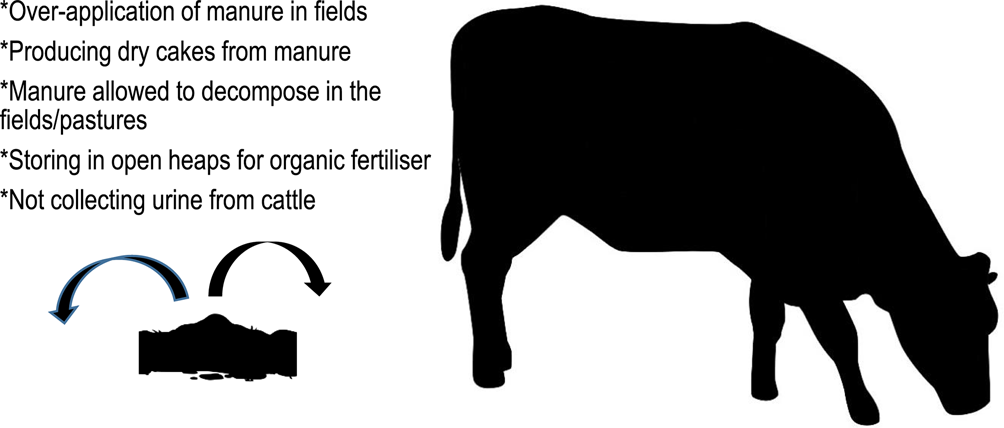
Manure is a valuable underutilized resource that, when properly managed, can significantly reduce the emissions from livestock production (Nautiyal et al., Reference Nautiyal, Goswami, Manasi, Bez, Bhaskar and Khan2015). But poor manure management results in wasted resources and have the potential to emit environmental pollutants. Besides, over-application of manure in fields can also lead to toxicity, odour, water pollution and pose a risk to human health (Dominguez and Edwards, Reference Dominguez, Edwards, Edwards, Arancon and Sherman2011; Nautiyal et al., Reference Nautiyal, Goswami, Manasi, Bez, Bhaskar and Khan2015). In India, the three most common types of manure use include (1) producing dry cakes from manure for use as fuel in rural households, (2) storing in heaps for composting as organic fertilizer for crops where traditionally, manure has been allowed to be composted with bedding and residual crop straw and (3) when animals are kept outdoors, the manure is not recycled and is generally allowed to decompose in the fields/pastures (Abrol et al., Reference Abrol, Adhya, Aneja, Raghuram, Pathak, Kulshrestha, Sharma and Singh2017). It is estimated that in India, 0.36 of the manure is used to make fuel cake, 0.27 is used for composting and the remaining 0.37 is left in the field when the animals are allowed to graze outdoors (Prasad et al., Reference Prasad, Gowda, Anandan, Sharma and Mohini2017). However, the proportion may vary with seasons.
In India, for farmers who collect manure daily, up to 0.90 of the manure is collected and stored in heaps, either taken to the farms during the crop season or put to alternative uses such as for the preparation of dung cakes (Gupta et al., Reference Gupta, Jha, Koul, Sharma, Pradhan, Gupta, Sharma and Singh2007). In producing dung cakes, the manure is spread on the floor or stuck to walls in the open resulting in substantial nitrogen emissions. Also, when dung is collected as organic fertilizer, it is stored for long periods in the open or partially covered stores before application in the field (Gupta et al., Reference Gupta, Jha, Koul, Sharma, Pradhan, Gupta, Sharma and Singh2007; Webb et al., Reference Webb, Sommer, Kupper, Groenestein, Hutchings, Eurich-Menden and Amon2012). This practice can lead to the accumulation of GHGs and subsequent emissions to the atmosphere (Külling et al., Reference Külling, Menzi, Kröber, Neftel, Sutter, Lischer and Kreuzer2001).
As much as 0.48 of excreted nitrogen is lost depending on the management practice of solid manure (Webb et al., Reference Webb, Sommer, Kupper, Groenestein, Hutchings, Eurich-Menden and Amon2012). Nitrogen losses from manure are mainly in the forms of NH3 and N2O (Ndegwa et al., Reference Ndegwa, Hristov, Arogo and Sheffield2008). NH3 losses may account for 0.92 of total ammoniacal nitrogen, depending on the manure mixture and the compost management employed (Eghball et al., Reference Eghball, Power, Gilley and Doran1997). Estimates of nitrogen loss through manure from all livestock in India suggest approximately 4017.52 million tonnes (Abrol et al., Reference Abrol, Adhya, Aneja, Raghuram, Pathak, Kulshrestha, Sharma and Singh2017). Specifically, it is estimated that 70 tonnes of N2O from manure management is emitted yearly in India (Sharma, Reference Sharma2020). In addition, the manure from approximately 0.14 of livestock that graze rangelands in India is also not put to use (Gupta et al., Reference Gupta, Jha, Koul, Sharma, Pradhan, Gupta, Sharma and Singh2007). Notably, urine is not collected as it is difficult to collect and store. Nitrogen losses from urine are between 0.30 and 1.00 (Snijders et al., Reference Snijders, Davies, Wouters, Gachimbi, Zake, Ebanyat, Ergano, Abduke and Van Keulen2009). This finding is a concern as urine in livestock production systems is a major source of NH3 volatilization and indirect N2O emissions. NH3 volatilization from urine deposited to grassland, pastureland and cropland may range from 0.07 to 0.41 depending on the climate and soil (Zaman et al., Reference Zaman, Saggar and Stafford2013; Fischer et al., Reference Fischer, Burchill, Lanigan, Kaupenjohann, Chambers, Richards and Forrestal2016). Figure 1 summarizes the discussion.
Manure mismanagement as a driver of nitrogen emissions from livestock production in India.
Social, cultural and economic determinants of nitrogen pollution from cattle production
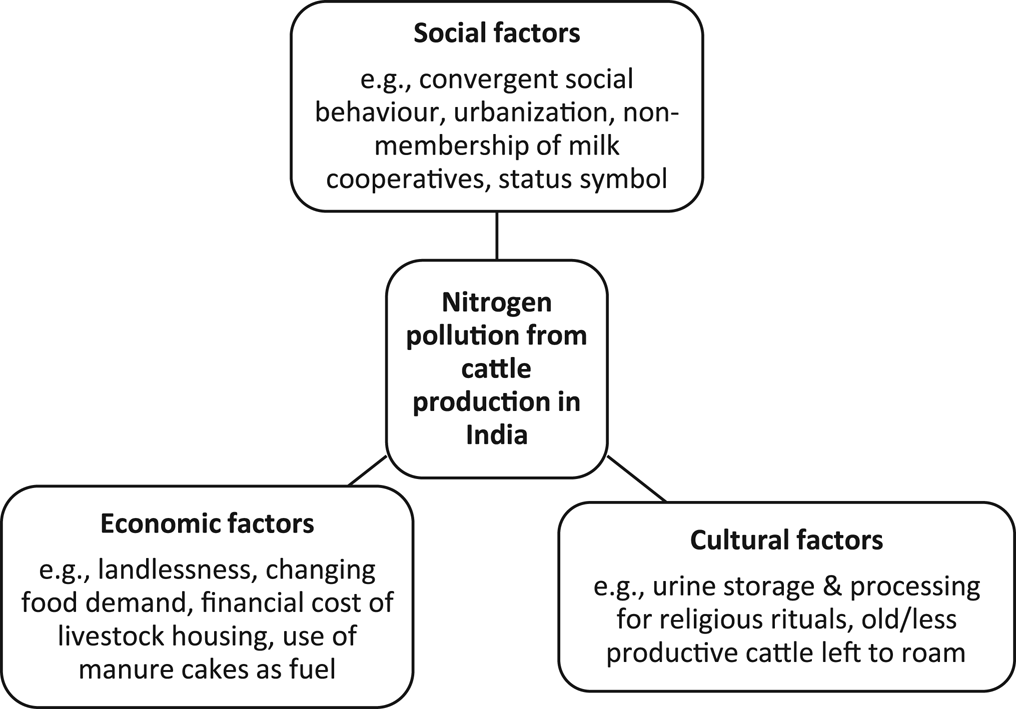
In India, several economic, socio-demographic, cultural and religious factors directly or indirectly influence the livestock production and management systems and, consequently, the level of N emission from cattle production. We discuss the factors as follows.
Economic factors
Livestock production contributes considerably to improving the economic status of the rural poor in India, especially small and marginal farmers who own more than 0.70 of the livestock wealth. For example, smallholder dairy farming has become a livelihood option for 0.44 of rural households and contributes to reducing poverty in rural India (Rajendran and Mohanty, Reference Rajendran and Mohanty2004). Typically, the smallholder farmer has a small herd of 1–3 cattle (Thimnavukkarasu et al., Reference Thimnavukkarasu, Narmatha, Doraisamy and Sakthivel2019). These smallholders are usually landless or have small landholdings. The implication is that they graze their cattle in open access grazing land, limiting the potential for reducing nitrogen losses from manure to the environment. Also, the cost of maintaining the animal impacts the management method. About a decade ago, the number of stray cattle in India was estimated to be only 5 million. However, about 40 million unproductive cattle are currently in danger of being abandoned (Khan et al., Reference Khan, Riedel, Hussain and Patel2020). The main reason for this is the financial requirement to keep cattle beyond the age of productivity, and it is beyond the capacity of the small and marginal farmers. Therefore, these cattle, bulls, heifers and cows with low productivity add to the stray cattle population (Katiyar & Layak, Reference Katiyar and Layak2019).
Changing consumption patterns have also impacted production via the increased cattle numbers. In 2018–19, India's annual milk production was approximately 198 million metric tonnes (National Dairy Development Board, 2020). The majority of this came from smallholder dairy farming as approximately 70 million farm families are engaged in dairy production (Thimnavukkarasu et al., Reference Thimnavukkarasu, Narmatha, Doraisamy and Sakthivel2019; Lindahl et al., Reference Lindahl, Chauhan, Gill, Hazarika, Fairoze, Grace, Gaurav, Satpathy and Kakkar2020). Since the implementation of ‘Operation Flood’, there has been a major increase in milk production and the per capita consumption of milk. While this programme had a significant impact on the economic sustenance and livelihood of dairy farmers, it also holds the potential to reduce environmental pollution from cattle rearing through an increase in production efficiency, particularly when technology is involved (Thornton, Reference Thornton2010).
The economic purpose for which the animal is reared also influences the breeding and management practices. Most small and marginal farmers keep cows for milk production and bulls as work animals (Akila and Chander, Reference Akila and Chander2010). The financial cost of keeping draught cattle reduces priority in terms of feeding and housing compared to dairy cattle (Akila and Chander, Reference Akila and Chander2010). In addition, the production systems have implications for environmental pollution. Livestock production is shifting towards intensive production systems to meet the growing demand for animal products. In India, the increase in intensive production is attributed to limited open land for cattle grazing, urbanization and the change in consumers' food preferences (Manoj, Reference Manoj2015). These changes have affected livestock numbers, feed requirements, feeding and manure management practices and associated GHG emissions (Pierre and Harald, Reference Pierre and Harald2006). Under intensive production systems, animals are often fed more protein, phosphorus and micronutrients to achieve higher yields, resulting in increased excretion of excess nutrients and consequently environmental pollution from the nutrient wastage (Abrol et al., Reference Abrol, Adhya, Aneja, Raghuram, Pathak, Kulshrestha, Sharma and Singh2017). For example, Reichenbach et al.'s (Reference Reichenbach, Pinto, Malik, Bhatta, König and Schlecht2021) investigation of resource use efficiency of dairy production in Bengaluru showed a low feed efficiency among semi-intensive and intensive dairy production systems. As a result, the per-area footprint is usually higher under an intensive system, considering that more cattle are kept per land area compared to extensive systems. In other words, an intensive system produces higher overall GHG emissions but lower emissions intensity. However, this paper does not delve into the debate on GHG emissions from intensive v. extensive systems but highlights the common point of agreement that emissions can be reduced with better management irrespective of the systems.
For economic reasons, the use of manure cakes as fuel in rural households is widespread. The cheap fuel source is an additional motivation to keep cattle (Khan et al., Reference Khan, Rehman and Salman2013). Manure contributes to 0.78 of residential energy from burning biomass (Council on Foreign Relations, 2021). However, the methods of processing and storing manure cakes are mostly not environmentally friendly. The manure is mixed with crop residue and sun-dried in the form of mid-sized pellets (Sfez et al., Reference Sfez, De Meester and Dewulf2017; Prasad et al., Reference Prasad, Anandan, Gowda, Schlecht and Buerkert2019). According to Stewart et al. (Reference Stewart, Acton, Nelson, Vaughan, Hopkins, Arya, Mondal, Jangirh, Ahlawat, Yadav, Sharma, Dunmore, Yunus, Hewitt, Nemitz, Mullinger, Gadi, Sahu, Tripathi, Rickard, Lee, Mandal and Hamilton2021), manure cake had a higher emissions factor than fuelwood and liquefied petroleum gas, suggesting that the contribution to environmental pollution from burning manure cake is substantial.
Institutional factors also play an important role in mitigating agricultural pollution. Breeding programmes such as the National Project for Cattle and Buffalo Breeding, which is aimed at genetic improvement in cattle and buffalo across India, have increased the conception rate by 15% (Department of Animal Husbandry and Dairying, 2019). This increase holds positive benefit for efficiency through reducing wastage from empty calving intervals and replacement rates.
Social factors
The societal influences on livestock farmers also play a role from the perspective of farmers understanding their action to be either ‘right’ or ‘wrong’ in light of the wider expectations. This social influence can make farmers behave in a particular manner (Fish, Reference Fish2014). Herding, i.e. a convergent social behaviour, is also responsible for livestock management practices in India. Cattle farmers may be influenced by group behaviour. As such, farmers abandon their information and beliefs to align their behaviours with others in the group. Besides economic reasons, there are reports of some farmers letting their cattle roam free because others do the same (Katiyar and Layak, Reference Katiyar and Layak2019).
Membership of milk cooperatives indirectly influences pollution mitigation via regulating milk quality. Kumar et al. (Reference Kumar, Shinoj and Jee2013) suggest that the membership of milk cooperatives provides a distinct advantage in milk yield, productivity and quality. Conversely, achieving better food safety measures is correlated with an increased milk yield (Kumar et al., Reference Kumar, Mishra, Saroj, Sonkar, Thapa and Joshi2020). Specifically, improvement in yield through productivity gains, improving feed efficiency and maintaining a high health status which is a prerequisite for better milk quality and food safety measures also have the potential to reduce inefficiency-driven environmental pollution. However, there are herd size barriers and cost implications of compliance with these standards.
Urbanization in India impacts livestock production efficiency in India. Reichenbach et al. (Reference Reichenbach, Pinto, Malik, Bhatta, König and Schlecht2021) find that within an urbanizing environment, the distinctly different feeding strategies that dairy producers follow result in differences in resource use efficiency. Efficient feed systems are important for reducing GHG emissions. Besides, due to urbanization, common pastures are being transformed from their previous use, which has reduced options for publicly available feed and pasture (D'Souza and Nagendra, Reference D'Souza and Nagendra2011). Consequently, cattle owners have to compete for degraded quality feed on the available common making the cattle vulnerable to many diseases and, in severe cases, resulting in losses for the farmers (Vij and Narain, Reference Vij and Narain2016).
Rearing cattle serves as a visible status symbol and as a store of wealth. Households with a large number of cattle are considered wealthy (Mohan, Reference Mohan2019). There are no studies that directly examine whether there is a correlation between the management of cattle owned mainly to store wealth and livestock emissions. However, one can postulate that there will arguably be less motivation to reduce the environmental impact of cattle reared for status purposes. Other important factors are education and environmental awareness. Several studies suggest that Indian cattle farmers' awareness of best management practices is limited (Singh et al., Reference Singh, Singh and Jaiswal2004; Paul and Chandel, Reference Paul and Chandel2010). Low environmental awareness could drive preference for certain traditional cattle management practices with questionable environmental sustainability.
Cultural and religious factors
Cows are considered sacred animals in the Hindu religion in India, and all the products such as milk, urine and dung are highly valued (Agoramoorthy and Hsu, Reference Agoramoorthy and Hsu2012). Because of the sacred status, the consumption of cow meat is taboo in the Hindu religion. In India, there is a national ban on cow slaughter and in most states, slaughtering cows is illegal (Kennedy et al., Reference Kennedy, Sharma and Phillips2018). This ban contributes to the approximately 5 million stray cattle population in India. These stray cattle are, in general, unproductive or low yielding animals, which increases the financial burden of the farmer with no returns. The farmers are not interested in rear the unproductive cattle, and there is a decline in their use on the farm due to increased mechanization. Since these cattle become a liability for the farmer, they are left free to roam around for their feed during the daytime and in some cases are kept in (publicly or privately funded) animal shelters. Not only do these stray cows contribute to a large amount of GHG emissions, but the manure they produce leads to loss of nitrogen as N2O and NH3. Also, cow urine is used for religious rituals (Daria and Islam, Reference Daria and Islam2021). How the urine is stored, processed and used could be pathways for nitrogen losses. A summary of the factors that influence the livestock production and management systems and the level of N emission from cattle production is presented in Fig. 2.
Factors that affect N emission from cattle production in India.
Solutions to reduce nitrogen pollution from cattle production
India can improve its shortcomings by learning from other countries, e.g. New Zealand that produces cattle sustainably. Reducing nitrogen emissions in cattle production can be achieved by changing manure management practices (Rees et al., Reference Rees, Baddeley, Bhogal, Ball, Chadwick, Macleod and Williams2013). In line with the nitrogen loss pathways identified in this review, mitigation options can broadly be considered in three ways. First, improving livestock productivity and thus ensuring better nitrogen balance. Second, addressing feed-related practices aimed at improving NUE. Third, implementing effective interventions related to manure and pasture management. The relevant mitigation options for sustainable livestock management and, specifically, reducing nitrogen pollution are discussed in the present paper.
Improving livestock productivity
The implementation of ‘Operation Flood’ has resulted in a major increase in milk production and per capita milk consumption. However, with current volume-oriented production, which relies on large numbers of animals and low productivity, the livestock industry in India will struggle to meet the growing local and global demand for livestock products. The desired production level can be achieved in the future by increasing productivity. This can be achieved by maintaining optimum livestock numbers during the production phase and increasing productivity through scientific breed, feed and herd management. Breeding methods that improve herd performance and better management can reduce non-productive animals and help to reduce emissions (Gerber et al., Reference Gerber, Steinfeld, Henderson, Mottet, Opio, Dijkman, Falcucci and Tempio2013). In India, increasing the average productivity of milk from 3.6 to 6 kg per day could reduce the number of dairy animals by 40% and feed requirements by 27% without reducing milk production, thus providing a significant advantage in reducing nitrogen pollution (Blummel et al., Reference Blummel, Anandan and Prasad2009). At the same time, the demand driven by the changing consumption patterns and preference for better quality milk will have a greater likelihood of being met.
Despite a large number of cattle in India, the quality of India's indigenous cattle is generally considered to be poor. Since the beginning of the last century, India has initiated several cattle development programmes to promote quality breeds throughout the country. In addition to this, in recent years, the national policy for animal husbandry has been directed towards optimizing the quality of indigenous cattle through crossbreeding, selection and breeding (National Livestock Policy, 2013). There is a need for breeding technologies such as sexed semen to be encouraged and made affordable to reduce the number of unwanted cattle (Rao et al., Reference Rao, Chaurasia, Singh and Gamit2016). Improving the health of cattle is also an important prerequisite for increasing productivity. However, many environmental and resource constraints affect the health of cattle. For example, the use of contaminated water sources may negatively impact the health and production of dairy cattle (Giri et al., Reference Giri, Bharti, Kalia, Arora, Balaje and Chaurasia2020).
Improving feed production systems and management practices
Measures taken during the production of feed can also reduce nitrogen emissions. These measures can be reduced nitrogen application in the bovine feed production process. Reducing the amount of nitrogen fertilizer applied to produce feed for bovines reared intensively is widely considered an effective measure to reduce N2O and NH3 emissions. In addition, the use of biological nitrogen fixation as an alternative to chemical fertilizers in the production of forage can also provide the required nitrogen input (Cassman et al., Reference Cassman, Dobermann and Walters2002; Erisman et al., Reference Erisman, Bleeker, Galloway and Sutton2007). Nitrogen-fixing legumes crops such as sesbania and leucaena contain symbiotic bacteria in their root nodules that convert atmospheric nitrogen into forms that plants can take up (Rees et al., Reference Rees, Baddeley, Bhogal, Ball, Chadwick, Macleod and Williams2013).
Additionally, the use of nitrification and urease inhibitors along with urea and other ammonium compounds in rangeland fertilization can reduce reactive nitrogen emissions (Di and Cameron, Reference Di and Cameron2003). More recently, the use of neem-coated urea instead of urea has been implemented in India for the slow release of nitrogen in the soil (Kumar, Reference Kumar2015). Globally, there is empirical evidence of reductions in nitrogen emissions from nitrification inhibitors in pasture and cropland fertilization (Di and Cameron, Reference Di and Cameron2003; Malla et al., Reference Malla, Bhatia, Pathak, Prasad, Jain and Singh2005). However, since its efficiency is dependent on external factors such as soil temperature, its effect may vary from region to region. The use of cost-effective decision support tools such as the soil health card for site specific nutrient management and demand-based nitrogen application using the leaf colour chart is gaining popularity among farmers in India. The benefit of such tools is that they can help optimize the timing of nitrogen fertilizer application and reducing the nitrogen losses (Móring et al., Reference Móring, Hooda, Raghuram, Adhya, Ahmad, Bandyopadhyay and Sutton2021). In addition, farmers can also download free software on their mobile phones to calculate the amount of nitrogen fertilizer required. This method has already proved effective in the production of several crops (Móring et al., Reference Móring, Hooda, Raghuram, Adhya, Ahmad, Bandyopadhyay and Sutton2021).
The types of feeds and feeding regimes of cattle determine feed efficiency and emission intensity. Approximately 0.25–0.35 of the nitrogen consumed by dairy cows is secreted in milk, while the excess nitrogen from feed proteins is excreted in manure (Ishler, Reference Ishler2004). Adopting nutritional management and manipulation of diet composition can increase the efficiency with which feed is converted into live weight gain or milk. For example, adjusting the crude protein in the diets has been reported to be effective at reducing NH3 emissions from manure (Sajeev et al., Reference Sajeev, Amon, Ammon, Zollitsch and Winiwarter2018).
Adopting better manure and pasture management
Animal manures consist of beneficial components. If effectively recycled, it can be used as fertilizer for crops, feed animals and produce energy (Parihar et al., Reference Parihar, Saini, Lakhani, Jain, Roy, Ghosh and Aharwal2019). However, whole-farm management is necessary to reduce nitrogen loss in the cattle production system. The nitrogen loss can be decreased by frequent removal of manure and by avoiding storing in open heaps – a common practice by farmers. In intensive production systems, the best options are to minimize losses through closed tanks or, where that is not viable, maintain natural crusting in open tanks. Anaerobic composting of manure and lime acidification can help minimize nitrogen emissions (Samer, Reference Samer2015). Other reliable manure management methods include biogas production, rotational composting and vermicomposting (Parihar et al., Reference Parihar, Saini, Lakhani, Jain, Roy, Ghosh and Aharwal2019). Although biogas production is used in India, there is a need to scale up the technology. Biogas plants recycle animal waste and produce CH4 under anaerobic conditions. The CH4 is used as an energy source for cooking, while the slurry left over after CH4 extraction is used as farm manure. This method is a sustainable approach as it reduces the emission of manure pollutants and converts valuable waste into energy and farm waste (Gautam, Reference Gautam2006). The animal urine should be collected in closed tanks and can be applied as a deep injection into the soil to reduce the likelihood of nitrogen leakage. Notably, this practice may lead to more leaching and denitrification losses from the soil if not managed properly and integrated with practices such as efficient crop rotation and need-based application (Rotz, Reference Rotz2004).
In terms of pasture management, controlled grazing can reduce N2O and NH3 emissions by reducing intensive use of grassland (Luo et al., Reference Luo, De Klein, Ledgard and Saggar2010). Also, controlling the moisture in grazing soils or forage production field soils through land drainage can reduce emissions of N2O to the atmosphere. Such changes could address the finding and concerns in previous studies in India, e.g. Shankar and Gupta (Reference Shankar, Gupta and Singh1992), that the carrying capacity of semi-arid grassland is 50 more adult cattle unit per hectare than recommended.
Future perspectives
Regarding the environmental impact of dietary structure, the typical Indian diet has a relatively low per capita environmental impression compared to high-income countries (Pathak et al., Reference Pathak, Jain, Bhatia, Patel and Aggarwal2010). Still, there are also significant differences between dietary patterns (Green et al., Reference Green, Joy, Harris, Agrawal, Aleksandrowicz, Hillier and Dangour2018). India's diet is changing rapidly, with consumption of dairy products in particular growing (Abrol et al., Reference Abrol, Adhya, Aneja, Raghuram, Pathak, Kulshrestha, Sharma and Singh2017). As incomes increase, Indian diets are likely to become more diverse. Also, there may be greater demand for meat among the religious groups that eat meat. Given the size of India's population, the environmental impact of such a change could be significant (Pathak et al., Reference Pathak, Jain, Bhatia, Patel and Aggarwal2010; Green et al., Reference Green, Joy, Harris, Agrawal, Aleksandrowicz, Hillier and Dangour2018).
Cubbing the practice of abandoning cattle due to old age, which results in a high number of stray cattle, makes sustainable practices in cattle management more difficult and consequently increases emissions. Therefore, ensuring these stray cattle can be properly housed and sustainably managed is an issue that needs attention in the future as it is an important step in reducing environmental pollution from cattle. Although India has over 3000 Gaushala (cow shelters), the increasing cattle population means that not all can be accommodated with the current capacity. Moreover, the increasing population of these animals also has implications for forage and feed demand. Crucially, the competition for land water and the challenges associated with the changing climate will also determine how environmentally friendly livestock production systems in India will be in the future.
In terms of national policy, the Indian government has introduced bioenergy policies and programmes to promote the safer, more efficient and environmentally friendly use of bioenergy (Kothari et al., Reference Kothari, Vashishtha, Singh, Pathak, Tyagi, Yadav, Ashokkumar and Singh2020). For example, the new National Biogas and Organic Fertilizer Programme (NNBOMP) introduced in 2018 aims to establish, operate and maintain many biogas plants to produce biogas and organic fertilizers to meet the demand for sustainable energy. Besides supplying energy and manure, biogas technology can provide an excellent opportunity to mitigate nitrogen emissions (Pathak et al., Reference Pathak, Jain, Bhatia, Mohanty and Gupta2009). However, regulation for manure under a single directive may be needed if multiple laws or state regulations on manure management are less efficient. Notably, controlling unwanted reactive nitrogen releases through policy initiatives alone is difficult because in India, as in other countries, most Nr releases come from various sources such as agriculture, industry, transport and energy and waste. Therefore, management strategies to reduce Nr releases into the environment require an integrated approach.
Crucially, increasing farmers' awareness of the problem of nitrogen mismanagement can create the desired change. Access to information often improves farmers' decision-making skills (Panda, Reference Panda2015). Without sufficient knowledge, it is not easy for farmers to think of the potentially serious consequences of environmental pollution. The importance of educating farmers on best management practices cannot be overemphasized. Such effort may focus, for example, on areas where there are findings that over 0.90 have no urine drainage facilities in animal sheds (Manohar et al., Reference Manohar, Goswami and Bais2014).
Conclusion
The nitrogen cycle has undergone large-scale transformations in its structure and function over the last six decades. From a human perspective, it is the most disturbed biogeochemical cycle. Human activities have a huge impact on the global nitrogen cycle through activities aimed at meeting the food and energy needs of a rapidly growing population, ranging from intensive agricultural activities to increased consumption of fossil fuels. Overall, nitrogen pollution from livestock in India is relatively serious due to the large number of cattle, unsustainable livestock production systems, poor manure management and surging population pressure. In addition, the increase in the number of stray cattle is creating significant pressure for the management of cattle and their waste. The sustainable solutions to reducing nitrogen pollution in the Indian cattle industry include improving livestock productivity, better feed-related practices to improve nitrogen use and interventions related to manure and pasture management. Also, with increased knowledge and awareness of environmental protection and advances in science and technology, India's livestock industry will perhaps move in a more sustainable direction.
The limitation in the narrative of this paper is that, across the different studies reviewed, no further distinction is made regarding how different cattle types, sizes and breeds differ in their emissions of GHG and environmental pollutants. Also, the paper did not discuss other non-nitrogen GHG and environmental pollutants. However, the recommendations made in this paper have a direct impact on the holistic reduction of pollution from cattle production in India.
Author contributions
Y. Zhou – conceptualization, methodology, investigation, resources, writing – original draft. N. Jain – validation, investigation, resources, writing – review and editing. G. K. Jha – validation, investigation, resources, writing – review and editing. T. Begho – conceptualization, validation, investigation, writing – review and editing, visualization, supervision, project administration.
Financial support
This paper results from research funded by UKRI under the title ‘South Asian Nitrogen Hub’ [SANH]. The project team includes partners from across South Asia and the UK. Neither UKRI nor any of the partner institutions is responsible for views advanced here.
Conflict of interest
None.


 Open access

