




Introduction
An American woman approached a train waiting at a station in Memphis, Tennessee. The train carried an atypical cargo: one hundred fifty Republic of Korea (ROK) Army personnel, members of South Korea’s 1st Study Abroad Corps, headed to Fort Benning, Georgia to receive infantry officer training. With war still raging on the Korean peninsula, the trainees arrived in San Francisco in September 1951 by ship; one group headed to Fort Sill, Oklahoma, and the rest to the Infantry School at Benning. Among the officers on the train was a young man named Captain Kim Jong-pil. Twenty-five years old and recently married, Kim was an eloquent writer who chronicled his experiences studying abroad in a series of dispatches for a South Korean newspaper.
The woman at the Memphis station, Kim described, was “young and beautiful.” She asked if they were South Korean soldiers, and shared that her husband was a captain who had recently been deployed. At her request, Kim and his compatriots handed her the South Korean flag as a memento. As the train departed, he could see the woman waving the flag until she disappeared from view.Footnote 1 This short but intimate encounter reflected the broader array of payoffs for the architects of the U.S. study abroad training program. Kim was not a blank slate. He served in a South Korean officer corps heavily defined by Imperial Japanese influence, and he would compare forms of American and Japanese military spirit during his travels. Still, for Kim, what he would undergo at Benning was far more than training—it was, rather, an experience that left profound impressions of camaraderie with the United States and its people. Such impressions stayed with Kim for the rest of his long and deeply controversial military and political career in South Korea.
From 1950 to 1963 the United States brought over 200,000 international military personnel like Kim to attend courses at U.S. military installations and schools, made possible by the Military Assistance Program (MAP). MAP focused its efforts on officers, from Korean junior lieutenants to French staff officers.Footnote 2 The program was initially envisioned as improving the capabilities of allied and partnered militaries, and international officers who participated generally carried the moniker of “trainee.” But over the 1950s, training in the continental United States expanded into what I argue is better described as “study abroad.” Along with the transferal of military skills, officials also organized field trips, participation in local civic activities, and contact with everyday Americana for international officers. More than just military training and “trainee,” treating international officer experiences in the United States as “study abroad,” and considering officers also as “students” helps attach them into the larger tapestry of U.S. global efforts to win the hearts and minds of an ideological Cold War. Like U.S. government efforts to support international civilian flows into American universities, studying abroad in the continental United States was supposed to arouse sweeping internal transformations and ignite faith in the American path of modernity. But unlike civilian students, the outright national security imperatives of military officers was an intensifier. U.S. officials imagined that the next generation of the world’s military elite could come to like the United States, affinity that would need to run in parallel to their ability to lead Asian armies in support of Free World solidarity. Consequently, U.S. efforts focused almost exclusively on international officers rather than on enlisted personnel.Footnote 3
While positioning U.S. military education as the pinnacle of warfighting, the military also engaged in a production of a fantasized American way of life that could serve as a legitimator of U.S. training. The archetype of the American officer was an extension of the qualities of idealized American manhood, and a product of a civic, recreational, and religious life that closely tracked the features of a similarly imagined suburban, white, middle-class experience.
The American imagination of a political, military, cultural, and emotional convergence did not always play out according to plan. Student officers often saw the U.S. military as first and foremost a source for information and schooling. Others concluded that only pieces of American modernity were suitable for their own countries. Many, if not all, saw U.S. military training foremost as a benefit to their individual careers when access to American weapons, aid, and professional knowledge was essential to their military’s development. As historian Anna Fett argues, with civilian exchange in the Cold War, the U.S. strategic planners of programs may have intended for exchanges to support foreign policy goals, but they were not always able to control how the individuals participating in those programs translated ideas into practice.Footnote 4
This paper argues that the U.S. military study abroad program reveals how the military functioned as a globalizing process, demonstrating the ambition and fragility of an American imperial security network. I frame military study abroad as an American project to transform the identities and worldviews of its tutelary subjects, seeking to globalize a vision of officership that was closely tied to the norms, values, and identities of an imagined 1950s American middle class while recruiting the soldiers of a decolonizing Asia to its banner. I illustrate how the global needs of U.S. security in the Cold War promoted an image of suburban harmony, which was reliant on the voluntary labor of American women and their imagined adoptive, maternal qualities. Such efforts proved to be a fragile visage over a deeper set of gendered and racial issues that complicated the U.S. government’s efforts to portray itself as a benevolent teacher for the Free World. Military study abroad illustrates the complications when the U.S. state pursued a policy of arousing emotional bonds (broadly defined) between its own citizens and its nominal allies, set in a context of overlapping Cold War conflict, nation building, and global decolonization.
This article explores U.S. military study abroad programs in the 1950s and early 1960s in three parts. It first examines how the U.S. military justified, structured, and steadily canonized the imaginative schematic of study abroad programs, personified in the publication of an official guidebook for trainees. Second, it explores the granular aspects of extracurricular activities trainees experienced, from luncheons with local women’s organizations to capstone sightseeing tours in Manhattan. Third, the paper examines the tensions that emerged in study abroad, as trainees revealed mixed perspectives on their experiences. The realities of 1950s American society often challenged the U.S. military’s attempt to insulate the trainees.
Scholars have previously identified the transnational circulations that have proliferated through the infrastructure of the U.S. military during and after World War II. The “imperial turn” in U.S. foreign policy historiography has benefited our understandings of the U.S. military as a global institution with contentious footholds abroad.Footnote 5 In addition, military historians have embraced race, gender, and culture as illuminating the nature of war and soldiering.Footnote 6 This article unites the rich contributions of these subfields, drawing together how the imperial qualities of the United States as a postcolonial global power, the transnational circulations of its military networks, and the fuzzy lines between “domestic” and “foreign” affairs collapsed into the hopes, anxieties, and tensions baked into military study abroad. Military study abroad intended to transform Asian officers into reliable military partners who could man a global defense perimeter, marrying military training to an American belief that those who bore witness to the United States would develop an admiration for its way of life.Footnote 7
The United States military in the 1950s did not mark the first appearance of these dynamics. International students had traveled to the United States for decades. Cadets from the U.S.-colonized Philippines, Japan, China, and elsewhere enrolled in U.S. military academies in the nineteenth and early twentieth centuries.Footnote 8 But MAP was both more global in scope and comprehensively designed in its application. International officers not only needed to be patriots for their own countries, but they also needed to see the metropole in order to witness the pinnacle forms of modernity the Free World was defending. As Imperial Japan had once used guided sightseeing of Tokyo to attempt to incorporate Taiwanese as loyal subjects, the U.S. global security architecture of interlinked sovereign allies similarly necessitated sensory and experiential intervention.Footnote 9 The U.S. military also typically saw Asian officers, coming from newer or suspect military establishments, as requiring sharper interventions to become more effective on the battlefield.Footnote 10 Such interventions supported an American empire that flaunted its anti-colonial differentiators, was aware of and worked around the paradigm of sovereignty, and needed to cultivate friendly interpersonal relationships in countries whose militaries could assist with defending the Free World.Footnote 11 The U.S. design of military study abroad certainly could be classified as “soft power,” but it more insightfully demonstrates the linkage between inducement, as an unequal exchange that required that Asian officers to repay their benefactor through their military service to the Free World, and kindness, as the social functioning of study abroad relied on the image of ordinary Americans as benign, welcoming, and giving without expectation.Footnote 12
By indicating the importance of women and women’s associations, this article also examines how the U.S. military relied upon a specific construction of American womanhood as liberal, inclusive, hospitable, and sharply regulated, with women in turn standing in as avatars of the United States as a compassionate mother for the Free World. Building upon arguments of the reliance of U.S. foreign policy and the U.S. military on American women, this article further indicates how constructing domesticity at home was foundational for American pretensions of global hegemony.Footnote 13 Military study abroad played on the motherly qualities of women who could serve as welcoming hosts. Maternal bonds then buttressed the fraternal allegiances of allied soldiers, even as the suggestive and thrilling qualities of femininity posed a danger to the kinds of nonsexual relationships that the U.S. military hoped to encourage. Maternal global security could indicate adoption, without miscegenation.
Military study abroad also indicates the connections of Asianness and Asian ambiguity to both foreign and social policy debates. The strategic balance of the Cold War in Asia, desegregation of the U.S. military, Brown vs. Board of Education, and Soviet charges of the horrors of American racism all required U.S. officials to imagine Asia as more than a place of singular threat—home of a Yellow Peril—but instead as a battleground bifurcated between “good” and “bad” Asians.Footnote 14 “Good” Asians repulsed by the United States could be devastating to foreign policy objectives. Integration thus was deeply connected to the spread and maintenance of global imperial power in a landscape of decolonizing states.Footnote 15 The act of welcoming Asian officers to U.S. military bases—many located in the American South—thus could burnish American credentials as a legitimate leader of the Free World, recreating the white American family as welcoming and racially inclusive. The U.S. program to train Asian military officers put the global in the literal American backyard, but it required a twisting dance to produce what the United States in the 1950s was and was not supposed to be.
The Strategic Context of Military Study Abroad
“[W]e welcome the opportunity to share with you not only our professional military skills, but our hospitality and our way of life,” stated the 1959 Guidebook for Visiting Military Students, published by the Office of the Secretary of Defense. Intended to be read by trainees prior to their arrival in the United States, the guidebook explicitly linked ordinary experience with strategic necessity, asserting the common goal of defending freedom and the possibility of immersive enrichment.Footnote 16 Its authors in the Pentagon were undoubtedly influenced by Eisenhower administration foreign policy priorities, and thus conceptualized exposure to the American way of life in the late 1950s on a near-equal level of importance as military training.
For U.S. officials in the 1950s, studying in the United States was not just a form of transferring technical skills to the officer corps of Asia; it was a transformational crucible that could intake the raw products of promising young officers, U.S. military strength, and hopefully positive impressions of the United States, and produce a combined output of reliable and effective future military leaders. These leaders would understand the land and people of the United States and form bonds of allegiance that could run parallel to written treaties and agreements.
Training in the U.S. for international officers, or “allied officers” as the U.S. military referred to them, occurred under the auspices of MAP—authorized by the Mutual Defense Assistance Act passed in 1949 and expanded during the Korean War. MAP centralized previously piecemeal agreements that provided for postwar military aid. Training for officers disproportionately affected Asians, set against the exigencies of active conflict on the western rim of the Pacific. South Korea, Japan, and the Republic of China in Taiwan constituted three of the four most common points of origin for trainees, and from 1950 to 1963, nearly 85,000 trainees from East and Southeast Asia attended school in the United States.Footnote 17 Asian trainees received training at Army, Navy, Air Force, and Marine Corps bases, with the Army appearing to train the majority. The Army focus reflected the immediate priorities of nascent Asian militaries as well as U.S. strategic plans that Asian countries could supply the manpower in a Pacific conflict supported by American air and naval strength.Footnote 18
Enlisted personnel also traveled to the United States for training, but these missions were limited in ambition and aim. Militaries sometimes requested training at U.S. bases or factories for enlisted technicians, based on contextual skill gaps in their force at a specific moment.Footnote 19 U.S. officials spent little time imagining the possibilities of the enlisted man. Lesley Gill’s examination of Latin American soldiers at Fort Benning from the 1980s onward argues that, while officers experienced a taste of white, middle-class suburbia, enlisted trainees often became acquainted with the racially diverse and unpolished Victory Drive neighborhood to the base’s south.Footnote 20 While this disparity may have been applicable to Asian trainees some thirty years earlier, as will be explored, even Asian officers sometimes went outside the boundaries of experiences that U.S. officials hoped to offer.
Military training in the continental United States for partner and allied personnel had operated prior to the 1950s. Filipinos had attended United States service schools for decades as colonial soldiers, U.S. bases had trained allied soldiers throughout World War II, and Latin American officers long attended schools in the continental United States and the Panama Canal Zone.Footnote 21 But by formalizing post-World War II mutual aid treaties, the United States also expanded its training programs on a larger scale. American military schooling grew inversely to the independence of previously colonized spaces.
Early U.S. training programs for South Koreans illustrate the idea that international trainees would serve as conduits of influence. In August 1948, the U.S. military advisory group in Korea (KMAG) arranged for six ROK trainees to attend the Infantry School at Fort Benning. Upon their return, four became commandants or assistant commandants of ROK Army schools.Footnote 22 After the outbreak of the Korean War, U.S. officials overseeing military aid took notice of study abroad’s possibilities. In a Cold War environment marked by U.S. strategic anxieties about a manpower disadvantage against Communism on the Asian continent, U.S. aid could supercharge a central core of international officers who would lead their militaries and man the defense perimeter. The logic further held that building up the officer corps of aligned militaries could allow the United States to reduce its aid expenditures in the future, having created “self-sustaining” corps of future military teachers and thus achieving a high return of security from an inexpensive investment.Footnote 23
Officers attended courses that included education in leadership, psychology, organizational theory, management, instructional methods, and codes of conduct.Footnote 24 The intention of such education was to imprint American military norms and customs onto trainees, and the possible effects of training were global. From August 1950 to July 1957, 3,844 international students attended the U.S. Army Infantry School, hailing from 52 countries. Over 1,500 came from Korea alone, illustrating the relatively large impact of study abroad training on the ROK officer corps.Footnote 25
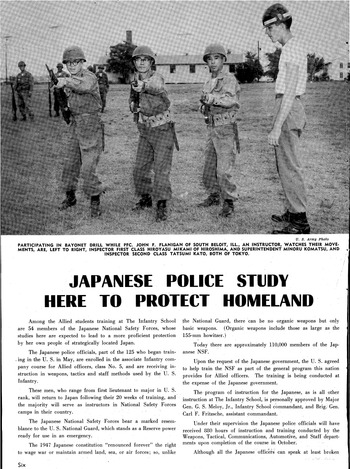
Some officers who studied abroad in the United States returned home to receive jumpstarts to their careers, promotions that vaulted them over the ranks, and a relationship to the U.S. military that earned them the confidence of U.S. military advisors. As the chief of KMAG would report in mid-1955, within the ROK Army, “graduation from Leavenworth [the Command and General Staff College] is considered an accolade and is highly prized.”Footnote 26 But U.S. training impacted far more than Korean officers. As Aqil Shah argues, in Pakistan, Pakistani military exposure to American military concepts through assistance and stateside training had “a decisive influence on the ideas of the officer corps.”Footnote 27 Advanced education in the United States overlapped with a generation of postcolonial military officers who were set to be key players in their own institutions and nations. Such influence was particularly felt across the Asian continent, where U.S. officials conceived of a defense perimeter stretching from South Korea, through Southeast Asia, and anchored in Iran and Pakistan in the west as a strategic crescent against Communism.Footnote 28 In Japan, for example, nearly 70 percent of all officers in its Self Defense force had by 1971 received training or education at U.S. military facilities or in U.S. schools (Figure 1).Footnote 29 When Kitamura Kenichi, a senior officer in Japan’s Maritime Self-Defence Force, attended the Naval War College in 1956, he was in a class with twenty-three student officers from Asia, Europe, and Latin America. For Kitamura, the experience cultivated a “consciousness of a Free World navy community having the U.S. Navy at its core.”Footnote 30 Study abroad, for some, produced a strong sense of Free World solidarity centering on but going beyond the United States.
Japanese national police reserve officers in bayonet drill at Fort Benning. Source: Benning Herald, August 1953. Disclaimer: The appearance of U.S. Department of War (DoW) visual information does not imply or constitute DoW endorsement.

International officers destined for the continental United States were often selected by their home government and then subjected to further checks from U.S. personnel abroad, which included an English proficiency exam. There were occasional exceptions to the requirement of English proficiency, where special groups arrived with interpreters.Footnote 31 But generally speaking, the U.S. military strongly preferred that any officers be English-speaking soldiers with bright careers ahead of them.Footnote 32
In and outside of the military in the 1950s, U.S. officials emphasized the importance of face-to-face interactions. Eisenhower touted the value of people-to-people meetings, the State Department operated an Exchange of Persons program, and predecessor agencies of the U.S. Agency for International Development brought civil servants and schoolteachers to the United States for training.Footnote 33 Educating international students was geopolitically important. As Paul Kramer argues, student migrations to and from the United States operated on the principle that returning students could legitimate the United States. with favorable accounts and diffuse American values and practices.Footnote 34
With the military, education could inculcate Free World solidarity. The focus was more about creating good military officers who would hopefully be impressed with American modernity, rather than becoming wholly “Americanized.” This key differentiation was evident by the late 1950s and early 1960s, when American social scientists and government officials theorized that U.S.-trained military officers might be well positioned to promote socioeconomic development, getting involved with civilian governance to an extent that would be anathema to American military norms.Footnote 35 In addition, military study abroad in this period took place while American policymakers repeatedly supported militarist authoritarian regimes and prioritized anti-communist credentials among global partners above all else. Over 7,000 Thai personnel trained in the U.S. from 1950 to 1963, in a period when there were two military coups. Similarly, nearly 13,000 Turkish personnel received training before and after a flurry of military coup attempts in the early 1960s. Such events were not obstructive challenges to the mission and nature of MAP training for its officers.Footnote 36
Influencing international student experiences was also key to the U.S. government’s Cold War interest in managing race relations. For American Cold Warriors, creating a stable alliance between Third World sympathies and American racial reformers could allow the country to proclaim itself a bulwark against both white supremacy and communism.Footnote 37 International officers constituted one of the most important demographics of international visitors. They functioned as interlocking chains in a system of global security, and therefore were key visitors whose experiences needed to be curated.
Guiding Study Abroad
The U.S. military slowly refined its notion of what study abroad experiences should look like, until the Pentagon finally produced in 1959 the Guidebook for Visiting Military Students, introduced at the beginning of this article. The guidebook’s ostensible goal was to orient trainees to the United States, and it indicates how study abroad required U.S. officials to produce canonical texts of American life.
The guidebook is replete with an argument for what experiences a trainee should take back with him to his home country. “You have probably heard many stories … about our extreme wealth, extreme poverty, and discrimination against racial or religious minorities,” the introduction stated. “This is your opportunity to discover the extent of truth in these stories.”Footnote 38 Directed at the military officer reading the guidebook, stress on the importance of personal witness to determine one’s own opinions aligned with efforts to downplay the problem of domestic racism.
One of the few moments of stern dictate in the guidebook related to dependents. Trainees were “not authorized to bring your wife or family with you to the United States at U.S. expense.” The issue of dependents complicated study abroad. Practically, housing families was expensive, logistically challenging, and outside MAP’s scope. But it also reified the transitory nature of the U.S. global network of military education: the military expected trainees to come for a short period of time, carrying away with them a specific imagination of the United States without becoming settled into it.Footnote 39
The guidebook provides a broad overview of American civilian life, framed as liberal and inclusive. General etiquette was important but, as the booklet outlined, generally informal. Its synopsis of American women also emphasized “their independence in fact and in spirit,” and the importance of women’s organizations. Such presentation of women was important and served larger purposes. By indicating the liberal qualities of American democracy through women’s activities, the guidebook could offer a riposte to criticisms of American individualism, while also introducing readers to the ideal formulations of womanhood that many trainees would encounter through association events.
Other characterizations in the guidebook appear determined to thread the needle between possible criticisms; it described healthcare, for example, as balanced between private efficiency and New Deal regulation. In an extensive discussion of racism, the guidebook also admitted that it was a problem, but not unique to the United States, and that prejudice could “in time be resolved.”Footnote 40 From women to welfare to Jim Crow, the guidebook’s writers in the Pentagon described the United States as a liberal polity committed to fixing solvable and discrete problems.
The guidebook ran through a laundry list of qualities that constituted the “character” of an American, presenting them as timeless as the nation’s founding principles. Those qualities aligned directly with the idealized virtues of U.S. military officers in Army field manuals.Footnote 41 Liberal democracy, the tenets of manhood, and the character of military officers intertwined in forming an ideal imaginary of the United States.
Later draft revisions of the guidebook included vastly longer overviews of gender norms. A March 1964 draft came through the Office of the Assistant Secretary of Defense for International Security Affairs. It discussed the many social graces involving women, including when to shake hands (not with a lady unless she offers her hand), when to light a cigarette (light a lady’s before your own), and dating. The details on dating were extensive, illustrating what to expect on a blind date and double dates, and the steps to asking a woman on a date. For an important function, a man should ask a woman on a date at least “3 or 4 days in advance” and should always “call for a girl at her home and meet her family.” The revised guidebook even walked the reader through how to deal with rejection: “If a girl says she is busy and she is sorry but cannot go, do not ask for another specific time but say, I am sorry, but maybe we can have a date another time.”Footnote 42
There were other revealing anxieties in the 1964 draft, including concerns about food. The proposed revisions included lengthy descriptions of different American foods and how to eat them. “Pancakes are eaten with a fork,” read one entry, followed by “muffins are eaten with fingers” in another.Footnote 43 Such microscopic guidelines showcase an attempt by the authors to account for almost every possible awkward or uncomfortable encounter that could stumble a student officer’s immersion in American society.
While there is no evidence that the 1964 draft made it to print, its changes from the 1959 edition point to revealing anxieties. While the 1959 edition emphasized liberal femininity balanced by the importance of women’s associations, the 1964 draft demonstrates an exhaustive attention to maintaining smooth social interactions, heteronormative expectations, and gendered guardrails of behavior. It framed the military trainee as a visitor who must also be onboarded to understand, respect, and travel smoothly through a calcified American social order, lest they eat a muffin with a fork and risk international ridicule. The draft writers were also conscious that international officers might go on dates with American women, which the 1959 guidebook had no commentary for.
Regardless of which edition trainees received, the guidebooks dictated the essence of an imagined “America.” It supported a wider range of U.S. military attempts to maximize the positive exposure of Americana to its visitors in everyday life. MAP study abroad, conceived under the aegis of global defense, was conceptualized as an intercultural exchange of emotional bonds atop professional engagements. That exchange was unbalanced. While ordinary Americans could meet visitors and gain global awareness, international officers faced the deeper task of evaluating the applicability of American life and modernity.
Officers at the Kitchen Table
On Thanksgiving 1954, a journalist from Columbus, Georgia, visited the home of Mrs. Olive Sheffield, a small two-story house a ten-minute walk away from the Chattahoochee River. There was no smell of turkey or apple pie wafting from the kitchen, but instead aromas of very different dishes: sukiyaki, steamed rice, kimchi, and spaghetti and boiled eggs. Mrs. Sheffield was hosting fourteen Korean officers for lunch—Fort Benning trainees. The journalist struggled with chopsticks, the officers sang, and they all ate bananas together. At some point a letter was passed around: a thank-you note from President Syngman Rhee himself to Mrs. Sheffield, in appreciation of her hospitality for Korean trainees.Footnote 44
Sheffield had entertained Korean officers since 1951 after hearing a call by her church to welcome Benning’s international trainees. The older woman, wife of a retired University of Georgia professor, then met four Koreans at a church service and invited them to try her fried chicken. Her efforts soon deepened, and she eventually earned the moniker of “Kimchi Mother” after learning how to make Korean recipes to offer a taste of home.Footnote 45 The efforts that Sheffield likely had to go to in order to acquire Korean ingredients or suitable substitutes, learn recipes, and try her hand at unfamiliar dishes would have made a deep impression on her South Korean officer guests as a symbol of maternal hospitality. Sheffield was a favorite of the base newspaper, The Bayonet, which wrote of her cooking and hospitality in effusive terms: “Korean student officers come and go, but in going they take with them a better understanding of America and the American way of life, and a deep and warm feeling of friendship for their ‘Kimchi Mother.’”Footnote 46
The importance of immersion in American life required expanded relationships that stretched between the Pentagon, military bases, local partners, and American women. Officials hoped international trainees would get a polished exposure to American life, in turn becoming more connected on an emotional register to their hosts. Such emotional connections could range from simply getting along to friendship, admiration, or even adoptive kinship with host families. While the specific emotional affect to be achieved was only lightly defined from top-down policymakers, a universal in study abroad training was that American objectives enabled and relied on a series of interpersonal and sensory encounters like those around Mrs. Sheffield’s kitchen table.
For most officers, the guided exposure to their study abroad experience began with an American sponsor assigned by their school upon arrival—U.S. military students or faculty who could serve as point of contact. At Fort Benning, sponsors oriented trainees, invited them to their home, and sometimes took them to the movies. When trainees did bring dependents, sponsors were also supposed to help the wives join Fort Benning’s Women’s Club and acquaint them with shopping on the base. In sum, sponsors were there to “assist in fostering close American-Allied relationships … and to introduce them to the American way of life.”Footnote 47 Fort Sill’s Artillery School had a similar sponsor system, which it hoped would enable international officers to “make new American friends” and “improve our country’s relations.”Footnote 48
Special classes, large units of officers accompanied by interpreters, sometimes merited more elaborate welcomes. For 150 ROK trainees who arrived at Benning in late September 1951, the school had a welcome ceremony, befitting their wartime symbolism. The military flew five ROK officers to Washington, DC, who made a short publicity tour and met President Truman prior to reuniting with their comrades at the Infantry School. Capt. Kim Jong-pil recalled that they all enjoyed a specially prepared meal and listened to a speech from a school official. Returning to their new barracks, the group found it adorned with a two-meter-wide taegeukgi, before which the group swore a communal oath to “become excellent officers.” The 1st Study Abroad Corps then settled in for their five-month training program, ushered into Fort Benning with pomp and public demonstrations of their national loyalty.Footnote 49
Extracurricular activities during training were especially important in creating an immersive, positive study abroad experience. Organized between school officials and local institutions, trainees commonly attended events put on by women’s associations, churches, honorary societies, or civic authorities—all attempts to integrate training with an idealized presentation of American modernity.
Women’s associations in towns and cities close to military bases were pivotal to this presentation, hosting barbecues, potlucks, celebratory banquets, and Christmas dinners for international officers.Footnote 50 The Lawton Women’s Forum, an association in Lawton, Oklahoma, which neighbored Fort Sill, organized many events with international officers that were intended to make them believe, as a 1958 article would describe it, that they were all part of “one big family.” The Forum, for example, placed officers with families for weekend “social entertainment,” who might visit with the same families repeatedly throughout their training. These placements entailed significant work from the Forum to find families to volunteer, at times trying to match 100 officers in different local homes.Footnote 51
The payoff for organizing such events was significant. One local reporter waxed on their global implications: “Through such programs, the Allied students have an opportunity to better understand the American way of life with their impressions being long lasting and spreading throughout the free world.”Footnote 52 The opening of American women’s homes to international officers was a microcosmic expression of the inclusive aims of U.S. global hegemony.
The Lawton Women’s Forum was certainly aware of the foreign policy implications of their work. In a community council meeting in late August 1959, which included the president of the Forum, a council member stressed how “the entire free world is represented in the Lawton-Sill community” through hospitality efforts.Footnote 53 Lawton had become a vibrant node in a globalized network of military assistance, heavily reliant on the Women’s Forum to welcome, publicize, and celebrate their visitors.
A universal for humanity, food was central to hospitality. It also served diplomatic purposes.Footnote 54 At a May 1958 outdoors barbecue hosted by the Fort Lee Women’s Club, a local reporter exclaimed how “internationally-minded women” offered trainees a “taste of typically American barbecue.” Fort Leavenworth Women’s Club in Kansas hosted activities directed at both non-U.S. officers at the fort and their wives. In October 1952, the club planned for movies featuring “American scenes” to be shown during an afternoon tea social, and dinners for both “husbands and wives” that would feature “typically American food.”Footnote 55 Introducing international officers to American food and social events was a way of dipping them into the cultural fabric of American life, with food, music, and dance as the mediums of connection, and an American woman functioning as the bearer of welcome. In an extension of Vice President Richard Nixon’s defense of American capitalism in the “Kitchen Debates,” American ideological indoctrination took the form of a combination of abundant food and feminine domestic hospitality rather than lessons on Adam Smith (Figure 2).Footnote 56
Advertising directed at students at the U.S. Artillery School. Source: Lawton Constitution, December 13, 1959. Image published courtesy of The Lawton Constitution.

That American life was a selective presentation, closely mapping onto the specific features of white, suburban, middle-class American comfort. Clubs on military bases, like the Officer Wives’ Club at Fort Benning, likely reflected the racial diversity of an Armed Forces officer corps that, in 1962, was only 1.6% Black. Women’s associations had a longer history of racial segregation, and slowly integrated in the 1950s and 1960s.Footnote 57 Hospitality should be conceptualized as more than American generosity driven by the goodness of one’s heart, but instead incentivized by multiscalar pressures. In “Dear Jenni,” an etiquette advice column for Benning’s base newspaper, a local woman wrote in 1962 that she was “embarrassed” that not enough families were welcoming international officers: “Isn’t it a breach of etiquette not to welcome these lonely Allied officers,” she wondered.Footnote 58
The emphasis on etiquette illustrates the burdens that women, especially Southern women, connected to military bases like Fort Benning or Fort Sill carried. In U.S. military families overseas, homemakers played an expected social role as unofficial ambassadors while exporting American forms of domesticity overseas.Footnote 59 Domestically, the women who would be reading the Fort Benning base newspaper were governed by codes of hospitality and femininity. With military trainees, the performance of Southern feminine hospitality—which Tara McPherson calls a “powerful” yet “agreed-upon social fiction”—melded with a national security imperative to show international officers a good time.Footnote 60 The performance of hospitality for non-white soldiers, while undoubtedly meaningful and sincere like in the case of Mrs. Sheffield the “Kimchi Mother,” also functioned to support the Pentagon’s portrayal of the United States in the 1959 guidebook as committed to racial inclusion.Footnote 61 Few sources reveal in detail how American women felt about their duties, but they shouldered elaborate expectations, akin to the expectations that military wives typically and tacitly carried.Footnote 62 White American housewives were subsequently the subject of multiple imaginations. First, the U.S. military’s hopes to employ their maternal qualities to integrate Asian officers into local life and insulate them from its intolerant edges. And second, the imaginations of Asian officers themselves, whose experiences with women held sway over their impressions of the United States itself.
The American desire to impress trainees also led to some efforts to expand the experience of the United States beyond the confines of the locales that surrounded American military bases. U.S. military liaisons organized tours of urban centers, like New York City, Washington, DC, and Philadelphia, as well as visits of U.S. military academies. While regulated encounters with American women were supposed to welcome student officers with adoptive undertones, big excursions to American tourist destinations had sensory overtones, with an explicit presumption that student officers should walk away impressed by American modernity.
One American liaison for a special class of fifty-four Japanese officers at Benning, attempting to organize an East Coast trip in July 1953, noted that it could be a “finishing touch to an experiment of great importance to Japan, the United States, and the free world,” one that would allow the Japanese to “see these American cities and understand them.”Footnote 63 The 1st Study Abroad Corps, whose arrival in the United States opened this article, also embarked on a holiday sightseeing trip in December 1951. Capt. Kim Jong-pil chronicled this trip in detail, writing of his awe at technological displays, admiration for the solemnity at West Point, and appreciation for the cleanliness in Washington, DC.Footnote 64 Yearbooks celebrating special classes of Korean officers at Fort Sill, Oklahoma, also showcase trips to the East Coast.Footnote 65 While less universal than encounters with women’s associations and local communities, sightseeing was another method by which the U.S. military attempted to win over the interior selves of student officers.
Even here, sensory encounters with American women loomed. While touring a museum on his own, Kim met several New Yorkers who asked him about the war in Korea. “Do you know of [----] division, where my husband is?” asked one woman, whose femininity wafts off Kim’s account. Her notebook, he writes, smelled of perfume, and she buried her face into her fox fur collar. He reassured her that he did know of the division in question and that he firmly believed her husband was alive. And when Kim visited Radio City Music Hall, he was dazzled by the exotic image of the “150 half-naked female dancers,” kicking their “pleasing legs” high over their heads.Footnote 66 In both unplanned and planned excursions, everyday encounters with women widened the range of interactions between the South Korean officers and their host nation.
Those interactions could be titillating. Lt. Won Moo Hurh, in artillery training at Fort Sill in 1951–52, noted that many of his compatriots found the woman clerk at the Post Exchange to be very attractive and relished the opportunity to have their hands measured for shoe sizing. There was also shock when they saw an American couple kissing in public.Footnote 67 Kim Jong-pil later joked that during his training at Fort Benning, “Georgia became like heaven to us” after witnessing American women tanning in the sun.Footnote 68 And when Captain Choi Gap-seok attended Fort Sill in 1954 and had to be admitted to the military hospital for an appendectomy, he liked the nurses who were friendly, wore makeup, and did their hair up nicely.Footnote 69 Such moments expand on the sanitized presentations of international officers attending luncheons with women’s associations and host family dinners.
In no case was the American project to sell itself an airtight one. Friction ground away at the gaps. Racial difference and hierarchy bracketed the U.S. imperial projection of multinational harmony. Challenges in schooling and training led to questions about the effectiveness of U.S. tutelage. And relations between Asian officers and American women could slip beyond the guidelines of maternal kinship. Study abroad’s diverse experience bucks the image of Asian officers adopted by their Kimchi Mothers and instead demonstrates the deeper complications of the military as a globalizing process.
Immersion and Friction
Training in the United States and exposure to American life introduced many opportunities for friction ranging from political differences, reactions to racial discrimination and cultural gulfs, and even the applicability of U.S. military practices.
The very nature of military study abroad, much like education for civilian international students, meant that its participants could and did have varied impressions of their experience. In one instance, prior to departing for San Francisco, ROK officer Hwang Gyu-man received U.S. khaki uniforms while in South Korea. The uniforms were stamped with an “S,” which Hwang assumed stood for “South Korea.” Instead, upon arriving in the United States, he learned the “S” stood for “salvage”—used U.S. uniforms that were repurposed for the ROK—which he felt was akin to being a cow with a brand. When the officers arrived at Benning, he threw out his “S” khakis and purchased new ones from the post exchange. The whole incident gave him “anti-American” feelings.Footnote 70
Some officers were indifferent to the cultural influence of the United States, which was contrary to the program’s aspirations. General Park Chung-hee, who attended Fort Sill in 1954, fell into the latter category. Instead of going on a sightseeing tour of Dallas with his peers, he would return to his room after class and study. As Gregg Brazinsky surmised, Park never demonstrated an affinity to Americana.Footnote 71 In an official Republic of China oral history collection intended to celebrate the U.S.–ROC alliance, many high-ranking Chinese officers mentioned studying abroad in the United States with little comment about their experiences beyond their on-base training. Such an absence could reflect the perspectives of more elite officers, who would be incentivized to portray their past perspectives of the U.S. at an appropriate professional distance.Footnote 72
International officers also questioned the value of their military training. South Korean officers, who had to pass intensive English tests to qualify for advanced training in the United States, would arrive to find that they had been assigned to basic courses, being put through a repeat of information they already knew.Footnote 73 For many Nationalist Chinese officers studying abroad, they came to the United States from a political context that at times rejected the applicability of American models, reflecting the successful efforts of Chiang Kai-shek and his son Chiang Ching-kuo to curtail the most pro-U.S. elements within their armed forces and instead build a military devoted to the party.Footnote 74
Liu Yuzhang, a general with ties to Chiang, had already in the past clashed with U.S. military advisors over differences in U.S. and ROC training methods.Footnote 75 Beginning in December 1959, Liu trained for four months at Fort Leavenworth in a special class accompanied by Chinese translators. His study abroad coincided with the pentomic doctrinal experiment in the U.S. Army, which sought to reshape the army around nuclear warfare. Liu found it interesting but questioned its utility for Taiwan’s needs.Footnote 76 Pentomic models had limited applicability for island defense.
But time abroad nevertheless served to establish fraternal military bonds. After Liu went sightseeing in St. Louis, a snowstorm interrupted his return flight. Stranded at the airport with limited English proficiency, Liu felt panicked until he happened to see an American major. Still facing language barriers but able to understand his situation, the major helped Liu secure lodging for the night and a train to return to Leavenworth the following day. “I was deeply grateful,” Liu said. “That major took care of me.”Footnote 77 Ordinary encounters nevertheless reflected the power of a fraternal association. It established both Liu and the major as legible to one another, rooted in shared military identities and professional obligations.
Other ROC officers saw their study abroad in the United States as a different form of opportunity. Hsuan Wei, an ROC Marine Corps lieutenant who disappeared in June 1954 after completing training in Virginia and then requested political asylum, was one of the most prominent cases, as he fought a legal battle to present himself as an anti-communist who nonetheless feared political persecution if he returned to Taiwan. As Simeon Man argues, Wei’s asylum case stressed the fantasized boundary of anti-communist or communist Asians.Footnote 78
Study abroad posed peculiar challenges for the Republic of China. In October 1952, Capt. Cheng Fu-sheng was scheduled to depart the United States after attending training at Tyndall Air Force Base in Florida. He went AWOL and penned a letter requesting political asylum, which was referred to the State Department.Footnote 79 A month later, the Department of the Air Force denied the request of another Chinese Air Force trainee who requested leave to visit his father in Venezuela. The ROC government had weighed in on the request, and the denial likely reflected anxieties in Taipei about defections.Footnote 80 And not only did Republic of China officers go AWOL during study abroad training, but there was at least one case of three Chinese Navy seaman attempting to disappear while on shore leave at Norfolk, Virginia, eventually turning up in Cleveland, Ohio.Footnote 81 Across ranks and branches, study abroad training was supposed to build Taiwan’s strengths as an anti-communist bulwark. Instead, amid Chiang Kai-shek’s White Terror, it offered an opportunity for individual soldiers to seek refuge from domestic repression without renouncing their loyalty to the Free World.
Besides coordinating with individual governments, school officials and base commanders took a keen interest in preventing common problems. Language difficulties were recurrent. By 1956, the Infantry School had developed a categorization system that sorted each allied student at the school into three levels based on English proficiency. The roster was provided to instructors who were told to only call on allied students to answer questions at the Category 1 level. Category 2 students could be called for “limited discourse” but not asked to discuss at length. Category 3 allied students, instead, “should not be called upon.” The Infantry School intended for such measures to prevent embarrassment for students. But these efforts also produced their own problems, as some students complained that instructors appeared to ignore them. Ignoring the less proficient prevented them from participating in class discussion and limited their chances to improve their English, perpetuating their difficulties.Footnote 82
Other efforts to contain the possibility of race tensions included outreach by base commanders to local town leaders, to emphasize the importance of good hospitality. Publicly, the U.S. military presented the image of harmonious relations, with a unity of purpose between the national security goals of Mutual Assistance training and the principle of peaceful coexistence between the military enclaves of the federal government and their local surroundings.Footnote 83
To a degree, such efforts succeeded. In a time when discrimination against African diplomats made newspaper headlines, there is limited reporting on explicit discrimination against nonwhite military officers.Footnote 84 The transitory nature of international military students helped constrain possible tension points. Unlike nonwhite Commonwealth cadets in the British Army, who aimed for commission in the British Army, MAP trainees who came to the United States typically visited for less than a year.Footnote 85 But the relationship between race, the U.S. military, local attitudes, and students were still tenuous. Those varied actors found themselves in a delicate production, one that proclaimed the existence of amicable global relations and an idyllic image of American life, but the demands of that production were strained, complicated by the relentless presence of racial difference.
Even Kim Jong-pil ruminated on the relationship of race and war in the United States. As his group left San Francisco, Kim was struck by the desert landscapes when they crossed into Arizona. Reminded of American westerns that depicted the laying of railroads across the continent and the Indian Wars, Kim felt a tragic association with the losers of that conflict, ensconced in shrinking reservations. With a feeling that Korea could face the same fate as North America’s indigenous population, Kim concluded that national strength must come before all: “I realize that the nation must first be strong, the nation must be civilized, and the nation must prosper … The more blood and sweat we shed, the stronger the promise of glory for our descendants.” Faced with annihilation or development, the indigenous fate or the railroad, Kim resolved to choose the railroad. The young captain was learning a Hobbesian lesson from his time in America.
After some officers separated to travel to Fort Sill’s Artillery School, the remaining officers passed through the South, bound for Fort Benning. There, Kim wrote of American segregation and its ill effects to his Korean audience. Even among Black Americans who had cars, the symbol of American modernity, Kim noticed that most of those cars appeared to be older and in poorer condition than the vehicles driven by white motorists. “All in all,” Kim concluded, “the lives of these Blacks seemed destitute.”Footnote 86 Inevitably, racism and discrimination touched the experiences of some student officers in the United States, despite the attempts of base commanders and liaison officers to insulate them.
Some of these racial encounters were deeply transformative for the identities of Asian participants. Won Moo Hurh, in his first stint at Fort Sill in 1951, decided to visit the nearby town of Lawton and boarded a local bus. Choosing to sit at the back of the bus, he pondered with confusion the meaning of a sign above him with his limited English that read “FOR COLORED.” Later, his answer came when a black American sergeant boarded and sat next to him. Hurh felt comfortable talking with him because of their uniforms. The sergeant explained that those seats were for colored people. “Colored people?” Hurh asked. “Yes sir,” the sergeant replied, “Colored people—like you and like me.”
As Hurh later described, he was treated courteously by the white residents of Lawton and later described the citizens of Lawton as the “friendliest people I had ever met.” But the sergeant’s statement—“colored people like you and like me”—was the start of a racial awareness that Hurh had not previously experienced.Footnote 87
International officers also socialized themselves outside of guided excursions. On December 30, 1952, the Columbus Ledger—newspaper of record for the city of Columbus, Georgia, which neighbored Fort Benning—reported on a drinking spree and robbery incident involving a trainee. Major Najid Razmara from the Iranian Army had joined up with locals in Phenix City, Alabama, Columbus’s sister town known for its nightlife, bordellos, and gambling halls.Footnote 88 The group piled into the car of Johnny Hatcher, a Phenix City native, for a night of barhopping and drinking. Later that night, Razmara called the police and claimed Hatcher attacked him while attempting to steal the Iranian officer’s camera. The Ledger, in a separate profile on Razmara two weeks later that intended to highlight Iran’s role in the Cold War, would write that during the incident, the major, “with all the eloquence at his broken-English command,” exclaimed that “[n]ever do I drink.”Footnote 89 In their free time, trainees were also introducing themselves to less polished American life, subverting the guidance of school officials and the regimented socialization of women’s associations.
Compounding trainee difficulties in the 1950s and early 1960s were official U.S. military prohibitions on families and dependents. MAP warned officers that dependents were not allowed to come, and that there would be no extra housing set aside or an increase in the per diem. There were financial and logistical reasons for these rules, but they exacerbated the friction that trainees experienced. Some trainees brought dependents with them anyway. When a Pakistan Army major was scheduled to arrive at Fort Benning in 1955, the Pakistan Embassy wrote to the Infantry School ahead of time requesting that housing be set aside for the major, his wife, and two children. Private rentals were available off base, the school replied.Footnote 90 In the early 1970s, international officers with dependents near Fort Knox lived out of motels in nearby towns and struggled to pay for extended transport costs.Footnote 91 Fort Benning, in 1972, noted that the restrictive daily allowances for international officers with families meant that they subsequently “are forced to live in the poorest communities of the area” with neighbors that were “poor, uneducated, and hostile.”Footnote 92 Far from the image of Southern hospitality hosting barbecues to welcome visitors, the realities of study abroad training for some officers meant poverty.Footnote 93
Still U.S. military bases accounted for the possibility that trainees would bring their own dependents. Sponsors received instructions on how to welcome a trainee’s wife by bringing their own along to events.Footnote 94 Local associations held events that invited trainees and their wives.Footnote 95 American communities and officials at the local level did not deliberately attempt to alienate dependents when they did arrive. But the design of MAP study abroad cut a messy intersection across the family realities of the international officers it hoped to influence. The official prohibition on families and dependents functions as the inverse of the politics of U.S. Army occupations after World War II, which deliberately sought to deploy American families overseas in order to maintain morale and good order among U.S. soldiers.Footnote 96 Without families present, the imagination was, soldiers might seek out other forms of companionship.
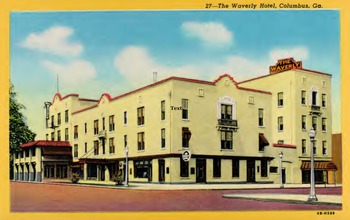
Other explicit conflicts distended the rosy picture of harmony between the U.S. military and local sensibilities about race and gender, and ratcheted up the dangerous possibilities that might be had in the relationships between international officers and local women. On New Year’s Day 1955, around 10 p.m., Columbus city police officers accosted an ROK Army officer who was parked in front of the Waverly Hotel (Figure 3). The Waverly was a popular destination for Fort Benning personnel, and the hotel advertised its cocktail lounge in Benning’s newspapers. Lieutenant Won Si Chon was sitting in the parked car and socializing with a woman “of European extraction” in the passenger seat. The police moved to arrest Won and “manhandled” him while doing so. A U.S. Army officer nearby, Captain Chamberlain, stepped in and told Won that he would serve as a witness on his behalf. The police officers promptly arrested Chamberlain, charging him with interference of police duty. The situation escalated further when a passing American private came to observe the commotion and was also arrested when he refused to obey police commands to move on.
“The Waverly Hotel, Columbus, GA,” Curt Teich Postcard Archives Collection, Newberry Library.

The three were taken to the Columbus city police station, where Won was released without charge, and the American captain and private were booked for disorderly conduct. All charges were dropped after a court hearing where the police officers involved told conflicting stories. The two soldiers escaped with a lecture from the Columbus city judge, who still chastised the two for interfering with police duty.Footnote 97
Columbus police, like many police forces in the American South, had a troubled race record in the 1950s. Just four years earlier, the Columbus Police Department had hired their first Black officers. In 1956, a Black civil rights activist was murdered in a store in front of a Columbus police officer.Footnote 98 Perhaps due to incidents like the arrest of Lt. Won, the 1959 Guidebook issued to visiting trainees underlined that students should “always wear your uniform” while away from base, to allow American servicemembers to help them and to avoid trouble with local authorities.Footnote 99
While it is left unsaid, given that U.S. military personnel intervened on his behalf, it is likely that Lt. Won was wearing his uniform. Furthermore, the Waverly’s cocktail lounge was a known destination for Fort Benning officers.Footnote 100 The police decision to “manhandle” the South Korean officer and only release him later, despite the evidence indicating that he was a trainee visiting under the auspices of U.S. Army supervision, demonstrated the limits of the protection nominally afforded by one’s military connection.
The New Year’s Day incident at the Waverly Hotel exposed several vulnerabilities in the U.S. military’s attempts to embed allied soldiers into the local environment. Unlike events supervised by liaisons, Lt. Won was not with an Army guide. He was with a white woman, sitting together in the semi-private setting of the front seats of a car. Absent municipal and police records of the incident, we can imagine that a South Korean in a one-on-one encounter could have overstepped a sexual and racial boundary in the minds of the Columbus police officers.Footnote 101 The behavioral border between the acceptable and the intolerable was brittle. Interracial mingling would be perfectly acceptable at a women’s club or a municipally approved group setting. But outside and alone, and the relationship between international officer and American woman was tinted a different hue.
The involvement of U.S. military personnel, despite their inability to deescalate or defuse the situation, nevertheless demonstrated the power of fraternal bonds that arose through professional allegiances. Recognizing one another by their uniforms, Chamberlain was willing to serve as a witness and testify on behalf of the assailed South Korean officer. The military uniform enabled Americans and Koreans to support the other when faced with law enforcement. Won was legible to his American comrades, a known quantity as the global system of military partnerships conflicted with domestic policing.
We do not know Won’s own feelings about the matter or whether it impacted his perceptions of the United States as a whole, but the contours of his case illustrate that study abroad in the United States was a program that influenced Americans. Envisioned by the U.S. military primarily to influence the outside world to suit its aims, military training for international officers centered the global and interconnected nature of their soldiering, even as it also contended with the permanence of domestic racial and sexual boundaries.
Conclusion
Study abroad training for an Asian officer was supposed to be like swallowing a multivitamin: a dozen different doses of Americana wrapped up in a U.S. government–approved short-term stay. Professional transformation through training was matched by excursions meant to produce emotional connection—whether that be making acquaintances, becoming friends with Americans, or feeling maternally cared for by American women. But immersion in American life still had few guarantees for determining how trainees would feel when they left. Even at the heart of American power, in the homeland, it had a tenuous ability to change the interiority of its international visitors and curate the American way of life to soften its less-than-ideal features.
Local American women were the U.S. military’s critical partner in the production of a pleasant study abroad training experience. They served as avatars of American leadership for the Free World and stood in as either adoptive “Kimchi mothers”—supporting the Free World family—or as symbols of a fantasized 1950s American modernity. But that partnership, too, was unstable. It was reliant on the compliance of women with social regulations of domesticity and association-bound femininity while opening the possibility that trainees and women might drift beyond the safe corner of maternal welcome. Military study abroad had an elegant premise, but soon demonstrated the same brittle and unresolved edges that characterized U.S. global empire in the early Cold War.
These varied experiences in the United States nonetheless had consequential impacts. A legion of international officers would come to understand the United States, its forms of modernity, and its military through study abroad, oftentimes drawing unforeseen lessons about what they hoped to achieve when they returned home. Some trainees departed with a renewed sense of the national destiny they hoped to affect. Others gained confidence in the administrative or battlefield skill. Friendships were no less sincere or meaningful when they did occur, and trainees with happy experiences would frequently remember the generosity of local Americans. And the sense of a professional allegiance between militaries and the shared common experience of soldiering often led to ordinary encounters where American soldiers acted in the spirit of camaraderie with allied students, demonstrative of a shared Free World fraternal military bond.
Military study abroad forced American and Asian personnel to consider themselves and their worlds in reference to one another. It demonstrates the circulatory and transnational flows of people that were the beating heart of global U.S. military power. Military study abroad illuminates the melding between “domestic” and “foreign” policy, the role of non-state actors and women in supporting those imaginations in regulated heteronormative encounters, and the inclusionary requirement for the expansion of global military power. Imperial security networks, as illustrated by the study abroad program, were buttressed by public–private partnerships, intersecting racial and gendered regulations, and ultimately unpredictable everyday experience. American global influence from this view was far-reaching and nebulous all at once.
Study abroad training inevitably entwined the United States with the behavior of the soldiers after it had invited them to its shores. Coups led by U.S.-trained officers were the result of complex and local determinants, and it would be facile to argue that U.S. military assistance was the universally decisive cause. But it would also be unreasonably dismissive to ignore the impact of the prestige, confidence, and legibility that the United States conferred upon cohorts of officers, many of whom hailed from decolonizing states with unstable civilian institutions, and whose allegiance the U.S. government relied upon to sustain its global hegemony.Footnote 102 With Latin American militaries, the relationship was much more apparent. Fort Benning’s School of the Americas, a training institute established for Latin American personnel, would become directly impugned due to the human rights abuses of the school’s graduates as soldiers of repressive regimes and movements from the 1970s to the 1990s. Public activism ultimately forced the School of the Americas to rebrand itself in 2000 and introduce curricula on human rights and democracy. However, regular protests have continued and the Pentagon has repeatedly faced the claim that its training for international officers has inflamed conditions for military coups.Footnote 103
Beginning in the early Cold War, the U.S. military has maintained the public view that the rapport and mutual insight between Americans and international trainees was strengthened through its training programs.Footnote 104 Such efforts combined training with tourism, spectacle with domesticity, food with weapons. Study abroad training brought the global peripheries of American power to the heart of the metropole and ultimately forced a reckoning on what the United States was supposed to be, what it should show, and the unintended consequences of its tutelage.
And what of Captain Kim Jong-pil, whose travelogues narrated his and his unit’s encounters with 1951 Americana? In April 1952, Kim returned to Korea. He would later claim that during his voyage home, he was “preoccupied with the question of if and when we could bequeath to our children a Korea as flourishing as America.”Footnote 105 Kim also moved in privileged circles. His uncle by marriage was Major General Park Chung-hee. Nine years later, Kim was a crucial figure in the May 16, 1961 military coup that vaulted Park to the presidency and Kim to director of the newly-created Korean Central Intelligence Agency (KCIA). The KCIA, which Kim decided should blend the roles of the American Central Intelligence Agency and Federal Bureau of Investigation, became a key tool of repression under Park’s regime. In a sign of the transnational ties across time that defined global U.S. military networks, in 1964 Kim was back in the United States, in exile after falling out of favor with Park. Among his activities included lobbying American lawmakers to request the deployment of South Korean troops to Vietnam.Footnote 106


 Open access

