


Introduction
Disasters, whether natural, such as earthquakes or pandemics, or manmade, such as terror attacks or war, have the potential to cause widespread death and destruction. Therefore, a quick and efficient response that must operate in a comprehensive, multi-hazard approach is required to save lives. Disaster response is a critical aspect of health policy at the local, regional, national, and international levels.Reference Lee, White and Adnan 1 The term “Medical Response Team” (MRT) is generic and describes a coordinated effort to address medical needs in a disaster scenario.
At the international level, the World Health Organization developed the Emergency Medical Teams (EMT) initiative to ensure an effective response against various disasters. 2 EMTs are tiered according to capacity and type of services provided and must be accredited and adhere to a set of principles and standards, including quality of care, infection control practices, and accountability.Reference Nerlander and von Schreeb 3
In the United Kingdom (UK), the Major Incident Medical Management and Support (MIMMS) is a training concept for licensed medical professionals focusing on teaching key disaster medicine skills. The concept originated in the early 1990s when, following several major incidents in the UK, gaps in the coordination between medical responders were recognized.Reference Bennett 4 Drawing on these experiences, the UK-based charity, the Advanced Life Support (ALS) Group, in collaboration with the UK ambulance services, developed MIMMS as a training program for medical staff to manage major incidents within a unified framework. 5 This framework, known as CSCATTT, includes Command, Safety, Communication, Assessment, Triage, Treatment, and Transport. 6 In the late 1990s and early 2000s, the MIMMS program was internationally disseminated, gaining widespread acceptance and becoming a standard approach for medical response in many civilian and military settings. Over time, specialized versions for hospitals, inter-agency coordination, and senior medical officers have been developed.Reference Porthouse, Clancy and Lax 7 –Reference Eddahiri, Arsura and Weinstein 9
In the United States, MRTs include Disaster Medical Assistance Teams (DMAT) and Community Emergency Response Teams (CERT). A DMAT consists of health care professionals who are deployed to respond to a distant disaster site where local resources are insufficient.Reference Mace, Jones and Bern 10 –Reference Jensen and Carr 13 The CERT responds to short-duration incidents that can be managed with community resources, and thus emphasizes the importance of training local volunteers, often laypersons, to assist in the initial response before formal emergency response assets can arrive in the immediate period after a sudden onset disaster.Reference Simmons 14 Teams located within neighborhoods train to deploy immediately after the disaster to rapidly reach the affected area to assess the situation and communicate to incident command, perform basic first aid, enable crowd control, designate ingress/egress routes, prepare to report to arriving first responders, and receive further instructions to integrate into the dynamic response.
The Disaster Site
Disasters are complex scenes, and may include destroyed infrastructure such as the electric grid, water facilities, sewage lines, roads, and bridges. MRTs may need to navigate hazardous conditions to locate survivors, perform triage, and provide life-saving interventions under extreme resource constraints. Life-saving interventions may include applying pressure bandages or tourniquets to stop bleeding, needle thoracostomy, or bag-valve mask ventilation. They need to continue sorting to match the patient to the most appropriate definitive care destination.Reference Lokerman, Waalwijk and van der Sluijs 15 , Reference Bosson, Abo and Litchfield 16 They may also be involved with the transport of victims to definitive care or providing prolonged field care in cooperation with search and rescue forcesReference Hrdina, Coleman and Bogucki 17 –Reference Glow, Colucci and Allington 19 (Figure 1A).
Simulated exercise depicting pre-hospital forces from the local search and rescue team extricating a victim from a building collapse at a mock disaster site.

Triage is critical in a mass casualty incident (MCI) to rapidly identify victims with immediately life-threatening injuries and distinguish them from those in whom evacuation can be safely delayed. Multiple prehospital triage systems have been developed, including START, SALT, Triage Sieve, and Military Sieve, but none have consistently demonstrated superior accuracy.Reference Jerome, Savage and Pietrosanu 20 , Reference Bazyar, Farrokhi and Khankeh 21 While triage protocols often include quantitative assessments, sensitivity varies, and both under-triage and over-triage are common even among trained medical personnel.Reference Marcussen, Bräuner and Alstrøm 22 Triage tags are frequently used in the prehospital setting to document care and communicate findings. However, the dynamic nature of trauma victims may render these tags unreliable, with a false sense of security being created when wounded are triaged at the scene as “green” or “yellow”.Reference Rådestad, Lennquist Montán and Rüter 23 In 2019, the Assistant Secretary for Preparedness and Response in the United States concluded that there is no clear evidence base that supports the use of triage tags. 24
The Casualty Collection Point
After evacuation from the area of destruction, if the victims can’t be directly transported to hospitals, they are concentrated in a protected area near the scene of a MCI known as the casualty collection point. The primary goal is to optimize resource utilization, stabilize critical patients, and facilitate the continual sorting of accumulating patients to match available transportation and priority destinations. At this site, patients receive initial care that includes resuscitation, transfusions, and treatment for burns or traumatic injuries. To establish an improvised treatment station, the professionally trained teams set up reception, intensive care, and recovery areasReference Khajehaminian, Ardalan and Keshtkar 25 –Reference Pepper, Archer and Moloney 27 (Figure 1B).
Simulated disaster exercise depicting pre-hospital forces working to examine and treat victims at the casualty collection point.

Prolonged Field Care
In cases where it is impossible to evacuate the victims immediately, the teams are trained to operate in challenging conditions and provide prolonged care until rescue forces arrive. Prolonged Field Care (PFC) is defined as medical treatment in the field that is applied beyond “doctrinal planning timelines” by a tactical medical practitioner to decrease patient mortality and morbidity.Reference Dolan, Valerio and Lee Childers 28 This care often requires special training and adaptations. For example, treatment of burn victims in the field requires the use of whatever is available, including banana leaves for burn care.Reference Shingleton, Folwell and Jones 29 Another example is extremity injuries, with open fractures requiring makeshift immobilizers.Reference Smith, Cheatham and Safcsak 30 This training includes familiarization with advanced techniques of managing limited resources, treating casualties in critical situations, and keeping them alive until evacuation is possible. Establishing contact with hospitals, ambulance teams, and emergency centers is crucial to coordinating the evacuation of victims for further treatment.
Response under Threat
Disasters caused by armed conflict carry the additional challenge of posing a deliberate threat to responders and their patients. Thus, even if a local scene may require external resources, these may not be available due to disrupted infrastructure or ongoing attacks. This may be a feature of MCIs, even those due to a single active shooter. For example, in the Pulse Nighclub mass shooting in 2016 that took the lives of 49 mostly young adults, it took 2.5 hours before rescue forces could reach many of the victims due to a standoff with the perpetrator.Reference Smith, Cheatham and Safcsak 30 A fundamental principle of MCI response is that the safety of the rescuers is paramount. In an ongoing threat, only armed, tactically trained responders enter the “hot zone,” while essential medical personnel and command-and-control remain in safe areas.Reference Schorscher, Kippnich and Meybohm 31 , Reference Castro-Delgado, Bhandari and Acharya 32
During the October 7, 2023, large-scale attacks in southern Israel, the country found itself in a new and unfamiliar reality. 33 , 34 The medical and emergency medical services (EMS) systems in Israel are typically accessible in short periods of time. However, on October 7, EMS providers were not able to reach the high number of wounded for many hours, mostly due to the prolonged security threats. As a result, the medical response was left to citizens in besieged places, many of whom did not have official training. This revealed the need to organize teams in advance so they will be prepared to best provide medical assistance during an emergency when there is no access to EMS.
Since October 7, 2023, several initiatives have been developed to involve communities in training local medical professionals for the care of potential victims of terrorist or missile attacks. Thus, the concept of the Professional Community Emergency Response Team (P-CERT) has been developed. This initiative recruits local residents who are health care professionals to provide a structured, high-quality medical response in their own communities to a disaster where EMS presence and evacuation would be protracted requiring prolonged field care in the casualty collection points. The objective of this article is to describe the P-CERT concept and how it has been implemented in Israel after the events of October 7, 2023.
Discussion
Magen David Adom
Magen David Adom (MDA) is Israel’s National EMS Organization which is a two-tiered system based on Basic Life Support (BLS) and ALS. The BLS providers are EMTs who can give oxygen, stop bleeding with tourniquets, and perform cardiopulmonary resuscitation, including defibrillation. ALS consists of paramedics whose skillset includes intubation and pushing resuscitative medications. Currently, MDA has approximately 3,500 employees, operates 200 ambulance stations nation wide, and has over 30,000 volunteers.Reference Jaffe, Dadon and Alpert 35 For over 20 years, the volunteers have been integrated into MDA and include those who staff ambulances and those who are on-call and respond by private vehicles. Most are trained at the level of BLS, although there are paramedic and physician volunteers. MDA volunteers are found in all cities and towns throughout Israel, and all are trained to respond to MCIs.Reference Jaffe, Alpert and Lipsky 36 , Reference Alpert, Lipsky and Elie 37
MDA played an important role on October 7, 2023, both in treating and transporting victims from the scene and performing secondary transfers from hospitals that were overwhelmed with casualties.Reference Alpert, Assaf and Nama 38 Missile fire placed additional safety challenges to MDA’s prehospital and inter-facility transportation responsibilities.
At the same time, MDA developed its P-CERT framework and operational protocols, providing volunteers with training. This included courses emphasizing the concepts of Prehospital Trauma Life Support (PHTLS) and simulations for diverse emergencies such as urban search-and-rescue operations, prolonged field care, and management of an MCI.Reference Esmaeilzadeh, Rostamian and Khorasani-Zavareh 39 , Reference Johansson, Blomberg and Svennblad 40
At the time this article was written in September 2025, MDA had trained over 14,000 civilian volunteers from more than 590 community and neighborhood teams throughout Israel. Among them, over 6,400 received basic first aid equipment, 1,800 received BLS equipment, and 700 received ALS equipment designated for certified doctors, nurses, and paramedics. Additionally, MDA has another 10,000 on-call volunteers with equipment designated according to their level of certification. (Table 1A)
Magen David Adom P-CERT Organization as of September 2025 (approximate numbers)

The City of Modi’in as a Case Study
The city of Modi’in is located in the center of Israel, halfway between Jerusalem and Tel Aviv. A decade ago, a search and rescue unit was established by the municipality under its Department of Security to extricate and provide initial treatment for those trapped in collapsed building sites due to natural disasters such as earthquakes. Among the unit’s volunteers, there were approximately 20 medical personnel—mostly EMTs. Already at the beginning of the war, the MRT began organizing to refresh its knowledge and skills. A few days later, several refresher days were held for a group of physicians from the city.
An emergency medicine specialist and veteran paramedic were recruited for the task of establishing a larger class of local professional responders. Several goals were defined for the city’s new P-CERT: (1) training medical teams to work at a disaster site with search and rescue teams; (2) managing a temporary casualty treatment site in a scenario in which the city becomes a “desert island” cut off by a missile attack or natural disaster; (3) and coordination with EMS.
To date, over 60 doctors with various specialties have been recruited, mostly via social media and word of mouth. Some of the physicians work in hospitals, while others are employed in the community. In addition, the team included 35 nurses, 45 EMTs, and 8 paramedics. Other paramedical staff included pharmacists, physiotherapists, and laboratory technicians. In total, over 150 medical professionals joined the P-CERT (Table 1B).
Modi’in Medical Response Team as of September 2025

The training of the medical teams dealt with the management of trauma casualties in the prehospital setting with an emphasis on the concepts of PHTLS. Crisis resource management (CRM), referring to the non-medical aspects of patient care in a crisis, was also taught. This included teamwork, communication, and logistical issues.Reference Fung, Boet and Bould 41 , Reference Carne, Kennedy and Gray 42 In a scenario where the city may be isolated, the large variety of specialties is a great advantage, since they provide a response to both emergency and routine medicine.
Several training courses took place in the first year of the readiness class. A procedures skill class was conducted, specifically designed for low-resource settings. In this session, local physicians who were not trained in emergency and critical care skills were taught bag-mask ventilation and laryngeal mask airway insertion. Intubation and chest tube insertion techniques were reviewed for those with previous experience. All physicians underwent hemorrhage control training with a tourniquet and packing similar to “Stop the Bleed®” education in the United States.Reference Trentzsch, Goossen and Prediger 43 , Reference Johnston, Deal and Estrada 44 In addition, all physicians underwent training in evacuating a victim while maintaining in-line cervical spine stabilization.
An exercise was conducted emphasizing team management and CRM in the treatment of a single patient in the field. An MCI response exercise at the city’s search and rescue site was then conducted to train the P-CERT in rescuing and treating multiple victims. The exercises were conducted using advanced and high-fidelity simulators. A group of physicians later participated in a separate “tabletop” exercise, led by the Deputy Director of MDA. This was an exercise aimed to train the city’s doctors to provide an initial response if they encounter an MCI, even before EMS forces arrive in the area. Volunteers in the rescue unit who were not physicians and members of the city’s armed tactical response team underwent first aid training.
Future projects include an advanced search and rescue course for physicians and a point-of-care ultrasound course. One of the goals of the team is to manage a staging site for casualties in the city in an emergency scenario in which the city becomes an isolated “desert island.” The plan is to conduct an exercise simulating such a staging site in a central location. Regular training will be conducted to maintain the competence of the medical teams, as well as exercises at a disaster site with a rescue and recovery unit.
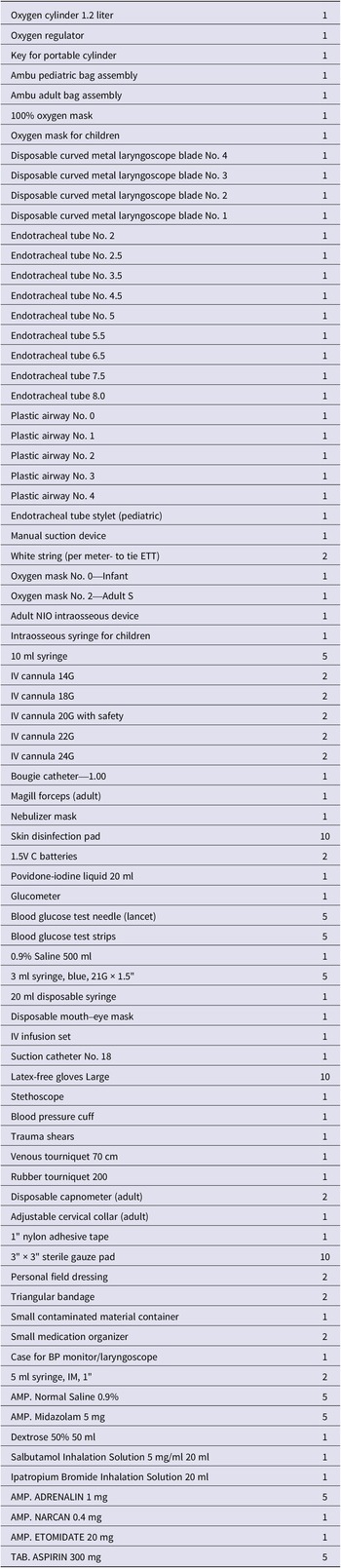
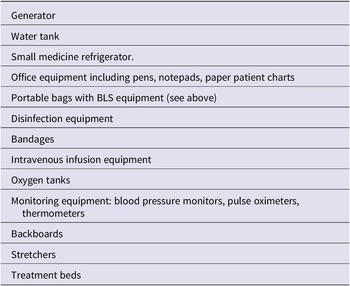
One of the initial challenges was the acquisition of appropriate equipment. A philanthropic organization donated advanced resuscitation equipment for physicians. Forty advanced life support kits have been distributed to the city’s physicians. (Table 2A) BLS equipment was distributed to nurses and paramedics (Table 2B). General equipment is to be transported to treatment sites using a municipality trailer (Table 2C).
Contents of advanced life support kit

Contents of basic life support kit

Contents of medical team trailer

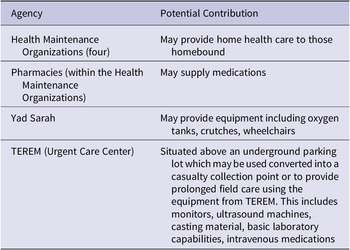
In addition to MDA, there are other bodies in the city that can be of assistance in emergencies. There are clinics of all four of Israel’s Health Maintenance Organizations as well as an urgent care center in the city. A meeting was held with representatives of each to clarify existing resources during an emergency. In addition, the local branch of Yad Sarah, a nationwide volunteer organization that specializes in the lending of medical, therapeutic, and rehabilitation equipment, agreed to participate. The branch received donations of medical equipment that can be used by patients who are hospitalized at home. A major effort is now underway to identify other healthcare agencies in the city, such as a dialysis center, pharmacies, and private clinics, which could also be of assistance if the city were to be besieged (Table 2D).
Agencies in Modi’in that may assist in the setting of a disaster

Frontline Emergency Medicine Model
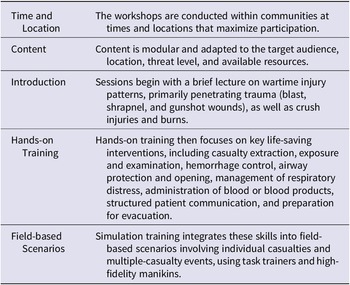
The Frontline Emergency Medicine (FEM) mobile unit was established to address the growing demand for trauma training in isolated communities throughout the country. At the time this article was written, the volunteer-run unit had conducted over 120 workshops and trained more than 3,200 medical personnel—including doctors, nurses, paramedics, and EMTs—on Israel’s northern and southern borders. Using MARCH (massive hemorrhage, airway, respirations, circulation, head injury/hypothermia) trauma care principles and protocols from the Israeli Defense Force Medical Corps, as well as Tactical Combat Casualty Care, the training focuses on essential life-saving skills, including hemorrhage control, airway management, hypothermia prevention, and rapid evacuation. By operating as a mobile unit, FEM offers adaptable, on-site, simulation-based workshops tailored to the skill levels and specific needs of providers, ranging from physicians in community hospitals to medics in casualty collection zones.
This program is unique in terms of its integration of skill acquisition with hyper-realistic simulations that train P-CERTs in managing multi-trauma scenarios within their endemic environment. Simulation-based training has been shown to improve teamwork and coordination in both military and civilian medical settings, a cornerstone of effective trauma care.Reference Holvelinsky, Travers and Stierwalt 45 The workshops emphasized teamwork and dynamic learning, evolving to prioritize practical, effective interventions over invasive procedures, exemplifying the principle that “less is more.” Training included not only procedures, but also protocols like “YaHaLOM,” an Israeli intervention designed to prevent post-traumatic stress reactions from the moment of injury.Reference Svetlitzky, Farchi and Yehuda 46 Competency was assessed in real time through direct supervision of all procedures and drills. Each workshop included supervised simulations of single- and multiple-patient scenarios that integrated the procedures taught and required decision-making under pressure. Assessment drills were conducted in small groups of up to four participants, allowing close observation and individual evaluation of acquired competencies. Selected workshops were additionally evaluated using formal pre- and post-workshop questionnaires, comparing knowledge, understanding, decision-making, and prioritization, as well as participant satisfaction and resilience before and after the training.
Training in triage was also emphasized. A recently proposed Transitional Triage Model synthesized shared elements across systems to create a more intuitive observational assessment. As training was directed at community first responders often with little or no experience in triage or trauma care, FEM adopted a similarly intuitive approach; a qualitative “ABCD” assessment based on “look, listen, and touch.” Responders were taught to identify visible signs of a compromised airway (A), recognize symptoms of respiratory distress (B), feel for a radial pulse (C), and have the wounded follow simple commands (D). Responders were trained to begin triage from the moment of extraction from danger, identifying “walking wounded” via their ability to follow a command to self-evacuate.
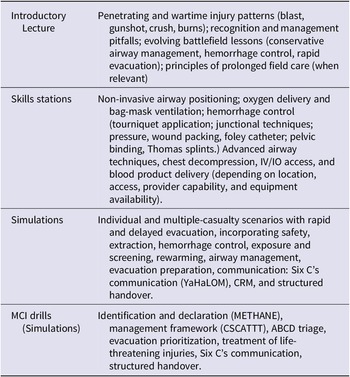
High-energy penetrating injuries and complex blast trauma are often associated with catastrophic limb or junctional zone bleeding that must be controlled in the field. Stopping the bleed must be performed during the initial assessment with continued assessments to remain vigilant for potential deterioration. Any blast exposure or penetrating trauma to the head, neck, torso, or pelvis mandates evacuation, with priority given to injuries not controllable in the field. This combined anticipate, triage, and treat method is teachable and suited to community responders in high-threat environments.Reference Khorram-Manesh, Nordling and Carlström 47 Participants consistently reported increased confidence and preparedness for an MCI (Tables 3A and 3B).
Modules taught in Frontline Emergency Medicine

Abbreviations: IV/IO = intravenous/intraosseous; CRM = crisis resource management; METHANE = Major Incident Declared, Exact location, Type of incident, Hazards, Access, Number and type of casualties, Emergency services present and required; CSCATTT = Command, Safety, Communication, Assessment, Triage, Treatment, and Transport; ABCD = Airway, Breathing, Circulation, Disability; Six C’s = Cognitive Communication to diminish emotional overwhelm and bolster cognitive functioning, Challenge for active engagement, Control for cognitive management of situations, Commitment from the helper to reduce loneliness, and Continuity to ensure narrative coherence.
Description of Frontline Emergency Medicine Workshops

During the war, the need to establish Community Casualty Collection Centers (CCCCs) emerged as a potential solution for outlying and high-risk communities with limited access to hospital care during mass casualty events. The concept was piloted in two demographically distinct but medically vulnerable communities. Majdal Shams is a Druze town on the Syrian and Lebanese borders with only one road to the nearest hospital (61 km). On July 27, 2024, the town suffered a devastating missile attack. A 53-kg warhead struck a football field in the town, killing 12 children and teenagers and injuring 34 others. The close-knit nature of the community meant that families and neighbors rushed casualties to multiple small clinics, turning a potentially centralized MCI into a dispersed one and exposing critical gaps in prehospital trauma care and priority transportation. FEM subsequently partnered with local leadership to build a structured preparedness program. A multi-level training sequence was delivered, including core skill-set instruction, single-patient management, and the design, equipping, and staffing of a dedicated CCCC. This culminated in a coordinated mass-casualty simulation (Figures 2A and 2B). Beyond improving skills and coordination, the program generated an overwhelming community response and strengthened collective resilience in the aftermath of profound loss. The other community was Kiryat Sefer, a densely populated ultra-Orthodox city with 108,000 residents, 65% of whom are children, only eight doctors, and one access road.
Community Casualty Collection Center (CCCC) layout and patient flow. Schematic representation of the CCCC, including triage/registration, Command and Control, Immediate, Delayed, and Minimal Care Zones, followed by discharge home or evacuation after exit documentation. Staffing patterns included physicians, medical personnel, zone leads, scribes, and social workers. Patient flow was unidirectional throughout the CCCC. Equipment includes modular stretchers (appearing as white rectangles), partitions, and equipment carts for rapid deployment. Definition of the zones: Immediate Care Zone: advanced airway management, chest decompression, hemorrhage control; Delayed Care Zone: equivalent to intermediate care including hemorrhage control, complex wound care, complex burn care; Minimal Care Zone: equivalent to ambulatory care including simple fracture management, simple wound care

Simulation of a Community Casualty Collection Center (CCCC) in an underground parking lot in Majdal Shams. Management of casualties during a supervised MCI drill simulating a missile attack in Majdal Shams. Live actors and high-fidelity trauma manikins with moulage are being treated by medical and support personnel, identifiable by color-coded vests, in the delayed-care zone of the CCCC. The CCCC is equipped with mobile equipment carts, collapsible stretchers, and privacy partitions. An ambulance crew member and a search-and-rescue team member are transferring a female patient to a stretcher behind a partition in the delayed care zone.

The CCCCs were equipped to provide frontline trauma care, including bleeding control, airway support, and stabilization, as well as emotional support, by locally-based volunteer teams consisting of family doctors, nurses, paramedics, medics, and social workers. FEM teams led the design, equipping, and multi-session training of P-CERT responders, culminating in full-scale MCI drills involving local EMS, HFC, and municipal leadership. The CCCCs serve both as clinical and operational hubs, transforming dispersed, chaotic trauma scenes into coordinated, life-saving efforts within the community itself.
The FEM model offers a scalable framework for national preparedness by combining a mobile, expert-led team with a highly adaptable curriculum that is tailored to local needs. This enables effective implementation across a wide spectrum of settings from the immediate life-saving response required of small military medical units to the operation of casualty collection zones.
Community preparedness training during this period was successful due to several factors. One was the immediacy and severity of the threat, which increased initial community willingness to participate. Equally important, however, was the quality of the training delivered by senior emergency medicine and trauma professionals. The workshops were further strengthened by a dynamic curriculum that evolved with the IDF protocols and shifted toward simpler, high-yield interventions. The FEM staff is planning to include short asynchronous learning modules, advocate for governmental support for mobile training capacity, and build broader national networks to maintain competency over time.
Challenges and Limitations
Team members may be required to operate in hazardous conditions, including destroyed infrastructure. Dedicated training in the field of work in risky situations allows the teams to operate safely and efficiently while safeguarding the lives of the victims. During emergencies, the available resources may be limited requiring the P-CERTs to implement crisis standards of care and make difficult ethical decisions to allocate resources to those who will benefit the most. The relationship between the local teams and external parties may encounter difficulties, especially when there is damage to the communication infrastructure. Therefore, the teams must be qualified to operate, even without continuous contact with other emergency responders.
Most of the training throughout the country occurred above ground. However, in the event of a ballistic missile attack, the actual CCCC would have to be in an underground protected area. The FEM initiative faced challenges that included reaching dispersed communities, reliance on volunteer staffing, and the inability to train evacuated southern towns.
Another limitation is that not all of the participants, even though they underwent training, were formally tested to determine competency, whether on specific procedures or on team-based skills.
While MDA is Israel’s National EMS and is in charge of any MCI, other volunteer services have incorporated professional medical personnel in disaster response. Also, there are other cities in Israel, in addition to Modiin, which have incorporated P-CERTs at the municipal level.
Future Directions
The future directions of the P-CERT program are currently focused on creating new teams throughout the country and maintaining the competencies of the current teams. This includes continuing education, training, and the distribution of supplies. This consists of exercises among the individual teams as well as those conducted with MDA or the IDF. Throughout this process, it will be important to continue to collect data to lead to quality improvement of the P-CERT program.
Conclusion
P-CERTs can be mobilized by the EMS central command centers and activated to support the entire emergency medical system after a sudden onset disaster that involves continued safety threats to the response or massive destruction leading to delayed priority transportation to definitive care. Along with the formation and training of local medical teams, it is crucial to understand the diverse roles and challenges they will assume during a prolonged response after a sudden onset disaster, in addition to the advantages of their operations in the field. These teams must perform in uncertain situations and deliver quick, high-quality medical care under challenging conditions, sometimes involving resource shortages as basic as medications, equipment, or proper treatment space, in addition to damaged infrastructure and communication difficulties. The P-CERT model can be integrated into local municipalities or implemented on a national level as an important aspect of health policy to enhance disaster response globally.
Acknowledgments
None.
Ethics approval and consent to participate
Not applicable.
Consent for publication
Ethics approval and consent to participate
Availability of data and materials
Information concerning data and materials is available from the contributing author, EAA, upon reasonable request.
Author contribution
EAA was a major contributor in the design and writing of the manuscript; DGW was a major contributor in writing the manuscript; MS was a major contributor in writing the manuscript; BB was a major contributor in writing the manuscript; MN was a major contributor in writing the manuscript; IW was a major contributor in writing the manuscript; and EJ was a major contributor in the design and writing of the manuscript. All authors read and approved the final manuscript.
Funding statement
There is no funding for this manuscript.
Competing interests
The authors declare that they have no competing interests.





 Open access

