


Introduction
During the austral summer of 1957–58 a deep hole was drilled to a depth of 309 m. in the ice sheet at Byrd Station (lat. 80° S., long. 120° W.), West Antarctica. This deep core drilling formed part of the U.S. I.G.Y. glaciological program and was conducted by U.S.A. SIPRE (now CRREL). The principal aims of this project were to: (1) recover a continuous sequence of undisturbed cores on which to conduct profile studies of the physical and petrographic properties of snow, firn and ice in the upper levels of a high polar glacier, and (2) provide a deep hole for studying the temperature profile and the flow properties of ice in the same glacier. Drilling was accomplished with a Failing 1500 rotary well-drilling rig, specially modified for coring in ice, and using cold compressed air as the drilling fluid. Details of the actual drilling are to be found in the postoperational reports of Reference PatenaudePatenaude (1958) and Reference LangeLange (in press). Preliminary results of core analyses and drill hole measurements have been published by Reference Marshall and CowMarshall and Gow (1958) and by Reference Bender and GowBender and Gow (1961) . The temperature profile was measured at the end of drilling in February 1958, but it was not until December 1958 approximately eleven months after the termination of drilling, that the bore hole was first fully instrumented for temperature, inclination and closure (Reference RagleRagle and others, 1960). Further measurements were made in January 1960, January 1961, and February 1962 and it is the purpose of this paper to present the results of these measurements of the past four years.
Equipment and Methods
In December 1958 closures and temperatures were measured in a single trip down the drill hole. The use of a single-shot inclinometer in 1958 required a separate trip to each level of measurement in the drill hole, but in January 1960, and in all subsequent measurements, the hole-gauging caliper, multiple-shot inclinometer and temperature probes (thermistors) were combined in a single instrument. This was attached to a steel-insulated triple conductor cable and lowered into the drill hole by means of a winch. Inclinations were measured as the cable was run down to the bottom of the hole, and closure and temperature measurements were made on the return trip. The winch and recording equipment were set up in an old disused undersnow laboratory and maintained at a temperature of approximately −26° C. The recording equipment consisted essentially of a Leeds and Northrup Wheatstone bridge and null indicator for measuring caliper and thermistor resistances, and a junction box for operating the inclinometer and for releasing the spring-loaded caliper at the bottom of the drill hole. The 1958 January summer surface was used as a datum level for all measurements, so as to ensure remeasurement at identical depths in the drill hole from one year to the next. This is particularly important for diameter measurements in the deeper parts of the drill hole, where closure is occurring relatively rapidly, and where an error of a meter or two in the depth would seriously effect the closure profile.
Results
Temperature measurements
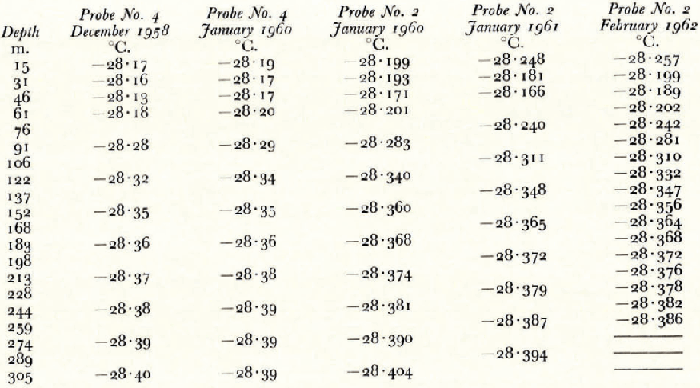
Valid temperature data can be obtained during drilling if observations are made in the bottom of the drill hole each time the drill string is pulled. If temperatures are not measured until after the hole has been drilled out, as was the case at Byrd Station, then heat introduced during drilling can be expected to affect sensibly the temperature profile. At Byrd Station the principal source of “drill heat” was the compressed air used for removing drilling chips. Since the compressed air is circulated past the higher levels for a longer period than past the lower levels, the drill hole will warm up by a greater amount at the top than at the bottom. This “drill heat” will dissipate with time, but its influence is definitely reflected in the initial measurements of February 1958, when the temperature gradient was much steeper than observed in later profiles (see inset Fig. 1). A similar effect was noted in the SIPRE drill hole at Site 2, Greenland in 1957–58 (personal communication from B. Lyle Hansen). At Site 2 the difference in gradients at the end of ten months was nearly the same as that observed between the February 1958 and December 1958 profiles at Byrd Station. The too ohm copper resistance thermometer (thermohm) used in February 1958 is known to furnish thoroughly reliable gradient data but the actual temperatures could be in error by as much as 0.2° C. In December 1958 a highly sensitive thermistor-type probe (probe No. 4), capable of detecting temperature changes of 0.005° C., was used for measuring temperatures in the drill hole. Two additional probes (No. 2 and No. 3) were used in January 1960. Unfortunately, probes No. 3 and No. 4 were both lost down the hole during measurements in January 1961, but temperatures were obtained with probe No. 2, and the same thermistor was used for recording temperatures in January 1962. Results of all measurements with probes No. 2 and No. 4 are listed in Table I. These have all been corrected for instrumental errors, and are considered to be within 0.02° C. of the true temperatures. However, since the bridge resistances can be read to within ±1 ohm, equivalent to ±0.001° C., with probe No. 2 the gradient data can be determined even more precisely. For this reason the probe No. 2 temperatures in Table I are given to the nearest millidegree. A depth-temperature curve for data from probe No. 2 is given in Figure 1; values obtained with probe No. 4 in December 1958 are also plotted in the same figure. These results show that the temperature profile below 70 m. has remained virtually unchanged since December 1958. Above 70 m., however, the temperatures have fluctuated. This is due in part at least to the existence of steel casing in the uppermost layers of permeable snow. This casing was set to a depth of 36 m. during drilling in 1957–58 to prevent loss of circulation of compressed air into the surrounding snow. The effects of conduction and convection in this region of the drill hole are difficult to evaluate at this stage. They could, perhaps, be profitably investigated in a moderately deep (say 60 m.) uncased drill hole, but it is interesting to note that there has been a small but progressive decrease in temperatures in the cased portion of the drill hole since 1958. This may reflect a trend toward decreasing surface temperatures at Byrd Station over the past few years. Nevertheless, it would appear that whatever disturbances exist in the upper levels of the drill hole, these are exerting a negligible effect on the temperature profile below 70 m. Further evidence of this stability at depth is indicated by the observation that the thermistors invariably equilibrated in a matter of minutes, and thereafter fluctuated by less than 0.002° C., even when suspended at the same depth for several days. This would certainly indicate minimal convectional movement of air below 70 m.
Temperature profiles, Byrd Station deep drill hole

Deep Hole Temperatures, Byrd Station, 1958–62
Negative temperature gradients (temperatures decreasing with depth) exist at all depths below 45 m. in the drill hole, and a constant-gradient profile is developed below 170 m. The existence of a positive gradient in the upper 45 m. of the drill hole seems anomalous, as snow temperature measurements at Byrd Station over the past five years have revealed negative gradients below about 15 m. The fact that a negative gradient does not develop until just below the bottom of the casing would certainly suggest that the casing itself is in some way responsible for this anomalous increase in temperature down to 45 m. Interestingly enough, no such anomaly was observed in the 400 m. hole at Site 2 Greenland, where temperatures in the casing were found to agree very closely with those recorded in nearby hand-drilled auger holes (personal communication from B. Lyle Hansen). It should be noted, however, that the casing at Byrd Station was extended an additional 5 m. above the snow surface in February 1958, to ensure relocating the drill hole in the event of its anticipated burial under drifting snow. This exposed section of casing would seem to be the most likely cause of the anomalous air temperatures measured in the casing. For temperatures measured in summer, the casing appears to permit a positive temperature gradient to propagate down the entire length of casing and just beyond to a depth of 45 m., approximately three times the depth to which positive temperature gradients have been observed to persist in undisturbed snow at Byrd Station. Presumably, a somewhat different profile would develop in the casing during winter but this has not been investigated. As indicated in Figure 1 the drill hole profile at 70 m. could be extended in a reasonably smooth curve to intersect the temperature of −28.1° C. measured by Reference AndersonAnderson (1958) at a depth of 31 m. If extrapolated further, this same curve would yield a temperature of −28.0° C. at about 15 m., which compares favorably with the −28.00° C. ±0.05° C. temperature that Anderson recorded at a depth of 16 m. throughout the winter of 1957. This temperature might be considered to approximate closely the average mean annual temperature of Byrd Station.
Although temperatures have been observed to decrease by less than 0.2° C. from 45 m. to the bottom of the drill hole, there are, nevertheless, some rather significant changes in gradient. These are illustrated in the gradient profile in Figure 2 from data obtained with probe No. 2 in January 1962. A gradient maximum of −0.0027° C./m. was observed at a depth of 69 m. and this then decreased linearly with increasing depth at the rate of 0.000028° C./m. per meter. If this rate of change of gradient had been maintained beyond 166 m. the temperature profile would have developed a positive gradient below that depth. Instead, the rate of change of gradient begins to fall off just above i 50 m., and a constant gradient profile is developed below 170 m. The gradient, −0.00026° C./m. is approximately one order of magnitude smaller than the gradient maximum observed at 69 m. (−0.0027° C./m.). It is interesting to note that a constant gradient profile was also found to develop at about the same depth in the drill hole at Site 2 Greenland (Reference Hansen and LandauerHansen and Landauer, 1958). At Site 2, however, the gradient of −0.001° C./m. is nearly four times larger than the gradient observed at Byrd Station. At some point in the 2,400 m. thick ice sheet at Byrd Station temperatures must begin to increase with depth as geothermal and frictional heat sources take effect. Temperature measurements in the upper 300 m. are of little help in this respect, since with the development of a constant gradient profile below 170 m., it is not possible to extrapolate to the depth at which this overturn of temperatures would actually take place. A negative temperature gradient could conceivably persist to a considerable depth in the ice sheet at Byrd Station, and there is an obvious need for temperature measurements to much greater depths than hitherto obtained for the inland ice of Antarctica. This would require the drilling of a hole to at least the depth of temperature overturn and preferably deeper. Until this is done the whole question of temperature distribution in thick ice sheets will remain largely in the realm of speculation.
Temperature gradient profile, Byrd Station deep drill hole

Temperature in the upper layers of an ice sheet are sensitive to variations at the surface. Profiles exhibiting negative gradients are generally thought to have developed in response to surface warming, due either to climatic amelioration or to the downhill movement of ice from colder to warmer temperatures at the lower elevations. Considering first the effects of ice motion, the magnitude of the gradient can be approximated in terms of Reference RobinRobin’s (1955) equation


Inclinometer measurements
Measurements with a Lane-Wells single-shot inclinometer in December 1958 revealed inclinations of up to 0.5 degree to a depth of 122 m. Negligible inclinations were recorded at all depths below 122 m. In January 1960, measurements were repeated with a Parsons Survey multiple-shot instrument. Results of this survey are presented in Figure 3. An inclination of 0.3 degree was observed at 183 m. Minor bending was recorded at 122 m. and 244 m., but elsewhere in the drill hole the inclination from the vertical was found to be negligible. Identical results were obtained in the resurvey in February 1962, and it is concluded that the drill hole has undergone insignificant bending since it was drilled more than five years ago. This would imply the existence of negligible differential motion in the top 300 m. of the 2,400 m. thick ice sheet at Byrd Station.
Inclinometer survey of Byrd Station deep drill hole, January 1960

Hole closure measurements
Hole diameters were measured at 15 m. intervals with a spring-loaded caliper that varies an electrical resistance as a function of the diameter. The diameter d of the drill hole was calculated from the equation

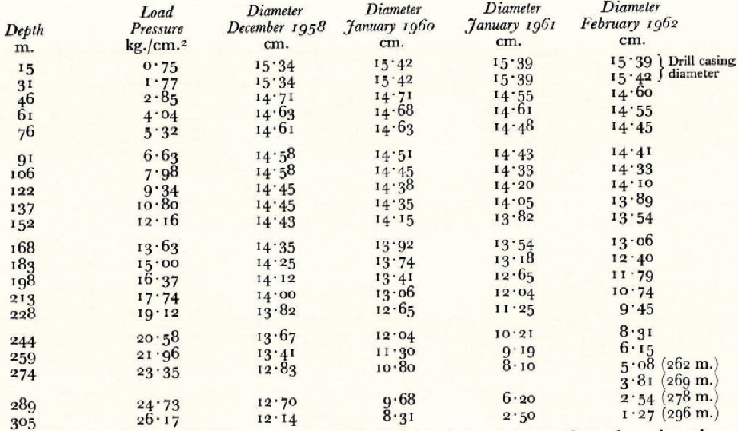
where c, r and k are constants dependent upon the design of the caliper, R 0 is the resistance of the caliper in the fully closed position, and R is the resistance measured with the caliper in the drill hole. A short description of this caliper and the derivation of the above equation are given by Reference Hansen and LandauerHansen and Landauer (1958). The caliper is designed to measure diameters of between 6 cm. and 15 cm. with a limit of error of 0.2 per cent. Sensitivity varies from 0.1 per cent at 6 cm. to 0.03 per cent at 15 cm. The results of four years’ measurements are presented in Table II and Figure 4. The diameter of the hole measured 14.63 cm. when drilled, but by January 1961 the unrestrained bore hole had contracted to less than 6.2 cm. at 289 m. Measurements with a 2.5 cm. diameter, lead-filled brass tube attached to a linen fish line showed that the hole had closed off to a diameter of 2.5 cm. at 305 m. depth.
Deep Hole Diameter Measurements, Byrd Station, 1958–62
Depth–diameter profiles, Byrd Station deep drill hole

In February 1962 an unstretchable wire line and a set of brass rods ranging in diameter from 5.1 cm. to 1.27 cm. were used to obtain accurate measurements of closure near the bottom of the drill hole. These measurements revealed a marked falling off of the closure below 270 m.—as illustrated in the February 1962 depth–diameter profile in Figure 4. Clearly, some constraint is developing in the bottom section of the drill hole. This constraint could be related to the actual dimensions of crystals of ice in the walls of the drill hole, as crystals as large as 1.5 cm. in diameter have been observed in thin sections of cores from the bottom of the drill hole. Once the bore hole had contracted to a size approaching that of the individual crystals in the walls of the drill hole, then some resistance to further closure could be expected to develop. At least it would seem, in the deepest parts of the drill hole anyway, that the actual size of the hole (and possibly the shape) is now exerting an increasing effect on the closure.
In Figure 5, hole closures at various depths in the drill hole have been plotted against time. The resultant family of curves shows that deformation rates have increased steadily at all depths, with the most rapid increases taking place in the deeper parts of the drill hole. Of considerable interest though, is the definite fall off of closure rates after the hole has contracted to a diameter of about 3.0 cm. This behavior was first observed in the lowermost 30 m. of the drill hole at the end of 4 yr. closure. As already noted this may reflect the attainment of a critical close-off diameter, beyond which the physical dimensions of crystals in the walls of the drill hole act to retard the closure. A similar pattern of closure has also been observed in the 411 m. bore hole at Site 2 Greenland. At Site 2, however, the first year’s deformation was approximately 70–80 per cent greater than that observed in the Byrd Station drill hole. Since this significantly greater closure at Site 2 can most likely be attributed to warmer temperatures in the ice at Site 2, we might write:

where


from which, E turns out to be 19.8 kcal./mole. This is somewhat higher than the generally accepted value of 14 kcal./mole for ice, but it is close to the value of 18.7 kcal./mole that Reference NakayaNakaya (1959) derived from visco-elastic measurements of old ice-sheet ice from Greenland. In this evaluation of the activation energy it was assumed that the rate of deformation


Variations in deformation rates with depth in the drill hole at Byrd Station. Deformation(diametric closure)=(D0−Dt)/D0 where D0=14·636 cm

At Byrd Station the firn transforms into ice at a depth of about 65 m. At this depth pockets of air trapped between firn grains seal off to form individual bubbles; the aggregate is no longer permeable and is, by definition, ice. The density at the firn-ice transition is about 0.830 g./cm.3. At 100 m. the ice has attained a density of 0.900 g./cm.3, increasing very slowly to 0.916 g./cm.3 at 309 m. in cores from the bottom of the drill hole. The density distribution was determined very accurately over the entire length of core, thus facilitating accurate calculation of the overburden pressure at any depth in the drill hole. From additional studies on the ice cores it was found that grain size increased progressively with depth, grain shapes became more irregular, and air bubble pressures increased steadily with increasing depth of burial. The nature and extent of these changes with increasing depth in the ice sheet arc illustrated in the thin-section photographs and petrofabric diagrams in Figure 6. Ice at 71 m. from just below the firn–ice transition is composed of equidimensional crystals—a mosaic texture—with tubular bubbles of entrapped air concentrated at the intersections of crystals rather than along the crystal boundaries. Ice from a depth of 163 m. shows obvious signs of grain growth, with air bubbles now largely located within the boundaries of individual crystals. Interlocked crystals of irregular outline, some exhibiting undulatory extinction, and all enclosing spherical bubbles of highly compressed air, characterize the texture of polycrystalline ice from 305 m. depth. Despite these marked changes in the size and shape of crystals with depth (an approximate ten-fold increase in the average crystal cross-sectional area between 71 m. and 305 m.), petrofabric studies revealed only weak patterns of preferred orientation of crystallographic c-axes. Since shear seems essential to the formation of oriented fabrics in ice we might conclude that little shear exists in the top 300 m. of the ice sheet at Byrd Station. As already noted englacial temperatures were observed to decrease by Iess than 0.2° C. between 70 m. and the bottom of the drill hole, so that drill hole closure can be considered to have occurred under constant temperature conditions. In the absence of any significant bending of the drill hole it is assumed that the walls of the unrestrained bore hole are squeezing inwards solely in response to the overburden pressures. Since contraction can be considered to take place only in the radial direction, the drill hole should deform symmetrically, i.e. the hole should retain its circular shape during closure. This has not been specifically determined, but experiments by Reference HigashiHigashi (1959) on the plastic deformation of thick-walled snow-ice cylinders under high hydrostatic pressure have shown that the cylindrical cavities do in fact maintain their circular shape during deformation. It is most unlikely that hoar-frost accretion could have contributed to drill hole closure. Measurements in the 36 m. section of drill casing have revealed no changes whatsoever in its internal diameter since its emplacement in January 1958, and there is no reason to suspect any reduction of diameter by deposition of hoar-frost on the walls of the uncased drill hole either. However, a natural relaxation of ice in the walls of the drill hole, may have contributed to the closure. Reference LangwayLangway (1958) has shown that glacier ice with bubble pressures exceeding about 10 atmospheres will relax when removed from its confining environment. It is possible that a sufficient relief of stress could occur in the deepest parts of the drill hole (below 150 m.) to allow bubbles of entrapped air to expand and cause a subsequent increase in the specific volume of the ice in the walls of the drill hole. Superficial cracks may even develop on the walls, but the overall effect on closure is probably very small in comparison with the true plastic contraction of the drill hole.
Crystal structures and ice fabrics in cores from deep drill hole. Byrd Station, Antarctica. Contours at 4%, 3%, 2%, 1%, 0.5% per 1% area in c-axes orientation diagrams. Lines on thin sections represent 1 cm. grid

Now according to Reference NyeNye (1953) the rate of contraction of a vertical cylindrical hole in ice can be expressed in a relationship of the form S=(σ/nA)n where S is the rate of contraction, σ is the hydrostatic stress at some sufficient horizontal distance from the drill hole, and A and n are constants. This constitutes the simple power-law relationship between stress and strain-rate for steady-state creep in ice. From the large number of experimental determinations of n where the minimum creep rate has been observed, the value of n has been found to vary between 1 and 4 depending on the stress. If closure in the drill hole at Byrd Station were to conform to steady state creep, then the rates of closure should remain constant and the hole should never close off. However, measurements over a period of four years show that closure has been accelerating. Double logarithmic plots of’ closure rate versus load pressure are presented in Figure 7 to give some idea of this departure from constant power-law behavior. In these the logarithms of the ratios of the diameter at the beginning and after exactly one year’s closure have been used to approximate the strain-rates. The time—deformation curves in Figure 5 were used to determine hole diameters after exactly one, two, three, and four years’ closure. A reasonably straight line of slope 3.1 can be fitted to the first year’s results, but data for the next three years deviate considerably from lines of constant slope. A very approximate straight line fit for data from the fourth year’s measurements gives an n value of about 6.0. Clearly the strain (closure) rate is not proportional to some constant power of the stress but increases with increasing stress. Some of Glen’s laboratory tests suggest similar behavior (Reference GlenGlen, 1955) and the results of Butkovich and Reference Butkovich and LandauerLandauer (1958), Reference Hansen and LandauerHansen and Landauer (1958), Reference HigashiHigashi (1959) and Reference JellinekJellinek (1960) and others on the plastic deformation of ice under a variety of stresses all show the same tendency for creep to accelerate at the higher stresses. An additional feature of Figure 7 is the very definite increase in the closure rates with time, even at the lower overburden pressures. This would imply that the rate of contraction of the bore hole depends not only on the magnitude of the overburden pressure, but also on the time for which the pressure is applied. With time we can associate the possible effects of recrystallization, and deviations from ideal power law behavior can perhaps be best explained in terms of the changes in the physical condition of the ice as it deforms. Reference GlenGlen (1958), for example, has attributed accelerating flow in laboratory-deformed polycrystalline ice to the recrystallization of ice to a preferred orientation favorable to gliding, and there is abundant evidence from the field (see Reference RigsbyRigsby, 1958) to show that recrystallization and reorientation of individual crystals into positions facilitating gliding contribute significantly to flow in glaciers—bodies of naturally deforming polycrystalline ice. Just how strain-induced recrystallization (if any) has affected the original structure of the ice in the walls of the drill hole at Byrd Station is impossible to determine at this stage. Actual granulation of crystals at high stress or some process of crystal boundary migration with or without intracrystalline gliding might be involved, but it does seem necessary at this stage to invoke some process of continuous recrystallization (parakinematic crystallization) involving strain-softening of the ice to account for the accelerating closure in the Byrd Station drill hole.
Deep hole strain (closure) rates sersus overburden pressure at Byrd Station

It would be extremely interesting to obtain samples of wall ice for determining the mode and extent of any recrystallization at various depths in the drill hole. of particular interest would be those samples from near the bottom of the hole where the greatest deformation has occurred. Unfortunately these are the very depths at which maximum contraction has occurred, and where sampling would be the most difficult. Perhaps the simplest, and certainly the most effective method of sampling would be to redrill the old hole. Apart from providing samples of deformed ice for comparison with undeformed ice from the original drilling, the recored material would also furnish direct evident of the size and shape of the deformed drill hole at various stages of its contraction. These cores, of course, would provide indisputable proof of whether or not the drill hole had retained its cylindrical shape during closure. In addition, such a redrilling would restore the old hole to its original diameter, thereby permitting further measurements of closure. These measurements could prove significant in that any extensive recrystallization from the previous deformation could be expected to exert considerable influence on deformation in the redrilled borehole. If measurements were found more or less to duplicate the previous results (say, at the end of two years) then the hole could be piped and used for long-term measurements of inclination. The drill casing, if extended periodically above the snow surface to keep pace with the accumulation, would serve as a permanent marker for measuring surface movement of the ice sheet at Byrd Station. Redrilling is a thoroughly feasible operation and could be accomplished with the same rig used in the original drilling in 1957–58. In view of the results already obtained, and for the reasons outlined above, a recoring project is strongly advocated.
Acknowledgements
This work was conducted while the author was employed with the Arctic Institute of North America, and latterly as a member of the Materials Research Branch of the U.S. Army Cold Regions Research and Engineering Laboratory. The project was sponsored by the U.S. National Committee of the I.G.Y. and the office of the U.S. Antarctic Research Programs and supported by the National Science Foundation. The co-operation of these organizations is gratefully acknowledged. Thanks are due also to various colleagues and the U.S. Navy for their invaluable support in the field. In particular the author is indebted to R. W. Patenaude and J. V. Tedrow for their masterful drilling of the deep hole at Byrd Station and to B. Lyle Hansen who supervised the design and calibration of the measuring equipment.



