

1. Introduction
Executive branches of government usually comply with judicial decisions favourable to their interests, but when decisions do not serve their interests or challenge their authority, they may retaliate against the judiciary. ComplianceFootnote 1/noncompliance is the litmus test of the rule of law, indicating whether the elites in power are above or subject to the law. Compliance with court decisions becomes more complicated in authoritarian regimesFootnote 2 where leaders are capable of retaliating against or attacking judges, or in hybrid regimesFootnote 3 where powerful groups influence politics and pressure the judiciary clandestinely.
Pakistan’s experience between 2005 and 2013 indicates that authoritarian and hybrid regimes consistently complied with higher judiciary rulings in politically important cases (explained below), even when such rulings were against their interests. However, the higher judiciary of Pakistan did not consistently make decisions in politically important cases that directly challenged authoritarian or hybrid regimes before 2005 or after 2013. This article examines how and why authoritarian and hybrid regimes, capable of controlling the judiciary, comply with court decisions in politically important cases that go against their interests. It investigates whether compliance with such rulings by civilian legislators and executives under hybrid regimes differs from that in authoritarian regimes, and, if so, how and under what circumstances they are willing to comply.
The broader literature on compliance with court decisions focuses mostly on developed democracies (Baum, Reference Baum1976, Reference Baum and Gardiner1977, Reference Baum1978, Reference Baum, Mazmanian and Sabatier1981; Staton & Vanberg, Reference Staton and Vanberg2008; Strother, Reference Strother2021; Tate, Reference Tate1993; Tyler, Reference Tyler2006; Tyler and Huo, Reference Tyler and Huo2002) and does not adequately explain compliance with higher judiciary decisions. The wider literature on compliance and judicial decisions under authoritarian and hybrid regimes (Epperly, Reference Epperly2019; Kapiszewski and Taylor, Reference Kapiszewski and Taylor2013; Kureshi, Reference Kureshi2022) does not adequately probe the above questions. Few studies specifically discuss compliance with the decisions of constitutional or higher courts in countries with authoritarian or hybrid regimes (Gauri, Staton and Cullell, Reference Gauri, Staton and Cullell2015; Kapiszewski and Taylor, Reference Kapiszewski and Taylor2013). However, these studies do not adequately explain the main question: how and why do authoritarian and hybrid regimes comply with decisions in politically important cases that are against their interests and where the cost of non-compliance is usually estimated to be less than that of compliance?
This article addresses the above questions by arguing that legal processes—whether internal or external to courts—are insufficient to compel authoritarian and hybrid regimes to comply with judicial rulings (or refrain from retaliation) in politically important cases when they are contradictory to their interests. I argue that interconnected socio-political (e.g., public support) and socio-legal (e.g., enforcement mechanisms) factors shape the context in which powerful elites comply with judicial rulings against their interests in politically important cases. Using existing literature, the decisions of the Supreme Court of Pakistan (SCP) in politically important casesFootnote 4 from 1947 to 2023, annual reports from different organisations, and news articles, this study determined that support from different social and political groups (i.e., lawyers, civil society organisations (CSOs), journalists, and opposition political parties) for the SCP before June 2005 was limited. However, from June 2005 onwards, such support grew, which eventually compelled elites to comply with the Court’s decisions consistently issued in politically important cases against their interests, particularly between 2009 and 2013. The Court and external actors used follow-up petitions, implementation proceedings, fortnightly reports, and contempt of court (CoC) petitions to strengthen compliance with the Court’s decisions in politically important cases. One of the above factors (the support of the above groups for the Court) decreased from 2014 onwards, which shaped the context in which the number of rulings issued by the Court in politically important cases against hybrid regimes significantly decreased from 2014 to 2023.
This article comprises six sections. Section 1 discusses the powers of the SCP. Section 2 explains how I conceptualised authoritarian and hybrid regimes, politically important cases, compliance, its nature and scope in Pakistan, and public support. Section 3 explores how the increase in public support for the SCP contributed to increased compliance with its decisions in politically important cases during 2009–2013. Section 4 explains how the SCP’s increased public support shaped the context in which the Court increased its use of CoC notices, thereby facilitating compliance with judicial decisions in politically important cases during 2009–2013. Section 5 explains how, post-2009, the Court and disparate social and political groups used a combination of mechanisms (e.g., follow-up petitions, implementation proceedings, CoC cases, and fortnightly reportsFootnote 5) to ensure compliance with its decisions in politically important cases and how public support for the Court and its rulings in politically important cases against government interests decreased during 2014–2023. The article concludes by discussing the implications of its findings for improving judicial compliance under authoritarian and hybrid regimes.
2. Understanding the judiciary in Pakistan
Many studies suggest that compliance is a legal phenomenon that depends upon courts’ legal powers (Castillejos-Aragón cited in Kapiszewski and Taylor, Reference Kapiszewski and Taylor2013; Spriggs, Reference Spriggs1997; Vanberg, Reference Vanberg2001). These studies suggest that the executive complies with courts’ rulings that are made against its interests in politically important cases because laws obligate them to do so. I argue that this does not adequately explain the nature and scope of compliance in Pakistan from 1947 to 2023. Laws alone are insufficient to ensure that other branches of the state comply with decisions of the higher judiciary, particularly when those decisions run counter to their interests during authoritarian or hybrid regimes. Laws empowering the judiciary and regarding compliance exist in Pakistan. The SCP, established under the 1956 Constitution, was the successor to the Federal Court of Pakistan (FCP), which had served as the highest judicial authority from Pakistan’s independence in 1947 until the enactment of the 1956 Constitution. All three constitutions enacted in Pakistan since 1947 (1956, 1962, and 1973, respectively) provided the SCP with formal powers. The third constitution is still in force, providing the Court with four jurisdictions: appellate,Footnote 6 original,Footnote 7 review,Footnote 8 and advisory.Footnote 9 The appellate jurisdiction empowers the Court to hear appeals against the decision of subordinate courts in Pakistan’s provinces or tribunals, making the Court the final authority. The advisory jurisdiction empowers the Court to give opinion on any question of law that the President refers to the Court for consideration. The review jurisdiction empowers the Court to review its own decisions. The original jurisdiction empowers the Court to make decisions on disputes among and between federal and provincial governmentsFootnote 10 and on questions that it deems to be of public importance with reference to the enforcement of fundamental rights.Footnote 11 The SCP or provincial high courts are empowered to punish anyone in CoC, i.e., anyone who abuses, interferes with, or obstructs court processes.Footnote 12
Further to the Constitution, other lawsFootnote 13 empowered the SCP by specifying the nature and scope of the CoC. These laws defined different types of contempt, e.g., criminal,Footnote 14 judicial,Footnote 15 and civil contempt.Footnote 16 The Court was empowered to initiate contempt proceedings when becoming aware of the contempt or based on information or a petition by anyone.
Yet, the SCP (formerly the FCP) could not use these powers effectively against regimesFootnote 17 in politically important cases between 1947 and 2008 and between 2014 and 2023. The Court did not issue a significant number of rulings in politically important cases against the regimes’ interests, let alone implement those decisions. The first constitution was abrogated by Army Chief Ayub Khan in 1958; the second by General Yahya in 1969. The last constitution was not abrogated but put in abeyance once by General Zia ul Haq through a military coup d’état in 1977 and twice by General Pervez Musharraf—in October 1999 and November 2007 (Khan, Reference Khan2017). On all these occasions, military leaders packed the judiciary with loyal judges who reciprocated by legitimising the regimes’ actions with favourable decisions (Kureshi Reference Kureshi2022, pp. 48–83). In State v. Dosso (1958), the SCP ratified General Ayub Khan’s military intervention imposed in October 1958. In Begum Nusrat Bhutto v. Chief of Army Staff (1977), the Court upheld General Zia-ul-Haq’s military coup of July 1977. In Zafar Ali Shah v. General Pervez Musharraf (2000), the Court legitimised General Pervez Musharraf’s military coup of 12 October 1999 (Zafar Ali Shah v. General Pervez Musharraf, 2000). Finally, in Tikka Iqbal Muhammad Khan v. General Pervez Musharraf (2008), the Court validated Musharraf’s proclamation of emergency issued on 3 November 2007. The Court voided the military intervention of General Yahya only when the military regime of General Yahya was no longer in power (Asma Jilani v. Government of Punjab, 1972 ). If laws alone were sufficient to ensure compliance with the Court’s rulings despite being against the interests of the executive, the Court would not only have consistently made decisions in politically important cases against the core interests of various regimes between 1947 and the present day but would also have implemented them.
Why could the SCP not use the above powers effectively enough to make decisions in politically important cases against the interests of the executive, let alone implement decisions made against regimes’ interests? The wider literature on compliance sees the regime’s attributes or actions as one of the factors that may influence public authorities’ compliance with judicial rulings (Kapiszewski and Taylor, Reference Kapiszewski and Taylor2013, p. 825). These attributes include the frequency of interaction and the nature of the relationship between the regimes and the judiciary. But what were the attributes or actions of regimes, and what was the nature of the relationship between regimes and the SCP (formerly the FCP) between 1947 and 2005 and between 2014 and 2023, that prevented the Court from consistently making decisions in politically important cases against regimes’ interests and from implementing those decisions? What exactly are authoritarian and hybrid regimes? This is discussed in the next section.
3. Concepts and methods
3.1 Regime type
3.1.1 Authoritarian regimes
What is an authoritarian regime? An authoritarian regime is one where a group of officers, a political party, or a leader controls state institutions and their functions (Geddes, Reference Geddes1999, Reference Geddes2003). There are three types of authoritarian regimes: military regimes, single-party regimes, and personalist regimes (Geddes, Reference Geddes2003, p. 51; Reference Geddes1999, p. 121). In military regimes, a group of officers decides who will rule and exercises some influence on policy (Ibid). Some examples of these regimes could be seen in Brazil from 1964 to 1985 and in Argentina from 1976 to 1983. In single-party regimes, one party dominates access to political office and control over policy, though other parties may exist and compete as minor players in elections (Geddes, Reference Geddes2003, p. 52; Reference Geddes1999, p. 122).
In personalist regimes, an individual leader controls state institutions and actors (Ibid). The leader could be an officer (e.g., the Army Chief) and may have created a party to empower himself, but neither the military nor the party could make decisions independently of the ruler’s whims. Examples of personalist regimes are Rafael Trujillo’s regime in Dominica (1930–1961) (Fatalski, Reference Fatalski2013), Saddam Hussain’s regime (1979–2003) in Iraq (Sassoon, Reference Sassoon2011), Muammar al-Gaddafi’s regime (1969–2011) in Libya (Kamel, Reference Kamel, Baturo, Anceschi and Cavatorta2024), and Idi Amin’s regime (1971–1979) in Uganda (Leopold, Reference Leopold2020).
Historically, the military has been Pakistan’s most powerful institution, ruling the country for decades and playing a major role in controlling constitutional developments (Shah, Reference Shah2014; Siddiqa, Reference Siddiqa2016; Siddique, Reference Siddique2006). The military regimes of General Ayub Khan (1958–1969), General Yahya (1969–1971), General Zia ul Haq (1977–1988), and General Musharraf (1999–2008) were personalist military regimes, as discussed above. Each was led by an army chief who centralised powers and controlled decision-making of actors in other branches of the state, including the judiciary. Military leaders packed the judiciary with loyal judges who reciprocated by legitimising the regime’s actions with favourable decisions (Khan, Reference Khan2017).
However, the above still does not explain what attributes or actions of regimes not led by army chiefs prevented the SCP from consistently making decisions in politically important cases against the regimes’ interests and implementing those decisions. This is discussed in the next section.
3.1.2 Hybrid regimes
The third wave of democratisation in the 1990s gave rise to regimes in the non-Western world that were neither fully democratic nor fully authoritarian. Ottaway defined them as “ambiguous systems that combine rhetorical acceptance of liberal democracy, the existence of some formal democratic institutions and respect for a limited sphere of civil and political liberties with essentially illiberal or even authoritarian traits” (Ottaway, Reference Ottaway2003, p. 3). Scholars defining hybrid regimes can be classified into two categories. The first group of scholars relies on one dimension to define hybrid regimes. Within this group, there are different approaches. Some view these regimes as a type of democracy: a flawed or defective democracy (Merkel and Croissant, Reference Merkel and Croissant2004). They categorise these regimes in terms of their deviation from one feature of democracy. For example, regimes are illiberal democracies if civil liberties are limited, tutelary democracies if some policy domains are controlled by unelected groups such as the military, and delegative democracies if there is a lack of horizontal accountability (O’Donnell, Reference O’Donnell1994; Zakaria, Reference Zakaria1997). Others see these regimes as a type of authoritarian state and categorise them in terms of the democratic features these regimes possess instead of what they lack (Cassani, Reference Cassani2014, p. 544). For example, regimes are considered electoral authoritarianism if elections are conducted and semi-authoritarianism if a certain degree of political competition exists during an authoritarian regime (Diamond, Reference Diamond2002; Levitsky and Way, Reference Levitsky and Way2010; Schedler, Reference Schedler2002, Reference Schedler and Schedler2006). Other scholars see these regimes as a separate regime type that possesses features of both authoritarian and democratic states (Bogaards, Reference Bogaards2009; Gilbert and Mohseni, Reference Gilbert and Mohseni2011). The second group of scholars use multiple dimensions, such as civil liberties, competitiveness of elections, and reserved domains to define hybrid regimes (Adeney, Reference Adeney2017; Gilbert and Mohseni, Reference Gilbert and Mohseni2011; Wigell, Reference Wigell2008).
Regimes in Pakistan since 1947, during which the military did not directly rule the country, cannot be categorised as authoritarian regimes. These regimes exhibited features of both authoritarian and democratic states. For example, the Pakistan People’s Party (PPP) came into power in 1988 and 1993, the Pakistan Muslim League Nawaz Group (PML-N) came into power in 1997 and 2013, and the Pakistan Tehreek-i-Insaf (PTI) came into power in 2018 (Afzal, Reference Afzal1998, Reference Afzal2000, Reference Afzal2002; Khan, Reference Khan2017; Kureshi, Reference Kureshi2022). These regimes were hybrid as they came into power through a democratic process (elections) but lacked the power to make important economic and foreign policy decisions or undertake related activities—such decisions were controlled by the military (Adeney, Reference Adeney2017). Adeney investigated regimes in Pakistan since 2008 across the three dimensions of competitiveness, civil liberties, and reserved domains. She used Merkel’s fourfold criteria (elected officials, universal suffrage, right to candidacy, and correctly organised free and fair elections) to measure the competitiveness of elections (Merkel, Reference Merkel2004, p. 42), Merkel’s threefold criteria (press freedom, freedom of association, and the rule of law) to measure civil liberties (Merkel, Reference Merkel2004, p. 38), and Croissant et al.’s fourfold criteria (external defence, internal security, military organisation, and public policy) to measure reserved domains (Croissant et al., Reference Croissant, Kuehn, Chambers and Wolf2010, pp. 955–958; Adeney, Reference Adeney2017). She suggested that the military’s control over most of the above dimensions was higher than the civilian control in Pakistan from 2008 onwards. Oldenburg and Samad arrived at similar conclusions about post-2008 Pakistani regimes (Oldenburg, Reference Oldenburg2016; Samad, Reference Samad2017).
The above suggests that the relationship between the military and the civilian leadership shapes the context during the hybrid regimes in which the judiciary demonstrates its ability to make decisions against the regime’s interests in politically important cases and to enforce those decisions. I argue that the SCP issued a limited number of rulings against the interests of the civilian leadership and parliaments in politically important cases during hybrid regimes and was able to implement them when the military supported the civilian leadership, but frequently issued rulings against the interests of these organisations and was able to implement them when the military did not support the civilian leadership in Pakistan between 1947 and 2005 and between 2014 and 2023. These regimes tampered with the higher judiciary by political appointments, receiving favourable decisions in return. For example, the PML-N was originally a protégéFootnote 18 of the Pakistani military. The President dissolved the PML-N–led government in 1993 on charges of corruption. The SCP set the dissolution order aside (Muhammd Nawaz Sharif v. Federation of Pakistan, 1993 ) in a context where the military’s relationship with the PML-N government was not significantly strained. (Khan, Reference Khan2017; Siddique, Reference Siddique2006, p. 671; Maluka, Reference Maluka1995, pp. 277–83).Footnote 19 Similar to PML-N, the PTI was also originally a protégéFootnote 20 of the military. Soon after the PTI came into power in 2018, the opposition political party sought the disqualification of the PTI’s chief and the then Prime Minister (PM) Imran Khan from the SCP on the grounds of being dishonest. The Court dismissed the petition (Malik, Reference Malik2018).
However, during hybrid regimes, the judiciary made some decisions against the interests of the civilian leadership in politically important cases involving the fate of political leaders or the issue of regime change when the relationship between the civilian leadership and the military was strained. For example, the PPP’s relationships were strained with the military in the 1990s (Shah, Reference Shah2014). The President dissolved the two PPP governments in 1990 and 1996 under the same powers and on similar grounds as those used to dissolve the PML-N-led government in 1993 (Benazir Bhutto v. President of Pakistan, 1998; Siddiqa, Reference Siddiqa2016). On both occasions, the issue reached the SCP. As the military did not support the civilian leadership during the hybrid regimes, the judiciary endorsed the dissolution on both occasions.Footnote 21 The government then in power accepted the decision.
Similarly, the judiciary was able to issue rulings in politically important cases involving the fate of political leaders and enforce those rulings during the hybrid regime of the PML-N led by Nawaz Sharif (2013–2018) because the relationship between the regime and the military became strained due to the issue of Dawn Leaks.Footnote 22 In Constitution Petition No. 29 of 2016, the SCP disqualified PM Nawaz Sharif for the latter’s misdeclaration of assets and ordered the National Accountability Bureau (NAB) to investigate the allegations of corruption. In Constitution Petition No. 37 of 2017, the SCP read down provisions of the Election Act 2017—relating to the duration of parliamentary disqualification and the eligibility of disqualified persons to head political parties—in order to bring them into conformity with the Constitution. This made Nawaz Sharif, the head of the ruling party PML-N, ineligible for the office of the chairperson of the party. These decisions were against the regime, but the latter complied because the military was not supportive (PILDAT, 2019).
Similarly, the higher judiciary of Pakistan was able to make the decision in a politically important case involving the issue of regime change against the hybrid regime of the PTI (2018–2022) when the latter reportedly lost the support of the military (Chaudhry, Reference Chaudhry2023). The military’s withdrawal of support from the PTI-led regime encouraged the alliance of opposition political parties to introduce a no-confidence motion in the National Assembly against the government in April 2022 (Malik, Reference Malik2022). However, the then PTI-affiliated Deputy Speaker of the Assembly rejected the motion on the ground that it violated Article 5Footnote 23 of the Constitution (Ibid). The President immediately dissolved the assembly. Taking suo motu notice (SCP actions taken on its own initiative, without applications from petitioners) of the speaker’s ruling, the SCP set aside the speaker’s ruling and restored the assembly ( S.M.C. No. 1/2022 PLD 2022 SC 574). The government complied with the decision. As a result, the no-confidence motion was successfully passed by parliament and a coalition government was formed in April 2022 (Chaudhry, Reference Chaudhry2023).
If the formal powers provided to the SCP in constitutions and other laws were sufficient, the judiciary would have independently challenged these regimes’ actions, and the regimes would have complied with the rulings. This supports the argument suggested by the wider literature on compliance and studies focusing on the Pakistani judiciary that regimes’ compliance with decisions against their interests had more to do with regimes’ actions or attributes and the civil–military relationship than with the legal powers of the Court (Gilani and Cheema, Reference Gilani and Cheema2015; Khan, Reference Khan2011; Kureshi, Reference Kureshi2022; Newberg, Reference Newberg1995; Waseem, Reference Waseem2012). Therefore, one may argue that civilian regimes in Pakistan comply with judicial decisions because the military withdrew support from the civilian leadership, which encouraged the judiciary to issue rulings against the interests of the civilian leadership and enforce them.
However, as shown in Table 1, judicial compliance increased significantly in 2009–2013 during the hybrid regime of the PPP, even though the judiciary’s legal powers regarding compliance had not changed and the relationship between the PPP and the military was strained.Footnote 24 Yet the judiciary made many decisions contrary to the interests of both the civilian government and the military, most of which were obeyed.
Number of rulings issued in politically important cases and their compliance before 2009, from 2009 to 2013, and after 2013
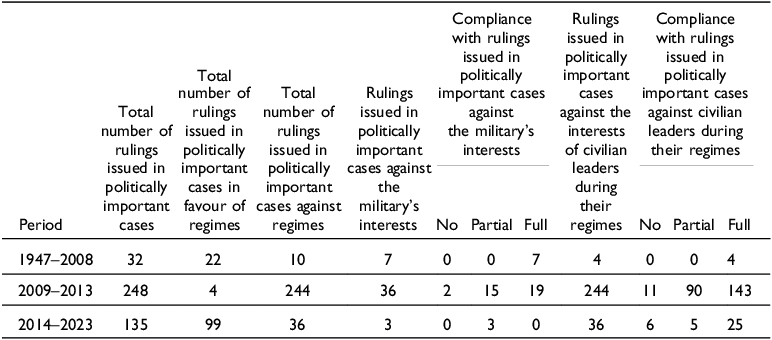
Source: The table is based on data taken from the cases reported in existing studies and order sheets of the rulings available on the SCP website.
Such data suggest that the reasons for compliance with rulings in politically important cases in authoritarian and hybrid regimes lie beyond the legal powers of the court, constitutional design, or political context (civil–military relationship). Thus, this article investigates what happened just before 2009 that triggered increased compliance between 2009 and 2013. But compliance with what? This article investigates compliance with rulings in politically important cases only. What qualifies as a politically important case, and how are such cases selected from among the thousands decided by the SCP (formerly the FCP) between 1947 and 2023? Before examining the nature and scope of compliance, this article unpacks the concept of politically important cases, compliance, and public support that shaped the context in which external actors used certain mechanisms to boost implementation.
3.2 Politically important cases
What is the universe of rulings being analysed in this paper? The SCP is unlike the United States (US) Supreme Court, which decides relatively few cases each year. Instead, it decides thousands of cases overall, like many other high courts. How many of those are politically significant?
For purposes of this article, “politically important cases” is deemed as such according to selection criteria from scholars of comparative constitutional law: cases that directly challenged the government’s authority (Kapiszewski, Reference Kapiszewski2012; Vondoepp, Reference Vondoepp2006, Reference Vondoepp2009). Rulings were analysed only if they were issued in politically important cases that involved the fate of political leadership or directly challenged government authority during 1947–2023. These cases involved issues such as regime changeFootnote 25; the accountability of members of Parliament, the military, or the civilian executiveFootnote 26; or the review of constitutional amendments enacted by Parliament. The significance of issues such as regime change and the review of constitutional amendments is self-evident, as the former directly concerns the powers of the executive, while the latter requires approval by a two-thirds majority in Parliament, as stipulated under Articles 238–239 of the Constitution of Pakistan 1973. By contrast, the importance of the issue of accountability of members of Parliament is evident from its direct implications for the powers and interests of political and military elites. Rulings on accountability primarily addressed corruption scandals, the misuse of powers by politicians or military, or laws enacted to shield elites from scrutiny, such as the National Reconciliation Ordinance (NRO), which sought to quash accountability proceedings against allies of General Musharraf’s regime (discussed below), and the CoC Act 2012, which attempted to curtail the judiciary’s authority to initiate CoC proceedings.
Until 1973, the SCP dealt with these kinds of cases only in its appellate jurisdiction, as Article 184(3), which empowered the Court to adjudicate questions that it deemed to be of public importance with reference to the enforcement of fundamental rights, was not introduced until the 1973 Constitution. After 1973, the Court adjudicated these cases through its appellate jurisdiction and under Article 184(3). Therefore, cases under Article 184(3) of the 1973 Constitution can be used as an additional criterion to determine the political significance of post-1973 cases only.
However, the SCP did not frequently use Article 184(3) during 1973–2005Footnote 27 (Khan, Reference Khan2011, Khan, Reference Khan2014). Thus, to properly account for the uniqueness of cases under Article 184(3), an additional criterion was borrowed from Mate, who used media reporting on cases and scholarly responses to help determine cases’ political significance (Mate, Reference Mate2010). Reported judgments in cases before 2005, that involved the fate of political leaderships or directly challenged government authority, and which already had been previously analysed by Pakistani scholars (Gilani and Cheema, Reference Gilani and Cheema2015; Khan, Reference Khan2011; Khan, Reference Khan2017; Newberg, Reference Newberg1995; Waseem, Reference Waseem2012) were selected for this study. I did not include media reporting of rulings among the criteria used to determine the political importance of judicial decisions, as most cases reported in the media are already discussed by Pakistani scholars, creating significant overlap. Moreover, print or electronic media do not always provide fully accurate analysis or comprehensive coverage of entire cases. Instead, they often present an oversimplified version of legal proceedings (Surette, Reference Surette1989).
However, the above approach has a major limitation in assessing the political significance of the SCP’s rulings issued from 2005 onwards. Most existing studies analyse only reported judgments (Kureshi, Reference Kureshi2024; Siddique, Reference Siddique2006; Khan, Reference Khan2017), without taking into account order sheetsFootnote 28 issued during the proceedings of politically important cases prior to the final decision. Studies on judicial developments in Pakistan (Nelson, Reference Nelson2025; Niaz, Reference Niaz2025; Kureshi, Reference Kureshi2022, Reference Kureshi2024; Khan, Reference Khan2017) do not focus specifically on the concept of compliance and therefore overlook the importance of analysing the SCP’s order sheets in politically significant cases, available on its website, for assessing compliance (as explained below). These order sheets document the steps taken by other branches of the state to implement the Court’s decisions. In some instances, the political significance of the order sheets produced during hearings may outweigh that of the final judgment itself. For example, in the hearing of Criminal Original Petition No. 8 of 2012, security agencies submitted a response to the SCP through Civil Miscellaneous Application No. 798. The order sheet regarding this application, which directly relates to compliance, is available on the Court’s website and is discussed later in this paper.
From 2005 onwards, the SCP began regularly uploading such documents to its website. Although the Court issues numerous directions in various cases on a daily basis, only those it deems significant and intends to make publicly accessible are uploaded to its website. Courts regard the publication of their decisions on official websites as important, as it guarantees free and public access to their rulings (Magrath, Reference Magrath2015, p. 191). It is therefore essential to include in this study all order sheets from 2005 to 2023 issued by the SCP under its appellate jurisdiction and/or Article 184(3) of the Constitution, and uploaded to the Court’s websiteFootnote 29, that addressed issues such as regime change; the accountability of members of Parliament, the military, or the civilian executive; or the review of constitutional amendments enacted by Parliament as part of the sample of politically important rulings. Some of the order sheets uploaded to the Court’s website include detailed reported rulings that have already been examined in existing studies on judicial politics in Pakistan.
This study is one of the very few to develop selection criteria for politically important cases by distinguishing between final judgments and order sheets, emphasising the importance of order sheets, incorporating them into the sample, and analysing them to enhance the understanding of compliance.
In light of the above, I developed three overlapping, yet contextually distinct, criteria for determining the political importance of SCP rulings across three phases: 1947–1973, 1973–2005, and 2005–2023. As shown in Table 2, the criteria for identifying rulings issued in politically important cases by the FCP from 1947 to 1956, and by the SCP from 1956 to 1973 were reported judgments that:
-
(a) were delivered under the appellate jurisdiction of the FCP (1947–1956) and the SCP (1956–1973) and addressed issues such as regime change; the accountability of members of Parliament, the military, or the civilian executive; or the review of constitutional amendments enacted by Parliament; and
-
(b) have been examined in the existing scholarly literature on Pakistan’s judicial politics. However, I expanded the criteria for identifying politically important SCP decisions during the period 1973–2005 by including reported judgments delivered under Article 184(3) of the Constitution.
Accordingly, the criteria were reported judgments that:
-
(a) were delivered under the SCP’s appellate jurisdiction and/or Article 184(3) and addressed issues such as regime change; the accountability of members of Parliament, the military, or the civilian executive; or the review of constitutional amendments enacted by Parliament; and
-
(b) have been examined in the existing scholarly literature on Pakistan’s judicial politics. I applied slightly different criteria for identifying politically important SCP decisions during the period 2005–2023. Specifically, I excluded the discussion of reported judgments in existing studies on judicial politics in Pakistan as a criterion for political importance and, instead, included order sheets delivered by the Court that were uploaded to the Court’s website.
The revised criteria were order sheets that:
-
(a) were delivered under the Court’s appellate jurisdiction and/or Article 184(3) of the Constitution and addressed issues such as regime change; the accountability of members of Parliament, the military, or the civilian executive; or the review of constitutional amendments enacted by Parliament; and
-
(b) have been uploaded to the Court’s website (Table 2).
Criteria for rulings issued in politically important cases issued by the SCP (formerly the FCP) 1947–2023
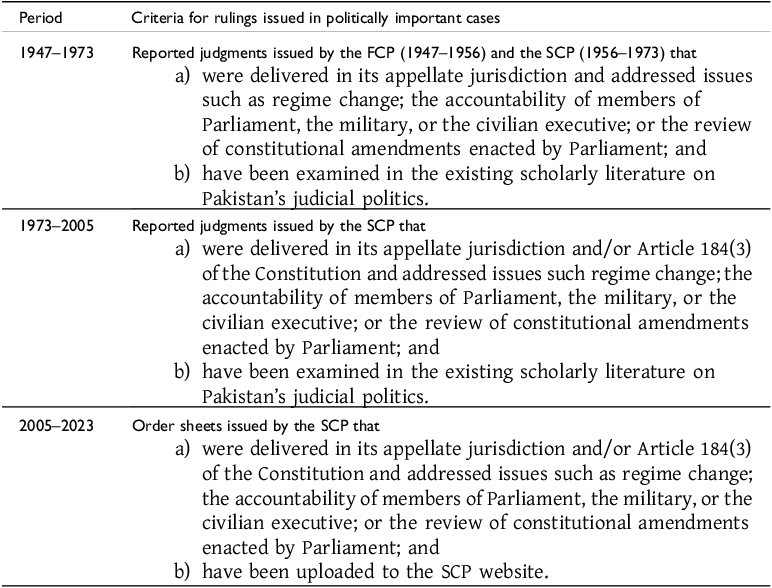
By systematically applying the above criteria, a total of 415 rulings issued by the FCP from 1947 to 1956 and by the SCP from 1956 to 2023 were identified as politically important. Of those, 32Footnote 30 were made during 1947–2008 (Table 1).Footnote 31 The SCP issued 248 and 135 rulings in politically important cases during 2009–2013 and 2014–2023, respectively.Footnote 32 Order sheets published on the Court’s website from 2005 onwards, addressing the aforesaid issues, arose in constitution petitions, human rights petitions, miscellaneous applications, civil appeals, suo motu cases, intra-court appeals, and criminal original petitions concerning these matters.
3.3 Compliance
3.3.1 Conceptualising compliance
Kapizewski and Taylor defined compliance as “full execution of the action (or complete avoidance of the action) called for (or prohibited) in one or more Court rulings” (Kapiszewski and Taylor, Reference Kapiszewski and Taylor2013, p. 806). Building upon this definition, when examining compliance with the SCP’s decisions, this article takes the full execution (or complete avoidance) of the action mandated (or prohibited) in SCP’s rulings and also the partial execution (or avoidance) into account. Authoritarian and hybrid regimes’ partial compliance demonstrates a willingness to comply in part, and thus cannot be ignored. This understanding of partial compliance aligns with Paulson’s definition, in which compliance “consists of acceptance of [a Court’s] judgment as final and reasonable performance in good faith of any binding obligation” (Paulson, Reference Paulson2004, p. 435). For example, in the Karachi Law and Order case, the SCP’s decisions offered detailed processes to follow regarding the security of citizens and maintaining law and order in Karachi (Suo Motu Case No 16 of 2011), most of which were related to policymaking and legislation. The government implemented only the parts of the decision related to the enforcement of existing laws and ignored the parts of the decision that mandated new laws. Therefore, I did not focus only on the final judgement in a case; I also focused on the steps taken to comply with the directives and instructions issued by the judiciary in different order sheets during a case. This helped me observe both partial and full compliance recorded in order sheets and final judgments.
In this article, references to compliance specifically refer to compliance by the executive, parliament, or the military with the SCP’s (formerly the FCP between 1947 and 1956) decisions in politically important cases between 1947 and 2023. These are the only state entities with a demonstrated history of consistently influencing the higher judiciary, and as such, possess the capacity to impede compliance with judicial decisions. Before 2009, as discussed above, these state entities either controlled the judiciary or retaliated against those judicial rulings that were contrary to their interests.
Literature on compliance with courts’ rulings in countries with authoritarian and hybrid regimes focuses mainly on compliance with courts’ rulings in general (Botero, Reference Botero2018; Brinks, Reference Brinks, Langford, Rodriguez-Garavito and Rossi2017; Gauri and Brinks, Reference Gauri and Brinks2008; Kapindu, Reference Kapindu2013), not compliance with the rulings of a higher judiciary in particular. I argue that compliance with the higher judiciary’s rulings is more important than compliance with any other court’s because the latter is appealable before the higher tiers of the judiciary. One cannot measure compliance with a ruling of a lower tier of the judiciary the moment it is appealed and a status quo order, or an order overturning that ruling, has been issued by the higher judiciary. Many decisions from lower courts in authoritarian and hybrid regimes like Pakistan reach the highest tier of the judiciary. Theoretically, like other high courts in other jurisdictions, the SCP is typically the court of last resort; thus, compliance with its decisions (or lack thereof) is likely to affect compliance with decisions of the entire judiciary (Ramseyer and Rasmusen, Reference Ramseyer and Rasmusen2007). Practically, focusing on the highest court of authority makes the analysis manageable and is an established practice in existing literature (Melton and Ginsburg, Reference Melton and Ginsburg2014, p. 191).
Scholars from countries with stable democracies are less familiar with this issue because only a few appeals from lower courts to the supreme courts are granted every year in their countries. Applications for leave to appeal are rarely denied in countries such as Pakistan or India. In 2019, 9728 appeals were pending before the SCP (Supreme Court of Pakistan, 2020, p.100). Unlike the US Supreme Court, which decides only a limited number of cases per year, the SCP decides thousands, aligning more with other high courts in authoritarian and hybrid regimes. In 2019, the SCP disposed of 19706 cases (Supreme Court of Pakistan, 2020, p.76). Analysing these many cases is impossible because the relevant data are not organised like those of the US and are beyond the scope of this paper’s focus.
3.3.2 Compliance measurement
To properly assess compliance with the SCP’s decisions, it was necessary to determine how compliance can be gauged. Several scholars (Creyke and McMillan, Reference Creyke, McMillan, Hertogh and Halliday2004; Kapiszewski, Reference Kapiszewski2012; Staton, Reference Staton2010; Trochev, Reference Trochev2008; Vanberg, Reference Vanberg2005) assessed compliance based on certain indicators, i.e., actions taken on behalf of those against whom courts make decisions. Vanberg focused on actions carried out by the legislature to comply with the decisions of the Federal Constitutional Court of Germany in five cases on legislation on political parties’ finances to identify the level of compliance (Vanberg, Reference Vanberg2005). Kapiszewski focused mainly on the government’s compliance with high courts in Argentina and Brazil (Kapiszewski, Reference Kapiszewski2012). In contrast, this study included actions by different branches of the state, including the executive, parliament, and military, to ascertain their compliance with the SCP’s decisions.
The 415 rulings by the FCP from 1947 to 1956 and by the SCP from 1956 to 2023 and the cases discussed in this study were manuallyFootnote 33 examined to evaluate the extent of compliance. Many of the order sheets of the SCP (which offer direct evidence of the degree of implementation) mentioned the implementation actions taken by the government. Compliance was cross-checked by perusing analysis of cases in existing literature, media reports, government notifications, and detailed judgments from the Pakistan Law Site.Footnote 34
Additionally, the government’s notifications to measure compliance were verified. Although the government’s notifications that align with the SCP’s decisions serve as compliance indicators, the government did not publish details of the actions taken to comply. Print and visual news reports were consequently used to track and assess the actions taken by the executive to implement the SCP’s decisions from March 2009 onwards. Media reports affirm that various compliance actions were taken by the executive and parliament.
Qazi analysed the SCP’s own observations on disobedience in each order it issued within a sample of suo motu cases, constitutional petitions, human rights cases, and civil appeals between 2002 and 2015 (Qazi, Reference Qazi2018). By contrast, this article classifies compliance in politically important cases from 1947 to 2023, as discussed above, on the basis of (a) the SCP’s observations or reports in the literature or media showing full implementation of judicial decisions are treated as full compliance; (b) the Court’s observations or reports indicating that some actions were taken in line with judicial decisions while others remained pending are classified as partial compliance; and (c) the Court’s observations or reports indicating non-implementation are considered non-compliance.
Weighed against the above criteria, it was found that the FCP, between 1947 and 1956, and the SCP, between 1956 and 2008, decided a total of 22 out of 32 politically important cases in favour of the government, with the remaining ten decided against it. One of the rulings was issued against General Yahya’s military takeover after his regime had ended. Unsurprisingly, it was complied with, as adherence did not conflict with the military’s institutional interests. I classified this, along with all similar rulings issued against leaders after their regimes, as rulings in favour of the government in power at that time. One of the ten rulings issued against the government (Sheikh Liaquat Hassan v. Federation of Pakistan, 1999) was delivered against the PML-N–led regime, striking down the establishment of military courts and thereby restricting the powers of the military. I therefore included this case in both categories: decisions against the civilian regimes and those against the military’s interests. This ruling, together with six of the ten rulings delivered against the government during periods of military rule, brings the total number of rulings that went against the military’s interests between 1947 and 2008 to seven. Four of the ten rulings against the government were issued against the interests of civilian leaders during their respective regimes, including the decision striking down the establishment of military courts. All of these rulings were complied with by the government.
However, during 2009–2013, 244 of the 248 rulings in politically important cases were against the interests of the government. Of the 244 rulings, 36 included directions specifically against the military’s interests. Since these rulings were issued by the SCP during the hybrid regime led by the PPP and also required actions to be taken by civilian leaders, they were included in both categories: rulings issued against civilian leaders during their regimes and rulings against the military’s interests. Accordingly, of the 244 rulings issued by the Court against the hybrid regime between 2009 and 2013, 11 (including 2 against the military’s interests) were not complied with, 90 (including 15 against the military’s interests) were partially complied with, and 143 (including 19 against the military’s interests) were fully complied with.
The SCP issued 135 politically important cases during 2014–2023; only 36 rulings were against the interests of the government. Of these 36 rulings, only three were against the military’s interests during civilian regime. All three rulings were included in both categories—rulings against the interests of civilian leaders during their regimes and rulings against the military’s interests—and were only partially complied with.Footnote 35 Of the remaining 33 rulings during the hybrid regimes, the civilian executive failed to comply with 6, partially complied with 2, and fully complied with 25.
3.3.3 Difference between compliance and other concepts
There is a tendency to conflate compliance with decisions made against the executive by the judiciary with judicial empowerment, independence and impact, respectively. One should distinguish these concepts as they differ in terms of indicators, nature, and scope. For example, decisions that are made in the regime’s favour legitimise the executive’s actions, but decisions against the government’s interest challenge the government’s authority. Both types of decisions indicate judicial empowerment because they suggest the judiciary’s ability to shape the executive’s behaviour, but they do not indicate compliance, as that refers to the implementation of those decisions. Similarly, judicialisation of politics involves the judiciary’s involvement in political issues and indicates the judiciary’s power to shape political affairs, and involve decisions for and against the executive in politically related cases.
Although judicial impact (Botero, Reference Botero2018; Kapiszewski and Taylor, Reference Kapiszewski and Taylor2013, p. 807), overlaps with compliance, there are important differences. Judicial impact refers to any effect of a court’s decision—social, political, economic, or legal—that may occur immediately or over time and can be either short- or long-term. Compliance, by contrast, refers specifically to the partial or complete implementation of the court’s decision (as discussed above in detail), carried out either immediately or at a later stage. This article focuses on examining compliance with rulings issued in politically important cases involving the interests of the executive, parliament, or the military.
3.4 Public support
As hypothesised, compliance with SCP’s decisions increased under hybrid regimes from 2009 to 2013 due to an increase in public support for the SCP and a combination of mechanisms used by the Court and social and political groups. Public support appears in two different forms: the diffused form of public support and the more specific public support of the courts (Gibson, Reference Gibson2011; Gibson, Caldeira and Spence, Reference Gibson, Caldeira and Spence2003; Staton, Reference Staton2010). The former refers to public support for the Court’s role in the political system (Gibson, Lodge and Woodson, Reference Gibson, Lodge and Woodson2014; Levi, Sacks and Tyler, Reference Levi, Sacks and Tyler2009), whereas the latter refers to approval of judicial decisions, trust, and/or public support for the Court in the face of the executive’s attempts to pack the judiciary with loyal judges. Both forms of public support for the SCP were evident during different time periods between 2005 and 2013. As will be discussed later, distinct groups of society supported the SCP’s decisions, trusted the Court, and supported its role in the political system while opposing the executive’s attempts to pack it with loyal judges.
Public support can be measured in various ways; many scholars measure it through public opinion polls (Bartels and Kramon, Reference Bartels and Kramon2020; Staton, Reference Staton2010). However, in the case of Pakistan, public support for the SCP expressed itself in events, anti-regime litigation under Article 184(3) of the Constitution, and different actions of different groups during different phases between 2005 and 2013. These groups included lawyers, CSOs, opposition political elites, journalists, and professionals. They expressed their support through mass demonstrations for the judges, engagement with the Court via petitions under Article 184(3) of the Constitution,Footnote 36 and public opinion polls in the Court’s favour.
Most of the above indicators of public support for the SCP did not exist before 2007. Countrywide mass demonstrations for judges of Pakistan’s higher judiciary took place for the first time during March 2007–March 2009, occurring on four occasions (explained below) (Table 3). These demonstrations mobilised masses and were followed by public opinion polls in favour of the SCP between March 2007 and December 2013. Public opinion polls regarding the legal system in general were published before 2007, but those polls did not favour the judiciary (Gallup Pakistan, 1987). From 2009 to 2013, all eleven public opinion surveys on the judiciary published by Gallup Pakistan indicated favourable views of the SCP. Between 2014 and 2022, six additional surveys on the Gallup Pakistan website likewise reflected favourable public opinion, while two surveys did not. Article 184(3) of the Constitution of Pakistan 1973, which empowers the SCP to consider matters it deems to be of public importance relating to the enforcement of fundamental rights, did not exist before 1973. There was no direct engagement via direct petitions of citizens or suo motu notices between the SCP and the public at large until 1973. During 1973–2005, such engagements and suo motu notices were infrequent. The exact number of suo motu notices or direct petitions between 1973 and 2005 is unknown,Footnote 38 but some studies suggest that they were relatively few and only began to increase significantly from 2005 onwards (Khan, Reference Khan2014, pp. 285–328). Although direct petitions from the aforesaid groups to the SCP against the government under Article 184(3) of the Constitution increased between June 2005 and March 2007, only 81 such petitions were received in 2008—far fewer than in subsequent years—indicating limited public trust in the SCP after judges acting against the regime’s interests were replaced with loyalists in November 2007 (Table 3). Petitions then reached an all-time high between March 2009 and December 2013, following the restoration of judges removed on 3 November 2007 (as explained below), far exceeding earlier levels and accounting for about 70% of the total received over the following eight years (ibid).
Public support for the SCP through demonstrations, public opinion surveys, and litigation
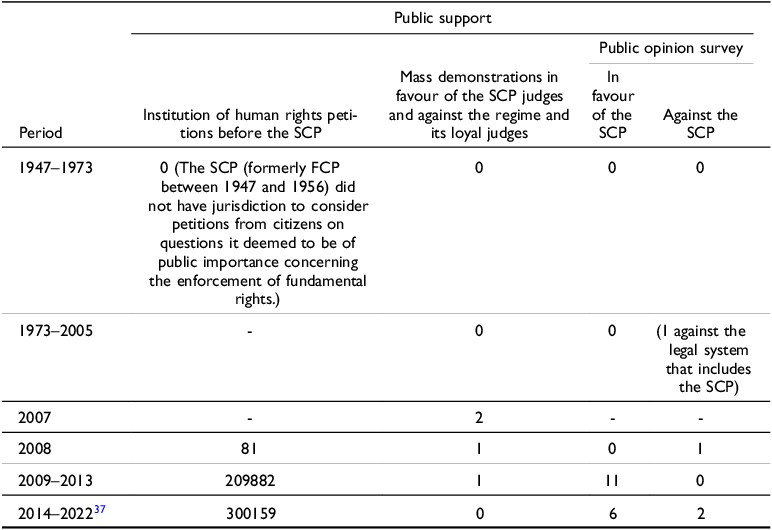
Source: The table is based on data developed from the Supreme Court Annual Reports for the previous 12 years, and public opinion survey reports available on the Gallup Pakistan website.
The above actions demonstrated that public support for the SCP can be measured by various indicators, which may shift in frequency according to different time frames or phases. The first phase of public support for the Court began in June 2005 and ended in March 2007, followed by the second phase (March 2007–July 2007), the third phase (July 2007–November 2007), the fourth phase (November 2007–March 2009), and the fifth phase (March 2009–December 2013) (Fig. 1).Footnote 39 I accordingly measured public support via different indicators associated with the different phases (Table 3). The increase in petitions under Article 184(3) of the Constitution of Pakistan between June 2005 and March 2007 was an indicator of trust in, and public support for, the SCP. Countrywide demonstrations between March 2007 and July 2007, coupled with direct petitions by different groups of society for the restoration of the Chief Justice of Pakistan (CJP), Iftikhar Muhammad Chaudhry, were two indicators of public support for the SCP during the second phase. Public opinion in favour of the judiciary served as an indicator of growing public support during the third phase. The first and second long marches for the restoration of judges removed on 3 November 2007, which took place in June 2008 and March 2009, respectively, along with the favourable public opinion survey, were indicators of an increase in public support during the fourth phase. The increase in the number of petitions under Article 184(3) of the Constitution and public opinion in favour of the judiciary were indicators of public support for the SCP during the fifth phase of the increase in public support. Public opinion polls also supported the role of the judiciary in the political system during this phase.
Phases of public support and compliance.

4. Explaining compliance
The broader literature on court compliance can be classified into three categories. The first category explains voluntary compliance with court decisions as driven by norms (Canon and Johnson, Reference Canon and Johnson1999; Tate, Reference Tate1993; Tyler, Reference Tyler1990, Reference Tyler2004; Tyler and Huo, Reference Tyler and Huo2002; Tyler and Rasinki, Reference Tyler and Rasinski1991). Tate argued that institutions comply with court decisions because the rule of law is an embedded norm in their context (Tate, Reference Tate1993). Tyler offered a similar explanation: when there is societal trust in legal procedures and those legal procedures are perceived as fair and neutral, then society defers to legal procedures and voluntarily complies with legal decisions (Tyler, Reference Tyler2004).
These studies may explain compliance or judicial independence in developed democracies such as the UK, the US, or other countries where the executive’s compliance with judicial rulings is an accepted norm or where decisions align with the executive’s expectations. However, this explanation does not fully account for recent developments in compliance with politically significant rulings issued by the higher judiciary in one of the world’s most established democracies—the US—let alone explain patterns of compliance by the executive in authoritarian and hybrid regimes. In March 2025, U.S. President Donald Trump called for the impeachment of Chief Judge of the US District Court for the District of Columbia James Boasberg, disparaging him as a “radical left lunatic” after the judge issued a ruling halting the deportation to El Salvador of numerous Venezuelan immigrants with alleged gang ties (Stone, Reference Stone2025). Trump’s reaction demonstrated that even the president of an established democracy—elected by a majority of the population through comparatively fair, transparent, and independent elections, in a country whose legal system and judiciary are central to global discourse on law and courts—sought retaliation rather than compliance when confronted with a ruling adverse to his administration’s interests.
It is clear that studies explaining compliance as an accepted norm do not adequately explain executives’ compliance with judicial rulings against the interests of the government in authoritarian and hybrid regimes where the governing elites handpick judges who cannot make decisions against their interests or retaliate against unfavourable decisions of the judiciary. For example, Abdullah Yameen, President of the Maldives, not only disregarded the decision of the Supreme Court of the Maldives to release political dissenters in February 2018, but also retaliated by arresting Chief Justice Abdulla Saeed and Judge Abdul Hameed (Firstpost, 2018).
The second category of studies suggests that other branches of the state comply with court decisions because doing so serves their interests (Spriggs, Reference Spriggs1997; Vanberg, Reference Vanberg2001, Reference Vanberg2005). The military in Pakistan toppled the government and arbitrarily abrogated or suspended the Constitution five times between 1947 and 2007 (Khan, Reference Khan2016, Reference Khan2017). The higher judiciary in Pakistan upheld the military’s intervention in four out of five cases—no wonder the military regimes complied with those decisions because they legitimised their direct rule. However, when the SCP attempted to initiate CoC proceedings against PM Nawaz Sharif for the latter’s inappropriate statements against the judiciary in 1997 (Muhammad Ikram Chaudhry v. Muhammad Nawaz Sharif, 1998), Nawaz’s political supporters stormed the Court, and CoC proceedings could not continue.
Some argue that courts might behave strategically by making decisions that are less costly to implement for the executive, making it more politically or economically viable for the executive to comply (Dixon, Reference Dixon2007; Gargarella, Reference Gargarella, Gloppen and Yamin2011; Huneeus, Reference Huneeus2011; Rodríguez-Garavito, Reference Rodríguez-Garavito2011). Others argue that courts intentionally write vague decisions to hide non-compliance (McNollgast, 2006; Staton & Vanberg, Reference Staton and Vanberg2008); therefore, if the executive resists those decisions, courts can interpret the executive’s actions as aligned with their decisions. Judges may also write decisions that require a long process of implementation, allowing the executive authority to delay their implementation (Trochev, Reference Trochev2008). These studies explain how courts avoid instances of non-compliance, but do not explain how and why governing elites in authoritarian and hybrid regimes would comply with court decisions that are contrary to their interests.
The third category of studies (discussed in the next two sections) suggests that compliance takes place due to steps taken by courts or actors outside courts (public support). These studies mostly address only one mechanism of compliance, such as increasing the legitimacy of courts, monitoring regimes, or CoC notices, which generally involve the role of one actor, such as CSOs or the court itself. These studies look at these mechanisms and actors in isolation from each other, which does not fully explain the compliance process in Pakistan. This is discussed in the next section.
4.1 Compliance through public support
Some studies suggest that public support forces ruling elites to comply with court decisions against them (Caldeira and Gibson, Reference Caldeira and Gibson1992, Reference Caldeira and Gibson1995). These studies discuss compliance in established democracies where public trust in courts is high but do not explain why the public supports courts in authoritarian and hybrid regimes where judges are mostly handpicked or influenced. These studies attribute compliance exclusively to public support and overlook the combination of legal, social, and political mechanisms by both courts and actors outside courts for compliance with court rulings opposed to the interests of authoritarian and hybrid regimes—a gap filled by this paper.
Studies focusing on judicial developments in Pakistan between 2005 and 2013 took a similar position by discussing how CSOs contributed to the judicialisation of politics (Ghias, Reference Ghias2010; Gilani and Cheema, Reference Gilani and Cheema2015; Khan, Reference Khan2011; Siddique, Reference Siddique, Tushnet and Khosla2015) or constitutionalism (Kalhan, Reference Kalhan2013) or supported judicial empowerment in Pakistan (Ahmed and Stephan, Reference Ahmed and Stephan2010; Kureshi, Reference Kureshi2022; Rafiq, Reference Rafiq, Ahmad and Rafiq2016; Shafqat, Reference Shafqat2018; Waseem, Reference Waseem2012), but they did not focus on compliance with decisions made against the interest of the government, which is different from other concepts.
I agree with the above studies to the extent that public support is an important factor in making non-compliance difficult for those against whom the courts issue rulings in politically important cases. This also happened in Pakistan in different phases from 2005 onwards. I will explain this shortly. However, public support is not the only factor in increasing compliance. I argue that public support shapes the context in which both courts and actors outside courts consistently use legal mechanisms (discussed later) for compliance.
As shown in Table 3, public support for the SCP was limited until June 2005. This was evident from the few human rights petitions and suo motu petitions under Article 184(3) of the Constitution (Khan, Reference Khan2014) and the absence of any large-scale protests for the restoration of judges removed by authoritarian regimes before 2007. As discussed above, the military directly intervened several times, abrogated or held the Constitution in abeyance, and packed the judiciary with judges loyal to the regime, but no one took to the streets to protect judges.
There were different reasons for limited public support for the SCP before June 2005. First, before the enactment of the 1973 Constitution, the Court was not empowered to make decisions on questions that it deemed to be of public importance with reference to the enforcement of fundamental rights. The Court was not able to engage directly with the people through suo motu petitions or petitions submitted to it directly by the general public. Second, when Article 184(3) of the Constitution of Pakistan 1973 empowered the Court to make decisions on questions that it deemed to be of public importance with reference to the enforcement of fundamental rights, the Court did not make any efforts to use this provision as proactively or as frequently to engage directly with the public as it did during the period between 2005 and 2013 (discussed below). Public support for the Court increased after June 2005 and impacted compliance in different phases. The next section examines how public support for the Court increased in different phases after 2005, which contributed to the increase in compliance from 2009 to 2013 (Fig. 1).
4.1.1 The first phase (June 2005–March 2007)
Gallup Pakistan public opinion surveys suggested that the public at large was disenchanted with the military regime of General Pervez Musharraf due to its involvement in the US-led War on Terror and failure to address the issues of increasing inflation, joblessness, corruption, and the lack of equality before the law (Gallup Pakistan, 2002a, 2002b, 2004, 2007). A focal point for disenchanted people was missing because the leadership of opposition political parties, such as the PML-N and PPP, were in exile at that time. This shaped the context in which the first phase of increasing public support for the SCP (Fig. 1) began with the appointment of Iftikhar Muhammad Chaudhry as the CJP on 30 June 2005 and ended with his suspension on 9 March 2007. During this phase, the engagement between the Court and heterogeneous groups of society increased, illustrated by a significant increase in human rights petitions under Article 184(3) of the Constitution of Pakistan 1973—from 68 in 2005 to 194 in 2007 (Court Library, 2013)—and suo motu notices of the Court under Article 184(3) of the Constitution of Pakistan 1973 (Khan, Reference Khan2014). The petitioners and beneficiaries of these human rights and suo motu petitions were CSOs and individuals from urban city centres and middle-classFootnote 40 backgrounds. For example, the petitioners in the case regarding the privatisation of Pakistan Steel Mills were an opposition political party and a CSO (Pakistan Steel Peoples Workers Union) (Watan Party v. Federation of Pakistan, 2006). Similarly, another CSO, the Defence of Human Rights Pakistan, was the petitioner in cases regarding missing persons in connection with the War on Terror (Amina Masood Janjua and Others v. the Government of Pakistan and Others, 2005).
However, compliance with most SCP decisions against the interests of the executive in politically important cases between June 2005 and 9 March 2007 was limited. For example, the SCP struck down the privatisation of Pakistan Steel Mills, and the executive complied with the decision (Watan Party v. Federation of Pakistan, 2006). However, the Court directed the executive to inform the Court about the whereabouts of missing persons (Amina Masood Janjua and Others v. the Government of Pakistan and Others, 2005). The executive initially ignored the Court’s directions and prolonged the proceedings. While direct engagement between the SCP and distinct groups of society was visible in the increasing number of suo motu notices and human rights petitions under Article 184(3), public support for the Court was not visible at that time. To prevent the Court from making more decisions against the interests of the executive, General Musharraf suspended CJP Chaudhry on 9 March 2007 (Kalhan, Reference Kalhan2013). The suspension itself was an expression of non-compliance and an attempt to stop the Court from making decisions whose compliance could harm the interests of the executive. The first phase ended with the suspension of CJP Chaudhry by General Pervez Musharraf on 9 March 2007.
4.1.2 The second phase (March 2007–July 2007): Expression of public support
The second phase, during which public support increased and its impact on the executive’s compliance became visible, began on 9 March 2007 and ended on 20 July 2007 (Fig. 1). As a reaction to CJP Chaudhry’s suspension, CSOs, lawyers, students, opposition political parties, and journalists held demonstrations against the authoritarian regime of General Musharraf, calling for the restoration of CJP Chaudhry and participated in his public addresses to lawyers in different cities around Pakistan (Iqbal, Reference Iqbal2007; Javed, Reference Javed2007; Wilkinson, Reference Wilkinson2007). Some of these groups challenged the regime’s decision to suspend CJP Chaudhry directly before the SCP under Article 184(3) of the Constitution (The Chief Justice Iftikhar Muhammad Chaudhry v. the President of Pakistan, 2010). Anti-regime demonstrations between 9 March 2007 and 20 July 2007Footnote 41 and petitions by different social and political groups for the restoration of CJP Chaudhry indicated an increase in public support for the Court. The Court eventually set aside the suspension of CJP Chaudhry on 20 July 2007 (Ibid), ending the second phase. The authoritarian regime adapted itself to the new context by accepting the decision and refraining from further attempts to control the judiciary.
4.1.3 The third phase (July 2007–November 2007): The decline of an authoritarian regime
The third phase of increasing support for the SCP involved another retaliatory attempt by the authoritarian regime of General Musharraf to control the SCP’s independent decisions against the regime’s interests. The restoration of CJP Chaudhry was followed by favourable public opinion of the SCP. Public opinion surveys showed that the popularity of the military regime of General Musharraf decreased because he attempted to remove CJP Chaudhry on 9 March 2007. The International Republican Institute (IRI) conducted a public opinion survey in February and March 2007 and found Musharraf’s job approval rating was 54% (Wike, Reference Wike2007). The IRI conducted the same survey again in July and August 2007 and found that Musharraf’s job approval rating had dropped to 24%. IRI reported, “Many observers have suggested that the controversy over Musharraf’s dismissal of Pakistani Supreme Court Chief Justice Iftikhar Chaudhry has badly damaged the President’s image.” This demonstrated that public support for the Court had increased, and attempts to restrict its independent behaviour were unpopular.
General Musharraf contested the presidential elections in October 2007. Rival candidates petitioned the SCP to challenge General Musharraf’s eligibility to run for president while retaining his position as Army Chief. Initially, the Court stopped the Election Commission of Pakistan (ECP) from issuing the official results until the final decision of the Court (Khan, Reference Khan2007). This gave rise to suspicions and rumours about a probable adverse decision against General Musharraf.
To pre-empt an adverse decision, General Musharraf imposed a state of emergency on 3 November 2007 (Qureshi, Reference Qureshi2010). As a result, around 53 judges of the superior courts were replaced with judges loyal to the regime (Khan, Reference Khan2017; Provisional Constitution Order No. 1 of 2007 ). The third phase ended on 3 November 2007 (Fig. 1).
4.1.4 The fourth phase (November 2007–March 2009): Transition to democracy
The fourth phase began on 3 November 2007 and ended in March 2009 (Fig. 1). This phase involved increased public support for the judges removed on 3 November 2007. The SCP, packed with judges loyal to the regime, initially made decisions in favour of the authoritarian regime of General Musharraf and later in favour of the hybrid regime of the PPP (2008–2013). For example, the loyal judges did not make any decisions against the interests of the executive or parliament. They ratified the suspension of the Constitution and the removal of the judges (Tikka Iqbal Muhammad Khan v. General Pervez Musharraf, 2008) and upheld Musharraf’s nomination by the ECP (Wajihuddin Ahmmad v. Chief Election Commission, 2008). The political and military elites’ subsequent compliance came as no surprise because the loyal judges’ decisions served the elites’ interests.
Lawyers, opposition political parties, students, CSOs, and journalists subsequently took to the streets to protest against the state of emergency and demand the restoration of the judges (Dawn, 2007; Qureshi, Reference Qureshi2010). Their objectives were not achieved immediately, but the demonstrations contributed to increased public support for the SCP and brought about the transition to democracy through the 2008 general election. The PPP came into power (Mehdi, Reference Mehdi2013), and General Musharraf resigned. However, the PPP was reluctant to restore the judges removed on 3 November 2007.
As a result, the aforesaid groups again took to the streets by initially holding the first long march in June 2008 (The News International, 2008a, 2008b, 2008c). Most of the judges removed on 3 November 2007 were administered the oath (Dawn, 2008; Iqbal, Reference Iqbal2008; Shah, Reference Shah2008), whereas some, including CJP Chaudhry, were not restored. Therefore, the aforesaid groups organised the second long march in March 2009 calling for the restoration of the remaining judges removed on 3 November, which ultimately led to their restoration (Munir, Reference Munir2009; Phelps, Reference Phelps2009; The News International, 2009a, 2009b). As a result of the protests during November 2007–March 2009, the judges were restored, ending this fourth phase of increased public support for the judges (Dawn, 2008; Iqbal, Reference Iqbal2008; Shah, Reference Shah2008; The News International, 2009b).Footnote 42
4.1.5 The fifth phase (March 2009–December 2013): Maximum compliance
The fifth phase began after the restoration of the judges in March 2009 (Fig. 1), during which the SCP continued to receive support from heterogeneous societal groups through increased engagement between the Court and those groups under Article 184(3) of the Constitution. The resulting favourable public opinion and support compelled the executive to comply with the SCP’s decisions in politically important cases, even though they were counter to the executive’s interests. The SCP’s Annual Report of 2020 reported that the number of human rights petitions submitted to the Human Rights Cell (HRC) of the SCP had dramatically increased from 81 in 2008 to 9,879 in 2009 (Supreme Court of Pakistan, 2020). Order sheets issued by the Court and uploaded to its website for some of these petitions show that petitioners were CSOs, opposition political elites, professionals, journalists, or individuals from urban city centres and middle-class backgrounds. The massive increase in the number of human rights petitions confirmed the people’s confidence in the Court when it was composed of judges who asserted themselves against other branches of the state.
The IRI surveyed Pakistanis from different backgrounds from 15 July 2009 to 7 August 2009 and found that CJP Chaudhry enjoyed a high approval rating (60%) as the most favourite leader, close to the approval ratings for the two primary political party leaders—Nawaz Sharif with 67% and Shahbaz Sharif with 64% (IRI Index, 2009). Interestingly, the CJP had no formal political constituency, yet his public approval ratings were comparable to those of political party leaders. This reflected significant public support for the SCP, whose powers the CJP was actively exercising.
Surveys conducted by the Gilani Research Foundation revealed that people’s confidence in the judicial system increased after the judges had been restored. The Foundation conducted a survey in four provinces of Pakistan and published the report on 22 March 2010 (Gallup Pakistan, 2010). The report disclosed that 57% of the respondents believed that the SCP was acting within its legal limits, with 25% being unsure and only 18% believing that the Court acted beyond its legal limits.
The Gilani Research Foundation published another public opinion survey report on 18 November 2013 (Gallup Pakistan, 2013a). The survey asked respondents to express their opinions about the performance of CJP Chaudhry. Twenty-three % of the respondents answered that CJP Chaudhry was performing very well, and 30% responded that he was performing well. Only 3% opined he was performing very poorly, and 9% viewed his performance as bad. The rest found his performance acceptable.
The impact of public support for the SCP on the executive’s compliance with the SCP’s decisions in politically important cases was highly visible after the restoration of the judges. From March 2009 to 2013, the Court issued 244 order sheets in politically important cases with directions against the interests of the political and/or military elites, most of which were complied with (Table 1).
For example, in Suo Motu Notice No. 10 of 2009, representatives of CSOs in Karachi challenged the lease of some land measuring 4.958 acres to the Army Welfare Trust by the government in 2002. The SCP struck down the lease. The decision directly threatened the commercial interests of the Pakistan Army; however, it was partially complied with (House of Habib, 2025, p. 18).
In Sindh High Court Bar Association v. the Federation of Pakistan (2009), the SCP struck down the emergency imposed by General Musharraf on 3 November 2007, as well as several actions taken thereunder. The government complied with the ruling and undid the relevant actions taken under the emergency powers. This ultimately resulted in the removal of the judges loyal to the regime appointed by General Musharraf on 3 November 2007.
Similarly, during the hybrid regime led by the PPP, the SCP struck down the NRO-whose beneficiaries were businessmen, bureaucrats, and politicians from the ruling party and its allies- and directed the executive to reopen corruption cases against those beneficiaries, including the President (Dr. Mobashir Hassan & Others v. Federation of Pakistan & Others, 2010). The decision was a direct clash between the office of the President and the Court. Initially, implementation of the decision exhibited partial compliance as cases, including those implicating the President, were reopened. Later, the executive complied with the decision in toto.
The SCP reviewed the oil prices in the country (Zafar Iqbal Jhagra v. Federation of Pakistan, 2013). The ruling was fully complied with. Their decisions were widely welcomed and supported by the public at large. The Gilani Research Foundation conducted a survey in four provinces on the public’s opinion about the Court’s decision on oil prices on 29 July 2009 (Gallup Pakistan, 2009). According to the report, 74% of the respondents approved of the decision. Furthermore, 69% of the respondents believed that any ordinance against the decision of the Court would be in CoC.
The military, like political elites, was previously reluctant to cooperate with the judiciary regarding the recovery of persons missing in connection with the War on Terror. In 2013, the CJP ordered the security agencies to present missing persons within two weeks (Zafar, Reference Zafar2013). As a result, some missing persons were presented to the Court, and details of others’ whereabouts were submitted to the SCP (Dawn, 2013; Pakistan Today, 2012). During the proceedings of missing persons cases, the Gilani Research Foundation conducted a public opinion survey on the issue of missing persons on 8 October 2013 (Gallup Pakistan, 2013b). They asked residents of four provinces whether they knew about the CJP’s decision and how likely it was that this decision would help improve peace in the country. 57% of the respondents said that they were aware of the decision, 86% of whom believed that peace was achievable due to the CJP’s action.
Compliance with the SCP’s decisions was not limited to decisions regarding the accountability of elites. In Nadeem Ahmed v. Federation of Pakistan, the SCP reviewed the Eighteenth Constitutional Amendment and made some suggestions and observations to parliament for reconsideration of the process of judicial appointment (Nadeem Ahmed v. Federation of Pakistan, 2010). The suggestions aimed to change the process of judicial appointments by providing the Judicial Commission of Pakistan (JCP) with the final say over matters regarding judicial appointments. In authoritarian or hybrid regimes, other branches of the state are often able to ignore the Court’s suggestions and observations. However, when strong public support for the Court shaped the political context, Parliament could not disregard the Court’s suggestions and observations regarding the process of judicial appointments. Parliament complied with the decision by enacting the Nineteenth Constitutional Amendment (Rabbani, Reference Rabbani2012) in which JCP was provided with the final say over matters regarding judicial appointments.
In another case, the SCP struck down the CoC Act 2012 (Baz Muhammad Kakar and Others v. Federation of Pakistan, 2012). Parliament accepted the decisions without retaliation. However, public support was not the only factor in increased compliance from 2009 to 2013. The increase in public support shaped the context in which the Court and other actors increased the use of CoC to strengthen compliance. This is discussed in the next section.
5. Contempt of Court (CoC)
Some studies focused on the steps taken by courts or actors outside courts for the enforcement of judicial rulings. These works typically centred on socio-economic rights (Baum, Reference Baum, Mazmanian and Sabatier1981; Gauri and Brinks, Reference Gauri and Brinks2008; Rosenberg, Reference Rosenberg2008; Spriggs, Reference Spriggs1997; Wasby, Reference Wasby1973). Some of these studies concentrated on countries with authoritarian or hybrid regimes (Denari, Reference Denari2018; Gauri, Staton and Cullell, Reference Gauri, Staton and Cullell2015; Kapiszewski and Taylor, Reference Kapiszewski and Taylor2013). They applied theories from developed democracies and attributed the process of implementation to courts, litigants, or third parties. Courts may take steps to ensure compliance with judicial rulings, including CoCs and/or attaching assets and fining the authority that is unwilling to comply (Spriggs, Reference Spriggs1997; Vanberg, Reference Vanberg2001).
However, I argue that courts take these steps in a context shaped by public support (as explained in the previous section). Before the commencement of the fifth phase in March 2009, the SCP used its CoC powers sparingly against elites in other branches of the state in politically charged cases under Article 184(3) of the Constitution of Pakistan. Between 2000 and 2005, only eight CoC notices were issued in petitions under Article 184(3) of the Constitution (Qazi, Reference Qazi, Cheema and Gilani2015, Reference Qazi2018, p. 37).Footnote 43 The frugal use of the CoC powers took place in a context of limited public support for the Court, demonstrated by the absence of demonstrations in its favour and limited engagement between the general public and the Court under Article 184(3) of the Constitution (Table 3). CoC notices peaked during 2005–2007, with a total of 14 issued (Qazi, Reference Qazi, Cheema and Gilani2015, Reference Qazi2018, p. 37). This is because the engagement between the public and the Court increased after CJP Chaudhry’s appointment on 30 June 2005 (Table 3), and this shaped the context in which judges felt empowered to enforce compliance from the executive branch, even when their rulings conflicted with governmental interests. The number of CoC notices decreased to eight in 2008 (Qazi, Reference Qazi, Cheema and Gilani2015, Reference Qazi2018, p. 37) because the Court was populated with judges loyal to the regime. A Gallup Pakistan public opinion survey recorded that 81% of respondents favoured the reinstatement of CJP Chaudhry, who had been removed during the emergency in November 2007. By implication, this indicated limited public support for the loyal judges appointed after the emergency and who worked during phase four (Gallup Pakistan, 2008).
However, different groups outside the SCP contributed to compliance through CoC proceedings by supporting the Court between 3 November 2007 and March 2009 (explained above). In the wake of anti-regime demonstrations for the restoration of the judges removed on 3 November 2007, the government restored all the judges in March 2009 (The News International, 2009b). The restoration through popular demonstrations indicated public support for the higher judiciary, shaping the context in which the number of CoC notices increased to 20 in 2009. This decreased slightly in 2010 but increased significantly to 44 in 2011 (Qazi, Reference Qazi, Cheema and Gilani2015, Reference Qazi2018, p. 37). The sequence of popular protests led to the restoration of the judges (who had been removed on 3 November 2007) in March 2009 and later to the increase in CoC notices during 2009–2013. These notices were issued by the Court in constitutional petitions, human rights petitions, or suo motu notices under Article 184(3) of the Constitution. Most of the rulings in these cases, some of which are discussed in detail later in the paper, were either partially or fully complied with. In Criminal Original Petition No. 6 of 2012, Justice Asif Saeed Khosa attributed the conceptual basis of the CoC law to public support by noting:
I deem it important and relevant to explain here the conceptual basis of the law regarding contempt of court. The power to punish a person for committing contempt of court is primarily a power of the people of this country to punish such person for contemptuous conduct or behaviour displayed by him towards the courts created by the people for handling the judicial functions of the State and such power of the people has been entrusted or delegated by the people to the courts through the Constitution.
In the same additional note, Justice Khosa referred to anti-regime agitation for the restoration of CJP Chaudhry, demonstrating that the Court was aware of its popularity and the support received from the public and that the same encouraged it to pursue the CoC proceedings. He noted:
A page from our own recent history reminds us that the Chief Justice of Pakistan did not possess or control any division when he refused to obey the unconstitutional dictates of General Pervez Musharraf, who commanded quite a few divisions, and still emerged victorious with the help of the people. The lesson to be learnt is that if the cause is constitutional and just then the strength and support for the same is received from the people at large who are the ultimate custodians of the Constitution.
CoC proceedings were not the only mechanism that the SCP and actors outside the Court used to strengthen compliance. The proceedings were used in combination with other mechanisms, including fortnightly reports, implementation proceedings, and follow-up petitions. This is discussed in the next section.
6. Fortnightly reports, implementation proceedings, and follow-up petitions
Courts may establish commissions to monitor compliance with their decisions (Castillejos-Aragón cited in Kapiszewski and Taylor, Reference Kapiszewski and Taylor2013). Third parties, such as non-governmental organisations (NGOs) or watchdogs (Epp, Reference Epp1998; Spriggs, Reference Spriggs1997), play an important role in encouraging compliance by monitoring and initiating legal action against non-compliance. According to Staton, NGOs in Mexico can run public relations campaigns to muster public support required for compliance litigation, or they can bring pressure to bear on politicians and the government to comply with court decisions (Staton, Reference Staton2010). These studies do not clarify that both the SCP and CSOs existed in Pakistan before 2009, during 2009–2013, and after 2013, without any significant change in the SCP’s formal legal powers. However, compliance with the Court’s decisions in politically important cases—particularly those issued against the interests of other branches of the state—was significantly strengthened only between 2009 and 2013, not before or after this period. The studies therefore fail to explain why regime compliance increased exclusively during these years.
I do not consider increased public support and CoC notices in isolation from other mechanisms used by both the SCP and actors outside the Court. I argue that CoC proceedings were also used in combination with other mechanisms—including fortnightly reports, implementation proceedings,Footnote 44 and follow-up petitionsFootnote 45—to enhance compliance with the Court’s decisions after March 2009. The reports and petitions compelled authoritarian and hybrid regimes to work towards the implementation of the Court’s decisions in politically important cases, even those that were against the interests of the aforesaid regimes. It helped the Court trace compliance with its decisions and made the avoidance of these decisions difficult for the executive. In the missing persons cases, a combination of follow-up petitions by CSOs and the families of the missing persons and the CoC proceedings by the Court in Criminal Original Petition No. 8 of 2012 made the Ministry of Defence and the Director-General (DG) of Inter-Services Intelligence (ISI) explain steps they took to ensure compliance with the Court’s orders.Footnote 46
The list of politically important cases in which the combination of the implementation proceedings and the CoC proceedings by the SCP and follow-up petitions by opposition political parties, lawyers, and professionals contributed to the executive’s compliance with the SCP’s rulings is long. All these cases were included in the sample of politically important rulings analysed for this article. I now turn to three of these examples. The first involves a ruling against the interests of the military. The second involves a ruling against the politicians. The third involves a ruling against the interests of both politicians and the military. In these politically important cases, a combination of mechanisms contributed to compliance with the SCP’s rulings against the interests of politicians and the military between 2009 and 2013.
6.1 Missing persons cases
Missing persons cases demonstrate how a combination of follow-up petitions, fortnightly reports, and the CoC proceedings contributes to compliance with the SCP’s orders. Missing person cases are politically very important cases, as they involve the powers of the military and intelligence agencies to make those allegedly involved in anti-state activities disappear and interrogate them without following due legal process. The military and intelligence agencies allegedly made thousands of people disappear in connection with the War on Terror without following due process of law (Ali, Reference Ali2025; Musharraf, Reference Musharraf2006, p. 237). Between 2005 and 2013, families of missing persons and CSOs periodically petitioned the SCP under Article 184(3) of the Constitution to address enforced disappearances (Amina Masood Janjua and Others v. the Government of Pakistan and Others, 2005; Khan, Reference Khan2014; Human Rights Commission of Pakistan v. Federation of Pakistan, 2009).
The SCP issued directions to the Ministry of Defence, the DG ISI, and DG Inter-Services Public Relations (ISPR) to present the detainees. However, the case was delayed because of the executive’s attack on the judiciary (discussed above). The Court, packed with judges loyal to the regime between November 2007 and March 2009, did not actively pursue the matter. However, soon after the restoration of judges in March 2009, the petitioners contributed to compliance through follow-up petitions (e.g., Constitution Petition 1 of 2012). They submitted civil miscellaneous applications to the Court, requesting that it initiate CoC proceedings against the respondents for their delay in complying with the Court’s decisions. The Court contributed to the process of compliance by issuing the CoC notices in Criminal Original Petition No. 8 of 2012 to the Ministry of Defence, DG ISI, and DG ISPR to ask about their non-compliance with the Court’s decisions. The respondents submitted a joint reply in Civil Miscellaneous Application No. 798 in Criminal Original Petition No. 8 of 2012 wherein they explained the steps taken by them to ensure compliance with the SCP’s orders:
This Court’s order was, however, complied with and the seven internees including the four admitted in the Government Lady Reading Hospital, Peshawar, were brought to Islamabad at about 6:00 pm on 10.02.2012, while the Order had already been passed at 5:30 pm by this Hon’able Court for their production on the next date of hearing i.e. 13.02.2012. There was no disobedience of the Order dated 30.01.2012 and the internees from Parachinar were brought despite taking great risk to human lives including those of pilots of the helicopter who undertook the extremely dangerous mission and operated in the hazardous and adverse weather and security environments. The Army leadership including the heads of the agencies have always honoured and implemented the orders passed by this Apex Court of the country. Leaving the orders aside, even the observations made by this Hon’able Court relating to matters falling in the domain of the Army and ISI never go unheeded.
The SCP acknowledged the compliance with its rulings in the order sheet dated 3 December 2012.Footnote 47 The above showed the impact of the follow-up petition submitted by both petitioners and the Court’s CoC notice on compliance with the Court’s orders. The military and intelligence agencies subsequently not only complied with the SCP’s decisions but also showed a long-term commitment to their implementation.
6.2 Rental Power Plants Case
The Rental Power Plant Corruption case shows that a combination of fortnightly reports and the CoC proceedings contributed to compliance with the Court’s rulings. In the early 2000s, there was a huge gap between the demand for electricity and its consumption. The government tried to address this problem by involving private companies in the generation and distribution of electricity. For this purpose, the government signed different contracts with private companies to rent power plants for electricity generation in 2006.Footnote 48 However, despite renting power plants, the countrywide electricity outage continued. Disappointed with the poor management of electricity, members of opposition political parties submitted applications to the SCP regarding alleged corruption in the Rental Power Plants and the mismanagement of electricity generation and distribution in 2009 and 2010.Footnote 49 Initially, Makhdoom Syed Faisal Saleh Hayat, one of the opposition parliamentarians, submitted an application to the Court in September 2009.Footnote 50 Khawaja Muhammad Asif of PML(N) submitted a follow-up petition (Civil Miscellaneous Application No. 3100/2010) in October 2010.Footnote 51
The SCP found corruption and illegalities in the process leading to the awarding of contracts to private electricity generation companies. In December 2011, the Court found that the government authority was required to a) take all necessary measures for improving governance, management, transparency, accountability, and quality of public procurement of goods, services, and works in the public sector under section 5 of the Public Procurement Regulatory Authority (PPRA) Ordinance, 2002; b) establish competition among bidders without withholding any information under the PPRA Ordinance as well as the Public Procurement Rules, 2004; and c) fix a reserve price while quoting lump sum rental charges, rental rate, and reference fuel cost components to ensure transparency and competition. The Court found that the government authority did not fix a reserve price or mention the plant sites or the type of fuel or technology of plant to be installed for the generation of electricity. The Court held that the government functionaries, including the Minister of Power from 2006 onwards and the Secretary of Finance, did not fulfil the procedural rules and requirements and hence had violated constitutional provisions regarding transparency. Therefore, the Court declared the contracts to be non-transparent, illegal and void ab initio.Footnote 52
Furthermore, the Court found that officials of the National Electric Power Authority and the power generation and distribution companies contracted had financially benefitted from the illegal awarding of contracts. Therefore, the Court directed the Chairman of the NAB to proceed against those involved in the corruption in accordance with the law and submit fortnightly reports to the Court. NAB submitted fortnightly reports.Footnote 53 However, the NAB tried to avoid and delay the implementation of the Court’s decision in September 2012.Footnote 54 Thus, the Court issued CoC notices to the Chairman and other senior officials of the NAB.Footnote 55 Consequently, the inquiry officer of the NAB informed the Court in the next hearing in January 2013 that “he has completed the investigation of two cases honestly and after completion of the investigation, filing of the References have been recommended and the reports have been received from the Regional Headquarters of NAB.”Footnote 56
In the Rental Power Plants Case, the Court and the groups approaching the Court used a combination of mechanisms (fortnightly reports, CoC proceedings, and follow-up petitions) to enforce the SCP’s decision on the Rental Power Plants Case. The Court contributed to the enforcement of its decisions by using its power of CoC and directing NAB to submit fortnightly reports. Opposition political parties contributed to compliance through a follow-up petition.
6.3 National Reconciliation Ordinance (NRO)
General Musharraf enacted the NRO in October 2007, under which he quashed criminal proceedings against all those with whom he wanted to build a political alliance. The aim of NRO was to institutionalise a backchannel deal with the PPP leadership under which Benazir Bhutto, Chairperson PPP, would work as the PM with General Musharraf as President, should the former secure the required majority in parliament (Rice, Reference Rice2011, pp. 383–386). Opposition political parties and individuals with middle-class backgrounds challenged the NRO before the SCP. As discussed above, public support for the judiciary increased between 2007 and 2009. This shaped the context that encouraged the SCP to strike down the NRO in 2009 (Dr. Mobashir Hassan & Others v. Federation of Pakistan & Others, 2010).
The SCP constituted a bench for the implementation of its decision on NRO (Criminal Original Petition No. 6 of 2012). One of the paragraphs of the SCP decision on NRO was paragraph 178. Accordingly, the Court directed the government to write a letter to the Swiss Court requesting the reopening of the cases against President Asif Ali Zardari. However, PM Yusuf Raza Gilani refused to do so on presidential immunity grounds. The Gilani Research Foundation conducted a public opinion survey on this issue and found that 61% of respondents opposed the PM’s view that President Zardari enjoyed immunity, whereas 33% supported this view (Gallup Pakistan, 2012). The remaining 6% declined to express an opinion. The survey indicated public support for the Court’s actions taken against the government’s interests.
The SCP initiated CoC proceedings against PM Yusuf Raza Gilani for his refusal to write the letter. In Criminal Original Petition No. 6 of 2012, the Court convicted the PM for CoC and ordered him to sit in the courtroom until the rising of the Court. As a result of the PM’s conviction, opposition political parties approached the Speaker of the National Assembly to disqualify PM Gilani from parliament. The Speaker, however, failed to proceed with the disqualification process; therefore, the opposition political parties approached the SCP with the same request. In contrast with the Speaker, the Court directed the disqualification of the PM to the ECP (Mohammad Azhar Siddique and Others v. the Federation of Pakistan and Others, 2012), and the executive complied with the disqualification decision. The new PM, Raja Pervez Ashraf, subsequently took the oath (Dawn, 2012).
CoC proceedings are criminal in nature, and convictions in CoC cases disqualify parliamentarians from parliamentary membership and bar them from holding any public office for the following five years. This deterred the new PM from non-compliance. The new PM, Raja Pervez Ashraf, complied with the SCP’s ruling in the NRO case and sent the letter to the Swiss Court regarding cases against the President (Wasim, Reference Wasim2012).
The Court and the groups approaching the Court used a combination of mechanisms (implementation proceedings, CoC proceedings, and follow-up petitions) to enforce the SCP’s decision on NRO. The SCP contributed to the enforcement of its decisions by constituting a special bench for implementation proceedings and by using its power of CoC. Political parties, lawyers, and individual professionals contributed to compliance through follow-up petitions.
The above analysis shows the direct impact of increasing public support for the SCP on compliance with its decisions in politically important cases from March 2009 to 2013. Public support for the Court grew significantly between 2005 and 2009. This rise indirectly contributed to compliance by other branches of the state with the Court’s decisions against both the PPP-led hybrid regime and the military from 2009 to 2013, and it also led to an increase in CoC cases. The Court and other groups used a combination of mechanisms, including CoC proceedings, implementation proceedings, follow-up petitions, and fortnightly reports to ensure compliance with its decisions in politically important cases between 2009 and 2013.
However, the SCP did not continue making decisions consistently in politically important cases against both politicians in power and the military between 2014 and 2023 as it did during 2009–2013 because some of the above factors ceased to exist. Public support for the Court initially became divided and later decreased after 2013. Middle-class individuals (mostly urbanites), students, and professionals supported the new PTI party (Ahmed, Reference Ahmed2019). Different politicians and lawyers joined the PTI, and the military supported the PTI clandestinely (Shackle, Reference Shackle2018). This became entirely visible when the PTI came into power in 2018 (Ibid). Later, public engagement with the SCP through human rights petitions and suo motu notices under Article 184(3) of the Constitution decreased. According to the annual report of the SCP 2019–2020 (Supreme Court of Pakistan, 2020), the balance of human rights petitions decreased from 21,025 in 2014 to 9,661 in 2017, increased to 25,753 in 2018, but decreased again to 3,109 in 2020.
Additionally, there were a few scandals involving the judiciary. For example, in 2018, Justice Shaukath Aziz Siddiqi made allegations about the influence of security agencies over decision-making in the judiciary (Bhatti, Reference Bhatti2018, Reference Bhatti2021b), and an alleged audiotape of the former CJP Mian Saqib Nisar suggesting that the decisions of the judiciary were influenced by other institutions was leaked (Naseer, Reference Naseer2021). Further, proceedings commenced against Justice Qazi Faez Isa for his bold decisions against the involvement of the Pakistan Army in dispersing mass protests in 2017 (Asad, Reference Asad2021; Bhatti, Reference Bhatti2021a; Iqbal, Reference Iqbal2019; Malik, Reference Malik2019; Waseem and Azeem, Reference Waseem and Azeem2017). These developments tarnished the image of the judiciary and reduced public support for the SCP. According to a public opinion report published by Gallup Pakistan (2024) in August 2024, only 13% of respondents correctly identified the then CJP Qazi Faez Esa, while 42% gave an incorrect answer, 44% reported not knowing, and 1% gave no response. This indicates that engagement between the SCP and the public declined to the point where people lost interest in its activities, let alone expressed any meaningful support for it.
In 2024 and 2025, the SCP delivered rulings that had the effect of narrowing the political space for the PTI, a party whose relationship with the military remained strained. In February 2024, the Court upheld the ECP’s decision to strip the PTI of its electoral symbol—the cricket bat—for failing to conduct fair and transparent intra-party elections. In a country of more than 240 million people, with nearly 129 million registered voters, only 58% are classified as literate (Cheema, Reference Cheema2024). For those unable to read the ballot paper, pictorial symbols serve as the only means of identifying their chosen candidate (ibid). In June 2025, the Constitutional BenchFootnote 57 of the Court further ruled that the party would not be eligible for reserved seats for women and non-Muslims in the national and provincial assemblies (Mehtab, Reference Mehtab2025).
The foregoing historical comparative analysis of compliance with the SCP’s rulings in politically important cases by other organs of the state across different phases of authoritarian and hybrid regimes in Pakistan provides important insights for the broader literature on compliance. First, as discussed above, some studies suggest that other organs of the state comply with court decisions either because compliance is regarded as an accepted norm (Canon and Johnson, Reference Canon and Johnson1999; Tate, Reference Tate1993; Tyler, Reference Tyler1990, Reference Tyler2004; Tyler and Huo, Reference Tyler and Huo2002; Tyler and Rasinki, Reference Tyler and Rasinski1991), or because courts enforce their rulings through contempt of court proceedings or the imposition of fines on the actors concerned (Spriggs, Reference Spriggs1997; Vanberg, Reference Vanberg2001). Other studies highlight the role of CSOs in promoting compliance through public relations campaigns or monitoring mechanisms (Castillejos-Aragón cited in Kapiszewski and Taylor, Reference Kapiszewski and Taylor2013; Epp, Reference Epp1998; Spriggs, Reference Spriggs1997; Staton, Reference Staton2010). This article advances the explanation of compliance by showing that while public support can compel powerful state actors to comply with rulings made against their interests, legal mechanisms—such as follow-up petitions by actors outside the courts, contempt of court proceedings, fortnightly reports, or implementation proceedings—serve to further reinforce and strengthen such compliance. Therefore, it is the combination of sustained public support and the coordinated use of these mechanisms that together foster compliance with judicial rulings issued against the interests of other organs of the state.
Second, all factors—public support, CoC proceedings, fortnightly reports, follow-up petitions, and implementation proceedings—are important in securing compliance by other organs of the state with judicial rulings issued against their interests. The absence of one or more of these factors can undermine compliance with judicial decisions issued against other branches of the state in politically important cases. Courts lack the “power of the purse,” as they depend on government-controlled budgets to finance their activities, and they also lack the “power of the sword,” as they do not command an independent enforcement force to execute their rulings. Consequently, courts are often reluctant to exercise CoC powers against powerful political actors unless supported by a countervailing force—most commonly broad public support—that enhances the likelihood of compelling those actors to comply with decisions issued against their interests. A notable example occurred when the SCP attempted to initiate CoC proceedings against Nawaz Sharif (Muhammad Ikram Chaudhry v. Muhammad Nawaz Sharif, 1998); as discussed above, this led to the storming of the Court’s building, demonstrating the risks of exercising such powers in isolation from public backing.
Public support, therefore, is crucial for ensuring compliance with courts rulings by other state institutions. Indeed, the SCP was able to issue numerous decisions adverse to the interests of other branches of the state, most of which were implemented only after strong public mobilisation in support of the judiciary between 2005 and 2013. However, public support alone is insufficient if the Court cannot strategically channel it through available mechanisms such as CoC, fortnightly reports and implementation proceedings, or if actors outside the judiciary—such as CSOs—fail to reinforce it through follow-up petitions and related initiatives.
The SCP capitalised on public support between 2005 and 2013 by increasingly employing fortnightly reports as well as CoC and implementation proceedings. Actors outside the judiciary, however, are unlikely to pursue follow-up petitions to enforce judicial rulings against other branches of the state unless they both trust the courts and have witnessed the courts’ willingness to challenge governmental authority. CSOs, journalists, and opposition political parties gained such confidence following the successful restoration of judges removed on 3 November 2007, which demonstrated the effectiveness of collective mobilisation in support of the Court. Building on this experience, these actors subsequently utilised follow-up petitions as a mechanism to ensure compliance with the Court’s rulings that ran counter to the interests of other organs of the state.
Third, although all of the aforementioned factors are important for ensuring compliance with courts’ politically important rulings against the interests of other state organs, public support emerges as the relatively more crucial factor. The SCP did not receive the same level of public support before 2005 or after 2013 as it did between 2005 and 2013. Public support shapes the context in which both courts and external actors feel encouraged to employ mechanisms such as CoC proceedings, implementation proceedings, fortnightly reports, and/or follow-up petitions to secure compliance. As this paper has explained, phases of increased public support from June 2005 onwards were consistently followed by the utilisation of these mechanisms by the Court and by actors outside the judiciary, thereby reinforcing the likelihood of compliance.
7. Conclusion
This paper found that compliance with judicial rulings in politically important cases by elites in power in authoritarian and hybrid regimes, like those in Pakistan between 2005 and 2013, is not a purely legal process. Legal actions by courts, such as CoC proceedings, or by actors outside the court, such as follow-up petitions, are not sufficient on their own to compel elites in authoritarian and hybrid regimes to comply with judgments in politically important cases against their interests. Instead, compliance with such rulings is a multifactorial socio-legal and socio-political phenomenon that involves a myriad of interconnected socio-political and socio-legal factors, processes, and actors.
First, students, CSOs, journalists, opposition political parties, and lawyers indirectly contributed to compliance by increasing public support for the judiciary through anti-regime and pro-judges demonstrations and anti-regime litigation in different phases from 2005 to 2009. This support enabled judges to assert themselves against other branches of the state and made non-compliance by those branches more difficult from 2009 to 2013. The executive, parliament, and the military initially retaliated against the SCP’s decisions that conflicted with their interests from 2005 onwards, but after March 2009, they consistently complied with those decisions because of the extent of increased public support for the SCP. Other branches of the state did not want to lose public support by continuing to retaliate against court decisions.
Second, the increase in public support for the SCP shaped the context in which both the Court and various external groups contributed directly to the enforcement of its decisions by using a combination of mechanisms between March 2009 and December 2013. The Court increased the number of CoC notices, directed the government to submit fortnightly reports on the execution of its rulings, and initiated implementation proceedings in many politically important cases. Groups outside the Court used follow-up petitions on the enforcement of its rulings that were issued against the regimes from March 2009 to December 2013. This kept those cases alive and made governmental avoidance of the decisions difficult.
The interconnected factors explained in this paper are essential for compliance with judicial rulings by the government in authoritarian and hybrid regimes. If one factor is missing, compliance is jeopardised. For instance, public support for the SCP was limited before 2005 and after 2013, as was the number of CoC notices. Before March 2009 and after 2013, elites in other branches of the government either controlled the Court or retaliated against its rulings that were contrary to their interests. However, all the compliance-related factors came into play successively from March 2009 to 2013. For example, public support increased during June 2005– 2013, with a concomitant increase in the number of CoC notices from March 2009 to 2013. The Court and external actors used a combination of mechanisms such as CoC proceedings, fortnightly reports, follow-up petitions, and implementation proceedings between March 2009 and December 2013, resulting in other branches of the state complying with decisions that were against their interests.
In the future, if the interconnected factors discussed in this paper jointly come into play, the judiciary could again consistently make decisions against the interests of both politicians and military elites and enforce those decisions.
Acknowledgements
I am grateful to anonymous reviewers, Prof Kate Malleson, School of Law, Queen Mary University of London, Prof Rachel Cahill-O’Callaghan, School of Law and Politics, Cardiff University, and Dr Ed Bates, Associate Professor, Leicester Law School, University of Leicester for reading the initial drafts and giving me their feedback.
Funding statement
This study is part of the project titled “Judicial Independence in Authoritarian and Hybrid Regimes” (ES/W007223/1), funded by the Economic and Social Research Council, United Kingdom, and conducted at the School of Law and Politics, Cardiff University. I began working on this paper at the School of Law and Politics, Cardiff University, and completed it after joining the Leicester Law School, University of Leicester, as a Lecturer in Law in October 2022.
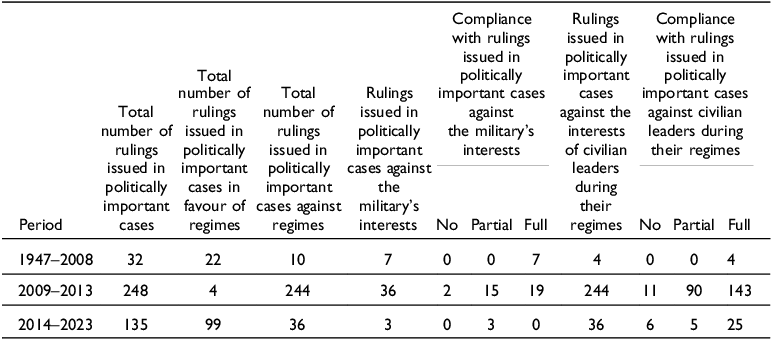
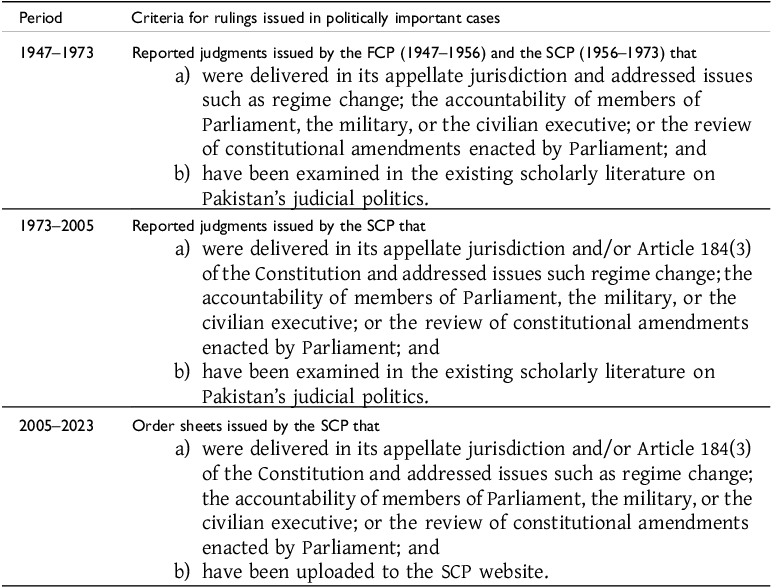
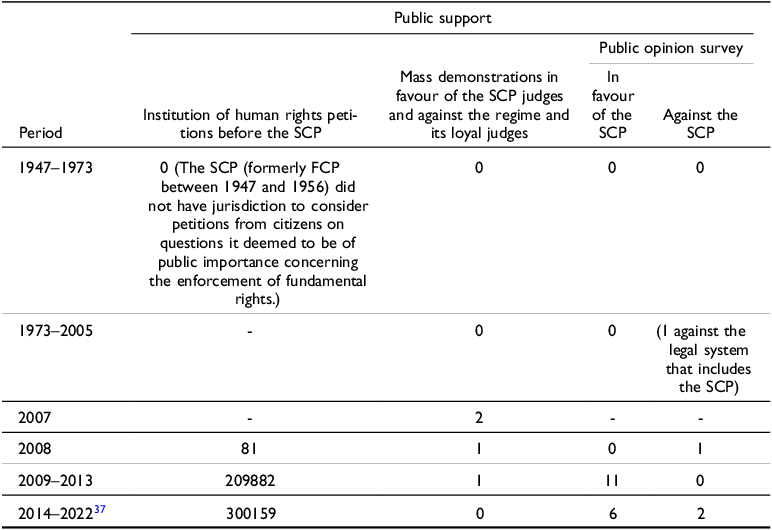


 Open access

