

Introduction
The end of base metal coinage in the late Roman north-west has recently garnered renewed interest. In the first half of the fifth century a.d., base metal coins ceased being an official currency, with only gold and silver remaining part of the monetary system. While earlier works provided a large-scale and long-term perspective on this phenomenon,Footnote 1 today’s research tends to ask how populations coped with the lack of new coin within everyday exchanges.Footnote 2 Most recently, van Heesch argued for a continued local use of bronze coin into the fifth century despite the lack of new issues, pointing to a general decline of the monetised economy.Footnote 3
In northern Gaul’s archaeological evidence, the latest — Theodosian — coin issues appear as settlement losses as well as within hoards. Otte has reviewed the evidence from the Theodosian coin hoards and formed new thoughts on continued coin use within settlements.Footnote 4 Although burial evidence is much scarcer,Footnote 5 burials are the key contexts when looking ahead into the early Middle Ages. Fiscal practices in the Merovingian era tend to manifest themselves within burials much more directly than within settlement contexts. Coins became a frequent burial find, both as oboloi and within purse assemblages. The same pertains to Hackbronze, i.e. intentionally fragmented base metal artefacts. In Late Antiquity, they are a typical feature of settlements, whereas they frequently appear in Merovingian-era purse contents.
The decades around a.d. 400 clearly brought a change not only to the monetary system but also to the archaeological record. Richly furnished burials became more frequent, while the preserved settlement record is sparser and more difficult to recognise and to date.
It is precisely during this transition that a person was buried at Oudenburg (Belgium, West-Flanders; graveyard A, burial A-104). A crossbow brooch and belt signal a late Roman military habitus. This person was also given a purse and an array of grave goods (see below) which foreshadow the typical Merovingian-era burial practice. It is the purse which gleaned our attention: it contained certainly three, possibly four coins, including one issued by Valentinian II, dating the assemblage to post-a.d. 388. Strikingly, the other coins date to the early second century. The same purse also held a number of fragmented copper-alloy artefacts. This raises the question whether the coins and the bronze fragments featured together in the purse as a means of payment.
Thus, the present paper aims to analyse the Oudenburg burial assemblage and to compare it to a number of contemporary burial assemblages. This allows us to ask whether the grave provides a ‘missing link’ on the question of a monetary use of Hackbronze by the early 400s.
The context of late Roman Oudenburg
By the late second century a.d., the high sand ridge at Oudenburg had already been chosen by the Roman army as the perfect strategic location for the installation of a coastal fort. Nowadays situated over 8 km away from the coastline, in the Roman period this sand ridge protruded into the coastal plain, providing an attractive position bordering this region of intertidal flats and salt marshes cut by tidal channels. The archaeological excavations at the interior of the fort, conducted between 2001 and 2009, have yielded many new insights into the fort’s chronology and successive fort occupations, and have made it possible to link them with the related graveyards.Footnote 6 Three earth-and-timber castella succeeded each other, after which a stone fort was built at the same spot in the 260s, during Postumus’ rule, which functioned until around the end of the third century. During Constantine’s reign, in the third decade of the fourth century — a date set by dendrochronological evidence — this stone fort was reactivated and totally renovated. The fort occupation in that period (5A) clearly reflects the lifestyle of Roman ‘officialdom’ in the form of limitanei. By that time, the Oudenburg fort together with several British coastal forts must have formed part of the Saxon Shore, or litus Saxonicum as it is later named in the Notitia Dignitatum. After a presumed hiatus in the fort occupation in the second half of the fourth century, the fort was reoccupied in or soon after a.d. 379/380 (presumed start of fort period 5B), a date also based on dendrochronological analysis.Footnote 7 The known historical data for that period mention a reorganisation of the north-western border region which could be related to the return of troops from campaigns in the east of the Roman Empire.Footnote 8 The fort interior clearly testifies to the socio-cultural contrast of the fort community from a.d. 380 onwards. It embodies the socio-culturally hybrid nature of the north-west society of that time, marked by significant Germanic influences. The fort occupation continued in the first decades of the fifth century, despite the withdrawal of limitanei from the region by Stilicho in a.d. 402, the usurpation of the north-west of Gaul by Constantine III in a.d. 407 and its suppression in a.d. 411. This indicates that the Oudenburg unit was most likely already acting semi-autonomously and was no longer part of the limitanei in the traditional sense.Footnote 9
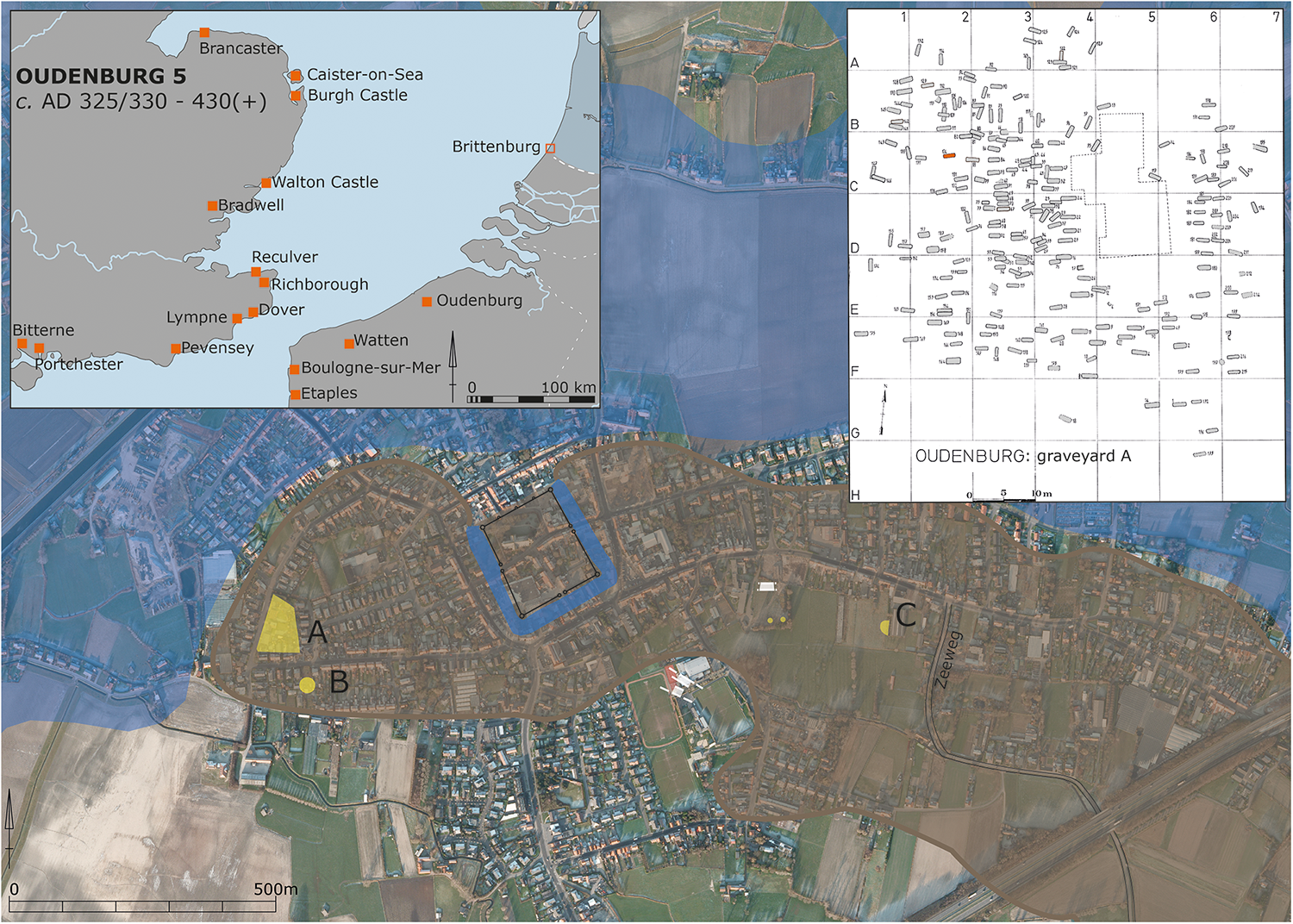
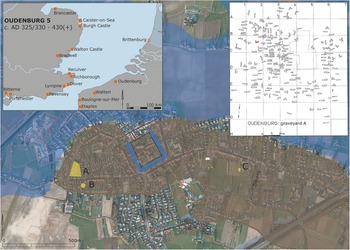
Near the late Roman castellum three related graveyards have been identified (Fig. 1). Graveyards A and B, approximately 400 m west of the fort, were investigated in the 1960s.Footnote 10 Excavations at Graveyard A uncovered 216 inhumations dating to the fourth and early fifth centuries, as indicated by associated grave goods and numismatic evidence, which align with the two final occupation phases of the fort.Footnote 11 During the construction of a new house, three graves were revealed, clearly part of a larger graveyard (B). Based on the limited grave goods, this burial site was dated to the late third to early fourth century.Footnote 12 The western edge of Graveyard C was discovered in 2014 during a preventive large-scale archaeological excavation.Footnote 13 It is located approximately 550 m east of the fort, near the intersection of two Roman roads. Twenty inhumation graves were uncovered; the full extent of the graveyard remains undetermined. Based on burial customs and grave goods, this site shares the same chronological horizon as Graveyard A.
Late Roman Oudenburg (period 5). Aerial view of Oudenburg showing the situation in the fourth century a.d. as understood from the archaeological observations so far, with indication of the presumed position of the sand ridge during the late Roman period (brown), the course of the waterways (blue) and the superimposition of the Roman stone fort with surrounding defensive ditch in the city centre, the late Roman inhumation graveyards A, B and C (yellow) and the uncovered late Roman roads (white) (from Vanhoutte Reference Vanhoutte2023a, 43, fig. 11). Inset left: the current position of the fourth-century Oudenburg fort in relation to the other attested and presumed Saxon Shore forts and military sites in the Channel region (empty square: the presumed late Roman military site of Brittenburg) (from Vanhoutte Reference Vanhoutte2023a, 170, part of fig. 104). Inset right: Graveyard A as published by Mertens and Van Impe (Reference Mertens and Van Impe1971) (‘plan I’), with the graves in grey. Grave 104 is marked in orange (© Flanders Heritage Agency).
Burial A-104
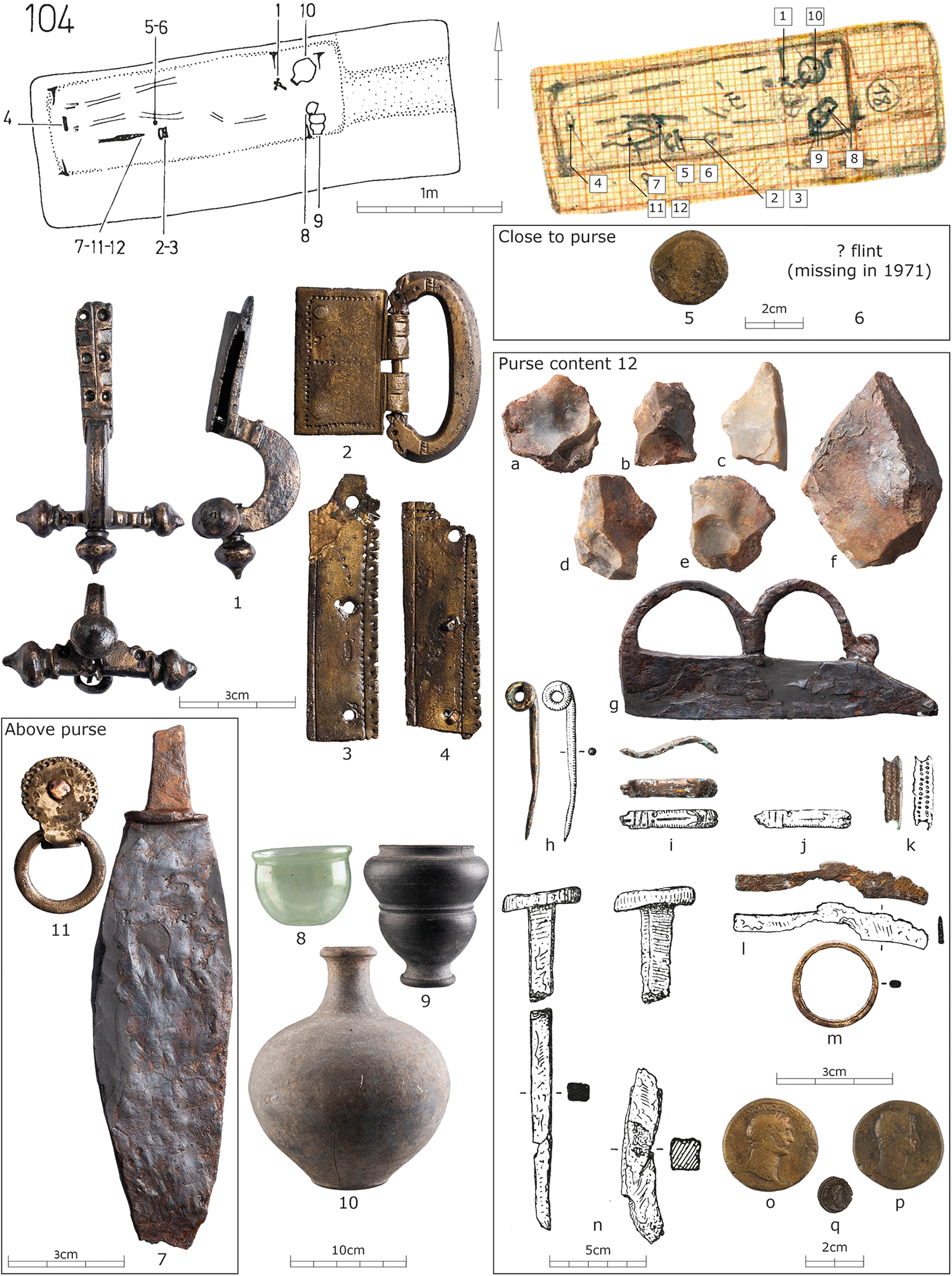
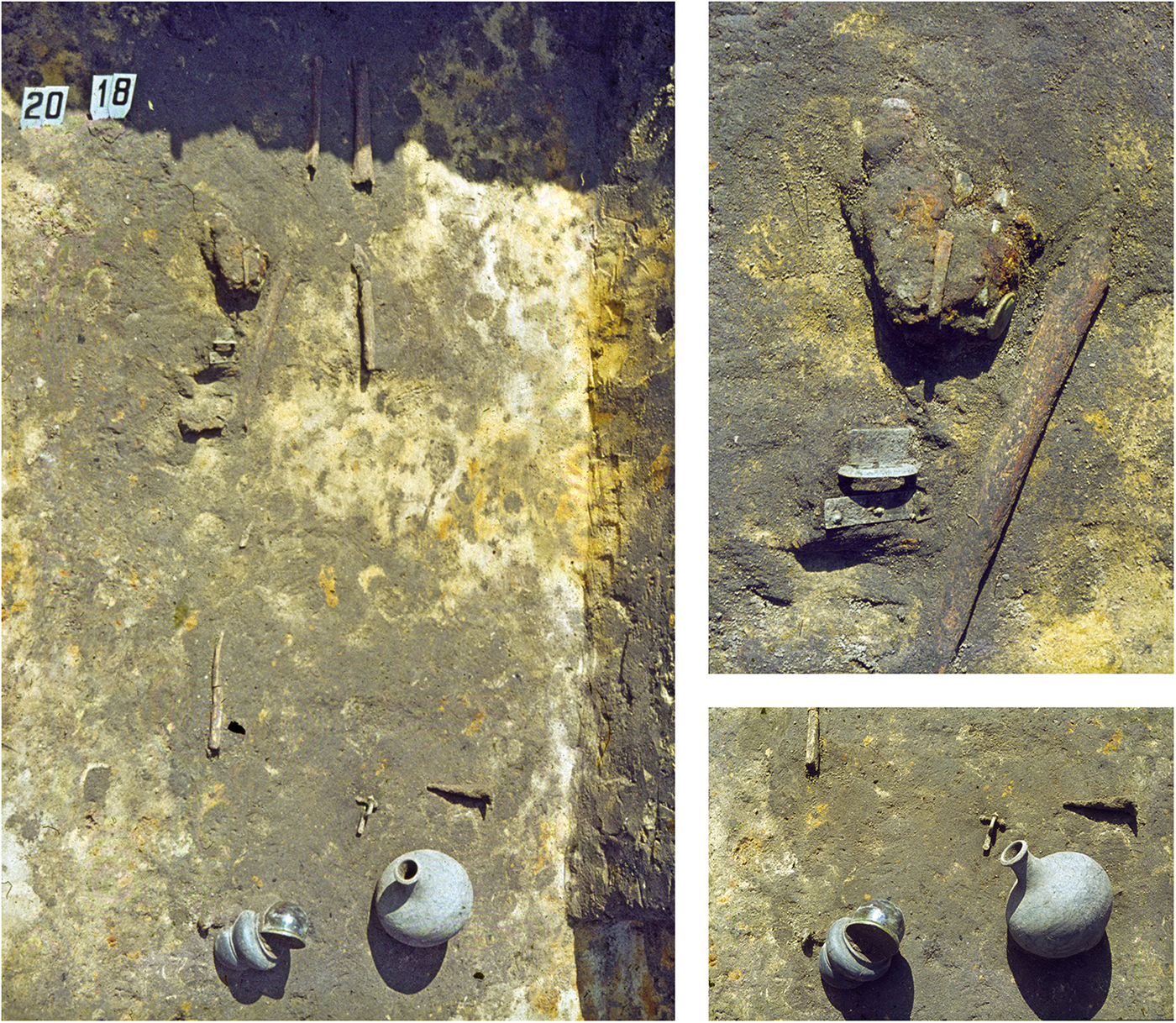
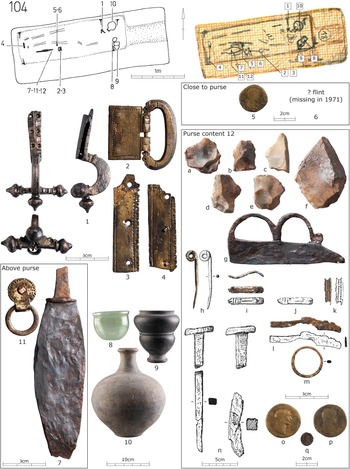
The largely excavated, late Roman burial ground A at Oudenburg was first published by Mertens and Van Impe in 1971Footnote 14 and was recently discussed by Vanhoutte in light of the new results from the fort excavations.Footnote 15 Based on this, the chronology of the graveyard could be specified to date from the second quarter of the fourth century until the early decades of the fifth century a.d. Burial 104, excavated in 1964, was aligned east–west and placed roughly in the north-west of the excavated area. It belongs to the densest concentration of graves in the graveyard but no intersections with other burials were noted. In fact, the rectangular grave pit, measuring 2.90×1.05 m, lay apart from the surrounding graves by a few metres on all sides. The buried individual lay in a stretched-out supine position with the feet to the west (Figs 2 and 3). To the east of the presumed coffin (2.18×0.65 m), the bottom of the grave featured a step. Although the right arm, torso and skull of the skeleton were not preserved, no post-burial grave disturbance was noted. The only thing that might point to a grave disturbance is the position of the belt plaque (Fig. 2.4) at the feet of the buried individual. However, a more convincing explanation for this position might be that the belt was laid out full length along the left leg of the deceased, which is supported by the position of the belt loop above the purse, along the lower leg. This is not an unusual position for a late Roman military belt, most of which were not worn by the deceased but placed separately in the grave.Footnote 16 There is no osteological analysis of the remains (left arm and lower limbs). However, with a belt and crossbow brooch — the latter placed near the presumed right shoulder — the buried was adorned with male clothing.
Oudenburg, Grave A-104, from Mertens and Van Impe Reference Mertens and Van Impe1971, 46 Afb. 19; pls XXXIV and XXXV, with the original excavation drawing of the grave (Archive Flanders Heritage Agency) (Photos Kris Vandevorst, composition Sylvia Mazereel, both Flanders Heritage Agency). The numbers correspond with the catalogue numbers in Mertens and Van Impe Reference Mertens and Van Impe1971, 133–6. Items 1–4, 7, 11 and 12a–m are presented at the same scale while nails 12n are on a smaller scale. The vessels 8, 9 and 10 are shown on a much smaller scale. Items 6, 12j and the nail 12n to the right are missing at present (© Flanders Heritage Agency).
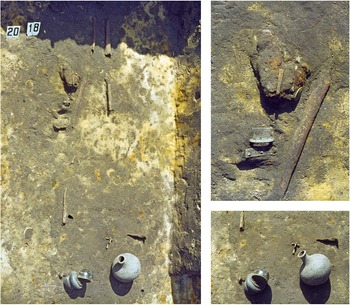
Oudenburg, burial A-104, excavation photos, digitised transparencies. Above, right: left humerus with belt set and purse assemblage (Archive Flanders Heritage Agency).
The grave goods from Burial A-104
There is a variety of grave goods present: a belt set, a crossbow brooch, a knife, a double-lobed beaker, a glass cup, a ceramic jug and a purse. The purse was encountered as a lump of dirt held together by ‘mineralised textile’, possibly wool, and yielded a number of objects that made up the purse contents.
In addition to three — perhaps four — coins, an iron fire striker and six pieces of flint, the purse assemblage contains a number of copper-alloy fragments. The two large iron nails look suspiciously like coffin nails, but were noted by Mertens and Van Impe as part of the purse assemblage. The almost complete nail measures 17.5 cm, thus above the average of coffin nails.Footnote 17 The purse assemblage was found underneath a knife (Fig. 2.7) and a belt loop (Fig. 2.11). It presented itself as a compact mass of dirt with remnants of mineralised fabric, supposedly wool, in which a bundle of threads could be discerned, consisting partly of single threads and partly of cable threads spun in Z-twist and S-twist twisted together.Footnote 18
Finds in the grave
The crossbow brooch (Fig. 2.1) is a type Keller-Pröttel 3b/4a–Swift 3/4b and has a common design for the type 3/4 brooches found in northern Gaul:Footnote 19 the foot has a ring-and-dot style consisting of singular punched circles (sometimes referred to as ‘hollow eyes’) with alternating rectangular slopes on both sides, separated by a single incised line in the middle. The foot is further characterised by an extended rear, an inclined orientation and a regular cuff on the foot-to-bow transition. The bow itself forms a regular arc with two incised lines running along the top. The arms are quadrangular in cross-section with an undulating top containing one eye on each side. The knobs are onion-shaped with tapered endings. The crossbow brooch dates to the mid-to-late fourth century for northern Gaul (a.d. 350–410), with a possibility of its use into the early fifth century, from a perspective of longevity.Footnote 20 Paul has reevaluated the chronology of the type 3/4B to which this item belongs and dates its onset in the a.d. 330s. The Oudenburg grave A-104 is the very latest known burial context with this type of brooch.Footnote 21 This brooch may therefore have been rather old compared to the rest of the assemblage. Possible indications of wear-and-tear might support this notion, but other than the broken-off corner of the foot, there are few indications that the brooch was used for a long time. While the eye of the pin is still in place at the centre of the hinge mechanism, the pin itself is missing. This is a well-observed phenomenon and could be explained by post-depositional and corrosive processes as the pin is often composed of a different metal or alloy than the brooch itself.Footnote 22 Nevertheless, from iconographic sources (cf. the Silistra TombFootnote 23 ), it is suggested that the crossbow brooch remained fastened on the cloak when it was not worn. This indicates that the brooch could have been used for a long time without much manipulation. Unfortunately, it appears that there is no clear evidence to indicate whether the brooch had been in use for a short or a long timespan prior to the burial.
The belt buckle (Fig. 2.2) is animal-ornamented and stamp-decorated. It comes with two stamp-decorated belt plates. Without the two additional belt plates, the buckle might belong to Böhme’s ‘Einfache, punzverzierte Tierkopfschnalle’ and more specifically type ‘Form Hermes-Loxstedt’ due to its proportions and decoration.Footnote 24 Böhme dates these to the end of the fourth until the mid-third of the fifth century.Footnote 25 However, with the two additional rectangular plates (Figs 2.3 and 2.4) it forms a belt set of which several exist in northern Gaul, each of them singular in itself, ‘irregularly formed’, yet reminiscent of the ‘Kerbschnittgarnituren’. According to Böhme their onset is in the early fifth century at the earliest.Footnote 26
The glass cup, Isings 96 (Fig. 2.8), is traditionally dated in the second half of the fourth and first third of the fifth century.Footnote 27 According to the most recent glass chronology, the type corresponds with form AR 60.1A (‘Glattwandiger Becher ohne Verzierung’) which sets in at the end of the third century and is present until a.d. 430/50.Footnote 28 The recent study of the glass finds from Oudenburg puts this item in the second half of the fourth century and early fifth century.Footnote 29
The double-lobed beaker (Fig. 2.9) belongs to the type Brulet B4.2 and dates post-a.d. 375.Footnote 30 It is a very common late Roman terra nigra/reduced ware vessel form at Oudenburg.Footnote 31
The grey, coarse-ware bottle (Fig. 2.10) belongs to Brulet type G11, twice associated with finds from post-a.d. 388.Footnote 32
Finds above the purse
The rounded form of the iron knife (Fig. 2.7) is typical in Late Antiquity. Most parallels are from men’s graves and are dated to the fourth century a.d.Footnote 33 The ring fitting (Fig. 2.11) from the purse typologically fits in with the rest of the belt ensemble (Figs 2.2–2.4) and was most likely part of it.
Finds in the purse
The iron fire striker (Fig. 2.12g) is not closely datable but occurs in only two other graves within the Oudenburg graveyard A, both dating to the late fourth century:
Grave A-76 dating post-a.d. 379 based on a purse content of 88 coins with a closing AE3 coin of Theodosius I, Arles, Fel temp reparatio (318–324 to 378–383)Footnote 34 and an animal-ornamented belt buckle. The fire striker was accompanied by two flints.Footnote 35
Grave A-109 dating around or post-400 due to a rectangular strap end.Footnote 36 The iron fire striker (without flint) was found close to mineralised fabric remains that possibly belonged to a purse.Footnote 37
The combination of fire striker and flint in fourth-/fifth-century (purse-bearing) military gravesFootnote 38 seems to mark the onset of this type of grave good which is later prevalent in Merovingian-era male burials.Footnote 39 The flints most likely served as to produce fire, as strike-a-lights. More shattered-looking items with more rounded edges may already have been in use during the lifetime of the buried individual. In Oudenburg grave A-104 this is the case for two or three of the flints in Fig. 2.12. The others could have been collected for an intended later use.Footnote 40
Several small metal items are included in the purse. The two belt hooks (Figs 2.12i and 2.12j) are both parts of late Roman ‘Tierkopfschnallen’. The brooch pin (Fig. 2.12h) and the other copper-alloy items (Figs 2.12k–2.12m) are not closely datable. Neither are the iron nails (Fig. 2.12n).
Additionally, at least three coins belong to the purse contents: two coins (Fig. 2.12o–2.12p) are Trajanic (a sestertius and a dupondius, minted between a.d. 98 and 117); the third coin is a Valentinian II coin (AE4, minted between a.d. 388 and 402) (Fig. 2.12q), and is the closing coin that dates the purse assemblage post-a.d. 388.
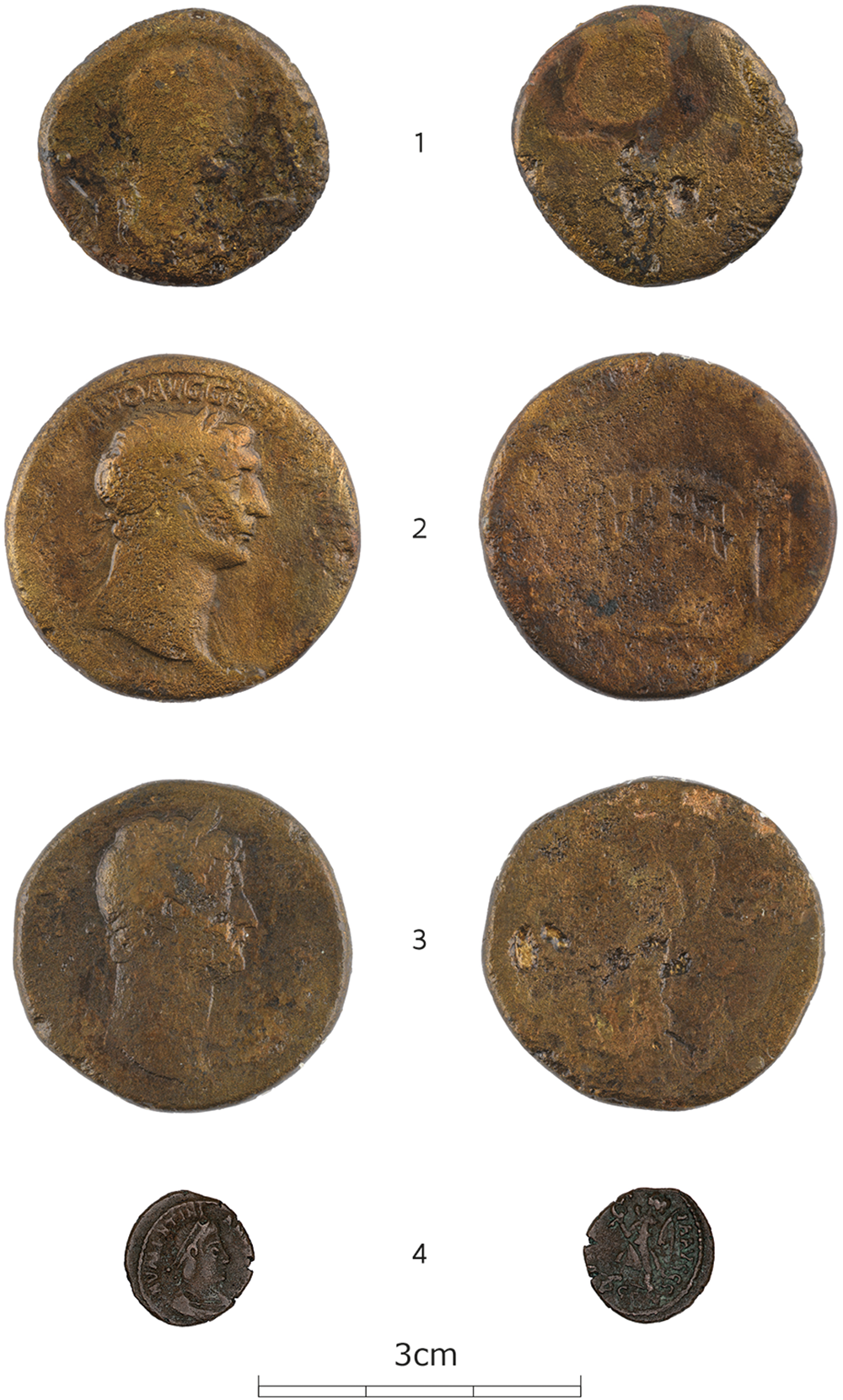
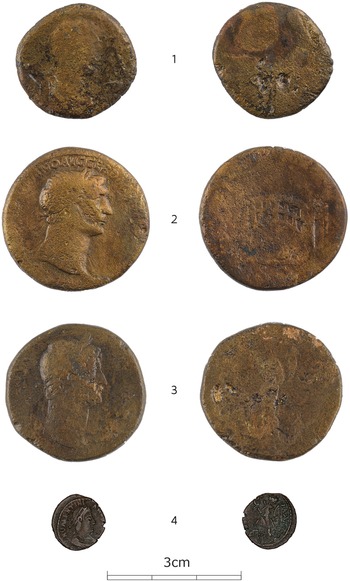
List of coins (Fig. 4)
1. Trajanic bronze dupondius minted in Rome, c. 98–117; obverse: bust to right; reverse: nothing visible; weight: 10.46 g; diameter: 27 mm
KBR – Coins and Medals, inv. 2B59/13
2. Trajanic bronze sestertius minted in Rome, c. 107–110; obverse: laureate head, with [IMP CAES NERVAE TRA]IANO AVG GER DA[C P M TR P COS V P P]; reverse: covered bridge flanked by a tower on the right and on the left, under the bridge a boat, with [SPQR OPTIMO PRINCIPI]/S C; weight: 22.24 g; diameter: 33 mm; die axis 6
(RIC 569; BMC cf. 851; MIR 314; Lallemand Reference Lallemand1966, 132, C1 (this coin); Mertens and Van Impe Reference Mertens and Van Impe1971, 136, n. o (this coin))
KBR – Coins and Medals, inv. 2B58/49
3. Hadrianic bronze sestertius, minted in Rome, in 138; obverse: head of Hadrian, laureate, to the right, with HADRIANVS – AVGVSTVS P P; reverse: Hilaritas standing to the left, holding a palm in the right hand and a cornucopia in the left hand, left a small boy, right a small girl; S – C, with HILARITAS P R COS III; weight: 22.99 g; diameter 32 mm; die axis 6
(RIC 970; RIC 2 988; BMC 1372; Lallemand Reference Lallemand1966, 132, C3 (this coin); Mertens and Van Impe Reference Mertens and Van Impe1971, 134, n. 5 (this coin))
KBR – Coins and Medals, inv. 2B69/58
4. Valentinian bronze AE4, minted in Arles, 388–402; obverse: bust of Valentinian II, pearl-diademed, draped and cuirassed, right, with D N VALENTINI-ANVS P F AVG; reverse: Victory advancing left, holding wreath and palm, with ] -IA AVGGG; weight: 1.14 g; diameter 13 mm; die axis 12
(RIC IX Arelate 30A; Lallemand Reference Lallemand1966, 136, Q (this coin); Mertens and Van Impe Reference Mertens and Van Impe1971, 134, n. 5 (this coin))
KBR – Coins and Medals, inv. 2B362/17
The four coins of grave A-104. (1) the Trajanic bronze dupondius, minted in Rome, c. 98–117, obverse–reverse (© KBR (Royal Library of Belgium) – Coins and Medals, inv. 2B59/13, Catalogue no. P); (2) the Trajanic bronze sestertius, minted in Rome, c. 107–110, obverse–reverse (© KBR (Royal Library of Belgium) – Coins and Medals, inv. 2B58/49, Catalogue no. O); (3) the Hadrianic bronze sestertius, minted in Rome, in 138, obverse–reverse (© KBR (Royal Library of Belgium) – Coins and Medals, inv. 2B69/58, Catalogue no. 5); (4) the Valentinian bronze AE4, minted in Arles, 388–402, obverse–reverse (© KBR (Royal Library of Belgium) – Coins and Medals, inv. 2B362/17, Catalogue no. Q).
Finds close to the purse
Two items, the above-mentioned Hadrianic sestertius (Fig. 2.5) and a piece of flint (Fig. 2.6), were documented in close proximity to the purse (Fig. 2). However, there is a notable discrepancy between the excavation photograph (Fig. 3), which shows these objects within a few centimetres of the belt clasp along the left femur, and the corresponding published drawing (Fig. 2) that situates them further down the lower leg. Given that the photograph may have been taken after objects were moved or ‘restaged’, the drawing — which was likely produced earlier — may more faithfully represent their original context. Comparison with the original archived excavation drawing, which is only done at scale 1:50, reveals that the published drawing has not copied the locations here very accurately and shows that items 2–3, 5–6 and 7–11–12 were situated much closer to each other. The small distance between the purse and the items therefore suggests they could have fallen out or been contained within a slightly larger purse. Consequently, these items should be interpreted as part of the purse assemblage, rather than as distinct objects placed at a distance from it.
Dating the burial
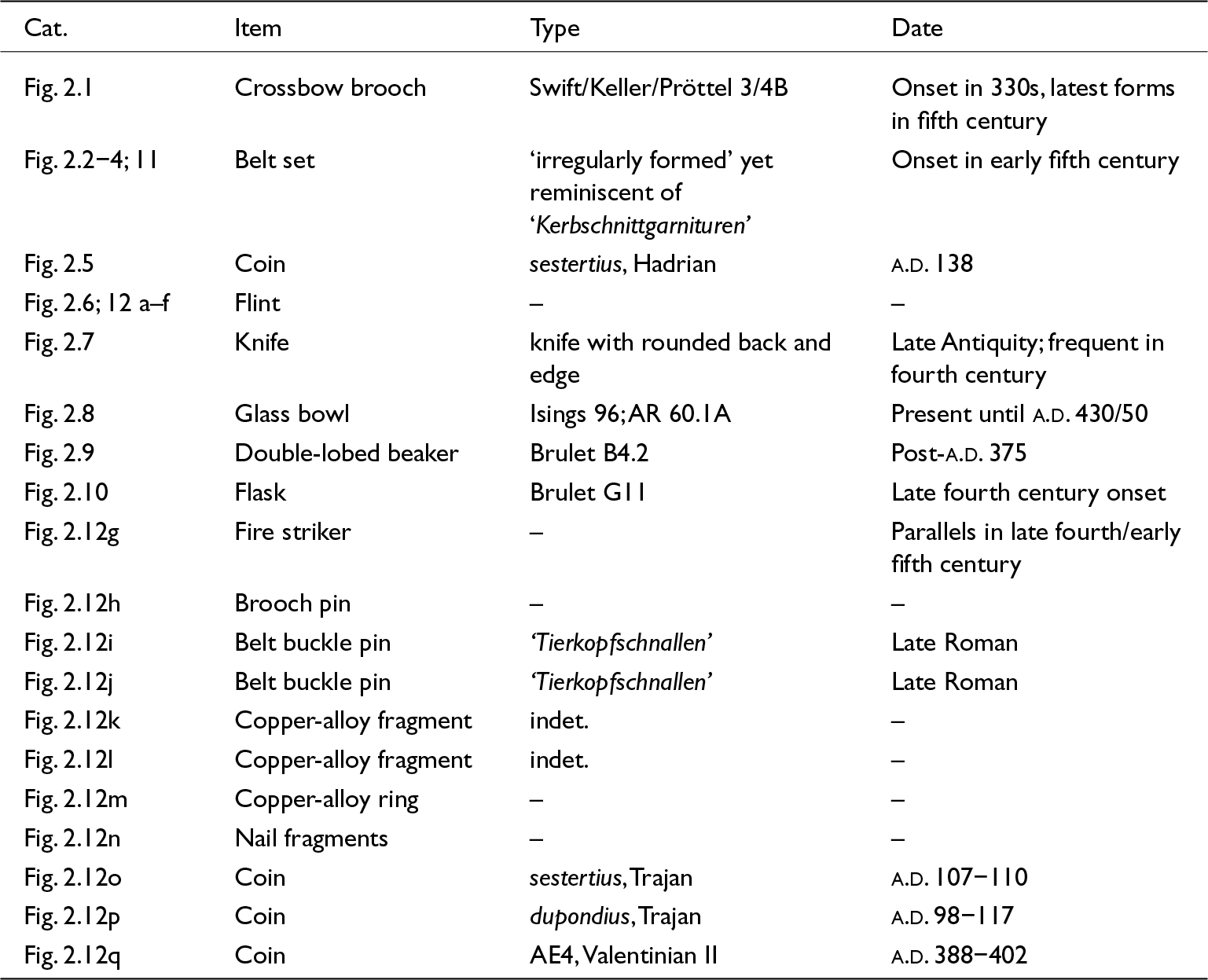
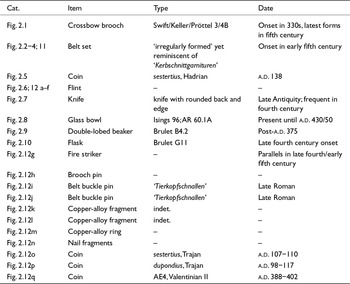
Considering the overall late Roman military habitus the grave cannot be placed later than the fifth century. At the moment, the grave can only be dated with certainty post-a.d. 388 based on the closing coin of Valentinian II. A possible date range is uncertain. The evidence from the fort would support the possibility of a chronological range up to around a.d. 430. From our recent assessment, the objects in the grave can roughly be dated between a.d. 375/380 and 450. The grave assemblage itself is therefore most likely to date between a.d. 388 and 430 (Table 1).
Oudenburg, burial A-104: dating evidence of the grave goods
The purse content as an ensemble
Was the placement of the purse, and thus the purse contents (Fig. 2.12), within grave A-104 intentional and, in consequence, symbolic? The position of the purse within the grave — along the length of the laid-out belt beside the left leg, close to the buckle (Fig. 2.2) — suggests otherwise. So does the hook (Fig. 2.11) on which the purse would have been fastened to the belt: the belt and purse almost certainly belonged together as one item. It was most probably the belt which served as a highly symbolic burial gift,Footnote 41 whereas the purse merely followed it into the grave because it was attached to it. We therefore hesitate to assign any further symbolic meaning to the purse, or the purse contents, as individual grave gifts. This also means that we see the purse contents as an ensemble with an assembling process that must have started long before the burial. Nonetheless the burial gift of a purse may have served to indicate possession and status, not unlike depictions of purses on Roman tombstones.Footnote 42
The bronze scrap within the purse: typology and object biographies
Item Fig. 2.12h is a typical brooch pin with a spiral construction. It might have belonged to a crossbow brooch, but another brooch type seems more plausible. A century before the burial, however, in the late third century, brooches with spiral construction were already being produced within the fort of Oudenburg, evidenced by a bronze-working workshop with brooch production waste of simple one-piece sprung brooches.Footnote 43 Belt hooks Figs 2.12i and 12j were both originally part of late Roman ‘Tierkopfschnallen’, and the animal head on 12i is still visible. The interpretation of Fig. 2.12k is unclear. The 1.9 cm long item might be a Roman plate/vessel fragment, part of a bracelet or belt set, or even the central part of a brooch. The fragment is entirely flat and bears a broken-out rivet hole on each end. Fig. 2.12l was originally labelled as a knife. Upon reviewing the artefact, this interpretation is false. We cannot, however, propose a secure alternative interpretation to the flat, fragmented piece of scrap metal. A small, incised line appears to follow the long edge — a vessel rim? The ringlet Fig. 2.12m has the same diameter (2.3 cm) as the one from the belt accessory, Fig. 2.11. It is therefore to be questioned if it had formed part of such a belt before being a part of the purse assemblage. It must however be noted that it bears a groove around the inside, and that it has a flat cross-section, both of which ring 11 appears to be lacking. Therefore, Fig. 2.12m was probably not part of the belt in burial A-104, and its interpretation as part of the purse contents seems appropriate.
An important note must be made on the functionality of the scrap metal items in burial A-104. Other than the ring, Fig. 2.12m, all scrap metal artefacts within the purse had, due to fragmentation, lost their original function before they formed part of the purse collection. They were no longer in a position to be repaired to regain their function. Crucial elements for repair appear lost: the brooch pin from Fig. 2.12h, the belt hook ends from Figs 2.12i and j, the rivet holes of Fig. 2.12k. Therefore, the intention behind collecting these items must have been something other than a future repair of the original item or a similar one. Their raw material or their material value come to mind (see below). Considering the object biographies of the former entire artefacts, we have to assume that any parts that were still manually repairable (without melting them) were in fact repaired or used otherwise, and probably did not end up as part of a bag assemblage. This appears to have been the destination only for the unrepairable fragments.
The question of intentional cutting must remain open. Apart from the flat, probably cut-down item Fig. 2.12l, the fragmentation traces are not so clear-cut and could also be from breaks due to use-wear or post-depositional breaks.
For future analyses of scrap metal in purse or bag assemblages, we propose to distinguish between potentially functional and/or repairable and unrepairable fragments. The latter appear to have been intentionally collected in the purse in burial A-104, or remained left over after a longer assemblage process.
Old coins in late Roman purses: money, Romanitas, or scrap metal?
Coins are often treated differently from other grave goods, typically valued for their chronological significance or interpreted as indicators of economic status. Such interpretations, however, merit reconsideration for the late fourth and fifth centuries. Grave A-104 is a good example of this. Here, within a single purse assemblage, a coin of Valentinian II (minted a.d. 388–402) is combined with two Trajanic coins, potentially alongside the Hadrianic coin (Fig. 4). This prompts the question of why a late fourth-century coin would be deposited together with early second-century coins in a closed context.
Often, coins of disparate dates are dismissed once their chronological information seems irrelevant. In graveyard A, Mertens and Van Impe categorised seven early imperial coins (Trajan, Hadrian, Faustina II and Commodus) as ‘without significance for the chronology of the graveyard’,Footnote 44 thereby excluding them from the analysis of the grave goods. Such older coins are often labelled as ‘intrusive’ among late Roman material, but burial A-104 demonstrates that at least two Trajanic coins formed part of the late Roman purse assemblage. This suggests that the significance of coins in this funerary context is perhaps not monetary or economical, and their value for archaeologists should go beyond establishing the grave’s chronology.
Building on these considerations, it is first necessary to determine whether the coins were actually reintroduced into regular circulation with their original nominal value. Although this possibility cannot be dismissed outright, if they were indeed returned to economic use, their nominal worth would likely have been secondary to their potential bullion value (as discussed below). An alternative view holds that these coins functioned similarly to other grave goods — i.e. intentionally selected to accompany the deceased — and should therefore be examined for the symbolic roles they may have played. As to the question of where these older coins were acquired in the fourth/fifth centuries, it is difficult to give a unilinear answer. Multiple object biographies appear possible, as they may equally stem from recovered hoards or have ‘survived’ above the earth through several generations.
Several interpretive perspectives merit attention. The notion of an ‘obol for Charon’,Footnote 45 for instance, seems unlikely in late Roman Oudenburg and northern Gaul, where funerary coins are typically found in a purse or in the hand, rather than placed in the mouth or on the eyes. A second possibility is that the coins were valued primarily for their material value, akin to scrap metal either held in reserve for recycling or employed in a weight-based exchange system (cf. Hackbronze). They may thus have paralleled other metal items in the purse, representing the deceased’s occupation or practices in life rather than serving a strictly monetary purpose.
A third interpretive option considers Roman coins as an active communication system through their iconography. Typically, one side depicts the emperor, while the other bears religious, political, or symbolic imagery. It is possible that these values, rather than monetary worth, explain why chronologically deviating coins appear together. In the purse assemblage, all four coins feature a Roman emperor, suggesting a symbolic significance attached to imperial representation. Perhaps they were specifically selected because of this: such imagery may refer to the Emperor as a political or mythical figure (cf. Imperial cult), invoke the broader Roman Empire or the city of Rome, or signify ‘Roman officialdom’ as a form of Romanitas in which the owner expresses loyalty, beliefs, or allegiance to Rome.Footnote 46 It is even possible that the fact that the image was more easily visible on the larger coins could have influenced the selection.
Roman imperial representation through coins remained influential in Late Antiquity and into the Merovingian period.Footnote 47 It could be argued that during periods of cultural transition — such as the fourth and fifth centuries in northern Gaul — people sought to assert their identities more visibly, especially in contexts of heightened interaction. Collins has noted that such expressions commonly emerge at cultural interfaces, where different communities mix.Footnote 48 A burial might therefore offer an ideal setting to convey symbolic messages to onlookers and the local community. One potential objection is that in burial A-104 the coins were placed within a purse, rendering them invisible during the funeral. Based on the composition of studied ensembles, Gorecki suggests that coins in purses generally reflect the possessions of the deceased at the time of death.Footnote 49 Yet in certain instances, coin selection clearly seems intentional.Footnote 50 Thüry and Doyen cite examples where coin images were specifically chosen for symbolic effect.Footnote 51 At burial Oudenburg A-104, this may apply to the Trajanic sestertius depicting a ship under a bridge, a motif possibly referencing death. Its rarity likewise hints at deliberate selection. By contrast, the Victoria on the AE4 and the Hilaritas on the Hadrianic sestertius do not present an obvious symbolic link. Nonetheless, these coins might still have served a communicative or emblematic function within the broader funeral context.Footnote 52
A fourth option is that these coins carried personal or communal values now lost to us, whether amuletic, commemorative, or reflective of personal memories. Coins worn as charms are typically perforated or otherwise modified, features not present in this burial assemblage. Still, this does not preclude the possibility that the items held significance for the deceased or for those who interred them.
Finally, a more overt economic symbolism may also be considered. A purse containing multiple coins could showcase wealth or connections, attributes that Roman elites were known to display through material culture drawn from across the Empire. In this case, the purse could have been ‘fattened’ with other objects to create the illusion of large wealth.
The most likely interpretation, put forth in this paper, is the significance of the material value of the coins, in line with the Hackbronze material in the purse.
Discussion: Hackbronze as a coin replacement in burial A-104?
Having discussed various options for the meaning of the coins in burial A-104 in Oudenburg, we now return to the Hackbronze fragments and their inclusion in the purse assemblage. In 1975, Gorecki first commented on the curious co-occurrence of bronze fragments and coins in the purse of burial A-104: ‘Da das Grab auf die germanische Herkunft des Bestatteten schließen läßt, sollte man vielleicht keine allzu differenzierte Absicht hinter dieser seltsamen Art der Handhabung einer Münzbeigabe vermuten’.Footnote 53 Although we no longer support Gorecki’s singular and uncritical interpretation of the buried individual as ‘Germanic’ in origin, we would like to point out that he raises the question of whether the coins as well as the scrap metal could have been chosen due to their material value. According to Gorecki, this interpretation might not fit with the placement of the sestertius Fig. 2.5 outside and the AE4 (Fig. 2.12q) inside the purse.Footnote 54 If, however, as we assume, items Fig. 2.5 and Fig. 2.6 were part of the purse content, we can return to the argument of material value, and ask whether the scrap metal was used as Hackbronze in a para-monetary sense.
It has been proposed that base metals (such as bronze or copper alloys) were cut up, or assembled, specifically in pieces to correspond to certain weight classes to serve as a ‘metal bullion’ that could be used together as a means of payment in a more exchange-oriented economy.Footnote 55 Specifically, this would be aimed at small-value exchanges and transactions, for which the remaining silver and gold coins would be too high in monetary value to be of use. The latter were probably more used as a way for taxation systems or circulating only in the higher social classes that had plenty of property and economic interests on an Empire-wide scale.
A strong indicator for the material, or material value, as the driving force behind collecting the scrap metal items in burial A-104 is the fact that almost all of the items are broken beyond repair, as discussed above. They were not collected for future repair.
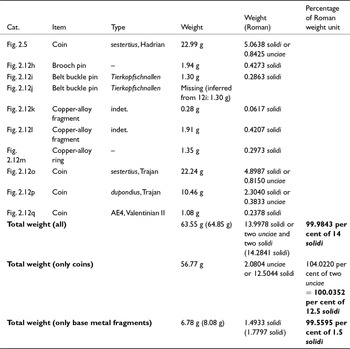
To assess how the artefacts, individually and collectively, fit within the late Roman weight system, their weights were taken (Table 2).Footnote 56 Martin’s extensive comparative research has shown that the late Roman and Migration period weight system was based on the Roman uncial system, where an uncia (27.2875 g), and its sixth portion, equalling a solidus (4.54 g), held special significance.Footnote 57 Therefore, attention is given to possible comparisons with these weight categories. As to the question of the level of accuracy sought after and attained in Roman times, the smallest known Roman unit measurable with scales is the siliqua, which weighs less than 0.1 g.Footnote 58
Oudenburg, burial A-104, purse content and adjacent finds (only base metal finds): individual and collective weights. 1 solidus = 4.54 g; 1 uncia = 27.2875 g (Roman measurements after Martin Reference Martin1987, 206). In brackets: Calculation including an inferred weight for the missing item Fig. 2.12j
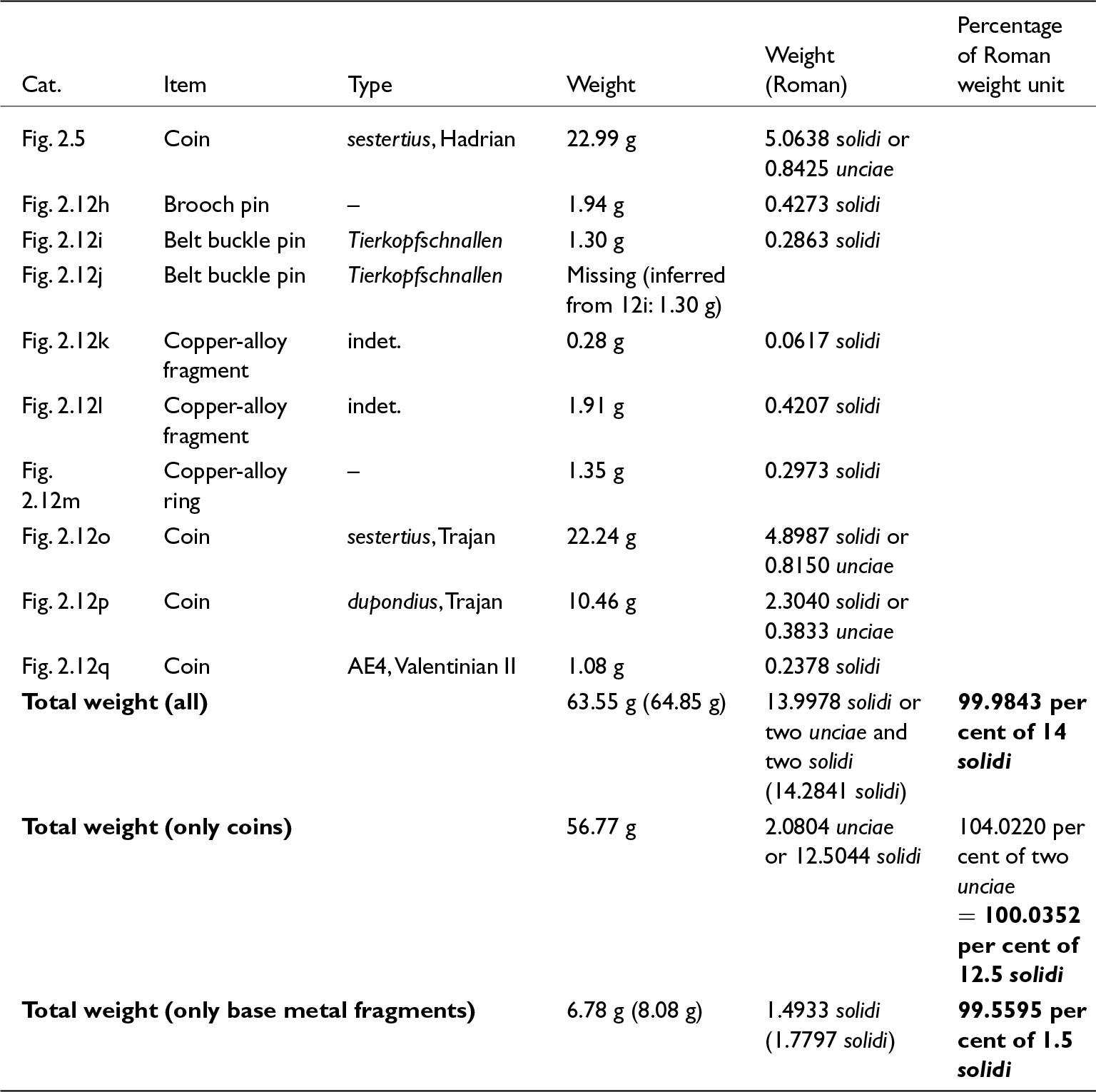
Table 2 shows the individual and collective weights of the bronze artefacts and coins in the purse in burial A-104. All under two grammes, with the smallest (Fig. 2.12k) only weighing 0.28 g, the individual scrap metal bits had very little material value, similar to one AE4 coin or less at the time. Only together do they amass a weight that may have held any purchasing power, perhaps thought of as bullion. Their difference in weight to the three then-ancient coins in the purse is remarkable; they will have been worth only a fraction of the coins’ worth. Nonetheless they had been deemed worthy of inclusion in the purse.
The weights of the single items in the assemblage do not suggest that their individual weights were targeted. However, taken together, the present scrap metal items weigh almost exactly as much as the amount of one quarter of a Roman uncia. A coincidence? We have to be careful with over-interpreting the data, as artefact Fig. 2.12j was missing when weights were taken and is therefore not included here. It was not entirely clear whether Fig. 2.12j was, in fact, an individual artefact or whether Mertens and Van Impe accidentally pictured and catalogued item Fig. 2.12i twice, with slight variations. In Böhme’s (Reference Böhme1974) catalogue Fig. 2.12j was already missing, along with a few other items which we were able to retrieve. Nonetheless, the total weight of coins and metal items, without Fig. 2.12j, strikingly corresponds with almost exactly 14 solidi, or two unciae and two solidi.
If we do not interpret the coins within the burial in a symbolic way as discussed above, this bears the question whether the three very old coins, Figs 2.5 and 2.12o–p, had been reintroduced as a replacement for current issues, or whether they, too, might rather form part of a weight-based bullion system, perhaps together with the Hackbronze. At 56.77 g, the coins alone also closely correspond to a Roman weight unit, i.e. almost exactly two Roman unciae. Too close to be a coincidence? Further studies of scrap metal assemblages, and ancient coins, in purses will have to be carried out to approach their respective functions and values within post-Roman exchange. It is still unclear whether the coins and Hackbronze were part of a para-monetary or commodity exchange system at all, or whether they were rather collected and used for re-melting on a case-to-case basis, as was hitherto assumed for Hackbronzes e.g. in Merovingian graves.Footnote 59 The close analysis of the artefacts in grave A-104 shows that remelting, here, may still have been intended, or even practised alongside the mentioned forms of exchange, while manual mending of existing artefacts is, due to the state of most items, out of the question.
As for the coins, having discussed their possible symbolic and material value within the purse, we have to admit the possibility that they may not have been intended to signify a means of payment. However, the burial took place within the final decade of the fourth century or first few decades of the fifth century. This means that the buried person, before his death, probably had an active memory of bronze coins as part of a functioning monetary system. And at least the Valentinian II coin may have come into the individual’s possession during a regular monetary transaction.Footnote 60
This is even more striking as there are few closely contemporary burials with purses. The ones from the first few decades of the fifth century still usually contain only money, which reinforces the fiscal interpretation of the purse content in burial A-104.
Among the comparable graves, burial A-76 at Oudenburg deserves a particular highlight for its large collection of 88 coins.Footnote 61 With a fire striker, two flint stones and a touchstone, the rest of the purse assemblage of A-76 is similar to the one in A-104. With a closing date of a.d. 379 it has only a ?slightly earlier terminus post quem than burial A-104. A striking difference is the fact that only one of these 88 coins is older than the second half of the fourth century a.d. Thus, compared to A-104, the purse content in burial A-76 gives the impression of a much more closed assemblage process. Nonetheless, we are able to observe an attempt to keep the weakening monetisation afloat toward the end of the fourth century, since one of the AE3 coins is in fact an empty flan. As to the weight of the purse assemblage in A-76, not all the coins had been weighed. With the weights of 13 pieces missing, the total remaining weight of 230.72 g or 8.4552 unciae is difficult to interpret.Footnote 62
Another such ensemble was found at Tongeren, Jaminéstraat, burial 11b. The military belt found there is of the mid-fifth-century type Jülich-Samson.Footnote 63 The burial contains a purse assemblage of 47 bronze coins. Beyond those there are no recognisable fragmented artefacts, thus no Hackbronze. A sewing needle and a bronze head and loop for closing the bag were probably functional. Yet among the many late fourth-century coins, there are three from 330–48 and one dating from a.d. 294–330.Footnote 64 The coin ensemble weighs exactly 46.15 g.Footnote 65 This equals 1.69 unciae or very close to 1 and 2/3 Roman unciae,Footnote 66 or the weight of 10.16 solidi (close to 10 solidi). It is therefore probable that it was not the face value, but the bullion value of the coins in the bag altogether, which counted. It is also close to one-seventh of a Roman pound (327.45 g). However, it is one-sixth of a pound, equalling an uncia, which was the dominant measure at the time.Footnote 67 Due to the fragmentary state of some of the coins of Tongeren, Jaminéstraat, burial 11 B, judging the result affords caution, since taphonomic processes may have altered the coins’ weight.Footnote 68
Conclusion
Post-a.d. 400, the existing market exchange system must have experienced an adjustment by the population after new bronze issues ceased to reach northern Gaul. The post-Roman economy in northern Gaul has recently been characterised as possibly consisting of a number of exchange networks which were self-organised by the population, without top-down control: a so-called eclectic exchange system. Market exchange was only one of several possible modes of material exchange here, with gift exchange, barter and commodity exchange as other possibilities.Footnote 69 Remnants of such exchanges may have been preserved within purse assemblages in post-Roman burials. The fact that bronze scrap is regularly found in purse assemblages shows that it was prone to move from one to another of these so-called spheres of exchange. The metal items may have turned from a commodity (e.g. a belt accessory) to a holder of material value (e.g. bullion). Perhaps this change occurred typically once the original items were perceived as broken beyond repair, as suggested by most base metal artefacts from the purse in burial A-104 of Oudenburg. Burial A-104 at Oudenburg possibly marks the very onset of what turned into the custom of collecting scrap within purses alongside coins. As such, this custom, and the metal scrap, became a distinct part of the post-Roman exchange system, whether it can be deemed monetary, post-monetary or purely material, with individual or grouped items changing hands as commodities or even gifts.
The weight analysis of the base metal items in the purse assemblage in burial A-104 at Oudenburg reveals the possibility that the artefacts were chosen and assembled with an intended Roman weight unit in mind. However, some uncertainties remain, due to a possibly missing piece in the ensemble. Moreover, the result of one such analysis is not strong enough to constitute proof to generally assume that metal scraps, in the fifth century a.d., were exchanged as bullion. More research on purse assemblages with Hackbronze will have to be carried out to test this hypothesis further. Perhaps the value of bronze coins too, at the time, was measured by their weight. This is suggested by the coins’ overall weight in burial 11b at Tongeren, Jaminéstraat, a purse ensemble without Hackbronze. For future analysis of purse assemblages, two factors strike us as particularly noteworthy. On the one hand, the assessment of weights of both Hackbronze and coins in purse assemblages will show whether they routinely changed hands in weighted units. On the other hand, the degree of brokenness of the Hackbronze may be informative, i.e. assessing whether bronze scraps in purses were still useful for repair or whether the only possibility of recycling them was to remelt them. If artefacts could not be collected with future repair in mind, melting, of course, still constituted an option. Yet it is conceivable that their material, or bullion value could have been of interest.
In sum, to be able to reconstruct the small-change economy and other exchange systems in the fifth century, we argue that assemblages containing scrap metal deserve a closer look.
Acknowledgements
We extend our gratitude to Markus Peter for his valuable suggestions and improvements throughout this work, and to Hans Vandendriessche for his insightful contributions on the flint artefacts. We also thank Fran Stroobants for granting access to coin information and documentation. In addition, we are grateful to the Royal Library of Belgium (KBR) for permitting the use of its coin data in this publication. Finally, Vince Van Thienen wishes to acknowledge the financial support provided by the Ghent University Special Research Fund and the King Baudouin Foundation – Jean Jaques Comhaire Fund, which was instrumental to the completion of this research.

 Open access

