

Introduction
Illegal killing and taking of birds has been a continuing issue in Europe, from the 19th century and earlier, with for example raptors persecuted owing to predation of gamebirds (Stroud Reference Stroud, Thompson, Redpath, Fielding, Marquiss and Galbraith2003). The advent of national legislation to protect birds, especially raptors, in the 20th century made these activities formally illegal (Bijleveld Reference Bijleveld1974). Illegal killing and taking of birds was also one of the principal drivers for the development of international policy instruments (Hudson Reference Hudson1975), such as the European Union (EU) Directive 79/409/EEC (now replaced by the Directive 2009/147/EC) on the conservation of wild birds (or EU Birds Directive; Council Directive 2009), the Bern Convention on the Conservation of European Wildlife and Natural Habitats (Council of Europe 1979), and the Convention on the Conservation of Migratory Species of Wild Animals (UNEP/CMS 1979). Most European countries are Party to these treaties and thus have transposed these texts into national law. Despite this strong legal protection, a number of illegal activities continue to threaten birds in Europe, including trapping of passerines for food consumption, shooting of protected species for ‘sport’ and poisoning raptors for ‘predator control’ (e.g. Rutz et al. Reference Rutz, Bijlsma, Marquiss and Kenward2006, Steiner Reference Steiner2006, Margalida et al. Reference Margalida, Heredia, Razin and Hernandez2008, BirdLife International 2011, Brochet et al. Reference Brochet, Van Den Bossche, Jbour, Ndang’ang’a, Jones, Abdou, Al-Hmoud, Asswad, Atienza, Atrash, Barbara, Bensusan, Bino, Celada, Cherkaoui, Costa, Deceuninck, Etayeb, Feltrup-Azafzaf, Figelj, Gustin, Kmecl, Kocevski, Korbeti, Kotrošan, Mula Laguna, Lattuada, Leitão, Lopes, López-Jiménez, Lucić, Micol, Moali, Perlman, Piludu, Portolou, Putilin, Quaintenne, Ramadan-Jaradi, Ružić, Sandor, Sarajli, Saveljić, Sheldon, Shialis, Tsiopelas, Vargas, Thompson, Brunner, Grimmett and Butchart2016).
Recognising that illegal killing and taking of birds still represent a significant conservation issue, these treaties have recently developed initiatives, adopting the ‘zero tolerance approach’, to tackle this threat, with e.g. the European Commission publishing the ‘Roadmap towards eliminating illegal killing, trapping and trade of birds’ (European Commission 2012), the Bern Convention producing the ‘Tunis Action Plan for the eradication of illegal killing, trapping and trade of wild birds’ (Council of Europe 2013) and CMS adopting a Resolution on ‘the Prevention of illegal killing, taking and trade of migratory birds’ (UNEP/CMS 2014). However, the current lack of quantitative data on illegal killing and taking of birds across Europe hampers the ability of governments, policy makers, organisations and initiatives to set appropriate priorities and address the issue in the region.
Despite a long history of illegal killing and taking of birds in Europe, McCulloch et al. (Reference McCulloch, Tucker and Baillie1992) provided the first quantitative Europe-wide assessment of geographical and temporal trends in the (legal and illegal) taking of 20 migratory bird species before and after 1980. BirdLife international (2011) provided the first qualitative assessment of the extent and importance of illegal activities against birds in Europe. Brochet et al. (Reference Brochet, Van Den Bossche, Jbour, Ndang’ang’a, Jones, Abdou, Al-Hmoud, Asswad, Atienza, Atrash, Barbara, Bensusan, Bino, Celada, Cherkaoui, Costa, Deceuninck, Etayeb, Feltrup-Azafzaf, Figelj, Gustin, Kmecl, Kocevski, Korbeti, Kotrošan, Mula Laguna, Lattuada, Leitão, Lopes, López-Jiménez, Lucić, Micol, Moali, Perlman, Piludu, Portolou, Putilin, Quaintenne, Ramadan-Jaradi, Ružić, Sandor, Sarajli, Saveljić, Sheldon, Shialis, Tsiopelas, Vargas, Thompson, Brunner, Grimmett and Butchart2016) provided the first quantification of this issue for all bird species within the Mediterranean. They estimated that 11–36 million individual birds per year may be killed or taken illegally in the Mediterranean region, including 6–15 million individual birds in European Mediterranean countries only. Illegal killing and taking of birds has however been the subject of many national/sub-national assessments, with recent examples including Voříšek et al. (Reference Voříšek, Klvaňová, Brinke, Cepák, Flousek, Hora, Reif, Šťastný and Vermouzek2009) estimating in the years 2006–2009 that the annual minimum number of birds illegally killed in Czechia was above 1,000 birds; Smart et al. (Reference Smart, Amar, Sim, Etheridge, Cameron, Christie and Wilson2010) showing that illegal killing of Red Kites Milvus milvus is restricting population growth in Northern Scotland and confirmed as a continuing problem by Sansom et al. (Reference Sansom, Etheridge, Smart and Roos2016); Van Maanen et al. (Reference Van Maanen, Goradze, Gavashelishvili and Goradze2001) estimating the mortality of migratory raptors resulting directly from illegal killing and trapping each autumn in Eastern Georgia at between 1,500 and 3,000 birds.
Available quantitative and qualitative information from previous studies suggests that illegal killing and taking of birds may be a significant issue for many European countries. In order to build a more complete understanding of the issue in the whole African-Eurasian flyway and to provide useful information for priority-setting both across the geographic region and within single-species conservation efforts, we aimed here to expand the work of Brochet et al. (Reference Brochet, Van Den Bossche, Jbour, Ndang’ang’a, Jones, Abdou, Al-Hmoud, Asswad, Atienza, Atrash, Barbara, Bensusan, Bino, Celada, Cherkaoui, Costa, Deceuninck, Etayeb, Feltrup-Azafzaf, Figelj, Gustin, Kmecl, Kocevski, Korbeti, Kotrošan, Mula Laguna, Lattuada, Leitão, Lopes, López-Jiménez, Lucić, Micol, Moali, Perlman, Piludu, Portolou, Putilin, Quaintenne, Ramadan-Jaradi, Ružić, Sandor, Sarajli, Saveljić, Sheldon, Shialis, Tsiopelas, Vargas, Thompson, Brunner, Grimmett and Butchart2016) to the rest of Europe. We assessed the number of individual birds which may be illegally killed or taken each year for each species regularly occurring in each country/territory assessed, the types of illegal activities which may be the most significant, the reasons for illegal killing, and which may be the worst locations and countries/territories for illegal killing and taking of birds in Northern and Central Europe (hereafter N & C Europe) and the Caucasus.
Methods
Study area and study species
For this study, 28 countries and one territory (Faroe Islands) from N & C Europe and the Caucasus were assessed (see Table 1; Moldova, Russia and Greenland were not surveyed as we were unable to secure input from experts in these countries and territory). All native species regularly present (i.e. excluding vagrants) in any season in at least one of the assessed countries/territories were included in the assessment (Table S1 in the online supplementary materials).
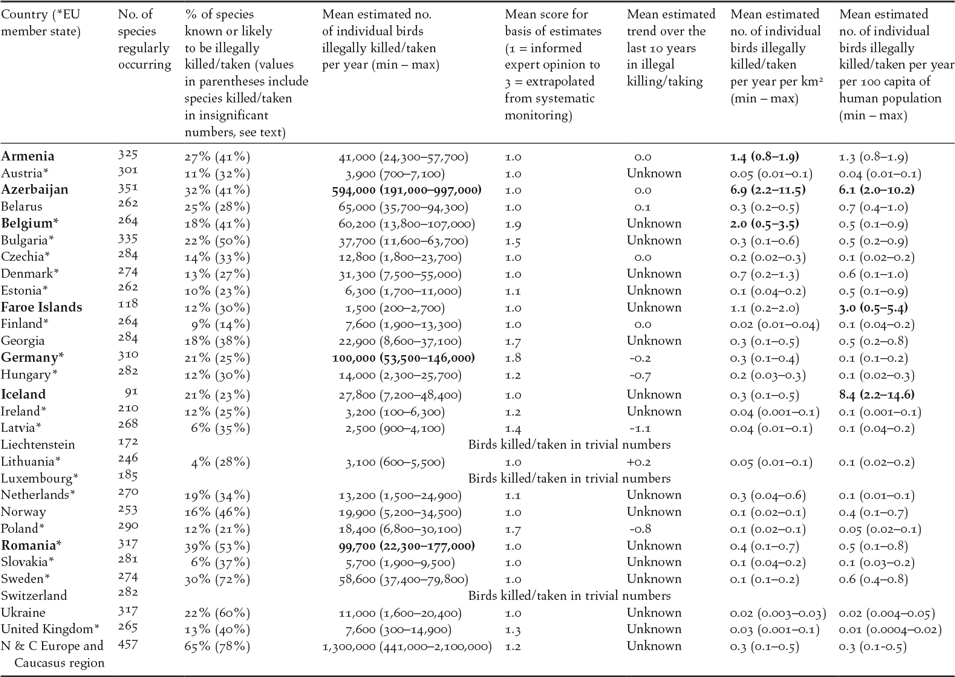
Estimated numbers of individual birds illegally killed/taken per year in each assessed country in Northern and Central Europe and Caucasus. Values in bold indicate the three countries with the highest numbers in each column (see text).
Data collection
Following Brochet et al. (Reference Brochet, Van Den Bossche, Jbour, Ndang’ang’a, Jones, Abdou, Al-Hmoud, Asswad, Atienza, Atrash, Barbara, Bensusan, Bino, Celada, Cherkaoui, Costa, Deceuninck, Etayeb, Feltrup-Azafzaf, Figelj, Gustin, Kmecl, Kocevski, Korbeti, Kotrošan, Mula Laguna, Lattuada, Leitão, Lopes, López-Jiménez, Lucić, Micol, Moali, Perlman, Piludu, Portolou, Putilin, Quaintenne, Ramadan-Jaradi, Ružić, Sandor, Sarajli, Saveljić, Sheldon, Shialis, Tsiopelas, Vargas, Thompson, Brunner, Grimmett and Butchart2016), the illegal killing and taking of birds (‘illegal killing’ in Methods and Results sections) was defined as any form of deliberate action that results in the death or removal from the wild of an individual bird (regardless of whether it was the target of this action or not) that is prohibited under national legislation. All 29 European countries/territories assessed have hunting/taking regulations in their national legislation, which were used to define activities which were illegal at the national level (BirdLife International 2017a). Derogations issued under the EU Birds Directive and/or the Bern Convention were considered as legal hunting/legal pest control. We also did not include estimates relating to hunting that is legal under national laws but that does not comply with national obligations under international conventions or agreements. In addition, we recognise the significance of use of lead shot as a conservation issue and the illegal nature of its continued use in some countries with a ban in place. In different countries/territories, use of lead shot may be legal, completely banned, banned only in certain provinces or banned only in certain areas making the issue quite complex. Only few countries with a ban or partial ban in place had information on numbers of birds killed by lead versus other ammunition types. We therefore did not incorporate this type of illegality in the total number of birds illegally killed per country where use of illegal ammunition was the only illegal aspect of the killing in order to maximise consistency of approach and comparability of estimates between countries, but see the note in the Supplementary Material.
Between July 2016 and June 2017, national experts assessed if wild birds were known or likely to be illegally killed in non-trivial numbers in their country/territory. For those for which the answer was ‘yes’, national experts provided quantitative information, based on their own data, experience and/or knowledge, as well as any available and relevant information (data from publications, grey literature, relevant databases, animal rehabilitation centres, police reports, bird ringing schemes, etc.) for that country/territory, using a standard template. Some national experts also consulted other individuals and organisations who might have relevant information (e.g. government departments, hunting associations, local conservation groups, etc.). Each assessed species was classified according to whether it was known or likely to be affected by illegal killing, with response options being: “Yes (or likely)”, “Yes but numbers killed are likely to be insignificant”, or “No (or unlikely)”. We defined ‘insignificant’ to be when the maximum estimate of the number of birds illegally killed was ≤ 100 individuals/year for a passerine species or ≤ 50 individuals/year for a non-passerine species that is listed as ‘Least Concern’ on the global IUCN Red List (BirdLife International 2017b). For globally ‘Critically Endangered’, ‘Endangered’, ‘Vulnerable’ and ‘Near Threatened’ species, any number of illegally killed birds was regarded as significant.
For each species reported to be known or likely to be affected by illegal killing in significant numbers, national experts provided a minimum and maximum approximate estimate of the total number of individuals killed illegally per year in the country/territory, and an explanation of how the estimate was derived. Estimates with credible wide range limits were possible, to take into account the level of uncertainty (e.g. 100–10,000 individuals), increasing the probability that the real value falls within the lower and upper limits of estimates. An estimate per species of the trend in the scale of illegal killing over the last 10 years was also provided, with response options of: substantial increase (≥ 25%), moderate increase (1–24%), stable, moderate decline (1–24%), substantial decline (≥ 25%) or unknown. National experts also provided the potential primary and secondary reason(s) for illegal killing (multiple reasons were possible). The response options, based on Brochet et al. (Reference Brochet, Van Den Bossche, Jbour, Ndang’ang’a, Jones, Abdou, Al-Hmoud, Asswad, Atienza, Atrash, Barbara, Bensusan, Bino, Celada, Cherkaoui, Costa, Deceuninck, Etayeb, Feltrup-Azafzaf, Figelj, Gustin, Kmecl, Kocevski, Korbeti, Kotrošan, Mula Laguna, Lattuada, Leitão, Lopes, López-Jiménez, Lucić, Micol, Moali, Perlman, Piludu, Portolou, Putilin, Quaintenne, Ramadan-Jaradi, Ružić, Sandor, Sarajli, Saveljić, Sheldon, Shialis, Tsiopelas, Vargas, Thompson, Brunner, Grimmett and Butchart2016), were: (i) “predator/pest control”, relating to illegal killing of birds of prey but also competitor species such as crows, gulls, herons etc., and killing of species considered pests; (ii) “sport”, relating to illegal killing of birds for leisure; (iii) “food”, relating to illegal killing of birds for human consumption, asking respondents to specify “for subsistence” (i.e. where the kill is an important source of affordable protein), “for culinary delicacy” (i.e. where the kill is not a necessary source of subsistence protein, but is eaten because it is prized for its taste, is considered to have health giving properties or is food favoured for traditional/cultural reasons) or “for commercial sale/trade” (e.g. liming or trapping of songbirds to sell them to restaurants or to markets, or to trade for other supplies); (iv) “taxidermy/egg collection”, relating to illegal killing of birds for taxidermy and taking of eggs for collections; (v) “cage-birds”, relating to illegal capture for pets and the associated trade (e.g. finches for use as cage-birds, birds of prey for falconry, birds for use as live decoys, owls and raptors for pets, etc.); and (vi) “other” (with details requested). Potential primary and secondary types of illegal killing activities affecting the species (multiple types were possible) were also recorded. The response options, based on Brochet et al. (Reference Brochet, Van Den Bossche, Jbour, Ndang’ang’a, Jones, Abdou, Al-Hmoud, Asswad, Atienza, Atrash, Barbara, Bensusan, Bino, Celada, Cherkaoui, Costa, Deceuninck, Etayeb, Feltrup-Azafzaf, Figelj, Gustin, Kmecl, Kocevski, Korbeti, Kotrošan, Mula Laguna, Lattuada, Leitão, Lopes, López-Jiménez, Lucić, Micol, Moali, Perlman, Piludu, Portolou, Putilin, Quaintenne, Ramadan-Jaradi, Ružić, Sandor, Sarajli, Saveljić, Sheldon, Shialis, Tsiopelas, Vargas, Thompson, Brunner, Grimmett and Butchart2016), were: (i) “protected species”, relating to illegal killing of protected species (including for any of the reasons given above); (ii) “within a protected area”, relating to illegal killing of birds in locations such as national parks, nature reserves or game reserves where such activities are forbidden; (iii) “outside legal open season”, relating to illegal killing of game species for which open and closed seasons are set in legislation; (iv) “illegal method”, relating to the use of illegal means, asking for responses to specify “poisoning” (poisons/poisoned baits targeted directly at birds), “trapping” (e.g. traps, nets, snares, lime-sticks) and “shooting” (e.g. using illegal means such as silencers, and automatic or semi-automatic guns); (v) “other” (with details requested).
For each species which is likely to be affected by illegal killing but in insignificant numbers, national experts provided either an estimate of the total numbers of individuals killed for all such species, or estimates for each of these species individually.
Finally, national experts provided information on up to the 10 worst locations for illegal killing in their country/territory, i.e. location and minimum and maximum estimates of the approximate percentage of all birds killed illegally each year in the country/territory that are killed at each of these locations. These locations may comprise a single site, e.g. a protected area, or a larger political or geographical region, e.g. an administrative region or section of coastline, depending upon the national context.
As estimates vary in certainty (e.g. they may be based on expert opinion or on accurate quantitative data), once all data were collected, we scored the “basis of estimates” to assess their quality, as follows: 1 if the estimate was based on informed expert opinion drawing on qualitative information on illegal killing (casual observations in the field, unofficial reports, media, verbal reports from hunters, etc.) and/or typically informed by quantitative data on bird abundance within the country/territory (e.g. from counting systematic monitoring schemes, bird ringing schemes, etc.); 2 if the estimate was based on informed expert opinion drawing on a) opportunistic (rather than systematic) site-scale data on numbers of birds observed to be killed, or b) data from rehabilitation centres, police/crime records, official reports, etc.; 3 if the estimate was based on informed expert opinion drawing on systematic site-based data for monitoring illegal killing of birds. Estimates for each species reported to be known or likely to be affected in significant numbers in each country/territory were scored, and the mean scores per country/territory and per species are presented here.
The datasets for each country/territory were then made available online for peer-review by external experts from government agencies, the scientific/technical bodies and national focal points of relevant international policy instruments, e.g. the European Commission (EC), the Bern Convention, the Convention on Migratory Species (CMS), the African-Eurasian Migratory Waterbird Agreement (AEWA), the Memorandum of Understanding on the Conservation of Migratory Birds of Prey in Africa and Eurasia (Raptors MOU) and the African-Eurasian Migratory Landbirds Action Plan (AEMLAP), hunting associations and conservation/ornithological organisations. Feedback, corrections, additional information or comments were requested, with the aim of ensuring that the data were as accurate as possible and integrated all relevant information. Any feedback was then used by the national experts to revise the data, and these revised datasets were used in our analysis.
Data analysis
For species known or likely to be illegally killed in insignificant numbers, we used species-specific estimates when provided, or where a single estimate was provided for the whole group of species known or likely to be killed illegally in insignificant numbers, we divided this by the number of such species.
We followed the taxonomy of BirdLife International (2015a) for the following species in order to be able to combine our results with Brochet et al. (Reference Brochet, Van Den Bossche, Jbour, Ndang’ang’a, Jones, Abdou, Al-Hmoud, Asswad, Atienza, Atrash, Barbara, Bensusan, Bino, Celada, Cherkaoui, Costa, Deceuninck, Etayeb, Feltrup-Azafzaf, Figelj, Gustin, Kmecl, Kocevski, Korbeti, Kotrošan, Mula Laguna, Lattuada, Leitão, Lopes, López-Jiménez, Lucić, Micol, Moali, Perlman, Piludu, Portolou, Putilin, Quaintenne, Ramadan-Jaradi, Ružić, Sandor, Sarajli, Saveljić, Sheldon, Shialis, Tsiopelas, Vargas, Thompson, Brunner, Grimmett and Butchart2016): Common Chiffchaff Phylloscopus collybita, European Goldfinch Carduelis carduelis, Great Grey Shrike Lanius excubitor, Greenish Warbler Phylloscopus trochiloides, House Sparrow Passer domesticus, Northern Wheatear Oenanthe oenanthe, Richard’s Pipit Anthus richardi, Sombre Tit Poecile lugubris, Subalpine Warbler Sylvia cantillans, Bonelli’s Warbler Phylloscopus bonelli and Orphean Warbler Sylvia hortensis; these taxa are now split by del Hoyo et al. (Reference del Hoyo, Collar, Christie, Elliott, Fishpool, Boesman and Kirwan2016) and BirdLife International (2017b).
Among the 457 native bird species occurring regularly in any season in at least one assessed country/territory in N & C Europe and Caucasus, 422 (92%) have a global population estimate documented in BirdLife International (2017b). For these species, we calculated the ratio between the mean estimated number of individual birds illegally killed in the region and the mean estimated global population, to indicate the relative potential impact of illegal killing on different species. Owing to the uncertainty associated with both parameters, the ranking of species is more informative than the absolute values; for the same reason, we report the ratio rather than the percentage. Among these 457 native bird species, 358 (78%) have ≥ 10% of their global breeding and resident range within Europe (BirdLife International 2015b). For these 358 species, we calculated the ratio between the mean estimated number of individual birds illegally killed in the region and the mean estimated European population documented in BirdLife International (2015b). Among these 358 species, 339 (94%) occur regularly in at least one of the 19 European Union Member States (EU MS) covered by this study (see Table 1). Among the 339 species, 328 (97%) have an estimated EU population documented in BirdLife International (2015b), based largely on the official data reported by EU MS to the European Commission under Article 12 of the EU Birds Directive in 2013–2014. Croatia did not join the EU until 2013 and so did not report under Article 12 for the period 2008–2012, hence hereafter the EU27 will be used to mean all current EU MS except Croatia. For these 328 species, we calculated the ratio between the mean estimated number of individual birds illegally killed in the 19 EU MS and the mean estimated EU27 population documented in BirdLife International (2015b). For all ratios, we calculated the best-case scenario (i.e. the ratio between the minimum estimated number of individual birds illegally killed and the maximum estimate of the global/European/EU27 population) and the worst-case scenario (i.e. the ratio between the maximum estimated number of individual birds illegally killed and the minimum estimate of the global/European/EU27 population), reported as minimum and maximum when presented in the Tables and Supplementary Material.
For sub-regional level analysis, we grouped the 29 assessed countries/territories into three different sub-regions: Denmark, Estonia, Faroe Islands, Finland, Iceland, Ireland, Latvia, Lithuania, Norway, Sweden and United Kingdom for “Northern Europe”; Austria, Belarus, Belgium, Bulgaria, Czechia, Germany, Hungary, Netherlands, Poland, Romania, Slovakia, Switzerland and Ukraine for “Central Europe”; and Armenia, Azerbaijan and Georgia for “Caucasus”.
Following Brochet et al. (Reference Brochet, Van Den Bossche, Jbour, Ndang’ang’a, Jones, Abdou, Al-Hmoud, Asswad, Atienza, Atrash, Barbara, Bensusan, Bino, Celada, Cherkaoui, Costa, Deceuninck, Etayeb, Feltrup-Azafzaf, Figelj, Gustin, Kmecl, Kocevski, Korbeti, Kotrošan, Mula Laguna, Lattuada, Leitão, Lopes, López-Jiménez, Lucić, Micol, Moali, Perlman, Piludu, Portolou, Putilin, Quaintenne, Ramadan-Jaradi, Ružić, Sandor, Sarajli, Saveljić, Sheldon, Shialis, Tsiopelas, Vargas, Thompson, Brunner, Grimmett and Butchart2016), we calculated additional variables for inclusion in the analyses from the raw data.
i) We assigned numeric values to the qualitative information on trend in the scale of illegal killing for all species likely to be significantly affected by the illegal killing at the country/territory level: -2 for substantial decline, -1 for moderate decline, 0 for stable, +1 for moderate increase and +2 for substantial increase, to be able to calculate the mean score per country/territory. Unknown trends were excluded, but if they comprised ≥ 50% of species-specific trends in a country/territory, the mean trend for all species likely to be significantly impacted by the illegal killing was considered as unknown for the country/territory.
ii) We represented the importance of each potential reason for illegal killing as an “index of importance”. We divided the mean estimated number of birds illegally killed per species per country/territory and per reason by the mean total estimated number of birds killed in the country/territory. We multiplied this ratio by 1 if the reason was scored as primary for that species in that country/territory, or by 0.5 if it was scored as secondary. We then defined the sum of these values for each reason across all species in the country/territory as the “index of importance” for the reason in the country/territory, and across all group of species (raptors, passerines, pigeons/doves, pheasant/partridges/grouse and waterbirds/seabirds) for each group. This approach allows comparison of the importance of different reasons for illegally killing birds in each country. A similar approach was used to calculate an analogous “index of importance” for each potential type of illegality in each country/territory.
iii) We also expressed the total estimated number of birds illegally killed in each country/territory as a total per km2 and as a total per 100 capita of human population. The surface area and human population of each country/territory were taken from the World Factbook (2016).
Results
Estimated numbers of individual birds illegally killed presented in the results are rounded appropriately (to three significant figures) to avoid spurious precision.
Number of birds estimated to be illegally killed in N & C Europe and Caucasus
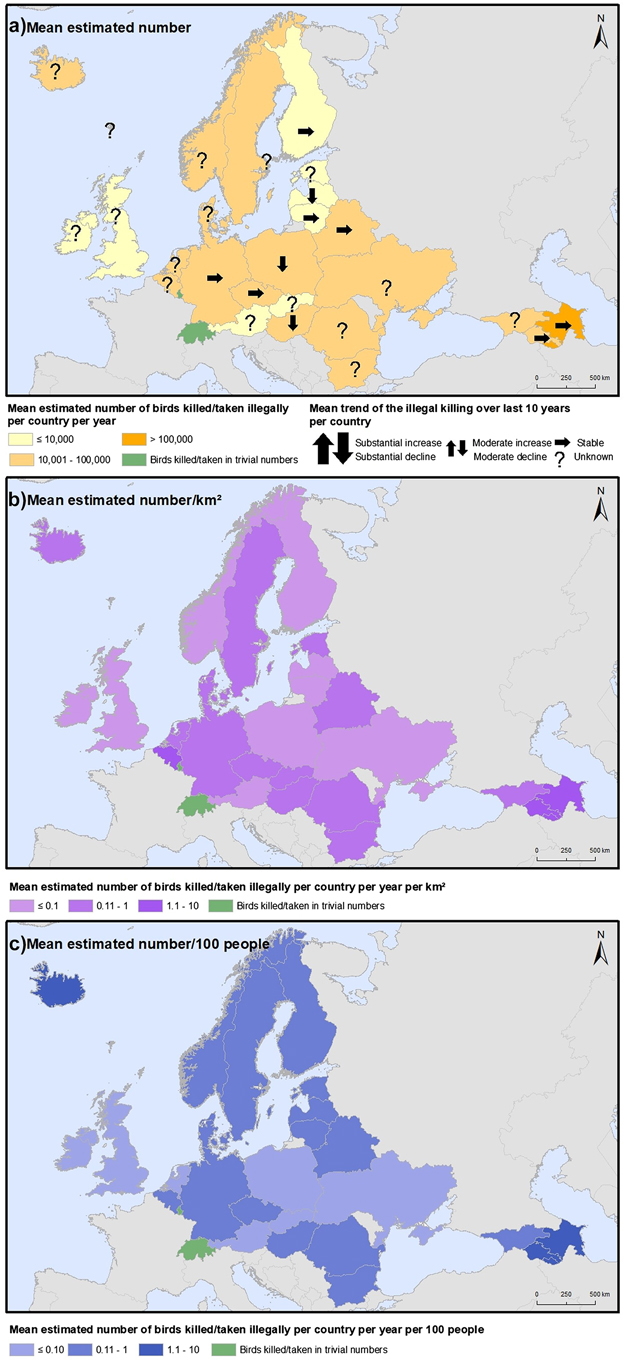
In total, 0.4–2.1 million individual birds were estimated to be illegally killed in N & C Europe and the Caucasus region each year (0.2–1.1 million in Caucasus and 219,000 individual birds illegally killed per country of the sub-region on average; 0.2–0.8 million in Central Europe and 41,900 individual birds illegally killed per country of the sub-region on average; 0.06–0.2 million in Northern Europe and 9,400 individual birds illegally killed per country/territory of the sub-region on average, representing 52%, 36% and 12% respectively of the mean estimated annual regional total of all birds; Table 1). Non-trivial numbers of birds were reported to be killed illegally in all assessed countries/territories, except Liechtenstein, Luxembourg and Switzerland. The highest total numbers of individual birds estimated to be known or likely to be illegally killed per year were reported in Azerbaijan (191,000–997,000), followed by Germany (53,500–146,000) and Romania (22,300–177,000; Table 1, Figure 1a). Expressed as a total per km2 in each country/territory, the potential highest rates per unit area were for Azerbaijan (2.2–11.5 individual birds estimated to be known or likely to be killed illegally/year/km2), Belgium (0.5–3.5) and Armenia (0.8–1.9; Table 1, Figure 1b). Expressed as a total per 100 capita of human population in each country/territory, the potential highest rates per inhabitant were for Iceland (2.2–14.6 individual birds estimated to be known or likely to be killed illegally/year/100 persons), Azerbaijan (2.0–10.2) and Faroe Islands (0.5–5.4; Table 1, Figure 1c). Trends in the scale of illegal killing (averaged across all species reported to be significantly impacted by illegal killing) varied between countries/territories, with seven reporting stable overall trends, three reporting declining overall trends and 16 reporting overall trends as unknown (Table 1, Figure 1a).
Spatial pattern of illegal killing/taking of birds in Northern and Central Europe and Caucasus in terms of the mean estimated number of individual birds illegally killed/taken per year per country a) in absolute values, b) per km2 and c) per 100 people, and the mean estimated trend in illegal killing/taking over the last 10 years. Mean estimated trends (as listed in Table 1) were categorised as: substantial decline (mean < -1.5), moderate decline (-1.5 to -0.5), stable (-0.4 to +0.4), moderate increase (+0.5 to +1.5) or substantial increase (> +1.5).
Species reported to be impacted
Among the 457 native bird species assessed, 303 (66%) were reported to be known or likely to be killed illegally in significant numbers each year (see Methods for definitions). An additional 53 species (12%) were reported to be known or likely to be killed illegally in insignificant numbers. The mean percentage of species reported to be known or likely to be illegally killed in significant numbers at national level was 17% ± 9% (range: 4–39%) and 63% ± 24% (range: 20–95%) when adding species killed illegally in insignificant numbers (Table 1).
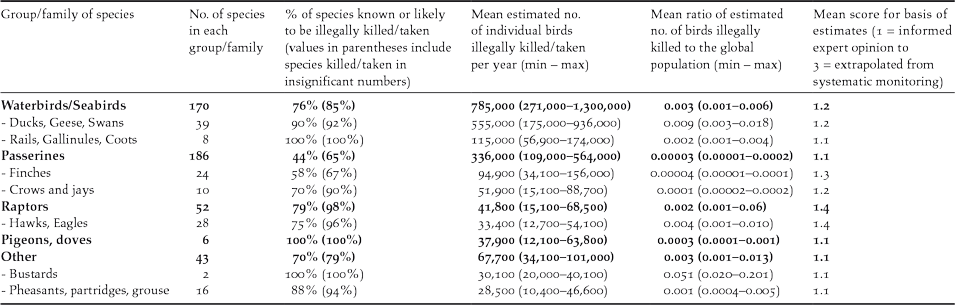
In absolute numbers, the groups most affected by illegal killing were waterbirds/seabirds followed by passerines, compared with raptors and pigeons/doves (Table 2). All the native species of auk, heron, rail/gallinule/coot, pigeon/dove and thrush families regularly present in the region were reported to be affected by illegal killing in significant numbers (only families with more than five species were considered in this analysis; Table 2, Table S1). At the species level, Mallard Anas platyrhynchos and Common Coot Fulica atra each have a mean estimate of > 100,000 individuals illegally killed per year in N & C Europe and Caucasus (Table 3). When only EU MS are considered, Common Starling Sturnus vulgaris and Eurasian Skylark Alauda arvensis have the largest estimated number of individual birds illegally killed per year, with for each a mean annual estimate of > 20,000 individuals illegally killed (Table 3).
Estimated numbers of individual birds illegally killed/taken per year in Northern and Central Europe and Caucasus for passerines, pheasants/partridges/grouse, pigeons/doves, raptors, waterbirds/seabirds, and the most impacted families within these.
The 10 bird species with the largest estimated number of individual birds illegally killed/taken per year in the 29 European countries and in the 19 EU Member States (ranked by mean estimates for N & C Europe and Caucasus, with ranks in square brackets for EU MS). 2016 IUCN Red List category: NT = Near Threatened, VU = Vulnerable.

1 This result is largely driven by an estimate of 20,000-150,000 individuals illegally killed per year in Azerbaijan (79% of the total mean estimate)
2 This result is largely driven by an estimate of 50,000-150,000 individuals illegally killed per year in Azerbaijan (94% of the total mean estimate)
3 This result is largely driven by an estimate of 20,000-120,000 individuals illegally killed per year in Azerbaijan (89% of the total mean estimate)
4 This result is largely driven by an estimate of 20,000-120,000 individuals illegally killed per year in Azerbaijan (89% of the total mean estimate)
5 This result is largely driven by an estimate of 15,000-100,000 individuals illegally killed per year in Azerbaijan (95% of the total mean estimate)
6 This result is largely driven by an estimate of 5,000-50,000 individuals illegally killed per year in Azerbaijan (80% of the total mean estimate)
7 This result is largely driven by an estimate of 5,000-50,000 individuals illegally killed per year in Azerbaijan (82% of the total mean estimate)
8 This result is largely driven by an estimate of 20,000-40,000 individuals illegally killed per year in Azerbaijan (100% of the total mean estimate)
9 This result is largely driven by an estimate of 8,000-16,000 individuals illegally killed per year in Germany (88% of the total mean estimate in the 19 EU MS)
10 This result is largely driven by an estimate of 11,000-22,000 individuals illegally killed per year in Germany (90% of the total mean estimate in the 19 EU MS)
In terms of the impact on global populations, the groups most affected by illegal killing were waterbirds/seabirds, followed by raptors, followed by pigeons/doves and passerines (Table 2). At the species level, Red-crested Pochard Netta rufina (‘Least Concern’ on the global IUCN Red List) may potentially have > 10% of its global population illegally killed each year (Table S2). Of greater concern, among the 20 species with potentially the largest proportion of their global population estimated to be killed illegally per year, eight are globally threatened or ‘Near Threatened’, with Little Bustard Tetrax tetrax (globally ‘Near Threatened’), Lesser White-fronted Goose Anser erythropus (globally ‘Vulnerable’) and White-headed Duck Oxyura leucocephala (globally ‘Endangered’) among those potentially most impacted species (Table 4, Table S2).
The 10 threatened and Near Threatened bird species with potentially the highest ratio between the estimated number of individuals killed/taken illegally per year in the 29 European countries or in the 19 EU Member States and the global/European/EU27 population size (ranked by global ratio, with ranks in square brackets for European/EU ratio). For European/EU analysis, only species with ≥10% of their global distribution within Europe are considered (see Methods). 2016 IUCN Red List category: NT = Near Threatened, VU = Vulnerable, EN = Endangered.

1 This result is largely driven by an estimate of 20,000-40,000 individuals illegally killed/taken per year in Azerbaijan (100% of the total mean estimate)
2 This result is largely driven by an estimate of 500-1,500 individuals illegally killed/taken per year in Azerbaijan (97% of the total mean estimate)
3 This result is largely driven by an estimate of 100-500 individuals illegally killed/taken per year in Azerbaijan (92% of the total mean estimate)
4 This result is largely driven by an estimate of 5,000-50,000 individuals illegally killed/taken per year in Azerbaijan (82% of the total mean estimate) and by an estimate of 2,000-4,000 individuals illegally killed/taken per year in Germany (86% of the total mean estimate for the 19 EU MS)
5 This result is largely driven by an estimate of 100-400 individuals illegally killed/taken per year in Georgia (96% of the total mean estimate)
6 This result is largely driven by an estimate of 170-1,700 individuals illegally killed/taken per year in Germany (82% of the total mean estimate in the 29 European countries and 82% of the total mean estimate for the 19 EU MS)
7 This result is largely driven by an estimate of 20-200 individuals illegally killed/taken per year in Azerbaijan (88% of the total mean estimate)
8 This result is largely driven by an estimate of 1,000-10,000 individuals illegally killed/taken per year in Iceland (86% of the total mean estimate)
9 This result is largely driven by an estimate of 20-100 individuals illegally killed/taken per year in Azerbaijan (89% of the total mean estimate)
10 This result is largely driven by an estimate of 170-960 individuals illegally killed/taken per year in Romania (80% of the total mean estimate for 19 EU MS)
Of greater concern, in relation to the impact on European populations, among the 20 species with potentially the largest proportion of their European population estimated to be killed illegally per year, six are globally threatened or ‘Near Threatened’, with White-headed Duck (globally ‘Endangered’), Pallid Harrier Circus macrourus (globally ‘Near Threatened’), Little Bustard (globally ‘Near Threatened’) and Saker Falcon Falco cherrug (globally ‘Endangered’) among those potentially most impacted species (Table 4, Table S2). We excluded Red-crested Pochard and Lesser White-fronted Goose (min-max ratios of estimated number of individual birds illegally killed/taken to the European population = 0.13–1.26 and 0.56–3.85 respectively, results mainly driven by high estimates reported in Azerbaijan) from Table 4, as the European population estimates are inferred from the breeding population (BirdLife International 2015b) and do not take into account birds breeding outside Europe but wintering in the Caucasus (Scott and Rose Reference Scott and Rose1996, Marchant and Musgrove Reference Marchant and Musgrove2011).
In terms of the impact on EU27 populations, Little Stint Calidris minuta and Pallid Harrier may potentially have > 20% of their EU27 population illegally killed each year (Table S2). Of greater concern, among the 20 species with potentially the largest proportion of their EU27 population estimated to be killed illegally per year, five are globally threatened or Near Threatened, with Pallid Harrier (globally ‘Near Threatened’) and Eastern Imperial Eagle Aquila heliaca (globally ‘Vulnerable’) among those potentially most impacted species (Table 4, Table S2). For the same reason as above, we excluded Red-crested Pochard Lesser White-fronted Goose (min-max ratios of estimated number of individual birds illegally killed/taken to the EU27 population = 0.005–0.01 and 0.004–0.11 respectively, results mainly driven by high estimates reported in Azerbaijan) from Table 4.
Reasons for killing and types of illegality
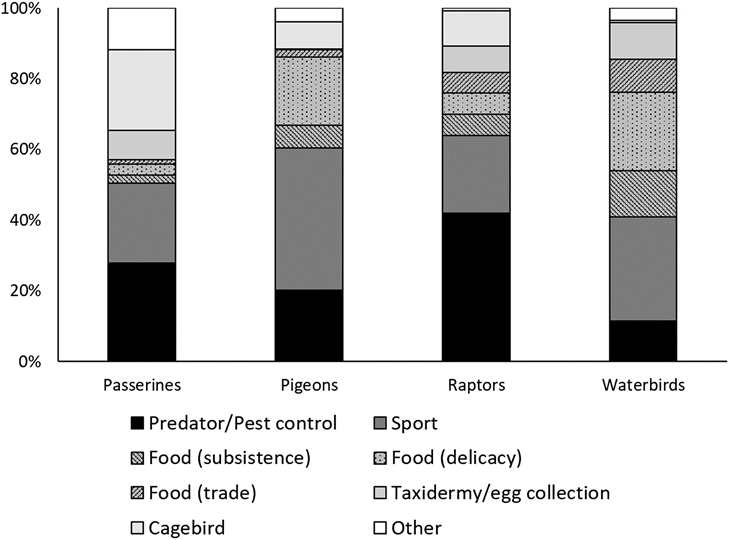
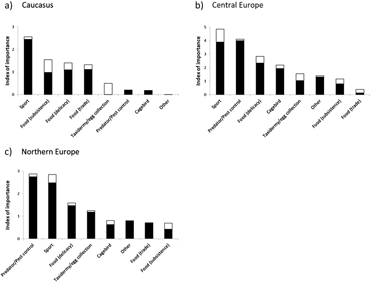
Most of these species (86%) were reported to be killed for multiple reasons. The importance of reasons for killing birds varied across the three sub-regions (Figure 2). Sport had the highest index of importance in the Caucasus sub-region, followed by the three ‘food’ categories (Figure 2a). Sport also had the highest index of importance in the Central Europe sub-region, followed by predator/pest control (Figure 2b), whereas predator/pest control had the highest index of importance in the Northern Europe sub-region, followed by sport (Figure 2c). For both N & C Europe sub-regions, the ‘other’ category had a medium index of importance (Figure 2b and c). Misidentification (48% of the other reasons) was frequently cited in the ‘other’ category of reasons for illegal killing, i.e. when a protected species is shot as a result of confusion with a huntable species. Nuisance (45%) was also frequently cited in the ‘other’ category, for example when people illegally kill birds because of noise and/or dirt or remove nest to minimise disruption of construction work. Superstition (7%) was also reported as a reason for illegal killing, i.e. when particular bird species are believed to be ‘bad luck’ or have other negative belief-based/cultural associations. The importance of reasons for killing birds also varied according to groups of birds, predator/pest control being the most important for passerines and raptors, and sport being the most important reason for pigeons/doves and waterbirds/seabirds (Figure 3).
Index of importance of the potential reasons for illegally killing/taking birds in (a) the Caucasus, (b) Central Europe, and (c) Northern Europe. Solid bars indicate the primary reasons, open bars indicate secondary reasons (see Methods for details).

Proportion of each reason category in terms of index of importance (primary and secondary reasons combined) for each bird group: passerines, pigeons/doves (pigeons), raptors, waterbirds/seabirds (waterbirds).
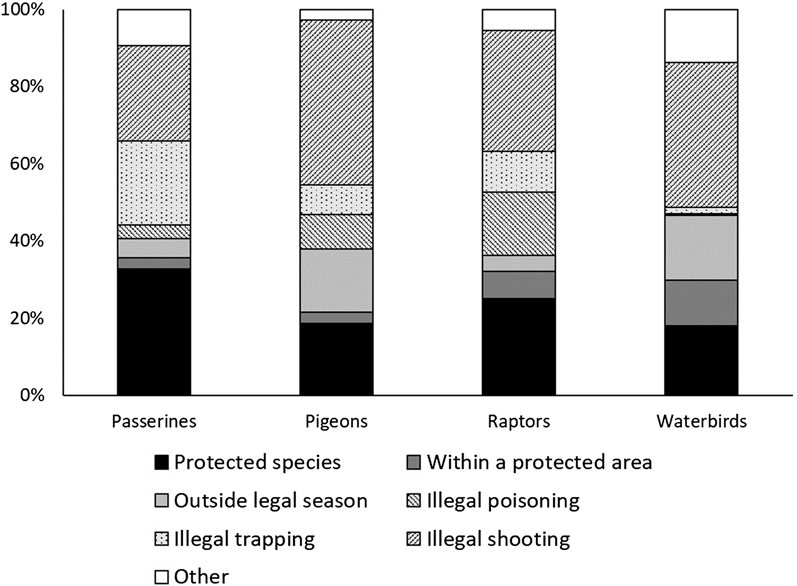
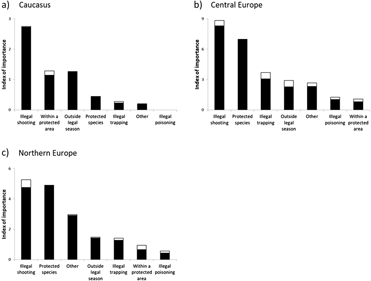
Most species (91%) were reported to be killed under several different types of illegality. Among the types of illegal methods documented, illegal shooting had the highest index of importance in each sub-region (Figure 4). Among the other types of illegalities documented, killing protected species also had a high index of importance in both N & C Europe (Figure 4b and c). For both N & C Europe sub-regions, the ‘other’ category had a high and medium index of importance respectively (Figure 4b and c). ‘Other’ types mentioned included: nest destruction (42% of other types), egg/chick collection from nest (29%), illegal method (e.g. electronic device, lure, from boat, etc., 17%); without land owner authorisation (8%), beyond quota (2%) and indirect poisoning (2%). The importance of the different types of illegalities also varied according to groups of birds, the highest index of importance was for killing protected species for passerines and for illegal shooting for all other groups of birds (Figure 5).
Index of importance of the potential types of illegality in (a) Caucasus, (b) Central Europe, and (c) Northern Europe. Solid bars indicate the primary reasons, open bars indicate secondary types (see methods for details).

Proportion of each type category in terms of index of importance (primary and secondary types combined) for each bird group: passerines, pigeons/doves (pigeons), raptors, waterbirds/seabirds (waterbirds).
Persecution of raptors
Raptors were the group with the highest percentage of species affected by illegal killing (only groups with more than 10 species were considered in this analysis; Table 2). All 52 raptor species regularly present in the region (except one, Black-winged Kite Elanus caeruleus occurring regularly in Armenia only within the study area) were reported to be affected by illegal killing. In total, 15,100–68,500 individual raptors were estimated to be illegally killed in N & C Europe and Caucasus each year (6,500–21,400 in Caucasus, 7,500–40,500 in Central Europe and 1,000–6,600 in Northern Europe). Among raptors, the potentially highest total numbers of individual birds estimated to be known or likely to be illegally killed per year were reported in Georgia (Figure S1, Table S3). Trends in the scale of illegal killing, averaged across all raptor species reported to be affected in significant numbers, varied across countries/territories, with overall trend reported to be stable in six countries/territories, declining in four and unknown in 16 (Figure S1, Table S3).
In absolute numbers, Eurasian Buzzard Buteo buteo was reported to be illegally killed in the highest numbers (mean estimate of > 10,000 individuals illegally killed per year), followed by European Honey-buzzard Pernis apivorus (> 5,000 individuals per year; Table S1). In terms of the impact on global populations, Pallid Harrier, White-tailed Sea-eagle Haliaeetus albicilla, Red Kite, Levant Sparrowhawk Accipiter brevipes and European Honey-buzzard may potentially have > 1% of their global population illegally killed each year in N & C Europe and the Caucasus region (Table 4, Table S1). This is of particular concern for Pallid Harrier and Red Kite which are globally ‘Near Threatened’. In terms of the impact on European populations, Pallid Harrier may have potentially > 10% of its European population illegally killed each year (Table 4). In terms of the impact on EU27 populations, Pallid Harrier may have potentially > 20% of its EU27 population illegally killed each year (Table 4).
Worst locations reported for illegal killing of birds
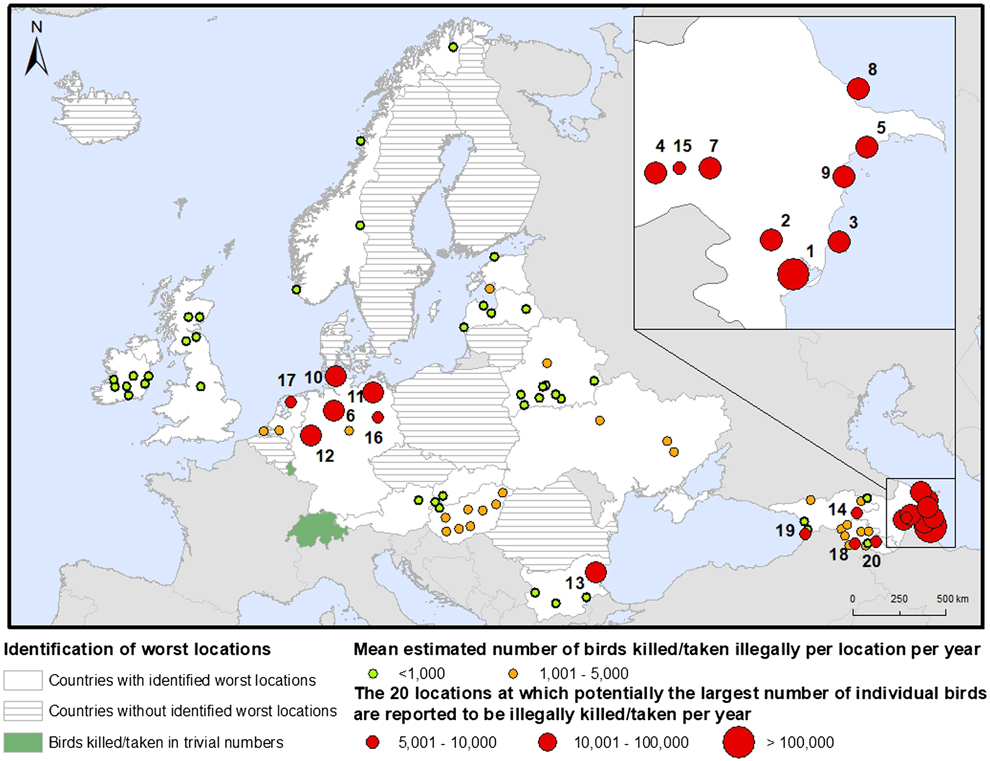
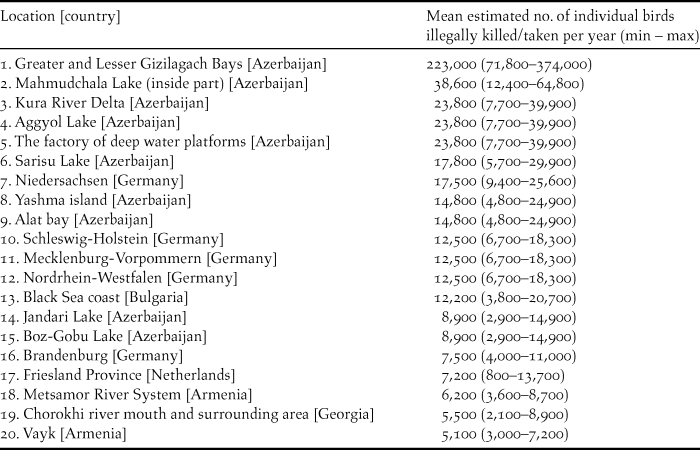
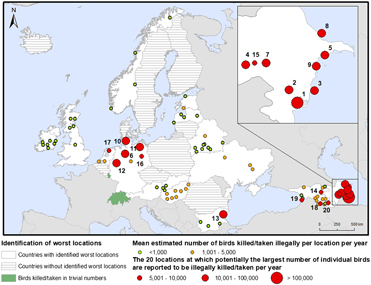
Ten countries/territories did not identify any worst locations for illegal killing of birds because of a lack of information/knowledge (Denmark, Faroe Islands, Iceland and Romania) or because illegal practices were reported to be widespread and non-localised within the country (Belgium, Czechia, Finland, Lithuania, Poland and Sweden). Among the 85 potential worst locations for illegal killing identified across the region by national experts (Figure 6), > 200,000 individual birds were estimated to be illegally killed on average each year at just one: Greater and Lesser Gizilagach Bays (Azerbaijan), representing 18% of the mean estimated annual total number of birds illegally killed across the region and for all species combined (Table 5). At all other worst locations identified, < 50,000 individual birds were estimated to be illegally killed on average each year (Table S4). The 20 identified worst locations with the highest numbers of individual birds likely to be illegally killed were located in six countries: Armenia, Azerbaijan, Bulgaria, Georgia, Germany and the Netherlands. Azerbaijan accounted however for 10 of the 20 worst locations and the Caucasus region as a whole for 13 of the 20 worst locations. Those worst locations identified in the Caucasus were small sites compared to administrative regions in Germany and Netherlands, and coastline in Bulgaria (Table 5). In these 20 worst locations, 175,000–818,000 individual birds were estimated to be illegally killed per year, representing 39% of the mean estimated annual regional total number of birds illegally killed for all species combined (Table 5, Figure 6).
The potential worst locations where large number of individual birds are reported to be illegally killed/taken per year in Northern and Central Europe and Caucasus. Numbers match those in Table 5.
The 20 locations at which the largest estimated numbers of individual birds are killed/taken illegally each year in Northern and Central Europe and Caucasus. Location numbers correspond to those in Figure 6.
Discussion
Controlling illegal killing and taking of birds is a complex issue, even in a region where legal protection of birds is considered strong (Stroud Reference Stroud, Thompson, Redpath, Fielding, Marquiss and Galbraith2003). Understanding the scale and importance of illegal activities can be challenging, as by definition the detected cases may only be the ‘tip of the iceberg’ and the proportion of the total that detected cases represents is often unknown (BirdLife International 2015c); birds killed can be very rapidly removed or concealed by perpetrators or taken by scavengers (Pain Reference Pain1991). A recent study revealed that as many as 41 (31%) of 131 Golden Eagles Aquila chrysaetos fitted with satellite tags in Scotland between 2004 and 2016 abruptly stopped transmitting in areas intensively managed for shooting of Red Grouse Lagopus lagopus scotica and with historically high levels of raptor persecution, strongly suggesting that they had been illegally killed (Whitfield and Fielding Reference Whitfield and Fielding2017). However, none of these 41 birds were found again, despite intensive on-the-ground searches. For less high-profile species subject to less intensive monitoring one would expect that the likelihood of discovering evidence of illegal killing is even lower. Making estimates of the scale and scope of illegal killing based on a variety of sources of available quantitative and qualitative information is therefore an essential step, with increased monitoring effort required to gradually improve these estimates over time.
Despite it having long been recognised as a conservation issue, our review is the first analysis providing detailed quantitative estimates of the scope and scale of illegal killing and taking of birds in N & C Europe and the Caucasus. Very little monitoring of the issue is currently under way, so there was uncertainty associated with some of the estimates. The quality of the data gathered varied, and while quantitative data underpinned some estimates, others were based on expert opinion informed by limited underlying data. Global/European/EU27 population data used to indicate the relative impact of illegal killing and taking on different species also had a broad range, reflecting uncertainty. The ranking of species presented here is therefore more informative than the absolute values. The figures presented in this paper should be considered as current best estimates that should be further refined through future work including more systematic monitoring of the issue.
Scale and scope of illegal killing and taking of birds in the N & C Europe and Caucasus
Illegal killing and taking of birds was reported to be widespread: 66% of bird species regularly present in at least one assessed country/territory were reported to be illegally killed or taken in significant numbers (as defined under Methods), and 0.4–2.1 million individual birds were estimated to be illegally killed or taken in N & C Europe and the Caucasus each year. Our data also indicated that the numbers of birds killed or taken illegally may have remained stable over the last decade in seven countries, and declined in only three. Of greater concern, trends were unknown in more than half of the countries/territories assessed (16; Figure 1a), owing to a lack of quantitative or qualitative information on the issue.
Our data also showed that the Caucasus has regionally high levels of illegal killing and taking of birds, with 0.7 million individuals illegally killed or taken on average per year there, representing 52% of the mean estimated annual regional total number of birds illegally killed or taken across all species, despite covering just 4% of the total surface area assessed. Out of the 20 worst locations identified, 13 were located in the Caucasus (Table 5, Figure 6). ‘Greater and Lesser Gizilagach Bays’ (Azerbaijan) was identified as the worst location with the highest mean estimated number of birds illegally killed/taken per year. This large location overlaps the ‘Gizilagach State Nature Reserve’, and is a Ramsar site as well as an Important Bird and Biodiversity Area (IBA). It has been identified as one of the most important Critical Sites for waterbirds in Africa-Eurasia, being internationally important for at least 49 waterbird populations including a number of globally threatened species (WOW 2011). Tackling illegal killing and taking at this location is therefore paramount to maintaining healthy waterbird populations in the region. In addition, the importance of the illegal killing and taking in the Caucasus has also been noted in the grey literature. Foster-Turley and Sultanov (Reference Foster-Turley and Sultanov2010) reported poaching to be a major threat for biodiversity in Azerbaijan, stating that migratory and resident birds, particularly waterfowl, are widely and illegally harvested throughout the country (providing food for villagers) and also seen for sale along roads through some districts. Illegal killing of birds in Azerbaijan results from a variety of violations of hunting legislation, including killing within protected areas, outside the legal season for game species (hunting is only allowed on weekends during open season), and in excess of the legal quotas (E. Sultanov, pers. comm.). Jansen (Reference Jansen2012) also reported illegal shooting of all raptor species as common practice in Batumi region (Georgia), a bottleneck site of international importance for migrating raptors. A recent report mentioned there may be some trapping of Peregrine Falcon Falco peregrinus in Armenia and that their export could be facilitated by fake permits (Mkrtchyan et al. Reference Mkrtchyan, Karapetyan and Goldthorpe2016).
Regarding the impact of illegal killing and taking on bird populations, the two species for which the largest numbers of individuals were reported to be killed illegally, Mallard and Common Coot (Table 3) are both listed as globally ‘Least Concern’ on the IUCN Red List (BirdLife International 2017b), although the latter is declining in Europe and assessed as ‘Near Threatened’ at European level (BirdLife International 2015b). Of greater concern are the 17 globally threatened or ‘Near Threatened’ species with the highest ratios of estimated numbers of individuals killed illegally per year relative to their global, European or EU27 population size (Table 4). Most of these are the subject of recent international Action Plans under one or several policy instruments (EC, CMS, AEWA, Raptors MOU, Bern Convention), which aim to improve their conservation status (Table 4). All these Action Plans recorded illegal shooting, illegal trapping, illegal poisoning and/or illegal egg collecting as a threat of low, medium or high importance according to the species. Most of these species are impacted by other threats alongside illegal killing and taking, such habitat loss/degradation, climate change, collision with powerlines, competition with alien species, etc. and the cumulative impact of all these threats throughout the flyway can be severe.
Drivers of illegal killing and taking of birds in N & C Europe and the Caucasus
Our assessment indicated that motivations for illegal killing and taking varied within the region. Food was however reported as of medium importance in all three sub-regions, with the difference that birds were illegally killed for subsistence, delicacy and trade on a similar level in the Caucasus, whereas they were mainly killed to be consumed as a delicacy in N & C Europe (Figure 2). Foster-Turley and Sultanov (Reference Foster-Turley and Sultanov2010) reported that people openly sold skinned wild ducks, coots and other illegally shot bird species, described as ‘chickens’, ‘domestic ducks’ or ‘geese’, along roads bordering strict nature reserves encompassing wetlands in Azerbaijan.
Illegal killing and taking for food, sport or through misidentification was reported to affect a large number of waterbirds/seabirds (Figure 3, Table S1). Most of the waterbird/seabird species assessed (139 out of 170; 82%) are globally ‘Least Concern’ on the IUCN Red List, but illegal killing and taking may drive populations to extinction locally. For example, illegal killing alongside legal waterfowl hunting is reported to have led to a rapid decline of the Common Crane Grus grus in Armenia (Ilyashenko et al. Reference Ilyashenko, Ghasabyan, Markin, Ilyashenko, Kovshar and Winter2008). Misidentification of protected species as legally huntable species may have been underestimated in this assessment, except in Germany, owing to lack of data on this issue, although misidentification was reported as a reason for illegal killing of waterbirds/seabirds in Belarus, Czechia, Denmark, Estonia, Faroe Islands, Latvia, Norway and Sweden. In Germany, only nine out of 20 duck species regularly present are huntable, eight of these have shorter open seasons than Mallard, the main target huntable species, and many of these are not huntable in every region. A study conducted by hunters in Baden-Württemberg region has shown that about 17% of all ducks killed were actually protected species shot because they had been confused with huntable species (L. Lachmann, pers. comm.). A similar percentage (16% on average) was found by Mikuška et al. (Reference Mikuška, Horvat, Tomik, Mikuška, Sackl and Ferger2017) who have inspected hunting bags during the 2008–2012 hunting seasons on two fishponds in Pannonian Croatia. The misidentification issue should be more intensively monitored to be included in any future assessments of illegal killing and taking.
Illegal killing for food and/or sport was also reported for other bird groups, such as pheasant/partridge/grouse and pigeon/dove families (Figure 3, Table S1). Impacts of illegal killing have already been noted for some of these species, e.g. Mikoláš et al. (Reference Mikoláš, Svitok, Tejkal, Leitão, Morrissey, Svoboda, Svoboda, Seedre and Fontaine2015) reported that illegal hunting may have serious effects on Western Capercaillie Tetrao urogallus populations in Romania. Hunting is practiced in Europe not only by resident hunters, but also by hunters travelling from abroad. As many as 20–30% of European hunters (from the EU as well as Norway and Switzerland) may travel outside their home country for hunting. Germany, Austria, Denmark, the Benelux countries, Italy, and Spain are the main European demand countries. The most popular destination countries are Hungary, Poland and other Eastern European countries (Hofer Reference Hofer2002). Some cases illustrate that sport hunting tourism may be part of or result in illegal killing and smuggling. For example, in 2003, an Italian court determined that two hunting tourism firms had facilitated the smuggling into Italy of over two million birds (songbirds mainly), shot in Serbia, over six years (Rocco and Isotti Reference Rocco and Isotti2006). Illegal killing of songbirds for consumption as a delicacy in restaurants is an issue of serious conservation concern. In this review, 1,700–25,000 Eurasian Skylarks were estimated to be illegally killed in Romania; hunting of this species is not traditional in Romania, and the species is killed illegally in Romania only by foreign hunters (D. Damoc, pers. comm.).
Our data also showed that raptors appear to remain under threat in N & C Europe, with ‘predator control’ being the most important reason given for illegal killing and taking of raptors (Figures 2 and 3, Table S1). Eurasian Buzzard and Northern Goshawk were among the raptor species most frequently illegally killed or taken; both are globally ‘Least Concern’ (Table S1), although populations of both are decreasing in Europe/EU27 (BirdLife International 2015b). Red Kite (globally ‘Near Threatened’) had potentially a high ratio of its European/EU27 population impacted (Table 4). Raptor species comprise a significant proportion of the rarest European bird species (BirdLife International 2015b). Their small populations are a consequence of naturally low population densities of these top predators, but also a result of widespread persecution, and adverse consequences of land-use changes (Stroud Reference Stroud, Thompson, Redpath, Fielding, Marquiss and Galbraith2003). In spite of evidence that deliberate illegal killing of raptors in Europe has dramatically declined over recent decades following legal protection (Newton Reference Newton, Chancellor and Meyburg2000, Mañosa Reference Mañosa2002), raptors are still deliberately illegally killed for various reasons in some areas, e.g. in Austria (Wichmann Reference Wichmann2011), Ireland (O’Donoghue Reference O’Donoghue2015), Netherlands (Bijlsma and van Tulden Reference Bijlsma and van Tulden2016), England (Fielding et al. Reference Fielding, Haworth, Whitfield, McLeod and Riley2011, Amar et al. Reference Amar, Court, Davison, Downing, Grimshaw, Pickford and Raw2012) and Scotland (Sansom et al. Reference Sansom, Etheridge, Smart and Roos2016, Whitfield and Fielding Reference Whitfield and Fielding2017). Many raptor populations are currently secure and show increasing trends in Europe (BirdLife International 2015b), indicating that illegal killing may not be impacting at the population level in these cases; others are declining and may be vulnerable even to low levels of illegal killing. For example, illegal persecution has been identified as a factor affecting the distribution, abundance and productivity of Hen Harriers in the United Kingdom (Redpath et al. Reference Redpath, Amar, Smith, Thompson, Thirgood and Thompson2010, Rebecca et al. Reference Rebecca, Cosnette, Craib, Duncan, Etheridge, Francis, Hardy, Pout and Steele2016). In southern Norway, Selås et al. (Reference Selås, Kleven and Steen2017) reported a higher turnover rate of breeding Northern Goshawk females in a county where hunters have long shown antipathy to Goshawks compared to another county with a lower level of illegal persecution. A high annual turnover rate of breeding Eastern Imperial Eagles in Hungary has been attributed to high mortality, most likely from poisoning and electrocution (Vili et al. Reference Vili, Szabó, Kovács, Kabai, Kalmár and Horváth2013). Recently reintroduced raptor populations can also be severely impacted by persecution, e.g. White-tailed Sea-eagle in Ireland (O’Rourke Reference O’Rourke2014). However, in the absence of the limiting factors that caused the initial decline (i.e. human persecution), raptors can be adaptable and capable of growing to a substantial population, e.g. Red Kite in the UK (Murn and Hunt Reference Murn, Hunt, Zuberogoitia and Martínez2011). Decades of persecution of Red Kite resulted in its extirpation from parts of its former range and considerable investment has been made in conservation action including successful reintroduction in Ireland and the United Kingdom (Evans et al. Reference Evans, Summers, O’Toole, Orr-Ewing, Evans, Snell and Smith1999, Mee Reference Mee2012). The growth of the reintroduced UK Red Kite population has been impressive, resulting in the re-establishment of nearly 2,200 breeding pairs (Holling et al. Reference Holling2012).
Our data suggested that illegal trade of cage-birds may not be a large issue in N & C Europe and the Caucasus, although there may still be a small market for wild-taken birds in some countries in N & C Europe (Figures 2 and 3). Our review provided information on live capture, but we were unable to collect data on trade explicitly. Further research is needed to survey illegal trade and assess the species and numbers of individuals affected, countries of origin, numbers held in captivity in different countries, market values, etc.
Taxidermy and egg collection were also reported as an issue of medium importance in N & C Europe (Figure 2). This is in spite of evidence that illegal egg collection has declined in Europe over recent decades following legal protection, e.g. the number of egg collecting incidents reported has reduced significantly in the UK since the early 1990s and particularly since 2000 (RSPB 2014). Collectors may still have a severe impact on populations of birds, including driving some species to local extinction. Illegal egg collection is still currently considered as a threat for Common Eider Somateria mollissima (globally ‘Near Threatened’), Terek Sandpiper Xenus cinereus and Caspian Tern Hydroprogne caspia in the Red List of Baltic Breeding Birds, in which these three species are classified as regionally threatened (HELCOM 2012).
A complex issue widespread across the whole of Europe
Considering the whole of Europe, by combining our results with those of Brochet et al. (Reference Brochet, Van Den Bossche, Jbour, Ndang’ang’a, Jones, Abdou, Al-Hmoud, Asswad, Atienza, Atrash, Barbara, Bensusan, Bino, Celada, Cherkaoui, Costa, Deceuninck, Etayeb, Feltrup-Azafzaf, Figelj, Gustin, Kmecl, Kocevski, Korbeti, Kotrošan, Mula Laguna, Lattuada, Leitão, Lopes, López-Jiménez, Lucić, Micol, Moali, Perlman, Piludu, Portolou, Putilin, Quaintenne, Ramadan-Jaradi, Ružić, Sandor, Sarajli, Saveljić, Sheldon, Shialis, Tsiopelas, Vargas, Thompson, Brunner, Grimmett and Butchart2016), our data showed that illegal killing and taking may be of lower importance in N & C Europe and the Caucasus (0.3 vs 2.7 mean estimated number of individual birds illegally killed/taken per year per km2; Table 1, Figure S2; Brochet et al. Reference Brochet, Van Den Bossche, Jbour, Ndang’ang’a, Jones, Abdou, Al-Hmoud, Asswad, Atienza, Atrash, Barbara, Bensusan, Bino, Celada, Cherkaoui, Costa, Deceuninck, Etayeb, Feltrup-Azafzaf, Figelj, Gustin, Kmecl, Kocevski, Korbeti, Kotrošan, Mula Laguna, Lattuada, Leitão, Lopes, López-Jiménez, Lucić, Micol, Moali, Perlman, Piludu, Portolou, Putilin, Quaintenne, Ramadan-Jaradi, Ružić, Sandor, Sarajli, Saveljić, Sheldon, Shialis, Tsiopelas, Vargas, Thompson, Brunner, Grimmett and Butchart2016), but may still result in the death or removal from the wild of millions of birds every year in Europe, including species subject conservation measures, such as European Turtle-dove and Common Pochard (mean estimate of > 100,000 and > 50,000 individuals illegally killed/taken per year respectively, Table S1). Migratory bird species that move through the European continent may be at increased risk. These species may be vulnerable to this and other threats at several different stages of their annual cycle and the potential cumulative take throughout their flyway may be very high for some species. The motivations for illegal killing and taking differed between regions: food, sport and cage-birds in Mediterranean Europe (Brochet et al. Reference Brochet, Van Den Bossche, Jbour, Ndang’ang’a, Jones, Abdou, Al-Hmoud, Asswad, Atienza, Atrash, Barbara, Bensusan, Bino, Celada, Cherkaoui, Costa, Deceuninck, Etayeb, Feltrup-Azafzaf, Figelj, Gustin, Kmecl, Kocevski, Korbeti, Kotrošan, Mula Laguna, Lattuada, Leitão, Lopes, López-Jiménez, Lucić, Micol, Moali, Perlman, Piludu, Portolou, Putilin, Quaintenne, Ramadan-Jaradi, Ružić, Sandor, Sarajli, Saveljić, Sheldon, Shialis, Tsiopelas, Vargas, Thompson, Brunner, Grimmett and Butchart2016), sport and food in the Caucasus, and sport and predator control in N & C Europe (Figure 2). An understanding of the motivation for illegal killing and taking of birds is key to determining appropriate local, national and international responses to the issue. Socio-economic studies can be helpful in shaping effective conservation action and should be considered as a component of any national plan of action on illegal killing and taking of birds (e.g. Elhalawani Reference Elhalawani2016).
Large numbers of birds are also legally hunted in Europe, e.g. over 2 million ducks in France (Guillemain et al. Reference Guillemain, Aubry, Folliot and Cazeirgues2016), over 1 million in the UK (PACEC 2014), over 500,000 ducks in Denmark (Asferg Reference Asferg2015), and over 350,000 ducks in Germany (DJV 2017). Most countries are now collecting hunting bag statistics. However, data are still neither collected in a standardised way nor necessarily at the same frequency in the different countries (Guillemain et al. Reference Guillemain, Aubry, Folliot and Cazeirgues2016) and reporting is patchy. For species where the whole population passes through many countries on migration and may be subject to mortality through illegal killing and legal hunting in each country, the assessment of cumulative mortality may be particularly important. Knowledge of the magnitude of illegal and legal take is therefore a prerequisite for assessing the sustainability of exploitation of birds (Brochet et al. Reference Brochet, Van Den Bossche, Jbour, Ndang’ang’a, Jones, Abdou, Al-Hmoud, Asswad, Atienza, Atrash, Barbara, Bensusan, Bino, Celada, Cherkaoui, Costa, Deceuninck, Etayeb, Feltrup-Azafzaf, Figelj, Gustin, Kmecl, Kocevski, Korbeti, Kotrošan, Mula Laguna, Lattuada, Leitão, Lopes, López-Jiménez, Lucić, Micol, Moali, Perlman, Piludu, Portolou, Putilin, Quaintenne, Ramadan-Jaradi, Ružić, Sandor, Sarajli, Saveljić, Sheldon, Shialis, Tsiopelas, Vargas, Thompson, Brunner, Grimmett and Butchart2016).
Implementing legislation and strengthening monitoring
All the 28 countries assessed are Parties to the Bern Convention and 19 are EU MS. As signatories of these treaties, these countries have to provide strong national provisions for the conservation of birds and are required to transpose international obligations into national legislation. Our data however showed that as in the Mediterranean European countries (see Brochet et al. Reference Brochet, Van Den Bossche, Jbour, Ndang’ang’a, Jones, Abdou, Al-Hmoud, Asswad, Atienza, Atrash, Barbara, Bensusan, Bino, Celada, Cherkaoui, Costa, Deceuninck, Etayeb, Feltrup-Azafzaf, Figelj, Gustin, Kmecl, Kocevski, Korbeti, Kotrošan, Mula Laguna, Lattuada, Leitão, Lopes, López-Jiménez, Lucić, Micol, Moali, Perlman, Piludu, Portolou, Putilin, Quaintenne, Ramadan-Jaradi, Ružić, Sandor, Sarajli, Saveljić, Sheldon, Shialis, Tsiopelas, Vargas, Thompson, Brunner, Grimmett and Butchart2016), illegal killing and taking is still occurring in N & C Europe and the Caucasus in spite of national legislation and international obligations. As with other international environmental policy instruments, the effectiveness of implementation by signatories is a fundamental and important issue (Victor et al. Reference Victor, Rausiala and Skolnikoff1998). According to Stroud (Reference Stroud, Thompson, Redpath, Fielding, Marquiss and Galbraith2003) and European Commission (2017), major issues that influence the effectiveness of the Bern Convention and the EU Birds Directive are inadequate enforcement measures and inadequate environmental education and public awareness programmes. As with any laws, environmental legislation needs to have broad public consent to be effective. In those cases where individuals deliberately persist in breaking the law, then effective enforcement is needed, with appropriate deterrent penalties. Despite the many positive impacts of such international policy instruments (e.g. EU Birds Directive on bird populations; Donald et al. Reference Donald, Sanderson, Burfield, Bierman, Gregory and Waliczky2007), efforts are clearly needed to ensure that legislation is fully enforced on the ground. Newth et al. (Reference Newth, Brown and Rees2011), for example, identified high levels of illegal shooting of Whooper Swan Cygnus cygnus and Bewick’s Swan Cygnus columbianus bewickii, by taking X-rays of live-caught birds showing they were carrying embedded shotgun pellets; both species have been protected by national and international legislation throughout their migratory ranges since the mid-20th century.
As reported by Brochet et al. (Reference Brochet, Van Den Bossche, Jbour, Ndang’ang’a, Jones, Abdou, Al-Hmoud, Asswad, Atienza, Atrash, Barbara, Bensusan, Bino, Celada, Cherkaoui, Costa, Deceuninck, Etayeb, Feltrup-Azafzaf, Figelj, Gustin, Kmecl, Kocevski, Korbeti, Kotrošan, Mula Laguna, Lattuada, Leitão, Lopes, López-Jiménez, Lucić, Micol, Moali, Perlman, Piludu, Portolou, Putilin, Quaintenne, Ramadan-Jaradi, Ružić, Sandor, Sarajli, Saveljić, Sheldon, Shialis, Tsiopelas, Vargas, Thompson, Brunner, Grimmett and Butchart2016), our study also highlighted the paucity of data on illegal killing and taking of birds. There appears to be even less monitoring in N & C Europe and the Caucasus region (no high score for the ‘basis of estimates’, Table 1) than in European Mediterranean countries, with no country apparently implementing national systematic monitoring schemes which can generate reliable quantitative national-scale estimates of the number of birds killed/taken per species per year (BirdLife International 2015c). In Cyprus, an ongoing systematic monitoring scheme for illegal bird trapping produces annual national estimates of the number of birds illegally trapped per year and identified trends in the illegal activity over time (Shialis Reference Shialis2017). Many national and local stakeholders do, however, show a strong commitment to survey aspects of this issue (e.g. for particular species such as raptors and waterbirds) and/or collect some relevant data on confirmed incidents of illegal killing and taking of birds (e.g. in Belgium, Estonia, Georgia, Germany, Hungary, Ireland, Netherlands, Poland and the UK). However, such data tend to be derived from ad hoc reporting and/or detection, and therefore typically underestimate totals and may not allow robust assessment of temporal trends. This lack of systematic monitoring is likely to result in underestimation of the scope and scale of illegal killing and taking of birds in some countries in this study. This need for monitoring is also flagged by the high percentage (69%) of countries where the trend in the scale of illegal killing and taking of birds over the last 10 years was unknown (Table 1, Figure 1a). It is therefore a priority to implement systematic monitoring of illegal killing and taking of birds, allowing stakeholders to track trends, target actions and monitor the effectiveness of responses (BirdLife International 2015c). There has been recent agreement under the CMS Intergovernmental Task Force on Illegal Killing, Taking and Trade of Migratory Birds in the Mediterranean and the Bern Convention Network of Special Focal Points on Eradication of Illegal Killing, Trapping and Trade in Wild Birds to move towards adoption of a ‘scoreboard’ approach to assessing national and regional progress in tackling this issue. This welcome development may encourage improved monitoring of the issue, as well as focus attention on effective action by government in many of the countries/territories of N & C Europe, Caucasus and the Mediterranean.
Conclusion
Despite efforts by many governments, illegal killing and taking of birds is still a serious pan-European problem. The current review focused geographically on N & C Europe and the Caucasus (see BirdLife International 2017a for details presented per country). Combining these results with those from the Mediterranean assessment (Brochet et al. Reference Brochet, Van Den Bossche, Jbour, Ndang’ang’a, Jones, Abdou, Al-Hmoud, Asswad, Atienza, Atrash, Barbara, Bensusan, Bino, Celada, Cherkaoui, Costa, Deceuninck, Etayeb, Feltrup-Azafzaf, Figelj, Gustin, Kmecl, Kocevski, Korbeti, Kotrošan, Mula Laguna, Lattuada, Leitão, Lopes, López-Jiménez, Lucić, Micol, Moali, Perlman, Piludu, Portolou, Putilin, Quaintenne, Ramadan-Jaradi, Ružić, Sandor, Sarajli, Saveljić, Sheldon, Shialis, Tsiopelas, Vargas, Thompson, Brunner, Grimmett and Butchart2016) provides a broader picture for the northern part of the African-Eurasian flyway. Building on these experiences, similar data are now needed for other regions of the flyway to provide a complete picture, as illegal killing and taking of birds is also a problem in sub-Saharan Africa (e.g. illegal poisoning of vultures; Ogada Reference Ogada2014), the Arabian Peninsula (e.g. illegal bird trade; Aloufi and Eid Reference Aloufi and Eid2014) and Russia (e.g. illegal shooting of geese; Holm and Madsen Reference Holm and Madsen2013). In addition, similar data are also needed for other flyways where there are indications that illegal killing and taking is also an issue, e.g. illegal trapping of songbirds in Asia (Kamp et al. Reference Kamp, Oppel, Ananin, Durnev, Gashev, Hölzel, Mishchenko, Pessa, Smirenski, Strelnikov, Timonen, Wolanska and Chan2015), illegal shooting of raptors in North America (Finkelstein et al. Reference Finkelstein, Kuspa, Welch, Eng, Clark, Burnett and Smith2014) and illegal capture for the bird trade in South America (Alves et al. Reference Alves, Lima and Araujo2013).
A greater understanding of the characteristics, attitudes and motivations of the groups of people undertaking each illegal activity in each region may help with tailoring appropriate interventions to specific activities and target groups (Fairbrass et al. Reference Fairbrass, Nuno, Bunnefeld and Milner-Gulland2016). National governments undoubtedly have a key role to play in recognising and tackling illegal killing and taking of birds within their borders (and indeed by their citizens outside the country). However, in most countries there will be multiple stakeholders who, additionally, can work successfully together to address the shared problem of illegal killing and taking. Harnessing their expertise to produce and implement a national multi-stakeholder action plan to tackle illegal killing and taking may be an effective approach, e.g. the Italian Action Plan against illegal killing of birds (ISPRA 2017), developed after the Mediterranean assessment. Local, national and international action may be needed to effectively address illegal killing and taking of birds. There are important roles in both developing and implementing any national plan of action for a wide array of actors, such as law enforcement agencies, the judiciary, national government agencies, hunting groups, NGOs, international policy instruments and local communities. The full commitment of all concerned will be essential if this intractable problem is to be effectively resolved.
Supplementary Material
To view supplementary material for this article, please visit https://doi.org/10.1017/S0959270917000533
Acknowledgements
We are grateful to data contributors who provided valuable national information on illegal killing and taking of birds, to the organisations that supported their work on this issue and to the external experts who helped to review the national data; a full list is given in the supplementary material. Thanks to Ariel Brunner, Ian Burfield, Nicola Crockford, Wouter Langhout, Iva Obretenova, David Stroud and Des Thompson for useful advice and comments on previous version of this paper. This review was partly funded by an anonymous donor to BirdLife International.






 Open access

