


Both the Mental Health Act 1983 and the Children Act 1989 can be used to compulsorily detain a child or adolescent exhibiting mental health problems. Various Sections of the Mental Health Act can be used, including Section 2 (admission for assessment) and Section 3 (admission for treatment). Section 25 of the Children Act can be used to detain a young person, but only if he or she fulfils certain specific criteria: a) if the child has a history of absconding and is likely to abscond from any other accommodation and is likely to be a risk to himself/herself if he/she absconds; or b) if he/she is kept in any other accommodation he/she is likely to injure himself/herself or others. The Children Act can also be used to give a local authority parental responsibility for the child, and thus the power to consent for admission and treatment. There are no definitive guidelines as to which Act should be used under what circumstances, although the issue has been considered in the NHS Health Advisory Service report (NHS Health Advisory Service, 1996). Further, little is known about the prevalence of the use of each of the Acts in such circumstances. The Department of Health has responded to this need for information by funding an evaluation of the use of the Children Act and the Mental Health Act in Children and Adolescents in Psychiatric Settings (CAMHA-CAPS).
As part of CAMHA-CAPS, a survey of the members of the Child and Adolescent Faculty of the Royal College of Psychiatrists was carried out. The purpose was to ascertain members' views on the use of the two types of legislation for people under the age of 18, and ensure that CAMHA-CAPS addresses these issues.
Method
A questionnaire was sent to all 505 members of the Child and Adolescent Faculty with addresses in England and Wales. A single question was asked: “Briefly, what do you think are the main issues relating to the use of the Children Act and the Mental Health Act in Children and Adolescents in Psychiatric Settings?”
In all, four mailings were sent, comprising the initial mail out, two reminder letters and a final reminder enclosing a further copy of the original response form. These were sent at approximately 2-week intervals.
The responses were coded using a method used for a previous faculty survey (Reference Worrall and O'HerlihyWorrall & O'Herlihy, 2001).
Results
Two hundred and fifty-eight forms were returned. This included 18 replies that were blank or otherwise considered unusable. Further investigation indicated that the addresses obtained were incorrect for about 10% of cases. The denominator was adjusted to 480 members, this giving a response rate of 54%.
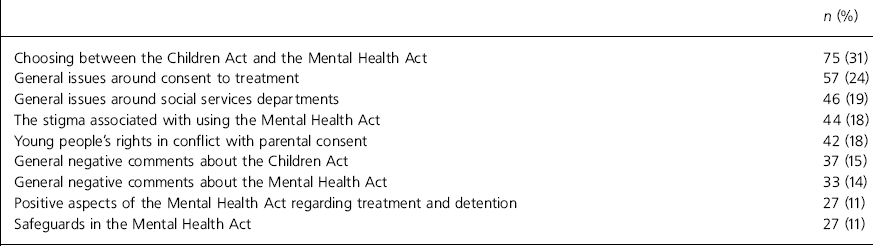
The 240 useable replies provided 800 individual statements, which related to 50 separate themes. Table 1 describes the most frequent themes and frequency of their inclusion in the members' responses.
Range of themes and frequency of psychiatrists who identified those themes
| n (%) | |
|---|---|
| Choosing between the Children Act and the Mental Health Act | 75 (31) |
| General issues around consent to treatment | 57 (24) |
| General issues around social services departments | 46 (19) |
| The stigma associated with using the Mental Health Act | 44 (18) |
| Young people's rights in conflict with parental consent | 42 (18) |
| General negative comments about the Children Act | 37 (15) |
| General negative comments about the Mental Health Act | 33 (14) |
| Positive aspects of the Mental Health Act regarding treatment and detention | 27 (11) |
| Safeguards in the Mental Health Act | 27 (11) |
The most frequently reported themes were: choosing between the Mental Health Act and the Children Act (31% of the sample); general issues around consent to treatment (24%); issues with social services departments (19%); and the stigma associated with using the Mental Health Act (18%).
Discussion
This was an effective method of quickly obtaining psychiatrists' views, avoiding the constraints of presenting categorised response options.
There are, however, several limitations to the study, which must be borne in mind. In the first instance, the response rate of 54% appears low. This study must therefore be seen as illustrative rather than representative of members' views. Second, the frequency of responses is necessarily reliant upon the coding frame. Finally, the most important comments might not have been necessarily the most often reported. Such comments will, however, be considered in the design of subsequent parts of the project.
Choosing between the Children Act and the Mental Health Act
Choosing between the Acts was the most commonly reported theme among the psychiatrists surveyed. Many respondents highlighted the lack of definitive national guidelines in this area and a degree of confusion as to which statute has priority, and which is most appropriate for a given patient. The lack of agreement between psychiatrists and social services on which Act is most appropriate was also mentioned.
General issues around consent to treatment
The issue of consent for minors is a complex area, with statute, common law and precedent all interacting. The situation is further complicated by the fact that the child's age will affect the situation. Many psychiatrists reported confusion as to when consent was acceptable from the patient, or from parents, especially if there is a conflict. Further, there was also confusion as to a patient's competence to give consent, and if this was acceptable, whether, and under what circumstances, the parent's wishes could override this.
General issues with social services
When a minor is detained using the Children Act or the Mental Health Act, by necessity there will be an interaction between the consultant psychiatrist and the social services department. The respondents state that this situation sometimes results in disagreement.
Specifically, respondents mentioned a tendency of social workers to see the needs of the child as too closely linked to those of the parents, and to be reluctant to take positive action.
The respondents suggested that social workers are sometimes reluctant to use either piece of legislation. They suggested that social workers might not use the Children Act for a child who is mentally ill, and might not use the Mental Health Act because it would stigmatise the child concerned.
Stigma associated with the use of the Mental Health Act
Many respondents commented on the stigmatising effect of using the Mental Health Act, and the possible subsequent consequences for the individual concerned. Some mentioned specific consequences, such as difficulty of obtaining a visa for travel to the US. For some, fear of stigma led to a reluctance to use the Mental Health Act, and one described its use in those under the age of 18 as ‘unethical’.
Conclusion
From this survey a range of themes has been identified, and these have informed the design of subsequent data collection tools. This includes a questionnaire for child and adolescent in-patient psychiatrists, to ascertain their knowledge, attitude and practice with regard to the use of legislation. Data collected from this and other commponents of CAMHA-CAPS will address many of these issues. Preliminary findings from this study were submitted to the Department of Health for consideration, prior to the drafting of the new Mental Health Act.


 Open access


eLetters
No eLetters have been published for this article.