




Obesity is considered a major public health challenge across all age groups. A particular concern is childhood obesity, as it is a major risk factor for developing obesity in adulthood (GBD 2015 Risk Factors Collaborators, 2016). While obesity is defined as the excessive accumulation of adipose tissue due to an imbalance between energy intake and expenditure, it is a multifactorial condition influenced by genetics, environment, behavior, and their mutual interactions. The primary indicator of obesity in epidemiological studies is body mass index (BMI), and it is also commonly used in clinical settings to identify individuals who may require further assessment for fat accumulation. The heritability of BMI ranges from 40% to 70% in twin studies (Silventoinen et al., Reference Silventoinen, Jelenkovic, Sund, Yokoyama, Hur, Cozen, Hwang, Mack, Honda, Inui, Iwatani, Watanabe, Tomizawa, Pietiläinen, Rissanen, Siribaddana, Hotopf, Sumathipala, Rijsdijk, Tan and Kaprio2017; Silventoinen et al., Reference Silventoinen, Jelenkovic, Sund, Hur, Yokoyama, Honda, Hjelmborg, Möller, Ooki, Aaltonen, Ji, Ning, Pang, Rebato, Busjahn, Kandler, Saudino, Jang, Cozen, Hwang and Kaprio2016) and 20% to 50% in family and adoption studies (Elks et al., Reference Elks, Den Hoed, Zhao, Sharp, Wareham, Loos and Ong2012; Silventoinen et al., Reference Silventoinen, Rokholm, Kaprio and Sørensen2010). Additionally, cross-sectional genomewide association (GWA) studies have identified over 1000 independent loci associated with adult BMI (Hardy et al., Reference Hardy, Wills, Wong, Elks, Wareham, Loos, Kuh and Ong2010; Min et al., Reference Min, Chiu and Wang2013; Yengo et al., Reference Yengo, Sidorenko, Kemper, Zheng, Wood, Weedon, Frayling, Hirschhorn, Yang and Visscher2018) and several loci associated with BMI in childhood (Locke et al., Reference Locke, Kahali, Berndt, Justice, Pers, Day, Powell, Vedantam, Buchkovich, Yang, Croteau-Chonka, Esko, Fall, Ferreira, Gustafsson, Kutalik, Luan, Mägi, Randall and Speliotes2015; Vogelezang et al., Reference Vogelezang, Bradfield, Ahluwalia, Curtin, Lakka, Grarup, Scholz, van der Most, Monnereau, Stergiakouli, Heiskala, Horikoshi, Fedko, Vilor-Tejedor, Cousminer, Standl, Wang, Viikari, Geller and Felix2020). Previous studies have also shown that genetic factors play an important role in determining BMI trajectories in adulthood (Drouard et al., Reference Drouard, Hagenbeek, Whipp, Pool, Hottenga, Jansen, Hubers, Afonin, Consortium, BBMRI-N., Consortium, Willemsen, de Geus, Ripatti, Pirinen, Kanninen, Boomsma, van Dongen and Kaprio2023; Hjelmborg et al., Reference Hjelmborg, Fagnani, Silventoinen, McGue, Korkeila, Christensen, Rissanen and Kaprio2008; Obeso et al., Reference Obeso, Drouard, Jelenkovic, Silventoinen, Latvala and Kaprio2024; Ortega-Alonso et al., Reference Ortega-Alonso, Sipilä, Kujala, Kaprio and Rantanen2009). However, there are no previous studies about the genetics of BMI trajectories in adolescence and BMI fluctuations both in adolescence and adulthood.
The role of BMI in adolescence in the development of adult obesity (Silventoinen et al., Reference Silventoinen, Li, Jelenkovic, Sund, Yokoyama, Aaltonen, Piirtola, Sugawara, Tanaka, Matsumoto, Baker, Tuvblad, Tynelius, Rasmussen, Craig, Saffery, Willemsen, Bartels, van Beijsterveldt, Martin and Kaprio2022) and BMI trajectories in adulthood has been demonstrated in previous studies (Obeso et al., Reference Obeso, Drouard, Jelenkovic, Silventoinen, Latvala and Kaprio2024). However, despite extensive research on BMI, only a few previous studies have examined the fluctuation of BMI over time (Freedman et al., Reference Freedman, Lawman, Galuska, Goodman and Berenson2018) and its associations with different health-related conditions, such as metabolic syndrome (Guo et al., Reference Guo, Zheng, Chen, Chu, Ren, Sun, Wang, He, Yan, Jia, Liao, Cao, Du, Wang, Yuan, Wang and Mu2024) and cardiometabolic disease risk (Sponholtz et al., Reference Sponholtz, van den Heuvel, Xanthakis and Vasan2019). BMI fluctuation has important public health and clinical implications since frequent weight cycling can predispose individuals to future weight gain (Dulloo et al., Reference Dulloo, Jacquet, Montani and Schutz2015; Rhee, Reference Rhee2017). Furthermore, little is still known about the role of genetic and environmental factors in BMI fluctuation and its associations with BMI and its trajectory. Moreover, the association between BMI fluctuation and genetic predisposition to high BMI, as well as the heritability of BMI fluctuation, remains underexplored.
We aimed to analyze the genetics of BMI fluctuations, defined as the temporal variability of BMI around an individual’s fitted BMI trajectory, and how it relates to future BMI and its trajectory over time. Specifically, we analyzed the association between (1) BMI in adolescence and BMI fluctuation in early adulthood, (2) BMI trajectories in adolescence and BMI fluctuation in early adulthood, (3) BMI fluctuation in adolescence and BMI trajectories in early adulthood, and (4) BMI fluctuation in adolescence and BMI fluctuation in early adulthood. Additionally, we investigated whether genetic predisposition to high BMI is associated with BMI fluctuation and BMI trajectories in adolescence and early adulthood. We used two analytical designs, genetic twin modeling and polygenic risk score of BMI (PRS_BMI), each with different background assumptions, and applied them to longitudinal data. This approach allowed us to unravel the complex interplay between genetics and the environment, as well as account for confounding factors.
Methods
Cohort
The data were obtained from the longitudinal FinnTwin12 study, which included five waves of data collection. The initial mailed questionnaire survey (wave 1) was sent to all twins born in Finland between 1983 and 1987 when they were 11–12 years old, resulting in a total of 5362 participants (response rate 87%). Four follow-up surveys (waves 2–5) were sent at the average ages of 14 (response rate 88%), 17.5 (response rate 92%), 24 (response rate 66%), and 37 (response rate 43%) (Cooke et al., Reference Cooke, Lumpe, Stephenson, Urjansson, Aliev, Palviainen, Brislin, Piirtola, Rabinowitz, Latvala, Barr, Vuoksimaa, Maes, Viken, Rose, Kaprio, Dick, Aaltonen and Salvatore2025; Kaprio et al., Reference Kaprio, Pulkkinen and Rose2002; Rose et al., Reference Rose, Salvatore, Aaltonen, Barr, Bogl, Byers, Heikkilä, Korhonen, Latvala, Palviainen, Ranjit, Whipp, Pulkkinen, Dick and Kaprio2019). Participants reported their current weight and height in each survey, which was used to calculate BMI (kg/m2). The correlation between self-reported and measured BMI was .97 in a subsample of these twins at age 24, indicating good reliability of self-reported BMI (Drouard et al., Reference Drouard, Hagenbeek, Whipp, Pool, Hottenga, Jansen, Hubers, Afonin, Consortium, BBMRI-N., Consortium, Willemsen, de Geus, Ripatti, Pirinen, Kanninen, Boomsma, van Dongen and Kaprio2023). Zygosity was assessed using DNA, or if not available, based on questions about physical similarity in the baseline questionnaire. In a validation study of 395 same-sex twin pairs in this cohort, 97% of questionnaire assignments of zygosity were confirmed by a DNA test, showing high reliability (Jelenkovic et al., Reference Jelenkovic, Ortega-Alonso, Rose, Kaprio, Rebato and Silventoinen2011). The Ethics Committee of the Helsinki University Central Hospital District (HUS) approved the most recent data collection (wave 5) (HUS/2226/2021, dated 22 September 2021), as well as the use of previously collected data. The participants or their parents/legal guardians provided informed consent when participating in the surveys.
Participants with valid BMI measures in all five waves (N = 1379) were selected. From these participants, we selected complete twin pairs (N = 336 pairs) for genetic twin modeling (Figure 1). Although BMI was not a criterion for selecting twins, we found that the BMI of those selected in the current study was slightly lower, but not statistically significant, compared to those not included (0.16–0.58 kg/m² after adjusting for age and sex in each survey), suggesting that there may be some self-selection related to BMI.
Participant flowchart and general study plan diagram.
Caption: The study was divided into two main parts based on the analyses after a data preprocessing phase. Preprocessing consisted of obtaining sex-specific BMI trajectories (slope and intercept) and fluctuation from those participants with height and weight measures for the five waves. One part of the study was phenotypic associations between BMI variables themselves and with the polygenic risk score of BMI. The other main part of the study was the classical twin genetic modelling which was based on BMI trajectories (slope and intercept) and fluctuation. Two exclusion criteria were performed at different times: they correspond to (1) data preprocessing and (2) selection of complete same-sex twin pairs. Abbreviations: MZ, monozygotic twins; DZ, dizygotic twins; N, number of participants

BMI Trajectory Calculation
The BMI trajectories in adolescence were calculated using BMI measures from waves 1–3 (between 11.5 and 17.5 years), while early adulthood BMI trajectories were based on measures from waves 3–5 (from age 17.5 to 37). In both cases, the trajectories were calculated using linear mixed-effects (LME) models that included both fixed and random effects, as explained in detail elsewhere (Obeso et al., Reference Obeso, Drouard, Jelenkovic, Silventoinen, Latvala and Kaprio2024). Random effects were applied to individual identifiers to estimate individual baseline BMI (i.e., intercept) and BMI trajectory (i.e., slope). R software (version 4.2.3) packages lme4 (version 1.1-34), lmerTest (version 3.1-3), dplyr (version 1.1.4), modelsummary (version 1.4.3), and optimx (version 2023-10.21) were used.
BMI Fluctuation Calculation
The participant-specific BMI trajectories and baseline BMI were used to estimate BMI fluctuation. Initially, the BMI trajectory value was determined using the formula y = xn + m, where n represents the BMI trajectory measured in kg/m2 per year, m is the baseline BMI measured in kg/m2 (i.e., wave 1 for adolescence and wave 3 for early adulthood), and x is the difference between the age of interest and the baseline age (i.e., wave 1 for adolescence and wave 3 for early adulthood). Next, the squared differences between observed and expected BMI values were calculated at each age. Finally, the total BMI fluctuations in adolescence and early adulthood were calculated for each participant by averaging the squared difference values (using waves 1, 2, and 3 for adolescence and waves 3, 4, and 5 for early adulthood). A sensitivity analysis was conducted to evaluate the accuracy of the method used for the estimation of BMI fluctuation. For that, another method (one that makes no assumptions about the linearity of BMI trajectories) was used for the estimation of BMI fluctuation and then compared to the previously used method (Zonneveld et al., Reference Zonneveld, Noordam, Sabayan, Stott, Mooijaart, Blauw, Jukema, Sattar and Trompet2023). A strong correlation was found between the BMI fluctuations obtained in these different ways (Supplementary Table 1 and related text).
Polygenic Risk Score of High BMI (PRSBMI)
At wave 4, DNA from a subset of twins selected from the cohort independently of their BMI was obtained from venous blood or saliva samples and used in the PRSBMI analyses (N = 1478; Rose et al., Reference Rose, Salvatore, Aaltonen, Barr, Bogl, Byers, Heikkilä, Korhonen, Latvala, Palviainen, Ranjit, Whipp, Pulkkinen, Dick and Kaprio2019). The technical details of genotyping, quality control and imputation in genotype data processing have been described elsewhere (Kujala et al., Reference Kujala, Palviainen, Pesonen, Waller, Sillanpää, Niemelä, Kangas, Vähä-Ypyä, Sievänen, Korpelainen, Jämsä, Männikkö and Kaprio2020). The PRSBMI was derived using GWA summary statistics from elsewhere (Yengo et al., Reference Yengo, Sidorenko, Kemper, Zheng, Wood, Weedon, Frayling, Hirschhorn, Yang and Visscher2018). For the calculation of the PRSBMI, a total of 996,919 single nucleotide polymorphisms (SNPs) with a minor allele frequency >5% in European individuals obtained from 692,578 participants were used. To correct for population stratification, the PRSBMI was regressed to the top 10 genetic principal components, and the residuals were scaled to a mean of zero and a variance of one (Price et al., Reference Price, Patterson, Plenge, Weinblatt, Shadick and Reich2006). We found no difference in PRSBMI distributions between included and excluded participants (p = .19), suggesting that there was no selection bias for PRSBMI.
Association Study
Linear mixed-effects regression models were conducted to calculate the associations between (1) BMI in adolescence (at waves 1, 2 and 3) and BMI fluctuation in early adulthood, (2) BMI trajectories in adolescence and BMI fluctuation in early adulthood, (3) BMI fluctuation in adolescence and BMI trajectories in early adulthood, and (4) BMI fluctuation in adolescence and BMI fluctuation in early adulthood (the models used are displayed in a footnote of the corresponding table). Furthermore, the associations between the PRSBMI and BMI fluctuation in adolescence and early adulthood were assessed to determine whether genetic predispositions for high BMI were associated with higher BMI fluctuation in adolescence and early adulthood (the models used for the study of associations of PRSBMI with BMI trajectories and fluctuations in adolescence and early adulthood are displayed in a footnote of the corresponding table). All analyses were conducted separately for males (n = 665) and females (n = 714) since mean BMI (from wave 3 onwards) and BMI trajectories differed by sex. We considered associations 0–0.39 as weak, 0.40–0.59 as moderate, and 0.60–1.00 as strong. The analyses were conducted using the R software (version 4.2.3) and the R package lme4 (version 1.1-35.5) and lmerTest (version 3.1-3).
Genetic Twin Modeling
The genetic analyses were continued by twin modeling based on the different genetic relatedness of monozygotic (MZ) and dizygotic (DZ) twins: while MZ twins have virtually identical genetic sequences, DZ twins share, on average, 50% of their genes identical-by-descent. The trait variance can be decomposed into four components: (1) additive genetic variation (A), which includes the effects of all the loci that play a relevant role in the trait (correlation of 1 in MZ twins and 0.5 in DZ twins); (2) effects due to dominance (D) where the heterozygote phenotype deviates from the additive model (correlation of 1 in MZ twins and .25 in DZ twins); (3) shared environmental component (C), including all the environmental factors that make the co-twins similar (correlation of 1 in MZ and DZ twins); and (4) unique environmental component (E), including all environmental factors making the co-twins different along with the measurement error (correlation of 0 in MZ and DZ twins). For twins reared together, all four components cannot be simultaneously estimated, hence ACE and ADE are chosen as starting models depending on the pattern of MZ and DZ correlations. ADE models are used when the MZ twin pair correlations (rMZ) are equal to or greater than twice the correlations on DZ twin pair (rDZ) (rMZ ≥ 2rDZ). If the correlations of MZ twin pairs are less than two times the correlation of DZ twins (rMZ< 2rDZ), ACE models are estimated.
Separate univariate models for each trait were used to determine the best-fitting model and to calculate the relative contributions of genetic and environmental factors. Intraclass correlations by zygosity were calculated by dividing within-pair variation by between-pair variation using the analysis of variance. Based on these correlations, the additive genetic/shared environment/unique environment (ACE) model was selected as the baseline model (Supplementary Table 2). Model comparisons were conducted using −2 log likelihood (−2LL) and Akaike information criterion. Based on the model comparisons, a full AE model with sex differences was selected for all the variables (Supplementary Table 3). However, in females the model suggests the presence of a shared environmental component (C) having rDZ > rMZ. However, this result can be attributed to a small sample size.
Finally, the bivariate Cholesky decomposition, a model-free method to decompose all variation and covariation in the data into uncorrelated latent factors (Kaprio & Silventoinen, Reference Kaprio and Silventoinen2011), was used to decompose the covariation between the different measures into genetic and environmental covariances. When these covariances are standardized, we obtain estimates of additive genetic (r A) and unique environmental (r E) correlations. Genetic twin modeling was performed using the R software (version 4.2.3) and the R package OpenMx (version 2.21.11). The 95% confidence intervals (CI) were assessed using maximum likelihood estimation (Neale et al., Reference Neale, Hunter, Pritikin, Zahery, Brick, Kirkpatrick, Estabrook, Bates, Maes and Boker2016).
Results
Table 1 displays the descriptive information of the data used. The mean BMI increased from 17.48 kg/m2 in males and 17.39 kg/m2 in females in wave 1 to 26.09 kg/m2 and 24.93 kg/m2, respectively, in wave 5. Males showed a higher mean BMI from age 17.5 onwards, which coincided with the establishment of statistically significant BMI differences between the sexes (p < .01). Accordingly, statistically significant sex differences were observed for the estimates of BMI trajectories, being higher in males in adolescence (0.64 kg/m2 per year in males and 0.54 kg/m2 per year in females, p < .01) and early adulthood (0.22 kg/m2 per year in males and 0.20 kg/m2 per year in females, p = .01).
Means and standard deviations of body mass index (BMI) at different waves and its trajectories in adolescence (waves 1 to 3) and early adulthood (from wave 3 to 5) by sex

Note: 1The BMI trajectory estimates were obtained by linear regression models based on BMI at waves 1, 2 and 3 for adolescence, and at waves 3, 4, and 5 for early adulthood. The sex difference was studied using linear mixed-effect models: (1) for ages: Age at n wave = Sex + Zygosity + (1| Family ID). (2) For BMI: BMI at n wave = Age at n wave + Sex + Zygosity + (1| Family ID). (3) For BMI trajectories in adolescence: BMI trajectories in adolescence = BMI intercept for adolescence + Adolescence age baseline + Zygosity + Sex + (1|Family ID). (4) For BMI trajectories in early adulthood: BMI trajectories in adulthood = BMI intercept for adulthood + Adulthood age baseline + BMI intercept for adolescence + Zygosity + Sex + (1| Family ID).
Table 2 presents the heritability estimates for the BMI trajectories and BMI fluctuation in adolescence and early adulthood for males and females. The heritability of BMI fluctuation in males was higher in adolescence (a2 = .80) than in early adulthood (a2 = .34), while in females the heritability was higher in early adulthood (a2 = .51) than in adolescence (a2 = .34). Regarding BMI trajectories, heritability in males was higher in early adulthood (a2 = .70) than in adolescence (a2 = .61), while in females the heritability was higher in adolescence (a2 = .75) compared to early adulthood (a2 = .61). However, not all differences were statistically significant, as indicated by overlapping 95% CIs.
Relative proportions of body mass index (BMI) variance explained by additive genetic and unique environmental variance components with 95% confidence intervals (CI) of BMI trajectories and fluctuation in adolescence and early adulthood by sex1

Note: 1AE model with sex differences was selected for the BMI fluctuation in adolescence and BMI trajectory in early adulthood in both sexes. a2, proportion of total variance explained by additive genetic factors; e2, proportion of total variance explained by unique environmental factors; LL, lower limit; UL, upper limit
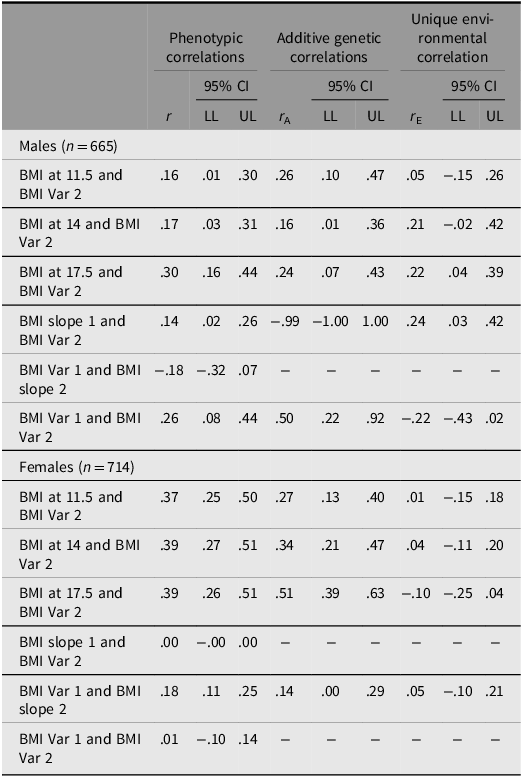
Table 3 displays the phenotypic, additive genetic, and unique environmental correlations between the analysed pairs of traits. The BMI fluctuation in adolescence was only linked to BMI trajectories in early adulthood in females (r = .18). Additionally, BMI in adolescence had significant phenotypic associations with BMI fluctuations in early adulthood in both males (r = .16–.30) and females (r = .37–.39). However, BMI trajectories in adolescence and BMI fluctuations in early adulthood showed a significant phenotypic association only in males (r = .14). The association between BMI fluctuation in adolescence and early adulthood was significant only in males (r = .26). Subsequently, we decomposed the significant correlations into genetic and environmental components. Genetic factors accounted for most of the phenotypic associations between BMI fluctuation and BMI trajectories: the additive genetic correlations (r A = .14 for the associations between BMI fluctuation in adolescence and BMI trajectories in early adulthood; r A = .16–0.51 for the associations between BMI in adolescence and early adulthood BMI fluctuation; r A = .50 for the associations between BMI fluctuations in adolescence and early adulthood in males) were generally higher than the phenotypic correlations. However, in males, the association between BMI fluctuation in early adulthood and BMI trajectory in adolescence was entirely (r E = .24) and the associations between BMI at wave 3 and early adulthood BMI fluctuation partly attributable to unique environmental factors (r E = .22).
Phenotypic associations, additive genetic and unique environmental correlations of BMI, BMI trajectories and BMI fluctuation in adolescence (Var 1, slope 1) versus early adulthood (Var 2, slope 2) by sex, and specific ages1

Note: 1Association estimates were obtained from the linear mixed-effects models: (1) for BMI in adolescence and BMI fluctuation in early adulthood = BMI at n wave of adolescence = Age at n wave of adolescence + Zygosity + BMI fluctuations in early adulthood + (1| Family ID). (2) For BMI trajectories in adolescence and BMI fluctuations in early adulthood: BMI fluctuations in early adulthood = BMI trajectories in adolescence + zygosity + BMI intercept in adulthood + (1| Family ID). (3) For BMI fluctuation in adolescence (BMI var 1) and BMI trajectories in early adulthood (slope 2) BMI trajectories in early adulthood = BMI fluctuations in adolescence + Zygosity + BMI intercept in adolescence + BMI intercept in early adulthood + (1| Family ID). (4) for BMI fluctuations in adolescence and BMI fluctuations in early adulthood: BMI fluctuations in early adulthood = BMI intercept in early adulthood + BMI fluctuation in adolescence + Zygosity + (1| Family ID). Everything is summarized with associations estimates besides their confidence intervals (CI). r A, additive genetic correlation; r E, specific environmental correlation; LL, lower limit; UL, upper limit.
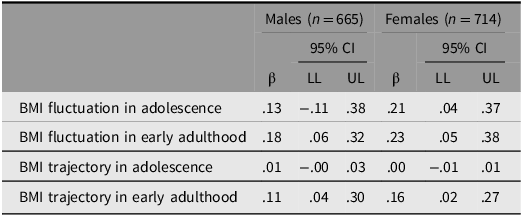
Finally, we examined the association between PRSBMI with BMI trajectories and BMI fluctuation in adolescence and early adulthood (Table 4). In males, PRSBMI was associated with BMI fluctuation (β = .13) and BMI trajectory in early adulthood (β = .11). In females, statistically significant associations were found with BMI fluctuation in adolescence (β = .21) and early adulthood (β = .23), as well as with BMI trajectory in early adulthood (β = .16).
Associations between polygenic risk score of BMI (PRSBMI) with body mass index (BMI) trajectories and fluctuation in adolescence and early adulthood by sex.1

Note: 1Associations obtained from linear mixed-effect models (1) BMI trajectories in adolescence or early adulthood = PRSBMI + Zygosity + BMI intercept in concrete stage + Baseline age of concrete stage + (1| Family ID) for obtaining those between BMI trajectories inin both adolescence and early adulthood and the polygenic risk scores and, (2) BMI fluctuation = PRSBMI + Zygosity + BMI intercept in concrete stage + (1| Family ID) for those between BMI fluctuation in adolescence and early adulthood and polygenic risk scores for BMI are summarised with association coefficients beside their confidence intervals (CI). LL, lower limit; UL, upper limit.
Discussion
The current study examines the associations between BMI, BMI trajectories, and BMI fluctuations in adolescence with the BMI trajectories and fluctuation in early adulthood. First, we found that BMI in adolescence is associated with BMI fluctuation in early adulthood. This indicates that greater BMI in adolescence is associated with greater BMI fluctuation (more erratic weight changes) in early adulthood. The associations in the early (11.5 years) and middle (14 years) stages of adolescence were fully attributable to genetic factors. In contrast, the association observed in the late stages of adolescence in males was influenced by both genetic and environmental factors. Second, in males the BMI trajectories in adolescence are related to BMI fluctuation in adulthood, indicating that greater weight gain in adolescence is associated with more BMI fluctuation in adulthood. This association was found to be fully influenced by environmental factors. Moreover, the fluctuation in BMI in adolescence is associated with fluctuation in early adulthood in males, indicating that greater fluctuation in BMI in adolescence is associated with greater fluctuation in adulthood. This association was driven exclusively by genetic factors. Finally, the BMI fluctuation in adolescence was associated with BMI trajectories in early adulthood in females, indicating that the more BMI fluctuates in adolescence the more pronounced the weight gains in early adulthood are. This association was also explained purely by genetic factors. Our results on the role of genetic factors behind BMI and its fluctuations were supported by the association between PRSBMI with BMI trajectories and fluctuations in early adulthood. The results indicate that genetic factors influencing BMI variation may also contribute to the definition of BMI trajectories and fluctuation.
Previous studies have reported associations between BMI in adolescence and BMI in adulthood (Ng & Cunningham, Reference Ng and Cunningham2020; Wang et al., Reference Wang, Chyen, Lee and Lowry2008), as well as between BMI trajectories in adolescence and BMI in adulthood (Ng & Cunningham, Reference Ng and Cunningham2020; Yang et al., Reference Yang, Walsh, Johnson, Belsky, Reason, Curran, Aiello, Chanti-Ketterl and Harris2021). Both genetic and environmental correlations explain these phenotypic associations (Choh et al., Reference Choh, Lee, Kent, Diego, Johnson, Curran, Dyer, Bellis, Blangero, Siervogel, Towne, Demerath and Czerwinski2014; Hjelmborg et al., Reference Hjelmborg, Fagnani, Silventoinen, McGue, Korkeila, Christensen, Rissanen and Kaprio2008; Jelenkovic et al., Reference Jelenkovic, Sund, Hur, Yokoyama, Hjelmborg, Möller, Honda, Magnusson, Pedersen, Ooki, Aaltonen, Stazi, Fagnani, D’Ippolito, Freitas, Maia, Ji, Ning, Pang, Rebato and Silventoinen2016). When interpreting these associations, it is noteworthy that during adolescence, trajectories in BMI reflect changes in both height and weight, whereas in adulthood the trajectories in BMI are primarily explained by weight change, especially the accumulation of fat mass. Moreover, childhood and prepubertal BMI, as well as other obesity markers, are associated with earlier onset of puberty, which may impact these associations (Busch et al., Reference Busch, Hollis, Day, Sørensen, Aksglaede, Perry, Ong and Juul2019; Kaplowitz, Reference Kaplowitz2008). It is known that earlier pubertal timing predicts higher BMI and increased risk of obesity in adulthood (Prentice & Viner, Reference Prentice and Viner2013). Furthermore, the associations between prepubertal or childhood BMI with puberty timing, as well as between puberty timing and adulthood BMI and obesity, are explained by both genetic and environmental factors (Day et al., Reference Day, Bulik-Sullivan, Hinds, Finucane, Murabito, Tung, Ong and Perry2015; Silventoinen et al., Reference Silventoinen, Jelenkovic, Palviainen, Dunkel and Kaprio2022). Thus, the genetic factors associated with puberty may contribute to the association between BMI fluctuation in adolescence and weight gain in adulthood.
The heritability estimates of BMI fluctuations in adolescence were found to be high in males and low in females. In early adulthood, females presented moderate heritability, while males presented a low estimate. These findings indicate that genetic factors influence BMI fluctuations in adolescence, but the role of genetic factors diminishes in early adulthood for males while the opposite occurs for females. However, genetic factors continue to exert an influence in early adulthood in both sexes. Regarding BMI trajectories, heritability estimates are high in both life stages and both sexes. High heritability estimates of BMI have been reported previously in adolescence (Allison et al., Reference Allison, Heshka, Neale and Heymsfield1994; Pietiläinen et al., Reference Pietiläinen, Kaprio, Rissanen, Winter, Rimpela, Viken and Rose1999) and adulthood (Korkeila et al., Reference Korkeila, Kaprio, Rissanen and Koskenvuo1991; Silventoinen et al., Reference Silventoinen, Jelenkovic, Sund, Yokoyama, Hur, Cozen, Hwang, Mack, Honda, Inui, Iwatani, Watanabe, Tomizawa, Pietiläinen, Rissanen, Siribaddana, Hotopf, Sumathipala, Rijsdijk, Tan and Kaprio2017) (0.80–0.85 for adolescence and 0.57–0.72 for adulthood). Additionally, BMI trajectories in adulthood have previously been shown to be heritable in another Finnish twin cohort (Drouard et al., Reference Drouard, Silventoinen, Latvala and Kaprio2023). However, to the best of our knowledge, our study is the first to report the heritability estimates for BMI fluctuations.
The current study has both strengths and weaknesses. The most notable strength is the use of longitudinal population-based data spanning from early adolescence to early midlife over a period of more than two decades and five measurement points, along with information not only on twins’ status but also PRSBMI, allowing us to use two methods to analyze the role of genetics, each based on different assumptions. However, the sample size decreased due to selecting only participants with BMI measurements at all ages, potentially reducing statistical power and increasing uncertainty in our estimates. The number of measurement points does not fully cover the BMI trajectories and therefore also the fluctuations. This may lead to an underestimation of the true variations, especially among those with a lot of weight cycling. This underestimation may be more pronounced in adulthood, considering the 13-year time gap between the last two measurements. However, to the best of our knowledge, there are limited observational cohorts that have measured BMI values over a sufficiently long period of time with short time periods between BMI measurements to more precisely capture weight cycling; for example, Nurses’ Health Study (Field et al., Reference Field, Manson, Taylor, Willett and Colditz2004) and Health Professionals Follow-up Study (Song et al., Reference Song, Hu, Spiegelman, Chan, Wu, Ogino, Fuchs, Willett and Giovannucci2015). Linear mixed-effect models used to estimate BMI trajectories do not capture non-linear patterns in BMI trajectories. However, capturing nonlinear patterns with a limited number of BMI measurements per individual is challenging. Another limitation is the lack of control for potential confounders such as diet or physical activities among others.
In conclusion, the current study provides evidence of a shared genetic background between BMI, BMI trajectories, and BMI fluctuations in adolescence and early adulthood using both twin modelling and polygenic risk scores. These associations emphasize the significance of adolescence in understanding BMI development in early adulthood, as temporal changes and fluctuations in BMI in adolescence are related to these traits in adulthood. This knowledge is important for identifying individuals at a higher risk of weight gain in early adulthood. However, while these findings are promising, it would be advantageous to confirm them in other populations to improve the generalizability.
Supplementary material
To view supplementary material for this article, please visit https://doi.org/10.1017/thg.2025.10030
Data availability statement
The FinnTwin12 (FT12) data is not publicly available due to the restrictions of informed consent. However, the FT12 data is available through the Institute for Molecular Medicine Finland (FIMM) Data Access Committee (DAC) (fimmdac@helsinki.fi) for authorized researchers who have IRB/ethics approval and an institutionally approved study plan. To ensure the protection of privacy and compliance with national data protection legislation, a data use/transfer agreement is needed, the content and specific clauses of which will depend on the nature of the requested data.
Authors’ contributions
AO created the study design, conducted the analyses, and drafted the manuscript. JK and SA collected the data. AJ, JG, GD, SA, JK and KS participated in the interpretation of the data and critically drafted the manuscript. All authors approved the submitted version of the manuscript.
Funding
Research supported by: Horizon Europe Research and Innovation programme (n of agreement 101080117) UK Research and Innovation (UKRI) (n of agreement 10093560 and 10106435) the Swiss State Secretariat for Education, Research and Innovation (SERI) Wellcome Trust Sanger Institute, the Broad Institute, ENGAGE – European Network for Genetic and Genomic Epidemiology, FP7-HEALTH-F4-2007 (n of agreement 201413), Academy of Finland (10.13039/501100002341) (n of agreement 100499, 205585, 118555, 141054, 264146, 308248, 265240, 263278) Academy of Finland Centre of Excellence in Complex Disease Genetics (n of agreement 312073, 336823 and 352792)
Competing interests
The authors declared no potential conflicts of interest with respect to the research, authorship, and/or publication of this article.
Code availability
All R scripts are available from the corresponding author.




 Open access

