





Introduction
A strong influence of parental educational background and socioeconomic status (SES) on children's language development has long been established (for reviews see Pace, Luo, Hirsh-Pasek & Golinkoff, Reference Pace, Luo, Hirsh-Pasek and Golinkoff2017; Rowe, Reference Rowe2018; Schwab & Lew-Williams, Reference Schwab and Lew-Williams2016). That is, children from high-SES families regularly outperform their peers from lower-SES families on standardized measures of language abilities (e.g., vocabulary, syntax). These better language abilities in turn are also linked to the children's (later) academic achievement (e.g., Hoff, Reference Hoff2013; Kempert, Saalbach & Hardy, Reference Kempert, Saalbach and Hardy2011; Saalbach, Gunzenhauser, Kempert & Karbach, Reference Saalbach, Gunzenhauser, Kempert and Karbach2016).
Less, however, is known about how children's socioeconomic environments influence their pragmatic abilities – specifically, their abilities to use and interpret language in context. On the one hand, parental education has been found to affect children's ability to express their own point of view, needs and wants, the consideration of others’ points of view, and their narrative skills (Pace et al., Reference Pace, Luo, Hirsh-Pasek and Golinkoff2017; Sohr-Preston, Scaramella, Martin, Neppl, Ontai & Conger, Reference Sohr-Preston, Scaramella, Martin, Neppl, Ontai and Conger2013). On the other hand, parental socioeconomic status (operationalized as a combination of parental education and occupation) has been shown to have only a very small effect on children's comprehension and production of pragmatic phenomena such as irony and deceit (Bosco, Angeleri, Colle, Sacco & Bara, Reference Bosco, Angeleri, Colle, Sacco and Bara2013) and no relation between SES and the understanding of communication failures was found (Bosco & Gabbatore, Reference Bosco and Gabbatore2017). Most relevant for the current study, however, is the influence of socioeconomic status on children's comprehension of indirect communication – more specifically, children's comprehension of relevance implicatures. This question has only been addressed in two studies (Antoniou, Veenstra, Kissine & Katsos, Reference Antoniou, Veenstra, Kissine and Katsos2020; Schulze, Endesfelder Quick, Gampe & Daum, Reference Schulze, Endesfelder Quick, Gampe and Daum2020). This is surprising, given that indirect communication of this type occurs very often in our daily lives. That is, mostly, we do not explicitely say what we mean but rather only hint at it (for instance, when we want somebody to hand us the bread at breakfast, we do not just say, “Give me the bread” but rather we might say, “I am really hungry today”). The recipient then needs to infer our intentions (e.g., eating more bread) from what we said and this requires a number of socio-cognitive abilities (comprehension of ostensive cues, joint attention and intentions, see Csibra, Reference Csibra2010; Tomasello, Reference Tomasello2008). Not least of all, we need to establish the relevance of what was said by using our world knowledge and information from the context and the common ground (Abbot-Smith, Schulze, Anagnostopoulou, Zajączkowska & Matthews, Reference Abbot-Smith, Schulze, Anagnostopoulou, Zajączkowska and Matthews2021; Grice, Reference Grice1989; Schulze, Reference Schulze2020; Sperber & Wilson, Reference Sperber and Wilson1995; Tomasello, Reference Tomasello2008). Given that SES strongly influences children's language acquisition, one might also expect SES-effects for this kind of communication comprehension in pragmatics. However, studies on children's comprehension of relevance implicatures did not find such an influence so far (Antoniou et al., Reference Antoniou, Veenstra, Kissine and Katsos2020; Schulze et al., Reference Schulze, Endesfelder Quick, Gampe and Daum2020).
Yet, these studies operationalized SES by measuring the parental educational background. Given the highly socio-cognitive nature of relevance implicature comprehension, it might well be that such pragmatic abilities rather depend on socio-cognitive engagement (SCE) between parents and children – for instance, in terms of joint parent-child activities (Pace et al., Reference Pace, Luo, Hirsh-Pasek and Golinkoff2017) that were not considered in previous studies. This seems especially plausible since these joint activities (e.g., reading books, playing games, talking about problems) can be seen as a form of joint engagement that is required to acquire language and infer a speaker's intentions in general (Bruner, Reference Bruner1983; Tomasello, Reference Tomasello2003).
In the same vein, pragmatic abilities might be influenced by the number of people the child is encountering on a daily basis – for instance, the number of people living in their home. The presence of more people raises the frequency of occasions for communication; changes in communication partners mean that the child needs to flexibly adjust to each communication partner's needs and wants (Hoff-Ginsberg, Reference Hoff-Ginsberg1998; Wermelinger, Gampe & Daum, Reference Wermelinger, Gampe and Daum2017).
Thus, these two variables (joint parent-child activities and frequency of occasions for communication operationalized in terms of family composition) can be considered as markers for children's socio-cognitive engagement.
The current study thus addressed the question how socioeconomic status and socio-cognitive engagement might influence children's communication comprehension. For socioeconomic status, we assessed not only parental education but also the families’ income; socio-cognitive engagement was assessed through the number of people living in the children's home and the frequency of joint parent-child activities as measured by a questionnaire on preschool-aged children's activities in the family (i.e., AKFRA, see Roßbach & Leal, Reference Roßbach and Leal1993; see also the documentation of instruments for the national assessment of education in early childhood (NUBBEK) in Eckhardt et al., Reference Eckhardt, Egert, Beckh, Berkic, Kalicki and Quehenberger2011).
More specifically, we aimed to compare the effect of those variables on direct and indirect communication in request situations. Therefore, in our study, direct communication was operationalized as a speaker mentioning her requested object explicitely (e.g., “I want the cereal” when being confronted with a choice between cereal and toast) while in indirect communication the speaker only hinted at her request (e.g., “I don't have a bowl” in the same situation). The former could rather be seen as a form of a vocabulary test, thus tapping language skills, while the latter is rather a form of a social-cognitive inferencing test, thus tapping pragmatic abilities required for relevance implicature comprehension.
We expected SES to influence children's comprehension of direct communication as this form of communication mainly concerns the knowledge of vocabulary and syntax, both of which have been shown to be influenced by SES (Pace et al., Reference Pace, Luo, Hirsh-Pasek and Golinkoff2017; Rowe, Reference Rowe2018; Schwab & Lew-Williams, Reference Schwab and Lew-Williams2016). In contrast, based on prior studies, we expected to find no influence of SES on children's comprehension of indirect communication (Antoniou et al., Reference Antoniou, Veenstra, Kissine and Katsos2020; Schulze et al., Reference Schulze, Endesfelder Quick, Gampe and Daum2020). No clear predictions were made concerning the SCE-variables (joint parent-child activities and frequency of occasions for communication operationalized in terms of family composition) as we explored the influence of these variables.
During early childhood, children undergo tremendous pragmatic development. Specifically, 3- to 4-year-old children have been shown to understand relevance implicatures as described above (Schulze, Grassmann & Tomasello, Reference Schulze, Grassmann and Tomasello2013; Schulze et al., Reference Schulze, Endesfelder Quick, Gampe and Daum2020). However, their performance is still somewhat fragile and understanding relevance implicatures develops up to early primary school age (Antoniou & Katsos, Reference Antoniou and Katsos2017; Bucciarelli, Colle & Bara, Reference Bucciarelli, Colle and Bara2003; Loukusa, Leinonen & Ryder, Reference Loukusa, Leinonen and Ryder2007; for reviews see Matthews, Biney & Abbot-Smith, Reference Matthews, Biney and Abbot-Smith2018; Wilson & Katsos, Reference Wilson, Katsos, Schneider and Ifantidou2020). Thus, we tested 4- and 6-year-old children as we wanted to explore whether the relation between pragmatic abilities and SES as well as SCE differed between those stages of development.
Method
2.1 Participants
92 monolingual German children of two age groups (4-year-olds and 6-year-olds) participated in this study.Footnote 1 The 4-year-old children's (n = 51, 49% female) mean age was 4 years; 2 months, 23 days (range: 3;11,27–4;5,30) and the 6-year-old children's (n = 41, 46% female) mean age was 6 years; 4 months, 0 days (range: 6;0,22–6;7,28). Five additional children were tested but had to be excluded from the final sample due to turning out to be bilingual (n = 3) or because of our exclusion criteria in the communication task (n = 2, see Coding and Data handling section). This study was conducted in accordance with the ethical standards laid down in the Declaration of Helsinki and the standards of the local ethics committee of the University of Leipzig, Germany. The children's parents had agreed to their children participating in studies on child development.
2.2 Materials and set-up
Throughout the study, the child sat at a table in front of a 10.1” tablet (Lenovo MIIX 320-10ICR, resolution 1280 x 800 pixel) mounted on a keyboard with the experimenter sitting on a chair next to the child. Stimulus presentation and data recording were carried out using OpenSesame 3.2.4 (Mathôt, Schreij & Theeuwes, Reference Mathôt, Schreij and Theeuwes2012). Testing took place in a quiet room in children's kindergartens. All sessions were videotaped.
2.3 Design
The communication task consisted of six trials in two between-subjects conditions (Direct Communication Condition, Indirect Communication Condition, see below). The children were randomly assigned to one of the two conditions: however, twice as many children participated in the Indirect Communication Condition; as we were particularly interested in children's pragmatic abilities in inferential communication comprehension. In each condition, the children saw six test trials that consisted of four phases (see Procedure). The order of the trials was fixed as was the position of the objects. The left-right-position of the correct object was counterbalanced. The children's task was to tap the object that they thought was the one intended by the puppets on the touchscreen.
The children's parents were asked to fill out a questionnaire on their socioeconomic status and the frequency of parent-child activities.
2.4 Procedure
After having been familiarized with the touchscreen, the experimenter explained that the child would now see a puppet theatre in which two puppets showed their daily activities and that sometimes the puppets would need the child's help. After two further warm-up trials to familiarize the children with the puppets and the object-choice task the experimenter proceeded with the test trials. Each test trial of the communication task consisted of four phases (context, utterance, object choice, play).
2.4.1 Communication task
Children saw a modified version of Schulze, Grassmann, and Tomasello's (Reference Schulze, Grassmann and Tomasello2013, Study 3) communication task. In the context phase, the child saw pre-recorded video clips in which the puppets introduced an action they were going to perform (e.g., “Now, we want to eat breakfast”) and the two objects to perform the action with (e.g., “We have cornflakes and toast”), pointing to both objects in turn. Then, one puppet asked the other which option she preferred to use (e.g., “Would you rather eat the cornflakes or the toast for breakfast?”).
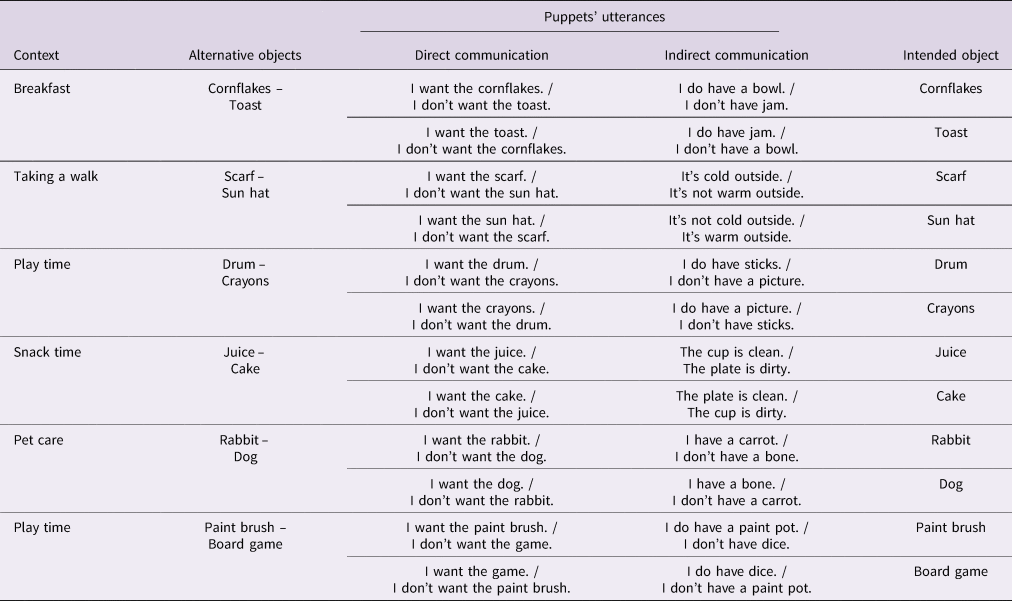
In the utterance phase, the child saw a video of the puppet that was asked the preference question placed centrally between the two alternative objects. The puppet's utterance depended on the condition (for an overview of utterances see Table 1).
Overview of Context Scenarios, Object-Choice Options, Utterances by Condition and Correct Intended Objects.
Direct Communication Condition
The puppet directly communicated her goal by labeling the intended object, saying for instance “I want/do not want the cornflakes”, thus explicitly mentioning the object the child should (not) choose.
Indirect Communication Condition
The puppet indirectly hinted at her goal, saying for instance “I have/do not have a bowl”, thus not mentioning any of the actual objects the child had to choose from. Therefore, the children had to infer the puppet's intended object.
In the object-choice phase, the child saw a white screen with the two alternative object-choice options depicted on either side of the screen. Her task was to tap the object that she thought was the one intended by the puppets. If the child hesitated to choose an object, the experimenter waited 10 seconds and then explained to the child that she should now choose one of the objects for the puppet (“Which one did the puppet want, which one do you have to tap?”). If the child did not choose during a further 10-second interval, the experimenter explained the situation by labeling the two object-choice options, repeating the puppet's utterance and then asked the child to choose an object to give to the puppet's (e.g., “Look, the puppets have cornflakes and toast and the puppet said: “I want the cornflakes” / “I have a bowl”. Which one do you give to puppets?”). If the child failed to choose during a further ten seconds, the experimenter proceeded with the next trial, saying, “Okay, there will be another story in a moment, please pay close attention!”
In the play phase, the child saw a video in which the puppets thanked the child and went on to perform the intended action (e.g., eating cornflakes).
2.4.2 Parental questionnaire on SES and socio-cognitive engagement
In a questionnaire, we asked parents for information on their highest education degree and their income. The education degree was assessed on a scale ranging from 1 (no school degree) to 8 (university degree), separately for both caregivers. The household income was assessed in categories ranging from 1 (500 to 1.000 €) to 8 (more than 6.500 €).
Moreover, we asked parents about their family's composition (i.e., how many persons lived in their household) and how often they performed joint activities with the child based on a questionnaire on preschool-aged children's activities in the family (German AKFRA, see Roßbach & Leal, Reference Roßbach and Leal1993; see also the documentation of instruments for the national assessment of education in early childhood (NUBBEK) in Eckhardt et al., Reference Eckhardt, Egert, Beckh, Berkic, Kalicki and Quehenberger2011). Activities comprised for instance reading books, singing, playing games, sports, drawing pictures (total of 13 activities) and parents answered on a 6-point Likert-scale ranging from 0 (never) to 5 (daily).
2.5 Coding and Data handling
In the communication task, an object was coded as chosen when the child tapped the side of the screen the object was displayed on. The choice as well as children's reaction times were recorded by OpenSesame (Mathôt et al., Reference Mathôt, Schreij and Theeuwes2012) and entered into a data file. Trials in which the children's reaction times for choosing an object exceeded two standard deviations of the condition's mean reaction time were excluded from all further analyses (39 trials out of 564 possible trials). This was done in order to reduce noise and facilitate an interpretation given that responses to trials with very long or very short reaction times are hard to interpret (Cousineau & Chartier, Reference Cousineau and Chartier2010). When more than half of a child's test trials had to be excluded, the child was completely removed from the analyses (n = 2). We then calculated children's mean proportion of trials in which they chose the correct object.
The questionnaire data were entered manually. The scores from the education degree scale were averaged across both caregivers (if information was provided for only one parent, then this score was used instead of the mean). The categorical values of the parents’ answers for each of the 13 joint-activity items were summed (thus, the range lay between 0 and 65 points).
2.6 Results
A preliminary analysis of the questionnaire data revealed no statistically significant differences in SES and socio-cognitive engagement between the group of 4-year-old children and the group of 6-year-old children (all ps > .09, see Table 2). More detailed data on the family composition and the joint-activity score can be found in the supplementary materials (Supplementary Materials).
Overview of Families’ Questionnaire Data by Age
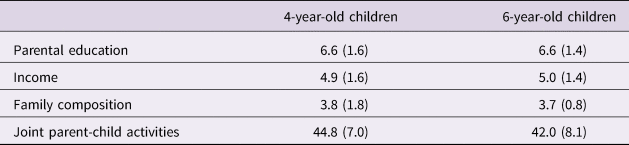
Note. The table reports the variables’ mean (numbers in brackets indicate the standard deviation). For further information on the possible range of the data see 2.4.2.
A Univariate ANOVA with children's mean percentage of trials in which they chose the correct object in the communication task as dependent and communication type (direct, indirect) and age group (4, 6) as independent variables revealed significant main effects of communication type (F(1) = 46.912, p < .001, η2 = .348) and age group (F(1) = 5.261, p = .024, η2 = .056). That is, children responded more correctly after hearing direct utterances compared to indirect ones (direct: M = 94.7, SD = 14.1; indirect: M = 66.7, SD = 20.8). 6-year-old children responded more correctly than 4-year-old children (6-year-olds: M = 81.4, SD = 21.9; 4-year-olds: M = 71.9, SD = 23.1). No interaction was found.
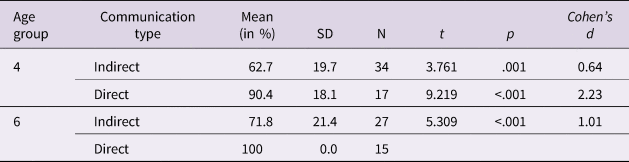
One sample t-test confirmed that children chose objects above chance (see Table 3).
Children's Object Choice in the Communication-Comprehension Task by Age and Communication Type
To assess the influence of socioeconomic status (SES) and socio-cognitive engagement (SCE) on children's communication comprehension, we ran a stepwise linear regression with proportion of correct responses in the communication task as dependent variable. Parental education and income were entered as two separate variables for SES and the sum score of joint parent-child activities and family composition (number of people in the household) were entered as two separate variables for SCE. Regressions were run separately for communication type and age group.
For 4-year-olds’ indirect communication, the regression model revealed a significant effect only for the number of people in the household, explaining 13.9% of children's object-choice performance in the communication task (see Table 4, ps > .07 for the other predictors).
Linear Model of Predictors of Children's Object-Choice in the Communication Task.
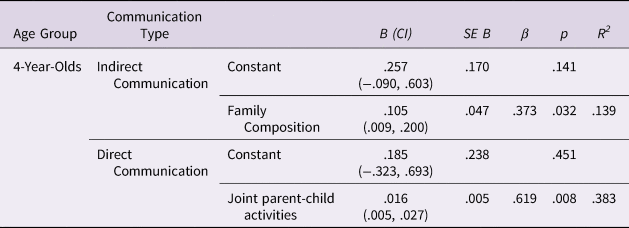
For 4-year-olds’ direct communication, the regression model revealed only a significant effect of the sum score for joint activities on children's object-choice performance, explaining 38.3% of the data (see Table 4, ps > .45 for the other predictors).
For 6-year-olds’ indirect communication, no significant predictor of children's object-choice performance was found (all ps > .16 in an additional linear regression with forced entry of the predictors). For 6-year-olds’ direct communication, no regression model could be calculated due to the children's at-ceiling-performance.
Discussion
In the current study, we aimed at analysing the influence of socioeconomic factors (SES) and socio-cognitive engagement (SCE) on children's language and pragmatic abilities. Specifically, we were interested in the effect of parental education, income, the number of people in the child's home, and joint parent-child activities on 4- and 6-year-old children's comprehension of direct and indirect communication (i.e., relevance implicature).
We found that children of both age groups mastered the communication task in both conditions – however, indirect communicative acts were harder to understand. This result is in line with Bosco and Bucciarelli (Reference Bosco and Bucciarelli2008), who suggested that any communicative act can be performed in more simple and more complex ways and that the simple act is easier to understand than the complex one – since, for the latter, more inferential steps are required for comprehension. The results of the Indirect Communication condition also replicate earlier findings by Schulze and colleagues (Reference Schulze, Grassmann and Tomasello2013).
Regarding the main research question, we first want to note that the SES range was limited as our sample consisted mainly of middle-SES families. We found that SES-variables (parental education and income) did not relate to children's communication comprehension while we found a relation between SCE-variables (joint activities and number of people in the household) and children's communication comprehension. In younger children, parental socio-cognitive engagement predicted children's language and pragmatic abilities. More precisely, direct communication was predicted by the frequency of joint parent-child activities while indirect communication was predicted by the number of people living in their home. The latter is in line with previous research that suggested that frequent switches between communication partners requires that the child needs to flexibly adjust to each communication partner's needs and wants and that this in turn strengthens their ability to make inferences on others’ intentions (Hoff-Ginsberg, Reference Hoff-Ginsberg1998; Wermelinger et al., Reference Wermelinger, Gampe and Daum2017). It also emphasizes the notion that communication and especially inferring others’ intentions is a highly social-cognitive task (e.g., Tomasello, Reference Tomasello2008), one which children perform better the more frequently they interact with different communication partners. The former is in line with previous research suggesting joint parent-child activities as a potential influence on language development (Pace et al., Reference Pace, Luo, Hirsh-Pasek and Golinkoff2017). However, we can only speculate why the joint parent-child activities influenced direct but not indirect communication comprehension and given that the sample size of the Direct Communication condition was rather small, we do this cautiously. One explanation might be that in those activities (such as reading a picture book, playing with the child et cetera), parents label basic-level objects more frequently (e.g., Markman & Wachtel, Reference Markman and Wachtel1988; Mervis & Rosch, Reference Mervis and Rosch1981; Rosch, Reference Rosch1975) and that we also used more basic-level objects in our direct communication condition. In contrast, indirect communication comprehension – that is, the inference on others’ intentions – seems to go beyond such language abilities in that it requires a host of socio-cognitive abilities that seem unaffected by the activities we asked parents about. Future research thus should assess not only the frequency but the quality of joint parent-child activities in order to better explore the nature of its influence.
In older children, we did not find any effects of the variables that predicted younger children's communication competences. We suggest that joint activities and number of people in the household not having a substantial relation to 6-year olds’ communication abilities might be a by-product of the length of their kindergarden stay – both in total years and also in hours per day. In kindergarden, children encounter numerous other people and thus all children have to adjust to others’ communication styles (how they communicate their needs and wants). Also, kindergarden might supersede joint parent-child activities, especially when older children stay longer hours in kindergarden. Thus, especially in older children, further research needs to take educational activities in kindergarden (or schools) into account in order to assess the influence of social (and economic) factors on children's language and pragmatic abilities.
Finally, in line with previous research on children's comprehension of relevance implicatures, we did not find a relation between parental education and children's comprehension of relevance implicatures (Antoniou et al., Reference Antoniou, Veenstra, Kissine and Katsos2020; Bosco & Gabbatore, Reference Bosco and Gabbatore2017; Schulze et al., Reference Schulze, Endesfelder Quick, Gampe and Daum2020). However, this finding needs to be interpreted cautiously as the parental education score of the current sample was skewed to higher educational degrees and the samples as a whole can be described as being of middle socioeconomic status. Recent research specifically investigates the differences between middle-SES and higher-SES samples and found that interaction quality in mother-child dyads affected children's language outcomes – but only in higher-SES samples (Masek, Paterson, Golinkoff, Bakeman, Adamson, Owen, Pace & Hirsh-Pasek, Reference Masek, Paterson, Golinkoff, Bakeman, Adamson, Owen, Pace and Hirsh-Pasek2021). Further research with more diverse samples is necessary in order to investigate the role of SES on children's pragmatic abilities.
Supplementary Material
For supplementary material accompanying this paper, visit https://doi.org/10.1017/S0305000921000295
Acknowledgments
The authors would like to thank Miriam Beneke, Frederike Svensson, Alexander Prasser, and Freya Heun for help with data collection. The authors also thank Katja Kirsche for organizational help, and Elisabeth Schulze for her assistance creating the test stimuli. This research did not receive any specific grant from funding agencies in the public, commercial, or not-for-profit sectors. Requests for the data or materials can be sent via email to the lead author.
Conflict of interest
We have no known conflict of interest to disclose.


 Open access

