


Introduction
Political participation can take shape in many ways, from being a member of a political party, or demonstrating against policy proposals, organizing an activist-group event or boycotting products. A consistent, but nonetheless striking finding, is that the overlap between types of participation is weak to moderate (Dekker et al. Reference Dekker, Koopmans, Van den Broek and Van Deth1997; Teorell et al. Reference Teorell, Torcal, Montero, Van Deth, Montero and Westholm2007; Van der Meer Reference Van der Meer2009; Verba and Nie Reference Verba and Nie1972). This low overlap points to the relevance of understanding differences among types of participants. It raises the question to what extent participants in different forms of political participation are all of one kind, or instead different types of people.
The question whether participants are the same types of people is very relevant for several reasons. First, understanding the differences among groups of participants is important with respect to the democratic function of participation. If different groups of citizens engage in different types of participation, the voices of those groups are only heard equally loud if all types of participation resonate to the same degree in the political arena, which is not the case (Hooghe and Marien Reference Hooghe and Marien2012). Second, the proposition that participation levels are declining (Putnam Reference Putnam2000) is often countered by pointing to new, non-institutional forms of participation (Dalton Reference Dalton2008). If some forms of participation are declining while others are rising, it is essential to know what distinguishes participants in these types of participation from each other.
However, this question is understudied in the comprehensive literature on participation, which has mainly focused on its causes. Many studies have examined the factors at play in the case of specific types of participation, such as political consumerism (Stolle et al. Reference Stolle, Hooghe and Micheletti2005), online participation (Oser et al. Reference Oser, Hooghe and Marien2013), various types of civic participation (Badescu and Neller Reference Badescu, Neller, Van Deth, Montero and Westholm2007; Van der Meer et al. Reference Van der Meer, Te Grotenhuis and Scheepers2009), or causes of a broadly defined type such as civic engagement (Pattie et al. Reference Pattie, Seyd and Whiteley2003). Studies that do compare various types of participants aim to test general patterns, rather than differences between participants (Badescu and Neller Reference Badescu, Neller, Van Deth, Montero and Westholm2007; Johann Reference Johann2012), or focus on the variety of activities people engage in instead of differentiating between activities (Amnå and Ekman Reference Amnå and Ekman2014; Oser Reference Oser2016).
This leaves the differences and similarities between participants engaged in different fields of society understudied. This article aims to differentiate between four types of political participation, building on the typology proposed by Van Deth (Reference Van Deth2014), and proposes two dimensions on which these four types of participation differ: political vs public orientation and formal vs informal organizational structure. It examines to what extent institutional political participants, non-institutional political participants, civic participants, and political consumers are the same kind of people.
I propose to differentiate these types of participants by moving beyond established factors in participation research such as resources, interests, and efficacy. Although these factors clearly explain why people participate, they are likely to be high among all participants and unlikely to differentiate between types of participants. Building on insights from studies that propose the “matching hypothesis” (Clary et al. Reference Clary, Snyder, Ridge, Copeland, Stukas, Haugen and Miene1998; Clary and Snyder Reference Clary and Snyder1999; Granik Reference Granik2005), I assume that people participate in an organization, movement or initiative that matches their societal outlook. I expect three aspects of the societal outlook to differentiate among participants: societal pessimism, political trust and social trust.
In what follows, I first discuss the typology of participation used in this article, the formal/informal and political/public dimensions in which the four types of participation differ, and why societal outlook can be expected to differentiate participants from each other. After discussing the choice of data and method, I present the logistic regressions’ results and finally I turn to the conclusions and implications.
Theory
Types of Participation
The comprehensive literature on civic engagement lacks consensus on both a definition of civic engagement or the less broad concept of political participation, and the types of participation that these definitions encompass (Adler and Goggin Reference Adler and Goggin2005; Berger Reference Berger2009; Van Deth Reference Van Deth2014). Consequently, the typologies of participation used are also diverse. Some studies consider civic engagement and examine all types of civic and political participation in the public domain (Brady et al. Reference Brady, Verba and Schlozman1995; Pattie et al. Reference Pattie, Seyd and Whiteley2003). Many focus on either political (Cohen et al. Reference Cohen, Vigoda and Samorly2001; Scott and Acock Reference Scott and Acock1979; Teorell et al. Reference Teorell, Torcal, Montero, Van Deth, Montero and Westholm2007; Vecchione and Caprara Reference Vecchione and Caprara2009) or civic participation (Badescu and Neller Reference Badescu, Neller, Van Deth, Montero and Westholm2007; Van der Meer et al. Reference Van der Meer, Te Grotenhuis and Scheepers2009). Some focus on non-institutional political participation such as consumer participation (Stolle et al. Reference Stolle, Hooghe and Micheletti2005), or the difference between online and offline participation (Oser et al. Reference Oser, Hooghe and Marien2013). Some authors compare between institutional and non-institutional political participation (Ekman and Amnå Reference Ekman and Amnå2012; Hooghe and Marien Reference Hooghe and Marien2013; Sabucedo and Arce Reference Sabucedo and Arce1991), between individual and collective participation (Ekman and Amnå Reference Ekman and Amnå2012; Pattie et al. Reference Pattie, Seyd and Whiteley2003; Quintelier and Hooghe Reference Quintelier, Hooghe, Van Deth and Maloney2012; Van Deth Reference Van Deth, Van Deth and Maloney2012), or between types of disengagement and activity (Amnå and Ekman Reference Amnå and Ekman2014; Oser Reference Oser2016).
A consistent, striking finding is that the overlap between types of participation is weak to moderate (Verba and Nie Reference Verba and Nie1972; Dekker et al. Reference Dekker, Koopmans, Van den Broek and Van Deth1997; Teorell et al. Reference Teorell, Torcal, Montero, Van Deth, Montero and Westholm2007; Van der Meer Reference Van der Meer2009). A mean correlation of .25 across thirteen types of participation indicates a “weak unitary model of participation,” whereas within categories, the correlations are moderate but not high, except for different instances of voting (Verba and Nie Reference Verba and Nie1972: 58–59). These outcomes point to the relevance of both categorizing types of participation and understanding differences among types of participants.
The typology used here builds on the conceptualization and categorization of political participation of Van Deth (Reference Van Deth2014). After narrowing political participation to voluntary activities by citizens, he distinguishes four types of political participation: (1) activities in the sphere of politics/government/the state, (2) activities targeted at the sphere of politics/government/the state, (3) activities aimed at solving collective or community problems, and (4) activities used to express political aims and intentions. I use these four types under the following common labels: (1) institutional political participation, (2) non-institutional political participation, (3) civic participation and (4) political consumerism. This typology of Van Deth (Reference Van Deth2014) stands out in two ways. First, in contrast to other studies (e.g., Hooghe and Marien Reference Hooghe and Marien2013; Marien et al. Reference Marien, Hooghe and Quintelier2010), he distinguishes political consumerism from non-institutional political participation, such as demonstrating and signing petitions. The rationale for this distinction is that boycotting products itself is not a political activity, but the intentions behind it (can) make it political. Still, the focus of this type of participation is not necessarily the political realm, but can also be for instance producers and multinationals. Second, he calls all these four types of participation political participation, in contrast to authors that define participation belonging in the third category as civic and/or social participation (Badescu and Neller Reference Badescu, Neller, Van Deth, Montero and Westholm2007; Van der Meer et al. Reference Van der Meer, Te Grotenhuis and Scheepers2009).
I use the typology of Van Deth (Reference Van Deth2014) with one adaptation, namely the meaning of civic participation. He defines this in a very broad way, including neighborhoods committees and street parties. Instead, I narrow civic participation here to activities that aim to improve society, such as participation in interest groups and charity organizations. Events with a purely social character, such street barbeques and leisure groups, I do not include, because I assume that the motivation to join these groups and or events is not (partly) related to aims of societal change.
Institutional political participation can be defined as “all acts directly related to the institutional process” (Hooghe and Marien Reference Hooghe and Marien2013: 133).Footnote 1 Acts of non-institutional political participation can be characterized as attempts to influence the state or politics from outside the political system (Hooghe and Marien Reference Hooghe and Marien2013; Sabucedo and Arce Reference Sabucedo and Arce1991). Building on the literature (Badescu and Neller Reference Badescu, Neller, Van Deth, Montero and Westholm2007; Van der Meer Reference Van der Meer2009; Van Deth Reference Van Deth2014), civic participation in this article refers to voluntary participation in organizations in the public domain but outside the institutional political domain, which aim to contribute to a specific collective problem or a specific community. It includes interest groups and activists groups, charitable organizations and citizens’ initiatives (Badescu and Neller Reference Badescu, Neller, Van Deth, Montero and Westholm2007; Van der Meer et al. Reference Van der Meer, Te Grotenhuis and Scheepers2009). Finally, political consumerism can be defined as “consumer choice of producers and products based on political or ethical considerations, or both” (Stolle et al. Reference Stolle, Hooghe and Micheletti2005: 246).
These four types of participation all aim to improve society, but in different ways. Table 1 presents a two by two table that presents two dimensions on which these four types of participation differ: the extent to which the aims are political or public and the extent to which the participation is embedded in a formal organizational structure or an informal one. First, institutional political participation and non-institutional political participation both aim to influence political actors, such as politicians, Parliament and/or the government, while civic participation and political consumerism as conceptualized above focus more broadly at society at large, including, but not firstly or mostly, the political domain. Second, the four types of participation differ in organizational structure. It goes without saying that institutional political participation takes place in a formal, organized group, namely political parties and/or institutions. Also civic participation usually takes place in an organizational setting. In comparison, both non-institutional political participation and political consumerism are rather informal, as they take place outside institutions and organizations and rely on ad hoc participation. Although, of course, actions can be initiated by more long-term action groups, people in protest types of participation such as demonstrations or signing petitions can, but do not need to, commit to more than occasional engagement. Political consumerism is even an individual act that occurs outside any organizational setting, although people can be and/or feel part of a larger movement. In contrast, institutional political participation and civic participation take place in (more) formal organizations and demand more long-term commitment from the start.
Two dimensions in types of political participation

Main focus of actions |
|||
|---|---|---|---|
Political |
Public |
||
Organizational structure |
Formal |
Institutional political participation |
Civic participation |
Informal |
Non-institutional political participation |
Political consumerism |
|
Differentiating Participants by Their Outlook on Society
Surprisingly, the literature does not offer a clear expectation which characteristics can differentiate between participants. The central focus of the literature has been not on which type of participation people engage in, but on explaining why people participate, yielding established factors of participation, such as resources (as in time, money, education, or income), political efficacy, political interest, social network, and incentives or motivations (e.g., Clary et al. Reference Clary, Snyder, Ridge, Copeland, Stukas, Haugen and Miene1998; Granik Reference Granik2005; Pattie et al. Reference Pattie, Seyd and Whiteley2004).
However, individuals in different types of participation are likely to score similarly on these established factors. From the studies that compare various groups of participants, it can be concluded that although the effect sizes of these factors may differ to some extent, the direction of the effects is the same (Badescu and Neller Reference Badescu, Neller, Van Deth, Montero and Westholm2007; Hooghe and Marien Reference Hooghe and Marien2013; Johann Reference Johann2012; Marien et al. Reference Marien, Hooghe and Quintelier2010; Quintelier and Hooghe Reference Quintelier, Hooghe, Van Deth and Maloney2012; Van der Meer et al. Reference Van der Meer, Te Grotenhuis and Scheepers2009; Van Deth Reference Van Deth, Van Deth and Maloney2012). For instance, people involved in boycotting are not distinct from the other types of participants under study (Van Deth Reference Van Deth, Van Deth and Maloney2012). Two studies on types of civic participants also show no diverging patterns in the characteristics studied (namely, education, employment, size of locality, network, social trust, church attendance and civic duty), only a smaller or larger influence of the characteristics considered (Badescu and Neller Reference Badescu, Neller, Van Deth, Montero and Westholm2007), or only a difference in source of income but not in educational level, income level or political interest (Van der Meer et al. Reference Van der Meer, Te Grotenhuis and Scheepers2009). It is likely that the similarity of the effects of the established factors lies in similar mechanisms driving them (Bekkers and Wiepking Reference Bekkers and Wiepking2011). Two exceptions are demographic characteristics, namely age and gender. Younger people (< 45 years) and women tend to be more often active in non-institutionalized political participation, while men and older citizens instead are more often involved in institutionalized political participation (Hooghe and Marien Reference Hooghe and Marien2013; Stolle and Hooghe Reference Stolle and Hooghe2011).
In contrast to the established factors, on which groups of participants often score similarly, several studies indicate that social attitudes do differentiate between types of participants (e.g., Hooghe and Marien Reference Hooghe and Marien2013; Stolle and Hooghe Reference Stolle and Hooghe2011). Building on those insights, this article suggests to focus on the societal outlook in order to distinguish groups of participants. It is likely that people participate in an organization, group or movement of people who “think like them,” i.e., who have the same worldview. Clary and Snyder propose the “matching hypothesis,” which states that participation results from congruence between individual and organizational values (Clary et al. Reference Clary, Snyder, Ridge, Copeland, Stukas, Haugen and Miene1998; Clary and Snyder Reference Clary and Snyder1999; Granik Reference Granik2005). They show that indeed values, namely: “I feel compassion toward people in need,” “I feel it is important to help others,” “I can do something for a cause that is important to me” matter in distinguishing non-participants from participants, but they conclude the article by stating that it is likely that different types of participation differ in specific motivations, and that this asks for further study (Clary et al. Reference Clary, Snyder, Ridge, Copeland, Stukas, Haugen and Miene1998). Building on this, I theorize that values, such as how important it is to people to contribute to society and/or other people might explain who participates, and that more specific views, namely attitudes, explain which type of participation people engage in.
Before discussing the attitudes that I expect to differentiate between participants and why, I want to stress that the causality of the association between attitudes and participation is not addressed here. My aim is to differentiate types of participants from each other, and not to examine whether the differentiation took place before or because of people’s participation.
Patterns of Societal Pessimism, Political Trust, and Social Trust Among Participants
How do the three attitudes differentiate among the four types of participants? Many studies on participation include political or social trust, or they focus on a specific type of participation, rather than comparing multiple groups (Allum et al. Reference Allum, Patulny, Read, Sturgis, Stillwell, Norman and Thomas2010; Hooghe and Marien Reference Hooghe and Marien2013; Kaase Reference Kaase1999; Stolle et al. Reference Stolle, Hooghe and Micheletti2005; Suh et al. Reference Suh, Yee and Chang2013). Below, I theorize why societal pessimism, political trust, and social trust are likely to differentiate the four types of participants from each other.
The few studies on societal pessimism show that a large part of the citizenry in advanced western democracies can be described as pessimistic about society (European Commission 2013; Gallup 2014; Steenvoorden and Van der Meer Reference Steenvoorden and Van der Meer2017). Societal pessimism can be defined as a sentiment among citizens that their society is in decline and refers to a sense of unmanageable deterioration of society and collective powerlessnessFootnote 2 to stop that deterioration (Steenvoorden Reference Steenvoorden2015). Other related concepts are cultural pessimism (Bennett Reference Bennett2001), social actualization, the “evaluation of the potential and trajectory of society” (Keyes Reference Keyes1998: 122), and optimism, “a view that the future will be better than the past and the belief that we can control our environment so as to make it better” (Uslaner Reference Uslaner2002: 81). To my knowledge, the only previous study on societal pessimism and participation is that of Uslaner and Brown (Reference Uslaner and Brown2005), who find a negative relationship between societal optimism and political institutional, political non-institutional and civic participation, but their aggregated, state-level data from the USA do not inform us on the individual-level relations in which I am interested here.
If people perceive unmanageable societal deterioration, and collective powerlessness to stop the decline, it is unlikely that they expect improvement in our conditions can easily be made. I expect societal pessimism to indicate whether people believe change is possible within institutions or organizations (political and non-political), or whether they instead do not expect that change can be (easily) established and are primarily interested in expressing their discontent through protest. This means that I think that societal pessimism distinguishes between institutional political participation and civic participation, on the one hand, and non-institutional political participation and political consumerism, on the other hand.
Given the overlap in types of participation it is theoretically—and, as I will show, empirically—unjust to formulate hypotheses on mutually exclusive groups. Moreover, differentiating between all possible combinations of participation would give us no theoretical grounds to build the expectations on. Therefore, I use hypotheses that describe the relationships between attitudes and types of participation, not comparisons of types of participation.
H1: societal pessimism is negatively related to institutional political participation
H2: societal pessimism is positively related to non-institutional political participation
H3: societal pessimism is negatively related to civic participation
H4: societal pessimism is positively related to political consumerism
Both political trust and social trust can be expected to offer insight into whether people want to participate within or outside the political institutional domain. Starting with political trust, we have to differentiate between trust in the political community, the political regime (performance and institutions), and the political authorities or incumbents (Easton Reference Easton1975; Norris Reference Norris2011). Here, I focus on trust in the political regime and political authorities: It is likely that people engage in participation because they are either dissatisfied or inspired by the political leaders and political institutions in their country, and not so much the political community. One applicable definition of political trust is that it is “the probability … that the political system (or some part of it) will produce preferred outcomes even if left unattended” (Gamson Reference Gamson1968: 54).
Research that compares participants to the general population demonstrates that participants’ levels of political trust vary. Political trust is found to be positively related to institutional political participation but negatively related to non-institutional political participation (Barnes and Kaase Reference Barnes and Kaase1979; Hooghe and Marien Reference Hooghe and Marien2013; Vráblíková Reference Vráblíková2013) and political consumerism (Newman and Bartels Reference Newman and Bartels2011; Stolle et al. Reference Stolle, Hooghe and Micheletti2005). Intuitively, this makes sense: Why would one engage in a political party if one does not trust political parties, politicians, or the political system? Conversely, if you distrust political institutions and authorities, it is likely that you express your dissatisfaction or frustration with how things are going or decisions made outside the political setting, thus in non-institutional political participation and/or political consumerism. Therefore, I follow this logic in comparing participants only.
To my knowledge, the relationship between political trust and civic participation is only sporadically discussed in the literature. The few available studies show that people involved in civic participation are politically distrustful (Brehm and Rahn Reference Brehm and Rahn1997; Eliasoph Reference Eliasoph1998). Brehm and Rahn theorize that this negative relationship follows from a do-it-yourself mentality (Reference Brehm and Rahn1997). Therefore, I expect civic participants to be political distrustful compared to other participants. With regard to political trust, I formulate the following hypotheses:
H5: political trust is positively related to institutional political participation
H6: political trust is negatively related to non-institutional political participation
H7: political trust is negatively related to civic participation
H8: political trust is negatively related to political consumerism
Two streams of literature suggest different conceptualizations of social trust, namely strategic trust (based on one’s interests), which follows a rational choice logic (Hardin Reference Hardin2002), and generalized trust (based on an outlook on human nature), which sees trust as resulting from culture and socialization (Uslaner Reference Uslaner2002). Following the literature on participation, I focus on generalized social trust. This can be defined as “the idea that most people can be trusted” (Uslaner Reference Uslaner2002: 5) and is based on “the perception that most people are part of your moral community” (Uslaner Reference Uslaner2002: 26).
Although cause and consequence are debated, social trust, as a form of social capital, is seen as one of the merits of social and civic involvement (Putnam Reference Putnam1993, Reference Putnam2000). It stimulates and results from participation in organizations, actions, or initiatives of that community and thereby overcomes collective action problems in producing public goods (for an overview of the literature, see Van Deth Reference Van Deth2001). Many studies that compare participants to the general population show that social trust is positively related to civic participation (e.g., Badescu and Neller Reference Badescu, Neller, Van Deth, Montero and Westholm2007; Dekker et al. Reference Dekker, Koopmans, Van den Broek and Van Deth1997; Uslaner and Brown Reference Uslaner and Brown2005).
In the case of non-institutional political participation and political consumerism, social trust can overcome collective action problems. Social trust can be expected to have a positive effect because “the threshold for political action for trusting individuals should be lower than for non-trusting individuals because the former have more generous estimates of the number of people who will join them in protest” (Benson and Rochon Reference Benson and Rochon2004: 438). This increases the perceived likeliness that a protest will have results; if many people join, it is more likely to have consequences. The positive relationship between social trust and non-institutional political participation is indeed underlined by many studies (Benson and Rochon Reference Benson and Rochon2004; Hooghe and Marien Reference Hooghe and Marien2013; Kaase Reference Kaase1999). In the case of political consumerism, previous studies find no relationship with social trust (Pattie et al. Reference Pattie, Seyd and Whiteley2003; Stolle et al. Reference Stolle, Hooghe and Micheletti2005). This could be due to the fact that it is a more individualistic type of participation than non-institutional political participation. Nevertheless, it can be expected that people boy/buycott certain products with the idea that they are not the only ones, and that they expect more people to do so.
In contrast, institutional political participation is not per se driven by membership in a generalized community; instead, it is driven by political camps that have very different ideas and values about what should be done. “The spirit of cooperation that underlies generalized trust is absent in political activity, which reinforces particularized trust [trust in your own group] at the expense of generalized trust” (Uslaner and Brown Reference Uslaner and Brown2005: 875). Therefore, several authors expect and find a negative association between social (generalized) trust and institutional political participation compared to the general population (Hooghe and Marien Reference Hooghe and Marien2013; Kim Reference Kim2005; Pattie et al. Reference Pattie, Seyd and Whiteley2003; Uslaner and Brown Reference Uslaner and Brown2005). In this article, I follow the result of these studies on the whole population in formulating hypothesis about participants only. Table 2 provides an overview of all of the hypotheses posited in this article.
Summary of hypotheses

Institutional political participation |
Non-institutional political participation |
Civic participation |
Political consumerism |
|
|---|---|---|---|---|
Societal pessimism |
− |
+ |
− |
+ |
Political trust |
+ |
− |
− |
− |
Social trust |
− |
+ |
+ |
+ |
H9: social trust is negatively related to institutional political participation
H10: social trust is positively related to non-institutional political participation
H11: social trust is positively related to civic participation
H12: social trust is positively related to political consumerism
Data and Method
Data
To test the hypotheses, I use the European Social Survey from 2006 (wave 3), which includes variables on not only all four types of participation and the three attitudes under study, but also on many of the established factors of political participation. I included data on individuals 18 years and older from 19 European countriesFootnote 3 in the analyses. I excluded Russia and Ukraine because they score not/partially free on the Freedom House indexFootnote 4 which may affect political participation, and Estonia and Hungary because in these countries level of income is not measured.
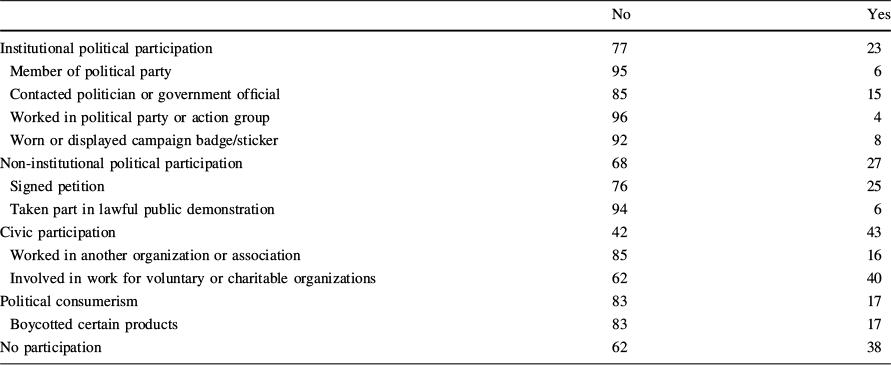
The four types of participation are measured by one or several items on specific forms of participation: A yes on one of the items establishes a yes on being such a type of participant. A general introduction preceded eight out of the nine items: “There are different ways of trying to improve things in [country] or help prevent things from going wrong. During the last 12 months, have you done any of the following:” The exception is one item on civic participation, “Involved in work for voluntary or charitable organization”. The operationalizations are presented in Table 3, as well as the percentage of respondents involved (including non-participants). All of the items are dummies (did/did not participate in the last 12 months), except for the last item on civic participation, which is recoded to 0 (never) or 1 (ranging from at least every 6 months to at least every week). Respondents with missing values on any of the nine items are excluded from the regression analyses, because they cannot be placed into a group of participants. Among the participants, this applies to 293 respondents, resulting in a final number of 15,321 respondents. Table 3 shows that civic participation (43%) is relatively popular compared to institutional political participation (23%), non-institutional political participation (27%), and political consumerism (17%). It also tells us that 38% of respondents do not participate in any form of participation measured here.
Measures of types of political participation (in %).

No |
Yes |
|
|---|---|---|
Institutional political participation |
77 |
23 |
Member of political party |
95 |
6 |
Contacted politician or government official |
85 |
15 |
Worked in political party or action group |
96 |
4 |
Worn or displayed campaign badge/sticker |
92 |
8 |
Non-institutional political participation |
68 |
27 |
Signed petition |
76 |
25 |
Taken part in lawful public demonstration |
94 |
6 |
Civic participation |
42 |
43 |
Worked in another organization or association |
85 |
16 |
Involved in work for voluntary or charitable organizations |
62 |
40 |
Political consumerism |
83 |
17 |
Boycotted certain products |
83 |
17 |
No participation |
62 |
38 |
All items but one (“Involved in work for voluntary or charitable organizations”) answer the following question: “There are different ways of trying to improve things in [country] or help prevent things from going wrong. During the last 12 months, have you done any of the following”
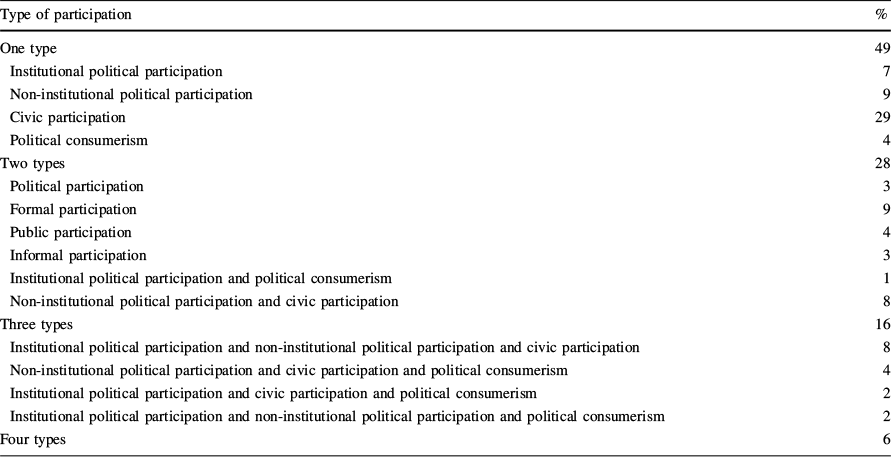
Table 4 shows the percentages of all possible participation combinations, from which follows that half (49%) of all participants engage in only one type of political participation, 28% of respondents is involved in two types of participation, 16% in three types, and 6% in all four types. We can conclude on the one hand that the largest group of participants engages in one type of participation, as suggested in the literature (Keeter et al. Reference Keeter, Zukin, Andolina and Jenkins2002; Verba and Nie Reference Verba and Nie1972). On the other hand, the overlap indicates that we cannot view these types of participants as entirely different people. Therefore, I control for this overlap in the analyses, which I clarify in the next section.
Overlap between types of political participation

Type of participation |
% |
|---|---|
One type |
49 |
Institutional political participation |
7 |
Non-institutional political participation |
9 |
Civic participation |
29 |
Political consumerism |
4 |
Two types |
28 |
Political participation |
3 |
Formal participation |
9 |
Public participation |
4 |
Informal participation |
3 |
Institutional political participation and political consumerism |
1 |
Non-institutional political participation and civic participation |
8 |
Three types |
16 |
Institutional political participation and non-institutional political participation and civic participation |
8 |
Non-institutional political participation and civic participation and political consumerism |
4 |
Institutional political participation and civic participation and political consumerism |
2 |
Institutional political participation and non-institutional political participation and political consumerism |
2 |
Four types |
6 |
Turning to the independent variables, societal pessimism is measured by the sum score of two items: “For most people in [country], life is getting worse” and “Hard to be hopeful about the future of the world” (r = .48).Footnote 5 These items both adequately measure the core of societal pessimism, given that they capture a diffuse concern about society in general going in the wrong direction. Although ideally this correlation would be higher, it is not overly surprising, given the fact the first item is more socioeconomic and the second is very general. Because both aspects are important to include in a measure of societal pessimism, the best option use them both. Moreover, these two items are also used in previous studies on societal pessimism (Steenvoorden and Harteveld Reference Steenvoorden and Harteveld2017) and on related concepts like social actualization “the world is becoming a better place for everyone” (Keyes Reference Keyes1998; Keyes and Shapiro Reference Keyes, Shapiro, Brim, Ryff and Kessler2004) and (a lack of) optimism, “the lot of the average person is getting worse” (Uslaner Reference Uslaner2002; Uslaner and Brown Reference Uslaner and Brown2005).
Political trust is measured by the sum score of three items, which ask people how much they trust politicians, political parties, and Parliament on a scale from 0 to 10. These items show correlations ranging from .69 to .86. Social trust is also measured by the sum score of three items on a scale from 0 to 10: “Most of the time people are helpful or mostly looking out for themselves,” “Most people try to take advantage of you if they had the chance, or try to be fair,” and “Most people can be trusted or you can’t be too careful in dealing with people”. The correlations range from .49 to .57. I standardized the resulting scales of societal pessimism, political trust, and social trust to facilitate direct coefficient comparison within models. The scales correlate at − .35 (societal pessimism and political trust), − .35 (societal pessimism and social trust), and .42 (political trust and social trust).Footnote 6
Of course, I control for a range of factors that are known in the literature to affect participation (e.g., Armingeon Reference Armingeon, Van Deth, Montero and Westholm2007; Badescu and Neller Reference Badescu, Neller, Van Deth, Montero and Westholm2007). For example, gender, age groups (18–34, 35–54, 55 +), resident in a rural area or small city versus (the suburbs of) a large city, marital status (married or official partner vs. divorced/separated, widowed or single), size of household, number of children, and level of religiosity (“How often attend religious services apart from special occasions,” ranging 1–7: never to every day) are included as established demographic factors related to political participation. As an assurance that the measure of societal pessimism reflects only sociotropic concerns, I include a variable on satisfaction with life as a whole, ranging from 0 to 10.Footnote 7
I also control for established factors in participation research, namely resources, political interest, and political efficacy. Resources are operationalized with educational level (low, medium, or high), source of income (salary or profit vs. pension, unemployment benefit, other benefit or other source), and level of income (household’s total net income, in 12 categories). Political interest is measured with two variables: An item asking how interested one is in politics on a 1–4 scale, and the ratio of time spent following political news and current affairs on TV to all time spent watching TV. Political efficacy is measured by the sum score of two items: “Politics is too complicated to understand” (reversed) and “Making mind up about political issues,” ranging from 1 to 5, indicating very difficult to very easy (r = .49).
Method
Because the four groups of participants overlap, separate logistic regression analyses for the four types of participation are the most appropriate research method. This is to be preferred over excluding participants in more than one type of participation, which non-randomly excludes 51% of all respondents, or to perform multinomial analysis on all groups in Table 3, which would disable a comparison of four types of participation. Still, controlling for the overlap in types of participation is needed because the people who participate in more than one type come from a specific group—the relatively highly educated and efficacious—which otherwise dominates the analyses and yields different results. Therefore, I include a dummy in all analyses, which is 1 when respondents participate in more than one type of participation. This means the higher chance of participation for people engaged in two, three, or four types is accounted for with the dummy and does not mediate through other variables.Footnote 8 As mentioned above, all non-participants are excluded from the analyses, because they are not the focus of this study and might blur the differences between types of participation. The results of the logistic regressions of the four types of participation are then compared to draw conclusions. In all regressions, I eliminate all cross-national variance in the dependent variables by including country dummies and deal with the error structure by using clustered robust standard errors. As robustness checks, I repeated the logistic analyses for the nine items that constitute the four types of participation separately and I repeated the analyses with non-participants (see Appendix Table 10).
Results
Correlations Between Types of Participation
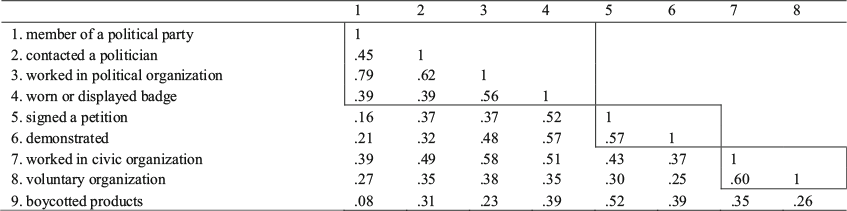
To examine the interrelatedness of the forms of participation, I show the correlations between all nine items on political participation (within-type correlations in boxes). In the literature, correlations are often reported to be low (.0–.3) to moderate (.3–.5) between types of participation, whereas within types of participation correlations range widely, from low to strong (> .5) (Teorell et al. Reference Teorell, Torcal, Montero, Van Deth, Montero and Westholm2007; Verba and Nie Reference Verba and Nie1972). Table 5 indeed shows that correlations between types of participation are mostly low to moderate, with a few exceptions (such as wearing a badge), and that within-type correlations vary considerably, from .39 to .79.
Correlations between the items on participation including non-participants.

These are tetrachoric correlations because the variables are dummies. The correlations shown are significant at p < .05
Table 6, shows the correlations for the participants only, as the logistic regressions also exclude non-participants. And that paints a different picture: correlations are overall much lower, some lose significance (and therefore not reported), and some turn out to be negative. From the differences between Tables 5 and 6, we can draw several important conclusions. First, correlations between types of participation are “artificially” high because non-participation on one type is positively related to non-participation on another type. Second, participation in one type does not always increase participation in another type. Instead, some types of participation show a negative correlation, meaning the opposite is in fact true. Finally, these correlations underline the need to establish what differentiates types of participants, because they are even less alike when we look at them without the “noise” of the non-participants.
Correlations between the items on participation excluding non-participants.

These are tetrachoric correlations because the variables are dummies. The correlations shown are significant at p < .05
Examining Differences Among Types of Participants
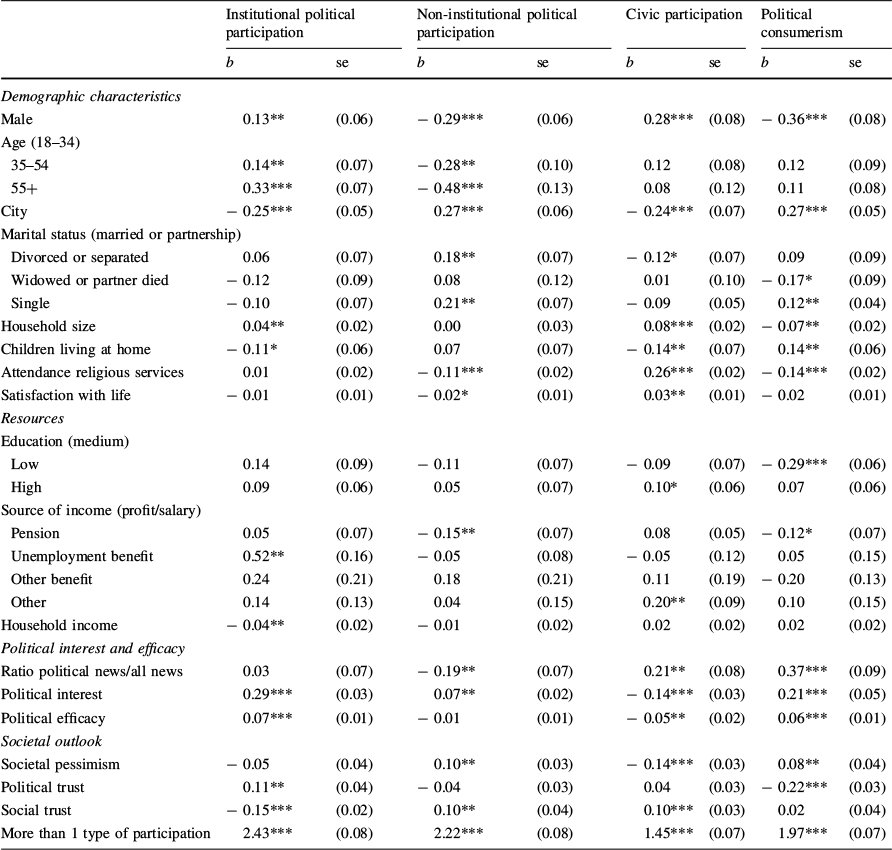
Table 7 shows the results of the logistic regression analyses (the country dummies are not shown for reasons of space), and Table 8 summarizes which hypotheses are supported and which are rejected (the latter between brackets). If we first look at the coefficients of societal pessimism, the results are in line with three of the four hypotheses on this attitude. Societal pessimism is positively related to non-institutional political participation and political consumerism, which means that people involved in both non-institutionalized, protest types of participation (namely demonstrating and signing petitions) as well as political consumerism (boycotting products) are indeed relatively pessimistic about society, which is in line with H2 and H4. The significant negative relationship between societal pessimism and civic participation supports H3; civic participants are relatively optimistic about society. However, the relationship between societal pessimism and institutional political participation is not significant and the expected negative relationship (H1) is not supported by the data.
Logistic regression analyses of four types of political participation.

Institutional political participation |
Non-institutional political participation |
Civic participation |
Political consumerism |
|||||
|---|---|---|---|---|---|---|---|---|
b |
se |
b |
se |
b |
se |
b |
se |
|
Demographic characteristics |
||||||||
Male |
0.13** |
(0.06) |
− 0.29*** |
(0.06) |
0.28*** |
(0.08) |
− 0.36*** |
(0.08) |
Age (18–34) |
||||||||
35–54 |
0.14** |
(0.07) |
− 0.28** |
(0.10) |
0.12 |
(0.08) |
0.12 |
(0.09) |
55+ |
0.33*** |
(0.07) |
− 0.48*** |
(0.13) |
0.08 |
(0.12) |
0.11 |
(0.08) |
City |
− 0.25*** |
(0.05) |
0.27*** |
(0.06) |
− 0.24*** |
(0.07) |
0.27*** |
(0.05) |
Marital status (married or partnership) |
||||||||
Divorced or separated |
0.06 |
(0.07) |
0.18** |
(0.07) |
− 0.12* |
(0.07) |
0.09 |
(0.09) |
Widowed or partner died |
− 0.12 |
(0.09) |
0.08 |
(0.12) |
0.01 |
(0.10) |
− 0.17* |
(0.09) |
Single |
− 0.10 |
(0.07) |
0.21** |
(0.07) |
− 0.09 |
(0.05) |
0.12** |
(0.04) |
Household size |
0.04** |
(0.02) |
0.00 |
(0.03) |
0.08*** |
(0.02) |
− 0.07** |
(0.02) |
Children living at home |
− 0.11* |
(0.06) |
0.07 |
(0.07) |
− 0.14** |
(0.07) |
0.14** |
(0.06) |
Attendance religious services |
0.01 |
(0.02) |
− 0.11*** |
(0.02) |
0.26*** |
(0.02) |
− 0.14*** |
(0.02) |
Satisfaction with life |
− 0.01 |
(0.01) |
− 0.02* |
(0.01) |
0.03** |
(0.01) |
− 0.02 |
(0.01) |
Resources |
||||||||
Education (medium) |
||||||||
Low |
0.14 |
(0.09) |
− 0.11 |
(0.07) |
− 0.09 |
(0.07) |
− 0.29*** |
(0.06) |
High |
0.09 |
(0.06) |
0.05 |
(0.07) |
0.10* |
(0.06) |
0.07 |
(0.06) |
Source of income (profit/salary) |
||||||||
Pension |
0.05 |
(0.07) |
− 0.15** |
(0.07) |
0.08 |
(0.05) |
− 0.12* |
(0.07) |
Unemployment benefit |
0.52** |
(0.16) |
− 0.05 |
(0.08) |
− 0.05 |
(0.12) |
0.05 |
(0.15) |
Other benefit |
0.24 |
(0.21) |
0.18 |
(0.21) |
0.11 |
(0.19) |
− 0.20 |
(0.13) |
Other |
0.14 |
(0.13) |
0.04 |
(0.15) |
0.20** |
(0.09) |
0.10 |
(0.15) |
Household income |
− 0.04** |
(0.02) |
− 0.01 |
(0.02) |
0.02 |
(0.02) |
0.02 |
(0.02) |
Political interest and efficacy |
||||||||
Ratio political news/all news |
0.03 |
(0.07) |
− 0.19** |
(0.07) |
0.21** |
(0.08) |
0.37*** |
(0.09) |
Political interest |
0.29*** |
(0.03) |
0.07** |
(0.02) |
− 0.14*** |
(0.03) |
0.21*** |
(0.05) |
Political efficacy |
0.07*** |
(0.01) |
− 0.01 |
(0.01) |
− 0.05** |
(0.02) |
0.06*** |
(0.01) |
Societal outlook |
||||||||
Societal pessimism |
− 0.05 |
(0.04) |
0.10** |
(0.03) |
− 0.14*** |
(0.03) |
0.08** |
(0.04) |
Political trust |
0.11** |
(0.04) |
− 0.04 |
(0.03) |
0.04 |
(0.03) |
− 0.22*** |
(0.03) |
Social trust |
− 0.15*** |
(0.02) |
0.10** |
(0.04) |
0.10*** |
(0.03) |
0.02 |
(0.04) |
More than 1 type of participation |
2.43*** |
(0.08) |
2.22*** |
(0.08) |
1.45*** |
(0.07) |
1.97*** |
(0.07) |
Coefficients are log odds, with *p < 0.05; **p < 0.01; ***p < 0.001 (one-sided tests)
Supported and rejected (between brackets) hypotheses

Institutional political participation |
Non-institutional political participation |
Civic participation |
Political consumerism |
|
|---|---|---|---|---|
Societal pessimism |
(−) |
+ |
− |
+ |
Political trust |
+ |
(−) |
(−) |
− |
Social trust |
− |
+ |
+ |
(+) |
When we turn to political trust, we see that people involved in political parties and with politicians indeed are more trusting of these actors and institutions than people who do not participate in this way, in line with H5. The expected negative relationship with political consumerism (H8) is also supported. Surprisingly, this is not the case for non-institutional political participation. In contrast to previous studies that measure non-institutional political participation including boycotting (Barnes and Kaase Reference Barnes and Kaase1979; Hooghe and Marien Reference Hooghe and Marien2013; Vráblíková Reference Vráblíková2013), the current measure with only demonstrating and signing petitions does not find this negative relationship with political trust. Possible, the effect found in previous studies is mainly driven by boycotting. Also the hypothesis on the negative relationship between political trust and civic participation needs to be rejected. This differs from in earlier studies that report this group as low in political trust (Brehm and Rahn Reference Brehm and Rahn1997; Eliasoph Reference Eliasoph1998). An explanation for this different finding could be that these previous studies focus on a broader range of civic participation and that they include social participation. The unexpected non-findings in the case of H6 and H7 could also be the result of the fact that non-participants are excluded here, in contrast to previous studies. That turns out not to be the case: the analyses in Table 10 in the Appendix include non-participants and yield the same conclusions with regard to H6 and H7.
Moving on to social trust, Table 7 shows social trust to be negatively related to institutional political participation, as hypothesized (H9). People involved in institutional politics are less trusting of the general other than are other types of participants, and social trust is positively related to civic participation (H10) and non-institutional political participation (H11), also in line with my expectations. However, social trust does not relate significantly to political consumerism. This is in line with previous studies (Pattie et al. Reference Pattie, Seyd and Whiteley2003; Stolle et al. Reference Stolle, Hooghe and Micheletti2005) and may underline the individual nature of political consumerism. It also stresses the need to differentiate political consumerism from non-institutional political participation.
Overall, the results support eight out of the twelve hypotheses on the relationships between the three societal attitudes and four types of participation. The societal outlook of the four groups of participants can be summarized as follows: Institutional political participants trust politics rather than people, non-institutional political participants are societal pessimists who trust other people, civic participants are societal optimists who trust other people, and political consumers are pessimists who do not trust politics.
Several of the control variables also show significance in differentiating between types of participation. Men are more often involved in formal and women in informal participation. The youngest age group (18–35) is more often involved in political non-institutional political participation, whereas the oldest age group (55 +) is more often involved in institutional political participation. Urban inhabitants and singles are more often non-institutional political participants and political consumerism, while in rural areas the other two types of participation are more common. Children living at home increase the chance on political consumerism, but decrease civic participation. Low-educated people are less likely to be political consumers, and the unemployed are more likely to engage in institutional political participation. Civic participants are less politically interested or politically efficacious than the other three groups. Political consumers stand out in their attention to political news.
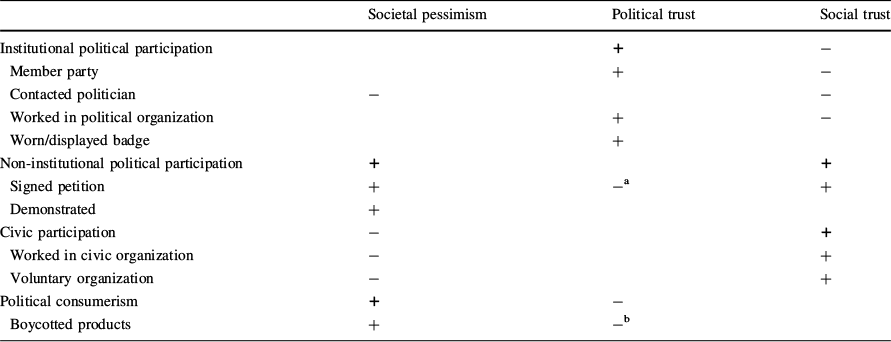
As a robustness check, I analyzed the nine participation items separately with logistic regressions to check whether this yields the same results. Table 9 shows the effects of the individual items per type of participation, with significant effects (p < .05, one-sided tests) indicated by plus and minus signs, and a non-significant effect indicated by an empty cell. It shows that there are three notable exceptions from the general pattern. One is the negative relationship between societal pessimism and contacting a politician, which is in line with hypothesis 1, but does not show for the institutional political participation category as a whole. A second exception is the negative relationship between political trust and signing petition. However, the positive coefficient for signing petition is only just significant [− 0.05 (se = 0.03)], in contrast to the coefficient of boycotting, which is very convincingly significant [− 0.22 (se = 0.03)]. Therefore, the negative sign of political trust in the case of signing petition is not a very convincing one and should not alter the conclusions.
Effects of attitudes on forms of institutional political participation, non-institutional political participation, civic participation and political consumerism.

Societal pessimism |
Political trust |
Social trust |
|
|---|---|---|---|
Institutional political participation |
+ |
− |
|
Member party |
+ |
− |
|
Contacted politician |
− |
− |
|
Worked in political organization |
+ |
− |
|
Worn/displayed badge |
+ |
||
Non-institutional political participation |
+ |
+ |
|
Signed petition |
+ |
−a |
+ |
Demonstrated |
+ |
||
Civic participation |
− |
+ |
|
Worked in civic organization |
− |
+ |
|
Voluntary organization |
− |
+ |
|
Political consumerism |
+ |
− |
|
Boycotted products |
+ |
−b |
a− 0.05 (0.03)
b− 0.22 (0.03)
Third, it is important to notice that the positive relationship between social trust and non-institutional participation seems to be based on the item signing a petition, as the other item of non-institutional political participation does not show this relationship. This means we should interpret the support for hypothesis 10 with some caution. Overall, it is safe to conclude that within all four types of participation, the effects of societal pessimism, political trust, and social trust are in line with those in Table 7 for most or all of the items on participation.
Finally, I ran the analyses including non-participants, to see whether that blurs the findings as expected. Table 10 in the Appendix shows the results, which are mostly the same, except for the relationship between political trust and non-institutional participation, which reaches significance, albeit only just. Therefore, it shows that the results are robust, and that in fact it does not alter the conclusions much in this article whether we compare groups of participations to each other or to the whole population, including non-participants. However, some coefficients do change, besides the one on political trust, also those of educational level, political interest, and marital status for instance. Therefore, in future research that compares groups of participants to each other, excluding non-participants is the most reliable line of inquiry.
Conclusions and Discussion
The large literature on participation has focused predominantly on causes of participation, or the characteristics of specific types of participation. While some authors examined the differences between groups of citizens with a small or large a variety of activities (Amnå and Ekman Reference Amnå and Ekman2014; Johann Reference Johann2012; Oser Reference Oser2016), the similarities and differences between participants in different fields of society are understudied. This article proposes to differentiate participants in political participation along two dimensions: politically vs publicly oriented participation and formally vs informally organized participation. These dimensions differentiate between four types of participation, distinguished Van Deth (Reference Van Deth2014): institutional political participation, non-institutional political participation, civic participation, and political consumerism. Building on the matching hypothesis (Clary and Snyder Reference Clary and Snyder1999; Granik Reference Granik2005), I proposed to differentiate between those four types by the societal outlook of participants. I argued that that people engage in participation in an organization, group, or movement in which people have the same world view, namely in terms of societal pessimism, political trust, and social trust.
As a first step, I find that excluding non-participants from the analyses is quite important if we examine something as straightforward as correlations. These are already only moderate while including participants, but decrease substantially, and in some cases even lose significance or turn out to be negative instead of positive, when non-participants are excluded. This underlines the need to differentiate among types of participants.
The logistic regression analyses support eight of the twelve hypotheses on the relationships between societal pessimism, political trust, and social trust and the four types of participation. If we compare types of participants to each other, we can characterize the institutional political participants as trusting politics rather than people, non-institutional political participants as societal pessimists who trust other people, civic participants as societal optimists who trust other people, and political consumers as pessimists who do not trust politics.
The finding that non-institutional political participation and political consumerism should be differentiated is most surprising and has also important consequences. In contrast to previous studies into non-institutional political participation, which often include political consumerism in that category (Barnes and Kaase Reference Barnes and Kaase1979; Hooghe and Marien Reference Hooghe and Marien2013; Vráblíková Reference Vráblíková2013), this article shows these two types of participation differ in various respects, most notably in their relationship to political trust, and should be pulled apart in future research. That is in line with the assumption of Almond and Verba, that citizens require positive orientations toward the political system to participate in it, and that negative attitudes toward the political system lead to alienation (Reference Almond and Verba1963). Demonstrating and signing petitions, the two operationalizations of non-institutional political participation used here, are not situated in political organizations, but are still directed at them. Compared to those types of participation, political consumerism is clearly more distanced from political actors and institutions. The finding that people in the latter distrust politics, while the former do not, means that political distrusting citizens might be more alienated from politics than we assumed.
The results also call for more attention in future research to the constellation of attitudes. The relationship between attitudes is a much debated topic, with some studies that find an effect of social trust on political trust (Bäck and Christensen; Catterberg and Moreno Reference Catterberg and Moreno2006; Keele Reference Keele2007), whereas in some cases the effect of political trust on social trust is larger than the other way around (Brehm and Rahn Reference Brehm and Rahn1997; Mishler and Rose Reference Mishler and Rose2005; Zmerli and Newton Reference Zmerli, Newton, Zmerli and Van der Meer2017). This article shows that a variety of constellations attitudes can exist, and can distinguish groups of participants from each other. It is therefore important to pay more attention to the causes of such different outlooks on society.
The results also add insight into the alleged decline in participation (Dalton Reference Dalton2004; Putnam Reference Putnam2000). A decline in participation, especially institutional political participation, seems unlikely to be counterbalanced by other types of participation, because they attract different types of people. In addition to the differences in attitudes, the analyses show age differences as well, with for instance relatively young (18–34) non-institutional political participants and older institutional political participants (55 +), in line with previous studies (Stolle and Hooghe Reference Stolle and Hooghe2011). These age differences ask for panel research into participation. Are these generational differences or cohort differences? In the latter case, we have little reason to expect that current divisions between groups of participants will diminish over time.
Moreover, because the results show participants to come from different groups, the influence of one type of participation versus others becomes more important. If political participation is seen as a way to raise one’s voice and thereby to play an important role in the functioning of democracy, the influence of one type of voice over the other becomes more important when those voices belong to different people. Indeed, types of political participation are rather different in terms of their perceived effectiveness (Hooghe and Marien Reference Hooghe and Marien2012). This underlines the importance of differentiating types of participation from each other in research on participation.
Appendix
See Table 10.
Logistic regression analyses of four types of political participation and non-participants.

Institutional political participation |
Non-institutional political participation |
Civic participation |
Political consumerism |
Non-participants |
||||||
|---|---|---|---|---|---|---|---|---|---|---|
b |
se |
b |
se |
b |
se |
b |
se |
b |
se |
|
Demographic characteristics |
||||||||||
Male |
0.14** |
(0.06) |
− 0.28*** |
(0.05) |
0.20** |
(0.07) |
− 0.36*** |
(0.08) |
0.04 |
(0.05) |
Age (18–34) |
||||||||||
35–54 |
0.12* |
(0.07) |
− 0.26** |
(0.10) |
0.07 |
(0.06) |
0.11 |
(0.09) |
− 0.02 |
(0.06) |
55+ |
0.29*** |
(0.08) |
− 0.47*** |
(0.13) |
− 0.01 |
(0.08) |
0.10 |
(0.08) |
0.20** |
(0.09) |
City |
− 0.25*** |
(0.05) |
0.21*** |
(0.06) |
− 0.24*** |
(0.06) |
0.25*** |
(0.05) |
0.12** |
(0.05) |
Marital status (married or partnership) |
||||||||||
Divorced or separated |
0.05 |
(0.08) |
0.19** |
(0.07) |
− 0.12 |
(0.08) |
0.10 |
(0.08) |
− 0.04 |
(0.06) |
Widowed or partner died |
− 0.17** |
(0.09) |
0.02 |
(0.10) |
− 0.17** |
(0.08) |
− 0.20** |
(0.09) |
0.24*** |
(0.06) |
Single |
− 0.11* |
(0.06) |
0.21** |
(0.07) |
− 0.11** |
(0.05) |
0.12** |
(0.04) |
0.02 |
(0.05) |
Household size |
0.04** |
(0.02) |
0.00 |
(0.03) |
0.07*** |
(0.02) |
− 0.07** |
(0.02) |
− 0.04* |
(0.02) |
Children living at home |
− 0.11** |
(0.05) |
0.06 |
(0.07) |
− 0.14** |
(0.06) |
0.13** |
(0.06) |
0.07 |
(0.05) |
Attendance religious services |
0.03 |
(0.02) |
− 0.08*** |
(0.02) |
0.23*** |
(0.02) |
− 0.13*** |
(0.02) |
− 0.15*** |
(0.02) |
Satisfaction with life |
− 0.01 |
(0.01) |
− 0.02 |
(0.01) |
0.02 |
(0.02) |
− 0.02 |
(0.01) |
− 0.00 |
(0.01) |
Resources |
||||||||||
Education (medium) |
||||||||||
Low |
0.08 |
(0.08) |
− 0.16** |
(0.07) |
− 0.18** |
(0.07) |
− 0.31*** |
(0.06) |
0.27*** |
(0.06) |
High |
0.10* |
(0.06) |
0.08 |
(0.07) |
0.15** |
(0.06) |
0.09 |
(0.06) |
− 0.38*** |
(0.05) |
Source of income (profit/salary) |
||||||||||
Pension |
0.03 |
(0.06) |
− 0.18** |
(0.07) |
0.01 |
(0.05) |
− 0.14** |
(0.07) |
0.12** |
(0.04) |
Unemployment benefit |
0.46*** |
(0.13) |
− 0.09 |
(0.10) |
− 0.13 |
(0.13) |
0.01 |
(0.14) |
0.06 |
(0.15) |
Other benefit |
0.18 |
(0.20) |
0.11 |
(0.17) |
− 0.02 |
(0.17) |
− 0.21 |
(0.13) |
− 0.10 |
(0.13) |
Other |
0.10 |
(0.13) |
− 0.00 |
(0.15) |
0.05 |
(0.10) |
0.07 |
(0.16) |
0.02 |
(0.12) |
Household income |
− 0.04** |
(0.02) |
− 0.00 |
(0.01) |
0.02 |
(0.01) |
0.02 |
(0.02) |
− 0.03** |
(0.01) |
Political interest and efficacy |
||||||||||
Ratio political news/all news |
0.07 |
(0.07) |
− 0.14* |
(0.07) |
0.29*** |
(0.08) |
0.40*** |
(0.09) |
− 0.48*** |
(0.08) |
Political interest |
0.33*** |
(0.03) |
0.15*** |
(0.02) |
0.03 |
(0.03) |
0.24*** |
(0.05) |
− 0.45*** |
(0.03) |
Political efficacy |
0.07*** |
(0.01) |
0.00 |
(0.01) |
− 0.02 |
(0.01) |
0.07*** |
(0.01) |
− 0.07*** |
(0.02) |
Societal outlook |
||||||||||
Societal pessimism |
− 0.05 |
(0.04) |
0.08** |
(0.04) |
− 0.11*** |
(0.03) |
0.08** |
(0.04) |
0.01 |
(0.03) |
Political trust |
0.10** |
(0.03) |
− 0.05* |
(0.03) |
0.02 |
(0.02) |
− 0.23*** |
(0.03) |
0.06** |
(0.03) |
Social trust |
− 0.12*** |
(0.02) |
0.12** |
(0.04) |
0.12*** |
(0.03) |
0.03 |
(0.03) |
− 0.12*** |
(0.02) |
More than 1 type of participation |
3.14*** |
(0.09) |
2.98*** |
(0.08) |
2.46*** |
(0.06) |
2.65*** |
(0.07) |
||
Coefficients are log odds, with *p < 0.05; **p < 0.01; ***p < 0.001 (one-sided tests)






 Open access

