

1. Introduction
Granitoids are the primary constituents of the continental crust, and their study is essential for understanding crust formation (Barbarin, Reference Barbarin1990, Reference Barbarin1999; Rudnick, Reference Rudnick1995; Hawkesworth et al. Reference Hawkesworth, Dhuime, Pietrank, Cawood, Kemp and Storey2010; Clemens et al. Reference Clemens, Stevens and Bryan2020; Palin et al. Reference Palin, Santosh, Cao, Li, Hernández-Uribe and Parsons2020). Given their significance, several classifications have been developed over the years, based on their geochemistry, mineralogy and generation processes (Chappel and White, Reference Chappell and White1974; Barbarin, Reference Barbarin1990; Castro et al. Reference Castro, Moreno-Ventas and de la Rosa1991; Frost et al. Reference Frost, Barnes, Collins, Arculus, Ellis and Frost2001; Bonin et al. Reference Bonin, Janoušek and Moyen2020; Moyen, Reference Moyen2020; Nagamma et al. Reference Nagamma, Ratnakar, Ajay Kumar and Ashok2023). Classifications based on opaque mineralogy have been used to determine crystallization parameters, such as temperature, pressure and oxygen fugacity (Ishihara, Reference Ishihara1977; Murata et al. Reference Murata, Itaya and Ueda1983; Whalen and Chappell, Reference Whalen and Chappell1988; Takagi, Reference Takagi1992; Santos-Dias et al. Reference Santos-Dias, Gonçalves and Gonçalves2019; Kumar et al. Reference Kumar, Kumar and Mohan2021; Ashok et al. Reference Ashok, Babu, Dash and Santhosh2022; Kumar and Ashok, Reference Ajay Kumar and Ashok2024).
The Ishihara series (Ishihara, Reference Ishihara1977) classifies granitic rocks into magnetite and ilmenite series based on the predominance of these two oxides. Magnetite-series granitoids are associated with oxidized environments, typically crystallized at greater depths than those of the ilmenite series, and with values greater than 3 × 10⁻³ SI when a correlation with magnetic susceptibility is applied (Ishihara, Reference Ishihara1979, Reference Ishihara and Skinner1981). This approach introduces the idea that granitic rocks could serve as markers, not only for geological periods but also for significant transitions, such as the Archaean-Paleoproterozoic boundary, marked by the transition from Tonalite-Trondhjemite-Granodiorite (TTG) to Sanukitoids (Martin et al. Reference Martin, Smithies, Rapp, Moyend and Champion2005, Reference Martin, Moyen and Rapp2009; Moyen and Martin, Reference Moyen and Martin2012), as well as for substantial changes in the oxidizing conditions of the continental crust (Bucholz et al. Reference Bucholz, Stolper, Eiler and Breaks2018; Aulbach et al. Reference Aulbach, Woodland, Stern, Vasilyev, Heaman and Viljoen2019; Bucholz and Spencer, Reference Bucholz and Spencer2019; Gao et al. Reference Gao, Liu, Cawood, Hu, Wang, Sun and Hu2022; Moreira et al. Reference Moreira, Storey, Bruand, Darling, Fowler, Cotte, Villalobos-Portillo, Patar, Seixas, Philippot and Dhuime2023; Nascimento et al. Reference do Nascimento, Oliveira, de Heilimo, Galarza and Gabriel2025).
TTGs are the predominant granitoids of the Archaean, formed by the partial melting of hydrous basalts at pressures reaching up to 20 kbar, likely providing evidence of subduction zones predating 2.5 Ga (Moyen and Stevens, Reference Moyen and Stevens2006; Moyen and Martin, Reference Moyen and Martin2012). During the Neoarchaean-Paleoproterozoic, changes in geodynamics facilitated the involvement of a mantle wedge in magmatic processes within subduction zones, leading to the emergence of rocks derived from TTG magmas, with high Mg# (Martin et al. Reference Martin, Smithies, Rapp, Moyend and Champion2005; Farina et al. Reference Farina, Albert and Lana2015; Guo et al. Reference Guo, Wu, Gao, Jin, Zong, Hu, Chen, Chen and Liu2015). Shirey and Hanson (Reference Shirey and Hanson1984) coined the term ‘sanukitoids’, marking the beginning of the occurrence of modern tectonic systems (Martin et al. Reference Martin, Moyen and Rapp2009; Heilimo et al. Reference Heilimo, Halla and Hölttä2010).
The Neoarchaean-Paleoproterozoic period was a unique time, marked by significant paleoenvironmental changes associated with the Great Oxygenation Event (GOE, Holland, Reference Holland2002). During 2.4–2.1 Ga, the atmospheric O2 concentration experienced a substantial increase, coinciding with a possible magmatic lull between 2.45 and 2.20 Ga (Condie et al. Reference Condie, O’Neill and Aster2009, Reference Condie, Pisarevsky, Puetz, Spencer, Teixeira and Faleiros2022) and the crystallization of granitic plutons in the southern São Francisco Craton (e.g. Seixas et al. Reference Seixas, David and Stevenson2012, Reference Seixas, Bardintzeff, Stevenson and Bonin2013; Lopes et al. Reference Lopes, Gonçalves, Gonçalves, Moreira, Lacerda and Armond2024). Given this context, could the TTG-Sanukitoid transition serve as a record of the oxygenation event? Furthermore, might the igneous opaque mineralogy provide insights into a potential link between the significant rise in atmospheric oxygen and an oxidizing process within the mantle and continental crust, associated with the initiation of modern plate tectonic systems?
The transition from TTG to Sanukitoid magmatism is mostly dated to the Neoarchaean-Paleoproterozoic. These suites serve as markers of this period, recording shifts in tectonic processes which culminated in the onset of modern plate tectonic systems (Martin and Moyen, Reference Martin and Moyen2002; Moyen and Martin, Reference Moyen and Martin2012; Moyen and Laurent, Reference Moyen and Laurent2018). In the Karelia Craton, northwest Russian-eastern Finland, TTG rocks are characterized by low MgO and sanukitoids by high Mg#, Ni, Cr, Ba and Sr (Halla et al. Reference Halla, Hunen, Heilimo and Hölttä2009; Heilimo et al. Reference Heilimo, Halla and Hölttä2010). The Amazonian Craton presents TTGs associated with high Al2O3 and medium La/Yb ratios, while the sanukitoids display high MgO, Cr and Ni contents, indicating a mantle source along with crustal contribution (Nascimento et al. Reference do Nascimento, de Oliveira, Gabriel, Marangoanha, Silva and Aleixo2023; Scandolara et al. Reference Scandolara, Saboia, Fuck, Corrêa, Rodrigues and Alves2024). It is argued that the emergence of sanukitoids in the Amazonian Craton may indicate changes in tectonic processes (Nascimento et al. Reference do Nascimento, Oliveira, de Heilimo, Galarza and Gabriel2025). In the Superior Province, the TTG-Sanukitoid transition is associated with the amalgamation of diverse crustal units through the Neoarchaean, with a diachronous transition across the region (Ackerman et al. Reference Ackerman, Žák, Kachlík, Svojtka, Tomek, Santolík, Sláma, Trubač, Strnad and Vacek2022; Pérez et al. Reference Pérez, Tremblay and Stevenson2024). In the Dharwar Craton, the transition between these suites marks its final stabilization in the Neoarchaean-Paleoproterozoic (Moyen et al. Reference Moyen, Martin, Jayananda and Auvray2003). This process is linked to crustal melting and recycling triggered by continental collision or mantle plume activity, serving as a prime example of hot orogenies at the end of the Neoarchaean (Chardon et al. Reference Chardon, Jayananda and Peaucat2011; Kumar et al. Reference Kumar, Kumar and Mohan2021).
The Mineiro Belt (Teixeira, Reference Teixeira1985), located in the southern São Francisco Craton – Brazil, serves as a natural laboratory, as it is composed of Paleoproterozoic granitoids, including the most recent TTG-Sanukitoid transition recorded. This transition occurred during the Siderian-Rhyacian, represented by the Lagoa Dourada (LDS) and Alto Maranhão (AMS) suites, respectively (Seixas et al. Reference Seixas, David and Stevenson2012, Reference Seixas, Bardintzeff, Stevenson and Bonin2013; Moreira et al. Reference Moreira, Seixas, Storey, Fowler, Lasalle, Stevenson and Lana2018, Reference Moreira, Storey, Fowler, Seixas and Dunlop2020). With ages corresponding to the GOE period, the oxygen fugacity involved in their crystallization – recorded by the primary opaque mineralogy and its textural relationships with the main mineral assemblage – provides new insights into the evolution of these plutons and the redox conditions prevailing during their formation.
2. Geological setting
2.a. The Mineiro Belt
The São Francisco Craton (SFC, Figure 1a) comprises Archaean and Paleoproterozoic rock assemblages, involved in the Minas-Bahia Orogeny, surrounded by Neoproterozoic belts (Almeida, Reference Almeida1977; Alkmim et al. Reference Alkmim, Marshak and Fonseca2001; Teixeira et al. Reference Teixeira, Ávila, Dussin, Corrêa Neto, Bongiolo, Santos and Barbosa2015). In its southern segment, three magmatic arc systems were formed including the Mineiro Belt (focus of this study), which is mainly composed of a series of Paleoproterozoic plutons and greenstone belts enclosed by Archaean blocks (Noce et al. Reference Noce, Teixeira, Queménéur, Martins and Bolzaquini2000; Seixas et al. Reference Seixas, Bardintzeff, Stevenson and Bonin2013; Barbosa et al. Reference Barbosa, Teixeira, Ávila, Montecinos and Bongiolo2015; Moreira et al. Reference Moreira, Seixas, Storey, Fowler, Lasalle, Stevenson and Lana2018, Reference Moreira, Storey, Fowler, Seixas and Dunlop2020).
(a) The São Francisco Craton in the context of western Gondwana/the Neoproterozoic orogeny and location of the study area (red rectangle). (b) Northern segment of the Mineiro Belt and sampling location. Modified from Seixas et al. (Reference Seixas, David and Stevenson2012, Reference Seixas, Bardintzeff, Stevenson and Bonin2013), Moreira et al. (Reference Moreira, Storey, Fowler, Seixas and Dunlop2020), Lacerda et al. (Reference Lacerda, Soares, Gonçalves, Gonçalves and Pinheiro2021) and Nahas et al. (Reference Nahas, Gonçalves, Gonçalves and Raposo2023).

The Mineiro Belt (MB; Teixeira, Reference Teixeira1985) is delimited to the north by two shear zones: the NE-SW Jeceaba-Bom Sucesso shear zone to the northwest (JBSZ; Campos and Carneiro, Reference Campos and Carneiro2008) and the NW-SE Congonhas-Itaverava shear zone to the northeast (CISZ; Corrêa-Neto et al. Reference Corrêa-Neto, Modesto de Almeida, Caputo Neto and Campos Guerrero2012; Nahas et al. Reference Nahas, Gonçalves, Gonçalves and Raposo2023), while its southern border remains unclear (Figure 1b; Ávila et al. Reference Ávila, Teixeira, Cordani, Moura and Pereira2010, Reference Ávila, Teixeira, Bongiolo, Dussin and Vieira2014; Moreira et al. Reference Moreira, Seixas, Storey, Fowler, Lasalle, Stevenson and Lana2018, Reference Moreira, Storey, Fowler, Seixas and Dunlop2020). Unlike the adjacent Paleoproterozoic magmatic arc systems, the northern segment of the MB did not undergo significant overprinting by the Neoproterozoic orogeny, allowing its granitoids to preserve igneous features indicative of their magmatic origin (e.g. Vieira et al. Reference Vieira, Gonçalves and Gonçalves2020; Lopes et al. Reference Lopes, Gonçalves and Gonçalves2020, Reference Lopes, Gonçalves, Gonçalves, Moreira, Lacerda and Armond2024, Lacerda et al. Reference Lacerda, Soares, Gonçalves, Gonçalves and Pinheiro2021, Reference Lacerda, Guitreau, Gonçalves, Moreira, Gonçalves, Pinheiro, Castro and Doucelance2024; Nahas et al. Reference Nahas, Gonçalves, Gonçalves and Raposo2023).
Among the several granitic bodies found in the MB, a set of distinct plutons record an extraordinary example of the TTG to Sanukitoid transition, documented worldwide as a typical feature of the Archaean-Paleoproterozoic tectonic transition (Martin et al. Reference Martin, Smithies, Rapp, Moyend and Champion2005; Laurent et al. Reference Laurent, Martin, Moyen and Doucelance2014). In the MB, this transition occurred in the Siderian-Rhyacian period, being one of the earliest indicators of changes in Plate Tectonics (Martin, Reference Martin1986; Martin and Moyen, Reference Martin and Moyen2002; Smithies et al. Reference Smithies, Champion and Cassidy2003; Martin et al. Reference Martin, Moyen and Rapp2009; Moyen and Martin, Reference Moyen and Martin2012; Moreira et al. Reference Moreira, Storey, Fowler, Seixas and Dunlop2020). In its northern region, geochronological and petrological evidence highlights the existence of the high-Al TTG Lagoa Dourada Suite (2350 Ma, Seixas et al. Reference Seixas, David and Stevenson2012) and the sanukitoid Alto Maranhão Suite (2130 Ma, Seixas et al. Reference Seixas, Bardintzeff, Stevenson and Bonin2013), denoting the generation of juvenile crust during the ‘magmatic lull’ (Condie et al. Reference Condie, O’Neill and Aster2009, Reference Condie, Pisarevsky, Puetz, Spencer, Teixeira and Faleiros2022; Partin et al. Reference Partin, Bekker, Sylvester, Wodicka, Stern, Chacko and Heaman2014; Spencer et al. Reference Spencer, Murphy, Kirkland, Liu and Mitchell2018).
2.b. Lagoa Dourada and Alto Maranhão suites
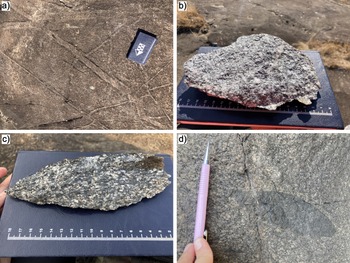
The Lagoa Dourada Suite (LDS) is located in the central segment of the MB (Figure 1b). Its zircon U-Pb crystallization age at ca. 2350 Ma and whole-rock Nd isotopes indicate a juvenile basaltic source, in an intra-oceanic setting (Seixas et al. Reference Seixas, David and Stevenson2012; Moreira et al. Reference Moreira, Storey, Fowler, Seixas and Dunlop2020). Their Bt-Hbl-tonalites and Bt-trondhjemites are crosscut by three pulses of dykes (Figure 2a–b), Hbl-gabbros, trondhjemites and tonalites, subparallel or discordant to the foliation of the host tonalite, with ages varying between 2347 and 2332 Ma (Lopes et al. Reference Lopes, Gonçalves and Gonçalves2020, Reference Lopes, Gonçalves, Gonçalves, Moreira, Lacerda and Armond2024). The Alto Maranhão Suite (AMS) is located in the northern segment of the MB (Figure 1b), comprising Bt-Hbl-tonalites and granodiorites (Seixas et al. Reference Seixas, Bardintzeff, Stevenson and Bonin2013), with dioritic enclaves related to the host rock through mingling and mixing features (Figure 2c–d), interpreted as a syn-magmatic refuelling of the main tonalitic magmatic chamber (Seixas et al. Reference Seixas, Bardintzeff, Stevenson and Bonin2013; Vieira et al. Reference Vieira, Gonçalves and Gonçalves2020; Nahas et al. Reference Nahas, Gonçalves, Gonçalves and Raposo2023). The high Mg#, Ni and Cr contents are unambiguous evidence of the sanukitoid affinity of this suite, sourced from a combination of a metasomatized mantle and a TTG melt, marking a transition from an oceanic to a continental arc in the MB (Moreira et al. Reference Moreira, Seixas, Storey, Fowler, Lasalle, Stevenson and Lana2018).
(a) and (b) Field aspects of the Lagoa Dourada Suite (LDS). The rocks are biotite-hornblende tonalites to biotite-trondhjemites, presenting plutonic dykes in all studied stations. (c) and (d) Field aspects of the Alto Maranhão Suite (AMS). The rocks are biotite-hornblende tonalites containing mafic enclaves in all extents of the suite.

The TTG-Sanukitoid late transition registered in the MB predates the development of modern subduction zones, during the magmatic lull and inside the Great Oxygenation Event window (GOE, Moreira et al. Reference Moreira, Storey, Fowler, Seixas and Dunlop2020; Moreira et al. Reference Moreira, Storey, Bruand, Darling, Fowler, Cotte, Villalobos-Portillo, Patar, Seixas, Philippot and Dhuime2023). The TTGs crystallized in a proto-subduction system, whereas sanukitoids are associated with a higher-angled subducting plate, allowing interaction with a mantle wedge. According to Moreira et al. (Reference Moreira, Seixas, Storey, Fowler, Lasalle, Stevenson and Lana2018, Reference Moreira, Storey, Fowler, Seixas and Dunlop2020, Reference Moreira, Storey, Bruand, Darling, Fowler, Cotte, Villalobos-Portillo, Patar, Seixas, Philippot and Dhuime2023), the input of sediments during subduction is crucial to the formation of the sanukitoids, which enables a connection between atmospheric changes and magma formation during this period.
3. Petrography, sampling, and methods
The LDS is a 50–80 km2 E-W oriented pluton (Seixas et al. Reference Seixas, David and Stevenson2012), crosscut by plutonic dykes of variable compositions (Lopes et al. Reference Lopes, Gonçalves and Gonçalves2020, Reference Lopes, Gonçalves, Gonçalves, Moreira, Lacerda and Armond2024). According to those authors, host rocks comprise medium-grained tonalites and trondhjemites, mostly foliated, preserving magmatic textures and may be magnetic. Essential minerals are plagioclase, quartz, biotite and hornblende (Figure 3a), and accessory minerals are apatite, zircon, allanite, epidote, titanite, garnet and opaque phases. Biotite, which defines the foliation, may contain inclusions of apatite, epidote, titanite, zircon and opaque minerals, which are also associated with hornblende. Amphibole exhibits subhedral to anhedral shapes, fine to medium grains, displaying inclusions of ilmenite and magnetite. The igneous character of minerals defining the foliation of the LDS was previously discussed in the literature (Seixas et al. Reference Seixas, David and Stevenson2012, Lopes et al. Reference Lopes, Gonçalves, Gonçalves, Moreira, Lacerda and Armond2024). Garnet is restricted to the LD4 station (Figure 3b).
Photomicrographs under polarized light and SEM electron backscattered images from the Lagoa Dourada Suite. (a) Allanite crystal encompassing magnetite. (b) Garnet is associated with hornblende. (c) Euhedral grain of magnetite. (d) Magnetite with signs of martitization (red mark). (e) Ilmenite with titanite lamellae. (f) Exsolution of ilmenite and magnetite, grain included in titanite. (g) Chalcopyrite grain. (h) Chalcopyrite with Fe-oxide border. (i) Pyrite associated with chalcopyrite. Aln: Allanite. Bt: Biotite. Ccp: Chalcopyrite. Grt: Garnet. Hbl: Hornblende. Ilm: Ilmenite. Mag: Magnetite. Mt: Martitization. Plg: Plagioclase. Py: Pyrite. Ttn: Titanite.

The tonalitic AMS host rocks are medium-grained and weakly to strongly foliated, with essential mineralogy comprising plagioclase, quartz, biotite and hornblende (Figure 4a), and accessory phases including titanite, apatite, zircon, allanite and opaque phases (Seixas et al. Reference Seixas, Bardintzeff, Stevenson and Bonin2013; Nahas et al. Reference Nahas, Gonçalves, Gonçalves and Raposo2023). Some plagioclase grains exhibit normal compositional zoning (Figure 4b) and may be oriented, defining the magmatic lineation (Vieira et al. Reference Vieira, Gonçalves and Gonçalves2020). Biotite and hornblende define the magmatic foliation, which corresponds to the magnetic foliation (Nahas et al. Reference Nahas, Gonçalves, Gonçalves and Raposo2023). Amphibole exhibits subhedral to euhedral shapes and medium to coarse-grained texture, displaying inclusions of ilmenite and associated with other minerals from the primary assemblage, such as biotite and plagioclase. Its textural relationships and grain shapes characterize it as an igneous phase (Seixas et al. Reference Seixas, Bardintzeff, Stevenson and Bonin2013; Vieira et al. Reference Vieira, Gonçalves and Gonçalves2020; Nahas et al. Reference Nahas, Gonçalves, Gonçalves and Raposo2023). Biotite and amphibole are associated with titanite and opaque phases (Figure 4c), and inclusions of apatite, zircon and allanite may also be present. The AMS petrographic samples are nominally non-magnetic (Nahas et al. Reference Nahas, Gonçalves, Gonçalves and Raposo2023).
Photomicrographs under polarized light and SEM electron backscattered images from the Alto Maranhão Suite. (a) Mineralogical assembly of Alto Maranhão Suite with biotite and plagioclase. (b) Zoned plagioclase crystal. (c) Hornblende with ilmenite. (d) Reaction between ilmenite and titanite (extracted from Nahas et al. Reference Nahas, Gonçalves, Gonçalves and Raposo2023). (e) Pyrrhotite and chalcopyrite. (f) Pyrite is associated with magnetite. (g) Pentlandite lamellae in pyrrhotite grain. (h) Pentlandite and sphalerite occur with other sulphides. (i) Pyrrhotite lamellae in pyrite grain. Ccp: Chalcopyrite. Ilm: Ilmenite. Mag: Magnetite. Pn: Pentlandite. Po: Pyrrhotite. Py: Pyrite. Sp: Sphalerite. Ttn: Titanite.

Representative samples from LDS and AMS tonalitic rocks, studied by Vieira et al. (Reference Vieira, Gonçalves and Gonçalves2020), Lopes et al. (Reference Lopes, Gonçalves and Gonçalves2020, Reference Lopes, Gonçalves, Gonçalves, Moreira, Lacerda and Armond2024) and Nahas et al. (Reference Nahas, Gonçalves, Gonçalves and Raposo2023), were selected for textural and chemical analyses of the opaque minerals and amphibole, via SEM-EDS. The LD7 was added as a sample coming from a new workstation. The sample localities are shown in Figure 1, consisting of 11 thin sections from the LDS and 24 from the AMS.
The mineral chemical analyses were performed using a JEOL JSM 6510 scanning electron microscope. The mineral compositions were quantified by an Oxford X-Max 20 energy dispersive x-ray detector (SEM-EDS), under high vacuum, with an accelerating voltage of 20 kV, a work distance of 15 mm and a spot size of 70 (in a reference scale of 0–100). Standardless quantitative EDS analyses, through a ratio of peak intensities, determined the relative abundance of major elements, converted using the Aztec software package (Oxford) and presented in their oxide forms, as percentage proportions. The analyses were carried out at the Microscopy and Microanalysis Laboratory of the Federal University of Ouro Preto (LMic – DEGEO – UFOP). The chemical formula of the amphibole analyses was calculated based on 23 oxygen and 13 cations, using the software Geo-fO2 from Li et al. (Reference Li, Cheng and Yang2019), according to Leake et al. (Reference Leake, Woolley, Arps, Birch, Gilbert, Grice, Hawthorne, Kato, Kisch, Krivovichev, Linthout, Laird, Mandarino, Maresch, Nickel, Rock, Schumacher, Smith, Stephenson, Ungaretti, Whittaker and Youzhi1997) and also Hawthorne et al. (Reference Hawthorne, Oberti, Harlow, Maresch, Martin, Schumacher and Welch2012). The oxybarometers and thermobarometers are calculated based on different amphibole studies (Schmidt, Reference Schmidt1992; Anderson and Smith, Reference Anderson and Smith1995; Ridolfi et al. Reference Ridolfi, Renzulli and Puerini2010), allowing the determination of temperature, pressure and oxygen fugacity (fO2) during the crystallization. The results can be found in the Supplementary Files.
4. Results
The predominance of oxides was initially employed to classify the suites into the magnetite or ilmenite series, as proposed by Ishihara (Reference Ishihara1977), while their association with some transparent minerals and microchemical analyses of amphibole provided insights into the oxygen fugacity associated with the crystallization of the studied samples.
4.a. Opaque mineralogy
The opaque phases from LDS and AMS are given in Figures 3 and 4. The identified phases are summarized in Table 1 and are discussed in detail in the following sections.
Distribution of the opaque mineralogy along the studied stations and their associations

4.a.1. Lagoa Dourada Suite
Oxide and sulphide grains are observed in the tonalitic host rock from the LDS. Magnetite occurs as euhedral to anhedral grains (Figure 3c), with grain sizes ranging from 25 to 1100μm, mostly found as isolated grains, although it can be associated with plagioclase, biotite, hornblende and ilmenite. When magnetite is located along the borders of biotite and hornblende, it predominantly takes an anhedral shape, whereas grains included in plagioclase and those present in the matrix more commonly exhibit euhedral forms. Some magnetite grains show signs of martitization (Figure 3d), with hematite lamellae arranged without a preferred orientation.
Ilmenite is subhedral to anhedral, with grain sizes ranging between 25 and 900μm, and often exhibits exsolutions or substitution by titanite (Figure 3e). Its most frequent occurrence is as anhedral inclusions in titanite, although it also occurs as an overgrowth or along the boundaries of hornblende and biotite, near magnetite, and as isolated grains. At the LD3 station, magnetite lamellae were found within ilmenite grains, as inclusions in a titanite grain (Figure 3f).
Chalcopyrite (Figure 3g–h) and pyrite are anhedral, with grain sizes ranging from 10 to 2000μm and from 10 to 15μm, respectively, with pyrite always associated with Cu-sulphide and included in plagioclase (Figure 3i). Chalcopyrite may occur along biotite borders, included in plagioclase, as isolated grains, and associated with ilmenite. In the latter, it can exhibit borders of Fe-oxide (Figure 3h). Both minerals are found exclusively at the LD4 station.
In all 11 samples from the LDS, magnetite is present with more than 20 grains per sample. Ilmenite is also observed in all studied samples, but with a maximum of 15 grains per sample. At the LD4 station, approximately 10 grains of chalcopyrite were identified, whereas only a single grain of pyrite was found.
4.a.2. Alto Maranhão Suite
Ilmenite is the most widespread oxide in the entire suite, occurring as subhedral to euhedral grains with grain sizes ranging between 20 and 500μm. Some grains show strongly irregular, curved boundaries, surrounded by titanite (Figure 4d), while others are associated with hornblende, biotite and plagioclase. The subhedral grains are primarily associated with biotite, occurring as inclusions along cleavage planes or near its borders. Ilmenite grains are also found along hornblende grain boundaries and as inclusions in plagioclase. Magnetite was identified only in the southern portion of the AMS, occurring as anhedral grains (200–400μm), associated with pyrite or as isolated grains (Figure 4e). In both cases, the grains are surrounded by plagioclase and biotite.
The predominant sulphide is pyrrhotite, which occurs in all studied samples as isolated anhedral grains ranging from 20 to 400μm, or associated with most of the minerals, including other opaque phases such as chalcopyrite (Figure 4f) and ilmenite. In the northern portion of the AMS (IN-8), pyrrhotite can exhibit pentlandite lamellae (Figure 4g) and occurs alongside sphalerite and chalcopyrite (Figure 4h). Pyrite is found in different locations within the AMS as very fine anhedral grains associated with magnetite (IN-17) or pyrrhotite (IN-7). In the IN-7 sample, the relationship between the two sulphides is observed as pyrrhotite lamellae within pyrite grains (Figure 4i). Chalcopyrite is present in the northern and central portions of the suite (IN-8, IN-13), often occurring alongside pyrrhotite but also associated with titanite and plagioclase.
Ilmenite is present in all 24 samples from AMS, with more than 30 grains per sample in 4 of the samples, and an average of 25 grains per sample. Magnetite is found in only two samples (IN-17 and LS-200b), with a maximum of 5 grains per sample. Pyrrhotite occurs at a frequency similar to that of ilmenite (∼25 grains per sample). Pyrite is found in two samples (IN-07 and IN-17), with no more than 5 grains per sample.
4.b. Mineral chemistry
4.b.1. Opaque minerals
The oxide and sulphide chemistry from the LDS and AMS samples is provided in the Supplementary Files for the minerals described in the previous section.
4.b.1.1. Lagoa Dourada Suite
Magnetite in the LDS contains between 48.5 and 55.6 wt.% of Fe2O3. The contents of Fe2+ and Fe3+ were calculated according to equations of Droop (Reference Droop1987). V2O3 commonly occurs in low percentages (<0.7 wt. %), accompanied by TiO2 (0.3–3.8 wt.%), Cr2O3 (0.2 wt.%) and WO3 (0.3 wt.%) when associated with ilmenite grains. At the LD1 station, magnetite shows higher TiO2 values, reaching up to 4 wt.% (Figure 5a). Ilmenite has FeOt ranging from 47.1 to 50.1 wt.% and TiO2 between 48.1 and 49.0 wt.% (Figure 5b). Trace elements include MnO (Figure 5c, 1.3–3.5 wt.%, with the highest values at the LD3 station), CaO (0.2 wt.%) and V2O3 (0.3–0.5 wt.%).
(a) FeOt versus TiO2 for magnetites from LDS; (b) FeOt versus TiO2 for ilmenites from LDS and AMS; (c) FeOt versus MnO for ilmenites from LDS and AMS; (d) FeOt versus CuO+NiO+SO2 for magnetites from AMS; (e) SO2 versus NiO for sulphides from AMS.

Chalcopyrite and pyrite have SO2 values of 48.0 and 65.6 wt.% and FeOt values of 26.5 and 32.5 wt. %, respectively. Chalcopyrite has CuO values of 25 wt.%. There is no compositional variation associated with textural variations for both sulphides.
4.b.1.2. Alto Maranhão Suite
Magnetite crystals from AMS exhibit Fe2O3 values ranging from 38.0 to 49.8 wt.%, often containing minor concentrations of CuO (0.4–4.0 wt.%), NiO (1.6 wt.%) and SO2 (0.3–1.1 wt.%) (Figure 5d), while V2O3 is absent. Ilmenite contains MnO ranging between 1.8 and 2.6 wt.%, with values reaching up to 3 wt.% in the northwestern portion of the suite (Figure 5c).
Pyrrhotite and pyrite contain NiO (0.4–0.5 wt.%), and in the southern portion of AMS, pyrite exhibits minor CoO (2.4 wt.%). Their FeOt contents range from 46.8 to 51.7 wt.% for pyrrhotite, and from 31.7 to 34.7 wt.% for pyrite. Chalcopyrite exhibits FeOt (25.7–26.1 wt.%), CuO (24.5–25.5 wt.%), and SO2 (48.5–49.7 wt.%). Pentlandite may contain low amounts of CoO (2.0–4.2 wt.%, Figure 5e), and sphalerite presents low percentages of FeOt (5.4 wt.%). No correlation was observed between compositional and textural variations in chalcopyrite, pentlandite and sphalerite.
4.b.2. Amphibole
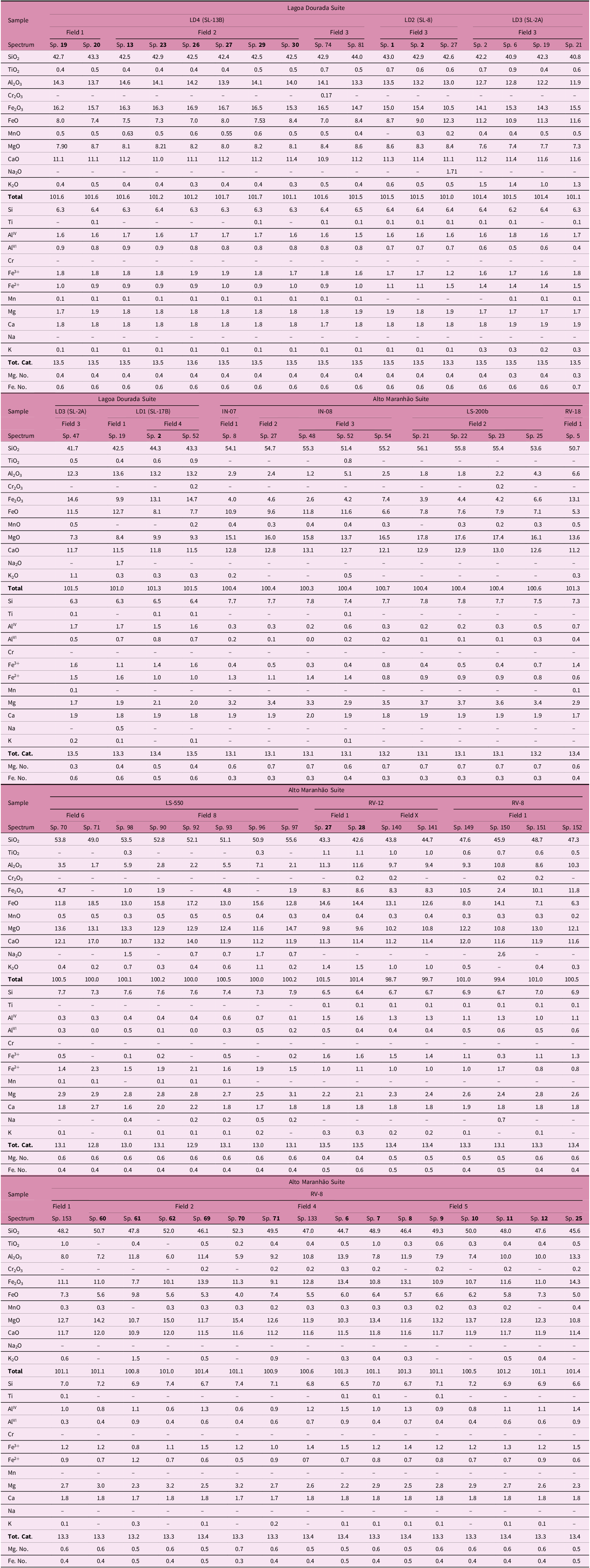
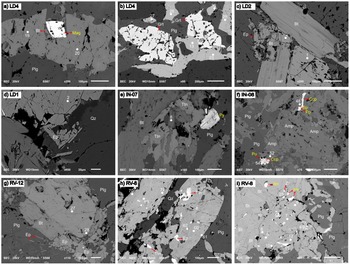
Representative chemical analyses of amphiboles from LDS and AMS are presented in Table 2, with some analysed spots shown in Figure 6. Different mineral assemblages and textural relationships were selected to observe possible compositional variations in the amphibole: when associated with magnetite (Figure 6a), garnet (Figure 6b), biotite (Figure 6c), symplectic epidote (Figure 6d), fine-grained epidote (Figure 6g) and also with titanite (Figure 6e,h), pyrite, and with inclusions of pyrrhotite, chalcopyrite, sphalerite (Figure 6f), ilmenite and epidote (Figure 6i).
Representative compositions (% weight oxide) of amphiboles from the LDS and AMS
Spots of analyses made in amphiboles from: (a)–(d) Lagoa Dourada Suite and (e)–(i) Alto Maranhão Suite. (a) magnetite grain associated with amphibole; (b) garnet crystals together with amphibole; (c) amphibole crystals together with biotite and titanite; (d) symplectic epidote in the border of an amphibole crystal; (e) amphibole associated with titanite and pyrite; (f) inclusions of pyrrhotite, chalcopyrite and sphalerite in large amphibole crystal; (g) biotite and epidote associated with amphibole; (h) epidote and titanite inclusions in amphibole; (i) ilmenite, zircon and epidote inclusions in amphibole crystal. Amp: amphibole; Bt: biotite; Ccp: chalcopyrite; Ep: epidote; Mag: magnetite; Plg: plagioclase; Po: pyrrhotite; Py: pyrite; Sp: sphalerite; Qz: quartz; Ttn: titanite; Zr: zircon.

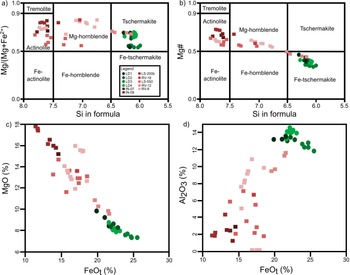
According to the Si apfu versus Mg/(Mg+Fe) classification of Leake et al. (Reference Leake, Woolley, Arps, Birch, Gilbert, Grice, Hawthorne, Kato, Kisch, Krivovichev, Linthout, Laird, Mandarino, Maresch, Nickel, Rock, Schumacher, Smith, Stephenson, Ungaretti, Whittaker and Youzhi1997), all analysed grains are calcic amphiboles, while based on the Si apfu versus Mg/(Mg+Fe2+) relation, the LDS amphiboles are primarily classified as tschermakites, and the AMS amphiboles range from magnesio-hornblende to actinolite (Figure 7a). However, based on AlVI and Fe3+ in the C-site, according to Hawthorne et al. (Reference Hawthorne, Oberti, Harlow, Maresch, Martin, Schumacher and Welch2012), Locock (Reference Locock2014), Li et al. (Reference Li, Zhang, Behrens and Holtz2020), and their Mg#, the LDS amphiboles are classified as ferro-tschermakites (Figure 7b). The amphiboles from AMS show higher MgO content (Figure 7c), while the LDS amphiboles exhibit higher Al2O3 content (Figure 7d). No significant compositional changes are observed in relation to the different textural patterns described.
(a) Nomenclature of amphiboles (after Leake et al. Reference Leake, Woolley, Arps, Birch, Gilbert, Grice, Hawthorne, Kato, Kisch, Krivovichev, Linthout, Laird, Mandarino, Maresch, Nickel, Rock, Schumacher, Smith, Stephenson, Ungaretti, Whittaker and Youzhi1997); (b) Mg# versus Si apfu for the LDS and AMS amphiboles, to indicate the proportion of Fe3+ in both suites; (c) FeOt versus MgO of AMS and LDS amphiboles; (d) FeOt versus Al2O3 of AMS and LDS amphiboles.

5. Discussion
5.a. Opaque mineralogy and the classification into the Ishihara series
The classification for granitic rocks proposed by Ishihara (Reference Ishihara1977) allows the estimation of crystallization parameters, such as temperature, depth and oxygen fugacity (fO2) involved during the evolution of granitic systems (Ishihara, Reference Ishihara1977; Whalen and Chappel, Reference Whalen and Chappell1988; Wones, Reference Wones1989; Magalhães and Dall’Agnol, Reference Magalhães and Dall’agnol1992; Santos-Dias et al. Reference Santos-Dias, Gonçalves and Gonçalves2019; Kumar et al. Reference Kumar, Kumar and Mohan2021). According to Ishihara (Reference Ishihara1977), the ilmenite-series granites exhibit low fO2 conditions if compared to the magnetite-series ones and then are thought to have crystallized at lower depths, associated with continental crust reworking. Conversely, Gastil et al. (Reference Gastil, Diamond, Knaack, Walawender, Marshall, Boyles, Chadwick and Erskine1990) proposed that magnetite-bearing granites could appear at shallower or deeper levels than the ilmenite-series granites, in subduction-related magmatism. Ilmenite-bearing rocks would be formed when the parental magma is associated with the dehydration of the subducted slab, when the initial water fugacity (fH2O) is high and the fO2 very low. Shallower magmas originating magnetite-series granites would be generated before the slab dehydration, where a low fH2O makes the magnetite crystallization prevail instead of hydrated Fe-rich minerals. Thus, in a subduction model where magma generation is depth-dependent, those authors argue that magnetite-series granites could come from shallower or deeper magmas, from depths where there is no dehydration process or it is limited or where the slab is already formed by anhydrous phases. In this perspective, the ilmenite-series granites would mark ‘where’ the dehydration of subducted crust took place.
As previously described, the host rocks from the LDS show magnetite as the predominant opaque mineral (section 4.a.1), classified as an example of magnetite-series TTG. In addition to the isolated subhedral-euhedral magnetite grains (Figure 2b-c), no recrystallization or metamorphic growth features have been recognized nor has any mineral assemblage related to metamorphic reactions, such as the breakdown of hydrous Fe-Mg silicates and their association with K-feldspar (Grant, Reference Grant1985). This leads to the interpretation that the identified opaque assemblage consists of igneous phases, although Moreira et al. (Reference Moreira, Storey, Bruand, Darling, Fowler, Cotte, Villalobos-Portillo, Patar, Seixas, Philippot and Dhuime2023) argue that the magnetite may result from recrystallization processes. For the AMS tonalites, ilmenite and sulphides predominate (section 4.a.2), thus classifying them as ilmenite-series sanukitoids. This is in agreement with Seixas et al. (Reference Seixas, Bardintzeff, Stevenson and Bonin2013), who showed that ilmenite grains from the AMS fall into the ilmenite series in the ternary diagram TiO2 x MnO x Fe2O3 (Figure 8), as do those studied here. Seixas et al. (Reference Seixas, Bardintzeff, Stevenson and Bonin2013) identified magnetite at a single workstation, whereas it is now identified in two localities. Moreover, the ilmenite chemistry in samples containing magnetite shows higher Fe3+ content, similar to that observed in more oxidized granitoids (IN-17, Figure 8). This is consistent with the expected crustal reworking related to sanukitoid magma genesis (Nascimento et al. Reference do Nascimento, Oliveira, de Heilimo, Galarza and Gabriel2025). However, within the context of the TTG-Sanukitoid transition, it is not associated with continental crust involvement but rather a ‘self-feeding arc’ in an intra-oceanic environment (Moreira et al. Reference Moreira, Storey, Bruand, Darling, Fowler, Cotte, Villalobos-Portillo, Patar, Seixas, Philippot and Dhuime2023).
Ternary diagram between MgO-TiO2-Fe2O3 for ilmenites from the AMS and LDS, comparing with ilmenites from ilmenite- and magnetite-series granitic rocks (data from Seixas et al. Reference Seixas, Bardintzeff, Stevenson and Bonin2013 and Shimizu, Reference Shimizu1986).

Consequently, based on the perspective of Ishihara (Reference Ishihara1977), it would be expected that the LDS, a magnetite-series TTG, crystallized at greater depths than the AMS, an ilmenite-series sanukitoid. According to Gastil et al. (Reference Gastil, Diamond, Knaack, Walawender, Marshall, Boyles, Chadwick and Erskine1990), the parental magma of the magnetite-bearing TTG could have evolved at shallower levels, in accordance with the depth-dependent model proposed for magma generation in a subduction context. Ishihara (Reference Ishihara1977) demonstrated that the mineral assemblages in magnetite-series granitoids imply higher fO2 than those in ilmenite-series granitoids, with the likely boundary between the two series occurring near the Ni-NiO buffer. Gastil et al. (Reference Gastil, Diamond, Knaack, Walawender, Marshall, Boyles, Chadwick and Erskine1990) discussed that magnetite-series granitoids could be related to a magma generated at lower depths when the dehydration of the subducted slab is not attained, or even in deeper levels with a condition of dry slab, both resulting in magmatism with low fH2O and high fO2. In the context of the tectonic environment of the TTG-Sanukitoid transition (e.g. Laurent et al. Reference Laurent, Martin, Moyen and Doucelance2014; Martin et al. Reference Martin, Moyen and Rapp2009; Moreira et al. Reference Moreira, Storey, Fowler, Seixas and Dunlop2020; Nascimento et al. Reference do Nascimento, de Oliveira, Gabriel, Marangoanha, Silva and Aleixo2023, Reference do Nascimento, Oliveira, de Heilimo, Galarza and Gabriel2025), the LDS and the AMS may record the transition from magmatism derived from a hydrous basaltic oceanic crust, forming the TTG (e.g. Lopes et al. Reference Lopes, Gonçalves, Gonçalves, Moreira, Lacerda and Armond2024), to a magmatism associated with slab dehydration. This leads to a higher fH2O melt, which, in interaction with sediments and the mantle wedge, forms the sanukitoid within the framework of a ‘self-feeding arc’ (Moreira et al. Reference Moreira, Storey, Bruand, Darling, Fowler, Cotte, Villalobos-Portillo, Patar, Seixas, Philippot and Dhuime2023). The sanukitoids could represent a transition in the tectonic regime and crystallization processes, being associated with crustal assimilation (Nascimento et al. 2025), but chemical and isotopic features indicative of crustal contamination were not found in the LDS nor in the AMS (Seixas et al. Reference Seixas, Bardintzeff, Stevenson and Bonin2013; Moreira et al. Reference Moreira, Storey, Fowler, Seixas and Dunlop2020; Vieira et al. Reference Vieira, Gonçalves and Gonçalves2020; Nahas et al. Reference Nahas, Gonçalves, Gonçalves and Raposo2023).
The magnetic susceptibility also serves to distinguish between ilmenite- and magnetite-series granitoids, with a threshold value around 3 × 10⁻³ SI. Rocks with susceptibility values higher than this are classified as magnetite-series, while those with lower values belong to the ilmenite-series granitoids (Ishihara, Reference Ishihara1977, Reference Ishihara1979; Gastil et al. Reference Gastil, Diamond, Knaack, Walawender, Marshall, Boyles, Chadwick and Erskine1990). Thus, it is expected that AMS rocks are associated with lower bulk magnetic susceptibility values. In agreement, Nahas et al. (Reference Nahas, Gonçalves, Gonçalves and Raposo2023) studied the magnetic susceptibility of AMS tonalites and found values ranging from 14.9 to 54.1 × 10⁻⁵ SI, which is consistent with what is expected for an ilmenite-series suite. Furthermore, magnetic mineralogy experiments did not detect the presence of magnetite in any of the studied samples (Nahas et al. Reference Nahas, Gonçalves, Gonçalves and Raposo2023). Hence, after analysing these parameters, we classified the LDS as a magnetite-series TTG and the AMS as an ilmenite-series sanukitoid.
5.b. Mineral phases and the fO2 path
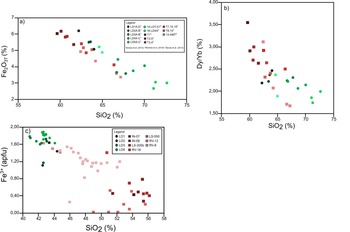
Magma composition evolves primarily through fractional crystallization (e.g. Grove et al. Reference Grove, Elkins-Tanton, Parman, Chatterjee, Müntener and Gaetani2003; Kelley and Cottrell, Reference Kelley and Cottrell2012; Nandedkar et al. Reference Nandedkar, Ulmer and Müntener2014), though assimilation of surrounding materials, interaction with fluids, or decompression may also contribute to the progressive compositional changes (e.g. Sparks et al. Reference Sparks, Huppert and Turner1984; Sparks, Reference Sparks1986; Villemant, Reference Villemant1988; Kuritani et al. Reference Kuritani, Kitagawa and Nakamura2005). Thus, the oxidizing or reducing environments predicted by magnetite- and ilmenite-series rocks, respectively (Ishihara, Reference Ishihara1977, Reference Ishihara1979, Reference Ishihara2004), may progressively change or evolve (e.g. Luo et al. Reference Luo, Wang, Nebel and Li2024). This evolution may be tracked through textural relations among Fe-Ti oxides, titanite and Fe-Mg-Ca-Al silicates (pyroxenes, amphiboles and micas) (e.g. Grant, Reference Grant1985; Luo et al. Reference Luo, Wang, Nebel and Li2024). The Fe-Mg-Ca-Al silicates found in the studied rocks include hornblende and biotite (section 3 and also Seixas et al. Reference Seixas, Bardintzeff, Stevenson and Bonin2013 and Lopes et al. Reference Lopes, Gonçalves, Gonçalves, Moreira, Lacerda and Armond2024). Among these, hornblende may preserve evidence of pristine crystallization stages, supported by Fe2O3T x SiO2 and Dy/Yb x SiO2 whole-rock geochemical diagrams (data from Seixas et al. Reference Seixas, David and Stevenson2012, Reference Seixas, Bardintzeff, Stevenson and Bonin2013 and Moreira et al. Reference Moreira, Seixas, Storey, Fowler, Lasalle, Stevenson and Lana2018). The diagrams exhibit negative correlations, suggesting that Fe depletion is primarily governed by fractional crystallization (Fe-Mg-Ca-Al silicates, Fe-Ti oxides and titanite). Notably, amphibole plays a crucial role in this process (Figure 9a–b), incorporating middle rare earth elements (e.g. as previously argued by Luo et al. Reference Luo, Wang, Nebel and Li2024).
(a) Fe2O3T versus SiO2 whole-rock diagram, compiled from Seixas et al. (Reference Seixas, David and Stevenson2012, Reference Seixas, Bardintzeff, Stevenson and Bonin2013) and Moreira et al. (Reference Moreira, Seixas, Storey, Fowler, Lasalle, Stevenson and Lana2018) to distinguish the LDS and the AMS based on their Fe3+ content; (b) Dy/Yb versus SiO2 whole-rock diagram, indicating the contribution of amphibole fractionation during magmatic differentiation, according to Luo et al. (Reference Luo, Wang, Nebel and Li2024). All data from (a) and (b) are compiled from Seixas et al. (Reference Seixas, David and Stevenson2012, Reference Seixas, Bardintzeff, Stevenson and Bonin2013) and Moreira et al. (Reference Moreira, Seixas, Storey, Fowler, Lasalle, Stevenson and Lana2018), with the location of the stations in the respective works; (c) Fe3+ versus SiO2 for amphiboles from the LDS and AMS.

5.b.1. Amphibole
Wones (Reference Wones1989) related the essential mineralogy of granitic rocks to temperature and fO2 conditions, showing that higher Mg# (greater than 0.5) in pyroxenes and/or amphiboles is associated with higher fO2 values, above the FMQ buffer. As seen in Figure 7, AMS and LDS samples can be clearly distinguished based on Mg#. The AMS amphiboles exhibit higher Mg# (Figure 7b, in agreement with Seixas et al. Reference Seixas, Bardintzeff, Stevenson and Bonin2013), with higher MgO and lower FeOt contents (Figure 7c), indicating a more oxidizing environment during the crystallization of the sanukitoids. Besides, considering the amphibole classification after Hawthorne et al. (Reference Hawthorne, Oberti, Harlow, Maresch, Martin, Schumacher and Welch2012), the Mg# for amphiboles in LDS samples can be below 0.5, indicating, according to Wones (Reference Wones1989), fO2 values likely below the FMQ buffer. However, fO2 estimation based only on amphibole chemistry must be analysed with caution, and its combination with the opaque assemblage stability field can be understood as a powerful tool to constrain the redox conditions of magmas. Figure 10 shows that the LDS samples have intermediate to high fO2 values, while the AMS samples reach the highest levels of fO2, based on the Fe# x AlIV calculation for amphibole grains (Anderson & Smith, Reference Anderson and Smith1995). Oliveira et al. (Reference Oliveira, Dall’Agnol and Scaillet2010) presented an oxidized example of sanukitoid, classified based on the opaque assemblage as an ilmenite-series rock, but presenting high fO2 levels, also based on amphibole chemistry. According to Fe# x AlIV, the amphiboles from all samples studied by the authors fall in the high fO2 field, being associated with the Ni-NiO buffer condition. Additionally, as observed in Figures 7 (c-d) and 9 (a-b), each suite displays an evolutionary trend, with linear compositional changes correlated with an increase in SiO2, suggesting fractional crystallization, possibly implying internal fO2 variability.
AlIV versus Fe/(Fe+Mg) of amphiboles from the studied tonalites and estimates of fO2 for their crystallization (after Anderson and Smith, Reference Anderson and Smith1995).

The observed negative correlation between Fe3+ x SiO2 (Figure 9c) in the amphibole crystals from both suites supports the interpretation that oxygen fugacity (fO2) progressively decreases during crystallization. This trend, where Fe loss (notably Fe3+) is associated with increasing SiO2, is consistent with the findings of Luo et al. (Reference Luo, Wang, Nebel and Li2024). The higher Fe3+ content in the amphiboles from LDS aligns with the interpretation of pristine crystallization of ferrotschermakite and magnetite as the main iron oxide in a low Mg# and high Fe# parental magma of a magnetite-series TTG. On the other hand, the AMS whole-rock data indicate a higher bulk Fe3+ concentration (Figure 9a), suggesting that the crystallization path of the accessory phases influenced the Fe2+ and Fe3+ concentrations on the suites, and lead to different evolutionary trajectories.
There is no evidence of post-magmatic processes that may have affected the amphibole chemistry of the LDS and the AMS suites, being the amphibole a defining factor of their lithology (Seixas et al. Reference Seixas, David and Stevenson2012, Reference Seixas, Bardintzeff, Stevenson and Bonin2013). Seixas et al. (Reference Seixas, David and Stevenson2012, Reference Seixas, Bardintzeff, Stevenson and Bonin2013) defined it as one of the main controllers of fractional crystallization from both suites and also used geothermobarometry based on the Al content in hornblende to estimate pressure conditions in the AMS.
5.b.2. Magnetite, ilmenite and titanite
Euhedral to subhedral magnetite and ilmenite crystals, occurring as inclusions or with Fe-Mg-Ca-Al silicates (Figures 3 and 4), along with randomly distributed titanite (Vieira et al. Reference Vieira, Gonçalves and Gonçalves2020), suggest that Fe-Ti oxides, including titanite, were also key primary phases in fractional crystallization, for the AMS. Igneous titanite and magnetite, as primary phases, reflect the abundance of Fe3+, indicating a high Fe3+/Fetotal ratio and the initial oxidizing conditions of both studied suites. However, given the distribution and high magnetite content in the LDS (section 4.a.1), it can be considered a ‘magnetite-saturated magma’, while its punctual occurrence in the AMS can be interpreted as the initial fractionation of it, which lowered Fe3+ (fO2), leading to ilmenite as the dominant oxide. In a ‘self-feeding arc’, with magma mixing controlling magmatic evolution (Seixas et al. Reference Seixas, Bardintzeff, Stevenson and Bonin2013), fO2 is also lowered via high fH2O, favouring ilmenite crystallization in the AMS. Oliveira et al. (Reference Oliveira, Dall’Agnol and Scaillet2010) argue that the lack of magnetite in oxidizing granitic rocks may occur due to its replacement by magmatic epidote, so the rocks present low magnetic susceptibility, but evidence of oxidizing conditions related to their crystallization. In the AMS, magmatic epidote was described by Seixas et al. (Reference Seixas, Bardintzeff, Stevenson and Bonin2013) and Vieira et al. (Reference Vieira, Gonçalves and Gonçalves2020) as an accessory phase associated with plagioclase, amphibole and opaque phases, magnetite and ilmenite. Nonetheless, evidence that could indicate a magnetite-epidote substitution were not found. Broska and Petrik (Reference Broska and Petrík2011) argue that the presence of microgranular enclaves (MMEs) in granitic rocks may lead to an increase in magnetic susceptibility. In this context, despite the abundance of MMEs in the AMS (Figure 2d), Nahas et al. (Reference Nahas, Gonçalves, Gonçalves and Raposo2023) reported that the bulk magnetic susceptibility showed no significant disturbance, particularly when only the host rock was sampled. It is important to note that mingling predominates over mixing processes in the AMS, such that MMEs do not significantly influence the magnetic susceptibility of the host tonalite.
The intergrowth of ilmenite and magnetite lamellae (Figure 3f) in the LDS shows that, at the initial stages and higher temperatures, Fe-Ti oxides crystallize, which exsolve as temperatures decrease, following the TiO2 – FeO – Fe2O3 (Fe-Ti-O system, Grant, Reference Grant1985). Titanite lamellae, as well as titanite overgrowths (Figures 3 e–f and 4d) or even Fe-oxide overgrowths in sulphide grains (Figure 3h), likely reflect oxidation associated with deuteric crystallization stages, when phases with lower fO2, such as ilmenite, become unstable (Broska et al. Reference Broska, Harlov, Tropper and Siman2007; Broska and Petrik, Reference Broska and Petrík2011; Kohn, Reference Kohn2017). In the AMS tonalites, Seixas et al. (Reference Seixas, Bardintzeff, Stevenson and Bonin2013) described the formation of titanite and symplectic quartz as a result of the hornblende-ilmenite reaction. This late-stage titanite is also recognized by Vieira et al. (Reference Vieira, Gonçalves and Gonçalves2020) and crystallizes under high ΔfO2, within ilmenite-buffered equilibria (Frost and Lindsley, Reference Frost and Lindsley1992). On the other hand, the euhedral, isolated titanite grains also recognized in the AMS do not result from Fe-Mg-Ca-Al silicate and Fe-Ti oxide reactions, but rather from early crystallization stages, used to constrain the AMS crystallization age (Noce, Reference Noce1995; Moreira et al. Reference Moreira, Seixas, Storey, Fowler, Lasalle, Stevenson and Lana2018). This occurrence indicates high initial fO2 and Ti levels in the AMS. Indeed, Wones (Reference Wones1989) postulated that the assemblage titanite + magnetite + quartz is associated with high fO2 values, above the FMQ buffer. Considering that the titanite content in the LDS is minimal and no pristine grains were identified, this observation aligns with the results presented in Figure 9. These findings suggest that, in general, the AMS exhibits a higher degree of oxidation compared to the LDS.
5.c. Mineral phases, fO2 path and their petrological significance
The Fe-Ti oxide and sulphide assemblages characterize the AMS and LDS as ilmenite- and magnetite-series granitic rocks, respectively, and their associations with amphibole and titanite indicate that both suites crystallized in an oxidizing environment (Figures 7 and 10). This is consistent with the idea that calc-alkaline magmas (for details on the AMS and LDS whole-rock geochemical data, see Seixas et al. Reference Seixas, David and Stevenson2012, Reference Seixas, Bardintzeff, Stevenson and Bonin2013 and Lopes et al. Reference Lopes, Gonçalves, Gonçalves, Moreira, Lacerda and Armond2024) typically exhibit fO2 values higher than the FMQ buffer (Frost et al. Reference Frost, Chamberlain and Schumacher2000; Xirouchakis et al. Reference Xirouchakis, Lindsley and Frost2001; Kohn, Reference Kohn2017).
An intriguing relationship comes out when the opaque assemblage is compared to chemical (this study) and isotopic data (Moreira et al. Reference Moreira, Storey, Bruand, Darling, Fowler, Cotte, Villalobos-Portillo, Patar, Seixas, Philippot and Dhuime2023). The ilmenite-series suite (AMS) appears more oxidized than the magnetite-series granites (LDS) (Figure 10), contradicting the perspective postulated in the literature, particularly that of Ishihara (Reference Ishihara1977). Considering the high fH2O melting conditions in the context of a ‘self-feeding arc’ for the AMS genesis, and the use of chemical diagrams with Fe#, Mg# and Fe2+ to distinguish amphibole phases (Leake et al. Reference Leake, Woolley, Arps, Birch, Gilbert, Grice, Hawthorne, Kato, Kisch, Krivovichev, Linthout, Laird, Mandarino, Maresch, Nickel, Rock, Schumacher, Smith, Stephenson, Ungaretti, Whittaker and Youzhi1997), the Fe speciation is often overlooked, with emphasis typically placed on its reduced state, while Fe3+ content is frequently neglected. It is clear, however, that the Fe3+ content serves as a distinguishing feature between the AMS and the LDS (Figure 7). Although the AMS shows lower Fe# values and higher fO2 (Figure 10), in agreement with Moreira et al. (Reference Moreira, Storey, Bruand, Darling, Fowler, Cotte, Villalobos-Portillo, Patar, Seixas, Philippot and Dhuime2023), its primary phases are minor magnetite and titanite, with ilmenite as the dominant oxide, in contrast to the magnetite-saturated LDS.
It highlights the multiple factors that define the oxidizing state of arc magmas, some of which remain undefined in certain aspects (e.g. Kelley and Cottrell, Reference Kelley and Cottrell2012). Volatile pressures, particularly fH2O, along with the presence of oceanic slabs and the conditions that facilitate their dehydration and/or melting, play a fundamental role in restricting fO2 during the early stages of this type of magmatism (Gastil et al. Reference Gastil, Diamond, Knaack, Walawender, Marshall, Boyles, Chadwick and Erskine1990). Sulphur pressure and Si activity coupled with fH2O will drive the speciation and partitioning of multivalent elements – such as Fe and S – while also shifting equilibrium reactions and altering the stability fields of reference mineral assemblages (Wones, Reference Wones1989). Thus, the opaque mineral assemblage, its coexistence with titanite and Fe-Mg-Ca-Al silicates, and their crystallization path serve as key tools for deciphering magma genesis and, subsequently, the evolution of the magma chamber and magmatic processes.
In this context, the opaque mineral assemblage of the AMS and the LDS provides valuable insights into the magmatic conditions at the early stages of plate tectonics. Considering that the LDS records a magmatism derived from a hydrous basaltic oceanic crust that underwent multiple episodes of partial melting (Seixas et al. Reference Seixas, David and Stevenson2012 and Lopes et al. Reference Lopes, Gonçalves, Gonçalves, Moreira, Lacerda and Armond2024), the opaque mineral assemblage suggests that this process likely occurred with minimal dehydration of the hydrous basaltic slab. This allowed for a higher Fe3+ content, resulting in ‘magnetite-saturated magmatism’. The pristine crystallized mineral phases record significant initial Fe3+ loss or partitioning, with magnetite and ferrotschermakite followed by more reduced phases. The AMS opaque mineral assemblage likely registers the dehydration of the basaltic slab, leading to the prevalence of ilmenite, a reduced oxide. The opaque assemblage and fO2 path reveal an intriguing initial relationship, with the ilmenite-series suite (AMS) appearing more oxidized than the magnetite-series granites (LDS). Importantly, Moreira et al. (Reference Moreira, Storey, Bruand, Darling, Fowler, Cotte, Villalobos-Portillo, Patar, Seixas, Philippot and Dhuime2023) also pointed out the oxidized state, based on a higher concentration of S6+ in apatite inclusions in zircon crystals, for the AMS rocks. This may reflect the changing conditions of subduction, as the oceanic slab descends deep enough to reach the conditions required for its dehydration and melting. Thus, magmatism with comparatively higher fH2O led to a reduced state for multivalent elements such as Fe.
Based on the limits established by the Fe-Ti oxides, sulphides and titanite textures, such as lamellae intergrowths indicating exsolution processes or solid solution immiscibility, the crystallization temperature for both suites must be higher than 660ºC (Wones, Reference Wones1989) (Figure 11). Seixas et al. (Reference Seixas, David and Stevenson2012) proposed that the LDS crystallized within the 700–800°C range, in accordance with the observed opaque mineralogy. For the AMS, Moreira et al. (Reference Moreira, Storey, Bruand, Darling, Fowler, Cotte, Villalobos-Portillo, Patar, Seixas, Philippot and Dhuime2023) established a crystallization temperature of 800 ± 13ºC, using Ti-in-zircon thermometry. Meanwhile, the intergrowth of pyrite and pyrrhotite lamellae indicates that the crystallization temperature exceeded the immiscibility limit for FeS, leading to the exsolution of pyrite and pyrrhotite (Arnold, Reference Arnold1962). This likely indicates that there is no significant thermal gradient between the studied TTG and the sanukitoid magmatism.
Temperature versus log fO2 related to the stability of mineral assemblages and the Fe-Si-O buffers, fayalite-magnetite-quartz (FMQ) and hematite-magnetite (HM) (after Wones, Reference Wones1989). The green lines represent temperature limits for the crystallization of the LDS, proposed by Seixas et al. (Reference Seixas, David and Stevenson2012). The red lines represent temperature limits for the AMS, based on their mineralogical assembly, according to Wones (Reference Wones1989). The filled fields estimate fO2 values involved in the crystallization of the LDS (green) and the AMS (red), based on their opaque mineralogy, texture features and relations with the main assembly. Yellow stars correspond to hypothetic temperature values for a high-temperature more oxidized sanukitoid and a low-temperature less oxidized TTG. Fay: fayalite; Hed: hedenbergite; Ilm: ilmenite; Mag: magnetite; Qtz: quartz; Ttn: titanite; Wol: wollastonite.

Considering the logarithmic diagram of fO2 versus temperature (T) from Wones (Reference Wones1989) and adapted by Santos-Dias et al. (Reference Santos-Dias, Gonçalves and Gonçalves2019) (Figure 11), the mineral assemblage of the studied ilmenite-bearing sanukitoids (AMS) would occupy the wedge bounded by the FMQ buffer and the stability curve of titanite + magnetite + quartz – Fe-Mg-Ca silicate + ilmenite. This coincides with the modern magnetite-free I-type granites from Santos-Dias et al. (Reference Santos-Dias, Gonçalves and Gonçalves2019), although, in this case, it is not constrained by the FeS solvus temperature (Figure 11). This limits the fO2 for the sanukitoids to above approximately 10−18 bars. The magnetite-bearing TTG, in turn, reflects an fO2 higher than 10−17 bars, above the titanite + magnetite + quartz – Fe-Mg-Ca silicate + ilmenite curve. This partially overlaps the field established by Santos-Dias et al. (Reference Santos-Dias, Gonçalves and Gonçalves2019) for modern magnetite-bearing I-type granites.
These stability fields for mineral assemblages from TTG (LDS) and sanukitoids (AMS) show that the premise that magnetite-series granitoids are always more oxidized than ilmenite-bearing ones is not an absolute rule. Considering higher temperature sanukitoids, their ilmenite-bearing assemblages will be more oxidized than lower temperature magnetite-bearing TTGs (Figure 11, yellow stars), even with no significant thermal gradient. Additionally, the increasing activity of Fe-Mg-Ca silicates, indicated in Figure 11 by the curves labelled as ahed=0.1 and 0.5, causes a shift in the equilibrium reaction titanite + magnetite + quartz – Fe-Mg-Ca silicate + ilmenite. This shift could drive the lower limit of the magnetite-bearing TTG stability field toward the FMQ or even below it, making the TTG rocks less oxidized compared to the sanukitoids.
Based on the oxidizing character indicated by the oxide textures, the presence of magnetite, the Fe3+/Fetotal ratio and amphibole chemistry, it can be assumed that the magmatic chambers involved in the crystallization of the sanukitoids and TTG rocks were associated with oxidizing conditions. The LDS presents magnetite as one of the first opaque phases in the crystallization path, which was favoured due to the lower fH2O involved. Ilmenite with exsolutions and titanite rims is also associated with the initial stages of crystallization. Both oxides are followed by sulphides, as well as magnetite and ilmenite lamellae (Figure 12). In the AMS, magnetite prevails only in the initial stage of crystallization, as slab dehydration promotes a high fH2O environment, after which ilmenite becomes the dominant oxide. Sulphides are the next opaque phase to crystallize. Most TTGs are associated with reduced environments (Ishihara et al. Reference Ishihara, Anhaeusser and Robb2002a, Reference Ishihara, Robb, Anhaeusser and Imai2002b; Kumar et al. Reference Kumar, Kumar and Mohan2021), while the LDS marks the initial transition to granitoid genesis related to higher fO2-related, occurring early in the development of plate tectonics, even before the formation of the ‘self-feeding arc’ sanukitoids (Moreira et al. Reference Moreira, Storey, Bruand, Darling, Fowler, Cotte, Villalobos-Portillo, Patar, Seixas, Philippot and Dhuime2023).
Crystallization path of opaque phases from the magnetite-bearing TTG (LDS) and ilmenite-bearing sanukitoid (AMS), and conditions involved in the genesis of the suites. Tectonic models proposed by Moreira et al. (Reference Moreira, Storey, Fowler, Seixas and Dunlop2020). Due to the abundance of magnetite in the TTG-LDS, their crystallization is related to a ‘magnetite-saturated magma’, in an oxidizing environment. The restricted occurrence of magnetite in the sanukitoid-AMS suggests an oxidizing environment with high fH2O and low fO2, prevailing the crystallization of ilmenite in the majority of the body.

Knowing that the GOE began around 2.4 Ga (Holland, Reference Holland2002), we argue that the LDS magnetite-bearing TTG already reflects an altered basalt source, oxidized like a primitive oceanic floor, as also suggested by Moreira et al. (Reference Moreira, Storey, Bruand, Darling, Fowler, Cotte, Villalobos-Portillo, Patar, Seixas, Philippot and Dhuime2023). The opening mantle wedge and the entrance of sediments in this subduction zone facilitated the generation of the more oxidized sanukitoid magmas, which, likely due to higher fH2O from slab dehydration, crystallized as an ilmenite-series rock. Keeping in mind the crystallization ages of the LDS and the AMS, 2350 Ma and 2130 Ma, respectively (Seixas et al. Reference Seixas, David and Stevenson2012, Reference Seixas, Bardintzeff, Stevenson and Bonin2013 and Lopes et al. Reference Lopes, Gonçalves, Gonçalves, Moreira, Lacerda and Armond2024), the studied rocks record the Siderian-Rhyacian tectonic and magmatic transition in the Mineiro Belt.
6. Conclusions
The 2350 Ma Lagoa Dourada Suite and 2130 Ma Alto Maranhão Suite represent one of the final recorded TTG-Sanukitoid transitions, occurring during the Great Oxygen Event. The opaque mineralogy suggests oxidizing conditions during the crystallization of both suites, although they are classified as magnetite- and ilmenite-series granitoids, respectively. The amphibole chemistry reveals an intriguing relationship, where ilmenite-bearing sanukitoids are more oxidized than magnetite-bearing TTGs. When analysed in the light of opaque assemblages and equilibrium reactions, it becomes evident that high-temperature ilmenite-bearing sanukitoids can exhibit higher oxidation levels than low-temperature magnetite-bearing TTGs, both in oxidizing conditions, above the FMQ buffer. The Fe3+/Fetotal ratio and fH2O play critical roles in characterizing the redox state of arc magmatism. These findings may indicate a significant shift in subduction conditions, marked by the dehydration of the hydrous oceanic slab and the onset of sanukitoid magmatism.
Supplementary material
The supplementary material for this article can be found at https://doi.org/10.1017/S001675682610065X
Acknowledgments
M. C. Marcussi thanks the Coordination of Superior Level Staff Improvement (CAPES). C. C. Gonçalves thanks the UFOP researcher fellowship, process 23109.016819/2023-81, and the Minas Gerais State Research Support Foundation – FAPEMIG (project APQ-02529-24). L. Gonçalves thanks the Minas Gerais Research Support Foundation (FAPEMIG, process APQ-01860-21) and the UFOP Research Scholarship, process 23109.007219/2024-11. We sincerely express our gratitude to Susie Cox and Sarah Sherlock for the editorial guidance and the careful evaluation of our work. We also thank Aline Costa Nascimento and anonymous reviewers, whose constructive comments have significantly improved the quality of the manuscript.
Competing interests
There is no conflict of interest for any of the contributing authors. We certify that the data and ideas presented in this manuscript are all original, and none of the content has been published or is currently under consideration for publication elsewhere.






 Open access

