





Impact statement
In response to the severe shortage of mental health specialists in low- and middle-income countries (LMICs), the WHO and national governments have promoted task-shifting, delegating psychological care to trained non-specialist providers, including lay health workers (LHWs). These workers are often community members without formal specialist mental health qualifications who deliver brief psychological interventions for depression and anxiety with focused training and supervision. Most research on task-shifting in LMICs has focused on intervention effectiveness and implementation, with far less attention to how LHWs themselves experience delivering care. Our systematic review and meta-ethnography synthesise qualitative evidence from multiple LMICs and show that this work depends not only on technical competence, but also on substantial relational and emotional labour. LHWs often move beyond manuals to respond to poverty, family conflict, stigma and risk, while managing their own distress, boundaries and safety. These hidden costs of care are not only emotional but also structural, shaped by working conditions, weak recognition, limited resources, supervision and organisational support. Efforts to scale up lay-delivered mental healthcare should therefore go beyond strengthening training and supervision alone. They should also recognise relational and emotional labour as core components of service delivery and embed this recognition in fairer remuneration, role clarity, protected time, safeguarding, supportive supervision and stronger organisational support.
Introduction
Depression and anxiety are major global health concerns and disproportionately affect low- and middle-income countries (LMICs), as classified by the World Bank based on gross national income per capita (World Bank, 2024). An estimated 5.53% of adults in LMICs live with depression and 4.52% with anxiety, conditions that frequently co-occur (Saha et al., Reference Saha, Lim, Cannon, Burton, Bremner, Cosgrove, Huo and John2021; WHO, 2022). Despite the burden, many people in LMICs face substantial barriers to accessing care, including limited mental health literacy, stigma, poor availability of services and lack of perceived need for therapy (Andrade et al., Reference Andrade, Alonso, Mneimneh, Wells, Al-Hamzawi, Borges, Bromet, Bruffaerts, de Girolamo, de Graaf, Florescu, Gureje, Hinkov, Hu, Huang, Hwang, Jin, Karam, Kovess-Masfety, Levinson, Matschinger, O’Neill, Posada-Villa, Sagar, Sampson, Sasu, Stein, Takeshima, Viana, Xavier and Kessler2014; Saha et al., Reference Saha, Lim, Cannon, Burton, Bremner, Cosgrove, Huo and John2021; Roberts et al., Reference Roberts, Miguel Esponda, Torre, Pillai, Cohen and Burgess2022).
These challenges are exacerbated by a severe shortage of mental health professionals (Eaton et al., Reference Eaton, McCay, Semrau, Chatterjee, Baingana, Araya, Ntulo, Thornicroft and Saxena2011; Patel et al., Reference Patel, Chowdhary, Rahman and Verdeli2011; WHO, 2021). LMICs have only 3.8 mental health workers per 100,000 population compared with 72.7 in high-income countries (WHO, 2021), and just 13.7% of people with depression and anxiety receive condition-appropriate care (Evans-Lacko et al., Reference Evans-Lacko, Aguilar-Gaxiola, Al-Hamzawi, Alonso, Benjet, Bruffaerts, Chiu, Florescu, de Girolamo, Gureje, Haro, He, Hu, Karam, Kawakami, Lee, Lund, Kovess-Masfety, Levinson, Navarro-Mateu, Pennell, Sampson, Scott, Tachimori, ten Have, Viana, Williams, Wojtyniak, Zarkov, Kessler, Chatterji and Thornicroft2018). In response, WHO has promoted task-shifting, which involves transferring routine tasks from specialists to trained non-specialists, including lay health workers (LHWs) (Liu et al., Reference Liu, Sullivan, Khan, Sachs and Singh2011; WHO, 2012). When supported by structured training and supervision, task-shifting can improve health outcomes, reduce specialist workload and expand access to early psychological care, which can prevent more severe illness and costly hospital care (Kakuma et al., Reference Kakuma, Minas, van Ginneken, Dal Poz, Desiraju, Morris, Saxena and Scheffler2011; Seidman and Atun, Reference Seidman and Atun2017; Heller et al., Reference Heller, Kumar, Kishore, Horowitz, Joshi and Vedanthan2019). The WHO’s Mental Health Gap Action Programme (mhGAP) provides guidance and training materials to support these roles (Kohrt et al., Reference Kohrt, Mutamba, Luitel, Gwaikolo, Onyango Mangen, Nakku, Rose, Cooper, Jordans and Baingana2018; WHO, 2019).
A key application of task-shifting is training LHWs to deliver low-intensity psychological interventions (LIPIs): brief, structured psychological interventions delivered by trained non-specialists with focused training and supervision. Many LIPIs draw on CBT principles, including thought challenging, behavioural activation, problem-solving and psychoeducation, and are designed to reduce distress and improve daily functioning (Bennett-Levy et al., Reference Bennett-Levy, Richards, Farrand, Christensen, Griffiths, Kavanagh, Klein, Lau, Proudfoot, Ritterband, White and Williams2010; Shafran et al., Reference Shafran, Myles-Hooton, Bennett and Öst2021). Many also adopt a transdiagnostic framework, targeting shared psychological processes across depression, anxiety and related forms of distress rather than a single diagnosis alone (McManus et al., Reference McManus, Shafran and Cooper2010; Dalgleish et al., Reference Dalgleish, Black, Johnston and Bevan2020). This review focused on depression and anxiety because they are major common mental health problems and central targets of task-shared psychological care in LMICs, and because many included interventions addressed shared processes across depression, anxiety and related distress (Karyotaki et al., Reference Karyotaki, Araya, Kessler, Waqas, Bhana, Rahman, Matsuzaka, Miguel, Lund, Garman, Nakimuli-Mpungu, Petersen, Naslund, Schneider, Sikander, Jordans, Abas, Slade, Walters, Brugha, Furukawa, Amanvermez, Mello, Wainberg, Cuijpers and Patel2022; Kim et al., Reference Kim, Aryee, Bang, Prajogo, Choi, Hoch and Prado2023). LIPIs also represent scalable strategies for addressing the treatment gap in resource-constrained settings (Patel et al., Reference Patel, Chowdhary, Rahman and Verdeli2011; WHO, 2019).
In this review, LHWs are defined as non-specialist providers without formal specialist mental health qualifications who are trained to deliver LIPIs (Lewin et al., Reference Lewin, Dick, Pond, Zwarenstein, Aja, van Wyk, Bosch-Capblanch and Patrick2005; WHO, 2013). Depending on context, they include community volunteers, peers, lay counsellors and other community-based workers, often drawn from and embedded within the communities they serve, and, in some cases, linked to existing health or NGO services and may have had broader health-related roles. Examples include grandmothers delivering problem-solving therapy in Zimbabwe and local mothers (“ Sakhis ”) supporting perinatal mental health in India (Chibanda et al., Reference Chibanda, Cowan, Verhey, Machando, Abas and Lund2017; Singla et al., Reference Singla, Ratjen, Krishna, Fuhr and Patel2020). Their roles often extend beyond formal counselling to include psychosocial support, health promotion and community mobilisation (Hartzler et al., Reference Hartzler, Tuzzio, Hsu and Wagner2018; Glenton et al., Reference Glenton, Javadi and Perry2021; Liana and Windarwati, Reference Liana and Windarwati2021).
Systematic reviews have demonstrated that LHW-delivered LIPIs can reduce symptoms of depression and anxiety in LMICs (Singla et al., Reference Singla, Kohrt, Murray, Anand, Chorpita and Patel2017; Connolly et al., Reference Connolly, Vanchu-Orosco, Warner, Seidi, Edwards, Boath and Irgens2021; van Ginneken et al., Reference van Ginneken, Chin, Lim, Ussif, Singh, Shahmalak, Purgato, Rojas-García, Uphoff, McMullen, Foss, Thapa Pachya, Rashidian, Borghesani, Henschke, Chong and Lewin2021), yet evidence on how these interventions are experienced by LHWs remains limited. Existing reviews have explored feasibility, acceptability and training needs (Shahmalak et al., Reference Shahmalak, Blakemore, Waheed and Waheed2019; Verhey et al., Reference Verhey, Ryan, Scherer and Magidson2020), or programme reach (Ahmed et al., Reference Ahmed, Chase, Wagnild, Akhter, Sturridge, Clarke, Chowdhary, Mukami, Kasim and Hampshire2022), and the perceived costs of task-shifting within health systems (Coales et al., Reference Coales, Jennings, Afaq, Arsh, Bhatti, Siddiqui and Siddiqi2023), highlighting that success depends not only on technical competence or adherence to manuals but also on training, supervision, cultural sensitivity and organisational support. However, these reviews remain largely programme-centred, and have not foregrounded LHWs’ lived experiences as they navigate cultural expectations, organisational constraints and social relationships in under-resourced settings. LHWs often rely on local understandings of mental health, community norms and personal relationships rather than formal diagnostic categories (Chase et al., Reference Chase, Shrestha, Datta, Forsythe, Jain, Maharjan, Mathias, Miguel-Lorenzo, Ranganathan, Shrestha, Sidgel, Subba, Gautam, Gurung and Ntow2024). Their roles are deeply rooted in social and cultural contexts (Chase et al., Reference Chase, Shrestha, Datta, Forsythe, Jain, Maharjan, Mathias, Miguel-Lorenzo, Ranganathan, Shrestha, Sidgel, Subba, Gautam, Gurung and Ntow2024). In many such settings, mental health initiatives rely more on community engagement, social trust and local networks than on formal systems (Chutiyami et al., Reference Chutiyami, Cutler, Sangon, Thaweekoon, Nintachan, Napa, Kraithaworn and River2025). In this context, the human dimensions of LHW work, their experiences, including emotional demands, relationships with patients, work–life balance and personal growth shape both their well-being and their capacity to deliver high-quality care (Padmanabhanunni Reference Padmanabhanunni2020; Draper et al., Reference Draper, Soepnel, Mabetha, Motlhatlhedi, Nkosi, Lye and Norris2024; Sangraula et al., Reference Sangraula, Chauhan, Best, McEneaney, Shah, Brown and Kohrt2024), yet these aspects have not been widely explored in LMICs.
As task-shifting to LHWs expands globally and they become a critical workforce in LMIC health systems, understanding their lived experiences is increasingly urgent. Their challenges directly affect intervention quality, burnout, retention and the sustainability of community-based mental health programmes. Attending to these experiences is essential for supporting current LHWs and developing future generations of community mental health workers. This review synthesises qualitative evidence on how LHWs experience delivering LIPIs for depression and anxiety in LMICs. It was guided by the main review question, what are the experiences of LHWs delivering these interventions in LMICs?, and by a more focused sub-question examining what psychosocial, emotional, cultural and organisational factors shape LHWs’ delivery of LIPIs.
Methods
We followed Preferred Reporting Items for Systematic Reviews and Meta-Analyses (PRISMA) guidelines (Moher et al., Reference Moher, Liberati, Tetzlaff, Altman and The2009). The protocol is registered in PROSPERO (CRD42023459609).
Eligibility criteria
The SPIDER tool (Sample, Phenomenon of Interest, Design, Evaluation, Research Type) guided eligibility criteria (Cooke et al., Reference Cooke, Smith and Booth2012). We included qualitative studies and qualitative components of mixed-methods studies reporting interview-based findings from process or trial-embedded evaluations of LHWs’ experiences delivering LIPIs for depression and/or anxiety in World Bank–classified LMICs (2022–2023) (World Bank, 2024). For the purposes of this review, LHWs were defined as non-specialist providers delivering the primary intervention without formal mental health qualifications. This included community volunteers, peers, lay counsellors and other community-based workers, some of whom were linked to existing health or NGO services and may have had broader health-related roles. LIPIs were defined as brief, structured psychological interventions delivered by trained non-specialists with focused training and supervision, typically involving less therapeutic input than conventional therapy and often drawing on CBT-informed, behavioural, cognitive, problem-solving or psychoeducational approaches. Studies were eligible if they involved adults (≥18 years). Mixed-age studies were eligible when adult-focused data predominated; mixed-provider studies when LHW-specific data were identifiable; and mixed-diagnosis studies when the intervention and qualitative findings were primarily relevant to depression, anxiety or closely related common mental distress targeted through the included LIPI. Mixed physical-mental health studies were eligible when the intervention delivery and qualitative findings focused primarily on depression and/or anxiety outcomes. Studies were excluded where this distinction could not be made with sufficient clarity. No language and date restrictions were applied. We excluded studies conducted outside LMICs, studies focused solely on severe mental disorders, interventions not described as a defined psychological intervention, papers without qualitative data and studies without accessible full texts (see Supplementary material 1 for full eligibility criteria).
Search strategy
We searched electronic bibliographic databases, CINAHL, Embase, PsycINFO, Medline, Cochrane Central, ASSIA and ProQuest Dissertation & Theses Global, from inception to January 22, 2024, with an update on June 17, 2025. Search strings combined terms for the sample (e.g., “lay health worker,” “community health worker”), phenomenon of interest (e.g., “depression,” “anxiety,” “CBT”), design (e.g., “interview,” “focus group”), evaluation (e.g., “experiences,” “perceptions,” “views”) and research type (e.g., “qualitative,” “mixed-methods”). Terms were informed by prior systematic reviews (van Ginneken et al., Reference van Ginneken, Tharyan, Lewin, Rao, Meera, Pian, Chandrashekar and Patel2013; Shahmalak et al., Reference Shahmalak, Blakemore, Waheed and Waheed2019; Coales et al., Reference Coales, Jennings, Afaq, Arsh, Bhatti, Siddiqui and Siddiqi2023) and developed in consultation with an academic librarian, then adapted to database-specific syntax and controlled vocabularies (e.g., MeSH in MEDLINE). Supplementary searches included WHO and IHME websites, Google Scholar and backward and forward citation tracking (see Supplementary material 2 for full strategies).
Selection process
The screening process was conducted using Covidence (Veritas Health Innovation, Melbourne, Australia), enabling independent duplicate screening of titles, abstracts and full texts. Each record was screened by two of three reviewers (APK, PAN and GEA). Inter-rater reliability was assessed using Cohen’s Kappa. For title and abstract screening, Kappa values were 0.50 (APK–GEA) and 0.30 (APK–PAN); for full-text screening, agreement improved to 0.60 (APK–GEA) and 0.40 (APK–PAN). Lower agreement at the title and abstract stage likely reflected the breadth and inconsistent reporting of LHW roles, intervention terminology and study focus in the literature. To minimise the risk of prematurely excluding potentially relevant studies, uncertain records were retained for full-text screening. Discrepancies were resolved through discussion, with a third reviewer adjudicating where needed. Any remaining unresolved cases were reviewed with the senior reviewer (HB) for a final decision.
Following initial screening, the operational application of the eligibility criteria was refined in relation to mixed-condition studies to ensure that included interventions and qualitative findings were primarily relevant to depression, anxiety or closely related common mental distress targeted through the included LIPI. This led to four included studies being returned to full-text screening for reappraisal. Following eligibility reassessment and author contact, two studies were excluded from the final synthesis because the populations were not sufficiently relevant to the review focus. The impact of these exclusions on theme development and synthesis interpretation is detailed in Supplementary material 7.
Data extraction
Two standardised extraction forms were developed following meta-ethnography guidelines (Noblit and Hare, Reference Noblit and Hare1988). APK extracted descriptive study data (aims, participants, setting, methods, key findings), while qualitative data (first- and second-order constructs) were double-extracted by APK and PAN, reconciled and organised into preliminary conceptual categories in Excel. For studies involving mixed diagnostic groups or broader common mental disorder populations, extraction focused on LHW delivery of interventions targeting depression, anxiety or related common mental distress. Broader mental health terminology, screening categories and local idioms of distress were accepted without requiring explicit diagnostic labels and any uncertainties were noted and interpreted cautiously during synthesis.
Quality appraisal
We appraised study quality using a modified Critical Appraisal Skills Programme (CASP) tool that included assessment of authors’ theoretical foundations (Long et al., Reference Long, French and Brooks2020). For each study, we recorded domain-level CASP judgements and wrote a brief narrative summary of key methodological strengths and limitations (Long et al., Reference Long, French and Brooks2020). Two reviewers (APK and PAN) conducted the appraisal; 30% of studies were double-appraised, and the remainder reviewed by one and verified by the other. No studies were excluded, in line with guidance that limited reporting does not necessarily indicate poor quality (Dixon-Woods et al., Reference Dixon-Woods, Shaw, Agarwal and Smith2004; Dixon-Woods et al., Reference Dixon-Woods, Sutton, Shaw, Miller, Smith, Young, Bonas, Booth and Jones2007; Atkins et al., Reference Atkins, Lewin, Smith, Engel, Fretheim and Volmink2008). All studies were retained to preserve contextual diversity, and methodological strengths and limitations were incorporated into the synthesis (Carroll et al., Reference Carroll, Booth and Lloyd-Jones2012). Decisions were documented in Excel. We also applied Grading of Recommendations Assessment, Development and Evaluation–Confidence in the Evidence from Reviews of Qualitative research (GRADE-CERQual) to assess confidence in each key finding.
Synthesis
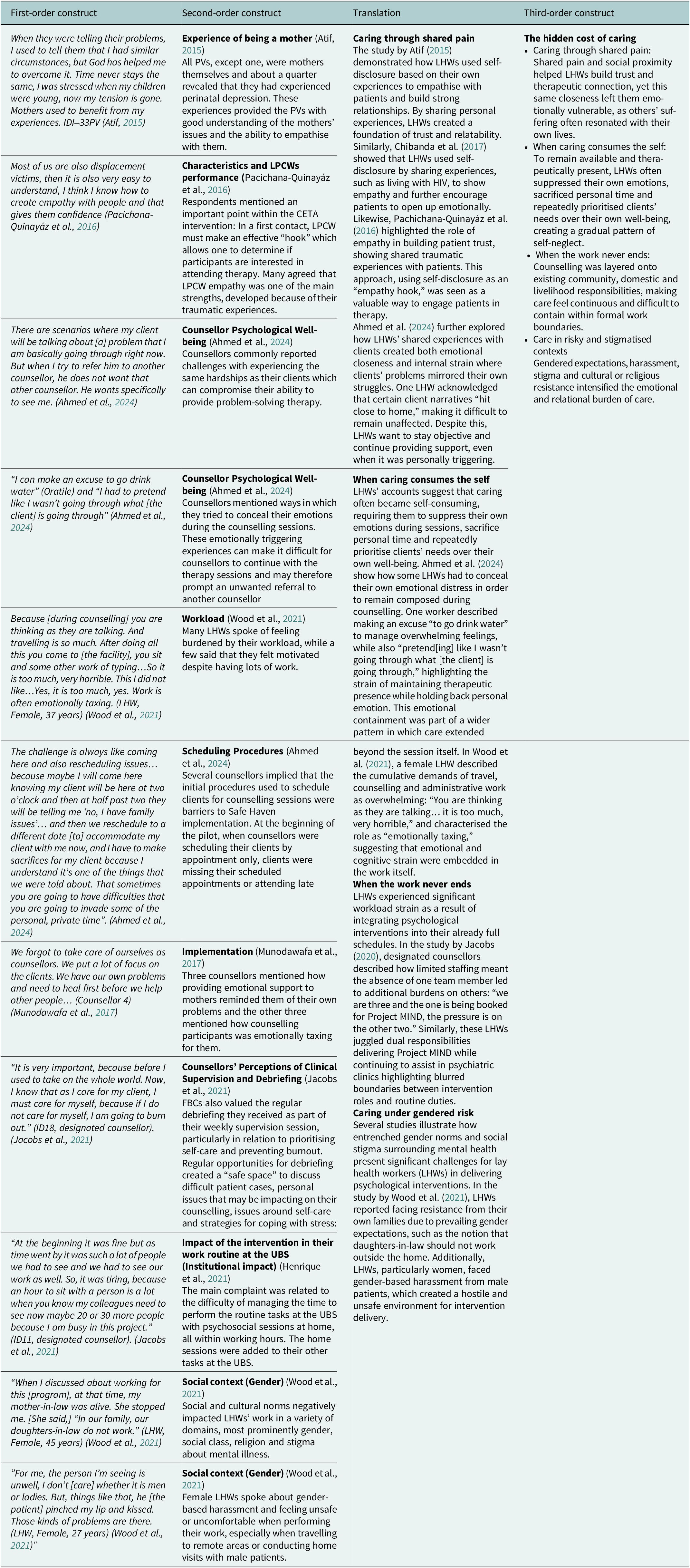
We conducted a meta-ethnographic synthesis following Noblit and Hare (Reference Noblit and Hare1988). First-order constructs (participants’ accounts) and second-order constructs (study authors’ interpretations) were identified and compared across studies. Reciprocal translation involved comparing conceptually similar findings and translating them into shared analytic concepts. For example, accounts of using personal hardship to empathise with clients, together with authors’ interpretations of self-disclosure, empathy and emotional triggering, were translated into caring through shared pain. Related accounts of emotional suppression during sessions, sacrifice of personal time and neglect of one’s own well-being were translated into when caring consumes the self. These translated concepts contributed to the third-order construct. The hidden cost of caring, and, across themes, informed an overarching line-of-argument synthesis about LHWs’ roles in community-based psychological care. (see Table 1; Supplementary Material 5).
Example of synthesis process
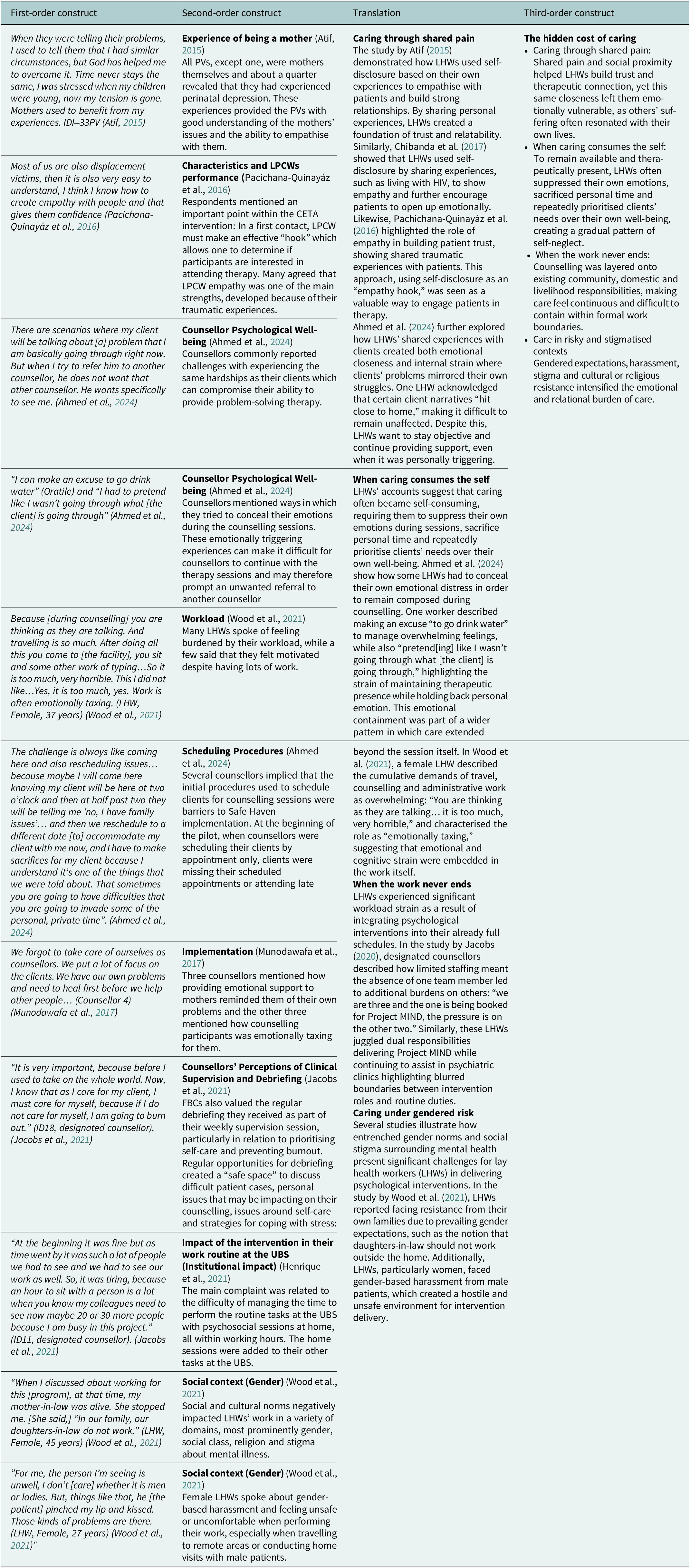
Table 1. Long description
The table is structured into four columns representing different levels of qualitative synthesis.
* First-order construct: Contains direct quotes from participants in various studies (Atif 2015, Pacichana-Quinayáz et al. 2016, Ahmed et al. 2024, Wood et al. 2021, Munodawafa et al. 2017, and Jacobs et al. 2021). These quotes detail personal experiences of motherhood, shared trauma, emotional suppression during counseling, and the burden of heavy workloads.
* Second-order construct: Provides thematic interpretations of the quotes. Key themes include Experience of being a mother, Characteristics and L P C W performance, Counselor Psychological Well-being, Workload, Scheduling Procedures, Implementation, Perceptions of Clinical Supervision, and Social context regarding gender.
* Translation: Groups the second-order constructs into four broader narrative categories:
1. Caring through shared pain: Focuses on how shared experiences build trust but increase vulnerability.
2. When caring consumes the self: Describes the suppression of personal emotions and self-neglect to maintain professional presence.
3. When the work never ends: Details the strain of integrating psychological interventions into existing community and domestic duties.
4. Caring under gendered risk: Highlights challenges from gender norms, family resistance, and harassment.
* Third-order construct: The final synthesis titled The hidden cost of caring. It summarizes the four translation categories into a cohesive finding that while social proximity builds therapeutic connection, it leaves L H W s emotionally vulnerable and prone to self-neglect due to continuous, risky, and gendered work demands.
Results
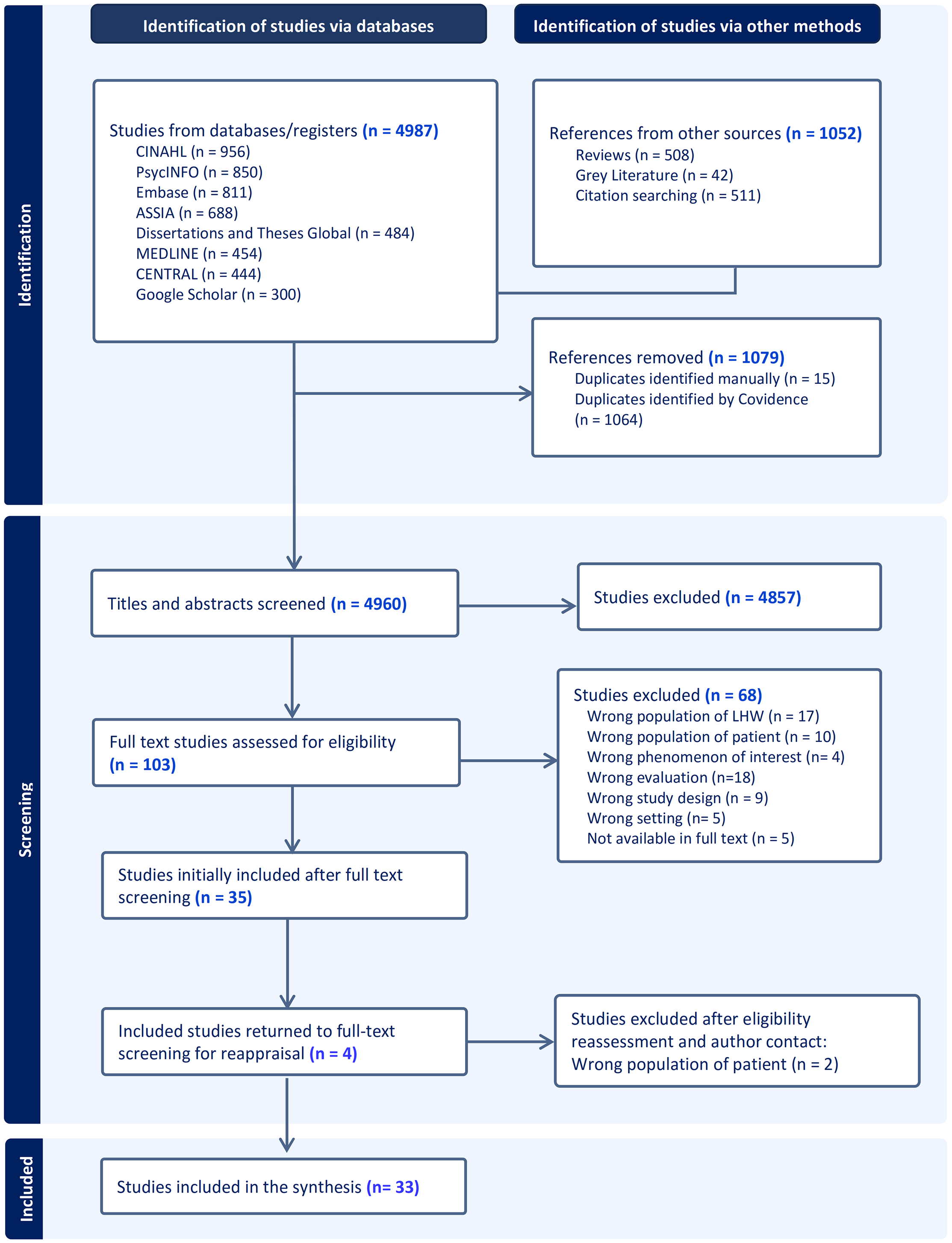
A total of 4,987 records were identified through eight database searches and 1,052 through other sources. Following screening and eligibility reappraisal, 33 studies were included in the final synthesis (Figure 1). Twelve of these appeared in multiple formats (e.g., theses and journal articles) (Atif, Reference Atif2015; Atif et al., Reference Atif, Lovell, Husain, Sikander, Patel and Rahman2016; Chibanda, Reference Chibanda2016; Nyatsanza et al., Reference Nyatsanza, Schneider, Davies and Lund2016; Atif et al., Reference Atif, Krishna, Sikander, Lazarus, Nisar, Ahmad, Raman, Fuhr, Patel and Rahman2017; Chibanda et al., Reference Chibanda, Cowan, Verhey, Machando, Abas and Lund2017; Munodawafa et al., Reference Munodawafa, Lund and Schneider2017; Munodawafa, Reference Munodawafa2018; Jacobs, Reference Jacobs2020; Chau et al., Reference Chau, Murphy, Nguyen, Lou, Khanh, Thu, Minas and O’Neil2021; Jacobs et al., Reference Jacobs, Myers, van der Westhuizen, Brooke-Sumner and Sorsdahl2021; Chau et al., Reference Chau, Lou, Murphy, Nguyen, Small, Samji and O’Neil2024). To avoid duplication, each set was treated as a single study, prioritising theses for methodological detail and using journal articles to supplement information, resulting in five unique studies. In total, 28 unique studies were included in the final synthesis.
PRISMA flow diagram of study selection.
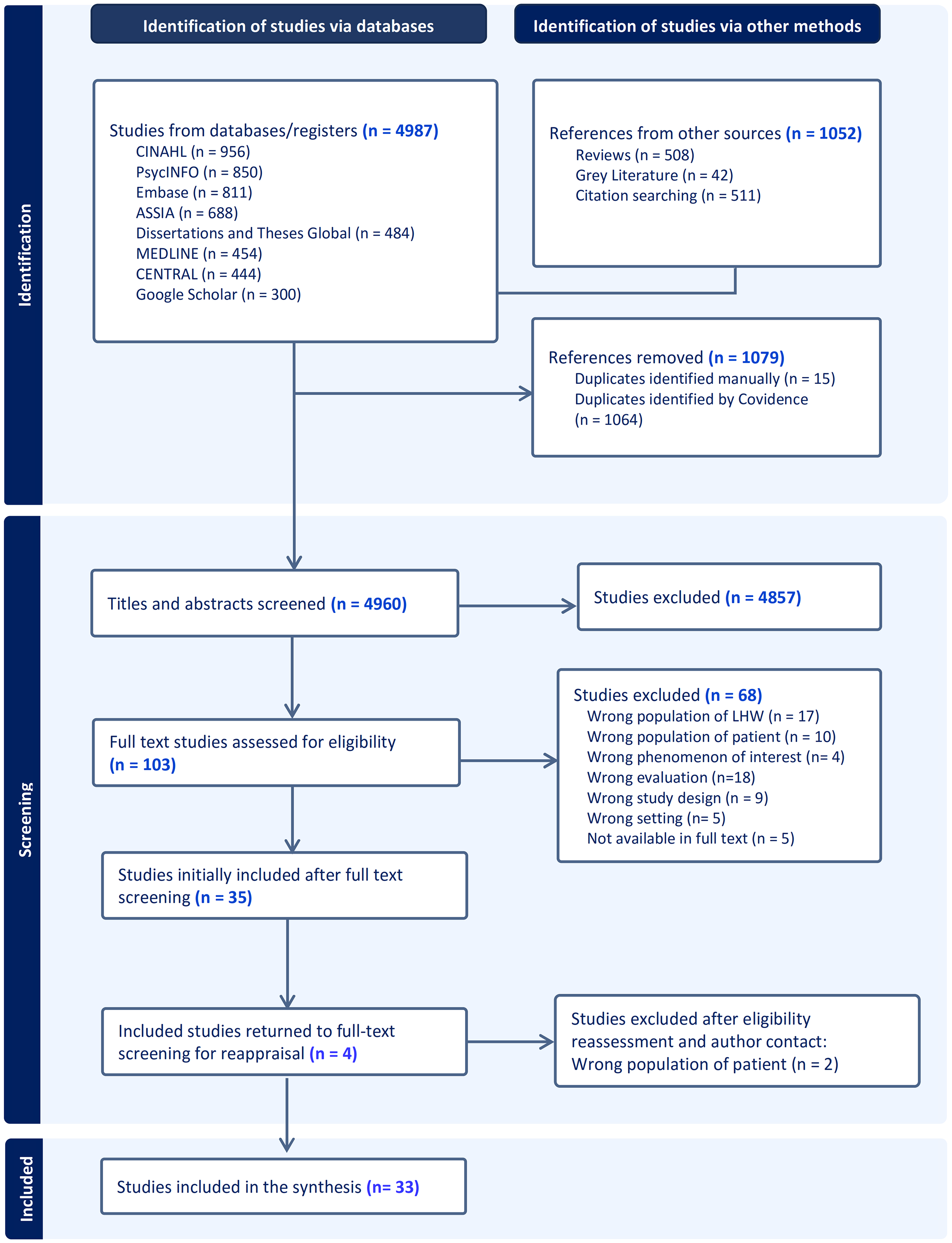
Figure 1. Long description
The flowchart is divided into three vertical sections: Identification, Screening, and Included.
1. Identification Phase:
- Top Left: Identification of studies via databases. Studies from databases/registers n = 4987. Sources include C I N A H L n = 956, Psyc I N F O n = 850, Embase n = 811, A S S I A n = 688, Dissertations and Theses Global n = 484, M E D L I N E n = 454, C E N T R A L n = 444, and Google Scholar n = 300.
- Top Right: Identification of studies via other methods. References from other sources n = 1052. Sources include Reviews n = 508, Grey Literature n = 42, and Citation searching n = 511.
- An arrow from both boxes leads to a central point where 1079 references are removed: Duplicates identified manually n = 15 and Duplicates identified by Covidence n = 1064.
2. Screening Phase:
- Titles and abstracts screened n = 4960. An arrow points right to Studies excluded n = 4857.
- Full text studies assessed for eligibility n = 103. An arrow points right to Studies excluded n = 68. Reasons include: Wrong population of L H W n = 17, Wrong population of patient n = 10, Wrong phenomenon of interest n = 4, Wrong evaluation n = 18, Wrong study design n = 9, Wrong setting n = 5, and Not available in full text n = 5.
- Studies initially included after full text screening n = 35.
- Included studies returned to full-text screening for reappraisal n = 4. An arrow points right to Studies excluded after eligibility reassessment and author contact: Wrong population of patient n = 2.
3. Included Phase:
- At the bottom, the final box indicates Studies included in the synthesis n = 33.
Characteristics of studies
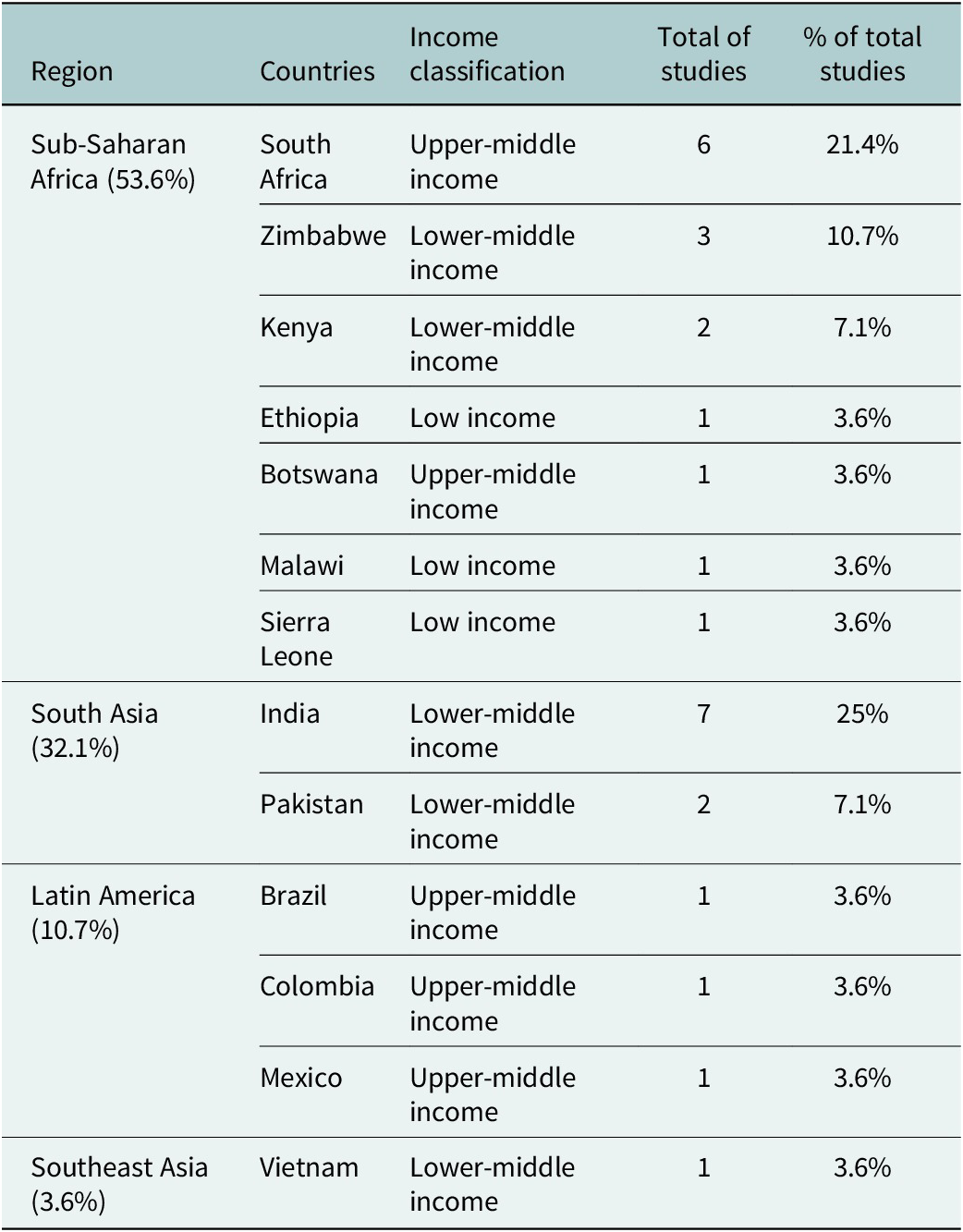
Studies spanned multiple LMICs, grouped by World Bank region. Sub-Saharan Africa contributed 53.6% of studies, primarily from South Africa, Zimbabwe and Kenya, followed by South Asia with 32.1% from India and Pakistan. Latin America accounted for 10.7% (Brazil, Colombia, Mexico), and Southeast Asia was represented by a single study from Vietnam (3.3%) (Table 2). Most studies were conducted in lower-middle-income countries (53.16%; Zimbabwe, Kenya, India, Pakistan, Vietnam), with 35.7% from upper-middle-income countries (Botswana, Brazil, Colombia, Mexico, South Africa) and 10.7% from low-income countries (Ethiopia, Malawi, Sierra Leone) (Table 3; Supplementary Material 3).
Distribution of studies by country, region and income classification
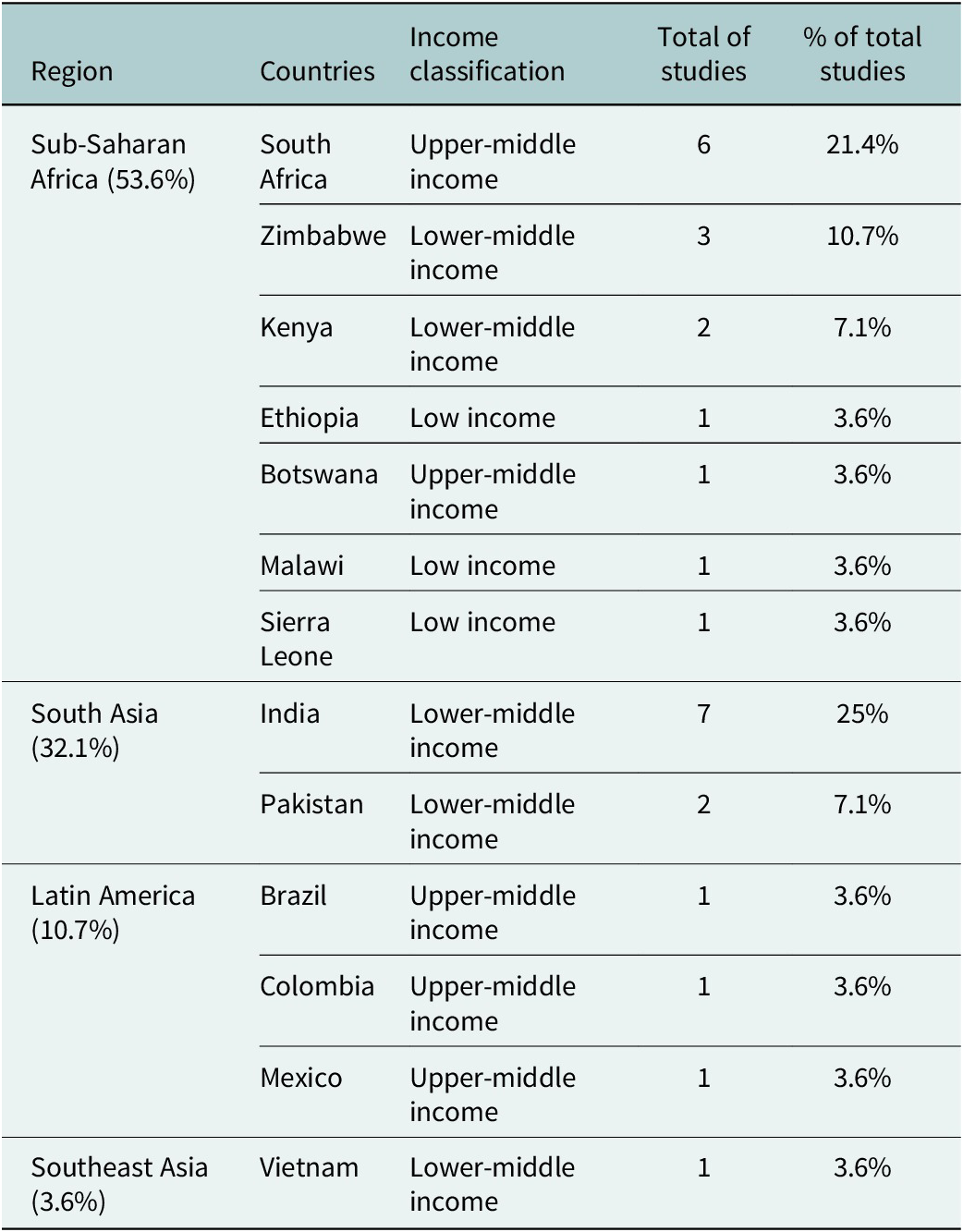
Table 2. Long description
The table is organized into five columns: Region, Countries, Income classification, Total of studies, and percentage of total studies.
* Sub-Saharan Africa (53.6 percent of total):
- South Africa: Upper-middle income, 6 studies, 21.4 percent.
- Zimbabwe: Lower-middle income, 3 studies, 10.7 percent.
- Kenya: Lower-middle income, 2 studies, 7.1 percent.
- Ethiopia: Low income, 1 study, 3.6 percent.
- Botswana: Upper-middle income, 1 study, 3.6 percent.
- Malawi: Low income, 1 study, 3.6 percent.
- Sierra Leone: Low income, 1 study, 3.6 percent.
* South Asia (32.1 percent of total):
- India: Lower-middle income, 7 studies, 25 percent.
- Pakistan: Lower-middle income, 2 studies, 7.1 percent.
* Latin America (10.7 percent of total):
- Brazil: Upper-middle income, 1 study, 3.6 percent.
- Colombia: Upper-middle income, 1 study, 3.6 percent.
- Mexico: Upper-middle income, 1 study, 3.6 percent.
* Southeast Asia (3.6 percent of total):
- Vietnam: Lower-middle income, 1 study, 3.6 percent.
Characteristics of studies

Table 3. Long description
A detailed table with nine columns: Author s, Countries, Design, data collection and analysis, Number of participants L H Ws, Gender and age range of L H Ws, Intervention target, Interventions, Background of L H W and organisational linkage, and Key findings.
Key entries include:
* Abas et al. 2016: Zimbabwe, mixed-methods, 40 to 60 female participants, targeting depression with problem-solving therapy P S T. Findings show positive reception and cost-effectiveness.
* Ahmed et al. 2024: Botswana, qualitative design, 8 mixed-gender participants, targeting depression and anxiety with P S T and behavioural activation. Barriers included client reticence and financial resources.
* Atif et al. 2015 to 2017: India and Pakistan, qualitative design, 8 female participants, targeting perinatal depression using C B T principles. Acceptability was enhanced by local presence and shared life experiences.
* Bah et al. 2025: Sierra Leone, mixed-methods, 10 female participants, targeting perinatal and postpartum depression with P S T. Reported high recruitment and reduction in psychological distress.
* Burgess et al. 2025: Ethiopia, qualitative, 4 female participants, targeting postpartum depression and anxiety with simplified C B T and family planning. Group sessions reduced isolation.
* Chau et al. 2021 and 2024: Vietnam, qualitative, 47 mixed-gender participants, targeting depression. Findings highlight that strong relationships foster openness but low education levels can reduce trust.
* Chibanda et al. 2016 and 2017: Zimbabwe, qualitative, 7 female participants, targeting depression and common mental disorders in people living with H I V or A I D S using P S T. Benefits included reduced stigma and improved access to care.
* Davis et al. 2022: South Africa, qualitative, 6 female participants, targeting perinatal depression. Socio-economic difficulties were a challenge, but participants reported improved mood.
* Henrique et al. 2021: Brazil, qualitative, 11 female participants, targeting depression. The P R O A C T I V E intervention was well-received but required better training.
* Jacobs et al. 2020 and 2021: South Africa, qualitative, 18 mixed-gender participants, targeting depression or alcohol use. Barriers included low pay and lack of space.
* Joag et al. 2020: India, mixed-methods, 16 participants, targeting common mental disorders. Community-led interventions successfully facilitated access to social benefits.
* Kidia et al. 2024: Zimbabwe, qualitative, 12 participants, targeting common mental disorders with P S T and income generation. Sustainability was a concern.
* Munodawafa et al. 2017 and 2018: South Africa, qualitative, multiple cohorts of 4 to 6 female participants, targeting perinatal depression. Success was linked to structured manuals and local language use.
* Musyimi et al. 2019: Kenya, qualitative, 88 female participants, targeting maternal depression by involving traditional birth attendants.
* Myers et al. 2019: South Africa, mixed-methods, 7 female participants, targeting depression in patients with H I V or A I D S and diabetes.
* Ng’oma et al. 2024: Malawi, mixed-methods, 7 female participants, targeting perinatal depression. Peer volunteers faced challenges with inadequate incentives.
* Pacichana-Quinayáz et al. 2016: Colombia, qualitative case study, 5 participants, targeting depression and anxiety. Conflict and economic instability were major barriers.
* Pereira et al. 2011: India, qualitative, 17 female participants, targeting depression and anxiety. Integration required building trust with primary care teams.
* Rodríguez-Cuevas et al. 2021: Mexico, qualitative, 4 female participants, targeting depression and anxiety. P M plus intervention improved L H W attitudes.
* Saleem et al. 2021: Pakistan, mixed-methods, 3 female participants, targeting depression and anxiety using family therapy.
* Selohilwe et al. 2023: South Africa, qualitative, 19 participants, targeting depression with hypertension. Barriers included high counsellor turnover.
* Singla et al. Reference Singla, Ratjen, Krishna, Fuhr and Patel2020: India, mixed-methods, 26 female participants, targeting perinatal depression. Peer supervision was preferred for quality assessment.
* Szajna et al. 2024: India, mixed-methods, 17 female participants, targeting postpartum depression with brief behavioural activation.
* Wood et al. 2021: India, qualitative, 32 mixed-gender participants, targeting a range of mental illnesses. Compensation and stigma were key barriers.
* Yator et al. 2022: Kenya, qualitative, 8 female participants, targeting postpartum depression with group interpersonal therapy I P T G.
* Included as a single study due to complementary data across multiple sources.
Although the included LIPIs varied in terminology and format, most drew on a shared set of brief psychological strategies, especially problem-solving, behavioural activation and psychoeducation, often alongside CBT-informed techniques and, in some studies, motivational, interpersonal, family or psychosocial support elements (Table 3). LHWs were heterogeneous rather than a homogenous group (Table 3). Their organisational linkage ranged from government primary care and primary care-linked roles to NGO-, programme and project-based positions, often in hybrid arrangements combining community embeddedness with facility, NGO or project structures. Where reporting was limited, classification was based on authors’ descriptions of role, employment, setting and supervision. Although most studies focused on depression and/or anxiety, a small subset (8 of 28 studies) included broader common mental disorder or mixed-condition populations, these were retained only where findings relevant to depression and/or anxiety were extractable.
Quality appraisal
Overall, the contributing studies demonstrated generally acceptable methodological quality, most clearly stated their aims, used appropriate qualitative methods and addressed ethical issues. However, theoretical underpinnings and researchers’ ontological or epistemological positions were rarely articulated. Reflexivity was limited, with little acknowledgement of researchers’ influence on data collection and interpretation. Although thematic or framework analyses were common, analytic procedures were often underdescribed, offering scant detail on theme development or divergent data. These limitations may reduce the depth and credibility of findings and underrepresent nuanced perspectives (see Supplementary material 4).
Findings
Through the meta-ethnographic synthesis, this review translated and interpreted findings across studies to develop four overarching constructs that explain LHWs’ lived experiences delivering LIPIs for depression and anxiety in LMICs. Together, these constructs offer a conceptual understanding of the complexity of their work, how they negotiate recognition within the health system, their trajectories of growth in practice and the emotional demands embedded in community-based care.
Doing more than psychological therapy
Across studies, LHWs described work that extended far beyond structured low-intensity interventions. Symptom alleviation and core techniques such as psychoeducation, problem-solving, relaxation and healthy-thinking remained central (Atif, Reference Atif2015; Abas et al., Reference Abas, Bowers, Manda, Cooper, Machando, Verhey, Lamech, Araya and Chibanda2016; Pacichana-Quinayáz et al., Reference Pachichana-Quinayáz, Osorio-Cuéllar, Bonilla-Escobar, Fandiño-Losada and Gutiérrez-Martínez2016; Chibanda et al., Reference Chibanda, Cowan, Verhey, Machando, Abas and Lund2017; Munodawafa et al., Reference Munodawafa, Lund and Schneider2017), but LHWs also addressed the social and family circumstances shaping distress. They helped patients navigate poverty, secure food or finances, link to social services, resolve family conflict and respond to domestic violence (Pereira et al., Reference Pereira, Andrew, Pednekar, Kirkwood and Patel2011; Abas et al., Reference Abas, Bowers, Manda, Cooper, Machando, Verhey, Lamech, Araya and Chibanda2016; Joag et al., Reference Joag, Shields-Zeeman, Kapadia-Kundu, Kawade, Balaji and Pathare2020; Chau et al., Reference Chau, Murphy, Nguyen, Lou, Khanh, Thu, Minas and O’Neil2021). In doing so, they routinely moved beyond formal intervention parameters into wider family and community issues to support safety and stability. For example, LHWs supporting women with depression also engaged husbands whose abusive behaviour contributed to their distress, not as part of the therapeutic protocol, but as a dynamic response to the surrounding context (Joag et al., Reference Joag, Shields-Zeeman, Kapadia-Kundu, Kawade, Balaji and Pathare2020).
In one family, the husband used to beat his wife, when I came to know about them, I visited them. I counselled them. Showed them the films on quarrels, addiction. Now fights between them have reduced to a large extent. (Joag et al., Reference Joag, Shields-Zeeman, Kapadia-Kundu, Kawade, Balaji and Pathare2020)
In areas with high mental health stigma, LHWs had to negotiate cultural and religious norms that discouraged engagement with psychological treatments such as counselling and behavioural activation. To overcome these barriers, they extended their work beyond manualised techniques, adapting therapeutic conversations, reframing symptoms and using culturally resonant practices to build trust and reduce resistance (Atif, Reference Atif2015; Wood et al., Reference Wood, Seevak, Bhatia, McBain and Nadkarni2021). Such adaptations illustrated both relational labour (managing relationships and cultural expectations) and emotional labour (modifying emotions to remain respectful, patient and reassuring when facing rejection).
When we visit [religious group] houses, they have temples and all and the patient and others are not ready to accept us and they said we don’t want your treatment and avoided us and they said our gods don’t like you coming here. But we convinced them and made a good relation with them and I even prayed at their home. (LHW, Female, 30 years). (Wood et al., Reference Wood, Seevak, Bhatia, McBain and Nadkarni2021)
Embedded in the community, precariously held by the system
Many LHWs had lived in the same communities for years, sharing everyday spaces and life events with those they supported. This deep social embeddedness fostered trust and familiarity, so they were recognised not only in their formal roles but as longstanding community members (Atif, Reference Atif2015; Chibanda et al., Reference Chibanda, Cowan, Verhey, Machando, Abas and Lund2017; Chau et al., Reference Chau, Murphy, Nguyen, Lou, Khanh, Thu, Minas and O’Neil2021; Wood et al., Reference Wood, Seevak, Bhatia, McBain and Nadkarni2021; Chau et al., Reference Chau, Lou, Murphy, Nguyen, Small, Samji and O’Neil2024; Bah et al., Reference Bah, Wurie, Samai, Horn and Ager2025). Their relationships extended beyond clinical contexts into markets, homes and religious gatherings, where shared histories and common experiences strengthened rapport (Atif, Reference Atif2015; Chibanda et al., Reference Chibanda, Cowan, Verhey, Machando, Abas and Lund2017; Saleem et al., Reference Saleem, Baig, Sajun, Bird, Priebe and Pasha2021). This shared lived experience became a therapeutic resource, enabling patients to feel understood and safe. As one LHW noted, longstanding relationships often encouraged people to open up in ways they would not with outsiders.
So because we are known as Ambuya Utano (grandmother health worker) there is a certain level of trust we get from PLWH. We have lived here for more than 20 years so we are known because with most of them we see each other at the market, we have helped them in the past maybe during the cholera outbreak, or when we carried out a home visit to see if they had medication for the HIV illness. (Chibanda et al., Reference Chibanda, Cowan, Verhey, Machando, Abas and Lund2017)
However, belonging did not always guarantee recognition and trust. For some LHWs, being deeply embedded in the community blurred the boundary between neighbour and professional. Familiarity could also generate tension, old conflicts resurfaced and fears of gossip or breaches of confidentiality made some patients reluctant to open up (Atif, Reference Atif2015; Jacobs, Reference Jacobs2020; Ahmed et al., Reference Ahmed, Van Pelt, Buttenheim, Poku, Rice, Lowenthal and Brooks2024). LHWs noted that mothers in their village often dismissed their guidance, whereas women in neighbouring villages valued their advice more precisely because they were seen as outsiders (Atif, Reference Atif2015).
A mother living in the same village as her PV (Peer Volunteer) might not pay much attention to what she is being told. Whereas if a PV is from a different village, she will think that she has come from far and acknowledge her better. Moreover if she is from same village, mother might or might not have good relationship with her. If the families have interpersonal conflicts, the PV might feel uncomfortable visiting them. (Atif, Reference Atif2015)
While community recognition affirmed LHWs’ roles, support from formal health systems, such as training, psychoeducation materials, financial support and supervision, was equally vital in reinforcing their sense of legitimacy and supporting their development in the role (Atif, Reference Atif2015; Pacichana-Quinayáz et al., Reference Pachichana-Quinayáz, Osorio-Cuéllar, Bonilla-Escobar, Fandiño-Losada and Gutiérrez-Martínez2016; Joag et al., Reference Joag, Shields-Zeeman, Kapadia-Kundu, Kawade, Balaji and Pathare2020; Henrique et al., Reference Henrique, de Paula Couto, Araya, Mendes, Nakamura, Hollingworth, van de Ven, Peters and Scazufca2021; Kidia et al., Reference Kidia, Machando, Dzoro, Chibanda, Abas, Manda, Mutengerere, Nyandoro, Chawarika, Majichi, van Dijk and Jack2024; Ng’oma et al., Reference Ng’oma, Atif, Meltzer-Brody, Chirwa and Stewart2024; Szajna et al., Reference Szajna, Tekkalaki, Nandagaon, Udapi, Sogalad, Dandagi, Kole, Patil, Raddi, Short and Kelly2024; Bah et al., Reference Bah, Wurie, Samai, Horn and Ager2025; Burgess et al., Reference Burgess, Bitew, Haile, Souffrant, Shattuck, Van Lith, Moore and Hendrickson2025). Supervision, in particular, created a space where LHWs could reflect on their practice, receive feedback and feel acknowledged in their efforts (Jacobs, Reference Jacobs2020).
The supervisor will listen to the recording and then he comes every week for supervision. So at least he will tell me this, this and this we must improve there and there. We did well here, very good, this and this. So, the supervision helps me…. (Jacobs, Reference Jacobs2020)
Despite their critical community role, many LHWs felt marginalised within formal health systems, treated as outsiders and excluded from decision-making (Musyimi et al., Reference Musyimi, Mutiso, Nyamai, Ebuenyi and Ndetei2019; Myers et al., Reference Myers, Petal, Claire van der, Crick, Carl, John, Naomi, Christopher, Tracey, Peter, Dan and Katherine2019; Jacobs et al., Reference Jacobs, Myers, van der Westhuizen, Brooke-Sumner and Sorsdahl2021; Wood et al., Reference Wood, Seevak, Bhatia, McBain and Nadkarni2021; Selohilwe et al., Reference Selohilwe, Fairall, Bhana, Kathree, Zani, Folb, Lund, Thornicroft and Petersen2023). This lack of recognition created practical barriers, including limited workspace, unclear role boundaries (Nyatsanza et al., Reference Nyatsanza, Schneider, Davies and Lund2016; Munodawafa et al., Reference Munodawafa, Lund and Schneider2017; Jacobs, Reference Jacobs2020; Henrique et al., Reference Henrique, de Paula Couto, Araya, Mendes, Nakamura, Hollingworth, van de Ven, Peters and Scazufca2021; Yator et al., Reference Yator, Khasakhala, Stewart and Kumar2022; Selohilwe et al., Reference Selohilwe, Fairall, Bhana, Kathree, Zani, Folb, Lund, Thornicroft and Petersen2023; Kidia et al., Reference Kidia, Machando, Dzoro, Chibanda, Abas, Manda, Mutengerere, Nyandoro, Chawarika, Majichi, van Dijk and Jack2024) and inadequate financial support (Abas et al., Reference Abas, Bowers, Manda, Cooper, Machando, Verhey, Lamech, Araya and Chibanda2016; Atif et al., Reference Atif, Krishna, Sikander, Lazarus, Nisar, Ahmad, Raman, Fuhr, Patel and Rahman2017; Jacobs et al., Reference Jacobs, Myers, van der Westhuizen, Brooke-Sumner and Sorsdahl2021; Wood et al., Reference Wood, Seevak, Bhatia, McBain and Nadkarni2021; Ng’oma et al., Reference Ng’oma, Atif, Meltzer-Brody, Chirwa and Stewart2024). LHWs also described the emotional toll of feeling undervalued, especially when their limited formal education led clinic staff to dismiss their contributions (Wood et al., Reference Wood, Seevak, Bhatia, McBain and Nadkarni2021). These frustrations were compounded by unsafe work environments (conflict-affected areas with high criminality), long travel distances (Munodawafa et al., Reference Munodawafa, Lund and Schneider2017; Wood et al., Reference Wood, Seevak, Bhatia, McBain and Nadkarni2021) and minimal transport allowances, reinforcing a sense of being unsupported by the systems they served (Munodawafa et al., Reference Munodawafa, Lund and Schneider2017; Wood et al., Reference Wood, Seevak, Bhatia, McBain and Nadkarni2021; Kidia et al., Reference Kidia, Machando, Dzoro, Chibanda, Abas, Manda, Mutengerere, Nyandoro, Chawarika, Majichi, van Dijk and Jack2024).
There are [staff] in the clinics who are more educated than us. It’s difficult for them to accept us and what we do. It’s difficult for them to accept the change that we bring and it’s hard for them to blend in with us. They will not coordinate with us and they speak offensively about us. It’s also hard for other people to accept us since we are not highly educated and non-professionals. And they prefer doctors and professionals. (Wood et al., Reference Wood, Seevak, Bhatia, McBain and Nadkarni2021)
Those who trained us had said when we’ll get … uniforms, bicycles, $10 transport. And now we are in the field and transport allowance is $2 and I use $2.50 a day. (Kidia et al., Reference Kidia, Machando, Dzoro, Chibanda, Abas, Manda, Mutengerere, Nyandoro, Chawarika, Majichi, van Dijk and Jack2024)
Growing in the role
While community recognition and embeddedness gave LHWs trust and legitimacy, it was not enough to sustain them through challenges. They had to translate recognition into effective therapeutic work, a process requiring confidence, adaptation and skill-building over time. Many struggled to balance protocol fidelity with patient needs, especially when manuals felt too rigid or when counselling demanded personalised responses (Munodawafa et al., Reference Munodawafa, Lund and Schneider2017; Ng’oma et al., Reference Ng’oma, Atif, Meltzer-Brody, Chirwa and Stewart2024). This learning process was rarely straightforward and often emotionally demanding. LHWs described frustration and a sense that their therapeutic skills were limited, particularly when patients did not complete CBT homework (Davies et al., Reference Davies, Lund and Schneider2022). For some, pressure to deliver the intervention correctly prompted more directive, even scolding, responses when homework was left undone (Davies et al., Reference Davies, Lund and Schneider2022). These reactions reflected a strong sense of responsibility for patients’ progress, broader healthcare norms that equate firmness with care and the strain of adhering to structured guidelines when patients could not engage as manuals assumed.
I was worried if I would be able to follow the manual and not add my own stuff. I was worried if I would be able to help the client with the problem they had, but at the end I was able to do so much so that others would tell me which sessions they enjoyed. (Munodawafa et al., Reference Munodawafa, Lund and Schneider2017)
The last session you spoke about your likes and dislikes right? Where is your book? You do not write [your exercises]. I gave an example for you and you did not write. You see? I even said choose here all the way to this side. You see?. I gave an example and even made brackets for you… You did not write. Write! Write! At all. Are you getting old? … Do not think you have escaped because you still have the book [at home]. I want that book and this one full for Session 5. Do you understand? (Davies et al., Reference Davies, Lund and Schneider2022)
Across the studies, LHWs ranged from their early 20s to late 60s. Some, particularly older providers, described feeling less confident in adapting to new therapeutic methods, especially when comparing themselves to younger colleagues whom they perceived as more technologically skilled or quicker to learn (Chau et al., Reference Chau, Murphy, Nguyen, Lou, Khanh, Thu, Minas and O’Neil2021). Similar anxieties arose during supervisory observations, where being watched made some LHWs feel scrutinised and unsure of their abilities (Munodawafa et al., Reference Munodawafa, Lund and Schneider2017). Interactions with more educated patients could also undermine confidence, as some LHWs felt that differences in education or status weakened their authority and legitimacy as helpers (Atif, Reference Atif2015). Their development into the role involved not only skill acquisition, but also negotiating insecurity and legitimacy.
I think young people like you [referring to the interviewer] are very talented. Old person like me cannot be talented like you. In fact, people said that they would like to see the old doctor, because they are full of experience, but I think there is no experience because the things they have learnt in the past is different from now. Now when I went to big hospital like (….), it is full of talented young doctors, I found that the youth is talented. (Chau et al., Reference Chau, Murphy, Nguyen, Lou, Khanh, Thu, Minas and O’Neil2021)
Despite these early struggles, LHWs often described becoming more confident and capable through practice, supervision and repeated engagement with patients. Over time, some developed greater autonomy in delivering intervention and a stronger sense of themselves as credible helpers. (Atif, Reference Atif2015; Atif et al., Reference Atif, Lovell, Husain, Sikander, Patel and Rahman2016; Pacichana-Quinayáz et al., Reference Pachichana-Quinayáz, Osorio-Cuéllar, Bonilla-Escobar, Fandiño-Losada and Gutiérrez-Martínez2016; Henrique et al., Reference Henrique, de Paula Couto, Araya, Mendes, Nakamura, Hollingworth, van de Ven, Peters and Scazufca2021; Jacobs et al., Reference Jacobs, Myers, van der Westhuizen, Brooke-Sumner and Sorsdahl2021; Rodríguez-Cuevas et al., Reference Rodríguez-Cuevas, Valtierra-Gutiérrez, Roblero-Castro and Guzmán-Roblero2021). Yet this growth was not only technical. For some, taking up the role reshaped how they understood and managed their emotions and worries, fostering greater confidence, agency and purpose, and inspiring aspirations to further education (Myers et al., Reference Myers, Petal, Claire van der, Crick, Carl, John, Naomi, Christopher, Tracey, Peter, Dan and Katherine2019; Joag et al., Reference Joag, Shields-Zeeman, Kapadia-Kundu, Kawade, Balaji and Pathare2020; Rodríguez-Cuevas et al., Reference Rodríguez-Cuevas, Valtierra-Gutiérrez, Roblero-Castro and Guzmán-Roblero2021; Wood et al., Reference Wood, Seevak, Bhatia, McBain and Nadkarni2021). These accounts show that the LHW role was not fixed by treatment manuals but evolved as a dynamic process in which skills, confidence and legitimacy were gradually negotiated and strengthened through experience.
I live with my mom, and I used to fear making my own decisions before (becoming a CMHW). I would expect others to decide on my behalf, but not anymore. Now I make my own decisions and my mother and family respect them…I only studied until middle school, but now I am determined to major in psychology. I know this (job) made me fall for psychology, and I would not like to stop doing my work. You can help people not only by being a doctor or a nurse, but by being like me, some sort of a psychologist. (Rodríguez-Cuevas et al., Reference Rodríguez-Cuevas, Valtierra-Gutiérrez, Roblero-Castro and Guzmán-Roblero2021)
I used to worry a lot. When I was doing the intervention then I realised that there are things we worry about that are not important…so it seems like I am helping someone else, and I am also helping myself. (Myers et al., Reference Myers, Petal, Claire van der, Crick, Carl, John, Naomi, Christopher, Tracey, Peter, Dan and Katherine2019)
The hidden cost of caring
LHWs’ accounts suggest that the effectiveness of care often depended on emotional closeness, but that this closeness came at a cost. Many used self-disclosure and shared experience to build trust and relatability with patients (Atif, Reference Atif2015; Pacichana-Quinayáz et al., Reference Pachichana-Quinayáz, Osorio-Cuéllar, Bonilla-Escobar, Fandiño-Losada and Gutiérrez-Martínez2016; Chibanda et al., Reference Chibanda, Cowan, Verhey, Machando, Abas and Lund2017; Ahmed et al., Reference Ahmed, Van Pelt, Buttenheim, Poku, Rice, Lowenthal and Brooks2024). While this strengthened rapport, it also made the work emotionally demanding, especially when patients’ stories echoed their own. In these moments, LHWs were not only supporting others, but also managing their own emotional responses in order to remain calm, trustworthy and therapeutically present (Wood et al., Reference Wood, Seevak, Bhatia, McBain and Nadkarni2021; Ahmed et al., Reference Ahmed, Van Pelt, Buttenheim, Poku, Rice, Lowenthal and Brooks2024).
When they were telling their problems, I used to tell them that I had similar circumstances, but God has helped me to overcome it. Time never stays the same, I was stressed when my children were young, now my tension is gone. Mothers used to benefit from my experiences. (Atif, Reference Atif2015)
“I can make an excuse to go drink water” (Oratile) and “I had to pretend like I wasn’t going through what [the client] is going through.” (Ahmed et al., Reference Ahmed, Van Pelt, Buttenheim, Poku, Rice, Lowenthal and Brooks2024)
This emotional demand extended beyond the session itself. LHWs described care as consuming personal time, energy and attention, as intervention was layered onto existing family, community and clinical responsibilities (Henrique et al., Reference Henrique, de Paula Couto, Araya, Mendes, Nakamura, Hollingworth, van de Ven, Peters and Scazufca2021; Jacobs et al., Reference Jacobs, Myers, van der Westhuizen, Brooke-Sumner and Sorsdahl2021; Burgess et al., Reference Burgess, Bitew, Haile, Souffrant, Shattuck, Van Lith, Moore and Hendrickson2025). Care was often difficult to contain within formal work boundaries: patients rescheduled, arrived late or sought help outside agreed times, leaving LHWs waiting, readjusting plans and feeling obliged to remain available (Chibanda et al., Reference Chibanda, Cowan, Verhey, Machando, Abas and Lund2017; Wood et al., Reference Wood, Seevak, Bhatia, McBain and Nadkarni2021; Ahmed et al., Reference Ahmed, Van Pelt, Buttenheim, Poku, Rice, Lowenthal and Brooks2024). Over time, this repeated extension of care could displace attention from LHWs’ own needs.
You know, sometimes a client will come and knock on my door (at home) hours after our session and say ‘Ambuya’ (grandma) I know which problem we have to focus on. (Chibanda et al., Reference Chibanda, Cowan, Verhey, Machando, Abas and Lund2017)
if we decided that we should meet with the client around one, then the client decides to come around two… it’s a problem because I do have other commitments outside there. So, waiting an hour for a client is a problem. (Ahmed et al., Reference Ahmed, Van Pelt, Buttenheim, Poku, Rice, Lowenthal and Brooks2024)
This emotional burden was further intensified by the contexts in which LHWs worked. They described stigma, suspicion and rejection during home visits as an additional emotional burden, while some women also faced direct safety risks, including sexual harassment from male patients (Wood et al., Reference Wood, Seevak, Bhatia, McBain and Nadkarni2021). These accounts show that LHWs were often expected to keep caring despite hurt, fear, frustration and exposure to risk. In doing so, they absorbed not only emotional strain, but also the social and gendered costs of making psychological care possible in everyday community settings.
For me, the person I’m seeing is unwell, I don’t [care] whether it is men or ladies. But, things like that, he [the patient] pinched my lip and kissed. Those kinds of problems are there. (Wood et al., Reference Wood, Seevak, Bhatia, McBain and Nadkarni2021)
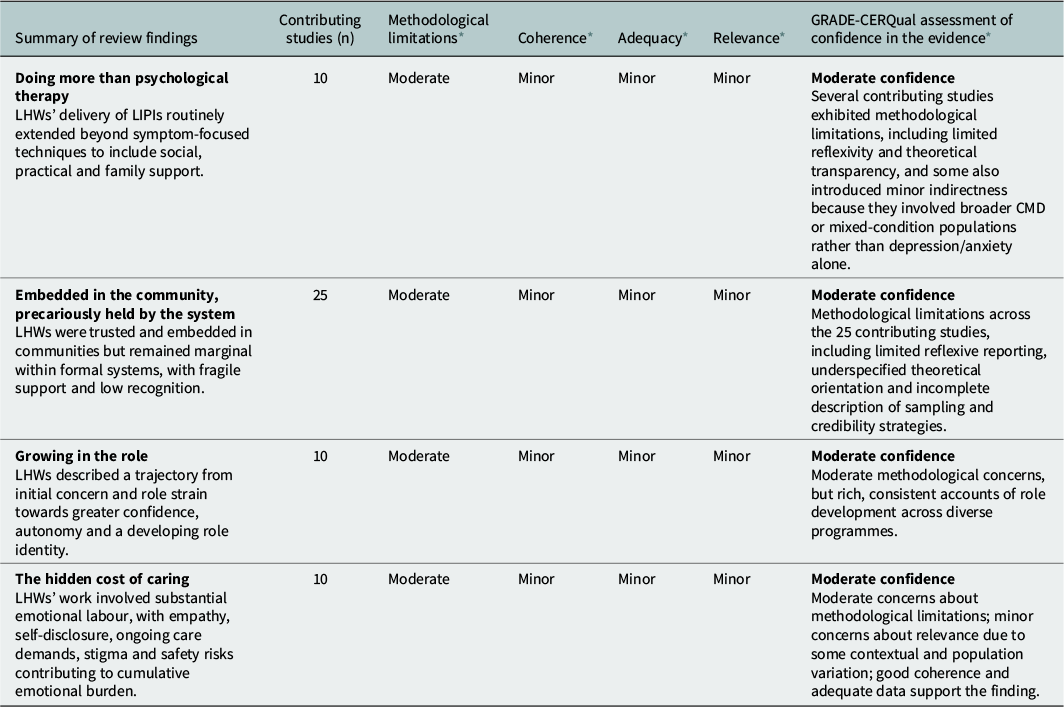
Overall, we had moderate confidence in each of the four review findings, as assessed using GRADE-CERQual (Table 4).
Summary of qualitative findings and GRADE-CERQual assessments
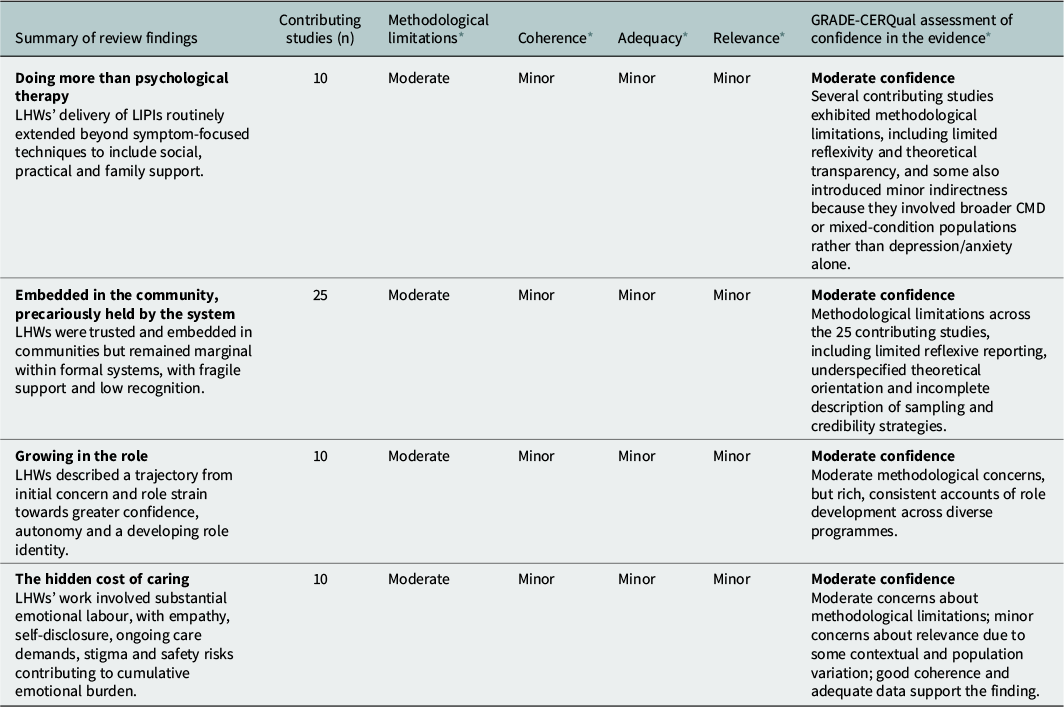
Table 4. Long description
A table with seven columns: Summary of review findings, Contributing studies (n), Methodological limitations, Coherence, Adequacy, Relevance, and G R A D E dash C E R Q u a l assessment of confidence in the evidence.
Row 1: Doing more than psychological therapy. L H W s’ delivery of L I P I s extended to social, practical, and family support. 10 studies. Limitations: Moderate. Coherence, Adequacy, and Relevance: Minor. Assessment: Moderate confidence due to limited reflexivity and theoretical transparency.
Row 2: Embedded in the community, precariously held by the system. L H W s were trusted in communities but marginal in formal systems. 25 studies. Limitations: Moderate. Coherence, Adequacy, and Relevance: Minor. Assessment: Moderate confidence due to underspecified theoretical orientation and incomplete sampling descriptions.
Row 3: Growing in the role. L H W s moved from role strain to confidence and autonomy. 10 studies. Limitations: Moderate. Coherence, Adequacy, and Relevance: Minor. Assessment: Moderate confidence based on rich, consistent accounts of role development.
Row 4: The hidden cost of caring. L H W s’ work involved emotional labor, stigma, and safety risks. 10 studies. Limitations: Moderate. Coherence, Adequacy, and Relevance: Minor. Assessment: Moderate confidence despite minor concerns about relevance due to population variation.
* Full justifications are provided in Supplementary Material 6.
Discussion
Our synthesis revealed how LHWs experience and sustain the delivery of LIPIs in LMICs. Unlike existing reviews that frame task-shifting primarily as a pragmatic response to workforce shortages (Kakuma et al., Reference Kakuma, Minas, van Ginneken, Dal Poz, Desiraju, Morris, Saxena and Scheffler2011; Patel et al., Reference Patel, Chowdhary, Rahman and Verdeli2011; van Ginneken et al., Reference van Ginneken, Chin, Lim, Ussif, Singh, Shahmalak, Purgato, Rojas-García, Uphoff, McMullen, Foss, Thapa Pachya, Rashidian, Borghesani, Henschke, Chong and Lewin2021), we found that LHWs’ delivery of psychological interventions is profoundly relational, adaptive and emotionally laborious. Most included studies were conducted in sub-Saharan Africa and South Asia, leaving relational and emotional dimensions of task-shifting underexamined in regions such as Latin America and Southeast Asia. Given that task-shifting is now central to the development and maintenance of mental health systems in Southeast Asia (Sharan et al., Reference Sharan, Sagar and Kumar2017), this represents a critical blind spot. This review contributes early cross-programme insights into LHWs’ relational and emotional labour in these underrepresented regions.
Our synthesis shows that LHWs in LMICs occupied dual identities as community members and mental health providers. They often struggled to reconcile being relatable neighbours and kin with the need to appear professional to gain legitimacy within health systems. Many shared the same poverty, domestic violence, stigma and social conflicts as those they supported. Many worked in settings where interdependence, mutual support and obligations to family and community were prominent, fostering belonging and social responsibility and shaping flexible, informal ways of delivering care. In this context, task-shifting emerged not simply as a technical transfer of tasks (Patel et al., Reference Patel, Chowdhary, Rahman and Verdeli2011; WHO, 2019) but as a redistribution of emotional and relational labour, sustained through empathy, social connection and shared vulnerability. LHWs moved beyond symptom alleviation to address socio-economic drivers of distress by linking patients to social services, navigating bureaucracy, involving families and engaging with abusive partners. Yet they faced stigma, rejection and risks, including sexual harassment and emotionally demanding practices such as joining prayers or adapting patients’ worldviews (Atif et al., Reference Atif, Lovell, Husain, Sikander, Patel and Rahman2016; Nyatsanza et al., Reference Nyatsanza, Schneider, Davies and Lund2016; Wood et al., Reference Wood, Seevak, Bhatia, McBain and Nadkarni2021). In this context, community embeddedness was therefore double-edged: the same shared social worlds that fostered trust and engagement could also expose LHWs to moral scrutiny and overlapping obligations shaped by local norms of kinship, deservingness and social responsibility (Chase, Reference Chase2023). Their work depended not only on building relationships, but also on navigating local values about what counts as the right way to respond to distress.
Our synthesis suggests that organisational support arrangements shaped LHWs’ ability to sustain intervention delivery. This interpretation is also informed by the heterogeneity of the included studies: LHWs ranged from community volunteers and peers to lay counsellors and primary care- or NGO-linked workers, while the LIPIs varied in terminology and format but generally shared a core of brief structured strategies, particularly problem-solving, behavioural activation and psychoeducation, with some also including cognitive restructuring or other cognitive techniques. Overall, the findings suggest that variation in LHW role, organisational linkage and delivery setting shaped access to supervision, recognition, role clarity and support. However, these distinctions were not always easy to disentangle, because LHWs represented a heterogeneous workforce and primary studies did not consistently describe their training, role boundaries or relationship to the wider health system. This means that differences between LHW roles should be interpreted cautiously, as they may reflect broader features of community-based intervention delivery as well as specific worker characteristics. Support often appeared more structured where LHWs were embedded within formal or service-linked arrangements offering training, adapted resources, collaborative processes and supervision (Myers et al., Reference Myers, Petal, Claire van der, Crick, Carl, John, Naomi, Christopher, Tracey, Peter, Dan and Katherine2019; Selohilwe et al., Reference Selohilwe, Fairall, Bhana, Kathree, Zani, Folb, Lund, Thornicroft and Petersen2023). Yet these benefits depended not only on formal embedding, but also on genuine integration into service settings; recognition as part of the care team; protected time within the workflow to deliver sessions, attend supervision and manage associated tasks alongside other responsibilities; and organisational backing. LHWs linked to facilities, NGOs, government services or funded projects often received regular supervision, debriefing, fidelity monitoring, peer learning and specialist support, although some community-based and volunteer models also demonstrated robust supervisory structures (Joag et al., Reference Joag, Shields-Zeeman, Kapadia-Kundu, Kawade, Balaji and Pathare2020; Singla et al., Reference Singla, Ratjen, Krishna, Fuhr and Patel2020; Ng’oma et al., Reference Ng’oma, Atif, Meltzer-Brody, Chirwa and Stewart2024; Bah et al., Reference Bah, Wurie, Samai, Horn and Ager2025). This pattern was therefore not uniform. Integration alone did not shield LHWs from low pay, weak recognition, role overload or funding insecurity (Myers et al., Reference Myers, Petal, Claire van der, Crick, Carl, John, Naomi, Christopher, Tracey, Peter, Dan and Katherine2019; Selohilwe et al., Reference Selohilwe, Fairall, Bhana, Kathree, Zani, Folb, Lund, Thornicroft and Petersen2023). Rather, organisational embeddedness mattered insofar as it provided role clarity, sustained supervision, recognition, protected time and emotional support. Although critical ethnographic scholarship has cautioned that the formalisation of community mental health roles may create tensions between community-rooted care and system demands (Kottai and Ranganathan, Reference Kottai and Ranganathan2020), the studies synthesised here more often showed LHWs maintaining strong community embeddedness and drawing on relational, adaptive and culturally resonant practices, even as they remained marginalised within formal systems.
However, structured supervision and organisational support did not, on their own, guarantee effective delivery. Even in settings where supervision and organisational supports were more structured, intervention delivery depended on more than technical skills or treatment fidelity alone. In many LMICs, where services are scarce and formal support structures remain weak, intervention delivery is often sustained through personal relationships, which become a key route through which care is enacted and support accessed (Chutiyami et al., Reference Chutiyami, Cutler, Sangon, Thaweekoon, Nintachan, Napa, Kraithaworn and River2025). People facing socio-economic vulnerability frequently rely on community cooperation to navigate external constraints and scarce resources (Wagner, Reference Wagner1995; Iacoviello and Lorenzi-Cioldi, Reference Iacoviello and Lorenzi-Cioldi2019), and social expectations such as mutual support, attentiveness to others and solidarity shape how care is enacted, emphasising social obligation and moral connection over hierarchy (Mthembu et al., Reference Mthembu, Mogaka and Chimbari2023). Within this context, LHWs operate simultaneously as community members and as extensions of the health system (Liu et al., Reference Liu, Sullivan, Khan, Sachs and Singh2011; Laurenzi et al., Reference Laurenzi, Skeen, Rabie, Coetzee, Notholi, Bishop, Chademana and Tomlinson2021). The effectiveness of psychological interventions therefore hinges on trust, relational resilience and LHWs’ ability to manage emotional demands, as they navigate blurred boundaries and balance friendship with professionalism to sustain interventions and maintain community acceptance (Atif, Reference Atif2015; Pacichana-Quinayáz et al., Reference Pachichana-Quinayáz, Osorio-Cuéllar, Bonilla-Escobar, Fandiño-Losada and Gutiérrez-Martínez2016).
This relational engagement, however, often required LHWs to absorb patients’ distress and internalise emotional tension. This amplified the emotional labour needed to sustain therapeutic relationships. Emotional labour, managing one’s feelings to meet care expectations, often maintaining calm or empathy despite internal strain (Hochschild, Reference Hochschild1983), emerged as the hidden mechanism enabling relational task-shifting. Unlike formal clinical settings where emotional display rules are explicit, LHWs’ emotion work was intuitive and embedded in shared community life, cultural norms of compassion and moral obligation. Unlike professionals with clinic boundaries that prevent overwork and allow recovery (Eriksson et al., Reference Eriksson, Germundsjö, Åström and Rönnlund2018; Rapp et al., Reference Rapp, Hughey and Kreiner2021; Clarke et al., Reference Clarke, Rees, Mancini and Breen2024), they remained continuously accessible across community settings, leading patients to view them as always available sources of support. Similar concerns have been described in ethnographic work showing that the emotional demands of delivering psychological interventions can become morally and emotionally consequential for peer volunteers, particularly when care extends beyond formal sessions into memory, identity and continuing obligation, even after programme or trial structures bring support to an end (Leocata et al., Reference Leocata, Kaiser and Puffer2021).
Because prevailing models of task-shifting emphasise technical skills, the relational and emotional dimensions of LHWs’ work often remain unrecognised. When overlooked, empathy, trust-building and community connectedness can be marginalised in training and supervision, which reduces care to procedural fidelity and symptom management, and leaving emotional labour invisible. This leaves LHWs underprepared for the emotional demands of delivering LIPIs and raises ethical concerns about unpaid or weakly recognised care work. Emotional and relational labour should therefore be recognised as integral to the LHW role and treated as part of formal service delivery rather than invisible goodwill. This recognition should be reflected in policy, training, supervision, workload planning, remuneration and referral systems. These capacities should not be treated as personal virtues alone, but as essential components of care that must be resourced, supervised, protected and fairly valued within health systems. This aligns with wider community health worker literature emphasising fair working conditions, opportunities for advocacy and stronger partnerships between community health worker, communities and policymakers to address structural inequities (Ahmed et al., Reference Ahmed, Chase, Wagnild, Akhter, Sturridge, Clarke, Chowdhary, Mukami, Kasim and Hampshire2022). It is also important from a gendered perspective, given that many LHWs in this review were women. Delegating clinical and emotional responsibilities to women without adequate pay risks reinforcing norms that position them as moral caregivers rather than legitimate wage earners, while undermining the sustainability of their work (Chase et al., Reference Chase, Gurung, Shrestha and Rumba2021; Chase et al., Reference Chase, Shrestha, Sidgel, Rumba, Shrestha and Gurung2022). At the same time, our findings showed that task-shifting could foster confidence, autonomy and aspiration.
Although mhGAP guidance emphasises observable skills such as detection, referral and adherence (Kohrt et al., Reference Kohrt, Mutamba, Luitel, Gwaikolo, Onyango Mangen, Nakku, Rose, Cooper, Jordans and Baingana2018; WHO, 2019), our synthesis suggests that competence also develops through emotional labour, relational engagement and reflective practice. Recent competency-based initiatives such as WHO/UNICEF’s EQUIP represent an important step towards more structured training and supervision for non-specialists, including the assessment of foundational helping skills across intervention types (Kohrt et al., Reference Kohrt, Pedersen, Schafer, Carswell, Rupp, Jordans, West, Akellot, Collins, Contreras, Galea, Gebrekristos, Mathai, Metz, Morina, Mwenge, Steen, Willhoite, van Ommeren, Underhill, Akhtar, Bryant, Concepcion, el Marsi, Elnasseh, Hemmo, Kasujja, Manolova, Maslovskiy, Mbwayo, Moran, Munthali-Mulemba, Mutamba, Mutavi, Raji, Rangel, Sangraula, Sepulveda, Tol, van t’Hof and Yurtaev2025). While competency frameworks can assess important helping skills, our findings suggest that effective LHW practice also depends on emotional, relational and organisational dimensions that are less easily captured in standardised measures. Supervision should therefore extend beyond treatment fidelity to support emotional insight and personal growth.
Future research directions
As emotional labour is strongly associated with burnout, emotional exhaustion and withdrawal from caring roles (Clarke et al., Reference Clarke, Rees, Mancini and Breen2024), failing to address it among LHWs in community-based care risks undermining workforce well-being, retention and the sustainability of task-sharing models in already fragile LMIC health systems. Future studies should examine how LHWs perform and regulate emotional labour across cultural contexts, and how these processes affect well-being and intervention quality by shaping resilience or vulnerability to burnout. Future intervention and implementation studies should also assess provider well-being alongside patient and service outcomes, using contextually appropriate measures of burnout, emotional burden, role strain and organisational support, and should consider longitudinal and qualitative approaches to better understand how these experiences develop over time. In addition, because emotional labour is demanding and embedded within the same communities where LHWs live, understanding the support networks they rely on is crucial. Social networks, connections among individuals or groups through interaction and exchange (Newman et al., Reference Newman, Watts and Strogatz2002; Bae et al., Reference Bae, Nikolaev, Seo and Castner2015), provide emotional, informational and appraisal support that promote self-evaluation and health awareness (Ashida and Heaney, Reference Ashida and Heaney2008; Crotty et al., Reference Crotty, Henderson, Ward, Fuller, Rogers, Kralik and Gregory2015). Evidence shows that diverse networks enhance mental health by expanding access to emotional and practical resources (Fiori et al., Reference Fiori, Smith and Antonucci2007; Sultan et al., Reference Sultan, Norris, Avendano, Roberts and Davis2014). In this review, these networks include both formal and informal relationships such as supervisors, family and peers that help sustain resilience and well-being in community-based psychological care. Moreover, future research should also examine how different organisational arrangements shape LHWs’ supervision, emotional support and working conditions, and how these in turn affect well-being, retention and intervention sustainability (Myers et al., Reference Myers, Petal, Claire van der, Crick, Carl, John, Naomi, Christopher, Tracey, Peter, Dan and Katherine2019; Selohilwe et al., Reference Selohilwe, Fairall, Bhana, Kathree, Zani, Folb, Lund, Thornicroft and Petersen2023). This should include attention to how structural conditions such as remuneration, workload, role clarity and service integration contribute to unpaid or weakly recognised emotional labour, and which workforce development strategies are most effective in supporting and sustaining community providers.
Strengths and limitations
Meta-ethnography enabled interpretation of LHWs’ lived experiences across studies and highlighted latent mechanisms, including emotional labour, relational trust and personal transformation, that more aggregative approaches may overlook. Using the GRADE-CERQual approach, we judged confidence in all four review findings to be moderate, due to moderate concerns about methodological limitations and only minor concerns about coherence, adequacy and relevance. Overall, the findings are likely to reasonably represent the phenomena, though future high-quality studies may refine them. However, this interpretive synthesis across diverse health systems reduces local specificity and limits reproducibility, as different reviewers may construct different conceptual models. Limited theoretical articulation and reflexivity in several included studies further constrained interpretive depth. In addition, although many LIPIs are transdiagnostic and may address broader distress rather than depression or anxiety alone, we retained a depression/anxiety focus to provide a clearer and more coherent analytical scope for the review. However, a small number of included studies involved broader common mental disorder or mixed-condition populations, and although extraction focused on depression/anxiety-relevant findings where possible, the influence of other conditions on some reported experiences cannot be fully excluded. A further limitation concerns the heterogeneity of LHW roles and the variable reporting of their training, responsibilities and organisational linkage across studies. This made neat classification difficult and limited the specificity with which some differences could be attributed to particular types of LHWs rather than to broader features of community-based intervention delivery. Most primary studies sampled LHWs who remained in post, with little insight into those who left, so the synthesis may overrepresent workers who felt able to continue and underrepresent those who disengaged or burned out. Finally, although broader literature exists on community-based mental health work in other LMICs, including countries such as Nepal, Uganda, Nigeria and Bangladesh, many such studies fell outside this review’s scope because they examined neither defined LIPIs targeting depression and/or anxiety nor LHWs’ qualitative delivery experiences. The concentration of studies in India, Zimbabwe and South Africa therefore allowed identification of cross-contextual patterns, but the underrepresentation of regions such as Latin America and Southeast Asia restricts transferability, and findings should be applied cautiously in these settings.
Conclusion
Across the included programmes, largely from Africa and Asia, with more limited representation from Latin America, this review shows that LHW-delivered LIPIs depend on intensive relational and emotional labour, not only the transfer of technical tasks. Yet this work remains insufficiently recognised in policy and programme design, leaving LHWs vulnerable to burnout, role strain and attrition, and ultimately undermining workforce retention and programme sustainability. If ministries of health and global agencies want task-sharing models to endure, emotional and relational labour must be recognised as core components of care and reflected in training, supervision, remuneration, role clarity, safeguarding, organisational support and opportunities for development and recognition, rather than being left to individual goodwill.
Open peer review
To view the open peer review materials for this article, please visit http://doi.org/10.1017/gmh.2026.10271.
Supplementary material
The supplementary material for this article can be found at http://doi.org/10.1017/gmh.2026.10271.
Data availability statements
All data supporting the findings of this review are contained within the article, its supplementary materials and the published studies it cites.
Author contribution
A.P.K. conceived and designed the review with input from H.B., P.B., R.P. and H.S. A.P.K. developed the review questions, eligibility criteria and search strategy and led screening. PAN and GEA contributed to screening, data extraction, quality appraisal and checking the synthesis. APK conducted the meta-ethnographic analysis and GRADE-CERQual assessment. H.B., P.B., R.P. and H.S. provided methodological guidance and contributed to interpretation and implications. APK drafted the manuscript; all authors revised it critically, approved the final version and agree to be accountable for all aspects of the work. APK is the corresponding author and will manage submission, revisions, publication formalities and post-publication queries on behalf of all co-authors.
Ethics and approvals
This study is a systematic review of previously published research and did not involve the collection or analysis of identifiable human data.
Funding statement
This research was funded by the NIHR [Global Health Research for Sustainable Care for Anxiety and Depression in Indonesia (Award ID NIHR134638)] using UK international development funding from the UK Government to support global health research. The views expressed in this publication are those of the author(s) and not necessarily those of the NIHR or the UK government.
Competing interests
All other authors have no competing interests to declare.



 Open access


Comments
Dear Editors of Cambridge Prisms: Global Mental Health,
Please find enclosed our manuscript, “Delivering low-intensity psychological interventions in low- and middle-income countries: a systematic review and meta-ethnographic synthesis of lay health workers’ experiences,” which we submit for consideration as a Research Article.
This systematic review and meta-ethnography synthesises qualitative evidence on how lay health workers in low- and middle-income countries experience delivering low-intensity psychological interventions for depression and anxiety. Drawing on 28 unique studies from Africa, Asia and Latin America, we identify four overarching themes that show how task-shifting redistributes not only technical tasks but also intensive relational and emotional labour to lay health workers. The review highlights implications for training, supervision, integration and remuneration to support lay health workers’ wellbeing, retention, and the sustainability of community-based mental health systems.
We consider this work a strong fit for Cambridge Prisms: Global Mental Health because it examines a central global mental health strategy, task-sharing, through an in-depth qualitative lens that foregrounds the experiences of non-specialist providers who are essential to scaling psychological care yet rarely the primary focus of synthesis. Our findings offer policy-relevant insights for WHO, ministries of health and implementing agencies seeking to expand lay health worker–delivered interventions in LMICs without placing unsustainable burdens on this workforce.
The main text is 5,677 words, slightly exceeding the 5,000-word guideline. Following prior correspondence with the editorial office, we understand there is flexibility up to approximately 5,700 words. This length reflects the methodological and interpretive demands of a qualitative meta-ethnography. To maintain analytic transparency and robustness, we have retained key first-order constructs in the results, provided sufficiently “thick” and rich descriptions with illustrative quotations to support each theme, and reported GRADE-CERQual assessments of confidence in the evidence. The manuscript has already been carefully trimmed; further reductions would require removing essential methodological detail or compressing the themes in ways that would weaken the credibility and practical utility of the synthesis for researchers, practitioners and policymakers.
All authors have approved the final version and agree to its submission to Cambridge Prisms: Global Mental Health. The manuscript is not under consideration elsewhere, and any potential competing interests are disclosed in the accompanying forms.
We hope you will consider this manuscript for peer review.
Yours sincerely,
Aditya Putra Kurniawan
(on behalf of all co-authors)
Division of Nursing, Midwifery & Social Work
The University of Manchester