


Introduction
The number of forced migrants across the world has risen sharply since 2007 (UNHCR, 2019): Historically, low and middle income countries such as Uganda, Turkey, Jordan, Lebanon, Pakistan and Iran have hosted the highest number of refugees in the world (UNHCR, 2014). The US being the main exception. More recently, Western countries (i.e. high-income, majority white nations) such as Sweden and Germany are accommodating increasing numbers of people (UNHCR, 2019). Forced migrants in both Western and non-Western countries are likely to have a higher risk of mental disorder compared to the host country population (Ryan et al., Reference Ryan, Kelly and Kelly2009). This is linked to stressors experienced pre-migration, during journeys, and post-migration (Zimmerman et al., Reference Zimmerman, Kiss and Hossain2011).
Programmatic and policy responses addressing the mental health of forced migrants should be underpinned by rigorous evidence. Yet, academic evidence on asylum and mental health is fragmented and siloed. This paper examines the issues with the evidence base used by Western practitioners, offering suggestions on how to move forward. We identify four key challenges in Western forced migration research, arguing that:
(1) The reliance on Western conceptions of mental health makes it difficult to learn from the example of other countries and cultures.
(2) The investigation, to date, of a relatively narrow range of potential risk and protective factors limits the evidence base.
(3) The lack of consistency in the measurement and reporting of risk factor variables makes it difficult to synthesise evidence.
(4) The use of the legal term ‘asylum seeker’ to define study populations makes it harder to draw on relevant evidence from migrants in other legal categories across the world.
We address each point using statistics and reflections from our systematic review of social environmental risk factors for mental disorder in people seeking asylum (Jannesari et al., Reference Jannesari, Hatch, Prina and Oram2020). Descriptive statistics on risk factors, outcome measures and population are drawn from review results, appendices and preparatory work. Some statistics have been updated to include papers that were eligible for our review but could not be included in the synthesis due to a lack of outcome data. Our points are further informed by the appraisal of other reviews in the field (Patel, Reference Patel2011; Ryan et al., Reference Ryan, Kelly and Kelly2009).
The reliance on Western conceptions of mental health
In our review's (Jannesari et al., Reference Jannesari, Hatch, Prina and Oram2020) updated statistics, most studies looked depression (39 of 49), followed by PTSD (38) and anxiety (29). Measurement tools were primarily developed by US universities, including the most common ones for depression and anxiety, the HSCL-25 (used by 21 and 18 studies, respectively), as well as for PTSD, with the HTQ used by 13 studies. The HSCL-25 was created with US participants (Parloff et al., Reference Parloff, Kelman and Frank1954) and the HTQ with participants from South East Asia (Mollica et al., Reference Mollica, Caspi-Yavin, Bollini, Truong, Tor and Lavelle1992). Some studies, such as Gerritsen et al. (Reference Gerritsen A, Bramsen, Devillé, Van Willigen, Hovens and Van der Ploeg2006) and Nakash et al. (Reference Nakash, Nagar, Shoshani and Lurie2017), have adapted these tools for their asylum populations (Afghans, Iranians and Somalis in the Netherlands, and Eritreans and Sudanese in Israel, respectively) through a multi-step process including translation and back-translation, and the addition of culturally relevant items.
Given the different conceptions of mental health across cultures, studies could also usefully examine mental disorders other than, or in addition to, PTSD, depression and anxiety. PTSD, in particular, has been the subject of cross-cultural criticism. Summerfield (Reference Summerfield1999), for example argues that the diagnosis pathologises normal social responses to trauma and disconnects ‘[victims] from others in their community and from the wider context of their experiences and the meanings they give to them’ (p. 1456). Miller et al. (Reference Miller, Omidian, Quraishy, Quraishy, Nasiry, Nasiry, Karyar and Yaqubi2006) provide a possible way forward in their development of the Afghan Symptom Checklist in collaboration with Afghan academics and community members. This scale was partly developed through common elements in community narratives of well-being.
Identifying and making use of evidence from non-Western countries may require Western academics to draw upon a broader range of concepts and terms for mental health, including spiritual health. For example, Baasher (Reference Baasher2001), writing from the University of Khartoum, argues that the Quran comments on mental health when giving directives for ‘a firm belief… endurance of hardship and resolution of stress’. Many health and well-being papers from Iran focus on spiritual mental health, using the spiritual well-being scale developed by Paloutzian and Ellison (Reference Zimmerman, Kiss and Hossain1982) (e.g. Sharif Nia et al., Reference Sharif Nia, Pahlevan Sharif, Boyle, Yaghoobzadeh, Tahmasbi, Rassool, Taebei and Soleimani2018; Niyazmand et al. Reference Niyazmand, Abbasszadeh, Borhani and Sefidkar2018; Ziapour et al. Reference Ziapour, Khatony, Jafari and Kianipour2017). Papers may also focus on culturally specific mental health terms such as Zar, an Iranian condition where a spirit takes control of a person, invading their heads and leading them to harm (Moghaddam, Reference Moghaddam2012). Analysis of studies included in our review (Jannesari et al., Reference Jannesari, Hatch, Prina and Oram2020) suggests that research conducted in non-Western settings is currently underutilised. For example, English language studies conducted with Afghan forced migrants in Iran and Pakistan (e.g. Kalafi et al., Reference Kalafi, Hagh-Shenas and Ostovar2002; Naeem et al., Reference Naeem, Mufti, Ayub, Haroon, Saifi, Qureshi, Ihsan, Chaudry H, Dagarwal and Kindgon2005), which host the majority of Afghan refugees (UNHCR, 2019), were rarely cited by the studies eligible for inclusion in our review, including those whose samples comprised Afghans.
The range of risk factors investigated
Our review's (Jannesari et al., Reference Jannesari, Hatch, Prina and Oram2020) updated figures comprise 29 distinct social environmental factors (i.e. the relationships, culture, government and settings people live in) that were tested for association with mental disorder among people seeking asylum in at least three studies. We grouped these factors into seven thematic categories: healthcare, social networks, community and identity, economic class, working conditions, immigration system, and living conditions (see Fig. 1).
Social environmental mental health risk factors for people seeking asylum. Blocks shaded according to the number of studies; darker shading indicates more studies (number of studies in brackets).
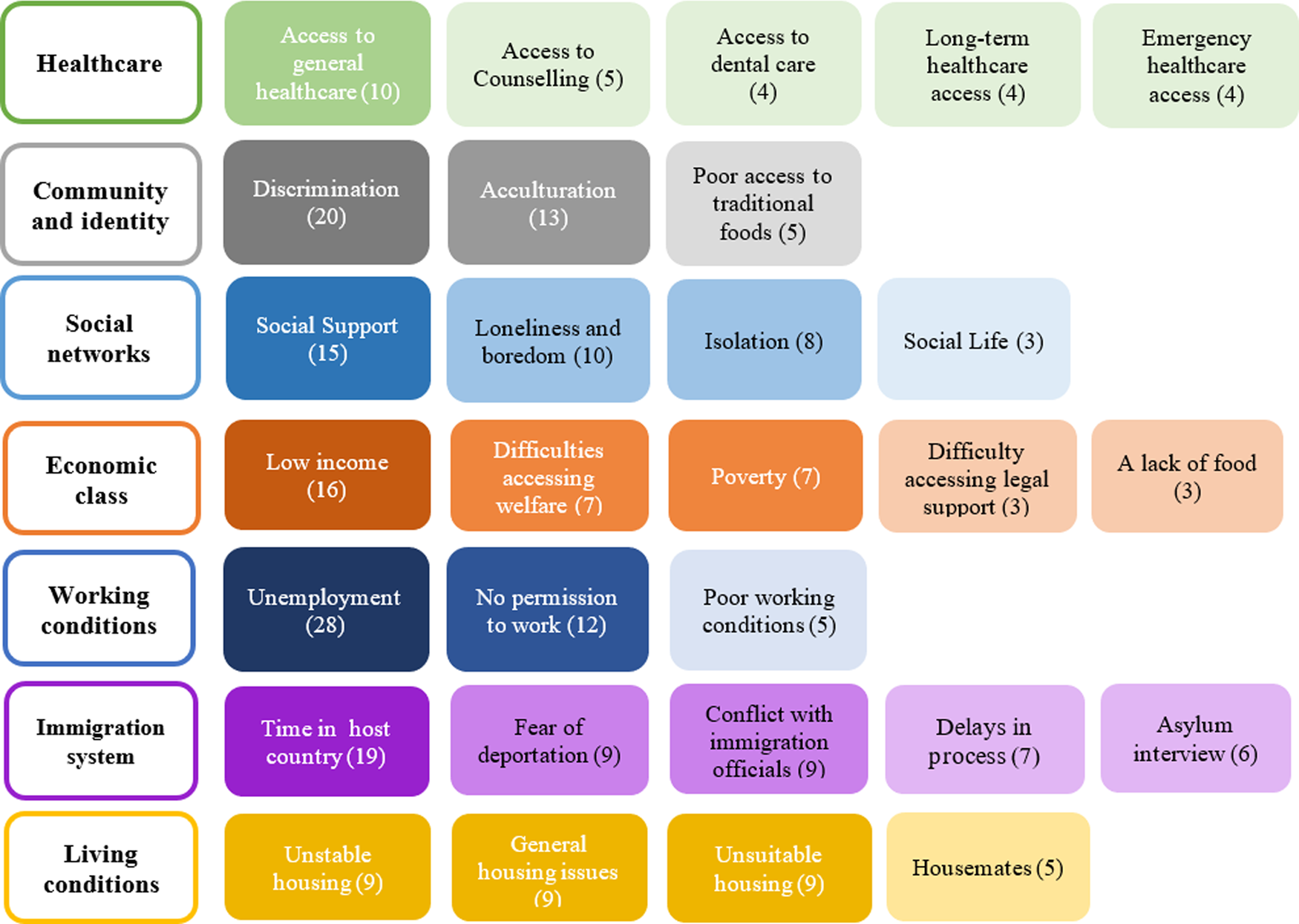
Identified factors were unevenly studied with some domains attracting relatively little attention. Compared to most other themes, factors relating to living conditions were seldom examined. Yet, housing is an important indicator of migrant integration, crucial : to a ‘sense of security and stability, opportunities for social connection, and access to healthcare, education and employment’ (Ager and Strang Reference Ager and Strang2004, p. 15) with well-established links to mental health in the broader literature (e.g. Chambers et al., Reference Chambers, Cantrell, Preston, Peasgood, Paisley and Clowes2018). Bhui et al.'s (Reference Bhui, Mohamud, Warfa, Curtis, Stansfeld and Craig2012) study on ‘forced residential mobility’ and psychiatric disorders was a welcome exception, collecting ‘detailed accommodation histories’ of Somali migrants.
Homelessness was rarely assessed by the studies in our review's (Jannesari et al., Reference Jannesari, Hatch, Prina and Oram2020) updated statistics. Homelessness is a risk for those seeking asylum as Government support may be difficult to access and many might not be eligible to receive it. An Australian charity surveyed 203 asylum seekers (Mitchell and Kirsner, Reference Mitchell and Kirsner2004), finding that 95% had no form of income, with 44% in debt. Resultantly, ‘at least 68% were homeless or at risk of being homeless’. In the UK, the application form for asylum seeker support is difficult to complete being 32 pages long, available only in English and accompanied by a 17-page guidance document (Home Office, 2013). There can be delays in a response and some people are left street homeless (UK Parliament, 2007).
There are other factors around housing, mental health and asylum which future work could explore in addition to those shown in Fig. 1. Freedom to enter and leave accommodation may be important. Research has shown that restrictions on movement, such as detention, are a mental health risk for people seeking asylum (see Robjant et al., Reference Robjant, Hassan and Katona2009). Accommodation setting (e.g. urban or rural) could also be investigated. It affects access to diaspora networks, a risk factor associated with mental disorder (e.g. Byrskog et al., Reference Byrskog, Essén, Olsson and Klingberg-Allvin2016). People in isolated areas may be more lonely or bored, commonly assessed risk factors in the literature (Jannesari et al.,Reference Jannesari, Hatch, Prina and Oram2020).
Our review's (Jannesari et al., Reference Jannesari, Hatch, Prina and Oram2020) updated statistics only identified four types of risk factor relating to working and working conditions. Though unemployment was well-researched (28 studies), crucial factors were omitted. For example, few studies in our review explicitly examined workers' rights: worker exploitation is associated with poor mental health in migrant workers (e.g. Hovey and Seligman, Reference Hovey, Seligman and Lessenger2006). In the UK, US and German detention centres, asylum seekers may be working for as little as €0.80 per hour (Kasinof, Reference Kasinof2017; Bales and Mayblin, Reference Bales and Mayblin2018). Similarly, limitations on people's ability to move between employers may increase vulnerability to abuse and exploitation (e.g. Khan, Reference Khan2014; Balasubramanian, Reference Balasubramanian2019).
Future studies could focus on the stability of employment; whether someone works regular hours, or is in a more precarious situation (e.g. on a zero-hour contract). Precarious work can be an issue among the general migrant population (e.g. Burgess et al., Reference Burgess, Connell and Winterton2013; Campbell and Burgess, Reference Campbell and Burgess2018) and relates to depressive symptoms (Kim and von dem Knesebeck Reference Kim and von dem Knesebeck2016). The areas detailed in the World Health Organisation's (2019) factsheet on mental health in the workplace could be usefully investigated. Risk factors encompassed ‘limited participation in decision-making or low control over one's area of work’. A UK study found that lack of control was a source of mental health distress for people seeking asylum (Jannesari et al., Reference Jannesari, Molyneaux and Lawrence2019).
Variation in risk factor measures
Our original systematic review identified 21 studies with sufficient data for inclusion (see Table 1, Jannesari et al., Reference Jannesari, Hatch, Prina and Oram2020). From this wealth of data, we were able to synthesise findings for just two risk factors: discrimination and unemployment. The majority of potential risk factors we identified were measured in only a small number of studies and, often, findings relating to these factors were not disaggregated by mental health status. The Post-Migration Living Difficulties checklist (PMLD) developed by Silove et al. (Reference Silove, Sinnerbrink, Field and Steel1997) provides consistency in the field, being used by 17 of 49 studies in our review's updated numbers. However, studies often used different versions of the checklist comprising anything from 13 to 31 total items, making synthesis difficult. Items relating to key domains identified in Fig. 1, such as living conditions, were sometimes omitted. The COMET initiative (Williamson et al., Reference Williamson, Altman, Bagley, Barnes, Blazeby, Brookes, Clarke, Gargon, Gorst, Harman, Kirkham, McNair, Prinsen, Schmitt, Terwee and Young2017) could provide a way forward. COMET seeks to produce a set of core measures to be assessed across clinical trials in a given area of health research : improving the relevance of outcome measures and the synthesis of evidence, as well as reducing outcome reporting bias.
Our review (Jannesari et al., Reference Jannesari, Hatch, Prina and Oram2020) also identified a lack of nuance in the measurement of included risk factors. Sometimes, risk factor measures relied on the extent of agreement or disagreement with a single statement. This is, for instance, the case with the PMLD (Silove et al., Reference Silove, Sinnerbrink, Field and Steel1997). It meant that complex items such as discrimination, which one or two studies divided into subcategories (e.g. Laban et al., Reference Laban, Gernaat and Komproe2005), was reduced to a simple concept with limited practical value. Similarly, major potential confounders were sometimes overlooked. For instance, most studies asking about employment did not ask whether people were working legally or illegally. We suggest a move away from large single-item lists and towards a core set of indicators measured using scales, and applied consistently throughout studies.
The use of the legal term ‘asylum seeker’
Our review (Jannesari et al., Reference Jannesari, Hatch, Prina and Oram2020), as well as the appraised reviews (Patel, Reference Patel2011; Ryan et al., Reference Ryan, Kelly and Kelly2009), used the legal definition of asylum seeker to define study population. This reflects standard practice in forced migration literature and the lack of viable alternatives. However, migrants are subjected to a multitude of ‘legal, bureaucratic and social labels’, each with their own associated constraints and opportunities (e.g. Janmyr and Mourad, Reference Janmyr and Mourad2018). Thus, co-nationals sharing the legal category ‘asylum seeker’ might have substantially different experiences, even if they reside in the same host country. Conversely, those in other legal categories may have very similar experiences.
Two ‘asylum seekers’ in the same country can have very different experiences based on their nationality. In 2015, the Dublin agreement, a law enabling deportation to the first EU country entered, was suspended in Germany for Syrians (Dernbach, Reference Dernbach2015). The rate of positive first decisions for Syrians in Germany was 98% with 101 415 being granted status (Eurostat, 2020). The government prioritised Syrian cases and decisions took around 3 months (AIDA, 2016). This compared to 17 months for Iranians and 14 for Afghans (Federal Government, 2019). Many Syrians were granted status based on a questionnaire and without any interview (AIDA, 2015), unlike all other nationalities for which an interview was obligatory. Combining Syrians, Iranians and Afghans within a single category of asylum seekers provides limited conceptual value.
Defining study populations using the legal term ‘asylum seeker’ can exclude other migrants who have sought sanctuary and undergone similar processes. Syrians seeking asylum in Germany in 2015, for instance, may have had some similar post-migration experiences to North Korean defectors to South Korea. North Koreans are also all accepted after identity and security checks (ICG, 2011). Defectors are initially housed in reception centres where they are provided integration information. This is comparable to the Syrian asylum experience in Germany where people stay in initial reception centres (AIDA, 2015).
We offer the concept of ‘sanctuary seekers’ – people who have fled their country and are asking another country for safety and residence – as an alternative to the legal category ‘asylum seeker’ in defining study populations. Though it requires empirical testing, we propose grouping sanctuary seekers based on the difficulty of obtaining permanent status and how supportive post-migration conditions are for integration. Decision waiting time, acceptance rates by nationality, interview processes and access to legal aid could assess the difficulty of attaining status. Temporary status rights, suitable accommodation and path to permanent settlement could assess post-migration conditions for integration. Alongside this rich set of indicators, legal category may aid in understanding experience. The term sanctuary seekers helps avoid the fragmentary labels imposed by governments that restrict migrant rights (Zetter, Reference Zetter2007).
Figure 2 illustrates how categorisation based on shared experience could group populations, with the y-axis representing the difficulty in obtaining permanent status and the x-axis supportive conditions for integration. Three groups emerge. Top left are sanctuary seekers enduring relatively high stress, defined as living in poor conditions while having few or no options to resolve their situation. In the middle are those under comparatively medium stress; though there are limited options, a path does exist to a stable life either through employment and integration, or permanent status. Bottom right are people for whom the process of obtaining status is typically an identity and security check; these people will almost certainly receive status and benefit from a range of support. We recognise that no categorisation can capture the full depth of someone's experience; even using our method, many experiences are excluded. In addition, rights and conditions are only considered at a single point in time.
Sanctuary seekers by shared experience (not in resettlement programme unless stated, population positions are illustrative and may also change with time).

Conclusion
Drawing on our systematic review, we have identified four challenges to the synthesis of evidence and the development of evidence-based responses to the mental health needs of forced migrants: the reliance on Western conceptions of mental health, the under-investigation of potential risk factors, the variability and lack of nuance in risk factor measures, and the use of the legal category ‘asylum seeker’ to define study population. We have suggested that future research draws on a broader conceptualisation of mental health, have called for the development of a core set of outcomes and measures to enhance the consistency of reporting and comparability of findings, and offered the concept of sanctuary seekers as an alternative to the legal category asylum seeker when defining study populations. Ultimately, we call for a more coherent, collaborative and international literature so we can better meet the mental health needs of people forced to flee their homes.
Financial support
This work was conducted as part of S Jannesari's PhD funded by the Economic and Social Research Council.
Conflict of interest
There are no conflicts to declare.


 Open access

