

Western Mexico has long been considered to be on the fringe of the main Mesoamerican interaction systems, but the region is now perceived as a heterogeneous cultural complex with regular interactions with other regions of Mesoamerica, in particular with western Mexico, at different periods of its history. As early as the Preclassic period (Braniff Reference Braniff C.1972; Carot Reference Carot, de Lameiras and Weigand1992; Darras Reference Darras2006) and then during the Classic period (Filini Reference Filini2004; Filini and Cárdenas García Reference Filini, García and Faugère2007; Hernández Reference Hernández, Williams and Maldonado2016; Jiménez Betts Reference Jiménez Betts, de Lameiras and Weigand1992, Reference Jiménez Betts2018), the societies occupying this vast region established links with their neighbors to the east, as shown by an ever-increasing list of material markers. We also now know that the role of the West was not just a passive one and that Western Mexican products, symbols and even populations affected the historic trajectory of societies from central Mexico (Braniff Reference Braniff C.1972, Reference Braniff C.1999; Hers Reference Hers and Manzanilla2005; Manzanilla Reference Manzanilla and Manzanilla2005). Michoacán and the Bajío seem to have played a preponderant role in these interactions, through mechanisms that have yet to be explored. For example, the discovery of a “barrio michoacano” in Teotihuacan (Gómez Chávez Reference Gómez Chávez and Ruiz-Gallut2002; Gómez Chávez and Gazzola Reference Gómez Chávez, Gazzola and Faugère2007) showed that populations from the West took part in the development of the Classic period metropolis and that products from the metropolis were imported and often imitated in or beyond their regions of origin (Carot Reference Carot and Manzanilla2005; Filini Reference Filini2004; Hernández Reference Hernández, Williams and Maldonado2016; Matos Moctezuma and Kelly Reference Matos Moctezuma, Kelly and Bell1974; Michelet and Pereira Reference Michelet, Pereira, Solís Olguín, Alcántara and Castillo2009).
After the fall of Teotihuacan, the appearance of new ceramic products in the Basin of Mexico has been interpreted as a marker of migrations from the Bajío, as in the case of the Coyotlatelco complex (Braniff Reference Braniff C.1972, Reference Braniff C.1999; Manzanilla Reference Manzanilla and Manzanilla2005) or certain productions from the Early Postclassic (Braniff Reference Braniff C.1999). During this later period, the emergence and development of the Toltec state marked the establishment of a new system of macro-regional interaction, in which Tula seemed to play a driving role (Diehl Reference Diehl and Rice1993). In western Mexico (Jiménez Betts Reference Jiménez Betts2018), this trend has been identified in diverse regions based on the presence of material markers, including Mazapa-style figurines, Tlaloc effigy censers, certain forms of incense burners, and the famous Plumbate ware. In southwestern Pátzcuaro Basin, elite burial goods from Urichu include many types of goods known from Tula, such as censers, ceramic vessels, flutes, and projectile point types found at the Palacio Quemado at Tula (Helen Pollard, personal communication 2018). According to the discovery contexts, which are generally ceremonial centers, Plumbate type pottery seems to be reserved for ritual use and linked to the elite. In the words of R. Cobean (Reference Cobean1990:481) “Tal vez eran artículos importantes ‘de lujo’ usados sobre todo por grupos de élite social para reforzar su alto estatus.” (“Perhaps they were important ‘luxury’ items used mostly by social elite groups to reinforce their high status” [translation by author].)
This article provides new data on the circulation of Plumbate type pottery in the Michoacán highlands, based on the analysis of a recently discovered collection from the site of El Palacio (Zacapu, Michoacán), as part of the Uacúsecha Project. The results of these analyses reveal that in addition to the examples imported from the region of Soconusco by the alleged intermediary of Tula, producers in Michoacán also imitated Plumbate vessels, which they supplied to local elites.
The Long-Distance Diffusion of Plumbate Pottery
Origins
Plumbate ware originally came from the Pacific side of the region of Chiapas and Guatemala (Figure 1; Neff Reference Neff, Love, de Hatch and Escobedo2002a, Reference Neff2003; Neff and Bishop Reference Neff and Bishop1988) and was very widely diffused throughout Mesoamerica (Shepard Reference Shepard1948). This production is diagnostic of the Toltec Horizon and is characterized by a very hard coating with a metallic aspect and a color varying from orange to gray or olive green (Fähmel Beyer Reference Fähmel Beyer1988; Shepard Reference Shepard1948). The first analyses of Plumbate type sherds carried out by Shepard (Reference Shepard1948) suggested that the iron- and alumina-based composition of the slip gave it its vitreous aspect. More recent analyses by Glascock and Neff on the material from the region of Soconusco also brought to light enriched concentrations of sodium and potassium, as well as an enrichment in copper and zinc (Neff Reference Neff2001, Reference Neff, Love, de Hatch and Escobedo2002a, Reference Neff, Ruvalcaba Sil, Trujeque, Alatorre and Castro2010). Petrographic (Shepard Reference Shepard1948) and chemical analyses (Neff Reference Neff1984, Reference Neff, Ciliberto and Spoto2000, Reference Neff, Laporte, Escobedo and Arroyo2002b; Neff and Bishop Reference Neff and Bishop1988) of the clays distinguished two Plumbate paste groups: San Juan and Tohil. During the Epiclassic period (AD 600–900), simple Plumbate vessels were the dominant serving vessels in Soconusco, and many, mostly of the San Juan paste group, were exported to the highlands of Guatemala and western El Salvador. During the Early Postclassic (AD 900–1200), fancy vessels made of Tohil clay reached the northern Yucatán peninsula (Chichén Itzá), central Mexico (Tula; Cobean Reference Cobean1990), and western Mexico (Lake Chapala; Meighan Reference Meighan1976; Neff Reference Neff and Voorhies1989; Shepard Reference Shepard1948). Plumbate production ceased around AD 1100; as of yet, no satisfactory explanation can account for this discontinuation, although the hypothesis of demographic decline in the producing region has been advanced (Neff Reference Neff and Martinón-Torres2014a).
Principal sites with presence of Plumbate pottery in Mesoamerica, with the location of the El Palacio site, Michoacán, and the two main source zones of Plumbate in the Soconusco region, Chiapas. Map by E. Jadot. (Color online)

Diffusion and Imitation
Plumbate pottery not only links the places of discovery to the region of Soconusco, from where this type originates, but also to other regions of Mexico through which these products may have transited. It is particularly prominent at Tula. According to Diehl (Reference Diehl and Sabloff1981:289), “Tohil Plumbate is the most notable ceramic import; over 1,000 sherds and 5 complete vessels were found in the excavations, and 300 sherds were collected during the survey, more than were collected of some of the rare local pottery types. Virtually all the identifiable vessel shapes are drinking goblets.” One of the most noteworthy finds was in the main ceremonial center, where a cache of five whole vessels was found in a well located in a structure near an altar ( Figure 2; Diehl et al. Reference Diehl, Lomas and Wynn1974).
Plumbate type vessels discovered in a cache on the site of Tula (after Diehl et al. Reference Diehl, Lomas and Wynn1974:Vessels 5–9). (Color online)

Shepard (Reference Shepard1948) described some imitation Plumbate, but they tend to be easily identified by non-Plumbate features such as polished surfaces or post-slip incising. Although no analyses have been carried out on the material from Tula to confirm that they are Plumbate, they clearly have the vitrified surfaces of true Plumbate, and we are certain that they are not imitations. In contrast, a Plumbate-like effigy vessel discovered in the Templo Mayor at Tenochtitlán was determined by instrumental neutron activation analyses (INAA) to have been produced in the Basin of Mexico (López Luján Reference López Luján2006). Its similarity to other jar effigies from the Early Postclassic period at Teotihuacán suggests that it may have been discovered at the site by the Mexicas and reused as an offering in Tenochtitlán (López Luján Reference López Luján2006), as was also probably the case for the famous 9-Xi vase (López Luján et al. Reference López Luján, Neff, Sugiyama, Carrasco, Jones and Sessions2000).
The Site of El Palacio and Its Links with the Toltec Culture
Context of Discovery
The site of El Palacio is located in the region of Zacapu, Michoacán (Figure 1), in the southeastern portion of the Malpaís de Zacapu, a vast Holocene volcanic flow from the eruption of the Capaxtiro volcano. The site currently sits above the town of Zacapu and undoubtedly corresponds to the former city of Tzacapo Tacanendan cited in the Relación de Michoacán. It is one of the oldest known establishments in the region and has been studied by several generations of archaeologists (Caso Reference Caso1930; Freddolino Reference Freddolino1973; Lumholtz Reference Lumholtz1973[1902]). Nevertheless, as part of the Michoacán Project, it underwent more rigorous research from the 1980s onward (Michelet Reference Michelet and Michelet1992, Reference Michelet and Darras1998; Michelet et al. Reference Michelet, Arnauld and Fauvet-Berthelot1989), which outlined its morphological characteristics and defined the occupation chronology. Surveys showed that the site extends across about 50 ha and located some of the ceremonial centers. Test pits indicated that the site was mainly occupied during the Early (Palacio phase: AD 900–1200) and Middle Postclassic (Milpillas phase: AD 1200–1450). Later research carried out in the 1990s by Fernández-Villanueva (Reference Fernández-Villanueva1992) focused mainly on the Milpillas phase of occupation. More recently, new research was conducted on El Palacio as part of the Uacúsecha Project, directed by G. Pereira (CNRS/MEAE/CEMCA), to gain a better understanding of the background of the Tarascan state. New surveys, cartography, and surface collections in 2010 generated a new plan and a more detailed analysis of the spatial organization of the site (Forest Reference Forest2014). Most of the ceremonial structures have now been located, and a habitation sector corresponding to the Milpillas phase occupation has been systematically mapped. Finally, in 2012, three stratigraphic test pits were excavated in zones where material from the Palacio phase had been found on the surface (Jadot Reference Jadot and Pereira2013). One of these (UT52) led to the discovery of several layers containing abundant material dated to the Early Postclassic (AD 900–1200). This 2 x 2 m test excavation penetrated deposits on one of the ceremonial places of the site, several meters to the west of pyramid Y5 (Figure 3). The Plumbate-like sherds discussed in this article were discovered in these layers.
Location of test pit UT52 and the prospected plot at the site of El Palacio, which yielded the analyzed sherds. Map after Forest 2014: Fig.41

The stratigraphic contexts associated with this material were dated by two charcoal samples (from levels UE553 and UE555) and a faunal bone (from level UE554), which provided the following radiocarbon dates (Supplementary Figures 1–3): 953 ± 12 BP (GrM11623; charcoal; δ13C = −24.06%), 1060 ± 12 BP (GrM 11625; charcoal; δ13C = −24.25%), and 1055 ± 35 BP (Lyon-11162 [SacA36799]; faunal bone). The calibration of these dates (HPD 95%: UE555: AD 974–1017; UE554: AD 896–1027; UE553: AD 1026–1151) and their stratigraphic position (Figure 4) place the objects in these levels between AD 974 and AD 1151, which is strictly contemporaneous with the apogee of the Toltec culture. Note that the occupation of the site begins at the end of the Epiclassic period (La Joya phase), as revealed at the lower level (UE530) of test pit UT51 that yields an AMS radiocarbon date of 1275 ± 45 BP (Lyon-11161 [SacA36798]; faunal bone; Supplementary Figure 4) and AD 659–869 after calibration (HPD 95%).
Stratigraphy of test pit UT52 and discovery context of the Plumbate-like sherds. Drawing by E. Jadot.

Archaeological Links with the Toltec Culture
Some of the material from test pit UT52 shows distinct links with the Toltec culture from the Tollán phase (ca. AD 950–1150/1200). For example, the fine monochrome pottery of the Palacio Pulido Inciso group (Supplementary Figure 5a–b) presents clear similarities with the Sillon Incised type bowls from Tula in terms of form, finishing, and decoration (see Supplementary Figure 5c; Cobean Reference Cobean1990:375–383). The Braseros San Antonio type fragments (Supplementary Figure 5d–e) found in UT52 also may have links with the Abra Coarse Brown braseros (see Supplementary Figure 5f; Cobean Reference Cobean1990:399–411). In addition, Plumbate type sherds and ceramic fragments of anthropomorphic Mazapa-style figurines (see Diehl Reference Diehl1983:106–110; Stocker Reference Stocker and Diehl1974) associated with the Toltec culture were among the material from the test pit (Jadot Reference Jadot2016a; Forest et al. Reference Forest, Jadot and Testard2019). Links between the material culture of north-central Michoacán and the region of Tula had already been pointed out by Michelet and Pereira (Reference Michelet and Pereira2000) for the Palacio ceramic complex; in particular, they established strong stylistic similarities (decorative technique and motifs) between the Hornos Rojo sobre Bayo type pottery (Supplementary Figure 5g; Michelet Reference Michelet, Pomédio, Pereira and Fernández-Villanueva2013) and the Mazapa Red on Brown type of the terminal Corral phase from Tula (AD 900–950; see Supplementary Figure 5h; Cobean Reference Cobean1990:267–280). Other elements from of the funerary adornments (Pereira Reference Pereira1999) also had similarities to the warrior paraphernalia depicted in Toltec iconography. Nevertheless, the authors concluded, “In contrast with the northwest (the Lake Chapala region) and the northeast (the Ucareo-Zinapecuaro zone), this northern-central part of the modern state does not seem to have received important influences from Tula nor, even less, to have been included within a Toltec political and/or economic sphere” (Michelet and Pereira Reference Michelet and Pereira2000:6). The recent discoveries at the site of El Palacio enable us to discuss this interpretation.
Plumbate Type Pottery from the Site of El Palacio
Test pit UT52 at El Palacio (Figures 3 and 4) yielded numerous ceramic fragments comparable to Plumbate ware (Table 1). No Plumbate ceramic artifacts had been recorded in the region of Zacapu before this discovery, apart from two sherds listed in the collections of the American Museum of Natural History in New York City (Ross Reference Ross1939:Table 1). To our knowledge, no analyses were done on those two sherds.
Quantities of Plumbate-Like Sherds in Test Pit UT52.

Technological Characteristics of the Plumbate-Like Pottery
At the site of El Palacio, Plumbate-like pottery was first identified on the basis of its carefully polished and extremely glossy slip, which had an almost metallic aspect, and the dark gray (Munsell Soil Color Charts: 10YR 2/1–10YR 4/1), reddish-brown (7.5YR 4/2), or red color (10R 3/6). Most of the fragments come from cylindrical forms with a diameter of 3.5–4.6 cm (Figures 5 and 6a–b); these are interpreted as coming from the long, narrow necks of small bottles that had a shape similar to that of the jars discovered in a cache at Tula (Figure 2). Only a few of the sherds belong to open forms. This pottery is made with particularly fine stretched coils (1 cm) and is polished with a horizontal movement on the internal face and a vertical movement on the external face, with a tool that leaves fine traces and gives the surface a very high degree of sheen. That the surfaces are polished is indicative that these are not Plumbate, but imitations. We find these finishing characteristics on the same type of pottery discovered in the Templo Mayor at Tenochtitlán, but López Luján (Reference López Luján2006) suggests that the latter pottery was made by modeling, without specifying the criteria on which this identification is based. The discoveries made at UT52 include a dark gray specimen with incisions made on the external surface of a wet paste before slipping and a reddish-brown bowl fragment, discovered on the surface of a ceremonial zone of the site during surveys in 2010 (Figures 3 and 5c), with a decoration of appliqué pellet on the external face. In the case of the El Palacio sherds, firing is oxido-reducing with a reducing phase followed by a very short oxidation phase: the core of the paste is dark gray to black and very wide, and the beige-colored edges are very narrow.
Examples of sherds analyzed for the study at El Palacio, Michoacán: (a–b) test pit UT52, CPP437, and CPP433; (c) survey, CPP435. (Photographs by E. Jadot.)

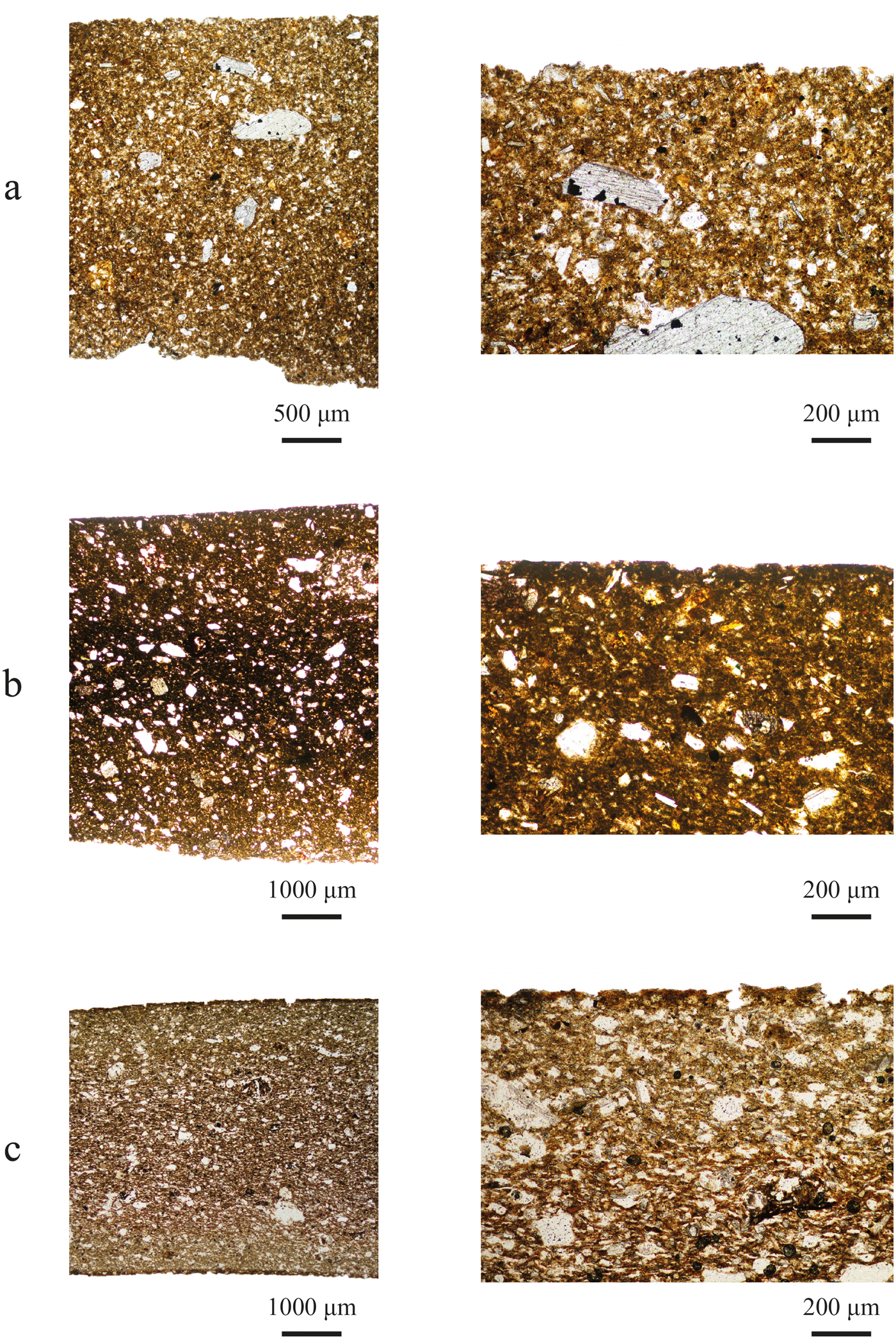
Types of pastes: (a) silty, CPP441; (b) sandy, CPP438; (c) clayey-silty-sandy, CPP435. (Photographs by E. Jadot.)
Analyses by X-ray fluorescence (XRF), X-ray diffraction (XRD), and Raman spectroscopy were conducted on a sherd from UT52 (CPP437) as part of a more general study of the ceramic pigments used on the Malpaís de Zacapu. The results showed the use of graphite, associated with a carbon deposited by smoking, at the end of the firing process, giving a shiny and metallic aspect to the surface of this sherd (Jadot et al. Reference Jadot, Schiavon and Manso2016). The graphite was applied on the surface of the pottery before burnishing, perhaps by rubbing a solid graphite mass (plumbago) on the surface (see Balfet et al. Reference Balfet, Fauvet-Berthelot and Monzon1992:123).
Paste Groups
Observed with the naked eye and the stereomicroscope, the Plumbate-like sherds all present a fine paste with a variable quantity of fine black inclusions. Some of these pastes underwent a preliminary petrographic analysis with the help of M.-A. Courty (CNRS, UPR 8521 – PROMES), resulting in the identification of three main groups: (1) a silty paste from a volcanic alteration soil, containing a lot of small volcanic glass and carbonaceous fibers, with a temper composed of volcanic breccia (Figure 6a, color online); (2) a sandy paste from an alteration soil, which was decanted and cleared of coarse inclusions, with carbonaceous elements well integrated in the mass and with a temper composed of volcanic breccia (Figure 6b); and (3) a clayey-silty-sandy paste containing altered tephra (Figure 6c). Unfortunately, the thin section corresponding to this third type of paste is too thin to allow adequate observation.
Cultural Implications
The unprecedented presence of such a quantity of Plumbate type sherds in the region of Zacapu raises questions regarding their provenance. Were these objects imported from a Maya zone, or do they represent a local production of Plumbate copies? To date, Plumbate imitations were easily identifiable as such (Shepard Reference Shepard1948), given that “convincing copies of Plumbate were never produced in the regions to which it was exported. In the case of Plumbate, instead, efforts to produce copies yielded obvious fakes” (Neff Reference Neff2014b:5). Most of the Plumbate-like sherds from Zacapu have non-Plumbate features, such as polishing, but we decided to select a range of pastes and surface types to undergo instrumental neutron activation analysis (INAA). We expected that the comparison of the chemical composition of the Plumbate ceramic paste from the site of El Palacio and that produced in Soconusco would enable us to define whether these ceramic pastes are from the same source. Overall, the goal of the analysis was to determine to what extent the El Palacio Plumbate-like pottery represents commercial exchange or local imitation.
Results
We selected sherds with a range of shiny surfaces, including some that were polished and others that were apparently not polished (Table 2). Ten monochrome fragments come from the test pit UT52, whereas one sherd with appliqué decoration was discovered on the surface (Figure 3).
Provenance and Description of the Analyzed Sherds.

Neff and Glascock at the Missouri Research Reactor Center (MURR) conducted a study of the 11 sherds using INAA (see Neff Reference Neff, Ciliberto and Spoto2000). They evaluated provenance by comparing the ceramic pastes of Michoacán samples with two Plumbate reference groups and the reference groups available for the Lake Pátzcuaro Basin (Pollard et al. Reference Pollard, Hirshman, Neff, Glascock, Dillon and Boxt2005; Speakman Reference Speakman2003) located near Zacapu.
Multivariate probabilities of membership in the reference groups (Table 3) rule out a Soconusco origin for 10 of the 11 sherds from the Zacapu area. The 10 specimens fall within the range of variation of a “general Lake Pátzcuaro Basin” group, and one of them (CPP433) exceeds 1% probability of membership in the Main Pátzcuaro Basin reference group. Thus, although pottery and raw materials from Zacapu have not been sampled extensively, a local Michoacán source can be inferred for these 10 specimens. On many bivariate projections of the data (Figure 7, color online), these 10 specimens fall within the range of variation of Pátzcuaro Basin Group 3, which was defined in a follow-up study of Pátzcuaro Basin pottery by Speakman (Reference Speakman2003).
Probabilities of Membership in Various Reference Groups Calculated for 11 “Plumbate” Samples from El Palacio, Michoacán.

Thorium and Tantalum concentrations in Zacapu “Plumbate” together with ceramics and raw materials from the Lake Pátzcuaro Basin, Michoacán. Ellipses indicate 90% probability cutoff for membership in the reference groups. The outlier to the right of Michoacán correlation line is CPP435.

One specimen (CPP435) shows practically no similarity to the Pátzcuaro Basin pottery and raw materials and exceeds the 1% probability cutoff for membership in the Tohil Plumbate reference group (Table 2). CPP435 is also very different from Pátzcuaro pottery and raw materials on most two-dimensional projections of the data (Figure 7). Because the Tohil Plumbate group is well represented (250+ members) and very tight (Figure 8, color online), this result confirms the identification of CPP435 as an imported Tohil Plumbate vessel. The Tohil Plumbate reference group is securely linked to raw materials near the mouth of Rio Cahuacán, in southern Chiapas, Mexico (Neff Reference Neff, Love, de Hatch and Escobedo2002a), where Plumbate pottery workshops were recently excavated (Neff Reference Neff2014b).
Antimony and chromium concentrations in Zacapu “Plumbate” together with two Plumbate reference groups. Ellipses indicate 90% probability cutoff for membership in the reference groups. CPP435 is within the cloud of Tohil Plumbate data points, although it is obscured by other data.
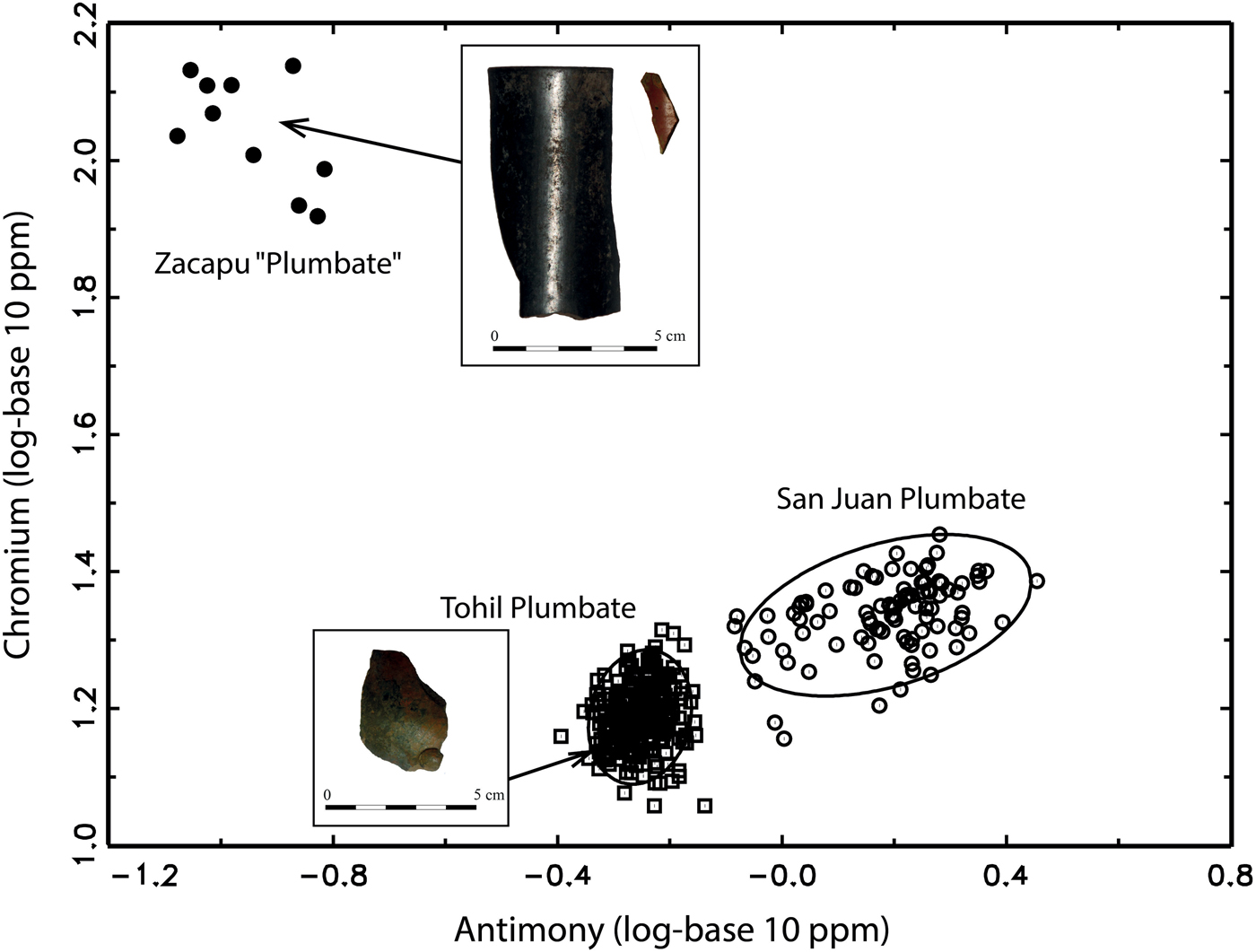
These results indicate that one sherd (CPP435) was produced in the Soconusco and then imported to the Zacapu region, whereas the 10 other sherds coincide with the chemical signatures of ceramic pastes produced in the southwestern Pátzcuaro Basin that are most similar to the Pátzcuaro Main Group and Groups 3 and 5 (Hirshman Reference Hirshman2003:221, 231; Hirshman and Ferguson Reference Hirshman and Ferguson2012; Pollard et al. Reference Pollard, Hirshman, Neff, Glascock, Williams and Weigand2001, Reference Pollard, Hirshman, Neff, Glascock, Dillon and Boxt2005). The silty and sandy clays from the alteration soil (Figure 6a–b) were thus extracted in the lowlands of the southwestern Pátzcuaro Basin, about 40 km from the site of El Palacio. It is likely that the finished products themselves, rather than the raw materials, were transported. These results still have to be compared to the compositions from the region of Zacapu, for which no analyses have yet been conducted. Yet, based on the results presented here, we can envisage the existence of imports from Pátzcuaro Basin to the site of El Palacio during the Early Postclassic (AD 900–1200).
Discussion
This study indicates that Early Postclassic long-distance exchange networks brought at least some Tohil Plumbate to Michoacán, where local potters also used local technological practices to produce Plumbate-like surfaces. Commercial exchanges have already been identified between Chiapas and the highlands of Michoacán following the discovery of obsidian from a Ucareo source at the site of Izapa, located in the region of Soconusco; in addition, there is evidence of exchanges from central Mexico, such as Pachuca and Otumba, near the region of Tula (Braswell Reference Braswell, Smith and Berdan2003). It is now important to assess whether these exchanges took place directly between the regions of Soconusco and Zacapu or whether the contacts passed through the intermediary of another region, in particular the Basin of Mexico.
Shepard observed that all the original Plumbate type ceramic artifacts are incised before slipping, whereas the imitations are all incised after that process (Shepard Reference Shepard1948), as if there had been no technical transmission between the potters from the region of Soconusco and those trying to copy them. In the case of the specimens from Zacapu, not only did the potters imitating the Plumbate succeed in attaining a high level of shine but they also made incisions before applying the slip. Nevertheless, these features do not enable us to assume that technical transfers took place between the two regions. First, the incision technique before slipping is attested for other productions in the region of Zacapu during the Palacio phase (Palacio Pulido Inciso type bowls; Jadot Reference Jadot2016a, Reference Jadot2016b), and thus it is not a new characteristic exclusively linked to this pottery. Second, there is at least one technique that was not transferred: the technique of dipping in the slip and achieving the shine purely by firing properties of the raw materials. Moreover, the slip “recipe” is different for the pottery produced in Chiapas (with an iron and alumina base, completed by sodium, potassium, copper, and zinc; Neff Reference Neff2001, Reference Neff, Love, de Hatch and Escobedo2002a, Reference Neff, Ruvalcaba Sil, Trujeque, Alatorre and Castro2010; Shepard Reference Shepard1948) than for the specimens from Zacapu (use of graphite; Jadot et al. Reference Jadot, Schiavon and Manso2016).
Therefore, we argue that there was no transfer of technology from the region of Soconusco to Michoacán: with the exception of the pre-slip incising, the Michoacán “Plumbate” is technologically very different from real Plumbate, the main difference being that graphite and polishing were used in the former to obtain a shiny gray surface; in contrast, Plumbate potters achieved this effect by using special raw materials for the slip and firing in a special atmosphere. Thus the Michoacán “Plumbate” does not represent a genuine reproduction of the whole chaîne opératoire but just the imitation of several characteristics without any understanding of the technology; this imitation could be the result of the attentive observation of the visible traits of finished products issued from commercial exchanges associating the two regions. Contact could have been established in several stages, probably via Toltec populations from the central highlands of Mexico.
We saw earlier that several ceramic indications from the Early Postclassic (AD 900–1200) link the site of El Palacio to that of Tula. The discovery of Braseros San Antonio, Palacio Pulido Inciso, Plumbate, and comales type sherds associated with several fragments of Mazapa-style figurines (Forest et al. Reference Forest, Jadot and Testard2019) indicates contacts with the Toltec culture. The region of Tula could have operated as a transit point for Plumbate between the regions of Soconusco and Zacapu. El Palacio pottery thus reflects exchanges between populations from the regions of Tula and Zacapu during the Early Postclassic. This observation is valid for the site of El Palacio and requires confirmation from other sites in the Zacapu Basin that it is not limited to El Palacio; however, the presence of other objects associated with the Toltec culture at the site of Potrero de Guadalupe (Mich.215), located in the lomas (Pereira Reference Pereira1997), implies that several groups in Zacapu Basin had established links with the Toltecs.
The nature of these links remains to be established. Were they created by commercial networks alone? Or were there more complex and tighter links suggesting forms of alliances between certain elites from Michoacán and Tula? This latter hypothesis was recently put forward by Jiménez Betts (Reference Jiménez Betts2018) in his analysis of the interactions between the west and the northwest regions of Mesoamerica with central Mexico. The same “Toltec package” is found as far as Jalisco and Nayarit, where Plumbate-style sherds, toltec-type braseros, incensarios, and especially Mazapa figurines are widespread and abundant (Meighan Reference Meighan1976), raising the question of the nature of the Toltec presence in western Mesoamerica. Based on evidence from the sites of Urichu (Pollard Reference Pollard2008; Pollard and Cahue Reference Pollard and Cahue1999) and El Palacio, Jiménez Betts suggests that the links between the lacustrine zones of Michoacán and Tula are part of a political network system, as defined by Chase-Dunn and Lerro (Reference Chase-Dunn and Lerro2014) in their world-system model. Jiménez Betts (Reference Jiménez Betts2018:63) refers to “zones where sovereign polities have regular political or military exchanges with a core zone. In this case evidence suggestive of political alliances is examined.”
We feel it is premature to affirm the existence of direct political links between Tula and the sites considered here. Yet currently available material evidence clearly shows that these populations had sufficient knowledge of the Toltec world to reproduce a wide range of objects for their own use, on a local scale. They not only include table vessels but also objects (braseros, Mazapa figurines, adornments, and corporal insignia) linked to the ceremonial complex, as proposed by Diehl (Reference Diehl and Rice1993). The original or imitation Plumbate-style pottery described in this article should undoubtedly be placed in this latter category of objects.
Acknowledgments
This study was conducted as part of a doctoral fellowship from the Paris 1 University – Panthéon-Sorbonne. Analysis of the sherds was made possible by the NSF grant supporting the Archaeometry Laboratory at the University of Missouri Research Reactor (Number 1621158) and the Proyecto Arqueológico Costa del Soconusco (PACS), which was funded by the U.S. National Science Foundation (BCS-1115361). Permission for destructive analysis was provided by the Instituto Nacional de Antropología e Historia (INAH) de México. We also acknowledge the French Ministère de l'Europe et des Affaires Étrangères (MEAE) and the CNRS (UMR 8096 ArchAm) for their funding of the Archaeological Uacúsecha Project, as well as the CEMCA for providing logistical support. We sincerely thank Marie-Agnès Courty for her invaluable assistance in the characterization of the paste groups.
Data Availability Statement
Since 2010, the Uacúsecha Project has been conducting research on the history of the Tarascan state in the region of Zacapu, Michoacán. It is directed by Grégory Pereira and funded by the Commission of Excavations of the French Ministère de l'Europe et des Affaires Étrangères (MEAE), the Centre National de la Recherche Scientifique (CNRS), and the Paris 1 University (Exodes project). It also receives logistical and institutional support from the Centre d’Études Mexicaines et Centre Américaines (CEMCA), the Instituto Nacional de Antropología et Historia (INAH), and the Universidad Nacional Autónoma de México (UNAM). All the material mentioned in this article is curated at the CEMCA, in the town of Mexico.
Supplementary material
To view supplementary material for this article, please visit https://doi.org/10.1017/laq.2019.24.
Supplementary Figure 1. Radiocarbon analysis results for the sample GrM11623 (charcoal; UE553, UT52, El Palacio).
Supplementary Figure 2. Radiocarbon analysis results for the sample Lyon-11162 [SacA36799] (faunal bone; UE554, UT52, El Palacio).
Supplementary Figure 3. Radiocarbon analysis results for the sample GrM 11625 (charcoal; UE555, UT52, El Palacio).
Supplementary Figure 4. Radiocarbon analysis results for the sample Lyon-11161 [SacA36798] (faunal bone; UE530, UT51, El Palacio).
Supplementary Figure 5. Similar pottery types from the El Palacio and Tula sites: (a–b) Palacio Pulido Inciso type, El Palacio, UT52 (drawing by E. Jadot); (c) Sillon Incised type, Tula, Unit 03N7E12D279 (after Cobean Reference Cobean1990:Plate 183); (d) Braseros San Antonio type, El Palacio, UT52 (drawing by E. Jadot); (e) Braseros San Antonio type, El Palacio (after Michelet Reference Michelet, Pomédio, Pereira and Fernández-Villanueva2013:Figure 15.2); (f) Abra Coarse Brown type, Tula, 03534020D145 (after Cobean Reference Cobean1990:Plate 192); (g) Hornos Rojo sobre Bayo type, El Palacio, UT52 (drawing by E. Jadot); and (h) Mazapa Red on Brown type, Tula, 070204130 (after Cobean Reference Cobean1990:Plate 132).




 Open access

