




Trained in raga-based music, song, and dance, elite female performers collectively known as tawa’ifs occupied a long-standing and influential position within the courtly culture of North India. Sustained by a complex network of patronage that connected them to the Mughal imperial court and the regional nobility, their appearances at public festivals like royal weddings or coronation ceremonies signified ‘celebration and good fortune’,Footnote 1 while their salons (koṭhās) served as arenas in which young aristocratic men would receive grooming in matters of aesthetic taste, comportment, and social etiquette (ādāb). Mobility and social liminality were major aspects of tawa’ifs’ professional lives,Footnote 2 closely tied to the dynamics of elite male patronage, regional courts, and urban cultural circuits.Footnote 3
Over the course of the nineteenth century, sweeping socio-cultural transformations led to increasing stigmatisation, marginalisation, and outright criminalisation of female performers. Colonial interventions and the collapse of courtly patronage networks in cities like Delhi and Lucknow, especially after 1857, contributed to shifting attitudes towards female performers and their roles as purveyors of enchantment among the upper and emerging middle classes. Culminating in the Anti-Nautch movement,Footnote 4 intense debates over their morality and the perceived dangers of their sexual allure ensued, both among the Muslim gentry (ashrāf) and elite Hindus, as well as among Anglo-Indian patrons of ‘dancing girls’ and ‘Hindustani airs’.Footnote 5 In consequence, large sections of society began to conflate the umbrella term ţawā’if (the Arabic plural of the word ţā’ifa or ‘troop’, ‘band’, ‘people’, ‘party’) with a range of ‘disrespectable’ women, thereby blurring the boundaries between elite courtesans, lower-class entertainers, and sex workers.Footnote 6
By the early twentieth century, the tawa’if had literally become a ‘woman of ill-repute’ or ‘prostitute’ (embodying disease and immorality). Simultaneously, it morphed into a figure of nostalgia for a past of Mughal and Awadhi courtly culture in parts of the Urdu public and literary sphere. And yet, despite multiple campaigns against these ‘fallen women’, the consequences of which ranged from the de-eroticisation of performance repertoires to changes in instrumentation and an increase in the numbers of professional female performers effectively forced into sex work, ‘the culture of singing and dancing women survived in a much-reduced form up to the present day’.Footnote 7
While prior studies have yielded pioneering accounts of the ways in which the tawa’if as a ‘public woman’ had become the subject of moral censure and how this affected performance practices, songs, poems, and dance repertoires, this article focuses on the power dynamics, hierarchies, and relationships between Muslim aristocratic patrons of the arts, middlemen, and travelling female performers in post-1857 northern India. Why, when, where, and how were tawa’ifs selected and recruited in this time of socio-cultural change? How, if at all, were female performers able to negotiate the terms of their employment? And how did aristocratic patronage of female performers adapt to the pressures of colonial modernity?
Seeking answers to these questions, this article focuses on the patronage of tawa’ifs in the princely state of Rampur as a case study, while drawing particular attention to links with former cultural capitals in the region and to the wider North Indian performance circuit. It aims to recover and critically examine the social and historical positioning of some of the many female performers whose identities, agencies, and histories have been obscured or erased through intersecting forces of colonial governance, moral censure, nationalist reform, and the enduring stigmatisation that conflated their artistic labour with prostitution. Far from being peripheral figures, tawa’ifs in colonial India were central to the production, preservation, and transmission of performance practices that laid the groundwork for what is now institutionalised as ‘classical’ or ‘semi-classical’ Hindustani music and dance.Footnote 8
I argue that princely patronage of tawa’ifs was a dynamic and continually evolving affair that adapted to the pressures of colonial modernity. Drawing on archival materials in Urdu and Persian, including unpublished petitions and letters written by or about female performers, I demonstrate that post-1857 Lucknow (rather than Delhi) retained a certain importance as regional hub and recruitment ground for mobile courtesans. Moreover, I show that it was the conscious articulation of a distinctly ‘native princely modernity’Footnote 9 in Muslim-ruled Rampur that enabled the princely state to emerge as a major patron of (female) performers.
In this context, I explore ways in which courtesans negotiated the conditions of their employment, and I provide rare evidence of female performers from the Ottoman empire travelling across the subcontinent in search of patronage. Finally, this article looks at previously overlooked Urdu print media to trace shifts in the public discourse on tawa’ifs performing at popular fairs and exhibitions, be it as part of emerging Parsi theatre companies or as early gramophone recording artists. Mobility and adaptability to changing socio-political circumstances, aesthetic trends, media, and technologies appear to have been crucial for their survival as professional singers, dancers, and later as actresses and recording artists.
Setting the scene: the emergence of Rampur as a centre of music and dance
Foreshadowing some of the developments and disruptions of the nineteenth and early twentieth centuries, Delhi already ceased to be the predominant musical centre of the Mughal world during the late eighteenth century. Especially the years between 1739 and 1761 witnessed a substantial ‘scattering’ (tafriqa) of the Mughal capital Shahjahanabad (now ‘Old Delhi’), as many Hindustani court musicians sought alternative patronage at emerging regional courts in Awadh, Rohilkhand, Rajasthan, the Punjab, Nepal, or the Deccan.Footnote 10
Situated on the upper Gangetic plains, Rohilkhand (or ‘land of the Rohillas’) was settled by upwardly mobile Afghan military and mercenary communities during the late seventeenth and early eighteenth century in search of service and status under the Mughals. Having consolidated their power and established several Rohilla chieftaincies in the region, the leaders of these Afghan Pashtun migrants quickly recognised the high cultural value and prestige accorded to the performing arts at the Mughal court as a key marker of elite social status and political authority.Footnote 11 In 1737, ‘Ali Muhammad Khan (d. 1748), their charismatic leader, was granted the title of nawwāb (governor, viceroy) by the Mughal emperor, cementing their political standing. By the time Rampur—an ally of the British East India Company—emerged as the sole surviving Rohilla-led principality in the region after the First Rohilla War of 1774, it had already begun to attract a distinguished cohort of poets, scholars, artists, musicians, and dancers circulating between various centres of patronage.Footnote 12
Until the mid nineteenth century, however, the region’s musical scene remained dominated by Awadh with its capital Lucknow, and even Shahjahanabad continued to be renowned for a courtly culture that survived in a somewhat transformed form.Footnote 13 This radically changed with the British annexation of Awadh in 1856 and the final dismantlement of the Mughal throne after the Uprising of 1857. With the loss of their main patrons, competition among the remaining female professional performers rose while semi-independent princely states like Rampur gained a significant boost. Being loyal allies of the British, Rampur’s nawabs not only ensured their survival as the only remaining Muslim-ruled principality in erstwhile Rohilkhand (or what became the United Provinces of British India), they also turned their court into a genuine refuge for musicians, dancers, and poets.Footnote 14
Under Nawab Kalb-e ‘Ali Khan (r. 1865–1887), Rampur’s reputation as an authentic North Indian Muslim centre of artistic and scholarly life reached its pinnacle. Among the state’s most prominent court musicians at this time were the rabāb and sursingār player Bahadur Husain Khan (d. 1879) and the vocalist and bīn player Amir Khan (d. 1880), both representing the senīya lineage of hereditary professional musicians—that is, those claiming descent from Emperor Akbar’s foremost court musician, Miyan Tansen (d. 1589). As respected master-musicians (ustads), they performed primarily in the setting of the North Indian maḩfil (assembly)—intimate gatherings of connoisseurs and musicians in elite male spaces—and instructed the nawab and his younger half-brother, Haidar ‘Ali Khan (d. 1903), in the art of music, thereby exerting significant influence over many professional court performers.Footnote 15
Since the 1840s, with the exception of Kalb-e ‘Ali Khan, all rulers of Rampur adhered to Shi‘i Islam, as did the Nawabs of Awadh. Among the latter, Wajid ‘Ali Shah (r. 1847–1856) was especially associated with a court culture in which rulers frequently married tawa’ifs as temporary mut‘a (pleasure) wives—a form of marriage permitted under Shi‘i law.Footnote 16 Several members of the Rampur royal family likewise entered into such unions with courtesans, reflecting the social liminality of female performers as an occupational class capable of crossing boundaries into higher-status spaces that were otherwise impenetrable to women of lower rank.Footnote 17 Nawab Yusuf ‘Ali Khan (r. 1855–1865), the father of Kalb-e ‘Ali Khan, for example, married the tawa’if Tuti Jan—an accomplished singer and poet who assumed the title Sardar Dulhan Begum—as his third wife.Footnote 18 Their son Haidar ‘Ali Khan, a well-educated connoisseur and patron of music, later married the singer Lali and transmitted his passion for music to his own offspring, especially Sa‘adat ‘Ali Khan (d. 1922), a close associate of Nawab Hamid ‘Ali Khan (r. 1889–1930).Footnote 19
While some musicians and dancers were able to secure stable positions and remain attached to a particular court for long stretches of time, many professional performers—both men and women—led itinerant lives, moving between alternating centres of patronage. Beyond working in the salons (koṭhās) of urban centres such as Lucknow, mobile tawa’ifs sought appointments at regional courts, where they performed at ritually auspicious events, religious festivals, and state ceremonies, or trained women of the zenana in music, poetry, and dance.Footnote 20 Lower ranking women often remained in relative seclusion, appearing only rarely outside the private quarters of elite households, and some were even regarded as ‘property’ that could be lent or gifted to other patrons.Footnote 21
If the patronage of Hindustani music was considered ‘central to the notion of what it meant to be a mirza or nobleman’,Footnote 22 the ability to host the most accomplished and beautiful female performers of song and dance served as an important signifier of cultural capital and power.Footnote 23 Yet, echoing the observations of the medieval Iraqi polymath al-Jahiz (d. circa 868 CE) in his Epistle on Singing-Girls (Risālat al-Qiyān), tawa’ifs were both revered and feared for their ability to appeal simultaneously to the eye, the ear, the sense of touch, and the heart.Footnote 24 While the status of tawa’ifs as purveyors of multiple sensory pleasures to elite men began to erode under colonial modernity, the question remains how this transformation affected continuities within the ‘paracolonial’ space of the princely state.Footnote 25
Travelling female performers, princely patrons, and public festivals
Previous scholarship has tended to characterise princely states like Rampur, Hyderabad, and Bhopal as sanctuaries of the arts in which Indo-Muslim courtly culture was ‘preserved’.Footnote 26 A closer examination, however, reveals that princely patronage, cultural production, and preservation were neither static nor insulated from developments beyond their borders. A distinctly modern public space in which the multisensory appeal of tawa’ifs came to fruition in princely Rampur was the Jashn-e benaz̧īr (Incomparable Festival), an annual fair established by Nawab Kalb-e ‘Ali Khan in commemoration of his accession to the throne in 1866.Footnote 27
Inspired by late Mughal and Awadhi examples of public gatherings as well as colonial-era industrial exhibitions, the Benazir fair not only boosted economic and cultural production and trade in the state, but it also gave Rampur’s rulers a stage for the demonstration of royal authority and splendour. As Amanda Lanzillo recently stated, princely ‘state elites sought to create material and industrial cultures that emphasised their authority as Indian rulers […, which] often meant engaging with claims on religious pasts and specific, locally rooted courtly cultures that exceeded colonial state authority’.Footnote 28 I suggest that this was enacted, among other things, by hosting an impressive assembly of artistes, entertainers, and poets performing before audiences composed of regional elites, merchants, the general populace, and representatives of the colonial state.
Capable of providing multisensorial experiences across social boundaries, talented tawa’ifs were key figures in these public-facing events—at least until shifting social mores, new performance venues, and the rise of the gramophone and radio (in addition to theatre and film) around the turn of the century altered their social status and also introduced ‘a new set of male controllers and gatekeepers’.Footnote 29 As will become clear, many of the female dancers and singers performing at the Benazir fair were recruited from outside the princely state, largely gaining their livelihoods by being ‘on the road’.
Despite its local specificities, organising a state-sponsored fair that emphasised both cultural and religious authority was not unique to Rampur. Indeed, some scholars have identified the emergence of a veritable ‘exhibition culture’ during this period.Footnote 30 Beginning with the Madras Exhibition of 1855, agricultural and industrial exhibitions were inaugurated throughout the 1860s in towns and cities across British India. In addition, pre-existing religious festivals and trade fairs (melās) were revived, transformed, and expanded.Footnote 31 Many exhibitions and festival-fairs shared the common feature of providing public spaces in which audiences could engage in novel sensory experiences. On this level, Rampur competed with both emergent colonial exhibitions and pre-existing pilgrimage fairs. What distinguished the Jashn-e benaz̧īr from many agricultural and industrial exhibitions, however, was that the nawab—in emulation of Mughal noblemen—continued to value and support both male and female performers of Hindustani music and dance.Footnote 32
An important text introducing us to the range of performers present at the first iteration of the Benazir fair—from Rampur’s male court musicians and accompanists to the cross-dressing or transgender dancer ‘Ali Jan (d. circa 1879) and several female performers—is the Musaddas tahnīyyat-e jashn-e benaz̧īr (Musaddas: felicitations for the Incomparable Festival), a generously illustrated commemorative rekhti poem composed around 1867 by the local Urdu poet Mir Yar ‘Ali Jan Sahib (1810–1896).Footnote 33 Making every effort to present his princely patron as a just and benevolent ruler, Jan Sahib describes the nawab as a highly cultured connoisseur of the arts wealthy enough to host and reward the best musicians, dancers, artisans, storytellers, and poets available in the region.Footnote 34 Moreover, the poem’s ‘ethnographic mode’ shows us how cultural activity in the princely state was not restricted to the elites and the physical space of the court, but that it included all varieties of people, the rich and the poor, who mingled in the bazaars, streets, gardens, and fairgrounds.Footnote 35
Musicians and dancers assembled at the festive fairgrounds performed on small make-shift stages and in tents. Setting their performing bodies apart, Jan Sahib differentiates between the distinct characteristics of individual tawa’ifs and alludes to nuances in social standing or occupational specificities, be it by emphasising the quality of their singing voices, the refinement of speech and manners, the level of physical beauty, or notoriety based on repertoires and place-related identities. For example, he writes:
Today Nauratan ensures that she remains peerless.
A sweet-singing voice, and tuneful no less.
A cultured whore (ranḍī hāi bā-tamīz) she is and to declare it is not meaningless.
Each dancing girl (ţā’ifa) is a rose, belongs to the garden, no less.
Seeing the rose makes it a garden, the heart of the nightingale.
These flowers also decide to blossom to the song of the nightingale.Footnote 36
Of note is that Jan Sahib not only uses the term ţā’ifa (troupe/company of a courtesan) interchangeably with ranḍī (prostitute), but he also qualifies the latter with the (seemingly contradictory) term bā-tamīz (cultured). We can therefore assume that he understood ranḍī as an ‘unmarried [but respectable] woman’, as was common before the late nineteenth century.Footnote 37 In a similar vein, the poet ranks the tawa’ifs Chunno, Mammi, and Allah Rakhi among the most cherished and cultured female performers available:
In their jobs both are polished and perform exquisitely.
Among dancing-girls (ţā’ifoñ), they are more than ten times twenty.
Sweeter than Shirin’s, their speech is unfussy.
Why won’t they be dear to every heart and be friendly?
The one ‘Night-dispelling Moon’ (badr-e munīr), the other ‘Incomparable’ (benaz̧īr),
Devoted to Mammi-Chunno is every patron and noble (amīr).Footnote 38
They are daughters of Subba and a wealthy (ḍeredār) courtesan—
To give the only description of Mammi and Chunno we can.
Women (ranḍīyāñ) they are fit for soirees of any nobleman,
Just as Allahrakkhi is known to any worldly man.
All three of them an aristocratic way of life maintain,
Just like Indra’s fairy house their house they maintain.Footnote 39
Described as highly cultivated and possibly also providing sexual companionship to elite patrons, Mammi and Chunno seem to have been relatively well-off courtesans who could clearly be distinguished from other women of the bazaar, their mother being a ḍeredār ţawā’if with her own fixed abode.Footnote 40 Likewise, the poem highlights the elite courtesan Daroga (lit. ‘keeper’) Mahbub Jan (d. around 1891), a long-time resident in Rampur who acquired a significant respectability and intimacy with Nawab Kalb-e ‘Ali Khan, even accompanying him to Mecca in 1872.Footnote 41
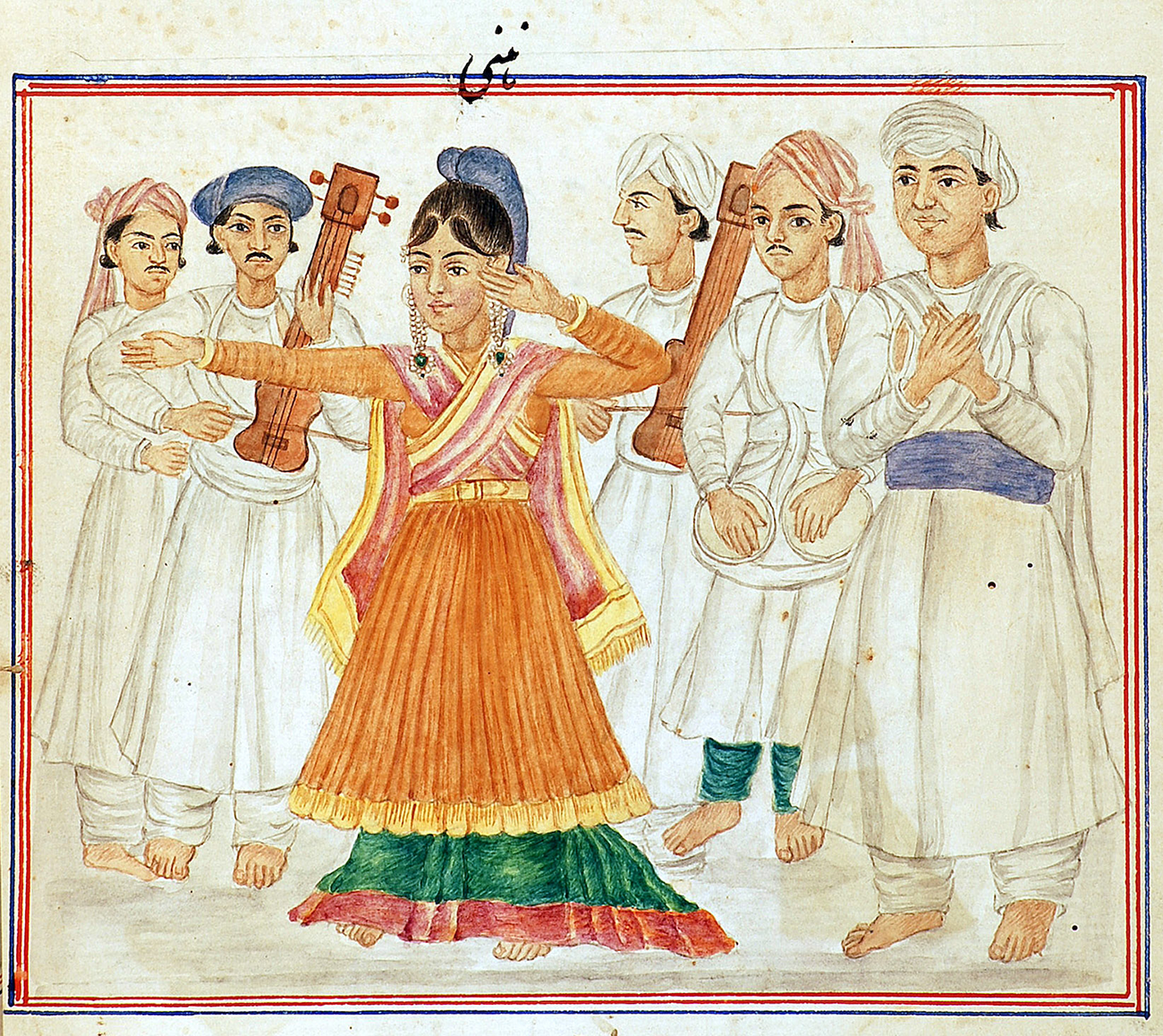
Jan Sahib’s poem also indicates that many female performers travelled from one engagement to another. While it does not directly engage with the theme of mobility, it nonetheless notes that numerous performers in Rampur came from Lucknow. Covering the longest distances to reach the princely state for the annual festival was Nanhi Kalkatte-wali who, as her name’s nisba (attribution) indicates, hailed from the colonial capital of Calcutta (see Figure 1). Her appearance illustrates not only how the regionally distinct khemṭā dance genre associated with her gained popularity across northern India but also the willingness of lower-status performers, seeking social mobility, to travel far and wide.Footnote 42
Nanhi Kalkatte-wālī and accompanists in Rampur, circa 1866. Source: M. Y. ‘A. Jān, Musaddas tahnīyat-e jashn-e benaz̧īr, Urdu Illustrated Manuscript 1229, fol. 25v, Rampur Raza Library.
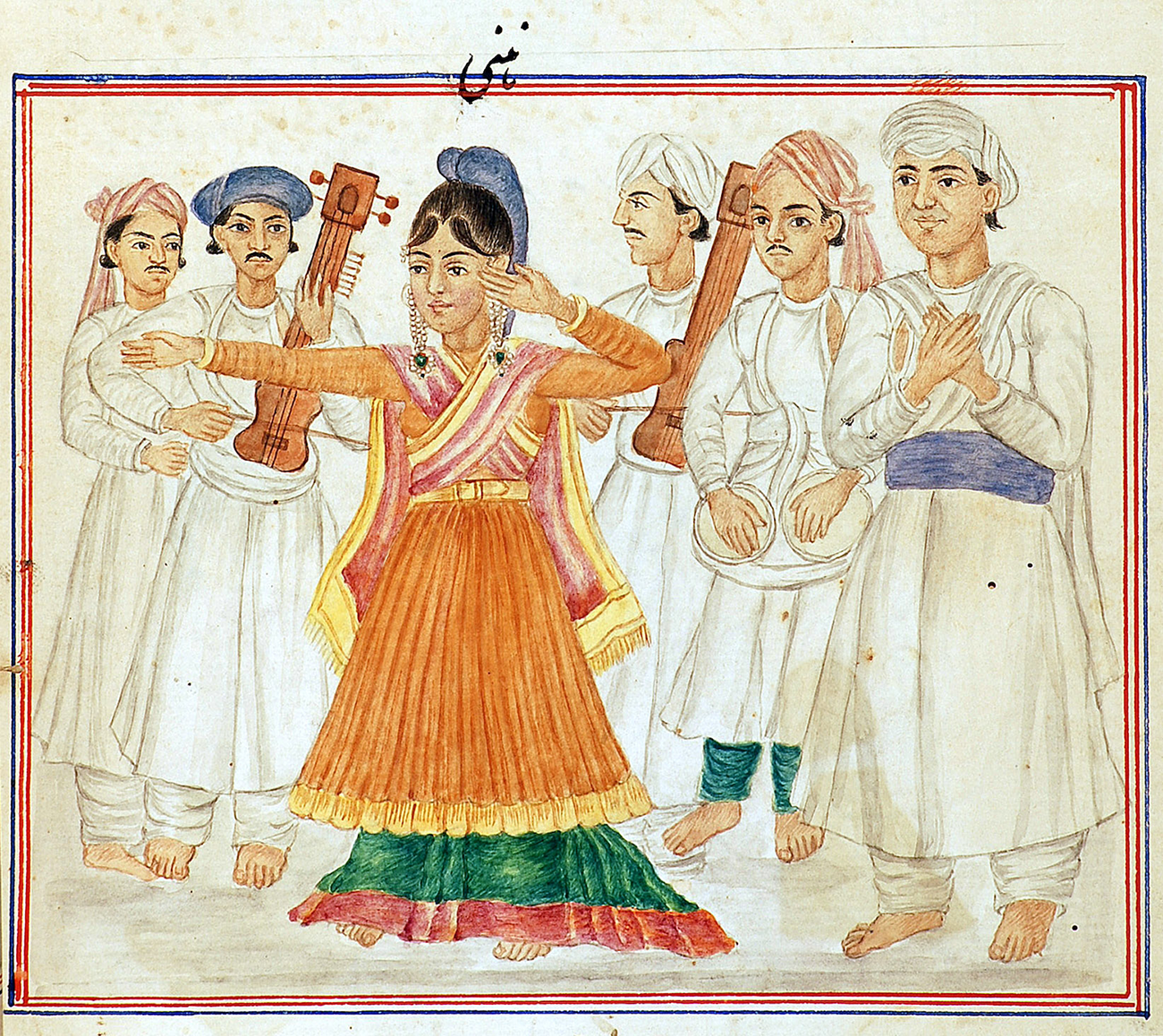
Figure 1 Long description
Nanhi is positioned centrally, wearing a traditional dress with elaborate patterns. She is surrounded by five accompanists, all dressed in similar traditional attire. Two of the accompanists hold stringed musical instruments, while the others appear to be clapping or gesturing. The group is arranged in a semi-circle, with Nanhi at the center, suggesting a dance performance setting. The attire and instruments indicate a cultural or traditional event. The background is plain, focusing attention on the performers.
Negotiating female performers’ terms of employment
For all its artistic and ‘ethnographic’ value, including a certain class and gender consciousness, Jan Sahib’s Musaddas remains the work of a male poet writing to please his princely patron. To gain a more nuanced perspective on the patronage of mobile tawa’ifs in post-1857 Rampur, we need to engage with a different set of primary sources and archives. Let us therefore turn our attention to several unpublished petitions and letters written by or about female musicians and dancers to the royal court during the reign of Nawab Kalb-e ‘Ali Khan, preserved in what survives of Rampur state’s Dār al-inshā’ (Department of Official and Diplomatic Correspondence) records. I contend that this change in perspective helps us recuperate some of the commonly occluded aspects in the relationships between patrons, middlemen, and performers.
In August 1865, a female envoy of the nawab—modestly referring to herself as a humble maidservant (kanīz), but likely a senior courtesan—sent the following report from Lucknow to the Rampur court, detailing her efforts to recruit talented female performers:
To the illustrious and renowned Nawab, the pinnacle of authority […], may God perpetuate his glory and fortune. After presenting the humble salutations of this devoted servant, it is respectfully submitted as follows: This humble maidservant (kanīz), having taken leave of her noble patrons, arrived in the city of Lucknow on the 22nd of Rabī ‘al-awwal, 1282 AH [15 August 1865 CE]. Astonishing events unfolded before her eyes: Mir Hasan Ja‘far (known as Bahar al-Daula), Mir Sayyid ‘Ali, and Mir Mahbub ‘Ali, envoys of Sahibzada [Prince] Haidar ‘Ali Khan, were already present. These gentlemen had taken up residence in the city in accordance with the royal decree mandating obedience. Regarding the search for the lamp of desire and the execution of the sacred orders, arrangements were duly made, and she applied herself with the utmost diligence and heartfelt effort to carry out all necessary tasks. The first company of arbāb-e nishāţ (lit. ‘masters of pleasure’), whose capital is pleasure and delight, was summoned, and the mujrā (lit. ‘salutation’) performances were conducted [by the tawa’ifs]. After the mujrā and the distribution of tips and gifts, she carefully recorded the details of each courtesan troupe (ţā’ifa) present: Haidari, Wazir Jan, Amir Jan, Dukhtar (‘daughter of’) Biba Jan, Haingan, and Sundar. In addition to these, several other well-known troupes were also called and their skills assessed, but none except Sundar pleased the maidservant or seemed worthy of the company of highly refined and noble patrons. Indeed, Sundar’s dance (raqş) puts Zohra [lit. ‘Venus’; a famous tawa’if] to shame, and her singing brings Mushtari [lit. ‘Jupiter’; Zohra’s sister] to sweat with embarrassment. However, that moon of beauty and star of excellence was presently attached to Munshi Binak Parshad of the Commissioner’s office. […] God willing, she will soon ensnare that ‘Huma [bird] of pleasure’ (humā-ye ‘ishrat) in the net of her craft and send her to Your exalted service. Many troupes were enticed by Mir Hasan Ja‘far and the others, so some hesitated to arrive. Upon hearing of this, Sahibzada Haidar ‘Ali Khan immediately came from Rampur by mail coach (ḍānk) and took up residence at the house of Sajjad ‘Ali Khan, son of Nawab ‘Ali Naqi Khan.Footnote 43 Sundar, the naïve one, whose mujrā the Sahibzada attended twice, still has a longing for him in her heart. As for Haingan tawa’if, she is presently at Gorakhpur. The maidservant has sent some men to bring her back. Haingan is excellent in character, though flawed in appearance. Should any other troupe with similar qualities appear, she will send them [to you] immediately. […] May the divine sun of fortune eternally shine from the horizon of glory and majesty […]. Petition, respectfully submitted by this long-standing devoted well-wisher, dated 1865.Footnote 44
Although the author remains anonymous, the letter appears to have been written by a high-ranking courtesan commissioned by Nawab Kalb-e ‘Ali Khan to identify, assess, and, where appropriate, dispatch talented tawa’ifs to his court, presumably in connection with the coronation celebrations of 1865 and the subsequent Benazir fair. Displaying a well-trained eye and a discerning ear, as would befit a senior tawa’if, she describes her efforts to gain an overview of the finest courtesans available in the koṭhās of Lucknow, having them perform sample mujrā Footnote 45 sessions of song and dance while rating or classifying the women according to their quality of voice, their singing and dancing skills, their physical beauty, as well as their manners and social etiquette.
Though clearly objectifying the female performers’ bodies, the letter’s descriptions appear to reflect a long-established convention of evaluating the qualities of tawa’ifs. In Dargah Quli Khan’s eighteenth-century Muraqqa‘-e Dihlī (Delhi album, 1738–1741), for example, courtesans are similarly assessed according to their physical beauty, body shape, age, and demeanour, while the effect they had on the eyes of the (male) beholder is weighed against their talents as singers and dancers.Footnote 46 Moreover, as Katherine Schofield has observed, selecting the right kinds of musicians and dancers was of utmost importance for a nobleman ‘to prove to his peers, who were his social judges, his mastery of elite male etiquette’.Footnote 47 In other words, the mission to search for talented courtesans in Lucknow was a serious undertaking, and the author of the letter seems to have been regarded as a trustworthy agent by the nawab.
The fact that only one or two courtesans met with her approval suggests either a genuine scarcity of high-quality performers in post-1857 Lucknow or the author’s exceptionally high standards as an evaluator. Moreover, it confirms that many courtesans travelled from one patron to the other, often across considerable distances. Gorakhpur, for example, whence Haingan tawa’if was summoned, lies around 300 miles east of Lucknow. Other passages, especially those referencing Mir Hasan Ja‘far and the sudden arrival of the nawab’s half-brother, Haidar ‘Ali Khan, by mail coach, underscore the importance attached to securing desirable performers and reflect the competitiveness of elite male patronage. This demonstrates that skilled courtesans continued to serve as vital markers of social prestige and cultural capital among certain elite circles.Footnote 48
In a passage omitted from the translation above, the letter abruptly shifts to the challenges of acquiring several consumer goods for the nawab—such as a water pipe, tobacco, mango saplings, fine rice, and a particular kind of lentil (dāl).Footnote 49 This casts light on the complex economy of patronage, connoisseurship, and princely maḩfil culture, in which luxury, artistic performance, and everyday household supplies were closely intertwined. While patrons may have objectified the tawa’ifs’ bodies, treating them almost like commodities, the performers nonetheless retained social esteem and cultural value, even as their profession ensured that they remained of lower social rank than the elite they served.Footnote 50
It is noteworthy that several of the names mentioned in the letter—Zohra, Mushtari, Sundar, Haidar, Wazir, and Amir Jan—also appear in the early photographic album, The Beauties of Lucknow (1874).Footnote 51 The album’s introduction claims that some of these women had performed at Wajid ‘Ali Shah’s court prior to the 1856 annexation, yet most appear too young for that to be true. As Kathryn Hansen suggests, this retrospective framing sought to preserve their social prestige by linking them to a lost era of royal patronage, rescuing them from a colonial present marked by ‘moralistic censure and legal regulation’.Footnote 52
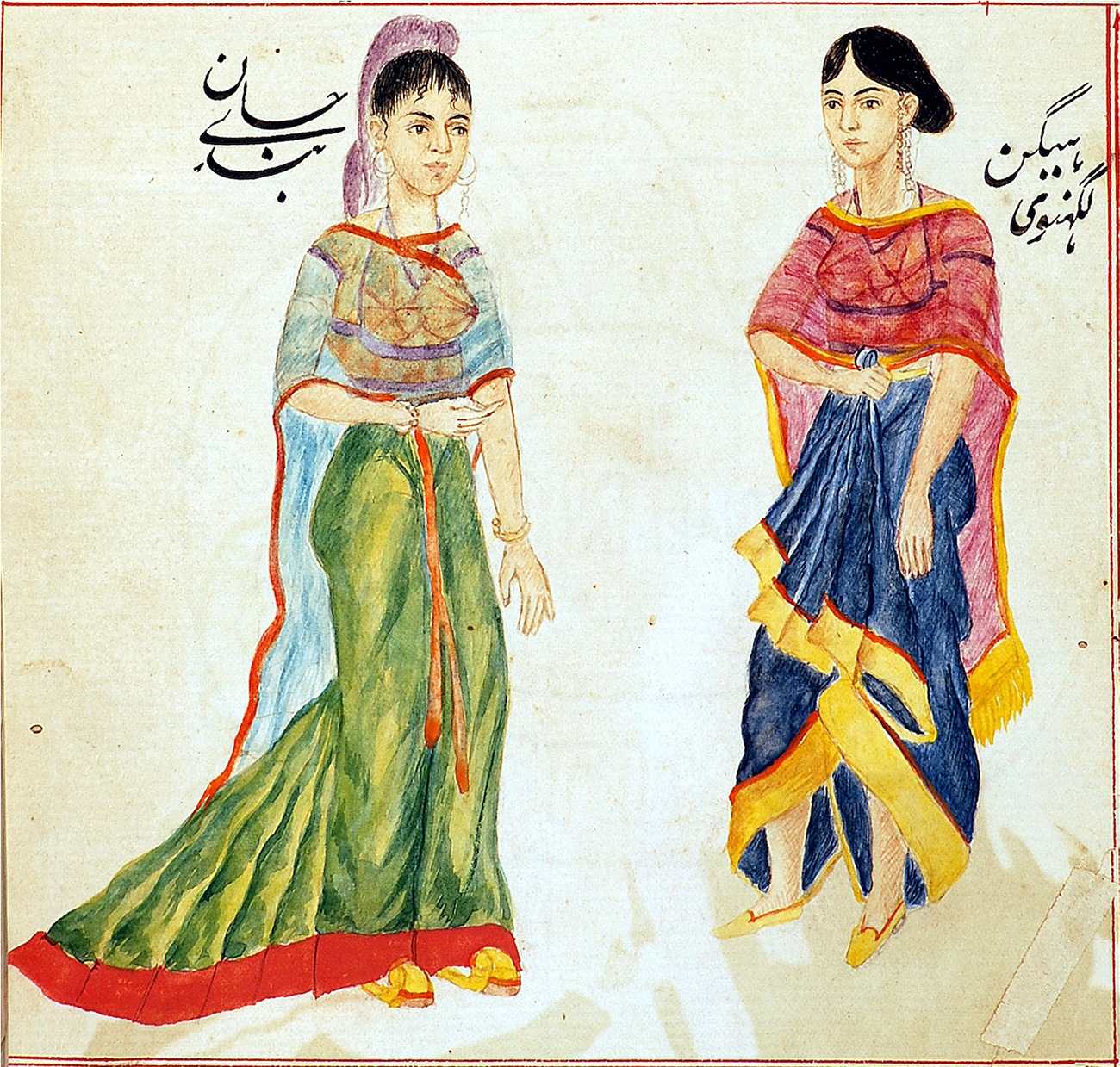
Of all the tawa’ifs mentioned in the letter, only Haingan reappears in Jan Sahib’s poem, indicating her presence at the Benazir fair in 1866 (see Figure 2).
The quick-witted wench (ranḍī) is brazenly flirty,
Hingan [sic] of Lucknow, she too is a ‘green fairy’.
Her breasts (joban) are youthful, her heart full of intensity.
She maintains her unique style of immaturity.
But […] Bandi Jan shows great cultivation (bā-tamīz):
Her habits and comportment (khū-o mizāj) have universal admiration.Footnote 53
The tawa’ifs Haingan Lakhnawi (right) and Bande Jan in Rampur, circa 1866. Source: M. Y. ‘A. Jān, Musaddas tahnīyat-e jashn-e benaz̧īr, Urdu Illustrated Manuscript 1229, fol. 27v, Rampur Raza Library.
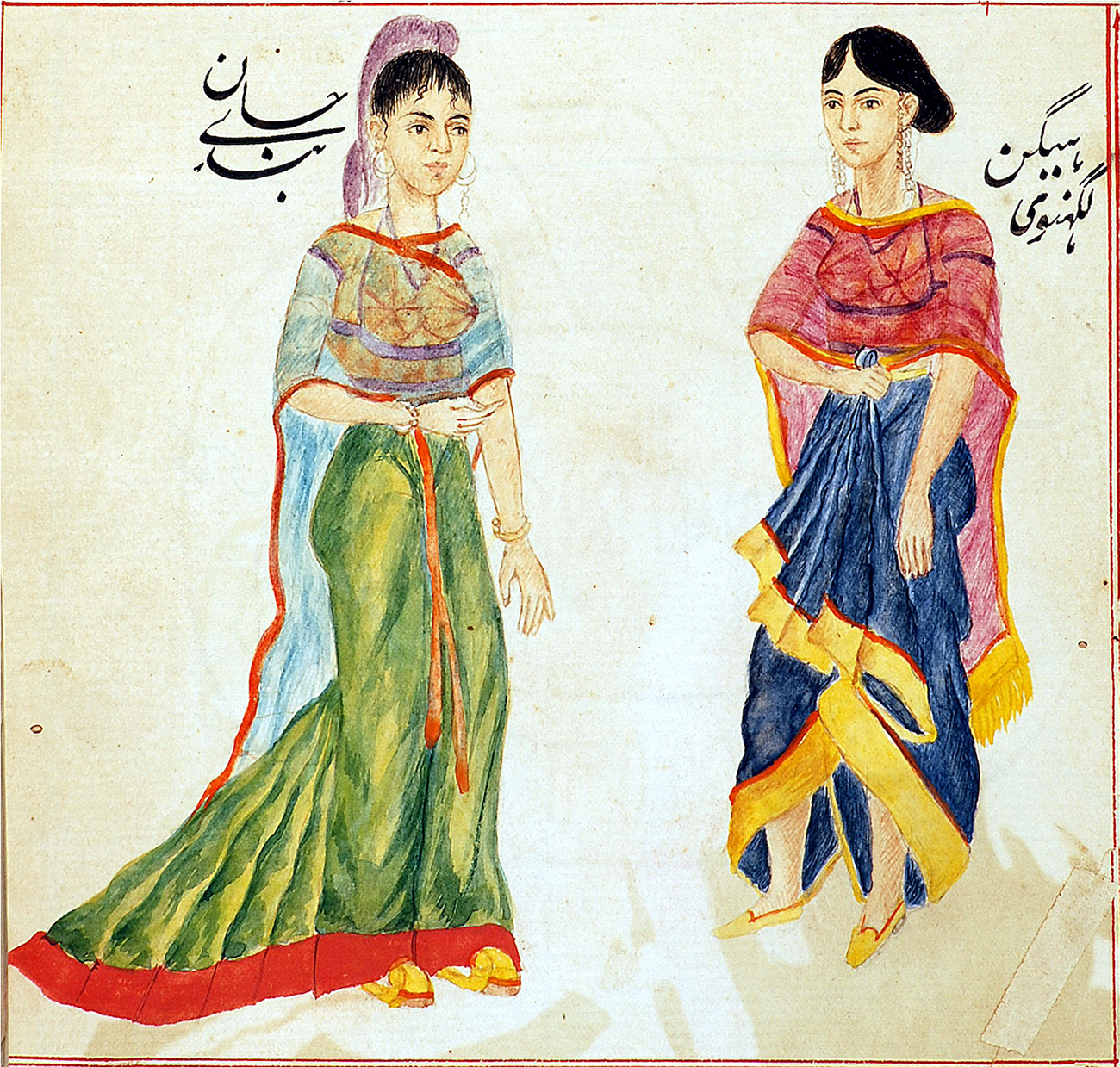
Figure 2 Long description
Two women are depicted standing side by side, each wearing traditional attire. The woman on the left is dressed in a long skirt and a blouse, with her hair styled up. The woman on the right is wearing a sari and has her hair tied back. Above each woman, there is text in a script. The background is plain, emphasizing the figures and their clothing.
Haingan’s young female body comes across here as sensuous and sexually attractive to the male gaze, her appearance as energetic and flirtatious. The couplets allude to the way in which the performer incited not just the sense of hearing and sight but also that of touch by arousing carnal desire. By contrast, her counterpart Bandi Jan seems to have been admired for her refined manners (tamīz), suggesting a capacity to arouse more than mere physical pleasure or a longing for intimate sensory experiences.Footnote 54
Female performers’ petitions to the court appear at regular intervals in the princely state’s records. Tawa’ifs would seek permission to enter the state in search of employment, ask for financial assistance in matters of urgency such as the passing of a close relative or head of the household, or submit complaints and claims concerning payments denied by a patron (e.g. in the form of jewels), inheritance disputes, and other such issues.Footnote 55 A particularly rich example is the following petition, written by the Lucknow-based tawa’if Haidar Jan in response to an offer from the Rampur court to perform at the nawab’s robe-of-honour ceremony (jashn-e khil‘at), along with several other female performers. Dated 7 October 1865, the letter is written in Persian on a paper dotted with rectangular gold plates. It reads:
Most Exalted and Elevated, may God prolong his dominion and sovereignty. His Excellency, the Shadow of the Divine, Vice-Regent of the Merciful; may God make his kingdom and authority everlasting. A petition, humbly submitted to be presented by those granted audience at the august court, refuge of the world: In accordance with the exalted decree of the world-illuminating sovereign, source of the sun’s radiance [i.e. the nawab], the esteemed servants, Musamma Fajja and Musammi ‘Ali Jan,Footnote 56 have arrived here in search of courtesan troupes (ţā’ifa bā ţawā’ifān) and other selected performers from the city of Lucknow, for the arrangement of the auspicious and blessed festivities of [Your Majesty’s] royal accession [to the throne]. Several troupes have entrusted this maidservant (kanīz)—herself belonging to the circle of the arbāb-e nishāţ (masters of pleasure) and well-versed in the arts of pleasure (ba funūn az bāb-e nishāţ), namely dance and music (raqş-o naghma-pardāzī), perfected to the highest degree—with the wish that they might lay the forehead of servitude and devotion before the gift of the spheres of heaven [i.e. the nawab] and display the brilliance of their skilled craft. However, since the sum of 200 rupees in wages (mawājib) for the above-mentioned lady is insufficient to cover the expenses of this maidservant, she remains in difficulty. Therefore, it is hoped that the maidservant’s request concerning an increase in salary (mushāhara) will be granted and a royal order issued accordingly. If this be so, this maidservant, present in the state of heavenly glorious dominion (dar daulat falak-shaukat), shall remain devoted and continuously engaged in prayers for the prosperity and fortune of Your Majesty’s realm. […] Petition submitted by the humble and devoted maidservant, Musamma Haidar Jan tawa’if, resident of the city of Lucknow.Footnote 57
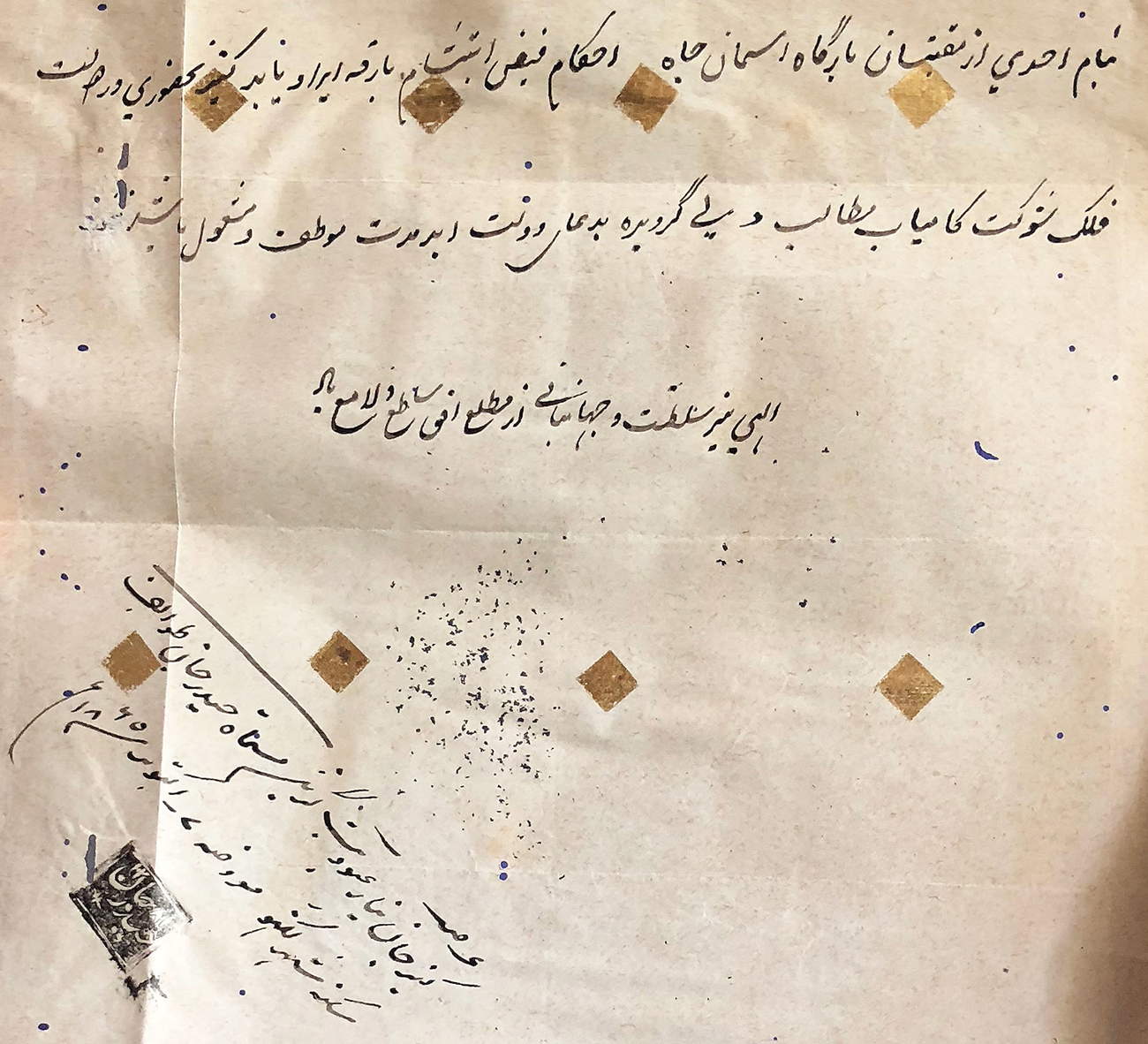
Haidar Jan was most likely a high-status courtesan with a permanent residence (or koṭhā) in Lucknow, writing to negotiate her salary directly with the Nawab of Rampur. By the nineteenth century, several tawa’ifs owned property in the city and derived income from it, reflecting their economic and cultural influence.Footnote 58 Acting as head of a household, Haidar Jan represented not only herself but also several ensembles of tawa’ifs invited to perform in Rampur by the nawab’s agents, Lady Fajja and ‘Ali Jan. Written just seven weeks after the above-cited letter by an anonymous servant of the nawab, it is possible that Lady Fajja was the same agent mentioned earlier. Interestingly, Haidar Jan addresses the nawab directly rather than negotiating further with the court’s envoy, who appears to have lacked the authority to approve salary increases. A seal bearing her name (see Figure 3) suggests that she regularly communicated via mail, likely with the aid of a professional scribe, underscoring her authority and established position within the elite patronage networks of the period.Footnote 59
Seal under tawa’if Haidar Jan’s petition to the Nawab of Rampur, 7 October 1865. Source: UPSRAA, Rampur State Records, Dar al-Insha Fort, Correspondence with Ruling Princes and Others, Nawab Kalb-e ‘Ali Khan, 1865, Bundle No. 64, File No. 265.
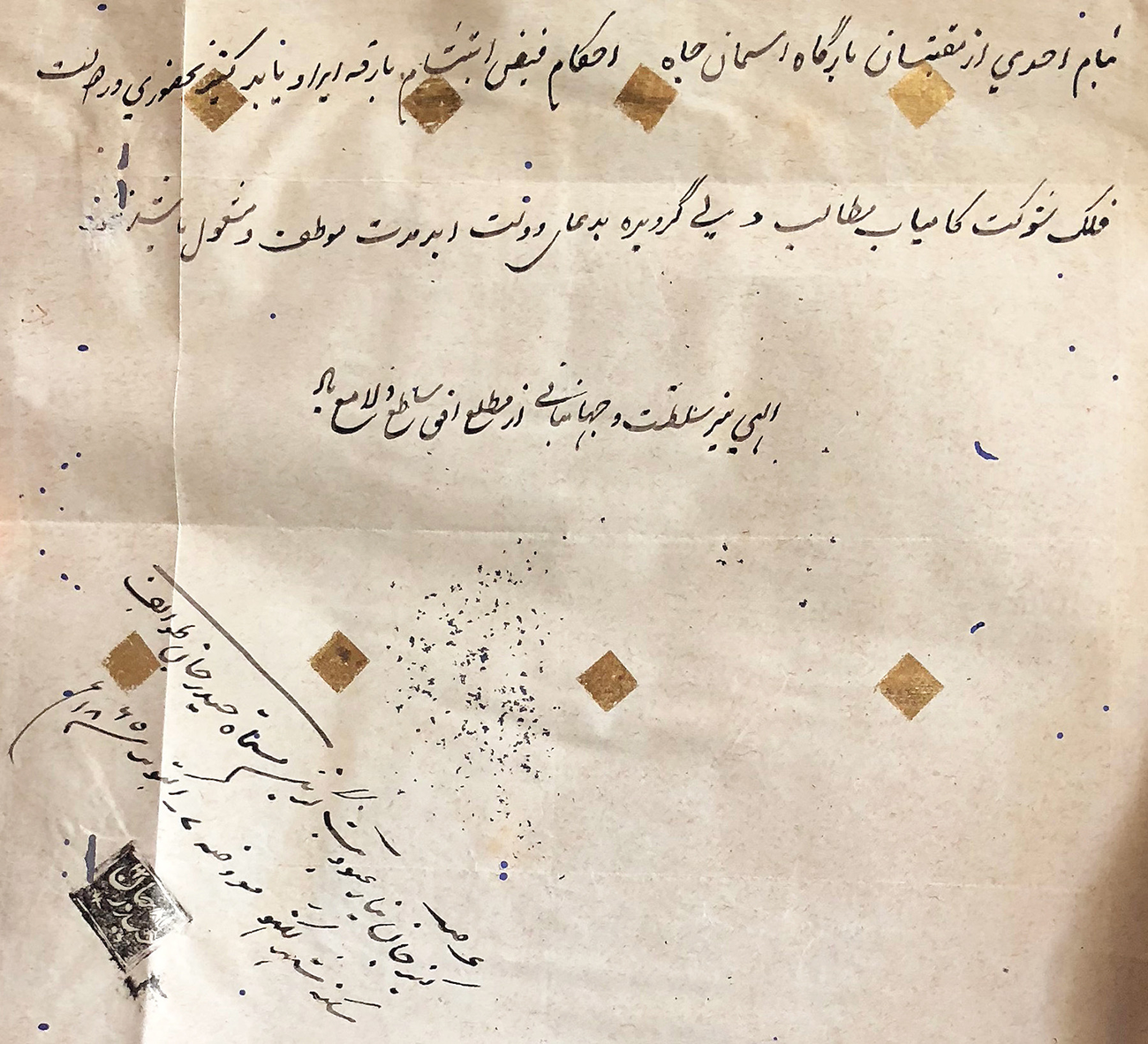
Figure 3 Long description
The document contains handwritten text in a script, arranged in several lines across the page. Decorative elements, including diamond shapes, are scattered throughout the document. In the lower left corner, there is a seal with intricate designs. The text appears formal and is likely part of an official or significant correspondence.
Based on the extant response, written on 12 October 1865 in Urdu, it is evident that the court took Haidar Jan’s petition seriously enough to raise the salary from 200 to 250 rupees:
To Haidar Jan tawa’if. The application you have written has come to our notice. Your pay (mushāhara) has been fixed at 250 rupees. Please accept this salary and come quickly. Besides the above-mentioned remuneration, all allowances (parvarish) including benefits (‘ināyāt) and gifts (in’ām) will be provided. […] Please prepare for the journey immediately, because the robe-of-honour ceremony (jashn-e khil‘at) is to be held in the month of November of this year. As there will be many courtesan groups (ţā’ifa), your participation is necessary. In this court (sarkār), one does not have to depend on remuneration alone. Rather, gifts and tips etc. (in’ām wa ghaira) are so generous that servants (mulāzimīn) can gain tremendous benefit (falāḥ) from them. Just imagine what that would mean for you…Footnote 60
Imploring the tawa’if to accept these conditions and to leave immediately so as to reach Rampur on time, the letter stresses how important it is that she participate in the festivities marking the nawab’s accession to the throne. Not entirely certain that she would accept the offer, the writer also deemed it expedient to remind her that the court always richly rewarded performers with gifts and tips.Footnote 61
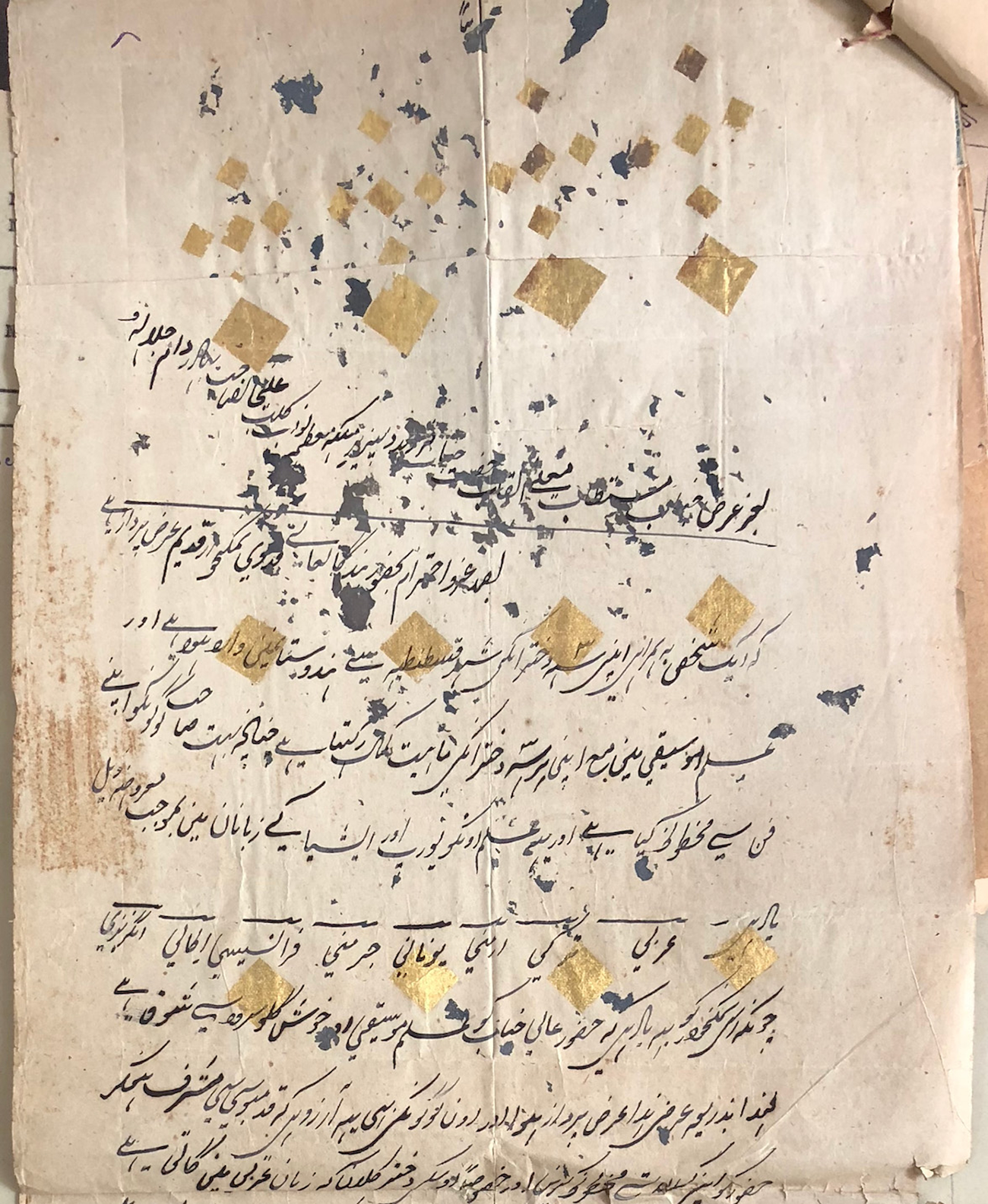
While some well-established female performers had the ability to negotiate their terms of employment via written petitions, most travelling musicians seeking engagements with the wealthy nobility in the region were dependent on middlemen. The following petition signed by the gemstone and curiosities dealer Alexander Malcolm Jacob (d. 1921) is a good example in this regard. It also provides unique evidence of female musicians from the Ottoman empire travelling and performing across the subcontinent in the nineteenth century (see Figure 4).Footnote 62
A petition by Alexander Malcom Jacob to the Nawab of Rampur, 16 November 1874. Source: UPSRAA, 1874, Bundle No. 99, File No. 455.
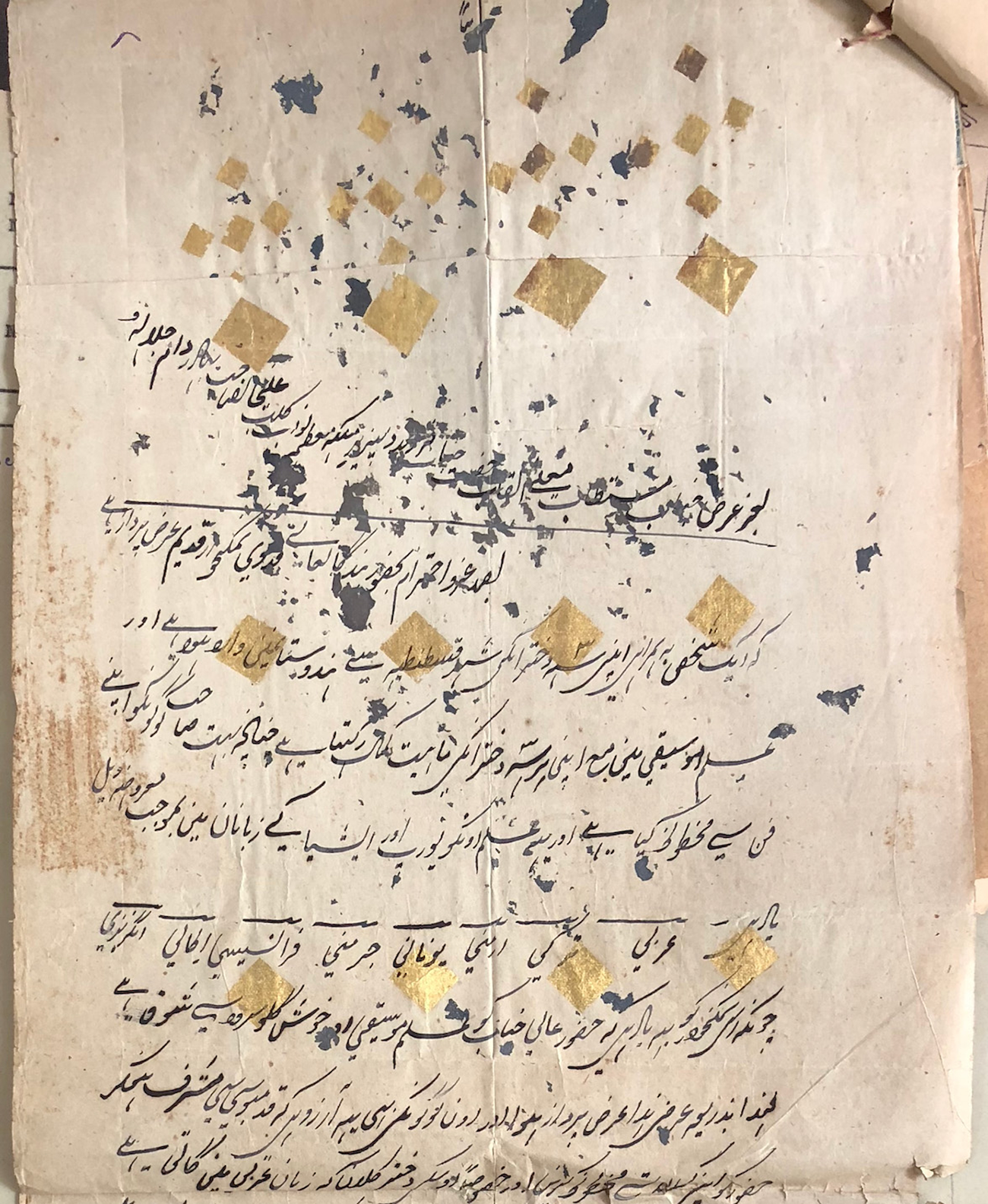
Figure 4 Long description
The document features handwritten text in a flowing script, with several decorative gold diamond shapes scattered across the page. The text is arranged in multiple lines, with some areas showing signs of wear and fading. The paper appears aged, with creases and slight discoloration. The decorative elements add an ornate touch to the document, suggesting it may have been of importance or ceremonial use.
Acting as their agent in 1874, Jacob invites Nawab Kalb-e ‘Ali Khan to engage a father and his three talented daughters from Constantinople:
With utmost respect, a request (‘arẕ) to His Exalted Highness […] Nawab Kalb-e ‘Ali Khan sahib Bahadur, the beloved son of the Great Queen (malika-ye mu‘az̧z̧ama) [i.e. Queen Victoria], may his glory endure forever. With utmost reverence and respect, this humble and long-standing servant [henceforth ‘I’], nourished by Your beneficence, submits the following petition: A man has recently arrived in Hindustan from the city of Constantinople, accompanied by his three daughters. Both he and each of his three daughters possess great mastery and accomplishment in the art of music (‘ilm-e mausīqī). They have, in fact, delighted many noble gentlemen with their skill (fann) and are learned in this art (‘ilm) in the following languages of Europe and Asia: Arabic, Turkish, Armenian, Greek, German, French, Italian, and English. Since I remember that Your Highness has a deep affection (shauq) for music and melodious singing, I humbly bring up this matter through this letter. They, too, have a keen desire to attain the honour of kissing the threshold [i.e. to be granted an audience] and to delight Your Exalted Self by presenting their accomplishments. Especially the eldest daughter (dukhtar-e kalāñ) sings in Arabic with such a sweet voice and perfection that if another like her were found in Egypt, it would indeed be a wonder; otherwise, she is without equal. It is therefore hoped that Your Majesty will graciously issue an order for their attendance [at court]. […] Should it not be Your wish to summon them, I still hope to be honoured with an instruction so that they do not wait in vain but may instead go on to another city in search of livelihood. With the utmost courtesy and respect. May God keep the son of the state and its glory forever shining. Submitted by Your humble servant, M. Jacob ‘Rumi’, 16 November 1874, from Delhi, signed in English.Footnote 63
Jacob’s petition shows us that musicians from the Ottoman empire, and especially good Arabic singers, were rare to come by in British India. With their unique background and impressive multilingual repertoire—one might even say ‘exotic’ in the sense that it did not include Indian vernaculars—the sisters can certainly be regarded as a ‘curiosity’ worth Jacob’s time. He clearly believed that they would appeal to the nawab, knowing that he was not only literate in Arabic but also emphasised his connection to the language of the Qur’an as a marker of his piety and Muslim identity.Footnote 64
But, perhaps in view of prominent ‘Eurasian’ singers born and raised on the subcontinent such as Malka Jan and her famous daughter Gauhar Jan (d. 1930), this proposal was apparently not attractive enough. After all, Gauhar Jan (who eventually became one of India’s first gramophone celebrities), was also known to be able to sing in a variety of languages, including Bengali, Urdu, Gujarati, Tamil, Marathi, Persian, and English. In the end, the nawab politely declined Jacob’s offer.Footnote 65
Increased mobility, new artistic trends, and emerging public spheres
Successful tawa’ifs could be relatively wealthy and vulnerable at the same time, part of which had to do with the mobile nature of their trade. ‘As itinerant professionals carrying plentiful jewels and cash’, Schofield writes, ‘they were clearly at risk of attack even when they travelled together in large troupes.’Footnote 66 Indeed, we find several reports of tawa’ifs being ambushed, robbed, kidnapped, or murdered while on the road during the colonial period.Footnote 67 Even marriage processions (bārāt) were occasionally looted.Footnote 68 And in other instances, royal patrons made sure to send out instructions to the gatekeepers of their forts and palaces to let the performers in without any hassle upon arrival.Footnote 69
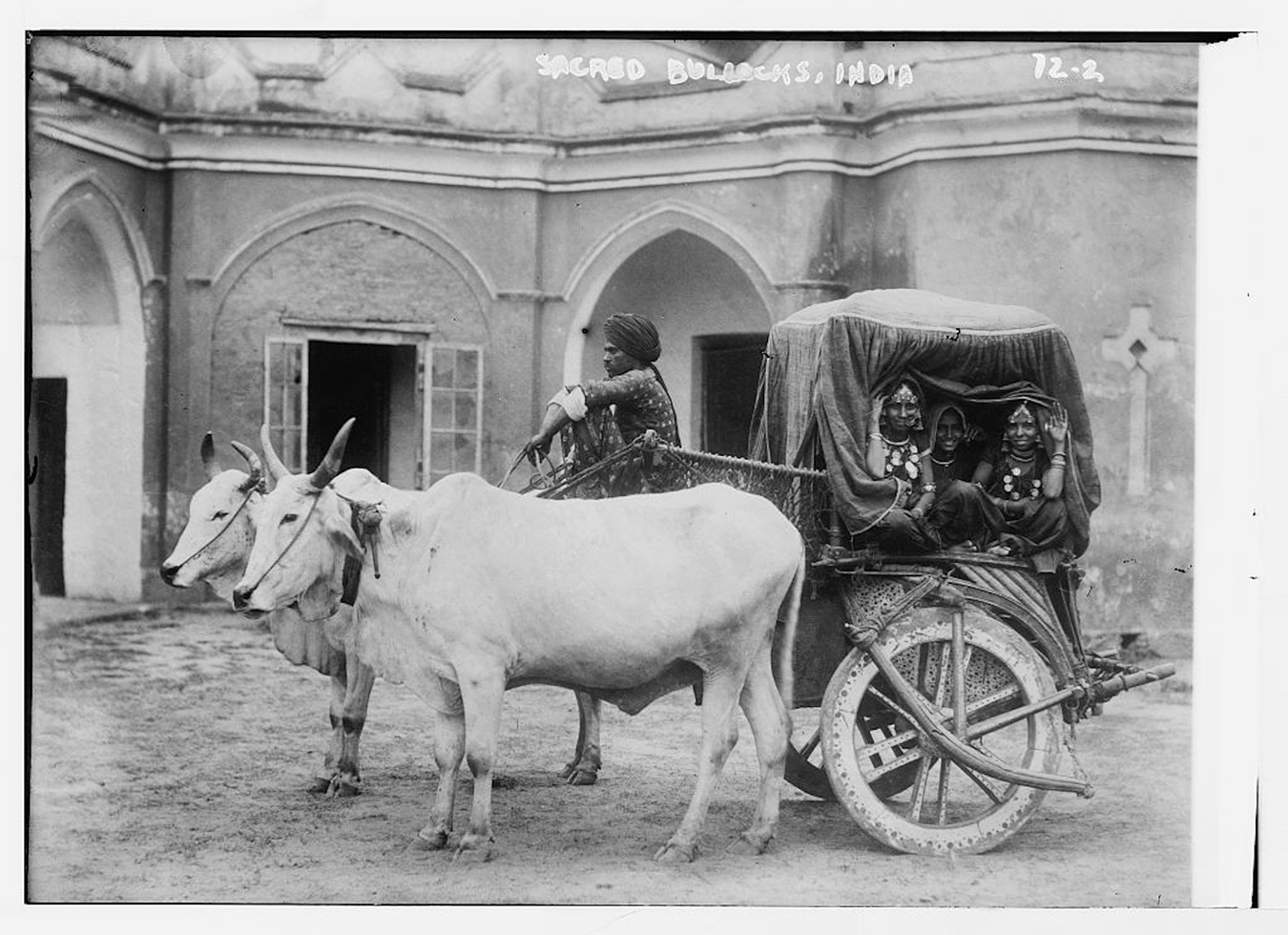
In any case, the evidence cited above alludes to the fact that female performers active in the second half of the nineteenth century often had to undertake long, arduous, and time-consuming journeys to reach their patrons. A typical means of transportation for female performers and their accompanists since the Mughal era was the ox-drawn cart (bahal), even as the railway network expanded (see Figure 5). Though around 200 miles south-east of Rampur and no longer a city with a functioning court, post-1857 Lucknow nevertheless not only seems to have retained some of its reputation as a centre of cultural refinement but also remained an important recruitment ground for tawa’ifs catering to the needs of wealthy landed elites in the region.Footnote 70
‘Nautch girls’ travelling by bullock cart, circa 1922. Source: George Grantham Bain Collection, Library of Congress, LC-DIG-ggbain-00377.
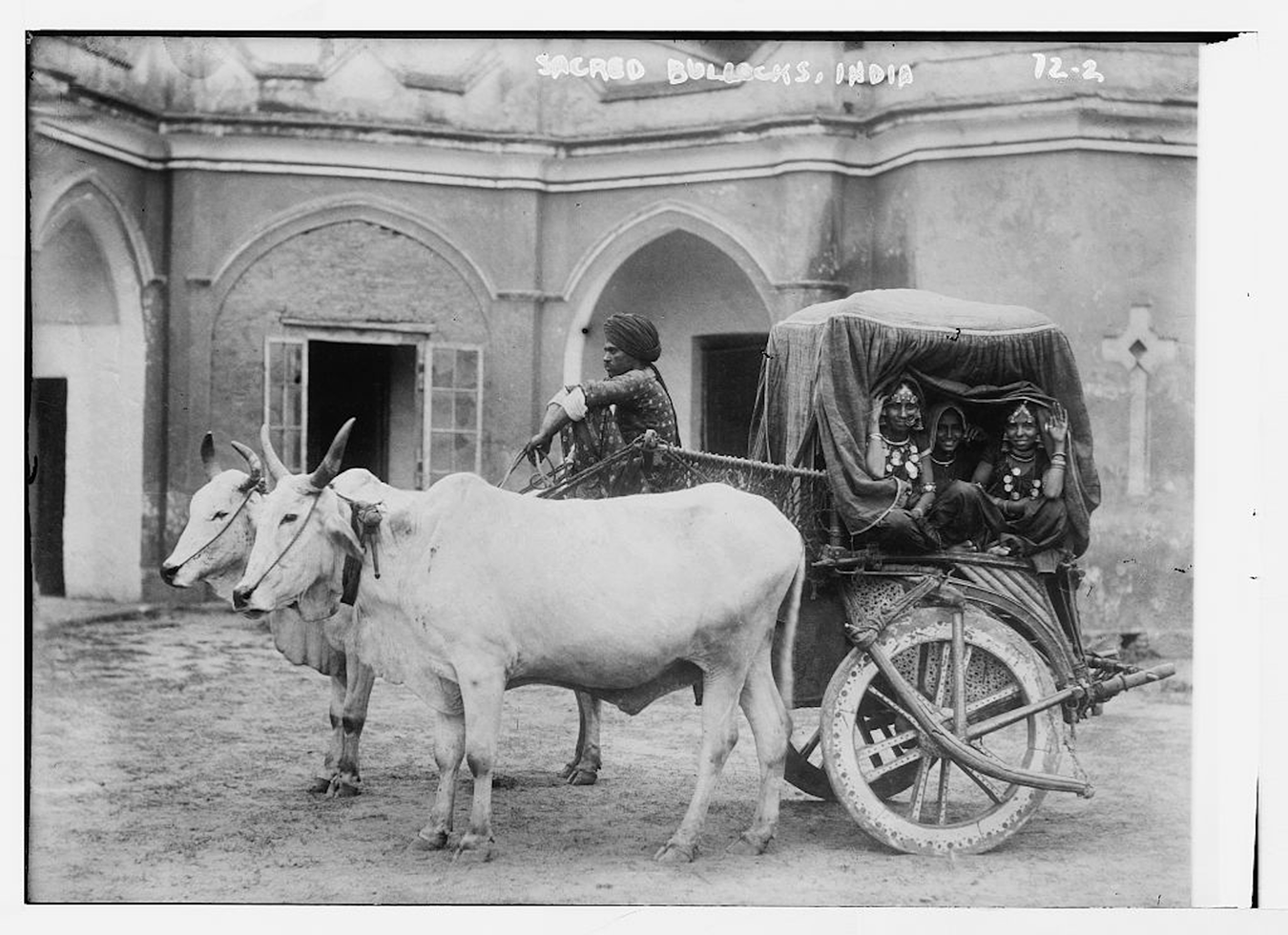
Figure 5 Long description
Three women are seated inside a covered bullock cart, positioned outside a building with arched doorways. The cart is drawn by two oxen standing side by side. One woman is visible at the front of the cart, holding the reins, while the other two women are seated inside the cart. The building in the background features arched doorways and a textured exterior wall.
Towards the end of the nineteenth century, transformations in the musical, technological, and infrastructural landscape across the subcontinent had an increasing impact on the labour market for travelling female performers. This was an era marked by the growth of Indian nationalism and anti-colonial mass movements, which were amplified by the introduction of new sound recording and transmission media, as well as the proliferation of brass and military bands and the employment of European bandmasters in Indian princely states. Moreover, the increasing mobility of Rampur’s elites during this time, coupled with a massive influx of new kinds of commodities and ideas from industrialised countries, had considerable effects on the patronage and practice of music.
While itinerant tawa’ifs continued to find patronage in Rampur during the reign of the princely state’s second-last ruler, Nawab Hamid ‘Ali Khan (r. 1889–1930), these changes and modernisation efforts also impacted their social standing and relevance in the princely state. Like his predecessors, Hamid ‘Ali Khan remained loyal to the British Crown while offering generous support for Muslim cultural institutions and educational modernisation projects across the country, such as the campaign for a Muslim university at Aligarh.Footnote 71 Being the first ruler of his state to visit Europe and North America, he revamped fairs like the Jashn-e benaz̧īr with the aim to promote the princely state as a site in which Rampur’s Indo-Islamic heritage would merge with and contribute to industrial modernity. This involved an emphasis on important innovations and new trends in the performing arts, including guest appearances by the increasingly popular Parsi theatre groups.Footnote 72
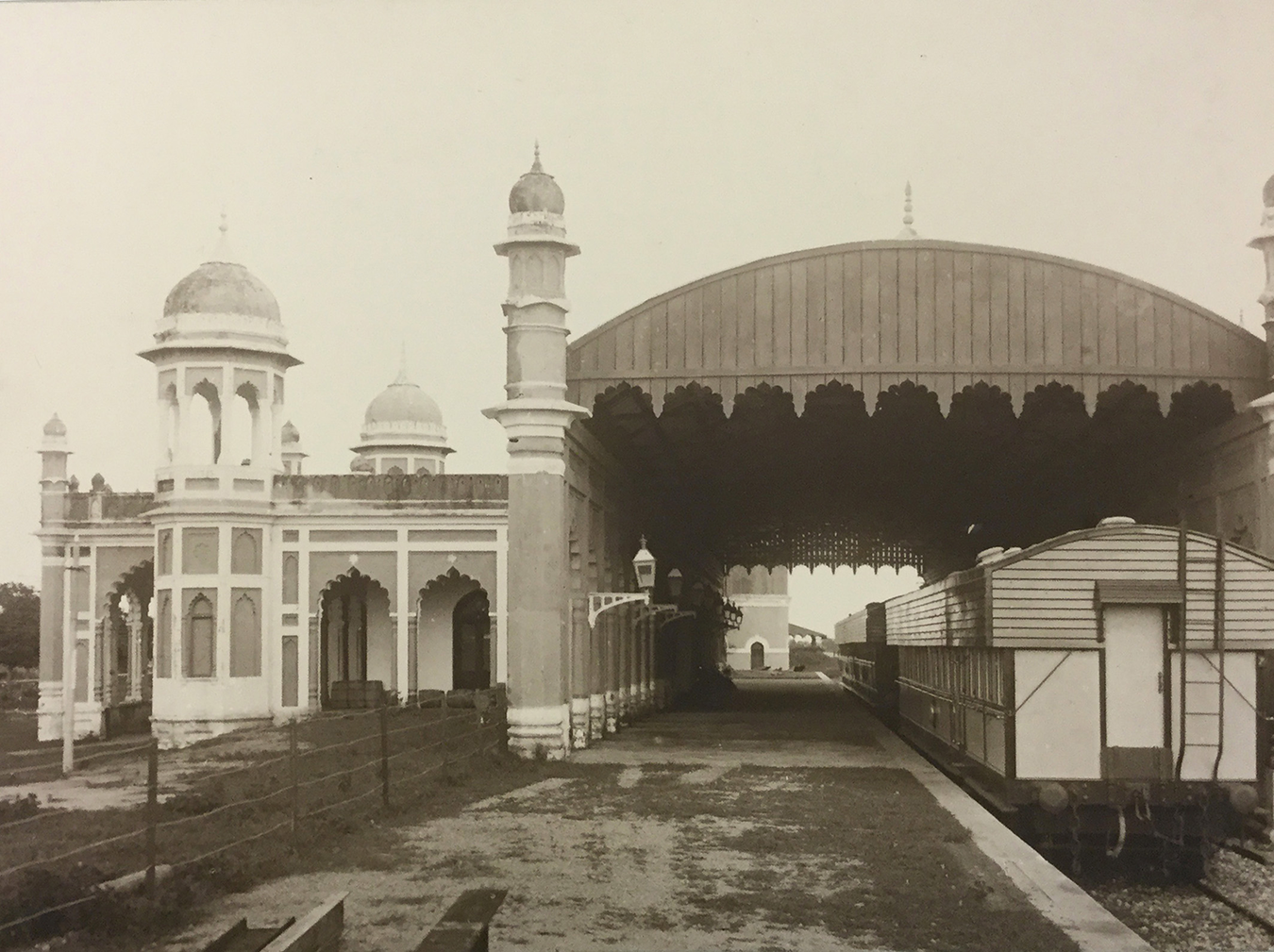
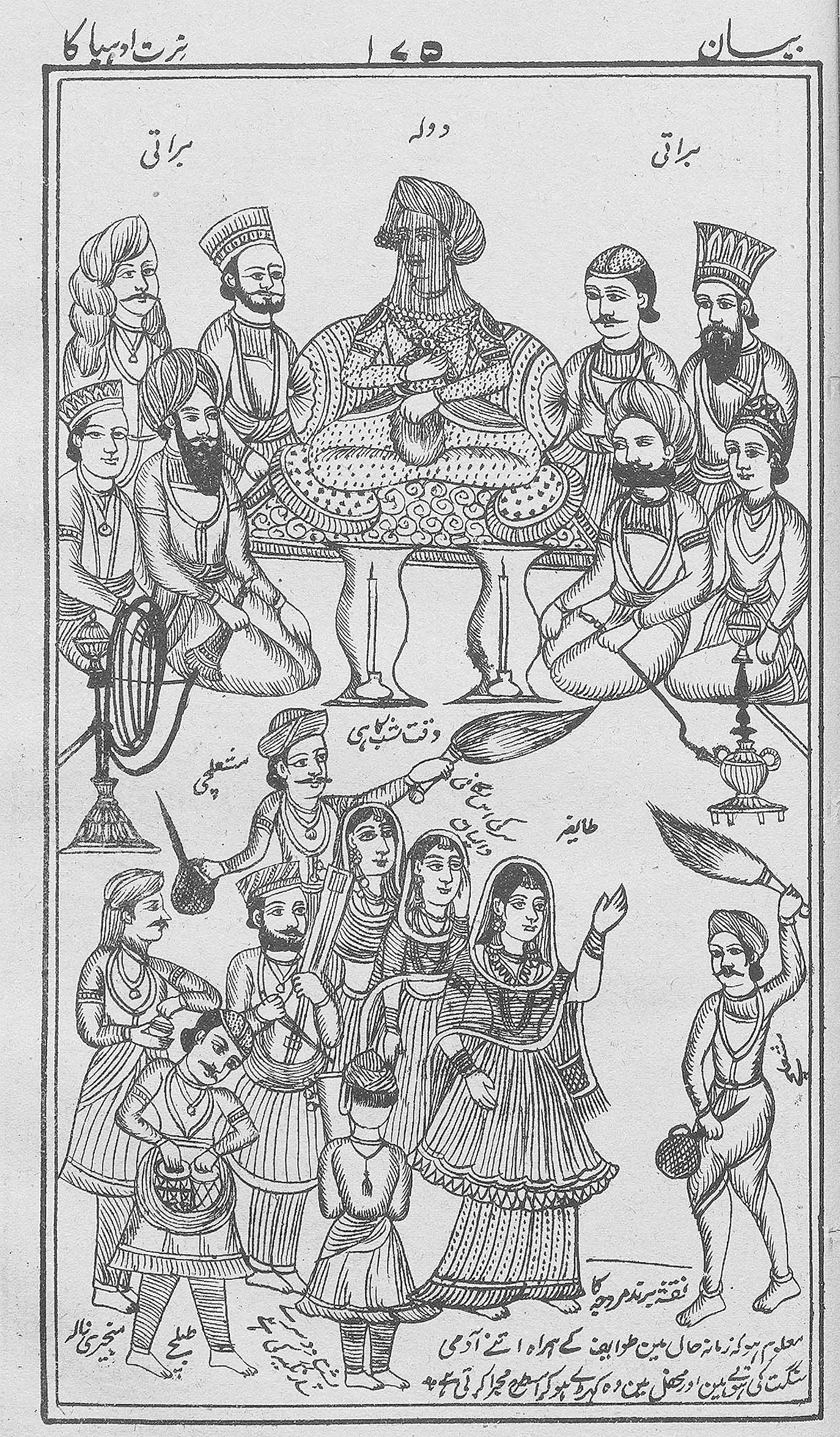
In February 1894, shortly before Rampur was connected to the railway line (see Figure 6), the young nawab celebrated his marriage (jashn-e ‘arūsī) to Sultanat Ara Begum (d. 1925), daughter of the Nawab of Jaora. What role both court musicians and travelling female performers played in such festivities can be gleaned from the published descriptions of the event by the Rampur state employee Muhammad Firoz Shah Khan ‘Firoz’. Narrating how musicians and dancers crowded in front of the groom (comparable to the illustration in Figure 7), Firoz highlights the flash-of-lightning-like dance of the Lucknow tawa’if Bi Jiddan, the tinkling of ‘dancing girl’ Bi Haidar chune wali’s ankle-bells (‘chūne wālī’ denoting her characteristic white make-up), and the ever-present sounds of tabla strokes. Illustrating how the singing and dancing reached a colourful and ecstatic climax, he also lists the musical genres performed on the occasion (including ṭappa, ṭhumrī, tirvaṭ, tarāna, dhrupad, and khayāl), suggesting an eclectic mix of Hindustani music and dance.Footnote 73
Nawab Railway Station, Rampur, circa 1911. Source: The British Library Collection, photo 36/(47).
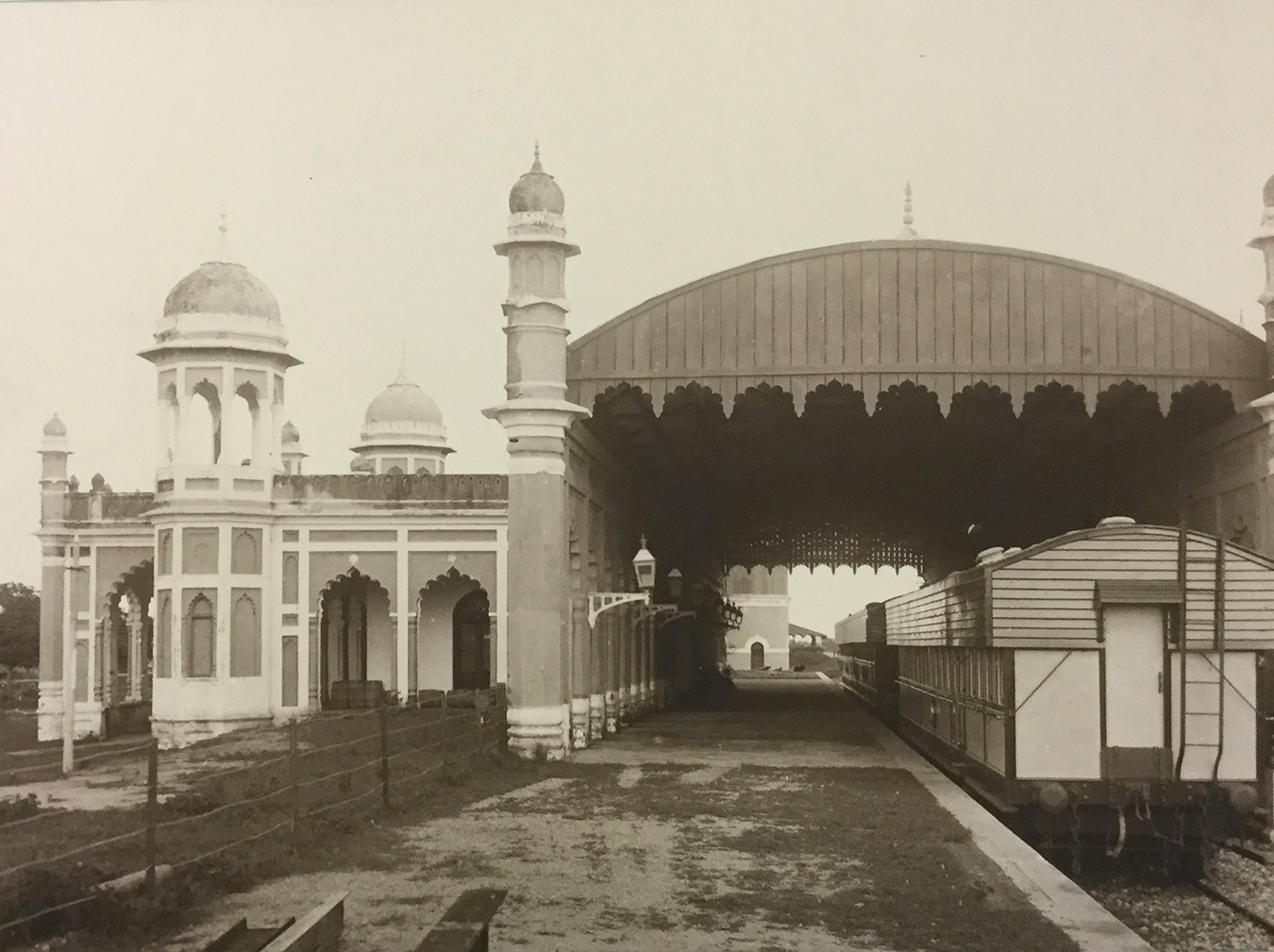
Figure 6 Long description
The image shows a railway station with a large arched roof covering the platform. Adjacent to the platform is a building with architectural features including domes and arches. A train with multiple carriages is positioned on the tracks next to the platform. The area appears to be well-maintained, with visible tracks and a paved platform. The station's design reflects a blend of traditional and colonial architectural styles.
A bridegroom (seated) and wedding guests watching the performance of a tawa’if ensemble. Source: S. ‘A. Khān, Sarmāya-ye ‘ishrat ma‘rūf Qānūn-e mausīqī [A treasury of pleasure, known as the Law of Music] (Delhi, 1875), p. 175.
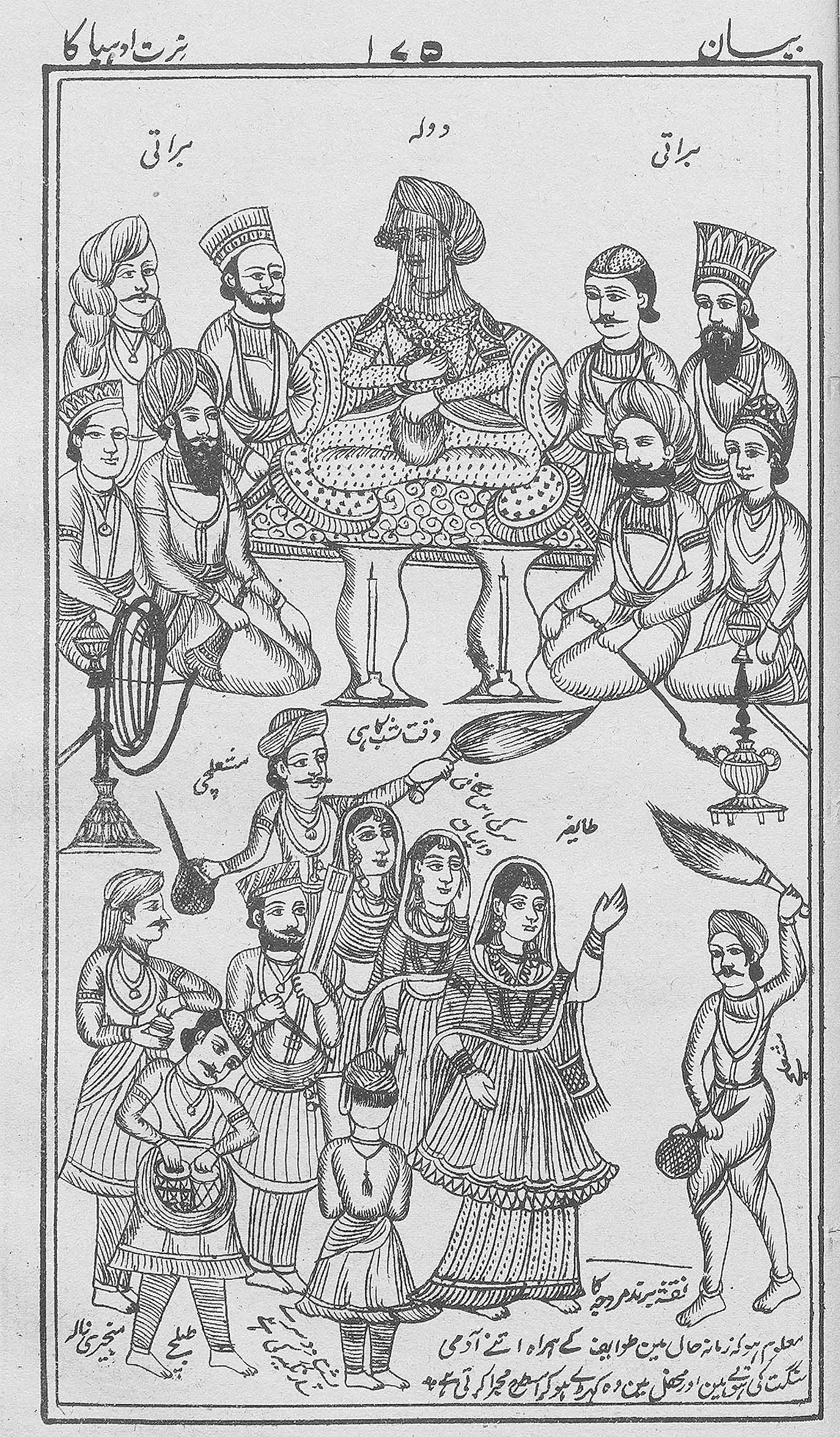
Figure 7 Long description
The illustration depicts a bridegroom seated at a table surrounded by wedding guests. There are six men seated around the table, each wearing traditional attire. Below them, a group of performers, including musicians and dancers, are shown. The dancers are dressed in elaborate costumes and several musical instruments are visible, such as drums and string instruments. The performers are actively engaged in their performance, with one dancer gesturing towards the audience. The scene is framed with decorative elements and text in a script at the top and bottom.
Firoz’s account indicates that the nawab’s week-long wedding celebrations much resembled the entertainments at the yearly Jashn-e benaz̧īr, with dance performances (maḩfil-e raqş) in the evenings and military demonstrations, games, or wrestling competitions during the day. In addition to the salaried musicians of Rampur’s music department (arbāb-e nishāţ), many mobile tawa’ifs were hired from places as remote as Calcutta, Bombay, Lucknow, Benares, Agra, Jaipur, Nainital, Kanpur, Bareilly, Moradabad, and Kashipur, to make sure that there would at least be four to five unique performers every night. And in between, the new state-owned military brass band played marches and anthems.Footnote 74
But the distinctly modern and mobile character of the event is perhaps most evident in the fact that the marriage party took a train from Moradabad to Agra for the bārāt (i.e. the groom’s wedding procession to the bride’s house), where they were welcomed with a dance performance by members of the arbāb-e nishāţ in a tent set up for breakfast next to the railway platform. Travelling on via Ajmer, the bārāt arrived in Jaora, where domnis (female musicians generally performing in seclusion for women) sang ferociously in the palaces, while groups of lower-status courtesans (ranḍīyoñ ke ţā’ife) danced outside in the streets, contributing to a festive atmosphere in the entire city. Cheerful singing, dancing, and ‘permissible magic’ (siḩl-e ḩalāl), we are told, set the tone of the festivities. Ensuing the nikāḩ ceremony presided over by a qāẕī (judge of a shari‘a court), court musicians intoned a congratulatory song, followed by a military band and another raga-based music session in the evening. Once the joyous bārāt set off for the return journey, fanfares blared at every halt. Three days later, upon arrival in Moradabad, a colourful group of elephants, horses, and camels brought the party home from the station to the streets of Rampur, where crowds eagerly awaited the procession.Footnote 75
Both the actual celebrations of Hamid ‘Ali Khan’s marriage and the publication of this officially sanctioned description of its sights and sounds along the journey certainly had the intention to promote a positive image of the nawab as a generous ruler and Rampur as a ‘modern’ and magnificent ‘house of pleasure’ (dār-us surūr).Footnote 76 It is significant to remember the reconceptualisation and modernisation of public fairs and exhibitions in this context.Footnote 77 In the case of Rampur’s revamped Jashn-e benaz̧īr, the main objective was to put the state’s industries and crafts (especially handicrafts, trade, and agriculture) on a path of ‘progress’ (taraqqī). In 1894, the old festival was therefore suspended, and the foundations of a new kind of fair (numā’ish) were laid, intended to feature elements believed to have the potential to benefit the entire country (mulk) and nation (qaum). Entertainments (tafrīḥ-e ţab‘) and sports spectacles (khel tamāshoñ), while no longer of central importance, nevertheless retained their function to attract and amuse visitors.Footnote 78
Prominent among the new cultural trends introduced at the fair were daily performances by the New Alfred Theatre Company (est. 1891 in Bombay). The increasing presence of travelling Parsi theatrical companies across northern India (including the princely states) had a lasting impact on the labour market for mobile performing women.Footnote 79 Except for its managers, most actors and musicians of the company hailed from Gujarat and the United Provinces, and its popularity across northern India was ‘aided by the fact that Urdu had become the prevailing language of the Parsi stage’.Footnote 80 During the Rampur fair, the company’s performances—their stories, colourful costumes, songs, and dances—seem to have been a particular highlight among visitors.Footnote 81
Interestingly, the rise of Parsi theatrical companies went hand in hand with an increase in the levels of public stigma attached to travelling female performers. An article in the short-lived Urdu Music Gazette of India (1910–1911), edited by the harmonium teacher Sutikshan Ray Qamar Dehlvi, straight-out characterised tawa’ifs employed as actresses in travelling theatre groups as immoral and untrustworthy seductresses, explicitly cautioning young men about the perils of becoming infatuated with them and the subtle ways in which they could manipulate the senses:
These days, theatrical companies employ the finest tawa’ifs for a rudimentary salary and teach them how to act. They then progress very quickly and become known as the soul (jān) of the company. And each year, they are at the forefront of ruining not just thousands of romantic lovers but also lots of simple students. The voice of a woman is pleasant and more impactful than that of a man. Its apparent innocence and delicacy have a tremendous effect. It is, of course, a simple matter for the theatre people to transform the appearance of a dark or an ugly face […]. Glittering clothes and artificial jewellery considerably enhance their [destructive] beauty (ḩusn) to the effect that moving about on the stage with licentious coquettishness becomes calamitous. In such a situation, it is understandable if someone becomes agitated and cannot restrain himself. I have seen lots of right-minded men become instantly besotted and ruined by the ladies of the theatre. It is difficult to find any actresses with virtuous qualities, and if not, all of them are immoral (bad-akhlāq), greedy (ţāmi’a), ugly (bad-şūrat), and afflicted with some disease or the other. It should always be remembered that the inward and hidden nature (bāţin aur poshīda ḍhang) of an actress is as detestable as her outward style (z̧āhirā aḍhang) is stunningly beautiful (ghaẕab). Parsi company people are mostly very cautious and don’t let actresses become spoiled, but that is not necessarily so. And no actress can be considered trustworthy unless we make sure of it [as follows]: (1) A beautiful face is a deception of the highest order. Look at any actress’s face in the morning and by daylight! (2) Even if they appear to be sixteen years old while acting in the theatre, their age is often deceptive [i.e. they can be much older]! (3) Has she been in theatre since childhood, or has she taken up this work during her youth? If she has been in the theatre since childhood, then she is really an actress, and it is useless to show any kind of love for her because the owner of the company would never allow it. However, if she entered the company during her adolescence, then she will most likely be an ordinary tawa’if. These are commonly a sheer waste of time and expressing love to them is like putting oneself in a burning fire. After considering these issues, I have realised that you should never be careless enough to fall in love with an actress. Do not look only at their bright side. Rather, let not their dark side remain hidden from view, which seems to us to burn more fiercely than the fire of Hell.Footnote 82
Emphasising sonic and visual aspects, especially those that can be deliberately concealed or artificially enhanced, the author warns the male readers (and main clients) of travelling Parsi theatre companies to stay away and shield their hearts from the deceitful allure of actresses. Such derogatory and discriminatory portrayals of actresses and tawa’ifs who switched into this line of work out of economic necessity was relatively widespread in British India, especially since the ‘anti-nautch’ campaign had gained momentum in the 1890s.Footnote 83
Operating in a male-dominated world and at a time when the words ţawā’if and ‘actress’ came to be associated with immorality and prostitution, Parsi theatrical company owners were apprehensive about employing female performers as actors. At the same time, their status as ‘public women’ suggested that the profession of the performing artist was not suitable for respectable women.Footnote 84 As Hansen has argued, ‘a new social conservatism emerged in companies such as the New Alfred, marked by stern adherence to traditional gender norms’.Footnote 85 Reflective of the increasing stigmatisation of tawa’ifs, the New Alfred at some point even prohibited actresses from appearing on stage. Nevertheless, the allure of female performers remained an integral component of theatrical performances, which the company navigated creatively by relying on artistic female impersonations and cross-dressing. At least some tawa’ifs who made it onto theatre stages (and later into the film business)Footnote 86 as actresses succeeded in becoming new celebrities of a growing commercial entertainment industry.Footnote 87
While several articles in the Music Gazette painted tawa’ifs in a negative light, the paper paradoxically also featured favourable pieces that defended the rights of tawa’ifs, so much so that several readers began calling it a ‘prostitute’s newspaper’.Footnote 88 In light of the number of journalists already subscribing to the view that tawa’ifs and the performance culture they embodied required reform, this is important to note.Footnote 89 For example, while several newspapers complained on moral grounds about the performances of tawa’ifs and gramophone celebrities at the 1911 Allahabad Exhibition, the Music Gazette of India enthusiastically announced that the famous ‘dancer’ (raqqāşa) Gauhar Jan was coming to the exhibition from Calcutta.Footnote 90 Addressing his critics, editor Qamar Dehlvi felt that any music lover ought to be excited about this unique opportunity to see and hear her sing and dance, stating:
Their objection [to Gauhar’s Jan’s performance] is valid from one point of view, but we ask our esteemed social reformer why he is so angry with Miss Gauhar Jan and why he left out the real purpose of the exhibition (numā‘ish)? Gauhar Jan is one of India’s universally accepted and most famous dancers. Other experts have been invited to the exhibition to demonstrate their accomplishments. Why, then, should Gauhar Jan, who is a tawa’if unmatched in her craft, not be invited to the exhibition and appreciated as well? The exhibition is neither a church nor a temple of the [Hindu reformist] Arya Samaj or a Muslim mosque but a theatre in which every religion (maz̄hab) and every community (qaum) should be able to display anything that is original. For the first time, at the exhibition in Lahore, a few like-minded individuals prevented assemblies of tawa’ifs for dancing and delight, leaving the event noticeably duller. […] Didn’t Shivaji and Parvati-shri or Krishna and Radha use to dance? Then why do you now think that dancing is bad? […] As for a tawa’if, dancing is her profession. We, too, say, don’t go to a tawa’if [and become her lover]! But watching a tawa’if’s dance and listening to the best raginis can never be wrong!Footnote 91
Qamar Dehlvi not only defends Gauhar Jan as a highly skilled tawa’if and nationally recognised celebrity performer, he also makes a more general case for allowing dancing women to perform on stage at colonial industrial fairs on the national level. Citing both Hindu gods and goddesses renowned as dancers, as well as social reformers who themselves could not resist the pleasurable effects of sound and rhythm on their senses, he upholds the practice of dancing as entirely natural and the exhibition as an inclusive public space.Footnote 92 Seeing in her one of the country’s best and most respectable musician-dancers, the secular-minded editor similarly expressed the hope that Gauhar Jan be invited to the Delhi Durbar of 1911, which scholars have rightly called a ‘sonic spectacle of Empire’.Footnote 93
Some tawa’ifs were certainly able to redefine themselves as early recording artists and even film actresses, yet most ‘hereditary female performers of dance were legislated and shamed out of existence’, while ‘hereditary male performers, the Kathaks, were taking their place on the stage’.Footnote 94 In sum, careful examination of turn-of-the-century Urdu print sources shows us that at least a few voices stood in solidarity with the increasingly marginalised female Muslim performers of North India, even if constrained by the observance of certain proprieties and the need for male patrons to keep their senses, hearts, and bodies in check.Footnote 95
Conclusion
From the Uprising of 1857 to the years leading up to the First World War, performers at festivals and fairs in the region under consideration in this article cut across diverse socio-occupational categories, from hereditary kalāwants and qawwāls to elegy (mars̄īya) singers, storytellers (dāstān-gos), jesters, and both transgender and female entertainers ranging from the elite singer to the dancing sex worker and bonded labourer. While evidence suggests that the performing arts continued to flourish within the ‘paracolonial’ space of the princely state, this vitality coexisted with broader processes of marginalisation and transformation under colonial influence—especially as voices calling for the need to ‘reform’ and ‘classicise’ Hindustani music and dance grew louder across the subcontinent. Increasingly stigmatised as an ‘immoral’ public woman or ‘prostitute’, it was particularly the figure of the Muslim tawa’if that fell victim to the pressures of nationalist reform movements dominated by Hindu upper-caste men. In consequence, and especially once princely patronage completely ceased to exist after 1947, their struggles and the occupational diversity, artistic expertise, and cultural capital they embodied were eventually forgotten or pushed into the realm of fictionalised nostalgia.Footnote 96
The primary materials discussed in this article, especially the handwritten exchanges between performers, middlemen, and elite patrons, enable us to recover some of the frequently occluded nuances of this bygone era. They illuminate that only a few high-ranking tawa’ifs were able to negotiate their terms of employment directly with aristocratic employers, whereas the majority were selected and recruited via intermediaries—sometimes senior courtesans—operating within the regional labour market for itinerant female performers. While these findings suggest that post-1857 Lucknow remained an important, if somewhat depleted, centre for the acquisition of mobile courtesans, they also indicate how a growing influx of bodies, ideas, and consumer goods from abroad impacted performance practices, gender norms, and moral codes of conduct—both within and beyond the borders of the princely state.Footnote 97
Much remains to be done, particularly through comparative, regionally grounded studies across princely states, to fully recover the complex historical, social, and artistic dimensions of tawa’ifs’ lives and labour. As I have illustrated, even popular recording artists of the early twentieth century like Gauhar Jan remained dependent on male intermediaries and negotiators, and they could not perform live on stage without facing critical backlash in the press. In view of the widespread stigmatisation of female artists in public discourse as ‘fallen women’ or ‘prostitute-courtesans’ representing ideas of ‘deviant female sexuality’,Footnote 98 only few media outlets chose to speak on behalf of tawa’ifs and in defence of their rights.
I would argue that the period under consideration in this article might best be understood as a time of transition, shaped by a range of distinctly modern forces: the criminalisation of sex workers; the expansion of the railway network; the growing popularity of agricultural and industrial exhibitions; emerging nostalgia for pre-colonial cultural expressions; the rise of vernacular print publics; social reform and nationalist movements promoting middle-class values; the proliferation of Parsi theatre companies; and new technologies such as the gramophone, radio, and film. Together, these developments significantly altered the working conditions, recognition, and social acceptance of travelling female performers.Footnote 99
Princely state elites continued to see value in highly skilled tawa’ifs and the multisensory experiences they embodied well into the late nineteenth century, for as long as these performers reinforced their identity as aristocratic patrons and connoisseurs of the arts. Across the subcontinent, however, tawa’ifs increasingly faced discrimination and stigma, while also having to compete with new artistic and aesthetic trends. Although mobility had long been a part of performing women’s lives, travel became an economic necessity amid growing marginalisation and the conflation of courtesans with prostitution. The readiness to adapt to these socio-cultural shifts, ideally coupled with the capacity to modify one’s occupational identity and status, thus emerged as a key criterion for survival in the national entertainment culture that gradually developed across northern India during the early twentieth century.
Acknowledgements
I thank the two anonymous reviewers for their helpful comments and suggestions. I am also grateful to Jennifer Howes, Radha Kapuria, and Shweta Sachdeva Jha for inviting me to present this research at the panel The Travelling Female Performer: Mobility and Agency in and Beyond South Asia, c. 1760–1940 at the European Conference on South Asian Studies (ECSAS) in Turin in July 2023, and for including my article in the resulting special issue.
Conflicts of interest
None.

 Open access

