



1 INTRODUCTION
The Colour-Magnitude Relation (CMR; Visvanathan & Sandage Reference Visvanathan and Sandage1977; Bower, Lucey, & Ellis Reference Bower, Lucey and Ellis1992; also known as the red sequence) describes the tight (with a scatter typically less than 0.1 mag at optical wavelengths) and Universal correlation between (mainly) early-type cluster galaxies on the colour-magnitude plane. The CMR has been found to be primarily caused by a metallicity effect (Kodama & Arimoto Reference Kodama and Arimoto1997), although this was later refined by Terlevich et al. (Reference Terlevich, Kuntschner, Bower, Caldwell and Sharples1999) who modelled the CMR as a metallicity caused relation with fluctuations caused through age variations (see also Worthey Reference Worthey1994; Kodama, Bower, & Bell Reference Kodama, Bower and Bell1999).
Many recent studies have revealed that the CMR is not a homogenous population. Although the brighter galaxies might be mostly morphologically elliptical or S0 (lenticular), there exist a significant population of comparatively red late-type galaxies within the CMR (e.g. Masters et al. Reference Masters2010a; Wolf et al. Reference Wolf2009; Lee, Bell, & Somerville Reference Lee, Bell and Somerville2008; Goto et al. Reference Goto, Yamauchi, Fujita, Okamura, Sekiguchi, Smail, Bernardi and Gomez2003; Poggianti et al. Reference Poggianti, Smail, Dressler, Couch, Barger, Butcher, Ellis and Oemler1999; see also Cortese & Hughes 2009; Mahajan & Raychaudhury Reference Mahajan and Raychaudhury2009; Masters et al. Reference Masters2010b; Deng, Chen, & Jiang Reference Deng, Chen and Jiang2011; Crossett et al. Reference Crossett, Pimbblet, Stott and Jones2013; Ko et al. Reference Ko, Hwang, Lee and Sohn2013). It may be the case that optical colours are insufficient to differentiate between truly quenched systems and starforming systems – especially at the upper end of the cluster galaxy mass function (Cortese Reference Cortese2012). Indeed, it seems the case that quenching (environmental or mass driven) must take place prior to morphological transformation to permit the existence of such a red spiral population.
Yet the origin of cluster CMRs is further complicated by the existence of very – suggestively anomalously – red galaxies. By this, we mean galaxies whose colour and colour uncertainty place them significantly above (i.e. redward of) the established CMR by > 3σ. Our own past work, shows the existence of such anomalously red galaxies (which we herein abbreviate to ARGs). For example, Pimbblet et al. (Reference Pimbblet, Smail, Kodama, Couch, Edge, Zabludoff and O’Hely2002) show a very red galaxy in the Abell 22 colour-magnitude plane but do not pass a comment on its presence. More recently, Jensen & Pimbblet (Reference Jensen and Pimbblet2012) described a small set of ARGs in a study of 45 intermediate X-ray luminosity galaxy clusters taken from the Sloan Digital Sky Survey (SDSS; Abazajian et al. Reference Abazajian2009). Many of the ARGs were found to be due to saturation effects from nearby objects (stars and other galaxies), whilst the majority of the remainder were suggested to have dust-affected colours. However, Jensen & Pimbblet (Reference Jensen and Pimbblet2012) found evidence for a handful of truly intrinsically red galaxies that are uncontaminated by nearby sources that lay significantly above the CMR.
In this work, we set out to create the first ever systematic search for ARGs in galaxy clusters from SDSS. We hypothesise that these types of galaxy are intrinsically rare and we therefore seek to address the questions of exactly how rare they are, and what precisely causes their red colours (how often is it due to nearby objects and how frequent are they simply intrinsically red – perhaps due to dust reddening?). We aim to address the question of whether these galaxies are truly quenched (so called red-and-dead), or whether they could be dust-enshrouded starbursts through use of SDSS spectroscopy. In Section 2, we present our dataset of 748 SDSS clusters and observational parameters that we work with to perform this analysis. In Section 3, we analyse our clusters by fitting their CMRs and searching for any ARGs contained within. Section 4 presents our results of this search and we discuss the cause of the redness in these galaxies.
2 DATA
For our study, we make use of the Sloan Digital Sky Survey (SDSS) Data Release 7 (DR7; Abazajian et al. Reference Abazajian2009) as our basis spectroscopic and photometric galaxy catalogue. The power of SDSS is contained in its wide areal coverage: a key factor that is needed to turn up multiple examples of the very rare class of galaxy that we aim to find.
Additionally, we use the C4 cluster catalogue of Miller et al. (Reference Miller2005) to identify SDSS clusters within DR7. Although other choices of cluster catalogue are possible for this study, the C4 catalogue is both up-to-date and highly complete for all classes and types of clusters of galaxies at low redshifts which we contend is more than sufficient for our present investigation.
From the cluster catalogue, we extract cluster galaxies from the SDSS database by taking all galaxies within ± 3σ of each mean cluster recession velocity given by Miller et al. (Reference Miller2005) and a radial limit of 3h − 1Mpc. Although somewhat a crude approach in comparison to caustic methods (cf. Alpaslan et al. Reference Alpaslan2012 and references therein), this extraction process will return members that are unlikely to be infalling galaxies (cf. Figure 5 of Pimbblet et al. Reference Pimbblet, Smail, Edge, O’Hely, Couch and Zabludoff2006 who show that this extraction is highly similar to a caustic approach using a mass model). Many of our clusters have small numbers of members. It is not 100 per cent possible to rule out the likelihood that some of the members of groups with low multiplicities have incorrectly included field galaxies due to a poor computation of the velocity dispersion. We do, however, note that Robotham et al. (Reference Robotham2011) demonstrated a good correspondence of low multiplicity groups with mock datasets in their friends-of-friends group catalogue for the GAMA survey. Therefore we are confident that with our higher multiplicity, our rate of interlopers will be smaller.
For each galaxy, we obtain petrosian magnitudes (from which we derive our colours), positions, redshifts and all pertinent associated uncertainties. The filters utilised are the g and r band, later using the g & i band to make a more definitive evaluation of the galaxies redness; the use of the petrosian magnitudes giving a robust measure of the total magnitude of each galaxy. Finally, we note that the limiting magnitude of spectroscopy in SDSS of r = 17.77 corresponds to M ⋆ + 1 for our typical cluster at z = 0.08. Our range of cluster redshifts means that this limiting magnitude will vary strongly over our full redshift range (0.03 < z < 0.17). We return to this point in Section 4.
3 ANALYSIS
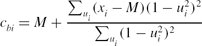
For each cluster we construct a colour-magnitude diagram for the spectroscopically confirmed members. To fit the red sequence of each cluster, we use the robust bi-weight fit method presented by Beers, Flynn, & Gebhardt (Reference Beers, Flynn and Gebhardt1990; see also Pimbblet et al. Reference Pimbblet, Smail, Kodama, Couch, Edge, Zabludoff and O’Hely2002) and we refer the reader to those works for full details of that method. In brief, it fits the data to find the intercept of the red sequence, cbi , the biweight fit estimator, such that
 \begin{equation}
c_{bi} = M + \frac{\sum _{u_i} (x_i-M) (1-u_i^2)^2 }{\sum _{u_i} (1-u_i^2)^2}
\end{equation}
\begin{equation}
c_{bi} = M + \frac{\sum _{u_i} (x_i-M) (1-u_i^2)^2 }{\sum _{u_i} (1-u_i^2)^2}
\end{equation}
where M is the sample median and ui is:
 \begin{equation}
u_{i} = \frac{u_{i} -M}{c(MAD)}
\end{equation}
\begin{equation}
u_{i} = \frac{u_{i} -M}{c(MAD)}
\end{equation}
and c is the tuning constant (Beers et al. Reference Beers, Flynn and Gebhardt1990) which we set to c=6.0 following Beers et al. (Reference Beers, Flynn and Gebhardt1990) to give cbi a high efficiency. The Median Absolute Deviation (MAD) is simply
 \begin{equation}
MAD = median (\vert {x_{i} - M}\vert ).
\end{equation}
\begin{equation}
MAD = median (\vert {x_{i} - M}\vert ).
\end{equation}
Once fitted, we systematically searched each galaxy cluster for ARGs by finding galaxies whose photometric uncertainty placed them > 3σ above the fitted red sequence for their given magnitude. An illustrative example of this process is shown in Figure 1 where we depict the colour-magnitude plane of Abell 1809 and have fitted the red sequence to recover a single ARG at r = 17.401
Example colour-magnitude plane (corresponding to ARG 1 in our sample) of one of our galaxy clusters (Abell 1809; SDSS-C4 1001) which depicts the fitted red sequence and an ARG that is 3.92σ above the fit, this includes the uncertainty on the measured colour.

4 RESULTS AND DISCUSSION
Out of 7845 galaxies that are bona fide members of 748 clusters brighter than r = 17.77, we find 7 fit our criteria of being anomalously red; some 0.0935 per cent of the total cluster population. Figure 2 displays the images and spectra of these ARG from our investigation, along with plots showing the CMR for each cluster.
Images and spectra of all ARG found. Each image is 120 by 120 pixels sourced from the SDSS database and each spectra displays the common absorption lines together with the RA, Dec, and SDSS observation tags along the top. Also displayed is the galaxies in each cluster plotted with their corresponding CMR, wavelengths are observed frame. Data on these galaxies is summarised in Table 1.


ARG data.

Out of our sample of seven, two have close companions that affect their photometry, as confirmed by inspection of the pixels contained in the segmentation maps of these images. These are caused by bright nearby stars and neighbouring foreground or background galaxies (Figure 2). There exists the possibility that any of these ARG could be field galaxies that are red due to their dusty nature, though this is unlikely as; the work done in Ruel et al. (Reference Ruel, Bazin, Bayliss, Brodwin, Foley, Stalder, Aird and Armstrong2013) shows that when investigating small numbers of member galaxies unbiased velocity dispersions can be obtained, however increased systematic error is also observed. The use of the petrosian model magnitudes from SDSS throughout this work enables overlay image maps to be interrogated for flux contamination. These overlap maps reveal that both ARGs 1 & 3 suffer from contamination and therefore cannot be considered as truly anomalous in their colours compared to the red sequence. ARG 7 is a borderline contamination case, but the size of the SDSS spectral aperture does not appear to be affected by the close neighbours of this particular galaxy. However, most of our sample appears to be genuinely red. We comment on these cases below.
The first of these is ARG 2 which is a very red, morphologically elliptical galaxy. It has a typical spectrum with no emission and strong 4000 Angstrom break (ARG 6 is a further example of this). The spectrum does not reveal anything particularly strange about ARG 2 or 6 though. It may be the case that they simply have a high dust content. To rule out that this is caused by nearby sources (explicitly, the Milky Way), we used dust maps from Schlegel et al. (Reference Schlegel, Finkbeiner and Davis1998) to confirm that the Galactic extinction does not vary on the local scale of the ARG or its parent cluster. Hence we conclude that any dust present will likely be an intrinsic property of the ARG itself.
To determine if the red colours are consistent with the spectra, we construct a representative sample of ‘normal’ CMR galaxies from the clusters we have used in the parent sample. We select all galaxies within 0.1(g − r) of the fitted CMR with 16.7 < r < 17.4 – i.e. covering the full range of ARG magnitudes – to do this. Both the star formation rate and the specific star formation rate of the comparison sample and these ARGs are statistically indistinguishable.
ARG 4 presents arguably the most interesting ARG case: a potential dusty star-forming galaxy, as suggested by the Hα line both in the spectra and the derived equivalent widths from Brinchmann et al. (Reference Brinchmann, Charlot, White, Tremonti, Kauffmann, Heckman and Brinkmann2004). The SFR and SSFR for ARG4 are significantly higher than for the control sample, supporting the notion that this is indeed a star-forming galaxy shrouded by dust.
ARG 5 is somewhat enigmatic. It has a very strong Magnesium absorption line which could be due to sky subtraction during processing (note the sky noise spike). However, the derived SFR and SSFR for this galaxy are also significantly higher than for the control sample, suggesting that it may be in the same dust-enshrouded class of ARG4.
ARG7 has a SFR that is significantly higher than the control sample as well, but its SSFR is fairly typical. It may be the case that there is some contamination from pixels from the blue source nearby to this object, but in this case, ARG7 will require followup observations to fully determine the cause of its intrinsically high (apparent) redness.
Finally, we noted above that there was a significant range of M ⋆ values across that range of our cluster redshifts. If we were to apply a common absolute magnitude cut off to our sample of r = −21.06 which corresponds to the nominal 100 per cent redshift completeness of SDSS at r = 17.77 and z = 0.14 (the redshift of our highest ARG), then we are left with only ARG 4. This corresponds to 0.0004 per cent of all galaxies brighter than this absolute limit. Changing this to z = 0.1 (and only considering clusters below that redshift) yields a limit of r = −20.33 and comprises 4 ARGs, which is 0.0011 per cent of all galaxies below z = 0.1 and brighter than this limit.
In summary, this work has:
-
(i) undertaken the first and largest systematic search for anomalously red cluster galaxies at low (SDSS) redshifts;
-
(ii) found seven galaxies out of 7485 that have colours significantly redder than the fitted CMR, accounting for photometric errors;
-
(iii) found that nearly a third of ARGs are caused by photometric contamination, but a subset of truly red cluster galaxies exist (0.0668 per cent of the cluster galaxy population). These can be roughly divided in to dusty starforming galaxies, and elliptical galaxies that probably possess a high dust content.
ACKNOWLEDGEMENTS
We thank Peter Jensen for pointing out the set of anomalous objects discussed in Jensen & Pimbblet (Reference Jensen and Pimbblet2012) that inspired the present work. KAP thanks Christ Church College, Oxford, for their hospitality whilst some of this work was being undertaken. We also thank Benjamin Milill and Heath Jones for their assistance. We would like to express our gratitude to the anonymous referee for their feedback and patience.
Funding for the SDSS and SDSS-II has been provided by the Alfred P. Sloan Foundation, the Participating Institutions, the National Science Foundation, the U.S. Department of Energy, the National Aeronautics and Space Administration, the Japanese Monbukagakusho, the Max Planck Society, and the Higher Education Funding Council for England. The SDSS Web Site is http://www.sdss.org/.
The SDSS is managed by the Astrophysical Research Consortium for the Participating Institutions. The Participating Institutions are the American Museum of Natural History, Astrophysical Institute Potsdam, University of Basel, University of Cambridge, Case Western Reserve University, University of Chicago, Drexel University, Fermilab, the Institute for Advanced Study, the Japan Participation Group, Johns Hopkins University, the Joint Institute for Nuclear Astrophysics, the Kavli Institute for Particle Astrophysics and Cosmology, the Korean Scientist Group, the Chinese Academy of Sciences (LAMOST), Los Alamos National Laboratory, the Max-Planck-Institute for Astronomy (MPIA), the Max-Planck-Institute for Astrophysics (MPA), New Mexico State University, Ohio State University, University of Pittsburgh, University of Portsmouth, Princeton University, the United States Naval Observatory, and the University of Washington.



