

Introduction
How and why is comparative law and society imperative to legal education? The 21st Century has been referred to as the Asian Century,Footnote 1 an idea that captures the rise of Asia economically, socially, politically and culturally, leading to the claim that ‘the future is Asian’.Footnote 2 The Asian Century is an expansive idea that acknowledges an increasingly multi-polar world; the great diversity, plurality and complexity of Asia; and its growing influence on international affairs and the global economy. The Asian Century also emphasises that no one country in Asia is dominant, but rather that there are multiple sources of power and influence. In this context, legal education displays a paradox: despite the growing importance of Asia and the growth in the number of Asia-heritage students (including international students), the study of comparative law and society as Asian legal studies is marginal in law schools outside of Asia. While the 21st century has also seen increasing numbers of international students studying at law school, particularly from Asia, this has not led to changes in course content.
In this article, I first define comparative law and society, and then set out two broad sets of arguments in favour of comparative law and society: its intrinsic pedagogical benefits, and its applied career benefits for students. I add a third set of arguments to these common claims, namely, the ability to empower law students as co-creators of knowledge. In this era of globalisation and internationalisation, legal education must enable all law students to incorporate their lived experiences, knowledge, and identities in the classroom. Comparative law and society, with its focus on pluralism and diverse legal systems, allows students to bring their knowledge of different contexts and cultures into the classroom. Due to the increase of Asian-heritage students, legal educators need to not only be attentive to the experiences that Asian-heritage students bring to the classroom but also find ways to incorporate their knowledge of, and connection to, laws and societies in Asia.
Having established the reasons for comparative law and society in legal education, I then explain my methods for assessing law schools’ commitments to comparative law and society as the study of Asian legal systems. We can map the strength of this commitment by tracing scholarly expertise and course offerings as essential characteristics of an institutional commitment to comparative law and society. I then apply this method to a case study of Asian legal studies in Australian law schools.Footnote 3 My case study offers the first original empirical research of trends in Asian legal studies in legal education in Australia over seven decades (1960s-2020s). It does so based on a comparison of available data on scholars and student numbers; a comparative survey of Asian law subjects offered in 2001 and 2021; an analysis of the records of research centres, and an auto-ethnography of my experience at three universities in the first three decades of the 21st century.Footnote 4
From the 1960s to 1990s, I explain the rise in Asian legal studies as driven by two types of scholars: comparative law scholars who focus on Asia, and Asian law scholars who model a sustained commitment to research and teaching that incorporates knowledge of Asian languages and cultures. I also demonstrate the related growth in the creation of comparative law courses on Asia. Surveying the 2000s-2020s, I identify that Asian law scholars are now less than one percent of law scholars, and most law students never have the chance to study a subject on Asia because scholarly expertise remains concentrated at a small number of law schools. These trends have led today to a problem I call the ‘Asian Century gap’ in legal education. There is a gap between a curriculum focused on the domestic, doctrinal law of the host country, in contrast with both the multipolar world of global legal practice and Asian-heritage students as the new minority – or perhaps even the ‘new majority’ – at law schools in countries like Australia. To close this gap, I argue that law schools in Australia need to make a renewed commitment to comparative law and society as Asian legal studies through hiring commitments and curriculum reform. In doing so, law students not only gain the intrinsic pedagogical benefits and career advantages of studying comparative law and society, their experience as co-creators of knowledge ensures that the educational experience is both a process of individual exploration and becoming.
Reimagining Legal Education for the 21st Century
What is Comparative Law and Society?
In order to make the case for comparative law and society in the Asian Century, I first introduce and explain the intellectual field of comparative law and society. It has two distinguishing features in comparison to the traditional study of comparative law.
First, comparative law and society extends beyond the traditional focus on comparing Global North legal systems to accommodate and consider a wide range of legal traditions, without having to compare them to a Global North jurisdiction as the ‘standard’. Traditionally, scholars of comparative law undertake the comparative study of legal doctrines and jurisprudence in Western liberal democracies.Footnote 5 This commonly involves comparing similar legal issues in countries that are perceived to belong to the same legal family, such as issues of private law in civil law jurisdictions like Germany and France, or judicial doctrine in common law jurisdictions such as England and America. Some comparative law scholars compare legal issues in countries from different legal families, such as constitutional law in civil-law Germany in contrast to common-law America. Others may compare legal issues in a Global North jurisdiction such as America with those in a postcolonial context such as India. But even when such scholars go beyond comparing Global North jurisdictions, their comparison may often be between liberal democracies. Scholars who go beyond this form of comparison usually compare the jurisdiction they are based in, such as the United States, with a populous jurisdiction like China. Contemporary scholars of comparative constitutional law, in contrast to private law scholars, are more likely to include the jurisdiction of countries in the Global South in their comparative gaze, but again the focus is often on liberal democracies.Footnote 6 In contrast, comparative law and society, as I understand it, is a genuinely global and comparative enterprise, that reaches beyond the comparison of liberal democracies. Such focus is increasingly important given the decline of democracy worldwide.
Second, aside from the geographic focus, scholars of comparative law and society differ from traditional comparative law scholars because they go beyond legal doctrine to focus on the study of law in action, as law and society scholarship does. On the traditional view, comparative law scholars study the case law of various legal jurisdictions,Footnote 7 that is, the study of jurisprudence and doctrine, and the state domestic law of other countries.Footnote 8 These scholars have long emphasised the benefits of comparative law to legal education. For example, in the early 1930s, American legal realist Roscoe Pound suggested that ‘the law teacher of the future should ground himself [sic] in comparative law’.Footnote 9 Likewise, comparative law scholars from various jurisdictions have argued for comparative law as an essential component of legal education. An example is German comparative law scholars, Konrad Zweigert (1911-1996) and Hein Kötz (1935-, former Director of the Max Planck Institute for Comparative and International Private Law), who are editors of a leading edition of a traditional comparative law text. In their volume (first published in 1977, and in its third edition in the 1990s) they argue that ‘we must integrate comparative law into the teaching of national law’,Footnote 10 and that ‘the need to open legal education up to comparative law is an urgent one’.Footnote 11 The call for comparative law in legal education therefore has a long global history, although these scholars adhered to the classical conception of comparative law as doctrinal studies, with a primary focus on Europe.
Comparative law and society scholars are sympathetic to this long-standing scholarly advocacy for comparative law in education, but at the same time they incorporate the insights of law and society scholarship.Footnote 12 The research and teaching of comparative law and society scholars reflects the scholarly reaction against legal formalism, and the related growth of ‘law and…’ approaches to the study of law. Comparative law and society scholars share with law and society scholars three broad sympathies: to law in context, legal pluralism, and interdisciplinarity. Law and society scholars recognise the importance of the place, location and culture of law, or law in context. On this view, comparative law and society scholars include in their sights the role of law in society at large, beyond mere jurisprudence. These scholars pay attention to how law works in action, rather than only what the legislature or courts declare the law to mean. Their emphasis on the context of law makes legal culture explicit.Footnote 13 Werner Menski (SOAS, London) has made a similar argument in his book on comparative law that is an early example of textbooks that incorporate legal knowledge beyond the Global North. He argues that students need ‘a broad-based analytical understanding of law as a cross-cultural phenomenon, rather than merely… technical rules of various legal systems’.Footnote 14 Similarly, comparative law and society scholars embrace the cultures of law.
Second, these scholars affirm the interdisciplinary possibilities of studying law in society by using the insights and methods from disciplines such as anthropology, sociology, history and political science, among others. The use of social sciences and humanities to study law enrich and deepen law students’ understanding of when, why and how law works, or does not work. And third, comparative law and society scholars value and take seriously the study of legal pluralism – from religious-based legal systems to traditional and customary law. Legal pluralism draws attention to colonial legal legacies, the co-existence of legal systems and the operation of law both within and outside of the modern state. Legal pluralism is concerned with how non-state and plural legal systems influence people’s lives and are just as important, if not more important, than official state legal systems.
For these reasons, I refer to the study of ‘comparative law and society’ as the contemporary contextual approach to comparative law, one that adopts and incorporates the perspective and ethos of law and society, in terms of its attention to law in context, interdisciplinarity, social justice and legal pluralism, and combines it with an inherently comparative outlook.
The Case for Comparative Law and Society: Its Intrinsic Pedagogical Value and its Applied Career Value
Building on this characterisation of comparative law and society, the case for teaching comparative law to law students usually rests on two broad sets of benefits for students: its intrinsic pedagogical value, and its applied career value. In terms of the first, the incorporation of comparative law and society in legal education is designed to train and equip law students with a sensibility, outlook and mindset that is open and respectful towards other ways of understanding and practising law, and different configurations of legal institutions and law. Given that legal education has a strong normative impulse, students learn from the legal institutions, concepts, reforms and innovations in other countries, in order to reconsider and reevaluate the merits of their own legal system. By studying comparative law and society, students gain a new perspective and vantage point from which to reflect on their own legal system. In doing so, they are better able to interrogate and evaluate the assumptions, preoccupations, logic, and merits of their own legal system. The study of comparative law and society also enables students to cultivate a new sense of humility about the legal system they are trained in, overcoming either a false sense of universalism about their own legal system or an implicit bias in favour of legal nationalism by assuming the importance or significance of their own legal system relative to others.
Overlapping with the intrinsic pedagogical value, law students benefit from the applied career value of comparative law and society. For students whose career path lies within the domestic legal system in which they are trained, the study of comparative law and society enables them to gain skills in identifying different approaches to legal and social problems; to be able to identify a range of possible solutions from comparative examples; to better appreciate legal pluralism at work within domestic borders; and to evaluate and assess the merits of potential comparative models in terms of appropriate legal solutions for domestic reform.Footnote 15 Yet the reality is that whether their work is domestic, regional or international, most law graduates will undertake careers that are fundamentally shaped by the forces of globalisation and the transnational dimensions of legal practice. Students’ ability to identify, appreciate, engage with and assess other legal traditions and systems is crucial for their work in a globalised world. Over the past few decades, an increasing number of transnational and regional law firms work in Asia, with India a recent example of a legal market opened to foreign law firms.Footnote 16 Students who have the opportunity to study about foreign legal systems are better equipped to work within and across other legal jurisdictions in their legal careers, from traditional areas of commercial law such as contracts and trade law, to migration law, or the influence of international law in areas such as human rights.
The argument for the applied career value of comparative law and society for law students is not only technical in the sense that students gain knowledge of law and the legal system in specific jurisdictions, but also critical, in the sense of enabling students to develop skills in critical analysis of why legal institutions exist, what purpose they fulfil and whose interests they serve. Teaching comparative law is essential to prepare students for legal practice because lawyers need to understand the legal diversity within their domestic jurisdiction, as well as plural legal orders that coexist with modern state systems, but also the interaction between domestic law and foreign legal systems, and regional and international legal orders.Footnote 17 But the benefit of students gaining technical legal knowledge of foreign legal systems also overlaps with wider arguments that students’ knowledge of a broader range of legal traditions and systems, such as legal systems in Asia and Africa, is essential in the 21st century. Scholars such as Werner Menski have argued that a focus beyond Western liberal democracies to Asia and Africa equips students as future lawyers to better appreciate the contemporary world order.Footnote 18
To comprehend the complexity of a multipolar world, students require a set of skills that can adapt to different contexts, sources of law and legal institutions rather than merely possess technical knowledge of specific Euro-American jurisdictions, or examples considered best practice in liberal democracies.Footnote 19 Through an appreciation of legal pluralism, students increase their awareness of pre-colonial law, the influence of colonial law on pre-colonial and postcolonial legal traditions and systems, and the impact of settler colonial law on indigenous legal systems. Specifically, the study of legal pluralism equips them to appreciate the interconnections, tensions and affinities between state law and non-state law, as well as the ongoing impact of colonial rule in the post-colony. Through such an exposure to diverse epistemologies, students come to a fuller appreciation and awareness of different practice and sources of law, and different voices and experiences of law. Comparative law and society can be central to a process of decolonisation, and part of a law schools’ agenda to decentre Euro-American law.Footnote 20
Both of these sets of arguments in favour of comparative law and society – its intrinsic pedagogical value, and its applied career value – focus on the benefits to students without considering who students are and what knowledge and experience they bring to the classroom. I add to the case in favour of comparative law and society by arguing that another benefit of comparative law and society is to empower students as co-creators of knowledge in the classroom.
An Additional Argument: Students as Co-Creators of Knowledge
A third major benefit of comparative law and society is that it enables the law classroom to be a place where students can explore their lived experiences, insights and knowledge about other legal traditions. My focus here is on Asian legal systems and traditions, though the idea applies beyond Asia. In terms of pedagogy, it is commonly said that students are co-creators of knowledge in the classroom, an idea often traced to the work of Brazilian educator Paulo Freire.Footnote 21 Freire assumed that a central challenge in education is to affirm a person’s identity as human. He rejected the idea that students are passive receptors of knowledge, often referred to as the banking model of education. On this traditional view, students are an empty receptacle, and the role of teacher and legal education is to fill the receptacle with knowledge and learning. It is called the banking model because the student is like the piggy bank and the teacher is the depositor of funds: the teacher fills the student with information and knowledge. On this model, the students’ existing knowledge is irrelevant, instead the teacher is the source of knowledge. In contrast, Freire proposed that pedagogy must treat the student as an active participant in the learning process and as a co-creator of knowledge.
This raises a challenge: how can law schools empower law students as co-creators of knowledge, particularly in contexts where the law classroom is highly diverse? Many law schools would be quick to reject the piggy-bank model of education and affirm students as co-creators of knowledge. In contemporary legal education, the idea of law students as co-creators of knowledge is often discussed with reference to the use in the classroom of specific pedagogical practices such as active learning and flipped classrooms. These practices assume students are learning through reading and preparing before class, and then come to class where they apply that new knowledge through activities such as discussion and debate, group work and specific legal problems. While this is one way of thinking about students as co-creators of knowledge, I seek to emphasise students’ identity, their lived experience and pre-existing knowledge. This focus on students’ lived experiences is not only consistent with Paulo Freire’s work on pedagogy, but is also affirmed by other scholars such as bell hooks and her argument that students’ lived experiences are central to higher education and that we must create space for diverse experiences, particularly of minority groups, in our teaching practices.Footnote 22
In the context of contemporary legal education, I suggest that students’ co-creation of knowledge is an approach to pedagogy that emphasises the agency of students in the learning process, the importance of their lived experience, and the contribution to collective knowledge that their identity offers. It not only puts students’ knowledge and experiences on equal terms with that of their teacher, but sees all students as co-equal, including students from diverse and minority backgrounds. The teacher aims to facilitate collaboration with and among students in the classroom through dialogue, enabling students to develop their own views and to exercise agency in the learning process.Footnote 23 Co-creation recognises that students do not learn in a vacuum, but rather learn best when they can bring who they are, what they know and what they seek to know to class.
In the 21st century, it is relatively well-accepted that law classrooms should be places of active learning where students have agency. However, in legal education, the study of domestic law often assumes a large amount of tacit knowledge about the language/s, history and culture of law in society. This is a problem for two reasons, which I illustrate with the example of Australia. First, legal education primarily remains the study of domestic law, which in Australia is the study of the common law of the settler colony. By default, the course context presumes certain knowledge about the context of the domestic legal system, which may be familiar to some students but is less open to the experiences of students from diverse backgrounds, particularly international students.
Second, the study of Australian law assumes law students already have a significant amount of tacit knowledge about Australian legal culture, but also the wider political and social culture of society. These two problems are at odds with both the increasingly diverse domestic student body, which includes a growing Asian-Australian community, and the significant increase in the number of international students in our classrooms as a result of the internationalisation of education, particularly students from Asia (see below).
The limitations of teaching domestic law, and the way it privileges Anglo-European students and their lived experience in the Australian context, can be illustrated by the compulsory course I teach, Principles of Public Law, which is designed to introduce students to the foundations and basics of public law in Australia’s common law system.Footnote 24 This course, like all compulsory courses, assumes that students have some basic familiarity with Australian society and its law and culture. For example, it assumes that students understand our two-party political system; that students know the role and function that courts play in our society, including the impact that a lack of a bill of rights in our Constitution has on the role of courts; and so forth. In teaching this course, the content often lends itself to domestic students who have lived experience and knowledge about Australia and its legal and political system and culture, which I have found manifests in their comparatively greater class participation. In contrast, international students (whether on short-term exchange, or in the country to complete their degree) have little to no lived experience of the context in which Australian public law operates, and often contribute much less frequently to class participation. Likewise, domestic students from diverse backgrounds may assume that their lived experience is somehow less relevant.
To enable students to be co-creators of knowledge in the classroom, as lecturers we must cultivate awareness of who are our students and what are their lived experiences, so that we can create space in the classroom for them to share and explore who they are and their lived knowledge. For example, in undergraduate classes, I often have students from Singapore and Hong Kong, two common law jurisdictions with unicameral parliaments. In our class on the legislature, I intentionally include time in class to discuss the differences between unicameral and bicameral systems, and its strengths and weaknesses (although technically not in the curriculum). I invite students to discuss the features of unicameral systems, a question that implicitly creates room for students from unicameral jurisdictions to explain the legislature in their home jurisdiction to the class. In turn, domestic students with no lived experience of unicameral systems must listen, which is another core commitment to the co-creation of knowledge in our classrooms. This discussion enables domestic students to learn from the lived experiences of other students, and for the class to reflect comparatively on the merits of Australia’s bicameral federal parliament. In doing so, I both seek to create space for Asian-heritage students who have knowledge and experiences to share with the class, and in turn ensure that other students have the opportunity to listen and learn from them. The discussion is designed to acknowledge the strengths of unicameral systems, challenging domestic students’ perception that the Australian bicameral system is somehow better or superior than unicameral systems.
Aside from core courses, elective courses offer significant scope to incorporate comparative law and society to enable students as co-creators of knowledge and to have an educational experience that facilitates exploration of their identity and sense of belonging. I have taught a range of electives, such as Law and Society in Asia, and The Rule of Law in Asia. In these course, I seek to empower Asian-heritage students in the classroom while enhancing the opportunities other students have for dialogue and listening through comparative learning. These classes attract a disproportionate number of students of Asian-heritage and international students outside of Asia, and often domestic students are in the minority. This class composition immediately changes the power dynamic in the classroom, as non-Asian heritage students experience what it is like to be in the minority, even if in a small and temporary way. The class discussion is the opposite of that in my compulsory course. All students have the opportunity to select their research topic. Students whose heritage lies in places as diverse as Hong Kong, China, Sri Lanka, Bangladesh, Indonesia, Malaysia, India, Pakistan, Singapore or the Philippines, often choose topics that align with their own experiences and that of their family. The course, then, becomes a vehicle for personal exploration, identity-formation and an affirmation of belonging through the recognition of diversity.
My students tend to be diverse, with international students from Germany, Canada, Ireland, and the United States, alongside international students from Asia and domestic students of Asian-heritage. At the start of my elective course, I invite students to share why they are interested in taking this course and their answers vary. Without being prompted to do so, many of the Asian heritage students share something along the lines of ‘I have a mother/father/grandparents from (one or more countries in Asia)’ or ‘I was born in (a country in Asia)’. Most have never had a formal educational opportunity to study about their heritage as part of their law degree. At the end of the course, student feedback often indicates this is the first time they have been able to bring their lived experiences into the classroom discussion. In contrast, the main reason other domestic students take the course is because they are majoring in an Asian language or international studies (in their other degree), again, the course functioning to affirm that legal education is closely connected to, rather than isolated from, culture and society.
There are several key features or themes of my elective courses. First, I do not focus solely on liberal democracies in Asia, unlike some comparative law courses. Instead, I incorporate the full range of legal traditions, with legal pluralism a dominant theme across the course. I seek to acknowledge and affirm that law has many expressions and historical origins – from religious legal traditions (Buddhist, Islamic, Hindu, Confucian, and so forth) to socialist legal systems, from civil law to common law studies, from military rule to other illiberal forms of constitutional rule. Second, the course content keeps in view the colonial legal histories of countries in Asia – whether British, Dutch, American, Spanish, Portuguese or Japanese - and their postcolonial trajectories. It aims to help students to recognise the long-term influence that colonial experiences and imperialism has had on these countries, while also acknowledging that some – like Thailand – were never colonised.
Third, my courses are designed to cover at least three countries in some depth, while also granting students the opportunity to focus on one legal system of most interest to them in class activities and discussion. In terms of assessment, I allow students the opportunity to pursue a topic for their research paper that is of interest to them by selecting a country and legal issue of their choice (within the themes of the course). Students present draft ideas of their paper to the class throughout the semester, so that other students engage with a diverse range of legal traditions and topics other than their own project. Students often choose to focus on the country they have ties to and a topic that is meaningful for them.
I give the examples of my approach in brief here not because it is unique, but rather because I believe it demonstrates the potential of teaching comparative law and society. Such teaching embodies an ethos that does not privilege Euro-American legal systems, but rather seeks to enable students to bring their lived experiences and identities into the classroom, with legal education functioning as a vehicle for personal exploration, identity formation and a sense of belonging. This is all the more important given the changing face of law students, which I discuss next.
The Changing Face of Law Students: A New Minority, or a New Majority?
If legal scholars are to take students as co-creators of knowledge seriously and incorporate their lived experiences in the classroom, we need to know who our law students are. Who, then, are our students in the 21st century? In the past, it has been presumed that law students share a similar lived experience or background in their understanding of the domestic legal jurisdiction. This is why comparative law was often understood as an exercise in understanding foreign law, that is, the assumption that other legal systems beyond the domestic legal system were ‘foreign’ to students and scholars. Yet today, law students may already have lived experience in other legal jurisdictions, and are a diverse cohort in jurisdictions like Australia. I identify the increasing number of law students of Asian-heritage (both Australian-born and international students from Asia) in Australia, and also explain the reasons for this increase and its implications for our classrooms.
In recent decades, legal practice, and therefore legal education, has been affected by globalisation,Footnote 25 making comparative law even more relevant for law students. Law schools have seen an increase in the practice and teaching of transnational law.Footnote 26 There has been the emergence of new international collaborations,Footnote 27 law schools and centres branded as ‘global’, and in particular an increase in engagement and collaborations with universities in Asia. Many law schools now tout their law degree as a global and international one. In Australia, the need for the internationalisation of law degrees was prominently recognised in a series of reports: more than two decades ago, in 2004, by the International Legal Services Advisory Council,Footnote 28 and then in 2012 by the government ministry responsible for higher education.Footnote 29
One aspect of the globalisation of legal education is the increasing numbers of international students studying in Global North higher education institutions. Global North law schools – from the US and Canada, to the United Kingdom and Australia – have a growing Asian-heritage student population, both due to an increase in the Asian-heritage population and an increase in student mobility with the growth in international students from Asia.Footnote 30 By referring to Asian-heritage students collectively, I do not imply that they have the same experiences, language skills or knowledge, quite to the contrary. Their lived experiences and knowledge vary significantly; my point is that the classroom should be a place where students can bring these diverse experiences and pursue further knowledge on who they are and the peoples and places they are connected to. The numbers vary from jurisdiction to jurisdiction, but as an example, in 2021, international students accounted for 18.7 percent of students in the United Kingdom, 16.2 percent in Canada and 5.2 percent of all students enrolled in tertiary education in the US.Footnote 31 In Australia, universities have among the highest rates of international student enrolments from Asia in proportion to the student body.Footnote 32
International education is Australia’s largest service export. Between 2012 and 2019, international students in Australia increased by almost 50 percent from 230,367 to 440,667.Footnote 33 In 2019, international students accounted for 28.4 percent of all students enrolled in tertiary education in Australia, which was the second highest proportion of international students of all OECD countries, behind Luxembourg.Footnote 34 Across all enrolments in Australia, the most common countries that students come from in Asia are China, India, Nepal, Vietnam, Indonesia and Malaysia.Footnote 35 While COVID-19 led to a reduction in numbers due to Australia’s border closures, the number of international students has since increased beyond 2019 enrolments. Since late 2025, although a legislatively mandated cap on international students per university did not succeed, the federal government did introduce a ministerial direction that has the same de facto effect, with the government slowing international student visa processing if and when a university reaches its cap. The overall effect of this policy is that international students numbers have slowed since 2026.
In Australia, this growth up until 2025 occurred simultaneous with the growth in the number of law schools and the size of law schools, particularly the growth in new degrees and in the number of student places. This growth dates back to 1988, when the federal government lifted its previous restrictions on law schools. This policy change led to the neoliberal expansion of legal education, that is, the growth in the number and size of law schools due to the commodification and marketisation of law degrees. By 2018, one report estimated the number of law graduates in Australia to be anywhere between 7,500 and 15,000.Footnote 36 The Council of Australian Law Deans responded with the clarification that there were 8,499 law graduates from the LLB and JD programmes entering the job market.Footnote 37 Based on the growth in the size of many law schools since then, the number of law graduates are now likely to be even higher. This is an astonishing number relative to Australia’s population of under 27 million. The number is much larger proportionately than the number of law graduates in more populous Global North countries, such as the United Kingdom (with a population 2.5 times larger than Australia) at approximately 18,000 law graduates,Footnote 38 and the United States (with a population more than 12 times larger) at 36,000 law graduates.Footnote 39
Systematic data on international students in law schools (as opposed to the university in general) in Australia is not available. But it is well-known on the ground that the internationalisation of education in Australia has seen increasing numbers of international students from Asia study a law degree.Footnote 40 One sign is the emergence of bodies such as international or even Chinese law student associations or societies. In Australian law schools, this is unusual because each law school often only has one, united law students’ association (not multiple, unlike law schools in the United States). For law students to form an association specific to Chinese students indicates that they are a large proportion of the law student population. At the very least, like international students in the JD programme of American law schools, in Australian law schools these international students from Asia are a ‘new minority’Footnote 41. In fact, in the JD or LLM programmes of some law schools, Chinese students constitute the ‘new majority’ of law students.Footnote 42 This phenomenon deserves our attention, but is not the primary focus of my article.
Aside from international students as a growing proportion of the law student population, there are also a growing number of Asian Australian students studying law. Asian Australians include Australian citizens who were born in Asia and those who identify as having Asian heritage. They are the fastest growing group in Australia; in 2021, they constituted 17.4 percent of Australia’s population.Footnote 43 The Asian-Australian population is larger as a percentage of the population in Australia than the Asian-American community is in America.Footnote 44 International students from Asia and Asian-heritage students from Australia are of course a diverse group. In this article, I refer to both of these groups broadly as ‘Asian-heritage students’ to recognise the growing diversity within the student body as a whole beyond its Anglo-European roots, although I also recognise the different backgrounds and experiences of students within this group.
While it is not possible to identify how many law students are Asian-Australian or international students from Asia, there are numerous indicators that they make up a growing percentage of many LLB classrooms, as well as the dominant representation of international students in JD, LLM and PhD programmes.Footnote 45 Combined, the rise of international students from Asia and the growth of the Asian-Australian population are changing the face of the law student population: constituting at minimum a new minority, or in some cases a new majority in Australian law schools.
I turn now to consider how we can begin to evaluate law schools’ commitment to comparative law and society.
Evaluating Law Schools’ Commitment to Comparative Law and Society
Asian Legal Studies Scholars
The first and fundamental commitment of law schools to comparative law and society is the hiring of Asian legal studies scholars. Asian legal studies scholarsFootnote 46 are scholars who can teach and research drawing on the ideas and texts from the region, informed by language skills,Footnote 47 cultural knowledge and in-country experience.Footnote 48 These scholars have competence in one or more Asian languages, and can teach and supervise using materials in this language. They have extended in-country experience through fieldwork, legal practice or other work experience. As a result, they have acquired deep cultural understanding, and have a sustained career commitment to the study, teaching and research of the legal system and traditions in at least one Asian jurisdiction.Footnote 49 Asian law scholars have both the skills to conduct research on law in Asia and bring these invaluable skills to bear in the classroom and in research supervision. While this is more than short-term academic mobility, although such mobility can enhance the comparative sensibility of academics.Footnote 50
A law schools’ commitment to Asian legal studies expertise is evident when they hire such scholars with linguistic skills, cultural knowledge and in-country experience that informs their research and teaching. Linguistic skills ensure deep engagement with the legal system of the country/ies concerned. A diversity of linguistic skills are also necessary because, unlike some regions of the world that have a dominant official language other than English such as Spanish/Portuguese in Latin America, English/French in Africa, or Arabic in the Middle East, in Asia there is no one dominant language.Footnote 51 One reason that it can be important to have scholars with relevant linguistic skills is to enable research supervision (LLB/JD/LLM or PhD) of students with existing languages skills to read and engage with primary or secondary texts on Asian law in local languages. So, for example, a student doing a research essay may be able to use their language skills to draw on foreign sources under the guidance of their supervisor who also has language skills. This is not as unusual as it sounds; for example, after I studied Bahasa Indonesia in high school, as part of my undergraduate law degree at university, I was able to undertake legal research essays on Indonesian law using primary sources in Bahasa Indonesia, while at the same time advancing my language skills in my Arts (social science) degree.
A law schools’ commitment to comparative law and society is strongest when it hires scholars across diverse fields of law (public and private) and across a diversity of legal jurisdictions including East Asia (China, Japan, Korea, Hong Kong and Taiwan), South Asia (India, Pakistan, Sri Lanka, Bangladesh, Nepal etc) and Southeast Asia (Indonesia, Singapore, Thailand, Malaysia, Vietnam, the Philippines, etc). Law schools enhance their commitment to comparative law and society the more they hire scholars of Asian legal studies. Hiring scholars with language skills also models to students the importance of such a skill and encourages students to take up an Asian language, or to advance their language skills. For students who undertake an LLB degree combined with another degree (eg Arts, Business, Education), such a strategy can promote synergy between their law degree, their second degree/s and the study of a language, adding a sense of relevance, purpose, direction and affirmation to the study of Asia.
More commonly, rather than an overt or implicit commitment to Asian legal studies, law schools may have a broader commitment to comparative law expertise. This is evident by hiring scholars who teach on Asian law but who either do not publish or research on Asian law, or who do not have the skills to do so in depth and in context (that is, without language skills and in-country experience). These scholars may have limited work, travel or study experience in Asia, or some experience but without the language skills. Comparative law scholars are also essential to law schools, given that the complexity and diversity of legal traditions and languages in Asia. Comparative law expertise is often a practical necessity, given the lack of a shared language in the region, as well as the recognition of multiple national languages in some jurisdictions and the plethora of unofficial languages within countries. These factors mean that there are significant practical barriers for scholars to gain competence in more than one legal jurisdiction, with some exceptions (for example, Bahasa Indonesia is derived from Malay, so scholars with such skills may have basic comprehension across Indonesia and Malaysia, among other jurisdictions with Malay-speaking populations like Brunei and Singapore).
As the field of Asian legal studies has expanded, the expertise of Asian legal studies scholars has become more specialised. Asian legal scholars are usually grounded in a particular field of legal research (private law, public law etc) and theoretical or methodological orientation (law and society, doctrinal research, anthropology etc). In recent decades, fields like comparative constitutional studies have grown exponentially and opened a new space for scholars working on constitutionalism in Asia particularly as countries in the region democratised and established constitutional courts.
For the purpose of my case study that follows later, I measure law schools’ commitment to hiring Asian law scholars by identifying the number of Asian legal studies scholars who hold permanent positions at Australian law schools in 1990s and 2021. I acknowledge that the number of comparative law scholars is larger than this.
Course Offerings
The second commitment by law schools is curriculum offerings on Asian law, including the number and depth of courses, and whether the course is taught by an Asian law scholar. In Australia, most law schools offer law as an undergraduate degree, and some also offer a JD,Footnote 52 with a smaller number offering a LLM programme. The focus of my case study is elective subjects, rather than compulsory (domestic law) subjects, that is the courses that undergraduate (LLB) or postgraduate students (LLM or JD) chose in their later years from a range of possible options. The bulk of a student’s LLB/JD degree consists of compulsory subjects, known as the Priestly 11, the courses mandated by the Law Council of Australia as necessary for law graduates to be eligible to be admitted as practising lawyers. Some law schools mandate more than eleven compulsory subjects, or offer semi-compulsory courses (that is, choice from a select list of options). For example, at UNSW, students take 17 compulsory courses, leaving students the choice of only seven elective courses.
For this research, we obtained information on these elective subjects primarily from course handbooks. Where possible, we surveyed the title and description of these elective subjects.Footnote 53 Where there was no course description to review, we included a subject if it referred to Asia in the title. Our data may undercount the number of such courses, because some 2001 postgraduate handbooks were not available, although we also relied on data collated for the Maximising Asia report.Footnote 54 Some 2001 handbooks used the general label ‘postgraduate’, which we took as referring to masters of law programmes since there were few JD degrees at this time.
We distinguish between the total number of elective subjects on the books and elective subjects actually run,Footnote 55 because many law schools have a range of potential subjects but only offer a select number each year. Further, conscious that many law schools offer elective subjects as combined classes (that is, with students from at least two of the LLB, JD or LLM programmes),Footnote 56 I present the data so as not to double-count the same subject. I classify subjects in three ways: by geographic focus; area of law, and teaching location (see figure 1.1 below).
Classification of Elective Subjects on Asia.

Figure 1.1 Long description
The table has three columns: Geographic focus, Subject matter/field of law and Teaching location. Row 1: Geographic focus Country-specific; Subject matter/field of law Public law; Teaching location Australia. Row 2: Geographic focus Region-specific; Subject matter/field of law Private law; Teaching location Asia. Row 3: Geographic focus Asia; Subject matter/field of law Law and religion; Teaching location blank. Row 4: Geographic focus Comparative (including Asia); Subject matter/field of law Law and society; Teaching location blank. Row 5: Geographic focus blank; Subject matter/field of law Comparative and International; Teaching location blank.
In terms of geographic focus, there are four types of subjects on Asian legal studies: country-specific subjects such as ‘Japanese Law’ or ‘Chinese Law’; region-specific subjects such as ‘Law in Southeast Asia’; subjects on Asia broadly speaking, such as ‘Law and Society in Asia’; and, comparative subjects including case studies from Asia such as ‘Comparative Corporate Governance’ with case studies of Japan and China. At some larger law schools, such as Melbourne Law School, the region-specific subjects may be taught as a team, for example, one course that includes classes taught by a Chinese law scholar, an Indonesian law scholar, a Japanese law scholar and a Vietnamese law scholar respectively. I include general subjects such as Comparative law where the abstract mentions some content on Asia (usually in the form of comparative case studies).Footnote 57
In terms of the field of law taught, I classified subjects based on the following five subject matter categories: public law, private law, religious law, law and society, or comparative and international law. Public law subjects include constitutional law, human rights law and criminal law. Private law subjects include corporate law, foreign investment and trade law, construction law, competition law and tax law. Law and society subjects include courses that offer a broad introduction to the legal system and legal culture of one country or region (eg Japanese law), as well as courses on law and development or courses with a socio-legal emphasis, rather than a doctrinal focus. Religious law subjects include Islamic law and also personal law subjects. Comparative and international law subjects include general comparative subjects (eg comparative corporate law, comparative human rights law) that mention ‘Asia’ in the course description as one of the jurisdictions covered. Subjects on Asian law span a range of approaches, from more doctrinal comparative law to more sociological law in context studies.
We also reviewed subjects by teaching location, that is, whether the subject was taught in Australia or through an Australian university but in-country in Asia and, if so, which country in Asia. These categories – geographic focus, subject matter and teaching location – enable me to break down the types of electives offered and identify areas of strength and weakness. The two commitments – scholars and subjects – are interdependent because subjects can only be offered if the law school has the scholarly expertise available. Further, a law school’s commitment may vary from comparative law expertise to Asian studies expertise.
These two institutional commitments are only a partial indication of comparative law and society as Asian legal studies in law schools. In the future, a more robust assessment would need to assess the depth of engagement with Asia in courses beyond references in the title or abstract of the subject.
Comparative Law as Asian Legal Studies: The Case of Australian Law Schools
Based on the above approach, I review the development of Asian legal studies in Australia across two main periods: from 1960s-1990s, and from 2000-2020s. I demonstrate that the 1960s-1990s marked the origins and rise of Asian legal studies as comparative law in Australia law schools. Conversely the 2000s-2020s era is marked by the concentration of Asian legal studies and its overall decline relative to the growth in the size of law schools in terms of both the number of scholars, the student body and the subjects offered relative to overall growth of law schools in Australia.
The Rise of Asian Legal Studies as Comparative Law (1960s-1990s)
From the 1910s, Asian Studies (or Oriental Studies as it was then known) as the study of Asian languages and culture began to emerge in Australian universities, although it was only after World War II that there was significant growth in programmes and hiring at universities.Footnote 58 This establishment phase was concentrated in the humanities and social sciences, and it took several more decades for Asian legal studies to emerge. This is partly because there were just six law schools in Australia prior to the 1950s. Like other common law jurisdictions, Australian law schools grew out of legal practice and did not have a strong focus on research; many lecturers also worked as lawyers (solicitors or barristers).
The history of Australian legal education that has been written to date omits the emergence and centrality of comparative law as Asian legal studies in Australia.Footnote 59 To address this gap, I offer a brief history of the rise of comparative law as Asian legal studies in Australia. I attribute its establishment and rise from the 1960s-1990s to two structural commitments: the growth in hiring of Asian law scholars, and the offering of subjects on Asian law.
The Rise of Scholars of Comparative Law and Asian Law
From the 1960s, during a time of economic growth in Asia, law schools began to hire scholars who championed the study of comparative law as Asian legal studies. There is no available data on the precise number of Asian law scholars in comparison to the total number of law scholars up until the late 1990s, so I tell a brief history through the appointments and role of key scholars. Two generations of scholars emerged: the first generation of generalist scholars of comparative law who included Asia in their teaching and research focus; and the second generation of scholars of Asian legal studies as comparative law.
The first generation of scholars were mostly doctrinal comparative law scholars with expertise in private and commercial law, and to a lesser extent legal pluralism. Their primary expertise was in Australian private and commercial law, but they began to use that expertise comparatively in their engagements with various partners in Asia – from law firms to governments and universities – and incorporate that knowledge into the classroom in Australia. An early pioneer at the Faculty of Law of the University of Melbourne was Dr Hans Leyser, who taught Indonesian customary law as part of a comparative law course. Upon his retirement, another scholar Professor Mary Hiscock reformed the curriculum on comparative law, building on her own expertise in contracts and commercial law. In 1963, Hiscock was hired as the first woman with a full-time appointment at the Faculty of Law of the University of Melbourne.Footnote 60 She undertook research collaborations with scholar David Allan (whom she later married) on contract and securities law, with a focus on Australia and Asia. In her teaching, Hiscock’s approach to comparative law incorporated the study of Asia alongside the more traditional comparative law focus on Europe. Through her research and practical engagement, she used her expertise in contracts and trade law to work with a range of international and bilateral institutions in Asia, including the Asian Development Bank.Footnote 61 These kinds of teaching, research and consultancy mirrors both comparative doctrinal approaches, and law and development with its emphasis on policy engagement.
Likewise, Allan was also a legal consultant with the Asian Development Bank at a crucial time in the economic growth and legal reform in region.Footnote 62 In the 1970s, he served as Dean of Monash Law School, establishing a Centre for Japanese Law (although it did not last). From 1977-1980, his successor, Dean Patrick Nash, also enhanced the focus of the Law School on Asia.Footnote 63 Aside from Hiscock and Allan, other first generation comparativists included Professor Michael Pryles, and scholar of comparative constitutional law, Professor Cheryl Saunders, among others. The latter, Professor Saunders, is an example of the turn to comparative public law, and the ways in which the increase in constitution-making and amendment exercises in the late 1980s and 1990s, including in Asia, opened up new comparative vistas. In 1988, she established the Centre for Comparative Constitutional Studies at the Melbourne Law School (MLS), the University of Melbourne (and more recently, the Constitution Transformations Network).Footnote 64 Professor Saunders has also been instrumental in embedding comparative law in the LLM programme of MLS, and was one of the few public comparative law scholars among a generation of comparative law scholars who were primarily focused on private law.
Building on these foundations, the second generation of scholars had lived or worked for extended periods in Asia (or were born there), acquired linguistic skills, and with this knowledge brought an awareness of culture, language and context to their teaching and research. Some of these scholars affiliated with the broader field of Asian studies or Asian legal studies, while their research and teaching overlapped with doctrinal studies of comparative law. I highlight three scholars briefly here: Professors Malcolm Smith, Alice Tay, and MB Hooker.Footnote 65
Malcolm Smith (1945-2006) was a graduate of MLS and Harvard Law School’s East Asian Legal Studies programme. In the 1960s, Professor Harold Ford (then Dean of MLS) recommend to Smith that if he wanted to become a law scholar he should study Japanese language. He did and went on to pioneer the study and teaching of Japanese law outside of Japan. At the University of British Columbia, Canada, he founded the Japanese Legal Studies programme. Many years later, he returned to MLS and in 1989 he founded the Asian Law Centre (ALC), which received initial seed funding from the Victorian Law Foundation. He became its inaugural director (1987-2000) and also held the Foundation Chair in Asian Law (until 2004). The ALC was founded at a time when the number of law schools in Australia was still small (just 14), and when trade with Asia (especially Japan) was high on the agenda. For this reason, the study of Asian law was largely a field of private law.Footnote 66 Smith understood scholars of Asian legal studies as generalists, by which he meant they focused on foreign legal systems across the public-private divide of law and they were interdisciplinary in an area studies sense of knowing about law in the context of the history, culture, economy and society of that country or region.Footnote 67 Smith worked to establish Asian law within the field of comparative law in order to expand this field beyond its European roots. The Asian Law Centre embedded comparative approaches to the study of law in Asia, and from Smith’s perspective in the late 1990s (by which time there were 24 law schools), its role in affirming Asian legal studies had been a success.Footnote 68
Mal Smith was an advocate for the study of comparative law as responsive and attentive to context and place. In particular, from his vantage point in Australia, rather than a sole focus on Euro-American law, he argued for a truly comparative law, one that paid attention to Asian laws. Smith was confident both in terms of Australia’s engagement with Asia generally, and in the idea that Asian legal studies had been mainstreamed in law schools, declaring: ‘The task of establishing Asian legal studies in Australia largely seems to have been accomplished, in both areas of teaching and research’.Footnote 69 He suggested that Asian legal studies had reached ‘take-off’; this assessment reflected both his general optimism; the wider enthusiasm for Australia’s engagement with Asia at the time; and the conducive environment at MLS for comparative law, which was not necessarily the case at other law schools. Smith later moved to take up an appointment as the first Australian law scholar at Chuo University, Japan, applying his skills teaching Japanese law in Japanese language. Of Smith’s impact, Tim Lindsey notes that ‘He inspired a generation of Australian lawyers to look north. He was a mentor and model to so many who had contact with the Asian Law Centre’.Footnote 70
Aside from Smith, another influential figure was Alice Erh-Soon Tay (1934-2004), distinguished Challis Professor of Jurisprudence at the University of Sydney. Tay was born in Singapore to Chinese parents and also spoke Mandarin. Tay’s contribution to legal education in Australia has recently received more attention, although it has been told primarily as a contribution to the study of jurisprudence and legal education,Footnote 71 rather than comparative law specifically. This view overlooks her contribution to Asian legal studies in Australia. Central to her efforts is her role as the founder of Sydney’s Centre for Asia Pacific Law (CAPLUS, est. 1994), a centre that continues to this day.Footnote 72 Alice Tay was involved in the intentional hiring of a diverse group of comparative law scholars.Footnote 73 She also pioneered the law school’s student exchange programme to China. Like the first generation of scholars, she emphasised Australia’s trade relations with Asia and the idea that ‘the very structure of trading relations is nurtured by and creates parallel structures of legal relations’.Footnote 74 The centre’s work intersected with the rise of new regional forums, such as the Asia Pacific Economic Cooperation (APEC) Forum and the ASEAN Regional Forum (1995).
Another key figure of this generation was MB Hooker, who spoke the Malay language and was an expert on Malaysian law and Islamic law in Southeast Asia.Footnote 75 Hooker was a Professor of Law at the Australian National University (ANU), and Honorary Senior Associate of the Asian Law Centre, the University of Melbourne.Footnote 76 While originally from New Zealand, in the 1960s he took up a three-year post at the University of Singapore (now National University of Singapore, NUS). He was then appointed in Asian studies and Law at the University of Kent in the United Kingdom. One of his major contributions was supervising a large number of masters and PhD students from Malaysia on projects about Malaysian law. In the 1990s, he returned to Australia with the intention of retiring, but instead took up an invitation to establish a course on Southeast Asian Law at ANU. His contribution to Asian legal studies was also marked by his enormous corpus of research (which long preceded his move to Australia). He pioneered the English-language field of Southeast Asian Islamic law and was a key early contributor to studies of legal pluralism.Footnote 77 He undertook sustained field research, ethnography and archival work, but also doctrinal work, on Malaysia, and also Indonesia and elsewhere. His work – particularly on customary law and Islamic law – became the baseline and go-to resource for future generations of scholars of Malaysian law and Indonesian Islamic law.Footnote 78
Overall, these early scholars of Asian law took a classical approach to comparative law, primarily focused on private law, and some were involved in the law and development industry.Footnote 79 Their efforts in establishing Asian legal studies were inevitably shaped by a combination of country-specific developments and Australia’s trade relations with region. This included the boom of the Japanese economy from 1960s-1990s; the 1980s doi moi renovation in Vietnam; the 1997 Asian Financial Crisis; the Asian values debates led by Lee Kwan Yew; political and social crises such as in 1991 when Bhutan refugees fled from Nepal; Indonesia’s transition to democracy post-1998; or in the late 1990s when the British left Hong Kong and Hong Kong returned to China under the Basic Law. In this way, the research and teaching of these scholars (among others) enabled students to engage with the legal and political developments in the region at the time.
Teaching on Asian Law as Comparative Law
The second related factor contributing to the rise of comparative law was the growth in courses on Asian legal studies that scholars offered to students. In 1948, MLS offered what it claimed was the first year-long course in Comparative Law in the British Commonwealth.Footnote 80 Its course epitomised the traditional approach to comparative law as the comparison of Continental and Anglo-American law, legal history and jurisprudence, with reference to the French, German, Swiss, American and English legal systems. But a new strand of comparative law as the study of legal traditions and systems in Asia began to emerge in the 1960s, as mentioned above. By the 1990s, Mal Smith claimed that ‘Most major law schools have consciously acted to incorporate material on Asian legal systems in their curriculum over the past decade’.Footnote 81 While the curriculum for the 1990s was unavailable, I draw upon curriculum from 2001 to demonstrate the trends in courses offered at the start of the 21st century.
In 2001, across 24 Australian law schools, there were 20 elective subjects offered on a single country, including the largest number offered on China (9), and others on Japan (5), Indonesia (2), and one each on the Philippines, Korea, Taiwan and Vietnam. Some of these subjects have a long history, for example, in 1969, the teaching of Japanese law at MLS began, and by 1999 the programme had celebrated 30 years.Footnote 82
There were twenty-two subjects on a region in Asia, including Asia or Asia-Pacific generally (17, eg Asian Legal Systems), Southeast Asia (4) and East Asia (1). Courses that are framed as region-wide do so to attract a sufficient number of students to a course, and to ensure that students gain a broad exposure to legal traditions and systems in the region. In addition to these subjects, there were eleven general comparative law subjects that included some sort of material or case study on Asia.
In terms of the area of law, in 2001, there were twenty-four subjects on the books that focused on law and society, sixteen on private law, four on public law, and one on religious law. There were another eight subjects on comparative and international law generally that had some minor coverage of Asia. Regarding the course location, only one of the forty-two subjects were in-country in China, pioneered by Alice Tay. The lack of in-country subjects at the time is partly because there was no government funding to support student travel to undertake such programmes, and also due to the high cost of travel in this era. As I show later, since 2014, there has been a significant increase of in-country electives offered by law schools (and other faculties).
Overall, law schools offered subjects with a strong focus on East Asia and to a lesser extent Southeast Asia, and with a subject area focus on private law and broader law and society (often law and development) subjects. A more thorough history of Asian legal studies in Australia remains to be told. This brief history of the people and subjects that contributed to comparative law as Asian legal studies is sufficient to contrast the state of the field at that time with the post-2000s stagnation and decline of Asian Legal Studies.
The Decline of Asian Legal Studies (2000-20s)
Since the 2000s, there has been a stagnation, and overall decline, of Asian legal studies in Australian law schools. I track this decline through institutional commitments in terms of scholars and subjects in the 2000-2020s, in comparison to the unusual growth in Australian law schools. The concentration of scholarly expertise and subjects at a handful of law schools means that most law students in Australia do not gain any exposure to Asian legal studies. Likewise, the concentration on private law and East Asian jurisdictions expose students to limited geographic and disciplinary areas of law.
Scholars of Asian Legal Studies as the One Percent (or Less)
Since the 2000s, scholars of Asian legal studies have remained prominent at a small handful of Australian law schools, but overall they are now the one percent of Australian law scholars. I explain how this occurred through the neoliberal expansion of law schools in terms of the major growth in the number of schools and the size of the student body, the persistence of the domestification of legal education through the compulsory Australian law subjects, and the over-concentration of Asian legal studies on private law in China.
While the total number of Asian law scholars has increased since the 1990s, overall the number has shrunk relative to all permanent law scholars in Australia. In fact, by 2020, just one percent of scholars above the level of senior lecturer had expertise in Asian legal studies out of 820 permanent scholars at or based in law schools in Australia.Footnote 83 Several years later in 2023, there were an estimated 1,100 scholars in law schools in Australia, although this was a generous count that included short-term (rather than permanent) contract positions such as research fellows and postdoctoral positions.Footnote 84 If correct, this means that the 34 scholars of Asian legal studies are now well below 1% of all law scholars in Australia.
These 34 Australian-based scholars are ones who have a sustained career commitment to the study of law in Asia, most of whom either speak one (or more) Asian language/s, have undertaken sustained research in Asia and/or whose primary research focus is Asian law. I did not include general comparative and international law scholars who did not have language expertise or who had not lived or worked in a country in Asia.
Out of this group, most of these scholars focus their expertise on either China, Indonesia or India, with a smaller number focus on Japan and Singapore/Malaysia. More than half of these scholars focus on East Asia, a reflection of the economic success of these countries, the importance of the Chinese economy to Australia, and the role of law firms in facilitating Australia’s trade relations with the region. Most of these scholars hold permanent positions at a small number of law schools, namely the University of Melbourne, the University of Sydney, the University of New South Wales (UNSW) and ANU. The concentration would extend to law schools such as Macquarie University, La Trobe University, Western Sydney University, and Bond University, among others, if we included general comparative scholars.
From the 2000s, a third generation of scholars of Asian legal studies were hired by Australian law schools. This included scholars in areas of long-standing strength, such as Japanese law (Veronica Taylor, Luke Nottage, Kent Anderson, Stacey Steele, Leon Wolff),Footnote 85 as well as growing expertise in Chinese law (Vivenne Bath, Sarah Biddulph, Sean Cooney, Randall Pereenboom) and Southeast Asia (Pip Nicholson, John Gillespie, Amanda Whiting, Tim Lindsey, Christoph Antons). While this may seem a significant number of scholars, they were dwarfed by the dramatic growth in scholars and students due to the number and size of law schools.
There was no industry-led demand for more law graduates; rather, the expansion of education generally, and legal education in particular, is due to the growth of the number and size of law schools for purely neoliberal, commercial reasons.Footnote 86 In the 1990s, eleven new law schools were established. In the two decades that followed (2000s-2010s), there were another six law schools established per decade, or twelve more in total. This means that from the 1990s to end of 2010s, 23 new law schools were established. By 2012, there were 32 law schoolsFootnote 87 and by 2021, there were 39 public law schools (and one private).
There are various reasons for both the establishment of new law schools, and the increase in size of their student intake.Footnote 88 From the perspective of the central university administration, law schools are relatively cheap to run because they can charge high fees, there is high demand due to the prestige of a law degree and they do not require labs or equipment in the same way that STEM faculties do. Law schools cross-subsidise other parts of the university. In an environment of decreased government funding, law schools are one of the ways that universities raise revenue.
The increase in student numbers is also important to note, and remains an ongoing development. Among other examples, in 2019, Macquarie University increased its student intake from about 400 to 700 LLB students;Footnote 89 in 2022 at Monash University increased its undergraduate student intake from approximately 500 to 700.Footnote 90 Another reason for the increase in student intake is the post-2008 impact of the University of Melbourne’s decision to shift to a US-style degree programme, with MLS becoming a JD only programme, rather than an LLB programme. Many other law schools across Australia kept their LLB programme but also added a JD programme (as a revenue raising postgraduate programme, some with large numbers of full fee-paying international students), thus increasing student numbers. In addition, over the past two decades, some top law schools have introduced or increased the size of their LLM programmes, benefiting from global trends in the internationalisation of education and the increase in international students studying in Australia, particularly students from China.
These two factors – the growth in the number of law schools and in the number of law graduates – demonstrate that while there is the opportunity for law schools to hire scholars with expertise on Asia, the reality is that these scholars represent a significantly smaller proportion of the overall number of law scholars compared to the 1990s.
Since the 2010s, another noticeable change is the backgrounds of scholars of Asian legal studies, with an increase in scholars of Asia-heritage – including Asian-Australian scholars and scholars from Asia based in Australia – or more specifically scholars from China.Footnote 91
If scholars of Asian legal studies are less than one percent in legal academia, then Australian law schools are now primarily populated by the 99 percent. This group of scholars are primarily trained in and focused on teaching and research about law in Australia, a legal system based on the common law, derived from a history of settler colonialism, affiliated with Western liberal democracy and connected to the international legal and economic order. The bias towards national law remains evident in law schools around the world, and so Australian law schools are not unusual in this regard. There are structural reasons for this bias. Even if a scholar has received legal training overseas (although anecdotally, many have obtained their undergraduate in Australia), they are required to teach compulsory (core) courses in Australian law.Footnote 92
Further, most law scholars do not speak an Asian language, either never having had the opportunity to study such a language in their schooling, nor having lived or worked in Asia. Despite the increasing demands upon the leadership of law schools to engage with Asia, most scholars in positions of leadership within law schools – such as Deans, Heads of School or Associate Deans (International) – have little or no expertise in Asia.Footnote 93 Most have not studied, lived, worked or undertaken sustained research or teaching in the region. The expertise of academics who lead law schools is crucial and affects hiring practices.
Overall, the number of Asian law scholars has increased since the beginning of the 21st century. However, this number has not kept pace with the expansion of law schools, and so these scholars are now less than one percent of all permanent academic staff.Footnote 94 Asian law expertise across law schools is lumpy with just nine law schools (out of 38) with at least one Asian law scholar. Many scholars hired over the past two decades have expertise on trade relations with China. Law schools that have no Asian law expertise tend to be newer law schools that are more teaching-oriented, ironically, often ones established in the Asian Century. Given that this factor – scholars – is a precondition for teaching offerings to students, this means that the potential for comparative law and society courses taught by Asian law scholars is only possible at a quarter of all law schools.
Change and Continuity in Subject Offerings: The Persistence in Private Law in East Asia and Growth in Short-term Overseas Study
Since the 2000s, student opportunities to study subjects on Asian law have failed to keep pace with the increase in elective subject offerings overall. Two exceptions are the increase in teaching private law and a geographic focus on East Asia, and in-country subjects, the latter of which can be explained by government funding incentives. My assessment is based on the compilation and comparison of elective subjects on the books in law schools in 2001 and 2021.
At the start of the 21st century in 2001, a total of 53 elective subjects on Asia were on the books across 27 Australian law schools, with 42 of these subjects actually offered. Of these subjects, 36 were offered at the undergraduate level and 17 at the postgraduate (masters) level. There were seven law schools that offered more than two electives on Asia.Footnote 95 The University of Melbourne had the most subjects on the books, with 17 electives or 25 percent of elective subjects on offer at the undergraduate level. UNSW had the next most subjects on the books, with eight electives or between 9 percent of the elective subjects on offer at the undergraduate level. By comparison to 2001, twenty years later, in 2021, there were 92 electives on Asian law on the books across 39 law schools. While the total number of electives on the books had expanded since 2001, there were 12 new law schools and a much larger student population in 2021. Overall, in relation to the number of law schools and the size of the student body, the proportion of subjects offered on Asian law has declined since 2001.
Turning to the spread of electives across law schools in 2021, there were nine law schools that had more than two electives on Asia, two more schools than in 2001.Footnote 96 Some law schools had a large number of subjects on the books, although they do not necessarily run every year depending on the availability of scholars and teaching needs. In 2021, at MLS, there were 24 subjects on the books and five of these were offered; at UNSW, there were 15 subjects on the books, and three were offered; at ANU there were 11 subjects on the books and three were offered; at the University of Sydney, there were eight subjects on the books (it is unclear how many ran), while at Bond University, there were six subjects on the books, although none were offered.Footnote 97 One of the reasons Melbourne and UNSW have a large number of subjects is because of the size of their masters’ programme: MLS has an Asian Law Masters and UNSW had a Chinese International and Economic Law Masters (2015-2025).Footnote 98 The replacement of a broad Asian law masters at UNSW with a more specific Chinese International and Economic Law programme is one example of adapting to the neoliberal imperatives of the role of law firms in facilitating Australia’s trade relations with China, and the rise in international students from China.
In terms of the country or region of study, in 2021, there were 40 subjects on the books on a single country, including China (24), Japan (6), India (4), Indonesia (3), and one in each of Malaysia, the Philippines and Myanmar (Burma). This compares to just 20 subjects in 2001. In 2021, the predominant focus is on China which reflects the rise of China as an economic power and its growing trade relations with Australia, as well as the role of law firms in facilitating trade. In 2021 there was greater diversity in country focus and offerings that did not exist in 2001 such as on Indian law. In 2021, there were ten subjects on a region in Asia, including Southeast Asia (5), Asia Pacific (4) and South Asia (1). Another 22 subjects focused on Asia generally, while a further 20 comparative subjects mentioned Asia as a case study or part of the course description. This represents an increase in subjects about Asia generally, possibly due to team teaching strategies an emphasis on students gaining exposure to legal traditions from a wide range of countries, as well as the reality that a subject on Asia generally may potentially receive higher student enrolments (and therefore be perceived as justified and feasible for a school to offer) than a subject on a single country or region.
In terms of the law content of subjects offered, in 2021, there were 36 on private law, 21 on law and society, 13 on public law and 5 on religious law (compared to 34, 16, 4 and 1 respectively in 2001). There were another 17 subjects on comparative and international law generally, up from 8. Overall, there was an increase in all subject areas, but particularly public law. This increase in general comparative law courses can be explained by the wide trend towards global or transnational law, and the growing acceptance of Asian law as a minor case study. It also reflects the growing legalisation of many areas in society across fast-growing economies in Asia.
In terms of the location where the subject was taught (Australia or overseas), in 2021, there were 19 in-country electives on the books, a remarkable number, with common destinations including China, India and Japan, and less common destinations including Indonesia (2), and Myanmar, Solomon Islands, Philippines and Singapore (one each; none ran in-country in 2021 due to covid). This represents a significant growth in opportunities for law students to study overseas, compared to just one overseas elective in 2001. The ANU offered three of the four subjects taught in-country in Japan, demonstrating that some schools have strong historic links to particular geographic areas of study.
The main reason for the growth of in-country electives is that in 2014, the Australian government launched the New Colombo Plan, that funds domestic students to study in the region, usually on a short term basis.Footnote 99 As a result, law schools have enhanced the subjects offered for their students to study intensively in Asia through New Colombo Plan funding.Footnote 100 Another reason is that subjects run in-country in law schools are also part of the broader trend towards experiential learning in legal education. Subjects run in-country vary from mooting competitions held in Asia, to internships, study tours, or short-term subjects run in collaboration with a university in Asia. The growth of China study tours mirrors the increased interest in Chinese private law. There has also been a growth in subjects offered in-country in India, reflecting the renewed engagement in Australia’s relations with India. Overall, the increase in law subjects on Asia from 2001 to 2021 has in large part been driven by government funding incentives to run programmes in Asia.
In addition to the above, some in-country programmes run by cross-institutional consortiums such as the flagship Australian Consortium for In-Country Indonesian Study (ACICIS). For more than 25 years, ACICIS has been the premier consortium that has been offering both short and long-term in-country studies in Indonesia. In 2014, ACICIS established its semester-long Indonesian Business, Law and Society Program, hosted by the Islamic University of Indonesia, Yogyakarta. In 2018, ACICIS launched the 6-week intensive Law Professional Practicum at Atma Jaya University, Jakarta; while numbers vary year-on-year, in 2024, the programme had 36 students enrolled.Footnote 101 The benefit of the ACICIS model is that it enables law students to undertake an in-country study experience for credit, in the absence of a university-run program.
Conclusion
In the 21st century, law schools remain the site of ongoing debate over the purpose, role, content and approach to legal education and research. It is imperative that law schools incorporate the teaching of comparative law and society in legal education. Through the case study of Asian legal studies in law schools in Australia, I have shown how comparative law was established and grew in the 1960s to 1990s through first generation comparative law scholars and second generation Asian legal studies scholars. During these decades, law schools hired comparative law and Asian law scholars who pioneered new subjects and established several prominent research centres. In contrast, since the 1990s, the number of scholars with sustained expertise on Asian law has declined relative to the overall growth in law schools.
My comparison of subjects offered in 2001 and 2021 demonstrates that about one-quarter of all law schools offer elective courses on Asian legal studies, although this varies from minimal (comparative law courses that touch on Asia) to more substantive content (courses offered by Asian law experts). The offerings of Asian law subjects closely follows the number and expertise of Asian legal studies scholars. Most subjects are region or country-specific, and most are on private law. While the number of subjects on Asian law has not kept pace with the increase in student numbers and subject offerings, government funding has supported the growth of in-country subjects. Further, many law schools have focused on China, reflecting scholarly expertise on Chinese law. There is a challenge to ensure that Australia’s economic interests and the interests of certain legal actors in the region – both the government, the commercial sector and law firms – do not overly determine what is taught as part of comparative law and society studies, and that Asia is not conflated solely with China.
Overall, most law students in Australia will never have the chance to study Asian law, with Asian legal studies concentrated at select law schools. Law students in Australia are missing out on the benefits that exposure to comparative law and society in the 21st century has to offer. Closing the Asian Century gap in legal education requires intentional efforts at hiring and course commitments.
More broadly, I have demonstrated that the case for law schools to incorporate comparative law and society in legal education rests on two common premises, its intrinsic pedagogical benefits and its long-term career benefits for law students. Adding to this debate about the relative merits of comparative law and society, I identify a third benefit, namely its potential to empower students as co-creators of knowledge in the classroom. By contextualising the learning process, we not only affirm students’ lived experiences, we ensure that the educational experience for students is one that enables them to explore and affirm their identity, purpose and sense of belonging. The increasingly diverse population, and the growth in international students, means that Asia-heritage students are a new minority, or even a new majority, in some law programmes. Comparative law and society creates the possibility of validating students’ diverse experiences and knowledge about different legal traditions and systems, and cultivating opportunities for students to listen to and learn from the lived experiences of their classmates. To realise these benefits for our students, law schools need to take up the challenge to adapt legal education to the 21st Century as the Asian Century.
Acknowledgements
I thank the following institutions for the opportunity to present draft versions of this article: ANU (2019), Monash University (2021, 2022), and UNSW (2022). I thank Amanda Whiting, Nadirsyah Hosen, and Petra Mahy for their comments on an earlier version. I thank Natasha Naidu for assistance in collating the data on law subjects. This article was completed as part of the author’s Australian Research Council Future Fellowship grant (FT240100384).
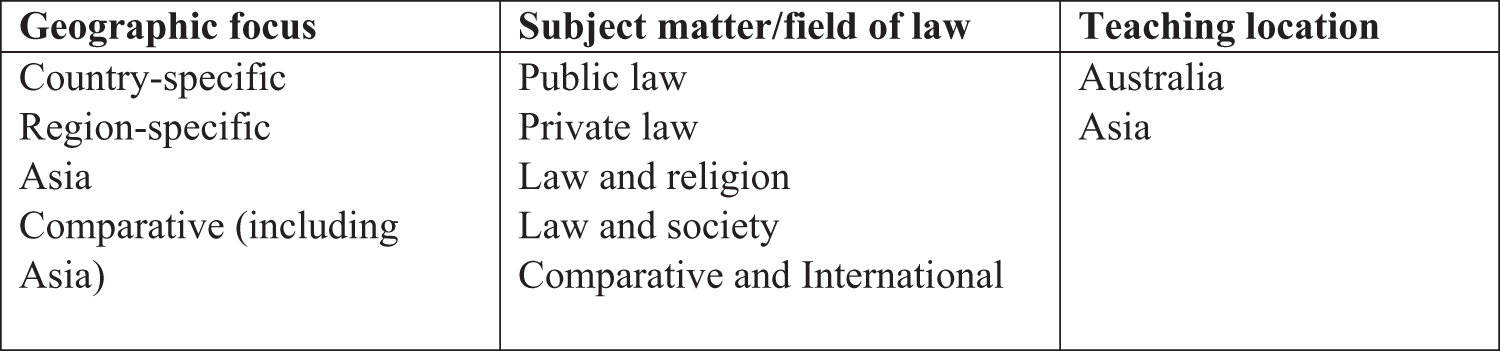

 Open access

