




1 Introduction
Let $\mathrm {spec}({\mathfrak {a}_{\text {e}}})$
denote the set of all sizes of maximal eventually different families and
$\mathrm {spec}({\mathfrak {a}_{\text {e}}})$
denote the set of all sizes of maximal eventually different families and ${{\mathfrak {a}}_{\text {e}}}$
its minimum (see Definition 2.1). Of particular interest for us are the following two well-known open questions. Since
${{\mathfrak {a}}_{\text {e}}}$
its minimum (see Definition 2.1). Of particular interest for us are the following two well-known open questions. Since $\mathrm {non}({\mathcal {M}}) \leq {{\mathfrak {a}}_{\text {e}}}$
[Reference Bartoszyński and Judah1] and
$\mathrm {non}({\mathcal {M}}) \leq {{\mathfrak {a}}_{\text {e}}}$
[Reference Bartoszyński and Judah1] and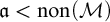 ${{\mathfrak {a}}} < \mathrm {non}({\mathcal {M}})$
is consistent (e.g., in the random model), also
${{\mathfrak {a}}} < \mathrm {non}({\mathcal {M}})$
is consistent (e.g., in the random model), also ${{\mathfrak {a}}} < {{\mathfrak {a}}_{\text {e}}}$
is consistent. However, the consistency of the other direction is an open problem.
${{\mathfrak {a}}} < {{\mathfrak {a}}_{\text {e}}}$
is consistent. However, the consistency of the other direction is an open problem.
Question 1.1. Does $\mathsf {ZFC}$
prove
$\mathsf {ZFC}$
prove ${{\mathfrak {a}}} \leq {{\mathfrak {a}}_{\text {e}}}$
?
${{\mathfrak {a}}} \leq {{\mathfrak {a}}_{\text {e}}}$
?
Secondly, among various types of combinatorial families it seems to be a recurrent feature that their spectra are closed under singular limits. Hechler proved this property for mad families in [Reference Hechler5] and Brian recently verified this also for partitions of Baire space into compact sets in [Reference Brian2]. The analogous question for many other types of combinatorial families is still open, for example, for independent families, cofinitary groups, or maximal eventually different families.
Question 1.2. Is $\mathrm {spec}({{\mathfrak {a}}_{\text {e}}})$
closed under singular limits?
$\mathrm {spec}({{\mathfrak {a}}_{\text {e}}})$
closed under singular limits?
Instead of answering these questions for maximal eventually different families, we will instead consider them for the strengthened notion of Van Douwen families. A maximal eventually different family is called Van Douwen iff it is also maximal with respect to infinite partial functions (see Definition 2.3). Van Douwen asked whether families with this strong kind of maximality always exists (see problem 4.2 in Miller’s problem list [Reference Miller9]). Zhang proved in [Reference Zhang12] that Van Douwen families of desired sizes may be forced by a c.c.c. forcing, so that MA implies the existence of a Van Douwen family of size ${\mathfrak {c}}$
. Later, Raghavan [Reference Raghavan10] proved that indeed there always is a Van Douwen family of size
${\mathfrak {c}}$
. Later, Raghavan [Reference Raghavan10] proved that indeed there always is a Van Douwen family of size ${\mathfrak {c}}$
. So, let
${\mathfrak {c}}$
. So, let $\mathrm {spec}({{\mathfrak {a}}_{\text {v}}})$
be the set of sizes of Van Douwen families and
$\mathrm {spec}({{\mathfrak {a}}_{\text {v}}})$
be the set of sizes of Van Douwen families and ${{\mathfrak {a}}_{\text {v}}}$
its minimum. It is not hard to prove and well-known that
${{\mathfrak {a}}_{\text {v}}}$
its minimum. It is not hard to prove and well-known that ${{\mathfrak {a}}} \leq {{\mathfrak {a}}_{\text {v}}}$
holds (see Corollary 2.7), so Question 1.1 has a positive answer for Van Douwen families. Using a similar argument in Lemma 3.3 we show that the standard forcing
${{\mathfrak {a}}} \leq {{\mathfrak {a}}_{\text {v}}}$
holds (see Corollary 2.7), so Question 1.1 has a positive answer for Van Douwen families. Using a similar argument in Lemma 3.3 we show that the standard forcing ${\mathbb {E}}_{\mathcal {F}}(I)$
for extending an eventually different family
${\mathbb {E}}_{\mathcal {F}}(I)$
for extending an eventually different family ${\mathcal {F}}$
by I-many elements to a maximal eventually different family of size
${\mathcal {F}}$
by I-many elements to a maximal eventually different family of size $\max (\left |{\mathcal {F}}\right |, \left |I\right |)$
also adds a maximal almost disjoint family of the same size.
$\max (\left |{\mathcal {F}}\right |, \left |I\right |)$
also adds a maximal almost disjoint family of the same size.
Lemma. Let ${\mathcal {F}}$
be an eventually different family and I an uncountable index set. Then
${\mathcal {F}}$
be an eventually different family and I an uncountable index set. Then
 $$ \begin{align*} {\mathbb{E}}_{\mathcal{F}}(I) {{ \, \Vdash \, }}\max(\left|{\mathcal{F}}\right|, \left|I\right|) \in \mathrm{spec}({{\mathfrak{a}}}). \end{align*} $$
Hence, the standard forcing for realizing a desired spectrum of ${{\mathfrak {a}}_{\text {e}}}$
also forces
${{\mathfrak {a}}_{\text {e}}}$
also forces ${{\mathfrak {a}}}$
to have the same spectrum and thus cannot be used to separate them. Further, as it is the case for
${{\mathfrak {a}}}$
to have the same spectrum and thus cannot be used to separate them. Further, as it is the case for ${{\mathfrak {a}}}$
and
${{\mathfrak {a}}}$
and ${\mathfrak {a}_{\text {T}}}$
, in Theorem 4.1 we show that Question 1.2 also has a positive answer for Van Douwen families.
${\mathfrak {a}_{\text {T}}}$
, in Theorem 4.1 we show that Question 1.2 also has a positive answer for Van Douwen families.
Theorem. $\mathrm {spec}({{\mathfrak {a}}_{\text {v}}})$
is closed under singular limits.
$\mathrm {spec}({{\mathfrak {a}}_{\text {v}}})$
is closed under singular limits.
Clearly, we have that $\mathrm {spec}({{\mathfrak {a}}_{\text {v}}}) \subseteq \mathrm {spec}({{\mathfrak {a}}_{\text {e}}})$
. One of the central open questions regarding Van Douwen families is if we always have equality.
$\mathrm {spec}({{\mathfrak {a}}_{\text {v}}}) \subseteq \mathrm {spec}({{\mathfrak {a}}_{\text {e}}})$
. One of the central open questions regarding Van Douwen families is if we always have equality.
Question 1.3. Does $\mathrm {spec}({{\mathfrak {a}}_{\text {v}}}) = \mathrm {spec}({{\mathfrak {a}}_{\text {e}}})$
hold?
$\mathrm {spec}({{\mathfrak {a}}_{\text {v}}}) = \mathrm {spec}({{\mathfrak {a}}_{\text {e}}})$
hold?
Notice, that a positive answer together with our Theorem 4.1 would yield a positive answer for the well-known open Question 1.2. Moreover, in order to answer Question 1.1 the following weaker version would suffice.
Question 1.4. Does ${{\mathfrak {a}}_{\text {v}}} = {{\mathfrak {a}}_{\text {e}}}$
hold?
${{\mathfrak {a}}_{\text {v}}} = {{\mathfrak {a}}_{\text {e}}}$
hold?
Towards an answer to this question, it is interesting to also study non Van Douwen families as well as their indestructibility via forcing. For any maximal eventually different family ${\mathcal {F}}$
in [Reference Raghavan10] Raghavan defined an associated ideal
${\mathcal {F}}$
in [Reference Raghavan10] Raghavan defined an associated ideal ${\mathcal {I}}_0({\mathcal {F}})$
which measures how far the family is from being Van Douwen (see Definition 5.1). This ideal is always proper and contains
${\mathcal {I}}_0({\mathcal {F}})$
which measures how far the family is from being Van Douwen (see Definition 5.1). This ideal is always proper and contains $\text {Fin}$
(see Proposition 5.2) and all ideals in this article are assumed to be of this form. We prove that under CH any ideal may be realized as the associated ideal of some maximal eventually different family (see Theorem 5.6), i.e., there are many different maximal eventually different but non Van Douwen families.
$\text {Fin}$
(see Proposition 5.2) and all ideals in this article are assumed to be of this form. We prove that under CH any ideal may be realized as the associated ideal of some maximal eventually different family (see Theorem 5.6), i.e., there are many different maximal eventually different but non Van Douwen families.
Theorem. Assume CH and let ${\mathcal {I}}$
be an ideal. Then there is a maximal eventually different family such that
${\mathcal {I}}$
be an ideal. Then there is a maximal eventually different family such that ${\mathcal {I}} = {\mathcal {I}}_0({\mathcal {F}})$
.
${\mathcal {I}} = {\mathcal {I}}_0({\mathcal {F}})$
.
Finally, towards the potential consistency of ${{\mathfrak {a}}_{\text {e}}} < {{\mathfrak {a}}_{\text {v}}}$
we also show that the associated ideal
${{\mathfrak {a}}_{\text {e}}} < {{\mathfrak {a}}_{\text {v}}}$
we also show that the associated ideal ${\mathcal {I}}_0({\mathcal {F}})$
of a maximal eventually different family
${\mathcal {I}}_0({\mathcal {F}})$
of a maximal eventually different family ${\mathcal {F}}$
may exhibit some forcing indestructibility, i.e., in the forcing extension
${\mathcal {F}}$
may exhibit some forcing indestructibility, i.e., in the forcing extension $V[G]$
we have that
$V[G]$
we have that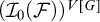 $({\mathcal {I}}_0({\mathcal {F}}))^{V[G]}$
is the ideal generated by
$({\mathcal {I}}_0({\mathcal {F}}))^{V[G]}$
is the ideal generated by $({\mathcal {I}}_0({\mathcal {F}}))^V$
. Note that this also implies that the maximality of
$({\mathcal {I}}_0({\mathcal {F}}))^V$
. Note that this also implies that the maximality of ${\mathcal {F}}$
is preserved. In particular, under CH we show that the associated ideals may also be Sacks-indestructible (see Theorem 5.13).
${\mathcal {F}}$
is preserved. In particular, under CH we show that the associated ideals may also be Sacks-indestructible (see Theorem 5.13).
Theorem. Assume CH and let ${\mathcal {I}}$
be an ideal. Then there is a maximal eventually different family such that
${\mathcal {I}}$
be an ideal. Then there is a maximal eventually different family such that ${\mathcal {I}} = {\mathcal {I}}_0({\mathcal {F}})$
and
${\mathcal {I}} = {\mathcal {I}}_0({\mathcal {F}})$
and ${\mathcal {I}}_0({\mathcal {F}})$
is indestructible by any countable support iteration or product of Sacks-forcing.
${\mathcal {I}}_0({\mathcal {F}})$
is indestructible by any countable support iteration or product of Sacks-forcing.
As an immediate corollary (see Corollary 5.14) all $\aleph _1$
-generated ideals are realized in the iterated Sacks-model.
$\aleph _1$
-generated ideals are realized in the iterated Sacks-model.
Corollary. In the iterated Sacks-model for every $\aleph _1$
-generated ideal
$\aleph _1$
-generated ideal ${\mathcal {I}}$
there is a maximal eventually different family
${\mathcal {I}}$
there is a maximal eventually different family ${\mathcal {F}}$
such that
${\mathcal {F}}$
such that ${\mathcal {I}} = {\mathcal {I}}_0({\mathcal {F}})$
.
${\mathcal {I}} = {\mathcal {I}}_0({\mathcal {F}})$
.
2 Preliminaries
Definition 2.1. We say $f, g \in {{^\omega \omega }}$
are eventually different iff
$f, g \in {{^\omega \omega }}$
are eventually different iff $\{ {n < \omega } \mid {f(n) = g(n)} \}$
is finite. A family
$\{ {n < \omega } \mid {f(n) = g(n)} \}$
is finite. A family ${\mathcal {F}} \subseteq {{^\omega \omega }}$
is called eventually different (e.d.) iff all
${\mathcal {F}} \subseteq {{^\omega \omega }}$
is called eventually different (e.d.) iff all $f \neq g \in {\mathcal {F}}$
are eventually different. It is called maximal (m.e.d.) iff it is maximal with respect to inclusion. Finally, we define the associated spectrum and cardinal characteristic
$f \neq g \in {\mathcal {F}}$
are eventually different. It is called maximal (m.e.d.) iff it is maximal with respect to inclusion. Finally, we define the associated spectrum and cardinal characteristic
 $$ \begin{align*} \mathrm{spec}({{\mathfrak{a}}_{\text{e}}}) &:= {\{ {\left|{\mathcal{F}}\right|} \mid {{\mathcal{F}} \text{ is an m.e.d. family}} \}},\\ {{\mathfrak{a}}_{\text{e}}} &:= \min(\mathrm{spec}({{\mathfrak{a}}_{\text{e}}})). \end{align*} $$
Remark 2.2. For any countably infinite $A, B$
we may equivalently consider m.e.d. families
$A, B$
we may equivalently consider m.e.d. families ${\mathcal {F}} \subseteq {^{A}{B}}$
by using bijections with
${\mathcal {F}} \subseteq {^{A}{B}}$
by using bijections with $\omega $
. In most cases
$\omega $
. In most cases $A, B = \omega $
, however we will also consider the cases
$A, B = \omega $
, however we will also consider the cases $A \in {[\omega ]^{\omega }}$
and
$A \in {[\omega ]^{\omega }}$
and $B = \omega \times \omega $
.
$B = \omega \times \omega $
.
Definition 2.3. Let ${\mathcal {F}} \subseteq {{^\omega \omega }}$
and
${\mathcal {F}} \subseteq {{^\omega \omega }}$
and $A \in {[\omega ]^{\omega }}$
. Then we define
$A \in {[\omega ]^{\omega }}$
. Then we define ${\mathcal {F}} \operatorname {\mathrm {\upharpoonright }} A := {\{ {f \operatorname {\mathrm {\upharpoonright }} A} \mid {f \in {\mathcal {F}}} \}}$
. We call
${\mathcal {F}} \operatorname {\mathrm {\upharpoonright }} A := {\{ {f \operatorname {\mathrm {\upharpoonright }} A} \mid {f \in {\mathcal {F}}} \}}$
. We call ${\mathcal {F}}$
Van Douwen iff
${\mathcal {F}}$
Van Douwen iff ${\mathcal {F}} \operatorname {\mathrm {\upharpoonright }} A$
is an m.e.d. family for all
${\mathcal {F}} \operatorname {\mathrm {\upharpoonright }} A$
is an m.e.d. family for all $A \in {[\omega ]^{\omega }}$
. Analogously, we define the associated spectrum and cardinal characteristic
$A \in {[\omega ]^{\omega }}$
. Analogously, we define the associated spectrum and cardinal characteristic
 $$ \begin{align*} \mathrm{spec}({{\mathfrak{a}}_{\text{v}}}) &:= {\{ {\left|{\mathcal{F}}\right|} \mid {{\mathcal{F}} \text{ is Van Douwen}} \}},\\ {{\mathfrak{a}}_{\text{v}}} &:= \min(\mathrm{spec}({{\mathfrak{a}}_{\text{v}}})). \end{align*} $$
Clearly, we have $\mathrm {spec}({{\mathfrak {a}}_{\text {v}}}) \subseteq \mathrm {spec}({{\mathfrak {a}}_{\text {e}}})$
, so also
$\mathrm {spec}({{\mathfrak {a}}_{\text {v}}}) \subseteq \mathrm {spec}({{\mathfrak {a}}_{\text {e}}})$
, so also ${{\mathfrak {a}}_{\text {e}}} \leq {{\mathfrak {a}}_{\text {v}}}$
. Unlike with other notions of strong maximality, such as
${{\mathfrak {a}}_{\text {e}}} \leq {{\mathfrak {a}}_{\text {v}}}$
. Unlike with other notions of strong maximality, such as $\omega $
-maximality or tightness, Raghavan [Reference Raghavan10] proved that there always exists a Van Douwen family of size
$\omega $
-maximality or tightness, Raghavan [Reference Raghavan10] proved that there always exists a Van Douwen family of size ${\mathfrak {c}}$
, i.e., the cardinal characteristic
${\mathfrak {c}}$
, i.e., the cardinal characteristic ${{\mathfrak {a}}_{\text {v}}}$
is well-defined. Next, we present a short argument of the well-known fact that
${{\mathfrak {a}}_{\text {v}}}$
is well-defined. Next, we present a short argument of the well-known fact that ${{\mathfrak {a}}} \leq {{\mathfrak {a}}_{\text {v}}}$
holds.
${{\mathfrak {a}}} \leq {{\mathfrak {a}}_{\text {v}}}$
holds.
Definition 2.4. Let ${\mathcal {F}}$
be an e.d. family. Then we define
${\mathcal {F}}$
be an e.d. family. Then we define
 $$ \begin{align*}\operatorname{\mathrm{cov}}({\mathcal{F}}) := {\{ {g \in {{^\omega \omega}}} \mid {\exists {\mathcal{F}}_0 \in {[{\mathcal{F}}]^{<\omega}}\ \exists N < \omega \ \forall n \geq N \ \exists f \in {\mathcal{F}}_0 \ f(n) = g(n)} \}}, \end{align*} $$
i.e., $g \in \operatorname {\mathrm {cov}}({\mathcal {F}})$
iff its graph can almost be covered by finitely many elements of
$g \in \operatorname {\mathrm {cov}}({\mathcal {F}})$
iff its graph can almost be covered by finitely many elements of ${\mathcal {F}}$
. Further, we set
${\mathcal {F}}$
. Further, we set $\operatorname {\mathrm {cov}}^+({\mathcal {F}}) := {{^\omega \omega }} \setminus \operatorname {\mathrm {cov}}({\mathcal {F}})$
.
$\operatorname {\mathrm {cov}}^+({\mathcal {F}}) := {{^\omega \omega }} \setminus \operatorname {\mathrm {cov}}({\mathcal {F}})$
.
Proposition 2.5. Let ${\mathcal {F}}$
be an e.d. family,
${\mathcal {F}}$
be an e.d. family, $g \in {{^\omega \omega }}$
,
$g \in {{^\omega \omega }}$
, ${\mathcal {F}}_1 \in {[{\mathcal {F}}]^{\omega }}$
, and assume
${\mathcal {F}}_1 \in {[{\mathcal {F}}]^{\omega }}$
, and assume $g =^\infty f$
for every
$g =^\infty f$
for every $f \in {\mathcal {F}}_1$
. Then
$f \in {\mathcal {F}}_1$
. Then $g \in \operatorname {\mathrm {cov}}^+({\mathcal {F}})$
.
$g \in \operatorname {\mathrm {cov}}^+({\mathcal {F}})$
.
Proof. Let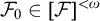 ${\mathcal {F}}_0 \in {[{\mathcal {F}}]^{<\omega }}$
and
${\mathcal {F}}_0 \in {[{\mathcal {F}}]^{<\omega }}$
and $N_0 < \omega $
. Choose
$N_0 < \omega $
. Choose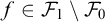 $f \in {\mathcal {F}}_1 \setminus {\mathcal {F}}_0$
. Since
$f \in {\mathcal {F}}_1 \setminus {\mathcal {F}}_0$
. Since ${\mathcal {F}}$
is e.d. choose
${\mathcal {F}}$
is e.d. choose $N_1 \geq N_0$
such that
$N_1 \geq N_0$
such that $f(n) \neq f_0(n)$
for all
$f(n) \neq f_0(n)$
for all $f_0 \in {\mathcal {F}}_0$
and
$f_0 \in {\mathcal {F}}_0$
and $n \geq N_1$
. Since
$n \geq N_1$
. Since $g =^\infty f$
choose
$g =^\infty f$
choose $n \geq N_1$
such that
$n \geq N_1$
such that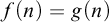 $f(n) = g(n)$
. Hence,
$f(n) = g(n)$
. Hence, $g(n) \neq f_0(n)$
for all
$g(n) \neq f_0(n)$
for all $f_0 \in {\mathcal {F}}_0$
. Thus,
$f_0 \in {\mathcal {F}}_0$
. Thus, $g \in \operatorname {\mathrm {cov}}^+({\mathcal {F}})$
.
$g \in \operatorname {\mathrm {cov}}^+({\mathcal {F}})$
.
Proposition 2.6. Let ${\mathcal {F}}$
be an e.d. family and
${\mathcal {F}}$
be an e.d. family and $g \in {{^\omega \omega }}$
. For every
$g \in {{^\omega \omega }}$
. For every $f \in {\mathcal {F}}$
define
$f \in {\mathcal {F}}$
define
 $$ \begin{align*}E_g^f := {\{ {n < \omega} \mid {f(n) = g(n)} \}}. \end{align*} $$
Then, ${\mathcal {A}}^{\mathcal {F}}_g := {\{ {E_g^f} \mid {f \in {\mathcal {F}} \text { with } E_g^f \in {[\omega ]^{\omega }}} \}}$
is an ad family and
${\mathcal {A}}^{\mathcal {F}}_g := {\{ {E_g^f} \mid {f \in {\mathcal {F}} \text { with } E_g^f \in {[\omega ]^{\omega }}} \}}$
is an ad family and $g \in \operatorname {\mathrm {cov}}({\mathcal {F}})$
implies that
$g \in \operatorname {\mathrm {cov}}({\mathcal {F}})$
implies that ${\mathcal {A}}_g^{\mathcal {F}}$
is a finite mad family. If
${\mathcal {A}}_g^{\mathcal {F}}$
is a finite mad family. If ${\mathcal {F}}$
is additionally Van Douwen, then
${\mathcal {F}}$
is additionally Van Douwen, then ${\mathcal {A}}_g^{\mathcal {F}}$
is always a (possibly finite) mad family and
${\mathcal {A}}_g^{\mathcal {F}}$
is always a (possibly finite) mad family and $g \in \operatorname {\mathrm {cov}}({\mathcal {F}})$
iff
$g \in \operatorname {\mathrm {cov}}({\mathcal {F}})$
iff ${\mathcal {A}}^{\mathcal {F}}_g$
is finite.
${\mathcal {A}}^{\mathcal {F}}_g$
is finite.
Proof. Note that ${\mathcal {A}}^{\mathcal {F}}_g$
is almost disjoint as for all
${\mathcal {A}}^{\mathcal {F}}_g$
is almost disjoint as for all $f \neq f' \in {\mathcal {F}}$
we have that f and
$f \neq f' \in {\mathcal {F}}$
we have that f and $f'$
are eventually different. Hence,
$f'$
are eventually different. Hence, $E^f_g \cap E^{f'}_g$
is finite. Next, assuming
$E^f_g \cap E^{f'}_g$
is finite. Next, assuming ${\mathcal {F}}$
is Van Douwen, let
${\mathcal {F}}$
is Van Douwen, let $A \in {[\omega ]^{\omega }}$
. Choose
$A \in {[\omega ]^{\omega }}$
. Choose $f \in {\mathcal {F}}$
and
$f \in {\mathcal {F}}$
and $B \in {[A]^{\omega }}$
such that
$B \in {[A]^{\omega }}$
such that $f \operatorname {\mathrm {\upharpoonright }} B = g \operatorname {\mathrm {\upharpoonright }} B$
. Thus,
$f \operatorname {\mathrm {\upharpoonright }} B = g \operatorname {\mathrm {\upharpoonright }} B$
. Thus, $B \subseteq E^f_g$
, which shows that
$B \subseteq E^f_g$
, which shows that $E^f_g \in {\mathcal {A}}_g^{\mathcal {F}}$
and
$E^f_g \in {\mathcal {A}}_g^{\mathcal {F}}$
and $A \cap E^f_g$
is infinite. Hence,
$A \cap E^f_g$
is infinite. Hence, ${\mathcal {A}}^{\mathcal {F}}_g$
is maximal.
${\mathcal {A}}^{\mathcal {F}}_g$
is maximal.
Now, assume $g \in \operatorname {\mathrm {cov}}({\mathcal {F}})$
. Choose
$g \in \operatorname {\mathrm {cov}}({\mathcal {F}})$
. Choose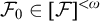 ${\mathcal {F}}_0 \in {[{\mathcal {F}}]^{<\omega }}$
as in the definition of
${\mathcal {F}}_0 \in {[{\mathcal {F}}]^{<\omega }}$
as in the definition of $\operatorname {\mathrm {cov}}({\mathcal {F}})$
and let
$\operatorname {\mathrm {cov}}({\mathcal {F}})$
and let $f \in {\mathcal {F}} \setminus {\mathcal {F}}_0$
. But if
$f \in {\mathcal {F}} \setminus {\mathcal {F}}_0$
. But if $E^f_g \in {[\omega ]^{\omega }}$
there would be a
$E^f_g \in {[\omega ]^{\omega }}$
there would be a $f_0 \in {\mathcal {F}}_0$
such that
$f_0 \in {\mathcal {F}}_0$
such that $E^f_g \cap E^{f_0}_g$
is infinite, i.e., f and
$E^f_g \cap E^{f_0}_g$
is infinite, i.e., f and $f_0$
are not eventually different, a contradiction. Thus,
$f_0$
are not eventually different, a contradiction. Thus, $E^f_g \notin {\mathcal {A}}_g^{\mathcal {F}}$
and hence
$E^f_g \notin {\mathcal {A}}_g^{\mathcal {F}}$
and hence ${\mathcal {A}}_g^{\mathcal {F}}$
is finite. We also have
${\mathcal {A}}_g^{\mathcal {F}}$
is finite. We also have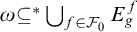 $\omega {\subseteq ^{*}} \bigcup _{f \in {\mathcal {F}}_0}E^f_g$
, so
$\omega {\subseteq ^{*}} \bigcup _{f \in {\mathcal {F}}_0}E^f_g$
, so ${\mathcal {A}}^{\mathcal {F}}_g$
is a finite mad family.
${\mathcal {A}}^{\mathcal {F}}_g$
is a finite mad family.
Finally, assume ${\mathcal {A}}_g^{\mathcal {F}}$
is finite and
${\mathcal {A}}_g^{\mathcal {F}}$
is finite and ${\mathcal {F}}$
is Van Douwen. Then we may choose a finite subset
${\mathcal {F}}$
is Van Douwen. Then we may choose a finite subset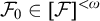 ${\mathcal {F}}_0 \in {[{\mathcal {F}}]^{<\omega }}$
with
${\mathcal {F}}_0 \in {[{\mathcal {F}}]^{<\omega }}$
with ${\mathcal {A}}_g^{\mathcal {F}} = {\{ {E^f_g} \mid {f \in {\mathcal {F}}_0 \text { and } E^f_g \in {[\omega ]^{\omega }}} \}}$
. By the argument above
${\mathcal {A}}_g^{\mathcal {F}} = {\{ {E^f_g} \mid {f \in {\mathcal {F}}_0 \text { and } E^f_g \in {[\omega ]^{\omega }}} \}}$
. By the argument above ${\mathcal {A}}_g^{\mathcal {F}}$
is maximal, so we have
${\mathcal {A}}_g^{\mathcal {F}}$
is maximal, so we have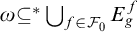 $\omega {\subseteq ^{*}} \bigcup _{f \in {\mathcal {F}}_0}E^f_g$
. Hence,
$\omega {\subseteq ^{*}} \bigcup _{f \in {\mathcal {F}}_0}E^f_g$
. Hence, $g \in \operatorname {\mathrm {cov}}({\mathcal {F}})$
is witnessed by
$g \in \operatorname {\mathrm {cov}}({\mathcal {F}})$
is witnessed by ${\mathcal {F}}_0$
.
${\mathcal {F}}_0$
.
Corollary 2.7. ${{\mathfrak {a}}} \leq {{\mathfrak {a}}_{\text {v}}}$
.
${{\mathfrak {a}}} \leq {{\mathfrak {a}}_{\text {v}}}$
.
Proof. Let ${\mathcal {F}}$
be a witness for
${\mathcal {F}}$
be a witness for ${{\mathfrak {a}}_{\text {v}}}$
. By the previous proposition it suffices to find a
${{\mathfrak {a}}_{\text {v}}}$
. By the previous proposition it suffices to find a $g \in \operatorname {\mathrm {cov}}^+({\mathcal {F}})$
. Choose a disjoint partition
$g \in \operatorname {\mathrm {cov}}^+({\mathcal {F}})$
. Choose a disjoint partition $\omega = \bigcup _{k < \omega } A_k$
into infinite sets and a subset
$\omega = \bigcup _{k < \omega } A_k$
into infinite sets and a subset ${\{ {f_k} \mid {k < \omega } \}}$
from
${\{ {f_k} \mid {k < \omega } \}}$
from ${\mathcal {F}}$
. Then, we define
${\mathcal {F}}$
. Then, we define
 $$ \begin{align*}g(n) := f_k(n), \text{ where } n \in A_k. \end{align*} $$
But then $g =^\infty f_k$
for every
$g =^\infty f_k$
for every $k < \omega $
, so by Proposition 2.5 we have
$k < \omega $
, so by Proposition 2.5 we have $g \in \operatorname {\mathrm {cov}}^+({\mathcal {F}})$
.
$g \in \operatorname {\mathrm {cov}}^+({\mathcal {F}})$
.
Remark 2.8. As in Proposition 2.6 for any eventually different family ${\mathcal {F}}$
we may define its trace
${\mathcal {F}}$
we may define its trace
 $$ \begin{align*}\operatorname{\mathrm{tr}}({\mathcal{F}}) := {\{ {g \in {{^\omega \omega}}} \mid {{\mathcal{A}}^{\mathcal{F}}_g \text{ is a (possibly finite) mad family}} \}}. \end{align*} $$
Proposition 2.6 then implies that $\operatorname {\mathrm {cov}}({\mathcal {F}}) \subseteq \operatorname {\mathrm {tr}}({\mathcal {F}})$
and Van Douwen families satisfy
$\operatorname {\mathrm {cov}}({\mathcal {F}}) \subseteq \operatorname {\mathrm {tr}}({\mathcal {F}})$
and Van Douwen families satisfy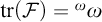 $\operatorname {\mathrm {tr}}({\mathcal {F}}) = {{^\omega \omega }}$
. Conversely,
$\operatorname {\mathrm {tr}}({\mathcal {F}}) = {{^\omega \omega }}$
. Conversely, $\operatorname {\mathrm {tr}}({\mathcal {F}}) = {{^\omega \omega }}$
also implies that
$\operatorname {\mathrm {tr}}({\mathcal {F}}) = {{^\omega \omega }}$
also implies that ${\mathcal {F}}$
is Van Douwen, for if
${\mathcal {F}}$
is Van Douwen, for if $A \in {[\omega ]^{\omega }}$
and
$A \in {[\omega ]^{\omega }}$
and $g: A \to \omega $
, let
$g: A \to \omega $
, let $g^*$
be any extension of g to
$g^*$
be any extension of g to $\omega $
. By assumption
$\omega $
. By assumption ${\mathcal {A}}^{\mathcal {F}}_{g^*}$
is mad, so choose
${\mathcal {A}}^{\mathcal {F}}_{g^*}$
is mad, so choose $f \in {\mathcal {F}}$
with
$f \in {\mathcal {F}}$
with $E^f_{g^*} \cap A$
infinite. But then
$E^f_{g^*} \cap A$
infinite. But then $f \operatorname {\mathrm {\upharpoonright }} (E^f_{g^*} \cap A) =^\infty g \operatorname {\mathrm {\upharpoonright }} (E^f_{g^*} \cap A)$
, i.e.,
$f \operatorname {\mathrm {\upharpoonright }} (E^f_{g^*} \cap A) =^\infty g \operatorname {\mathrm {\upharpoonright }} (E^f_{g^*} \cap A)$
, i.e., ${\mathcal {F}}$
is Van Douwen. Note that the trace is one of the crucial ingredients of the ZFC-construction of a Van Douwen family in [Reference Raghavan10].
${\mathcal {F}}$
is Van Douwen. Note that the trace is one of the crucial ingredients of the ZFC-construction of a Van Douwen family in [Reference Raghavan10].
3 ${\mathbb {E}}_{\mathcal {F}}(I)$
adds a mad family of size
$\max (\left |{\mathcal {F}}\right |, \left |I\right |)$
${\mathbb {E}}_{\mathcal {F}}(I)$
adds a mad family of size
$\max (\left |{\mathcal {F}}\right |, \left |I\right |)$


Remember the standard c.c.c. forcing ${\mathbb {E}}_{\mathcal {F}}(I)$
for extending an eventually different family
${\mathbb {E}}_{\mathcal {F}}(I)$
for extending an eventually different family ${\mathcal {F}}$
by I-many new eventually different reals.
${\mathcal {F}}$
by I-many new eventually different reals.
Definition 3.1. Let ${\mathcal {F}}$
be an e.d. family and I an index set. Let
${\mathcal {F}}$
be an e.d. family and I an index set. Let ${\mathbb {E}}_{\mathcal {F}}(I)$
be the partial order of pairs
${\mathbb {E}}_{\mathcal {F}}(I)$
be the partial order of pairs $(s, E)$
, where
$(s, E)$
, where $s:I \times \omega {{\overset {\text {part}}{\to }}} \omega $
is a finite partial function and
$s:I \times \omega {{\overset {\text {part}}{\to }}} \omega $
is a finite partial function and $E \in {[{\mathcal {F}}]^{<\omega }}$
. For
$E \in {[{\mathcal {F}}]^{<\omega }}$
. For $(s, E) \in {\mathbb {E}}_{\mathcal {F}}(I)$
and
$(s, E) \in {\mathbb {E}}_{\mathcal {F}}(I)$
and $i \in I$
we define the finite partial function
$i \in I$
we define the finite partial function $s_i:\omega {{\overset {\text {part}}{\to }}} \omega $
by
$s_i:\omega {{\overset {\text {part}}{\to }}} \omega $
by $s_i := {\{ {(n,m)} \mid {(i,n,m) \in s} \}}$
and set
$s_i := {\{ {(n,m)} \mid {(i,n,m) \in s} \}}$
and set $\operatorname {\mathrm {supp}}(s) := {\{ {i \in I} \mid {s_i \neq \emptyset } \}}$
. For
$\operatorname {\mathrm {supp}}(s) := {\{ {i \in I} \mid {s_i \neq \emptyset } \}}$
. For $(s, E), (t, F) \in {\mathbb {E}}_{\mathcal {F}}(I)$
we define
$(s, E), (t, F) \in {\mathbb {E}}_{\mathcal {F}}(I)$
we define $(t, F) \operatorname {\mathrm {{\mathbin {\leq }}}} (s, E)$
iff
$(t, F) \operatorname {\mathrm {{\mathbin {\leq }}}} (s, E)$
iff
-
(1)
$s \subseteq t$
and
$E \subseteq F$
; -
(2) for all
$i \neq j \in \operatorname {\mathrm {supp}}(s)$
and
$n \in \operatorname {\mathrm {dom}}(t_i) \setminus \operatorname {\mathrm {dom}}(s_i)$
we have
$n \notin \operatorname {\mathrm {dom}}(t_j)$
or
$t_i(n) \neq t_j(n)$
; -
(3) for all
$i \in \operatorname {\mathrm {supp}}(s)$
,
$f \in E$
and
$n \in \operatorname {\mathrm {dom}}(t_i) \setminus \operatorname {\mathrm {dom}}(s_i)$
we have
$t_i(n) \neq f(n)$
.








For $\left |I\right | = 1$
Zhang [Reference Zhang12] proved that a finite support, uncountable cofinality iteration of this forcing yields a Van Douwen family. With similar arguments we also have for the product version.
$\left |I\right | = 1$
Zhang [Reference Zhang12] proved that a finite support, uncountable cofinality iteration of this forcing yields a Van Douwen family. With similar arguments we also have for the product version.
Lemma 3.2. Let ${\mathcal {F}}$
be an eventually different family and I an uncountable index set. Then
${\mathcal {F}}$
be an eventually different family and I an uncountable index set. Then
 $$ \begin{align*}{\mathbb{E}}_{\mathcal{F}}(I) {{ \, \Vdash \, }} {\mathcal{F}} \cup \dot{{\mathcal{F}}}_{\text{gen}} \text{ is a Van Douwen family}, \end{align*} $$
where $\dot {{\mathcal {F}}}_{\text {gen}} = {\{ {\dot {f}^i_{\text {gen}}} \mid {i \in I} \}}$
is the family I-many eventually different reals added by
$\dot {{\mathcal {F}}}_{\text {gen}} = {\{ {\dot {f}^i_{\text {gen}}} \mid {i \in I} \}}$
is the family I-many eventually different reals added by ${\mathbb {E}}_{\mathcal {F}}(I)$
.
${\mathbb {E}}_{\mathcal {F}}(I)$
.
Note that in contrast to the iteration-version Zhang considered in [Reference Zhang12], with the product-version it is possible to add Van Douwen families of uncountable size with countable cofinality. We use Lemma 3.2 and a similar argument as in the proof of ${{\mathfrak {a}}} \leq {{\mathfrak {a}}_{\text {v}}}$
(Corollary 2.7) to prove that the standard forcing to realize a desired spectrum of
${{\mathfrak {a}}} \leq {{\mathfrak {a}}_{\text {v}}}$
(Corollary 2.7) to prove that the standard forcing to realize a desired spectrum of ${{\mathfrak {a}}_{\text {e}}}$
also forces
${{\mathfrak {a}}_{\text {e}}}$
also forces ${{\mathfrak {a}}}$
to have the same spectrum.
${{\mathfrak {a}}}$
to have the same spectrum.
Lemma 3.3. Let ${\mathcal {F}}$
be an eventually different family and I an uncountable index set. Then
${\mathcal {F}}$
be an eventually different family and I an uncountable index set. Then
 $$ \begin{align*}{\mathbb{E}}_{\mathcal{F}}(I) {{ \, \Vdash \, }} \max(\left|{\mathcal{F}}\right|, \left|I\right|) \in \mathrm{spec}({{\mathfrak{a}}}). \end{align*} $$
Proof. Choose a disjoint partition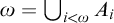 $\omega = \bigcup _{i < \omega } A_i$
into infinite sets and a subset
$\omega = \bigcup _{i < \omega } A_i$
into infinite sets and a subset $I_0 = {\{ {i_k} \mid {k < \omega } \}}$
from I. Let G be
$I_0 = {\{ {i_k} \mid {k < \omega } \}}$
from I. Let G be ${\mathbb {E}}_{\mathcal {F}}(I)$
-generic. In
${\mathbb {E}}_{\mathcal {F}}(I)$
-generic. In $V[G]$
we define
$V[G]$
we define
 $$ \begin{align*}g(n) := f^{i_k}_{{\text{gen}}}(n), \text{ where } n \in A_k. \end{align*} $$
By construction, we have $E_g^{f^{i_k}_{\text {gen}}} \in {[\omega ]^{\omega }}$
for all
$E_g^{f^{i_k}_{\text {gen}}} \in {[\omega ]^{\omega }}$
for all $k < \omega $
. We show that also
$k < \omega $
. We show that also $E_g^f \in {[\omega ]^{\omega }}$
for all
$E_g^f \in {[\omega ]^{\omega }}$
for all $f \in {\mathcal {F}}$
. So in V fix
$f \in {\mathcal {F}}$
. So in V fix $f \in {\mathcal {F}}$
and let
$f \in {\mathcal {F}}$
and let $N < \omega $
and
$N < \omega $
and $(s, E) \in {\mathbb {E}}_{\mathcal {F}}(I)$
. Choose
$(s, E) \in {\mathbb {E}}_{\mathcal {F}}(I)$
. Choose $k < \omega $
such that
$k < \omega $
such that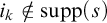 $i_k \notin \operatorname {\mathrm {supp}}(s)$
and
$i_k \notin \operatorname {\mathrm {supp}}(s)$
and $n \geq N$
with
$n \geq N$
with $n \in A_k$
. Then
$n \in A_k$
. Then $(s \cup {\{{(i_k, n, f(n))}\}}, E) \in {\mathbb {E}}_{\mathcal {F}}(I)$
,
$(s \cup {\{{(i_k, n, f(n))}\}}, E) \in {\mathbb {E}}_{\mathcal {F}}(I)$
, $(s \cup {\{{(i_k, n, f(n))}\}}, E) \operatorname {\mathrm {{\mathbin {\leq }}}} (s,E)$
, and
$(s \cup {\{{(i_k, n, f(n))}\}}, E) \operatorname {\mathrm {{\mathbin {\leq }}}} (s,E)$
, and
 $$ \begin{align*}(s \cup {\{{(i_k, n, f(n))}\}}, E) {{ \, \Vdash \, }} \dot{g}(n) = \dot{f}^{i_k}_{\text{gen}}(n) = f(n). \end{align*} $$
Finally, we show that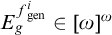 $E_g^{f^{i}_{\text {gen}}} \in {[\omega ]^{\omega }}$
for all
$E_g^{f^{i}_{\text {gen}}} \in {[\omega ]^{\omega }}$
for all $i \in I \setminus I_0$
. So in V fix
$i \in I \setminus I_0$
. So in V fix $i \in I \setminus I_0$
and let
$i \in I \setminus I_0$
and let $N < \omega $
and
$N < \omega $
and $(s, E) \in {\mathbb {E}}_{\mathcal {F}}(I)$
. We may assume that
$(s, E) \in {\mathbb {E}}_{\mathcal {F}}(I)$
. We may assume that $i \in \operatorname {\mathrm {dom}}(s)$
. Choose
$i \in \operatorname {\mathrm {dom}}(s)$
. Choose $k < \omega $
such that
$k < \omega $
such that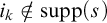 $i_k \notin \operatorname {\mathrm {supp}}(s)$
and
$i_k \notin \operatorname {\mathrm {supp}}(s)$
and $n \geq N$
with
$n \geq N$
with $n \in A_k$
and
$n \in A_k$
and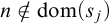 $n \notin \operatorname {\mathrm {dom}}(s_j)$
for all
$n \notin \operatorname {\mathrm {dom}}(s_j)$
for all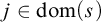 $j \in \operatorname {\mathrm {dom}}(s)$
. Finally, choose
$j \in \operatorname {\mathrm {dom}}(s)$
. Finally, choose $m \in \omega \setminus {\{ {f(n)} \mid {f \in E} \}}$
. Then we have
$m \in \omega \setminus {\{ {f(n)} \mid {f \in E} \}}$
. Then we have $(s \cup {\{{(i_k, n, m), (i, n, m)}\}}, E) \in {\mathbb {E}}_{\mathcal {F}}(I)$
,
$(s \cup {\{{(i_k, n, m), (i, n, m)}\}}, E) \in {\mathbb {E}}_{\mathcal {F}}(I)$
, $(s \cup {\{{(i_k, n, m), (i, n, m)}\}}, E) \operatorname {\mathrm {{\mathbin {\leq }}}} (s,E)$
, and
$(s \cup {\{{(i_k, n, m), (i, n, m)}\}}, E) \operatorname {\mathrm {{\mathbin {\leq }}}} (s,E)$
, and
 $$ \begin{align*}(s \cup {\{{(i_k, n, m), (i, n, m)}\}}, E) {{ \, \Vdash \, }} \dot{g}(n) = \dot{f}^{i_k}_{\text{gen}}(n) = m = \dot{f}^{i}_{\text{gen}}(n). \end{align*} $$
Hence, by Lemma 3.2 and Proposition 2.6 we obtain
 $$ \begin{align*}{\mathbb{E}}_{\mathcal{F}}(I) {{ \, \Vdash \, }} {\mathcal{A}}_{\dot{g}}^{{\mathcal{F}} \cup \dot{{\mathcal{F}}}_{\text{gen}}} \text{ is a mad family of size } \max(\left|{\mathcal{F}}\right|, \left|I\right|), \end{align*} $$
completing the proof.
4 Spectrum of Van Douwen families
In this section, similar to ${{\mathfrak {a}}}$
[Reference Hechler5] and
${{\mathfrak {a}}}$
[Reference Hechler5] and ${\mathfrak {a}_{\text {T}}}$
[Reference Brian2] we prove that the spectrum of Van Douwen families is closed under singular limits. The main idea is that we may glue a sequence of Van Douwen families together in order to obtain a bigger Van Douwen family. A similar argument fails for maximal eventually different families as the gluing argument we present here might not preserve maximality. Hence, the corresponding Question 1.2 for
${\mathfrak {a}_{\text {T}}}$
[Reference Brian2] we prove that the spectrum of Van Douwen families is closed under singular limits. The main idea is that we may glue a sequence of Van Douwen families together in order to obtain a bigger Van Douwen family. A similar argument fails for maximal eventually different families as the gluing argument we present here might not preserve maximality. Hence, the corresponding Question 1.2 for ${{\mathfrak {a}}_{\text {e}}}$
is still open.
${{\mathfrak {a}}_{\text {e}}}$
is still open.
Theorem 4.1. $\mathrm {spec}({{\mathfrak {a}}_{\text {v}}})$
is closed under singular limits.
$\mathrm {spec}({{\mathfrak {a}}_{\text {v}}})$
is closed under singular limits.
Proof. Let $\kappa = \operatorname {\mathrm {cof}}(\lambda ) < \lambda $
,
$\kappa = \operatorname {\mathrm {cof}}(\lambda ) < \lambda $
, ${\langle {\lambda _\alpha } \mid {\alpha < \kappa } \rangle }$
be an increasing sequence of cardinals cofinal in
${\langle {\lambda _\alpha } \mid {\alpha < \kappa } \rangle }$
be an increasing sequence of cardinals cofinal in $\lambda $
with
$\lambda $
with $\kappa < \lambda _0$
and
$\kappa < \lambda _0$
and ${\langle {{\mathcal {F}}_\alpha } \mid {\alpha < \kappa } \rangle }$
a sequence of Van Douwen families with
${\langle {{\mathcal {F}}_\alpha } \mid {\alpha < \kappa } \rangle }$
a sequence of Van Douwen families with $\left |{\mathcal {F}}_\alpha \right | = \lambda _\alpha $
. Choose pairwise different elements
$\left |{\mathcal {F}}_\alpha \right | = \lambda _\alpha $
. Choose pairwise different elements ${\mathcal {G}} = {\langle {g_\alpha \in {\mathcal {F}}_0} \mid {\alpha < \kappa } \rangle }$
. We construct an eventually different family of functions from
${\mathcal {G}} = {\langle {g_\alpha \in {\mathcal {F}}_0} \mid {\alpha < \kappa } \rangle }$
. We construct an eventually different family of functions from $\omega \to \omega \times \omega $
of size
$\omega \to \omega \times \omega $
of size $\lambda $
as follows:
$\lambda $
as follows:
-
• Given
$\alpha < \kappa $
and
$f \in {\mathcal {F}}_\alpha $
define
$(g_\alpha \times f):\omega \to (\omega \times \omega )$
for
$k < \omega $
by
$$ \begin{align*}(g_\alpha \times f)(k) := (g_\alpha(k), f(k)). \end{align*} $$
-
• Given
$f_0 \in {\mathcal {F}}_0 \setminus {\mathcal {G}}$
and
$f_1 \in {\mathcal {F}}_0$
define
$(f_0 \times f_1):\omega \to (\omega \times \omega )$
for
$k < \omega $
by
$$ \begin{align*}(f_0 \times f_1)(k) := (f_0(k), f_1(k)). \end{align*} $$





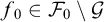


Finally, we define the family ${\mathcal {F}}$
to be the family of all functions from
${\mathcal {F}}$
to be the family of all functions from $\omega \to (\omega \times \omega )$
of one of the two forms above. Then
$\omega \to (\omega \times \omega )$
of one of the two forms above. Then ${\mathcal {F}}$
is of size
${\mathcal {F}}$
is of size $\lambda $
and we claim that
$\lambda $
and we claim that ${\mathcal {F}}$
is Van Douwen. First, we prove that
${\mathcal {F}}$
is Van Douwen. First, we prove that ${\mathcal {F}}$
is e.d., so we have to consider the following cases:
${\mathcal {F}}$
is e.d., so we have to consider the following cases:
-
• Let
$\alpha < \kappa $
and
$f \neq f' \in {\mathcal {F}}_\alpha $
. Since f and
$f'$
are e.d. choose
$K < \omega $
such that
$f(k) \neq f'(k)$
for all
$k \geq K$
. But then for every
$k \geq K$
we have
$$ \begin{align*}(g_\alpha \times f)(k) = (g_\alpha(k), f(k)) \neq (g_\alpha(k), f'(k)) = (g_\alpha \times f')(k). \end{align*} $$
-
• Let
$\alpha \neq \beta < \kappa $
and
$f \in {\mathcal {F}}_\alpha , f' \in {\mathcal {F}}_\beta $
. Since
$g_\alpha $
and
$g_\beta $
are e.d. choose
$K < \omega $
such that
$g_\alpha (k) \neq g_\beta (k)$
for all
$k \geq K$
. But then for every
$k \geq K$
we have
$$ \begin{align*}(g_\alpha \times f)(k) = (g_\alpha(k), f(k)) \neq (g_\beta(k), f'(k)) = (g_\beta \times f')(k). \end{align*} $$
-
• Let
$\alpha < \kappa $
,
$f \in {\mathcal {F}}_\alpha $
,
$f_0 \in {\mathcal {F}}_0 \setminus {\mathcal {G}}$
, and
$f_1 \in {\mathcal {F}}_0$
. Since
$g_\alpha $
and
$f_0$
are e.d. choose
$K < \omega $
such that
$g_\alpha (k) \neq f_0(k)$
for all
$k \geq K$
. But then for every
$k \geq K$
we have
$$ \begin{align*}(g_\alpha \times f)(k) = (g_\alpha(k), f(k)) \neq (f_0(k), f_1(k)) = (f_0 \times f_1)(k). \end{align*} $$
-
• Let
$f_0, f_0' \in {\mathcal {F}}_0 \setminus {\mathcal {G}}$
and
$f_1, f_1' \in {\mathcal {F}}_0$
with
$(f_0', f_1') \neq (f_0, f_1)$
. W.l.o.g. assume
$f_0 \neq f_0'$
. Then
$f_0$
and
$f_0'$
are e.d., so choose
$K < \omega $
such that
$f_0(k) \neq f^{\prime }_0(k)$
for all
$k \geq K$
. But then for every
$k \geq K$
we have
$$ \begin{align*}(f_0 \times f_1)(k) = (f_0(k), f_1(k)) \neq (f^{\prime}_0(k), f^{\prime}_1(k)) = (f^{\prime}_0 \times f^{\prime}_1)(k). \end{align*} $$













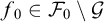






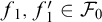






Hence, it remains to prove that ${\mathcal {F}}$
is Van Douwen. So let
${\mathcal {F}}$
is Van Douwen. So let $A \in {[\omega ]^{\omega }}$
and
$A \in {[\omega ]^{\omega }}$
and $h:A \to (\omega \times \omega )$
. For
$h:A \to (\omega \times \omega )$
. For $i \in 2$
let
$i \in 2$
let $p_i(h):A \to \omega $
be the projection of h to the i-th component. As
$p_i(h):A \to \omega $
be the projection of h to the i-th component. As ${\mathcal {F}}_0$
is Van Douwen choose
${\mathcal {F}}_0$
is Van Douwen choose $B \in {[A]^{\omega }}$
and
$B \in {[A]^{\omega }}$
and $f_0 \in {\mathcal {F}}_0$
such that
$f_0 \in {\mathcal {F}}_0$
such that $f_0 \operatorname {\mathrm {\upharpoonright }} B = p_0(h) \operatorname {\mathrm {\upharpoonright }} B$
. We consider the following two cases.
$f_0 \operatorname {\mathrm {\upharpoonright }} B = p_0(h) \operatorname {\mathrm {\upharpoonright }} B$
. We consider the following two cases. $f_0 \in {\mathcal {G}}$
. Choose
$f_0 \in {\mathcal {G}}$
. Choose $\alpha < \kappa $
such that
$\alpha < \kappa $
such that $f_0 = g_\alpha $
. As
$f_0 = g_\alpha $
. As ${\mathcal {F}}_\alpha $
is Van Douwen choose
${\mathcal {F}}_\alpha $
is Van Douwen choose $C \in {[B]^{\omega }}$
and
$C \in {[B]^{\omega }}$
and $f \in {\mathcal {F}}_\alpha $
such that
$f \in {\mathcal {F}}_\alpha $
such that $p_1(h) \operatorname {\mathrm {\upharpoonright }} C = f \operatorname {\mathrm {\upharpoonright }} C$
. But then for every
$p_1(h) \operatorname {\mathrm {\upharpoonright }} C = f \operatorname {\mathrm {\upharpoonright }} C$
. But then for every $k \in C$
we have
$k \in C$
we have
 $$ \begin{align*}(g_\alpha \times f)(k) = (g_\alpha(k), f(k)) = (p_0(h)(k), p_1(h)(k)) = h(k). \end{align*} $$
Otherwise,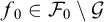 $f_0 \in {\mathcal {F}}_0 \setminus {\mathcal {G}}$
. As
$f_0 \in {\mathcal {F}}_0 \setminus {\mathcal {G}}$
. As ${\mathcal {F}}_0$
is Van Douwen choose
${\mathcal {F}}_0$
is Van Douwen choose $C \in {[B]^{\omega }}$
and
$C \in {[B]^{\omega }}$
and $f_1 \in {\mathcal {F}}_0$
with
$f_1 \in {\mathcal {F}}_0$
with $p_1(h) \operatorname {\mathrm {\upharpoonright }} C = f_1$
. But then for every
$p_1(h) \operatorname {\mathrm {\upharpoonright }} C = f_1$
. But then for every $k \in C$
we have
$k \in C$
we have
 $$ \begin{align*}(f_0 \times f_1)(k) = (f_0(k), f_1(k)) = (p_0(h)(k), p_1(h)(k)) = h(k). \end{align*} $$
Hence, in both cases h is infinitely often equal to some element in ${\mathcal {F}}\operatorname {\mathrm {\upharpoonright }} A$
.
${\mathcal {F}}\operatorname {\mathrm {\upharpoonright }} A$
.
5 Many non Van Douwen families
Given a maximal eventually different family ${\mathcal {F}}$
Raghavan in [Reference Raghavan10] introduced the following ideal
${\mathcal {F}}$
Raghavan in [Reference Raghavan10] introduced the following ideal ${\mathcal {I}}_0({\mathcal {F}})$
measuring how far
${\mathcal {I}}_0({\mathcal {F}})$
measuring how far ${\mathcal {F}}$
is from being Van Douwen.
${\mathcal {F}}$
is from being Van Douwen.
Definition 5.1. Let ${\mathcal {F}}$
be an eventually different family. Then we define
${\mathcal {F}}$
be an eventually different family. Then we define
 $$ \begin{align*}{\mathcal{I}}_0({\mathcal{F}}) := {\{ {A \in {[\omega]^{\omega}}} \mid {{\mathcal{F}} \operatorname{\mathrm{\upharpoonright}} A \text{ is not a m.e.d. family}} \}} \cup \mathrm{Fin}. \end{align*} $$
Note that ${\mathcal {I}}_0({\mathcal {F}})$
is proper iff
${\mathcal {I}}_0({\mathcal {F}})$
is proper iff ${\mathcal {F}}$
is a maximal eventually different family. We also verify that it is indeed an ideal.
${\mathcal {F}}$
is a maximal eventually different family. We also verify that it is indeed an ideal.
Proposition 5.2. ${\mathcal {I}}_0({\mathcal {F}})$
is an ideal.
${\mathcal {I}}_0({\mathcal {F}})$
is an ideal.
Proof. Since ${\mathcal {F}}$
is maximal we have
${\mathcal {F}}$
is maximal we have $\omega \notin {\mathcal {I}}_0({\mathcal {F}})$
. If
$\omega \notin {\mathcal {I}}_0({\mathcal {F}})$
. If $A \in {\mathcal {I}}_0({\mathcal {F}})$
and
$A \in {\mathcal {I}}_0({\mathcal {F}})$
and $B \in {[A]^{\omega }}$
choose
$B \in {[A]^{\omega }}$
choose $g:A \to \omega $
eventually different from
$g:A \to \omega $
eventually different from ${\mathcal {F}} \operatorname {\mathrm {\upharpoonright }} A$
. But then
${\mathcal {F}} \operatorname {\mathrm {\upharpoonright }} A$
. But then $g \operatorname {\mathrm {\upharpoonright }} B: B \to \omega $
is eventually different from
$g \operatorname {\mathrm {\upharpoonright }} B: B \to \omega $
is eventually different from ${\mathcal {F}} \operatorname {\mathrm {\upharpoonright }} B$
. Hence,
${\mathcal {F}} \operatorname {\mathrm {\upharpoonright }} B$
. Hence, $B \in {\mathcal {I}}_0({\mathcal {F}})$
.
$B \in {\mathcal {I}}_0({\mathcal {F}})$
.
Finally, let $A, B \in {\mathcal {I}}_0({\mathcal {F}})$
. We may assume that
$A, B \in {\mathcal {I}}_0({\mathcal {F}})$
. We may assume that $A \in {[\omega ]^{\omega }}$
, so choose
$A \in {[\omega ]^{\omega }}$
, so choose $g: A \to \omega $
eventually different from
$g: A \to \omega $
eventually different from ${\mathcal {F}} \operatorname {\mathrm {\upharpoonright }} A$
. If B is finite, then any extension of
${\mathcal {F}} \operatorname {\mathrm {\upharpoonright }} A$
. If B is finite, then any extension of $f:A \to \omega $
to
$f:A \to \omega $
to $f^*:(A \cup B) \to \omega $
is eventually different from
$f^*:(A \cup B) \to \omega $
is eventually different from ${\mathcal {F}} \operatorname {\mathrm {\upharpoonright }} (A \cup B)$
, so assume that
${\mathcal {F}} \operatorname {\mathrm {\upharpoonright }} (A \cup B)$
, so assume that $B \in {[\omega ]^{\omega }}$
and choose
$B \in {[\omega ]^{\omega }}$
and choose $h:B \to \omega $
eventually different from
$h:B \to \omega $
eventually different from ${\mathcal {F}} \operatorname {\mathrm {\upharpoonright }} B$
. We claim that
${\mathcal {F}} \operatorname {\mathrm {\upharpoonright }} B$
. We claim that $g \cup h \operatorname {\mathrm {\upharpoonright }} (A \setminus B):(A \cup B) \to \omega $
is eventually different from
$g \cup h \operatorname {\mathrm {\upharpoonright }} (A \setminus B):(A \cup B) \to \omega $
is eventually different from ${\mathcal {F}} \operatorname {\mathrm {\upharpoonright }} (A \cup B)$
, so let
${\mathcal {F}} \operatorname {\mathrm {\upharpoonright }} (A \cup B)$
, so let $f \in {\mathcal {F}}$
. By choice of g and h there are
$f \in {\mathcal {F}}$
. By choice of g and h there are $K_0, K_1 < \omega $
such that
$K_0, K_1 < \omega $
such that $g(k) \neq f(k)$
for every
$g(k) \neq f(k)$
for every $k \in A \setminus K_0$
and
$k \in A \setminus K_0$
and $h(k) \neq f(k)$
for every
$h(k) \neq f(k)$
for every $k \in B \setminus K_1$
. Hence,
$k \in B \setminus K_1$
. Hence, $(g \cup h \operatorname {\mathrm {\upharpoonright }} (B \setminus A))(k) \neq f(k)$
for all
$(g \cup h \operatorname {\mathrm {\upharpoonright }} (B \setminus A))(k) \neq f(k)$
for all $k \in (A \cup B) \setminus (K_0 \cup K_1)$
.
$k \in (A \cup B) \setminus (K_0 \cup K_1)$
.
Corollary 5.3. ${\mathcal {F}}$
is Van Douwen iff
${\mathcal {F}}$
is Van Douwen iff ${\mathcal {I}}_0({\mathcal {F}}) = \mathrm {Fin}$
.
${\mathcal {I}}_0({\mathcal {F}}) = \mathrm {Fin}$
.
We prove that under CH any ideal may be realized as the associated ${\mathcal {I}}_0$
-ideal of some maximal eventually different family. To achieve this, we need the following two diagonalization lemmata.
${\mathcal {I}}_0$
-ideal of some maximal eventually different family. To achieve this, we need the following two diagonalization lemmata.
Lemma 5.4. Let ${\mathcal {F}} = {\langle {f_n} \mid {n < \omega } \rangle }$
be e.d. and
${\mathcal {F}} = {\langle {f_n} \mid {n < \omega } \rangle }$
be e.d. and $A \in {[\omega ]^{\omega }}$
. Then there is
$A \in {[\omega ]^{\omega }}$
. Then there is $g: A \to \omega $
such that
$g: A \to \omega $
such that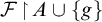 ${\mathcal {F}} \operatorname {\mathrm {\upharpoonright }} A \cup {\{{g}\}}$
is e.d.
${\mathcal {F}} \operatorname {\mathrm {\upharpoonright }} A \cup {\{{g}\}}$
is e.d.
Proof. Enumerate A by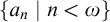 ${\{ {a_n} \mid {n < \omega } \}}$
. Inductively, choose
${\{ {a_n} \mid {n < \omega } \}}$
. Inductively, choose $g(a_n)$
different from
$g(a_n)$
different from ${\{ {f_m(a_n)} \mid {m < n} \}}$
. By construction
${\{ {f_m(a_n)} \mid {m < n} \}}$
. By construction ${\mathcal {F}} \operatorname {\mathrm {\upharpoonright }} A \cup {\{{g}\}}$
is e.d.
${\mathcal {F}} \operatorname {\mathrm {\upharpoonright }} A \cup {\{{g}\}}$
is e.d.
Lemma 5.5. Let ${\mathcal {I}}$
be an ideal,
${\mathcal {I}}$
be an ideal, ${\mathcal {F}} = {\langle {f_n} \mid {n < \omega } \rangle }$
be e.d. and
${\mathcal {F}} = {\langle {f_n} \mid {n < \omega } \rangle }$
be e.d. and ${\langle {g_n:A_n \to \omega } \mid {n < \omega } \rangle }$
be such that
${\langle {g_n:A_n \to \omega } \mid {n < \omega } \rangle }$
be such that $A_n \in {\mathcal {I}}$
and
$A_n \in {\mathcal {I}}$
and ${\mathcal {F}} \operatorname {\mathrm {\upharpoonright }} A_n \cup {\{{g_n}\}}$
is e.d. for all
${\mathcal {F}} \operatorname {\mathrm {\upharpoonright }} A_n \cup {\{{g_n}\}}$
is e.d. for all $n < \omega $
. Further, let
$n < \omega $
. Further, let $h:B \to \omega $
such that
$h:B \to \omega $
such that $B \notin {\mathcal {I}}$
and
$B \notin {\mathcal {I}}$
and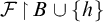 ${\mathcal {F}} \operatorname {\mathrm {\upharpoonright }} B \cup {\{{h}\}}$
is e.d. Then there is
${\mathcal {F}} \operatorname {\mathrm {\upharpoonright }} B \cup {\{{h}\}}$
is e.d. Then there is $f: \omega \to \omega $
such that
$f: \omega \to \omega $
such that
-
(1)
${\mathcal {F}} \cup {\{{f}\}}$
is e.d.; -
(2)
$({\mathcal {F}} \cup {\{{f}\}}) \operatorname {\mathrm {\upharpoonright }} A_n \cup {\{{g_n}\}}$
is e.d. for all
$n < \omega $
; -
(3)
$f \operatorname {\mathrm {\upharpoonright }} C = h \operatorname {\mathrm {\upharpoonright }} C$
for some
$C \in {[B]^{\omega }}$
.





Proof. We define an increasing sequence of finite partial functions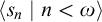 ${\langle {s_n} \mid {n < \omega } \rangle }$
as follows. Set
${\langle {s_n} \mid {n < \omega } \rangle }$
as follows. Set $s_0 := \emptyset $
. Now, let
$s_0 := \emptyset $
. Now, let $n < \omega $
and assume
$n < \omega $
and assume $s_n$
is defined. By assumption, choose
$s_n$
is defined. By assumption, choose $K < \omega $
such that
$K < \omega $
such that $\operatorname {\mathrm {dom}}(s_n) \subseteq K$
and for all
$\operatorname {\mathrm {dom}}(s_n) \subseteq K$
and for all $k \in B \setminus K$
and
$k \in B \setminus K$
and $m < n$
we have
$m < n$
we have $f_m(k) \neq h(k)$
. Since
$f_m(k) \neq h(k)$
. Since ${\mathcal {I}}$
contains
${\mathcal {I}}$
contains $\mathrm {Fin}$
and
$\mathrm {Fin}$
and $B \notin {\mathcal {I}}$
, the set
$B \notin {\mathcal {I}}$
, the set $B \setminus \bigcup _{m < n}A_m$
is infinite, so choose
$B \setminus \bigcup _{m < n}A_m$
is infinite, so choose $k \in B \setminus K$
with
$k \in B \setminus K$
with $k \notin A_m$
for all
$k \notin A_m$
for all $m < n$
. Now, set
$m < n$
. Now, set $s^{\prime }_{n + 1} := s_n \cup {\{{(k, h(k))}\}}$
. Finally, if
$s^{\prime }_{n + 1} := s_n \cup {\{{(k, h(k))}\}}$
. Finally, if $n \in \operatorname {\mathrm {dom}}(s^{\prime }_{n + 1})$
set
$n \in \operatorname {\mathrm {dom}}(s^{\prime }_{n + 1})$
set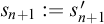 $s_{n + 1} := s^{\prime }_{n + 1}$
, otherwise choose
$s_{n + 1} := s^{\prime }_{n + 1}$
, otherwise choose $l < \omega $
such that
$l < \omega $
such that $l \neq f_m(n)$
for all
$l \neq f_m(n)$
for all $m < n$
and
$m < n$
and $l \neq g_m(n)$
for all
$l \neq g_m(n)$
for all $m < n$
with
$m < n$
with $n \in A_m$
and set
$n \in A_m$
and set $s_{n + 1} := s^{\prime }_{n + 1} \cup {\{{(n, l)}\}}$
.
$s_{n + 1} := s^{\prime }_{n + 1} \cup {\{{(n, l)}\}}$
.
Set $f := \bigcup _{n < \omega } s_n$
. Then,
$f := \bigcup _{n < \omega } s_n$
. Then, $f :\omega \to \omega $
as
$f :\omega \to \omega $
as $n \in \operatorname {\mathrm {dom}}(s_{n + 1})$
for all
$n \in \operatorname {\mathrm {dom}}(s_{n + 1})$
for all $n < \omega $
. Further, we verify (1–3):
$n < \omega $
. Further, we verify (1–3):
-
(1) let
$m < \omega $
, then for every
$n> m$
and
$k \in \operatorname {\mathrm {dom}}(s_{n + 1}) \setminus \operatorname {\mathrm {dom}}(s_n)$
we compute that
$f(k) = s_{n + 1}(k) \neq f_m(k)$
by choice of K or l, i.e., f and
$f_m$
are e.d.; -
(2) let
$m < \omega $
, then for every
$n> m$
and
$k \in (A_m \cap \operatorname {\mathrm {dom}}(s_{n + 1})) \setminus \operatorname {\mathrm {dom}}(s_n)$
we compute that
$f(k) = s_{n + 1}(k) \neq g_m(k)$
by choice of k or l, i.e.,
$f \operatorname {\mathrm {\upharpoonright }} A_m$
and
$g_m$
are e.d.; -
(3) for every
$n < \omega $
there is a
$k \in \operatorname {\mathrm {dom}}(s_{n + 1}) \setminus \operatorname {\mathrm {dom}}(s_n)$
such that
$f(k) = s_{n + 1}(k) = h(k)$
, i.e.,
$f \operatorname {\mathrm {\upharpoonright }} C = h \operatorname {\mathrm {\upharpoonright }} C$
for some
$C \in {[B]^{\omega }}$
.














Hence, f is as desired.
Theorem 5.6. Assume CH and let ${\mathcal {I}}$
be an ideal. Then there is a maximal eventually different family
${\mathcal {I}}$
be an ideal. Then there is a maximal eventually different family ${\mathcal {F}}$
such that
${\mathcal {F}}$
such that ${\mathcal {I}} = {\mathcal {I}}_0({\mathcal {F}})$
.
${\mathcal {I}} = {\mathcal {I}}_0({\mathcal {F}})$
.
Proof. Enumerate all functions ${\{ {h_\alpha :B_\alpha \to \omega } \mid {\alpha < \aleph _1} \}}$
, where
${\{ {h_\alpha :B_\alpha \to \omega } \mid {\alpha < \aleph _1} \}}$
, where $B_\alpha \notin {\mathcal {I}}$
, and
$B_\alpha \notin {\mathcal {I}}$
, and ${\mathcal {I}}$
by
${\mathcal {I}}$
by ${\langle {A_\alpha } \mid {\alpha < \aleph _1} \rangle }$
. We inductively construct an m.e.d. family
${\langle {A_\alpha } \mid {\alpha < \aleph _1} \rangle }$
. We inductively construct an m.e.d. family ${\langle {f_\alpha } \mid {\alpha < \aleph _1} \rangle }$
and functions
${\langle {f_\alpha } \mid {\alpha < \aleph _1} \rangle }$
and functions ${\langle {g_\alpha :A_\alpha \to \omega } \mid {\alpha < \aleph _1} \rangle }$
while preserving the following properties for every
${\langle {g_\alpha :A_\alpha \to \omega } \mid {\alpha < \aleph _1} \rangle }$
while preserving the following properties for every $\alpha < \aleph _1$
:
$\alpha < \aleph _1$
:
-
(1)
${\mathcal {F}}_{<\alpha } := {\{ {f_\beta } \mid {\beta < \alpha } \}}$
is e.d.; -
(2)
${\mathcal {F}}_{<\alpha } \operatorname {\mathrm {\upharpoonright }} A_\beta \cup {\{{g_\beta }\}}$
is e.d. for all
$\beta < \alpha $
; -
(3) if
${\mathcal {F}}_{<\alpha } \operatorname {\mathrm {\upharpoonright }} B_\alpha \cup {\{{h_\alpha }\}}$
is e.d., then
$f_\alpha \operatorname {\mathrm {\upharpoonright }} C = h_\alpha \operatorname {\mathrm {\upharpoonright }} C$
for some
$C \in {[B_\alpha ]^{\omega }}$
.






Let $\alpha\hspace{-0.5pt} <\hspace{-0.5pt} \aleph _1$
. By construction we may apply Lemma 5.5 to
$\alpha\hspace{-0.5pt} <\hspace{-0.5pt} \aleph _1$
. By construction we may apply Lemma 5.5 to ${\mathcal {F}}_{<\alpha }$
,
${\mathcal {F}}_{<\alpha }$
, ${\langle {g_\beta :A_\alpha\hspace{-0.75pt} \to\hspace{-0.75pt} \omega }\hspace{-0.75pt} \mid\hspace{-0.75pt} {\beta\hspace{-0.75pt} <\hspace{-0.75pt} \alpha } \rangle }$
, and
${\langle {g_\beta :A_\alpha\hspace{-0.75pt} \to\hspace{-0.75pt} \omega }\hspace{-0.75pt} \mid\hspace{-0.75pt} {\beta\hspace{-0.75pt} <\hspace{-0.75pt} \alpha } \rangle }$
, and $h_\alpha : B_\alpha \to \omega $
to obtain
$h_\alpha : B_\alpha \to \omega $
to obtain $f_\alpha :\omega \to \omega $
such that
$f_\alpha :\omega \to \omega $
such that
-
(1)
${\mathcal {F}}_{<\alpha } \cup {\{{f_\alpha }\}}$
is e.d.; -
(2)
$({\mathcal {F}}_{<\alpha } \cup {\{{f_\alpha }\}}) \operatorname {\mathrm {\upharpoonright }} A_\beta \cup {\{{g_\beta }\}}$
is e.d. for all
$\beta < \alpha $
; -
(3) if
${\mathcal {F}}_{<\alpha } \operatorname {\mathrm {\upharpoonright }} B_\alpha \cup {\{{h_\alpha }\}}$
is e.d., then
$f_\alpha \operatorname {\mathrm {\upharpoonright }} C = h_\alpha \operatorname {\mathrm {\upharpoonright }} C$
for some
$C \in {[B_\alpha ]^{\omega }}$
.
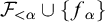





Finally, by Lemma 5.4 choose $g_\alpha :A_\alpha \to \omega $
such that
$g_\alpha :A_\alpha \to \omega $
such that $({\mathcal {F}}_{<\alpha } \cup {\{{f_\alpha }\}}) \operatorname {\mathrm {\upharpoonright }} A_\alpha \cup {\{{g_\alpha }\}}$
is e.d.
$({\mathcal {F}}_{<\alpha } \cup {\{{f_\alpha }\}}) \operatorname {\mathrm {\upharpoonright }} A_\alpha \cup {\{{g_\alpha }\}}$
is e.d.
Then, by (1) ${\mathcal {F}} := {\langle {f_\alpha } \mid {\alpha < \aleph _1} \rangle }$
is e.d. and we claim that
${\mathcal {F}} := {\langle {f_\alpha } \mid {\alpha < \aleph _1} \rangle }$
is e.d. and we claim that ${\mathcal {I}} = {\mathcal {I}}_0({\mathcal {F}})$
. First, let
${\mathcal {I}} = {\mathcal {I}}_0({\mathcal {F}})$
. First, let $A \in {\mathcal {I}}$
. Choose
$A \in {\mathcal {I}}$
. Choose $\alpha < \aleph _1$
such that
$\alpha < \aleph _1$
such that $A = A_\alpha $
. By (2) we have that
$A = A_\alpha $
. By (2) we have that ${\mathcal {F}} \operatorname {\mathrm {\upharpoonright }} A \cup {\{{g_\alpha }\}}$
is e.d., which witnesses
${\mathcal {F}} \operatorname {\mathrm {\upharpoonright }} A \cup {\{{g_\alpha }\}}$
is e.d., which witnesses $A \in {\mathcal {I}}_0({\mathcal {F}})$
.
$A \in {\mathcal {I}}_0({\mathcal {F}})$
.
Secondly, let $B \notin {\mathcal {I}}$
and assume
$B \notin {\mathcal {I}}$
and assume $B \in {\mathcal {I}}_0({\mathcal {F}})$
. Choose
$B \in {\mathcal {I}}_0({\mathcal {F}})$
. Choose $h:B \to \omega $
such that
$h:B \to \omega $
such that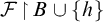 ${\mathcal {F}} \operatorname {\mathrm {\upharpoonright }} B \cup {\{{h}\}}$
is e.d. Choose
${\mathcal {F}} \operatorname {\mathrm {\upharpoonright }} B \cup {\{{h}\}}$
is e.d. Choose $\alpha < \aleph _1$
such that
$\alpha < \aleph _1$
such that $B = B_\alpha $
and
$B = B_\alpha $
and $h = h_\alpha $
. Then also
$h = h_\alpha $
. Then also ${\mathcal {F}}_{<\alpha } \operatorname {\mathrm {\upharpoonright }} B \cup {\{{h}\}}$
is e.d. Thus, by (3) we have
${\mathcal {F}}_{<\alpha } \operatorname {\mathrm {\upharpoonright }} B \cup {\{{h}\}}$
is e.d. Thus, by (3) we have $f_\alpha \operatorname {\mathrm {\upharpoonright }} C = h \operatorname {\mathrm {\upharpoonright }} C$
for some
$f_\alpha \operatorname {\mathrm {\upharpoonright }} C = h \operatorname {\mathrm {\upharpoonright }} C$
for some $C \in {[B]^{\omega }}$
, which contradicts that
$C \in {[B]^{\omega }}$
, which contradicts that $f_\alpha \operatorname {\mathrm {\upharpoonright }} B$
and h are e.d.
$f_\alpha \operatorname {\mathrm {\upharpoonright }} B$
and h are e.d.
Notice that with Theorem 5.6 under $\mathsf {CH}$
we may construct m.e.d. families
$\mathsf {CH}$
we may construct m.e.d. families ${\mathcal {F}}$
, so that
${\mathcal {F}}$
, so that ${\mathcal {I}}_0({\mathcal {F}})$
is a maximal ideal. These kind of maximal eventually different families are in some sense as far as possible away from being Van Douwen while still being maximal. Hence, we may define the following definition.
${\mathcal {I}}_0({\mathcal {F}})$
is a maximal ideal. These kind of maximal eventually different families are in some sense as far as possible away from being Van Douwen while still being maximal. Hence, we may define the following definition.
Definition 5.7. A maximal eventually family is called very non Van Douwen iff ${\mathcal {I}}_0({\mathcal {F}})$
is a maximal ideal. Equivalently, for any
${\mathcal {I}}_0({\mathcal {F}})$
is a maximal ideal. Equivalently, for any $A \in {[\omega ]^{\omega }} \setminus \operatorname {\mathrm {cofin}}(\omega )$
exactly one of the following holds:
$A \in {[\omega ]^{\omega }} \setminus \operatorname {\mathrm {cofin}}(\omega )$
exactly one of the following holds:
-
(1) either there is
$g:A \to \omega $
such that
${\mathcal {F}} \operatorname {\mathrm {\upharpoonright }} A \cup {\{{g}\}}$
is e.d.; -
(2) or there is
$g: A^c \to \omega $
such that
${\mathcal {F}} \operatorname {\mathrm {\upharpoonright }} A^c \cup {\{{g}\}}$
is e.d.

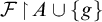
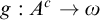

Similar to Van Douwen’s question we may ask the following question.
Question 5.8. Does there always exist a very non Van Douwen m.e.d. family?
Further, under $\mathsf {CH}$
these very non Van Douwen m.e.d. families may have a P-ideal as their associated ideal, whose maximality is preserved by Sacks [Reference Shelah11] or Miller [Reference Miller8] forcing. Note this does not imply that the maximality of
$\mathsf {CH}$
these very non Van Douwen m.e.d. families may have a P-ideal as their associated ideal, whose maximality is preserved by Sacks [Reference Shelah11] or Miller [Reference Miller8] forcing. Note this does not imply that the maximality of ${\mathcal {F}}$
is preserved, as the associated ideal interpreted in the generic extension may grow compared to the associated ideal interpreted in the ground model.
${\mathcal {F}}$
is preserved, as the associated ideal interpreted in the generic extension may grow compared to the associated ideal interpreted in the ground model.
Definition 5.9. Let ${\mathcal {F}}$
be a maximal eventually different family and
${\mathcal {F}}$
be a maximal eventually different family and ${\mathbb {P}}$
be a forcing. We say that
${\mathbb {P}}$
be a forcing. We say that ${\mathbb {P}}$
preserves
${\mathbb {P}}$
preserves ${\mathcal {I}}_0({\mathcal {F}})$
or
${\mathcal {I}}_0({\mathcal {F}})$
or ${\mathcal {I}}_0({\mathcal {F}})$
is
${\mathcal {I}}_0({\mathcal {F}})$
is ${\mathbb {P}}$
-indestructible iff for every
${\mathbb {P}}$
-indestructible iff for every ${\mathbb {P}}$
-generic G in
${\mathbb {P}}$
-generic G in $V[G]$
we have that
$V[G]$
we have that ${\mathcal {I}}_0({\mathcal {F}}) = \langle {\mathcal {I}}_0({\mathcal {F}})^V \rangle $
, where
${\mathcal {I}}_0({\mathcal {F}}) = \langle {\mathcal {I}}_0({\mathcal {F}})^V \rangle $
, where $\langle \cdot \rangle $
is the generated ideal.
$\langle \cdot \rangle $
is the generated ideal.
Question 5.10. For which forcings may we construct non Van Douwen m.e.d. families, so that their associated ideals are preserved?
These considerations are particularly interesting towards a possible proof of the consistency of ${{\mathfrak {a}}_{\text {e}}} < {{\mathfrak {a}}_{\text {v}}}$
, as in this case a non Van Douwen m.e.d. family which remains maximal under some forcing which destroys the Van Douwenness of some other family is desirable.
${{\mathfrak {a}}_{\text {e}}} < {{\mathfrak {a}}_{\text {v}}}$
, as in this case a non Van Douwen m.e.d. family which remains maximal under some forcing which destroys the Van Douwenness of some other family is desirable.
As a proof of concept for the remainder of this article we show that assuming CH we may indeed construct maximal eventually different families with associated ideal indestructible by (any) Sacks forcing. In order to construct such a family, we use the framework developed by Fischer and the author in [Reference Fischer and Schembecker3]. That is, to obtain a maximal eventually different family with its associated ideal indestructible by any kind of countably supported Sacks-forcing it suffices to construct such a family whose associated ideal is indestructible by ${\mathbb {S}}^{\aleph _0}$
, the fully supported product of Sacks-forcing of size
${\mathbb {S}}^{\aleph _0}$
, the fully supported product of Sacks-forcing of size $\aleph _0$
.
$\aleph _0$
.
Corollary 5.11 [Reference Fischer and Schembecker3]
Let ${\mathcal {F}}$
be a maximal eventually different family such that its associated ideal
${\mathcal {F}}$
be a maximal eventually different family such that its associated ideal ${\mathcal {I}}_0({\mathcal {F}})$
is
${\mathcal {I}}_0({\mathcal {F}})$
is ${\mathbb {S}}^{\aleph _0}$
-indestructible. Then
${\mathbb {S}}^{\aleph _0}$
-indestructible. Then ${\mathcal {I}}_0({\mathcal {F}})$
is also indestructible by any countably supported product or iteration of Sacks-forcing.
${\mathcal {I}}_0({\mathcal {F}})$
is also indestructible by any countably supported product or iteration of Sacks-forcing.
Thus, it suffices to restrict our attention to ${\mathbb {S}}^{\aleph _0}$
. We will need to refine Lemma 5.5 to also diagonalize against
${\mathbb {S}}^{\aleph _0}$
. We will need to refine Lemma 5.5 to also diagonalize against ${\mathbb {S}}^{\aleph _0}$
-names
${\mathbb {S}}^{\aleph _0}$
-names $\dot {h}:\dot {B} \to \omega $
, which may extend the associated ideal in the Sacks-extension.
$\dot {h}:\dot {B} \to \omega $
, which may extend the associated ideal in the Sacks-extension. ${\mathbb {S}}^{\aleph _0}$
satisfies Axiom A/has fusion, we assume the reader is familiar with the usual fusion order of
${\mathbb {S}}^{\aleph _0}$
satisfies Axiom A/has fusion, we assume the reader is familiar with the usual fusion order of ${\mathbb {S}}^{\aleph _0}$
and the notion of suitable functions. For more details see [Reference Fischer and Schembecker3] or [Reference Kanamori6].
${\mathbb {S}}^{\aleph _0}$
and the notion of suitable functions. For more details see [Reference Fischer and Schembecker3] or [Reference Kanamori6].
Lemma 5.12. Let ${\mathcal {I}}$
be an ideal,
${\mathcal {I}}$
be an ideal, ${\mathcal {F}}\hspace{-0.75pt} =\hspace{-0.75pt} {\langle {f_n}\hspace{-0.75pt} \mid\hspace{-0.75pt} {n\hspace{-0.5pt} <\hspace{-0.5pt} \omega } \rangle }$
be e.d. and
${\mathcal {F}}\hspace{-0.75pt} =\hspace{-0.75pt} {\langle {f_n}\hspace{-0.75pt} \mid\hspace{-0.75pt} {n\hspace{-0.5pt} <\hspace{-0.5pt} \omega } \rangle }$
be e.d. and ${\langle {g_n:A_n \to \omega } \mid {n < \omega } \rangle }$
be such that
${\langle {g_n:A_n \to \omega } \mid {n < \omega } \rangle }$
be such that $A_n \in {\mathcal {I}}$
and
$A_n \in {\mathcal {I}}$
and ${\mathcal {F}} \operatorname {\mathrm {\upharpoonright }} A_n \cup {\{{g_n}\}}$
is e.d. for all
${\mathcal {F}} \operatorname {\mathrm {\upharpoonright }} A_n \cup {\{{g_n}\}}$
is e.d. for all $n < \omega $
. Further, let
$n < \omega $
. Further, let $p \in {\mathbb {S}}^{\aleph _0}$
and
$p \in {\mathbb {S}}^{\aleph _0}$
and $\dot {h}$
be an
$\dot {h}$
be an ${\mathbb {S}}^{\aleph _0}$
-name such that
${\mathbb {S}}^{\aleph _0}$
-name such that
 $$\begin{align*}p {{ \, \Vdash \, }} \dot{h}:\dot{B} \to \omega \text{ such that } \dot{B} \notin \langle{\mathcal{I}}\rangle \text{ and } {\mathcal{F}} \operatorname{\mathrm{\upharpoonright}} \dot{B} \cup {\{{\dot{h}}\}} \text{ is e.d.} \end{align*}$$
Then there is $q \operatorname {\mathrm {{\mathbin {\leq }}}} p$
and
$q \operatorname {\mathrm {{\mathbin {\leq }}}} p$
and $f: \omega \to \omega $
such that
$f: \omega \to \omega $
such that
-
(1)
${\mathcal {F}} \cup {\{{f}\}}$
is e.d.; -
(2)
$({\mathcal {F}} \cup {\{{f}\}}) \operatorname {\mathrm {\upharpoonright }} A_n \cup {\{{g_n}\}}$
is e.d. for all
$n < \omega $
; -
(3)
$q {{ \, \Vdash \, }} f \operatorname {\mathrm {\upharpoonright }} \dot {C} = \dot {h} \operatorname {\mathrm {\upharpoonright }} \dot {C}$
for some
$\dot {C} \in {[\dot {B}]^{\omega }}$
.




Proof. As before we define an increasing sequence of finite partial functions ${\langle {s_n} \mid {n < \omega } \rangle }$
but now alongside a fusion sequence
${\langle {s_n} \mid {n < \omega } \rangle }$
but now alongside a fusion sequence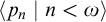 ${\langle {p_n} \mid {n < \omega } \rangle }$
below p. Set
${\langle {p_n} \mid {n < \omega } \rangle }$
below p. Set $s_0 := \emptyset $
and
$s_0 := \emptyset $
and $p_0 := p$
. Now, let
$p_0 := p$
. Now, let $n < \omega $
and assume that
$n < \omega $
and assume that $s_n$
and
$s_n$
and $p_n$
have been defined. As in the proof of Lemma 5.5 we may assume that
$p_n$
have been defined. As in the proof of Lemma 5.5 we may assume that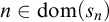 $n \in \operatorname {\mathrm {dom}}(s_n)$
. Let
$n \in \operatorname {\mathrm {dom}}(s_n)$
. Let ${\langle {\sigma _m} \mid {m < M} \rangle }$
enumerate all suitable functions for
${\langle {\sigma _m} \mid {m < M} \rangle }$
enumerate all suitable functions for $p_n$
and n. We define an increasing sequence of finite partial functions
$p_n$
and n. We define an increasing sequence of finite partial functions ${\langle {t_m} \mid {m \leq M} \rangle }$
extending
${\langle {t_m} \mid {m \leq M} \rangle }$
extending $s_n$
and
$s_n$
and $\leq _n$
-extensions
$\leq _n$
-extensions ${\langle {q_m} \mid {m \leq M} \rangle }$
of
${\langle {q_m} \mid {m \leq M} \rangle }$
of $p_n$
as follows.
$p_n$
as follows.
Set $t_0 := s_n$
and
$t_0 := s_n$
and $q_0 := p_n$
. Now, let
$q_0 := p_n$
. Now, let $m < M$
and assume
$m < M$
and assume $s_m$
and
$s_m$
and $q_m$
have been defined. By assumption we have
$q_m$
have been defined. By assumption we have
 $$\begin{align*}q_m \operatorname{\mathrm{\upharpoonright}} \sigma_m {{ \, \Vdash \, }} \dot{h}:\dot{B} \to \omega \text{ such that } \dot{B} \notin \langle{\mathcal{I}}\rangle \text{ and } {\mathcal{F}} \operatorname{\mathrm{\upharpoonright}} \dot{B} \cup {\{{\dot{h}}\}} \text{ is e.d.} \end{align*}$$
As in the proof of Lemma 5.5 choose $r_m \operatorname {\mathrm {{\mathbin {\leq }}}} q_m \operatorname {\mathrm {\upharpoonright }} \sigma _m$
and
$r_m \operatorname {\mathrm {{\mathbin {\leq }}}} q_m \operatorname {\mathrm {\upharpoonright }} \sigma _m$
and $k, l < \omega $
with
$k, l < \omega $
with $k \notin \operatorname {\mathrm {dom}}(t_n) \cup \bigcup _{\bar {n} < n} A_{\bar {n}}$
and
$k \notin \operatorname {\mathrm {dom}}(t_n) \cup \bigcup _{\bar {n} < n} A_{\bar {n}}$
and
 $$\begin{align*}r_m {{ \, \Vdash \, }} k \in \dot{B} \text{ and } \dot{h}(k) = l \neq f_{\bar{n}}(k) \text{ for all } \bar{n} < n. \end{align*}$$
Finally, we set $t_{m + 1} := t_m \cup {\{{(k, l)}\}}$
and define
$t_{m + 1} := t_m \cup {\{{(k, l)}\}}$
and define $q_{m+1} \leq _n q_m$
with
$q_{m+1} \leq _n q_m$
with $q_{m + 1} \operatorname {\mathrm {\upharpoonright }} \sigma _m = r_m$
by
$q_{m + 1} \operatorname {\mathrm {\upharpoonright }} \sigma _m = r_m$
by
 $$\begin{align*}q_{m+1}(\alpha) := \begin{cases} r_m(\alpha) \cup \bigcup{\{ {q_m(\alpha) \operatorname{\mathrm{\upharpoonright}} \sigma_{\bar{m}}} \mid {\bar{m} < M, \bar{m} \neq m} \}} &\text{if } \alpha < n,\\ r_m(\alpha) & \text{otherwise}. \end{cases} \end{align*}$$
Now, set $p_{n+1} := q_M$
and
$p_{n+1} := q_M$
and $s_{n+1} := t_M$
. By construction we have that
$s_{n+1} := t_M$
. By construction we have that
 $$\begin{align*}p_{n+1} {{ \, \Vdash \, }} \exists k \in \operatorname{\mathrm{dom}}(s_{n + 1}) \setminus \operatorname{\mathrm{dom}}(s_n) \text{ such that } \dot{h}(k) = s_{n+1}(k) \end{align*}$$
and for every $k \in \operatorname {\mathrm {dom}}(s_{n + 1}) \setminus \operatorname {\mathrm {dom}}(s_n)$
and
$k \in \operatorname {\mathrm {dom}}(s_{n + 1}) \setminus \operatorname {\mathrm {dom}}(s_n)$
and $\bar {n} < n$
we have
$\bar {n} < n$
we have $s_{n+1}(k) \neq f_{\bar {n}}(k)$
.
$s_{n+1}(k) \neq f_{\bar {n}}(k)$
.
Set $f := \bigcup _{n < \omega } s_n$
and let q be the fusion of
$f := \bigcup _{n < \omega } s_n$
and let q be the fusion of ${\langle {p_n} \mid {n < \omega } \rangle }$
. As before, we have that
${\langle {p_n} \mid {n < \omega } \rangle }$
. As before, we have that $f:\omega \to \omega $
and f and q satisfy (1-3).
$f:\omega \to \omega $
and f and q satisfy (1-3).
Theorem 5.13. Assume CH and let ${\mathcal {I}}$
be an ideal. Then there is a maximal eventually different family such that
${\mathcal {I}}$
be an ideal. Then there is a maximal eventually different family such that ${\mathcal {I}} = {\mathcal {I}}_0({\mathcal {F}})$
and
${\mathcal {I}} = {\mathcal {I}}_0({\mathcal {F}})$
and ${\mathcal {I}}_0({\mathcal {F}})$
is indestructible by any countable support iteration or product of Sacks-forcing.
${\mathcal {I}}_0({\mathcal {F}})$
is indestructible by any countable support iteration or product of Sacks-forcing.
Proof. The proof is essentially the same as the proof of Theorem 5.6. The only difference is instead of enumerating ${\langle {h_\alpha :B_\alpha \to \omega } \mid {\alpha < \aleph _1} \rangle }$
, where
${\langle {h_\alpha :B_\alpha \to \omega } \mid {\alpha < \aleph _1} \rangle }$
, where $B_\alpha \notin {\mathcal {I}}$
, we enumerate all pairs
$B_\alpha \notin {\mathcal {I}}$
, we enumerate all pairs ${\langle {(p_\alpha , \dot {h}_\alpha )} \mid {\alpha < \aleph _1} \rangle }$
, where
${\langle {(p_\alpha , \dot {h}_\alpha )} \mid {\alpha < \aleph _1} \rangle }$
, where $p \in {\mathbb {S}}^{\aleph _0}$
and
$p \in {\mathbb {S}}^{\aleph _0}$
and $\dot {h}_\alpha $
is an
$\dot {h}_\alpha $
is an ${\mathbb {S}}^{\aleph _0}$
-name such that
${\mathbb {S}}^{\aleph _0}$
-name such that
 $$\begin{align*}p_\alpha {{ \, \Vdash \, }} \dot{h}_\alpha:\dot{B} \to \omega \text{ such that } \dot{B} \notin \langle{\mathcal{I}}\rangle. \end{align*}$$
We cannot enumerate all such ${\mathbb {S}}^{\aleph _0}$
-names in order type
${\mathbb {S}}^{\aleph _0}$
-names in order type $\aleph _1$
, but using continuous reading of names and CH already
$\aleph _1$
, but using continuous reading of names and CH already $\aleph _1$
-many nice names suffice, see [Reference Fischer and Schrittesser4] for more details. Now, argue the same way as in the proof of Theorem 5.6 using Lemma 5.12 instead to iteratively construct a family
$\aleph _1$
-many nice names suffice, see [Reference Fischer and Schrittesser4] for more details. Now, argue the same way as in the proof of Theorem 5.6 using Lemma 5.12 instead to iteratively construct a family ${\mathcal {F}}$
with
${\mathcal {F}}$
with ${\mathcal {I}} = {\mathcal {I}}_0({\mathcal {F}})$
and
${\mathcal {I}} = {\mathcal {I}}_0({\mathcal {F}})$
and ${\mathcal {I}}_0({\mathcal {F}})$
is indestructible by
${\mathcal {I}}_0({\mathcal {F}})$
is indestructible by ${\mathbb {S}}^{\aleph _0}$
. By Corollary 5.11
${\mathbb {S}}^{\aleph _0}$
. By Corollary 5.11 ${\mathcal {I}}_0({\mathcal {F}})$
is also indestructible by any countably supported product or iteration of Sacks-forcing.
${\mathcal {I}}_0({\mathcal {F}})$
is also indestructible by any countably supported product or iteration of Sacks-forcing.
As a corollary we show that in the iterated Sacks-model over a model of CH every $\aleph _1$
-generated ideal, i.e., with a basis of size
$\aleph _1$
-generated ideal, i.e., with a basis of size $\aleph _1$
, is realized as the associated ideal of some maximal eventually different family.
$\aleph _1$
, is realized as the associated ideal of some maximal eventually different family.
Corollary 5.14. In the iterated Sacks-model for every $\aleph _1$
-generated ideal
$\aleph _1$
-generated ideal ${\mathcal {I}}$
there is a maximal eventually different family
${\mathcal {I}}$
there is a maximal eventually different family ${\mathcal {F}}$
such that
${\mathcal {F}}$
such that ${\mathcal {I}} = {\mathcal {I}}_0({\mathcal {F}})$
.
${\mathcal {I}} = {\mathcal {I}}_0({\mathcal {F}})$
.
Proof. Let G be ${\mathbb {S}}_{\omega _2}$
-generic, where
${\mathbb {S}}_{\omega _2}$
-generic, where ${\mathbb {S}}_{\omega _2}$
is the countable support iteration of Sacks-forcing of length
${\mathbb {S}}_{\omega _2}$
is the countable support iteration of Sacks-forcing of length $\omega _2$
over a model of CH. Every
$\omega _2$
over a model of CH. Every $\aleph _1$
-generated ideal
$\aleph _1$
-generated ideal ${\mathcal {I}}$
has a basis
${\mathcal {I}}$
has a basis ${\mathcal {B}}$
of size
${\mathcal {B}}$
of size $\aleph _1$
added at an intermediate step
$\aleph _1$
added at an intermediate step $V[G_\alpha ]$
with
$V[G_\alpha ]$
with $\alpha < \omega _2$
of the iteration. In
$\alpha < \omega _2$
of the iteration. In $V[G_\alpha ]$
CH still holds, so by the previous theorem there is a maximal eventually different family
$V[G_\alpha ]$
CH still holds, so by the previous theorem there is a maximal eventually different family ${\mathcal {F}}$
in
${\mathcal {F}}$
in $V[G_\alpha ]$
with
$V[G_\alpha ]$
with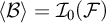 $\langle {\mathcal {B}}\rangle = {\mathcal {I}}_0({\mathcal {F}})$
and
$\langle {\mathcal {B}}\rangle = {\mathcal {I}}_0({\mathcal {F}})$
and ${\mathcal {I}}_0({\mathcal {F}})$
is indestructible by any countably supported iteration or product of Sacks-forcing. But the quotient forcing
${\mathcal {I}}_0({\mathcal {F}})$
is indestructible by any countably supported iteration or product of Sacks-forcing. But the quotient forcing ${\mathbb {S}}_{\omega _2} / {\mathbb {S}}_\alpha $
is isomorphic to
${\mathbb {S}}_{\omega _2} / {\mathbb {S}}_\alpha $
is isomorphic to ${\mathbb {S}}_{\omega _2}$
, hence by the indestructibility of
${\mathbb {S}}_{\omega _2}$
, hence by the indestructibility of ${\mathcal {I}}_0({\mathcal {F}})$
in
${\mathcal {I}}_0({\mathcal {F}})$
in $V[G]$
we have that
$V[G]$
we have that ${\mathcal {I}}_0({\mathcal {F}}) = \langle \langle {\mathcal {B}}\rangle ^{V[G_\alpha ]}\rangle = \langle {\mathcal {B}} \rangle = {\mathcal {I}}$
.
${\mathcal {I}}_0({\mathcal {F}}) = \langle \langle {\mathcal {B}}\rangle ^{V[G_\alpha ]}\rangle = \langle {\mathcal {B}} \rangle = {\mathcal {I}}$
.
Corollary 5.15. In the iterated Sacks-model there is a very non Van Douwen m.e.d. family of size $\aleph _1$
. In particular their existence is consistent with
$\aleph _1$
. In particular their existence is consistent with ${\mathfrak {c}} = \aleph _2$
.
${\mathfrak {c}} = \aleph _2$
.
Proof. In V by CH there is a P-ideal (i.e., the dual ideal of a P-point), which is preserved by iterations of Sacks-forcing [Reference Shelah11]. Thus, by Theorem 5.13 there is a maximal eventually different family ${\mathcal {F}}$
such that in the iterated Sacks-model we have
${\mathcal {F}}$
such that in the iterated Sacks-model we have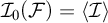 ${\mathcal {I}}_0({\mathcal {F}}) = \langle {\mathcal {I}} \rangle $
, where
${\mathcal {I}}_0({\mathcal {F}}) = \langle {\mathcal {I}} \rangle $
, where $\langle {\mathcal {I}}\rangle $
is a maximal ideal. Hence,
$\langle {\mathcal {I}}\rangle $
is a maximal ideal. Hence, ${\mathcal {F}}$
is very non Van Douwen also in the generic extension.
${\mathcal {F}}$
is very non Van Douwen also in the generic extension.
Finally, we note that we may also obtain very non Douwen m.e.d. families of size $\aleph _1$
with arbitrarily large continuum in the product Sacks-models. The argument is the same as above together with the fact that product Sacks-forcing also preserves P-ideals [Reference Laver7].
$\aleph _1$
with arbitrarily large continuum in the product Sacks-models. The argument is the same as above together with the fact that product Sacks-forcing also preserves P-ideals [Reference Laver7].


 Open access

