





Introduction
Political science equips students with important intellectual, critical, and analytical skills that allow a deep understanding of politics, society, and culture. Political science studies forms of government, the role of power, the functioning of political institutions, the political behaviour of elites and ordinary citizens, and the interactions between politics and other spheres of life (Goodin and Klingemann Reference Goodin and Klingemann1996). In essence, it covers all elements relating to humans governing ourselves (Mansbridge Reference Mansbridge2014). Political science increases students’ factual knowledge about contemporary political events, political parties, and topical political issues, including ideology (Denver and Hands Reference Denver and Hands1990). It also teaches students how to be effective citizens (Breuning, Parker and Ishiyama Reference Breuning, Parker and Ishiyama2001).
As a generalist degree, political science can equip students with practical skills that open up diverse career prospects. Some political science departments make efforts to prepare students for the job market through voluntary internships, faculty advice, courses on career preparation, career mentoring programmes, and institutional social media functionality connecting students to working professionals (Collins, Knotts and Schiff Reference Collins, Knotts and Schiff2012). Political science graduates generally have good career prospects, and their future jobs are financially comparable with those of students with more career-oriented business degrees (Lewis Reference Lewis2017). These results are driven by the broad range of jobs occupied by political science graduates, few of whom go into politics.
This limited appetite for politics may appear somewhat counterintuitive since these students learn so much about government and governance. Political science as a discipline has an interest in preparing students for political careers, especially in a global context in which politicians are increasingly being viewed unfavourably. Political science courses could develop well-informed, well-equipped politicians, even though only a relatively small group of students may ultimately follow this career path.
This article seeks to contribute to the bigger picture by answering the following question: How do political science courses prepare students for activities within political parties? We focus on party politics because engagement with political parties is often a first step taken by those wishing to occupy either appointed or elected public political office. Moreover, party membership is accessible and can be secured from an early age, including throughout university studies. Previous research illustrates the existence of a relationship between being a party member and taking courses on domestic politics. Such courses often depict political parties as key players in the functioning of democracy, and students who take such classes may believe that parties can produce change, motivating the students to join their chosen parties (Cross and Young Reference Cross and Young2008). However, we do not yet know whether (and which aspects of) political science studies help people after they join parties. It is important to understand the extent to which political science education may influence the beginning of individuals’ political careers. Equally important, there is a need for the political science profession to better understand how educational programmes affect students’ likelihood of making the first steps towards a career in a field, which they have learned a lot about.
Our study uses 45 semi-structured interviews conducted at the end of 2024 with political science students or recent graduates who are party members in three countries: Romania, Spain, and the United Kingdom. The interviewees were at least in their second year of undergraduate study at the time of the research (so they had had the opportunity to take several classes on the topic), while the graduates had completed their studies one year previously (meaning that they could still clearly recall what they had learned). We selected political party members because political parties are crucial political institutions as transmission belts between the state and society, the primary points of contact for those wishing to start their political activity, and are covered by political science courses. Parties provide their members with ample opportunities to participate in politics, such as getting involved in campaigns, communicating with the electorate between elections, engaging in the internal decision-making process, and running for office. Party membership acts as a training ground where actively involved individuals can acquire and develop the skills they need to pursue future political careers. Most political parties have a youth organisation that is led by young people, recruits young people, fosters interactions with like-minded peers, and involves them in party-related political and social activities.
We chose the three countries to increase variation in relation to three elements: the national experience in teaching political science (the UK has been teaching it for many decades, Romania mainly in the 21st century, while Spain is between the two), the reputation of the academic sector (the UK has many universities in the global top 100 according to the QS and Times Higher Education rankings, Spain has many universities in the top 500 according to the same rankings, while almost all the Romanian universities are lower than position 1,000), and the party system format in each country, including the number of new parties. If we have similar results in different educational and party systems, then these could be generalised more easily.
The next section summarises the link between party membership and young people. The third section presents the data and method, followed by two sections outlining the theoretical benefits provided by the study of political science for party activities, and the identification of several specific skills and abilities which students develop during their studies. The fifth section identifies what is missing from political science education that could facilitate better engagement with party activities, according to our participants. The discussion and conclusion sections outline the main takeaways of the article and suggest implications for the discipline of political science.
Young people as party members
Around the democratic world, party politics is crucial to governance, as very few independents occupy public office. Party members occupy most public offices, which can be regarded as a direct benefit derived from their partisan affiliation. In spite of oscillations in the size of membership rolls over time (van Biezen, Mair and Poguntke Reference van Biezen, Mair and Poguntke2012; Gherghina, Iancu and Soare Reference Gherghina, Iancu and Soare2018), most political parties maintain their membership organisation or seek to recruit new members because doing so provides campaign and electoral support, ensures financial support and volunteer work, allows the development of networks within the electorate, builds an appreciative audience for party elites, and provides valuable pools of resources for recruiting and socialising future political leaders and senior figures (Kopecký Reference Kopecký1995; Gherghina Reference Gherghina2014; Gherghina and von dem Berge Reference Gherghina and von dem Berge2018). Although political parties have started providing alternative affiliation options in recent years (Scarrow Reference Scarrow2015), party members remain the backbone of party activity because they do more than non-member supporters, especially in terms of more intensive forms of activity (van Haute and Gauja Reference van Haute and Gauja2015; Webb, Poletti and Bale Reference Webb, Poletti and Bale2017). The digitalisation of political parties has also gained momentum in recent times, and traditional forms of members’ activity have thereby been supplemented by online activities (Gherghina, Barberà and Lisi Reference Gherghina, Barberà and Lisi2025).
Young people often join political parties through the youth organisation, a sub-organisation designed specifically for them. These youth organisations were popular more than two decades ago (Poguntke Reference Poguntke, Katz and Crotty2006) and more than three-quarters of political parties in Western democracies had them roughly a decade ago (Allern and Verge Reference Allern, Verge, Scarrow, Webb and Poguntke2017). Youth organisations perform similar functions to the party’s main structure, but membership is limited to age. The range differs across parties and countries: in some cases, youth membership ends at 18, sometimes at 26, while in other cases, it goes up to 30 or 35. In general, youth organisations include people between 16 and 26 years old (McDonnell et al. Reference McDonnell, Ammassari, Valbruzzi, Bolin, Werner, Heinisch, Jungar and Wegscheider2025). These organisations fulfil several main tasks: the recruitment of members who will potentially stay with the party for the long term, legitimacy by showing the members and the broader electorate that the party cares about young people, socialisation with party activities and ideology, campaigning, and elite development (de Roon Reference de Roon2022; McDonnell et al. Reference McDonnell, Ammassari, Valbruzzi, Bolin, Werner, Heinisch, Jungar and Wegscheider2025).
Prior research has outlined why young people join political parties (Weber Reference Weber2020; Bolin, Backlund and Jungar Reference Bolin, Backlund and Jungar2023; McDonnell et al. Reference McDonnell, Ammassari, Valbruzzi, Bolin, Werner, Heinisch, Jungar and Wegscheider2025) and reported on their profile. Most young members in parties from Western democracies are men; many had someone in the family as a party member; and almost three-quarters are either enrolled in university or hold a degree (McDonnell et al. Reference McDonnell, Ammassari, Valbruzzi, Bolin, Werner, Heinisch, Jungar and Wegscheider2025). However, we lack information about the extent to which specialising in the study of politics helps students or recent graduates in their daily activities as party members. This exploratory study, therefore, aims to shed light on the match between education and daily political practices.
Data and method
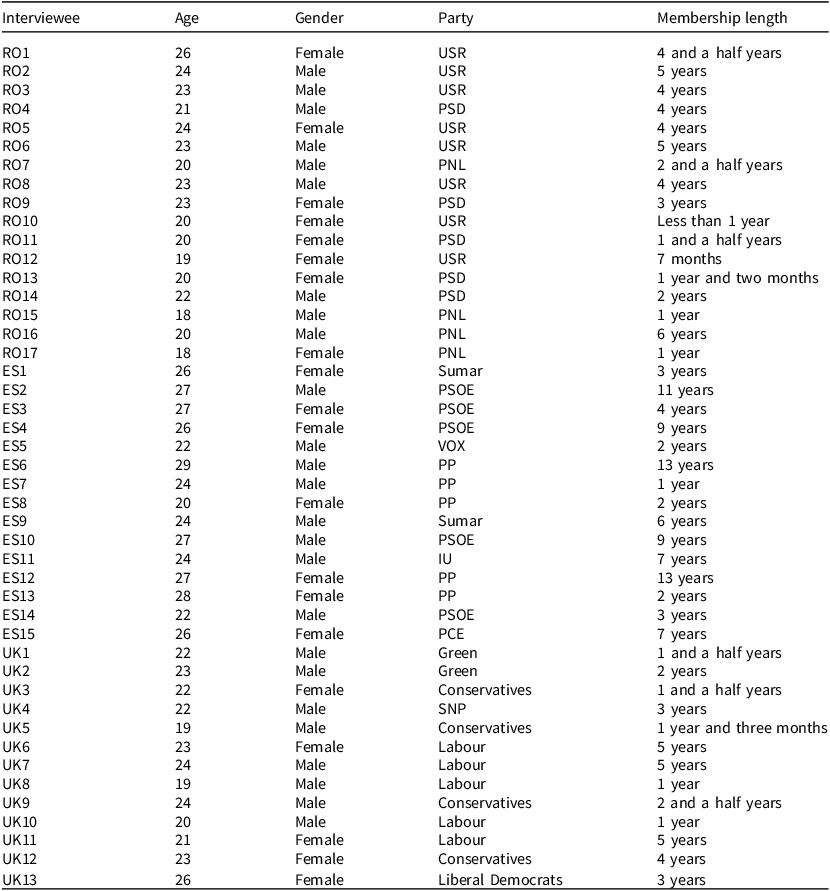
We conducted 45 interviews with students from Romania (17), Spain (15), and the United Kingdom (13) in November and December 2024. We used two criteria to select interviewees: they had to study political science, and be a party member. Our initial list of potential participants was higher in each country, but we stopped when we reached the data saturation point in each country (Hennink, Hutter and Bailey Reference Hennink, Hutter and Bailey2020); that is, no new themes or meaningful information emerged from additional interviews. The students came from different universities in each country. For example, the UK students studied at King’s College London, the University of Bath, the University of Edinburgh, the University of Glasgow, the University of Manchester, the University of Oxford, the University of Sussex, and Warwick University. We identified our interviewees through personal contacts in universities and through snowball sampling. We sought maximum variation in terms of party involvement, gender, membership duration, and political party (see Table 1).
Overview of interviewees

We interviewed 25 men and 20 women between 18 and 29 years old, with different degrees of involvement in party activities, various responsibilities ranging from ordinary members to leading positions in the youth or local party organisations, and various lengths of party membership (less than one year to 13 years). In Romania, party members must be over 18, but in Spain and in the UK the minimum age is 14. The participants came from the main political parties in each country. At the time of the interviews these were: Social Democratic Party (PSD), National Liberal Party (PNL) and Save Romania Union (USR); Spanish Socialist Workers’ Party (PSOE), People’s Party (PP), United Left (IU), Unite (Sumar), Vox, and the Communist Party of Spain (PCE); Labour, Conservatives, Liberal-Democrats, Greens, and the Scottish National Party (SNP).
The interview guide comprised six questions focusing on what students enjoy the most in being party members, their degree of involvement in the party’s activities, how active their branch is, the most important lessons they had learned from university political science courses, what they can apply in their party activities from what they learned, what takeaways from their university courses apply to politics in general, and what they believe should be included or emphasised in the curriculum. We used ad-hoc follow-up questions when we needed more information. The interviews were conducted online, with an average length of 15 minutes, and were recorded with the interviewees’ permission.
We used inductive thematic analysis to find common themes in the answers (Nowell et al. Reference Nowell, Norris, White and Moules2017). Since there is no prior literature about the relationship between the content of political science courses and party member activity, we used inductive thematic analysis to identify common themes in the interviewees’ responses. The analytical process consisted of five phases: 1) identifying the interviewees and scheduling the interviews, 2) conducting the interviews at the same time for each country, 3) transcribing the interviews, 4) independent reading of each interview and outlining the initial themes, and 5) generating the final themes. We identified two major themes: the practical use of information, with communication skills and party activities as sub-themes, and underdeveloped or missing elements in their education, with practical applicability and specific courses as sub-themes.
Theoretical foundations and knowledge
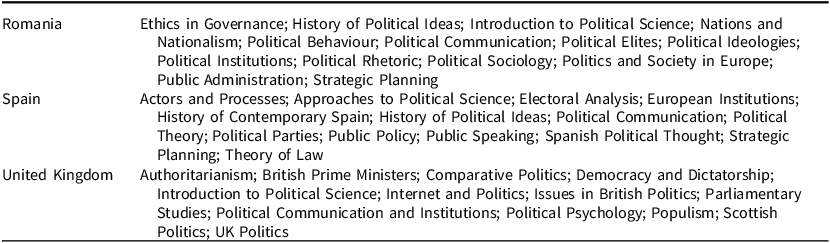
All the interviewees underlined that their university courses prepared them at a good theoretical level to become engaged in party activities. Many courses cover extensive historical, political and social aspects of societies and provide students with a holistic understanding of the political system. This stance is confirmed by the curricula of the universities in the three countries. Table 2 includes the university courses mentioned by the participants as providing relevant information for them as party members. No major differences were evident between the political science topics taught at the universities across the three countries. When the students were asked about the most important things they had acquired in their courses, they referred to political knowledge, abilities, and values.
Courses mentioned by the participants as including relevant information
To start with political knowledge, some interviewees praised the importance of courses on political ideology because these had helped students gain a broader understanding of the political space and helped them to decide on their own ideological positions (RO1, RO9, RO13, RO14, ES3, UK13). For example, RO1 argued that the courses had helped her to ‘figure out where I position myself ideologically and helped me to choose my political party (…) I learnt about the political ideologies and where the Romanian parties are positioned, so I could make an informed choice’. Another interviewee emphasised that the importance of these courses is not limited to helping students to understand their ideological positions, but to:
…identify patterns of behaviour. If you are a social democratic organisation, you must know what social democracy is and know what you agree with (…) and be able to establish your limits. Learning about ideology is very important because it contributes to thinking about policies under ideological approaches. (ES3)
Gaining political knowledge helped most of the interviewees to better understand political phenomena. They referred to these matters as follows: ‘I think learning about British politics, how our electoral system works, was enlightening and interesting’ (UK1), and ‘part of the learning was recognising different voting systems between the UK as a whole and the Parliaments’ (UK4). In other instances, the information the students learned in university courses about branches of government, the system of checks and balances, and elements related to the rule of law and the electoral system, was mentioned as a key advantage in the discussions with other party members (RO9, RO12, ES7, UK5). In the words of another participant, ‘the courses showed us how state institutions function (…) when we would have had a problem to understand how we, as a party, have to position ourselves internally and externally’ (RO5). Several participants pointed out that they knew what to expect when joining the party because the courses they took had provided the basics of party organisation, how the hierarchy functions, and how communication takes place within political parties (RO14, ES3, ES6, ES9, UK8, UK13). Other participants pointed out that their university courses provided details of the broad framework in which their political parties operate, such as the political system, territorial structure, and how policies are enacted (RO7, RO15, ES2, ES12, UK10).
Moving on to abilities, some interviewees argued that the knowledge they acquired during their university courses had developed their ability to engage in debates, think and understand the political world, and conduct research (RO3, RO4, RO7, ES10). The participants explicitly stated that politics is complex and that information helps them to understand what happens. They explained that courses had exposed them to scientific literature, provided rich information, pushed them to search for evidence to substantiate their points of view, and enhanced their critical thinking about processes (RO3, ES5, UK7, UK11). All these had helped greatly in their activities as party members, as was eloquently explained by two interviewees: ‘university emphasised the need for thorough research instead of taking information for granted, which is crucial to understanding political issues in depth and to develop a mind of your own within the party’ (UK7), and ‘I would say there’s been an increase in my research abilities. I know more about where to look for documents, and when I try to explore something’ (UK11).
The access to different points of view during debates had helped the interviewees to accept multiple opinions and develop their own critical thinking: ‘I think what politics gave me is the ability to look at certain situations and connect the dots with how things are playing out – why things are playing out, why certain things are not politically possible’ (UK2), and ‘it exposed me constantly to different opinions (…) and I had colleagues in my class or from other specialisations who were from other political parties with whom I had discussions. I believe that helped enormously’ (RO1).
In terms of values, several participants explained that their political science courses taught them about the determination, loyalty, and persistence that had helped in their daily activities as party members (RO11, RO13, ES11, UK6). For example, one interviewee explained that political science courses had helped her to understand the value of patience and responsibility: ‘the courses taught me the basics about ideology and politics, to organise my steps carefully, to make informed choices about which party to join, and to be patient; I get my degree first and then a party career’ (RO5). Another participant highlighted honesty as a key value: ‘How to avoid plagiarism, because we tend to draw inspiration from other sources without mentioning them. The courses set clear guidelines about what is ethical and how to proceed. This is useful outside class, including in politics, given the existing issues’ (RO12).Footnote 1 One participant outlined neutrality, as opposed to subjective assessment, as an important value cultivated by political science courses: ‘there are things that are done incorrectly, or that could be improved because there are other organisations and structures that better optimise their functioning. I learned how to take some distance, compare, understand, and get the best out of each system’ (ES9). Another participant referred to how the university courses had made him understand the importance of openness to dialogue and of listening to other opinions in a debate (ES11). Along similar lines, another student referred to community spirit as one key thing learned from university courses:
…being able to work with many different people, because you do not always get to choose who is in your group. In a party, people have similar views but are different from those I would usually mix with. I learned to accommodate people picked at random and to work together for a common goal. (UK4)
In brief, the political science curriculum in each of the three countries provides a comprehensive theoretical basis that has helped students and recent graduates to choose their political parties and anchor their routine activities as party members. The interviewees considered that university courses had helped them to develop abilities that would be relevant for a political career. With a few exceptions rooted in the special interests of the participants, there were similar opinions regarding the courses from which they learned the most.
Communication, leadership, and analytical skills
In addition to the theoretical foundations, the interviewees outlined the frequent applicability of what they learned in their university courses as being reflected in their communication, leadership, and analytical skills. To begin with communication skills, approximately half of our interviewees underlined that their university courses had greatly improved their communication skills via communication courses, debate sessions, and oral presentations. The interviewees mentioned several instances in which they used these communication skills: canvassing activities with non-specialised members of the public, candidacies for internal party positions, communication with party members, and interactions with politicians. Many acknowledged that the ability to understand different types of audiences and convey clear and persuasive messages are rooted in university courses. Some differentiated between internal and external communication, outlining that the courses were very useful, especially during election campaigns (RO2, RO16, RO17, ES11, ES12, UK6, UK11). Others highlighted the role of teaching simulations in learning about verbal or non-verbal communication (RO13, ES5, ES9, UK1, UK2, UK4).
The oral examinations for courses that are very common in the Romanian education system enhance communication skills as well as students’ abilities to present arguments and structure a discourse so that it will be interesting to a broader audience (RO14, RO16). In general, the Romanian interviewees showed a predisposition for internal communication, focusing on how their abilities, developed through university courses, had guided their activity within parties: candidacies for party positions, and debates with other party members. The Romanian participants strongly emphasised their personal achievements in the form of advancing in their political careers from an early start, and did so more than those in Spain and the UK.
The Spanish students and recent graduates took a broader view of communication, referring generally to it and mentioning different types of audiences. They explained that to them, the ability to deliver and explain a message to various audiences is crucial (ES9, ES11, ES12). For example, ‘I never wanted to be a councillor or a member of parliament, but I can help people to understand a law, or the Official State Gazette, or what conditions they have to fulfil to get a subsidy’ (ES1). The ability to follow the discourses of politicians and to make sense of their vocabulary is also said to be cultivated by the university courses (ES11). Another participant claimed that communication helps explain voting behaviour: ‘I repeat myself a lot, but I would say again that political communication is the key, honestly. Having knowledge in the field of political communication is key to understanding why people vote the way they do’ (ES14).
For the UK students and graduates, external communication with voters and politicians from other parties is essential. This is mainly because they are driven by the desire to increase partisan membership, electoral support for their party, and overall public awareness about politics. UK seminars often include applied exercises and roleplay sessions according to the participants, which help to develop communication skills that are useful during campaign canvassing, where people must be persuaded either to vote or how to vote (UK1, UK4, UK11). Other participants referred to their awareness of framing, which they derived from a specific course on political communication (UK2), as it is intensively used in campaign activities: ‘I applied quite a lot of what was covered in my communication Master’s degree, as well as some other courses I did during undergrad – particularly in terms of emphasising salient issues and framing. Those are things I use when speaking to politicians and ordinary people’ (UK6).
Turning now to leadership abilities, this area was mentioned by several interviewees as important in their party membership activities (RO9, UK3, UK7). One interviewee explained that ‘understanding the constraints leaders face helps contextualise their choices and informs my approach as a party member’ (UK7). Other interviewees mentioned concrete instances in which the courses provided leverage over opponents: ‘I’ve been involved with leadership hustings, a leadership campaign. I wanted to be a councillor, and then I worked in the parliament for the party’ (UK3), and ‘I was one of the organisers of different events. I can give you examples, there was a PSD conference in Timisoara and the leadership course helped me to behave as a leader’ (RO9).
Several students pinpointed the analytical dimensions of their party activity, as derived from specific courses. Some spoke about the ability to understand and undertake statistical analyses in relation to elections, understanding polls and identifying their supporters’ profiles (RO3, ES3, UK2, UK12). Several participants outlined the possibility of identifying paths for community development thanks to courses on strategic planning (RO9, ES7). Several others referred to a deeper understanding of the policy-making process based on several courses on political systems, institutions, and public policy (RO5, ES2, ES8, ES12, UK4, UK13).
Underdeveloped and missing elements
In this section, findings are presented that indicate universities should develop or better integrate certain elements into the political science curriculum. These are the interviewees’ suggestions based on their experience as party members. Most of the content in this section is drawn from answers to the question on what they believe is missing or should be emphasised more in university courses to prepare students and recent graduates better for party membership activities.
Practitioners’ views and hands-on sessions
Many of the interviewees mentioned two types of practical issues to be covered by university curricula: practitioners’ viewsand hands-on sessions. The Romanian interviewees extensively referenced the practitioner perspective, mainly because the educational system in the country has often been criticised for being over-theoretical. Some underlined the need to invite politicians as guest lecturers in specific modules to talk about how politics really works, to explain what parties do, and what politics is about (RO3, RO7). Other participants referred to the possibility of practitioners teaching courses: ‘to attract teachers with diverse experience in politics – ministers, or other politicians to share their experience’ (RO16).
Many students and recent graduates listed the hand-on approach as a priority. Many students also outlined the need to apply the theoretical approaches learned during courses to practical situations so that students can learn how to adapt and adjust when things are different from what they have learned in theory. They also emphasised the importance of such approaches in understanding what is missing from their knowledge so that they can focus on those components for the remainder of their university courses (RO5, RO8, ES6, ES14, UK1, UK5, UK6, UK8, UK10, UK12). Concrete examples include the practice of canvassing for various informative or signature collection campaigns that could be carried out within universities, or the possibility of internships within political organisations, including political parties. In essence, the knowledge that students accumulate during their courses is understood better and will be remembered for a longer period if they apply it in real situations. For example, one student explained: ‘we need more applied knowledge, giving the students an opportunity to see what it is to actually engage with people and practice the abstract notion of political participation’ (UK1). Another student expressed a similar idea: ‘I feel the whole structure of lecturers and seminars does not lend itself well. Teaching people how it should be, like being a member of a political party and putting the work in, you need to be really there, to learn it’ (UK10). For some students, theoretical knowledge is abstract, while the hands-on components are considered more concrete as they are useful to foster understanding and further engagement. In the words of one student, ‘I would like to see a more explicit focus on the practicalities of engaging with parties and institutions. I think that would be beneficial, because often things can seem quite abstract’ (UK6).
Along similar lines, several participants identified the need to integrate specific teaching simulations relating to practical aspects such as how to develop and adopt laws, how to set up an electoral alliance, how to participate politically in democratic processes, and how to develop a public policy cycle (RO4, RO9, RO11, RO13, RO17). Many activities take place within political parties: bureaucracy, debates, counselling, engagement with voters, canvassing, and event organisation. However, no interviewee – regardless of degree of involvement, membership duration, or political party – mentioned that their university had provided any teaching simulations of these activities. They found ways to practice what the university taught them when they faced specific situations. Many participants acknowledged that the major gain from university is the clarity of the bigger picture, but they lacked exercises in how to deal with concrete situations.
New courses and content
The participants suggested several courses that could be introduced into the university curricula to address some of the points outlined in the previous section, but not all (see Table 3). This does not necessarily mean that all those courses are missing in each country, but simply that they were not taught at the interviewee’s university. Nevertheless, this list is informative because it reveals what students who are party members consider most useful in their education. Some suggest more courses about how politics function at the domestic level, and not just a theoretical view on how it should work (RO1, RO2, RO5, RO12, ES5, ES6, ES11, UK6). One interviewee underlined the need to keep the curriculum updated with the latest information, because otherwise the quality of courses will be negatively affected: ‘from my experience the curriculum is not always 100% up to date on the latest news, which is not good’ (UK4).
A list of suggested courses

Many interviewees argued that political science courses should better reflect contemporary political challenges. One commented that courses should deconstruct the existing myths: ‘I believe that politics has a bad reputation. We need courses that talk about how to pinpoint logical mistakes or how politicians manipulate us’ (RO8), while others mentioned the need to incorporate salient issues such as political scandals, corruption, clientelistic networks, polarisation, and disinformation (RO14, ES3, ES9, UK2, UK13).
When suggesting new courses or new content, the students gave reasons related to their party activities or to the broader understanding of the environment in which the party operates. For example, one UK student argued that: ‘I think the skills that you need as a campaigner, persuasive talking and stuff like this, seem like a priority’ (UK5), while another UK student suggested that ‘there should be more focus on the machinery of government, as understanding the roles of cabinet secretaries and special advisors is crucial for grasping how government functions’ (UK7). The Spanish students in particular mentioned the study of social networks: ‘we study practically nothing about social networking.If you join a youth group in a party, you have to know how to manage social networks, how to post, how it works, what time is better, what time is worse’ (ES11), and ‘since in politics today everything is based on television and social networks, we need more emphasis on that aspect’ (ES12).
Discussion and conclusions
This article has aimed to identify how political science prepares students for party member activities. It considers interviews with 45 political science students or recent graduates in different universities from Romania, Spain, and the UK. We find that political science courses have a positive impact on students’ activity as party members because of their comprehensive theoretical basis and holistic approach to knowledge. The extensive knowledge acquired from courses provides a solid foundation for young members to engage in activities ranging from discussion and debates with their peers to canvassing or competing for internal party positions. The major advantage of the holistic approach of political science courses is its potential to increase students’ understanding of politics, which enables them to use that information when they join parties. Equally important, many students broadly acclaimed the development of their communication skills through debates, oral exams, and presentations, representing a practical component that they repeatedly emphasised.
However, the practical aspects of politics are limited in university courses, which sometimes leaves students unprepared for a political career, even at an entry level. Many interviewees explained that students who are interested in the practical side of politics must look for suitable opportunities outside university. Many of the answers reveal that political science does little to prepare students for the realities of life in politics, although many may have a public vocation. Party membership is often a first step into politics, and political science does not nurture the practical skills needed for such activities. These observations are valid across the board, irrespective of the participant’s profile. Nevertheless, there are several nuances between countries. For example, almost every Spanish student or graduate referred to a need to add more courses to the curriculum, which shows a desire to cover a broader range of topics. In contrast, the Romanian and UK students and graduates asked for more practical components to be integrated into the existing courses offered. There were also differences in how practical components are defined: for students in Romania, ‘more practical aspects’ refers to frequent contact with politicians, while in the UK it stands for transferable skills that can be used in their party activity.
When asked how they would integrate such practical components into the curriculum, most students did not have a concrete answer. One reason for this, which some interviewees outlined, related to the theoretical focus of the existing content, which makes it difficult to add practical elements in a meaningful way. Other participants argued that the content of many courses is cognitively oriented, thus fails to allow students to be reflective and care for deep learning about real-life political challenges. More spacious learning could address some of these issues (Timperley and Schick Reference Timperley and Schick2026), but it is currently rarely used. What aspiring politicians think they need and what they need in reality may be quite different. Students do not see courses as providing opportunities for reflective practice, and they do not know what skills and knowledge real-world politics demands because of their limited experience of it. Political science courses tend not to address these skills and knowledge requirements, which are acquired mostly through practice. That gives weight to the need for experiential learning, simulations, or role playing. Political science course instructors play a crucial role in addressing this gap and must identify topics or suggest new courses, including some with public policy or public administration content. These could foster a broader understanding of how institutions are organised and what they can do to equip students with the necessary skills for political activity in general, or participation within political parties in particular.
Although students gain valuable inputs from political science courses in terms of developing their theoretical knowledge and communication skills, it is questionable whether these are sufficient in preparing them for a political career. As such, it is not surprising that very few political science graduates go into politics, although in theory, they would be a good fit for political jobs. The young party members interviewed here argued that party activities require a broad array of skills and abilities, with which they are equipped to a limited extent. Some of these include leadership and analytical abilities, which were mentioned only by a handful of our interviewees. One reason for this might be that political science professors often focus on being as objective and politically neutral as possible, at least in relation to partisan politics, which may result in a fear that preparing students for politics may take them too close to the subject matter. The neutrality and distance of course instructors from real-life politics was mentioned by a handful of students in Spain and the UK, but a possible explanation for this requires a more thorough investigation to understand whether it is indeed the source of the limited attention to public skills in political science courses.
Nevertheless, the good news is that political science has the tools to cultivate the required skills and abilities. Course instructors can develop class exercises and assignments linking theoretical knowledge with the complexity of real-world politics, can stimulate decision-making abilities through presenting students with different scenarios, and can simulate the types of activities specific to political decisions. We find that students enjoy simulations, learn from them, and often want more of them. These observations are consistent with previous work on teaching simulations in political science, which confirms that they are long-established and add value to the process of learning and understanding in both domestic and international politics (Asal and Blake Reference Asal and Blake2006; Shanks and Zhang Reference Shanks and Zhang2024; Brown Reference Brown2025; Gülmez Reference Gülmez2025). Several interviewees also outlined the benefits of in-class presentations or debates to foster their communication skills. Similarly, diversified active learning practices can articulate and shape other abilities that would prepare students for careers in politics.
Our results show that students who are active in party politics wish to see a greater integration of practical experiences in politics into political science courses and curricula. More broadly, even for students not (interested in) engaging in party politics, there are several good reasons to believe that more practical examples and experiences would be useful and valuable for political science graduates. Adding practical components to political science courses would allow students to familiarise themselves with political realities and support the development of specific skills such as professional campaigning, policy proposals that meet the goals of the government, the party, and constituents, and/or how to overcome various challenges in the pursuit of the public good. Voluntary internships, while in place to some extent and mentioned by several participants, have a limited impact on students’ political prospects because their quality varies, and students can rarely access them in political organisations. The effectiveness of political career preparation strategies is likely to be higher if the current content is complemented by career-focused courses that are in high demand by students who experience real politics. For example, in the UK, the undergraduate programme on British Politics and Legislative Studies run by Professor Philip Lord Norton of Louth at the University of Hull is devoted to preparing students for political activity.Footnote 2
However, this avenue is not always straightforward because it involves a relevant trade-off: the inclusion of more practical experience may displace more theoretical aspects of politics or methodological training. While a balance may be achieved, careful consideration is required since both theoretical learning and systematic approaches are unlikely to be offered elsewhere. The implementation of curriculum changes could be considered holistically across political science degree programmes, and an agreement reached on a minimum number of courses that include practical elements. An alternative possibility would be to include practical ‘hands-on’ experiences outside formal training to supplement the existing courses. For example, political career-oriented classes can be created in which practitioners appear as guest lecturers.
Data availability statement
The data that support the findings of this study are available from the corresponding author upon request.
Acknowledgements
The authors are grateful to Ozlem Atikcan, Luke March, Michael Scanlan, Iñaki Urrutia, and Paul Webb for their invaluable support in the data collection process.
Funding statement
Research for this article was supported by a project funded by the Romanian Executive Agency for Higher Education, Research, Development and Innovation Funding (UEFISCDI) with the number PN-IV-P1-PCE-2023-0070.
Competing interests
The authors have no competing interests to declare.
Ethical standards
Ethical approval for this study was obtained from the Ethics Research Committee of the Department of International Studies and Contemporary History, Babes-Bolyai University Cluj, reference number 2-09/2024.


 Open access

