





Introduction
Field patrols constitute the primary wildlife law enforcement tool in many protected areas. Monitoring their effectiveness is important for adaptive wildlife management (Jachmann Reference Jachmann2008, Linkie et al. Reference Linkie, Martyr, Harihar, Risdianto, Nugraha and Maryati2015) – an iterative process that explicitly incorporates feedback from past actions to improve the effectiveness of future management decisions (Williams & Brown Reference Williams and Brown2014). Patrols are typically assessed in terms of effort, output and/or outcome (Nyirenda & Chomba Reference Nyirenda and Chomba2012, Hötte et al. Reference Hötte, Kolodin, Bereznuk, Slaght, Kerley and Soutyrina2016, Mahatara et al. Reference Mahatara, Rayamajhi and Khanal2018). While GPS-enabled devices have drastically improved the ability to measure metrics of effort (e.g., kilometres patrolled) by logging routes in high spatiotemporal resolution, output monitoring is often limited to metrics that are prone to biases in both collection and interpretation (e.g., encounter rates with spent cartridges), whereas wildlife abundance – a common outcome metric – is slow to respond to improved protection (Keane et al. Reference Keane, Jones and Milner-Gulland2011, Wiafe & Amoah Reference Wiafe and Amoah2012).
Passive acoustic monitoring is rapidly gaining recognition as a practical, affordable and robust tool for measuring firearm-based hunting intensity (Astaras et al. Reference Astaras, Linder, Wrege, Orume and Macdonald2017, Wrege et al. Reference Wrege, Rowland, Keen and Shiu2017b). However, there has been no report to date of a park authority using an acoustic grid to explore gun hunting patterns, adapting its patrols in response to those patterns and then evaluating the new strategy based on its effects on poaching levels.
We report here such a case in Cameroon’s Korup National Park (KNP), with the intension of demonstrating the key role that passive acoustic monitoring can have in the outcome-based evaluation of anti-poaching patrols and therefore in enabling their adaptive design.
As in many Central African protected areas, locally made single-cartridge shotguns are used to hunt in KNP – where all forms of hunting are illegal, with the meat primarily destined for sale in local or regional markets (Fa et al. Reference Fa, Seymour, Dupain, Amina, Albrechtsen and Macdonald2006). According to hunter surveys that we conducted in the region concurrently with this study, three-quarters of killed animals are shot, with snares, dogs and machetes accounting for the rest (Astaras et al. Reference Astaras, Macdonald, Wrege and Linder2016). While KNP game guards use GPS-enabled units with CyberTracker software (www.cybertracker.org) to record patrol efforts in terms of space and time, monitoring of poaching levels was, until 2013, based solely on hunting signs observed during patrols. However, due to inconsistencies in the implementation of the hunting sign recording protocols, these data were too unreliable to use (Astaras et al. Reference Astaras, Linder, Wrege, Orume and Macdonald2017), in effect precluding the assessment of patrols’ impact on poaching.
In May 2013, we set up an acoustic grid of 12 autonomous acoustic sensors (SM2+ Wildlife Acoustics, Inc.) to record continuously the soundscape at the core of the southern – and most patrolled – sector of KNP for 2 years (Fig. 1). Using a gunshot detection algorithm (Wrege et al. Reference Wrege, Rowland and Keen2017a), putative gunshots were extracted from the sound files and subsequently assessed visually and acoustically. This baseline analysis of gun hunting pressure alerted KNP’s management to an increasing threat to wildlife from poaching, as well as an annual peak in gunshots in the Christmas/New Year holiday season each year (Astaras et al. Reference Astaras, Linder, Wrege, Orume and Macdonald2017). In response, KNP management worked closely with us in the third year to design a new patrol strategy for the November 2015 to February 2016 period. The goal was to test whether a substantial increase in anti-poaching patrol efforts would curb gun hunting to levels lower than the baseline for the same period in the previous 2 years. To achieve this, unprecedentedly, two six-member game guard teams rotated every 12 days in patrolling the study area. In addition, off-trail and night patrols were included in the patrol scheme – the latter because two-thirds of gunshots recorded over the previous 2 years had occurred at night (Astaras et al. Reference Astaras, Linder, Wrege, Orume and Macdonald2017).
Map depicting the study area’s location within the southern sector of Cameroon’s Korup National Park (NP).

Methods
Korup National Park, located in southwest Cameroon (4°54′–5°28′N, 8°42′–9°16′E), extends over 1259 km2 of mostly closed-canopy lowland moist forest (Biafran coastal forest; Letouzey Reference Letouzey1968). The study area’s topography consists of low-lying stream valleys and rolling hills (Astaras & Waltert Reference Astaras and Waltert2010).
The gun hunting activity was measured in the 2015–2016 period using the same passive acoustic monitoring grid, sensors and data analysis protocols as the previous 2 years. Based on in situ control gunshots, we estimated the effective gunshot detection range of acoustic sensors to be 1.2 km and therefore considered the survey area of each sensor to be a circle of that radius (area 4.5 km2). Given the low variation in vegetation and topography within the study area and that the sensors were placed at the same locations for all 3 years, we assumed the survey area to be the same across sensors and years. We aggregated the gun hunting and patrolling effort data of all 3 years at the week level to account for observed hunting patterns (Astaras et al. Reference Astaras, Linder, Wrege, Orume and Macdonald2017).
To examine whether individual poachers were deterred from hunting by the patrol intensity within their hunting grounds, we used linear mixed-effects models with random effects of sensors, using the lmer4 package (Bates et al. Reference Bates, Maechler, Bolker and Walker2015) in R (R Core Team 2013). The response variable was gun hunting activity (weekly mean gunshots per day) within the 4.5-km2 survey area of an acoustic sensor, and the predictor was the patrol effort (km week–1) in that same area. We considered this approach logical, as we can expect hunters to have different incentives for hunting and therefore to respond differently to the risk of arrest. Moreover, hunters are unlikely to be omniscient of patrol intensity in areas where they do not hunt, and hence patrol effort measured at the acoustic sensor level was a more logical predictor of gun hunting than if measured at the acoustic grid level. Initial data exploration supported this assumption, as there was no evidence of a significant relation between patrolling effort and gun hunting at the level of the entire acoustic grid.
In addition to patrolling effort and year, we considered precipitation and moon illumination as potential explanatory variables of hunting activity in multivariate models. We knew from discussions with local hunters that heavy rainfall impedes hunting by making stream crossings dangerous, animal spotting difficult and gun use challenging. Moonlight is known to affect the activity patterns of animals and their predators (e.g., Pratas-Santiago et al. Reference Pratas-Santiago, Gonçalves, Nogueira and Spironello2017). We measured moon illumination nightly as the fraction of the moon illuminated multiplied by the proportion of the night that the moon was above the horizon. Additional explanatory variables that were explored but deemed uninformative at the data exploration stage were the location of sensors in the grid (peripheral versus central), weeks until (7 to 0) or after (–1 to –9) Christmas, patrol effort during the previous week (to test for a possible delay in hunters’ perceived risk of arrest due to patrols) and mean elevation and distance to permanent streams within the 4.5-km2 survey area of each sensor.
Results
Patrol effort (output) in the 2015–2016 November–February period was increased more than five-fold compared with the same period during the previous 2 years, as measured in patrol days and distance covered (Table 1). The spatial coverage of the patrols was also increased, with 27% of the 0.25-km2 patrol grid cells visited by park rangers at least once in 2015–2016, compared to 8.5% in 2013–2014 and 3.2% in 2014–2015 (Fig. 2). Patrol daily effort was unchanged under the new scheme; mean daily distance patrolled was comparable across years (Table 1).
Anti-poaching patrol effort in the southern sector of Korup National Park from November to February 2013–2014, 2014–2015 and 2015–2016.

Spatial distribution of anti-poaching patrols in the southern sector of Korup National Park from November to February 2013–2014, 2014–2015 and 2015–2016. Lines denote permanent trails and circles denote a 1.2-km gunshot detection range by acoustic sensors, estimated based on in situ control gunshots. Grid cells size is 0.25 km2.

Despite the increase in anti-poaching effort, gunshots detected by the acoustic grid in 2015–2016 (n = 766) were 15% and 21% more than in 2013–2014 and 2014–2015, respectively (Fig. 3). After accounting for variation due to rainfall and moon illumination, with which gun hunting was negatively correlated, weekly patrol effort was not a significant predictor of gun hunting activity (Table 2). The desired outcome – lower gunshot frequency – was not detectable even at the level of Year 3 (2015–2016), when the new anti-poaching patrol strategy was implemented. A sharp decrease in gun hunting pressure in January–February 2016 to levels lower than for the same period in the previous 2 years hints at a possible time lag between increased patrolling and changes in the behaviour of poachers.
Gun hunting activity during the study period (mean of sensors’ monthly mean number of recorded gunshots per day).

Mixed-effects model results for fixed (year, precipitation, moon illumination, patrolling effort) and random (acoustic sensor) effects on weekly mean gun hunting activity in the southern sector of Korup National Park.
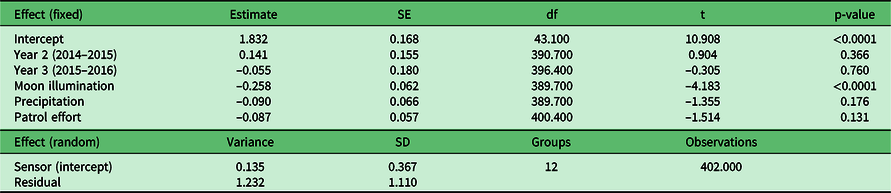
df = approximate degrees of freedom; Estimate = unstandardized β.
Discussion
The KNP data emphasize the need for adaptive wildlife law enforcement and demonstrate how passive acoustic monitoring can contribute towards this goal, especially in areas where firearms are the primary hunting weapon. The results also serve as a warning concerning the risks of using effort-based metrics as a surrogate for desired outcomes. While it may require years of increased protection for wildlife-based metrics to reveal conservation outcomes, acoustic monitoring can detect changes in poaching intensity very quickly, facilitating the prompt and progressive fine-tuning of conservation measures.
For example, in the light of our findings, KNP management decided to focus on improving the outcomes rather than on the total effort of patrols by bringing in international experts to retrain the game guards and by introducing financial bonuses for arrests made. Passive acoustic monitoring was also rolled out to additional sectors of the park, where regular patrolling was to be expanded. However, civil unrest in the Anglophone regions of Cameroon since late 2016, which eventually escalated to armed insurgency, has delayed plans for full implementation of the renewed anti-poaching strategy.
In order for other protected areas to take full advantage of this new law enforcement tool, they should be able to incorporate gun hunting information into conservation action evaluations regularly and in a timely manner. This means they should have the capacity to both collect and analyse acoustic data in situ. In order to achieve this, we propose that acoustic methods are incorporated in the law enforcement curriculum of wildlife management training institutions and that the cost of acoustic monitoring is shared among protected areas by establishing regional analysis hubs. This could also help detect potential spatial displacement of hunting (Herbig & Minaar Reference Herbig and Minaar2019), promoting landscape-scale conservation. Finally, we encourage efforts to optimize the deployment and efficiency of acoustic grids (Covarrubias et al. Reference Covarrubias, Hill, Prince, Snaddon, Rogers and Doncaster2019, Prince et al. Reference Prince, Hill, Covarrubias, Doncaster, Snaddon and Rogers2019), to integrate acoustic input into law enforcement monitoring software such as SMART (https://smartconservationtools.org) and to link personnel rewards to achieved law-breaking deterrence (i.e., reduction in gunshots) in addition to arrests made.
Acknowledgments
We thank the Korup National Park management and park game guards for their collaboration.
Financial support
The project was funded by the UK government’s Darwin Initiative grant scheme (DI20012). The anti-poaching patrols were funded by the Programme for the Sustainable Management of Natural Resources in the South West Region of Cameroon (PSMNR-SWR).
Conflict of interest
None.
Ethical standards
None.


 Open access

