

Autistic high school students overwhelmingly have a poor experience of school, both academically and socially. In Australia, 97% of autistic students who responded to a national survey reported that they faced difficulties in their education, and more than half (56%) said they’d been treated unfairly at school (Jones et al., Reference Jones, Akram, Murphy, Myers and Vickers2018). Similarly, the Australian Bureau of Statistics (ABS) has reported that of autistic people aged 5 to 20 years who attended school or another educational institution, 68.9% experienced difficulty at their place of learning. The main difficulties reported were fitting in socially (53.4%), communication difficulties (51.0%) and learning difficulties (44.1%; ABS, 2024).
Globally, it has been reported that the demands of academic requirements and targets in the mainstream curriculum were a source of stress and anxiety for autistic students (Horgan et al., Reference Horgan, Kenny and Flynn2023). Autistic high school students were likely to obtain poorer grades and lower test and examination scores and to be severely challenged by tasks related to executive function (e.g., planning, time management and organisation; Bolic Baric et al., Reference Bolic Baric, Hellberg, Kjellberg and Hemmingsson2016). Autistic adolescents also experienced social and emotional difficulties at school, such as isolation and bullying (Humphrey & Lewis, Reference Humphrey and Lewis2008; Saggers et al., Reference Saggers, Hwang and Mercer2011). Evidence suggests that autistic students had fewer friends, more limited social networks and experienced loneliness more often than their non-autistic peers (Bauminger et al., Reference Bauminger, Shulman and Agam2003; Kasari et al., Reference Kasari, Rotheram-Fuller, Locke and Gulsrud2012). These students also reported more teasing, verbal aggression and bullying (Maïano et al., Reference Maïano, Normand, Salvas, Moullec and Aimé2016; Shtayermman, Reference Shtayermman2007), and more often engaged in reactive aggression (ABS, 2015, 2018, 2024; Humphrey & Symes, Reference Humphrey and Symes2011).
Despite this evidence of the immense challenges of high school for so many autistic young people, there has been relatively little research to understand this important educational stage (Aubineau & Blicharska, Reference Aubineau and Blicharska2020; Greaves, Reference Greaves2014; Humphrey & Lewis, Reference Humphrey and Lewis2008). An international review of educational provisions and interventions for autistic children reported that of the 100 papers included, just 10 focused on the needs of post-elementary and high school students (Parsons et al., Reference Parsons, Guldberg, Macleod, Jones, Prunty and Balfe2009). Researchers have noted that the needs of older children have been significantly understudied (Parsons et al., Reference Parsons, Guldberg, MacLeod, Jones, Prunty and Balfe2011). Similarly, Mason et al. (Reference Mason, Stewart, Capp and Happé2022) reviewed the number of autism research publications in 2021 and found an average of 34,873 articles on childhood and early life compared with 6,224 for adolescence. When research has been conducted into the experience of secondary education for autistic students, the firsthand perspectives of autistic students have often been excluded, highlighting an important gap in the extant literature. Researchers have noted a tendency to rely on the opinions of others (e.g., parents, teachers) as proxies. In a review of research into stakeholder perspectives on the inclusion of autistic students in mainstream schools, the authors found that of the 23 articles examined, only five included interviews with autistic adolescents, two included autistic adolescents in focus groups with other stakeholders and the rest reported on the perspectives of observers including parents and teachers (Roberts & Simpson, Reference Roberts and Simpson2016). McKinlay et al. (Reference McKinlay, Thorpe, Cage, Grainger, Jasper and Stewart2025) found that most studies into the experience of school for autistic students ‘prioritise non-autistic perspectives (from parents or school staff) over autistic adolescent lived experience’ (p. 567). The same authors noted that the extant research typically focused on the challenges autistic people faced in schools, not on what students want or what may be working (McKinlay et al., Reference McKinlay, Thorpe, Cage, Grainger, Jasper and Stewart2025). Attempting to understand the experience of school for autistic students by reporting the views and observations of others is problematic, as it excludes those with lived experience and prioritises the perspective of non-autistic people (Danker et al., Reference Danker, Strnadová and Cumming2019a; Horgan et al., Reference Horgan, Kenny and Flynn2023). This also suggests that the views of autistic people are not informing the policies and processes most relevant to their experience. There is a growing discourse arguing that research into the lived experience of autistic people must include autistic participants and preferably autistic researchers (Horgan et al., Reference Horgan, Kenny and Flynn2023; Milton, Reference Milton2014). However, there are limited examples of this approach being used in attempts to understand and improve the school experience of autistic high school students.
There has been robust discussion on how the different theoretical models of disability address the physical, psychological, political and sociocultural dimensions of disability. The medical model, for example, regards disability as a medical condition expressed in terms of deficiency or deficit (Twardowski, Reference Twardowski2022). In contrast, the social model (Thomas, Reference Thomas2004) views disability as ‘the social disadvantage and exclusion that some people face due to their surrounding environment, which includes common social practices and physical structures’ (Goldiner, Reference Goldiner2022, p. 31). Disability, through the lens of the social model, is defined principally by the barriers and discrimination experienced by people. However, increasingly in recent discourse on disability, researchers are calling for consideration of the more nuanced social relational model: ‘The social relational model essentially acknowledges the merits of both the medical and social models … [and] acknowledges that both impairment and psycho-emotional oppression are important influences’ (Martin, Reference Martin2013, p. 2031). We have therefore chosen to position this study within the social relational model of disability, in recognition of its understanding of both levels of function and capacity, and the role of the system, in this case the education system, in responding to (or not responding to) these differences. The authors argue that the social relational model is a ‘better fit’ for autism research in the context of education, as it takes into account both a student’s level of functioning or capacity and how that might interact with their environment. Importantly, in this study, lack of capacity or function is consciously framed as a difference rather than as a deficiency.
Although prior literature has reported autistic students’ poor experience of high school, both academically and socially, there is a lack of research that includes the students’ perspective, in particular their perceptions of what works and what would help. This study addresses this gap by eliciting firsthand accounts of school experiences from 10 autistic adolescents in Australian mainstream high schools to answer the research question: What do autistic students identify as the enablers and inhibitors for a successful secondary school experience?
Methods
Study Design and Community Consultation
Qualitative research methods, including semistructured interviews, were chosen, as they are best suited to identifying information in natural settings, using a holistic approach (Creswell & Creswell, Reference Creswell and Creswell2018).
A community reference group, comprising five individuals, was recruited for the study from the very early stages of the work (see Community Involvement Statement). The five group members were not participants but acted as consultants to inform and advise the authors on research design throughout the study. Reference group members were remunerated for their time. Ethics approval was granted for this work by La Trobe University’s Human Research Ethics Committee on December 19, 2022 (HEC22302).
Community Involvement Statement
A reference group that included autistic members was involved in the research from its inception. The reference group included at least one autistic adult (though not all disclosed this), two parents of autistic teenagers and two educators with extensive experience working with autistic students. The reference group had input into the research design, which included participant recruitment and interview questions through online consultations, follow-up emails and phone calls (two online whole-group meetings, three follow-up emails inviting comment, and phone calls from three reference group members to offer more feedback). The autistic student participants also contributed to the interview topics and questions; for example, during the first interview, they were asked if there were other questions we should be asking or anything else we should be talking about. Most questions were open-ended and some were designed to encourage students to raise topics that the researchers may not have anticipated; for example, Could you design or imagine your ideal school? Following the first round of interviews, students were sent a summary of the data and invited to give feedback on this via a second interview, phone call or feedback in writing.
Participants
Participants were 10 autistic high school students in their seventh to 13th years of education. Their ages ranged from 13 to 20 years old. Four students identified as female and six as male. Student participants were from nine different schools and year levels were 7, 9, 10, 11 and 12. Schools were mainstream, with some additional support, such as integration aides, provided to students. The schools were located in the Australian states of Victoria, New South Wales and Queensland and were from both government and independent sectors. The schools included large mainstream high schools, a smaller mainstream high school and a much smaller alternative high school (all in metropolitan settings).
Recruitment Procedure
Students were invited to participate in the research through online advertising in the university’s social media posts, as well as via contact with autism-focused social, advocacy and support groups. This recruitment strategy was aimed at ensuring students did not feel any sense of compromise, influence or power imbalance, which may have occurred if they were approached by the schools (Becerra-Murillo, Reference Becerra-Murillo2020). Students may not have felt free to criticise schools or teachers if the research took place at their school or even via an approach from schools. Student participants were sent accessible, plain language printed information about the research, which had to be signed by a parent or guardian prior to the interview.
Interview Procedure
The interviewer also offered a brief phone call or meeting before the interviews for students to get to know her and ask any questions, but no participants chose to have a pre-interview meeting/call. The first 5 minutes of each interview were spent introducing the researcher and the project, aiming to make the experience more comfortable. The interviews were scheduled for 30 minutes so as not to strain the participants. A summary of the interview guidelines can be found in Table 1.
Interview Guidelines

Table 1 Long description
The table presents guidelines for conducting interviews with participants, offering choices between in-person or online formats. Participants can bring a parent or support person and are interviewed at their preferred location to ensure comfort and remove any sense of obligation. Online interviewees have the option to turn their camera off to avoid sustained eye contact. Breaks are allowed and can be indicated through chat or verbally. Parents are generally not present during interviews, with one exception noted. Interviews include printed materials and allow for visual, non-spoken responses. Online participants can type responses into the chat, and all participants are offered recordings of the interview questions for further input. Printed versions of questions are also provided, with options for sending additional responses later. All participants are de-identified to emphasize privacy. The table consists of ten rows and one column, detailing these guidelines in a clear and structured manner.
The researcher used semistructured interviews, as these have been frequently used in flexible qualitative research designs, where the main focus of the research is on the participants’ experiences, and have been used in a number of studies focused on autistic children and young people (Kelly et al., Reference Kelly, O’Malley and Antonijevic2018; Kvale & Brinkmann, Reference Kvale and Brinkmann2015; Robson, Reference Robson2002).
The interview design was flexible to capture the perspectives of a group with differences in communication styles and preferences. For example, one student did not speak and answered mainly in writing and with some drawing. One student gave most of their responses in the chat function during an online interview, and one student drew pictures. Several students pointed to or indicated emoticon pictures (provided by the researcher) to describe their feelings. The emoticons were commonly used icons, likely to be familiar to adolescents, representing six emotions (happy, nervous, worried, angry, sad and unsure). In the interview process, the authors also sought to address the likely discomfort for participants in discussing their experience of school when this was often negative (Humphrey & Lewis, Reference Humphrey and Lewis2008; Saggers et al., Reference Saggers, Hwang and Mercer2011).
Students were invited to speak, write or draw their responses to a mix of closed and open questions. At the end of the session, participants were asked if ‘there is anything else you think I should be asking?’ Similarly, participants were asked to imagine their ideal school, which provided an open-ended opportunity to raise topics or issues not already specifically asked about.
There was also flexibility according to the individual’s preferences for contact — for example, online or in person, camera on or off. Most interviews were conducted online, in part because the participants were located across three states (Victoria, New South Wales and Queensland) and the researcher was based in the city of Melbourne, Victoria.
Although students were invited to bring a support person to the interviews, parents were usually not present, so each participant could freely describe their lived experience. The only exception was one student who was nonverbal and chose to have her mother present to support with communication.
The first author completed all interviews, which were recorded, with notes also taken in shorthand. The recordings were later transcribed by hand to improve accuracy and to address the communication differences of some students.
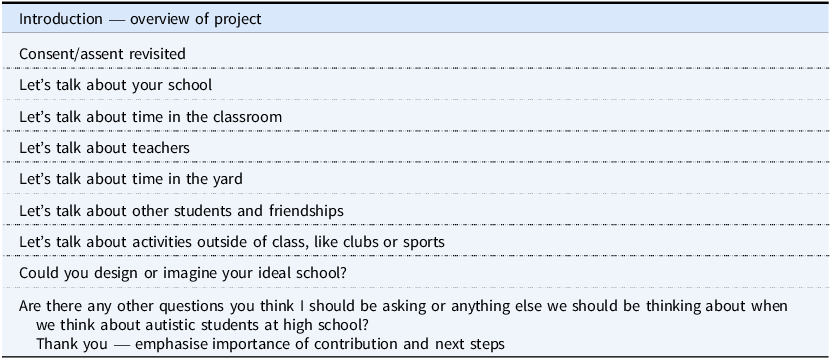
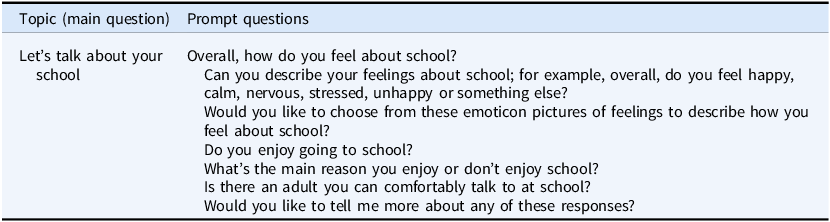
Interviews were conducted to gain a detailed understanding of the lived experiences of autistic students in mainstream high schools in Australia. The interviews consisted of a series of topics, with each topic having several prompt questions. More or less prompt questions were asked depending on how expansive the initial responses were. Table 2 lists the interview topics, and Table 3 provides an example of the first topic and prompt questions.
Interview Topic (Main Question)

Table 2 Long description
The table presents a structured list of interview topics designed to explore the experiences of autistic students in mainstream high schools. It includes an introduction, consent/assent revisited, and various discussion points such as talking about school, time in the classroom, teachers, time in the yard, other students and friendships, activities outside of class, designing or imagining an ideal school, and any additional questions. The table is organized into a single column with ten rows, each row representing a different topic. The focus is on gathering detailed insights into the students' lived experiences through these structured topics.
Examples of Topic and Prompt Questions

Table 3 Long description
The table presents a structured format for conducting interviews with autistic students in mainstream high schools. It includes a main topic column titled 'Let's talk about your school' and a prompt questions column with several specific questions. The questions aim to understand the students' feelings and experiences about school, such as their overall feelings, reasons for enjoying or not enjoying school, and who they can comfortably talk to. The table also mentions the use of emoticon pictures to describe feelings and invites further elaboration on responses.
Analysis
The interview data were analysed using interpretative phenomenological analysis (IPA). The aim of IPA is to explore in detail how participants make sense of their personal and social world (Becerra-Murillo, Reference Becerra-Murillo2020; Smith & Osborn, Reference Smith, Osborn and Smith2003). Smith et al. (Reference Smith, Larkin and Flowers2009) describes seven key steps in IPA:
-
Step 1: Starting with the first case: reading and re-reading
-
Step 2: Exploratory noting
-
Step 3: Constructing experiential statements
-
Step 4: Searching for connections across experiential statements
-
Step 5: Naming the personal experiential themes and consolidating and organising them in a table
-
Step 6: Continuing the individual analysis of other cases
-
Step 7: Working with personal experiential themes to develop group experiential themes across cases.
The researcher used NVivo 14 software (https://lumivero.com/products/nvivo/ ) to identify the codes within the data and followed Smith et al.’s (Reference Smith, Larkin and Flowers2009) seven key steps of IPA. The IPA approach is well suited to smaller sample sizes. Researchers conduct close, line-by-line analysis of the experiential claims, concerns and understandings of each participant, before identifying patterns and developing experiential statements and then themes (Smith et al., Reference Smith, Larkin and Flowers2009). The themes are developed into personal experiential themes. Two of the authors worked closely to test and review patterns, experiential statements and themes. The first author is a PhD candidate at the Olga Tennison Autism Research Centre, La Trobe University, Melbourne, and the second author is a senior lecturer in inclusive education (trauma) at La Trobe University, Bendigo. The two researchers met weekly for two months to go over the interview data, looking closely at the transcripts.
Findings
All students completed one interview, either in person or online. Although the researcher aimed to keep the interviews to 30 minutes, two of the students went well over this time at their own request, and one interview was very brief (interviews ranged from 10 minutes to 60 minutes). All participants were advised that they could add more responses by contacting the researcher after the interview and were offered a printed copy of the questions, a recording, or the option to receive the questions via email. Two students sent more information in writing soon after the interview.
All students were later contacted with a summary of the interview data and asked for their feedback. They were offered a phone call, a meeting or the opportunity to give their responses in writing. All students responded with feedback on the interview data, with eight students giving detailed responses in writing and three asking for phone calls to expand on their feedback. Figure 1 shows the student interview data, analysed using IPA, and organised into experiential themes.
Student Interview Data, Analysed Using Interpretative Phenomenological Analysis (IPA).

Figure 1 Long description
The diagram presents student interview data analyzed using interpretative phenomenological analysis. It includes four main sections: Interview topics, Themes, Themes clustered into experiential statements, and Experiential themes. Interview topics cover areas such as school, classroom, teachers, friends, participation, and ideal school. Themes include overall feelings about school, friends, acceptance, noise, breaks, participation, teachers' understanding, peers' understanding, and different ways of learning and assessing. Themes clustered into experiential statements highlight intersections of feelings, friends, noise, breaks, participation, teachers' understanding, and flexibility. Experiential themes are categorized into friendship, educators, school environment, peers, and flexibility in teaching and assessment.
Friendship and Peers
Autistic students were highly motivated by having or wanting friends and being with peers who accepted them. Despite all reporting that they had few or no friends at school, most described a good day as one when they were with friends. Several also described the protective factors that friends can provide; for example, friends made time in the yard comfortable or told them to ignore mean comments. One student reported that he was ‘happy when I’m around kids who accept me for who I am’ (male student aged 20). However, autistic students also described other students not wanting to be friendly with them or to talk to them and being impatient: ‘Other students not wanting to mingle with me even when I take the first step in trying to make friends’ (male student aged 17). No students described any school-based programs to support developing friendships.
Students reported that bullying, especially exclusion and social isolation, commonly occurred. These were reported in the context of participants being asked about friendships and how they got on with the other students. One student reported, ‘I have lots of issues with other students because there are people who are giving me a hard time; they really don’t understand me’ (female student aged 16).
Wanting to be accepted or understood was a common theme. Interestingly, although the word accepted was frequently used in the context of several themes, it mostly related to friendship, educators not understanding autism or peers not understanding autism. Many students reported that they did not feel accepted by their peers.
Students reported that peers and friends generally did not understand autism and did not understand that autistic differences drove behaviours or needs. Several students described discrimination, with one reporting that ‘I face a lot of discrimination when it comes to the students’ (female student aged 16). Students noted that it would be better if peers understood autism — for example, ‘Most of the other kids are like, “why doesn’t he understand, something as simple as this, how come he still doesn’t understand”, not knowing that I’m different’ (male student aged 17).
Peers’ attitudes or lack of understanding of autism impacted on the possibility of friendship, participation in class and extracurricular activities and was also seen as fuelling negative interactions such as bullying or being socially excluded. One student described avoiding interactions out of concern that he would be misunderstood or rejected. Another student reported that although peers were generally nice, most did not understand her autistic traits, and this meant they were often impatient: ‘People get annoyed if I take too long to understand things or talk about the same thing too much’ (female student aged 15).
Educators’ Training and Attitudes Towards Autism and Autistic Students
The students interviewed were very clear that they wanted teachers who were trained in autism and had a positive attitude towards autistic students; however, most believed their teachers had neither. Many students reported that they felt their teachers did not like them. Only one student agreed with the statement that his teachers liked him the way he was, while others said only some or no teachers liked them as they were. Some students also wanted awareness and understanding by educators running activities so that they could participate. For example, one student described teachers’ lack of understanding of autism as a barrier to participation in extracurricular activities, observing that he probably would take part in sport if the coach knew something about autism and how to support him:
It might not be easy for me to join because you don’t know how I might be treated … it might depend on the kind of person you have, like a coach, if you have someone who receives a lot of orientation about people with disabilities and accepts them, that might help. (Male student aged 18)
A common reflection from the students was that teachers did not understand autism or how it impacted their individual learning. Students reported that teachers’ lack of understanding of learning differences meant support and accommodations were not offered, leading to frustration, tiredness and reduced learning capacity.
One student said, ‘None of them are really trained to deal with anything other than neurotypical, so when you don’t behave like they expect, they don’t know what to do’ (male student aged 16). Another student reported that ‘teachers like the way I am when I’m like all the other students, but they get a bit annoyed at me when I need extra time’ (female student aged 15). And another student reported that she kept away from teachers who did not understand her. When asked if there was anything else we should be talking about when we think about the experience of school for autistic students, one student said, ‘the teachers, they are the people we learn from so they should try to understand us and probably they should get education about autism’ (male student aged 17).
School Environment and Sensory Needs Not Met
When asked to reflect on their classroom and the yard or outdoor areas, none of the students described liking or feeling comfortable in these spaces. All students said they found their classroom too noisy, and most reported that the outdoor spaces were also too noisy. For example, when asked whether there is a time when they feel comfortable in the classroom, one student said, ‘No, not really’ and mentioned noise and lighting. Students reported that unmet sensory needs were a common and pervasive problem, causing stress, tiredness and discomfort. In the context of their classrooms, students were asked whether they could comfortably take breaks when they needed them, as this is a common and proven strategy for autistic people (Price & Romualdez, Reference Price and Romualdez2024). However, most students reported that they could only take breaks sometimes and lacked a comfortable place to go to if they needed a break from the class. Not knowing whether they would be allowed to take breaks or supported to do this caused stress and led to exhaustion. Students reported that being allowed to take breaks depended on which teacher they had. For example, one student reported that if she did take a break, the teacher would not help her catch up on what she might have missed. Another student reported that although she could usually take breaks, the only quiet space to go to was the toilets. Others reported that if they were allowed to take breaks, they could walk around the yard but did not have a quiet room to go to. The lack of appropriate places in which to take a break when overwhelmed or overstimulated also suggests an area where the policy and intentions of schools were not matched by practice; for example, although school policy may allow breaks from class, in practice this depended on the teachers and may not have been supported with an appropriate break space.
Students also reported sensory challenges, such as noise, crowds and overstimulation, as barriers to participation. One student said, ‘It’s too crowded and I don’t know what they are doing. I would like to be involved in sport. I’m not really involved in activities, but I would like to be’ (male student aged 20).
Learning Needs Not Met
Students reported that they would like more flexibility in both teaching and assessments, and this was also identified by students when they described their ideal school. Several students said that they would like to be able to choose their own topics or to have topics that related to their special interests. Having deep and focused interests is a common trait for autistic people. One student, in describing her ideal school, mentioned that she would like learning that was more hands on, ‘where students could prefer what they are learning and it’s more focused on interests. Different ways of learning, not just pen and paper’ (female student aged 15).
Students also reported that what learning support they did get was inconsistent; for example, they received support only in some classes and with some tasks, and if they asked for support, teachers often took too long to get to them. One student noted that she received accommodations in exams but not in class: ‘In tests, I can sit in a quieter space, but in the classroom, I don’t get any support’ (female student aged 15). The same student reported that she felt teachers became annoyed with her when she needed extra time and did not understand that, although she often received good marks, it was a struggle and was very exhausting. Interestingly, since experiencing learning from home during the COVID-19 pandemic, some students expressed a desire for a mix of online and in-person learning.
Students also suggested that they would benefit from better communication within school, with information about their needs shared between teachers. One student said, ‘It would be good if teachers and head of my year level had meetings to work out how to help me’ (female student aged 15).
The autistic students interviewed had specific recommendations for changes that they believed would improve their experience of learning at school. Most of these were derived from responses to the open-ended question, Can you describe your ideal school, the school that would be the best for you? Students recommended changes to accommodate sensory needs, such as schools having quiet places and less crowding. They asked for changes to support autistic learning differences, including activities and assessments focused on their special interests, multi-age learning groups and flexible types of assessments.
Discussion
This study aimed to address a gap in the extant literature about the experience of high school for autistic students by seeking the firsthand perspective of these students about their experience of school and their ideas for how this could be improved. This is a perspective that has often been missing from the literature, with research into this area more likely to be based on the opinions and observations of non-autistic others, such as parents and teachers. Further, the extant research typically focuses on the challenges autistic people face in schools, and there is little research reporting what autistic students judge is working now or what would work to support a positive experience of secondary school (McKinlay et al., Reference McKinlay, Thorpe, Cage, Grainger, Jasper and Stewart2025).
The interview data from the 10 autistic secondary students found that despite all reporting they had few or no friends at school, they were highly motivated by wanting to be with friends or peers. Although participants reported frequent bullying, they also described a friend as someone who could protect them from bullying and isolation. The desire to be accepted or understood by peers was a common theme, with students typically reporting that a lack of understanding or acceptance of autism and autistic differences impacted on the possibility of friendship, participation in class and extracurricular activities and was also seen as fuelling negative interactions such as bullying. The students reported that they wanted teachers who were trained in autism and had a positive attitude towards autistic students; however, most believed their teachers had neither. Students reported finding their classroom and outdoor spaces too noisy and/or crowded and reported sensory challenges such as noise, crowds and overstimulation as barriers to participation. Students also reported that their learning needs were not being met, describing inconsistencies in accommodations. Students reported that they would like more flexibility in both teaching and assessments.
The accounts of the 10 autistic students interviewed for this research elucidated the barriers that typically prohibit them from having a successful experience of school, confirming many of the findings reported in the Australian and international literature. However, by including the student voice, this data made a valuable contribution to our understanding of autistic students’ school experience, adding depth and detail, and including the enablers to a successful experience and what autistic students would like to see changed to achieve this. Importantly, the interview data also challenged misconceptions about what autistic students prioritised in their school experience and the barriers to them having a successful experience of schooling. For example, although the autistic participants reported having few or no friends, they placed a high priority on friendship and were not choosing to be without friends. It is a common assumption that friendship may not be an important factor for autistic young people. For example, McNerney et al. (Reference McNerney, Hill and Pellicano2015) reported that in choosing a school for their autistic children, few adults mentioned children’s social relationships, whereas this was prominent in the children’s reports. Similarly, students were not choosing to avoid participating in extracurricular activities; rather, they would like support and accommodations to achieve this and an understanding of their autistic differences from the teachers involved.
Friendship and acceptance were raised across several interview themes, with autistic students placing high value on having friends, being near friends or being accepted by peers. This was a priority for students, but it did not seem to be well understood or supported by the practices at school. For example, students did not mention any school-based programs or practices aimed at developing or maintaining friendships. Several students also reported that they would like to join in with peers in activities out of class, such as sports, but that while they wanted support or accommodations to achieve this, these were not offered.
This finding aligns with the social relational model of disability (Reindal, Reference Reindal2008), which recognises the impact of impairments or differences and the response to these. In this study, students clearly recognised that they have difficulty making and maintaining friendships, but schools did not appear to respond by providing scaffolding or supports to aid their autistic students with friendship. Importantly, this finding ought not to suggest that autistic social communication differences are always impairments or should be viewed as deficiencies. Although the students interviewed wanted support in the area of friendship, they also noted that peers did not understand autism and often did not accept them. This supports the double empathy problem (Milton, Reference Milton2012) and is a significant finding, suggesting that support for friendship should not focus solely on autistic students but could be a whole-of-school approach, increasing understanding of autistic differences and emphasising the reciprocal nature of social communication. Many of the autistic students interviewed reported that greater understanding of autism among peers and teachers would be helpful, suggesting that friendship support could be based on mutual learning. Prior literature has reported that a lack of knowledge and understanding of autism among peers and school stakeholders can lead to negative attitudes towards autistic students and impact their engagement and participation in school and their quality of life (Rajotte et al., Reference Rajotte, Grandisson, Couture, Desmarais, Chrétien-Vincent, Godin and Thomas2025). This includes research where the student voice has been specifically included. For example, Humphrey and Lewis (Reference Humphrey and Lewis2008) interviewed 20 autistic secondary students and found that where autistic students’ needs at school were not being met, they experienced increased exposure to social isolation and bullying.
This finding aligns with recent research into inclusive education (Tallentire, Reference Tallentire2024), highlighting that the focus of effective inclusion should be on all students, not only those with additional educational needs. These studies emphasise the need for the identification of educational barriers, including attitudinal barriers. For example, Poikola et al. (Reference Poikola, Kärnä and Hakalehto2024) reviewed 62 studies on students’ views of inclusive education, including six studies that specified that the students were autistic. Further, the broader literature reports that autistic people want support around friendship and social skills to be based on mutual learning and understanding and not the idea that autistic people need to be trained to perform in a non-autistic way (Ayirebi & Thomas, Reference Ayirebi and Thomas2024).
Many students in the present study described peers’ lack of acceptance or understanding in terms of a barrier to friendships and participation. Students also identified that they thought that friends could prevent some of the negative experiences of school, including being isolated or bullied. This focus on friendship challenged the common perception that autistic young people are choosing to be alone (Page et al., Reference Page, Barr, Rendoth, Roche, Foggett, Leonard and Duncan2024) by, for example, staying inside during breaks or choosing to be on their devices for long periods. This aligns with Horgan et al.’s (Reference Horgan, Kenny and Flynn2023) systematic review of the experiences of autistic young people in mainstream secondary schools, which found that many autistic students struggled to make friends and that having a friend impacted positively on school experiences. Notably, Horgan et al.’s search criteria included that the eligible studies elicited the views of at least one autistic young person (aged 11–18 years). Other researchers similarly found that autistic adolescents placed as much emphasis on the importance of peer approval as their non-autistic peers. For example, Williamson et al. (Reference Williamson, Craig and Slinger2008), who interviewed 19 autistic students aged 11 to 15 years, found that although the autistic participants perceived they had less peer approval, they placed as much importance on peer and parental approval as their non-autistic peers. The priority that autistic students gave to friendship has implications for practice in schools and may encourage educators to consider how they could explicitly teach friendship skills, facilitate interactions with peers and support and scaffold the development of friendships for autistic students, prioritising the approach of mutual learning.
The students’ reflections on participation, particularly in school-based extracurricular activities, could also challenge existing understanding (Hilton et al., Reference Hilton, Ratcliff and Hong2021) and provide suggestions for improving practices in schools. Students generally reported not participating by, for example, staying inside or spending time alone in the yard; however, for several students, this was not an active preference but rather the result of not being able to cope with the activities on offer or feeling that they would not be accepted or supported to engage in them. This is of particular concern in the context of the evidence that autistic youth participate in extracurricular activities at far lower rates than neurotypical young people (Hilton et al., Reference Hilton, Ratcliff and Hong2021). The reports of low participation rates by the students interviewed for this study were consistent with broader research into participation for autistic adolescents. Lower participation rates in extracurricular activities directly relate to health, wellbeing, and quality of life (Hilton et al., Reference Hilton, Ratcliff and Hong2021). Again, several students in the present study said that they would like to participate but wanted specific support or accommodations to do this.
The issue of breaks from class for autistic students emerged as another theme in the interview data with clear implications for practice. The broader literature highlighted the importance of safe, quiet spaces for autistic students to help them decompress and recharge (Price & Romualdez, Reference Price and Romualdez2024). However, even when breaks were theoretically permitted, students reported that this occurred only sometimes and that there was often no comfortable, safe place for them to go. This illustrates how, even when policies existed at schools to support autistic students, they may not be understood by educators or applied consistently in practice, undermining well-intentioned approaches.
All students reported that sensory needs not being met were a common and pervasive problem, causing stress, tiredness and discomfort, and impacting on their participation in and outside of class. This confirms the substantial literature (Schaaf & Lane, Reference Schaaf and Lane2015) reporting that autistic students experience sensory discomfort at a far higher rate than their neurotypical peers and the subsequent impact on their learning (Howe & Stagg, Reference Howe and Stagg2016; Jones et al., Reference Jones, Hanley and Riby2020). It’s important to note that this does not demonstrate that students don’t want to participate in class and in extracurricular activities; rather, they need accommodations based on their sensory needs, including breaks in appropriate settings, to ensure they are not overwhelmed or exhausted. In fact, preventing the kind of exhaustion associated with managing sensory overload could increase participation.
Of particular significance were the findings that autistic students typically felt misunderstood and even disliked by their teachers and that this impacted on their learning and participation in extracurricular activities. Many students reported that they felt their teachers did not like them. This finding points to a strong disconnection between teachers’ attitudes and intentions and how autistic students were experiencing them. It seems unlikely that teachers genuinely disliked their autistic students or intended to convey this to them; yet most students felt disliked by most of their teachers, suggesting that something important was being ‘lost in translation’. However, there is evidence in the extant literature that some teachers have attitudes that may contribute to autistic students feeling poorly accepted. For example, several studies have reported that mainstream teachers generally lack knowledge of autism, and this was associated with negative attitudes towards inclusive education (Kisbu-Sakarya & Doenyas, Reference Kisbu-Sakarya and Doenyas2021). Many authors have reported that a lack of knowledge of autism and misconceptions fuelled negative views towards inclusive classrooms for autistic students (Barned et al., Reference Barned, Knapp and Neuharth-Pritchett2011). Teachers are also widely reported to be experiencing unprecedented levels of burnout and exhaustion, which may lead students to interpret teachers’ body language or less positive interactions as dislike. The finding of the present study — that students feel disliked by their teachers — is significant in light of the existing literature indicating that poor teacher–student relationships have been associated with increasing levels of behavioural difficulties and lower levels of social inclusion for autistic students (Robertson et al., Reference Robertson, Chamberlain and Kasari2003). Conversely, feeling that teachers cared and being recognised as an individual have been found to give autistic students a sense of belonging and positively influence learning (Bolic Baric et al., Reference Bolic Baric, Hellberg, Kjellberg and Hemmingsson2016). Teachers also serve as strong role models for other students and the broader school community (Kim & Cillessen, Reference Kim and Cillessen2023), so it is reasonable to ask whether an autistic student’s perception of being disliked by their teacher might also impact the attitudes of others towards them.
Autism is defined by social communication differences, and effective communication with autistic students is clearly a complex challenge for educators. This is a strong focus of the social relational model of disability where autistic students have communication differences but educators are not effectively understanding or addressing these differences, leading to students feeling misunderstood, not accepted and even disliked. This is a critical finding that poses challenges for how educators could better communicate, including communicating their understanding, support for and liking of autistic students. Communication with students with communication difference may need to be more explicit and deliberate. The present study’s findings underscore the need to consider changes to practice in schools to better meet the needs of autistic students.
Future Directions
This study indicates key areas for further research, including how teachers can more effectively communicate with autistic students, and what is leading autistic students to feel that their teachers do not like or understand them. Another key area for future research would be how autistic students wish to communicate their needs to educators. There is also a need for further research exploring how to facilitate friendships and engagement in extracurricular activities.
Limitations
One limitation of the current study was the somewhat modest sample size of 10 students. Although it is a valid sample given the lack of research including the firsthand perspectives of autistic adolescents, having more participants would have strengthened the findings. A further limitation was that the students were self-selected, and we did not seek information on whether they had a formal diagnosis of autism or whether they had co-occurring conditions such as attention-deficit/hyperactivity disorder. Information about the study was in English and the interviews were conducted in English.
Conclusion
The interviews with 10 autistic secondary school students provided rich, detailed information about their experience of school and their insights into what they believed could be changed to improve this. With limited research into the experience of school for this group, and much of this from the perspective of non-autistic observers, such as parents and teachers, having the first-person views of autistic students made a valuable contribution to our knowledge of their experience of schooling, the barriers that prevent their successful experience of school, and what could be done to improve this. These findings presented clear implications for practice in secondary schools.
In the context of this research, the aim is that by being driven by the voices of the autistic students, information will be generated that can contribute to constructive change in practices and policies aimed at better meeting the needs of autistic students. It has been well documented in the literature that autistic high school students have a poor experience of school and achieve poor outcomes, with researchers concluding that the education system is failing autistic students (Jones et al., Reference Jones, Akram, Murphy, Myers and Vickers2018). It is greatly hoped that this research can contribute to informing real, positive change in the experience of secondary school for autistic students.



 Open access

