



Background
The clinical evaluation of older people in primary care remains a challenging field. Comprehensive assessments combined with action on agreed problems can improve survival and function (Reuben et al., Reference Reuben, Frank, Hirsch, McGuigan and Marly1999; Harari et al., Reference Harari, Iliffe, Kharicha, Egger, Gilmann, von Renteln-Kruse, Beck, Swift and Stuck2008; Ward and Reuben, Reference Ward and Reuben2012) but we still lack feasible approaches in general practice (Freer, Reference Freer1985).
(Semi)structured assessments of need may identify health problems leading to functional deterioration. This patient-centred methodology allows the definition of health priorities and suitable interventions to address them (Wright et al., Reference Wright, Williams and Wilkinson1998). Unmet needs have been associated with low quality of life which calls for proactive needs assessments in clinical practice (Slade et al., Reference Slade, Leese, Cahill, Thornicroft and Kuipers2005).
The Camberwell Assessment of Need for Elderly (CANE) (Reynolds et al., Reference Reynolds, Thornicroft, Abas, Woods, Hoe, Leese and Orrell2000; Orrell and Hancock, Reference Orrell and Hancock2004) has been validated in different countries and settings (Walters et al., Reference Walters, Iliffe, Tai and Orrell2000; Ybarzabal Mesa et al., Reference Ybarzabal Mesa, Mateos, Jesús Garcia, Amboage and Fraguela Pérez2002; Kaiser et al., Reference Kaiser, Krautgartner, Rainer, Unger, Marquart, Weiss and Wancata2005). Being perhaps too lengthy for routine clinical use in primary care, a shorter version with five priority domains was developed (SPICE): Senses, Physical ability, Incontinence, Cognition and Emotional distress (Iliffe et al., Reference Iliffe, Lenihan, Orrell, Walters, Drennan and Tai2004).
Assessing needs in primary care entails a change in usual clinical practice. To our best knowledge, the use of brief needs assessments such as SPICE have never been tested in routine consultations. Our study aimed to explore the usefulness and feasibility of the SPICE assessment tool taking into account the perspectives of both GPs and patients.
Methods
Design and participants
This cross-sectional study was conducted in 2014, in one family health unit near Lisbon, with 11 GPs and 10 nurses responsible for 17 800 registered patients (3692 aged 65+ years). GPs approached all patients aged 65+ years who attended the first scheduled appointment of the day, for six consecutive days. Patients on emergency visits were excluded, resulting in a sample of 51 patients.
Needs assessment
The SPICE interview was used, assessing: senses (vision and hearing), physical ability (mobility and falls), incontinence, cognition and emotional distress (Iliffe et al., Reference Iliffe, Lenihan, Orrell, Walters, Drennan and Tai2004). These five items were extracted from the Portuguese translation of the CANE (Gonçalves-Pereira et al., Reference Gonçalves-Pereira, Fernandes, Leuschner, Barreto, Falcão, Firmino, Mateos and Orrell2007). In Portugal, the CANE was validated in a sample of older people with neuropsychiatric disorders (Fernandes et al., Reference Fernandes, Gonçalves-Pereira, Leuschner, Martins, Sobral, Azevedo, Dias, Mateos and Orrell2008) and used to interview nursing home residents (Ferreira et al., Reference Ferreira, Dias and Fernandes2016), people with dementia (Kerpershoek et al., Reference Kerpershoek, de Vugt, Wolfs, Woods, Jelley, Orrell, Stephan, Bieber, Meyer, Selbaek, Handels, Wimo, Hopper, Irving, Marques, Gonçalves-Pereira, Portolani, Zanetti and Verhey2017) and people with psychiatric disorders (Passos et al., Reference Passos, Fonte, Dias and Fernandes2017).
According to the CANE instruction manual (Orrell and Hancock, Reference Orrell and Hancock2004) and the literature (Reynolds et al., Reference Reynolds, Thornicroft, Abas, Woods, Hoe, Leese and Orrell2000; Walters et al., Reference Walters, Iliffe, Tai and Orrell2000), a trained rater provides a separate judgement for the patient and their carer, along with key-staff views on each domain and a fourth overall assessment (the rater’s view). However, in order to study this assessment’s feasibility in routine consultations, the obvious rater would be the GP, accumulating the role of ‘key-staff’. To further document the usefulness of a proactive assessment in practice, we explored discrepancies between GPs’ assumptions about users’ needs (as based on previous consultations) and GPs’ direct needs assessments in current consultations. Thus, in the present study, GPs provided three separate scores: (1) immediately before the consultation (GP-T0), using all available information in medical records; (2) scoring the patient’s perspective during the consultation; and finally, (3) reporting again their own perspective after having interviewed the patients (GP-T1).
A ‘met’ need was recorded when a problem was identified and there was sufficient support to meet the need. An ‘unmet’ need was recorded when a problem was identified but there was either no support or insufficient support to meet the need (Orrell and Hancock, Reference Orrell and Hancock2004). We did not consider interviewing the carers systematically because most patients would not have an informal carer, and the advantage of systematically doing this in clinical practice is still unknown (Walters et al., Reference Walters, Iliffe, Tai and Orrell2000).
All GPs were trained in the administration of SPICE, including through rehearsal in role-play scenarios. Pilot interviews were video-recorded and reliability training conducted.
Additional feasibility data collection
To address feasibility issues at different levels, we adopted a sequential explanatory mixed-methods design (Creswell, Reference Creswell2014) and complemented quantitative data with qualitative explorations of GPs’ and patients’ perceptions about the use of SPICE.
GPs’ perceptions were assessed with a self-report questionnaire, including four multiple-choice items (on GPs’ reactions, patients’ reactions, perceived usefulness, and intentions regarding future use of the questionnaire) and two open-ended questions (further exploring advantages and difficulties).
Patients’ perceptions were explored in individual interviews. While all the Unit’s GPs were interviewed, we decided to randomise only five patients (10% of the sample) due to operational constraints. These assessments took place at home or at the primary care facility as convenient, one week after each SPICE interview.
Ethical issues
Approval was obtained from ARS Lisboa e Vale do Tejo ethics committee. Participants and GPs gave their written informed consent.
Data analysis
Quantitative analysis was performed using IBM SPSS Statistics 21 (Mac Version). Cronbach’s α was used to analyse SPICE internal consistency and K tests to analyse levels of agreement between patients’ and GPs’ assessments of need. The significance level of α=5% was considered.
In the questionnaire for GPs, responses to multiple-choice items were analysed using absolute frequencies. Open-ended questions were subjected to content analysis, identifying ranges of responses organised according to predefined themes (advantages and difficulties). Additional thematic units derived from content analysis (11 sub-categories and 12 indicators).
The qualitative interviews with patients were conducted semi-structuredly, audio-taped and transcribed. Content analysis using a directed approach (Hsieh and Shannon, Reference Hsieh and Shannon2005) was employed to code the records into four predetermined categories (opportunity, advantages, difficulties, acceptability) or into new categories. Two researchers independently analysed and coded the transcripts, to improve data trustworthiness.
Results
SPICE interviews were completed for all eligible patients (n=51). Demographic characteristics of the sample are illustrated in Table 1.
Demographic characteristics of the sample (n=51)
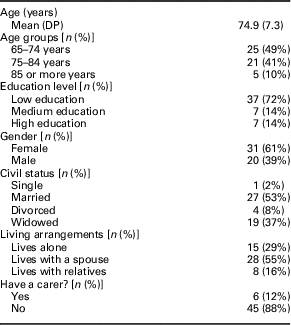
Patients participating in individual interviews (n=5) had a median age of 79.5 (range 66–88), and four were women. Two asked for the presence of a companion during the interview.
Needs assessment: SPICE results
All patients completed SPICE assessments. Median time taken for interviews was 8 min (range 3–23). In 11 (22%) appointments there were other people present at the interview (two carers, nine relatives with no caring role).
Needs were identified by patients and their GPs (Table 2). Needs for care were reported by 38 (75%) patients, reporting on average 1.6 needs each, 0.3 of which were, on average, unmet. Unmet needs (n=17) corresponded to 7% of total needs (n=255). ‘Emotional distress’ was the most frequent unmet need (n=5).
Frequencies of needs identified using the SPICE by patients and general practitioners
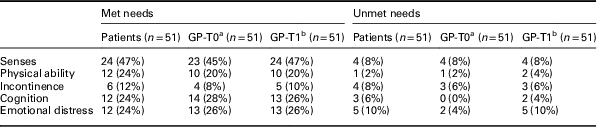
a GP assessment before consultation.
b GP assessment after consultation.
Of 17 unmet needs identified by patients, six were unknown to GPs before consultations using SPICE.
According to Fleiss’ (Reference Fleiss1981) criteria, k tests between patients’ and GPs’-T0 assessments showed fair agreement regarding senses (k=0.59), incontinence (k=0.56) and cognition (k=0.58); and good agreement in physical ability (k=0.68) and emotional distress (k=0.71). k tests between patients’ and GPs’-T1 assessments showed excellent agreement in all domains (senses, k=0.79; physical ability, k=0.79; incontinence, k=0.87; cognition, k=0.95; emotional distress, k=0.88).
GPs’ and patients’ perceptions about the use of SPICE
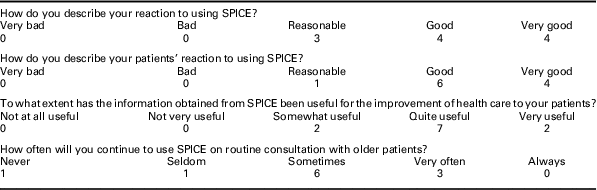
The majority of GPs (n=9) found that the information obtained from SPICE was quite useful or very useful, but only three intended to continue using SPICE in routine consultations (Table 3).
General practitioners’ questionnaire multiple-choice questions results (n=11)
Regarding qualitative analysis, ‘gaining knowledge’ stood out of the five sub-categories of ‘advantages’ (Table 4).
Advantages identified by general practitioners on the use of the SPICE interview (n=11)

Citing a GP, ‘… my views don’t always correspond to the reality of older people’. SPICE allowed GPs to address key issues concerning older people’s health and well-being: ‘It allows preventive approaches towards wellbeing issues, usually forgotten by doctors’. Using SPICE also prompted inquiries about sensitive issues related with intimacy.
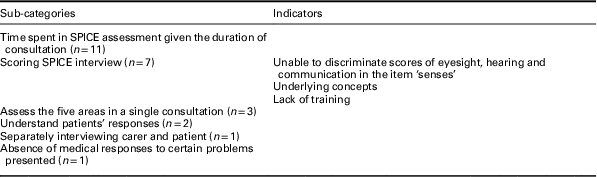
Concerning ‘difficulties’, six sub-categories emerged (Table 5). Time spent in assessments was the major one. To overcome time constraints, two GPs suggested that SPICE assessments should be completed throughout consecutive consultations. Despite previous training, distinguishing ‘met’ from ‘unmet’ need was deemed difficult in a few situations.
Difficulties identified by general practitioners on the use of SPICE interview (n=11)
Regarding individual patient interviews, content analysis of the ‘advantages’ category identified four sub-categories. Patients recognised that SPICE may improve the GP-patient relationship (n=2), value issues important to patients (n=2) and improve doctors’ knowledge about patients (n=2). Quoting a patient: ‘I think that this consultation was clearly better, different from the others’. No patient reported discomfort about the issues addressed. In fact, all showed willingness to be questioned on these in future consultations and two even mentioned never having had previous opportunities to talk about some of them.
Discussion
Main findings
In this Portuguese primary care sample of older participants, SPICE disclosed information that was new to GPs. Furthermore, SPICE was well accepted and its importance recognised by GPs and patients alike.
To our knowledge, needs assessment of older patients in primary care had only been studied in the United Kingdom (Walters et al., Reference Walters, Iliffe, Tai and Orrell2000) and in Holland (Hoogendijk et al., Reference Hoogendijk, Muntinga, van Leeuwen, van der Horst, Deeg, Frijters, Hermsen, Jansen, Nijpels and van Hout2014). Nevertheless, these studies differed from ours in important aspects: different versions of CANE used (24-item, Walters et al., Reference Walters, Iliffe, Tai and Orrell2000; 13-item, Hoogendijk et al., Reference Hoogendijk, Muntinga, van Leeuwen, van der Horst, Deeg, Frijters, Hermsen, Jansen, Nijpels and van Hout2014); frail patients selected (Hoogendijk et al., Reference Hoogendijk, Muntinga, van Leeuwen, van der Horst, Deeg, Frijters, Hermsen, Jansen, Nijpels and van Hout2014); interviews performed at home by trained interviewers, not by GPs themselves (Walters et al., Reference Walters, Iliffe, Tai and Orrell2000; Hoogendijk et al., Reference Hoogendijk, Muntinga, van Leeuwen, van der Horst, Deeg, Frijters, Hermsen, Jansen, Nijpels and van Hout2014).
Exploring a routine scenario, GPs were the raters in our study and, despite small sample size, there were interesting findings. Better agreement in patient/GP post-assessment scores highlights the importance of GPs proactively asking about SPICE domains and not merely relying on their assumptions about their older patients. In fact, some unmet needs were unknown to GPs before SPICE assessments and this patient-centred approach helped to identify undisclosed needs, improving satisfaction in both patients and GPs.
Feasibility
All selected patients were interviewed (n=51) and all SPICE items were completed (n=255). The analysis of GPs’ questionnaires showed that the majority of professionals accepted the SPICE interview well and valued the disclosed information. However, they were cautious regarding their intentions to use the interview in the future, probably because of the time needed to do so.
Strengths and limitations
Our study documented, for the first time, the usefulness and feasibility of a brief needs assessment designed for primary care but never actually tested. However, it was conducted in a single, local setting, with a small non-randomized sample, and a major limitation is lack of generalisability.
Using mixed methods allowed us to explore patients’ and professionals’ perceptions, expanding the analysis of the SPICE assessment’s feasibility. However, pragmatic reasons limited the number of patient interviews, whose findings were mainly about SPICE use advantages. Further probing and additional interviews would have been needed to explore patients’ views more fully.
Although the CANE interview was validated in Portugal (Fernandes et al., Reference Fernandes, Gonçalves-Pereira, Leuschner, Martins, Sobral, Azevedo, Dias, Mateos and Orrell2008), this SPICE version was used for the first time in Portuguese primary care. Indeed, its psychometric properties should be further evaluated internationally as only the full CANE has been applied in primary care in other countries (Walters et al., Reference Walters, Iliffe, Tai and Orrell2000).
The triangulation of perspectives is an asset of CANE (Orrell and Hancock, Reference Orrell and Hancock2004); however, some argue that its usefulness in clinical practice is not yet established (Walters et al., Reference Walters, Iliffe, Tai and Orrell2000). Although we have not interviewed carers in this study, it might have been important in some cases.
Implications for clinical practice and policy
SPICE can unravel unexpressed needs for care, although the extended length of consultations may be a source of concern. Its practical implementation should be further evaluated, probably requiring top-down and bottom-up strategies altogether. Being well accepted overall by physicians and patients, perhaps its use by primary care nurses could contribute to overcoming GPs’ time constraints.
Although SPICE domains relate to older people’s functionality (Stuck et al., Reference Stuck, Walthert, Nikolaus, Bula, Hohmann and Beck1999), we lack direct evidence that the routine use of this interview specifically builds effective strategies for improving clinical outcomes.
Conclusions
SPICE interviewing may yield new valuable information about unmet needs of older people in primary care, but its implementation may not be straightforward and requires facilitating strategies.
Acknowledgements
The authors thank all the doctors of USF Marginal: A. Ferrão, A. Franco, A. Biscaia, J. Faria, J. Ramires, J. Sousa, M. Santos, P. Charondière, T. Carneiro and V. Ramos. This study was presented by the first author as part of a Master’s Thesis (NOVA Medical School/Faculdade de Ciências Médicas – Universidade Nova de Lisboa). J. Grave provided valuable help editing the manuscript.
Financial Support
None.
Conflicts of Interest
None.



