





Nomenclature
Symbol
- $n$
$n$
-
Number of uncertainty factors (in this study,
$n = 8$
) -
${F_1},{F_2}, \ldots ,{F_n}$
-
Score for the
$i$
-th uncertainty factor (range: 1 = low, 5 = high) -
${C_1},{C_2}, \ldots ,{C_n}$
-
Contextual coefficient for factor
$i$
(range: 0.5 = minimal, 2.0 = strong) -
$U$
-
Scalar uncertainty score for the maintenance task
-
$ToU$
-
Threshold of Uncertainty; interprets
$U$
into risk categories -
$\sum $
-
Summation operator across all
$n$
factors -
$\sqrt {{\rm{\;\;\;\;}}} $
-
Square root operator used to normalise the aggregated score
-
${U_{{\rm{low}}}},{U_{{\rm{high}}}}$
-
IUE scores resulting from low or high values of a single
${F_i}$


Acronyms
- AI
-
Artificial Intelligence
- FRAM
-
Functional Resonance Analysis Model
- HFiE
-
Human Factors-induced Error
- IUE
-
Integrated Uncertainty Equation
- ToU
-
Threshold of Uncertainty
- SMS
-
Safety Management System
- STAMP
-
Systems-Theoretic Accident Model and Processes
- UQAM
-
Uncertainty Quantification in Aircraft Maintenance
1.0 Introduction
Aircraft maintenance environments are characterised by complexity, variability and time-sensitive operations. Yet current frameworks and safety models such as SMS, STAMP and FRAM often struggle to represent the dynamic human uncertainty involved in these settings. Despite decades of safety system evolution, the persistent challenge of modelling and predicting how human factors contribute to risk in real-world maintenance contexts remains.
1.1 Background and industry context
Human factors-induced errors (HFiEs) continue to represent a significant share of aviation maintenance incidents and remain one of the most persistent challenges in operational safety [Reference Aktas and Kagnicioglu2, Reference Bohrey and Chatpalliwar12, 44, Reference Janovec and Mojžišová53, Reference Karunakaran and Ashok57]. Despite decades of regulatory reform and human factors research, maintenance-related HFiEs still account for up to 42% of landing gear failures and approximately 18% of in-flight damage events [Reference Dalkilic22, 49, Reference Khan, Ayiei, Murray, Baxter and Wild58]. While mitigated by frontline checks and engineering protocols, these failures still cause critical operational disruptions such as system degradation, aircraft returns and schedule delays.
Aircraft maintenance operates under stringent oversight, governed by regulatory frameworks including European Union Aviation Safety Agency (EASA) Part-145, EU Regulation 1321/2014, and International Civil Aviation Organisation (ICAO) Annex 19, all of which enforce rigorous procedural compliance and continuing airworthiness [48, 82]. The safety management system (SMS), adopted globally since 2013, is the core framework for risk identification, hazard monitoring and continuous improvement [47]. However, research increasingly points to limitations in SMS’s ability to account for latent threats, context-specific variability and real-time performance fluctuations [Reference Clare and Kourousis18, Reference Mendes, Vieira and Mano73].
Moreover, IATA’s 2021 and 2022 safety data [45, 46] reveal persistent SMS challenges, particularly in risk monitoring and safety assurance, where latent conditions go undetected until incident manifestation. The evolution of SMS toward predictive and dynamic monitoring systems, accompanied by more adaptive risk-based quantification methods for managing operational complexity and uncertainty, has been recognised as essential [Reference Kıvanç, Tuzkaya and Vayvay62]. Wachter and Yorio [Reference Wachter and Yorio107] argue that SMS frameworks cannot feasibly encompass every error-prone scenario without becoming overly complex and economically unviable. A number of researchers note the ongoing absence of predictive, interactive capabilities, while other emphasise the data-intensive requirements for implementing such features [Reference Claros, Sun and Edara19, Reference Mendes, Vieira and Mano73]. SMS also struggles to model field-level performance variability, an essential factor in maintenance safety [Reference Stroeve, Smeltink and Kirwan101] and is hindered by limited analytical resources and under-reporting [Reference Aust and Pons4, Reference Dekker and Pruchnicki23, Reference McLeod and Bowie72, Reference Saward and Stanton97]. Others further criticise the tendency of SMS to devolve into symbolic compliance rather than substantive safety improvement [Reference Gerede33, Reference Gerede and Kurt34].
1.2 The role of uncertainty in decision-making and aircraft maintenance
Uncertainty has long been understood as a major factor influencing the emergence of human error in safety-critical work. Reason [Reference Reason89, Reference Reason90] emphasised that uncertainty distorts judgement, especially when people must switch from rule-based to knowledge-based reasoning under unfamiliar conditions. In such cases, mistakes often emerge as individuals attempt to restore control under cognitive or emotional strain. Rasmussen [Reference Rasmussen87] linked uncertainty to the adaptation process during novel or dynamic scenarios, where decision-makers must act without clear precedents. Similarly, Belton et al. [Reference Belton and Stewart7] framed uncertainty as an ever-present, but partially reducible factor in decision-making, particularly under multiple conflicting criteria. Hollnagel [Reference Hollnagel43] noted that system complexity and uncertainty tend to increase together, elevating error risk, a point echoed by Wickens [Reference Wickens, Hollands, Banbury and Parasuraman110], who showed that uncertainty in information processing directly impairs decision-making accuracy.
In aircraft maintenance, uncertainty has been recognised as a destabilising factor affecting operational planning, productivity and resource allocation. Maintenance environments inherently exhibit stochastic variability, setting them apart from deterministic production systems and requiring dynamic, uncertainty-resilient models. A clear distinction between aleatory uncertainty (stemming from inherent variability) and epistemic uncertainty (arising from incomplete knowledge) is essential for developing effective uncertainty quantification frameworks in maintenance operations [Reference Dinis26]. Several studies have linked unplanned maintenance to workflow disruptions, delivery delays and cost overruns. Attempts to mitigate these impacts by increasing workforce capacity can inadvertently introduce new risks, such as worker fatigue [Reference da Silva, Barqueira, Magalhães and Santos21] or mismatched skill levels [Reference Rosales94]. Other researchers have stressed the importance of proactively addressing uncertainty in human factors risk assessments and safety-related decision-making processes [Reference Delatour24, Reference Yilmaz117]. Johansen [Reference Johansen and Rausand55] further argued that uncertainty must be considered when evaluating the effectiveness of safety barriers and defences. Additional studies have shown that uncertainty can distort safety defence models [Reference Liu68], compromise schedule integrity [Reference Goncharenko35] and hinder both tactical and strategic maintenance planning [Reference Masmoudi and Haït70]. Rashid et al. [Reference Rashid, Place and Braithwaite85, Reference Rashid, Place and Braithwaite86] highlighted how time pressure and ambiguous cues intensify uncertainty during task execution, while others have identified its role in reducing situational awareness and increasing the likelihood of judgemental errors [Reference Illankoon and Tretten50, Reference Illankoon, Tretten and Kumar51]. This body of research suggests that uncertainty is not merely a contextual factor influencing human error but a fundamental operational variable that must be explicitly modelled and quantified within aviation safety systems.
1.3 Objectives
This paper introduces the uncertainty quantification in aircraft maintenance (UQAM) framework, a novel predictive model that quantifies human-centric uncertainty through the integrated uncertainty equation (IUE). Grounded in both qualitative field research and mathematical modelling, UQAM identifies eight operational dimensions of uncertainty and evaluates their predictive value through a 12-month field validation.
The rest of the paper is organised as follows. Section 2 presents the literature review and identifies theoretical limitations in current safety models. Section 3 details the methodological approach, the research gap and the conceptual development of the UQAM framework. Section 4 describes the design of the UQAM process and the mathematical derivation of the IUE. Section 5 presents the field validation results, while in Sections 6 and 7 we discuss the implications and conclude the study.
2.0 Literature review and conceptual foundations
This section reviews the evolution of safety thinking in aviation maintenance and examines how current frameworks such as SMS, STAMP and FRAM conceptualise and respond to uncertainty. It also explores the role of human variability in operational risk and the limitations of existing models in capturing real-time uncertainty. These conceptual foundations provide the basis for identifying the methodological and practical needs that the proposed UQAM framework seeks to address.
2.1 Evolution and limitations of existing safety models
The complexity of modern aviation maintenance environments necessitates a shift from linear accident models toward frameworks capable of addressing emergent behaviours and performance variability in socio-technical systems. Two of the most prominent models are STAMP (Systems-Theoretic Accident Model and Processes) and FRAM (functional resonance analysis method). However, SMS frameworks often fail to fully capture dynamic human factors such as psychological stress, environmental variability and team dynamics. At the same time, these safety models increasingly require integration with dynamic hazard detection mechanisms, moving beyond retrospective analysis towards real-time system adaptability [Reference Kıvanç, Tuzkaya and Vayvay62, Reference Xiong, Wang, Wong and Hou114].
2.1.1 STAMP: a systems-theoretic approach to safety control
STAMP, developed by [Reference Leveson66], represents a significant departure from traditional failure-event models, in the sense that it conceptualises safety as an emergent property of a system’s control architecture, rather than as the outcome of discrete technical failures (Fig. 1). In STAMP, accidents occur due to component malfunctions and inadequate enforcement of safety constraints across a hierarchical structure of interacting components, technical, organisational and human. STAMP is structured around the idea that each layer of a socio-technical system, ranging from frontline operators to management and regulators, exerts control through constraints, feedback loops and decision-making processes. Two critical sub-methodologies have emerged within STAMP:
-
• CAST (Causal Analysis based on STAMP) that focuses on identifying how systemic control failures propagate through an organisation, often uncovering mismatches between planned safety structures and actual practices.
-
• STPA (System-Theoretic Process Analysis) is designed to identify potential hazard scenarios proactively and inform design interventions before an accident occurs [Reference Allison, Revell, Sears and Stanton3].
The system safety engineering process components based on STAMP. Adapted from Ref. (Reference Leveson66).

Despite its conceptual strength, STAMP faces practical limitations in contexts that demand rapid or dynamic responses, such as aircraft maintenance. While STPA offers predictive insight into potential hazards, it requires extensive qualitative data and time-intensive modelling. It also lacks built-in mechanisms for quantifying uncertainty, particularly the kind that emerges from fluctuating psychological states, resource constraints or inter-team coordination issues under time pressure. These shortcomings hinder its scalability and real-time applicability in fast-paced operational environments such as line or base maintenance, where uncertainty must be assessed and acted upon rapidly.
2.1.2 FRAM: a model of functional variability and emergent risk
The FRAM, proposed by [Reference Hollnagel41], follows a different, yet complementary approach by shifting the focus from component failure to everyday performance variability (Fig. 2).
A display of FRAM. A hexagon representing a function, with the six aspects of input (I), output (O), preconditions (P), resources (R), control (C), and time (T). In public domain [Reference Hollnagel41].
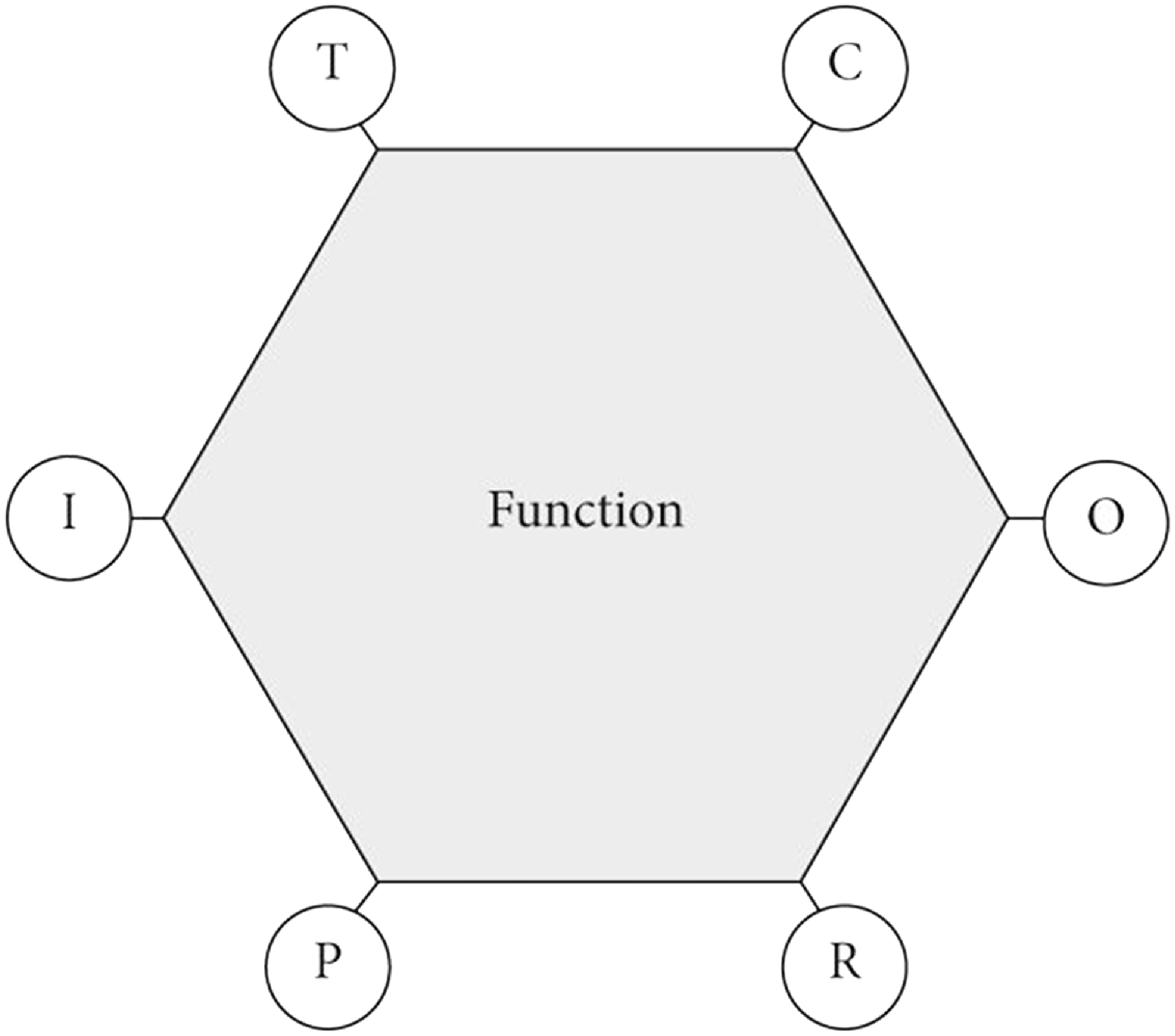
Nomenclature:
-
• I: that which the function processes or transforms or that which starts the function
-
• O: the result of the function, can be an entity or a state change
-
• R: resource(s) required for the processing performed by the function
-
• T: time required for the processing performed by the operational unit
-
• C: constraints and controls on the operational unit (procedures, methods, etc.)
-
• P: conditions that must be satisfied before a function can be carried out
It posits that both safe and unsafe system outcomes emerge from interactions between routine functions and that risk arises when these functional outputs resonate or interact in unpredictable ways. FRAM models work as nodes with six aspects (input, output, preconditions, resources, control, and time), emphasising that variability in one function can propagate through the system, potentially amplifying other minor deviations into major disruptions. This makes it particularly well-suited for analysing socio-technical systems like aircraft maintenance, where adaptive behaviour is often required to handle changing operational demands, environmental conditions or incomplete information. The strengths of FRAM lie in its ability to:
-
• Map complex interactions between human and technical functions.
-
• Capture non-linear emergent phenomena in operations.
-
• Recognise that variability is a normal, not an exceptional, condition in human performance.
However, as Tian et al. [Reference Tian, Caponecchia and Kourousis104] highlight in their systematic review of 108 FRAM applications, including 26 in aviation, FRAM is primarily qualitative and lacks precise mechanisms for time-sensitive quantification or risk calculation. Its application requires intensive manual modelling and contextual knowledge, which impedes its utility in real-time decision-support systems or predictive safety monitoring. Furthermore, it struggles to incorporate dynamic human-centric uncertainty, such as fluctuating psychological load, task ambiguity, or shifting team structures – conditions common in aviation maintenance operations.
2.2 Toward uncertainty-aware safety models
Recent scholarship advocates for integrating artificial intelligence (AI) and human reliability analysis (HRA) into these frameworks to enhance real-time predictive capacity [Reference Claros, Sun and Edara19, Reference Gursel, Madadi, Coble, Agarwal, Yadav, Boring and Khojandi38, Reference Mendes, Vieira and Mano73]. Walton [Reference Walton108] stresses the need for AI systems to be optimised for information flow and interpretability. However, integration challenges remain, particularly around data harmonisation and trust assurance. Tonk and Boussif [Reference Tonk and Boussif105] and Bjerga et al. [Reference Bjerga, Aven and Zio10] also note the absence of tools to communicate uncertainty effectively in decision-making environments, while Salmon et al. [Reference Salmon, Cornelissen and Trotter95] and Mogles et al. [Reference Mogles, Padget and Bosse75] highlight ongoing problems in categorising human error and temporal effects within these frameworks. Recent advancements in intelligent hazard identification, such as deep learning models, combining contextualiser (BERT), sequencer (Bi-LSTM), and labeller (CRF) architectures, highlight the feasibility of embedding AI into real-time safety risk quantification systems [Reference Xiong, Wang, Wong and Hou114]. Furthermore, framing maintenance management challenges through business analytics, encompassing descriptive, predictive and prescriptive layers, provides a valuable pathway for AI-driven safety system integration [Reference Dinis26].
3.0 Research design and conceptual rationale
This section outlines the research design and the rationale underpinning the development of the UQAM framework. It details the methodological approach used to investigate uncertainty in aircraft maintenance, including the literature review process, identification of the research gap and philosophical foundations. The section also describes the data collection strategy and introduces the conceptual basis for the proposed framework, bridging empirical insights with model development.
3.1 Literature review methodology
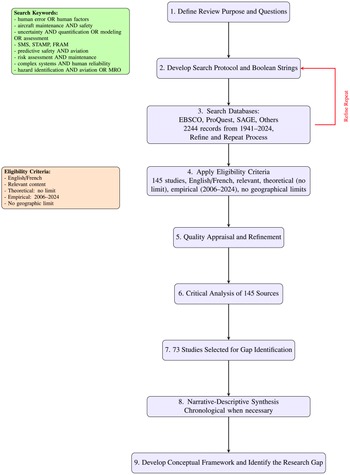
A systematic literature review was undertaken, following a structured seven-stage protocol adapted from Booth et al. [Reference Booth, Sutton and Papaioannou13], Grant and Booth [Reference Grant and Booth36] and Okoli [Reference Okoli79, Reference Okoli80], as shown in Fig. 3.
The procedural steps of the literature review.

Search strategies combined Boolean logic across four academic databases (ProQuest, ScienceDirect, SAGE and EBSCOhost), applying human error, uncertainty, safety management, maintenance, STAMP, FRAM and SMS keywords. Articles were selected according to language (English or French), publication quality (peer reviewed) and domain relevance (safety critical systems), focusing on sources from 2006 to 2025 for applied studies, with broader inclusion criteria for theoretical frameworks. From an initial pool of 2244 sources, 73 articles were ultimately included in the final synthesis. Figure 4 presents the typological breakdown of the included sources, indicating that the majority were peer-reviewed journal articles (68.5%), followed by scholarly monographs (20.5%), book chapters (6.8%) and technical or institutional reports (4.1%). Thematic clustering revealed that while 64% of sources addressed human error or human factors, fewer than 7% attempted any quantitative operationalisation of uncertainty, and none provided validated tools for field-level application in aircraft maintenance. These findings align with the observations made by Reason [Reference Reason90] and Liu [Reference Liu68], who highlighted the limitations of retrospective error models and the absence of predictive frameworks.
Percentage distribution by publication type.

As illustrated in Fig. 5, the thematic distribution of the selected studies reveals a prevailing research concentration on general human factors topics, particularly those situated within safety-critical industries and defence-related safety systems. In contrast, only a marginal proportion of the literature directly estimates or quantifies uncertainty. These findings also underscore the limitations of dominant human error taxonomies – slips, lapses and violations, as outlined by Reason [Reference Reason90] and Wickens et al. [Reference Wickens, Hollands, Banbury and Parasuraman110]. These classifications describe error as a retrospective artifact rather than a dynamic construct, influenced by evolving environmental, organisational and psychological factors. As a result, they fail to capture the cyclical, situated drivers of uncertainty that characterise real-world aviation maintenance environments.
The sources arranged by themes.

3.2 Research gap
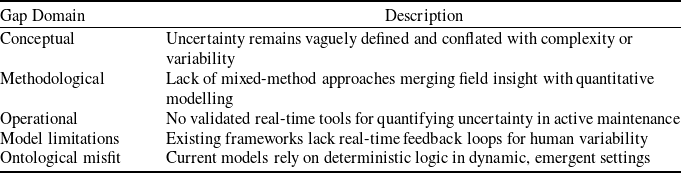
Despite significant advancements in aviation safety research, the current body of literature remains constrained in its ability to fully capture human behaviour’s complexity, fluidity and unpredictability in aircraft maintenance. A systematic review of 73 key studies (Table 1 and Table B1 in Appendix B) revealed several persistent gaps across theoretical, methodological and practical dimensions, particularly in relation to human-centric uncertainty and its influence on safety outcomes.
-
1. Widely adopted safety models such as STAMP and FRAM emphasise systemic structures, control constraints and functional variability. However, they fail to represent the probabilistic and emergent nature of human behaviour, especially under conditions of uncertainty. These models lack mechanisms for modelling real-time variability in psychological, environmental and team-based factors that directly influence operational safety.
-
2. Existing approaches to human factors, including HRA and human factor analysis and classification system (HFACS), rely predominantly on qualitative or taxonomic methods, which, although insightful, do not lend themselves to proactive, quantitative risk prediction. This absence of quantitative modelling limits our ability to anticipate error emergence and implement timely interventions.
-
3. Most safety models in aviation maintenance remain static and retrospective in nature. They are not designed to evolve dynamically with frontline conditions or integrate live operational data. In high-risk environments like aircraft maintenance, where situational variables shift rapidly, this rigidity diminishes the practical utility of such models in real-time decision-making.
-
4. Prevailing positivist and deterministic paradigms underpinning most safety research, assume error to be an observable, linear output of failure chains. This view neglects the subtleties of human adaptation, context-driven decisions, and the subjective experience of uncertainty. Consequently, the field lacks operator-centric research that explores how frontline personnel perceive, navigate, and mitigate uncertainty before it manifests as error.
The shift from traditional compliance-driven SMS frameworks toward continuous, predictive safety systems has become increasingly vital in managing growing operational complexity and uncovering latent risks [Reference Kıvanç, Tuzkaya and Vayvay62]. Effectively addressing both foreseeable ‘grey rhino’ threats and rare, high-impact ‘black swan’ events demand a more sophisticated, real-time approach to uncertainty modelling and hazard detection [Reference Xiong, Wang, Wong and Hou114]. This evolving landscape highlights an urgent research imperative: developing a novel safety framework that quantitatively models human uncertainty as a dynamic and context-aware variable. Such a framework should be rooted in real-world operational insights, remain adaptable to shifting field conditions and enhance existing safety paradigms such as SMS, STAMP and FRAM.
Gap domains in uncertainty modeling

The interviews outline
3.3 Conceptual response: the UQAM framework
In response to the abovementioned gaps, this study introduces the (UQAM framework, a novel, hybrid model designed to mathematically represent and operationally manage human-centric uncertainty within safety-critical maintenance environments. At the core of UQAM is the IUE, a computational mechanism that synthesises field-level assessments across eight key dimensions of uncertainty:
-
• technical knowledge
-
• procedural familiarity
-
• psychological state
-
• environmental conditions
-
• team dynamics
-
• resource availability
-
• task complexity
-
• time pressure
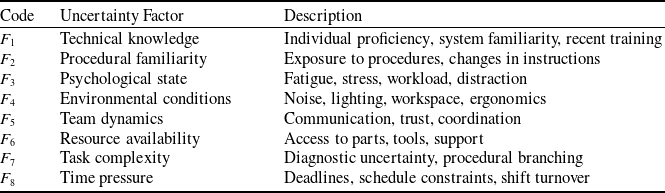
These dimensions emerged through a constructivist analysis of interviews with 49 licensed aircraft maintenance professionals representing civil and military sectors. Unlike traditional models, UQAM does not treat uncertainty as an abstract background condition but as a measurable real-time input into safety decision making. The IUE quantifies these variables into a scalar uncertainty score that supervisors can visualise, interpret and act upon during task planning and execution. This transforms uncertainty from a latent risk into a manageable parameter, enabling predictive interventions, targeted oversight and continuous feedback within safety management systems. The UQAM framework is both theoretically grounded and practically validated. It integrates the interpretivist understanding of human experience with the precision of mathematical modelling, thereby bridging the methodological division between soft human factors inquiry and hard systems engineering. Furthermore, its compatibility with existing safety models, such as SMS, STAMP, and FRAM, offers a pathway for real-time enhancement of these frameworks, transforming them from retrospective taxonomies into adaptive, anticipatory systems. In essence, UQAM proposes a paradigm shift: from error-centric to uncertainty-aware safety governance. It equips maintenance organisations with a practical tool for quantifying human variability, enhances situational awareness at the supervisory level and contributes to the long-term evolution of predictive safety science in aviation. In the next section, the paper presents the methodological design, empirical findings, and validation outcomes that support the implementation of this new framework and argues for its integration into future-oriented aviation safety governance.
3.4 Research philosophy and methodological approach
Anchored in the interpretivist paradigm, this research posits that uncertainty in aircraft maintenance stems not solely from technical anomalies but also from contextual, experiential and inherently subjective dimensions of frontline practice. The methodology embraces the complexity of socio-technical systems and recognises safety as an emergent property shaped by dynamic operational contexts [Reference Creswell20]. Consistent with the perspective of [Reference Lincoln, Lynham and Guba67], it emphasises reflexivity, context-awareness, and the co-construction of meaning. The adopted mixed-method approach (Fig. 6) unfolded across three interconnected phases, balancing theoretical depth with empirical validation. This design ensures the resulting framework is both firmly rooted in real-world practice and adaptable for broader system-level applications.
-
1. Qualitative exploration: In-depth, semi-structured interviews and field note observations were conducted to capture frontline perspectives on uncertainty, error genesis and safety systems.
-
2. Model development: Thematic patterns were translated into a conceptual framework, leading to the design of the UQAM process and the derivation of the IUE.
-
3. Computational formalisation: A structured mathematical formulation operationalised uncertainty as a scalar quantity, grounded in real-world inputs.
The mixed method research approach.

3.5 Data collection and participants
3.5.1 Sampling
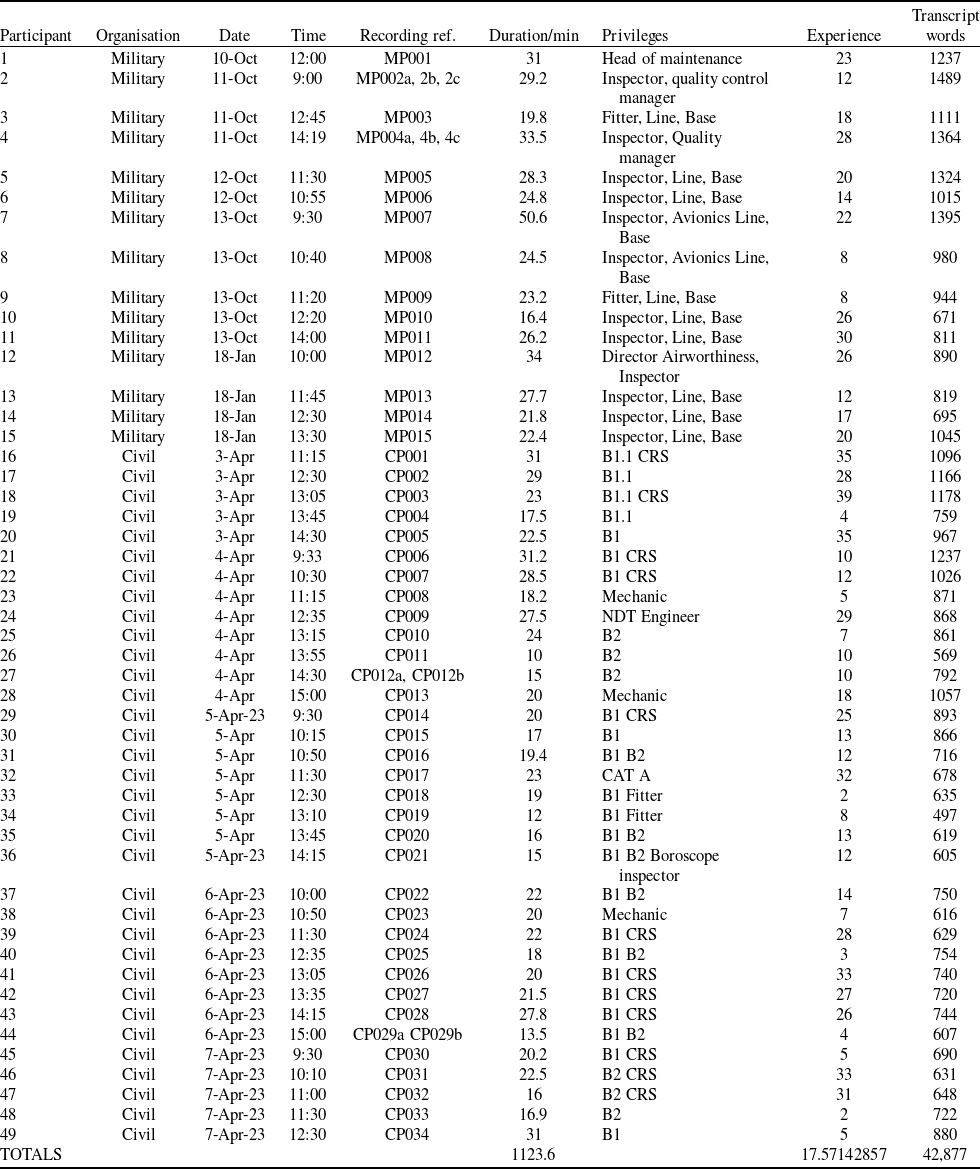
A purposive, maximum-variation sampling strategy was employed to capture a broad range of expertise, operational settings and maintenance task complexities. A total of 49 licensed aircraft maintenance engineers were recruited from two major aviation maintenance organisations, one civilian, operating under the EASA Part-145 framework, and one military, compliant with European Military Airworthiness Requirements (EMAR-145). The sample was balanced across line maintenance (n = 25) and base maintenance (n = 24) personnel, reflecting routine and deep-level maintenance activities with varying technical and procedural complexity.
Participants were selected based on five key inclusion criteria:
-
1. Current active certification as Part-66 or EMAR-66 engineers
-
2. Minimum of five years’ experience in maintenance operations
-
3. Operational familiarity with recurring tasks and airworthiness directives
-
4. Exposure to both routine and non-routine maintenance events
-
5. Willingness to participate in a study exploring uncertainty in maintenance operations
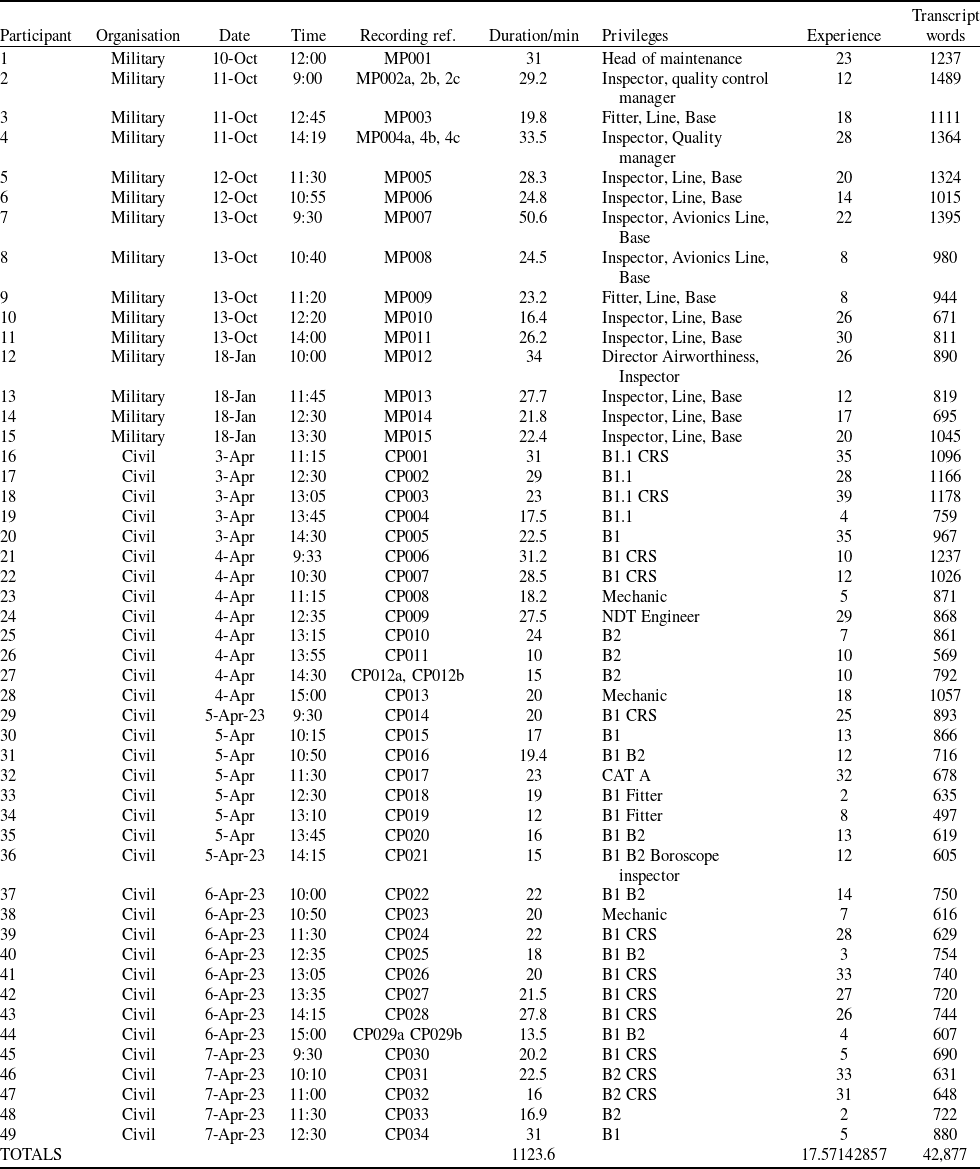
The sample included engineers from avionics, airframe, propulsion and systems specialities. Participants represented varying rank levels, technicians, team leaders, supervisors and quality assurance engineers, ensuring that both frontline and managerial perspectives were included in the data. This diversity allowed the study to capture layered understandings of uncertainty across organisational hierarchies and technical domains. Each participant was interviewed individually at their respective units (technical rooms, hangars, maintenance briefing areas), minimising workflow disruption and ensuring privacy. Interviews were conducted in English, lasted approximately 40 to 60 minutes, and were audio-recorded with full consent. This qualitative part of the research was complemented by field observation and note-taking. A total of 1123.6 minutes of recording time were transcribed into 42,877 words of consolidated text and cross-checked for accuracy (Table 2).
3.5.2 Interview protocol
The interview protocol was carefully developed to investigate how frontline aircraft maintenance engineers perceive, encounter and manage human-centred uncertainty within operational settings. Its design was conceptually anchored in well-established human factors frameworks, including Reason’s Swiss cheese model, Hollnagel’s FRAM, and Rasmussen’s skill–rule–knowledge (SRK) taxonomy. Following a pilot phase involving three senior engineers (not included in the final sample), the protocol was iteratively refined to better reflect practical field conditions while maintaining theoretical coherence. Ethical approval for the study was obtained from the Cyprus National Bioethics Committee and the University of Nicosia Ethics Committee (Approval Code: UNIC-EHSC-21-109).
All participants were fully informed, both in writing and verbally, about the study’s objectives, procedures, confidentiality provisions and their right to withdraw at any point. Informed consent was obtained before participation. All data were anonymised, securely stored and handled in full compliance with the General Data Protection Regulation (GDPR), ensuring ethical standards were upheld and participant trust maintained.
A semi-structured interview format was adopted to balance procedural consistency with exploratory flexibility. The protocol was organised around four thematic clusters:
-
1. The development and recognition of human error in maintenance tasks
-
2. The perception and sources of uncertainty in task execution
-
3. The interaction between human factors and formal safety systems
-
4. Perceived limitations of prevailing safety frameworks such as SMS, STAMP, and FRAM
A reflexive, iterative approach guided the analysis. Member checking was incorporated to enhance interpretive credibility, with selected participants reviewing emergent themes and validating their alignment with lived experience. This methodological rigour ensured the collection of rich, grounded data that was both contextually sensitive and analytically robust. The insights generated from these interviews directly informed the development of the UQAM framework. They shaped the identification of eight core uncertainty factors and the IUE design. By systematically capturing the frontline experience of uncertainty, the interview process served as a critical foundation for bridging qualitative inquiry with computational modelling in safety-critical environments.
4.0 UQAM Process Design And Mathematical Model
This section presents the structure and computational logic of the UQAM framework. Building on the thematic analysis of the qualitative findings, the framework translates eight key operational uncertainty factors into a structured process and a predictive scalar output. The section outlines the scoring mechanism’s development, the IUE mathematical formulation, and the design of task-specific thresholds of uncertainty (ToU) that support supervisory decision-making in real-time contexts.
4.1 Thematic analysis and qualitative findings
Qualitative data were analysed using Braun and Clarke’s [Reference Braun and Clarke15] six-phase thematic analysis methodology, with a reflexive approach guided by Kiger and Varpio [Reference Kiger and Varpio59]. This combination provided a flexible yet rigorous structure to inductively generate themes while ensuring that the analytic process remained grounded in participants’ lived experiences. As presented in Fig. 7 the analytical workflow was structured around the following iterative steps:
-
1. Familiarisation with the data: Audio recordings were transcribed verbatim and repeatedly reviewed alongside field notes to ensure a comprehensive understanding of contextual nuances, body language and environmental cues.
-
2. Initial coding: Open inductive coding was performed manually and iteratively in NVivo, generating more than 150 unique codes across the dataset. Codes reflected descriptive and interpretive insights, often capturing relational dynamics and psychological states.
-
3. Theme development and refinement: The codes were reviewed, clustered and abstracted into higher-order thematic categories. Themes were refined through recursive comparison and aligned with theoretical constructs and emergent operational realities.
-
4. Conceptual mapping and synthesis: Thematic patterns were synthesised into a conceptual map of uncertainty-inducing conditions in aircraft maintenance. This map informed the structure of the UQAM framework and directly influenced the development of the IUE.
-
5. Participant validation: A reflexive member-checking process was conducted with a sub-sample of 10 participants, who reviewed thematic summaries and confirmed their accuracy, clarity, and resonance with real-world practice. Their feedback led to the refinement of terminology and the clarification of two overlapping dimensions.
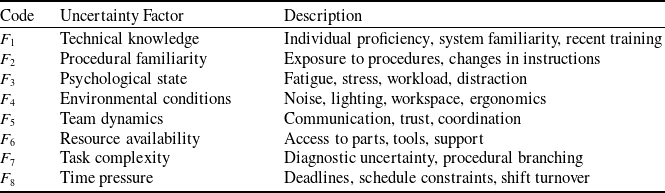
Through this robust analytical process, eight recurrent and interdependent factors emerged as primary dimensions of operational uncertainty. These factors were cited across civil and military contexts and consistently reflected in tasks ranging from routine line maintenance to complex base-level inspections. The final thematic structure is presented in Table 3 and serves as the conceptual foundation for the UQAM framework. These factors were not isolated or static; they operated as dynamic, interacting variables that fluctuated based on task type, personnel configuration and real-time operational pressures. This thematic foundation enabled the translation of rich qualitative insights into the formalised mathematical structure of the IUE, ensuring that the final model was theoretically sound, empirically grounded and operationally relevant.
Primary dimensions of operational uncertainty in aircraft maintenance
Thematic map of uncertainty in maintenance tasks.

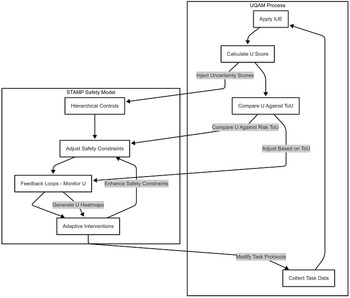
The UQAM process.

4.2 Design of the UQAM process
The UQAM process offers a structured, dynamic and predictive framework for quantifying operational uncertainty in aviation maintenance tasks. Grounded in real-world practice and designed for adaptability, UQAM integrates human-centric factors with mathematical modelling to support proactive safety management. As seen in Fig. 8, the process begins with targeted data collection on eight key uncertainty factors (e.g., technical knowledge, team dynamics, time pressure), which are then mapped into a dynamic framework capable of incorporating evolving variables, such as new technologies or environmental changes. Each factor is assigned a dynamic coefficient, calibrated using empirical data, expert judgement and contextual relevance. These weighted factors are synthesised using the IUE to compute a total scalar uncertainty score. This score is compared against a predefined ToU to determine whether corrective actions are required. Heatmaps visualise the distribution of factor-level uncertainty, enhancing interpretability and team-based decision-making. The process supports real-time feedback loops, updating uncertainty levels dynamically as tasks evolve. The visualisation of uncertainty contributions parallels the need to dynamically map factor propagation across maintenance environments [Reference Bohrey and Chatpalliwar11]. In its final phase, UQAM could incorporate AI-driven analysis to refine coefficient weights and thresholds over time, enabling continuous learning and alignment with shifting operational risk profiles. UQAM transforms uncertainty from a latent background risk into a measurable, actionable and adaptive safety metric through its modular design, real-time responsiveness and integration with predictive analytics.
4.3 The Integrated Uncertainty Equation (IUE)
At the core of UQAM lies the IUE, a computational model that quantifies uncertainty using task-level data. The equation mathematically represents uncertainty as a function of the interaction between factor scores and contextual coefficients.
4.3.1 Conceptual rationale
The IUE was developed to address a gap in existing safety models: the lack of a real-time, quantitative mechanism for evaluating uncertainty. Traditional tools such as bowtie diagrams or risk matrices lack temporal sensitivity and are static in nature. The IUE allows for dynamic and granular modelling of fluctuating human and environmental inputs during task execution.
4.3.2 Equation derivation
The IUE aims to quantify the total uncertainty $U$
associated with a specific aircraft maintenance task. This is achieved by aggregating the influence of eight uncertainty-inducing factors, each weighted by a context-sensitive coefficient. The objectives of the IUE are to (1) capture the individual contribution of each factor, (2) reflect the relative contextual importance of that contribution (via a weight), (3) preserve the independence and non-linearity of contributing dimensions and (4) aggregate all components into a scalar, interpretable measure of total task uncertainty.
$U$
associated with a specific aircraft maintenance task. This is achieved by aggregating the influence of eight uncertainty-inducing factors, each weighted by a context-sensitive coefficient. The objectives of the IUE are to (1) capture the individual contribution of each factor, (2) reflect the relative contextual importance of that contribution (via a weight), (3) preserve the independence and non-linearity of contributing dimensions and (4) aggregate all components into a scalar, interpretable measure of total task uncertainty.
Let:
-
•
$i \in \left\{ {1,2, \ldots ,n} \right\}$
denote the index for each uncertainty factor. In this model,
$n = 8$
. -
•
${F_i} \in \left[ {1,5} \right]$
: the score for the
$i$
-th factor, based on observation or expert assessment. -
•
${C_i} \in \left[ {0.5,2.0} \right]$
: the coefficient (weight) reflecting the contextual importance of factor
$i$
. -
•
$U$
: the task’s total scalar uncertainty score computed.


To ensure non-negativity and to amplify the influence of higher scores (i.e., high-risk factors), each factor value is squared:
 $$F_i^2$$
This approach aligns with formulations found in kinetic energy, statistical variance and machine learning cost functions. Each squared factor score is then multiplied by its respective contextual coefficient:
 $$F_i^2 \cdot {C_i}$$
This forms a weighted squared value that reflects both the severity and situational relevance of each uncertainty factor. To compute the combined uncertainty, all weighted squared terms are summed:
 $$\mathop \sum \limits_{i = 1}^n F_i^2 \cdot {C_i}$$
To produce a normalised, interpretable scalar score, the square root is applied:
 $$U = \sqrt {\mathop \sum \limits_{i = 1}^n \left( {F_i^2 \cdot {C_i}} \right)} $$
Where:
-
•
$U$
is the total uncertainty associated with the maintenance task. -
•
${F_i}$
is the uncertainty score for factor
$i$
, where 1 represents very low uncertainty and 5 represents very high uncertainty. -
•
${C_i}$
is the real-time coefficient for factor
$i$
, ranging from 0.5 (minimal contextual impact) to 2.0 (high contextual impact). -
•
$n = 8$
, corresponding to the eight core uncertainty dimensions listed in Table 3.


Range of Output ( $U$
):
$U$
):
-
• Minimum Value:
$U = \sqrt {\sum F_i^2 \cdot {C_i}} = \sqrt 4 = 2$
, represents uniformly low uncertainty. -
• Maximum Value:
$U = \sqrt {\sum F_i^2 \cdot {C_i}} = \sqrt {400} = 20$
, represents uniformly high uncertainty.


4.3.3 Justification and mathematical properties
IUE was deliberately designed to balance mathematical rigour with practical operational relevance. IUE is inspired by principles of variance modelling (from statistics) and energy distribution (from physics). The non-linear sensitivity introduced by squaring ensures that higher-risk conditions exert proportionally greater influence on the final uncertainty score. This effect is significant in capturing the compounding nature of latent risks in high-stakes aviation environments. Capturing the compounded influence of high-risk factors through non-linear mathematical structures aligns with the need for measurable, causally linked human factor contributions, as emphasised by recent aviation maintenance research [Reference Bohrey and Chatpalliwar12]. The following key mathematical properties justify its use as a predictive tool within safety-critical maintenance environments:
-
1. Non-negativity: All terms within the IUE are squared and multiplied by non-negative coefficients, ensuring the output is always a non-negative scalar. This preserves interpretability and aligns with the conceptual nature of uncertainty.
-
2. Scalability: The IUE structure is modular. While it currently includes eight uncertainty factors, the summation form allows for straightforward expansion. Additional factors can be incorporated as new domains or tasks are modelled, without affecting the underlying logic.
-
3. Interpretability: The resulting uncertainty score (U) maps directly onto field-validated operational thresholds (e.g., low, moderate, and high risk), making it intuitive for supervisory and planning personnel. This aligns the mathematical model with maintenance planning and decision-making workflows.
-
4. Interoperability: The scalar output of the IUE can be embedded into existing safety models such as SMS, STAMP and FRAM. It provides a dynamic feedback input, enhancing those frameworks’ ability to monitor human factors variability in real time.
-
5. AI-Compatibility: The continuous, real-valued output of the IUE is compatible with machine learning pipelines. U-values can serve as training features, risk prediction inputs or anomaly detection markers within data-driven decision-support systems.
Quantifying operational uncertainty through structured models enhances the precision of task-level risk assessments, reflecting recent approaches that integrate human factors into probabilistic frameworks [Reference Bohrey and Chatpalliwar12].
4.4 Thresholds of Uncertainty (ToU)
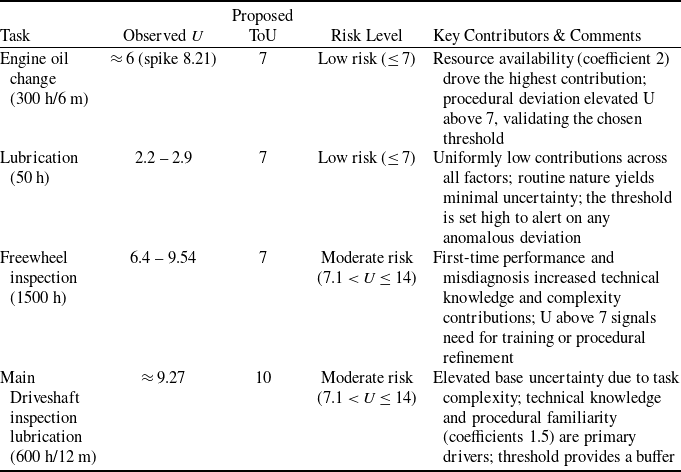
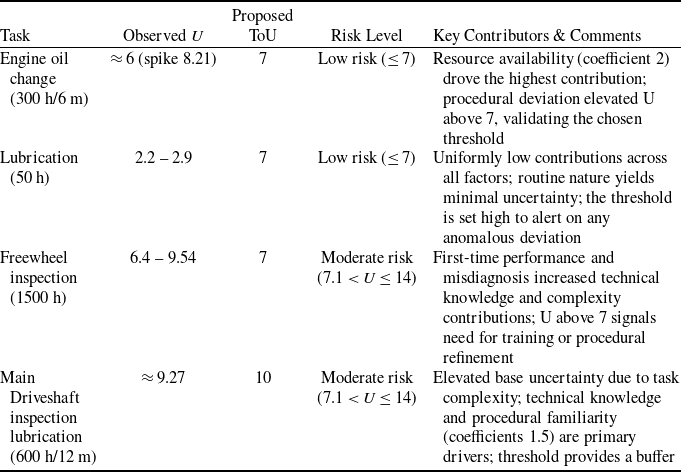
To interpret the output of the IUE in operational terms, ToU were developed collaboratively with safety managers and engineering supervisors. These thresholds translate scalar uncertainty scores into actionable decision categories and are tailored to specific task types, as presented in Table 4. During the 12-month field validation, the ToU values were not arbitrarily set but were empirically calibrated through an iterative, data-driven process. Supervisors assigned factor scores and contextual coefficients for each maintenance task evaluated, which were then input into the IUE to produce U-values. These values were tracked alongside task performance indicators, such as deviations, delays or first-time execution issues, to assess whether elevated uncertainty levels align with observable operational risks. When U-scores consistently preceded errors or procedural breakdowns, threshold levels were adjusted downward to improve sensitivity. Conversely, if high scores were repeatedly recorded without corresponding risk manifestations, thresholds were raised to prevent over-alerting. This refinement process ensured that ToU boundaries accurately reflected both real-world variability and organisational risk tolerance.
Risk categories and recommended actions based on uncertainty score

The final thresholds guide supervisory decision-making through a three-tiered risk model:
-
• Low Risk (
$U \le 7.0$
): Task proceeds as planned. No additional oversight is required. -
• Moderate Risk (
$7.1 \lt U \le 14.0$
): Task should proceed with enhanced monitoring or resource adjustments, such as experienced personnel assignment or procedural reinforcement. -
• High Risk (
$U \gt 14.0$
): Task execution should be deferred, reassigned, or escalated to a higher authority due to elevated uncertainty and potential risk exposure.



These thresholds are intentionally dynamic and responsive. They are reviewed regularly based on ongoing operational data, evolving regulatory guidance and frontline feedback. This adaptability ensures that uncertainty assessment remains aligned with aircraft maintenance environments’ complex, fluid realities.
5. Field validation and results
This section presents the empirical evaluation of the UQAM framework, including its computational core, the IUE. Conducted between March 1, 2024 and March 31, 2025, the study took place within a certified EMAR-Part-145 military maintenance organisation. The objective was to assess the predictive accuracy, operational usability and contextual sensitivity of the IUE in real-world maintenance scenarios. Four recurring tasks were selected for validation, each representing distinct combinations of technical complexity, procedural frequency and operational risk.
5.1 Validation design and procedure
A supervisor-led, checklist-based scoring mechanism was implemented with safety and compliance officers. For each task, supervisors assessed eight predefined uncertainty-inducing factors $\left( {{F_1}} \right)$
to
$\left( {{F_1}} \right)$
to $\left( {{F_8}} \right)$
, assigning a score between 1 and 5, and a dynamic coefficient between 0.5 and 2.0. These values were then input into the IUE:
$\left( {{F_8}} \right)$
, assigning a score between 1 and 5, and a dynamic coefficient between 0.5 and 2.0. These values were then input into the IUE:
 $$U = \sqrt {\mathop \sum \limits_{i = 1}^8 \left( {F_i^2 \cdot {C_i}} \right)}$$
where:
-
•
${F_i}$
represents the task-specific uncertainty score for factor
$i$
-
•
${C_i}$
denotes the real-time contextual weight for factor
$i$


Risk categorisation followed pre-established ToU, developed and refined with engineering supervisors. Supervisors were instructed not to intervene based on U-scores during the trial to preserve objectivity. Instead, scores and observations were collected for post-hoc analysis, threshold calibration and model tuning.
5.2 Evaluated maintenance tasks
Four recurring maintenance tasks were selected to test the model’s responsiveness across varied operational contexts. These tasks offered a spectrum of procedural regularity, technical depth and environmental variability ideal for evaluating the IUE’s performance resolution and flexibility. To ensure comprehensive model validation, the tasks were deliberately chosen to reflect varying levels of technical complexity, predictability and human-centric uncertainty.
5.3 Task-specific results
5.3.1 Engine oil change
This task is moderately complex but highly predictable, with well-defined procedural steps and standardised tool usage. It was a stable reference point for evaluating whether the model could detect subtle operational deviations. This task demonstrated consistently low uncertainty $\left( {U \approx 6} \right)$
, with a single procedural deviation, incorrect torque application, elevating the score to 8.21. This validated a ‘Low Risk’ threshold of 7, reliably flagging emerging procedural risks without false positives. Uncertainty in this task was primarily influenced by psychological state
$\left( {U \approx 6} \right)$
, with a single procedural deviation, incorrect torque application, elevating the score to 8.21. This validated a ‘Low Risk’ threshold of 7, reliably flagging emerging procedural risks without false positives. Uncertainty in this task was primarily influenced by psychological state $\left( {{F_3}} \right)$
and time pressure
$\left( {{F_3}} \right)$
and time pressure $\left( {{F_8}} \right)$
.
$\left( {{F_8}} \right)$
.
5.3.2 Lubrication tasks
The simplest of the four tasks, routine lubrication, exhibited minimal variability and negligible uncertainty. Its high predictability and standardised execution made it ideal for validating the model’s stability and resistance to noise. U-scores remained between 2.2 and 2.9 across all instances, confirming their well-controlled nature. A conservative threshold of 7 was retained to ensure any unexpected risk surge would still be promptly detected.
5.3.3 Freewheel inspection
This task exhibited higher procedural complexity and lower predictability, particularly in cases involving first-time diagnoses or atypical wear patterns. It consistently showed broader variability in U-scores, ranging from 6.4 to 9.54, with notable spikes during initial task execution and misdiagnosis incidents. These findings underscore the model’s capacity to reflect diagnostic uncertainty and transitions into the ‘Moderate Risk’ zone when U exceeds 7. Primary contributing factors were task complexity $\left( {{F_7}} \right)$
and technical knowledge
$\left( {{F_7}} \right)$
and technical knowledge $\left( {{F_1}} \right)$
, highlighting the critical influence of experience and context-dependent interpretation.
$\left( {{F_1}} \right)$
, highlighting the critical influence of experience and context-dependent interpretation.
5.3.4 Driveshaft inspection & lubrication
This procedure was the most operationally demanding task, requiring substantial technical depth, close coordination among team members and execution under fluctuating environmental conditions. It consistently produced elevated uncertainty levels, with a baseline U-score of 9.27. Key contributing factors included environmental conditions $\left( {{F_4}} \right)$
and team dynamics
$\left( {{F_4}} \right)$
and team dynamics $\left( {{F_5}} \right)$
. To account for the inherent complexity of this task, a higher threshold of 10 was established, providing an operational buffer to distinguish between expected variability and genuinely hazardous deviations. Its inclusion enabled the model to be evaluated under conditions representing the upper bounds of operational risk and system complexity.
$\left( {{F_5}} \right)$
. To account for the inherent complexity of this task, a higher threshold of 10 was established, providing an operational buffer to distinguish between expected variability and genuinely hazardous deviations. Its inclusion enabled the model to be evaluated under conditions representing the upper bounds of operational risk and system complexity.
5.4 Heatmap analysis of uncertainty factors
Factor contribution heatmap: engine oil changes.

In addition to scalar uncertainty scores, the UQAM framework provides visual diagnostics through heatmaps that represent the relative contribution of each factor $({F_1}$
–
$({F_1}$
– ${F_8})$
, to the total uncertainty score (U). These visualisations offer a granular view of the dominant sources of task-related uncertainty, enabling supervisors and safety managers to pinpoint areas for targeted intervention, such as focused training, procedural reinforcement or environmental adjustments. Heatmaps were generated based on supervisor-assigned scores during live assessments for each of the four tasks evaluated. As illustrated in Figs 9–12, the heatmaps clearly differentiate the uncertainty profiles across tasks:
${F_8})$
, to the total uncertainty score (U). These visualisations offer a granular view of the dominant sources of task-related uncertainty, enabling supervisors and safety managers to pinpoint areas for targeted intervention, such as focused training, procedural reinforcement or environmental adjustments. Heatmaps were generated based on supervisor-assigned scores during live assessments for each of the four tasks evaluated. As illustrated in Figs 9–12, the heatmaps clearly differentiate the uncertainty profiles across tasks:
-
• Engine oil change: Heatmaps showed occasional spikes in time pressure
$({F_8}$
) and psychological state
$({F_3}$
), particularly during turnaround scenarios, despite the task’s overall stability. These factors accounted for over 60% of total uncertainty in outlier cases. -
• Lubrication: Factor contributions remained uniformly low across all observations. The heatmap validated the task’s minimal uncertainty profile, with no individual factor exerting a dominant influence, confirming task predictability and model reliability in low-variance contexts.
-
• Freewheel inspection: High contributions were observed from technical knowledge
$({F_1}$
) and task complexity
$({F_7}$
), especially when inspections involved first-time execution or unfamiliar system configurations. These factors accounted for over 70% of the uncertainty, reinforcing the need for skill-based mitigation strategies in complex diagnostic tasks. -
• Driveshaft inspection and lubrication: Environmental conditions
$({F_4}$
) and team dynamics
$({F_5}$
) emerged as dominant sources of uncertainty. Variability in workspace ergonomics and multi-person coordination increased the operational risk profile. The heatmap revealed distributed, multi-factor uncertainty, reflecting the complexity and interdependence inherent in this task.


Factor contribution heatmap: lubrication.

Factor contribution heatmap: freewheel inspection.

These heatmap outputs not only confirmed the validity of the eight-factor model but also demonstrated its diagnostic value in visualising uncertainty propagation. By making the source and weight of uncertainty visible at the task level, the UQAM heatmaps support real-time risk communication, enhance supervisory awareness, and provide a feedback mechanism for continuous safety improvement.
5.5 Model sensitivity
The field validation demonstrated that the IUE is highly responsive to the variability and complexity inherent in real-world maintenance operations. Across the four evaluated tasks, the IUE consistently reflected task-specific uncertainty dynamics, distinguishing between routine, moderate and elevated risk conditions without producing false alerts in stable contexts (Table 5). One of the model’s key strengths is its sensitivity to anomaly conditions. During the trial, the IUE successfully flagged elevated uncertainty in cases involving procedural deviation, task unfamiliarity, misdiagnosis and constrained work environments, each of which correlated with known operational disruptions. These outcomes confirm the IUE’s utility as a measurement tool and an early warning indicator for supervisory decision-making. The model’s scalability and adaptability were confirmed through its successful application across tasks with widely differing profiles. By dynamically incorporating contextual coefficients $\left( {{C_i}} \right)$
and enabling modular adjustments, the IUE allowed for fine-tuned application without recalibrating the mathematical structure. This modularity supports deployment across diverse maintenance environments, from line to base operations. The model also proved to be practically usable.
$\left( {{C_i}} \right)$
and enabling modular adjustments, the IUE allowed for fine-tuned application without recalibrating the mathematical structure. This modularity supports deployment across diverse maintenance environments, from line to base operations. The model also proved to be practically usable.
Uncertainty observations, thresholds, and key contributors per task
Supervisors in the trial reported that the scoring process was intuitive and easily integrated into pre-task briefings or planning workflows. The heatmap visualisations were particularly valued for their ability to clearly communicate uncertainty sources, aiding task-level decisions and long-term safety planning.
Furthermore, the scalar output produced by the IUE was shown to integrate seamlessly with existing digital safety infrastructures, including SMS dashboards. Its real-valued output is also well-suited for future incorporation into AI tools and machine learning systems, opening the door to data-driven safety forecasting and autonomous decision support. The validation confirmed that the UQAM framework represents a substantive advancement in predictive safety modelling. Its ability to quantify human-centric uncertainty in real time and to do so in a flexible, scalable and interpretable way positions it as a valuable tool not only for post-hoc analysis but for shaping frontline interventions before error materialises. However, further testing in civilian Part-145 environments, integration with AI risk agents, and cross-sector validation are recommended to enhance generalisability and system-wide applicability. The model lays a foundational pathway for incorporating uncertainty as a live operational variable in future-ready safety architectures such as SMS, STAMP and FRAM.
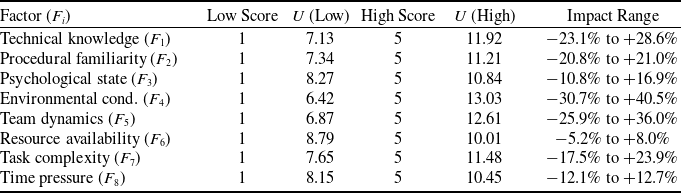
5.5.1 Sensitivity analysis using the driveshaft inspection and lubrication task
To evaluate the responsiveness of the IUE to fluctuations in individual uncertainty factors, a sensitivity analysis was conducted using the driveshaft inspection and lubrication task. This task, identified as the most operationally complex during field trials, provides a representative test case due to its multi-factor uncertainty profile and elevated baseline risk score.
Using a one-at-a-time (OAT) approach, each input score ( ${F_i}$
) was independently varied from its baseline to extreme low (1) and high (5) values, while holding contextual coefficients (
${F_i}$
) was independently varied from its baseline to extreme low (1) and high (5) values, while holding contextual coefficients ( ${C_i}$
) and other factors constant. The resulting changes in the total uncertainty score (
${C_i}$
) and other factors constant. The resulting changes in the total uncertainty score ( $U$
) were used to calculate the impact range, reflecting each factor’s marginal influence.
$U$
) were used to calculate the impact range, reflecting each factor’s marginal influence.
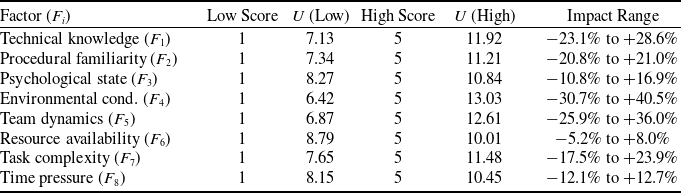
As shown in Table 6, the most influential variables were Environmental Conditions ( ${F_4}$
) and Team Dynamics (
${F_4}$
) and Team Dynamics ( ${F_5}$
), which produced the highest impact ranges (up to
${F_5}$
), which produced the highest impact ranges (up to $ \pm 40{\rm{\% }}$
). Factors like Technical Knowledge (
$ \pm 40{\rm{\% }}$
). Factors like Technical Knowledge ( ${F_1}$
) and Task Complexity (
${F_1}$
) and Task Complexity ( ${F_7}$
) also showed considerable leverage, supporting the field-observed findings. Less sensitive variables included Resource Availability (
${F_7}$
) also showed considerable leverage, supporting the field-observed findings. Less sensitive variables included Resource Availability ( ${F_6}$
) and Time Pressure (
${F_6}$
) and Time Pressure ( ${F_8}$
), though still relevant in high-stress contexts.
${F_8}$
), though still relevant in high-stress contexts.
Sensitivity of IUE Score to input factors (baseline $U = 9.27$
)
$U = 9.27$
)
6.0 Discussion and implications
The successful field validation of the UQAM framework, anchored by the IUE, marks a significant advancement in predictive safety science. This study shifts the analytical focus from retrospective error analysis toward proactive uncertainty management, positioning uncertainty as a quantifiable, decision-driving variable in aviation maintenance safety. It responds to recent studies that advocate transitioning from descriptive to causal, probabilistic models of human factors to better reflect the dynamic nature of operational uncertainty [Reference Bohrey and Chatpalliwar12].
6.1 Theoretical contribution
UQAM addresses longstanding theoretical limitations in dominant safety models – SMS, STAMP and FRAM – by introducing a formal mechanism to measure and model human-centric uncertainty in real time. While these models acknowledge complexity and emergent risk, they largely lack the capacity to assign operational value to uncertainty before errors occur. The IUE bridges this gap by transforming subjective, qualitative risk factors into measurable, scalar outputs that are actionable during planning and execution. This aligns with contemporary calls for nonlinear, probabilistic and adaptive models in safety-critical systems. Moreover, by grounding the framework in field-based qualitative data and operational context, the study offers a theoretical model that respects human factors’ interpretive dimensions while enhancing their integration into systems engineering and predictive analytics.
6.2 Methodological innovation
Methodologically, UQAM represents a hybrid model that blends constructivist inquiry with computational modelling. Using thematic analysis to derive eight operational uncertainty factors ensured that the model reflects lived frontline experience, not just abstract constructs. The IUE’s mathematical formulation, validated through a year-long field study, demonstrates how mixed-methods research can move from conceptual exploration to formalised, scalable tools. This hybrid approach also resolves a key limitation in the human factors field: the lack of quantitative methods for operationalising uncertainty in day-to-day maintenance activities. UQAM thus sets a precedent for developing rigorous, field-responsive models in other high-risk domains.
6.3 Practical applications and system integration
In practical terms, UQAM delivers a decision-support tool that is both intuitive and operationally impactful. The factor-based scoring system and associated heatmap visualisations provide clear, real-time insights into the sources and severity of task-related uncertainty. This supports informed supervisory decisions such as reallocating resources, adjusting schedules or delaying high-risk tasks. The framework is also designed for seamless integration into existing safety systems. As proposed in Figs 13–15, by embedding scalar uncertainty scores into SMS workflows and enhancing STAMP and FRAM with real-time inputs, UQAM strengthens feedback loops, enhances hazard visibility and supports dynamic intervention, transforming these frameworks from retrospective audits into proactive safety engines. Furthermore, the IUE’s real-valued outputs are AI-compatible, enabling future applications, such as intelligent task planning, automated threshold tuning, and predictive risk detection through machine learning pipelines. By embedding AI-driven knowledge bases and predictive diagnostic tools into maintenance ecosystems, promises to transform aviation safety from reactive to proactive risk governance [Reference Kabashkin and Perekrestov56].
Factor contribution heatmap: driveshaft inspection.

UQAM potential integration into STAMP.

UQAM potential integration into FRAM.

Reshaping the SMS with UQAM.

While the UQAM framework demonstrated strong usability and interpretability in field trials, certain limitations merit attention. The scoring of uncertainty factors, although guided by structured checklists, remains partially subjective and may vary depending on the assessor’s experience, fatigue or situational awareness. Future iterations may benefit from incorporating automated or sensor-based inputs to complement human judgement. Additionally, the introduction of new scoring and visualisation tools may encounter cultural or operational resistance from supervisors accustomed to established routines. Early engagement, training and integration into existing workflows are essential to ensure acceptance and sustained use.
6.4 Regulatory and industry relevance
Given the industry’s increasing push toward predictive, performance-based safety management, UQAM aligns with evolving expectations under EASA Regulation 1321/2014, EMAR-145, and ICAO Annex 19. Its emphasis on real-time assessment, frontline usability and feedback-driven calibration directly supports emerging adaptive and evidence-based safety oversight requirements. UQAM provides a pathway for transitioning from compliance-driven audits to risk-intelligent operations – a shift vital to sustaining safety in increasingly complex maintenance ecosystems.
7.0 Conclusion
This study addressed a critical and underexplored dimension of aviation maintenance safety: the real-time quantification of human-centric uncertainty. While existing frameworks and safety models such as SMS, STAMP and FRAM have advanced the understanding of systemic risk and performance variability, they lack the tools to proactively assess uncertainty at the task level. In response, this paper introduced and validated the UQAM framework, centred around the IUE. Through a mixed-methods approach grounded in frontline operational data, the study identified eight empirically supported uncertainty factors and developed a mathematical model capable of producing scalar uncertainty scores. These scores were field-tested across four real-world maintenance tasks of varying complexity, predictability and risk. The results confirmed that the IUE captures variability in human and environmental conditions and supports predictive risk governance through actionable thresholds and visual diagnostics. The UQAM framework offers several key contributions:
-
• Conceptually, it reframes uncertainty as a measurable input to safety decision-making rather than a residual artifact of error.
-
• Methodologically, it bridges qualitative human factors analysis with quantitative systems engineering, offering a replicable structure for hybrid safety modelling.
-
• Practically, it provides an intuitive, field-compatible tool for supervisors, enabling proactive task-level interventions based on real-time conditions.
-
• Strategically, it positions safety management systems to evolve from compliance-oriented structures into adaptive, predictive architectures.
The UQAM framework holds strong potential for integration into digital safety platforms, AI-driven risk analysis and regulatory innovation. Its compatibility with existing maintenance management ecosystems allows for seamless adoption across both civil and military sectors. Future research may expand the model’s scope by validating its use across different aircraft types, MRO organisations and operational contexts, as well as by exploring automated coefficient tuning through machine learning. This research advances the science and practice of predictive safety by quantifying what was previously treated as intangible. It also sets the foundation for a new generation of uncertainty-aware tools and policies capable of keeping pace with the growing complexity of aviation maintenance operations.
Future work will include uncertainty quantification methods similar to those applied in computational science and computational engineering [Reference Barmparousis and Drikakis6, Reference Christakis and Drikakis17, Reference Drikakis and Asproulis27].
Acknowledgements
The authors certify that they have no affiliations with or involvement in any organisation or entity with any financial interest (such as honoraria; educational grants; participation in speakers’ bureaus; membership, employment, consultancies, stock ownership, or other equity interest; and expert testimony or patent-licensing arrangements), or non-financial interest (such as personal or professional relationships, affiliations, knowledge or beliefs) in the subject matter or materials discussed in this manuscript. All authors have approved the final manuscript and agree with its submission.
Appendix A. Mathematical Assumptions
Integrated Uncertainty Equation
 \begin{align}U = \sqrt {\mathop \sum \limits_{i = 1}^n \left( {F_i^2 \cdot {C_i}} \right)} \end{align}
Assumptions
-
• Each factor
${F_i}$
is treated as an independent variable representing a distinct uncertainty source. -
• Squaring
${F_i}$
introduces non-linearity, amplifying the influence of high uncertainty values. -
• Contextual coefficients
${C_i}$
are empirically derived to reflect situational importance.


The output $U$
is a real, non-negative scalar that maps directly to risk thresholds for supervisory action.
$U$
is a real, non-negative scalar that maps directly to risk thresholds for supervisory action.
Appendix B The 73 studies included in the analysis for the research gap identification
The 73 studies included in the analysis for the research gap identification

















 Open access

