

Violence against women (VAW) is a global problem with massive implications for women’s lives and society at large. Among all forms of VAW, intimate partner violence (IPV) is the most common, affecting one in three women globally (UNODC 2020). The negative effects of VAW on women are well documented, including ill health, emotional distress, suicidality, and long-term effects for children witnessing violence (e.g., Jordan et al. Reference Jordan, Campbell and Follingstad2010). While most countries have vowed to confront VAW, the reporting and prosecution of VAW crimes remain low. In addition, most victims do not have access to services designed to respond to the negative consequences of violence and to help them start a new life (Kras Reference Kras2022; Frías Reference Frías2022).
Research has shown that stigma is a powerful consideration for victims of IPV in deciding whether or not to disclose their situation to formal and informal networks. Studies with IPV victims suggest that the fear of stigmatizing reactions from others is potent in preventing them from seeking help (e.g., Htun and Jensenius Reference Htun and Jensenius2022). As such, the present study contributes to interdisciplinary literature by analyzing how government efforts to address VAW, and IPV specifically, can reduce the public’s stigmatizing attitudes toward IPV that might prevent women from seeking help, even in contexts of widespread cynicism about the justice system due to high impunity. While research examining the effect of laws, public messages, and women’s police stations on attitudes toward VAW has been conducted in the context of Latin America (Htun and Jensenius Reference Htun and Jensenius2022; Córdova and Kras Reference Córdova and Kras2022; Arias Reference Arias2019), no study to our knowledge has explicitly analyzed the effect of anti-VAW policies on the public’s stigmatizing opinions of victims and of IPV.
Drawing on the literature on policy feedback effects and source cues, we posit that, even in contexts of impunity, credible messengers who convey information about existing government efforts to address VAW can shape stigmatizing attitudes toward victims of IPV among the public. We argue that credible sources communicating information about state efforts to confront VAW can alter common knowledge about what others think of victims and of IPV (see also Arias Reference Arias2019). By convincing citizens that this problem is taken seriously by those who have the power to change outcomes related to the issue, anti-VAW messages delivered through credible sources can shape both personal stigmatizing views of IPV victims, as well as the extent to which the public perceives others as holding stigmatizing opinions toward IPV. However, we expect that the effect of credible messengers delivering information about anti-VAW state efforts on personal and public stigmatizing opinions of victims to be conditional on gender and sexism, with women holding more critical attitudes toward IPV and hostile sexists exhibiting highly stigmatized opinions of it. These two groups should hold crystallized attitudes that are harder to change.
We conduct our analysis based on an online survey experiment with samples from Mexico and Guatemala—countries with weak rule of law and low public trust in institutions. In our experiments, we vary the messenger’s identity (non-profit organization, police officer, or medical doctor) and gender to test whether the message itself or the messenger’s authority and credibility matter in reducing stigmatizing opinions of IPV among the public. We find that, in general, credible source cues do shape personally held stigmatizing opinions about IPV victims as well as perceptions of the stigmatizing opinions of others. The effects of the source cue treatments, however, are conditional on gender and sexist attitudes, sometimes in surprising ways not anticipated in our theory. For example, the opinions of women and hostile sexists were more susceptible to change than anticipated.
In all, the practical implications of the findings are that different messengers resonate with different people. For example, certain cues were more powerful for women versus men or for those scoring high on hostile sexism than for those scoring low. Such findings strongly suggest that to properly reduce stigmatizing attitudes toward IPV and promote a context more welcoming to victims, efforts to diffuse information about anti-VAW resources must be comprehensive and multifaceted with multiple messengers and approaches. Survey participants responded positively to NGO, medical doctors, and police officers as messengers, depending on whether they were men or women, and their views on gender (sexism). For some, the message itself mattered more than the messenger’s characteristics. Importantly, the results strongly suggest that men must be involved in anti-VAW efforts, as male messengers were particularly potent in shaping opinions. Finally, these results suggest that even in the context of impunity and low institutional trust, government action to combat VAW and commitment from credible sources can still significantly reduce stigmatizing attitudes that stereotype and demean victims of IPV.
Violence against Women and Stigma
Research in Latin America reveals that the vast majority of victims do not have access to or reach out for formal help from specialized public services (Kras Reference Kras2022; Htun and Jensenius Reference Htun and Jensenius2022). This is by no means a problem unique to Latin America, as many forms of VAW, including sexual violence, are vastly underreported to the authorities in the Global North as well (e.g., James and Lee Reference James and Lee2015). The absence or inaccessibility of shelters, crisis centers, specialized police stations, and other services has dire consequences for survivors and precludes efforts to effectively combat VAW. Victims are more likely to use services when they are available locally (Kras Reference Kras2022). Laws and public services for victims increase women’s sense of safety and decrease rates of violence (Córdova and Kras Reference Córdova and Kras2022; Htun and Jensenius Reference Htun and Jensenius2022). IPV survivors report positive interactions with service providers as healing and empowering, even when services are unable to provide survivors with tangible outcomes (Bell et al. Reference Bell, Perez, Goodman and Ann Dutton2011). In fact, survivors often turn to the police or other services for advice, guidance, “someone to talk to,” and protection, rather than to pursue justice against offenders (e.g., Cattaneo and Goodman Reference Cattaneo and Goodman2010; Kras Reference Kras2022). For society at large, laws and visible institutions for survivors can foster critical attitudes toward VAW (Arias Reference Arias2019; Córdova and Kras Reference Córdova and Kras2022).
What remains unclear is the effect of anti-VAW public policy on personally held stigmatizing and stereotyped opinions of VAW, as well as the extent to which one perceives that others hold these views. Stigma refers to an “attribute that is deeply discrediting” (Goffman Reference Goffman1963). While stigma is shaped by place and time, virtually all members of a society are aware of the identities that are tainted or undesirable (Major and O’Brien Reference Major and O’Brien2005). Further, the literature distinguishes between overlapping manifestations of stigma. These include public stigma, or prejudices endorsed by the public; anticipated stigma, or the fear of public stigma; and internalized stigma, wherein the stigmatized person develops a negative self-image (Gronholm et al. Reference Gronholm, Henderson, Deb and Thornicroft2017). Many identities have been subjected to stigma, including people with mental health conditions and HIV/AIDS (Clair et al. Reference Clair, Daniel and Lamont2016), and only recently has research begun to investigate VAW survivors as targets of stigma. The public stigma around VAW victims often involves judging, labeling, and pathologizing them, and it’s deeply connected to victim-blaming and beliefs that IPV is private or normal (Crowe and Murray Reference Crowe and Murray2015). The degree of stigmatization of survivors of VAW varies widely across countries. But research reveals a broader pattern of stigmatization of VAW victims that is not unique to a country or region. For example, a study with IPV victims in the United States found that 55 percent of their sample reported experiencing subtle forms of victim-blaming (Overstreet et al. Reference Overstreet, Willie and Sullivan2019).
Stigma has powerful and sweeping effects on its targets (Major and O’Brien Reference Major and O’Brien2005). For survivors of IPV, stigmatization shapes their feelings and behaviors as they recover and their help-seeking and coping processes. Internal consequences of stigma include low self-esteem, embarrassment, fear, and depression (Crowe and Murray Reference Crowe and Murray2015; Overstreet et al. Reference Overstreet, Willie and Sullivan2019). Consequently, fear of what others might think and say (anticipated stigma) is a major barrier to help-seeking for survivors of IPV (Overstreet and Quinn Reference Overstreet and Quinn2013): when people judge disclosing private information to someone as risky, they are much less likely to do so (Afifi and Steuber Reference Afifi and Steuber2009).
For example, our focus group interviews with healthcare professionals in Guatemala suggest that women engage in strategic thinking when deciding whether to disclose their experience with IPV to others. One participant said, “women don’t find support from their families … So, they just stay quiet … And even if they go to institutions, they also turn their backs on them. So, then they think, ‘What’s the point of going? It’s just shameful for me…’” [emphasis added]. When victims perceive high societal stigma toward IPV, they judge the costs of seeking help from formal and informal channels too high to bear, such as acquiring shame or experiencing gossip. Indeed, another participant in our focus group added: “Sometimes even the family blames the woman [who experienced IPV]—maybe because she is not fulfilling her duties as a wife…” Victim-blaming is, of course, a highly stigmatizing reaction to IPV. Thus, effective strategies to clamp down on VAW must inevitably confront stigma.
Extensive research examining mental health and HIV/AIDS has shed light on strategies to reduce stigma. For example, anti-stigma strategies have been categorized into advocacy, contact with the targets of stigma, and various forms of social support (Heijnders and Meij Reference Heijnders and Van Der Meij2006; Gronholm et al. Reference Gronholm, Henderson, Deb and Thornicroft2017). Governmental and structural-level interventions are also theorized to reduce public and internalized stigma; however, few studies have empirically tested this or proposed mechanisms (Murvartian et al. Reference Murvartian, Saavedra-Macías and Infanti2023). Thus, this study contributes to the literature on VAW and stigma by investigating whether state efforts to address VAW can reduce personally held stigmatizing attitudes and perceptions of the extent to which others hold stigmatizing views of VAW, even in contexts of entrenched impunity and limited resources.
Anti-VAW Legislation Policy Feedback Effects and Source Cues
This study builds on the policy feedback effect and elite cues literature (e.g., Jacobs and Mettler Reference Jacobs and Mettler2018). In essence, this approach to public opinion holds that policies, laws, and credible signals from elites can alter public attitudes and establish the parameters of behavior (e.g., Zaller Reference Zaller1992). Policies can alter attitudes around several social issues, including smoking (Pacheco Reference Pacheco2013) and same-sex marriage (Kreitzer et al. Reference Kreitzer, Hamilton and Tolbert2014). As such, legislation and messages from elites hold the potential to shape how individuals view victims of IPV as well as raise the salience of VAW as a legitimate social problem. Scholars have long argued that legislation serves purposes beyond sanctions and deterrence. Rather, laws serve as informational vehicles that reveal accepted norms and behaviors (Nadler Reference Nadler2017).
Research in the context of Latin America has shown that policies on VAW shape opinions, providing some evidence that there can be feedback effects from VAW policy. Htun and Jensenius (Reference Htun and Jensenius2022) find that women in Mexico became increasingly more intolerant of IPV and less likely to experience violence after the anti-VAW law was adopted. This finding is in line with Córdova and Kras (Reference Córdova and Kras2022), whose study finds that men in Brazil are more likely to display intolerance of IPV in municipalities with an established women’s police station. A study in Mexico by Arias (Reference Arias2019) also finds that radio messages condemning VAW led the public to reject VAW. The present study builds on these works to examine whether awareness of anti-VAW laws and other concerted efforts to prevent and remedy VAW also shape people’s views on public stigma.
While recent studies, such as those described above, have begun to investigate the policy feedback effect thesis in the Global South, most of the existing literature has focused on the United States and Europe. Similarly, the source cues literature has focused primarily on the United States, examining the impacts of the Supreme Court (e.g., Mondak Reference Mondak1994) and party members (e.g., Tesler Reference Tesler2018). The policy feedback effect literature has focused on visible and traceable policies and their impacts on public opinion, such as smoking bans in the United States (Pacheco 2012) and women’s police stations in Brazil (Córdova and Kras Reference Córdova and Kras2022). However, these institutions can leverage some level of confidence in their contexts.Footnote 1 But in many Latin American countries, trust in political elites and the justice system is notoriously low (Lupu et al. Reference Lupu, Rodríguez, Wilson and Zechmeister2023). Distrust in government may blunt the effects of policies on attitudes and behaviors (Jacobs and Mettler Reference Jacobs and Mettler2018). Therefore, there are reasons to doubt the application of the feedback thesis in Mexico and Guatemala.
Scholars argue that for policies and elite rhetoric to exert a persuasive function, the public must have confidence in them (Stoutenborough et al. Reference Stoutenborough, Haider-Markel and Allen2006; Mondak Reference Mondak1994). As such, we are particularly interested in investigating whether credible efforts to combat VAW can diminish perceptions of public stigma even when the public believes there is widespread impunity in their countries. Indeed, Latin Americans recognize the weakness of the law. For example, people expect more punishment for VAW in Mexico but believe that in reality, these crimes go unpunished (Barba et al. Reference Barba, Lupu and Zechmeister2023). In Guatemala, 98 percent of homicides of women remain unpunished (Wands and Mirzoev Reference Wands and Mirzoev2022). Trust in institutions is low in Guatemala, even by Latin American standards (Lupu et al. Reference Lupu, Rodríguez, Wilson and Zechmeister2023).Footnote 2 This is hardly surprising given Guatemala’s long history of political violence, corruption, impunity, poverty, and neglected public services (e.g., Menjívar Reference Menjívar2011; Wands and Mirzoev Reference Wands and Mirzoev2022). Fair processes and the delivery of outcomes—both of which are lacking in Guatemala and Mexico, as indicated by the corruption index, rampant impunity, and inadequate public service provision—are associated with legitimacy (e.g., Esparza and Ugues Reference Esparza and Ugues2020). When institutions deliver, the public is much more approving of them (see Reinold Reference Reinold2022).
Thus, can political efforts to confront VAW shift perceptions of public stigma even when people have little faith in the justice and political system? We posit that awareness of anti-VAW laws and other signals of state condemnation of IPV can foster a perception that society does not stigmatize victims (public stigma) even when trust in institutions runs low. In these contexts, source credibility should be particularly important in generating shifts in perceptions of IPV survivors. When messages conveying the extent to which the state condemns VAW are transmitted to citizens through credible sources (e.g., Mondak Reference Mondak1994), citizens may perceive that society is welcoming to IPV victims and that they do not have to be ashamed (public stigma is absent). After all, credible and authoritative figures are committed to ensuring the rights and dignity of IPV victims. Credible sources of information about anti-VAW efforts are likely to be authoritative figures with whom the average person has more exposure at the local level. Such sources have some track record of delivering outcomes that citizens can observe.
Messages disseminated by police and health professionals might carry more weight and be perceived as more credible by citizens in contexts of impunity and low institutional trust. For a cue to be influential, people must believe that the cue-giver has some knowledge or authority in the subject (Gelpi Reference Gelpi2010). Both police and healthcare professionals are authorities on VAW, and in developing countries, they may be the closest people come to an authoritative figure (see Menjívar Reference Menjívar2011). In this case, messages about the state’s efforts to seriously address VAW might convey mental representations of IPV victims as deserving of rights and undeserving of ostracism when delivered by healthcare professionals or the police. Trust in doctors and nurses is higher in Latin America than in the government (e.g., Moucheraud et al. Reference Moucheraud, Guo and Macinko2021). While trust in the police in Guatemala and Mexico is very low (Lupu et al. Reference Lupu, Rodríguez, Wilson and Zechmeister2023), the police may be perceived as authorities in crime-related matters. Their “subject matter” knowledge in crime-fighting might offset the negative impact of police impunity and corruption in convincing citizens that IPV is a legitimate concern and that there is institutional will to combat this problem (reducing public stigma).
However, in highly patriarchal societies like Guatemala and Mexico (e.g., Menjívar and Walsh Reference Menjívar and Walsh2016; Menjívar Reference Menjívar2011),Footnote 3 we expect citizens to perceive male police officers and healthcare professionals as more credible in this messaging. Men have traditionally dominated the state’s security apparatus and are therefore the “default experts” in determining the seriousness of crime types. Research shows that in “male-dominated arenas,” women are seen as less competent and judged more harshly by the public (Carlin et al. Reference Carlin, Carreras and Love2020). When it comes to matters of national security and external threats, people prefer men’s leadership over women’s (Holman et al. Reference Holman, Merolla and Zechmeister2016). In terms of medicine, although the global health workforce is predominantly composed of women, men have disproportionately occupied the higher ranks of the profession (e.g., Shannon et al. Reference Shannon, Jansen, Williams, Cáceres, Motta, Odhiambo, Eleveld and Mannell2019). Thus, when the “default experts” in crime and health send credible signals of commitment to anti-VAW governmental action, citizens might be more persuaded of the seriousness of VAW and that victims are legitimate recipients of these rights.
Highly credible male messengers are likely to be more influential in reducing men’s stigmatizing opinions of IPV. Research shows that institutions such as women’s police stations exert stronger effects on men’s rejection of VAW compared to women, who already have high baseline levels of rejection of VAW (Córdova and Kras Reference Córdova and Kras2022). But when it comes to perceptions of the public stigma of IPV victims, women might be more persuaded that state measures are credible—and therefore victims aren’t stigmatized— when male authorities demonstrate commitment to anti-VAW efforts. Women are more likely than men to recognize that women suffer discrimination in society (e.g., Clayton et al. Reference Clayton, O’Brien and Piscopo2019) and are more likely to personally know an IPV victim (Córdova and Kras Reference Córdova and Kras2022). As a consequence, women might find it especially hard to believe that IPV survivors are not blamed and shamed—suffer stigmatizing reactions from society, e.g., public stigma—and that their rights are protected and guaranteed.
Source cues are less influential on the opinions of those with stable attitudes (e.g., Chong and Druckman Reference Chong and Druckman2012). Women may hold crystallized beliefs regarding public stigma toward VAW and, therefore, be more likely to deliberate rather than passively rely on elite cues (e.g., Chong and Druckman Reference Chong and Druckman2012). However, even when attitudes are well-developed, cues that reveal unexpected information can powerfully persuade people to revise their judgments (Gelpi Reference Gelpi2010; Nicholson Reference Nicholson2011). Messengers are also deemed more trustworthy when they take surprising positions that are contrary to what people expect (Nicholson Reference Nicholson2011). The public expects female police officers and leaders to take gendered crimes seriously (Huber and Gunderson Reference Huber and Gunderson2023). But in societies where gender inequality is rife, anti-VAW messages from credible men might be more surprising and consequently more potent in convincing women that state action in this area is serious, reducing the public and societal stigma that victims suffer. This discussion leads to the following hypotheses:
H1: Compared to female respondents, male respondents display more personally held stigmatizing attitudes and perceive lower public stigma toward IPV victims.
H2: Male respondents display lower personally held stigmatizing attitudes and perceive lower public stigma toward IPV victims when the messenger of anti-VAW state efforts is a man in a credible occupation (police and healthcare).
H3: Female respondents will display stable and low personally held stigmatizing attitudes on IPV and, therefore, are not susceptible to the type of messenger.
H4: Female respondents will be more likely to perceive lower public stigma around IPV when the messenger of anti-VAW efforts is a man in a credible occupation (police and healthcare).
As noted above, source cues are more likely to shape opinions in low-salience and non-polarized areas, and when people have little experience with the policy or have otherwise less crystallized attitudes (e.g., Chong and Druckman Reference Chong and Druckman2012; Nicholson Reference Nicholson2011; Tesler Reference Tesler2018). The influence of credible elite rhetoric and signaling on individuals’ opinions depends on the degree to which these attitudes are malleable. Thus, those holding some sexist attitudes should be less susceptible to anti-VAW messages, even if communicated through credible elites. Some sexist attitudes not only should produce stable opinions about women but can also be triggered through messages about policies that target women as beneficiaries (Cassese and Holman Reference Cassese and Holman2019).
Scholars have demonstrated the existence of two distinct yet interconnected forms of sexism among the public: benevolent and hostile sexism (e.g., Glick and Fiske Reference Glick and Fiske1996). While benevolent sexism endorses traditional gender stereotypes and might appear positive, hostile sexism is more broadly recognized as chauvinistic, given its derogatory beliefs toward women (e.g., Cassese and Holman Reference Cassese and Holman2019). Benevolent sexists hold paternalistic attitudes toward women rooted in the belief that women should be protected as they are best suited for conventional gender roles. Hostile sexists, meanwhile, are explicitly antagonistic toward women and perceive the relationship between men and women as a zero-sum game (Glick and Fiske Reference Glick and Fiske2001; Cassese and Holman Reference Cassese and Holman2019). Both manifestations of sexism can be endorsed by men and women (e.g., Glick and Fiske Reference Glick and Fiske2001).
Scholars have shown that both dimensions of sexism predict attitudes related to VAW. Hostile sexism is directly associated with tolerance and perpetration of domestic violence (e.g., Juarros-Basterretxea et al. Reference Juarros-Basterretxea, Overall, Herrero and Rodríguez-Díaz2019) and opposition to pro-women social spending (Beauregard et al. Reference Beauregard, Holman and Sheppard2022). While benevolent sexism enjoys greater societal acceptance, it too predicts harmful attitudes toward women (and men). Individuals scoring high on a benevolent sexism scale are more likely to blame victims of acquaintance rape (e.g., Abrams et al. Reference Abrams, Viki, Masser and Bohner2003) and to endorse the use of aggression to protect male honor (Saucier et al. Reference Saucier, Stanford, Miller, Martens, Miller, Jones, McManus and Burns2016). Because hostile sexism powerfully predicts endorsement and perpetration of VAW, we posit that hostile sexists should hold crystallized attitudes toward women, and therefore be less susceptible to cues.
Hostile sexists should view VAW as an exaggerated problem and hold stigmatizing attitudes toward victims, while at the same time, they perceive that society does not discriminate against IPV victims. Recognizing that a group is stigmatized implies that they experience discrimination and that they are legitimate recipients of special protections (e.g., Mangum and Block Reference Mangum and Block2021), which is at odds with the hostile sexists’ worldview. Hostile sexists view women as exaggerating their problems and might perceive anti-VAW laws as a sign that women demand “special favors.” Therefore, we expect hostile sexists to resist persuasion and display highly stigmatizing opinions of IPV, while downplaying public stigma. Those without such underlying attitudes, meanwhile, are much more susceptible to the messenger’s credibility when forming opinions about IPV.
H5: Respondents scoring high on hostile sexism display stable, highly stigmatizing attitudes toward IPV and perceive low public stigma toward IPV victims. Those scoring low in hostile sexism will be more persuaded by credible messengers (police and healthcare).
Case Studies: Mexico and Guatemala
In Latin America, violence against women is a persistent concern. The WomenStats database indicates that women’s physical security across the region is low. However, VAW is especially acute in Central America and Mexico, for example, and less so in some countries of the Southern Cone, highlighting the country-level variation in women’s physical security in the region. Central America carries the dubious distinction of having some of the highest femicide rates globally. In Guatemala, there were 624 femicides recorded for 2022 alone, while in Mexico, an estimated total of 3,754 women and girls were murdered in the same year (Kloppe-Santamaría and Zulver Reference Kloppe-Santamaría and Zulver2023). Indeed, one of the driving forces behind women’s decisions to migrate to the United States is the staggering scale of gender-based violence in the region (Menjívar and Walsh Reference Menjívar and Walsh2019).
In Guatemala, IPV is also disturbingly common and widely accepted (Menjívar Reference Menjívar2011). Indeed, in our focus group interviews with healthcare providers, participants highlighted that women in small towns accept IPV as part of marriage— “if their mom endured [IPV], they think so should they,” one participant said. Further, Guatemalan women have the lowest labor market participation in the region (Beck Reference Beck2021; Menjívar Reference Menjívar2011). Economic vulnerability severely hinders IPV victims’ ability to start a new life. In Mexico, a representative survey found that 27.4 percent of female respondents had experienced domestic abuse in the previous year (Htun and Jensenius Reference Htun and Jensenius2022). Low service delivery, weak rule of law, and limited political commitment to implementing VAW policies, combined with criminal violence, result in very low levels of reporting and help-seeking among survivors (Frías Reference Frías2022; Morse et al. Reference Morse, Colombini, Lentz, Soriano, Morales, Olavarrieta and Rodríguez2025; Htun and Jensenius Reference Htun and Jensenius2022; Kloppe-Santamaría and Zulver Reference Kloppe-Santamaría and Zulver2023). Indeed, generalized insecurity in Mexico, rooted in criminal violence and the heavy-handed state response it has elicited, is found across several indicators, such as levels of lethal violence against local-level public officials (Ley Reference Ley2018) and crime victimization (Lupu et al. Reference Lupu, Rodríguez, Wilson and Zechmeister2023). Despite the link between criminal violence and VAW, criminal violence has dominated public and scholarly debates about Mexico (Kloppe-Santamaría and Zulver Reference Kloppe-Santamaría and Zulver2023).
As elsewhere in Latin America, Mexico and Guatemala have adopted anti-VAW laws that set forth clear state obligations. In Guatemala, the 2008 law guarantees resources for comprehensive support centers for women and legal assistance for victims. Similarly, a strong anti-VAW law was adopted in 2007 in Mexico. The law defined the crimes of femicide and domestic violence and established a national system to prevent, punish, and eradicate VAW. Further, Mexico has implemented notable measures to curb VAW. For example, following similar approaches adopted by other countries in the region, some states in Mexico have established women’s police stations designed to serve victims of VAW. However, despite these efforts, impunity for VAW and crimes in general remains an intractable problem. For example, only 3 percent of murders of women have resulted in sentences in Mexico, versus 11 percent for all homicides (Barba et al. Reference Barba, Lupu and Zechmeister2023). The WomenStats database highlights the justice system’s failure in reporting, investigating, and prosecuting crimes against women. The database also observes that women in situations of violence in Mexico came to expect little to no response from the authorities.
Meanwhile, in Guatemala, scholars observe a “patchwork” of implementation of services for victims, with some implementation in urban areas and complete neglect in rural, heavily Indigenous regions (Beck Reference Beck2021). Our fieldwork corroborates Beck’s findings. Participants in our focus group highlighted that there are many government “initiatives” but only on paper. Further, anti-VAW legislation in Guatemala is in direct tension with persistent discriminatory legal practices and laws around property and divorce, creating barriers to justice for women victims of violence (Menjívar and Walsh Reference Menjívar and Walsh2016). In both Mexico and Guatemala, trust in the police is notoriously low (Lupu et al. Reference Lupu, Rodríguez, Wilson and Zechmeister2023). Even still, research in Guatemala suggests that 77 percent of survey respondents expressed a preference for increased police presence (Denny et al. Reference Denny, Dow, Pitts and Wibbels2023). In our focus group in Guatemala, participants lamented the absence of policing in their municipality when we asked about reporting VAW to the police, noting that they don’t even go when it is a domestic violence call. The WomenStats database notes that law enforcement’s insufficient capacity leads to high levels of impunity in Guatemala. Adding to these serious structural problems, Guatemala ranks the highest in the region in levels of tolerance for domestic violence, with 58 percent of Guatemalans either approving or “understanding” a husband hitting an unfaithful wife (Azpuru Reference Azpuru2015). It is not surprising that participants in a study with service providers in Guatemala identified VAW as being deeply rooted in entrenched conservative and patriarchal values (Wands and Mirzoev Reference Wands and Mirzoev2022).
In terms of help-seeking behavior, survey evidence from Mexico suggests that only 15 percent of women who experienced violence reported the crime to the authorities (Htun and Jensenius Reference Htun, Jensenius, Brinks, Levitsky and Victoria Murillo2020). In this study, women cited “shame” and “keeping it quiet” as reasons for not reporting, which fit in Overstreet and Quinn’s (Reference Overstreet and Quinn2013) anticipated stigma model. Other reasons provided for not reporting IPV include low trust in authorities and insufficient information about available options for victims (Htun and Jensenius, Reference Htun, Jensenius, Brinks, Levitsky and Victoria Murillo2020). Our interviews with healthcare professionals in Guatemala largely confirmed these findings from Mexico. Focus group participants cited shame, fear, and scant resources as reasons for women to keep the violence “quiet.” Our participants also added that victims do not want to be blamed for the violence: the community always blames her, they said in unison. Thus, a powerful mix of poverty, inaccessibility of services, insufficient implementation of the law, impunity and corruption, sexism, and stigmatization prevents women experiencing IPV from seeking help.
Notwithstanding the codification of legislation aimed at eradicating violence against women in Guatemala and Mexico, both countries are unable or unwilling to make good on these promised rights to various degrees. In all, the absence of a functioning criminal justice system in both countries has contributed profoundly to the persistence of generalized insecurity, high rates of VAW, low institutional legitimacy, discretionary sentencing, and low help-seeking among victims (e.g., Frías Reference Frías2022; Wands and Mirzoev Reference Wands and Mirzoev2022). For these reasons, Mexico and Guatemala are appropriate cases to test our theoretical framework. That is, information about state efforts to combat VAW diffused through credible individuals should still shape stigmatizing opinions about victims, even in contexts of rampant impunity and widespread distrust in institutions and authorities.
Empirical Strategy
To test these hypotheses, we rely on an original experiment embedded in a public opinion survey conducted in Guatemala and Mexico in October 2024. In all, 1,204 individuals were surveyed. The online survey was administered through NetQuest, which maintains a large respondent pool by offering tokens that can be traded for goods in exchange for occasional participation in surveys. Subjects from all 31 states and the federal district took part in the survey in Mexico. However, due to NetQuest’s limited reach in Guatemala, only subjects from cities were sampled. Furthermore, due to the small panel, only 401 Guatemalans participated in the survey.Footnote 4 As a result, the Mexican sample is balanced across age, gender, socioeconomic status, and region of residence, mirroring the demographics of the general population. In contrast, the Guatemalan sample is wealthier and more urban compared to the general population. We recognize that this is a limitation of our Guatemalan sample, as research notes that women in Guatemala face more entrenched forms of social stigma when experiencing and reporting IPV in rural areas (Beck Reference Beck2021). We also rely on focus group interviews conducted in Guatemala in 2024 with 10 women from a local organization working with women’s health. We draw on illustrative insights from these interviews to substantiate our theoretical claims and contextualize the survey findings. We provide a detailed explanation of our fieldwork methodology and focus group procedure in the Supplementary Material (Box A1).
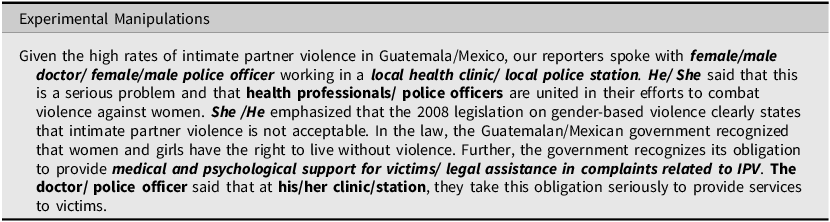
The theoretical argument proposes that in contexts of chronic impunity and weak institutions, credible anti-VAW messages can shape attitudes toward IPV victims, generating perceptions of lower societal stigma toward VAW. We propose that male authority figures, especially those with expertise in fighting crime and public health, might tap into a reservoir of subject matter credibility to transmit these messages to the public. We test this argument with a 2 × 2 experimental design with two additional control groups (Table 1). The vignettes manipulate the messenger’s gender and occupation (police officer or medical doctor).Footnote 5 Importantly, the aspects of the anti-VAW law in their messages are slightly manipulated to either prime respondents to the criminal aspects of the anti-VAW legislation or its public health components. The control groups either answer questions about VAW stigma without reading a vignette or after reading about a non-governmental organization (NGO) (no legislation primed). These messengers were selected based on the traditional authorities tasked with responding to VAW (the justice system and healthcare professionals), but also as a result of the findings of our fieldwork in Guatemala. In the towns we visited, the police are largely absent. However, NGOs and medical facilities are often present. Nevertheless, as articulated above, we expect police and healthcare messengers to exert stronger influence on opinions given their public authority, subject matter expertise, and power to change outcomes at the local level. Vignettes and questions are available in the online appendix. Additionally, Table A1 in the supplementary material presents balance tests that verify randomization.
Vignettes

After reading a randomly assigned vignette, respondents were presented with several statements gauging attitudes toward VAW and views of the public’s stigma toward IPV victims. On a scale from 1 (strongly disagree) to 5 (strongly agree), stigmatizing attitudes held by the participants were assessed with the following statements: 1) Intimate partner violence is a private matter and society should not interfere (mean: 1.8; SD: 1.12); 2) Men do not hit women for no reason (mean: 2.42; SD: 1.33); and 3) it is more serious when a stranger kills a person during a robbery than when a man kills his wife because of jealousy (mean: 2.3; SD: 1.4). These three items were combined into an index assessing personally held beliefs about IPV. For views on the extent of public stigma toward IPV, respondents were asked their level of agreement or disagreement with the following statements: 1) Society does not take victims of intimate partner violence seriously (mean: 3.6; SD: 1.2); and 2) Society thinks victims of intimate partner violence should keep the experience secret (mean: 2; SD: 1.3). These statements were also combined into an index assessing perceptions of public stigma. These items were inspired by previous research on the components of the stigma (e.g., Overstreet et al. Reference Overstreet, Willie and Sullivan2019; Day et al. Reference Day, Edgren and Eshleman2007).
The models control for several relevant individual-level characteristics and attitudes, asked before the experimental vignettes. Importantly, models account for trust in political institutions and views of impunity. Indeed, as expected, the sample displayed very high levels of distrust in institutions. For example, 76.25 percent of the combined sample selected no or very little trust when asked about the police. When asked how likely it would be for someone to be punished by the authorities if they committed a crime, a plurality of the sample (43 percent) selected “not very likely.” To test hypotheses 2 and 4, we include gender as a moderator in the models, along with its interaction with the experimental treatments.
Similarly, to test the effect of sexism on views of IPV, we use the benevolent and hostile sexism scale developed by Glick and Fiske (Reference Glick and Fiske1996). The hostile sexism index on a 5-point scale included: 1) women are too easily offended, 2) most women fail to appreciate all that men do for them, and 3) women exaggerate their problems (index mean = 3.07 SD=1.04). Benevolent sexism index included: 1) many women have a quality of purity that few men possess, 2) men should be willing to sacrifice their own well-being in order to provide financially for the women in their lives, and 3) in a disaster, women should be rescued first (index mean= 3.02; SD= 0.9). Benevolent sexism is used as a control in the models, while hostile sexism is included as a moderator to test H5.
Results
Gender and Stigmatizing Attitudes
Table 2 depicts the effect of treatment manipulations, sexism, and gender on personally held stigmatizing attitudes and views of public stigma. Models 1, 3, and 4 test whether the type of messenger affects personally held stigmatizing opinions about IPV. As can be observed, the only messengers who significantly shifted personal opinions were the NGO and the male police officer. When an NGO or a male police officer shared information about anti-VAW measures, respondents were significantly less likely to strongly agree with personally held stigmatizing statements than in the control condition (model 1). Those in the control group were 23 percent likely to hold very low stigmatizing opinions of victims, while those in the NGO and the male police officer vignettes were 31 percent and 32 percent, respectively (p<0.05, Figure A1 in the Supplementary Material). However, the treatment manipulations had no effects on views of public stigma in the baseline Model 2.
The Effect of the Messenger on Personal and Public Stigma Toward IPV

Note: Ordered Logit. Standard errors in parentheses, ***p<0.001, **p<0.01, *p<0.05. In the appendix, all results are replicated separately for Mexico and Guatemala. Models control for crime victimization, which is not significant.
H1 states that men should hold more personally held stigmatizing attitudes toward IPV. Model 1 lends credence to this proposition, as female respondents were significantly less likely to hold stigmatizing opinions toward IPV (p < 0.01). H1 further posits that men should perceive lower levels of public stigma toward IPV victims relative to women. However, the results in the baseline model 2 do not support this expectation: men and women share similar views on whether society stigmatizes IPV victims. This provides partial support to H1 as men agree with stigmatizing statements about IPV at higher levels than women, on average.
H2 posits that men should be more susceptible to the type of messenger in their personal views of IPV and perceptions of public stigma, as women hold more crystallized attitudes toward IPV (H3). That is, men should be more susceptible to persuasion along both dimensions. While the interactions in models 4 and 6, Table 2, appear insignificant, Mitchell (Reference Mitchell2012) suggests that to gauge the impact of interactions, a difference-in-means test should be performed. Panels A and B in Figure 1 depict the difference-in-means test and substantive effects of the gender and treatment interactions from model 4, Table 2. As shown in Panel B in Figure 1, men’s and women’s personally held stigmatizing opinions of IPV victims are not significantly different when exposed to female or male healthcare professionals—as confidence intervals cross the zero line, indicating statistically insignificant differences. However, a statistically significant gap exists in every other category.
Moderated Effects of Gender on Stigmatizing Attitudes.

Surprisingly, Panel A in Figure 1 suggests that the messenger seems to be moving women’s attitudes more drastically than men’s, which is the opposite of what we expected in H2 and H3. We posited that men should generally hold more malleable personal opinions on IPV, while women’s views should be more stable. But contrary to that, the NGO and police messengers are more impactful on personally held stigmatizing opinions of women. Doctors seem slightly more persuadable messengers for men than women. As shown in Panel A of Figure 1, NGO messengers increase women’s positions from a 27 percent low probability of holding stigmatizing opinions when no vignette is provided (control) to 38 percent. Female and male police officers move women to a 41 percent probability of holding very low levels of stigmatizing personal attitudes toward IPV victimization. Men’s opinions across manipulations remain relatively stable. Thus, these messengers more powerfully reduce stigmatizing opinions of IPV among women respondents, even though women already have lower baseline levels of stigma toward IPV compared to men. These results refute H2, as male messengers did not persuade men in their personal beliefs, and parts of H3, since women’s opinions proved to be less stable than theorized. The appendix presents the results of these analyses for each of the statements comprising the index.Footnote 6
We also theorized above that anti-VAW efforts disseminated by credible messengers can shape respondents’ perceptions of what others think about IPV (public stigma). Contrary to our expectations outlined in H1, men and women have indistinguishable opinions on this dimension. In fact, men’s and women’s beliefs about the opinions of the wider public are similar across all conditions except the male police officer (Panel B, Figure 2). Women’s probability of perceiving lower public stigma toward IPV is higher in the male police officer condition, from 18 percent in the control to 24 percent. This supports H4, in which we posited that women would be more persuaded that IPV victims aren’t subjected to societal stigma when a man in a credible occupation signals commitment to anti-VAW efforts. As the default experts in security, male police officers signal to women that law enforcement views VAW as a matter of public concern. Curiously, male doctors were not as persuadable to women as predicted in H4, however. It is possible that women view law enforcement as exerting more influence on the social norms than healthcare professionals, especially in the subject matter of their expertise: crime. Future research should unpack this possibility. Generally speaking, compared to personally stigmatizing attitudes, public stigma views seem less susceptible to awareness building about anti-VAW state efforts and the type of messenger.
Gender and Views of Public Stigma.

Hostile Sexism and Stigmatizing Attitudes
In H5, we posit that hostile sexists should hold very high personal stigmatizing attitudes toward IPV, but view public stigma as low, regardless of the messenger. Opinions on VAW should be more crystallized among this group. Those scoring lower in hostile sexism, meanwhile, should have more room for movement. They should display less stigmatizing attitudes and perceive lower levels of societal stigma toward victims (public stigma) when presented with more credible messengers. As can be observed in models 1 and 2 in Table 2, hostile sexism is a strong predictor of stigmatizing attitudes toward IPV (p<0.001), but, surprisingly, it is unrelated to views on public stigma. Yet, as theorized, different messengers did not significantly shift personally held stigmatizing opinions among those who scored highest on the hostile sexism scale (Panel A, Figure 3). The appendix presents the results of the moderating effect of hostile sexism on each statement comprising the stigma indexes.Footnote 7
Hostile Sexism and Stigmatizing Beliefs about IPV.

As expected, those who score the lowest on the hostile sexism scale are, in fact, the most “movable” group. This group holds less crystallized opinions on VAW, as they do not display disparaging attitudes toward women in general. As can be observed in Panel A in Figure 3, those holding the weakest attitudes, those scoring 1 and 2 on the hostile sexism scale, exhibit the sharpest shifts in their views toward IPV. While this group shares similar levels of stigmatizing beliefs in the control condition with those higher on the sexism scale, they are the ones who move the most drastically in a positive manner. This group moves from a 39 percent likelihood of holding low stigmatizing beliefs of IPV victims in the control group, to above 60 percent in every other treatment condition. This might suggest that the message itself is more powerful for this group than the credibility of the cue giver.
Nevertheless, those with no hostile views toward women still seem slightly more convinced by the NGO, female doctors, and female police officers, with 82, 75, and 67 percent likelihood of holding low levels of personal stigma toward IPV, respectively. Panel B in Figure 3 demonstrates that, besides the control, those very low and very high on the sexism scale hold significantly different opinions toward IPV, with hostile sexists demonstrating a higher level of stigmatizing views. Those scoring 2 on the hostile sexism scale, which is still very low, also moved significantly with different treatments, especially the male police officer. This group moved from a 37 percent likelihood in the control to a 54 percent likelihood of disapproving of stigmatizing statements toward IPV. In the male police officer vignette, the significance gap between those scoring low and the second-lowest on the hostile sexism scale in their views toward IPV closes (Panel B, Figure 3). This provides some evidence that different credible messengers resonate with different groups.
While the type of messenger did not generate drastic changes in hostile sexists’ personal attitudes that stigmatize IPV victims, results are more nuanced regarding their views on public stigma. Indeed, the type of messenger shifts this group’s opinions more powerfully with this dependent variable. Results in Table 2 show that high hostile sexism does not correlate with views on public stigma. If this is a sign of less crystallized, weaker opinions, then the shifts in beliefs related to public stigma caused by the messenger fit the larger theoretical argument of this article. In Panel A of Figure 4, we observe larger movements across groups, particularly for those at the very low (Group 1) and very high (Group 5) levels of hostile sexism. For those scoring very low in the hostile sexism scale, the NGO, female and male doctors, and the male police officer generated large shifts in opinions. From an 11 percent likelihood of believing that society holds low stigmatizing views toward IPV victims (public stigma) in the control condition, to a 33 percent likelihood in the NGO, 24 percent in the female medical doctor, 31 percent in the male doctor, and 24 percent likelihood in the male police officer conditions. Interestingly, the only treatment that did not generate a move in this group’s opinions was the female police officer messenger. For those low in hostile sexism, the messenger seems important in predicting views of public stigma, with the NGO and male medical doctor more powerfully convincing them that society is receptive to IPV victims. Indeed, Panel B in Figure 4 shows that the NGO and male doctor are the only conditions under which the views of public stigma of those scoring very high and very low in the sexism scale are significantly different from each other.Footnote 8
Hostile Sexism and Views of Public Stigma.

In Panel A of Figure 4, we observe large shifts in the opinions of those scoring very high on hostile sexism (Group 5), which is noteworthy given the lack of movement in this group regarding their personal stigmatizing opinions. The cue-givers seem to polarize opinions of public stigma of those very high and very low in sexism, moving them in opposite directions. Hostile sexists perceive the wider public as holding more stigmatizing opinions toward IPV victims compared to those scoring very low in sexism in the NGO and male doctor conditions; these conditions improve the opinions of public stigma of those very low in the sexism scale (Panel B, Figure 4). Hostile sexists, meanwhile, move more sharply toward the direction of believing that the public holds low stigmatizing opinions of victims in the male police officer condition. Given their support for traditional law enforcement (Beauregard et al. Reference Beauregard, Holman and Sheppard2022), it makes sense that hostile sexists would perceive low public stigma when male police officers are engaged in efforts to combat VAW. If the default authorities in law enforcement are committed to VAW reduction, then it stands to reason that the public is receptive to victims. In general, those low in sexism are more convinced by non-law enforcement credible sources, while those high in sexism are persuaded by law enforcement, especially male agents. It is also worth noting that those who scored 3 on the scale perceived less public stigma when exposed to the female doctor messenger. Future research should explore the mechanisms underlying these shifts, as they remain unclear.
Other Findings: Benevolent Sexism
While we have not theorized about the impact of benevolent sexism on personally held stigmatizing opinions and views of public stigma toward IPV victims, it is clear from Table 2 that benevolent sexism matters for these attitudes. Benevolent sexists are more likely to hold stigmatizing views of IPV victims and perceive that society equally stigmatizes victims at the p<0.05 significance level across all models. In line with benevolent sexists’ paternalism toward women, it makes sense that they would perceive high societal stigma toward IPV victims. Furthermore, as strong endorsers of traditional gender roles, they would also approve of stigmatizing statements toward IPV. Future research should investigate this group’s views on stigma more closely.
Limitations
Several lingering questions remain regarding the mechanisms behind the findings above, as noted throughout the article. However, it is also critical that we acknowledge some limitations related to the sample and external validity. As we previously mentioned, the sample from Guatemala is small and not representative of the population. It is significantly more urban and wealthier. Research finds that women experience far more stigma related to IPV and encounter greater challenges when looking for help in non-urban areas in Guatemala (e.g., Beck Reference Beck2021; Menjívar Reference Menjívar2011). It is reasonable to suggest that the findings related to Guatemala might underestimate the extent to which the population holds stigmatizing views of IPV and of the level of societal stigma, as rural areas were not sampled. Thus, the results for Guatemala are only suggestive. Further, this study has not theorized and tested the effect of anti-VAW messages and messengers on whether IPV victims perceive society as more welcoming to them (victims’ views on public stigma). This is a central question as fear of stigma has been shown to prevent victims from reaching out to institutions as well as friends and family (e.g., Htun and Jensenius Reference Htun and Jensenius2022). This represents a promising and important avenue for future research.
Further, a note on external validity is in order. We must consider how individuals receive information on government projects and institutions in the “real world” (see Gelpi Reference Gelpi2010). Our experimental vignettes were designed to closely resemble a section of a news story; however, we isolated the information on anti-VAW state action as provided by the cue giver. In reality, news stories on VAW are likely to be more negative and/or sensationalized, often depicting extreme cases of domestic violence, sexual violence, or femicides, even when providing information on state efforts to combat these crimes (Kras Reference Kras2023). It is unclear how information on anti-VAW laws and institutions provided by credible messengers within the larger context of a news story reporting a case of VAW would shift public opinion. It is possible that such stories could generate greater shifts in personally held stigmatizing opinions as a way to demonstrate repudiation of VAW. However, this combination might dilute the positive effects of credible messengers and messages of anti-VAW state efforts on views of societal stigma toward victims. Finally, the temporal persistence of these effects also remains unclear. Our study does not permit an investigation into the duration of these shifts in personal attitudes toward VAW and views of others’ attitudes resulting from exposure to these messages. However, it is reasonable to suggest that longer-term or more crystallized shifts in attitudes occur only in prolonged exposure to many such stories or information (see, for example, Córdova and Kras Reference Córdova and Kras2022). Further research is needed to validate these claims.
Conclusion
This article aimed to investigate whether the messenger’s credibility in disseminating anti-VAW messages affects personally held beliefs about IPV and views on others’ beliefs. We argued that in contexts where impunity is rife and trust in institutions is low, the credibility of the messenger should be particularly important in persuading citizens that government action on VAW is credible. In such contexts, credibility is linked to the authority of the messenger in shaping outcomes related to VAW at the local level, such as healthcare and law enforcement. Further, we argued that male officers and doctors would be particularly persuasive messengers as they are “surprising” endorsers and are the “default” authorities in crime-fighting and healthcare, especially in more patriarchal settings. However, we proposed that those with more crystallized attitudes toward gender and VAW would be less persuadable, such as women and hostile sexists. Results were surprising in several ways.
Using survey experiments collected from Mexico and Guatemala, we found that men are indeed more likely than women to hold personally stigmatizing attitudes toward IPV victims. However, contrary to what we expected, women were more persuaded by the messenger than men, despite lower baseline levels of personal stigma toward IPV victims. Women’s stigmatizing attitudes improved significantly with NGO and law enforcement messengers. While men and women shared similar views of the level of societal stigma toward IPV in the control condition, women’s views of public stigma improved significantly in the male police officer condition. These findings suggest that women’s attitudes toward IPV victims are malleable. It is possible that, as women care more about VAW, they deliberate more on information related to VAW and are therefore more susceptible to persuasion. Men might perceive information about VAW as a subject of little personal relevance, providing answers with little deliberation. Thus, it is possible that women still hold strong opinions on VAW; however, they are more likely to pay closer attention to information about this subject. Further research is needed to investigate this topic in more detail.
We also showed that hostile sexists are, in fact, much more likely to hold stigmatizing personal opinions toward IPV victims, although they were not more likely to downplay public stigma toward IPV. In terms of stigmatizing personal opinions, those lower in the scale moved more. They were persuaded by the NGO, the female doctor, and the female police officer—but they moved in every vignette compared to the control, suggesting that the anti-VAW message itself moves this group. The type of messenger matters more for hostile sexists’ views on public stigma, which makes sense as hostile sexism was not a predictor of views of public stigma, perhaps suggesting malleable attitudes on this dimension.
For those very low on hostile sexism, the NGO, female and male doctors, and male officers generated larger shifts. For hostile sexists, it is the male police officer who improves views of public stigma, consistent with research showing this group’s approval of traditional law enforcement. Thus, even hostile sexists can shift their views of public stigma toward IPV. Furthermore, future research should examine whether NGOs are seen as more legitimate in contexts of poor governance and impunity. It was surprising to observe the significant impact of the NGO messenger on certain groups. In our focus group interviews and fieldwork in Guatemala, we observed greater exposure to NGO workers at the local level in small and mid-sized towns than to law enforcement, and NGOs often provided healthcare services. Thus, in these settings, NGOs may be perceived as credible and trustworthy sources of information.
In short, different messengers resonated with different respondents. Some simply changed their views when presented with a message about the anti-VAW legislation, as with those low in hostile sexism and their personal views. Yet, even if the message is persuasive regardless, some messengers still moved those low in hostile sexism more than others, such as physicians and the NGO. For women, traditional law enforcement was more persuasive in generating shifts in their personally held opinions, but male police officers were of particular influence in lowering their perceptions of public stigma of IPV victims. Male police officers were also the messengers who influenced hostile sexists the most in their views of public stigma. Thus, the general lesson that emerges from this research is that a diverse set of actors must be engaged in information diffusion about state efforts to address VAW, including men in credible professions capable of changing outcomes at the local level.
Supplementary material
To view supplementary material for this article, please visit https://doi.org/10.1017/lap.2026.10050
Data availability statement
Data files can be accessed at https://dataverse.harvard.edu/dataset.xhtml?persistentId=doi:10.7910/DVN/IIQLPJ
Acknowledgments
We gratefully acknowledge the generous support of Fordham University through a Faculty Research Grant, which made data collection for this project possible.
Competing interests
The authors declare they have no competing interests.


 Open access

