





Introduction
Within the vast literature on what shapes people’s political and civic behaviour, few explanatory factors have been studied so extensively as education (Persson Reference Persson2015; Willeck and Mendelberg Reference Willeck and Mendelberg2022). However, most studies on this topic have treated education as a single quantity, measured typically in terms of years. By contrast, research on how different types of education – and educational content – affect political participation is more limited. Such research has often focused on quite specific aspects of education, such as courses in civic education (eg Galston Reference Galston2001; Hillygus Reference Hillygus2005; Weinschenk and Dawes Reference Weinschenk and Dawes2022), classroom climate and different types of pedagogy (eg Campbell Reference Campbell2008; Kahne and Sporte Reference Kahne and Sporte2008), as well as on democratic practices in school (eg Keating and Janmaat Reference Keating and Janmaat2016; Mennes et al. Reference Mennes2023). There is also a small set of studies on how the field of study at the tertiary level affects political participation (eg Bhatti Reference Bhatti2017; Esaiasson and Persson Reference Esaiasson and Persson2014; McGregor and Pruysers Reference McGregor and Pruysers2022).
While these particular aspects of education are indeed relevant and bear investigation, many educational systems – especially outside of North America – employ a more fundamental division: that is, they introduce distinct educational pathways already at the secondary level. As secondary education is nearly compulsory for today’s adolescents, this is a division that influences largely all students in these educational systems. The most typical differentiation is between general and vocational tracks: the former prepares students for academic studies; the latter imparts skills directly applicable to the labour market (Shavit and Müller Reference Shavit, Müller and Hallinan2000). In the education literature, this separation of students into different educational pathways with distinct curricula and credentials is referred to as tracking.
Policymakers put much trust in vocational education and training as a measure for dealing with youth unemployment and providing labour markets with skilled workers (eg Council Recommendation 2020/C 417/01; OECD 2023). A recent EU report (Cedefop 2022: 1), for instance, states that:
VET [Vocational Education and Training] programmes, with their practical component, can help young people acquire entrepreneurship skills and ease their transition to work. Ultimately, they can provide young people with skills harnessing their employability and fostering their inclusion in society.
Social inclusion, however, is not just about incorporating people into the labour market. It concerns political inclusion as well. Earlier research has raised concerns that the two policy aims may come into conflict (Janmaat, Mostafa and Hoskins Reference Janmaat, Mostafa and Hoskins2014; Van de Werfhorst Reference Van de Werfhorst2017): that is, vocational programmes may help prepare students for work, but be negative for their political engagement. A possible reason for this negative impact is that such programmes place less emphasis on analytical thinking and the social sciences. Such an educational divide in political participation would not only lead to the underrepresentation of vocational graduates but also exacerbate inequality in policy responsiveness (Schakel and Van der Pas Reference Schakel and Van der Pas2021). If vocational tracks, in comparison to their general equivalents, do indeed have negative effects on political participation, then policymakers face a difficult trade-off between economic and democratic aims. However, current research provides no conclusive answer to the question of how different tracks at the upper secondary level affect political participation. The current study aims to improve on this state of affairs. It asks: does pursuing a general versus a vocational upper secondary education make a difference for political participation?
The distinction between general and vocational tracks in secondary education arguably constitutes the most common differentiation in educational systems (Shavit and Müller Reference Shavit, Müller and Hallinan2000). However, research on how these different trajectories affect political participation is limited – and struggles with disentangling the effects of the type of education from those stemming from differences in the background of students who attend different programmes. Recent research on education and political outcomes has highlighted the inherent difficulty of isolating the effects of education (Persson Reference Persson2015; Willeck and Mendelberg Reference Willeck and Mendelberg2022).
We aim in this article to contribute to solving the difficult question of causal identification by employing a regression discontinuity (RD) design. The design exploits the grade-based admission to upper secondary school in Sweden and focuses on students who apply for both vocational and general programmes. This novel design for the topic of how the type of secondary education affects political participation is enabled by our access to individual-level Swedish register data.
Beyond the large literature on education and political participation, our study is also important for scholarship on how school tracking affects social and educational inequalities (Van deWerfhorst and Mijs Reference Van de Werfhorst and Mijs2010), and particularly the impact of tracking on equality of political opportunity (eg Matthieu and Junius Reference Matthieu and Junius2024; Van de Werfhorst, Ten Dam, Geven et al. Reference Van de Werfhorst, Ten Dam, Geven, Huijsmans, Mennes, Mulder, van Slageren and van der Meer2025).
We find no positive effect from general education in our RD models. We also predominantly obtain null results in supplementary analyses of siblings covering the full population. In fact, our RD results indicate negative effects on turnout from starting a general programme rather than a vocational one for students who have applied for both types of programmes. These effects appear to stem from that the curriculum in general programmes is too demanding for these students, resulting in them dropping out of school. Our finding that pursuing a general track instead of a vocational one can lead to political disengagement suggests that tracking under some circumstances can mitigate rather than reinforce inequality of political opportunity.
Theory and previous research
The extensive literature on education and political participation suggests three different theoretical possibilities for how pursuing a general versus a vocational upper secondary education may affect students’ willingness to engage politically.
The first possibility is that pursuing a general rather than a vocational education stimulates political engagement due to curriculum and peer effects. The argument is that educational programmes that focus less on practical skills and more on cognitive capacities – eg literacy, analysis, critical thinking – make students more well-equipped to reason about political matters, which in turn encourages political interest and engagement (Hoskins, Janmaat, Han et al. Reference Hoskins, Janmaat, Han and Muijs2016; Van de Werfhorst Reference Van de Werfhorst2017). Similarly, programmes which include more in the way of social science may impel students to be more active politically by providing them with knowledge about how democracy works and helping them to navigate the political system (Bhatti Reference Bhatti2017; Esaiasson and Persson Reference Esaiasson and Persson2014; Hillygus Reference Hillygus2005). Furthermore, the concentration in general programmes of students whose parents are highly educated and politically engaged may stimulate students to talk about political issues at school (Janmaat and Mons Reference Janmaat and Mons2023; Witschge and van de Werfhorst Reference Witschge and van de Werfhorst2020). Students in vocational programmes, by contrast, can be expected to spend less time with schoolmates who can furnish them with political knowledge and motivate them to participate politically (Janmaat, Mostafa and Hoskins Reference Janmaat, Mostafa and Hoskins2014). These curricula and peer mechanisms may also be reinforced during students’ further studies, since graduates from general tracks are more likely to engage in tertiary studies than graduates from vocational tracks.
The second possibility is that pursuing a general education has no substantial causal effect on political participation. This would be in line with the so-called education-as-a-proxy perspective, according to which education simply captures the impact of family background (Persson Reference Persson2015). In this view, the effects of the type of education on political participation are just selection effects, inasmuch as students’ choice of educational programme is determined by factors such as upbringing and genetic inheritance – which are also decisive for political participation. One thing that speaks for such an interpretation is that the choice of programme in upper secondary school is strongly influenced by family background (Persson Reference Persson2012; Shavit and Müller Reference Shavit, Müller and Hallinan2000).
Previous research on how general education may affect political participation has focused solely on null or positive effects thereof. However, inspired by the literature in economics and educational science, we believe there is also a possibility that pursuing a general education, instead of a vocational one, has negative effects on participation under certain circumstances. Both curriculum and peer mechanisms might generate such an outcome. Regarding educational content, some students may lack the skills and capacities needed to manage the more demanding theoretical curriculum and graduation requirements of a general programme. Attending general rather than vocational programmes can therefore lead to poor academic performance for such students and make it difficult for them to complete their education. In fact, education economists have found that reforms introducing a more general curriculum in secondary school can increase the dropout rate, particularly among males (eg Görlitz and Gravert Reference Görlitz and Gravert2016; Hall Reference Hall2012; Ollikainen and Karhunen Reference Ollikainen and Karhunen2021; Zilic Reference Zilic2018). Dropping out may, in turn, lead to a ‘bad start’, signified by difficulties in the labour market, with subsequent negative effects on electoral turnout (Emmenegger, Marx and Schraff Reference Emmenegger, Marx and Schraff2017; Österman and Brännlund Reference Österman and Brännlund2024). Moreover, low- or average-performing students who start a general programme dominated by high-performing students – rather than a vocational programme with more similarly skilled peers – may become insecure about their cognitive abilities, creating anxiety and a feeling of alienation in relation to their peers. This is in line with the so-called Big-Fish-Little-Pond effect, which is well-established within educational psychology (see, eg Fang, Huang, Zhang et al. Reference Fang, Huang, Zhang, Huang, Li and Yuan2018). The idea is that students’ reference group is important for their academic self-concept and sense of efficacy (Korthals, Schils and Borghans Reference Korthals, Schils and Borghans2022; Marsh Reference Marsh1987). Thus, having high-performing peers can have an adverse impact on students’ self-beliefs, which may be negative for career aspirations and educational achievement (Nagengast and Marsh Reference Nagengast and Marsh2012; Parker, Marsh, Ciarrochi et al. Reference Parker, Marsh, Ciarrochi, Marshall and Abduljabbar2014). Such effects can, in turn, depress the willingness and capacity to participate politically.
Turning to the empirical literature, it can be divided into three categories of studies based on their design for identifying the causal effects of the type of education. First, there is a group of studies that draw on cross-sectional data. Results from several countries demonstrate that persons who attend (or have completed) general programmes show significantly higher levels of intended and reported political participation than do persons who attend (or have completed) vocational programmes (eg Janmaat and Mons Reference Janmaat and Mons2023; Van de Werfhorst Reference Van de Werfhorst2017). However, these results may reflect self-selection rather than the causal effects of education.
Second, certain other studies use panel or longitudinal survey data measuring students’ political participation both before and after they have completed secondary education. The results are mixed here. Some studies support that type of education has a causal effect, since they indicate that attitudes towards political participation develop more positively among students who attend general programmes than among those who attend vocational ones (Hoskins, Janmaat, Han et al. Reference Hoskins, Janmaat, Han and Muijs2016; Janmaat, Mostafa and Hoskins Reference Janmaat, Mostafa and Hoskins2014; Witschge and van de Werfhorst Reference Witschge and van de Werfhorst2020). Other studies find that differences in political participation connected to types of education exist already before students enter these programmes (Persson Reference Persson2012; van de Werfhorst, Ten Dam, Geven et al. Reference Van de Werfhorst, Ten Dam, Geven, Huijsmans, Mennes, Mulder, van Slageren and van der Meer2025; Witschge, Rözer and van de Werfhorst Reference Witschge, Rözer and van de Werfhorst2019). These longitudinal studies have advantages over cross-sectional ones, as they can provide evidence that the differences in political engagement between students in general and those in vocational programmes emerge during secondary education. However, interpreting these differences as a causal effect of students’ divergent educational pathways assumes that the impact of background factors is constant over time. Such an assumption can be questioned in the case of adolescents, who are still forming their adult identities during secondary education. For instance, if students in general programmes possess traits stemming from their family background that stimulate political engagement – but which do not start playing out until they become eligible to vote – then a panel study will attribute these background effects to the programme itself. Another issue is that panel studies hinge on an initial measure of students’ political participation – recorded before they start different types of education – when they are in their early teens. Such an indicator may be subject to substantial measurement error, which could also vary systematically with choice of education.
Lastly, there is a small group of studies that take advantage of educational reforms for a quasi-experimental design. Two of them exploit a reform introduced in 1991 of Swedish upper secondary school (Lindgren, Oskarsson and Persson Reference Lindgren, Oskarsson and Persson2019; Persson and Oscarsson Reference Persson and Oscarsson2010). This reform prolonged the vocational track by one year and added more general subjects to the curriculum. Neither of these studies finds positive average effects on political participation. However, Lindgren, Oskarsson and Persson (Reference Lindgren, Oskarsson and Persson2019) reveal that the reform resulted in smaller differences in voter turnout between strong and weak socio-economic groups. Garritzmann and Wehl (Reference Garritzmann and Wehl2025) look at secondary school reforms in Germany that reduced educational stratification and made the curriculum more general. Their findings are similar to those of Lindgren, Oskarsson and Persson (Reference Lindgren, Oskarsson and Persson2019), in that they find positive effects on participation among students in the lower tracks. These studies are valuable because they address the difficult issue of selection across educational programmes. However, the reforms exploited in these studies make it difficult to separate the effects of the type of education from those of education length and other aspects of the reforms. Put differently, such studies fail to capture the distinct impact on political participation of pursuing a general education versus a vocational one.
To summarise, there are strong theoretical arguments for positive and negative effects on political participation of pursuing a general education – in comparison to a vocational one – at the upper secondary level. Moreover, existing empirical studies have not been able to ascertain credibly which of these different theoretical perspectives is correct. We hope, therefore, to help fill this research gap by applying a RD design that allows for a stringent comparison of the effects on political participation of pursuing a general education versus a vocational one. This design is possible because of how upper secondary education and admission to it are structured in Sweden, which we will soon explain. First, however, we describe general and vocational education in Europe more broadly and situate Sweden within this context.
General versus vocational education, tracking and voter turnout in Europe
In most parts of the world, students at the upper secondary level can enrol in either general academic education or vocational education. Within the OECD, 44 per cent of all upper secondary students are enrolled in vocational programmes or tracks and most OECD countries offer such programmes (OECD 2023). Figure 1 presents the vocational enrolment rate in a number of European countries, as well as the proportion of the population with a vocational education in contrast to a general one (among those who have finished upper secondary school). On average, 49 per cent of the population had a vocational education in 2021. In many Eastern and Central European countries – as well as in Germany and France – vocational education is more common than general education. Also in countries such as Great Britain and Denmark, vocational education is about as common as general education. Sweden is in the middle in terms of the share of the population with vocational qualifications, accounting for 51 per cent, whereas enrolment is on the lower end at 35 per cent. This difference reflects that the share enrolling in vocational secondary education has fallen over time in Sweden.
Share with vocational education and enrolment to vocational upper secondary education in Europe.
The dashed lines indicate the mean levels across countries. Vocational education in the population is coded dichotomously, so the complement represents the share with general education. Cumulative ESS data 2010–2020 (ESS 2023); respondents with at least upper secondary schooling. See Online Appendix A for variable definitions.

The differentiation between vocational and general programmes – or tracks – by definition signifies a form of tracking (Shavit and Müller Reference Shavit, Müller and Hallinan2000). However, the extent of tracking differs considerably between educational systems in terms of at what age tracking is introduced, whether it takes place between or within schools and in regard to the number of tracks (Garritzmann and Wehl Reference Garritzmann and Wehl2025; Witschge and van de Werfhorst Reference Witschge and van de Werfhorst2020). In more heavily tracked systems – such as in Germany and in the Netherlands – children are divided between several different tracks already in lower secondary school. In the Swedish system, tracking is introduced at the upper secondary level when students choose between vocational and general programmes. Swedish vocational programmes are school-based and typically regarded as relatively distinct, offering an intermediate level of occupation-specific skills, between the more specific vocational training offered in German-speaking countries and the general skills emphasised in Anglophone countries (Busemeyer Reference Busemeyer2009; Shavit and Müller Reference Shavit, Müller and Hallinan2000). Furthermore, a Swedish reform introduced in 2011 increased the level of differentiation by making vocational programmes more closely tied to specific occupations and also meant that graduates from vocational programmes no longer became eligible for tertiary education unless they added extra courses (Nylund and Virolainen Reference Nylund and Virolainen2019). Vocational programmes that do not provide direct access to tertiary education are quite common in the OECD: about one-third of all upper secondary vocational students attended such programmes in 2018 (OECD 2020).
Against this background, we believe that Sweden, with its distinct general and vocational upper secondary programmes, similar to those in many European and OECD countries – but without tracking in compulsory school – represents a good test ground for the study of how vocational versus general secondary education affects political participation. In more strongly tracked systems, where students are placed in different tracks in lower secondary school, it would be difficult to study the impact of general versus vocational secondary programmes per se, because effects would also depend on earlier track selection. On the other hand, in countries with less distinct vocational programmes, differences between vocational and general programmes may be too small to expect much of an effect on political behaviour.
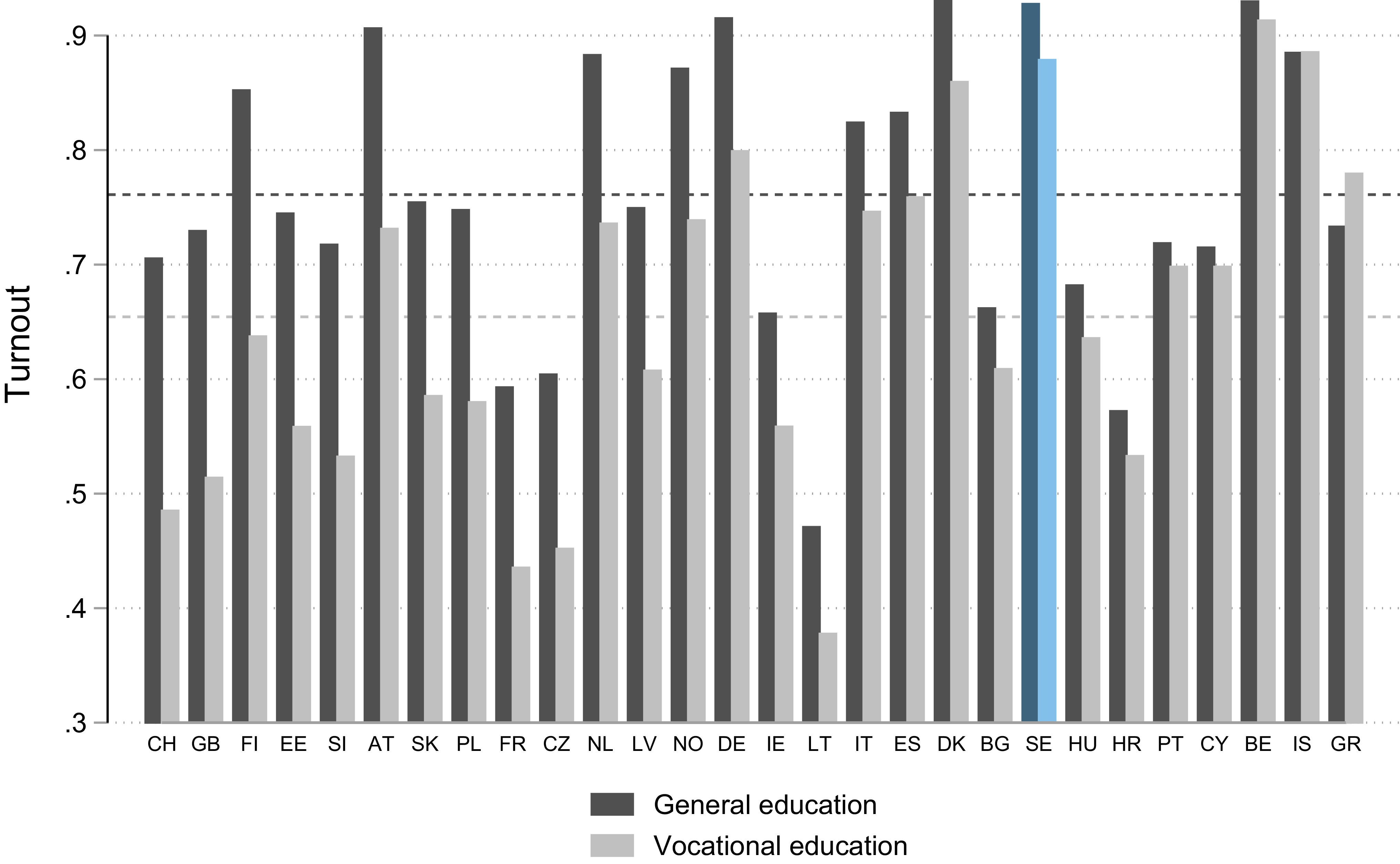
In most European countries, a significant gap exists in voter turnout in national elections between individuals with vocational education and those with general education. Figure 2 demonstrates this gap among young individuals aged 18 to 35. In the countries where the difference in electoral participation is most pronounced between vocational and general qualifications – such as in Switzerland, Great Britain and Finland – it exceeds 20 percentage points. The average difference is 10.7 percentage points, but stands somewhat smaller in Sweden at 4.9, possibly related to the overall high level of turnout in Sweden. We reason that the take-home message from Figures 1 and 2 is that vocational and general education represent an important educational divide in present-day Europe, which – at least descriptively – shows a strong relationship with electoral participation.
Voter turnout among young adults with general and vocational education in Europe: 2010–2020 ESS data. Ordered by turnout difference between programmes (largest to smallest).
The dashed lines indicate the mean turnout levels for the different types of education. Self-reported turnout in the last national election among respondents 18–35 years old.
Upper secondary school in Sweden
Swedish law requires children to undergo nine years of compulsory schooling on the comprehensive primary and lower secondary level, after which they can apply to upper secondary school.Footnote 1 To qualify for the latter, students must have passed courses in Swedish, English, mathematics, and a number of other subjects. Eligible students can choose between six general programmes (egnatural science, social science) and twelve vocational programmes (eg construction, transport). All programmes take three years to complete. Upper secondary education is not compulsory, but almost all adolescents (97–99 per cent) embark on studies at this level. A relatively large proportion, however, drop out, and between 70 and 80 per cent finish upper secondary school.
There are substantial curricular differences between general and vocational programmes. Unlike vocational programmes, the general programmes include the Swedish and English courses needed to acquire basic eligibility for tertiary education. General programmes also include more courses in mathematics, history, the social sciences, or the natural sciences. These differences can mean two to four times the number of study hours in these subjects compared to vocational programmes (see Table B.1 in the Online Appendix). Moreover, the programmes include specialised subjects: in vocational programmes, these are aimed at specific occupations, whereas in general programmes, they are designed to prepare students for academic studies. Students with highly educated parents are overrepresented in general programmes, with 52 per cent of the students having parents with post-secondary education during our period of study. The corresponding figure for vocational programmes is 28 per cent (see Tables C.5 and C.6).
Students apply to upper secondary school in the spring semester of ninth grade and start in the following autumn semester. Students apply to a programme at a specific school and thus rank their preferred combinations of programmes and schools. Regional admission offices allocate students to programmes based on their preference rankings and their final grades from lower secondary school. Students receive an admission letter in July, which lets them know what programme and school they may enter in the autumn semester. If they are not admitted to their first choice, they can remain on a reserve list while accepting a less preferred option.
If a programme at a school is oversubscribed by eligible students, slots are generally allocated based on applicants’ grades from lower secondary school. The main exceptions are arts programmes, sports programmes, and gifted students’ programmes; these also allocate slots based on auditions and entrance exams. The grades used in the admission process consist of the sum of a student’s 16 or 17 best subject grades (ranging from 0 to 340 points). We refer to this summary measure as the student’s GPA (Grade Point Average).
Methods
Considering the difficulty of identifying the causal effects of different educational trajectories, we aim to improve on previous research by applying an RD design (Lee and Lemieux Reference Lee and Lemieux2010). We exploit the admission process to upper secondary education in Sweden, focusing on individuals who apply to a general programme as their higher-ranked alternative and a vocational programme as their next preference. Due to the grade-based admission system, some of these individuals will have grades just high enough to gain admission to a general programme, while others (with slightly lower grades) are admitted to a vocational programme instead. This creates exogenous variation in the type of programme to which individuals are admitted, meaning that the type of programme should be unrelated to individual background characteristics.
The RD approach is a well-established quasi-experimental design, and it is generally thought to lend good support for causal inference (Cattaneo, Idrobo and Titiunik Reference Cattaneo, Idrobo and Titiunik2019; Lee and Lemieux Reference Lee and Lemieux2010). We present the main aspects of our approach below. However, an RD involves several nontrivial modelling considerations, and we refer the reader to Appendix D for further details.
Data
We rely on Swedish administrative data maintained by public agencies. Statistics Sweden collects individual-level data on all students’ applications to upper secondary education, including programme, school, rankings, and GPA. These registers also record the results of the admission process (as revealed in the letters that students get in July). We also have information on the programmes students are registered in by October. We have the data necessary for the RD design from 2008 onward. Approximately 100,000 adolescents apply annually to upper secondary school in Sweden.
The application data are combined with population data on voter turnout from digitised electoral rolls for the Swedish national elections of 2018 and 2022, as well as the European Parliament (EP) election of 2019. These data on individual electoral participation form our dependent variables. Turnout in national elections in Sweden is high in international comparison and reached 87.2 per cent in 2018 and 84.2 per cent in 2022. Such high levels of electoral participation imply a risk for ceiling effects regarding the extent to which the type of education may impact turnout. From this outset, the EP election is important as turnout in this secondary election is lower and amounted to 55.3 per cent in 2019.
Using administrative data has several advantages over most other types of data, such as survey data. They largely eliminate measurement errors like misreporting of socio-economic circumstances and overreporting of turnout (Karp and Brockington Reference Karp and Brockington2005), and they are not affected by non-response and panel attrition. A limitation of register data is that they do not capture non-electoral participation – such as contacting politicians or attending demonstrations. However, we consider voter turnout to be a reasonable test of whether the type of education affects political participation. Voting is one of the least demanding forms of participation, so if general education does not positively influence voting compared to vocational education, we reason that it is unlikely to influence more demanding forms of non-parliamentary participation (Persson Reference Persson2012). In terms of descriptive differences, voting shows the largest participation gap in favour of academic programmes – compared to other forms of political participation – in Sweden and in Europe (Table A.1).
Students typically apply to and begin upper secondary school during the year they turn sixteen, and one must be eighteen on election day to be eligible to vote in Sweden. Against this backdrop, we limit the sample to the nine cohorts that applied to upper secondary school between 2008 and 2016, meaning that most students will be eligible to vote in all three elections. Furthermore, we restrict the sample such that all students should have had time to finish upper secondary school within the standard three-year time frame. Consequently, the students in our sample were typically between 19 and 30 years of age during the period spanning from 2018–2022 elections. We also have access to population data on turnout in the national election of 2010 and the EP election of 2009, which we use for auxiliary analyses. Finally, we pair the application and turnout data with annual individual-level socio-economic data, mainly relating to students’ parents.
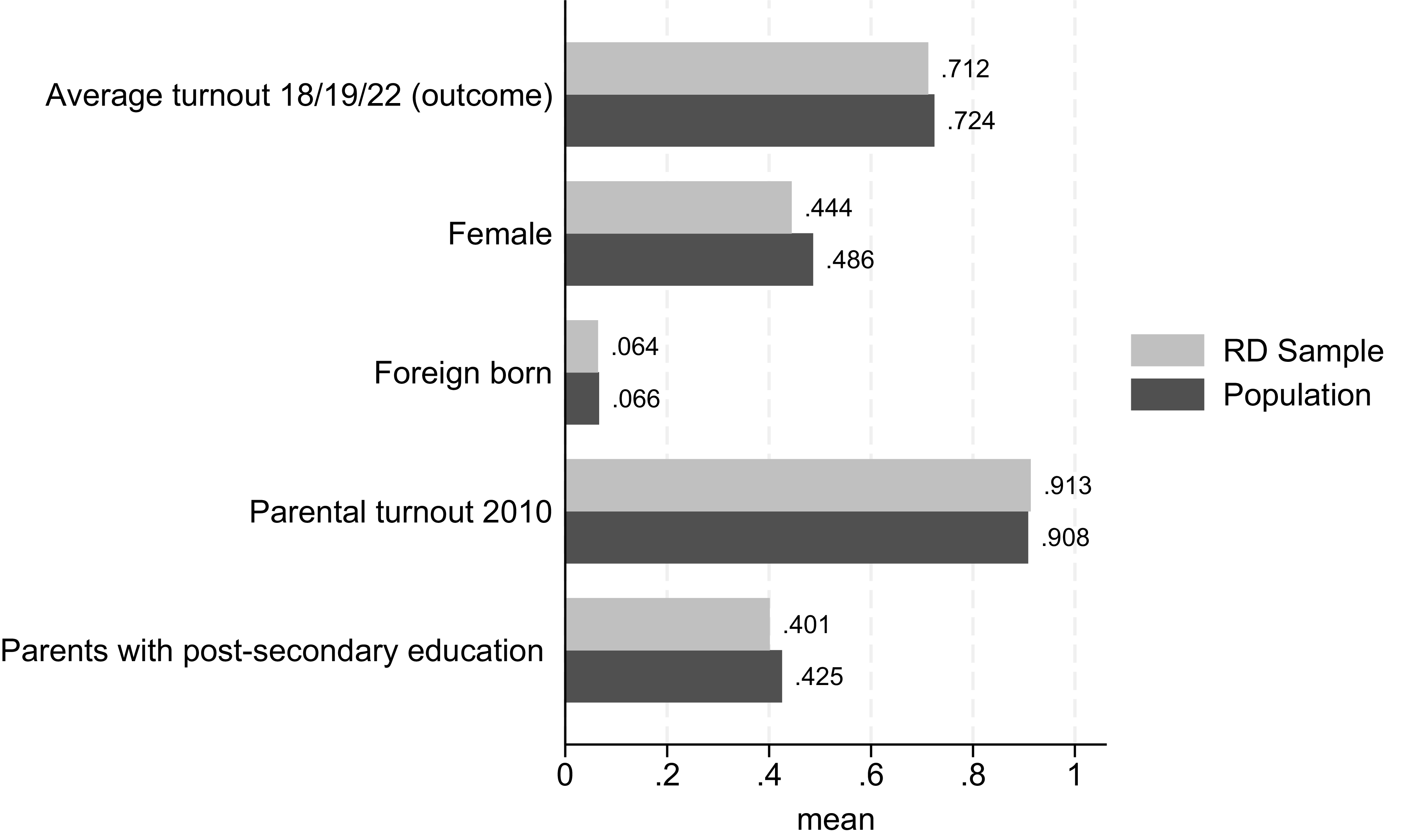
While our dataset encompasses nearly the entire population of upper-secondary school applicants, there are several aspects of the empirical approach that make the sample we use for our RD models much smaller. First, we can only study students who apply for an oversubscribed general programme as one of their higher-ranked options and a vocational programme as their next lower-ranked option. Many students do not mix programme types in this way, and about a fourth of the general programmes are not oversubscribed. Second, we focus on students who are eligible for the standard national programmes in Sweden. Third, we also exclude some non-compliant observations in regard to their admission status (see the RD setup section). This results in a final sample size of 15,000–17,000 students, representing about 2.3 per cent of all adolescents starting upper secondary school between 2008 and 2016. Naturally, this small sample raises questions of how well it reflects the population. However, the RD sample is quite representative in terms of turnout, foreign background, compulsory school GPA as well as parental turnout and education (see Figures 3 and C.1, see also additional variables in Tables C.1 and C.4). Our sample is somewhat negatively selected in regard to academic ability compared to the population of students on general programmes – but positively selected in relation to the population of vocational students (see comparison of compulsory school grades in Figures C.2 and C.3). This is because students applying to both general and vocational programmes tend to be in the middle of the academic skill distribution. We will come back to the question of external validity in the Results section.
Proportions and means in the RD sample compared to the population of students applying to upper secondary school.
RD setup: Defining the running variable and estimation
An RD design requires ‘a score, a cutoff, and a treatment’ (Cattaneo, Idrobo and Titiunik Reference Cattaneo, Idrobo and Titiunik2019: 1). In our application, the score equals students’ GPA, and the cutoff is the GPA needed for admission to a certain programme and school in a given year. The treatment is whether a student starts a general programme instead of a vocational one, due to the admission outcome.
The GPA cutoff is not predefined in our data but depends on the number of applicants, their grades, and the available slots. If slots outnumber applicants, all eligible students are admitted. Since there is no cutoff in these cases, we exclude such observations. Then, for oversubscribed programmes, we set the GPA cutoff equal to the lowest GPA among the admitted students. We encounter some instances of non-compliance, mainly because we lack data on the special programmes that complement grade-based admissions with additional tests, and because some schools offer similar programmes with separate admissions for which we do not have detailed programme codes to differentiate them. We exclude these observations following the approach of Dahl, Rooth and Stenberg (Reference Dahl, Rooth and Stenberg2023), who apply a comparable RD in a study of how secondary education affects earnings (this procedure is explained in Appendix D).
We specify treatment as starting a general programme, and the control condition as starting a vocational one. Treatment status is assigned on the basis of which programme a student is admitted to in their admission letter. However, students do not always start the programme to which they are admitted. Some may choose not to start upper secondary school at all, while others can gain admission to their preferred higher-ranked programmes as reserves. We lack data on reserve admissions. It is also possible that some students who are not admitted to their preferred general programme are able to switch to another general programme, for example, by directly contacting a school.
We define our running variable, ${X_i} - {c_j}$
, by subtracting the GPA admission cutoff for the specific programme j (
${X_i} - {c_j}$
, by subtracting the GPA admission cutoff for the specific programme j ( ${c_j}$
) from the GPA of student i (
${c_j}$
) from the GPA of student i ( ${X_i}$
). In other words, for
${X_i}$
). In other words, for $X_i \ge c_j$
, a student meets the admission cutoff for his/her higher-ranked general programme; whereas
$X_i \ge c_j$
, a student meets the admission cutoff for his/her higher-ranked general programme; whereas ${X_i} \lt {c_j}$
means the student falls below the cutoff and is admitted to a vocational programme instead. The GPA variable is not strictly speaking continuous; rather, it varies in increments of 2.5 GPA points on a 0–340 scale. However, we reason that the number of mass points is large enough for us to apply methods that assume the running variable to be continuous (Cattaneo and Titiunik Reference Cattaneo and Titiunik2022).
${X_i} \lt {c_j}$
means the student falls below the cutoff and is admitted to a vocational programme instead. The GPA variable is not strictly speaking continuous; rather, it varies in increments of 2.5 GPA points on a 0–340 scale. However, we reason that the number of mass points is large enough for us to apply methods that assume the running variable to be continuous (Cattaneo and Titiunik Reference Cattaneo and Titiunik2022).
Our running variable should not be vulnerable to manipulation. When students fill out their applications, the GPA cutoff is unknown to them. The cutoff also tends to fluctuate annually, making it unpredictable for students. Furthermore, the fact that students are unaware of their exact GPA at the time of their application adds further uncertainty. Naturally, students can make an effort to improve their grades, but they cannot target the admission cutoff since it is unknown.
Since gaining admission to a general programme (assignment to treatment) does not necessarily imply starting a general programme (receiving the treatment), we apply a fuzzy RD. This is the recommended approach when a deterministic relationship is lacking between treatment assignment and actual treatment (Cattaneo, Idrobo and Titiunik Reference Cattaneo, Idrobo and Titiunik2019; Lee and Lemieux Reference Lee and Lemieux2010). A fuzzy RD resembles instrumental variable (IV) estimation, where the cutoff is used to instrument the treatment of interest. We use the cutoff as an instrument for determining whether a student starts a general or a vocational programme. In other words, we estimate a local average treatment effect on the basis of students who comply with the result of the final admission. A fuzzy RD builds on similar assumptions as a standard IV, in that we have to assume that monotonicity and the exclusion restriction hold (Lee and Lemieux Reference Lee and Lemieux2010). Monotonicity implies that crossing the cutoff does not make some individuals less likely to start a general programme (something which appears very unlikely in our setting). The exclusion restriction means that admission to a general programme (in contrast to a vocational one) may only affect individual turnout through which programme the individual starts. While we cannot rule out the possibility that the admission result per se has effects, we believe this to be a minor problem. First, there is a strong connection between admission and the programme that someone starts as well as finishes (see next section). Second, we measure outcomes several years after admission when students have had time to finish secondary school, at which time we reason that the students are mostly affected by their school and programme rather than the preceding admission procedure as such. Third, if there is an effect directly related to whether students are admitted to their higher-ranked general programme, we believe such a bias would run counter to our results. That is, a potential effect connected to disappointment about being admitted to a less preferred vocational programme would reasonably be negative for vocational programmes.
For estimation, we follow the RD literature (Cattaneo and Titiunik Reference Cattaneo and Titiunik2022; Gelman and Imbens Reference Gelman and Imbens2019) and employ a local-linear RD estimator with a data-driven MSE-optimal bandwidth and triangular kernel weighting, relying on the RDRobust package (Cattaneo, Idrobo and Titiunik Reference Cattaneo, Idrobo and Titiunik2019). Given the potential bias in conventional standard errors, we augment our analysis by reporting confidence intervals using the robust bias-corrected procedure (Cattaneo and Titiunik Reference Cattaneo and Titiunik2022).
Testing the validity of the RD design
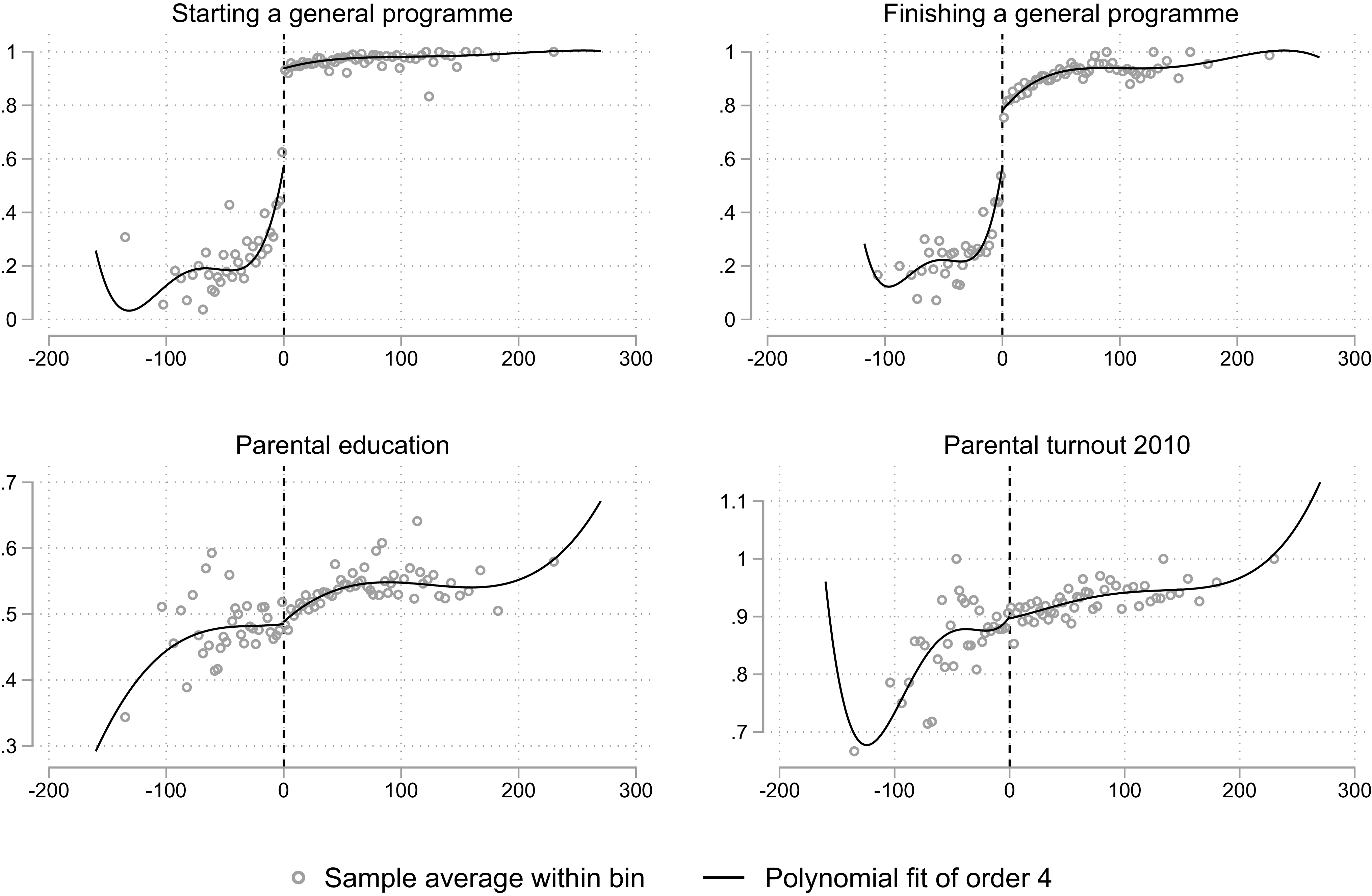
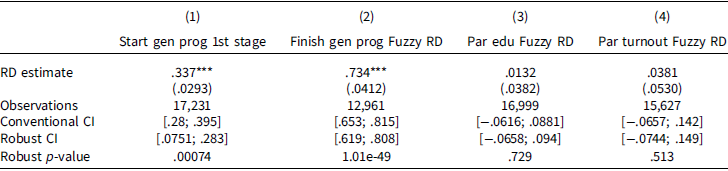
To give an overview of the discontinuity and the overall relationship between the running variable and education outcomes – as well as pre-determined covariates – we present RD plots in Figure 4. Corresponding local-linear RD estimates of the effects are presented in Table 1.
RD plots of the upper secondary programme and falsification tests.
The upper panel portrays the relationship between the running variable and whether a student starts and finishes a general programme or a vocational one. The lower panel demonstrates two falsification tests: ‘Parental education’ is the mean education between the mother and the father using a 7-level indicator, standardised to run from 0 to 1. ‘Parental turnout 2010’ portrays the mean turnout for parents in the national election of 2010.
RD estimates on education outcomes and falsification tests: Students starting upper secondary school 2008–2016
* $p \lt 0.10$
, **
$p \lt 0.10$
, ** $p \lt 0.05$
, ***
$p \lt 0.05$
, *** $p \lt 0.01$
.
$p \lt 0.01$
.
Note: Model (1) shows the sharp RD effect on starting a general programme. For reasons of comparability, Model (1) uses the same bandwidth as our preferred model on voter turnout: Model (4) in Table 2. The remaining models report fuzzy RD estimates. Conventional OLS-standard errors in parentheses.
First, the upper left plot in Figure 4 shows that the cutoff has a clear effect on the orientation of the programme a student starts. The discontinuity corresponds to an increase of 34 percentage points in the likelihood of starting a general programme instead of a vocational one, according to Model (1) in Table 1. This model is equivalent to the first-stage effect in IV regression. That is, the estimate portrays the average effect of being admitted to a general programme on actually starting such a programme, for students close to the admission cutoff. However, the plot also indicates that some students with grades below the cutoff nonetheless start their studies in a general programme. This is likely because they are admitted as reserves, which reduces the first-stage effect.
The upper right plot in Figure 4 illustrates that the cutoff also influences whether a student graduates from a general programme (in contrast to a vocational one). The discontinuity is somewhat smaller than for starting a general programme, probably because some students switch to vocational programmes. In the corresponding Model (2), we shift to fuzzy RD estimation to portray the effect of admission to a general programme for students who are actually affected by the treatment. The estimate tells us the probability is 73 per cent that a student who, due to the RD treatment, is admitted to a general programme and starts studying in it, also graduates from said programme.
In the lower panel of Figure 4, and in Models (3) and (4) in Table 1, we conduct two falsification tests (Cattaneo, Idrobo and Titiunik Reference Cattaneo, Idrobo and Titiunik2019) by examining the RD effects on parental education and largely historical parental turnout. Reassuringly, there are no indications of discontinuities at the cutoff or of significance in the RD estimates. This suggests that the cutoff introduces exogenous variation in the type of education and supports a causal interpretation of our RD estimates.
We believe these plots and estimates corroborate our RD design. There are clear discontinuities in the type of programme a student starts and finishes as a result of the RD treatment. Compliance is not perfect, however, as students just below the cutoff also pursue general programmes to some degree – which is why we choose to rely on fuzzy RD estimation. We present further tests of the RD design in Appendix F, including additional falsification tests and placebo cut-offs.
Results
The presentation is divided into four sections. First, we report results from a typical cross-sectional approach to studying the effects of education. Our main RD estimates follow thereupon, after which we present an analysis of mechanisms and, lastly, supplementary population-level estimates.
Correlational analysis
The top three models in Figure 5 demonstrates results on turnout in the 2019 EP election and the 2022 national election for the population of students starting upper secondary school between 2011 and 2016 in Sweden. These models rely on control variables to isolate the impact of the type of education from that of other factors that correlate with education and turnout. As in the RD design, we focus on the difference between starting a general programme versus a vocational one. The two top bivariate models demonstrate that a student who starts a general programme has a remarkably higher probability of voting in the EP election (equal to 24 percentage points), but also in the national election (5.8 percentage points).
The difference in future turnout between students starting general compared to vocational programmes, 2011–2016.
Socio-economic controls add dummies/FEs for gender, birth year, foreign-born, foreign-born father, foreign-born mother, 7 levels of parental education (separately for mother and father), and parental earnings in deciles (separately for mother and father). Parental turnout in Model (3) adds controls for the turnout of the mother and father in previous elections of the same type (2009 and 2010). See full results in Appendix: Tables E.1 and E.2.
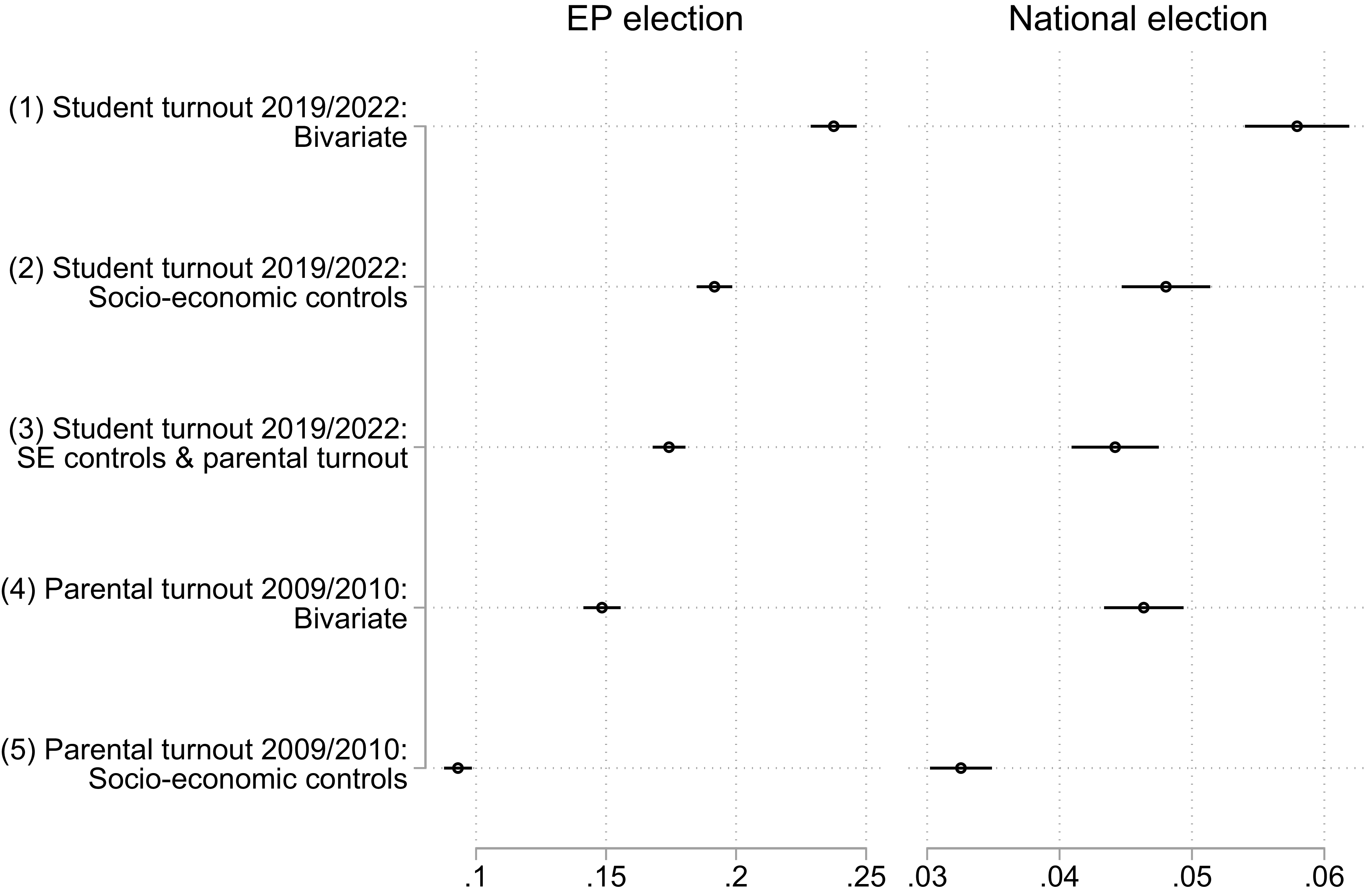
Models (2) and (3) add some rather extensive and flexible controls. These reduce the difference in turnout between general and vocational students, but even when accounting for parental turnout in Model (3), the difference in participation equals 17 percentage points in the EP election and 4.4 percentage points in the national election.
In the last two models, we change the outcome and examine the relationship between students’ programme type and their parents’ turnout in the EP election of 2009 and the national election of 2010. Since we limit the data to students who began their studies after 2010, the type of programme a student starts cannot affect this outcome. Thus, we include it as a placebo outcome. Interestingly, the estimates remain substantial, at 15 percentage points in the EP election and 4.6 percentage points in the national election when analysed bivariately. Adding controls reduces these estimates by only about a third to 9.3 and 3.3 percentage points, respectively.
We believe some important insights can be gleaned from the models in Figure 5. First, we find similar relationships in our register data as in Figure 2: future turnout is considerably higher among students who start general programmes compared to those who start vocational ones, especially in European elections. Second, there is a sizable association between programme type and historical parental turnout, which cannot be a causal effect of programme choice. Instead, we reason that this relationship shows that certain background characteristics of parents are related both to their own turnout and to the type of programme to which their children apply. These confounding factors cannot be adequately controlled for even with high-quality data. However, what about if it is as good as random, what type of education one starts? This is what the RD design allows us to explore in the next section.
RD results
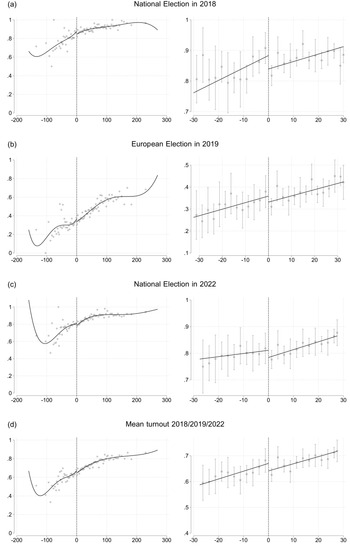
We set off our presentation of the main results by plotting the relationship between turnout and our running variable in Figure 6 – separately for the two national elections, the EP election, and the mean turnout between these three elections. The left-hand plots give an overview of the relationship, while the right-hand plots zoom in on the discontinuity and demonstrate the local-linear estimation (comparable to sharp RD estimation). The left-hand plots show a strong positive relationship between turnout and our running variable, particularly in the case of the EP election. This is expected considering that student GPA is closely related to several socio-economic variables that correlate with turnout. However, there is a tendency towards a negative jump at the cutoff, suggesting that just clearing the cutoff for admission to a general programme depresses turnout.
RD plots on voter turnout. The effect of admission to a general versus a vocational programme among cohorts starting upper secondary school 2008–2016.
The left-hand plots show a fourth-order polynomial, whereas the right-hand plots present separate linear regression lines on each side of the cutoff (95 per cent confidence intervals). The bandwidths of the right-hand plots are equal to the optimal bandwidths for the corresponding fuzzy RD models in Table 2 and apply a triangular kernel.

In Table 2, we present the fuzzy RD estimates on the effect of starting a general programme rather than a vocational one. We start by studying the national election of 2018, in Model (1). The negative discontinuity found for this election in Figure 6a is reflected in a substantial negative point estimate, signifying a lower turnout of almost 10 percentage points for students who start a general programme as a result of the RD treatment. The estimate reaches statistical significance at the 95 per cent level, according to the conventional confidence interval and the robust bias-corrected (RBC) alternative. We continue with the EP election in Model (2), and find a slightly smaller but still substantial negative estimate. However, it is not statistically significant. In Model (3), we see to the 2022 national election, where the estimate is similar to the one for the EP election.
The effect of starting a general versus a vocational programme on turning out to vote: fuzzy RD estimates. Cohorts starting upper secondary school 2008–2016

* $p \lt 0.10$
, **
$p \lt 0.10$
, ** $p \lt 0.05$
, ***
$p \lt 0.05$
, *** $p \lt 0.01$
.
$p \lt 0.01$
.
In Model (4), we aim to address the somewhat lacking statistical precision in the previous models by analysing mean turnout across all three elections. We also add municipal fixed effects as pre-determined covariates to possibly further enhance precision (Cattaneo, Idrobo and Titiunik Reference Cattaneo, Idrobo and Titiunik2019). The estimate suggests a negative effect on electoral participation of starting a general programme – instead of a vocational one – amounting to 8 percentage points. The confidence intervals also become narrower, and the estimate is significant.
In contrast to much previous research, the results in Table 2 do not indicate any positive effect of general education over vocational education. On the contrary, the estimates consistently demonstrate substantial negative effects on future turnout of starting a general rather than a vocational programme for students at the margin between these programmes. Although the statistical precision warrants some caution, the fact that the estimates are of similar magnitude across three different elections and statistically significant when analysed jointly supports the conclusion that the effects are indeed negative. Furthermore, estimates on the order of seven to ten percentage points signify large effects on turnout, considering that average turnout in Sweden is between 80 and 90 per cent in national elections, and between 40 and 55 per cent in EP elections. However, the wide confidence intervals imply that we should be cautious about taking the point estimates at face value.
We conduct a large set of robustness tests recommended for RD designs, which are presented in Appendix G. These tests also tend to result in negative estimates, although they are not always statistically significant. Nevertheless, both running a sharp RD model and a local-randomisation approach give significant negative effects. There are no instances of significant positive effects.
In sum, our RD results show that there is no universal positive effect of general education over vocational education on political participation. Instead, effects can be negative for students who apply for both types of programmes. A likely reason why our results diverge sharply from much existing research on this matter is that most previous studies are not able to fully control for the inherent selection related to the type of education. As demonstrated in Figure 5, such selection effects can be large even with extensive controls, and the importance of selection in studying the impact of education is by now widely recognised (Persson Reference Persson2015; Willeck and Mendelberg Reference Willeck and Mendelberg2022).
A key limitation of our results is that they are based on a particular group of students: those at the margin between general and vocational programmes. We do not believe that these results can be generalised to the population of upper secondary school students, and we will return empirically to the question of external validity. However, we reason that there is a case to be made for why the RD estimates can provide insight into how students who have weaker academic skills more broadly respond to general education.
Students in our RD sample, who choose between general and vocational programmes, tend to be positively selected in terms of academic ability compared to the average vocational student (see lower secondary GPA in Tables C.1 and C.6). Therefore, we reason that if the students in our sample are unable to reap the benefits of general education for their ability to participate politically, the typical vocational student may likewise lack the necessary academic ability and interest. This reasoning assumes that the mechanism behind our negative effects is that the curriculum of general programmes is too demanding for our sample of students. We will examine whether there is empirical support for this assumption in the following section.
Mechanisms
We focus on the two negative mechanisms brought forward in the theory section that we believe may explain how attending a general programme, in some cases, can lead to political disengagement. First, the curriculum in general programmes might be too taxing for students with weak academic skills, causing them to perform poorly and possibly drop out. Second, treated students may become psychologically negatively affected by the Big-Fish-Little-Pond effect, since these students in general programmes are likely to get a higher-performing peer group compared to control students in vocational programmes.
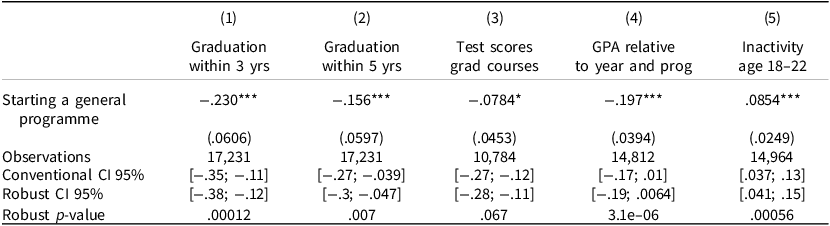
In Table 3, we explore these mechanisms using the same type of RD models as above (ie we compare students who start a general programme with similar students who start a vocational programme instead). We begin with the curriculum mechanism in Models (1)–(3). The estimate in Model (1) demonstrates that a student who, due to the treatment, starts a general programme becomes 23 percentage points less likely to graduate from upper secondary school within three years (the time stipulated in the curriculum), and 16 percentage points less likely to graduate within five years. It is worth noting that these analyses consider whether the students graduate at all, ie from general and vocational programmes. Thus, these negative effects include treated students who start general programmes but eventually switch to vocational programmes. These are large effects, although they should be seen in relation to the overall dropout risk in upper secondary education. In Sweden, about one in four students drop out, and the OECD reports a similar rate in its member states, as only 72 per cent complete their upper secondary programme within its theoretical duration (OECD 2023: 209).
The effect of starting a general versus a vocational programme on dropout risk, educational performance and inactivity; fuzzy RD estimates. Students starting upper secondary school 2008–2016

* $p \lt 0.10$
, **
$p \lt 0.10$
, ** $p \lt 0.05$
, ***
$p \lt 0.05$
, *** $p \lt 0.01$
.
$p \lt 0.01$
.
Note: Dependent variables are as follows. Models (1) and (2): dummy for graduation within 3 or 5 years. Model (3): Test scores for courses necessary for graduation (general programmes: Swedish 1–3, English 1–2 and Mathematics 1, vocational programmes: Swedish 1, English 1 and Mathematics 1). Rescaled percentiles, 0–1. Model (4): GPA relative to students graduating in the same year, programme and school. Rescaled percentiles 0–1. Model (5): Proportion of years not in education or employment between 18 and 22 years of age (cohorts 2008–2015).
Model (3) measures actual student performance by analysing test scores for the courses necessary to graduate from upper secondary school. The course requirements are more extensive for general than for vocational programmes (see the table notes). Although imprecise, the estimate suggests that treated students indeed struggle with the more demanding coursework in general programmes, scoring 8 percentiles lower on these tests compared to vocational control students.
In Model (4), we investigate how treated and untreated students perform relative to their respective programme peers (peer composition mechanism). The coefficient demonstrates that, on average, treated students in general programmes end up 20 percentiles further down in the grade distribution in their programme and school compared to how students in vocational programmes do relative to their peers. Naturally, this effect is partly a result of selection, in that students in general programmes tend to have peers who get higher grades. Nonetheless, the results confirm that treated students in general programmes have a reference group that performs markedly better than they do.
Finally, Model (5) explores how the type of programme shapes what students undertake in early adulthood. More precisely, we examine inactivity by measuring the proportion of years between the ages of 18 and 22 in which students neither engage in education nor have a job. The model illustrates that treated students starting general programmes face adverse effects not only during upper secondary school but also afterwards, as they spend almost 9 percentage points more time outside education and the labour market (equivalent to just under half a year between the ages of 18 and 22).
We believe the results in Table 3 help explain the negative effects on voter turnout found in Table 2. The treated students who start general programmes are more likely to drop out, not pass tests for the courses necessary to graduate and to start their adult life inactive. Considering the breadth and size of these adverse effects, they are likely to strongly shape early adulthood for these students in ways that are negative for their willingness and capacity to participate politically. For example, dropping out of upper secondary school is related to a higher risk of unemployment (Lyche Reference Lyche2010), drug disorders (Gonzalez, Salas-Wright, Connell et al. Reference Gonzalez, Salas-Wright, Connell, Jetelina, Clipper and Businelle2016) and criminal behaviour (Bäckman Reference Bäckman2017; Maynard, Salas-Wright and Vaughn Reference Maynard, Salas-Wright and Vaughn2015). Furthermore, there may also be effects of a psychological nature for treated students as they become aware that they cannot perform on par with their peers, leading to depression of their self-belief and sense of efficacy (Fang, Huang, Zhang et al. Reference Fang, Huang, Zhang, Huang, Li and Yuan2018).
Population estimates: Exploring the within-family variation
The RD design provides strong causal support but is lacking when it comes to external validity. In this section, we aim to make progress on this question by exploiting the within-family variation in educational programmes and turnout. By comparing siblings, we can rule out time-invariant family background factors that are shared by siblings, such as common genetics and upbringing. We also add flexible controls for lower secondary school GPA, demographics and time-varying parental characteristics. The GPA control implies that we compare siblings with a similar academic ability, akin to the RD analyses. These models can be applied to the population of upper secondary students from 1998 to 2016, provided that they have at least one sibling. We also include turnout in the earlier elections of 2009 (EP) and 2010 (national), and define our outcomes as the mean turnout across several elections. In this way, we can study turnout for a large sample of students over five elections, thereby providing stronger ground for generalisation.
However, these within-family models offer weaker causal support than the RD models, as they are susceptible to unobserved differences between siblings that may affect programme choice and electoral participation. Such differences may involve, for instance, political interest and educational ambitions. These types of unobserved factors are likely to produce a positive bias in the estimates for starting a general programme.
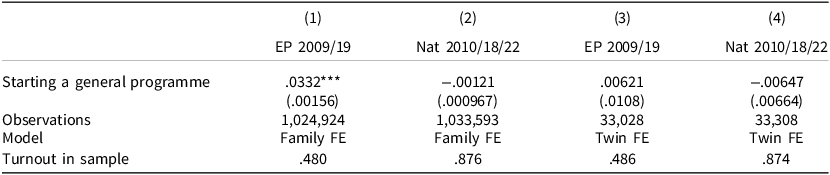
Table 4 presents our population-level results. Model (1) shows that general students are 3 percentage points more likely to turn out in European elections than their siblings studying vocational programmes. However, Model (2) indicates that there is no significant difference in future turnout for national elections. Models (3) and (4) restrict the analyses to twins to potentially remove additional confounders. Unfortunately, we do not have information on whether twins are monozygotic or dizygotic, so some genetic confounding still remains (Ahlskog Reference Ahlskog2021). Interestingly, among twins, we find no significant difference in turnout between those starting general versus vocational programmes.
Population estimates on voter turnout in European and national elections, relying on sibling comparisons, comparing students starting general and vocational programmes, 1998–2016

* $p \lt 0.10$
, **
$p \lt 0.10$
, ** $p \lt 0.05$
, ***
$p \lt 0.05$
, *** $p \lt 0.01$
Note: Standard errors clustered at family. The dependent variables are defined as the mean turnout across the European elections of 2009 and 2019, and across the national elections of 2010, 2018 and 2022. Students are only compared to full siblings through the addition of fixed effects (FE) for having the same biological parents. The family FE models, (1)–(2), include the following additional dummies/FE: gender; birth order; birth year and year starting upper secondary school, and their interaction; 7 levels of parental education (separately for mother and father); parental earnings in deciles (separately for mother and father); compulsory school GPA in percentiles relative to year; upper secondary school. The twin FE models, (3)–(4), include dummies/FEs for: gender; compulsory school GPA in percentiles; upper secondary school.
These supplementary population-level models support the view that there are no universal positive effects of pursuing a general education, compared to a vocational one, considering that we find null results in national elections and also for European elections in the more conservative twin model. The fact that these estimates are likely to be biased to the advantage of general programmes strengthens the case against the positive effects of general programmes.
Discussion
To summarise our results, we find no positive effect on turnout from starting a general programme rather than a vocational one in our RD analyses focusing on students in the middle of the academic skill distribution, who apply for both types of programmes. Furthermore, our sibling-based population models predominantly indicate null effects of programme type. In other words, our analyses do not support the argument that general secondary education – with a more theoretical curriculum and more in the way of social sciences – universally stimulates political participation. Instead, the correlation between the type of programme and turnout appears to stem from unobserved background characteristics. In fact, our RD results suggest that starting a general programme is negative for the electoral participation of students at the margin between general and vocational programmes. In general programmes, these students struggle with their coursework, leading to a high risk of dropping out of school and becoming inactive. Such a bad start to early adulthood is likely to reduce their propensity to engage politically.
Our findings are partly in line with a growing body of research suggesting no positive average effects on political participation from various educational interventions and experiences, including transitions between types of education, taking civics courses or pursuing a longer education (eg Lindgren, Oskarsson and Persson Reference Lindgren, Oskarsson and Persson2019; Weinschenk and Dawes Reference Weinschenk and Dawes2022; Witschge, Rözer and van de Werfhorst Reference Witschge, Rözer and van de Werfhorst2019). Our results are distinctive, however, in that we find that enrolling in a more demanding general programme can backfire and negatively affect the political engagement of some students. While these negative effects apply to students at the margin between general and vocational programmes, they suggest that a more academic curriculum can do more harm than good for less resourceful students and risks perpetuating, rather than reducing, inequalities in political participation across the academic skill distribution. This finding bears importance for the large literature on education and political participation in that this relationship can be conditional upon the abilities of the students. In case of a mismatch between educational content and student ability, effects can even turn negative. A related key takeaway is that the impact of education on political participation is connected to the downstream effects of education (Marshall Reference Marshall2016), and if an educational pathway has negative consequences for one’s life course, such effects may also undermine political engagement.
Furthermore, the absence of any positive effects of attending a general programme has significant implications for the scholarly and political debate on the effects of tracking on civic and political outcomes (Hoskins and Janmaat Reference Hoskins and Janmaat2019; Matthieu and Junius Reference Matthieu and Junius2024; Österman Reference Österman2021; Witschge and van de Werfhorst Reference Witschge and van de Werfhorst2020). If, namely, pursuing a general programme does not stimulate political engagement among students at the margin between general and vocational tracks – and may even in fact have negative effects in that regard – then we have reason to conclude that tracking does not reinforce socio-economic differences in political participation. On the contrary, the risk would instead seem to be that reducing tracking – by making all tracks more similar to the general one – will increase inequality in political participation, because in that case, less resourceful students might experience difficulties with such a curriculum and become more likely to withdraw from politics. However, our results apply to non-compulsory upper secondary schooling, and the effects of tracking on lower (compulsory) educational levels may be different (cf. Garritzmann and Wehl Reference Garritzmann and Wehl2025).
We believe our findings hold relevance for public discourse on the structure of secondary education. Political debate and recent reforms have mostly targeted vocational education and the degree of separation between these programmes and general programmes. Overall, there has been a trend towards integrating general and vocational tracks by adding more general content to the vocational tracks (Sahlberg Reference Sahlberg2007). These reforms primarily affect the group of students to whom our results apply: students who choose between general and vocational programmes, and vocational students more broadly. We reason that there are two different ways of interpreting our findings in terms of policy implications. The straightforward interpretation is that policymakers should seek to uphold the separation of general and vocational programmes – not only for labour market concerns but also for reasons of equality of political participation. Alternatively, if policymakers deem it important to add more general subjects to vocational programmes – for instance, to make vocational graduates less exposed to changing labour markets (Hanushek et al. Reference Hanushek2017) or to prepare them for democratic citizenship – such reforms must be implemented in ways that do not cause students to drop out. It may, among other things, require the allocation of sufficient resources to support students with a weaker academic ability.
A potential objection to our study concerns the external validity of the Swedish case, and particularly whether general and vocational programmes differ enough to identify positive effects of general education. While Swedish upper secondary education is less tracked than, for instance, the German system, there are large differences in the study hours in general subjects – and in the family background of students – between general and vocational programmes. There are thus good conditions for curriculum and peer mechanisms to stimulate political interest among students in general programmes. The differences between the programmes are also large enough to have substantial effects on the dropout risk. Indeed, it seems likely that even more pronounced differences in curricula would only amplify the negative effects of general programmes related to poor study performance among students with weaker academic skills.
The external validity of our findings may also be questioned with respect to the specific time period and cohorts studied in the RD models (students starting upper secondary school between 2008 and 2016). However, assuming that our results on voter turnout are linked to the effects on dropout rates, we believe it is likely that our findings also apply to other cohorts. This is because previous research has shown that the relationship between a more theoretical curriculum in secondary education and higher dropout rates is robust across time periods and national contexts. Furthermore, our population models cover a broader set of elections and cohorts (1998–2016) and predominantly do not find positive effects of general education on turnout.
Nevertheless, additional quasi-experimental studies in other country contexts, time periods and on other types of political participation will be necessary to more definitively assess the prospects for generalising our results. Another important avenue for future research will be to look more closely at the mechanisms resulting in negative effects of a general curriculum on students’ political engagement, including through the use of qualitative methods.
Supplementary material
The supplementary material for this article can be found at https://doi.org/10.1017/S1475676526100930.
Data availability statement
The data we use are located on a secure, encrypted server administered by Statistics Sweden. Due to the extreme sensitivity of the individual-level data, we are under contractual and ethical obligation not to distribute these data to others. We are therefore not able to make our data available in a public data repository or distribute it to you for replication. However, we describe the variables we use from Statistics Sweden in Online Appendix C. We can also share our script files, which show exactly how we define our variables and run our models. It is also possible to replicate our results by ordering the data from Statistics Sweden (after ethical review). The data can be obtained by filing a request directly with Statistics Sweden (https://www.scb.se/en/services/ordering-data-and-statistics/).
Acknowledgements
We want to thank The Swedish Research Council for funding the project on which this study is based (project number: 2019-03135). Early versions of this paper were presented at the Swedish Political Science Annual Meeting 2022 (Political Behaviour workshop) in Örebro, the SASE 2022 Annual Meeting in Amsterdam, the Quality in Education Conference 2023 in Stockholm, the Political Sociology and Economy (POLSEK) seminar at the Department of Government at Uppsala University in 2022, and at the Uppsala Center for Labor Studies in 2024. We want to thank all participants on these occasions, as well as the anonymous reviewers, for their helpful comments.
Funding statement
This work was funded by the Swedish Research Council (Dnr 2019-03135).
Competing interests
None to declare.
Ethics approval statement
This work has been approved by the Swedish Ethical Review Authority (Dnr 2020-01550).
Permission to reproduce material from other sources
All of the materials in the manuscript from other sources may be reproduced.
AI Contributions to research content
AI has been used for language editing. No data have been collected through AI.





 Open access

