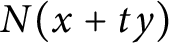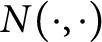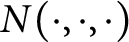



1 Introduction
Albert algebras are exceptional Jordan algebras. Over fields, any simple Jordan algebra is either special, i.e. a subalgebra of the anticommutator algebra $B^+$
of an associative algebra B, or an Albert algebra [MZ]. Albert algebras over rings have attracted recent interest, as is seen in the extensive survey [Reference PeterssonP], which contains a historic account to which we refer the interested reader. Over an algebraically closed field, there is a unique Albert algebra up to isomorphism; this both testifies to the remarkable character of these algebras, and indicates that the framework of torsors, descent and cohomology is suitable for studying them over a general base. Furthermore, the assignment
$B^+$
of an associative algebra B, or an Albert algebra [MZ]. Albert algebras over rings have attracted recent interest, as is seen in the extensive survey [Reference PeterssonP], which contains a historic account to which we refer the interested reader. Over an algebraically closed field, there is a unique Albert algebra up to isomorphism; this both testifies to the remarkable character of these algebras, and indicates that the framework of torsors, descent and cohomology is suitable for studying them over a general base. Furthermore, the assignment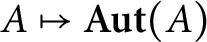 $A\mapsto {\mathbf {Aut}}(A)$
defines an equivalence of categories between Albert algebras and groups of type
$A\mapsto {\mathbf {Aut}}(A)$
defines an equivalence of categories between Albert algebras and groups of type $\mathrm F_4$
. Thus understanding Albert algebras provides a precise understanding of such groups, and vice versa. This is analogous to the relationship between octonion algebras and groups of type
$\mathrm F_4$
. Thus understanding Albert algebras provides a precise understanding of such groups, and vice versa. This is analogous to the relationship between octonion algebras and groups of type $\mathrm G_2$
. In the present work, we approach Albert algebras using appropriate torsors (principal homogeneous spaces), building on this interplay between groups and algebras as well as the relation that Albert algebras have to octonion algebras, triality for groups of type
$\mathrm G_2$
. In the present work, we approach Albert algebras using appropriate torsors (principal homogeneous spaces), building on this interplay between groups and algebras as well as the relation that Albert algebras have to octonion algebras, triality for groups of type $\mathrm D_4$
, and cubic norms. Thanks to this approach, we are able to shed new light on classical constructions, generalize them, and, expressing the objects as twists by appropriate torsors, we are able to obtain results that the classical methods have fallen short of providing.
$\mathrm D_4$
, and cubic norms. Thanks to this approach, we are able to shed new light on classical constructions, generalize them, and, expressing the objects as twists by appropriate torsors, we are able to obtain results that the classical methods have fallen short of providing.
We begin by giving a sketch of the key ideas of the present paper, with emphasis on the torsors involved. In this introduction, we abuse notation by referring to groups simply by their type; this is done for the sake of overview and does not imply uniqueness of groups of a certain type. Precise notation will be used in the respective sections.
An indication that Albert algebras over general unital, commutative rings can be expected to behave in a much less orderly way than they do over fields is that this is true for octonion algebras. Indeed, Gille showed in [Reference GilleG1], by means of $\mathrm G_2$
-torsors, that octonion algebras over rings are not determined by their norm forms. In [Reference Alsaody and GilleAG] the author together with Gille showed, using triality, how twisting an octonion algebra C by such a torsor precisely gives the classical construction of isotopes of C. Abusing notation, these papers dealt with the torsorFootnote
1
$\mathrm G_2$
-torsors, that octonion algebras over rings are not determined by their norm forms. In [Reference Alsaody and GilleAG] the author together with Gille showed, using triality, how twisting an octonion algebra C by such a torsor precisely gives the classical construction of isotopes of C. Abusing notation, these papers dealt with the torsorFootnote
1
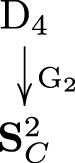
where $\mathrm D_4$
and
$\mathrm D_4$
and $\mathrm G_2$
are (simply connected) groups of the corresponding types, and
$\mathrm G_2$
are (simply connected) groups of the corresponding types, and $\mathbf {S}_C$
is the octonionic unit sphere in C, which is an affine scheme. Inspired by this, we set out, in the current work, to examine Albert algebras from this point of view.
$\mathbf {S}_C$
is the octonionic unit sphere in C, which is an affine scheme. Inspired by this, we set out, in the current work, to examine Albert algebras from this point of view.
We start in Section 2 with the question of isotopy, where we show that the isotopes of an Albert algebra A are precisely the twists of A by the torsor defined by the projection of the isometry group of the cubic norm N of A, which is simply connected of type $\mathrm E_6$
, to the unit sphere of N. This is a torsor under the automorphism group of A; thus it is of the type
$\mathrm E_6$
, to the unit sphere of N. This is a torsor under the automorphism group of A; thus it is of the type
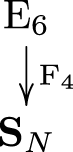
with $\mathbf S_N$
an affine scheme. The non-triviality of this torsor for certain Albert algebras is therefore known, since it is known that over e.g.
$\mathbf S_N$
an affine scheme. The non-triviality of this torsor for certain Albert algebras is therefore known, since it is known that over e.g. $\mathbb R$
the Albert algebra
$\mathbb R$
the Albert algebra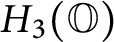 $H_3(\mathbb O)$
of hermitian
$H_3(\mathbb O)$
of hermitian $3\times 3$
-matrices over the real division octonion algebra
$3\times 3$
-matrices over the real division octonion algebra $\mathbb O$
has non-isomorphic isotopes. However, over any field, isotopes of the split Albert algebra are isomorphic. We prove that this is not the case over rings in general.
$\mathbb O$
has non-isomorphic isotopes. However, over any field, isotopes of the split Albert algebra are isomorphic. We prove that this is not the case over rings in general.
In Section 3 we turn to the inclusion of groups of type $\mathrm D_4$
into the automorphism group of a reduced Albert algebra, i.e. one of the form
$\mathrm D_4$
into the automorphism group of a reduced Albert algebra, i.e. one of the form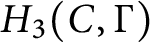 $H_3(C,\Gamma )$
for an octonion algebra C and a triple
$H_3(C,\Gamma )$
for an octonion algebra C and a triple $\Gamma $
of invertible scalars. (This is a slight deformation of the algebra
$\Gamma $
of invertible scalars. (This is a slight deformation of the algebra $H_3(C,{\mathbf {1}})=H_3(C)$
of hermitian matrices.) In [Reference Alberca Bjerregaard, Loos and Martín GonzálezALM] it was shown that over fields, this inclusion defines a
$H_3(C,{\mathbf {1}})=H_3(C)$
of hermitian matrices.) In [Reference Alberca Bjerregaard, Loos and Martín GonzálezALM] it was shown that over fields, this inclusion defines a $\mathrm D_4$
-torsor where the base is the scheme of frames of idempotents of the Albert algebra, and this result easily generalises to rings. We show that over rings this torsor is nontrivial in general, even under the condition that the Albert algebra be split. This torsor is of the type
$\mathrm D_4$
-torsor where the base is the scheme of frames of idempotents of the Albert algebra, and this result easily generalises to rings. We show that over rings this torsor is nontrivial in general, even under the condition that the Albert algebra be split. This torsor is of the type
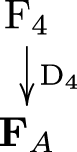
with $\mathbf F_A$
an affine scheme. In a sense, therefore, this torsor bridges the gap between the two torsors above. The natural question that arises then is what objects it parametrises. To answer it, we observe that the definition of a reduced Albert algebra becomes cleaner if the symmetric algebras of para-octonions are used instead of octonion algebras. This is in line with a recent philosophy followed in [Reference Knus, Merkurjev, Rost and TignolKMRT] and [Reference Alsaody and GilleAG]. From there, we are able to generalize the construction of reduced Albert algebras by noting that one may replace the para-octonion algebra by any composition of quadratic forms of rank
$\mathbf F_A$
an affine scheme. In a sense, therefore, this torsor bridges the gap between the two torsors above. The natural question that arises then is what objects it parametrises. To answer it, we observe that the definition of a reduced Albert algebra becomes cleaner if the symmetric algebras of para-octonions are used instead of octonion algebras. This is in line with a recent philosophy followed in [Reference Knus, Merkurjev, Rost and TignolKMRT] and [Reference Alsaody and GilleAG]. From there, we are able to generalize the construction of reduced Albert algebras by noting that one may replace the para-octonion algebra by any composition of quadratic forms of rank $8$
. Such objects generalise (para)-octonion algebras, since they consist of a triple
$8$
. Such objects generalise (para)-octonion algebras, since they consist of a triple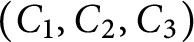 $(C_1,C_2,C_3)$
of quadratic spaces, each of constant rank
$(C_1,C_2,C_3)$
of quadratic spaces, each of constant rank $8$
as a locally free module, with a map (the composition)
$8$
as a locally free module, with a map (the composition) $C_3\times C_2\to C_1$
that is compatible with the quadratic forms. If
$C_3\times C_2\to C_1$
that is compatible with the quadratic forms. If $C_1=C_2=C_3=C$
, where C is an octonion algebra, then the multiplication of C is a composition of quadratic forms, and every composition of rank
$C_1=C_2=C_3=C$
, where C is an octonion algebra, then the multiplication of C is a composition of quadratic forms, and every composition of rank $8$
is locally isomorphic to a composition arising from an octonion algebra in this way. We show that the
$8$
is locally isomorphic to a composition arising from an octonion algebra in this way. We show that the $\mathrm D_4$
-torsor in question classifies those compositions of quadratic spaces that give rise to isomorphic Albert algebras via this generalised construction. Nontriviality of the torsor means that two nonisomorphic compositions may give rise to isomorphic Albert algebras. More precisely we show that even the algebra
$\mathrm D_4$
-torsor in question classifies those compositions of quadratic spaces that give rise to isomorphic Albert algebras via this generalised construction. Nontriviality of the torsor means that two nonisomorphic compositions may give rise to isomorphic Albert algebras. More precisely we show that even the algebra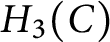 $H_3(C)$
can arise from compositions not isomorphic to the one obtained from C, and this occurs even in the split case.
$H_3(C)$
can arise from compositions not isomorphic to the one obtained from C, and this occurs even in the split case.
This gives rise to the yet more precise question of the extent to which a reduced Albert algebra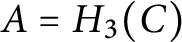 $A=H_3(C)$
determines C, which we treat in Section 4. Over a field k, the isomorphism class of A (in fact even the isotopy class) determines C up to isomorphism; this goes back to the 1957 paper [Reference Albert and JacobsonAJ] of Albert and Jacobson. In cohomological terms, the map
$A=H_3(C)$
determines C, which we treat in Section 4. Over a field k, the isomorphism class of A (in fact even the isotopy class) determines C up to isomorphism; this goes back to the 1957 paper [Reference Albert and JacobsonAJ] of Albert and Jacobson. In cohomological terms, the map
 $$\begin{align*}H^1(k,{\mathbf{Aut}}(C))\to H^1(k,{\mathbf{Aut}}(A)),\end{align*}$$
induced by the natural inclusion ${\mathbf {Aut}}(C)\to {\mathbf {Aut}}(A)$
, has trivial kernel. Since this inclusion factors through the simply connected group
${\mathbf {Aut}}(C)\to {\mathbf {Aut}}(A)$
, has trivial kernel. Since this inclusion factors through the simply connected group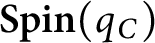 ${\mathbf {Spin}}(q_C)$
of the quadratic form
${\mathbf {Spin}}(q_C)$
of the quadratic form $q_C$
of C, we first show how the aforementioned result of [Reference GilleG1], augmented by results from [Reference Alsaody and GilleAG], readily implies that in general there exists an octonion algebra
$q_C$
of C, we first show how the aforementioned result of [Reference GilleG1], augmented by results from [Reference Alsaody and GilleAG], readily implies that in general there exists an octonion algebra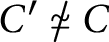 $C'\not \simeq C$
with
$C'\not \simeq C$
with $H_3(C')\simeq H_3(C)$
, namely by taking
$H_3(C')\simeq H_3(C)$
, namely by taking $C'$
having the same quadratic form as C. This corresponds to the torsor
$C'$
having the same quadratic form as C. This corresponds to the torsor
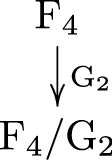
being nontrivial. One may therefore ask if this is the only obstruction, i.e. if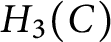 $H_3(C)$
at least determines the quadratic form of C up to isometry. The main result of Section 4 is that this question has a negative answer, which we show by proving that the torsor
$H_3(C)$
at least determines the quadratic form of C up to isometry. The main result of Section 4 is that this question has a negative answer, which we show by proving that the torsor
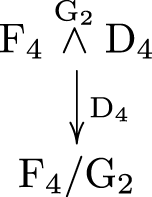
is nontrivial, where $\wedge $
denotes the contracted product.
$\wedge $
denotes the contracted product.
A conclusion of our work is thus that the behaviour of Albert algebras over rings is significantly more intricate than it is over fields, even when the algebras are reduced or split, and that these intricacies can be better understood using appropriate torsors. The combination of these two conclusions hopefully serves as an indication for future investigations.
1.1 Preliminaries on Albert Algebras
Throughout, R is a unital, commutative ring. By an R-ring we mean a unital, commutative and associative R-algebra, and by an R-field we mean an R-ring that is a field. If M is an R-module and S is an R-ring, we write $M_S$
for the S-module
$M_S$
for the S-module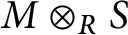 $M\otimes _R S$
obtained by base change. All sheaves and cohomology sets involved will be with respect to the fppf topology, and we therefore omit the subscript fppf universally.
$M\otimes _R S$
obtained by base change. All sheaves and cohomology sets involved will be with respect to the fppf topology, and we therefore omit the subscript fppf universally.
A Jordan algebra over R is an R-module A endowed with a distinguished element $1$
and a quadratic map
$1$
and a quadratic map $U:A\to {\mathrm {End}}_R(A), x\mapsto U_x$
, satisfying the identities
$U:A\to {\mathrm {End}}_R(A), x\mapsto U_x$
, satisfying the identities
 $$ \begin{align*}\begin{array}{llll} U_1={\mathrm{Id}}_A, & U_{U_xy}=U_xU_yU_x, & \text{and} & U_x\{yxz\}=\{xy(U_xz)\} \end{array}\end{align*} $$
for all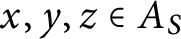 $x,y,z\in A_S$
whenever S is an R-ring, where
$x,y,z\in A_S$
whenever S is an R-ring, where $\{abc\}=(U_{a+c}-U_a-U_c)b$
is the triple product. The map U is called the U-operator of A and replaces, in a sense, the multiplication in linear Jordan algebras, and the element
$\{abc\}=(U_{a+c}-U_a-U_c)b$
is the triple product. The map U is called the U-operator of A and replaces, in a sense, the multiplication in linear Jordan algebras, and the element $1$
is the unity of A.
$1$
is the unity of A.
Example 1.1 The algebras we will consider will be cubic Jordan algebras. Recall from [Reference PeterssonP] that a cubic norm structure over R is an R-module A endowed with a base point $1_A$
, a cubic form
$1_A$
, a cubic form $N=N_A:A\to R$
, known as the norm, and a quadratic map
$N=N_A:A\to R$
, known as the norm, and a quadratic map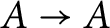 $A\to A$
denoted as
$A\to A$
denoted as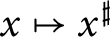 $x\mapsto x^\sharp $
and known as the adjoint. These are required to satisfy certain regularity and compatibility properties (see [Reference PeterssonP, 5.2]) and give rise to the bilinear traceFootnote
2
$x\mapsto x^\sharp $
and known as the adjoint. These are required to satisfy certain regularity and compatibility properties (see [Reference PeterssonP, 5.2]) and give rise to the bilinear traceFootnote
2 $T=T_A:A\times A\to R$
, and the bilinear cross product
$T=T_A:A\times A\to R$
, and the bilinear cross product $A\times A\to A$
given by
$A\times A\to A$
given by $(x,y)\mapsto x\times y:=(x+y)^\sharp -x^\sharp -y^\sharp $
. The cubic Jordan algebra associated to this cubic norm structure is the module A with unity
$(x,y)\mapsto x\times y:=(x+y)^\sharp -x^\sharp -y^\sharp $
. The cubic Jordan algebra associated to this cubic norm structure is the module A with unity $1=1_A$
and U-operator given by
$1=1_A$
and U-operator given by
 $$ \begin{align}U_xy=T(x,y)x-x^\sharp\times y.\end{align} $$
We refer to [Reference PeterssonP] for a thorough discussion of cubic Jordan algebras. An Albert algebra over R is a cubic Jordan R-algebra A the underlying module of which is projective of constant rank $27$
, and such that the Jordan algebra
$27$
, and such that the Jordan algebra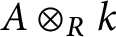 $A\otimes _R k$
is simple for every R-field k. The notion of an Albert algebra is stable under base change.
$A\otimes _R k$
is simple for every R-field k. The notion of an Albert algebra is stable under base change.
An element $p\in A$
is invertible precisely when
$p\in A$
is invertible precisely when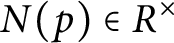 $N(p)\in R^\times $
, in which case
$N(p)\in R^\times $
, in which case $p^{-1}=N(p)^{-1}p^\sharp $
. The set of invertible elements is denoted by
$p^{-1}=N(p)^{-1}p^\sharp $
. The set of invertible elements is denoted by $A^\times $
. If
$A^\times $
. If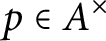 $p\in A^\times $
, then the p-isotope
$p\in A^\times $
, then the p-isotope $A^{(p)}$
of A is the Jordan algebra with unity
$A^{(p)}$
of A is the Jordan algebra with unity $p^{-1}$
and U-operator
$p^{-1}$
and U-operator $x\mapsto U^{(p)}_x:=U_xU_p$
, where U is the U-operator of A. It is known that
$x\mapsto U^{(p)}_x:=U_xU_p$
, where U is the U-operator of A. It is known that $A^{(p)}$
is an Albert algebra whose norm satisfies
$A^{(p)}$
is an Albert algebra whose norm satisfies $N_{A^{(p)}}(x)=N_A(p)N_A(x)$
.
$N_{A^{(p)}}(x)=N_A(p)N_A(x)$
.
1.2 Preliminaries on Torsors
We recall and slightly extend some known facts about torsors that will be useful later. Let E be a G-torsor over X, where E and X are R-schemes, X is affine, and G is an R-group scheme. (Recall that the topology in question is always the fppf topology.) In particular, we have a map $\Pi :E\to X$
and a compatible action of G on E (to fix a convention, we assume G acts on the right.) Recall that E is trivial if there is a G-equivariant morphism
$\Pi :E\to X$
and a compatible action of G on E (to fix a convention, we assume G acts on the right.) Recall that E is trivial if there is a G-equivariant morphism $E\to X\times G$
over X, which is equivalent to the projection
$E\to X\times G$
over X, which is equivalent to the projection $\Pi $
admitting a section [Reference Demazure and GabrielDG, III.4.1.5].
$\Pi $
admitting a section [Reference Demazure and GabrielDG, III.4.1.5].
Remark 1.2 If E is trivial, then clearly $\Pi _S:E(S)\to X(S)$
is surjective for every R-ring S. We will need the converse, which holds as well: if E is nontrivial, then there is an R-ring A such that
$\Pi _S:E(S)\to X(S)$
is surjective for every R-ring S. We will need the converse, which holds as well: if E is nontrivial, then there is an R-ring A such that $\Pi _A$
is not surjective. Indeed, if
$\Pi _A$
is not surjective. Indeed, if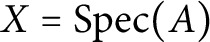 $X={\mathrm {Spec}}(A)$
for an R-ring A, then
$X={\mathrm {Spec}}(A)$
for an R-ring A, then $X(A)={\operatorname {Hom}}(A,A)$
contains the generic element
$X(A)={\operatorname {Hom}}(A,A)$
contains the generic element ${\mathrm {Id}}_A$
. If
${\mathrm {Id}}_A$
. If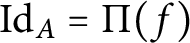 ${\mathrm {Id}}_A=\Pi (f)$
for some
${\mathrm {Id}}_A=\Pi (f)$
for some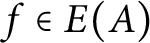 $f\in E(A)$
, then the morphism
$f\in E(A)$
, then the morphism $X={\mathrm {Spec}}(A)\to E$
corresponding to f is a section.
$X={\mathrm {Spec}}(A)\to E$
corresponding to f is a section.
A certain class of torsors will be of particular interest to us.
Remark 1.3 If G is an R-group scheme and H is a subgroup scheme of G, then the inclusion $i:H\to G$
induces a map
$i:H\to G$
induces a map $i^*:H^1(R,H)\to H^1(R,G)$
; explicitly, by [Reference Demazure and GabrielDG, III.4.4.1],
$i^*:H^1(R,H)\to H^1(R,G)$
; explicitly, by [Reference Demazure and GabrielDG, III.4.4.1], $i^*$
maps the class of an H-torsor E to the class of the G-torsor
$i^*$
maps the class of an H-torsor E to the class of the G-torsor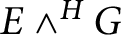 $E\wedge ^H G$
, where
$E\wedge ^H G$
, where $\wedge ^H$
denotes the contracted product over H. This is the quotient sheaf of
$\wedge ^H$
denotes the contracted product over H. This is the quotient sheaf of $E\times G$
by the relation
$E\times G$
by the relation $\sim $
defined, on each
$\sim $
defined, on each $E(S)\times G(S)$
, by
$E(S)\times G(S)$
, by $(e,g)\sim (e',g')$
whenever
$(e,g)\sim (e',g')$
whenever $(eh,g)\sim (e',hg')$
for some
$(eh,g)\sim (e',hg')$
for some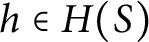 $h\in H(S)$
, and the structural projection of
$h\in H(S)$
, and the structural projection of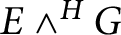 $E\wedge ^H G$
is the projection on the first component. By [Reference Demazure and GabrielDG, III.4.4.5] (or [Reference GilleG2, 2.4.3]), the kernel of
$E\wedge ^H G$
is the projection on the first component. By [Reference Demazure and GabrielDG, III.4.4.5] (or [Reference GilleG2, 2.4.3]), the kernel of $i^*$
is in bijection with the set of orbits of the left action of
$i^*$
is in bijection with the set of orbits of the left action of $G(R)$
on
$G(R)$
on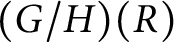 $(G/H)(R)$
, where
$(G/H)(R)$
, where $G/H$
is the fppf quotient. This bijection is given by assigning to the orbit of
$G/H$
is the fppf quotient. This bijection is given by assigning to the orbit of $x\in (G/H)(R)$
the class of the H-torsor
$x\in (G/H)(R)$
the class of the H-torsor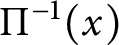 $\Pi ^{-1}(x)$
, where
$\Pi ^{-1}(x)$
, where $\Pi $
is the quotient projection.
$\Pi $
is the quotient projection.
In order to produce examples of nontrivial torsors, we will use the following straightforward generalisation of an argument from [Reference GilleG1].
Lemma 1.4 Let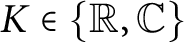 $K\in \{\mathbb R,\mathbb C\}$
, let X be an affine K-scheme, G an affine algebraic K-group, E a G-torsor over X, and assume that E has a K-point e. If for some
$K\in \{\mathbb R,\mathbb C\}$
, let X be an affine K-scheme, G an affine algebraic K-group, E a G-torsor over X, and assume that E has a K-point e. If for some $n\in \mathbb N$
the homotopy group
$n\in \mathbb N$
the homotopy group $\pi _n(G(K),1_G)$
is not a direct factor of the homotopy group
$\pi _n(G(K),1_G)$
is not a direct factor of the homotopy group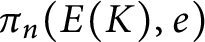 $\pi _n(E(K),e)$
, then the torsor E is nontrivial.
$\pi _n(E(K),e)$
, then the torsor E is nontrivial.
The condition of the existence of a K-point does not imply that E is trivial. Indeed, this condition is fulfilled whenever E is an affine algebraic K-group, G a closed subgroup, and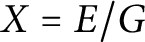 $X=E/G$
, with e being the neutral element of E.
$X=E/G$
, with e being the neutral element of E.
Proof We mimic the proof of [Reference GilleG1]. Assume that E is trivial. Then there is a G-equivariant morphism $E\to X\times G$
over X. This implies the existence of a map
$E\to X\times G$
over X. This implies the existence of a map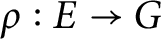 $\rho : E\to G$
that is a retraction of the inclusion
$\rho : E\to G$
that is a retraction of the inclusion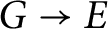 $G\to E$
defined by
$G\to E$
defined by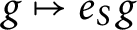 $g\mapsto e_Sg$
for every K-ring S and
$g\mapsto e_Sg$
for every K-ring S and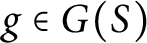 $g\in G(S)$
. This in particular implies that the corresponding inclusion
$g\in G(S)$
. This in particular implies that the corresponding inclusion $G(K)\to E(K)$
admits a continuous retraction. It follows that
$G(K)\to E(K)$
admits a continuous retraction. It follows that $\pi _n(G(K),1_G)$
is a direct factor of the homotopy group
$\pi _n(G(K),1_G)$
is a direct factor of the homotopy group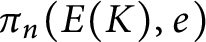 $\pi _n(E(K),e)$
. The proof is complete. ▪
$\pi _n(E(K),e)$
. The proof is complete. ▪
2 Isometries, Isotopes and $\text{F}_4$
-torsors
$\text{F}_4$
-torsors

2.1 Isometry and Automorphism Groups
Let A be an Albert algebra over R with norm N. We begin by determining the groups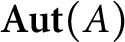 ${\mathbf {Aut}}(A)$
and
${\mathbf {Aut}}(A)$
and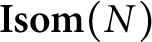 ${\mathbf {Isom}}(N)$
. While this is done to varying degree in the existing literature, we include the proofs of the below results as there is no single reference to which we can refer. Recall that the subgroup
${\mathbf {Isom}}(N)$
. While this is done to varying degree in the existing literature, we include the proofs of the below results as there is no single reference to which we can refer. Recall that the subgroup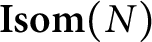 ${\mathbf {Isom}}(N)$
of
${\mathbf {Isom}}(N)$
of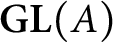 ${\mathbf {GL}}(A)$
is defined, for each R-ring S, by
${\mathbf {GL}}(A)$
is defined, for each R-ring S, by
 $$\begin{align*}{\mathbf{Isom}}(N)(S)=\{\phi\in {\mathbf{GL}}(A)(S)|N_S\circ\phi=N_S\},\end{align*}$$
where $N_S$
is the norm of
$N_S$
is the norm of $A_S=A\otimes S$
. Let further
$A_S=A\otimes S$
. Let further ${\mathbf {S}}_N$
be the cubic sphere of A, i.e. the R-functor defined, for each R-ring S, by
${\mathbf {S}}_N$
be the cubic sphere of A, i.e. the R-functor defined, for each R-ring S, by
 $$\begin{align*}{\mathbf{S}}_N(S)=\{x\in A_S|N_S(x)=1\}.\end{align*}$$
Clearly,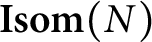 ${\mathbf {Isom}}(N)$
acts on
${\mathbf {Isom}}(N)$
acts on ${\mathbf {S}}_N$
by
${\mathbf {S}}_N$
by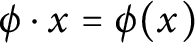 $\phi \cdot x=\phi (x)$
for each R-ring S,
$\phi \cdot x=\phi (x)$
for each R-ring S,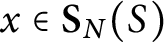 $x\in {\mathbf {S}}_N(S)$
and
$x\in {\mathbf {S}}_N(S)$
and $\phi \in {\mathbf {Isom}}(N)(S)$
. We shall refer to this simply as the action of
$\phi \in {\mathbf {Isom}}(N)(S)$
. We shall refer to this simply as the action of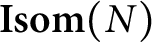 ${\mathbf {Isom}}(N)$
on
${\mathbf {Isom}}(N)$
on ${\mathbf {S}}_N$
.
${\mathbf {S}}_N$
.
Proposition 2.1 The group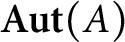 ${\mathbf {Aut}}(A)$
is a semisimple algebraic group of type
${\mathbf {Aut}}(A)$
is a semisimple algebraic group of type $\mathrm F_4$
, and
$\mathrm F_4$
, and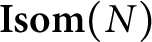 ${\mathbf {Isom}}(N)$
is a semisimple simply connected algebraic group of type
${\mathbf {Isom}}(N)$
is a semisimple simply connected algebraic group of type $\mathrm E_6$
.
$\mathrm E_6$
.
In the case where R is a field of characteristic different from 2 and 3, the result is due to [Reference Springer and VeldkampSV, Theorems 7.2.1 and 7.3.2].
It is known (see [Reference PeterssonP, Theorem 17]) that there is a faithfully flat R-ring S such that $A_S$
is split, hence isomorphic to
$A_S$
is split, hence isomorphic to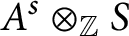 $A^s\otimes _{\mathbb {Z}} S$
, where
$A^s\otimes _{\mathbb {Z}} S$
, where $A^s$
is the split
$A^s$
is the split ${\mathbb {Z}}$
-Albert algebra
${\mathbb {Z}}$
-Albert algebra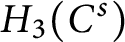 $H_3(C^s)$
with norm
$H_3(C^s)$
with norm $N^s$
,
$N^s$
, $C^s$
being the split octonion algebra over
$C^s$
being the split octonion algebra over ${\mathbb {Z}}$
. To unburden notation, we set
${\mathbb {Z}}$
. To unburden notation, we set ${\mathbf {G}}={\mathbf {Isom}}(N)$
and
${\mathbf {G}}={\mathbf {Isom}}(N)$
and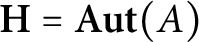 ${\mathbf {H}}={\mathbf {Aut}}(A)$
, which are group schemes over R, and
${\mathbf {H}}={\mathbf {Aut}}(A)$
, which are group schemes over R, and ${\mathbf {G}}^s={\mathbf {Isom}}(N^s)$
and
${\mathbf {G}}^s={\mathbf {Isom}}(N^s)$
and ${\mathbf {H}}^s={\mathbf {Aut}}(A^s)$
, which are group schemes over
${\mathbf {H}}^s={\mathbf {Aut}}(A^s)$
, which are group schemes over ${\mathbb {Z}}$
.
${\mathbb {Z}}$
.
Proof Since ${\mathbf {G}}$
and
${\mathbf {G}}$
and ${\mathbf {H}}$
are forms of
${\mathbf {H}}$
are forms of ${\mathbf {G}}^s_R$
and
${\mathbf {G}}^s_R$
and ${\mathbf {H}}^s_R$
, respectively, for the fppf topology, it suffices to establish the claims for
${\mathbf {H}}^s_R$
, respectively, for the fppf topology, it suffices to establish the claims for ${\mathbf {G}}^s$
and
${\mathbf {G}}^s$
and ${\mathbf {H}}^s$
, i.e. to prove that they are smooth affine
${\mathbf {H}}^s$
, i.e. to prove that they are smooth affine ${\mathbb {Z}}$
-group schemes with connected, semisimple, simply connected geometric fibres of the appropriate types. Now
${\mathbb {Z}}$
-group schemes with connected, semisimple, simply connected geometric fibres of the appropriate types. Now ${\mathbf {G}}^s$
and
${\mathbf {G}}^s$
and ${\mathbf {H}}^s$
are affine since they are closed subschemes of the affine scheme
${\mathbf {H}}^s$
are affine since they are closed subschemes of the affine scheme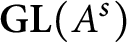 ${\mathbf {GL}}(A^s)$
. To prove smoothness, it suffices, by [Reference Alsaody and GilleAG, Lemma B.1], to show that
${\mathbf {GL}}(A^s)$
. To prove smoothness, it suffices, by [Reference Alsaody and GilleAG, Lemma B.1], to show that ${\mathbf {G}}^s$
and
${\mathbf {G}}^s$
and ${\mathbf {H}}^s$
are finitely presented and fibre-wise (i.e. over any field) smooth, connected and equidimensional. Finite presentation is clear. Since a group over a field is smooth if and only if its scalar extension to an algebraic closure is, smoothness of the fibres follows from the lemma below, which also implies that the fibres are connected and equidimensional. Thus the groups are smooth, and the lemma also implies that they have semisimple, simply connected geometric fibres of the appropriate types. The proof is then complete. ▪
${\mathbf {H}}^s$
are finitely presented and fibre-wise (i.e. over any field) smooth, connected and equidimensional. Finite presentation is clear. Since a group over a field is smooth if and only if its scalar extension to an algebraic closure is, smoothness of the fibres follows from the lemma below, which also implies that the fibres are connected and equidimensional. Thus the groups are smooth, and the lemma also implies that they have semisimple, simply connected geometric fibres of the appropriate types. The proof is then complete. ▪
Remark 2.2 In the proof of the lemma below, we will use the fact that the group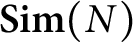 ${\mathbf {Sim}}(N)$
of similarities with respect to N coincides with the structure group
${\mathbf {Sim}}(N)$
of similarities with respect to N coincides with the structure group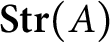 ${\mathbf {Str}}(A)$
of A. While this seems to be known, we will give a short proof here. By [Reference LoosL, 2.5] and [Reference PeterssonP, 3.13], we have, for each R-ring S,
${\mathbf {Str}}(A)$
of A. While this seems to be known, we will give a short proof here. By [Reference LoosL, 2.5] and [Reference PeterssonP, 3.13], we have, for each R-ring S,
 $$\begin{align*}{\mathbf{Str}}(A)(S)=\{\phi\in{\mathbf{GL}}(A)(S)| \phi:A_S\overset{\sim}\rightarrow (A_S)^{(p)} \text{ for some } p\in A_S^\times\}. \end{align*}$$
If now $\phi :A_S\overset {\sim }\rightarrow (A_S)^{(p)}$
with
$\phi :A_S\overset {\sim }\rightarrow (A_S)^{(p)}$
with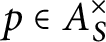 $p\in A_S^\times $
for some R-ring S, then from
$p\in A_S^\times $
for some R-ring S, then from $N_{A^{(p)}}(x)=N_A(p)N_A(x)$
it follows that
$N_{A^{(p)}}(x)=N_A(p)N_A(x)$
it follows that $\phi $
is a norm similarity with multiplier
$\phi $
is a norm similarity with multiplier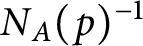 $N_A(p)^{-1}$
. Thus
$N_A(p)^{-1}$
. Thus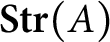 ${\mathbf {Str}}(A)$
is a subgroup functor of
${\mathbf {Str}}(A)$
is a subgroup functor of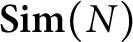 ${\mathbf {Sim}}(N)$
. Conversely, if
${\mathbf {Sim}}(N)$
. Conversely, if $\phi \in {\mathbf {Sim}}(A)(S)$
for some R-ring S, then
$\phi \in {\mathbf {Sim}}(A)(S)$
for some R-ring S, then $\phi (1)$
is invertible in
$\phi (1)$
is invertible in $A_S$
and the multiplier of
$A_S$
and the multiplier of $\phi $
is
$\phi $
is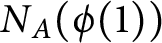 $N_A(\phi (1))$
. Setting
$N_A(\phi (1))$
. Setting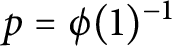 $p=\phi (1)^{-1}$
, we find that
$p=\phi (1)^{-1}$
, we find that $N_{A^{(p)}}(\phi (x))=N_A(x)$
. Thus
$N_{A^{(p)}}(\phi (x))=N_A(x)$
. Thus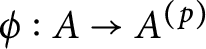 $\phi :A\to A^{(p)}$
is a linear bijection that respects unities and norms, and therefore is an isomorphism by [Reference PeterssonP, Corollary 18(b)]. Hence
$\phi :A\to A^{(p)}$
is a linear bijection that respects unities and norms, and therefore is an isomorphism by [Reference PeterssonP, Corollary 18(b)]. Hence $\phi \in {\mathbf {Str}}(A)(S)$
. This proves that the inclusion of
$\phi \in {\mathbf {Str}}(A)(S)$
. This proves that the inclusion of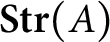 ${\mathbf {Str}}(A)$
into
${\mathbf {Str}}(A)$
into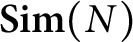 ${\mathbf {Sim}}(N)$
is an equality.
${\mathbf {Sim}}(N)$
is an equality.
Lemma 2.3 Assume that $R=k$
is an algebraically closed field. Then
$R=k$
is an algebraically closed field. Then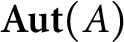 ${\mathbf {Aut}}(A)$
is a semisimple algebraic group of type
${\mathbf {Aut}}(A)$
is a semisimple algebraic group of type $\mathrm F_4$
, and
$\mathrm F_4$
, and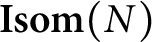 ${\mathbf {Isom}}(N)$
is a semisimple simply connected algebraic group of type
${\mathbf {Isom}}(N)$
is a semisimple simply connected algebraic group of type $\mathrm E_6$
.
$\mathrm E_6$
.
Proof First we address smoothness. The group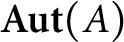 ${\mathbf {Aut}}(A)$
is smooth (see e.g. [Reference Alberca Bjerregaard, Loos and Martín GonzálezALM]). For
${\mathbf {Aut}}(A)$
is smooth (see e.g. [Reference Alberca Bjerregaard, Loos and Martín GonzálezALM]). For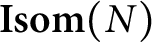 ${\mathbf {Isom}}(N)$
, consider the exact sequence of k-group schemes
${\mathbf {Isom}}(N)$
, consider the exact sequence of k-group schemes

where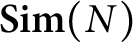 ${\mathbf {Sim}}(N)$
is the group of norm similarities with respect to N, and
${\mathbf {Sim}}(N)$
is the group of norm similarities with respect to N, and $\mu $
is the multiplier map
$\mu $
is the multiplier map $\phi \mapsto \mu _\phi =N(\phi (1))$
. By Remark 2.2,
$\phi \mapsto \mu _\phi =N(\phi (1))$
. By Remark 2.2,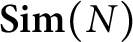 ${\mathbf {Sim}}(N)$
coincides with the structure group
${\mathbf {Sim}}(N)$
coincides with the structure group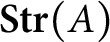 ${\mathbf {Str}}(A)$
of A. By [Reference LoosL, Corollary 6.6],
${\mathbf {Str}}(A)$
of A. By [Reference LoosL, Corollary 6.6],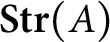 ${\mathbf {Str}}(A)$
is smooth. For
${\mathbf {Str}}(A)$
is smooth. For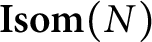 ${\mathbf {Isom}}(N)$
to be smooth it is necessary and sufficient that the differential
${\mathbf {Isom}}(N)$
to be smooth it is necessary and sufficient that the differential $d\mu $
be a surjective map of Lie algebras. But
$d\mu $
be a surjective map of Lie algebras. But ${\mathrm {Id}}+\varepsilon {\mathrm {Id}}\in {\mathbf {Str}}(A)(k[\varepsilon ])$
(where
${\mathrm {Id}}+\varepsilon {\mathrm {Id}}\in {\mathbf {Str}}(A)(k[\varepsilon ])$
(where $\varepsilon ^2=0$
) and
$\varepsilon ^2=0$
) and $\mu _{{\mathrm {Id}}+\varepsilon {\mathrm {Id}}}=1+\varepsilon $
. Thus
$\mu _{{\mathrm {Id}}+\varepsilon {\mathrm {Id}}}=1+\varepsilon $
. Thus ${\mathrm {Id}}\in {\mathrm {Lie}}({\mathbf {Str}}(A))$
, and its image under
${\mathrm {Id}}\in {\mathrm {Lie}}({\mathbf {Str}}(A))$
, and its image under $d\mu $
is
$d\mu $
is $1\in k={\mathrm {Lie}}({\mathbb {G}_{\mathrm {m}}})$
. Surjectivity follows by linearity.
$1\in k={\mathrm {Lie}}({\mathbb {G}_{\mathrm {m}}})$
. Surjectivity follows by linearity.
Let j be the inversion on A, i.e. the birational map on A defined by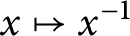 $x\mapsto x^{-1}$
for all
$x\mapsto x^{-1}$
for all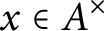 $x\in A^\times $
. Then
$x\in A^\times $
. Then $\Sigma =(A,j,1_A)$
is an H-structure in the sense of [Reference McCrimmonMc], as well as a J-structure in the sense of [Reference SpringerSp]. By [Reference SpringerSp], the structure group
$\Sigma =(A,j,1_A)$
is an H-structure in the sense of [Reference McCrimmonMc], as well as a J-structure in the sense of [Reference SpringerSp]. By [Reference SpringerSp], the structure group ${\mathbf {S}}(j)$
of j is a smooth closed subgroup of
${\mathbf {S}}(j)$
of j is a smooth closed subgroup of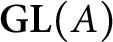 ${\mathbf {GL}}(A)$
, and so is the automorphism group of
${\mathbf {GL}}(A)$
, and so is the automorphism group of $\Sigma $
as a J-structure. By definition a linear automorphism of A is an automorphism of
$\Sigma $
as a J-structure. By definition a linear automorphism of A is an automorphism of $\Sigma $
as a J-structure if and only if it is an automorphism of
$\Sigma $
as a J-structure if and only if it is an automorphism of $\Sigma $
as an H-structure. By [Reference McCrimmonMc] we thus have
$\Sigma $
as an H-structure. By [Reference McCrimmonMc] we thus have ${\mathbf {Aut}}(\Sigma )(k)\simeq {\mathbf {Aut}}(A)(k)$
and
${\mathbf {Aut}}(\Sigma )(k)\simeq {\mathbf {Aut}}(A)(k)$
and ${\mathbf {S}}(j)(k)\simeq {\mathbf {Str}}(A)(k)$
. Thus since k is algebraically closed, and all groups involved are smooth,
${\mathbf {S}}(j)(k)\simeq {\mathbf {Str}}(A)(k)$
. Thus since k is algebraically closed, and all groups involved are smooth, ${\mathbf {Aut}}(A)\simeq {\mathbf {Aut}}(\Sigma )$
and
${\mathbf {Aut}}(A)\simeq {\mathbf {Aut}}(\Sigma )$
and ${\mathbf {Str}}(A)\simeq {\mathbf {S}}(j)$
. The statement about
${\mathbf {Str}}(A)\simeq {\mathbf {S}}(j)$
. The statement about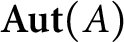 ${\mathbf {Aut}}(A)$
then follows from [Reference SpringerSp, 14.20], as does the statement that
${\mathbf {Aut}}(A)$
then follows from [Reference SpringerSp, 14.20], as does the statement that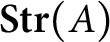 ${\mathbf {Str}}(A)$
is the product of its one-dimensional centre and a semisimple, simply connected algebraic group
${\mathbf {Str}}(A)$
is the product of its one-dimensional centre and a semisimple, simply connected algebraic group ${\mathbf {G}}'$
of type
${\mathbf {G}}'$
of type $\mathrm E_6$
. From this and the above exact sequence, it follows that f induces an isomorphism from the identity component of
$\mathrm E_6$
. From this and the above exact sequence, it follows that f induces an isomorphism from the identity component of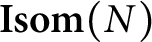 ${\mathbf {Isom}}(N)$
to
${\mathbf {Isom}}(N)$
to ${\mathbf {G}}'$
, and it remains to be shown that
${\mathbf {G}}'$
, and it remains to be shown that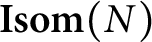 ${\mathbf {Isom}}(N)$
is connected. By Proposition 3.7 and Lemma 3.9 of [Reference Alberca Bjerregaard, Loos and Martín GonzálezALM], the group
${\mathbf {Isom}}(N)$
is connected. By Proposition 3.7 and Lemma 3.9 of [Reference Alberca Bjerregaard, Loos and Martín GonzálezALM], the group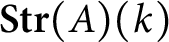 ${\mathbf {Str}}(A)(k)$
acts transitively on
${\mathbf {Str}}(A)(k)$
acts transitively on $A^\times $
(k being algebraically closed). If
$A^\times $
(k being algebraically closed). If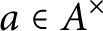 $a\in A^\times $
has norm 1 and
$a\in A^\times $
has norm 1 and $\phi \in {\mathbf {Str}}(A)(k)$
satisfies
$\phi \in {\mathbf {Str}}(A)(k)$
satisfies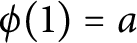 $\phi (1)=a$
, then necessarily
$\phi (1)=a$
, then necessarily $\phi \in {\mathbf {Isom}}(N)(k)$
. Thus
$\phi \in {\mathbf {Isom}}(N)(k)$
. Thus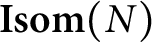 ${\mathbf {Isom}}(N)$
acts transitively on
${\mathbf {Isom}}(N)$
acts transitively on ${\mathbf {S}}_N$
, which is an irreducible k-variety since N is irreducible. (The irreducibility of N follows from the fact that its restriction to
${\mathbf {S}}_N$
, which is an irreducible k-variety since N is irreducible. (The irreducibility of N follows from the fact that its restriction to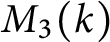 $M_3(k)$
is the usual determinant, which is irreducible, as shown in e.g. [Reference JacobsonJ2, Theorem 7.2].) By [Reference Alberca Bjerregaard, Loos and Martín GonzálezALM], the stabiliser of
$M_3(k)$
is the usual determinant, which is irreducible, as shown in e.g. [Reference JacobsonJ2, Theorem 7.2].) By [Reference Alberca Bjerregaard, Loos and Martín GonzálezALM], the stabiliser of $1$
is
$1$
is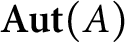 ${\mathbf {Aut}}(A)$
, which is connected. Thus
${\mathbf {Aut}}(A)$
, which is connected. Thus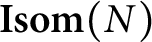 ${\mathbf {Isom}}(N)$
is connected. Hence it is a semisimple, simply connected group of type
${\mathbf {Isom}}(N)$
is connected. Hence it is a semisimple, simply connected group of type $\mathrm E_6$
, and the proof is complete. ▪
$\mathrm E_6$
, and the proof is complete. ▪
2.2 Isotopes
Let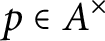 $p\in A^\times $
. Recall that the p-isotope
$p\in A^\times $
. Recall that the p-isotope $A^{(p)}$
of A is an Albert algebra where the unity is
$A^{(p)}$
of A is an Albert algebra where the unity is $p^{-1}$
, the U-operator is given by
$p^{-1}$
, the U-operator is given by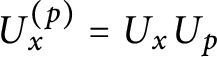 $U^{(p)}_x=U_xU_p$
(where U is the U-operator of A), and the norm is given by
$U^{(p)}_x=U_xU_p$
(where U is the U-operator of A), and the norm is given by $N_{A^{(p)}}(x)=N_A(p)N_A(x)$
. One can check that the map
$N_{A^{(p)}}(x)=N_A(p)N_A(x)$
. One can check that the map $\lambda U_p:A^{(\lambda U_pp)}\to A^{(p)}$
is an isomorphism for any
$\lambda U_p:A^{(\lambda U_pp)}\to A^{(p)}$
is an isomorphism for any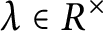 $\lambda \in R^\times $
, in particular for
$\lambda \in R^\times $
, in particular for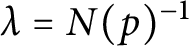 $\lambda =N(p)^{-1}$
, in which case
$\lambda =N(p)^{-1}$
, in which case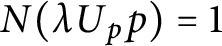 $N(\lambda U_pp)=1$
. Thus up to isomorphism one may assume that
$N(\lambda U_pp)=1$
. Thus up to isomorphism one may assume that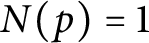 $N(p)=1$
. In that case the norm of
$N(p)=1$
. In that case the norm of $A^{(p)}$
coincides with that of A, and the adjoint is given by
$A^{(p)}$
coincides with that of A, and the adjoint is given by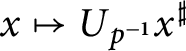 $x\mapsto U_{p^{-1}}x^\sharp $
. In this section we will show that isotopes of Albert algebras are twists by a certain torsor. To begin with, the following proposition provides the torsor.
$x\mapsto U_{p^{-1}}x^\sharp $
. In this section we will show that isotopes of Albert algebras are twists by a certain torsor. To begin with, the following proposition provides the torsor.
Proposition 2.4 The stabiliser of $1_A$
with respect to the action of
$1_A$
with respect to the action of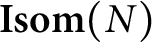 ${\mathbf {Isom}}(N)$
on
${\mathbf {Isom}}(N)$
on ${\mathbf {S}}_N$
is
${\mathbf {S}}_N$
is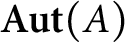 ${\mathbf {Aut}}(A)$
, and the fppf quotient sheaf
${\mathbf {Aut}}(A)$
, and the fppf quotient sheaf ${\mathbf {Isom}}(N)/{\mathbf {Aut}}(A)$
is representable by a smooth scheme. Furthermore, the map
${\mathbf {Isom}}(N)/{\mathbf {Aut}}(A)$
is representable by a smooth scheme. Furthermore, the map $\Pi :{\mathbf {Isom}}(N)\to {\mathbf {S}}_N$
, defined by
$\Pi :{\mathbf {Isom}}(N)\to {\mathbf {S}}_N$
, defined by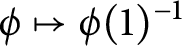 $\phi \mapsto \phi (1)^{-1}$
for any R-ring S and
$\phi \mapsto \phi (1)^{-1}$
for any R-ring S and $\phi \in {\mathbf {Isom}}(N)(S)$
, induces an isomorphism between the quotient and
$\phi \in {\mathbf {Isom}}(N)(S)$
, induces an isomorphism between the quotient and ${\mathbf {S}}_N$
.
${\mathbf {S}}_N$
.
Proof By the results of [Reference Alberca Bjerregaard, Loos and Martín GonzálezALM] quoted in the proof of Lemma 2.3, the action is transitive (in the sense of being transitive on geometric fibres) and the stabiliser of $1$
is
$1$
is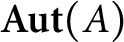 ${\mathbf {Aut}}(A)$
. Then since
${\mathbf {Aut}}(A)$
. Then since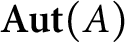 ${\mathbf {Aut}}(A)$
is flat (in fact smooth) and
${\mathbf {Aut}}(A)$
is flat (in fact smooth) and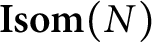 ${\mathbf {Isom}}(N)$
is smooth,
${\mathbf {Isom}}(N)$
is smooth, ${\mathbf {Isom}}(N)/{\mathbf {Aut}}(A)$
is representable by a smooth scheme by [SGA3, XVI.2.2 and VIB.9.2]. The induced map is then an isomorphism by [Reference Demazure and GabrielDG, III.3.2.1]. ▪
${\mathbf {Isom}}(N)/{\mathbf {Aut}}(A)$
is representable by a smooth scheme by [SGA3, XVI.2.2 and VIB.9.2]. The induced map is then an isomorphism by [Reference Demazure and GabrielDG, III.3.2.1]. ▪
This defines an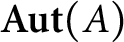 ${\mathbf {Aut}}(A)$
-torsor with total space
${\mathbf {Aut}}(A)$
-torsor with total space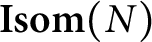 ${\mathbf {Isom}}(N)$
over
${\mathbf {Isom}}(N)$
over ${\mathbf {S}}_N$
for the fppf topology, and we denote by
${\mathbf {S}}_N$
for the fppf topology, and we denote by ${\mathbf {E}}^p$
the fibre of
${\mathbf {E}}^p$
the fibre of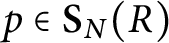 $p\in {\mathbf {S}}_N(R)$
, which is an
$p\in {\mathbf {S}}_N(R)$
, which is an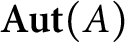 ${\mathbf {Aut}}(A)$
-torsor over
${\mathbf {Aut}}(A)$
-torsor over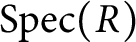 ${\mathrm {Spec}}(R)$
. The next theorem shows that the isotopes of A are precisely the twists of A by this torsor. Before formulating it, we shall define precisely what we mean by a twist of a (quadratic) Jordan algebra.
${\mathrm {Spec}}(R)$
. The next theorem shows that the isotopes of A are precisely the twists of A by this torsor. Before formulating it, we shall define precisely what we mean by a twist of a (quadratic) Jordan algebra.
Let A be a Jordan algebra and ${\mathbf {E}}$
a (right)
${\mathbf {E}}$
a (right)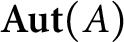 ${\mathbf {Aut}}(A)$
-torsor over
${\mathbf {Aut}}(A)$
-torsor over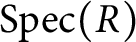 ${\mathrm {Spec}}(R)$
, and denote by
${\mathrm {Spec}}(R)$
, and denote by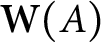 ${\mathbf {W}}(A)$
the vector group scheme defined by
${\mathbf {W}}(A)$
the vector group scheme defined by ${\mathbf {W}}(A)(S)=A_S$
for every R-ring S. The twist
${\mathbf {W}}(A)(S)=A_S$
for every R-ring S. The twist ${\mathbf {E}}\wedge A$
of A by
${\mathbf {E}}\wedge A$
of A by ${\mathbf {E}}$
is the sheaf of Jordan algebras associated to the presheaf
${\mathbf {E}}$
is the sheaf of Jordan algebras associated to the presheaf
 $$\begin{align*}S\mapsto ({\mathbf{E}}(S)\times A_S)/\sim\end{align*}$$
defined as follows: for each R-ring S, the equivalence relation $\sim $
is defined by
$\sim $
is defined by $(\phi ,a)\sim (\psi ,b)$
if and only if
$(\phi ,a)\sim (\psi ,b)$
if and only if $(\phi \rho ^{-1},\; \rho (a))=(\psi ,b)$
for some
$(\phi \rho ^{-1},\; \rho (a))=(\psi ,b)$
for some $\rho \in {\mathbf {Aut}}(A)(S)$
, which is then in fact unique. Denoting the equivalence classes by square brackets, the additive structure is given by
$\rho \in {\mathbf {Aut}}(A)(S)$
, which is then in fact unique. Denoting the equivalence classes by square brackets, the additive structure is given by
 $$\begin{align*}[\phi,x]+[\psi,y]=[\phi,x+\phi^{-1}\psi(y)],\end{align*}$$
the S-module structure by
 $$\begin{align*}\lambda[\phi,x]=[\phi,\lambda x],\end{align*}$$
the unity by $[\phi ,1]$
, and the U-operator by
$[\phi ,1]$
, and the U-operator by
 $$\begin{align*}U_{[\phi,x]}[\psi,y]=[\phi,U_x\phi^{-1}\psi(y)],\end{align*}$$
for any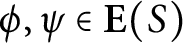 $\phi ,\psi \in {\mathbf {E}}(S)$
,
$\phi ,\psi \in {\mathbf {E}}(S)$
,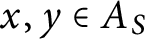 $x,y\in A_S$
and
$x,y\in A_S$
and $\lambda \in S$
. Here
$\lambda \in S$
. Here $\phi ^{-1}\psi $
is the unique
$\phi ^{-1}\psi $
is the unique $\rho \in {\mathbf {Aut}}(A)(S)$
with
$\rho \in {\mathbf {Aut}}(A)(S)$
with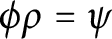 $\phi \rho =\psi $
. It is straightforward to check that these expressions are well-defined on equivalence classes, and satisfy the axioms of a Jordan algebra.
$\phi \rho =\psi $
. It is straightforward to check that these expressions are well-defined on equivalence classes, and satisfy the axioms of a Jordan algebra.
Remark 2.5 If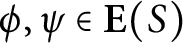 $\phi ,\psi \in {\mathbf {E}}(S)$
, then
$\phi ,\psi \in {\mathbf {E}}(S)$
, then $\rho =\phi ^{-1}\psi \in {\mathbf {Aut}}(A)(S)$
. Thus
$\rho =\phi ^{-1}\psi \in {\mathbf {Aut}}(A)(S)$
. Thus
 $$\begin{align*}[\psi,y]=[\psi\rho^{-1},\rho(y)]=[\phi,\phi^{-1}\psi(y)].\end{align*}$$
Thus the above definition is equivalent to the definition
 $$\begin{align*}U_{[\phi,x]}[\phi,y]=[\phi,U_xy].\end{align*}$$
Note further that in an algebra with bilinear multiplication, the twist of the multiplication is defined by
 $$\begin{align*}(\phi,x)(\psi,y)=(\phi,x\phi^{-1}\psi(y)).\end{align*}$$
If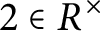 $2\in R^\times $
, then A is endowed with a bilinear multiplication, and the U-operator is defined by
$2\in R^\times $
, then A is endowed with a bilinear multiplication, and the U-operator is defined by
 $$\begin{align*}U_xy=2x(xy)-x^2y,\end{align*}$$
and one easily checks that the twist of the U-operator defined above is precisely the one obtained in this way from the twist of the bilinear multiplication.
Theorem 2.6 Let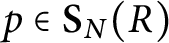 $p\in {\mathbf {S}}_N(R)$
. The map
$p\in {\mathbf {S}}_N(R)$
. The map
 $$\begin{align*}\Theta_S:[\phi,x]\mapsto \phi(x)\end{align*}$$
for each R-ring S,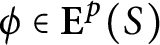 $\phi \in {\mathbf {E}}^p(S)$
, and
$\phi \in {\mathbf {E}}^p(S)$
, and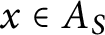 $x\in A_S$
, defines a natural isomorphism of algebras
$x\in A_S$
, defines a natural isomorphism of algebras ${\mathbf {E}}^{p}\wedge A\to A^{(p)}$
.
${\mathbf {E}}^{p}\wedge A\to A^{(p)}$
.
The reader may wish to compare this result to [Reference Alsaody and GilleAG, Theorem 4.6].
Proof The proof that this is a well-defined, injective linear map from $({\mathbf {E}}^p(S)\times A_S)/\sim $
to
$({\mathbf {E}}^p(S)\times A_S)/\sim $
to $A_S^{(p)}$
is straightforward and analogous to that of [Reference Alsaody and GilleAG, Theorem 4.6]. The same goes for surjectivity whenever
$A_S^{(p)}$
is straightforward and analogous to that of [Reference Alsaody and GilleAG, Theorem 4.6]. The same goes for surjectivity whenever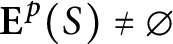 ${\mathbf {E}}^p(S)\neq \emptyset $
, and for naturality. This proves that the map in question is a an isomorphism of sheaves of modules. It is a morphism of algebras since
${\mathbf {E}}^p(S)\neq \emptyset $
, and for naturality. This proves that the map in question is a an isomorphism of sheaves of modules. It is a morphism of algebras since $\Theta _S([\phi ,1])=\phi (1)=p^{-1}=1_{A^{(p)}}$
, and
$\Theta _S([\phi ,1])=\phi (1)=p^{-1}=1_{A^{(p)}}$
, and
 $$\begin{align*}\Theta_S(U_{[\phi,x]}[\psi,y])=\Theta_S([\phi,U_x\phi^{-1}\psi(y)])=\phi(U_x\phi^{-1}\psi(y)).\end{align*}$$
Now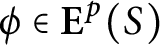 $\phi \in {\mathbf {E}}^p(S)$
implies that
$\phi \in {\mathbf {E}}^p(S)$
implies that $\phi \in {\mathbf {Isom}}(N)(S)$
with
$\phi \in {\mathbf {Isom}}(N)(S)$
with $\phi (1_A)=p^{-1}=1_{A^{(p)}}$
. Thus
$\phi (1_A)=p^{-1}=1_{A^{(p)}}$
. Thus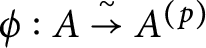 $\phi :A\overset {\sim }{\rightarrow } A^{(p)}$
, and the above is equal to
$\phi :A\overset {\sim }{\rightarrow } A^{(p)}$
, and the above is equal to
 $$\begin{align*}U_{\phi(x)}^{(p)}\phi(\phi^{-1}\psi(y))=U_{\phi(x)}^{(p)}\psi(y)=U_{\Theta_S[\phi,x]}^{(p)}\Theta_S[\psi,y],\end{align*}$$
which completes the proof. ▪
2.3 Nontrivial Isotopes
It is well known that the above torsor is nontrivial in general; indeed, over $\mathbb R$
, the Albert algebras form two isotopy classes, one of which consists of two isomorphism classes (see [Reference PeterssonP, 13.7]). However, by e.g. [Reference PeterssonP, Proposition 20], any isotope of the split Albert algebra over a field K is isomorphic to it. As the next result shows, this is not the case over rings.
$\mathbb R$
, the Albert algebras form two isotopy classes, one of which consists of two isomorphism classes (see [Reference PeterssonP, 13.7]). However, by e.g. [Reference PeterssonP, Proposition 20], any isotope of the split Albert algebra over a field K is isomorphic to it. As the next result shows, this is not the case over rings.
Theorem 2.7 There exists a smooth $\mathbb C$
-ring S such that the split Albert S-algebra admits a nonisomorphic isotope.
$\mathbb C$
-ring S such that the split Albert S-algebra admits a nonisomorphic isotope.
Proof Let A be the (split) complex Albert algebra, and denote its cubic norm by N. By Proposition 2.4, the affine scheme ${\mathbf {S}}_N$
is smooth. In view of this it suffices, by Remark 1.2, to show that the
${\mathbf {S}}_N$
is smooth. In view of this it suffices, by Remark 1.2, to show that the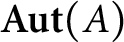 ${\mathbf {Aut}}(A)$
-torsor
${\mathbf {Aut}}(A)$
-torsor ${\mathbf {Isom}}(N)\to {\mathbf {S}}_N$
of Proposition 2.4 is nontrivial. To this end it suffices, by Lemma 1.4, to show that for some n,
${\mathbf {Isom}}(N)\to {\mathbf {S}}_N$
of Proposition 2.4 is nontrivial. To this end it suffices, by Lemma 1.4, to show that for some n, $\pi _n({\mathbf {Aut}}(A)(\mathbb C))$
is not a direct factor of
$\pi _n({\mathbf {Aut}}(A)(\mathbb C))$
is not a direct factor of $\pi _n({\mathbf {Isom}}(N)(\mathbb C))$
. (The choice of base point is immaterial by connectedness.)
$\pi _n({\mathbf {Isom}}(N)(\mathbb C))$
. (The choice of base point is immaterial by connectedness.)
Let C be the real division octonion algebra, and set $A_0=H_3(C,{\mathbf {1}})$
, with norm
$A_0=H_3(C,{\mathbf {1}})$
, with norm $N_0$
, so that
$N_0$
, so that $A_0$
is the formally real Albert algebra and
$A_0$
is the formally real Albert algebra and $A=A_0\otimes _{\mathbb R}\mathbb C$
. Then
$A=A_0\otimes _{\mathbb R}\mathbb C$
. Then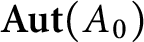 ${\mathbf {Aut}}(A_0)$
(resp.
${\mathbf {Aut}}(A_0)$
(resp.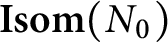 ${\mathbf {Isom}}(N_0)$
) is an anisotropic real group of type
${\mathbf {Isom}}(N_0)$
) is an anisotropic real group of type $\mathrm F_4$
(resp.
$\mathrm F_4$
(resp. $\mathrm E_6$
). The Lie group
$\mathrm E_6$
). The Lie group ${\mathbf {Aut}}(A)(\mathbb C)={\mathbf {Aut}}(A_0)(\mathbb C)$
(resp.
${\mathbf {Aut}}(A)(\mathbb C)={\mathbf {Aut}}(A_0)(\mathbb C)$
(resp. ${\mathbf {Isom}}(N)(\mathbb C)={\mathbf {Isom}}(N_0)(\mathbb C)$
) contains
${\mathbf {Isom}}(N)(\mathbb C)={\mathbf {Isom}}(N_0)(\mathbb C)$
) contains ${\mathbf {Aut}}(A_0)(\mathbb R)$
(resp.
${\mathbf {Aut}}(A_0)(\mathbb R)$
(resp. ${\mathbf {Isom}}(N_0)(\mathbb R)$
) as a maximal compact subgroup. By Cartan decomposition,
${\mathbf {Isom}}(N_0)(\mathbb R)$
) as a maximal compact subgroup. By Cartan decomposition,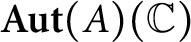 ${\mathbf {Aut}}(A)(\mathbb C)$
is thus homeomorphic to
${\mathbf {Aut}}(A)(\mathbb C)$
is thus homeomorphic to ${\mathbf {Aut}}(A_0)(\mathbb R)\times \mathbb R^k$
and
${\mathbf {Aut}}(A_0)(\mathbb R)\times \mathbb R^k$
and ${\mathbf {Isom}}(N)(\mathbb C)$
is homeomorphic to
${\mathbf {Isom}}(N)(\mathbb C)$
is homeomorphic to ${\mathbf {Isom}}(N_0)(\mathbb R) \times \mathbb R^l$
for suitable k and l. By [Reference MimuraMi],
${\mathbf {Isom}}(N_0)(\mathbb R) \times \mathbb R^l$
for suitable k and l. By [Reference MimuraMi], $\pi _8({\mathbf {Aut}}(A_0)(\mathbb R))$
, and hence also
$\pi _8({\mathbf {Aut}}(A_0)(\mathbb R))$
, and hence also $\pi _8({\mathbf {Aut}}(A)(\mathbb C))$
, is cyclic of order 2, while by [Reference Bott and SamelsonBS],
$\pi _8({\mathbf {Aut}}(A)(\mathbb C))$
, is cyclic of order 2, while by [Reference Bott and SamelsonBS], $\pi _8({\mathbf {Isom}}(N_0)(\mathbb R))$
, and thus also
$\pi _8({\mathbf {Isom}}(N_0)(\mathbb R))$
, and thus also $\pi _8({\mathbf {Isom}}(N^s)(\mathbb C))$
, is trivial. This completes the proof. ▪
$\pi _8({\mathbf {Isom}}(N^s)(\mathbb C))$
, is trivial. This completes the proof. ▪
3 Compositions of Quadratic Forms and
$\mathrm {D}_4$
-torsors

In this section, we will define and consider Albert algebras arising from compositions of quadratic forms, and describe these in terms of certain $\mathrm {D}_4$
-torsors.
$\mathrm {D}_4$
-torsors.
3.1 Composition Algebras and Compositions of Quadratic Forms
An Albert algebra over R is called reduced if it is isomorphic to the algebra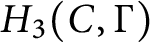 $H_3(C,\Gamma )$
of twisted hermitian matrices over an octonion R-algebra C, with
$H_3(C,\Gamma )$
of twisted hermitian matrices over an octonion R-algebra C, with $\Gamma =(\gamma _1,\gamma _2,\gamma _3)\in (R^\times )^3$
. Before giving the definition of
$\Gamma =(\gamma _1,\gamma _2,\gamma _3)\in (R^\times )^3$
. Before giving the definition of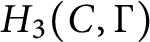 $H_3(C,\Gamma )$
, we note that the formulae can be simplified slightly if they are expressed in terms of the para-octonion algebra obtained from C. This is the algebra with underlying quadratic module C, and multiplication given by
$H_3(C,\Gamma )$
, we note that the formulae can be simplified slightly if they are expressed in terms of the para-octonion algebra obtained from C. This is the algebra with underlying quadratic module C, and multiplication given by
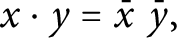 $$\begin{align*}x\cdot y=\bar x\ \bar y,\end{align*}$$
where $a\mapsto \bar a$
denotes the usual involution on C and juxtaposition the multiplication of C. This algebra is not unital, but it is a symmetric composition algebra in the sense of the following definition.
$a\mapsto \bar a$
denotes the usual involution on C and juxtaposition the multiplication of C. This algebra is not unital, but it is a symmetric composition algebra in the sense of the following definition.
Definition 3.1 A composition algebra $(C,q)$
over R is a faithfully projective R-module C endowed with a bilinear map
$(C,q)$
over R is a faithfully projective R-module C endowed with a bilinear map $C\times C\to C, (x,y)\mapsto x\cdot y$
(the multiplication) and a separable quadratic form
$C\times C\to C, (x,y)\mapsto x\cdot y$
(the multiplication) and a separable quadratic form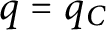 $q=q_C$
satisfying
$q=q_C$
satisfying $q(x\cdot y)=q(x)q(y)$
for all
$q(x\cdot y)=q(x)q(y)$
for all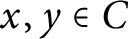 $x,y\in C$
. The algebra is called symmetric if the symmetric bilinear form
$x,y\in C$
. The algebra is called symmetric if the symmetric bilinear form
 $$\begin{align*}(x,y)\mapsto \langle x,y\rangle=\langle x,y\rangle_q=q(x+y)-q(x)-q(y)\end{align*}$$
satisfies
 $$\begin{align*}\langle x\cdot y, z\rangle=\langle x,y\cdot z\rangle\end{align*}$$
for all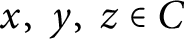 $x,\;y,\;z\in C$
.
$x,\;y,\;z\in C$
.
Remark 3.2 There is a large variation in the literature as concerns the terminology of quadratic forms. Following [Reference PeterssonP], we call a quadratic form q on an R-module M separable if M is projective and the scalar extension of q to any R-field K has trivial radical. If M is of even constant rank, which is the case of interest to us, this is equivalent to q being nonsingular, i.e. to the map $M\to {\operatorname {Hom}}_R(M,R)$
given by
$M\to {\operatorname {Hom}}_R(M,R)$
given by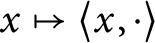 $x\mapsto \langle x,\cdot \rangle $
being an isomorphism.
$x\mapsto \langle x,\cdot \rangle $
being an isomorphism.
In the literature, the term symmetric composition is sometimes used in reference to the structure of a symmetric composition algebra. We shall only be interested in symmetric composition algebras of constant rank $8$
. Examples of these include para-octonion algebras and (over fields) Okubo algebras. In this case, the module being faithfully projective amounts to it being projective (of constant rank
$8$
. Examples of these include para-octonion algebras and (over fields) Okubo algebras. In this case, the module being faithfully projective amounts to it being projective (of constant rank $8$
). Abusing notation, we shall refer to a composition algebra
$8$
). Abusing notation, we shall refer to a composition algebra $(C,q)$
simply by C.
$(C,q)$
simply by C.
We shall begin by writing the definition of reduced Albert algebras in terms of symmetric composition algebras. Let thus C be a symmetric composition algebra over R of constant rank $8$
. We will often consider the R-module
$8$
. We will often consider the R-module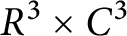 $R^3\times C^3$
. Following the notation of [Reference PeterssonP], we write an element
$R^3\times C^3$
. Following the notation of [Reference PeterssonP], we write an element $(\alpha _1,\alpha _2,\alpha _3,u_1,u_2,u_3)\in R^3\times C^3$
as
$(\alpha _1,\alpha _2,\alpha _3,u_1,u_2,u_3)\in R^3\times C^3$
as $\sum \alpha _i e_i +\sum u_i[jl]$
where the second sum runs over all cyclic permutations
$\sum \alpha _i e_i +\sum u_i[jl]$
where the second sum runs over all cyclic permutations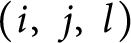 $(i,\;j,\;l)$
of
$(i,\;j,\;l)$
of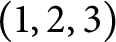 $(1,2,3)$
. We write
$(1,2,3)$
. We write $\Delta $
for the trilinear form on C defined by
$\Delta $
for the trilinear form on C defined by
 $$\begin{align*}\Delta(u_1,u_2,u_3)=\langle u_3\cdot u_2,u_1\rangle,\end{align*}$$
noting that by symmetry of C, it is invariant under cyclic permutations.
Proposition 3.3 Let C be a symmetric composition algebra over R of constant rank $8$
and let
$8$
and let $\Gamma =(\gamma _1,\gamma _2,\gamma _3)\in R^3$
with
$\Gamma =(\gamma _1,\gamma _2,\gamma _3)\in R^3$
with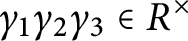 $\gamma _1\gamma _2\gamma _3\in R^\times $
. Then
$\gamma _1\gamma _2\gamma _3\in R^\times $
. Then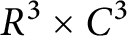 $R^3\times C^3$
is a cubic norm structure with base point
$R^3\times C^3$
is a cubic norm structure with base point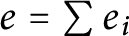 $e=\sum e_i$
and with norm N and adjoint map
$e=\sum e_i$
and with norm N and adjoint map $\sharp $
defined by
$\sharp $
defined by
 $$\begin{align*}N(x)=\alpha_1\alpha_2\alpha_3+\gamma_1\gamma_2\gamma_3\Delta(u_1,u_2,u_3)-\sum\gamma_j\gamma_l\alpha_i q(u_i)\end{align*}$$
and
 $$\begin{align*}x^\sharp=\sum(\alpha_j\alpha_l-\gamma_j\gamma_lq(u_i))e_i + \sum (\gamma_iu_l\cdot u_j-\alpha_iu_i)[jl],\end{align*}$$
where $x=\sum \alpha _i e_i +\sum u_i[jl]$
. Moreover, the bilinear trace T of this cubic norm structure satisfies
$x=\sum \alpha _i e_i +\sum u_i[jl]$
. Moreover, the bilinear trace T of this cubic norm structure satisfies
 $$\begin{align*}T(x,y)=\sum \alpha_i\beta_i+\sum \gamma_j\gamma_l\langle u_i,v_i\rangle,\end{align*}$$
where $y=\sum \beta _i e_i +\sum v_i[jl]$
.
$y=\sum \beta _i e_i +\sum v_i[jl]$
.
Proof It is straightforward to verify that N, $\sharp $
and
$\sharp $
and $1$
satisfy the axioms of [Reference PeterssonP], and that the bilinear trace defined in [Reference PeterssonP] is equal to T. ▪
$1$
satisfy the axioms of [Reference PeterssonP], and that the bilinear trace defined in [Reference PeterssonP] is equal to T. ▪
We denote the Jordan algebra of the above cubic form by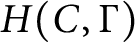 $H(C,\Gamma )$
.
$H(C,\Gamma )$
.
Remark 3.4 If C is a para-octonion algebra obtained from an octonion algebra O, then $H(C,\Gamma )=H_3(O,\Gamma )$
, and the above definition coincides with the definition of
$H(C,\Gamma )=H_3(O,\Gamma )$
, and the above definition coincides with the definition of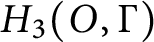 $H_3(O,\Gamma )$
in [Reference PeterssonP].
$H_3(O,\Gamma )$
in [Reference PeterssonP].
For a para-octonion algebra C, we write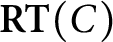 ${\mathbf {RT}}(C)$
for the affine group scheme defined by
${\mathbf {RT}}(C)$
for the affine group scheme defined by
 $$\begin{align*}{\mathbf{RT}}(C)(S)=\{(t_1,t_2,t_3)\in\mathbf{SO}(q_C)(S)^3|t_1(x\cdot y)=t_3(x)\cdot t_2(y)\}.\end{align*}$$
Up to renaming the indices, by [Reference Alsaody and GilleAG], this is precisely the semi-simple simply connected group of type $\mathrm D_4$
denoted in [Reference Alsaody and GilleAG] by
$\mathrm D_4$
denoted in [Reference Alsaody and GilleAG] by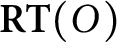 ${\mathbf {RT}}(O)$
, where O is the octonion algebra from which C is obtained.
${\mathbf {RT}}(O)$
, where O is the octonion algebra from which C is obtained.
For later use, we recall the definition of a composition of quadratic forms, generalising that of a composition algebra.
Definition 3.5 A composition of quadratic forms over R is a heptuple
 $$\begin{align*}{\mathcal{M}}=(C_1,C_2,C_3,q_1,q_2,q_3,m),\end{align*}$$
where $C_1$
,
$C_1$
, $C_2$
and
$C_2$
and $C_3$
are projective R-modules of the same rank, and each
$C_3$
are projective R-modules of the same rank, and each $q_i$
is a nonsingular quadratic form on
$q_i$
is a nonsingular quadratic form on $C_i$
, and where
$C_i$
, and where $m:C_3\times C_2\to C_1$
is a bilinear map satisfying
$m:C_3\times C_2\to C_1$
is a bilinear map satisfying $q_1(m(x,y))=q_3(x)q_2(y)$
for any
$q_1(m(x,y))=q_3(x)q_2(y)$
for any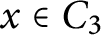 $x\in C_3$
and
$x\in C_3$
and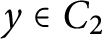 $y\in C_2$
. We call the rank of
$y\in C_2$
. We call the rank of $C_i$
the rank of
$C_i$
the rank of ${\mathcal {M}}$
. If
${\mathcal {M}}$
. If ${\mathcal {M}}'=(C^{\prime }_1,C^{\prime }_2,C^{\prime }_3,q^{\prime }_1,q^{\prime }_2,q^{\prime }_3,m')$
is another composition, then a morphism of compositions of quadratic forms is a triple
${\mathcal {M}}'=(C^{\prime }_1,C^{\prime }_2,C^{\prime }_3,q^{\prime }_1,q^{\prime }_2,q^{\prime }_3,m')$
is another composition, then a morphism of compositions of quadratic forms is a triple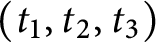 $(t_1,t_2,t_3)$
of isometries
$(t_1,t_2,t_3)$
of isometries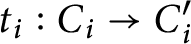 $t_i:C_i\to C^{\prime }_i$
such that
$t_i:C_i\to C^{\prime }_i$
such that $m'(t_3(x),t_2(y))=t_1(m(x,y))$
for each
$m'(t_3(x),t_2(y))=t_1(m(x,y))$
for each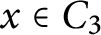 $x\in C_3$
and
$x\in C_3$
and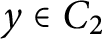 $y\in C_2$
.
$y\in C_2$
.
Such compositions were defined in [Reference KnusK, V.7.2], where they were called compositions of quadratic spaces. Note that in [Reference KnusK], the condition on the quadratic forms is weaker. For our purposes, the generality of the above definition is sufficient. It is clear that this notion is stable under base change, which for an R-ring S we shall write as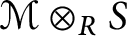 $\mathcal M\otimes _R S$
. The notions of isomorphisms and automorphisms are clear, and we thus obtain an affine group scheme
$\mathcal M\otimes _R S$
. The notions of isomorphisms and automorphisms are clear, and we thus obtain an affine group scheme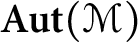 ${\mathbf {Aut}}({\mathcal {M}})$
.
${\mathbf {Aut}}({\mathcal {M}})$
.
Example 3.6 Let C be a composition algebra over R of constant even rank, with quadratic form $q_C$
. The multiplication map
$q_C$
. The multiplication map $m_C:C\times C\to C$
makes
$m_C:C\times C\to C$
makes ${\mathcal {M}}_C:=(C,C,C,q_C,q_C,q_C,m_C)$
into a composition of quadratic forms. If C is a para-octonion algebra, then by definition
${\mathcal {M}}_C:=(C,C,C,q_C,q_C,q_C,m_C)$
into a composition of quadratic forms. If C is a para-octonion algebra, then by definition ${\mathbf {Aut}}({\mathcal {M}}_C)={\mathbf {RT}}(C)$
.
${\mathbf {Aut}}({\mathcal {M}}_C)={\mathbf {RT}}(C)$
.
Given a composition of quadratic forms ${\mathcal {M}}=(C_1,C_2,C_3,q_1,q_2,q_3,m)$
of constant rank
${\mathcal {M}}=(C_1,C_2,C_3,q_1,q_2,q_3,m)$
of constant rank $8$
, the nonsingularity of
$8$
, the nonsingularity of $q_2$
and
$q_2$
and $q_3$
implies that the map m determines maps
$q_3$
implies that the map m determines maps $m_2:C_1\times C_3\to C_2$
and
$m_2:C_1\times C_3\to C_2$
and $m_3:C_2\times C_1\to C_3$
by
$m_3:C_2\times C_1\to C_3$
by
 $$ \begin{align} \begin{array}{l} \langle m_2(x_1,x_3),x_2\rangle_2=\langle x_1, m(x_3,x_2)\rangle_1,\\ \langle x_3, m_3(x_2,x_1)\rangle_3=\langle m(x_3,x_2),x_1\rangle_1 \end{array} \end{align} $$
where $\langle ,\rangle _i$
is the bilinear form corresponding to the quadratic form
$\langle ,\rangle _i$
is the bilinear form corresponding to the quadratic form $q_i$
. The significance of these is due to the following proposition.
$q_i$
. The significance of these is due to the following proposition.
Proposition 3.7 Let ${\mathcal {M}}=(C_1,C_2,C_3,q_1,q_2,q_3,m)$
be a composition of quadratic forms over R of constant rank
${\mathcal {M}}=(C_1,C_2,C_3,q_1,q_2,q_3,m)$
be a composition of quadratic forms over R of constant rank $8$
. Then
$8$
. Then ${\mathcal {M}}\otimes _R S\simeq _S{\mathcal {M}}_C\otimes _R S$
for some para-octonion R-algebra C and some faithfully flat R-ring S. Under any isomorphism
${\mathcal {M}}\otimes _R S\simeq _S{\mathcal {M}}_C\otimes _R S$
for some para-octonion R-algebra C and some faithfully flat R-ring S. Under any isomorphism ${\mathcal {M}}\otimes _R S\to {\mathcal {M}}_C\otimes _R S$
, the multiplication on
${\mathcal {M}}\otimes _R S\to {\mathcal {M}}_C\otimes _R S$
, the multiplication on $C_S$
restricts to the maps
$C_S$
restricts to the maps $m_i:C_l\times C_j\to C_i$
for every cyclic permutation
$m_i:C_l\times C_j\to C_i$
for every cyclic permutation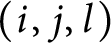 $(i,j,l)$
of
$(i,j,l)$
of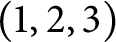 $(1,2,3)$
, where
$(1,2,3)$
, where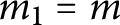 $m_1=m$
and
$m_1=m$
and $m_2$
and
$m_2$
and $m_3$
are as in (3.1).
$m_3$
are as in (3.1).
To simplify notation we shall write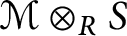 ${\mathcal {M}}\otimes _R S$
as
${\mathcal {M}}\otimes _R S$
as $(C_{1S},C_{2S},C_{3S},q_{1S},q_{2S},q_{3S},m_S)$
.
$(C_{1S},C_{2S},C_{3S},q_{1S},q_{2S},q_{3S},m_S)$
.
Remark 3.8 To prove the first statement, it suffices to show that ${\mathcal {M}}\otimes _R S\simeq {\mathcal {M}}_C$
for some para-octonion algebra C over S. Indeed, assume this is the case. If O is the octonion S-algebra from which C is obtained, then
${\mathcal {M}}\otimes _R S\simeq {\mathcal {M}}_C$
for some para-octonion algebra C over S. Indeed, assume this is the case. If O is the octonion S-algebra from which C is obtained, then $O\otimes _S T\simeq {\mathrm {Zor}}(R)\otimes _R T$
for some faithfully flat S-ring T, where
$O\otimes _S T\simeq {\mathrm {Zor}}(R)\otimes _R T$
for some faithfully flat S-ring T, where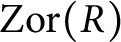 ${\mathrm {Zor}}(R)$
is the split (Zorn) octonion R-algebra. Hence
${\mathrm {Zor}}(R)$
is the split (Zorn) octonion R-algebra. Hence $C\otimes _S T\simeq Z\otimes _R T$
, where Z is the para-octonion R-algebra obtained from
$C\otimes _S T\simeq Z\otimes _R T$
, where Z is the para-octonion R-algebra obtained from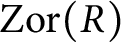 ${\mathrm {Zor}}(R)$
, and a fortiori
${\mathrm {Zor}}(R)$
, and a fortiori ${\mathcal {M}}_C\otimes _S T\simeq {\mathcal {M}}_{Z\otimes S}\otimes _S T\simeq {\mathcal {M}}_Z\otimes _R T $
. Altogether,
${\mathcal {M}}_C\otimes _S T\simeq {\mathcal {M}}_{Z\otimes S}\otimes _S T\simeq {\mathcal {M}}_Z\otimes _R T $
. Altogether,
 $$\begin{align*}{\mathcal{M}}\otimes_R T\simeq ({\mathcal{M}}\otimes_R S)\otimes_S T\simeq{\mathcal{M}}_C\otimes_S T\simeq{\mathcal{M}}_Z\otimes_R T,\end{align*}$$
and the claim follows since T is faithfully flat over R.
Proof of Proposition 3.7 Choose S such that there are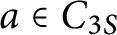 $a\in C_{3S}$
and
$a\in C_{3S}$
and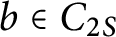 $b\in C_{2S}$
with
$b\in C_{2S}$
with $q_{3S}(a)=q_{2S}(b)=1$
. (This is possible since a nonsingular quadratic form is split by a faithfully flat extension.) Define
$q_{3S}(a)=q_{2S}(b)=1$
. (This is possible since a nonsingular quadratic form is split by a faithfully flat extension.) Define
 $$ \begin{align*}\begin{array}{ll} f:C_{2S}\to C_{1S},& x\mapsto m_S(a,x),\\ g:C_{3S}\to C_{1S},& x\mapsto m_S(x,b). \end{array}\end{align*} $$
Then $q_{1S}f(x)=q_{2S}(x)$
and
$q_{1S}f(x)=q_{2S}(x)$
and $q_{1S}g(x)=q_{3S}(x)$
, whence f and g are isometries, hence invertible. Thus
$q_{1S}g(x)=q_{3S}(x)$
, whence f and g are isometries, hence invertible. Thus
 $$\begin{align*}(x,y)\mapsto x\cdot y:=m_S(g^{-1}(x),f^{-1}(y))\end{align*}$$
defines a bilinear multiplication on $C_{1S}$
. Since
$C_{1S}$
. Since $f^{-1}$
and
$f^{-1}$
and $g^{-1}$
are isometries, we have
$g^{-1}$
are isometries, we have
 $$\begin{align*}q_{1S}(x\cdot y)=q_{3S}g^{-1}(x)q_{2S}f^{-1}(y)=q_{1S}(x)q_{1S}(y).\end{align*}$$
Thus $q_{1S}$
is multiplicative with respect to the multiplication
$q_{1S}$
is multiplicative with respect to the multiplication $\cdot $
. Setting
$\cdot $
. Setting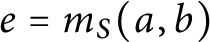 $e=m_S(a,b)$
we have
$e=m_S(a,b)$
we have $e=f(b)=g(a)$
. Thus
$e=f(b)=g(a)$
. Thus $e\cdot x=ff^{-1}(x)=x$
, and likewise
$e\cdot x=ff^{-1}(x)=x$
, and likewise $x\cdot e=x$
, for all
$x\cdot e=x$
, for all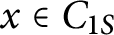 $x\in C_{1S}$
. Thus the multiplication is unital, whence it makes
$x\in C_{1S}$
. Thus the multiplication is unital, whence it makes $C_{1S}$
into an octonion algebra over S with quadratic form
$C_{1S}$
into an octonion algebra over S with quadratic form $q_{1S}$
, and
$q_{1S}$
, and
 $$\begin{align*}({\mathrm{Id}},f,g):{\mathcal{M}}\otimes_R S\to {\mathcal{M}}_{C_{1S}}\end{align*}$$
is an isomorphism of compositions of quadratic forms since $g(x)\cdot f(y)=m_S(x,y)$
by construction. Denoting by
$g(x)\cdot f(y)=m_S(x,y)$
by construction. Denoting by $\kappa $
the involution on the octonion algebra
$\kappa $
the involution on the octonion algebra $C_{1S}$
and by C the corresponding para-octonion algebra, we have an isomorphism
$C_{1S}$
and by C the corresponding para-octonion algebra, we have an isomorphism
 $$\begin{align*}({\mathrm{Id}},\kappa f,\kappa g): {\mathcal{M}}\otimes_R S\to{\mathcal{M}}_C,\end{align*}$$
and the first statement is proved.
To prove the second statement for $i=1$
, let
$i=1$
, let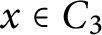 $x\in C_3$
and
$x\in C_3$
and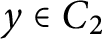 $y\in C_2$
. Since any isomorphism
$y\in C_2$
. Since any isomorphism ${\mathcal {M}}\otimes _R S\to {\mathcal {M}}_C\otimes _R S$
takes
${\mathcal {M}}\otimes _R S\to {\mathcal {M}}_C\otimes _R S$
takes $m_S$
to the multiplication of
$m_S$
to the multiplication of $C_S$
, it suffices to show that
$C_S$
, it suffices to show that $z:=m_S(x\otimes 1,y\otimes 1)\in C_{1S}$
descends to
$z:=m_S(x\otimes 1,y\otimes 1)\in C_{1S}$
descends to $C_1$
, which is equivalent to
$C_1$
, which is equivalent to $z\otimes 1$
being fixed by the standard descent datum
$z\otimes 1$
being fixed by the standard descent datum
 $$ \begin{align*}\begin{array}{ll}\theta:C_1\otimes S\otimes S\to C_1\otimes S\otimes S,& c\otimes \mu\otimes\nu\mapsto c\otimes \nu\otimes\mu\end{array}.\end{align*} $$
This in turn follows from the fact that
 $$\begin{align*}m_S(x\otimes 1,y\otimes 1)=m(x,y)\otimes 1\otimes 1.\end{align*}$$
To prove the statement for $i=3$
, we let instead
$i=3$
, we let instead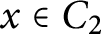 $x\in C_2$
and
$x\in C_2$
and $y\in C_1$
. We must show that for any symmetric composition algebra C with multiplication
$y\in C_1$
. We must show that for any symmetric composition algebra C with multiplication $\bullet $
over S and any isomorphism of compositions of quadratic forms
$\bullet $
over S and any isomorphism of compositions of quadratic forms
 $$\begin{align*}(\phi_1,\phi_2,\phi_3): {\mathcal{M}}\otimes S\to{\mathcal{M}}_C\end{align*}$$
we have
 $$\begin{align*}\phi_3^{-1}(\phi_2(x\otimes 1)\bullet\phi_1(y\otimes 1))=m_3(x,y)\otimes 1.\end{align*}$$
Since $q_{3S}$
is nonsingular, it suffices for this to show that for any
$q_{3S}$
is nonsingular, it suffices for this to show that for any $z\in C_3$
,
$z\in C_3$
,
 $$\begin{align*}\langle\phi_3^{-1}(\phi_2(x\otimes 1)\bullet\phi_1(y\otimes 1)),z\otimes 1\rangle_{q_{3S}}=\langle m_3(x,y)\otimes 1,z\otimes 1\rangle_{q_{3S}}.\end{align*}$$
Since $\phi _3:C_{3S}\to C$
is an isometry, the left-hand side equals
$\phi _3:C_{3S}\to C$
is an isometry, the left-hand side equals
 $$\begin{align*}\langle\phi_2(x\otimes 1)\bullet\phi_1(y\otimes 1),\phi_3(z\otimes 1)\rangle_{q_C}\end{align*}$$
which, by symmetry, is equal to
 $$\begin{align*}\langle\phi_3(z\otimes 1)\bullet\phi_2(x\otimes 1),\phi_1(y\otimes 1)\rangle_{q_C}=\langle \phi_1m_S(z\otimes 1,x\otimes 1),\phi_1(y\otimes 1)\rangle_{q_C}.\end{align*}$$
Since $\phi _1$
is an isometry, this is equal to
$\phi _1$
is an isometry, this is equal to
 $$\begin{align*}\langle m_S(z\otimes 1,x\otimes 1),y\otimes 1\rangle_{q_{1S}}=\langle m(z,x),y\rangle_1\otimes 1,\end{align*}$$
which by definition of $m_3$
is equal to
$m_3$
is equal to
 $$\begin{align*}\langle m_3(x,y),z\rangle_3\otimes 1=\langle m_3(x,y)\otimes 1,z\otimes 1\rangle_{q_{3S}}\end{align*}$$
as desired. The statement for $i=2$
is deduced analogously, and the proof is complete.
$i=2$
is deduced analogously, and the proof is complete.
▪
3.2 Albert Algebras Constructed from Compositions
Given a composition of quadratic forms
 $$\begin{align*}{\mathcal{M}}=(C_1,C_2,C_3,q_1,q_2,q_3,m)\end{align*}$$
of constant rank $8$
, consider the R-module
$8$
, consider the R-module $R^3\times C_1\times C_2\times C_3$
, whose elements we will write, in analogy to the above, as
$R^3\times C_1\times C_2\times C_3$
, whose elements we will write, in analogy to the above, as $x=\sum \alpha _i e_i +\sum u_i[jl]$
, where
$x=\sum \alpha _i e_i +\sum u_i[jl]$
, where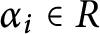 $\alpha _i\in R$
and
$\alpha _i\in R$
and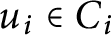 $u_i\in C_i$
, and where the second sum runs over all cyclic permutations
$u_i\in C_i$
, and where the second sum runs over all cyclic permutations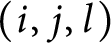 $(i,j,l)$
of
$(i,j,l)$
of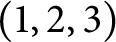 $(1,2,3)$
. Also, let
$(1,2,3)$
. Also, let $\Gamma =(\gamma _1,\gamma _2,\gamma _3)\in (R^\times )^3$
.
$\Gamma =(\gamma _1,\gamma _2,\gamma _3)\in (R^\times )^3$
.
Proposition 3.9 The module $R^3\times C_1\times C_2\times C_3$
is a cubic norm structure with base point
$R^3\times C_1\times C_2\times C_3$
is a cubic norm structure with base point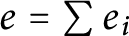 $e=\sum e_i$
and with norm N and adjoint map
$e=\sum e_i$
and with norm N and adjoint map $\sharp $
defined by
$\sharp $
defined by
 $$\begin{align*}N(x)=\alpha_1\alpha_2\alpha_3+\gamma_1\gamma_2\gamma_3\langle m(u_3,u_2),u_1\rangle_1-\sum\gamma_j\gamma_l\alpha_i q_i(u_i)\end{align*}$$
and
 $$\begin{align*}x^\sharp=\sum(\alpha_j\alpha_l-\gamma_j\gamma_lq_i(u_i))e_i + \sum (\gamma_i m_i(u_l,u_j)-\alpha_iu_i)[jl].\end{align*}$$
Moreover, the bilinear trace T of this cubic norm structure satisfies
 $$\begin{align*}T(x,y)=\sum \alpha_i\beta_i+\sum \gamma_j\gamma_l\langle u_i,v_i\rangle_i,\end{align*}$$
where $y=\sum \beta _i e_i +\sum v_i[jl]$
. The cubic Jordan algebra of this cubic norm structure is an Albert algebra.
$y=\sum \beta _i e_i +\sum v_i[jl]$
. The cubic Jordan algebra of this cubic norm structure is an Albert algebra.
We denote this cubic Jordan algebra by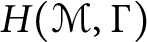 $H({\mathcal {M}},\Gamma )$
. If
$H({\mathcal {M}},\Gamma )$
. If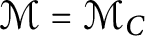 ${\mathcal {M}}={\mathcal {M}}_C$
for some symmetric composition algebra C, then
${\mathcal {M}}={\mathcal {M}}_C$
for some symmetric composition algebra C, then $H({\mathcal {M}},\Gamma )=H(C,\Gamma )$
.
$H({\mathcal {M}},\Gamma )=H(C,\Gamma )$
.
Proof We need to verify the identities (1) of [Reference PeterssonP, 5.2] in all scalar extensions of R. It suffices to do this upon replacing R by a faithfully flat R-ring S. By Proposition 3.7, we can choose S so that ${\mathcal {M}}\otimes S\simeq {\mathcal {M}}_C$
for some symmetric composition S-algebra C. Extending any isomorphism
${\mathcal {M}}\otimes S\simeq {\mathcal {M}}_C$
for some symmetric composition S-algebra C. Extending any isomorphism ${\mathcal {M}}\otimes S\simeq {\mathcal {M}}_C$
by the identity on
${\mathcal {M}}\otimes S\simeq {\mathcal {M}}_C$
by the identity on $S^3$
, we obtain a linear bijection
$S^3$
, we obtain a linear bijection $H({\mathcal {M}},\Gamma )\otimes S=H({\mathcal {M}}\otimes S,\Gamma )\to H(C,\Gamma )$
that transforms the expressions for the norm, adjoint and trace into those of Proposition 3.3, from which the first two statements therefore follow. We conclude with [Reference PeterssonP, Theorem 17] and Proposition 3.3. ▪
$H({\mathcal {M}},\Gamma )\otimes S=H({\mathcal {M}}\otimes S,\Gamma )\to H(C,\Gamma )$
that transforms the expressions for the norm, adjoint and trace into those of Proposition 3.3, from which the first two statements therefore follow. We conclude with [Reference PeterssonP, Theorem 17] and Proposition 3.3. ▪
Remark 3.10 A related, but different, construction over fields is the Springer construction, which provides an Albert algebra given a twisted composition; see [Reference Knus, Merkurjev, Rost and TignolKMRT, 38.6]. Twisted compositions over a field k involve a quadratic space over a cubic étale algebra over k; eight-dimensional (symmetric) composition algebras over k give rise to twisted compositions using the split étale algebra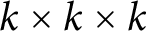 $k\times k\times k$
. Note however that the automorphism group of such a twisted composition is the semi-direct product of a simply connected group of type
$k\times k\times k$
. Note however that the automorphism group of such a twisted composition is the semi-direct product of a simply connected group of type $\mathrm D_4$
with the symmetric group
$\mathrm D_4$
with the symmetric group $S_3$
[Reference Knus, Merkurjev, Rost and TignolKMRT, 36.5], and therefore is not the required notion for our purposes. Generalising the notion of twisted compositions to the ring setting is a possible topic for a future investigation.
$S_3$
[Reference Knus, Merkurjev, Rost and TignolKMRT, 36.5], and therefore is not the required notion for our purposes. Generalising the notion of twisted compositions to the ring setting is a possible topic for a future investigation.
The following lemma is known for reduced Albert algebras over fields, and generalises, mutatis mutandis, to the case at hand.
Lemma 3.11 Let ${\mathcal {M}}=(C_1,C_2,C_3,q_1,q_2,q_3,m)$
be a composition of quadratic forms of constant rank
${\mathcal {M}}=(C_1,C_2,C_3,q_1,q_2,q_3,m)$
be a composition of quadratic forms of constant rank $8$
over R, and let
$8$
over R, and let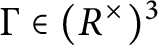 $\Gamma \in (R^\times )^3$
. The map
$\Gamma \in (R^\times )^3$
. The map $\iota :{\mathbf {Aut}}({\mathcal {M}})\to {\mathbf {Aut}}(H({\mathcal {M}},\Gamma ))$
defined, for each R-ring S and each
$\iota :{\mathbf {Aut}}({\mathcal {M}})\to {\mathbf {Aut}}(H({\mathcal {M}},\Gamma ))$
defined, for each R-ring S and each $(t_1,t_2,t_3)\in {\mathbf {Aut}}({\mathcal {M}})(S)$
, by
$(t_1,t_2,t_3)\in {\mathbf {Aut}}({\mathcal {M}})(S)$
, by
 $$\begin{align*}\iota(t_1,t_2,t_3)\left(\sum \alpha_i e_{i} + \sum u_i[jl]\right)=\sum \alpha_i e_{i} + \sum t_i(u_i)[jl]\end{align*}$$
is a monomorphism of groups.
Proof Set $A=H({\mathcal {M}},\Gamma )$
. We first show that
$A=H({\mathcal {M}},\Gamma )$
. We first show that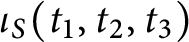 $\iota _S(t_1,t_2,t_3)$
is an automorphism of
$\iota _S(t_1,t_2,t_3)$
is an automorphism of $A_S$
for each
$A_S$
for each $(t_1,t_2,t_3)\in {\mathbf {Aut}}(\mathcal M)(S)$
, S an R-ring. As it is linear, by [Reference PeterssonP, Corollary 18], it suffices to show that it fixes the unity and preserves the cubic norm. The first condition is satisfied by construction; as for the second, recall that
$(t_1,t_2,t_3)\in {\mathbf {Aut}}(\mathcal M)(S)$
, S an R-ring. As it is linear, by [Reference PeterssonP, Corollary 18], it suffices to show that it fixes the unity and preserves the cubic norm. The first condition is satisfied by construction; as for the second, recall that
 $$\begin{align*}N(x)=\alpha_1\alpha_2\alpha_3+\gamma_1\gamma_2\gamma_3\langle m(u_3,u_2),u_1\rangle_1-\sum\gamma_j\gamma_l\alpha_i q_i(u_i);\end{align*}$$
thus since $t_i$
is an isometry with respect to
$t_i$
is an isometry with respect to $q_i$
for each i, the norm is preserved by
$q_i$
for each i, the norm is preserved by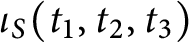 $\iota _S(t_1,t_2,t_3)$
if and only if
$\iota _S(t_1,t_2,t_3)$
if and only if
 $$\begin{align*}\langle m(t_3(u_3),t_2(u_2)),t_1(u_1)\rangle_1=\langle m(u_3,u_2),u_1\rangle_1.\end{align*}$$
By definition of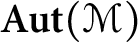 ${\mathbf {Aut}}({\mathcal {M}})$
, the left-hand side is equal to
${\mathbf {Aut}}({\mathcal {M}})$
, the left-hand side is equal to $\langle t_1(m(u_3,u_2)),t_1(u_1)\rangle _1$
, which is equal to the right-hand side since
$\langle t_1(m(u_3,u_2)),t_1(u_1)\rangle _1$
, which is equal to the right-hand side since $t_1$
is an isometry. The map
$t_1$
is an isometry. The map $\iota $
is further clearly natural, respects composition and is injective, whence the claim follows. ▪
$\iota $
is further clearly natural, respects composition and is injective, whence the claim follows. ▪
To understand the quotient ${\mathbf {Aut}}(A)/\iota ({\mathbf {Aut}}({\mathcal {M}}))$
, we will extend the approach of [Reference Alberca Bjerregaard, Loos and Martín GonzálezALM].
${\mathbf {Aut}}(A)/\iota ({\mathbf {Aut}}({\mathcal {M}}))$
, we will extend the approach of [Reference Alberca Bjerregaard, Loos and Martín GonzálezALM].
Definition 3.12 Let A be an Albert algebra over R. A frame for A is a triple $(c_1,c_2,c_3)\in A^3$
such that
$(c_1,c_2,c_3)\in A^3$
such that
-
1
$U_{c_i}1=c_i$
,
$U_{c_i}c_j=\delta _{ij}$
and
$\sum _i c_i=1$
, and -
2 the module
$U_{c_i}A$
has rank
$1$
.
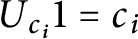
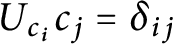
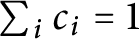


The first condition states that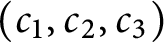 $(c_1,c_2,c_3)$
is a complete set of idempotents, and the module
$(c_1,c_2,c_3)$
is a complete set of idempotents, and the module $U_{c}A$
, for an idempotent
$U_{c}A$
, for an idempotent $c\in A$
, is the Peirce 2-space of c, which is known to be a direct summand of A by Peirce decomposition, and hence is projective. The arguments of [Reference Alberca Bjerregaard, Loos and Martín GonzálezALM, 4.5] (using [Reference Colliot-Thélène and SansucCTS, 6.12]) show that the functor
$c\in A$
, is the Peirce 2-space of c, which is known to be a direct summand of A by Peirce decomposition, and hence is projective. The arguments of [Reference Alberca Bjerregaard, Loos and Martín GonzálezALM, 4.5] (using [Reference Colliot-Thélène and SansucCTS, 6.12]) show that the functor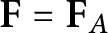 ${\mathbf {F}}={\mathbf {F}}_A$
from the category of R-rings to that of sets, defined by
${\mathbf {F}}={\mathbf {F}}_A$
from the category of R-rings to that of sets, defined by ${\mathbf {F}}(S)$
being the set of all frames for
${\mathbf {F}}(S)$
being the set of all frames for $A_S$
, is an affine R-scheme. It should be mentioned that there is an extensive theory of frames in Jordan algebras, into which we shall not delve, the notion introduced above being the particular case we need for our purposes. The interested reader may consult [Reference Petersson and RacinePR].
$A_S$
, is an affine R-scheme. It should be mentioned that there is an extensive theory of frames in Jordan algebras, into which we shall not delve, the notion introduced above being the particular case we need for our purposes. The interested reader may consult [Reference Petersson and RacinePR].
Example 3.13 If $A=H({\mathcal {M}},\Gamma )$
, then the triple
$A=H({\mathcal {M}},\Gamma )$
, then the triple ${\mathbf {e}}=(e_1,e_2,e_3)$
is a frame for A, which we will call the distinguished frame of A.
${\mathbf {e}}=(e_1,e_2,e_3)$
is a frame for A, which we will call the distinguished frame of A.
Proposition 3.14 Let $A=H({\mathcal {M}},\Gamma )$
. Under the natural action of
$A=H({\mathcal {M}},\Gamma )$
. Under the natural action of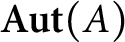 ${\mathbf {Aut}}(A)$
on
${\mathbf {Aut}}(A)$
on ${\mathbf {F}}_A$
the stabiliser of
${\mathbf {F}}_A$
the stabiliser of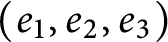 $(e_1,e_2,e_3)$
is
$(e_1,e_2,e_3)$
is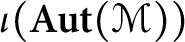 $\iota ({\mathbf {Aut}}({\mathcal {M}}))$
.
$\iota ({\mathbf {Aut}}({\mathcal {M}}))$
.
Proof Let ${\mathbf {H}}\subseteq {\mathbf {Aut}} A$
be the stabiliser of
${\mathbf {H}}\subseteq {\mathbf {Aut}} A$
be the stabiliser of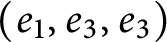 $(e_1,e_3,e_3)$
. This is a finitely presented group scheme and, by construction, it is clear that
$(e_1,e_3,e_3)$
. This is a finitely presented group scheme and, by construction, it is clear that $\iota ({\mathbf {Aut}}({\mathcal {M}}))\subseteq {\mathbf {H}}$
. To check that this inclusion is an equality, it suffices to do so locally with respect to the fppf topology. We may thus assume that
$\iota ({\mathbf {Aut}}({\mathcal {M}}))\subseteq {\mathbf {H}}$
. To check that this inclusion is an equality, it suffices to do so locally with respect to the fppf topology. We may thus assume that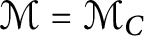 ${\mathcal {M}}={\mathcal {M}}_C$
for a para-octonion algebra C. Recall that then,
${\mathcal {M}}={\mathcal {M}}_C$
for a para-octonion algebra C. Recall that then, ${\mathbf {Aut}}({\mathcal {M}})={\mathbf {RT}}(C)$
. By [Reference Alberca Bjerregaard, Loos and Martín GonzálezALM, 4.6], the inclusion
${\mathbf {Aut}}({\mathcal {M}})={\mathbf {RT}}(C)$
. By [Reference Alberca Bjerregaard, Loos and Martín GonzálezALM, 4.6], the inclusion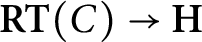 ${\mathbf {RT}}(C)\to {\mathbf {H}}$
is an isomorphism on each geometric fibre in the case
${\mathbf {RT}}(C)\to {\mathbf {H}}$
is an isomorphism on each geometric fibre in the case $\Gamma ={\mathbf {1}} := (1,1,1)$
, and in the general case since over an algebraically closed field,
$\Gamma ={\mathbf {1}} := (1,1,1)$
, and in the general case since over an algebraically closed field, ${\mathbf {Aut}}(H(C,\Gamma ))\simeq {\mathbf {Aut}}(H(C,{\mathbf {1}}))$
via an isomorphism that maps
${\mathbf {Aut}}(H(C,\Gamma ))\simeq {\mathbf {Aut}}(H(C,{\mathbf {1}}))$
via an isomorphism that maps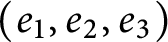 $(e_1,e_2,e_3)$
to itself and commutes with the inclusion of
$(e_1,e_2,e_3)$
to itself and commutes with the inclusion of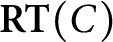 ${\mathbf {RT}}(C)$
. Since
${\mathbf {RT}}(C)$
. Since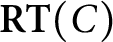 ${\mathbf {RT}}(C)$
is smooth, hence flat, and of finite presentation, we conclude with the fibre-wise isomorphism criterion [Reference GrothendieckEGAIV,
${\mathbf {RT}}(C)$
is smooth, hence flat, and of finite presentation, we conclude with the fibre-wise isomorphism criterion [Reference GrothendieckEGAIV, ${}_4$
.17.9.5] and the fact that the property of being an isomorphism over fields is preserved under descent from an algebraic closure. ▪
${}_4$
.17.9.5] and the fact that the property of being an isomorphism over fields is preserved under descent from an algebraic closure. ▪
Proposition 3.15 Let $A=H(\mathcal M,\Gamma )$
. The map
$A=H(\mathcal M,\Gamma )$
. The map $\Sigma :{\mathbf {Aut}}(A)\to {\mathbf {F}}_A$
, defined by
$\Sigma :{\mathbf {Aut}}(A)\to {\mathbf {F}}_A$
, defined by $\rho \mapsto (\phi (e_i))_i$
for any R-ring S and
$\rho \mapsto (\phi (e_i))_i$
for any R-ring S and $\rho \in {\mathbf {Aut}}(A)(S)$
, induces an isomorphism between the fppf quotient
$\rho \in {\mathbf {Aut}}(A)(S)$
, induces an isomorphism between the fppf quotient ${\mathbf {Aut}}(A)/\iota ({\mathbf {Aut}}({\mathcal {M}}))$
and
${\mathbf {Aut}}(A)/\iota ({\mathbf {Aut}}({\mathcal {M}}))$
and ${\mathbf {F}}_A$
.
${\mathbf {F}}_A$
.
Proof With respect to the fppf topology,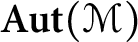 ${\mathbf {Aut}}({\mathcal {M}})$
is locally isomorphic to the smooth group
${\mathbf {Aut}}({\mathcal {M}})$
is locally isomorphic to the smooth group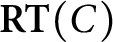 ${\mathbf {RT}}(C)$
for a para-octonion R-algebra C. Therefore
${\mathbf {RT}}(C)$
for a para-octonion R-algebra C. Therefore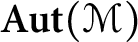 ${\mathbf {Aut}}({\mathcal {M}})$
is smooth, and the quotient is representable by a scheme, which is smooth since so is
${\mathbf {Aut}}({\mathcal {M}})$
is smooth, and the quotient is representable by a scheme, which is smooth since so is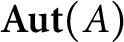 ${\mathbf {Aut}}(A)$
. By the fibre-wise isomorphism criterion [Reference GrothendieckEGAIV,
${\mathbf {Aut}}(A)$
. By the fibre-wise isomorphism criterion [Reference GrothendieckEGAIV, ${}_4$
17.9.5] and the fact that the property of being an isomorphism over fields is preserved under descent from an algebraic closure, it suffices to check that the induced map is an isomorphism on geometric fibres. We may thus assume that R is an algebraically closed field. But then
${}_4$
17.9.5] and the fact that the property of being an isomorphism over fields is preserved under descent from an algebraic closure, it suffices to check that the induced map is an isomorphism on geometric fibres. We may thus assume that R is an algebraically closed field. But then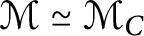 ${\mathcal {M}}\simeq {\mathcal {M}}_C$
for some para-octonion algebra C, and
${\mathcal {M}}\simeq {\mathcal {M}}_C$
for some para-octonion algebra C, and ${\mathbf {Aut}}(H({\mathcal {M}},\Gamma ))\simeq {\mathbf {Aut}}(H(C,\Gamma ))\simeq {\mathbf {Aut}}(H(C,{\mathbf {1}}))$
. It thus suffices to consider the case where the quotient in question is
${\mathbf {Aut}}(H({\mathcal {M}},\Gamma ))\simeq {\mathbf {Aut}}(H(C,\Gamma ))\simeq {\mathbf {Aut}}(H(C,{\mathbf {1}}))$
. It thus suffices to consider the case where the quotient in question is ${\mathbf {Aut}}(H(C,{\mathbf {1}}))/{\mathbf {RT}}(C)$
, in which we conclude with [Reference Alberca Bjerregaard, Loos and Martín GonzálezALM, 4.6]. ▪
${\mathbf {Aut}}(H(C,{\mathbf {1}}))/{\mathbf {RT}}(C)$
, in which we conclude with [Reference Alberca Bjerregaard, Loos and Martín GonzálezALM, 4.6]. ▪
Similarly to the previous section, this defines an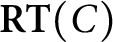 ${\mathbf {RT}}(C)$
-torsor over
${\mathbf {RT}}(C)$
-torsor over ${\mathbf {F}}_A$
for the fppf topology, and we denote by
${\mathbf {F}}_A$
for the fppf topology, and we denote by ${\mathbf {E}}^{\mathbf {c}}$
the fibre of
${\mathbf {E}}^{\mathbf {c}}$
the fibre of $\mathbf {c}=(c_1,c_2,c_3)\in {\mathbf {F}}_A(R)$
. The main result of this section is that this torsor is in general nontrivial, even in the split case.
$\mathbf {c}=(c_1,c_2,c_3)\in {\mathbf {F}}_A(R)$
. The main result of this section is that this torsor is in general nontrivial, even in the split case.
Theorem 3.16 If C is the para-octonion algebra of the (split) complex octonion algebra O, then there exists a smooth $\mathbb C$
-ring S and a composition
$\mathbb C$
-ring S and a composition ${\mathcal {M}}$
of quadratic forms over S with
${\mathcal {M}}$
of quadratic forms over S with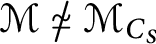 ${\mathcal {M}}\not \simeq {\mathcal {M}}_{C_S}$
and such that
${\mathcal {M}}\not \simeq {\mathcal {M}}_{C_S}$
and such that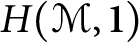 $H({\mathcal {M}},{\mathbf {1}})$
is isomorphic to
$H({\mathcal {M}},{\mathbf {1}})$
is isomorphic to $H_3(O,{\mathbf {1}})=H({\mathcal {M}}_C,{\mathbf {1}})$
.
$H_3(O,{\mathbf {1}})=H({\mathcal {M}}_C,{\mathbf {1}})$
.
Proof We have $O=O_0\otimes _{\mathbb R}\mathbb C$
, where
$O=O_0\otimes _{\mathbb R}\mathbb C$
, where $O_0$
is the real division octonion algebra. The quadratic form of
$O_0$
is the real division octonion algebra. The quadratic form of $O_0$
is the Euclidean form
$O_0$
is the Euclidean form $x\mapsto x_1^2+\cdots + x_8^2$
. Let
$x\mapsto x_1^2+\cdots + x_8^2$
. Let $C_0$
be the corresponding real para-octonion algebra, so that
$C_0$
be the corresponding real para-octonion algebra, so that $C=C_0\otimes _{\mathbb R}\mathbb C$
. It is known (see e.g. [Reference Alsaody and GilleAG]) that
$C=C_0\otimes _{\mathbb R}\mathbb C$
. It is known (see e.g. [Reference Alsaody and GilleAG]) that ${\mathbf {RT}}(C_0)\simeq {\mathbf {Spin}}_{8,\mathbb R}$
, which is anisotropic, and from [Reference JacobsonJ1] we know that
${\mathbf {RT}}(C_0)\simeq {\mathbf {Spin}}_{8,\mathbb R}$
, which is anisotropic, and from [Reference JacobsonJ1] we know that ${\mathbf {Aut}}(H_3(O_0,{\mathbf {1}}))$
is anisotropic of type
${\mathbf {Aut}}(H_3(O_0,{\mathbf {1}}))$
is anisotropic of type $\mathrm F_4$
. From [Reference MimuraMi] we know that
$\mathrm F_4$
. From [Reference MimuraMi] we know that $\pi _n({\mathbf {Spin}}_8(\mathbb R))$
contains
$\pi _n({\mathbf {Spin}}_8(\mathbb R))$
contains $\pi _n({\mathbf {Spin}}_7(\mathbb R))$
as a direct factor, that
$\pi _n({\mathbf {Spin}}_7(\mathbb R))$
as a direct factor, that $\pi _7({\mathbf {Spin}}_7(\mathbb R))\simeq \mathbb Z$
and that the seventh homotopy group of the compact group of type
$\pi _7({\mathbf {Spin}}_7(\mathbb R))\simeq \mathbb Z$
and that the seventh homotopy group of the compact group of type $\mathrm F_4$
is trivial, and thus does not contain a direct factor isomorphic to
$\mathrm F_4$
is trivial, and thus does not contain a direct factor isomorphic to $\pi _7({\mathbf {Spin}}_{8,\mathbb R}(\mathbb R))$
. Now the complex Lie group
$\pi _7({\mathbf {Spin}}_{8,\mathbb R}(\mathbb R))$
. Now the complex Lie group ${\mathbf {RT}}(C)(\mathbb C)\simeq {\mathbf {Spin}}_{8,\mathbb R}(\mathbb C)$
contains
${\mathbf {RT}}(C)(\mathbb C)\simeq {\mathbf {Spin}}_{8,\mathbb R}(\mathbb C)$
contains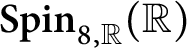 ${\mathbf {Spin}}_{8,\mathbb R}(\mathbb R)$
as a maximal compact subgroup, and
${\mathbf {Spin}}_{8,\mathbb R}(\mathbb R)$
as a maximal compact subgroup, and ${\mathbf {Aut}}(H_3(O,{\mathbf {1}}))(\mathbb C)$
contains
${\mathbf {Aut}}(H_3(O,{\mathbf {1}}))(\mathbb C)$
contains ${\mathbf {Aut}}(H_3(O_0,{\mathbf {1}}))(\mathbb R)$
as a maximal compact subgroup. As in the proof of Theorem 2.7, it follows by Cartan decomposition that the homotopy groups of these complex Lie groups coincide with those of their maximal compact subgroups. Since
${\mathbf {Aut}}(H_3(O_0,{\mathbf {1}}))(\mathbb R)$
as a maximal compact subgroup. As in the proof of Theorem 2.7, it follows by Cartan decomposition that the homotopy groups of these complex Lie groups coincide with those of their maximal compact subgroups. Since $\mathbf {F}_A$
is affine, we conclude with Lemma 1.4 and Remark 1.2, since the quotient of a smooth group by a smooth group is smooth. ▪
$\mathbf {F}_A$
is affine, we conclude with Lemma 1.4 and Remark 1.2, since the quotient of a smooth group by a smooth group is smooth. ▪
3.3 Compositions of Quadratic Forms and Circle Products
The above theorem states that $H({\mathcal {M}},{\mathbf {1}})\simeq H({\mathcal {M}}',{\mathbf {1}})$
may occur when
$H({\mathcal {M}},{\mathbf {1}})\simeq H({\mathcal {M}}',{\mathbf {1}})$
may occur when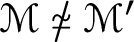 ${\mathcal {M}}\not \simeq {\mathcal {M}}'$
, and Proposition 3.15 implies that those
${\mathcal {M}}\not \simeq {\mathcal {M}}'$
, and Proposition 3.15 implies that those ${\mathcal {M}}'$
with
${\mathcal {M}}'$
with $H({\mathcal {M}}',{\mathbf {1}})\simeq H({\mathcal {M}},{\mathbf {1}})$
are obtained as the twists
$H({\mathcal {M}}',{\mathbf {1}})\simeq H({\mathcal {M}},{\mathbf {1}})$
are obtained as the twists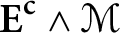 ${\mathbf {E}}^{\mathbf {c}}\wedge {\mathcal {M}}$
as
${\mathbf {E}}^{\mathbf {c}}\wedge {\mathcal {M}}$
as ${\mathbf {c}}$
runs through the frames of
${\mathbf {c}}$
runs through the frames of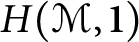 $H({\mathcal {M}},{\mathbf {1}})$
. In this section, we set out to describe these twists explicitly. To this end, we shall use the circle product of Jordan algebras, defined by
$H({\mathcal {M}},{\mathbf {1}})$
. In this section, we set out to describe these twists explicitly. To this end, we shall use the circle product of Jordan algebras, defined by $x\circ y=\{x1y\}$
in terms of the triple product.
$x\circ y=\{x1y\}$
in terms of the triple product.
Remark 3.17 If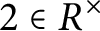 $2\in R^\times $
, then J carries the structure of a linear Jordan algebra with bilinear product
$2\in R^\times $
, then J carries the structure of a linear Jordan algebra with bilinear product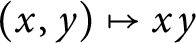 $(x,y)\mapsto xy$
defined by
$(x,y)\mapsto xy$
defined by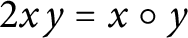 $2xy=x\circ y$
.
$2xy=x\circ y$
.
Let $A = H(\mathcal{M},\ \Gamma),\ {\mathbf {c}}=(c_1,c_2,c_3)\in {{F}}_A(R)$
, and for any permutation
$A = H(\mathcal{M},\ \Gamma),\ {\mathbf {c}}=(c_1,c_2,c_3)\in {{F}}_A(R)$
, and for any permutation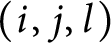 $(i,j,l)$
of
$(i,j,l)$
of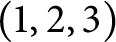 $(1,2,3)$
, set
$(1,2,3)$
, set
 $$\begin{align*}C_{l}^{\mathbf{\,c}}=A_1(c_i)\cap A_1(c_j),\end{align*}$$
where the Peirce 1-space of an idempotent c is defined as
 $$\begin{align*}A_1(c)=\{x\in A| c\circ x=x\}.\end{align*}$$
Lemma 3.18 The restriction of the quadratic trace $S:x\mapsto T(x^\sharp ,1)$
to
$S:x\mapsto T(x^\sharp ,1)$
to $C_i^{\mathbf {\,c}}$
is a nonsingular quadratic form of constant rank
$C_i^{\mathbf {\,c}}$
is a nonsingular quadratic form of constant rank $8$
.
$8$
.
Proof The quadratic trace being a quadratic form, so is its restriction to $C_i^{\mathbf {\,c}}$
. Since nonsingularity and rank are invariant under faithfully flat descent, it suffices to prove the statement after a faithfully flat extension S of R. By Proposition 3.15, one can choose S such that
$C_i^{\mathbf {\,c}}$
. Since nonsingularity and rank are invariant under faithfully flat descent, it suffices to prove the statement after a faithfully flat extension S of R. By Proposition 3.15, one can choose S such that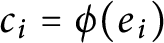 $c_i=\phi (e_i)$
for some
$c_i=\phi (e_i)$
for some $\phi \in {\mathbf {Aut}}(A)(S)$
. Thus
$\phi \in {\mathbf {Aut}}(A)(S)$
. Thus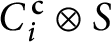 $C_i^{\mathbf {\,c}}\otimes S$
is the image of
$C_i^{\mathbf {\,c}}\otimes S$
is the image of ${C_{i}}_S$
, which is of rank
${C_{i}}_S$
, which is of rank $8$
, and the quadratic form in question is the transfer of the restriction of the quadratic trace to
$8$
, and the quadratic form in question is the transfer of the restriction of the quadratic trace to ${C_{i}}_S$
, which by Proposition 3.9 is an invertible scalar multiple of the nonsingular form
${C_{i}}_S$
, which by Proposition 3.9 is an invertible scalar multiple of the nonsingular form $q_i$
. This proves the statement. ▪
$q_i$
. This proves the statement. ▪
We write $q_i^{\mathbf {c}}$
for the negative of the restriction of the quadratic trace to
$q_i^{\mathbf {c}}$
for the negative of the restriction of the quadratic trace to $C_i^{\mathbf {c}}$
. The choice of sign is made for the next proposition to hold, which describes the essential ingredient in our twist.
$C_i^{\mathbf {c}}$
. The choice of sign is made for the next proposition to hold, which describes the essential ingredient in our twist.
Remark 3.19 For convenience we introduce some notation. Let $\Gamma =(\gamma _1,\gamma _2,\gamma _3)\in (R^\times )^3$
. If
$\Gamma =(\gamma _1,\gamma _2,\gamma _3)\in (R^\times )^3$
. If ${\mathcal {M}}=(C_1,C_2,C_3,q_1,q_2,q_3,m)$
is a composition of quadratic forms, then so is
${\mathcal {M}}=(C_1,C_2,C_3,q_1,q_2,q_3,m)$
is a composition of quadratic forms, then so is $(C_1,C_2,C_3,\gamma _2\gamma _3 q_1,\gamma _1\gamma _3 q_2,\gamma _1\gamma _2 q_3,\gamma _1 m)$
. We shall denote this composition by
$(C_1,C_2,C_3,\gamma _2\gamma _3 q_1,\gamma _1\gamma _3 q_2,\gamma _1\gamma _2 q_3,\gamma _1 m)$
. We shall denote this composition by $\Gamma {\mathcal {M}}$
.
$\Gamma {\mathcal {M}}$
.
Proposition 3.20 The circle product of $A=H({\mathcal {M}},\Gamma )$
defines a composition of quadratic forms
$A=H({\mathcal {M}},\Gamma )$
defines a composition of quadratic forms ${\mathcal {M}}^{\mathbf {c}}=(C_1^{\mathbf {c}},C_2^{\mathbf {c}},C_3^{\mathbf {c}},q_1^{\mathbf {c}},q_2^{\mathbf {c}},q_3^{\mathbf {c}},m_\circ ^{\mathbf {c}})$
of rank
${\mathcal {M}}^{\mathbf {c}}=(C_1^{\mathbf {c}},C_2^{\mathbf {c}},C_3^{\mathbf {c}},q_1^{\mathbf {c}},q_2^{\mathbf {c}},q_3^{\mathbf {c}},m_\circ ^{\mathbf {c}})$
of rank $8$
, where
$8$
, where $m_\circ ^{\mathbf {c}}$
is the restriction of
$m_\circ ^{\mathbf {c}}$
is the restriction of $\circ $
to
$\circ $
to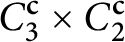 $C_3^{\mathbf {c}}\times C_2^{\mathbf {c}}$
. If
$C_3^{\mathbf {c}}\times C_2^{\mathbf {c}}$
. If ${\mathbf {c}}=(e_1,e_2,e_3)$
, then
${\mathbf {c}}=(e_1,e_2,e_3)$
, then ${\mathcal {M}}^{\mathbf {c}}$
is isomorphic to
${\mathcal {M}}^{\mathbf {c}}$
is isomorphic to $\Gamma {\mathcal {M}}$
. In that case the automorphism group of
$\Gamma {\mathcal {M}}$
. In that case the automorphism group of ${\mathcal {M}}^{\mathbf {c}}$
is
${\mathcal {M}}^{\mathbf {c}}$
is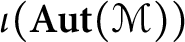 $\iota ({\mathbf {Aut}}({\mathcal {M}}))$
.
$\iota ({\mathbf {Aut}}({\mathcal {M}}))$
.
From this it follows that in particular, if $\Gamma ={\mathbf {1}}$
and
$\Gamma ={\mathbf {1}}$
and ${\mathbf {c}}=(e_1,e_2,e_3)$
, then
${\mathbf {c}}=(e_1,e_2,e_3)$
, then ${\mathcal {M}}^{\mathbf {c}}$
is isomorphic to
${\mathcal {M}}^{\mathbf {c}}$
is isomorphic to ${\mathcal {M}}$
; if in addition
${\mathcal {M}}$
; if in addition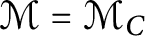 ${\mathcal {M}}={\mathcal {M}}_C$
for some symmetric composition algebra C, then
${\mathcal {M}}={\mathcal {M}}_C$
for some symmetric composition algebra C, then ${\mathcal {M}}^{\mathbf {c}}$
has automorphism group
${\mathcal {M}}^{\mathbf {c}}$
has automorphism group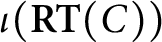 $\iota ({\mathbf {RT}}(C))$
.
$\iota ({\mathbf {RT}}(C))$
.
Proof If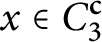 $x\in C_3^{\mathbf {c}}$
and
$x\in C_3^{\mathbf {c}}$
and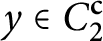 $y\in C_2^{\mathbf {c}}$
, then from [Reference Petersson and RacinePR, 34.12(c)] it follows that
$y\in C_2^{\mathbf {c}}$
, then from [Reference Petersson and RacinePR, 34.12(c)] it follows that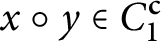 $x\circ y\in C_1^{\mathbf {c}}$
. To show the compatibility of quadratic forms, we must show that
$x\circ y\in C_1^{\mathbf {c}}$
. To show the compatibility of quadratic forms, we must show that $S(x\circ y)=-S(x)S(y)$
. We first assume that
$S(x\circ y)=-S(x)S(y)$
. We first assume that ${\mathbf {c}}=(e_1,e_2,e_3)$
. Writing
${\mathbf {c}}=(e_1,e_2,e_3)$
. Writing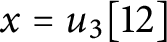 $x=u_3[12]$
and
$x=u_3[12]$
and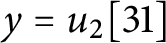 $y=u_2[31]$
we find, from (1.1) and the fact that x and y are orthogonal to 1 with respect to the bilinear trace, that
$y=u_2[31]$
we find, from (1.1) and the fact that x and y are orthogonal to 1 with respect to the bilinear trace, that
 $$\begin{align*}x\circ y=-(x\times y)\times 1.\end{align*}$$
From the formula for the adjoint in Proposition 3.9 we have $x\times y=\gamma _1m(u_3,u_2)[23]$
, and using the same formula again we find
$x\times y=\gamma _1m(u_3,u_2)[23]$
, and using the same formula again we find
 $$\begin{align*}x\circ y=-(x\times y)\times 1=\gamma_1m(u_3,u_2)[23].\end{align*}$$
By an easy computation, one finds that the quadratic trace satisfies $S(u_i[jl])=-\gamma _j\gamma _lq_i(u_i)$
, from which it follows that
$S(u_i[jl])=-\gamma _j\gamma _lq_i(u_i)$
, from which it follows that
 $$\begin{align*}S(x\circ y)=-\gamma_2\gamma_3q_1(\gamma_1 m(u_3,u_2))=-\gamma_1^2\gamma_2\gamma_3q_3(u_3)q_2(u_2)=-S(x)S(y)\end{align*}$$
as desired. This shows the first statement for this particular choice of ${\mathbf {c}}$
. For the general case, let
${\mathbf {c}}$
. For the general case, let $\lambda =S(x\circ y)+S(x)S(y)\in R$
. We need to show that
$\lambda =S(x\circ y)+S(x)S(y)\in R$
. We need to show that $\lambda =0$
, for which it suffices to show that
$\lambda =0$
, for which it suffices to show that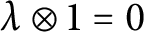 $\lambda \otimes 1=0$
in
$\lambda \otimes 1=0$
in $R\otimes _R R'=R'$
, where
$R\otimes _R R'=R'$
, where $R'$
is a faithfully flat R-ring. Now for any
$R'$
is a faithfully flat R-ring. Now for any $z\in A$
, writing
$z\in A$
, writing $S'$
,
$S'$
, $T'$
and
$T'$
and $\sharp '$
respectively for the quadratic trace, linear trace, and adjoint of
$\sharp '$
respectively for the quadratic trace, linear trace, and adjoint of $A_{R'}$
, we have
$A_{R'}$
, we have $(z\otimes 1)^{\sharp '}=z^{\sharp }\otimes 1$
by [Reference Petersson and RacinePR, 35.1] and thence by linearity of T,
$(z\otimes 1)^{\sharp '}=z^{\sharp }\otimes 1$
by [Reference Petersson and RacinePR, 35.1] and thence by linearity of T,
 $$\begin{align*}S'(z\otimes1)=T'((z\otimes 1)^{\sharp'})=T'(z^{\sharp}\otimes 1)=T(z^{\sharp})\otimes 1=S(z)\otimes 1.\end{align*}$$
This, together with the bilinearity of the circle product, implies that
 $$\begin{align*}\lambda\otimes 1=S'((x\otimes 1)\circ(y\otimes 1))+S'(x\otimes1)S'(y\otimes1).\end{align*}$$
By Proposition 3.15 we may choose $R'$
such that
$R'$
such that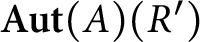 ${\mathbf {Aut}}(A)(R')$
acts transitively on the set of frames of
${\mathbf {Aut}}(A)(R')$
acts transitively on the set of frames of $A_{R'}$
. Thus there is
$A_{R'}$
. Thus there is $\phi \in {\mathbf {Aut}}(A)(R')$
with
$\phi \in {\mathbf {Aut}}(A)(R')$
with $\phi (c_i\otimes 1)=e_i\otimes 1$
, and since
$\phi (c_i\otimes 1)=e_i\otimes 1$
, and since $\phi $
preserves
$\phi $
preserves $S'$
and respects the circle product, we have
$S'$
and respects the circle product, we have
 $$\begin{align*}\lambda\otimes 1=S'(\phi(x\otimes 1)\circ\phi(y\otimes 1))+S'(\phi(x\otimes1))S'(\phi(y\otimes1)).\end{align*}$$
Since $\phi (C_i^{\mathbf {c}}\otimes R')=C_i\otimes R'$
, we are back to the special case treated above, from which we conclude that
$\phi (C_i^{\mathbf {c}}\otimes R')=C_i\otimes R'$
, we are back to the special case treated above, from which we conclude that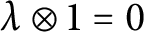 $\lambda \otimes 1=0$
as desired. This proves the first statement.
$\lambda \otimes 1=0$
as desired. This proves the first statement.
The second statement follows since by the above, ${\mathcal {M}}^{\mathbf {c}}\simeq \Gamma {\mathcal {M}}$
for this choice of
${\mathcal {M}}^{\mathbf {c}}\simeq \Gamma {\mathcal {M}}$
for this choice of ${\mathbf {c}}$
, and the third statement follows since the quadratic forms and the composition of
${\mathbf {c}}$
, and the third statement follows since the quadratic forms and the composition of ${\mathcal {M}}^{\mathbf {c}}$
are scalar multiples of those of
${\mathcal {M}}^{\mathbf {c}}$
are scalar multiples of those of ${\mathcal {M}}$
. ▪
${\mathcal {M}}$
. ▪
We can now give an explicit construction of the twist of a composition of quadratic forms by the above torsor.
Definition 3.21 Let ${\mathcal {M}}$
be a composition of quadratic forms of rank
${\mathcal {M}}$
be a composition of quadratic forms of rank $8$
, set
$8$
, set $A=H({\mathcal {M}},\Gamma )$
and let
$A=H({\mathcal {M}},\Gamma )$
and let ${\mathbf {c}}=(c_1,c_2,c_3)$
be a frame in A. The
${\mathbf {c}}=(c_1,c_2,c_3)$
be a frame in A. The $({\mathbf {c}},\Gamma )$
-deformation of
$({\mathbf {c}},\Gamma )$
-deformation of ${\mathcal {M}}$
is the composition
${\mathcal {M}}$
is the composition ${\mathcal {M}}^{\mathbf {c}}$
of quadratic forms, defined in Proposition 3.20.
${\mathcal {M}}^{\mathbf {c}}$
of quadratic forms, defined in Proposition 3.20.
Note that ${\mathcal {M}}^{\mathbf {c}}$
is determined uniquely by the datum
${\mathcal {M}}^{\mathbf {c}}$
is determined uniquely by the datum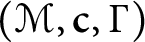 $({\mathcal {M}},{\mathbf {c}},\Gamma )$
. We will compare this to the twist
$({\mathcal {M}},{\mathbf {c}},\Gamma )$
. We will compare this to the twist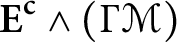 ${\mathbf {E}}^{\mathbf {c}}\wedge (\Gamma {\mathcal {M}})$
of
${\mathbf {E}}^{\mathbf {c}}\wedge (\Gamma {\mathcal {M}})$
of $\Gamma {\mathcal {M}}$
by the torsor
$\Gamma {\mathcal {M}}$
by the torsor ${\mathbf {E}}^{\mathbf {c}}$
defined at the end of Section 3.2.
${\mathbf {E}}^{\mathbf {c}}$
defined at the end of Section 3.2.
Remark 3.22 If ${\mathbf {E}}$
is any
${\mathbf {E}}$
is any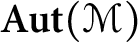 ${\mathbf {Aut}}({\mathcal {M}})$
-torsor over
${\mathbf {Aut}}({\mathcal {M}})$
-torsor over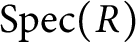 ${\mathrm {Spec}}(R)$
, then the twist
${\mathrm {Spec}}(R)$
, then the twist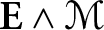 ${\mathbf {E}}\wedge {\mathcal {M}}$
is defined in analogy to twists of modules and algebras. Concretely, it is the fppf sheaf associated to the presheaf whose S-points, for each R-ring S, is the composition of quadratic forms constructed as follows. For each
${\mathbf {E}}\wedge {\mathcal {M}}$
is defined in analogy to twists of modules and algebras. Concretely, it is the fppf sheaf associated to the presheaf whose S-points, for each R-ring S, is the composition of quadratic forms constructed as follows. For each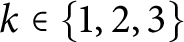 $k\in \{1,2,3\}$
, define the equivalence relation
$k\in \{1,2,3\}$
, define the equivalence relation $\sim _k$
on
$\sim _k$
on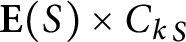 ${\mathbf {E}}(S)\times {C_k}_S$
by
${\mathbf {E}}(S)\times {C_k}_S$
by $(\phi ,x)\sim _k (\phi ',x')$
precisely when there exists
$(\phi ,x)\sim _k (\phi ',x')$
precisely when there exists $(t_1,t_2,t_3)\in {\mathbf {Aut}}({\mathcal {M}})$
such that
$(t_1,t_2,t_3)\in {\mathbf {Aut}}({\mathcal {M}})$
such that
 $$\begin{align*}(\phi,t_k(x))=(\phi'\cdot(t_1,t_2,t_3),x')),\end{align*}$$
where the right action $\cdot $
of
$\cdot $
of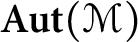 ${\mathbf {Aut}}({\mathcal {M}})$
on
${\mathbf {Aut}}({\mathcal {M}})$
on ${\mathbf {E}}$
is the one defining the torsor. Denote the equivalence class of
${\mathbf {E}}$
is the one defining the torsor. Denote the equivalence class of $(\phi ,x)$
under
$(\phi ,x)$
under $\sim _k$
by
$\sim _k$
by $[\phi ,x]$
. For each k, the set
$[\phi ,x]$
. For each k, the set $({\mathbf {E}}(S)\times {C_k}_S)/\sim _k$
is a quadratic S-module under the scalar multiplication
$({\mathbf {E}}(S)\times {C_k}_S)/\sim _k$
is a quadratic S-module under the scalar multiplication
 $$\begin{align*}\lambda[\phi,x]=[\phi, \lambda x]\end{align*}$$
and addition
 $$\begin{align*}[\phi,x]+[\psi,y]=[\phi, x+t_k(y)],\end{align*}$$
where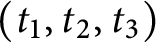 $(t_1,t_2,t_3)$
is uniquely defined by
$(t_1,t_2,t_3)$
is uniquely defined by $\psi =\phi \cdot (t_1,t_2,t_3)$
, and quadratic form
$\psi =\phi \cdot (t_1,t_2,t_3)$
, and quadratic form $[\phi ,x]\mapsto q_i(x)=-S(x)$
. Moreover we have a map
$[\phi ,x]\mapsto q_i(x)=-S(x)$
. Moreover we have a map
 $$\begin{align*}({\mathbf{E}}(S)\times {C_3}_S)/\sim_3\times ({\mathbf{E}}(S)\times {C_2}_S)/\sim_2\ \longrightarrow\ ({\mathbf{E}}(S)\times {C_1}_S)/\sim_1\end{align*}$$
defined by
 $$\begin{align*}([\phi,x],[\psi,y])\mapsto[\phi,m(x,t_2(y))],\end{align*}$$
where $t_2$
is given by
$t_2$
is given by $\psi =\phi \cdot (t_1,t_2,t_3)$
. These data define the desired composition of quadratic forms. Noting that
$\psi =\phi \cdot (t_1,t_2,t_3)$
. These data define the desired composition of quadratic forms. Noting that ${\mathbf {Aut}}({\mathcal {M}})={\mathbf {Aut}}(\Gamma {\mathcal {M}})$
, we can do the same after replacing
${\mathbf {Aut}}({\mathcal {M}})={\mathbf {Aut}}(\Gamma {\mathcal {M}})$
, we can do the same after replacing ${\mathcal {M}}$
by
${\mathcal {M}}$
by $\Gamma {\mathcal {M}}$
.
$\Gamma {\mathcal {M}}$
.
Theorem 3.23 Let ${\mathcal {M}}$
be a composition of quadratic forms of constant rank
${\mathcal {M}}$
be a composition of quadratic forms of constant rank $8$
and let
$8$
and let ${\mathbf {c}}=(c_1,c_2,c_3)$
be a frame in
${\mathbf {c}}=(c_1,c_2,c_3)$
be a frame in $A=H({\mathcal {M}},\Gamma )$
. The twist
$A=H({\mathcal {M}},\Gamma )$
. The twist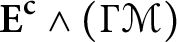 ${\mathbf {E}}^{\mathbf {c}}\wedge (\Gamma {\mathcal {M}})$
is canonically isomorphic to
${\mathbf {E}}^{\mathbf {c}}\wedge (\Gamma {\mathcal {M}})$
is canonically isomorphic to ${\mathcal {M}}^{\mathbf {c}}$
.
${\mathcal {M}}^{\mathbf {c}}$
.
Proof By Proposition 3.20, we may and will identify $\Gamma {\mathcal {M}}$
with
$\Gamma {\mathcal {M}}$
with ${\mathcal {M}}^{\mathbf {e}}$
for the distinguished frame
${\mathcal {M}}^{\mathbf {e}}$
for the distinguished frame ${\mathbf {e}}$
from Example 3.13, upon which
${\mathbf {e}}$
from Example 3.13, upon which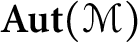 ${\mathbf {Aut}}({\mathcal {M}})$
acts via the inclusion
${\mathbf {Aut}}({\mathcal {M}})$
acts via the inclusion $\iota $
of Lemma 3.11. Consider the map
$\iota $
of Lemma 3.11. Consider the map $\Theta :{\mathbf {E}}^{\mathbf {c}}\wedge (\Gamma {\mathcal {M}})\to \mathcal {M}^{\mathbf {c}}$
induced by the maps
$\Theta :{\mathbf {E}}^{\mathbf {c}}\wedge (\Gamma {\mathcal {M}})\to \mathcal {M}^{\mathbf {c}}$
induced by the maps
 $$ \begin{align*}\begin{array}{ll} ({\mathbf{E}}(S)\times {C_k}_S)/\sim_k\ \to C_k^{\mathbf{c}}(S), & [\phi,x]\mapsto \phi(x), \end{array}\end{align*} $$
which is well-defined by definition of $\sim _k$
and the fact that if
$\sim _k$
and the fact that if $\phi \in {\mathbf {Aut}}(A)(S)$
maps
$\phi \in {\mathbf {Aut}}(A)(S)$
maps ${\mathbf {e}}$
to
${\mathbf {e}}$
to ${\mathbf {c}}$
, then it maps
${\mathbf {c}}$
, then it maps $C_k^{\mathbf {e}}$
to
$C_k^{\mathbf {e}}$
to $C_k^{\mathbf {c}}$
. It is straightforwardly checked that these maps are well-defined linear bijections of modules whenever
$C_k^{\mathbf {c}}$
. It is straightforwardly checked that these maps are well-defined linear bijections of modules whenever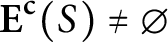 ${\mathbf {E}}^{\mathbf {c}}(S)\neq \emptyset $
. From Proposition 3.20 it follows that they respect the quadratic forms and are compatible with the composition. We conclude with the definition of the sheaf associated to a presheaf. ▪
${\mathbf {E}}^{\mathbf {c}}(S)\neq \emptyset $
. From Proposition 3.20 it follows that they respect the quadratic forms and are compatible with the composition. We conclude with the definition of the sheaf associated to a presheaf. ▪
4 Non-Isomorphic and Non-Isometric Coordinate Algebras
Over fields, a celebrated theorem that goes back, in its essential form, to Albert and Jacobson [Reference Albert and JacobsonAJ] (see [Reference PeterssonP, Theorem 21] for a more general statement) implies that for two octonion algebras C and $C'$
, we have
$C'$
, we have
 $$\begin{align*}H_3(C,{\mathbf{1}})\simeq H_3(C',{\mathbf{1}})\Longleftrightarrow q_C\simeq q_{C'}\Longleftrightarrow C\simeq C'.\end{align*}$$
By [Reference GilleG1], the second equivalence does not hold over arbitrary rings. In this section we consider the first equivalence and show that this also fails over rings in general. We begin by showing how a combination of known results implies that the first and third conditions are not equivalent over rings. (For visual clarity, we will, in this section, often use the notation ${\overline {C}}$
to denote the para-octonion algebra obtained from the octonion algebra C.)
${\overline {C}}$
to denote the para-octonion algebra obtained from the octonion algebra C.)
Proposition 4.1 There exists a smooth $\mathbb C$
-ring S and two octonion S-algebras C and
$\mathbb C$
-ring S and two octonion S-algebras C and $C'$
such that
$C'$
such that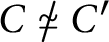 $C\not \simeq C'$
and
$C\not \simeq C'$
and $H_3(C,{\mathbf {1}})\simeq H_3(C',{\mathbf {1}})$
.
$H_3(C,{\mathbf {1}})\simeq H_3(C',{\mathbf {1}})$
.
Proof Set $A=H_3(C,{\mathbf {1}})$
. We need to show that the map
$A=H_3(C,{\mathbf {1}})$
. We need to show that the map
 $$\begin{align*}H^1(S,{\mathbf{Aut}}(C)){\longrightarrow} H^1(S,{\mathbf{Aut}} (A)),\end{align*}$$
induced by the subgroup inclusion, has nontrivial kernel for a smooth $\mathbb C$
-ring S and octonion S-algebra C. This inclusion is the composition of the inclusions
$\mathbb C$
-ring S and octonion S-algebra C. This inclusion is the composition of the inclusions $i: {\mathbf {RT}}({\overline {C}})\to {\mathbf {Aut}}(A)$
of Lemma 3.11 (noting that
$i: {\mathbf {RT}}({\overline {C}})\to {\mathbf {Aut}}(A)$
of Lemma 3.11 (noting that ${\mathbf {RT}}({\overline {C}})={\mathbf {Aut}}({\mathcal {M}}_{{\overline {C}}})$
) and
${\mathbf {RT}}({\overline {C}})={\mathbf {Aut}}({\mathcal {M}}_{{\overline {C}}})$
) and $j:{\mathbf {Aut}}(C)\to {\mathbf {RT}}({\overline {C}})$
defined by
$j:{\mathbf {Aut}}(C)\to {\mathbf {RT}}({\overline {C}})$
defined by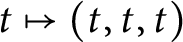 $t\mapsto (t,t,t)$
(see [Reference Alsaody and GilleAG, 3.5]). Thus the map of cohomologies factors as
$t\mapsto (t,t,t)$
(see [Reference Alsaody and GilleAG, 3.5]). Thus the map of cohomologies factors as
 $$\begin{align*}H^1(S,{\mathbf{Aut}}(C))\overset{j^*}{\longrightarrow}H^1(S,{\mathbf{RT}}({\overline{C}}))\overset{i^*}{\longrightarrow} H^1(S,{\mathbf{Aut}} A)\end{align*}$$
and has nontrivial kernel since by [Reference Alsaody and GilleAG, 4.3] (which is a variant of [Reference GilleG1, 3.5]), so does $j^*$
, for an appropriate (smooth) choice of S. This completes the proof. ▪
$j^*$
, for an appropriate (smooth) choice of S. This completes the proof. ▪
From [Reference Alsaody and GilleAG, 6.6] we know that two octonion algebras C and $C'$
have isometric norms if and only if the corresponding compositions
$C'$
have isometric norms if and only if the corresponding compositions ${\mathcal {M}}_{{\overline {C}}}$
and
${\mathcal {M}}_{{\overline {C}}}$
and ${\mathcal {M}}_{\overline {C'}}$
of quadratic forms are isomorphic. In the previous section we showed that nonisomorphic compositions of quadratic forms may give rise to isomorphic Albert algebras. To achieve our goal for this section, we need to refine this statement and show that nonisomorphic compositions of quadratic forms of the form
${\mathcal {M}}_{\overline {C'}}$
of quadratic forms are isomorphic. In the previous section we showed that nonisomorphic compositions of quadratic forms may give rise to isomorphic Albert algebras. To achieve our goal for this section, we need to refine this statement and show that nonisomorphic compositions of quadratic forms of the form ${\mathcal {M}}_{{\overline {C}}}$
may give rise to isomorphic Albert algebras.
${\mathcal {M}}_{{\overline {C}}}$
may give rise to isomorphic Albert algebras.
Let thus C be an octonion algebra over R and ${\overline {C}}$
the para-octonion algebra obtained from C. Recall that
${\overline {C}}$
the para-octonion algebra obtained from C. Recall that $H_3(C,{\mathbf {1}})=H({\mathcal {M}}_{{\overline {C}}},{\mathbf {1}})$
, and consider the inclusions
$H_3(C,{\mathbf {1}})=H({\mathcal {M}}_{{\overline {C}}},{\mathbf {1}})$
, and consider the inclusions $i: {\mathbf {RT}}({\overline {C}})={\mathbf {Aut}}({\mathcal {M}}_{{\overline {C}}})\to {\mathbf {Aut}}(A)$
and
$i: {\mathbf {RT}}({\overline {C}})={\mathbf {Aut}}({\mathcal {M}}_{{\overline {C}}})\to {\mathbf {Aut}}(A)$
and $j:{\mathbf {Aut}}(C)\to {\mathbf {RT}}({\overline {C}})$
from the proof of Proposition 4.1, and, for every R-ring S, the induced maps
$j:{\mathbf {Aut}}(C)\to {\mathbf {RT}}({\overline {C}})$
from the proof of Proposition 4.1, and, for every R-ring S, the induced maps
 $$\begin{align*}H^1(S,{\mathbf{Aut}}(C))\overset{j^*}{\longrightarrow}H^1(S,{\mathbf{RT}}({\overline{C}}))\overset{i^*}{\longrightarrow} H^1(S,{\mathbf{Aut}} A).\end{align*}$$
To show that there exists an octonion S-algebra $C'$
with
$C'$
with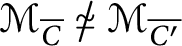 ${\mathcal {M}}_{{\overline {C}}}\not \simeq {\mathcal {M}}_{\overline {C'}}$
and
${\mathcal {M}}_{{\overline {C}}}\not \simeq {\mathcal {M}}_{\overline {C'}}$
and $A=H_3(C,{\mathbf {1}})\simeq H_3(C',{\mathbf {1}})$
, we need to prove that for some R-ring S there is a non-trivial element
$A=H_3(C,{\mathbf {1}})\simeq H_3(C',{\mathbf {1}})$
, we need to prove that for some R-ring S there is a non-trivial element $\eta \in {\mathrm {Ker}}(i^*)\cap \mathrm {Im}(j^*)=j^*({\mathrm {Ker}}(i^*j^*))$
.
$\eta \in {\mathrm {Ker}}(i^*)\cap \mathrm {Im}(j^*)=j^*({\mathrm {Ker}}(i^*j^*))$
.
Let $Z={\mathbf {Aut}}(A)/{\mathbf {Aut}}(C)$
and
$Z={\mathbf {Aut}}(A)/{\mathbf {Aut}}(C)$
and $Y={\mathbf {Aut}}(A)/{\mathbf {RT}}({\overline {C}})$
be the respective fppf quotients with quotient projections
$Y={\mathbf {Aut}}(A)/{\mathbf {RT}}({\overline {C}})$
be the respective fppf quotients with quotient projections $\pi _Z:{\mathbf {Aut}}(A)\to Z$
and
$\pi _Z:{\mathbf {Aut}}(A)\to Z$
and $\pi _Y:{\mathbf {Aut}}(A)\to Y$
. We will show that for some
$\pi _Y:{\mathbf {Aut}}(A)\to Y$
. We will show that for some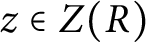 $z\in Z(R)$
, the
$z\in Z(R)$
, the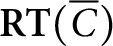 ${\mathbf {RT}}({\overline {C}})$
-torsor
${\mathbf {RT}}({\overline {C}})$
-torsor
 $$\begin{align*}\pi_Z^{-1}(z)\wedge^{{\mathbf{Aut}}(C)}{\mathbf{RT}}({\overline{C}})\end{align*}$$
is nontrivial for an appropriate choice of R. By Remark 1.3, the class of this torsor is the image under $j^*$
of the class of the torsor
$j^*$
of the class of the torsor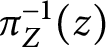 $\pi _Z^{-1}(z)$
. This implies, together with Remark 1.2, that for some R-ring S, this torsor has no S-point, and hence there is an octonion S-algebra
$\pi _Z^{-1}(z)$
. This implies, together with Remark 1.2, that for some R-ring S, this torsor has no S-point, and hence there is an octonion S-algebra $C'$
with the desired properties. We will therefore prove that the
$C'$
with the desired properties. We will therefore prove that the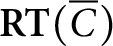 ${\mathbf {RT}} ({\overline {C}})$
-torsor
${\mathbf {RT}} ({\overline {C}})$
-torsor
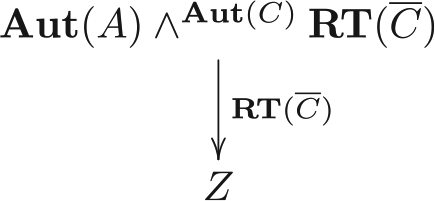
is nontrivial, i.e. does not admit a global section. The following proposition says that this is indeed the case in general. We refer the reader to Remark 1.3 for the definition of contracted products.
Theorem 4.2 The torsor (4.1) is nontrivial over $\mathbb R$
for the real division octonion algebra C.
$\mathbb R$
for the real division octonion algebra C.
The proof makes use of the following basic observation.
Lemma 4.3 Let G be a group scheme over R, H a subgroup scheme of G, and K a subgroup scheme of H. Then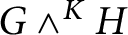 $G\wedge ^K H$
and
$G\wedge ^K H$
and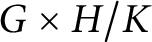 $G\times H/K$
are isomorphic as H-torsors over
$G\times H/K$
are isomorphic as H-torsors over $G/K$
. Here the right action of H on
$G/K$
. Here the right action of H on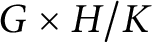 $G\times H/K$
is given by
$G\times H/K$
is given by $(g,x)\cdot h=(gh,h^{-1}x)$
and the structural projection
$(g,x)\cdot h=(gh,h^{-1}x)$
and the structural projection $G\times H/K\to G/K$
is induced by the product map
$G\times H/K\to G/K$
is induced by the product map $G\times H\to G, (g,h)\mapsto gh$
.
$G\times H\to G, (g,h)\mapsto gh$
.
Proof It is straightforwardly verified that the H-action and structural projection of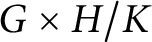 $G\times H/K$
are well-defined; they make
$G\times H/K$
are well-defined; they make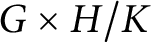 $G\times H/K$
an H-torsor over
$G\times H/K$
an H-torsor over $G/K$
since if over the R-ring S, the K-torsor
$G/K$
since if over the R-ring S, the K-torsor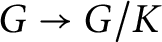 $G\to G/K$
admits a section
$G\to G/K$
admits a section $\sigma $
, then the structural projection of
$\sigma $
, then the structural projection of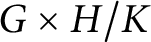 $G\times H/K$
admits the section
$G\times H/K$
admits the section $x\mapsto (\sigma (x),e)$
, where e is the image of the neutral element of H in
$x\mapsto (\sigma (x),e)$
, where e is the image of the neutral element of H in $H/K$
. To show that the two H-torsors in question are isomorphic over
$H/K$
. To show that the two H-torsors in question are isomorphic over $G/K$
, consider the map
$G/K$
, consider the map
 $$\begin{align*}\Theta:G\wedge^K H\to G\times H/K.\end{align*}$$
induced by the map $G\times H\to G\times H/K$
defined by
$G\times H\to G\times H/K$
defined by $(g,h)\mapsto (gh,\overline {h^{-1}})$
, where
$(g,h)\mapsto (gh,\overline {h^{-1}})$
, where $\overline {h^{-1}}$
is the quotient image of
$\overline {h^{-1}}$
is the quotient image of $h^{-1}$
. This map is invariant with respect to the quotient defining the contracted product. The fact that the induced map is H-invariant and lifts the identity of
$h^{-1}$
. This map is invariant with respect to the quotient defining the contracted product. The fact that the induced map is H-invariant and lifts the identity of $G/K$
can be straightforwardly verified on the level of presheaves. We conclude with the universal property of the sheaf associated to a presheaf and the fact that any morphism of torsors is an isomorphism. ▪
$G/K$
can be straightforwardly verified on the level of presheaves. We conclude with the universal property of the sheaf associated to a presheaf and the fact that any morphism of torsors is an isomorphism. ▪
Proof of Theorem 4.2 The lemma above implies that the two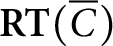 ${\mathbf {RT}}({\overline {C}})$
-torsors
${\mathbf {RT}}({\overline {C}})$
-torsors
 $$\begin{align*}{\mathbf{Aut}}(A)\wedge^{{\mathbf{Aut}}(C)}{\mathbf{RT}}({\overline{C}})\end{align*}$$
and
 $$\begin{align*}{\mathbf{Aut}}(A)\times {\mathbf{RT}}({\overline{C}})/{\mathbf{Aut}}(C)\end{align*}$$
over ${\mathbf {Aut}}(A)/{\mathbf {Aut}}(C)$
, which is representable by an affine scheme by [Reference Colliot-Thélène and SansucCTS, 6.12], are isomorphic. By [Reference Alsaody and GilleAG, Theorem 4.1], the quotient
${\mathbf {Aut}}(A)/{\mathbf {Aut}}(C)$
, which is representable by an affine scheme by [Reference Colliot-Thélène and SansucCTS, 6.12], are isomorphic. By [Reference Alsaody and GilleAG, Theorem 4.1], the quotient ${\mathbf {RT}}({\overline {C}})/{\mathbf {Aut}}(C)$
is isomorphic to the product of two copies of the Euclidean 7-sphere
${\mathbf {RT}}({\overline {C}})/{\mathbf {Aut}}(C)$
is isomorphic to the product of two copies of the Euclidean 7-sphere $\mathbb {S}_7$
. Using Lemma 1.4 and arguing as in the proof of Theorem 3.16, it thus suffices to show that for some n,
$\mathbb {S}_7$
. Using Lemma 1.4 and arguing as in the proof of Theorem 3.16, it thus suffices to show that for some n, $\pi _n({\mathbf {Spin}}_8(\mathbb R))$
is not a direct factor in
$\pi _n({\mathbf {Spin}}_8(\mathbb R))$
is not a direct factor in
 $$\begin{align*}\Gamma=\pi_n({\mathbf{Aut}}(A)(\mathbb R))\times\pi_n(\mathbb{S}_7(\mathbb R))^2.\end{align*}$$
Now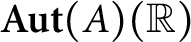 ${\mathbf {Aut}}(A)(\mathbb R)$
is compact of type
${\mathbf {Aut}}(A)(\mathbb R)$
is compact of type $\mathrm F_4$
. We know from [Reference SerreSe] that
$\mathrm F_4$
. We know from [Reference SerreSe] that $\pi _{14}(\mathbb {S}_7)\simeq \mathbb {Z}_{120}$
, while from [Reference MimuraMi] we get
$\pi _{14}(\mathbb {S}_7)\simeq \mathbb {Z}_{120}$
, while from [Reference MimuraMi] we get $\pi _{14}({\mathbf {Aut}}(A)(\mathbb R))\simeq \mathbb {Z}_2$
. Thus in particular
$\pi _{14}({\mathbf {Aut}}(A)(\mathbb R))\simeq \mathbb {Z}_2$
. Thus in particular $\Gamma $
has no direct factor isomorphic to
$\Gamma $
has no direct factor isomorphic to $\mathbb {Z}_7$
, which, by [Reference MimuraMi] is a direct factor of
$\mathbb {Z}_7$
, which, by [Reference MimuraMi] is a direct factor of $\pi _{14}({\mathbf {Spin}}_8(\mathbb R))$
. This completes the proof. ▪
$\pi _{14}({\mathbf {Spin}}_8(\mathbb R))$
. This completes the proof. ▪
Corollary 4.4 There exists a smooth $\mathbb {R}$
-ring S and octonion S-algebras C and
$\mathbb {R}$
-ring S and octonion S-algebras C and $C'$
such that
$C'$
such that $H_3(C,{\mathbf {1}})\simeq H_3(C',{\mathbf {1}})$
and
$H_3(C,{\mathbf {1}})\simeq H_3(C',{\mathbf {1}})$
and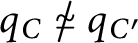 $q_C\not \simeq q_{C'}$
.
$q_C\not \simeq q_{C'}$
.
Proof Let $C_0$
be the real division octonion algebra. Since
$C_0$
be the real division octonion algebra. Since ${\mathbf {Aut}}(H_3(C_0,{\mathbf {1}}))$
and
${\mathbf {Aut}}(H_3(C_0,{\mathbf {1}}))$
and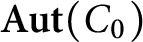 ${\mathbf {Aut}}(C_0)$
are smooth, so is their quotient, and it follows from Theorem 4.2 and Remark 1.2 that there exists a smooth
${\mathbf {Aut}}(C_0)$
are smooth, so is their quotient, and it follows from Theorem 4.2 and Remark 1.2 that there exists a smooth $\mathbb R$
-ring S and an octonion S-algebra
$\mathbb R$
-ring S and an octonion S-algebra $C'$
with
$C'$
with $H_3(C)\simeq H_3(C')$
and
$H_3(C)\simeq H_3(C')$
and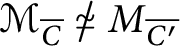 ${\mathcal {M}}_{{\overline {C}}}\not \simeq M_{\overline {C'}}$
, where
${\mathcal {M}}_{{\overline {C}}}\not \simeq M_{\overline {C'}}$
, where $C=C_0\otimes _{\mathbb R} S$
. If
$C=C_0\otimes _{\mathbb R} S$
. If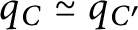 $q_C\simeq q_{C'}$
, then the class of
$q_C\simeq q_{C'}$
, then the class of $C'$
is in the kernel of the map
$C'$
is in the kernel of the map $H^1(S,{\mathbf {Aut}}(C))\to H^1(S,\mathbf {O}(q_C))$
induced by the inclusion
$H^1(S,{\mathbf {Aut}}(C))\to H^1(S,\mathbf {O}(q_C))$
induced by the inclusion ${\mathbf {Aut}}(C)\to \mathbf {O}(q_C)$
. But by [Reference Alsaody and GilleAG, Theorem 6.6], this kernel coincides with the kernel of
${\mathbf {Aut}}(C)\to \mathbf {O}(q_C)$
. But by [Reference Alsaody and GilleAG, Theorem 6.6], this kernel coincides with the kernel of
 $$\begin{align*}j^*:H^1(R,{\mathbf{Aut}}(C))\to H^1(R,{\mathbf{RT}}({\overline{C}})).\end{align*}$$
Thus the class of $C'$
is in the kernel of
$C'$
is in the kernel of $j^*$
, whence
$j^*$
, whence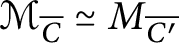 ${\mathcal {M}}_{{\overline {C}}}\simeq M_{\overline {C'}}$
, a contradiction. This completes the proof. ▪
${\mathcal {M}}_{{\overline {C}}}\simeq M_{\overline {C'}}$
, a contradiction. This completes the proof. ▪
Acknowledgement
I am indebted to Philippe Gille for many fruitful discussions and valuable remarks. I am also grateful to Erhard Neher and Holger Petersson for their interest and encouragement and for enriching conversations and comments. Finally, I would like to thank the referee for their careful reading of the manuscript.