




HISTORICAL DEVELOPMENT OF DENDROCHRONOLOGY
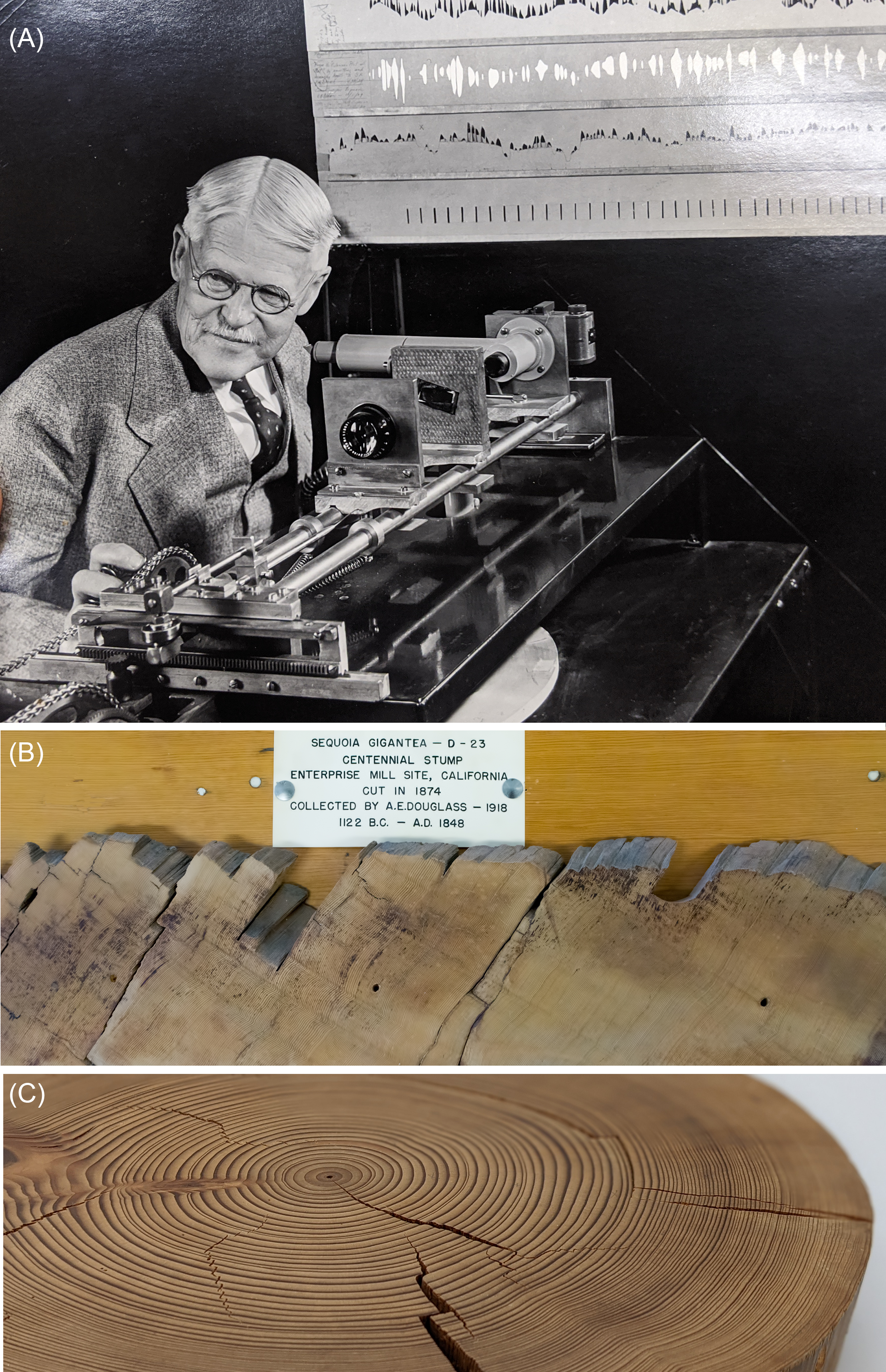
Growth rings are a prominent internal feature in the stems of woody plants. We may casually notice them in a wide variety of places in our human-built environment such as wooden doors and furniture, or perhaps on an outdoor hike through some natural area where stumps provide a window into the interior of remnant trees. Historical accounts indicate awareness of tree-rings by ancient scholars, such as Theophrastus in 322 BCE, who contemplated their annual formation, and Leonardo Da Vinci in the late 1400s CE, who considered weather as influencing their formation (Speer Reference Speer2010). At least a dozen other scientists in Europe and North America in the 1700s and 1800s made observations or measurements on tree-rings related to climate, weather events, ecology, and human activities (Speer Reference Speer2010). However, it was not until investigations in the early 1900s by Andrew Ellicott Douglass, considered to be the “founder of modern dendrochronology” (Figure 1A), that a scientific field of study began to emerge.
Early tree-ring and radiocarbon interactions: (A) Andrew Ellicott Douglass with his Cycloscope (1935), designed with the over-riding aim of discovering predictable cycles of solar activity in patterns of tree-ring growth, with emphasis on the 11-year solar cycle and its impact on climate (see Webb 1993 for further details). (B) Centennial Stump from California’s Sierra Nevada used by Willard Libby in the first radiocarbon calibration, the “Curve of Knowns” featured in his Nobel prize speech in 1960. Note the large notches along the top edge of the sample created by the radiocarbon sampling. (C) Sample from “Broken Flute Cave,” an Ancestral Puebloan cliff dwelling in the Prayer Rock district of the Navajo Nation in Arizona, also used in Libby’s Curve of Knowns. (All images reproduced with permission from The Laboratory of Tree-Ring Research, University of Arizona.)
Douglass was an astronomer, originally based at the Lowell Observatory in Flagstaff, Arizona, near the turn of the 20th century. Among his research interests were the Sun and solar activity manifested in sunspots. Reasoning that solar activity could influence Earth’s weather, he investigated tree-rings as indicators of year-to-year climate variability that could then be related to sunspots. During his time in Flagstaff, he noticed the growth rings of ponderosa pine, often on the ends of logs in lumber yards, showing variability in their ring width. He found that inter-annual variability of ring-size contributed to distinctive ring patterns (sequences) that were present in trees over a large region and appeared to be related to year-to-year precipitation variability (Dean Reference Dean, Taylor and Aitken1997). He took a faculty position at the University of Arizona in 1906 to advance his scholarly interests in astronomy while continuing to work with tree-rings, particularly related to archaeological dating in the U.S. Southwest (Douglass Reference Douglass1929). He launched the journal Tree-Ring Bulletin (now Tree-Ring Research) in 1934, and in 1937 he established a new department known as the Laboratory of Tree-Ring Research (LTRR) at the University of Arizona.
Douglass systematically developed field/laboratory methods, principles, and terminology of dendrochronology, which remain in use today. In particular, his principle of “crossdating” (matching of patterns of ring widths among trees to establish absolute dates, see Figure 2) is the linchpin to successful tree-ring studies (Dean Reference Dean, Taylor and Aitken1997; Leavitt et al. Reference Leavitt, Panyushkina and Grissino-Mayer2012). Rather than just “counting rings,” crossdating is necessary to identify the temporal correspondence between rings with certainty. Furthermore, crossdating identifies “missing rings” and extra rings that are not annual (so-called “false rings”). The method not only applies to matching patterns in contemporaneous living trees, but also to building extended tree-ring-width chronologies. Such long chronologies are produced by matching tree-rings of living trees to patterns in older wood samples from stumps and wood lying on the ground surface, wood in various historic and prehistoric constructions, and logs preserved in waterlogged sediments (see Figure 2). On one hand this crossdating is made possible by the imprint of weather influence on tree growth in a region, and on the other, tree-rings can offer a suitable proxy for climate reconstructions because of this influence. These aspects of dendrochronology are profound and have tremendously and increasingly contributed to historical and archaeological dating, and to a wide variety of investigations involving climate, hydrology, ecology, and geomorphology. Douglass’s student and eventual colleague, Edmund Schulman (Figure 3A), was the first to begin developing long tree-ring chronologies from bristlecone pine (Pinus longaeva, Pinus aristata) in California’s White Mountains, realizing the great longevity of these trees in that high-elevation mountain environment. Following Schulman’s death, C. Wesley (Wes) Ferguson (Figure 3B) was the central bristlecone investigator for almost three decades, arranging expeditions to the White Mountains to extend the chronology. Stimulated by Douglass’s successes, Bruno Huber began tree-ring work in Germany in the 1940s, eventually applying the technique to historic and prehistoric buildings (Becker Reference Becker1992), much as Douglass had successfully done with the archaeological ruins in the American Southwest. Tree-rings have now been studied on all continents (Zhao et al. Reference Zhao, Pederson, d’Orangeville, HilleRisLambers, Boose, Penone, Bauer, Jiang and Manzanedo2019), even from ancient and petrified wood in Antarctica (e.g., Taylor and Ryberg Reference Taylor and Ryberg2007). Calendar dated ring-width records spanning hundreds and thousands of years have been constructed for multiple regions and the long Northern Hemisphere tree-ring chronologies are paralleled by Southern Hemisphere records.
Illustration of the tree-ring crossdating method. Ring-width patterns from areas with common climate forcing show matching patterns of growth, which can be overlapped from successively older samples to develop an extended “master” chronology of ring-width variability. Here the oldest rings in the living tree are shown to match the pattern of growth in the outer rings of a standing dead tree, and in turn the inner rings of the standing dead tree match the outer rings of a beam used in construction of a building. (Image redrawn by C. Pearson based on a composite of images reproduced with permission of LTRR and P. I. Kuniholm, University of Arizona.)

The early long tree-ring chronologies. (A) Edmund Schulman with bristlecone sample #4779 in 1957; (B) Charles “Wes” Ferguson measuring a bristlecone pine dating 2963 BCE to 278 CE; (C) 20-g sample (10 years) of bristlecone pine prepared at LTRR for requests from radiocarbon dating labs in 1964 and published by Suess (Reference Suess1967); (D) Mike Baillie working on the Irish oak chronology; (E) Irish bog oaks, Garry Bog, (inset) trees from Hillsborough Co. Down, Trinity College Dublin and Coagh Co. Tyrone showing a matching pattern of wide rings, the last being 1580 CE; (F,G) Bernd Becker extracting trees for the European oak and pine chronology. (Images A–C reproduced with permission from The Laboratory of Tree-Ring Research, University of Arizona. D and E provided by M.G.L. Baillie. F & G provided by B. Kromer.)

The longest chronologies for the Northern Hemisphere are from Germany (>12,300 years, oak [Quercus petraea, Quercus robur] and Scots pine [Pinus sylvestris L.]), the European Alps (>9000 years, pine [Pinus cembra], larch [Larix decidua], spruce [Picea abies]), California (>8800 years, bristlecone pine [Pinus longaeva, Pinus aristata]), Finland (>7500 years, Scots pine [Pinus sylvestris L.]), Ireland (>7200 years, oak [Quercus petraea, Quercus robur]), and Siberia (>4000 years, Larch [Larix sibirica]) (see Becker Reference Becker1992; Kromer Reference Kromer2009; Nicolussi Reference Nicolussi, Kaufmann, Melvin, van der Plicht, Schießling and Thurner2009; Eronen Reference Eronen, Zetterberg, Briffa, Lindholm, Meriläinen and Timonen2002; Hantemirov and Shiyatov Reference Hantemirov and Shiyatov2002; Friedrich et al. Reference Friedrich, Remmele, Kromer, Hofmann, Spurk, Kaiser, Orcel and Küppers2004; Pilcher et al. Reference Pilcher, Baillie, Schmidt and Becker1984; Brown and Baillie Reference Brown and Baillie2012; Salzer Reference Salzer, Pearson and Baisan2019). In the Southern Hemisphere, the longest securely dated sequences are from New Zealand (>4400 years, kauri [Agathis australis]) and Tasmania (>4000 years, Huon pine [Lagarostrobos franklinii C. J. Quinn]) (Boswijk et al. Reference Boswijk, Fowler, Lorrey, Palmer and Ogden2006, Reference Boswijk, Fowler, Palmer, Fenwick, Hogg, Lorrey and Wunder2014; Cook et al. Reference Cook, Buckley, Palmer, Fenwick, Peterson, Boswijk and Fowler2006). The diverse applications of these multi-functional, calendar-dated tree-ring data continue to enrich the histories of these regions in multiple ways but as remarked by Dean (Reference Dean, Taylor and Aitken1997), the primary applications of dendrochronology are for “the dating of past events and the reconstruction of past environmental conditions.” Similarly, tree-ring chronologies strike both of these chords with respect to radiocarbon (14C) applications in that they are used to infer the 14C concentrations in past atmospheres (thereby providing data for carbon cycle investigations and for solar/magnetic reconstruction) and to improve accuracy of dates obtained by radiocarbon methods.
IMPORTANCE OF TREE RINGS TO 14C DATING
Douglass established the LTRR just a decade or so before Willard Libby at the University of Chicago first developed the radiocarbon dating method and what, in addition to transforming understanding of past timelines, would also become a means to study the solar activity through time, the very motivation for much of Douglass’s research. So, since the very inception of these two remarkable disciplines, there has been a kind of symbiosis, with one technique feeding into the other and used in powerful combinations to advance numerous scientific frontiers. This relationship continues to advance and evolve into the present and will no doubt be a focus for future applications.
Calibration and Chronologies
The critical value of dendrochronology for radiocarbon dating can be distilled as follows: Anywhere around the world, where trees form annual growth rings that can be calendar-dated using the techniques of dendrochronology, each tree-ring offers a dated sample of atmospheric radiocarbon. Although there are some caveats to this, such as for oak (Quercus sp.), which begins yearly growth using stored carbon from the previous growth season (Pilcher Reference Pilcher1995), this basic premise underpins the primary value of dated tree-rings for radiocarbon calibration: Tree-rings offer an independently dated, exact measure of changing radiocarbon levels through time. The first clear demonstrated use of this came in the early development of the radiocarbon dating method (Arnold and Libby Reference Arnold and Libby1949) and Libby’s “Curve of Knowns” (Libby Reference Libby1961), featured in his Nobel Prize lecture in 1960, which included measurements of dendrochronologically dated tree-rings from Centennial stump and Broken Flute cave (Figure 1B,C) beginning the long history of LTRR providing tree-ring samples to internal and external 14C researchers (Leavitt and Bannister Reference Leavitt and Bannister2009). Work to test and refine the radiocarbon dating method continued in diverse ways using tree-rings from many growth locations between 1950 and 1970. Spruce (Picea sp.) from Alaska, white pine (Pinus strobus) and incense cedar (Calocedrus decurrens) from North America and Cedrela sp. from the Peruvian Amazon were used by Suess (Reference Suess1955) to compare radiocarbon concentrations in modern wood. Then de Vries (Reference de Vries1958, Reference de Vries and Abelson1959) using North American Douglas-fir (Pseudotsuga menziesii) and German oak, detected 1–2% fluctuations in 14C activity along with the decline in 14C activity over the most recent 100 years related to 14C dilution by carbon dioxide from combustion of 14C-free fossil fuels, which Suess (Reference Suess1955) had previously identified (known as the “Suess effect”). Suess (Reference Suess1965) then went on to verify de Vries’ original observations of 14C wiggles (the “de Vries effect”) using dendrochronologically dated North American sequoia (Sequoiadendron giganteum), Douglas-fir and ponderosa pine (Pinus ponderosa). Stuiver (Reference Stuiver1965) also independently verified the de Vries wiggles at high-resolution using North American Douglas-fir, thus tree-rings were central to establishing the first links between these features and solar activity that modulates 14C production (Stuiver Reference Stuiver1961; Damon and Peristykh Reference Damon and Peristykh2000). This work also underpins the premise for radiocarbon wigglematch dating, where several radiocarbon dates sampled from a non-calendar dated (or floating) tree-ring sequence, spaced by exact ring counts, can be used to find a more precise fit of the wiggles (slopes and plateaus) against the radiocarbon calibration curve, so narrowing the possible date range for end point (outermost ring) of that sequence. Wiggles in the calibration data-sets also limit the dating precision and accuracy achievable for particular time periods.
Meanwhile dendrochronological work on North American bristlecone pine (Schulman Reference Schulman1954; Pritchett Reference Pritchett2021) had led to these remarkable long-lived trees becoming the basis for the world’s first multi-millennial tree-ring time-series (Ferguson Reference Ferguson1969). The value of this material for radiocarbon calibration and testing the method was also realized by Suess (Reference Suess1967), who demonstrated that for the period between 4100 BCE and 1500 BCE (extended back to 5200 BCE, Suess Reference Suess1970), the radiocarbon content of 80 multi-year blocks of calendar-dated bristlecone pine tree-rings (see Figure 3C for a typical sample) was between 6 and 9% higher than what had been calculated for the same time period using the radiocarbon half-life. This correction and time-series was used in some of the first attempts to synchronize archaeological sequences that were critical to old world chronology (Clark Reference Clark1978) and to secure one of the first-ever radiocarbon wiggle-matches (Ferguson et al. Reference Ferguson, Huber and Suess1966) of non-calendar secured tree-ring sequences from the archaeological pile-dwelling site of Burgäschisee in Switzerland. In this study, 14C in the calendar-dated bristlecone pine sequence was used to secure 14C measurements from the undated Swiss samples, assigning them to the 38th century BCE with an error less than 40 years.
As dendrochronology became a globally utilized science, multiple tree-ring sequences were developed in different regions, opening up more and more opportunities for cross-pollination of radiocarbon and tree-ring research. At Queen’s University Belfast in Northern Ireland, the idea to produce a 14C timescale for Holocene peat and lake deposits in Northern Ireland and to answer questions raised by the bristlecone pine-based calibration curve (Suess Reference Suess1970) was in fact a driving force behind the development of the long Irish tree-ring chronology that utilized oak trees preserved in Irish bog and terrestrial environments (Baillie Reference Baillie2009; Figure 3D,E). As work progressed on the construction of the Irish tree-ring chronology, in Germany, Burghart Schmidt and Bernd Becker, and separately Hubert Leuschner and Axel Delorme, were working on parallel chronologies, published back to 2000 BCE in 1982 (Becker and Schmidt Reference Becker and Schmidt1982) and back to 4004 BCE (Leuschner and Delorme Reference Leuschner and Delorme1984) using oaks and pines retrieved from riverine flood deposits (Figure 3F,G). At the time of Becker and Schmidt’s (Reference Becker and Schmidt1982) publication, the Irish chronology was back to 5289 BCE (Baillie Reference Baillie2009) and an initial comparison of these two records across a 1000-year test period raised an issue. The two groups of tree-ring patterns matched with certainty, but the dates applied to each chronology did not synchronize, revealing a 71-year discrepancy in the dating applied to the two records. Which was correct? Here, radiocarbon “wiggle-matching” of sections of the German chronology to the bristlecone pine calibration curve, played a part in resolving the discrepancy, by revealing that the German record was off-set by ca. 70 years relative to the bristlecone pine, almost the exact discrepancy revealed by the dendrochronological comparison with the Irish oak record. As a result the dendrochronological issue (which it turned out was because dating for the pre-550 BCE portion of Becker and Schmidt’s chronology was based on a single site chronology produced and misdated by Ernst Hollstein [Reference Hollstein1980]) was swiftly identified and resolved (Pilcher et al. Reference Pilcher, Baillie, Schmidt and Becker1984; Baillie and Pilcher Reference Baillie and Pilcher1987), resulting in the joint publication of an agreed European oak chronology back to 5289 BCE (Pilcher et al. Reference Pilcher, Baillie, Schmidt and Becker1984). This happened to coincide exactly with the publication of the alternate German oak record, developed by Leuschner and Delorme (Reference Leuschner and Delorme1984), which did not contain the 71-year error included in Becker and Schmidt’s record, and so provided a fully independent dendrochronological confirmation of the Pilcher et al. (Reference Pilcher, Baillie, Schmidt and Becker1984) chronology. Following this, the German chronology was expanded back to 9420 BCE (see table 4.1 in Becker Reference Becker1993; Becker and Schmidt Reference Becker and Schmidt1990). Meanwhile, combined dendrochronological and radiocarbon effort continued towards the creation of a series of high-precision radiocarbon calibration curves for terrestrial Northern Hemisphere samples using 14C measurements from Irish and German oak, German pine and North American conifers including bristlecone pine. These were measured primarily at the Seattle, Belfast, Heidelberg, and Arizona radiocarbon laboratories and extended back to 13,300 cal BP by 1986 (Stuiver et al. Reference Stuiver, Kromer, Becker and Ferguson1986; Pearson et al. Reference Pearson, Pilcher, Baillie, Corbett and Qua1986). The Hohenheim oak and pine chronology, currently the world’s longest calendar-dated tree-ring sequence at 12,460 years (Friedrich et al. Reference Friedrich, Remmele, Kromer, Hofmann, Spurk, Kaiser, Orcel and Küppers2004), facilitated the further extension of this calendar-dated 14C record for calibration in more recent years (Stuiver et al. Reference Stuiver, Reimer, Bard, Beck, Burr, Hughen, Kromer, McCormac, van der Plicht and Spurk1998; Reimer et al. Reference Reimer, Baillie, Bard, Bayliss, Beck, Blackwell, Ramsey, Buck, Burr, Edwards and Friedrich2009, Reference Reimer, Bard, Bayliss, Beck, Blackwell, Ramsey, Buck, Cheng, Edwards, Friedrich and Grootes2013), in combination with the European Preboreal Pine and Swiss chronologies. This is now reinforced by the inclusion of single-year subfossil pine data from the French Alps (Reinig et al. Reference Reinig, Sookdeo, Esper, Friedrich, Guidobaldi, Helle, Kromer, Nievergelt, Pauly, Tegel and Treydte2020) to extend the latest iteration back to 14,226 ± 4 cal BP (Reimer et al. Reference Reimer, Austin, Bard, Bayliss, Blackwell, Ramsey, Butzin, Cheng, Edwards, Friedrich and Grootes2020).
Out of these previously described early cross-pollination events between dendrochronology and radiocarbon dating also came some of the first research into interhemispheric calibration (McCormac et al. Reference McCormac, Hogg, Higham, Lynch-Stieglitz, Broecker, Baillie, Palmer, Xiong, Pilcher, Brown and Hoper1998, Reference McCormac, Reimer, Hogg, Higham, Baillie, Palmer and Stuiver2002; Hogg et al. Reference Hogg, McCormac, Higham, Reimer, Baillie and Palmer2002), the study of regional 14C offsets (McCormac et al. Reference McCormac, Baillie, Pilcher and Kalin1995—see Reimer et al. Reference Reimer, Austin, Bard, Bayliss, Blackwell, Ramsey, Butzin, Cheng, Edwards, Friedrich and Grootes2020 for a detailed discussion of these) and explorations of the complexities of 14C mixing in the intertropical convergence zone (McCormac et al. Reference McCormac, Hogg, Blackwell, Buck, Higham and Reimer2004).
The Southern Hemisphere has a larger ocean surface area than the Northern Hemisphere (ca. 60% compared to ca. 40%, respectively) and greater wind velocities. The effects of this on ocean/atmosphere transfer mean that natural levels of 14C in the southern troposphere are usually lower than in the northern troposphere. This means that radiocarbon ages for terrestrial samples from the Southern Hemisphere can be expected to measure older than contemporary terrestrial samples in the Northern Hemisphere by ca. 40 years. Radiocarbon measurements on contemporary pairs of tree-ring samples from Northern Hemisphere (Quercus petraea) and Southern Hemisphere (Libocedrus bidwillii/Manoao colensoi) trees at the Belfast and Waikato radiocarbon laboratories (McCormac et al. Reference McCormac, Hogg, Higham, Lynch-Stieglitz, Broecker, Baillie, Palmer, Xiong, Pilcher, Brown and Hoper1998, Reference McCormac, Reimer, Hogg, Higham, Baillie, Palmer and Stuiver2002; Hogg et al. Reference Hogg, McCormac, Higham, Reimer, Baillie and Palmer2002) for the period AD 1850–950 however showed that a fixed “offset” should not be applied to Northern Hemisphere radiocarbon calibration data in order to use it to calibrate Southern Hemisphere radiocarbon measurements. Instead, the Southern Hemisphere required its own separate calibration curve. Tree-ring measurements from New Zealand, Chile and South Africa combined to form the basis of the first (and subsequent) curve iterations (SHCal02—McCormac et al. (Reference McCormac, Reimer, Hogg, Higham, Baillie, Palmer and Stuiver2002); SHCal04—McCormac et al. (Reference McCormac, Hogg, Blackwell, Buck, Higham and Reimer2004); SHCal13—Hogg et al. (Reference Hogg, Hua, Blackwell, Niu, Buck, Guilderson, Heaton, Palmer, Reimer, Reimer and Turney2013)). In the most recent iteration, SHCal20 (Hogg et al. Reference Hogg, Heaton, Hua, Palmer, Turney, Southon, Bayliss, Blackwell, Boswijk, Ramsey and Pearson2020) 14 new tree-ring data sets are added in the 2140–0, 3520–3453, 3608–3590, and 13,140–11,375 cal BP time ranges. The first three of these periods provide calendar-dated calibration reference material, and the latter brings annual resolution data via a floating tree-ring sequence. In between these periods, the current SH curve still lacks direct SH observations and relies on the corresponding sections of the Northern Hemisphere curve as a modeling basis. Fortunately, dendrochronology of New Zealand kauri in particular offers many future possibilities to fill in some of these gaps and extend measurements further back in time (Boswijk et al. Reference Boswijk, Fowler, Palmer, Fenwick, Hogg, Lorrey and Wunder2014; Lorrey et al. Reference Lorrey, Boswijk, Hogg and Palmer2018).
Other Synergies and Applications
The transition between the Northern and Southern Hemispheric atmospheres lies along the Intertropical Convergence Zone (ITCZ). Seasonal shifts in the ITCZ may entrain atmospheric CO2 from the Northern and Southern Hemisphere to sites in this region within a given year and be impacted by a number of climatic forcings. Evidence for the migration of the ITCZ on multi-decadal to millennial time scales has been seen in a wide range of proxy records (e.g., Jacobel Reference Jacobel, McManus, Anderson and Winckler2017), but tree-ring 14C records offer excellent potential for fine-scale geographic coverage and high-resolution reconstructions. Studies utilizing 14C distribution in Mexican tree-rings have shown the influence of the North American Monsoon on the position of the ITCZ (Beramendi-Orosco et al. Reference Beramendi-Orosco, Johnson, Noronha, González-Hernández and Villanueva-Díaz2018), and these data also offer much potential for correcting archaeological chronologies within this region where calibration uncertainties are high due to the atmospheric mixing of 14C (see Marsh et al. Reference Marsh, Bruno, Fritz, Baker, Capriles and Hastorf2018). Another beneficial feedback between disciplines here is that typically the tropics have a scarcity of trees suitable for traditional dendrochronological methods, so a combination of radiocarbon and dendrochronology can be used to first confirm the presence of annual increments in trees (Santos et al. Reference Santos, Granato-Souza, Barbosa, Oelkers and Andreu-Hayles2020) and then to go on to explore how these increments might be used in tracing the ITCZ and the forces governing its movement. In particular, use of the 14C bomb spike, caused by nuclear bomb testing in the 1960s CE, which almost doubled atmospheric 14C levels at this time before a steady decline due to ocean surface transfer processes and carbon cycling, produced an artificial tracer with which to date more recent organic material. Vieira et al. (Reference Vieira, Trumbore, Camargo, Selhorst, Chambers, Higuchi and Martinelli2005), used the bomb spike to determine ages of tropical trees from the Brazilian Amazon without clear tree-ring structures, inferring tree growth rates and their consequences to carbon cycle modeling of forest biomass turnover. Radiocarbon dating and dendrochronology techniques have also been applied to see if African baobab trees, which have hollow inner cavities, could be dated using size–age relationships (Patrut et al. Reference Patrut, Karl, Van Pelt, Mayne, Lowy and Margineanu2011) and if monumental olive trees in Spain (Camarero et al. Reference Camarero, Colangelo, Gracia-Balaga, Ortega-Martínez and Büntgen2021) and Israel (Bernabei Reference Bernabei2015) were as old as purported by local populations. Olive trees are frequently encountered in key contexts in the ancient Mediterranean and Near East and have been the focus of much recent study (Ehrlich et al. Reference Ehrlich, Regev and Boaretto2018, Reference Ehrlich, Regev and Boaretto2021) to aid with use in the dating of archaeological contexts (e.g., Friedrich et al. Reference Friedrich, Kromer, Friedrich, Heinemeier, Pfeiffer and Talamo2006, Reference Friedrich, Kromer, Friedrich, Heinemeier, Pfeiffer and Talamo2014; Cherubini et al. Reference Cherubini, Humbel, Beeckman, Gaertner, Mannes, Pearson, Schoch, Tognetti and Lev-Yadun2013).
THE SOLAR AND GEOMAGNETIC CONNECTION
Past Solar Activity
The solar activity that so fascinated Douglass can now be explored directly through radiocarbon measurements from tree-rings and compared with documented visual observations of sunspots over the past four centuries, and instrumental data from recent decades (Solanki et al. Reference Solanki, Krivova and Haigh2013). The significance of 14C in tree-ring chronologies as a tool to reveal the temporal variability of solar activity over past millennia was realized early in the history of 14C studies and pioneered largely using coarser resolution 14C from multi-year blocks of tree-rings. However, as discussed by Stuiver (Reference Stuiver1961) and Suess (Reference Suess1965), and summarized by Lingenfelter (Reference Lingenfelter1963), the precision and temporal resolution of these 14C data were insufficient to discriminate production and carbon cycle (oceanic) causes of the observed 14C variations.
In the late 1970s a precision of 1.5 to 2‰ was reached in the 14C laboratory of Seattle, and Stuiver and Quay (Reference Stuiver and Quay1980) published a detailed and statistically convincing comparison of 14C in decadal tree-ring samples, observing sunspot numbers (averaged over 11-year cycles) from 1620 to 1880 CE. They also found strong 14C maxima corresponding to three grand solar minima, the Wolf, Spörer, and Maunder, with very low solar activity for several decades, and discussed the heliomagnetic modulation of galactic cosmic rays, leading to production changes of the cosmogenic isotopes 14C, 10Be, and 36Cl. Using IntCal98, Solanki et al. (Reference Solanki, Usoskin, Kromer, Schüssler and Beer2004) reconstructed decadal sunspot numbers back to 11,000 years BP and determined the distribution of grand solar maxima and minima. Also based on IntCal98, Usoskin et al. (Reference Usoskin, Solanki and Kovaltsov2007) analyzed the statistics of grand minima and maxima, concluding that the occurrence of these events is characterized by a stochastic/chaotic process, and that they represent special states of the solar dynamo.
Solar Cycles and 14C Production Spikes
Initial measurements of 14C in annual rings over intervals of 10–20 years were limited by the precision of the measurements. After early inconclusive efforts to identify the solar cycle in 20th century tree-rings, Damon et al. (Reference Damon, Long and Wallick1973) concluded that radiocarbon “measurement errors [did] not allow precise determination of the relatively small amplitude of the atmospheric radiocarbon variation due to the 11-yr solar cycle.” Statistically robust observations of the solar 11-year cycle in 14C had to wait until the early 1990s, when Stuiver and Braziunas (Reference Stuiver and Braziunas1993) measured annual 14C content in tree-rings for 1510–1954 CE. At those times, low-level gas counting detectors required 20–30 g of wood per ring and extended counting times of a week or more per sample. Hence, only a rather limited interval of 1510–1954 CE could be considered; as noted by Minze Stuiver (Reference Stuiver1993): “the counting time for producing the 440-yr single-year series reported here is identical to that needed for an 8800-yr bidecadal chronology.” Stuiver and Braziunas (Reference Stuiver and Braziunas1993) found a statistically significant correlation between sunspot numbers and annual 14C data during 1715–1948 CE.
Fortunately, the AMS technique is ideal for annual 14C measurements on wood samples, even single tree-rings, because it can work with a low sample mass (<50 mg) with counting times per sample of only a few hours, i.e., two orders of magnitude lower compared to radiometric low-level counting (LLC). Routine precision of <2‰ in AMS has only become a reality in the past decade (Wacker et al. Reference Wacker, Scott, Bayliss, Brown, Bard, Bollhalder, Friedrich, Capano, Cherkinsky and Chivall2020), leading to several series of centennial-long annual 14C data sets. This work has been further propelled by the discovery of an incredible increase of Δ14C of 15‰ in single tree-rings covering the years 774 to 775 CE by Miyake et al. (Reference Miyake, Nagaya, Masuda and Nakamura2012). McCormac et al. (2008) had previously noted this increase within a 10-yr resolution time series based on the Irish oaks, reporting a rapid enrichment of 14C between 765 and 775 CE, but the discovery that this change was in fact an abrupt event occurring between two single years opened a wide range of new research. Initially, a supernova, gamma-ray burst, or an extreme solar event were discussed as a possible cause for this phenomenon, but later comparison with 10Be (Usoskin et al. Reference Usoskin, Kromer, Ludlow, Beer, Friedrich, Kovaltsov, Solanki and Wacker2013) and additionally 36Cl (Mekhaldi et al. Reference Mekhaldi, Muscheler, Adolphi, Aldahan, Beer, McConnell, Possnert, Sigl, Svensson and Synal2015) led to an unambiguous identification of an extreme solar proton event (SPE) as the source. The realization that such events can be identified, and their magnitude and re-occurrence tracked via annual 14C has led to a global scale search of annual (and sub-annual) tree-ring 14C for more such events and other solar cycles, solar maxima and minima, not visible in the previous coarser-resolution records (Miyake et al. Reference Miyake, Masuda and Nakamura2013, Reference Miyake, Masuda, Nakamura, Kimura, Hakozaki, Jull, Lange, Cruz, Panyushkina, Baisan and Salzer2017; Güttler et al. Reference Güttler, Adolphi, Beer, Bleicher, Boswijk, Christl, Hogg, Palmer, Vockenhuber, Wacker and Wunder2015; Neuhäuser et al. Reference Neuhäuser and Neuhäuser2015; Sukhodolov et al. Reference Sukhodolov, Usoskin, Rozanov, Asvestari, Ball, Curran, Fischer, Kovaltsov, Miyake, Peter and Plummer2017; Jull et al. Reference Jull, Panyushkina, Miyake, Masuda, Nakamura, Mitsutani, Lange, Cruz, Baisan and Janovics2018; Uusitalo et al. Reference Uusitalo, Arppe, Hackman, Helama, Kovaltsov, Mielikäinen, Mäkinen, Nöjd, Palonen, Usoskin and Oinonen2018; Scifo et al. Reference Scifo, Kuitems, Neocleous, Pope, Miles, Jansma, Doeve, Smith, Miyake and Dee2019; Friedrich et al. Reference Friedrich, Kromer, Sirocko, Esper, Lindauer, Nievergelt, Heussner and Westphal2019).
So far two more SPEs have been confirmed: 993 CE (Miyake et al. Reference Miyake, Masuda and Nakamura2013) and 660 BCE (Park et al. Reference Park, Southon, Fahrni, Creasman and Mewaldt2017; O’Hare et al. Reference O’Hare, Mekhaldi, Adolphi, Raisbeck, Aldahan, Anderberg, Beer, Christl, Fahrni and Synal2019; Fahrni et al. Reference Fahrni, Southon, Fuller, Park, Friedrich, Muscheler, Wacker and Taylor2020), and three more candidates have been tentatively identified. These are at 3372 BCE (Wang et al. Reference Wang, Yu, Zou, Dai and Cheng2017; but this was not confirmed by Jull et al. Reference Jull, Panyushkina, Molnár, Varga, Wacker, Brehm, Laszló, Baisan, Salzer and Tegel2021), 1052 CE and 1279 CE (Brehm et al. Reference Brehm, Bayliss, Christl, Synal, Adolphi, Beer, Kromer, Muscheler, Solanki and Usoskin2021) but they need further confirmation with independent tree-ring chronologies. The global nature of the 775 and 993 CE events has meanwhile been confirmed in a study involving annual 14C series of 44 tree-ring chronologies of five continents (Büntgen et al. Reference Büntgen, Wacker, Galván, Arnold, Arseneault, Baillie, Beer, Bernabei, Bleicher and Boswijk2018), demonstrating the unique “signature year” character of SPEs to link chronologies worldwide. Replicate annual measurements in the respective century of the 1052 and 1279 CE events were published by Kudsk et al. (Reference Kudsk, Philippsen, Baittinger, Fogtmann-Schulz, Knudsen, Karoff and Olsen2019).
The longest and most precise annual 14C dataset so far has been created by Brehm et al. (Reference Brehm, Bayliss, Christl, Synal, Adolphi, Beer, Kromer, Muscheler, Solanki and Usoskin2021) using 13 oak timbers from buildings in the UK and Switzerland (full details are given in the supplement of Brehm et al. Reference Brehm, Bayliss, Christl, Synal, Adolphi, Beer, Kromer, Muscheler, Solanki and Usoskin2021) and covering the period 969–1933 CE. It shows the persistence of the 11-yr Schwabe cycle throughout the last millennium, with a Δ14C amplitude of 0.9‰ during solar maxima and 0.6‰ during minima, and an average length of 10.4 yr. Details of the Wolf, Spörer, and Maunder minima have been studied in annual 14C data by Eastoe et al. (Reference Eastoe, Tucek and Touchan2019), Fogtmann-Schulz et al. (Reference Fogtmann-Schulz, Kudsk, Trant, Baittinger, Karoff, Olsen and Knudsen2019, Reference Fogtmann-Schulz, Baittinger, Karoff, Olsen and Knudsen2020), and Moriya et al. (Reference Moriya, Miyahara, Ohyama, Hakozaki, Takeyama, Sakurai and Tokanai2019). These same data were used by Land et al. (Reference Land, Kromer, Remmele, Brehm and Wacker2020) to connect with the broader scope of dendrochronology by comparing the record of solar forcing with climatic impact on tree-ring growth for the same years. This is an exciting study in that it combines annually resolved paleoclimatic and solar proxies from the same calendar-dated tree-ring sequence and shows a direct influence of the Schwabe cycle on climate. It reaffirms that 14C in tree-ring chronologies can provide information on solar variability on time scales of years to centuries and millennia.
Earth’s Magnetic Field
The Earth’s magnetic field protects Earth against the solar wind and helps it shield against cosmic rays that produce radiocarbon in the upper atmosphere, with implications for Earth radio communications, satellite networks and life on Earth (Channell and Vigliotti Reference Channell and Vigliotti2019). The magnetic field strength, position, and polarity have long been known to vary over millions of years based on measurement of remanent magnetism in rocks (Kono Reference Kono2007, remanent magnetism is the permanent magnetism in rocks, resulting from the orientation of the Earth’s magnetic field at the time of rock formation in a past geological age) but multi-millennial-scale production changes of cosmogenic isotope abundance are also considered to be caused mainly by these geomagnetic variations (Beer et al. Reference Beer, McCracken and von Steiger2012). High-resolution production records showing the “secular trend” of modulation by the Earth’s magnetic field were originally derived from radiocarbon measurements on long tree-ring sequences as part of the early calibration-curve development efforts, which revealed long-term quasi-sinusoidal variation in radiocarbon production (Sonett and Finney Reference Sonett and Finney1990). Between 1970 and 1990 atmospheric 14C reconstructions from tree-rings were used to infer changes of the global magnetic dipole moment, assuming a constant carbon cycle (Damon and Linick (Reference Damon and Linick1986); Stuiver et al. (Reference Stuiver, Braziunas, Becker and Kromer1991) and references therein). Geomagnetic measurements on sediments and rocks are now the primary source of information about Earth’s magnetic field. Calculating this field requires a record of global dipole moment that is modeled from localized data covering part of the globe, which has only recently converged through three different models (e.g., Nilsson et al. Reference Nilsson, Holme, Korte, Suttie and Hill2014).
Solar Reconstructions and 14C Spike Dating
The discussion of the full sequence of solar variability, solar-terrestrial interactions and the response of the climate system is outside the scope of this paper (see Haigh (Reference Haigh2007) and Gray et al. (Reference Gray, Beer, Geller, Haigh, Lockwood, Matthes, Cubasch, Fleitmann, Harrison and Hood2010) for reviews). The first steps involving reconstruction of sunspots and of total solar irradiance (TSI) or solar spectral intensity (SSI) have been gradually developed in response to the progress in determining atmospheric 14C over the Holocene and the availability of 10Be data from polar ice cores. Steinhilber et al. (Reference Steinhilber, Abreu, Beer, Brunner, Christl, Fischer, Heikkilä, Kubik, Mann and McCracken2012) reconstructed TSI from a combination of 2000-yr high-pass filtered 14C in IntCal09 and 10Be from seven ice cores in Greenland and Antarctica, and compared TSI to the δ18O record of Dongge cave, China, thought to represent a signal of the Asian monsoon, revealing a significant correlation. Wu et al. (Reference Wu, Krivova, Solanki and Usoskin2018a, Reference Wu, Usoskin, Krivova, Kovaltsov, Baroni, Bard and Solanki2018b) presented the latest reconstruction of sunspots and TSI (Figure 4) and SSI back to 6755 BCE from 14C and 10Be. The range of the TSI variability on a millennial scale is determined to be ca. 0.11% (1.5 W m−2).
Total solar irradiance reconstructed from 14C (IntCal09) and six 10Be data sets from polar ice core archives. (Reproduced from Wu et al. Reference Wu, Krivova, Solanki and Usoskin2018a.)

The high-resolution solar data, and the 774–775 CE event in particular, have been used as a chronological anchor point to secure the dating of ice-core records (Sigl et al. Reference Sigl, Winstrup, McConnell, Welten, Plunkett, Ludlow, Büntgen, Caffee, Chellman, Dahl-Jensen and Fischer2015) and to improve the dating of a number of “floating” tree-ring sequences (i.e., sequences that are not dendrochronologically anchored to the present with exact calendar dates using the tree-ring dating methods previously described). The replication of the 774/775 CE event in multiple global locations has also proved useful for exploring ideas about latitudinal, regional and laboratory offsets (Büntgen et al. Reference Büntgen, Wacker, Galván, Arnold, Arseneault, Baillie, Beer, Bernabei, Bleicher and Boswijk2018). Wacker et al. (Reference Wacker, Güttler, Hurni, Synal and Walti2014) demonstrated how the 774–775 CE marker event could be used effectively (along with traditional dendrochronological techniques) to provide a precise and accurate construction date for wood samples from the St. John convent in Müstair, Switzerland, a UNESCO Word Heritage Site. Similarly, anchoring a tree-ring sequence on the 774–775 CE event allowed Oppenheimer et al. (Reference Oppenheimer, Wacker, Xu, Galván, Stoffel, Guillet, Corona, Sigl, Di Cosmo, Hajdas and Pan2017) and Hakozaki et al. (Reference Hakozaki, Miyake, Nakamura, Kimura, Masuda and Okuno2018) to date the volcanic eruption of Changbaishan, on the China–North Korea border, to late 946 CE. It also allowed Pearl et al. (Reference Pearl, Anchukaitis, Donnelly, Pearson, Pederson, Gaylord, McNichol, Cook and Zimmermann2020) to establish and secure a paleoenvironmentally significant 2500-year-long Atlantic white cedar (Chamaecyparis thyoides) chronology from the Northeastern United States. The revolutionary potential of this approach in archaeological contexts has been well emphasized by Dee and Pope (Reference Dee and Pope2016) and has been demonstrated to dramatic effect when Kuitems et al. (Reference Kuitems, Panin, Scifo, Arzhantseva, Kononov, Doeve, Neocleous and Dee2020) used the event to resolve the origins of the Uyghur monument of Por-Bajin in Russia, dating construction to the summer of 777 CE and resolving decades of debate.
The 10Be Connection
Changes in 14C over time are directly related to atmospheric 14CO2, which registers production changes caused by the solar/magnetic variability previously described. This variability simultaneously produces a record of 10Be that is preserved as a parallel record in the polar ice cores. This can provide multiple advantages. Prior to the beginning of the continuous tree-ring-based 14C calibration data (i.e., before 14,000 cal BP), the temporal resolution of the 14C data from speleothems, lake and marine sediments, and corals is coarser, leading to some attenuation of the atmospheric 14C variability, which is thus less accurate for calibration purposes. However, floating tree-ring series, found for various intervals in glacial times in both hemispheres, can be independently fixed in time by matching the 14C from such samples with the 10Be ice record that extends beyond the secure tree-ring record. Once in the correct temporal position, the tree-ring 14C can then be used to improve the resolution of the calibration data for such time periods. For example, bidecadal 14C measurements across 2000 rings of New Zealand kauri around Heinrich event 3 (Turney et al. Reference Turney, Palmer, Bronk Ramsey, Adolphi, Muscheler, Hughen, Staff, Jones, Thomas and Fogwill2016), placed in time relative to the 10Be record from the GRIP ice cores, now refines the IntCal20 calibration data (compared to IntCal13) for the period ca. 30,000 cal BP. In that case, some ambiguity over the temporal 14C position relative to the 10Be record was resolved by the use of D-O (Dansgaard–Oeschger) phase 3, as recorded in the Cariaco climate proxy, to confirm the dating. Similarly, kauri was also measured in decadal blocks across 1300 years around the time of the Laschamps geomagnetic minimum event, showing the strong rise of Δ14C caused by the event. The link to a 10Be reconstruction provided an ice core-based age of 42,500 cal BP, which was 1000 years younger compared to the Hulu cave 14C ages (Turney et al. Reference Turney, Fifield, Hogg, Palmer, Hughen, Baillie, Galbraith, Ogden, Lorrey and Tims2010), possibly resulting from carbon cycle changes causing different signals in 14C. A detailed discussion is presented in Staff et al. (Reference Staff, Hardiman, Bronk Ramsey, Adolphi, Hare, Koutsodendris and Pross2019). Meanwhile, Scots pine and other sub-fossil trees from Northern Italy sampled at 5- and 10-year resolution show large age variations ca. 12,400 14C years BP during the Bølling warm phase, which were not evident in the coarser resolution IntCal13 data, but could clearly be seen in the GRIP 10Be record. These tree-ring 14C series were included in IntCal20, resulting in a wide calendar age bias for the onset of Greenland Interstadial 1 (Bølling chronozone), shown in Fig. 9 of Adolphi et al. (Reference Adolphi, Muscheler, Friedrich, Güttler, Wacker, Talamo and Kromer2017). Finally, for the Holocene period, where tree-ring 14C is calendar secured, the comparison with 10Be from the ice cores has instead been used to fine tune the chronological precision of the ice cores (e.g., Adolphi and Muscheler Reference Adolphi and Muscheler2016) and to explore these combined records to improve our understanding of solar dynamics and to quantify the solar influence on climate (e.g., Steinhilber et al. Reference Steinhilber, Abreu, Beer, Brunner, Christl, Fischer, Heikkilä, Kubik, Mann and McCracken2012).
WHAT’S NEXT?
The future directions for tree-ring based radiocarbon research will likely include large-scale creation and replication of multi-millennial, multi-regional time series of annual (or sub-annual) measurements of 14C from individual dated tree-rings (e.g., Kudsk et al. Reference Kudsk, Philippsen, Baittinger, Fogtmann-Schulz, Knudsen, Karoff and Olsen2019; Fogtmann-Schulz Reference Fogtmann-Schulz, Kudsk, Trant, Baittinger, Karoff, Olsen and Knudsen2019; Friedrich et al. Reference Friedrich, Kromer, Wacker, Olsen, Remmele, Lindauer, Land and Pearson2020; Pearson et al. Reference Pearson, Brewer, Brown, Heaton, Hodgins, Jull, Lange and Salzer2018, Reference Pearson, Wacker, Bayliss, Brown, Salzer, Brewer, Bollhalder, Boswijk and Hodgins2020b; Fahrni et al. Reference Fahrni, Southon, Fuller, Park, Friedrich, Muscheler, Wacker and Taylor2020; Brehm et al. Reference Brehm, Bayliss, Christl, Synal, Adolphi, Beer, Kromer, Muscheler, Solanki and Usoskin2021). Such data are now well established in terms of feasibility/quality of measurement (Sookdeo et al. Reference Sookdeo, Kromer, Büntgen, Friedrich, Friedrich, Helle, Pauly, Nievergelt, Reinig, Treydte and Synal2020; Wacker et al. Reference Wacker, Bonani, Friedrich, Hajdas, Kromer, Němec, Ruff, Suter, Synal and Vockenhuber2010), dynamic multi-purpose functionality and scientific value. There now seems a strong basis (Friedrich et al. Reference Friedrich, Kromer, Wacker, Olsen, Remmele, Lindauer, Land and Pearson2020; Pearson et al. Reference Pearson, Brewer, Brown, Heaton, Hodgins, Jull, Lange and Salzer2018, Reference Pearson, Wacker, Bayliss, Brown, Salzer, Brewer, Bollhalder, Boswijk and Hodgins2020b) for such data to be used to refine the structure of future iterations of the radiocarbon calibration curves as these community-based resources continue to evolve and improve (Reimer et al. Reference Reimer, Austin, Bard, Bayliss, Blackwell, Ramsey, Butzin, Cheng, Edwards, Friedrich and Grootes2020; Hogg et al. Reference Hogg, Heaton, Hua, Palmer, Turney, Southon, Bayliss, Blackwell, Boswijk, Ramsey and Pearson2020). The current Northern Hemisphere IntCal data now include annual data from trees from across Europe, North America, and Japan (for a comprehensive review and future recommendations see Bayliss et al. Reference Bayliss, Marshall, Dee, Friedrich, Heaton and Wacker2020), and it seems likely that both the geographic and temporal spread of such data (with inter-laboratory replication) will increase for both hemispheres. In the Southern Hemisphere there is particular potential for earlier time periods, in combination with 10Be, from New Zealand’s swamp kauri (preserved in anoxic bog environments similar to the Irish oaks) that span a remarkable range of time periods extending back over 70,000 years (Turney et al. Reference Turney, Fifield, Hogg, Palmer, Hughen, Baillie, Galbraith, Ogden, Lorrey and Tims2010; Lorrey et al. Reference Lorrey, Boswijk, Hogg and Palmer2018). It also seems likely that an increasing number of annually resolved floating tree-ring series will be created to more finely delineate climatic events in Northern Hemisphere calibration data e.g., Capano et al. (Reference Capano, Miramont, Shindo, Guibal, Marschal, Kromer, Tuna and Bard2020).
While multi-regional, annually resolved 14C time series undoubtedly have a future role in calibration, such data are multi-functional and the driving force for their creation may also (instead) come from applications to explore and predict the occurrence of solar/magnetic phenomena (Miyake et al. Reference Miyake, Masuda, Nakamura, Kimura, Hakozaki, Jull, Lange, Cruz, Panyushkina, Baisan and Salzer2017; Park et al. Reference Park, Southon, Fahrni, Creasman and Mewaldt2017; O’Hare et al. Reference O’Hare, Mekhaldi, Adolphi, Raisbeck, Aldahan, Anderberg, Beer, Christl, Fahrni and Synal2019; Fahrni et al. Reference Fahrni, Southon, Fuller, Park, Friedrich, Muscheler, Wacker and Taylor2020), gain new insights into the role of solar forcing in different climatic regions (Land et al. Reference Land, Kromer, Remmele, Brehm and Wacker2020), and be used to synchronize with other high-resolution paleoclimatic proxy evidence (e.g., Reinig et al. Reference Reinig, Sookdeo, Esper, Friedrich, Guidobaldi, Helle, Kromer, Nievergelt, Pauly, Tegel and Treydte2020). The continued two-way feedbacks between dendrochronology and radiocarbon will likely see both an increased use of single-year tree-ring based 14C determinations to secure floating tree-ring sequences, either using SPEs (e.g., Kuitems et al. Reference Kuitems, Panin, Scifo, Arzhantseva, Kononov, Doeve, Neocleous and Dee2020) or using other subdecadal structure revealed by annual 14C (e.g., Pearson et al. Reference Pearson, Salzer, Wacker, Brewer, Sookdeo and Kuniholm2020a) or to provide independent verification of the dendrochronological dating of others (discussed by Büntgen et al. Reference Büntgen, Wacker, Galván, Arnold, Arseneault, Baillie, Beer, Bernabei, Bleicher and Boswijk2018). The same annual tree-ring based 14C data will also be used to explore further questions of small-scale regional or latitudinal 14C variability (see Reimer et al. (Reference Reimer, Austin, Bard, Bayliss, Blackwell, Ramsey, Butzin, Cheng, Edwards, Friedrich and Grootes2020), Bayliss et al. (Reference Bayliss, Marshall, Dee, Friedrich, Heaton and Wacker2020) for in-depth discussion, plus data in Büntgen et al. (Reference Büntgen, Wacker, Galván, Arnold, Arseneault, Baillie, Beer, Bernabei, Bleicher and Boswijk2018), Pearson et al. (Reference Pearson, Salzer, Wacker, Brewer, Sookdeo and Kuniholm2020a, Reference Pearson, Wacker, Bayliss, Brown, Salzer, Brewer, Bollhalder, Boswijk and Hodgins2020b). There are also considerable new possibilities to trace the movement of the ITCZ through time using 14C in tropical tree-rings as a means of climatic modeling, as well as in accessing parallel, highly resolved contemporaneous records of marine 14C, by crossdating tree-ring and marine sequences (Black et al. Reference Black, Andersson, Butler, Carroll, DeLong, Reynolds, Schöne, Scourse, van der Sleen, Wanamaker and Witbaard2019).
This brief overview of the interwoven history of dendrochronology and radiocarbon advancements, exploration of cosmogenic isotopes, and study of solar magnetic activity, has demonstrated the complexity and productivity of the interactions between these fields. The high scientific relevance of the data generated has stimulated substantial progress in building millennia-long chronologies, greatly improving precision in isotope techniques, and advancing models of heliomagnetic impacts on the Earth’s climate. The data have also revealed the previously unknown presence and intensity of extreme solar proton events, potentially harmful to technology on Earth. Future pathways will undoubtedly result in an impressive further array of interdisciplinary research.
ACKNOWLEDGMENTS
With thanks to P. Brewer, Curator of Collections at the Laboratory of Tree-Ring Research for support with locating and accessing archived materials and to M.G.L. Baillie for provision of images D and E, Figure 3. We also thank two anonymous reviewers and Paula Reimer for suggestions that much improved the manuscript. CP acknowledges support from the Malcolm H. Wiener Foundation. IU acknowledges support of the Academy of Finland (project No. 321882 ESPERA).


 Open access

