

In this report, we present a Manteño (AD 650–1532) burial dating between AD 771 and 953 from coastal Ecuador. This burial is enigmatic both because it contains the remains of a young female and perinate, as well as spondylus (Spondylus princeps) ornaments from various cultural traditions and periods, and because of its mortuary body treatment, including the perimortem removal of the hands and left leg. We hypothesize this individual was treated thusly as part of a sacrificial ritual or other punitive measure.
Archaeological Context
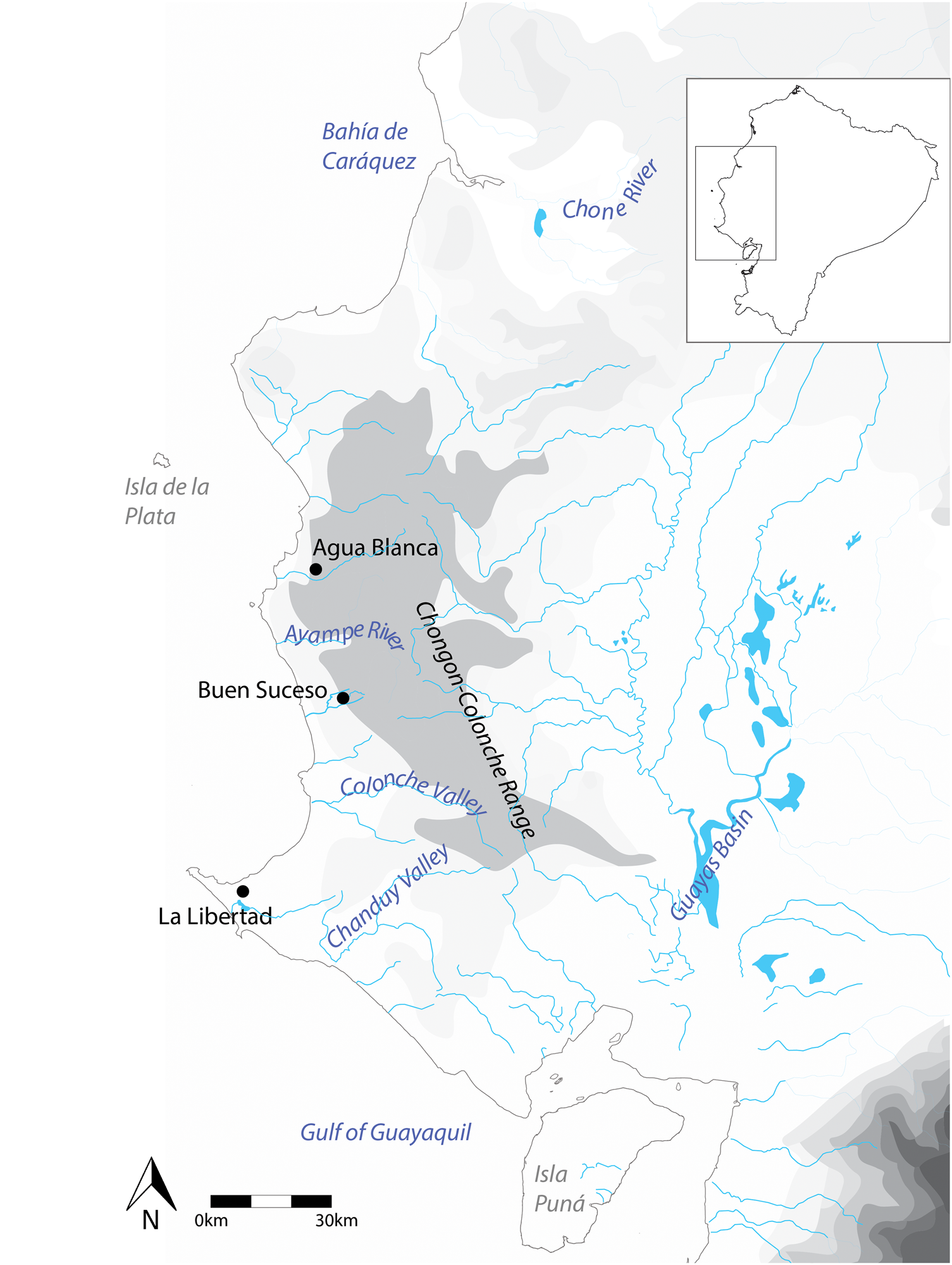
The Manteño tradition is found along 350 km of Ecuadorian coast, united by broad similarities in material culture and sociopolitical organization, though regional differences have led to the identification of three regional variants: the northern Manteño del Norte, the southern Huancavilca, and the Punáes of Isla Puná (Figure 1; see Bushnell Reference Bushnell1951; Estrada Reference Estrada1957; Jijón y Caamaño Reference Jijón y Caamaño1952; McEwan and Delgado-Espinoza Reference McEwan, Delgado-Espinoza, Silverman and Isbell2008). In general, these coastal peoples invested in agriculture and public architecture, were expert seafarers, and participated in various political and ritual activities (Estrada Reference Estrada1957; McEwan and Delgado-Espinoza Reference McEwan, Delgado-Espinoza, Silverman and Isbell2008). Spondylus shell collection and long-distance exchange were elaborated; people created small beads, known as chaquira, out of the white part of the spondylus and traded the more valued colorful parts of the shell to the south (Carter Reference Carter2008; Estrada Reference Estrada1957).
Map of coastal Ecuador showing Buen Suceso and other Manteño sites.

Manteño del Norte burials were in bell-shaped pits or ceramic urns, accompanied by bowls, animal bone, copper, and other secondary burials and occasionally adorned with spondylus (Currie Reference Currie, Staller and Currie2001; Delabarde Reference Delabarde, Eeckhout and Owens2015; Estrada Reference Estrada1957:34; Mester Reference Mester1990:139–147; Norton et al. Reference Norton, Lunniss and Navling1983; Stothert and Cruz Cevallos Reference Stothert, Cevallos, Staller and Currie2001; Ubelaker Reference Ubelaker1981). Tombs were frequently covered with stone slabs or gates (Holm Reference Holm1963; Saville Reference Saville1910) to facilitate interaction with the dead. To the south, Huancavilca burials tended to be in bell- or boot-shaped pits containing numerous individuals in extended primary burials and secondary burial bundles (Bushnell Reference Bushnell1951:97–102; Stothert and Cruz Cevallos Reference Stothert, Cevallos, Staller and Currie2001).
Methods
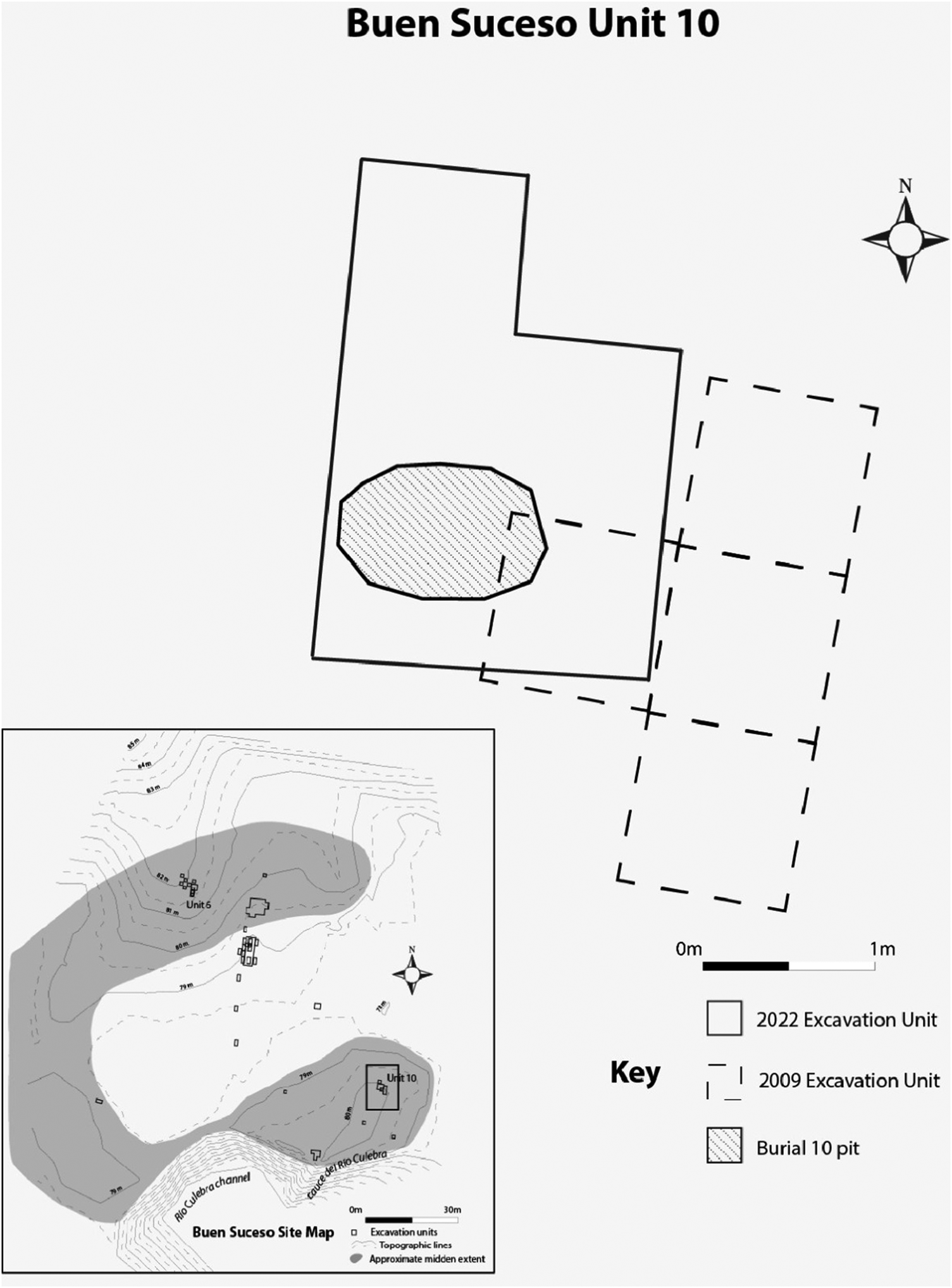
Buen Suceso, primarily a Valdivia period site (3750–1425 BC; Rowe and Duke Reference Rowe and Duke2020), is in a liminal zone between the Huancavilca and the Manteño del Norte traditions (Figures 1 and 2). In 2006, a survey identified evidence of Manteño occupation in the valley, including house mounds, middens, and water management features, with elements of both the northern and southern traditions. Local residents reported eroding graves with Manteño artifacts, and several Manteño burials were discovered in 2009. In 2022, we digitally mapped and excavated nine 1 × 1 m units where these burials had been previously identified (Figure 2). Excavations followed arbitrary 10 cm levels in the absence of stratigraphic changes to control for depth and context. Soil was subsequently passed through 1 mm screens.
Excavation map of Buen Suceso showing Unit 10 where Manteño burials were located.

Burials and artifacts were mapped in situ and removed carefully for analysis in the lab. Burial type was designated as primary or secondary, based on anatomical orientation and the presence of skeletal elements. Burial orientation and body positioning were recorded. Photographs were taken of each level with a Nikon D15000 camera and a DJI Mini drone.
Material Analysis
All artifacts were measured and weighed with digital tools. Samples selected for destructive analysis were weighed, photographed, and exported to the United States (INPC export permit No. INPC-DTZ5-2022-0194-O) for radiocarbon analysis at the University of California Irvine Keck Carbon Cycle AMS Facility (UCIAMS). Results were calibrated in OxCal v4.4 (Ramsey Reference Ramsay2021) using the SHCal20 atmospheric curve (Hogg et al. Reference Hogg, Heaton, Hua, Palmer, Turney, Southon and Bayliss2020).
Skeletal Analysis
Age was based on skeletal development for fetal remains (Cunningham et al. Reference Cunningham, Scheuer and Black2016:105) and, for adult remains, on dental wear (Murphy Reference Murphy1959) and pubic symphyseal change (Buikstra and Ubelaker Reference Buikstra and Ubelaker1994:23–24). Sex estimation was based on pubic morphology (Buikstra and Ubelaker Reference Buikstra and Ubelaker1994:17; Phenice Reference Phenice1969). The paleopathology we observed included cribra orbitalia and porotic hyperostosis, based on the presence and coalescence of pitted lesions in the eye orbits and parietals, respectively (Buikstra and Ubelaker Reference Buikstra and Ubelaker1994:120–121); linear enamel hypoplasia based on horizontal disruptions to dental enamel (Goodman and Rose Reference Goodman and Rose1990); and periosteal reactions and osteomyelitis based on the presence of reactive bone and cloaca (Ortner Reference Ortner2011). Traumatic fractures and cutmarks (identified as V-shaped grooves) were counted and measured and recorded by skeletal element (Ortner Reference Ortner, Kimmerle and Baraybar2008). Trauma timing was determined as antemortem (based on bony remodeling), perimortem (evidence of bony deformation or the presence of concentric or radiating fractures), or postmortem (based on color differences, jagged fracture edges, or no evidence of deformation or remodeling; Galloway et al. Reference Galloway, Zephro, Wedel, Wedel and Galloway2014; Ortner Reference Ortner, Kimmerle and Baraybar2008). All trauma was observed microscopically using a Dino-Lite Pro AM413T microscope camera.
Results: Burial 10
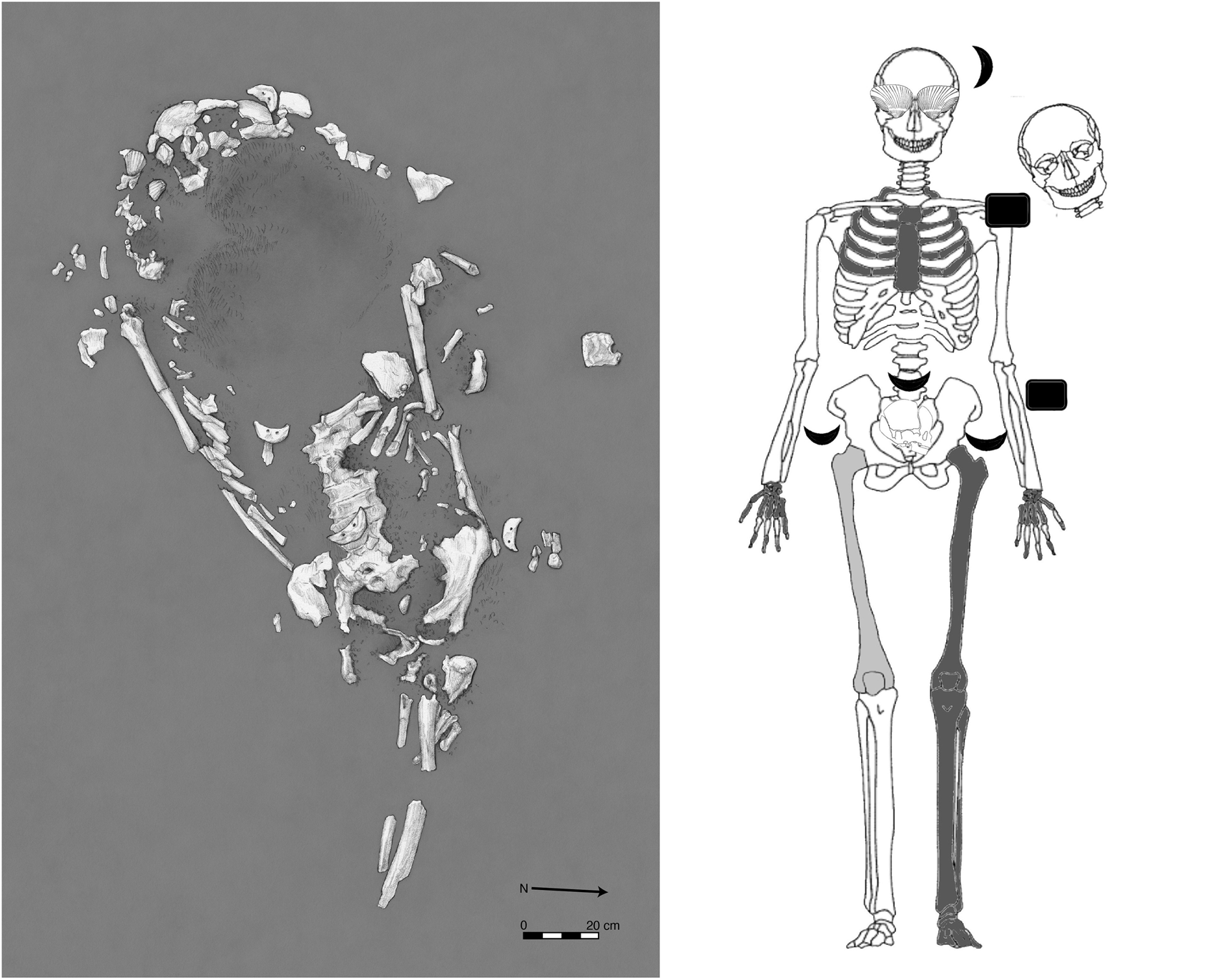
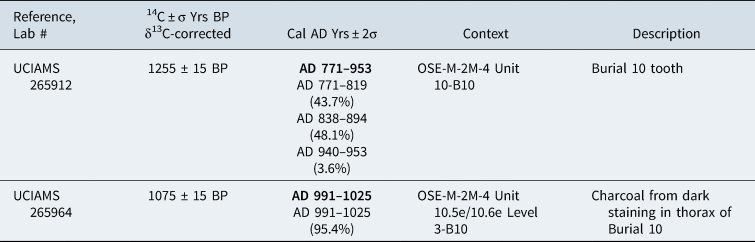
Burial 10 was in a supine and extended position with the head to the west facing south and the lower body to the east (Figure 3). Fetal cranial fragments were found in the pelvic area. The hands and left leg were not recovered. The distal radii and ulnae were under and behind the pelvis in the anticipated anatomical position. Isolated hand phalanges were recovered from other parts of the burial, but no carpals or metacarpals were found. The right femur was disturbed by rodent activity and recovered in 2009 during earlier excavations, but the lower right leg was manipulated in antiquity so that the plantar surface of the foot was on the lower pelvis. The rest of the burial was undisturbed by modern human activity, although a rodent burrow ran by the right leg and thorax. Radiocarbon analysis of a first molar returned a date range of AD 771–953 (Table 1).
Drawing of Burial 10 in situ during excavation by Kathryn Killacky and schematic showing missing elements (dark gray), disturbed elements (light gray), and the location of mascaras (crescents) and pendants (squares).

Radiocarbon Dates from Burial 10.

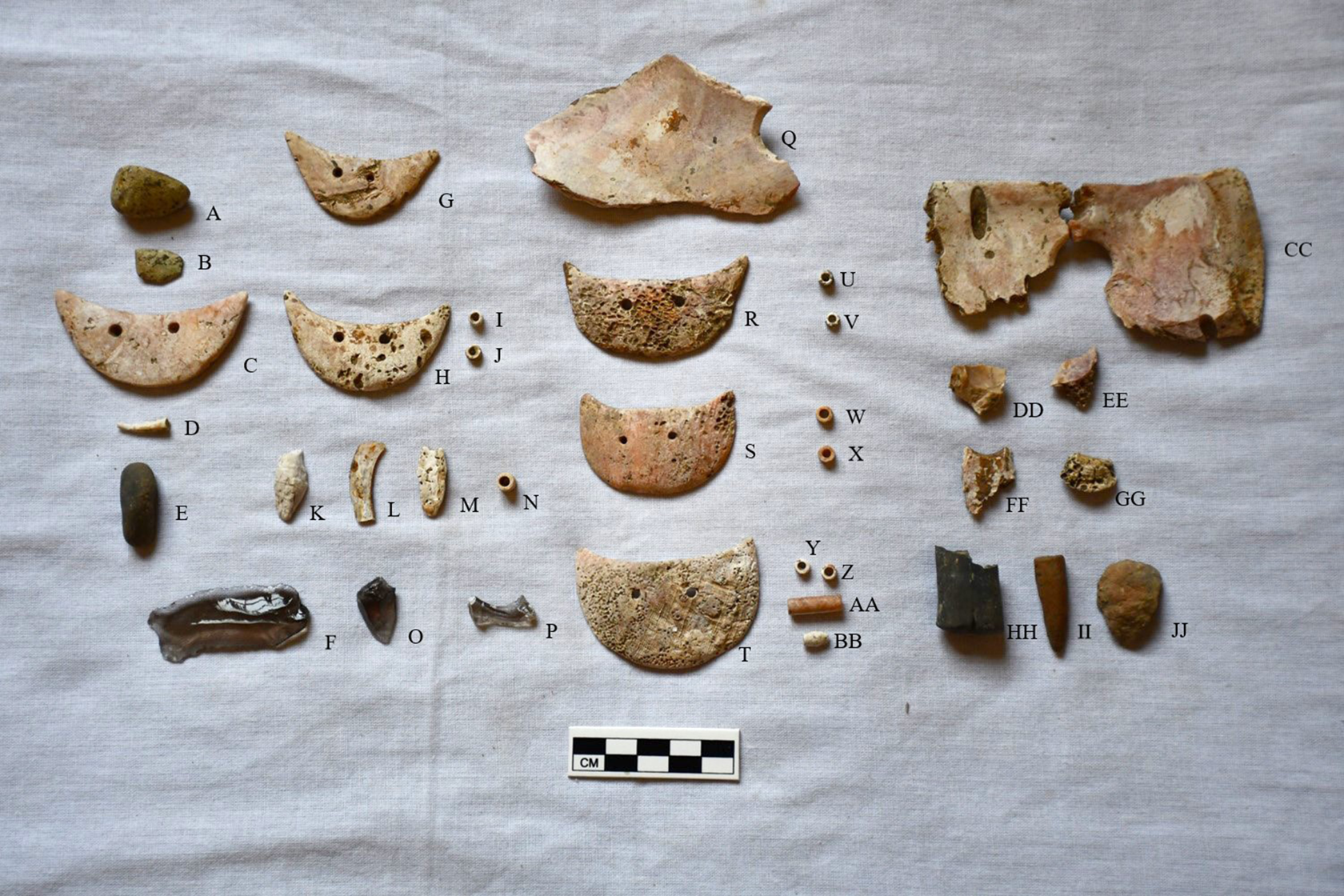
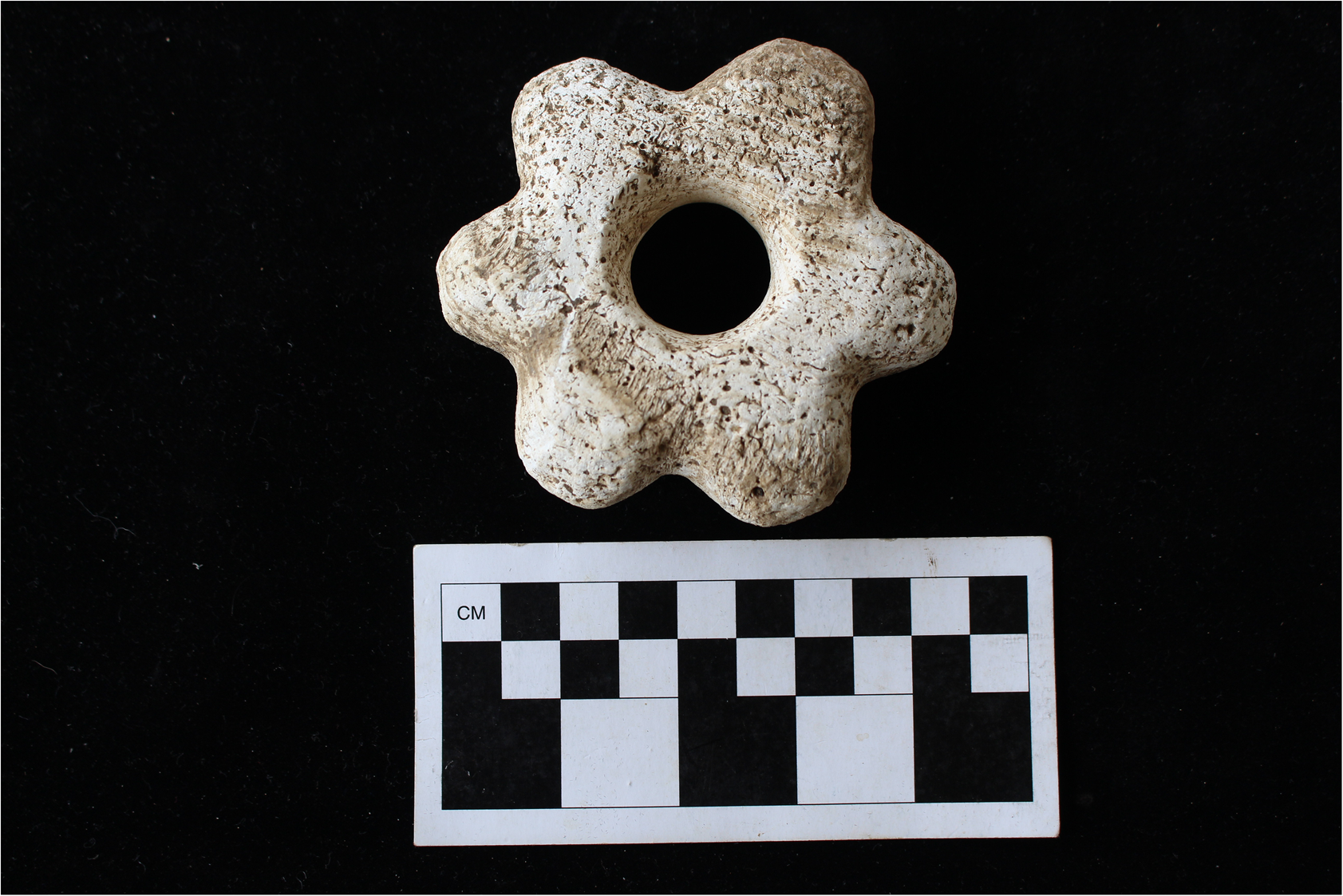
Two ark clam shells (Anadara sp.) covered the eye orbits, next to a large green clay stone and several ceramic fragments on the forehead (Figure 3). Crescent-shaped spondylus mascaras were located around the body (Figure 3). Two rectangular spondylus pendants were near the left shoulder and hip, along with nine small spondylus beads or chaquira, two oblong spondylus beads, and three obsidian blades. Two additional mascaras were found in disturbed areas of the burial (Figure 4). Another human cranium was in the burial pit, near the left shoulder, possibly as a grave offering. Finally, a limestone star-shaped mace (Figure 5) was recovered 1 m north of the burial, at the interface with the plow zone.
Grave goods associated with Burial 10, including mascaras (C, G, H, R, S, T), spondylus pendants (Q, CC), green stone (A, B, E), obsidian (F, O, P), chaquira (I, J, N, U, V, W, X, Y, Z), other beads (K, M, AA, BB), shell and spondylus fragments (L, DD, EE, FF, GG), ceramic fragments (HH, II, JJ), and the crab claw (D). (Color online)

Limestone mace associated with Burial 10. (Color online)

A burnt offering was later placed in the thoracic cavity. A radiocarbon date from this burnt material suggested this occurred between AD 991 and 1025 (Table 1). The sternum, the anterior upper ribs (left and right ribs 1–4), and upper thoracic vertebrae (T1–T7) were not recovered due to taphonomy or removal/disturbance during placement of this burnt offering.
Lab analyses indicated that Burial 10 was female and was 17–20 years old at the time of death, based on partially erupted third molars and minimal dental wear on all teeth. Fetal cranial fragment development suggested seven to nine months gestational age. Trauma analyses indicated perimortem blunt force trauma to the frontal bone based on the presence of a concentric fracture with deformed edges, although the fragmentation of cranial bones made this difficult to confirm. There were three cutmarks on the palmar surface of a hand phalanx near the proximal base. Other skeletal pathology included dental plaque and caries and slight lipping on the lumbar vertebrae.
The additional cranium was estimated as an older individual, 25–35 years old at the time of death. No evidence of trauma was identified on the cranium, although preservation of these remains was poor. Our attempt to radiocarbon date a tooth from this cranium was unsuccessful.
Significance of Burial 10
We suggest the following sequence of events around the time of death of Burial 10. First, Burial 10 received a blow to the head (intentional or accidental) and died. Before burial but around the time of death, her hands and left leg were removed. She was then buried in an earthen pit with a mix of Manteño and earlier offerings. Later, the burial was reopened, whether through accidental discovery or because the spot was marked, and a burnt offering was placed on her chest. Although speculative, these activities seem the most parsimonious interpretation of the current evidence.
The mortuary stylings of Burial 10 mark this burial as special. The quantity of artifacts is dramatically higher than at other Manteño burials at Buen Suceso (N = 6 adults). Although one other Manteño burial included chaquira, none were accompanied by mascaras or obsidian. The body positioning also differed; the other Manteño burials were flexed or secondary burial bundles. No other burial showed evidence of perimortem trauma or limb removal.
The perimortem cranial trauma and limb removal suggest that Burial 10 may have been sacrificed or treated in a violent manner around the time of death. Evidence for human sacrifice in coastal Ecuador is rare but not entirely absent. European chroniclers mentioned that human sacrifice occurred when a local leader died or to ask favors from local deities (Benzoni Reference Benzoni1962 [1572]; Cieza de León Reference Cieza de León1971 [1533]). Burial 10 may have been sacrificed as part of similar rites. Although not directly associated, the limestone mace could have been wielded for this purpose. Similarly, Manteño burials from Puerto López, north of Buen Suceso, contained multiple individuals, including isolated crania (Currie Reference Currie, Staller and Currie2001). Although the additional crania did not show evidence of violence, their status as burial offerings, rather than central figures, suggests violent treatment. The additional cranium found with Burial 10 mimics this; perhaps both Burial 10 and the extra individual met violent ends.
However, the removal of hands and left leg from Burial 10 is quite distinct from other mortuary customs in coastal Ecuador. Dismemberment of individuals is rare, with only one suggested case from the southern coast (Marcos Reference Marcos1988:163–165; Zeidler Reference Zeidler, Peregrine and Ember2001). The positioning of Burial 10's wrists under and behind the pelvis indicated that the hand bones were removed before burial, because the anatomical position of the pelvis was undisturbed. It also suggests that the wrists were tied at the time of burial. Similarly, the left ilium and acetabulum were present and undisturbed, but no left leg bones were present. It is unlikely that these elements could have been removed after burial without altering the anatomical position of the pelvis due to the superposition of the pelvis, leg, and wrists. The removal of these limbs was likely part of the symbolic punishment and interment of this individual.
Although chaquira and rectangular spondylus pendants with Burial 10 are common in Manteño contexts, the mascaras are associated with Valdivia, a culture preceding Manteño by nearly 2,000 years (Zeidler Reference Zeidler1991). These artifacts may have been encountered by Manteño residents of Buen Suceso (given the significant Valdivia occupation of the site). However, to accumulate so many artifacts required purposeful collection and curation before inclusion in this burial. The green clay stone with Burial 10 also recalls earlier times; green stone in Valdivian burials represented a link between death and fertility (Stothert Reference Stothert, Scott Raymond and Burger2003) and is less common in Manteño burials. Interpretation of this burial must ultimately consider these repeated emphases and ties to the past to understand the reasons for this enigmatic burial.
Acknowledgments
Thanks to the Comuna Dos Mangas and to the Instituto Nacional de Patrimonio Cultural (Permit no. DAAPPS-INPC-Z5-014-2022), Daniela Balanzátegui, Ana María Morales, and the 2022 PARCC field school. Valuable feedback came from Richard Lunniss, Ben Carter, the Southern Andean Scholar Symposium, the Institute of Andean Studies, and POMSLAMS.
Funding Statement
Funding for this research was provided by a Faculty Research Grant and the CHESS Small Grants Program from the University of North Carolina at Charlotte and from a Faculty Seed Grant from the University of Texas Rio Grande Valley.
Data Availability Statement
Data and photos are available on request.
Competing Interests
The authors declare none.

 Open access

