





Introduction
Tropical forests are increasingly vulnerable to environmental degradation driven by unregulated or illicit activities (Kumar et al. Reference Kumar, Kumar, Saikia, Singh, Yadav, Yadav and Yadava2022). Globally, nearly 60% of ecosystem services (ESs; benefits people obtain from ecosystems (Kumar Reference Kumar2012), including provisioning, regulating, supporting and cultural functions) are being degraded or used unsustainably (Millennium Ecosystem Assessment 2005), threatening the welfare of more than 3 billion people who depend directly on natural resources. Latin America hosts c. 40% of the planet’s biodiversity and 23% of its forest carbon stocks, yet the region loses close to 2.6 million ha of forest annually (FAO 2022). In Peru, 7.5 million ha of Amazonian forest were lost between 2001 and 2022 (Ministerio del Ambiente 2024), with increasing pressure coming from illegal logging, agriculture and mining. These processes directly endanger the provision of ESs essential for local livelihoods, including water regulation, soil fertility and food security. Amazonian forests in particular provide critical services such as food, water, climate regulation and carbon storage (Borma et al. Reference Borma, Costa, da Rocha, Arieira, Nascimento, Jaramillo-Giraldo and Nobre2022), yet their economic invisibility – often tied to indirect or non-market values – has contributed to undervaluation in policy processes and their ongoing deterioration (Hejnowicz & Rudd Reference Hejnowicz and Rudd2017). Depending on the context, ESs may behave as public goods or common resources, with risks of overexploitation where institutional frameworks are weak (Ostrom Reference Ostrom1990).
The Amazon faces multiple pressures – agricultural expansion and fires, mercury contamination from illegal mining and habitat fragmentation from logging and roads – that undermine the provisioning and regulating of services, with global consequences (Artaxo Reference Artaxo2023, Cortinhas Ferreira Neto et al. Reference Cortinhas Ferreira Neto, Diniz, Maretto, Persello, Silva Pinheiro, Castro and Klautau2024). Addressing these challenges requires effective policy actions, such as stricter enforcement of land-use regulations, sustainable agricultural practices and stronger forest governance. Within this broader context, environmental valuation methods play an indirect yet critical role by providing monetary estimates of non-market ESs typically overlooked in decision-making. Such estimates do not themselves halt deforestation or pollution, but they make visible the economic importance of ecosystems, informing incentives, conservation finance and distributive policies (Bateman et al. Reference Bateman, Carson, Day, Hanemann, Hanley, Hett and Swanson2002, Mäler & Vincent Reference Mäler and Vincent2003). Recent applications in Latin America show that stated-preference valuation can support innovative financing schemes by linking social preferences with ecological functionality (Broadbent et al. Reference Broadbent, Brookshire, Goodrich, Dixon, Brand, Thacher and Stewart2015, Matias Figueroa et al. Reference Matias Figueroa, del Pilar Salazar Vargas and Lara Pulido2021).
Revealed-preference approaches are common in urban and tourism contexts due to the availability of market information (Boyle Reference Boyle, Champ, Boyle and Brown2003), whereas stated-preference methods – particularly contingent valuation (CV) – capture both use and non-use values and are better suited to rural and open-access ecosystems (McFadden Reference McFadden, McFadden and Train2017). CV has been applied to tropical forests (Carson Reference Carson1998, Barrio & Loureiro Reference Barrio and Loureiro2010), but applying it in rural Amazonian settings is challenging; limited liquidity, prevalence of non-monetary contributions and perceptions of forests as collective heritage complicate assumptions about monetary preferences (Whittington Reference Whittington2002, Bremner & Lu Reference Bremner and Lu2006). Nonetheless, studies show a willingness to contribute when ESs are tied to livelihoods and collective identity, stressing the need for context-sensitive approaches (Ansong et al. Reference Ansong, Ameyaw, Boadu, Kpikpitse and Acheampong2023). Comparable evidence from other rural and semi-arid regions confirms that willingness to pay (WTP) often reflects social attachment and perceived dependence on local ecosystems rather than pure income effects (Reis et al. Reference Reis, MDMVBR and Galvincio2022, Cortés-Espino et al. Reference Cortés-Espino, Langle-Flores and Gauna Ruíz de León2023). Similarly, community-based valuations of agricultural and wetland services in Europe and Asia highlight how cultural and distributive dimensions shape participation and payment decisions (Novikova et al. Reference Novikova, Rocchi and Vaznonis2019, Eskandari-Damaneh et al. Reference Eskandari-Damaneh, Noroozi, Ghoochani, Taheri-Reykandeh and Cotton2020).
Within a welfare economics framework, the economic valuation of ESs is grounded in the theory of utility maximization, where individuals derive satisfaction from the consumption of goods and services that contribute to their well-being (Lancaster Reference Lancaster1966, Hanemann Reference Hanemann1984). The total economic value (TEV) of ecosystems includes both use values – linked to direct consumption or indirect benefits – and non-use values, such as existence and bequest motives (Bateman et al. Reference Bateman, Carson, Day, Hanemann, Hanley, Hett and Swanson2002). Among stated-preference methods, which include CV and choice experiments, the CV method estimates WTP through hypothetical market scenarios, consistent with the random utility model (RUM; McFadden Reference McFadden, McFadden and Train2017). In this approach, WTP reflects the monetary measure of welfare change associated with preserving or improving ESs. This makes CV particularly suitable for contexts such as rural Amazonian communities, where market prices do not capture the full contribution of forests to local well-being.
International evidence shows substantial variation in relative WTP values across income levels and socioecological contexts. In high-income countries, WTP/income ratios are typically below 0.15%, such as for river restoration in the south-western USA (e.g., Broadbent et al. Reference Broadbent, Brookshire, Goodrich, Dixon, Brand, Thacher and Stewart2015) and European landscape studies (e.g., Novikova et al. Reference Novikova, Rocchi and Vaznonis2019). In middle- and upper-middle-income settings, ratios rise markedly: Matías Figueroa et al. (Reference Matias Figueroa, del Pilar Salazar Vargas and Lara Pulido2021) estimated 0.7% for climate-adaptation co-financing in Puerto Vallarta (Mexico), while Cortés-Espino et al. (Reference Cortés-Espino, Langle-Flores and Gauna Ruíz de León2023) reported 2.0% for protecting a free-flowing river, reflecting the influence of social and cultural attachment on valuation outcomes. Similarly, Reis et al. (Reference Reis, MDMVBR and Galvincio2022) obtained 0.9% in Brazil’s semi-arid region, and Eskandari-Damaneh et al. (Reference Eskandari-Damaneh, Noroozi, Ghoochani, Taheri-Reykandeh and Cotton2020) found 1.0% for wetland conservation in rural Iran, both emphasizing the role of institutional trust and compensation mechanisms. These indicate a WTP/income ratio range worldwide of 0.1–2.0%, increasing with ecological dependence and declining where liquidity constraints or weak institutions prevail.
For the Amazon, empirical evidence in this domain remains scarce. Alarcón Aguirre et al. (Reference Alarcón Aguirre, Díaz Revoredo, Vela Da-Fonseca, Quiñonez Almiron, Zevallos Pollito and Gutiérrez Alberoni2018) reported a ratio of 0.33% in two Indigenous communities of Madre de Dios under land-use compensation schemes, while Manero et al. (Reference Manero, Nikolakis, Woods and Grafton2024) highlighted the absence of Indigenous-inclusive approaches and persistent methodological challenges. Several studies have shown that income does not always exert a positive effect on WTP in low-income or resource-dependent contexts. In rural and forest-based communities, higher-income households may perceive conservation as a public responsibility, while lower-income households – being more directly dependent on local ecosystems – often express greater willingness to contribute (Cortés-Espino et al. Reference Cortés-Espino, Langle-Flores and Gauna Ruíz de León2023). In such settings, contributions are driven more by perceived necessity and ecological vulnerability than by disposable income, reflecting a distinct socio-environmental rationality. Consequently, understanding the relative economic effort of low-income Amazonian households remains an open empirical question that this study seeks to address.
The rationale for this study was to make visible the economic effort that low-income Amazonian households are willing to make for forest conservation. By expressing local conservation values in monetary and relative terms (WTP/income ratio), our analysis connects micro-level household behaviour with macro-level debates on equitable and sustainable conservation finance in data-scarce rural contexts. We provide empirical evidence from two rural Amazonian communities in Peru – San Joaquín de Omaguas (SJO) and Santa Clara de Nanay (SCN) – by estimating households’ WTP for local conservation actions and identifying the socio-economic factors that shape these decisions. Our contribution lies in quantifying both the absolute and relative economic effort of low-income rural populations, thereby linking valuation outcomes with distributive dimensions of environmental policy. In doing so, the study extends previous evidence from other ecosystem contexts (Broadbent et al. Reference Broadbent, Brookshire, Goodrich, Dixon, Brand, Thacher and Stewart2015, Novikova et al. Reference Novikova, Rocchi and Vaznonis2019, Eskandari-Damaneh et al. Reference Eskandari-Damaneh, Noroozi, Ghoochani, Taheri-Reykandeh and Cotton2020) to tropical forest contexts where collective environmental ethics and low market participation influence monetary valuation.
Methods
Study area
We conducted the study in two rural localities of the Loreto region: SJO and SCN (Fig. 1). Soils in SJO are mainly alluvial, favouring traditional agriculture, while SCN presents greater heterogeneity (clayey, sandy, mixed), supporting diverse vegetation and land uses. These territories harbour high-biodiversity ecosystems that provide key ESs, such as water regulation, carbon storage and resources that support local subsistence activities (Otrera & Wong Reference Otrera and Wong2003). Provisioning services include wild fruits and valuable timber species, all of which are central to household subsistence and income. Regulating services include climate stabilization, soil protection and hydrological regulation, which mitigate seasonal rainfall impacts.
Location of San Joaquín de Omaguas and Santa Clara de Nanay in the Loreto region (Peruvian Amazon).

Survey design
The study used a quantitative, non-experimental and cross-sectional approach based on primary data collected through structured surveys. The research design was descriptive and explanatory, as it sought to identify socio-economic factors that determine households’ WTP for ES conservation and to estimate their relative economic effort. The analysis combined the CV method with econometric modelling as a step prior to estimating monetary WTP by first quantifying the probability of accepting the proposed payment for conservation.
The CV method was applied to elicit households’ WTP for forest conservation because it enabled the estimation of the monetary value of non-market goods through hypothetical market scenarios (Mitchell & Carson Reference Mitchell and Carson1989). Respondents were asked whether they would pay a specified monthly amount to support local conservation initiatives, consistent with the dichotomous-choice format recommended by the National Oceanic and Atmospheric Administration (NOAA) Panel (Arrow et al. Reference Arrow, Solow, Portney, Leamer, Radner and Schuman1993). The survey followed these guidelines and recent best practices (Johnston et al. Reference Johnston, Boyle, Adamowicz, Bennett, Brouwer, Cameron and Tourangeau2017) to support validity and contextual relevance. A focus group with community representatives, a local biologist and the research team helped adapt language and scenarios, complemented by field visits to identify priority ESs (De Groot et al. Reference De Groot, Wilson and Boumans2002).
The questionnaire (Appendix S1) comprised five sections: (1) socio-economic information; (2) perceptions of forest condition and ESs; (3) the valuation scenario describing degradation and conservation alternatives; (4) the dichotomous WTP question with brief follow-up items to verify respondents’ understanding and motives; and (5) final opinions on forest conservation and respondents’ evaluation of the survey. The instrument was pre-tested with community representatives to ensure clarity and cultural relevance.
The first two sections of the questionnaire collected information on respondents’ knowledge of local ecosystems, perceived importance of forest ESs and socio-economic attributes such as age, gender, education, income and household size. These variables were later incorporated as explanatory factors in the logit model to assess how individual characteristics were associated with bid acceptance. The variables were selected based on their theoretical relevance and previous empirical evidence linking socio-economic factors to WTP in CV studies (Whittington Reference Whittington2002, Aseres & Sira Reference Aseres and Sira2020, Ansong et al. Reference Ansong, Ameyaw, Boadu, Kpikpitse and Acheampong2023). Education and income were originally collected as categorical variables. For estimation purposes, education was expressed in years of schooling by assigning standard durations to each category, while income intervals were represented by the midpoint of each range.
The baseline scenario described progressive forest degradation from illegal logging, burning, resource extraction and agricultural expansion leading to biodiversity loss, soil erosion and local climate impacts. These environmental changes were explained through observable effects (e.g., higher temperatures, altered rainfall, reduced wild foods, etc.), so respondents could relate forest conditions to household well-being. The alternative scenario proposed community-led conservation actions (e.g., patrols, reforestation, monitoring, etc.) financed by a local fund. WTP was elicited through a dichotomous-choice format (Hanemann Reference Hanemann1984), with bid levels defined from the focus group and pilot survey: ‘Would you be willing to contribute monthly, on a voluntary basis, PEN [X] to a community fund for the conservation of the SCN/SJO forest, including activities such as reforestation, surveillance, and sustainable resource use?’
To mitigate potential bias, surveyors were trained to avoid influence (Mekonnen Reference Mekonnen2000), a cheap-talk script reminded respondents to consider their budget (Cummings & Taylor Reference Cummings and Taylor1999) and control questions ensured consistency (Mitchell & Carson Reference Mitchell and Carson1989). Protest responses were not excluded due to the limited sample size, a decision that is acknowledged as a methodological limitation (Bateman et al. Reference Bateman, Carson, Day, Hanemann, Hanley, Hett and Swanson2002).
Sample
To determine the sample size, we employed a probabilistic random sampling approach with finite population correction, using Cochran’s (Reference Cochran1977) formula (Equation 1), with a 95% confidence level (Z = 1.96), an expected population proportion with the characteristic of interest of 50% (p = 0.5) and an acceptable margin of error of 5%. The target population comprised 232 households in SJO and 900 households in SCN (INEI 2018), resulting in initial sample sizes of 145 and 269 households, respectively. $n = {{N{Z^2}pq} \over {\left( {N - 1} \right){e^2} + {Z^2}pq}}$
where N is the population size, Z is the critical value corresponding to the selected confidence level, p is the expected proportion, q = 1 − p and e is the margin of error. Due to the small and relatively homogeneous populations, simple random sampling was considered appropriate and efficient. Stratified sampling yields substantial gains in precision only when the population exhibits pronounced heterogeneity across clearly differentiated subgroups. When such conditions are absent, the reduction in sampling variance is minimal, whereas the procedural complexity and design requirements increase considerably. Consequently, for populations of limited size and relatively uniform characteristics – as in the present study – simple random sampling is broadly regarded as a rigorous and methodologically justified approach (Casal & Mateu Reference Casal and Mateu2003, Rivas & Ramoni Reference Rivas and Ramoni2007, Tello et al. Reference Tello, Prada and Cristeche2018).
In total, we conducted 176 surveys in SJO and 305 surveys in SCN, representing 76% and 34% of their respective household populations. Surveys were administered to household heads between March and September 2024.
Descriptive statistics
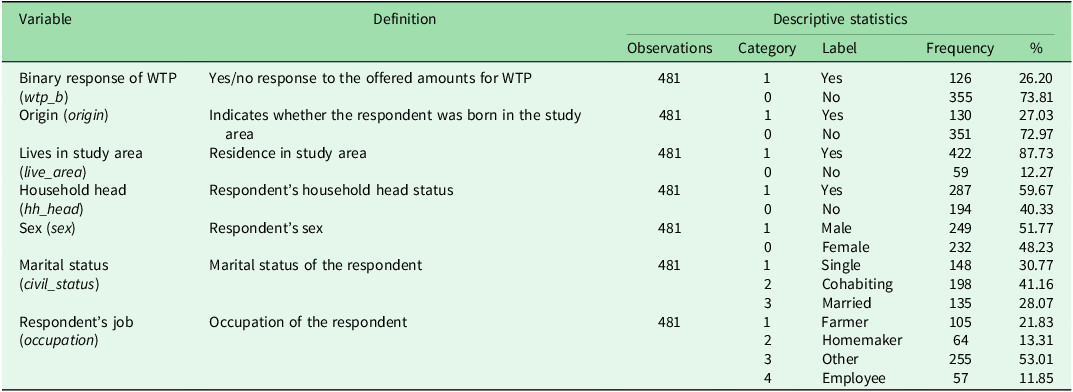
The final dataset comprised 481 households from SJO and SCN (Table 1). Approximately 26% of respondents expressed a positive WTP for ES conservation, with an average bid amount of PEN 4.57 (≈ USD 1.28). Respondents’ average age was 43 years, ranging from 18 to 95, and households averaged four members. Slightly more than half of respondents were men (52%), and nearly 60% were household heads. While 88% resided in the study area, only 27% were originally from there.
Summary of quantitative variables (PEN 3.57 ≈ USD 1.00).

ES = ecosystem services; WTP = willingness to pay.
Most households exhibited low income levels: 62% earned less than PEN 700 per month and fewer than 10% exceeded PEN 1500, with an average of PEN 690.23 (Table 2). Educational attainment was similarly low – 38% completed primary school, 38% completed secondary school and only 6% pursued technical or university studies – averaging 7.42 years of schooling. In terms of occupation, 22% were farmers, 13% were homemakers, 12% were employees and 53% were engaged in other independent activities. Regarding marital status, 41% cohabited, 28% were married and 31% were single.
Summary of categorical and dummy variables.

WTP = willingness to pay.
Econometric model
To estimate WTP derived from the CV survey, a binary logit model consistent with the RUM framework was employed (McFadden Reference McFadden, McFadden and Train2017) because it is appropriate for dichotomous-choice data (Hanemann Reference Hanemann1984). The econometric form of the model is given in Equation 2: $P\left( {wtp\_b = 1} \right) = {{{e^{{\beta _0} + {\beta _1}bid + \sum\nolimits_{j = 2}^k {{\beta _j}} {X_j}}}} \over {1 + {e^{{\beta _0} + {\beta _1}bid + \sum\nolimits_{j = 2}^k {{\beta _j}} {X_j}}}}}$
where ${\beta _1} \lt 0$
,
${\beta _1} \lt 0$
, ${X_j}$
represents the
${X_j}$
represents the $j$
th explanatory variable and
$j$
th explanatory variable and $k$
denotes the total number of covariates. This model estimated the probability of accepting the proposed payment as a function of the bid amount and a set of socio-economic characteristics obtained from the survey.
$k$
denotes the total number of covariates. This model estimated the probability of accepting the proposed payment as a function of the bid amount and a set of socio-economic characteristics obtained from the survey.
The model’s efficiency and goodness of fit were evaluated through the likelihood-ratio chi-square test (p < 0.01), pseudo-R2 and information criteria (Akaike information criterion (AIC) and Bayesian information criterion (BIC)), suggesting an adequate model specification. Correlation diagnostics were conducted to assess multicollinearity (Appendix S2).
In this framework, the covariates – along with the coefficient of the bid variable – were used to derive the mean WTP (Haab & McConnell Reference Haab and McConnell2002, Carson & Hanemann Reference Carson and Hanemann2005). Given the estimated coefficients $\,\hat {\! \beta}$
0,
$\,\hat {\! \beta}$
0, $\,\hat {\! \beta}$
1, …,
$\,\hat {\! \beta}$
1, …, $\,\hat {\! \beta}$
k (Equation 2), the expected (mean) WTP could be expressed as in Equation 3:
$\,\hat {\! \beta}$
k (Equation 2), the expected (mean) WTP could be expressed as in Equation 3: $E\left( {WTP} \right) = E\left( {{{{{\,\hat {\! \beta} }_0} + \sum\nolimits_{j = 2}^k {{{\,\hat {\! \beta} }_j}} {X_j}} \over {{{\,\hat {\! \beta} }_1}}}} \right)$
Accordingly, for a sample of size n, where i = 1, …, n, Equation 3 can be estimated as in Equation 4: $\overline {WTP} = {1 \over n}\sum\limits_{i = 1}^n {{{\widehat {WTP}}_i}} = {1 \over n}\sum\limits_{i = 1}^n {\left( {{{{{\,\hat {\! \beta} }_0} + \sum\nolimits_{j = 2}^k {{{\,\hat {\! \beta} }_j}} {X_{ji}}} \over {{{\,\hat {\! \beta} }_1}}}} \right)}$
Thus, WTP estimates were obtained from Equation 4 using the coefficients derived from the logit specification in Equation 2. During data collection, protest responses could not be identified or excluded, potentially leading to an over-representation of zero values in the dependent variable. The binary outcome was imbalanced (Table 2); therefore, a weighting correction was applied to the minority class in the logit model to mitigate potential bias due to class imbalance (King & Zeng Reference King and Zeng2001, Zhang et al. Reference Zhang, Geisler, Ray and Xie2021). Logistic regressions may become unstable under imbalance (Hilbe Reference Hilbe2015). To evaluate uncertainty, confidence intervals were calculated using the Krinsky and Robb (Reference Krinsky and Robb1986) simulation method. This approach ensured more robust estimates despite limitations in data distribution and sample constraints.
Results
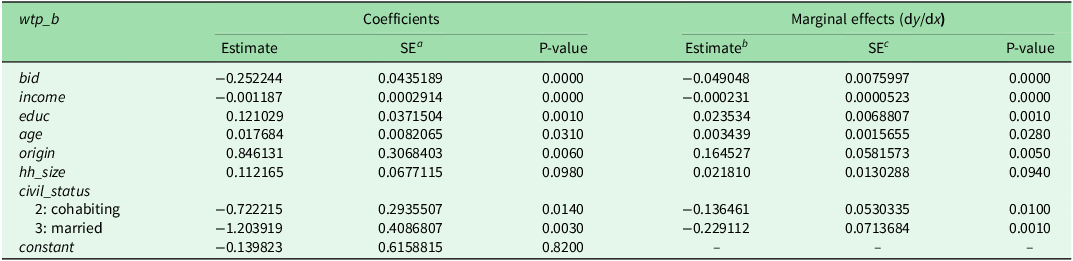
The binary logit model indicates that the bid variable had a negative and statistically significant effect on respondents’ WTP (Table 3). Specifically, each additional PEN unit offered reduced the probability of accepting the proposed payment by nearly 5% (dy/dx = −0.049). The income variable exhibited a small but significant negative marginal effect (–0.00023, p < 0.001), indicating that higher-income respondents were slightly less likely to accept the proposed payment. This marginal effect suggests a very small reduction in the probability of acceptance per additional PEN unit of income.
Estimation results of the selected logit specification.

a Robust SEs.
b Average marginal effect,
c SEs obtained using the delta method.
SE = standard error.
The model fit was assessed using the pseudo-R2 (0.1818), the Wald chi-square (74.96, p < 0.001) and the information criteria (AIC = 563.58 and BIC = 601.17).
The education variable showed a positive effect on WTP (Table 3). The average marginal effect of 0.0235 suggests that, on average, one additional year of schooling increased the probability of a ‘yes’ response by c. 2.4%, holding other factors constant.
Age had a positive effect on WTP (Table 3), indicating that each additional year of age increased the probability of accepting the proposed payment by c. 0.34%, on average, holding other factors constant. The variable ‘origin’ showed one of the strongest effects, indicating that respondents originally from the study area had, on average, a 16.5% higher probability of accepting the proposed payment. The model does not identify the underlying mechanisms associated with this difference. Similarly, household size had a positive effect on WTP level (Table 3), with the average marginal effect suggesting that each additional household member increased the probability of acceptance by c. 2 percentage points. The marital status variable was significant for the categories ‘cohabiting’ and ‘married’ relative to the reference group (‘single’; Table 3), indicating a lower probability of accepting the proposed payment. No additional behavioural interpretation is inferred from these coefficients.
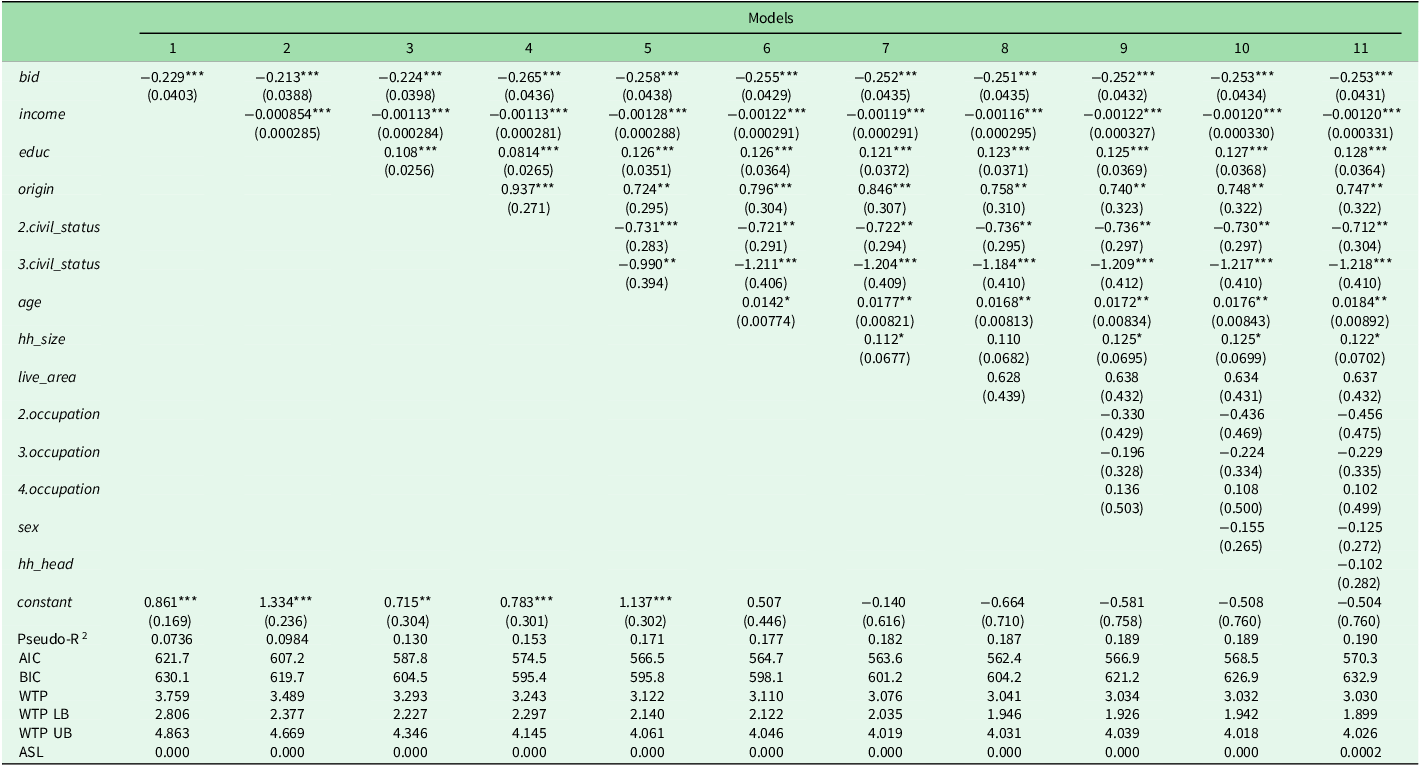
By contrast, sex, household head status, lives in study area and occupation were not significant and were excluded. Model 7 was selected as the final specification (Table 4) because it retained only statistically significant predictors and exhibited one of the lowest AIC values. Based on this model, the average monthly WTP was estimated at PEN 3.076 (≈ USD 0.86), with a 95% confidence interval of PEN 2.035–4.019 (≈ USD 0.57–1.13).
Logit regression results (standard errors in parentheses) and computed willingness to pay (WTP) for each specification.

***p < 0.01, **p < 0.05, *p < 0.1.
AIC = Akaike information criterion; ASL = achieved significance level; BIC = Bayesian information criterion; LB = lower bound; UB = upper bound.
A bid vector ranging from PEN 1 to 20 was used, with a mean offer of PEN 4.57. Bid frequencies were mostly concentrated in the lower end: 56.34% of respondents were offered amounts between PEN 1 and 4, and 35.97% were offered bids between PEN >4 and 10, while values above PEN 10 appeared only marginally (Table 4). This distribution reflects a concentration of bids at lower contribution levels. No further assumptions are made regarding the implications of this distribution for estimation.
In the baseline model, which included only the bid variable, the mean WTP was estimated at PEN 3.76 (≈ USD 1.05). As explanatory variables were progressively added, the estimates declined moderately, reaching PEN 3.03 (≈ USD 0.85) in the final specification. This change coincides with the inclusion of socio-economic covariates. Nevertheless, the bid coefficient remained stable in sign, magnitude and significance across all models, underscoring the robustness of the results. Furthermore, the confidence intervals for all WTP estimates consistently excluded zero, and the achieved significance levels for testing the null hypothesis that WTP ≤ 0 were below 0.001 in every case, providing statistical evidence that the mean WTP is significantly greater than zero.
Discussion
The WTP/income ratio estimated for SCN and SJO (0.50%) falls within an intermediate range compared to previous studies in rural and Amazonian contexts, where empirical evidence remains scarce (Manero et al. Reference Manero, Nikolakis, Woods and Grafton2024). This value is higher than that reported by Alarcón Aguirre et al. (Reference Alarcón Aguirre, Díaz Revoredo, Vela Da-Fonseca, Quiñonez Almiron, Zevallos Pollito and Gutiérrez Alberoni2018) for Indigenous communities in Madre de Dios (0.33% under land-use compensation schemes). In Amazonian settings, strong ecosystem dependence coexists with severe budget constraints, which may explain the relatively low monetary contributions despite a high reliance on forest resources (Alarcón Aguirre et al. Reference Alarcón Aguirre, Díaz Revoredo, Vela Da-Fonseca, Quiñonez Almiron, Zevallos Pollito and Gutiérrez Alberoni2018). Moreover, when ESs are viewed mainly as communal rather than tradable goods, the link between conservation initiatives and individual payments tends to weaken, consistent with community-based valuations reported in other rural contexts (Reis et al. Reference Reis, MDMVBR and Galvincio2022, Cortés-Espino et al. Reference Cortés-Espino, Langle-Flores and Gauna Ruíz de León2023).
Comparison with rural Andean areas highlights marked differences. Quispe-Mamani et al. (Reference Quispe-Mamani, Quispe-Mamani, Roque-Guizada, Yapuchura-Saico and Catachura-Vilca2021) estimated a WTP/income ratio of 1.05% in the Coata River basin for water-related provisioning services, which have a long tradition of monetary payment. In contrast, in SCN and SJO, the valued ESs – although essential for subsistence – lacked such a payment tradition, evidently reducing willingness to contribute. This pattern mirrors results from Eskandari-Damaneh et al. (Reference Eskandari-Damaneh, Noroozi, Ghoochani, Taheri-Reykandeh and Cotton2020), who found that participation in Iran’s wetland set-aside programme was constrained by the absence of established compensation mechanisms and limited institutional trust. Taken together, these studies suggest that, beyond ecological importance, cultural and institutional factors – including collective norms and governance credibility – strongly shape conservation values and financial commitment.
At the regional scale, Broadbent et al. (Reference Broadbent, Brookshire, Goodrich, Dixon, Brand, Thacher and Stewart2015) and Matias Figueroa et al. (Reference Matias Figueroa, del Pilar Salazar Vargas and Lara Pulido2021) provide complementary evidence from Latin America showing that valuation outcomes are more robust when respondents perceive tangible ecological improvements or transparent reinvestment of funds. In the south-western USA, Broadbent et al. (Reference Broadbent, Brookshire, Goodrich, Dixon, Brand, Thacher and Stewart2015) found significant WTP for both restoration and preservation when ecological endpoints such as riparian vegetation and bird abundance were explicitly linked to policy scenarios. Similarly, Matias Figueroa et al. (Reference Matias Figueroa, del Pilar Salazar Vargas and Lara Pulido2021) demonstrated that stated-preference valuation in Puerto Vallarta supported the design of matching-funds schemes for climate adaptation, highlighting how economic evidence can guide co-financing strategies. In contrast, our findings from SCN and SJO reflect the incipient stage of conservation finance in the Amazon, where limited institutional presence and informality restrict the translation of social support into actual payment mechanisms.
International comparisons reinforce these insights. Ratios from Ethiopia (1.05%; Aseres & Sira Reference Aseres and Sira2020), the Philippines (1.22%; Ampaso et al. Reference Ampaso, Buncag, Magarin and Arreza2024) and Ghana (2.00%; Ansong et al. Reference Ansong, Ameyaw, Boadu, Kpikpitse and Acheampong2023) are higher than in SCN and SJO, reflecting stronger risk perception, lack of substitutes and tighter integration of ESs into daily livelihoods. Similarly, Novikova et al. (Reference Novikova, Rocchi and Vaznonis2019) reported that in Lithuanian agricultural landscapes, cultural attachment and pro-agriculture attitudes significantly increased WTP, even at low income levels, supporting the notion that non-monetary motivations and identity factors can sustain conservation efforts. Together, this evidence suggests that risk perception, livelihood integration and social attachment jointly determine relative economic effort. The results for SCN and SJO are therefore consistent with the lower bound of values observed in low-income settings, confirming that Amazonian communities face structural barriers that constrain their financial contribution capacity.
Based on our results, we can infer that SCN and SJO value the ESs received by their communities at an average of PEN 41 184 (≈ USD 11 536) per year at the community level. As an illustrative exercise, assuming c. 500 000 people distributed across 2700 Amazonian communities with similar preferences and an average household size of 4.11 members, the aggregate annual WTP for ES conservation could be estimated at c. PEN 5.83 million (≈ USD 1.63 million). This figure derives from the monthly household WTP, which represents c. 0.50% of household income, and should be interpreted as an approximate indication of the collective economic effort that low-income Amazonian households could contribute. It is modest relative to national budgets but relevant for designing community-based funding mechanisms in line with equitable conservation finance principles.
Socio-demographic determinants provide further insights. As expected in CV studies, higher bid amounts reduce the probability of accepting the proposed payment (Hanemann Reference Hanemann1984, Carson & Hanemann Reference Carson and Hanemann2005). Income was negatively associated with WTP, contrasting with contexts where higher incomes increase or have neutral effects on payment probability (Novikova et al. Reference Novikova, Rocchi and Vaznonis2019, Aseres & Sira Reference Aseres and Sira2020, Ansong et al. Reference Ansong, Ameyaw, Boadu, Kpikpitse and Acheampong2023). This negative association is consistent with findings from rural and low-income settings, where stronger environmental dependence and relational values among poorer households often outweigh income effects on WTP (Baumgärtner et al., Reference Baumgärtner, Drupp, Meya, Munz and Quaas2012, Susaeta et al. Reference Susaeta, Lal, Alavalapati and Mercer2011, Cortés-Espino et al. Reference Cortés-Espino, Langle-Flores and Gauna Ruíz de León2023). A plausible explanation is the relative homogeneity of low incomes in the study areas, where marginal increases do not necessarily translate into greater support for conservation. Education showed a positive and significant effect, aligning with evidence that more schooling enhances environmental awareness and conservation preferences (Novikova et al. Reference Novikova, Rocchi and Vaznonis2019, Aseres & Sira Reference Aseres and Sira2020, Bostan et al. Reference Bostan, Fatahi Ardakani, Fehresti Sani and Sadeghinia2020, Matías Figueroa et al. Reference Matias Figueroa, del Pilar Salazar Vargas and Lara Pulido2021, Quispe-Mamani et al. Reference Quispe-Mamani, Quispe-Mamani, Roque-Guizada, Yapuchura-Saico and Catachura-Vilca2021). Household size was also positively associated with WTP, consistent with findings from rural wetland contexts where larger families depend more directly on provisioning services (Eskandari-Damaneh et al. Reference Eskandari-Damaneh, Noroozi, Ghoochani, Taheri-Reykandeh and Cotton2020) but contrasting with cases where more dependents reduced payment capacity (Alarcón Aguirre et al. Reference Alarcón Aguirre, Díaz Revoredo, Vela Da-Fonseca, Quiñonez Almiron, Zevallos Pollito and Gutiérrez Alberoni2018, Bostan et al. Reference Bostan, Fatahi Ardakani, Fehresti Sani and Sadeghinia2020). This positive association probably reflects the greater reliance of larger households on forest provisioning services and the perceived benefits of sustaining local ecosystem functions. In Amazonian communities, this pattern may reflect stronger perceptions of collective benefit, similar to the social-value dynamics observed by Cortés-Espino et al. (Reference Cortés-Espino, Langle-Flores and Gauna Ruíz de León2023).
Other variables, such as gender and age – significant in other contexts (Wilson et al. Reference Wilson, Davis, Matzek and Kragt2019, Reis et al. Reference Reis, MDMVBR and Galvincio2022, Ansong et al. Reference Ansong, Ameyaw, Boadu, Kpikpitse and Acheampong2023) – were not significant here, probably reflecting community homogeneity. Local residence increased WTP, consistent with evidence on territorial attachment and daily ecosystem use (Torres-Miralles et al. Reference Torres-Miralles, Grammatikopoulou and Rescia2017, Quispe-Mamani et al. Reference Quispe-Mamani, Quispe-Mamani, Roque-Guizada, Yapuchura-Saico and Catachura-Vilca2021). Although no formal filters were applied to identify protest responses, some zero-WTP values may reflect distrust in institutional management or expectations of state-funded conservation (Meyerhoff & Liebe Reference Meyerhoff and Liebe2010), as has also been reported in Brazil’s semi-arid basins (Reis et al. Reference Reis, MDMVBR and Galvincio2022) and Iran’s wetland programmes (Eskandari-Damaneh et al. Reference Eskandari-Damaneh, Noroozi, Ghoochani, Taheri-Reykandeh and Cotton2020).
These results should be interpreted in light of several limitations. The study was restricted to two communities, which limits statistical generalization across the Amazon. Protest responses could not be formally identified, potentially biasing zero-WTP observations. Similarly, the use of stated-preference methods is subject to hypothetical and strategic bias, despite mitigation through cheap-talk scripts and follow-up consistency checks. Future studies could explore alternative valuation approaches – such as revealed preferences or experimental methods – and incorporate institutional, behavioural and ecological indicators to deepen understanding of conservation motivations.
Ethical safeguards were applied throughout the study. Participation was voluntary, based on informed consent, and no financial incentives were offered. Local leaders and community representatives reviewed and approved survey instruments to ensure cultural appropriateness. These measures aimed to respect autonomy, avoid coercion and align with local norms of reciprocity and trust – essential elements when valuing shared environmental goods in Indigenous and rural contexts.
Despite low aggregate contributions, the results emphasize the importance of coupling local willingness to contribute with institutional support and co-financing mechanisms. Community-managed environmental funds, differentiated schemes and transparent governance can enhance both equity and financial sustainability. Policies that are context-sensitive and ethically grounded in collective values are more likely to achieve durable and socially legitimate conservation outcomes in the Amazon.
Conclusion
Research evaluating ESs with the participation of rural Amazonian communities remains scarce, despite the direct dependence of these communities on these services. This study provides empirical evidence from two localities – SJO and SCN – estimating a monthly household WTP of PEN 3.076 (≈ USD 0.86) and a WTP/income ratio of 0.50%. These values, although modest in absolute terms, represent a significant relative effort compared to high-income countries and are consistent with the lower bound of estimates observed in low-income rural contexts.
Income showed a negative association with WTP, indicating that higher-income households were less likely to contribute, although the underlying reasons for this cannot be identified from the data. In contrast, education and household size had positive effects, suggesting that contributions reflect not only financial capacity but also cultural values and livelihood strategies. These results align with international evidence showing that, in low-income settings, education and social-relational values are stronger predictors of WTP than income, and that liquidity constraints and the absence of payment traditions limit monetary participation.
From a policy perspective, these findings suggest that conservation financing in Amazonian contexts should not rely solely on voluntary monetary contributions but rather combine them with institutional support, co-financing schemes and culturally appropriate governance mechanisms. Strengthening trust, transparency and community participation appears to be essential to translating positive conservation attitudes into effective funding mechanisms.
Overall, this study contributes to the limited empirical literature on ES valuation in tropical forest communities by highlighting that willingness to contribute exists but is structurally constrained, underscoring the need for hybrid conservation strategies that integrate local preferences with broader institutional frameworks.
Supplementary material
To view supplementary material for this article, please visit https://doi.org/10.1017/S0376892926100435.
Acknowledgements
The authors thank the communities of San Joaquín de Omaguas and Santa Clara de Nanay for their participation and collaboration during the fieldwork.
Financial support
None.
Competing interests
The authors declare none.
Ethical standards
The study involved voluntary participation based on informed consent. Respondents were informed about the purpose of the study and their right to withdraw at any time, and no personal identifiers were collected.




 Open access

