

How children are or are not supported in their relationship with a parent with mental illness, and most specifically how they are helped to understand the parent's behaviour, can have serious consequences for the prevention or otherwise of mental illness in these children and young people later in life. This article defines some of what is known about the impacts of parental mental illness on children and young people, their responses and what they say they need and want from professional services, as well as some suggestions for how professionals may respond.
Background to the problem
England and Wales
Extrapolation from the studies of Reference Aldridge and BeckerAldridge & Becker (2003) suggests that between 6000 and 17 000 children in England and Wales will be caring for a parent with mental illness at any one time. However, Aldridge & Becker have also concluded that about 170 000 children are caring for a parent with physical or mental illness and that it is likely that about a third of these parents have predominantly mental illnesses. On that basis about 55 000 to 60 000 children will be affected. Also, aggregated figures from a number of studies suggest that about 3 million children under the age of 16 are being significantly affected by a parent's mental or physical illness and therefore about 1 million can be expected to be affected by mental illness. The spread of these figures is probably an indication of the lack of knowledge about, as well as the previous serious neglect of, these children.
The USA, the UK and Australia
In the USA the National Co-morbidity Survey (Reference Nicholson, Sweeney and GellerNicholson 1998, Reference Nicholson, Nason and Calabresi1999) showed that 68% of women with mental health disorders are parents, compared with 57% of men. Similar figures are reported in the UK (Reference RichmanRichman 1976; Reference Brown and HarrisBrown 1978; Reference OatesOates 1997) and in Australia (Reference McGrath, Hearle and JennerMcGrath 1999). Aggregated data suggest that having one mentally ill parent gives a child a 70% chance of developing at least minor adjustment problems by adolescence. With two mentally ill parents there is a 30–50% chance of becoming seriously mentally ill (Reference Rubovits, Göpfert, Webster and SeemanRubovits 1996). A child with an affectively ill parent has a 40% chance of developing affective disorder by age 20, compared with a 20–25% risk in the general population (Reference Beardslee, Bemporad and KellerBeardslee 1983).
Other effects
The UK Department of Health's training manual and reader on working with mentally ill parents and their children (Reference FalcovFalcov 1998) includes evidence that the presence of mental illness in a parent has been shown to negatively affect the children's cognitive and language development, attention and concentration span, educational achievement and social, emotional and behavioural development.
Reference Stuart, Aldridge and BeckerStuart (1998) has reported a ‘befriending project’ for children of parents with schizophrenia, in which 73% of the children reported serious distress resulting from their parent's illness – the main complaints being a sense of being ignored, pressure to be ‘good’, false maturity and a fear of family breakdown. Similar complaints were reported by Reference Mackereth, Göpfert and HarrisonMackereth et al (1999), in which the young people interviewed reported a lack of explanation of their parent's disorder and a consequent sense of personal blame and responsibility.
The hidden impact
Reference Weir and DouglasWeir & Douglas (1999) reported that ‘some children seem fine on the surface, until subsequent disclosure reveals that they have been experiencing neglect and abuse and have been living in fear for years, all the time wearing a mask’. This is backed up by Reference Yule and WilliamsYule & Williams (1990), who conclude that parents as well as other adults commonly underestimate the consequences of ‘critical events’ on children and the degree to which children think of, and are occupied with, what has happened. They write: ‘[it] seems that the assumption that “out of sight … [means] … out of mind” continues to predominate’. Reference DunnDunn (1993) found that adults who had had a mentally ill parent when they were children retrospectively reported high levels of abuse and neglect, as well as isolation. This more candid reporting in adulthood of abusive experiences that were not disclosed during childhood suggests that there may be significant underreporting of abuse by children of mentally ill parents, even among those relatively few who are given an opportunity to talk about their experiences.
Alternative caring adults
A number of factors, particularly the presence of an alternative caring adult, can mitigate against these negative effects (Schachnow 1987). Reference Quinton and RutterQuinton & Rutter (1984) and Rutter (1987Reference Rutter, Rolf, Masten and Cicchetti, 1990) identified a ‘capacity to appraise’ stressful situations (particularly through the availability of a warm, concerned, but relatively non-involved adult) as a significant protective factor. Reference CowlingCowling (1999) confirmed that the availability of one or more adults with whom the child can develop a supportive relationship is a key factor in a child's development of resilience in the face of parental mental illness. Reference Falcov, Wood and RoseFalcov (1999, Reference Falcov and Cowling2004) has further shown that the degree to which a child can develop a ‘good’ explanation (i.e. which is reasonably accurate, lowers the child's confusion and self-blame, and raises the child's self-esteem) of a parent's mental illness is associated with a lower level of ‘caseness’ on the Rutter B2 Scale (Reference RutterRutter 1967). Thus, relatively small and appropriately timed interventions for children of a parent who has a mental illness can have a significant protective impact.
Adoption
At the extreme end of alternative care is adoption. A Finnish adoption study demonstrated that children of mothers with schizophrenia, who were subsequently adopted, had an incidence of schizophrenia similar to those who stayed with their mothers, when the sample was examined as a whole (Reference Tienari, Sorri and LahtiTienari 1985, Reference Tienari, Wynne and Moring1994, Reference Tienari, Wynne and Sorri2004). However, when good-quality relationships and family environment were present, the incidence of schizophrenia reduced to that of the general population. This suggests that good relationships and family environment can have a strong protective function.
Designing appropriate prophylactic interventions
There is evidence that children can sometimes overcome the effects of extreme adversity, provided that they can understand what is happening to them (and as far as possible why) and that they have at least one reliable and impartial adult with whom they can affirm a more objective perception of events (Reference ShachnowShachnow 1987; Reference Quinton, Rutter, Gulliver, Robins and RutterQuinton 1990). This is probably why the impact of any form of significant adversity on a child with poor or underdeveloped language skills can be more serious and more entrenched.
Discussion and comprehension
The first need of these children, therefore, is for a convincing and understandable explanation of what is happening to their parent, what is likely to happen and why, the likely impact on their own lives, and what part they can play in their parent's recovery. This takes priority over any suggested form of counselling or other therapy. Many children will actively – and often reasonably – oppose offers of counselling, which they may perceive as placing them in a similar category to their ill parent.
In keeping with studies by Rutter and others, evidence reported by Reference Falcov, Wood and RoseFalcov (1999, Reference Falcov and Cowling2004) suggests that appropriately discussing a parent's illness with a child or young person can have a significant protective effect. This is in line with the views of children and young people reported below. Possible reasons for this are outlined in Box 1.
Positive effects of discussing a parent's mental illness with a child or young person
-
• An adequate explanation helps the child to objectify disordered behaviour in their parent and to free themselves from assuming inappropriate responsibility for their parent's disorder
-
• Discussion allows the child to test the reality of fears that they may automatically follow in their parent's footsteps
-
• Discussion acknowledges the child's competence, countering the child's fear that professionals will perceive them to be following the parent's trajectory
-
• Two-way explanation, as defined in the training manual for Being Seen and Heard (Reference Cooklin, Balmer and HartCooklin 2004), provides a medium in which the child can both identify and communicate their needs while maintaining a personal distance from the notion of being ‘disturbed’
-
• Making society aware of ‘young carers’ as a social group mitigates the effects of stigma and social isolation
Even explanation on its own, given over one or more discussions and provided that it can be shown to have been adequately understood by the child in a manner that is congruent to his or her developmental stage, can be a significant prophylactic intervention.
The duty of intervening services
It is incumbent on local health and social care services to ensure that each child of a parent with mental illness has one or more opportunities for detailed discussion of their parent's illness and this, if possible, needs to be linked with what the ill parent is willing and able to explain. If both parents are active in a child's care then the well parent should be given advice about why explanation is important and asked to participate in the discussion with the child.
Shortfalls in the system
Despite the government's initiative in the Every Child Matters programme, the needs of this group of children and young people appear to remain the responsibility of ‘everyone and no-one’. This is partly because these children will often not present with overt and visible behavioural problems during the periods of their parent's illness. As a result they are unlikely to be known to the children and families sections of social services.
A lack of training
Many children in our project the Kidstime Workshops (Box 2) have reported that their social workers have tended to avoid much discussion of mental illness, claiming that it is not a subject that they themselves understand adequately or that has been addressed sufficiently in their training (Reference Cooklin and McClureCooklin 2005). These children are rarely seen by child and adolescent mental health services (CAMHS), as they do not usually present with a level of symptomatology that would justify the use of their sparse resources. However, experienced CAMHS workers may be able to offer a valuable training resource to staff working with the children. The size of their case-loads may be only part of the reason why many staff in community mental health teams are not addressing the need for explanation to the children. They also have been discouraged by worries about how to speak to children, uncertainty about what these children will understand and what in any case to explain about mental illness.
The Kidstime Workshops
The Kidstime Workshops are monthly events for children and young people who have parents with mental illnesses – together with their parents. The workshops are run by a combination of mental health, social care and voluntary workers and last 2.5 hours after school. They begin with a short seminar for the children and parents together, in which some aspect of mental illness, or questions about it, are discussed. This is followed by separate groups for the children and for the parents. The children's group starts with games and warm-up exercises, then the children tell stories about family life, perhaps prompted by the seminar. They are helped to dramatise these stories and the resulting plays are filmed. The parents and children then gather as a single group to eat pizza and watch the filmed plays. Finally, there is a group discussion of what the children have produced and of issues raised in the parents' group.
Two-way explanations
What is clear is that someone needs to explain the illness to the child and whoever takes this responsibility needs to consider in what context they will carry out this work. Although I have referred specifically to explaining to a child, it needs to be a two-way process. A presentation by a group of young carers that I attended recently stressed that one of the worst aspects of the experience was when the mental health services suddenly realised there was a problem and became involved. The young carers complained bitterly that even though they had often been managing the situation for months without help, no-one asked their advice, what they knew about their parent's illness or what made it better or worse. An example was a girl aged 8 who had been both monitoring and managing her mother's medication, without any of the services being aware of it.
Forming a care network
Inevitably, workers in mental health teams are the most likely to encounter the children, either at home, particularly when the parent is in the acute phase, or when the child visits their parent on a ward. It is therefore necessary for each team to form a network with the local Social Services, CAMHS and relevant voluntary bodies to develop a rapid-response strategy for children who may be affected by a parent's mental illness. Each group needs to be assured that someone will be talking to the child and to know who that person is. How to do it and what to say are outside the scope of this article. However, an ideal way to proceed is by setting up a local interagency group who may first need to discuss the kind of explanations they use and then practise – possibly in role-play – engaging young children in these explanations.
The training pack attached to the film Being Seen and Heard (Reference Cooklin, Balmer and HartCooklin 2004) contains useful general advice about how to do this, as well as a manual – for those who find more prescriptive literature useful – about how to talk to children in such a situation. Boxes 3 and 4 contain information gained from discussions with children and young people about the effect on their lives of having a parent with mental illness, as well as their needs and wishes for intervention.
Having a parent with a mental illness: the impact on children and their responses
This information was extrapolated from discussions with children and young people over the past 5 years of the work in the Kidstime Workshops project.
Common complaints
Children and young people complained particularly about losing the closeness with their ill parent, about fears for the parent's safety, about ambiguous expectations/demands (e.g. one parent's demands contradict those of the other parent, or one parent makes contradictory demands at different times) and about neglect and/or violence (verbal, physical and/or sexual).
Fears
They fear for the ill parent's safety, for the parents' future as a couple (if there are two parents), for the future of the family and about who will look after the child. They complain about contradictory expectations (i.e. that the child be ‘grown up’ and ‘a carer’ at home and a child at school), rejection, harassment and/or bullying by other children at school or in the neighbourhood.
Other impacts
Other common and well-documented impacts include invasion of the child's thinking and feelings by exposure to the parent's delusions and hallucinations, and isolation of the child through stigma and fear of rejection. The child's life will also be altered by: isolation of the family through stigma; lowered standard of living, with financial hardship; separation from parent/s and their usual daily routine; different and potentially confusing care patterns if looked after by others; separation from other family members (e.g. siblings if children cannot be cared for together); disruption of education, with underachievement and reduced life chances as a consequence.
Responses
Children and young people commonly respond to a parent's mental illness by:
-
• attempting to fill the care-taking space left by the parent by looking after parents and/or siblings; as a result, the child may become dictatorial or bullying
-
• self-blame and taking undue responsibility for problems in the family or for the parent's illness
-
• confusion about how to interpret their ill parent's behaviour, particularly anger – is it caused by the illness or by something the child has done?
-
• increased compliance in response to the parent's unpredictability
-
• loyalty to the parent, through guilt and fear about the situation
-
• withdrawal and isolation
-
• depression, low self-esteem and/or a fatalistic acceptance of their situation
-
• attempts at disassociation from the problem, particularly if another sibling is ‘taking control’
-
• violent and/or other self-destructive behaviour
-
• copying the parent's symptoms and/or behaviour, particularly in eating disorders.
Commentary
This short article has attempted to highlight the plight of children of parents who have severe and enduring mental illness. I have argued that a child's right and need to understand their parent's mental illness should be met jointly by the mental health, social care and child and adolescent mental health services. In reality, this is highly problematic in the UK and as a result many children are wholly or partially neglected, receiving little or no explanation or, for that matter, any other service directed to their needs.
The problem is that these children and young people fall between the obvious responsibilities of all the relevant professionals. Mental health staff – often best placed to talk to the child because they are there at the time of or soon after a parent's crisis – will claim that they are ill-equipped in terms of both time and expertise to talk to children. In common with many professions, they seem almost to fear children. Social workers in the children and families sections of Social Services will make a similar claim, although for different reasons. They are often hard-pressed to respond to even the serious and obvious cases of child abuse in their locality and children with mentally ill parents are commonly not obvious. Such children often to try to hide their fears and concerns from outsiders, partly out of loyalty to their parent and partly through fear that they will be ‘taken away’. Furthermore, many social workers will have had only minimal training in mental health and will feel ill-equipped to offer any explanation to a child.
Children's needs and wishes in regards to having a parent with mental illness
This information was extrapolated from discussions with children and young people over 5 years of Kidstime Workshops.
The needs and wishes expressed by the children and young people
From a small study of 11- to 15-year-olds, living with a depressed parent, Garly et al (1997) found that the children particularly wanted to discuss the following four topics:
-
• understanding the illness, including their own concerns, ideas about the cause of the illness and access to information
-
• how to recognise the signs of an impending illness
-
• issues to do with hospitalisation
-
• advice about managing the illness, including coping with the effect on themselves as well as on their parent, perceptions of what is helpful to the parent and recommendations for other children whose parents are depressed.
This is in line with the wishes of the children and young people we interviewed, who wanted:
-
• to have a frank discussion about their parent's illness so they can think about the situation more objectively and to have their questions answered honestly and openly
-
• to know that there is an adult who will act as their advocate
-
• to know that their situation is not uncommon
-
• to have access to a place or a group where they can mix with other children and young people who have had similar experiences
-
• to be helped to develop their understanding of mental health problems and for any belief that they are responsible for the illness to be identified and challenged
-
• to discuss whether they could ‘catch’ the illness now or develop it later
-
• to understand what is and what is not acceptable behaviour from an adult
-
• to be helped to develop an understanding of how mental health services are organised and what treatment the parent is receiving
-
• to be helped to recognise when their parent is becoming ill, to understand the behavioural signs that show the onset of illness and to know how to access help
-
• to know that their knowledge and experience of their parent's illness will be listened to and taken into account in terms of care-planning
-
• to know that their contribution to the care of their parent has been recognised and respected
-
• to have daily life re-established
-
• for all the professionals concerned with both adults and children to be working together
-
• help and support with education, training and employment
-
• to have recognition and acknowledgment of any positive benefits of their situation.
Many assume that these children are the responsibility of the local CAMHS. These services, however, are often underresourced and anyway are required to give precedence to children with a defined disorder. In addition, many of these children will be highly averse to any suggestion that they require therapy or counselling, as they so closely associate this with ‘following in their parent's footsteps’. The type of discussion outlined above allows professionals to relate to a child through his or her competence. Within such discussions a child may disclose many different kinds of need, which may be responded to in a way that is more respectful of the child's need to stay in control.
MCQs
-
1 Mental illness in parents has the following effects on their children:
-
a a 60% incidence of schizophrenia or bipolar disorder
-
b a high incidence of anti-social behaviour
-
c a 70% increase in eating disorders
-
d high levels of adjustment disorders and educational underachievement
-
e improved social skills with peers.
-
-
2 Children of mothers with schizophrenia who were adopted during the first 18 months of life manifested:
-
a a much lower overall incidence of schizophrenia than the general population
-
b a higher incidence of schizophrenia than those brought up by their biological mothers
-
c a much lower overall incidence of schizophrenia than those brought up by their biological mothers
-
d an equivalent incidence of schizophrenia to that of the general population if their adoptive families were in the optimum band
-
e many additional adjustment disorders.
-
-
3 Children affected by parental mental illness represent:
-
a only those recognised as young carers
-
b 65 000 children in the UK
-
c only those who are the children of parents who have received in-patient psychiatric treatment
-
d mainly the children of parents with borderline personality disorder
-
e up to one million children throughout the UK.
-
-
4 Children of parents with a mental illness will nearly all (if asked) express a wish for:
-
a counselling and/or therapy for themselves
-
b family therapy with their ill parent
-
c an understandable explanation of their parent's illness
-
d foster care
-
e in-patient treatment for their ill parent.
-
-
5 Under UK legislation, the responsibility to ensure that the child of an ill parent has an opportunity to discuss the illness with a neutral adult rests with:
-
a the clinically responsible consultant psychiatrist
-
b the children, schools and families social worker
-
c the local child and adolescent mental health service
-
d a local voluntary body, such as a young carers' project
-
e all of the above.
-
MCQ answers
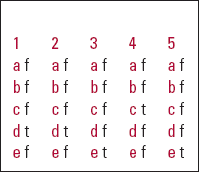
| 1 | 2 | 3 | 4 | 5 | |||||
|---|---|---|---|---|---|---|---|---|---|
| a | f | a | f | a | f | a | f | a | f |
| b | f | b | f | b | f | b | f | b | f |
| c | f | c | f | c | f | c | t | c | f |
| d | t | d | t | d | f | d | f | d | f |
| e | f | e | f | e | t | e | f | e | t |



eLetters
No eLetters have been published for this article.