




Handheld or individual firearms have been little studied in the military history of the Portuguese in Asia. This might seem paradoxical, since so much has been made of the importance of gunpowder weapons for Portuguese expansion in Asia and for European expansion outside Europe in general. The Portuguese case is traditionally mentioned by historians arguing for an early European military superiority based on gunpowder weapons (Cippola Reference Cipolla1965; Parker Reference Parker1996). However, most historiography on the subject has focused mainly on the classical and better-known episodes of Portuguese military history in Asia: naval battles on the open sea and sieges of coastal fortresses. These remain the central events in the standard military narrative of the so-called Estado da Índia (State of India). This article aims to move beyond this reductive point of view. It examines both the use of handheld firearms by the Estado and beyond its borders, whether through the employment of Portuguese mercenaries or firearms of Portuguese origin. Our focus is on evaluating the effectiveness of these weapons based on their “fitness-for-purpose,” as described by Jeremy Black (Black Reference Black2004, 128–129). That is, to judge whether they were effective based on the actual tasks troops armed with them were called to perform, rather than on whether they were employed according to the then-new volley-fire tactics.
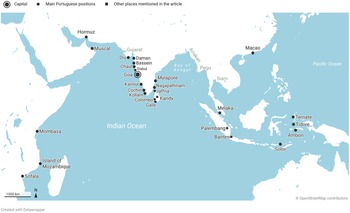
Map of the Estado da Índia (16th – 17th centuries).
Source: Authors, created with Datawrapper.

Handheld firearms in the Estado da Índia
At the height of its power in the sixteenth century and the first half of the seventeenth century, the Estado consisted mostly of a network of fortified coastal enclaves spread out from East Africa to the Persian Gulf, the South China Sea, and the Malay-Indonesian archipelago (Disney Reference Disney2009; Newitt Reference Newitt2005; Subrahmanyam Reference Subrahmanyam1993). The standard view is that the Portuguese countered their numerical inferiority at sea by using superior full-rigged ships heavily armed with artillery, and on land by building coastal fortresses that could be supplied by sea and defended from the multitudes outside by the same artillery that made Portuguese ships superior (Rodrigues Reference Rodrigues and Hespanha2004). In both cases, gunpowder weapons were crucial, but these weapons were cannons, not handheld firearms. Behind the ramparts of fortresses and the bulwarks of ships, harquebuses and muskets played only an auxiliary role in relation to the artillery.
This focus on ships, fortresses, and cannons made the Portuguese case, for the most part, a good fit for Geoffrey Parker’s model of military revolution, which was based on these three elements along with changes in the use of handheld firearms brought about by volley-fire tactics (Parker Reference Parker1996). Handheld firearms and volley-fire tactics had been at the center of the first military revolution model, put forward by Michael Roberts in the 1950s to describe the tactical changes introduced mainly by the Dutch and Swedes in European land warfare between 1560 and 1660 (the maximization of the firepower of infantry firearms through the tactical innovation of volley-fire) (Roberts Reference Roberts and Rogers1995). However, the Portuguese case in Asia would not have been relevant to the Roberts model, which focused on a type of regular warfare characterized by infantry deploying in disciplined lines, advancing in organized columns, and executing coordinated volleys of gunfire. Due to their small numbers, the Portuguese shied away from great field battles. The infantry actions of Portuguese troops in Asia tended to be hit-and-run affairs, often carried out in quick amphibious operations. While harquebusiers were always present, they rarely operated in close coordination with bodies of pikemen in the tight, disciplined formations favored in Western Europe at the time. Their actions involved, on the contrary, hit-and-run tactics and swarming maneuvers, where small groups moved rapidly and attacked opportunistically rather than holding structured formations. What we may call the irregular warfare practiced by the Portuguese in Asia was not propitious to practices conducive to the development of volley-fire tactics.
Examples of this type of warfare include the 1509 attack on Dabul, West India, where Viceroy Dom Francisco de Almeida destroyed the city. This was a relatively simple amphibious operation in which the Portuguese rapidly disembarked, ravaged the coastal settlement, and retreated to their ships (Pissarra Reference Pissarra2002, 71–74). Another example is the series of attacks launched by Portuguese armadas along the coast of Gujarat during and after the second siege of Diu between 1546 and 1547 (Jesus Reference de Jesus2021, 143–148). The poet Jerónimo Corte-Real famously illustrated these tactics later in the century, depicting Portuguese rowing ships executing such coastal raids (Figure 1).
Portuguese amphibious operations against the Gujarati coast, in 1546–1547.
Source: Jerónimo Corte-Real - Sucesso do segundo cerco de Diu, ANTT, Casa de Cadaval, n.° 31.

Figure 1. Long description
The illustration depicts a coastal scene with multiple ships and boats in the water, some bearing flags with Portuguese symbols. The shore is ablaze with fires, and smoke billows into the sky. Buildings and fortifications are visible along the coastline, indicating a battle or siege scenario. The scene captures the intensity of the conflict with detailed depictions of the ships, soldiers, and the burning landscape.
Portuguese sources, whether historical chronicles or contemporary documentation, are replete with accounts of this type of operation, which spread terror as a form of pre-emptive strike and strategy of intimidation. The bombardment of a location was followed by a landing, and often by slaughter and pillage (Newitt Reference Newitt, Trim and Fissel2011).
Of course, besides amphibious operations, there are records of land combat involving infantry, including harquebusiers. For instance, in 1547, the Portuguese recovered the territory south of Goa, Salcete, after a clash with Bijapur troops. They initially employed a group of forty to fifty harquebusiers to sow confusion in the enemy encampment, followed by hand-to-hand combat and a cavalry charge. In this instance, there is little evidence of concern for formal battlefield layout, as this type of skirmish was frequently improvised in wooded terrain ill-suited for such tactics (Jesus Reference de Jesus2021, 150–151).
While the Estado da Índia included a handful of fortified positions on the Eastern African coast, the Persian Gulf, the Straits of Malacca, and the Moluccas, most of its military power was concentrated on the Western Indian coast and on Ceylon, or present-day Sri Lanka. Fire weapons, both artillery and individual, had been used on the Indian subcontinent since at least the fifteenth century. However, the basis of armies was the light cavalry of the Turkish type, introduced by Islamic invaders in the thirteenth century (Chase Reference Chase2003, 127–134). The great southern Hindu kingdom of Vijayanagar adopted this system to face the northern Islamic sultanates. Kenneth Chase has argued that early handheld fire weapons were mostly ineffectual against light cavalry, which hindered their development in regions where light cavalry prevailed. Portuguese troops, however, confined themselves mostly to the Indian coast and never entered into any serious conflict with the great armies of Vijayanagar, the Deccan sultanates, or, later, the Mughal empire.
Non-operational factors may have also hindered European-type discipline. Namely, the widespread practice of having Portuguese soldiers in Asia maintained as dependents of noble high officers, rather than serving continuously in a standing army (Rodrigues Reference Rodrigues and Hespanha2004, 219–223). For instance, a document from the first half of the sixteenth century lists the names and other occupations of around 200 harquebusiers (“espingardeiros”) serving in Goa. It shows that some of them were also specialized craftsmen, such as shoemakers, bricklayers, and carpenters (ANTT, Fragmentos, cx. 5, mç. 1, n.° 26). This made the regular drilling of troops more difficult and favored loose chain-of-command structures and loose discipline in general. The sixteenth century saw a series of repeatedly failed attempts by Portuguese upper commands to develop a so-called “ordinance system,” that is, mixed formations of pike men and harquebusiers with a strong hierarchy of command and regular training (Rodrigues Reference Rodrigues1994). Three of the most famous proponents of this system were Governor Afonso de Albuquerque (1509–1515), and viceroys João de Castro (1545–1548) and Luís de Ataíde (1568–1571, 1578–1580). These three were among the most celebrated Portuguese military figures in Asia, with Albuquerque in particular occupying a foundational role, due to his conquests of Goa, in India (1510), Malacca, in the Malay peninsula (1511), and Hormuz, in Persia (1515) (Garcia Reference Garcia2017; Jesus Reference de Jesus2021; Pelúcia Reference Pelúcia2016; Vila-Santa Reference Vila-Santa2015). The fact that these renowned figures – widely seen as the greatest commanders of their periods – won their fame while deploring the existing infantry system and attempting to replace it has contributed to a certain “bad reputation” of Portuguese infantry in Asia. All in all, it has been found lacking in discipline when compared to the models prevalent in Europe (Bebiano Reference Bebiano and Hespanha2004b, 50–52; Costa Reference Costa and Hespanha2004, 97–99; Hespanha Reference Hespanha and Hespanha2004, 19–20).
European military standards and Portuguese self-criticisms
Military “eurocentrism” was also a persistent sentiment in Portugal during this period. While Portugal succeeded in building a considerable colonial empire in the sixteenth century, it did so while staying away from conflicts in Europe. This distinguished it from similar European early modern colonial powers, such as the Spanish Monarchy or the Dutch Republic, and created a curious sentiment of insecurity regarding its feats of arms outside Europe. In the sixteenth century, some Portuguese voices already denigrated the feats of their countrymen in India by disqualifying their opponents as “little naked, unarmed black men” (Castanheda Reference de Castanheda and de Almeida1979, 794). In the seventeenth century, the writer and military veteran Francisco Manuel de Melo (1608–1666) pioneered the notion that the Portuguese had lagged behind their European neighbors in military terms by waging wars exclusively outside of Europe (Melo Reference de Melo and Sérgio1958, 31–34).
Melo, a cosmopolitan servant of the Spanish Monarchy, was a typical example of the Portuguese military class who saw service abroad in Europe. Portuguese with this kind of background had already existed in the sixteenth century, usually veterans of the Spanish armies in Europe. However, the Iberian Union period, during which Portugal was integrated into the Spanish Monarchy (1580–1640), increased the opportunities for this kind of service. Participation in the war against the Dutch Republic in “Flanders” was seen as especially prestigious. This war then took the status of a warfare “role-model,” against which all other conflicts were measured (Cruz Reference da Cruz2018).
Portuguese military treatises reflected this situation. They closely followed the Spanish and Italian models, and as such, reflected little of the dominant Portuguese military experience, which took place mostly far from Europe. The scarcity of these treatises, on the one hand, and their dependence on Spanish and Italian models, on the other, made historians regard them as an indication that Portugal lagged militarily behind its European neighbors (Bebiano Reference Bebiano and Hespanha2004a). Luís Costa e Sousa has recently questioned this assumption, pointing out that some treatises and similar texts have been overlooked (Sousa Reference Sousa2013). Nevertheless, the fact remains that this body of texts offers little information on Portuguese military practices outside Europe. The two main exceptions are not military treatises in the proper meaning of the phrase, but rather moral and political dissertations on military matters: the Primor e honra da vida soldadesca no estado da India, written probably in the 1570s; and the Reformação da milícia e governo do Estado da Índia Oriental, written around 1600 (Pereira and Cruz Reference Pereira and Cruz2003; Silveira Reference Silveira, Barreto, Winius and Teensma1996).
The most striking of the two is the Reformação. Its author, Francisco Rodrigues Silveira, was a former soldier who served in the armies of the Estado da Índia between 1586 and 1598. Written as a denunciation of the situation of the Estado, the Reformação paints a highly dramatic picture of military and political decline. Chief among its causes was the lack of discipline of the Portuguese infantry. It was alleged that, concerned only with the search for loot and glory, the Estado’s troops competed among themselves for spoils and fame rather than acting in coordination. This is a recurrent topic in the criticisms leveled against Portuguese troops in Asia, but seldom has it been put forward so forcefully as in Silveira’s work. It should be seen as a polemicist’s work, a sort of military version of Diogo do Couto’s Soldado Prático (Couto Reference do Couto and Lapa1980; Couto Reference do Couto and Martins2001).
Couto’s influential work, a denunciation of corruption in the Estado da Índia in the second half of the sixteenth century, was probably the main reason for the posthumous reputation of Portuguese “decadence” in Asia. Historians have seen it as the creator of a “black legend” of decline, comparable to that of Spain’s leyenda negra (Winius Reference Winius1985). Despite its title (“the Practical Soldier”) and subject, it does not contain much on military matters. Silveira and the anonymous author of Primor e honra largely fill that gap, painting a portrayal of late sixteenth-century military decadence underpinned by the fundamentally moral flaw of indiscipline. The eventual military collapse of the Estado da Índia between the 1630s and the 1660s seemed to prove them right, especially given the central role of the Dutch East India Company (Verenigde Oostindische Compagnie, VOC) in that collapse. Already in 1617, King Philip III (1598–1621) himself stressed the need to organize the troops of the Estado da Índia according to European models, now that they faced well-disciplined Dutch troops (Pato Reference de Pato1893, 168–169, 287–288). Between 1638 and 1663, the VOC, operating in conjunction with several Asian allies, conquered all Portuguese positions in Ceylon and Kerala (Malabar) in Southwest India, along with the strategic position of Malacca in the Malay Peninsula. The fact that the VOC was a Northern European military power created in the same country and in the same period that saw Maurice of Nassau develop the volley-fire technique has contributed to its reputation of military “modernity,” confirming by opposition the view of the defeated Estado as an atavistic, decadent power.
The Soldado Práctico and its associated views of decadence have been much criticized of late (Thomaz Reference Thomaz1995; Subrahmanyam Reference Subrahmanyam1993, 115–116). Couto has been depicted not as an impartial observer, but as a spokesperson for the established local Portuguese communities, which were very critical of the Estado’s administration. As a result of all this revisionist work, the traditional vision of the Estado da Índia being in decline before the arrival of the Dutch East India Company is no longer accepted. However, no similar revisionism has taken place in the military field so far (except for Murteira Reference Murteira2020).
Re-examining the impact of individual firearms in the Estado da Índia
The intent of the historiographical excursion above was to show that the lack of interest in the subject of handheld firearms in the history of the Estado da Índia had two reasons: on the one hand, the focus on naval and siege warfare, where the Portuguese employment of artillery has been seen as most innovative; and, on the other, the “bad reputation” of Portuguese infantry in the East, viewed precisely as the opposite – an undisciplined corps that clung to atavistic forms of irregular warfare. While preparing this article, we were thus confronted with an almost complete lack of detailed and reliable studies on individual firearms.
We question whether the importance of these arms was as limited as the historiographical interest in the subject. Historians tend to value what may look revolutionary in retrospect, as has been the case with Portuguese ships, fortresses, and artillery. But the fact that handheld firearms were not used in a way that anticipated their future use does not mean that they were not effective at the time on their users’ own terms. On this matter, we subscribe to Jeremy Black’s ideas about fitness-for-purpose being the best standard to measure military effectiveness, not fitness to evolutionary (or revolutionary) models (Black Reference Black2004, 128–119; Black Reference Black2020).
From the outset, there was consistently high demand for these weapons by the Estado. In 1502, in the first known list of Portuguese weaponry in Asia, handheld firearms still came behind crossbows, although not by much. Yet, twenty-five years later, crossbows had become marginal, and the viceroy at the time wrote to Lisbon asking insistently for more firearms (Rodrigues Reference Rodrigues2008, 53). Around the same time, the troops serving exclusively in the naval forces of the Estado, outside the fortresses, included 200 harquebusiers (serving in sixty ships) (Pissarra Reference Pissarra2016, 380). The viceroy was sent around 300 firearms, which he considered to be a small number. By this time, the Portuguese had already installed firearms manufacturing facilities in Asia. As a matter of fact, when they conquered their future capital, Goa, in Western India, they found that local iron workers could produce firearms as good as those made in Bohemia, in Germany (Rodrigues Reference Rodrigues2008, 53).Footnote 1 However, they continued to ask Europe for more. Half a century later, in 1581, more than 800 were sent. This throws doubt on the view that their importance was limited.Footnote 2
The lack of data makes it difficult to guess the actual figures of individual firearms at the disposal of the Estado’s troops at any given time. In 1546, approximately 300 guns, mostly damaged, were found at the Goa arsenal (Jesus Reference de Jesus and Domingues2016). A 1553 inventory of the Estado’s armament listed 150 guns (Jesus and Castro Reference de Jesus and de Castro2014). This was certainly an underestimate, as they were mostly located in the arsenals of the Diu and Hormuz fortresses, when there were other Portuguese positions of similar importance. It must be said that there are also many uncertainties regarding the number of troops of the Estado. One of the most quoted and generally accepted estimates is that of the viceroy João de Castro, who put that number at 2,500 men, at the most (Castro Reference de Castro, Cortesão and de Albuquerque1968, 30). If we accept that at least one-third of them would be armed with muskets or harquebuses, we arrive at a likely number of a little more than 800 handheld firearms. Irrespective of these estimates, however, it is certain that both the men and firearms at the disposal of the Estado da Índia extended beyond those in service with their weapons. The militarily fit men of the Portuguese civilian communities, the so-called casados, were a reserve force that could serve in emergencies. And all sources concur that privately held handheld firearms were common in Portuguese settlements.
Some sources also throw doubt on the traditional view that these weapons were not used in a more innovative way. We have already pointed out that the subject has not been studied satisfactorily. Some intriguing little-known sources seem to paint a more complicated picture, such as the case of a little-known Portuguese military treatise written at an uncertain date before 1578 (Melo Reference de Melo and de Sousa1948). Little is known about its author, Martim Afonso de Melo, other than that he served as an infantry officer in Asia and Morocco, where Portugal held a few coastal positions. He was thus a typical representative of the Portuguese military class, which was supposed to have lagged behind its more advanced counterparts in Western Europe in terms of firearms. Nevertheless, as Luís Costa e Sousa first remarked, the treatise contains a striking description of what seems at first sight to be volley-fire tactics or proto-volley-fire tactics (Sousa Reference Sousa2013, 315–362, 812). The following is a short extract:
“The other way of fighting [with harquebuses] is by having a first line come out together and shoot; when it retreats, a second one goes and takes its place; the line retreating takes cover behind the pikemen to reload; when the second one retreats, a third one comes out and takes its place; in this way, by having always a line retreating and another one taking its place, there is always a continuous activity of fire; but they [the lines] must always wait for one another” (Melo Reference de Melo and de Sousa1948, 258–259).Footnote 3
We know that in Europe, there are claims for at least Spanish and Ottoman precedence in the “discovery” of volley-fire before its use by Dutch troops (Börek Reference Börek2006; González de León Reference González de León and Mortimer2004, 28, 34). Similar claims exist for China, Japan, and Korea (Andrade Reference Andrade2016, 166–187). If this text indeed describes a volley fire technique, then it shows that there were also Portuguese officers in Asia aware of this type of tactic, although no traces of its implementation are known to us.
Another aspect where traditional claims seem dubious at times is the lack of ability of the Portuguese infantry to operate in formation. We saw that the perceived need to have more disciplined and drilled troops was behind a series of attempts to introduce the “ordinance” system in the sixteenth century. However, the fact that these attempts do not seem to have worked does not mean that all Portuguese troops could not operate in formations such as those that existed in Europe. Some isolated instances of this are documented, such as a 1540s expedition to Ethiopia, recently studied by Luís Costa e Sousa (Sousa Reference Sousa2008). Not long after, also in the 1540s, a veteran of the war in Morocco reported to Viceroy João de Castro that he had successfully trained his men to operate in formations such as the “caracol” (caracole) and the “esquadrão fechado” (closed squadron) (Lalande Reference de Lalande1983, 533).
Such claims have not been noticed much by historians. However, it is not our intention to use them to “rehabilitate” Portuguese troops, refuting what were already widely held views at the time about their aversion to discipline. We suggest rather that this alleged aversion, while detrimental in some cases, could also be understandable and not harmful in others. This is evident in the areas where handheld firearms were more important, especially on the island of Ceylon.
The neglect of handheld firearms by historians is no more apparent than in the case of the territorial possessions of the Estado da Índia. As mentioned earlier, the Estado consisted mostly of a network of fortified coastal enclaves spread out from East Africa to East Asia. However, there were a few exceptions. The so-called “Província do Norte” (Northern Province) in Northwestern India was one of them. It stretched from Chaul to Daman and comprised extensive territorial domains. Lands were given to the Portuguese local nobility and former soldiers. These were obliged to contribute to the defense of the territory with contingents of cavalry and harquebusiers, which shows the importance of individual firearms in local warfare (Mendiratta Reference Mendiratta2012).
The case of Ceylon
Another, more important, exception was Ceylon, because of the extensive territorial domains acquired by the Portuguese on the island around the end of the sixteenth century. From the moment they became an important territorial power, they lived in an almost permanent state of warfare with the inland Sinhalese kingdom of Kandy, first, and with the Dutch East India Company from 1638 onward (Flores Reference Flores2001; Winius Reference Winius1971). Although the subject has never been properly studied, Portuguese infantry in Ceylon seems to have left their fortresses more than elsewhere in Asia. A Portuguese veteran of the Ceylon wars, João Ribeiro, stated that the harquebus was the main weapon on the island (Ribeiro Reference Ribeiro1836, 82). Father Fernão Queiroz, the other main source on the history of the Portuguese presence in Ceylon, corroborated this claim, explaining it by the difficulty of moving artillery through the jungles of the interior (Queiroz Reference de Queiroz and Pieris1916, 77). When there were extensive land domains to defend, and mobility was a factor, this encouraged the use of handheld guns rather than hard-to-move heavy cannons.
It is important to note that the use of firearms was not restricted to the Portuguese troops. A 1602 document reveals that local Christian soldiers from Cochin, Southwest India (known as “Topasses”) were sent there on the Estado’s service, and describes them as “very great arquebusiers” (AHU, CU, Cod. 282, fl. 66v). Ribeiro later states that some 4,000 Sinhalese harquebusiers also served in the Estado’s troops. Their Portuguese counterparts were a minority among the total. It is no wonder that repeated Portuguese attempts to conquer Kandy failed due to mass desertions, because so many troops were Sinhalese. Also, the other side was similarly well-armed with handheld firearms, for Ribeiro tells us that Kandy had accumulated 5,000 harquebusiers (Ribeiro Reference Ribeiro1836, 47–48). According to the Portuguese sources, this constituted a radical transformation of Kandy’s warfare culture, as the inland kingdom did not use firearms before their wars with the Portuguese. Queiroz regretted bitterly that its conquest was attempted too late: It should have taken place before, when people in Kandy were not yet well-versed in the use of handheld firearms. In another passage, he refers to the time when the Sinhalese learned to form squadrons, raise military structures, and employ lances and guns after meeting the Portuguese (Queiroz Reference de Queiroz and Pieris1916, 54, 881).
Another aspect worthy of mention in the Ceylon case is the subcontracting of the manufacture of harquebuses and muskets, and also of lances, to a network of local ironworkers located in villages in iron-rich regions in the hinterland. Officially recorded production was never very high, with no more than around 250–300 firearms every year in the 1610s and the 1620s. Portuguese authorities at Goa were sure that the ironworkers could and did produce more, but that they smuggled the rest of the weapons by exporting them to South India, with the collusion of Portuguese high officers in the island (Pirani Reference Pirani2016, 81–86). It is certainly interesting to see the Ceylon hinterland turned into an exporting center of firearms when we think that it was a region without any experience of these weapons when the Portuguese first visited it in the middle of the sixteenth century. This was at least the version of some Portuguese sources. They also regretted bitterly that they had taught the local Sinhalese to manufacture and use firearms, giving them the instruments to fight back against later Portuguese attempts to subjugate the interior of the island, at least since the mid-sixteenth century (Jesus Reference de Jesus2021, 240; Lalande Reference de Lalande1983, 88–89).
At the time, the Portuguese widely believed that technological military knowledge should not be passed on to local forces. The anonymous author of Primor e honra da vida soldadesca no Estado da India, already mentioned above, stated this clearly with regard to the case of Ceylon: “It is not only teaching them that is harmful, but also using everything that we know, when they can learn it from us; so we must hide it from them” (Pereira and Cruz Reference Pereira and Cruz2003, 170).Footnote 4 In spite of that, such transfers of knowledge took place often, whether by the employment of Asian soldiers or craftsmen by the Estado, or by the circulation of Portuguese weapons and personnel in Asian military markets.
It is important to note that the Portuguese troops in Ceylon were among the most criticized for their lack of European-type discipline. The author of Primor e honra was a Ceylon veteran. His fellow writer, Rodrigues Silveira, attacked how his former comrades waged war on the island (Silveira Reference Silveira, Barreto, Winius and Teensma1996, 61–71). Almost a century later, João Ribeiro and Fernão Queiroz supplemented him with similar criticisms, vindicated by the fact that the island had been lost to the Dutch East India Company in the meantime. Both authors praised the VOC troops for their ability to maintain formation and argued that their Portuguese counterparts’ inability or simple refusal to emulate them contributed to their eventual defeat (Queiroz Reference de Queiroz and Pieris1916, 666–667, 710, 982–983; Ribeiro Reference Ribeiro1836, 95).
Nevertheless, Ribeiro and Queiroz’s military history of the prior Portuguese presence on the island does much to contradict their negative view. If the Portuguese were indeed responsible for the mass introduction of handheld firearms in Ceylon to the point that they became the dominant weapon in warfare, then they must have employed them effectively. Queiroz’s lament, quoted above, that the fast learning of the gun’s use by the Sinhalese had prevented the final conquest of the island, also attests to this, as does the importance acquired by the island as a manufacturing place for muskets and harquebuses.
It must be said that Queiroz professed the caveat that the war in Ceylon could not be like in Europe (Queiroz Reference de Queiroz and Pieris1916, 77–78, 876–877). However, this caveat only confirms the “fitness-for-purpose” point. In places like Ceylon, handheld firearms were as important for the Portuguese as cannons elsewhere because of their transformative impact on local warfare. This is despite the fact that they might not be used in a (by European standards) state-of-the-art way.
Another arguable point is that European discipline was an advantage for the VOC in Ceylon. An important counterexample to test this assertion is a Dutch-Portuguese conflict that took place on the other side of the globe around the same time – the 1630–1654 war in what is now northeastern Brazil between the Portuguese and the Dutch West India Company (WIC, or West-Indische Compagnie, the sister company of the VOC for the Atlantic) (Antunes Reference Antunes2023; Boxer Reference Boxer1957; Mello Reference de Mello2007). This conflict had some important resemblances to the Ceylon war because of its territorial nature (Winius Reference Winius1971, x). Most other Portuguese positions lost to the VOC were fortified coastal cities with little attached territory. Ceylon was an exception because of the extensive territorial domains of the Estado da Índia on the island. The conflict was not confined to siege operations and naval actions, as was the case elsewhere in Asia. It included land campaigns, field battles, and guerrilla warfare, as it occurred roughly at the same time in Brazil. The tropical conditions and sometimes thickly wooded landscapes were also important resemblances.
Despite all these similarities, the outcomes could not be more different: while the WIC was fully expelled from Brazil, the VOC succeeded in doing the same to the Portuguese in Ceylon. It should also be noted that in Brazil, Portuguese troops counted on the support of Italian and Spanish troops experienced in European warfare. The kind of experience that, according to Ribeiro and Queiroz, their counterparts lacked in Ceylon, to their detriment. However, this support was limited to the 1630s, before the end of the Iberian Union in 1640. This was exactly the period when the conflict went in the WIC’s favor. Only after the local Luso-Brazilian forces were left to their own devices were they able to turn the tide. Today, it is consensual among historians of the conflict that their acquaintance with the local, non-European methods of warfare worked in their favor (Mello Reference de Mello2007, 257–315). The opposite was the case with their Dutch opponents, whose reliance on formation tactics seems to have harmed them in the two decisive battles of the Guararapes.
Circulation of Portuguese harquebusiers and handheld firearms in Asia
In summary, handheld firearms have been a neglected subject in the military history of the Portuguese in Asia in its more restricted sense, that is, the history of the Estado da Índia. This is especially the case in areas such as Ceylon.Footnote 5 However, the history of the Portuguese in the East is not confined to the Estado’s history. For decades now, historians such as George Winius, Luis Filipe Thomaz, Sanjay Subrahmanyam, and Jorge Flores have argued for the need to consider Portuguese presence outside the official boundaries of Portuguese colonial outposts (Flores Reference Flores and de Oliveira Marques1998; Subrahmanyam Reference Subrahmanyam1993; Thomaz Reference Thomaz1994; Winius Reference Winius2001). This presence was particularly significant in the regions east of Ceylon. The official presence of the Estado was the most scarce here, as most of its positions were on the western Indian coast and in Ceylon. Perhaps the most striking part of this “unofficial” expansion was the colonies of self-organized Portuguese communities that cropped up mostly in the Bay of Bengal (Subrahmanyam Reference Subrahmanyam1990). The most eastern example of this type of settlement was the port city of Macao in South China, which, after being eventually integrated into the Estado, survived as literally the last Portuguese colony until 1999, when it was finally handed back to China. However, these outposts were only part of the wide Portuguese presence throughout coastal Asia, based on extensive mercantile, missionary, and military diasporas.
The Portuguese private agents most discussed by scholars have been private merchants, on the one hand, and Catholic missionaries, on the other. Mercenaries formed an important third group that has been neglected by historians. They are in no way easy to distinguish from the merchant group, since many members of one group doubled as members of the other. The same certainly applied to the fourth group, that of pirates, who were mainly active in the Gulf of Bengal (Pelúcia Reference Pelúcia2010).Footnote 6 Thus, Portuguese handheld firearms and harquebusiers were not exclusively employed by the Estado da Índia. Both found a market in several parts of Asia, where Portuguese sources assert that firearms were widespread.Footnote 7
There is little historiography on Portuguese mercenaries, who are a subject inherently difficult to research (Cruz Reference Cruz1986; Subrahmanyam Reference Subrahmanyam1993, 269–74). Thus, much less exists on the more specific subject of mercenary harquebusiers. Sources tend to group them with gunners without clearly distinguishing between the two groups. The Portuguese started to change the service of the Estado for that of Asian rulers soon after Vasco da Gama’s arrival in India in 1498 (Eaton and Wagoner Reference Eaton and Wagoner2014; Subrahmanyam Reference Subrahmanyam1987). At the 1520 Battle of Raichur between the Sultanate of Bijapur and the Kingdom of Vijayanagar in southern India, there were already about twenty Portuguese harquebusiers fighting on the side of Vijayanagar. In the sixteenth century, Portuguese mercenaries were regularly employed by the armies of Indian states, both as harquebusiers and as gunners. Their role was thus closely linked to firearms, albeit not exclusively. They competed in that role with Ottoman mercenaries, their main rivals as firearms experts in Asia (Parker and Subrahmanyam Reference Parker and Subrahmanyam2008, 21–24).
Portuguese mercenaries have attracted the most attention from historians in mainland Southeast Asia (Charney Reference Charney1993; Charney Reference Charney and Michael2011; Flores Reference Flores1995; Galen Reference van Galen2008; Guedes Reference Guedes1994; Mukherjee Reference Mukherjee2018; Trakulhun Reference Trakulhun and Grabowsky2011). In Bengal, Arrakan, and Siam, in the present-day territories of Bangladesh, Myanmar, and Thailand, local armies employed Portuguese troops, sometimes numbering in the hundreds. More than that, certain leaders of these troops managed to carve for themselves positions of importance inside Asian courts, such as Diogo Soares Melo in Pegu, and Domingos de Seixas in Siam (Flores Reference Flores1995, 103–115). This shows how much of an asset military expertise could be when it came to winning political power. It is significant that these Portuguese figures had Middle Eastern mercenaries with similar expertise as their main rivals in the region. Once more, the Portuguese and Ottomans or Middle Easterners appear as competing agents of military diffusion in Asia in the sixteenth century.
It is possible that similar cases of Portuguese mercenaries exist in other parts of Asia. We have already seen the case of India, but there are also signs of an important presence of Portuguese mercenaries in the Malay-Indonesian archipelago. For instance, the first Dutch fleet to reach Asia called at the port of Banten in West Java in 1596. There, the Dutch learned of the recent death in combat of the local king in Palembang, in nearby Sumatra: the killers had been Portuguese mercenary gunners in the service of Palembang (Rouffaer and Ijzerman Reference Rouffaer and Ijzerman1925, 17). However, what happened in the north of the Bay of Bengal by the end of the sixteenth century seems to have been truly exceptional. Profiting from a situation of political uncertainty and turmoil, two former Portuguese mercenary high commanders, Filipe de Brito de Nicote and Sebastião Gonçalves Tibau, followed by small core groups of countrymen, established two independent, short-lived coastal domains in the north of the Bay of Bengal. (Galen Reference van Galen2008, 78–93, 107–114; Guedes Reference Guedes1994, 121–170). Decisive action by the neighboring kingdoms put a quick end to these adventures (in the Tibau case, with the help of the newly arrived Dutch East India Company). Nevertheless, the two episodes give an idea of the potential importance of the military abilities of the Portuguese operating on their own beyond the borders of the Estado da Índia.
Although the subject remains understudied, it seems possible to conclude that in Southeast Asia, Portuguese mercenaries enjoyed an importance disproportionate to their small number. While the reasons for this remain unclear, it was probably partly due to their ability to use gunpowder weapons. Among these gunpowder weapons, however, it is difficult to determine whether cannons were more or less important than individual firearms. Be that as it may, the impact of gunpowder weapons in general in the region does not appear to have been “revolutionary”. Historiography on the subject has concluded that gunpowder weapons brought by the Europeans, overall, do not seem to have had a deeply transformative effect on existing ways of warfare; “they brought back something familiar in an unfamiliar form,” as put by Subhrahamanyam and Parker (Reference Parker and Subrahmanyam2008, 14). They were rather adopted mostly to the extent that they suited themselves to dominant military practices (Andaya Reference Andaya and Tarling1992, 388–90; Charney Reference Charney2004, 71–72). This replicates what seems to have also been the case in India, at least regarding individual firearms (Subrahmanyam Reference Subrahmanyam1987).Footnote 8
By contrast, in East Asia, the new handheld firearms introduced by the Portuguese seem to have had a deeper impact (especially for their matchlock mechanism).Footnote 9 The well-known case of the rapid development of the harquebus and of volley-fire tactics in Japan attests to this. More recently, new findings about the innovative use of these weapons by Chinese and Korean troops have also attracted the attention of historians (Andrade Reference Andrade2016, 166–187). The Portuguese may have introduced the Japanese to individual firearms in the 1540s, but their role did not go beyond this. Unlike the Japanese, the Chinese were already familiar with the weapons, but the type of firearms the Portuguese introduced in Asia was found by the Chinese to be an improvement on those they already used. Like the Japanese, however, they did not need anything else from the Portuguese besides the introduction of the weapons themselves. In their case, that did not even seem to have come by direct contact with the Portuguese: the new type of harquebuses brought by the Portuguese to Asia apparently found their way to China before the Portuguese themselves. Thus, there was nothing in East Asia comparable to the large-scale employment of Portuguese mercenaries and gun founders in Southeast Asia and India. It also shows that while Portuguese harquebusiers remained in demand in many places, they did not seem to have been indispensable to the dissemination of their firearms.
The impact of these weapons of Portuguese origin on Chinese, Korean, and especially Japanese warfare has made historians value them more than in the case of the history of the Estado da Índia, where they always came a distant fourth, behind ships, fortresses, and cannons. Geoffrey Parker mentioned Portuguese ships, fortresses, and cannons in his influential book on the military revolution. However, he was also very impressed with the adaptation and development of the harquebuses brought by the Portuguese to Japan, which included the independent development of volley-fire tactics (Parker Reference Parker1996, 140). For him and others, Japan appeared as an extreme case of important transformative effects brought about by firearms of Portuguese origin.
To conclude, it is tempting to compare this kind of transformative effect with the supposedly limited role of handheld firearms when employed by the troops of the Estado da Índia. The Portuguese reluctance to get drawn into open-field warfare would have limited their firearms development potential, and others would have been better at taking advantage of this potential, as in Japan and China. However, we have argued in this article for the need to revise traditional assumptions about the lack of importance of handheld firearms to the Portuguese; therefore, perhaps this opposition is a bit too simplistic. The aim of this article was not to uncover “modern” aspects of the Portuguese infantry that previous historians may have overlooked. Rather, our intention is to stress that the employment of handheld firearms by the Portuguese should not be judged according to whether it fits into a model of military development based on a “modernity” criterion. We should rather look at whether they were adequate to the tasks that the troops armed with them were called to perform. In other words, whether they were, according to Jeremy Black, fit for purpose. Overall, the answer seems to be positive. The continued employment and high demand of harquebuses and muskets by the troops of the Estado da Índia would be enough to assert their importance for the Portuguese, irrespective of whether they used them in ways resembling the new techniques that were then in development in Europe and East Asia.
Acknowledgements
This paper stems from the international workshop “Beyond the Military Revolution Debate and Geographic Determinism? The Multifarious Reception of the Harquebus”, held online on 23 and 24 September 2021 under the auspices of the “Aftermath of the East Asian War of 1592-1598” project hosted by the Universitat Autònoma de Barcelona, Spain. This project has received funding from the European Research Council (ERC) under the European Union’s Horizon 2020 research and innovation program (grant agreement no. 758347). We would like to thank the two anonymous reviewers for their suggestions, which contributed to the final version of this article. An earlier version was published in Portuguese under the title “Armas de fogo individuais portuguesas na Ásia,” in Representações do Campo de Batalha em Portugal (1521–1621). Imagens e Textos, edited by Luis Costa e Sousa and Ana Paula Avelar (Lisbon: Edições Colibri, 2024). André Murteira‘s contribution to this article was undertaken as a part of his research project, “Ships and War: Dutch and Iberian War Fleets in the Dutch-Iberian Global Conflict (1600-1669),” funded by FCT, Portugal (2021.02332.CEECIND). It also had the support of CHAM (NOVA FCSH/UAc), through the strategic project sponsored by FCT (UIDB/04666/2020). https://doi.org/10.54499/UIDB/04666/2020.


 Open access

