




Introduction
Iranian women have long been agents of struggle in Iranian politics, both directly and indirectly. Women's corporeal bodies have been treated as a locus of symbolic meaning for the identity of the nation, while their productive and reproductive roles have been marshaled by the state for political purposes by different regimes. Women's agency and the appropriation of their labor and bodies represent crucial points of contention for the Left,Footnote 1 liberals, monarchists, and Islamists in Iran. This analysis examines the role of women and gender during the periods of urbanization and White Revolution, the revolution of 1979, and the Iran–Iraq War, and the consequences of the decisions that were made vis-à-vis women and gender during these periods.
After the revolution of 1979, Iranian women were asked by the New Clergy to replenish the armed forces by reproducing soldiers for the Iran–Iraq War while being expected to rejoice when their family and friends were killed in combat because they were able to become martyrs for the nation.Footnote 2 As family law and the penal code were restructured to institute more conservative gender roles, women's ability to make choices for themselves and their families was curtailed and their rights within the legal system limited. The archetype of the pious and devoted Muslim wife and mother was promulgated as the “true” or “authentic” Iranian identity, both for the individual and for the nation.Footnote 3 The aim of the paper is to show that although they represented a vital force with strong potential for helping bring about democratic institutions after the Shah was ousted, secular opposition to the New Clergy committed a crucial error in their political approach to women's sexuality and social roles, ultimately enabling the New Clergy to take control of ideational and material elements of the revolution.
Employing a qualitative, interpretive methodological approach, this article examines the role of women and gender in Iran's nation-building exercise in the period beginning with the White Revolution of 1963 and through the lead up to the 1979 revolution. A social reproduction theory (SRT) framework is particularly useful here because it facilitates a clearer understanding of the ways that the struggles around women, gender, and sexuality have been at times ignored and at times harnessed and appropriated in service of the political regime in power. In contrast with other theoretical frameworks such as, for example, Islamic feminismFootnote 4 – which the Islamic regime has successfully co-opted, as it did with other potentially subversive currents in Iranian society (e.g., populism) – SRT elucidates the facets of both state control and spaces of counterhegemonic resistance.Footnote 5 Applying SRT to the case of the Iranian revolution enables a better understanding of state coercion and popular resistance.
Furthermore, in contrast with studies that employ a dominant lens of either class or gender to explain the position of women during the Pahlavi period, this analysis utilizes both class and gender in order to demonstrate the ways that class status and gender roles combined to produce complex and myriad conditions for Iranian women. Arguments that suggest that women's status as a whole degraded as a result of the revolution are as incomplete as the Islamic Republic's claims that the Islamic regime has protected and improved the women's lives and social roles. The approach of this study accounts for both class and gender in order to disaggregate women as a category of analysis and provide a more complete picture of whose conditions improved and whose suffered.
Accordingly, an examination of political satire cartoons related to poverty, politics, and corruption in several issues of the magazine Tawfiq (published during the reign of Mohammad Reza Pahlavi) focuses on how urban liberals created a counterhegemonic space of resistance and dissent which could be utilized and expanded by other opposition groups. Because this space became important as a site of opposition, it is useful as a source of data to understand the role of popular media in political contestation. It also reflects and reveals critical shortcomings in the liberal urban intelligentsia's public framing of women and gender roles in the decades leading up to the 1979 revolution.
Methodology
This study investigates the role of women's sexuality and gender roles in the struggle between the secular opposition and the clerical factions of Iranian society during the Pahlavi period. This study employs a qualitative, interpretive methodological approach to analyze content from the satirical-political magazine Tawfiq, which ran weekly from 1922 to 1971, as well as descriptive statistics provided by international agencies such as the International Labor Office, obtained in the United Kingdom's National Archives in London. Unfortunately, during much of the period of focus for this study, Leftist and liberal publications were constrained by the state and prohibited from publishing outright support for opposition forces. As skillful satirists and cartoonists have demonstrated throughout history, censorship does not halt political expression but rather forces it to become more sophisticated.Footnote 6
Tawfiq is widely seen to have reflected the political aspirations of lower- and middle-class Iranians. The pool of authors was largely comprised of liberal intelligentsia, or educated secular liberals. To date, there are no existing textual analyses of Tawfiq. Because Tawfiq was considered by many to be the “voice of the people,” the content of the magazine provides insight on salient popular cultural narratives during this period. This data will enable an analysis of how issues of labor, the state, capital, and the Left intelligentsia were perceived by Iranians who lived as political and economic outsiders in relation to the state.Footnote 7 Including Tawfiq in the analysis will provide a clearer picture of the social milieu before the 1979 revolution and facilitate a more meaningful analysis.Footnote 8
Political cartoons from Tawfiq were collected and analyzed from issues published in the period from 1962 to 1970. I was able to review approximately 68 issues of Tawfiq in the field. All documents reviewed were evaluated for content relating to labor, the Shah or other political figures, political organizing, social or economic inequality, gender norms or disparities, the Shah's land reforms, popular resentment against political figures or movements, the urban/rural divide, and perceptions of political or social conflict between various factions. Content that was sufficiently relevant to those factors or to political conditions prior to the revolution was further analyzed and included in this study.
These Farsi-language journals were first analyzed for content related to workers and peasants in urban and rural Iran. Relevant commentary was then translated to English. Because the restrictions surrounding Leftist writing significantly constrained and limited publications, many of the most pertinent messages were contained within multiple layers of meaning in cartoons; due to the use of satire as a means of protection and evasion from the most immediate dangers posed by the regimes that were the target of critique, cartoons and images often carry much more meaning than the text. Thus, this article focuses on the graphical content. The included issues of Tawfiq were used primarily for cartoons that represented a response by the Left to poverty and government corruption.Footnote 9
The tensions and contradictions of the Left vis-à-vis gender are not neatly contained in one case or one cohesive set of events. Rather, it is necessary to look to spaces used for counterhegemonic resistance to the state to see how the mainstream Left and urban liberals viewed women and gender during the period leading up to the revolution. Because the Left was not a monolithic group, a complete inventory of Leftist activities and agendas has not been created for the current study. Furthermore, a catalogue of the varieties of Leftist and liberal political thought in pre-revolutionary Iran is outside the scope of this piece. Major differences in the politics and objectives of these two segments of Iranian society pitted them against one another in many spaces. Nevertheless, there was significant overlap between liberals and the mainstream Left in respect to their public framing of women's sexuality and gender roles. In addition, from the perspective of the conservative factions, together they functioned as opposition to the New Clergy and were fought by conservatives in similar ways. Therefore, the term “secular opposition” is used in this paper to refer to both – not to flatten the crucial differences between them or to suggest a clean ideological unity but to reflect the similarities of their position on women and gender as well as their shared opposition to conservative and clerical factions.
Theory and Literature Review
In the Marxian canon, “economic reproduction” refers to the reinforcement of the conditions of labor and capital in which a social order is continually reproduced. That order maintains the hierarchy wherein laborers possess only their labor power and the capitalists control the means of production and raw materials necessary for production.Footnote 10 This requires and reinforces capital accumulation. There are numerous social and economic processes that serve to undergird this set of productive relations. One such process is enumerated by social reproduction theory (hereafter SRT).Footnote 11
According to SRT, in order to maintain adequate numbers of workers necessary for the requirements of capital, women are required to reproduce in order to replenish the labor force as well as provide the care necessary to not only sustain those workers in a literal, material sense (e.g., food, medical care) but also to perform the necessary unpaid domestic labor that facilitates the laborer's work outside the home. This burden disproportionately falls to women in spite of the fact that women's share of work in the formal labor market outside the home has increased dramatically in the past 50 years. This realm of unpaid productive activity in the home is known as the reproduction of labor power. Silvia Federici (2004) argues that women's bodies and their centrality in the social reproduction of labor represent a kind of primitive accumulation, without which the process of capital accumulation would be impossible. Primitive accumulation, representing the first time a resource is made into a commodity, is a fundamental requirement and a first step in the ongoing exploitation and profit associated with the accumulation of capital. In the case of Iranian women, the social reproduction of labor can take place because of the transformation of their bodies into a component in the production and support of laborers, and because of the surplus value produced by their unpaid labor as laborers themselves.
Federici's argument about the social reproduction of labor and the primitive accumulation of capital applies in a particular way to the case of Iran.Footnote 12 Federici wants to expand the Marxist notion of enclosure to include enclosure of the body, specifically women's bodies.
Beyond the changes in widespread modes of production, Federici argues, capitalism radically transformed social relations, including the gendered division of labor and the role of the collective. SRT reframes the discussion of primitive accumulation such that it includes labor as well as land and powerfully disciplines the body while constantly mining it for more market utility. SRT's framing of women's bodies as both targets of capitalist enclosure and the necessary condition for the existence of the worker helps elucidate the processes by which the New Clergy actively sought to control and direct the structures of labor, reproduction, women's sexuality, and the family, and to inhibit or co-opt labor organizing among workers. This theoretical framing enables an analysis that accounts for more than simply women's labor activity in formal and informal markets; it allows a more complete picture of the ways that women's bodies were treated as a nexus of power by the New Clergy, who then sought to control them for the purpose of accumulation of not only wealth but also political power during the precarious revolutionary struggles and the existential threat posed by Iraq during the war.
The White Revolution of 1963 represented an attempt by the Shah to more effectively harness the surplus value generated by women's unpaid labor. The cultural and religious backlash this created helped lay the ground for the New Clergy to address women's labor in a more effective way by posing their approach in direct opposition to that of the Shah. At the same time, they elevated the social value of women's reproductive labor by symbolically describing it as essential to the nation itself. In doing so, they casted themselves as representatives of the “authentic” Iranian women, juxtaposed in opposition to the “Westoxified” (polluted by Western decadence and corruption), “modern” model of women and gender roles promoted by the monarchy and the liberal intelligentsia.
The New Clergy's ability to exploit women's labor constituted an approach to capital accumulation that “was not simply an accumulation and concentration of exploitable workers and capital” but “also an accumulation of differences and divisions within the working class, whereby hierarchies built upon gender, as well as ‘race’ and age, become constitutive of class rule and the formation of the modern proletariat.”Footnote 13 Women's participation in the public sphere had transformed and accelerated under the Shah. The New Clergy, rather than attempting to universally undo all of those developments in order to return women to their previous level of visibility, selectively changed the nature of women's public role for the benefit of the new theocratic state.
In the context of highly politicized social upheavals, including rapid rural-urban migration, economic stagnation, dramatic wealth inequality, and top-down, state-led liberalization and modernization, gender roles became a central point of contention among Leftists, liberals, monarchists, and Islamists. In cities, forced modernization and increased public visibility of women forced recent rural transplants to retreat from the public sphere in deference to religious or familial norms. Popular media like magazines, films, and television programming were largely produced by educated urban liberals; in keeping with class-dominant theories of mass media, the priorities and perspectives reflected in publications like Tawfiq aligned with the segment of Iranian society to which the publishers belonged.Footnote 14 As a result, many of the images found in popular media promoted a Westernized or “Westoxified” caricature of women, sexually objectifying or denigrating them while attempting to make a point that was critical of the monarchy.
Representations of women in mass media thus came to serve as what Lisel Hintz has termed an “affective cultural heuristic.”Footnote 15 In the highly contentious period of political turmoil in 1960s and 1970s Iran, gender became an immediately recognizable, emotionally evocative, and socially salient marker of an individual's or publisher's normative and political commitments. The cartoons themselves were especially important because the literacy rate for Iranian women in 1966 was only 17.9 percent according to national census data.Footnote 16 Photographs or cartoons depicting women in popular media, then, operated as a cultural heuristic more so than the literature or written work that may have been contained within those publications. For this reason, Tawfiq provides a valuable source of data for researchers interested in questions of gender and politics in Iran.
Gender represented an area of contestation between liberals and Islamists that offered the New Clergy a space within which they could attract alienated, traditional, rural-origin women who were recent arrivals in the cities with promises of protection and dignity. The relationship of middle-class and wealthy urban women to poor urban women and recent transplants from rural Iran was central in ongoing class tensions among women. There were a number of organizations that implemented “educational” programs for poor women in urban areas,Footnote 17 which constituted a sort of outreach typical in gender and development regimes.Footnote 18 The New Path is an example of one such group, which “provided a variety of classes for poor, illiterate women, including classes on health and hygiene, child rearing, cooking, sewing, and literacy.”Footnote 19 There was a distinct narrative in the way the women of the New Path saw the poor women they were there to help. Their “condescending assumption” about these women, like classic development perspectives, equated “tradition. . . with irrationality, disorder, filth, and ignorance.”Footnote 20
This perspective was typical of the way the Shah viewed poor, rural, and traditional Iranians, which is reflected in several memoranda of conversations uncovered in the U.S. National Archives. It is also shown in remarks made by the Shah's sister, Ashraf Pahlavi,Footnote 21 in her book as well as those she delivered at a 1975 conference relating to the status of women as recounted by Mana Kia:
‘[T]he literacy program will transform the submissive and passive into beings of a new type – into beings able to share the sufferings and difficulties of others, who will develop a critical consciousness and know how to pose problems objectively, who will find fulfillment in constructive work and who will, above all, be receptive to others.’ Rural women are represented as submissive and passive beings, incapable of rational thought, engaged in meaningless work, with an almost subhuman emotional consciousness. In these discussions of rural lower-class women, feminism constitutes itself along class lines, mirroring international norms of socioeconomic modernization.Footnote 22
In this context, it is clear why poor rural or urban Iranian women may have viewed urban, liberal feminist programs with suspicion. They were treated as backward and uncivilized transplants in cities where they were simultaneously experiencing pressure from these groups to abandon their social and cultural experiences and pressures from the Pahlavi state to abandon their religious practices. At the same time, women's labor power was actively recruited by the state in order to support an economy that had seen decreases in men's economic activity without corresponding increases in women's economic activity.
Labor, Modernization, and the State
The disparity between men's and women's formal economic output was accompanied by a wealth gap so dramatic that Iran was characterized as a “dual society” by the International Labor Office, in which the divide between the wealthy and the poor was so severe that Iranian society was virtually split in two.Footnote 23 In the period from 1956 to 1966, there was a 6.9% decrease in men's economic activity, offset by only a 3.3% increase in women's economic activity.Footnote 24 In terms of household expenditure, at that point the top 10% of wealth holders spent 40% of total expenditure while the bottom 30% spent 8%; at that time the top 50% of Iranians consumed 82.5% of goods and services, while the bottom 50% consumed 17.5%.Footnote 25 The reforms instituted as part of the 1963 “White Revolution” were advertised as sweeping measures to improve the lives of all Iranian women and thus the nation as a whole, though “in practice, women's participation under the ancien regime was limited to those who had access, both financially and socially, to modern institutions.”Footnote 26 For example, when education reforms intended to send more girls to school were implemented, lack of enforcement did little in the way of expanding educational opportunities for rural girls whose lives were in large part controlled by the local mullahs, who were overwhelmingly against educating girls. Thus, as is often the case with such sweeping measures, many of the reforms implemented as part of the White Revolution had disparate impacts on women of different social classes, with the rural poor being among the least of the beneficiaries, and “middle-class urban women [as] the main beneficiaries of these changes.”Footnote 27
For many rural women the reforms exacerbated the unequal conditions in which they lived and worked. One example of the deterioration of living conditions was the increase in the need for “female and child labour on peasant family plots.”Footnote 28 Because of the unequal distribution of the mechanization of farm labor, the share of work that men and boys typically performed on the land decreased, while the share of work that women typically performed actually increased. There was also an increased “demand for seasonal agricultural labor” as a result of this mechanization, and “[t]he bulk of this was again provided by women and children.”Footnote 29 In addition, because of rapid urbanization and the liberalization of markets, carpet production increased dramatically, and most of the carpet weaving was a task completed by rural women and girls.Footnote 30 In the early 1980s, “[m]ore than 90% of all carpet weavers [were] female, and 40% of these [were] under the age of fifteen… The majority of rural carpet weavers – [were] unpaid family workers.”Footnote 31 As a result of these consequences of the White Revolution on rural women and girls, their exploitation intensified, “making their already miserable lives considerably worse.”Footnote 32 At the same time, there was a significant increase in women's entry into the formal labor market from the mid-1950s to the mid-1970s, when the government of the Shah was actively attempting to capitalize on “women as an ‘untapped supply of labor’ that should be utilized for economic growth.”Footnote 33 This increase was disproportionately drawn from urban women.
According to Haideh Moghissi, the main reasons the Shah was unable to bring about the kinds of structural and cultural transformations necessary to irreversibly improve the lives of Iranian women were due to the relatively short period he was in power, the types of development programs implemented, and the persistence of general social hostility to an increase in women's rights.Footnote 34 In employment, women made gains, but it was only a “very small number of urban wage-earning women” primarily concentrated in “the higher echelons of the new middle-class and upper-class families” who “enjoyed financial and personal independence and could maneuver within the limits imposed upon them by the patriarchal and male-centered culture.”Footnote 35 The highly classed character of organizing women's rights within the confines of state-sanctioned activity made many non-upper-class women suspicious. This may have undermined the reforms and weakened their long-term influence.
Contrary to conventional wisdom, after the 1979 revolution education became accessible to even more girls because schools were suddenly gender segregated. Therefore, it was no longer socially unacceptable for a large swath of the population to attend school. Education was a visible marker of women's attainment of culturally contingent notions of social equality. That rural and conservative girls suddenly had educational opportunities available to them due to gender segregation under the New Clergy was an unexpected development. On the one hand, gender-segregated education in previously gender-inclusive schools was seen by women who considered themselves to be representatives of a “modern” Iran as a step backward. On the other, the post-revolutionary availability of education at all levels to girls and women who were previously barred from it because they were not allowed by their social, familial, or religious circumstances to attend school with boys and men led to the material improvement of literacy and education rates for girls and women in Iran. This paradox allowed the New Clergy to simultaneously restrict women's rights pertaining to marriage and family law, civil and criminal codes, and employment and politics, while also proclaiming the Islamic Republic as an advocate for women based on the public visibility of rural or conservative women who were previously mostly confined to domestic and private life. In this way women and girls were politically and economically exploited as they were simultaneously exalted in the public sphere.
In the intellectual lineage embodied by Ali Shariʿati and Jalal Al-e Ahmad, there are few concepts as significant as moral corruption. These major figures and the generation of Iranians they influenced put morality at the center of their critiques of the Shah and the creeping Westoxification that was infecting Iranian society. Just as Shariʿati centered the historical figure Fatemeh in his arguments about the proper role of a pious Iranian (especially a pious Iranian woman), the New Clergy put what Afsaneh Najmabadi calls the “woman question” at the center of their political project:
Within the new Islamic paradigm, where imperialist domination of Muslim societies is seen to have been achieved through the undermining of religion and culture – rather than through military or economic domination as the earlier generations of nationalists and socialists argued – and where moral corruption is viewed as the linchpin of imperialist designs, the “woman question” acquired a singular centrality.Footnote 36
In the years leading up to the 1979 revolution, women embodied the morality or immorality of Iranian society, and thus became the “key location for the imposition of the good” for the clerics who sought to reestablish a traditional social order that rejected whole cloth the Western values of the publicly visible Westoxified woman.Footnote 37 This had especially wide-ranging implications for Iranian women around the crucial nexus of women's autonomy as the New Clergy exalted women who were historical religious figures as “authentic” and dismissed “Westoxified” ideas like women's sexual liberation as empty bourgeois scientism.Footnote 38 The value of women's social and economic roles was deliberately cast as a crucial pillar of support for the state, framing “authentic” Iranian women a basis of the state's legitimacy.
A cursory glance at the views of Ayatollah Khomeini is sufficient to understand why the clergy felt that the key to social change could be found in a nation's dominant gender relations:
[S]ince in his scheme of thought women were regarded as signifiers of national identity, their appearance, behaviour and position first had to be Islamized. Within a few months of the victory of the Revolution, most aspects of women's position had been subjected to intervention by Ayatollah Khomeini.Footnote 39
It is unsurprising, then, that the New Clergy focused so much energy on controlling not only women's and girls’ behavior, but also on gender roles and relations as a whole. They believed, and continue to believe, that therein rests the honor of the nation and the family, and that failure to control them leads to chaos and insurrection.
For the New Clergy, the Westoxified woman seemed to have promulgated and “taken over the whole social space.”Footnote 40 In 1986, when discussing what public life was like prior to the 1979 revolution, then-speaker of the Majles Ali Akbar Hashemi Rafsanjani told Kayhan that “a cleric could not walk through the university with those scenes on the grass, in classes, in streets. We could not go to government offices. If you stood in front of a desk, you would commit a sin, because there was a nude statue [an unveiled woman] behind the desk.”Footnote 41 This type of framing was part of a systematic program in which the New Clergy promoted themselves publicly as protectors of Iranian women, in direct contrast with both the Westoxified Shah and the secular opposition. Iranian women from traditional, religious, or rural backgrounds who migrated to the cities, many of whom were unable to read the captions or articles accompanying the illustrations in Tawfiq and other popular media and were thus reliant on the graphical content to derive their intended meaning, were likely to feel alienated by the class-inflected images produced by prominent sectors of the secular opposition.
Khomeini aimed his rhetoric at women whom he believed could be brought to the side of the Islamists in the fight for the political upper hand. He juxtaposed Western decadence and authentic Iranian womanhood in his speeches.Footnote 42 He contrasted the frivolous Westernized urban woman with the “authentic” (i.e., religious) veiled Iranian woman. In some sense, Khomeini was only able to pull a plurality of women to “his” side because of the rapid urbanization and the White Revolution that had preceded the 1979 revolution: there was a large and growing number of rural women in cities, especially Tehran, who had brought with them the inherently conservative, traditional culture of the rural villages. These women constituted Khomeini's target audience in many ways, and in their absence it would have been more difficult to enforce a return to the “old,” “authentic” gender relations of “true” Islam.
These women attempted to assimilate into their new environment, which many found to be unfamiliar and Western in relation to the villages they had left. Khomeini's calls to hearken back to the “true” Iranian identity, to re-veil, and to join the mullahs in creating a new Islamic state fulfilled two purposes: first, it allowed them to feel they were part of the in-group in a way that they had been denied since they had left their villages; second, it gave them the opportunity to redeem themselves from the “corrupt” and “decadent” life in the cities where social pressures had pushed them to unveil and to adopt more “modern” attitudes and lifestyles in spite of their traditional upbringing. This, again, bears similarity to a process already underway during the Shah's regime in large part due to Shariʿati's influence: “with its vague puritanical image of an ideal woman, Shariʿati's writings touched a sensitive chord in the minds of many middle-class women caught in the cross-currents of change and tradition, seeking a mystified notion of a lost identity.”Footnote 43
This is not to suggest that all urban women rallied to Khomeini's side. On the contrary, the massive demonstrations against Khomeini's mandatory veiling decree on March 7, 1979, the eve of International Women's Day, showed the widespread resistance to this type of control by the state. There was also some confusion by the Left regarding its position on women's autonomy in relation to a state that the Majority Fadaiyan supported as anti-imperialist and anti-capitalist. The Fadaiyan immediately declared that there would be an anti-imperialist march at the same time on the same day, in an apparent effort to undermine the women's demonstrations.Footnote 44 The pushback from women was so forceful that the clergy were forced to make a concession to pacify them: they declared that Khomeini's decree had been misunderstood, and claimed it was simply a recommendation and not an order. They instituted mandatory veiling later in the same year. This was, in part, made possible by the lack of a cohesive feminist movement in Iran during this time in spite of the relative visibility and strength of women's activism prior to 1979.Footnote 45
The populist logic of the New Clergy's rhetoric necessitated a focus on women in order to both gain the support of certain crucial segments of Iranian society and to facilitate its own rise to power. Populism was the foil used to bring certain women into the public sphere who had been excluded for various reasons under the Shah. Women's contributions to society under the Shah had been framed as primarily economic and political, with increased access to formal labor markets and education and political enfranchisement. These measures were somewhat effective but limited in scope. The New Clergy framed women's contributions as symbolic (mothers and sisters of the nation), economic (as workers with new jobs available due to gender-segregated spaces), and reproductive (as mothers of soldiers and martyrs). In this way the New Clergy were able to effectively exploit women's productive, reproductive, and symbolic value in the struggle to create a new Islamic state. They were also able to capitalize on the tensions between urban and rural women in urban areas. They elevated the conflicts to a level that supported their position on the existential threat posed by the distance between “traditional” or “authentic” Iranian values and the Westoxified and sexually deviant urban lifestyle. The “authentic/Westoxified woman” binary was a core element enabling the New Clergy to influence the cultural narrative in their favor in the years leading up to the ousting of the Shah; the caricaturing of women as sexually promiscuous or morally bankrupt by the urban liberal class was a necessary precondition for such an outcome.
Gender Roles and Cultural Heuristics
The prevailing political position on the importance of women's social role was shared by very different ideologies during this period. The secular opposition and the clergy broadly agreed that the Westoxified urban woman was both a symptom of and a corrupting influence on a sick society.Footnote 46 In this way, disparate groups coalesced in general agreement around the “woman question” with the ultimate consequence of undermining the revolutionary possibilities that were opened by women's resistance to the stripping of their rights and the transformation of their public lives in the aftermath of the 1979 revolution.Footnote 47 Women were asked by the Left, and by the Majority Fadaiyan in particular, to set aside “women's issues” as secondary to the more immediate goal of overthrowing the Shah,Footnote 48 and instead were told that when class inequality was abolished, other forms of social and economic inequality would also fall to the wayside under the new society.Footnote 49
Immediately following their rise to power in 1979, the New Clergy began to institute regressive policies in regulating the role of women in public life, such as the implementation of Islamic dress code and the removal of women judges from the courts (Behrooz 2000). Women's groups began to organize against these actions, mostly women who identified as Marxists or sympathized with Marxist groups.Footnote 50 In spite of Fadaiyan's nominally supportive stance in favor of gender equality, this group, the major Leftist opposition at the time, did not “respond to the issue decisively.”Footnote 51 Instead,
[T]he organization reiterated its class-based approach to women's liberation, and implied that those who favoured any other approach were causing “false agitation” among women. . . The policy of defending women's demonstrations, while at the same time condemning the independent women's movement as “false agitation,” was in fact the genesis of the Fadaiyan's break-up.Footnote 52
The factionalism that exposed and was exacerbated by disagreements over how to approach women's liberation within the Fadaiyan weakened the Left and women's groups simultaneously.
Thus, the anti-imperialist organizing by Leftist groups prior to the 1979 revolution did not prioritize women's liberation within the context of anti-Shah and anti-West struggles. “The Iranian left was concerned with women qua member of an oppressed proletariat, not as individuals with particular needs” – despite the long history of state suppression of the feminist movement in Iran and broad agreement about the corrupting influence on society of the hypersexualization and commodification of women's bodies.Footnote 53 The ultimate result of this failure by the Left to recognize and prioritize women's rights not only had a profound impact on women's ability to agitate and organize for their emancipation after the ousting of the Shah, but there is also evidence that it undermined the most prominent Leftist group in the aftermath of the 1979 revolution.Footnote 54
There were two main commonalities shared by the secular opposition and the clergy during the tense months and years on either side of the 1979 revolution concerning women: the language and ethos of populism, which subordinated the rights of the individual as it prioritized the anti-imperialist struggle,Footnote 55 and the “puritanical concept of sexuality” that resulted in a view of the urban woman as a symbol of the corruption, consumerism, and commodity fetishism of the Pahlavi regime.Footnote 56 In fact, the second point of commonality was so pervasive that it manifested in a view of women that saw them as “more prone to deceit” such that “they could be used to deceive men and especially male revolutionaries. Consequently, women's demonstrations in postrevolutionary Iran served imperialism to undermine the revolution.”Footnote 57 The points of convergence served to weaken the autonomous women's movement and ultimately the entire Left.
The majority of Leftist groups in postrevolutionary Iran were very concerned with maintaining unity in service of the anti-imperialist struggle, and therefore saw calls for women's rights as divisive and second rank. As a result,
[T]he left timidly supported women's rights to avoid controversy on such crucial issues of women's family status as equal rights to divorce, child custody, questions of polygamy, temporary marriage, control over reproduction, and other issues involving individual liberation of women and their personal freedoms.Footnote 58
Beyond such politicking, the overall cultural norms surrounding “female sexuality and moralistic conceptions of appropriate gender roles” led to significant hostility toward the activism of women's groups in their “struggle for autonomy and choice in both private and public life.”Footnote 59 The failure to support women's struggles for autonomy undermined and weakened the resistance to the New Clergy's consolidation of power.
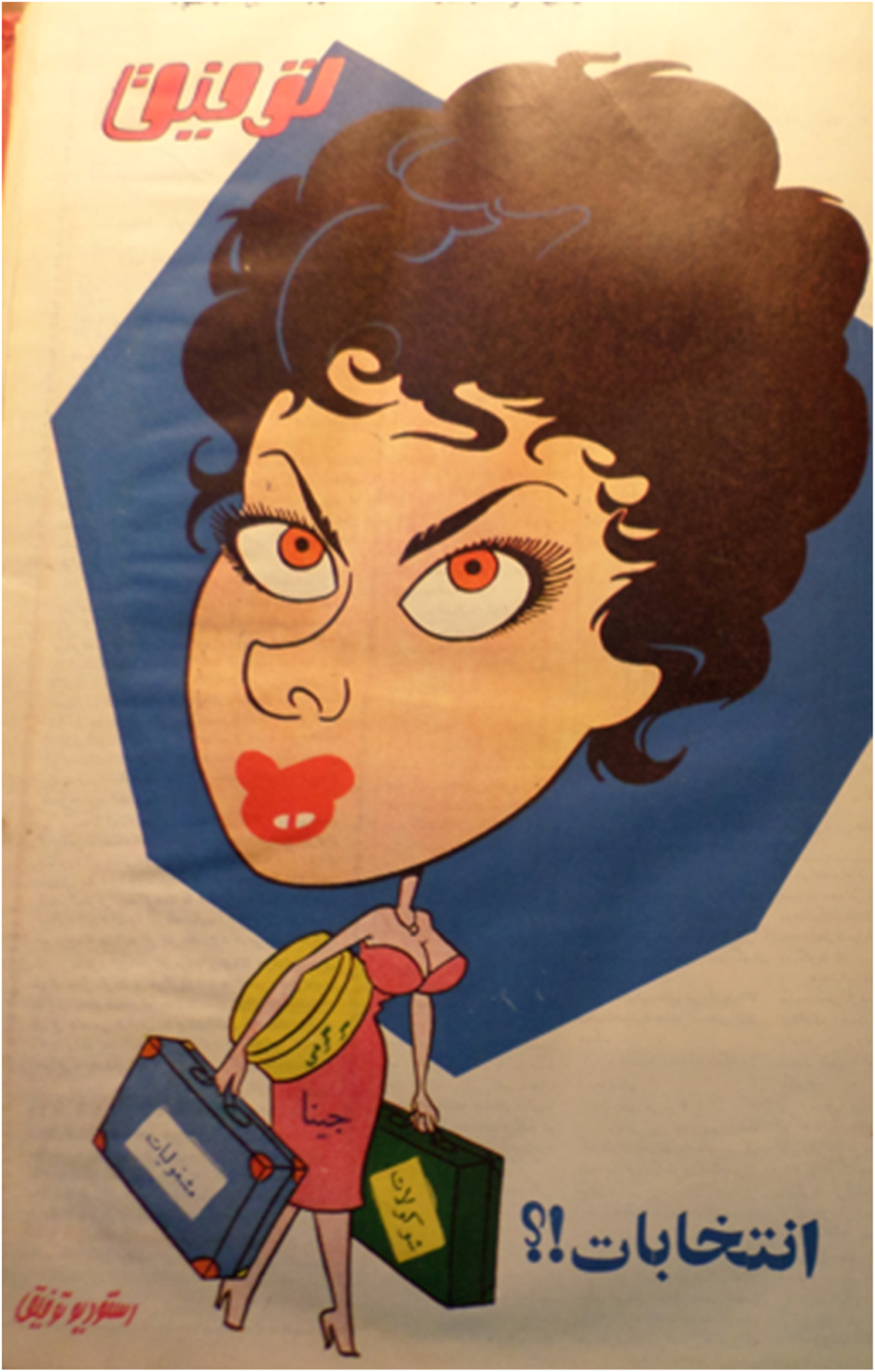
Tawfiq was a prominent outlet of critique of the monarchy from 1922 to 1971. Thus, it offers a window into the way that the urban intelligentsia perceived women and gender roles under the Shah. To avoid censorship, many of the most pertinent messages were contained within multiple layers of meaning in cartoons. This is a common phenomenon in places where the expression of political dissent is disallowed.Footnote 60 A representative selection of images from the magazine is provided below. They relate to women and gender, specifically as gender roles were constructed along the rural/urban divide. Young urban women were hypersexualized, while the women performing work of a political nature, especially in public agencies, were shown as corrupt and self-serving like their male counterparts. Men's responses to these women's dress and behavior ranged from lecherous (e.g., Figure 1) to disdainful (e.g., Figure 2). On the other hand, the comparatively fewer instances of rural or traditional women represented in Tawfiq showed them to be pure, modest, humble, and working in service of their families (e.g., Figure 3).
From the special yearbook edition (Salnameh). This image of a woman undressing in front of her rapt boss implies that women are using their sexuality to their advantage in the workplace. The woman is saying to him, “I am going to get naked so you can see how thin I have become because of how little you are paying me.” It supports Shahidian's suggestion that there was a widespread belief that women could deceive and manipulate men.Footnote 64 It could also be a commentary on the new dynamics in the workplace as urban women were entering professional offices following the White Revolution. By this interpretation, this drawing exposes both the corruption of women's sexuality for reasons of employment and the tendency for male bosses to take advantage of them.
Salnameh-i Fukahi-i Tawfiq (Washington: United States Library of Congress, 1970).

This cartoon is set in a wealthy household, evident by the décor and especially the father's clothing. He asks his nearly naked daughter, who is talking on the phone and wearing high heels and a negligee in addition to very coiffed hair and thick make-up, why her breasts are so exposed. She asks him what is wrong with that, and says this is not Majles where she would have to cover herself. This is a commentary on the corrupted sexuality of the urban elite and supports the assertions made by Gerami, Moghissi, and others about the way the liberal Left viewed women and especially women's sexuality as a marker of the Pahlavi regime.Footnote 65 It is also an implicit critique of the bald-faced corruption of the Majles, which they do not even attempt to conceal.
Tawfiq, May 9, 1963.

In contrast with the previous two selections, this cartoon reflects the urban liberal perception of the poor, and especially of poor women. In this cartoon, the husband is stretching outside and saying, “Before air becomes expensive, too, let us breathe deeply!” The wife is wearing a head covering, is dressed modestly and wearing slippers, and is attending to their young daughter. With a content smile on her face, she seems to represent the ideal woman and mother, unconcerned with material trappings or her own sexuality. Though it is possible that this family is supposed to represent the urban poor, because there are no buildings or other homes shown and an outhouse and cobbled ground included in the drawing, it is more likely that this is meant to represent the rural poor.
Tawfiq, May 9, 1963.

Figures 2 and 3 offer a glimpse into the social norms surrounding the difference between “authentic” rural Iranian women and “Westoxified” urban women. In Figure 2, the stereotypical Westernized and wealthy urban woman is depicted with hypersexualized body and dress, and the dialogue between her and her father suggest that she is unconcerned with the way that her appearance influences others in her environment. The implication here is that she should be concerned; that she is not seems to reflect the corruption of this class of women. By contrast, the woman in Figure 3 is dressed modestly, with her hair covered, and tending to her child rather than herself. The woman in Figure 3 is clearly meant to represent women of rural or traditional origin. Rather than depicting such women as backward, or with dismissal, Tawfiq – and, more broadly, the urban liberals whose voice the publication represented – treated them either as victims of social and economic violence or as wholesome repositories of Iranian identity.
The stark contrast between depictions of women of rural origin and urban women suggests a certain degree of agreement between the secular opposition and the conservative or religious right in Iran during that period. Both sides elevated women's expression of sexuality as the primary factor by which their character or social value could be determined. Though Tawfiq's creators and audience largely identified as liberal, the linking of urban women to hypersexual behavior (e.g., Figures 4 and 2) and of traditional women to modesty (e.g., Figure 3) was consistent with the views of the New Clergy. Thus, Tawfiq serves as a representative case of how deeply the secular opposition and the conservative faction aligned on issues of women and gender in Iran, ultimately weakening the secular opposition and strengthening the populism of the New Clergy in the years after the revolution.
This woman represents the liberal, urban woman based on her clothing, hair, make-up, and name (in this case “Gina” is written on her dress, a Western name during a time that Gina Lollobrigida was very popular in Iran). The text reads “Elections?!” The Farsi word for “elections” (entekhābāt) can also mean “choices.” She is carrying luggage on which “chocolate,” “entertainment,” and “things to keep busy” are written. She looks agitated at being asked to engage politically via voting, which was a recent development in Iran when this was published in 1964. The implication in this cartoon is that the liberal, urban woman is uninterested in serious matters and more concerned with trivialities even though the right to vote was just opened to her via the White Revolution. The “choices” she is “electing” to make are related to consumption of material goods.
Tawfiq, May 16, 1963.
Conclusion
The Shah and his supporters drew upon notions of ancient Iranian identities to explain the reasons that Iranian society must be modernized. In hearkening back to pre-Islamic Iran to promote European dress and social mores, the Shah attempted to link Iran to Europe and the West more generally to argue that the “real” Iranian identity was not Islamic in nature, but Western, and a return to pre-Islamic Iranianness was not alienation but “a return to the true self.”Footnote 61 In doing so, he was able to support his modernization project by simultaneously connecting Iran to Europe and also differentiating it from most of its neighbors.Footnote 62 This process also tended to marginalize large segments of Iranian society that were committed to their religious, Islamic identity.
Interestingly, there was a similar line of reasoning from parts of the secular opposition during the same period. On the one hand, public intellectuals like Ali Shariʿati and Jalal Al-e Ahmad who existed in a grey area between the Left and the clergy were denouncing the Shah and Westoxification and calling upon Iranians to revive ancient Islamic figures like Fatemeh, and on the other hand, many Marxists publicly rejected Islamic codes of conduct and standards in law, education, and labor. There was a considerable degree of disagreement between different factions of the secular opposition and other forces positioned against the Shah, but there was an interesting consensus with regard to the corrupt influence of the Westoxified urban woman.Footnote 63 This was reflected in popular images, e.g., those found in Tawfiq in the 1960s, as well as in statements made by prominent members of the clergy like Rafsanjani. The Shah and the New Clergy shared a belief that women's status and roles reflected the character of the nation, and therefore focused on them to support their respective nation-building projects. The commonalities shared by key Leftist groups and the New Clergy did not, as the Left had hoped, contribute to a more democratic politics based on anti-imperialist unity. Instead it allowed the New Clergy to co-opt and coerce movements and groups that challenged it.
Via the reforms and initiatives of the White Revolution, the Shah attempted to manipulate women's role in the social reproduction of labor, and to build the nation-state by employing and manipulating the symbolic meaning of women's bodies, sexuality, and social roles. His approach was to Westernize and “modernize” social and economic relations in order to achieve this objective. Liberals and Leftists as a whole failed to adequately address or transform the underlying regressive social and cultural practices that were at best nominally targeted by the Shah, while the New Clergy tapped into popular resentment about forced Westernization and exploited the wide degree of similarity across disparate political ideologies and groups with respect to women, sexuality, and gender roles in order to successfully co-opt Leftist principles in service of right-wing religious populism.
In addition, the rapid urbanization that Iran experienced in the decades prior to 1979 was essential to the success of the New Clergy in taking power because it allowed them to tap into tensions that were simmering in the cities, particularly Tehran, concerning women's sexuality, independence, gender roles, and class differences. In their opposition to the Shah and their support for what they perceived to be modern gender relations, the secular opposition provided a powerful affective cultural heuristic via Tawfiq for the New Clergy through the exploitation of women's sexuality to demonstrate their political and normative commitments. Consequently, the New Clergy's purposeful integration of women and gender in their construction of an Islamic Republic state helped them achieve and maintain power in the post-revolutionary struggles that marked the early 1980s. Caught between a rock and a hard place, in the absence of a cohesive feminist movement in the Pahlavi era, women were forced to choose to align with either a secular opposition that relied on their sexual objectification and alienation or a theocratic class relying on religious edicts to restrict their education, employment, appearance, and behavior in public spaces. Consequently, women were unable to pursue a political program that would advance their collective emancipation. The secular opposition to monarchic and theocratic factions of Iranian society failed to represent the interests of women, thus bolstering the New Clergy's ability to co-opt core cultural narratives, strengthening them against their rivals at a critical moment in the political upheavals of the 1970s.


 Open access

