




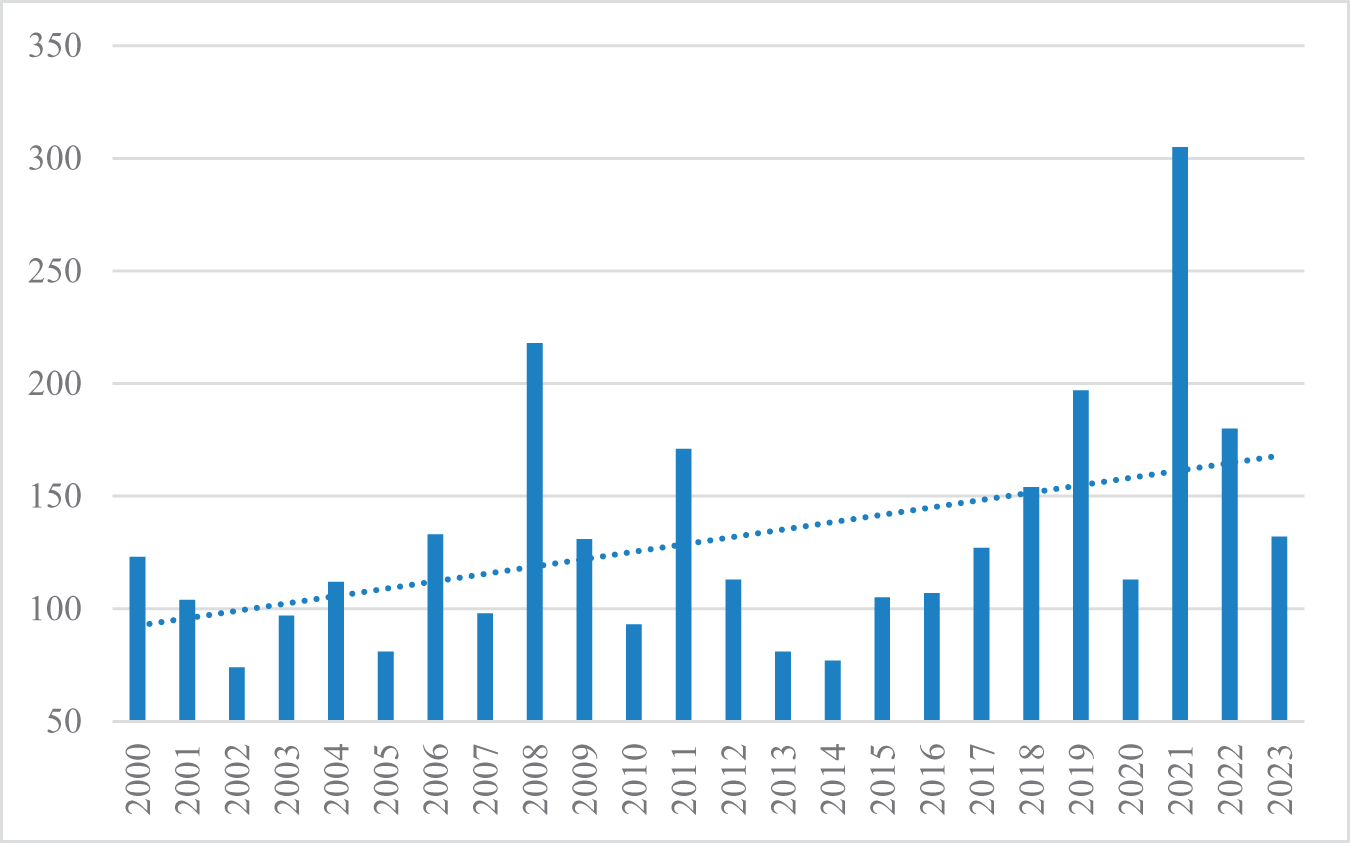
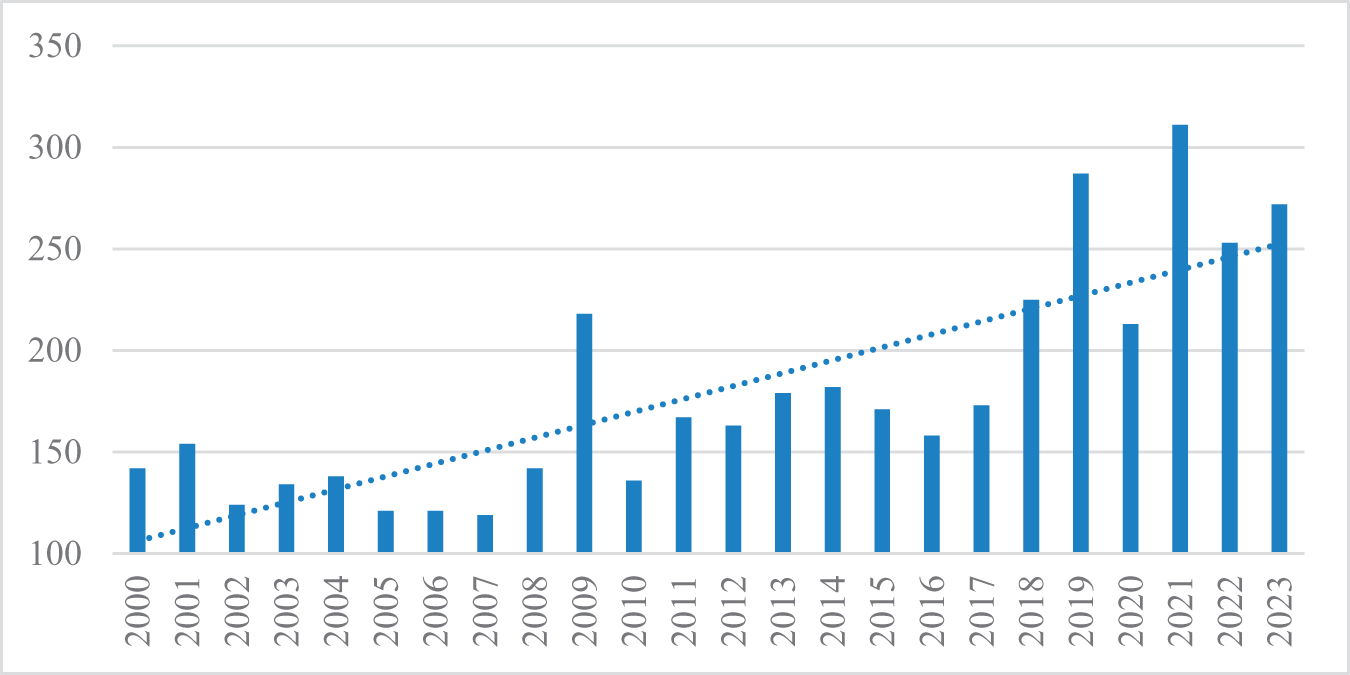
The notion of “self-reliance” (zili gengsheng 自力更生) is seemingly everywhere in China today, and is mirrored by growing global references to self-reliance among advanced, industrialized and developing countries alike.Footnote 1 In the Xi Jinping 习近平 era, self-reliance has become a trope in advocating “independent innovation” and the mastery of science and technology to achieve “Chinese-style modernization” and has been matched by growing numbers of Chinese-language academic articles on the theme (see Figures 1 and 2).Footnote 2 Increasing Chinese references to self-reliance have triggered concern among Western observers, who interpret them as China’s rejection of globalization and a return to the insular economic policies of the Mao Zedong 毛泽东 era.Footnote 3 Such concerns originate from two persistent assumptions about the idea of self-reliance: first, that self-reliance means self-sufficiency, autarky or isolation from the global economic system;Footnote 4 and second, that self-reliance is an idea that emerged in China during the Mao era but was then abandoned or fundamentally altered by China’s reform-era leaders.Footnote 5
Articles Referencing “Self-reliance” in the Main Text, 2000–2023

Figure 1 Long description
The bar graph displays annual data from the year 2000 to 2023. The x-axis is labeled with years ranging from 2000 to 2023, while the y-axis represents numerical values from 50 to 350. Each bar corresponds to a specific year, showing fluctuations in data values. A dotted trend line runs through the graph, indicating an overall upward trend over the years. Notable peaks are visible in 2008, 2020 and 2021, with the highest value in 2020. The graph illustrates variations in data across the years, with a general increase over time.
Academic Articles Referencing “Self-reliance” in their Titles, Keywords or Abstracts, 2000–2023

Figure 2 Long description
The graph shows a series of vertical bars representing data from the year 2000 to 2023. Each bar corresponds to a specific year, with the height indicating the value for that year. The x-axis is labeled with years from 2000 to 2023 and the y-axis ranges from 100 to 350. A dotted trend line runs through the bars, illustrating an overall upward trend over the years. Notable peaks are visible in 2009, 2019 and 2021, with the highest value in 2021. The graph suggests a general increase in values over the period shown.
In this article, we challenge both of these assumptions, showing instead that China’s idea of self-reliance has always accommodated global economic interdependence. Moreover, we demonstrate that the notion of self-reliance has persisted in China for nearly a century, originating in the Republican-era discourse of both the Kuomintang (KMT) and the Chinese Communist Party (CCP), and enduring profound changes in China’s political, economic and strategic circumstances since the 1930s. By recovering self-reliance from its association only with Mao and the CCP, and by elucidating the long-standing place of economic interdependence in China’s ideas of self-reliance, we join a growing body of scholarship dismantling the notion of neat ruptures in studies of the Chinese economy. Instead, this scholarship is beginning to emphasize the continuities in China’s participation in the capitalist half of the global economy during the Mao era as well as the role of the party-state in controlling the degree of economic opening that occurred under Deng Xiaoping 邓小平.Footnote 6 Building on these perspectives, we extend the notion of continuity in two ways: first, by highlighting the connections between the KMT and CCP ideas of self-reliance across the 1949 divide, and second, by demonstrating how the Xi Jinping government deploys older KMT and CCP understandings of self-reliance today.
As historians and political economists have argued, self-reliance is better characterized as a “spectrum,” an “attitude of mind” or a “disposition,” rather than as a rigid or specific policy blueprint. These characteristics have allowed the Chinese leadership to “indiscriminately [use] the term … to describe a variety of different policies from virtual autarky to the importing of a wide range of agricultural products and industrial plants.”Footnote 7 Whereas much of this literature has focused on the domestic and external factors that have driven the variations in China’s “self-reliant” economic policies,Footnote 8 this article instead explores how the internal content and structure of the notion have facilitated its profound endurance over time.
Drawing on the International Political Economy (IPE) literature’s concept of “ideational resilience,” we demonstrate that since the 1930s, Chinese discourse on self-reliance has comprised three elements, which we label “autonomy,” “interdependence” and “order-shaping.” Autonomy, which is a state’s capacity to formulate and implement policies without undue external constraints, is the central goal of self-reliance and captures the notion that China must retain its independence in a world shaped by more powerful, and frequently exploitative, foreign actors. Yet to achieve that autonomy, Chinese ideas of self-reliance have always embraced a second, contradictory element – interdependence – engaging in economic, technological and other cooperative interstate exchanges that would be costly to forego.Footnote 9 While autonomy and interdependence are typically posited as opposing concepts,Footnote 10 Chinese leaders have always tolerated this inherent tension in their conception of self-reliance. Doing so has enabled them to acknowledge a challenge common to all states, and particularly to late-industrializing, post-colonial states such as China: how to retain autonomy while absorbing the economic benefits of an interdependent global economy.Footnote 11 Tolerating the autonomy–interdependence tension has also offered Chinese leaders a way to maintain consistency in political discourse even while pursuing seemingly contradictory policy solutions. This has been an important feature in one-party China, allowing leaders since Mao to make change without criticizing their predecessors and to legitimize their inheritance of the Party’s core values.
Beyond autonomy and interdependence, we show that the idea of self-reliance contains a crucial third element, order-shaping, which has been overlooked in the existing literature to date. At key junctures since the 1930s, international conditions have made the autonomy–interdependence tension too much to bear. At these moments, Chinese leaders have attempted to forge new internationally shared ideas and practices – in other words, a change in the order – governing economic relations between states.Footnote 12 Offering ideas and associated practices centred on independence, sovereignty, equality and mutual benefit, Chinese leaders have sought to shape an order that might better accommodate the autonomy–interdependence tension by allowing states to participate in the global economy without undermining their autonomy.
In what follows, we first elaborate on the IPE concept of ideational resilience and then draw on archival and contemporary sources to trace the origins and evolution of self-reliance over three time periods. The first period (1930s–1960s) shows how the KMT and the CCP originally understood the idea of self-reliance in a wartime (Second World War and militarized early Cold War) context, demonstrating how three core elements, autonomy, interdependence and order-shaping, were common to both parties’ understanding and usage of the idea. The second and third periods show how reform-era leaders (1970s–2012) and Xi Jinping (2012–present) adapted and re-interpreted the idea of self-reliance while maintaining its three core elements.Footnote 13 Throughout, we pay attention to how leaders articulated the relationship between autonomy and interdependence, and the conditions under which they sought to accommodate the autonomy–interdependence tension via order-shaping. While the order-shaping strategies of the KMT and Mao-era achieved only limited success, the Xi government’s efforts have had a far more profound – and somewhat unintended – impact on the international economic order.
Ideational Resilience
The concept of ideational resilience was developed by discursive institutionalist IPE scholars studying the continuity of neoliberal ideas across space and time. Defining ideational resilience as an idea’s “ability to endure, recur, or adapt over time; to predominate against rivals; and to survive despite [its] own many failures,” Vivien Schmidt and Mark Thatcher suggest that resilient ideas are those characterized by a high degree of generality, a lack of internal coherence and a degree of conceptual “fuzziness” or malleability.Footnote 14 These characteristics enable an idea’s core elements to be open to diverse interpretations, to be applicable and adaptable to changing circumstances, and to provide policymakers with “a large menu” of possible policies that may legitimately be said to flow from the original idea.Footnote 15 Indeed, these aspects of an idea’s content and structure contribute to an idea’s resilience because they enable political actors to reinterpret an idea without having to criticize past leaders’ interpretations and/or to neutralize potential political attacks by incorporating competing ideas within their own.Footnote 16 Whereas previous IPE accounts tended to view ideas as static phenomena that remained fixed until exogenous shocks prompted rapid change,Footnote 17 the concept of ideational resilience responds to the growing academic stress on how the substantive content and structure of an idea can facilitate actors’ ability to flexibly interpret ideas, thereby initiating incremental change.Footnote 18
In practice, however, making claims to the resilience of an idea is a challenging endeavour. Ideas may mean very different things at different points in time, and simply pointing to a term’s usage across different eras risks reducing ideas to abstracted or empty slogans.Footnote 19 Moreover, studying ideas prompts perennial questions about whether an idea is deeply felt or is being used for cynically instrumental reasons. In line with discursive institutionalists and wider theorizing in the fields of international relations and political science, we view ideas as phenomena that work in both ways, simultaneously: ideas can be deployed by political actors for a range of instrumental purposes and can deeply constitute how political actors understand the world and diagnose and resolve policy challenges.Footnote 20
Studying resilient ideas, then, means examining how an idea was first defined and understood by those using it in a particular historical context and identifying the idea’s core elements. Next, it means tracing the idea’s usage in other times or places, determining whether those core elements remain intact and observing how the idea has been re-interpreted, adapted or fused with other ideas.Footnote 21 Finally, it means considering why the idea has been deployed in other times and places, including the instrumental reasons potentially motivating political actors’ use of the idea. As we argue below, the three core elements of autonomy, interdependence and order-shaping are precisely what have made self-reliance such a resilient idea in China. The acceptance of an internal contradiction between the first two of these elements has allowed Chinese leaders to adjust policies while retaining the discourse of self-reliance, thereby avoiding the impossible political cost, in a one-party state, of criticizing or publicly overturning the policies of previous leaders. Yet, when external conditions have made it too difficult to tolerate that contradiction, self-reliance has given Chinese leaders the discursive tools needed to shape an international order in which economic interdependence might enhance, rather than undermine, nation-states’ autonomy.
The origins of self-reliance under the KMT and CCP (1930s–1960s)
The idea of self-reliance began to be articulated in China in the 1930s and 40s when, despite differences in aspects of their political ideologies, China’s Communist and Nationalist leaders converged on a central observation: in an age in which foreign imperial powers had steadily expanded their extraterritorial rights and privileges across China, China must strive to rid itself of foreign control or dependency, particularly in its economic affairs.Footnote 22 This central observation was itself an idea that leaders across the Chinese political spectrum had absorbed from the 19th-century “Self-strengthening” reformers who had identified China’s low levels of economic development, and particularly its lack of industrial and technological modernity compared with Western powers, as the source of China’s vulnerability to foreign imperialism.Footnote 23 Without industrial and technological development, China could not regain its political independence as a sovereign nation.
The first, and most important, element of self-reliance was, therefore, autonomy, or the notion that China must “keep the initiative in one’s own hands.”Footnote 24 Indeed, autonomy is captured in the literal translation of the Chinese term for self-reliance, zili gengsheng 自力更生, which is typically rendered as “revival through one’s own efforts.”Footnote 25 The CCP first articulated the idea of self-reliance in December 1935 in the remote village of Wayaobu, Yan’an 瓦窑堡 延安, after being driven there by the KMT following years of civil war. Simultaneously confronting the Japanese army’s growing encroachment into northern China, CCP leader Mao Zedong declared that China had “the determination to recover lost territory through self-reliance, and the ability to stand independently among the nations of the world.”Footnote 26 But with the KMT imposing an economic blockade on Yan’an throughout 1936, the CCP had little choice but to rely on its own efforts to produce the food and other items needed to survive.Footnote 27 The early 1930s also saw a growing Nationalist concern regarding China’s dependency on the export markets, manufactured goods and raw materials controlled by foreign imperial powers in China. Although they initially used the term “self-sufficiency” (zizu 自足) rather than self-reliance, economist Chen Gongbo 陈公博 and senior Nationalist leader Wang Jingwei 汪精卫 argued in 1933–1934 that autarky and “economic control” were the path to autonomy for China. Working in uneasy coalition with Nationalist military leader Chiang Kai-shek 蒋介石, they instituted economic reforms that elevated the role of China’s rural economy over foreign markets.Footnote 28
However, from the very outset, Chinese actors across the political spectrum also understood self-reliance in terms of a second core element: it could not be achieved without economic interdependence with foreign powers. For the Nationalists, interdependence was a way to access the goods and capital that China could not (yet) produce itself, and to overcome over-dependence on any single country. Despite the avowed goal of self-sufficiency, the Nationalist ambassador to the United States, Alfred Sao-ke Sze 施肇基, acknowledged that “China still needs, and will welcome, expert advice from abroad and the investment of foreign capital in her enterprises.”Footnote 29 Beginning in the early 1930s, the Nationalist government began cultivating a wider array of economic partners, including the United States and Britain, in a bid to reduce its growing economic dependency on Imperial Japan.Footnote 30 Similarly, in 1935, Mao made clear that self-reliance and “stand[ing] independently” “does not mean that we can do without international assistance.”Footnote 31 Initially, this meant economic (and military) assistance from the Soviet Union, but as conflict with Japan escalated into a full-scale war in 1937, Mao’s notion of possible economic partners widened. War with Japan prompted the KMT and the CCP to join forces in a United Front against the Japanese, with the KMT agreeing not only to end its blockade but also to pay the CCP a monthly stipend, which it used to import food, warm clothing and war materiel from British-controlled Hong Kong.Footnote 32 This wartime partnership, and the economic flows it generated, was critical in cultivating the CCP’s earliest recognition of the contradictory impulses between autonomy and interdependence, with Mao explaining in 1937 that “to defeat the Japanese aggressors [we should] rely mainly on our own strength” but China should also “struggle for sympathy from England, the United States, and France for our anti-Japanese [resistance] … under conditions that do not forfeit China’s territorial integrity or sovereign rights.”Footnote 33
The KMT and CCP tolerance of the tension between autonomy and interdependence was, however, challenged by an increasingly globalized Second World War, partial post-war settlement and the onset of the militarized Cold War in Asia. Yet rather than seeing this tension as unresolvable, both parties began to deploy ideas of self-reliance in striving to shape an international economic order conducive to the simultaneous pursuit of autonomy and interdependence. The KMT order-shaping efforts commenced in the late stages of the Second World War, when the government began working with the Allied powers at Bretton Woods to craft new international institutions that could, in its view, “rehabilitat[e]” the economies of member nations, and “contribut[e] to the sound recovery and growth of international trade.”Footnote 34 On 26 July, four days after the 1944 Bretton Woods conference, the lead editorial in the Nationalists’ party newspaper, Zhongyang ribao 中央日报, celebrated and pledged China’s support for the soon-to-be established International Monetary Fund (IMF) and International Bank for Reconstruction and Development (IBRD).Footnote 35 Yet the editorial also warned that: “we have to keep in mind that economic self-reliance (jingji de zili gengsheng 经济的自力更生) is the precondition for international economic cooperation. Without self-reliance, we have no means of accepting international investment, let alone developing international trade.”Footnote 36
A decade on from Wang Jingwei and Chen Gongbo’s discussions on self-sufficiency, the KMT’s first usage of the term self-reliance reflected a China and a world that had both changed. Having split with Wang and Chen over the response to Japan’s invasion of China, Chiang Kai-shek was determined that his government would remake China and its place in the world.Footnote 37 To do so, the editorial argued, would require the pursuit of both autonomy and interdependence, via a combination of domestic “thrift” and “hard work,” so that “idle capital” could be mobilized in service of industrial development; an increase in the “quantity and quality” of exports “so that we can earn enough foreign exchange to import agricultural and industrial equipment”; and a change in the character of the international economic order itself.Footnote 38 The editorial described how the international economic cooperation envisaged in the post-war period would be based on “mutual respect for sovereignty” (rather than empire) and underpinned by new institutions, such as the IMF and IBRD, which the Chinese delegation “had spared no effort” in helping to shape.Footnote 39 Having helped to facilitate this major transition from empire to post-Second World War sovereign order, the KMT expressed confidence that China could use international economic cooperation to “stabilize its currency, exploit its resources and enlarge its trade” while simultanously “emphasiz[ing] the principle of self-reliance.”Footnote 40
The CCP’s pursuit of self-reliance via the contradictory elements of autonomy and interdependence came to a head in the early 1950s, following its defeat of the KMT and its establishment of the Soviet-aligned People’s Republic of China (PRC). Although it publicly distinguished its policies of self-reliance from the KMT’s “reliance on foreigners,”Footnote 41 the CCP had already initiated trade between the Communist-controlled north-east China and the Soviet Union and Japan during the Chinese Civil War (1946–1949).Footnote 42 By 1949, the CCP’s early planning documents made clear that the Party viewed economic cooperation – not only with the Soviet bloc but also with the capitalist world – as vital for the “accumulation of productive capital,” expertise and technology necessary for industrialization.Footnote 43 Foreign firms held too much power in the Chinese economy, and the import of “luxuries” or goods that might be produced domestically should be “banned,” the Party argued; however, this did not mean abandoning the global economy altogether. Instead, China should pursue a “self-reliant” foreign trade policy by “encouraging exports and limiting imports” and strengthening state control over “all foreign trade operations.”Footnote 44
However, the changing international conditions eroded the CCP’s early tolerance of this autonomy–interdependence tension. The CCP had shared the Nationalists’ vision of a post-Second World War order in which China might join the world’s leading nations in shaping that order’s governing institutions and practices. But its 1949–1950 decisions to align with the Soviet Union and to enter the Korean War resulted in a definitive US-led strategy to exclude China from that order for the next two decades.Footnote 45 The US and its allies introduced strict controls on trade with China so that the 70 per cent of China’s trade that had taken place with the capitalist world was re-oriented towards the Soviet bloc by 1952.Footnote 46 The Korean War also sharpened CCP thinking about the industrial and technological basis of China’s long-term autonomy. Although aware of the potential for economic exploitation by its Soviet “elder brother,” the CCP leadership recognized that China could not achieve long-term autonomy without first deepening interdependence with Moscow. In 1951–1952, the CCP began negotiating new loans from the Soviet Union to finance the purchase of military equipment. It also drafted an industrial development strategy, the First Five-Year Plan (1953–1957), which relied heavily on Soviet ideas, technical assistance, investment and industrial technology.Footnote 47 But by 1956, growing concerns about over-dependence on Moscow made the CCP look towards Japan, Europe and Hong Kong for diverse sources of industrial goods, expertise and capital.Footnote 48 Premier Zhou Enlai 周恩来 explained in 1962 that such economic interdependence was vital for Chinese autonomy: “China is emphasizing the approach of self-reliance, but this certainly does not mean that we have to produce everything ourselves to achieve self-reliance. In order to increase the speed [of development] we ought to buy what we need.”Footnote 49
Within a decade, these regions had surpassed the Soviet Union as China’s leading trade partners. More importantly, they had become major alternative sources of the advanced industrial and agricultural technologies, expertise and capital that, as Zhou maintained when introducing his Four Modernizations policy in 1964, would be vital in turning China into a “powerful socialist country with modern agriculture, modern industry, modern national defence and modern science and technology.”Footnote 50
However, increasing interdependence with capitalist countries simultaneously threatened to undermine China’s autonomy, as it required participation in an international economic order that was all but closed to China. It was also characterized by what the CCP saw as the exploitative ideas and practices of the US-led “imperialist” world. Beginning in the early 1950s, therefore, the CCP embarked on an international order-shaping strategy to forge new ideas and practices that might accommodate the autonomy–interdependence tension. At the 1952 International Economic Conference in Moscow, which was attended by countries from both sides of the Cold War divide, the Chinese delegation criticized the “abnormal” economic relations and “artificial obstacles” to world trade caused by the US-led trade embargo. To create more “normal” international trade relations, Nan Hanchen 南汉宸, who was then the president of the People’s Bank of China and head of China’s delegation, made clear that China was willing to develop trade relations with “any country in the world,” “as long as it is on an equal, reciprocal basis.” Equality and reciprocity, Nan argued, would ensure that countries of different political and social systems could pursue economic interdependence while still respecting one another’s “political independence” and “trade autonomy.”Footnote 51 At the conference, the Chinese delegation advocated for a “permanent agency … to effectively promote the development of international economic relations.”Footnote 52 This idea culminated in the creation of an International Trade Promotion Committee and corresponding national committees; China’s own Committee for the Promotion of International Trade then negotiated millions of dollars in trade with Japan, Britain and other capitalist countries throughout the 1950s and 60s.Footnote 53
Beyond “equality and mutual benefit,” the CCP also advocated self-reliance and denser economic ties within Asia and Africa as a way to foster an international order more conducive to the mutual pursuit of autonomy and interdependence. Starting with the Bandung Conference in 1955 and continuing at gatherings with Asian and African countries throughout the 1960s, the CCP identified regional economic cooperation as a way to overcome the “economic backwardness” that had enabled the “plunder and oppression” of these countries by colonial powers.Footnote 54 As Nan Hanchen explained in June 1964: “Such economic cooperation should be on an equal and reciprocal basis, with no conditions or privileges attached and conducive to the national independence and healthy development of the national economy of each country. Self-reliance and this kind of economic cooperation are mutually reinforcing rather than mutually exclusive.”Footnote 55
The Chinese premier, Zhou Enlai, further urged Bandung participants to establish long-term procurement and supply agreements among themselves to overcome the “suppression and manipulation” of global commodity prices by more powerful countries, and to develop intra-regional trade fairs and the exchange of industrial and technological expertise.Footnote 56 Regional uptake of these initiatives was constrained by post-colonial and Cold War allegiances, and China’s own economic openness was disrupted during the Great Leap Forward and Cultural Revolution.Footnote 57 Nevertheless, by the mid-1960s, the majority of China’s trade was taking place with the non-communist parts of Asia, Africa, Europe, Latin America and Oceania, and the CCP continued its discursive efforts to craft an order premised on more “equitable” and “mutually beneficial” economic relations between states.
Resilience of self-reliance during the reform era (1970s–2012)
Following Mao’s death in 1976, Hua Guofeng 华国锋 and Deng Xiaoping redoubled the Party’s earlier efforts to expand trade and welcome foreign industrial technology and expertise to China, and began accepting commercial loans and foreign capital to finance industrial development projects. In December 1978, the CCP embarked on a programme of reform and opening up by decentralizing economic decision making and permitting foreign firms to operate and invest in China.Footnote 58 These reforms catapulted China’s economic interdependence to an unprecedented level and thus, by definition, the cost of severing these economic ties, particularly for Chinese individuals and private firms who were now permitted to benefit from global trade. Between 1977 and 1997, external trade rose from US$14.8 billion to US$325.16 billion (a compounded annual growth rate of 16.76 per cent), the number of FDI projects in China increased from 638 (in 1983) to 21,001, and per capita GDP rose from 345 yuan to 6,522 yuan.Footnote 59
The reform era marked a departure from the economic policy crafted under Mao, but it did not entail an abandonment of the idea of self-reliance. Instead, the three sometimes contradictory elements facilitated the idea’s adaptation and resilience. Rather than having to abandon self-reliance, as understood narrowly as autonomy, in favour of interdependence, reform-era leaders instead followed the approach taken by the KMT and Mao-era CCP by explaining how self-reliance tolerated the coexistence of autonomy and interdependence. In 1977–1978, Hua’s reports about the new economic issues facing China linked self-reliance “to the need to import foreign technology” and praised countries like Romania, Yugoslavia and Iran for the way in which they “accepted foreign currency, had joint ventures with foreign companies … and brought in foreign technology – all without any loss of sovereignty.”Footnote 60 Similarly, in September 1978, leading finance official, Li Xiannian 李先念, explained to the National Planning Conference that expanding Chinese exports to finance the import of advanced foreign technology would enable China to achieve self-reliance, so long as China avoided importing goods and technologies that it could already produce itself. As Li concluded, “[s]elf-reliance does not mean shutting ourselves behind closed doors and turning a blind eye to advancements in foreign countries.”Footnote 61 Such language echoed the ideas articulated by these “bureaucratic Stalinists” since the early Mao era,Footnote 62 but they also recalled the earlier KMT views that self-reliant trade could enable access to industrial equipment and technology.Footnote 63 Hua and Li’s view was reinforced by Deng in 1984 when he explained that, “on the foundation of upholding self-reliance,” China should be “open to the outside world, welcoming foreign investments and technology to aid in its development.”Footnote 64
The malleability of self-reliance further contributed to the idea’s resilience as it enabled reform-era leaders to pursue significant policy change without paying the political costs of discrediting the Party’s formidable former leader. Hua and Deng recognized the critical importance, both to their own political futures and the Party’s standing, of venerating Mao, even as they moved China away from Mao’s radical programmes.Footnote 65 Deploying the idea of self-reliance enabled Deng, in particular, to deftly project himself as a staunch defender of Mao’s legacy, while reinterpreting Mao’s ideas in light of the contemporary facts. Early in the process of reform and opening up, Deng explained that, “while we are implementing an open-door policy on the one hand, on the other hand, we still adhere to the principle of self-reliance as the main guideline, consistently advocated by Chairman Mao Zedong since the founding of the nation.”Footnote 66
Moreover, Deng treated self-reliance as a living concept, chiefly expressing the idea as China’s ability to independently formulate its own development trajectory.Footnote 67 At the Party’s 12th National Congress in 1982, Deng stated that “China’s affairs should be run according to China’s specific conditions and by the Chinese people themselves.” Only by following such a path, he continued, could China commit to “independence and self-reliance,” which “have always and will always be China’s basic stand.”Footnote 68
Yet while the concept of self-reliance was malleable, and its contradictory core elements facilitated policy adaptation during the reform era, it was not endlessly mutable, nor was it merely ideological packaging for policies pursued for pragmatic reasons.Footnote 69 Even as China deepened its interdependence, the autonomy element of self-reliance enabled reform-era leaders to mitigate the costs of interdependence. Hua and Deng’s enthusiasm for a “New Great Leap Forward” in imported industrial plants and technology in the late 1970s was tempered by some reluctance to finance these imports through large-scale foreign-owned debt.Footnote 70 In 1977, Deng highlighted the risk of dependence posed by foreign debt, explaining that “we commit to the principle of self-reliance and mainly rely on our own savings. We do not want to take on a lot of debt.”Footnote 71 Initially setting aside his caution, Deng had called for a significant expansion of Hua’s import programme. However, by 1979, Deng was persuaded by the CCP’s most authoritative economic voice, Chen Yun 陈云, that mimicking other countries’ levels of large-scale foreign debt would be to neglect China’s “actual situation” and economic reality.Footnote 72 To retain its autonomy, Deng’s government chose to borrow medium- and long-term credits rather than short-term ones, which allowed greater control over economic planning, and maintained a conservative debt service ratio of 10 per cent of export earnings.Footnote 73 Similarly, in the mid-1980s, as overheating in China’s foreign exchange accounts sparked a rapid rise in imports, concerns for autonomy within the Deng government echoed earlier efforts by both the KMT and CCP to strictly regulate imports relative to exports, and to ensure that imports did not crowd out domestic production. In 1986, the vice-premier, Li Peng 李鹏, argued that “China should rely mainly on its own products to push ahead with the modernization drive instead of importing large amounts of foreign equipment.”Footnote 74 To do so, China tightened control over imports by restricting access to foreign currencies, limiting the ability of certain cities to sign investment deals with foreign companies, and retaining strict upper limits on the scale of trade and investment projects that could be negotiated by local governments.Footnote 75 The autonomy-inflected pursuit of interdependence was maintained in the 1990s and early 2000s as Deng’s successors, Jiang Zemin 江泽民 and Hu Jintao 胡锦涛, emphasized “opening up on the basis of self-reliance” by importing advanced technology and pursuing indigenous innovation; ensuring a balance between imports and exports; and prioritizing China’s accumulation of capital so that “we can buy time and accelerate the narrowing of the gap with developed countries.”Footnote 76
The third order-shaping element of self-reliance was notably absent during the reform era because China enjoyed international conditions in which the tension between autonomy and interdependence could be tolerated. As Deng explained in 1978, “during Comrade Mao Zedong’s lifetime, we also wanted to expand economic and technical exchange abroad … However, at that time conditions weren’t right and people blocked us … the current international situation is much better than that of the past.”Footnote 77
The international response to the Tiananmen Square incident in June 1989 briefly threatened to upend China’s simultaneous pursuit of autonomy and interdependence when major Western states and Japan imposed strict economic sanctions on China and suspended bilateral aid and development loans.Footnote 78 However, the relaxation of most of these sanctions by 1991, and Deng’s adoption of a deliberately non-confrontational foreign policy in the wake of Tiananmen, dampened international resistance to economic interdependence with China.Footnote 79 In the 1990s and early 2000s, Jiang and Hu continued to integrate China into the extant international economic order and its key institutions, such as the World Trade Organization. This was not an order-shaping strategy but instead an effort to bring China into closer alignment with the order’s existing ideas and practices.Footnote 80 Doing so allowed these reform-era leaders to focus on China’s own economic development, and avoid “shifting its problems or contradictions onto other countries.”Footnote 81
Resilience of self-reliance under Xi (2012–present)
Like Deng, Xi Jinping has stressed Mao Zedong Thought as a continuing guiding principle for the Party while warning that the Party must “make the past serve the present and bring forth the new from the old.”Footnote 82 Self-reliance has thus enabled Xi to signal his status as bastion of the Party’s true spirit, while being sufficiently flexible to be adapted to meet new challenges, including a trade war with the United States and supply chain disruptions stemming from the COVID-19 pandemic. In a series of high-profile speeches during his first five-year term (2013–2017), Xi frequently argued that China must commit to self-reliance and “autonomous innovation” (zizhu chuangxin 自主创新), particularly in core technologies – information, biology, high-end equipment manufacturing and energy – which were now at the forefront of economic and military competitiveness.Footnote 83 Just as KMT and CCP officials in the 1930s and 1940s had associated China’s vulnerability to foreign colonialism with its low levels of industrial and technological development, so, too, did Xi argue that China’s “greatest hidden peril” was that its access to the core technologies of the 21st century continued to be “heavily dependent on foreign countries.”Footnote 84 To reduce China’s reliance upon foreign technology supply chains, Xi’s government introduced major industrial policy initiatives, such as the 2015 “Made in China 2025” programme.
The US Trump administration’s introduction of wide-ranging tariffs on the Chinese economy in 2018 prompted both an increase and adaptation in self-reliance discourse, as Xi’s government argued that China’s autonomy could be preserved by deepening interdependence with the non-Western world and by shifting the locus of global supply chains to China. In September 2018, during an inspection tour in Heilongjiang, Xi admitted that “it is becoming increasingly difficult to obtain advanced and key technologies in the world, and unilateralism and trade protectionism are on the rise, forcing China to take the road of self-reliance.”Footnote 85 In response, the Xi government introduced its “dual circulation” (shuangxunhuan 双循环) strategy in May 2020 to strengthen China’s domestic consumption and competitiveness and reduce China’s dependence on global supply chains for “strategic” goods, including food, energy and advanced technologies.Footnote 86 Rejecting the idea that dual circulation was about attempting to “do everything by itself,” the vice-premier, Liu He 刘鹤, one of the strategy’s leading architects, described dual circulation as a way to “accelerate self-reliance and self-strengthening in science and technology” domestically so that China could better “take the initiative” within the global economy.Footnote 87 As Xi further elaborated, this involves not only “conquering key core technologies” but also better “leveraging China’s super-sized domestic market to attract global resources and production factors” – the underpinnings of supply chains – to China.Footnote 88 Consistent with this rhetoric, the Xi government expanded its foreign trade to reach record-high levels of US$6.1 trillion in 2024, while simultaneously altering the pattern and asymmetry of that trade.Footnote 89 It has deepened digital trade, green tech cooperation and supply-chain integration with non-Western economies, particularly in South-East Asia, through the China–Association of Southeast Asian Nations (ASEAN) Digital Economy Partnership Initiative and negotiations to upgrade the ASEAN–China Free Trade Area, while simultaneously reducing its trade dependence on advanced industrialized economies.Footnote 90
Alongside dual circulation, Xi’s government has mirrored the Nationalists’ and Mao-era order-shaping strategies in response to its growing perception that the autonomy–interdependence tension of self-reliance has become harder to reconcile. To accommodate that tension, it has initiated ideas and practices that, it argues, will better enable states – like China but also the wider developing world – to participate in an interdependent global economy without undermining their autonomy. This is aptly demonstrated through the Belt and Road Initiative (BRI), which was launched in 2013 to deepen China’s “infrastructure, trade, financial and people-to-people connectivity” with the wide swathe of the world loosely defined as the Global South.Footnote 91 Xi has cited the BRI as a clear example of the mutual benefits available in an international economic order founded on self-reliance and “shared development”: the BRI helps to facilitate China’s self-reliant development by providing Chinese industries with new opportunities that can ensure China’s “permanent invincibility and perpetual initiative” in the global economy, while simultaneously offering resources and assistance to developing countries.Footnote 92 Likewise, through its 2017 Global Development Initiative (GDI) and wider discursive and financial support for development within UN institutions, the Xi government has championed China’s role as a “defender” of an international order based on “equality and mutual respect,” and “fair” and “equitable” access to technology, industrialization and inclusive development.Footnote 93 Most notably, Xi’s government is reshaping the US dollar-dominated international monetary order, which Chinese officials have viewed as vulnerable to the potentially turbulent economic conditions and sovereign interests of a handful of major international reserve currencies since the 2008 global financial crisis.Footnote 94 To diversify the monetary order and build an “independent” renminbi (RMB) cross-border payment system, China has used the BRI and networks such as the Shanghai Cooperation Organization (SCO) to promote the use of local currencies in trade settlements, advance bilateral currency swaps and strengthen non-Western monetary cooperation.Footnote 95 As of March 2023, the People’s Bank of China had signed bilateral currency swap agreements with monetary authorities in 40 countries and regions.Footnote 96
Beyond these order-shaping initiatives, Xi’s discourse on self-reliance has begun to shape the ideas and practices embedded in the very international economic order itself. In what is likely an unintended consequence given the deleterious economic impact on China, advanced industrialized countries have adopted China’s language of self-reliance when framing their own policy responses to China. At a press event marking the signing of the US CHIPS and Science Act into law in August 2022 – a law that authorizes around US$280 billion in funding to boost US high-tech research and manufacturing, and prohibits the export of advanced semiconductor technology to China – US House Speaker Nancy Pelosi outlined the United States’ ambition to be “more self-sufficient and reliant.” However, echoing China’s position, she also noted that the pursuit of self-reliance does not exclude interdependence, stating that “not that we don’t want to be respectful and exist in a global economy, but we cannot be reliant – just totally dependent.”Footnote 97 G7 nations have similarly incorporated the rhetoric of self-reliance into their strategies for “de-risking and diversifying” from “critical dependencies” on China, while avoiding “decoupling or turning inwards.”Footnote 98
Conclusion
“Self-reliance” has endured in Chinese political discourse since the 1930s, accommodating a wide range of policy realities, from the Nationalists’ attempts to strengthen China’s self-sufficiency, to the Mao-era’s state-controlled foreign trade, the reform era’s opening to foreign investment and technology, and Xi’s pursuit of “autonomous innovation.” Our findings call into question the still-prevalent tendency to categorize China into discrete policy eras, dominated by the personalities and policies of Mao and Deng. Moreover, while it has become commonplace to equate China’s policies of self-reliance with autarky and isolation, we have shown that Chinese policymakers have always considered self-reliance to be consistent with varying degrees of trade, foreign investment and other forms of interdependence with the global economy. Such interdependence has enabled China to acquire the advanced industrial goods and technologies needed to achieve autonomy, while avoiding the perceived costs of overdependence on any single foreign power.
Building on the discursive institutionalist conceptualization of ideational resilience, we have shown that the elements of autonomy, interdependence and order-shaping have enabled Chinese political leaders to reinterpret the idea of self-reliance to fit changing circumstances, to accommodate the contradictions inherent within the idea, and to adjust national policies without criticizing previous generations of Chinese leaders. In doing so, the idea of self-reliance has served a function not dissimilar to the revival of Confucian and Marxist-Leninist ideas under Xi, “allowing for change – and at times quite radical change – to be explained as representing continuity rather than a fundamental rupture with the party’s (sometimes failed) past.”Footnote 99
And yet while we emphasize the mutability of the idea of self-reliance, and the ways in which its resilience – rather than its static continuity – has facilitated adaptation and strategic deployment over time, we do not suggest that self-reliance is merely an empty slogan used by Chinese leaders for purely instrumental purposes.Footnote 100 Consistently bounded by the three elements of autonomy, interdependence and order-shaping, the idea of self-reliance has helped Chinese leaders to navigate an enduring challenge since the arrival of Western powers in Asia in the 19th century: how to maintain autonomy and regain the initiative in an international economic order controlled by exploitative foreign powers or unpredictable market forces.Footnote 101 While the specific policy solutions to this challenge have changed over time, self-reliance’s consistent tolerance for, and order-shaping strategies to overcome, the tension between autonomy and interdependence have constrained the range of possible responses. In particular, it has led to a relatively persistent strategy of suppressing consumption in favour of thrift and trade surpluses in order to accumulate the foreign exchange reserves and capital needed for rapid industrialization and national strength.Footnote 102
In the wake of China’s dramatic economic opening to the world in the late 1970s, scholars asked how much China had been fundamentally altered by its economic integration with a liberal, capitalist international economic order. Pointing to the continuity of China’s self-reliant goals of indigenous innovation, state control over the economy and economic modernization as a path to strategic autonomy, they concluded that China and its motivating ideas had not been fundamentally changed.Footnote 103 A few decades on, and in light of our conceptualization of ideational resilience, we would answer this question somewhat differently. The evidence shown in this article suggests clearly that the internal contradiction between autonomy and interdependence continues to be tolerated, and that self-reliance continues to shape Chinese policy and practice. But our findings on the tripartite structure of self-reliance, and particularly its third order-shaping element, reveal another distinct implication of the resilience of this idea. Whereas earlier generations of scholars asked how, and to what extent, China was being altered by its economic integration with the outside world, our identification of the order-shaping element of self-reliance leads us instead to inquire how China might alter the international order through its ideas and practices of self-reliance.
From the Nationalists’ efforts to shape a post-Second World War order founded on sovereign equality rather than empire, to Mao-era efforts to build cross-Cold War trade based on “equality and mutual benefit,” to Xi Jinping’s efforts to reduce the centrality of the Western-dominated trade and financial order, the Chinese leadership has demonstrated optimistic, outwardly oriented and historically contingent efforts to shape the international economic order in ways that might allow China to pursue economic interdependence without undermining its autonomy. While China’s earlier order-shaping efforts were less successful at times, Xi’s China now has the capacity to shape the order in a decisive way. Indeed, beyond efforts to internationalize the RMB or to strengthen connectivity with the Global South, Xi’s China could shape the international economic order most powerfully by implementing the politically costly domestic reforms necessary to boost Chinese consumption and thus reverse a development model whose costs have been borne by deficit countries such as the United States.Footnote 104 In the absence of such reforms, China’s drive for self-reliance will continue to shape the counter-responses of the US, European Union, Japan and other major economies as they “derisk and diversify” away from China. In such a context, it is tempting to conclude that we are moving towards a more fragmented and de-globalized world. However, China’s persistent efforts to integrate self-reliance’s three elements of autonomy, interdependence and order-shaping suggest an alternative possibility: China and others could choose to alleviate the insecurities underlying their pursuit of self-reliance by reshaping, rather than abandoning, the international order itself. The challenge, then, is not simply to point to the revival of self-reliant discourse, but instead to consider how China and other major powers are defining and managing the relationships between the three elements of self-reliance, and how they reinterpret self-reliance as a means to achieve their ends.
Acknowledgements
For their thoughtful feedback on earlier drafts of this paper, the authors are grateful to Wesley Widmaier, Gail Hershatter, Xiaoyu Lu, Muyang Chen, Pete Millwood, Rosemary Foot, Reina Reilly and Bo Li, as well as the participants in seminars and conferences at the Australian National University, Peking University, Oxford University and the 2024 Association for Asian Studies Annual Conference, Seattle.This research was supported by research grants from the Australian Research Council (DE170101282; Grant Title “China’s economic ideas: from Bretton Woods to Bandung”); and the Westpac Scholars Trust (Westpac Research Fellowship 2017–2024).
Competing interests
None.
Amy KING is associate professor and head of the Strategic and Defence Studies Centre in the Coral Bell School of Asia-Pacific Affairs at the Australian National University. Her research focuses on international order, ideas in international relations and the nexus between economics and security, particularly in relation to China and Japan.
Wenting HE holds a PhD in international relations from the Australian National University. Her research focuses on economic ideas, economic crises, development finance and geo-economics, particularly in relation to China.

 Open access

